Blog Archives
Dancer in the Dark (2000) [Review Re-View]
 Originally released October 6, 2000:
Lars von Trier’s latest shaky video opus is likely the most unique movie going experience you’ll have all year. Dancer in the Dark is a clever, heartfelt, and achingly beautiful tale of sorrow and redemption. Dancer stars Iceland’s version of Madonna in the elfin Bjork. She plays Selma, quite possibly the nicest but also most stubborn person in the world. She’s an immigrant in 1960s America working long and odd hours to ensure that she can raise enough money for her son. You see Selma is slowly going blind but continuing to work so she can make sure her son will not have to suffer the same inherited illness. So she works late on heavy industrial machinery causing accidents as her condition worsens all to stop her son’s genetic curse she will give to him. Selma’s escape has always been musicals. In life she hears music in unusual places and visualizes life stopping to burst out into a vibrant fully choreographed musical number. Selma’s life continues to degenerate along with her vision as events pile on worse and worse until they all come crashing together.
Dancer in the Dark is no picnic in the park. The movie is haunting but incredibly depressing. Lars von Trier’s previous film (Breaking the Waves) was another wrenching drama with good people going through rough times with no fraction of light at any end of a tunnel. His jerky handheld video work is back capturing the life of Selma and seemingly framing it in a more realistic sense. The video images are edited to look like a documentary and the whole feel is one of raw power. You aren’t merely watching a film, it’s like you are in it witnessing the actions from the sidelines. The escapist musical numbers are shot in glorious still film to contrast the drab realism of video. The colors are bright, the faces are happy, and the cinematography is a wonder to envision.
 Bjork soars and delivers what should be an Oscar-caliber performance. I never knew the queen of alt-rock had such emotive powers. Selma’s innocence is keenly expressed in Bjork and her glassy eyes. Her love for her son is no more evident then all the suffering and tragedy she goes through. All of the suffering and tragedy could be avoided – except her son would not be helped.
The ensemble around Bjork work fantastic magic as well. Peter Stormare is a sad figure trying to just get a glimpse of Selma’s attention. David Morse is a down-and-out policeman who is Selma’s landlord and in need of some cash. He’s afraid to tell his bourgeois wife they’ve run empty with money. Catherine Deneuve turns in the brightest supporting performance as Selma’s co-worker and friend Kathy. She’s torn between trying to stop Selma from continuing on her acts that could cause her harm and helping her along her determination. A great scene as example of her care for Selma is when the two of them are in a theater watching an old Hollywood musical. At this point Selma is completely blind and can’t see what’s going on, so Kathy takes Selma’s palm and dances her fingers in correlation with the actions on screen to Selma’s delight. A simple scene yet so elegant and beautiful.
Dancer in the Dark is a wonderful piece of original film making that gives us the escape of hope and the crush of despair. Selma’s love of musicals and their role in life is perfect symbolism for discussion. Dancer will leave you with a distinct feeling by the end credits. Whether it’s sorrow or bewilderment Dancer in the Dark is a film not to miss.
Nate’s Grade: A
——————————————————
WRITER REFLECTIONS 20 YEARS LATER

I knew going back to my first Lars von Trier film was not going to be a pleasant experience, and oh what an understatement that turned out to be. von Trier has compared himself to a Nazi, his intense methods have driven his actors to the brink, including Dancer in the Dark’s Bjork who swore off the entire profession of acting after her experiences working with him. I am not surprised by this response because his movies have famously followed a formula of a woman being tortured by men, by society, by forces outsider her control, and then she suffers for two hours and dies, a victim of the cruelty of the universe. Repeat. It’s a formula that I’ve since grown weary of and after 2018’s The House That Jack Built I contemplated not watching another von Trier movie again. He just can’t help himself and his nihilistic, heavy-handed impulses handicap his genuine artistic abilities and the merits of his storytelling. Back in 2000, it all felt relatively new. von Trier was the biggest name of the Dogme 95 movement, a Danish collective of filmmakers who swore to adhere to digital video and other aesthetic rules to better replicate reality as it was, ripping away the glossy artifice of Hollywood fantasy. von Trier was subversive, provocative, and exciting, and since then I’ve broken free from the von Trier spell. I was questioning whether I would share Requiem for a Dream or Dancer in the Dark with my girlfriend, who had seen neither, and in hindsight I’m glad I picked Requiem instead (think about that, yikes).
Dancer in the Dark is a powerful experience and one that is unfortunately smothered by von Trier’s heavy hand. It’s easy to root for Selma (Bjork), a Czech transplant in small-town 1960s America (the movie was filmed in Sweden because von Trier is afraid to fly). She already has so much going against her: 1) she’s a woman, 2) she’s an immigrant, 3) she’s poor, 4) she’s suffering from a degenerative disease that will rob her of her sight. Even worse, her son will suffer the same fate unless Selma raises enough money for an operation. She takes on extra work at her factory, even if she’s not exactly qualified, and she’s a hopeful yet stubborn woman who says what she means, earning friends who will champion her. She’s also a lover of old-fashioned Hollywood musicals, as they presented an escape to her as a little girl growing up in poverty. America was the land of opportunity, where everyone dances all the time, sings their hearts out, and gets the girl or the guy by the conclusion of the finale. That dichotomy, between reality and fantasy, and all the cultural and psychological commentary within, is the strongest aspect of the film and a peak of ambition that von Trier never really got close to again with his later punishing dramaturgy. The first musical number doesn’t come until 45 minutes into the movie, and by that time we have had our heroine, her plight, and the first markers of a looming tragedy efficiently established.
 Jeff (Peter Stormare), a lovesick co-worker who shows up every day to maybe drive Selma home, cannot understand musicals, saying people just burst out into song and how unrealistic this is, and Selma agrees, but for her it’s wonderful. She hears music in the world around her and it gives her life, especially as her vision deteriorates. As injustice after injustice falls upon her, Selma uses extravagant musicals as an escape, where everyone is a friend waiting to jump into the number and work together. A common refrain she sings is “there’s always someone to catch me,” referencing the choreography of musicals where the dancers frolic together but it’s also her request to the universe for a little help, for someone to catch her when she stumbles and provide that level support a woman of her means and background lacked in this landscape. The musical numbers staged by von Trier have a chaotic energy to them, assembled from dozens and dozens of sporadically placed cameras. They feel like a burst of imagination while keeping an improvisational feel; less drilled than managed. The first musical number “Cvalda” is a delirious daydream where Selma imagines the various sounds of the work machines creating a percussive symphony and she’s a Mary Poppins conductor. After Bill (David Morse) dies, she retreats to “Scatterheart” to make sense of her actions, with her son telling her she only did what she had to do and Bill rising from the dead to beg her forgiveness. When she’s in solitary confinement and can’t hear any sound, Selma goes into despair. She shouts the lyrics to selections from The Sound of Music to bring music back into her isolated world. Even on her march to execution, Selma copes by turning the “107 Steps” to the noose into a song. Her last words are her singing her final goodbyes to her off-screen son, so until the end musicals were how this woman chose to compensate for the rotten luck of her life. And oh boy was it ever rotten.
There’s one scene in the second half begging for symbolic unpacking where Selma is in the middle of her trial and the prosecution calls a famous Czech film actor and dancer to the stage. It’s none other than Oscar-winning theater legend Joel Grey (Cabaret) and his character doesn’t know who Selma is, even though she told the court she had been sending money to him (she listed her son’s account for his operation under a pseudonym to not risk it being derailed). This famous actor starred in movies in her native Czechoslovakia and crossed over to American cinema. He was an idol for young Selma and another figure to encapsulate the promise of America. Then as he’s testifying on the stand is when Selma drifts back into another rendition of “In the Musicals” and Grey joins her in tapping, and he confesses, “I didn’t mind it at all / That you were having a ball / at my musicals / And I was always there to catch you.” He understands and empathizes. This scene alone is just packed with so many layers of metaphor and projection and symbolic subtext and commentary and you could probably write an entire Master’s thesis on its myriad meanings. At its best, that’s Dancer in the Dark, when von Trier is using the language of musicals to subvert their form, to lay commentary on the un-reality is a rejection of the cruelty of real life, of finding order in disorder, finding community amid a nest of selfish vipers competing for dominance. It’s when von Trier uses our understanding of musicals to really make us think about the associations and contradictions that makes this movie a stirring and sometimes sensational experience.
 Alas, the artistry is seriously wounded by von Trier’s heavy-handed approach to all drama. This has become even more pronounced after where von Trier has obliterated the entire world (2011’s Melancholia) and ruined a four-hour movie with a last-second dumb joke of an ending (2014’s two-part Nymphomaniac). Subtlety is not one of the tools von Trier prefers to dabble with. It’s a shame because he’s a natural storyteller when it comes to establishing vulnerable characters in fraught scenarios and slowly raising the temperature, organically transforming allies into enemies and friends into abusers. This is done very well in 2004’s Dogville as well, a movie I would argue both plays into and succeeds his tortured-woman formula of drama and political allegory. I would say Dogville is his second-best film precisely because I was expecting another unrelentingly unjust ending for another anguished woman. However, where a lighter touch could accomplish his points, von Trier instead brings out a bazooka. Selma’s deadly encounter with Bill happens at the halfway point in the film. From there there’s still another 65 minutes of her suffering to drag out to preposterous proportions. We go through the trial, her cross-examination, her willfully keeping secrets that will only make her look guilty to maintain a promise to a dead man, and then there’s her visitations in jail, her appeal, her rejection of her appeal because the costs will empty the fund’s for her son’s operation, the realization of her impending execution, the march to the execution, her being bound to a board because she cannot stand straight because she’s so scared, her rejection of the hood, her last song while she waits for the governor’s call, and then her abrupt death. There were several points where I was just pleading, “Enough already,” because it was so thoroughly exhausting.
Selma is served to be a martyr of an unjust system that looked suspiciously on immigrants, and Selma elects to accept her fate because anything less would endanger losing what she has set up for her son’s well-being. This woman takes all this punishment and that’s the story, America. That’s the story of America, America. That’s what von Trier is getting at, but the 140-minute movie is so overdone and so drawn out to obsess over the wrongs inflicted on this poor woman that it unintentionally blunts the message. The second half becomes a passion play where we watch our poor Selma elect to accept tragedy and self-sacrifice and endure all the injustices. It’s harrowing and upsetting but would still be so if we didn’t spend half of the movie dwelling on a litany of examples of her fated misery. I’m sure others will argue the crushing nature of the injustice is meant to convey for the viewer the feeling of aggravation and outrage. I would agree that outrage is sought, but when von Trier doesn’t let up, it tilts into overwrought self-parody.
 Dancer in the Dark resonates as strongly as it does because Bjork gives every ounce of herself in this performance. She was originally just going to write songs but von Trier chased her for a year to convince her to also star as the lead. There are moments of awkwardness where it feels like maybe she’s confused in the scene with what her lines are supposed to be, but then her lack of polish is revealed for its true strength. It’s a deeply, deeply felt performance, stunning in how raw and empathetic she gets, subsuming herself into the character and her tribulations. You don’t see the craft so much here as you do sheer, undiluted passion and ferocious naturalism. She doesn’t hold anything back and gives the best performance in any von Trier movie. In my mind, she had been nominated for a Best Actress Oscar that year but this was not the case; she was only nominated for Best Original Song (“I’ve Seen It All”) where she wore her famous swan dress that became a go-to punchline. She was, and continues to be, an eclectic artist and a really weird person, but man could she be a tremendous actress given the right circumstances. It’s a shame that von Trier’s sadistic directing style lead her to quit the entire profession.
Looking back on my original review, I remember seeing Dancer in the Dark with my freshman pal Kat Lewis, who was just the biggest Bjork fan you could find in all of Ohio in 2000. We were both floored by the movie, and Bjork, and cited it as uniformly brilliant. With twenty years of distance, I can say some of the ironic commentary of undercutting musical escapism feels too easy now, seeking credit for daring to ask, “Hey, what if musicals weren’t so happy, huh?” It’s still a worthwhile subversion to explore but simply presenting it as a subversion isn’t enough for a satisfying thematic focus. It’s funny that the moments that stood out to me as an 18-year-old, like Catherine Deneuve dancing her fingers on Selma’s palm to communicate the onscreen dance routine she can no longer see, are the same ones that stood out to me as a 38-year-old. Good writing will still make itself known and felt. There’s plenty to admire and, paradoxically, enjoy about such a depressing movie, but von Trier’s inability to self-edit and hold back his condemnation of humanity is what truly oppresses his movie.
Re-View Grade: B
Share this:

Concussion (2015)
 Concussion wants to be a hard-hitting drama exposing the dangers of repetitive head trauma in football and the lengths of the cover-ups and collusion within the NFL, except that movie already exists and is the Frontline documentary League of Denial that was too controversial to air on ESPN. Concussion, in comparison, is an adequate but hopelessly underwhelming film on the Nigerian-born Dr. Omalu (Will Smith) who discovered chronic traumatic encephalopathy (CTE) in the brains of deceased NFL players. The resistance and denials are soft-pedaled, though the movie treats them with heightened dramatic stakes that are unearned. There’s one threatening anonymous phone call but for the most part it feels like Dr. Omalu is just being ignored, and “being ignored” is a hard thing to turn into outstanding dramatic stakes at the movies. The movie doesn’t let the NFL completely off the hook but its critiques have been softened by studio interference (as revealed through the Sony email hack). As a straightforward drama, Concussion is easy to watch and Smith gives an authentic performance that doesn’t have to go to histrionic lengths to communicate his internal struggle. There’s a nice subplot with Omalu courting his eventual wife played by Gugu Mbatha-Raw. Albert Brooks and Alec Baldwin are strong supporting players. David Morse gets a show-stopping part to show off his acting skills. By the end, it all feels just a little too nice, a little too polished, and a little too easy, both in how it presents a complicated medical discovery and its implications but also the NFL’s response. For an awards-season drama that’s meant to shock and inform, being “easy” is the wrong call.
Nate’s Grade: B-
Note: “League of Denial” is currently available on Netflix streaming and I encourage people to check it out.
Share this:

World War Z (2013)
 No movie this summer has had such a dark cloud of bad buzz like Brad Pitt’s World War Z. Based upon Max Brooks’ 2006 novel, it’s a global zombie action adventure that Pitt, as producer, has developed for years. He hired director Marc Forster (Finding Neverland, Monster’s Ball) and after a very protracted shoot, according to reports, neither was on speaking terms. A Vanity Fair article highlights the fascinating challenges World War Z endured, the biggest being a third act that, while filmed, did not work. The movie’s release date was pushed back twice, from summer 2012 to December 2012 to finally summer 2013. That sort of talk usually raises critic hackles, anticipating a bomb that all parties are trying their best to salvage some investment. It’s something of a small miracle then that the finished film actually kind of sort of mostly works. It still feels lacking and under developed but World War Z is not the fiasco many had feared.
Gerry Lane (Brad Pitt) is an ex U.N. inspector pulled back into the field to do nothing less than possibly save humanity from the undead. The world is under siege by a new sort of pandemic, one that reanimates the dead. Gerry and his family barely escape Philadelphia alive and find refuge on a U.S. aircraft carrier offshore. Gerry bids his family goodbye and zips around the globe looking for Patient Zero. If he can crack the mystery of how it all began perhaps mankind can develop a cure.
 For fans of the book, it’s best to come to terms with the fact that the only thing World War Z has in common with its source material is the fact that there are zombies. There is one reference to Israel’s response to zombie rumors, but that’s it. Believe me, I know the book is excellent but allow me to play devil’s advocate here. Would a strict adaptation of Brooks’ book work as a movie? Perhaps, but it takes place years after the titular World War Z. I understand the producers’ wishes to set the movie in the middle of the crises, adding urgency and an immediate sense of suspense. Once you go that route, there are certain limitations to your storytelling. Unless you were going to go the Crash-style ensemble route, you’re going to need a central character/hero to tie it all together, and that too limits your storytelling options. Gerry can hop around the globe but we’re still only following one man’s personal experiences. While in the air, we see in the distance below a mushroom cloud rising. Who detonated an atomic bomb and why? We never know, and it’s that sort of in-the-moment fog of war madness that helps the movie operate. I enjoyed watching the small moments of society breaking down. Factoring in all that, I’d say that the big-screen edition of Brooks’ book is a passable starter, an appetizer that gets you hungry for more.
This movie is one of the first global-scale zombie outbreak films I can recall. Usually the zombie subgenre is told in confined spaces, remote locations, intimate settings. Danny Boyle had some larger London set pieces with 28 Days Later but that was still a film about dark corridors and small places. The scale of World War Z is what sets it apart. There is a degree of fascination watching the world come apart, and watching it fall apart in so many places adds to that. Gerry hops from one hotspot to the next in his quest and we watch as each new location goes to hell. It gives a greater sense to the dire threat out there. In the information age, and with Gerry’s U.N. connections, he can get global reports, and to learn that nowhere is safe helps maximize the pandemic threat and sense of urgency. I didn’t even mind Forster’s decision to present the teeming armies of the undead like there were a swarm of bees, rolling and tumbling over one another, forming formidable human pyramids. It’s a fairly spooky image and relates back to the nature-undone alchemy that makes zombies tick, plus it gives an extra sinister edge to the zombies. High-walled structures are not the sanctuaries we might have assumed. The true terror afforded by zombies, beyond the fact that the monster is us, is its inevitability; it doesn’t matter what you do, they will get you. There are more of them, and they don’t require food, water, sleep, and have only one goal. Adding to that sense of doom I think is a good move, and the raging sea of human bodies also helps Forster keep the PG-13 rating the studio dictated. I didn’t really miss the blood/gore, though one sequence where Gerry slices off a soldier’s infected arm seems a bit too clean and precise.
I criticized Forster’s skills directing action after 2008’s deeply disappointing Bond misfire, Quantum of Solace. The man showed no real feel for action sequences. Perhaps the man found a greater appeal to World War Z because there are some genuinely thrilling action and suspense sequences here and Forster deserves credit. The Israel sequence degenerates at a horrifying speed, and I loved the touch of caged passageways being erected through streets as a last-second defense from falling zombies. The initial stop in South Korea is at night and in the rain, thwarting Gerry and his team from seeing too far into the distance. It makes for a rather suspenseful sequence that makes good use of darkness and cover. The zombie actors in this movie deserve some recognition. They really get into all their clicks and clacks and add some creepy authenticity to the proceedings. Then there’s the airplane attack, zombies on a plane, that is all over the film’s advertising blitz. It’s a rather entertaining sequence, though one can’t help but provide some class subtext when the first class passengers barricade themselves while the coach passengers are torn apart. I still think Forster would be more at home with smaller dramas but he shows much more prowess for larger material.
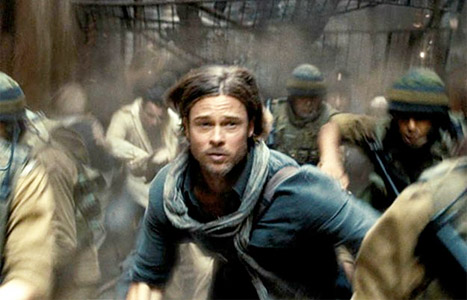 The reshot third act, thanks to added writers Damon Lindelof (TV’s Lost, Prometheus) and his pal Drew Goddard (The Cabin in the Woods), drastically scales down the scope of the pandemic. After two acts of all-out global chaos, we retreat back to the zombie film roots: a small, secluded place. The third act is almost like its own little separate movie. Partly because it’s something different, more horror/suspense than action, as well as being in the confined space, but also because Lindelof and Goddard do a fine job of structuring this concluding chapter. When Gerry gets to a World Health Organization outpost in Wales, he has a simple goal: get from one end of a lab to another. Oh, there are zombies all over the lab. Its narrative simplicity, as well as the clear focus, is a satisfying way to close out a movie that was sort of all over the place. Forster seems to really enjoy the suspense setups that he gets to have fun with in the third act, things like ducking around corners, avoiding zombie detection. The very end provides a ray of hope for humanity… until you fully think out what the consequences are for that hope (the first line of defense shall be hookers). Anyway, it sets up a sequel where mankind can begin fighting back. How do I know this? None other than Gerry’s closing lines are: “This is only the beginning. This war isn’t over.” A bit of hope on Pitt’s part as well there.
And yet with the world falling apart and Pitt our savior, I found myself from the outset very emotionally unengaged with the film. Pitt’s performance is perfectly suited for the material. It’s just the whole family man angle that doesn’t work. I understand it gives Gerry some personal stakes in doing his job but wouldn’t, I don’t know, saving the world be enough when it comes to motivation? It’s your standard reluctant hero’s tale, but the family stuff just kept dragging down Gerry’s character. To begin with, a man looking like Brad Pitt who voluntarily makes pancakes for his kids every morning… sounds like the stuff of fantasies for many. However, it almost keeps him away from his mission, the greater good, and there’s actually a sequence in South Korea where his family literally endangers Gerry’s life by making a phone call. Then the movie keeps cutting back to their existence on an aircraft carrier like I have equal interest in this storyline. One storyline involves Gerry flying the world over and escaping zombies. The other storyline involves whether Karin and the kids will be kicked off the ship. Which would you rather spend time with an as audience member? I didn’t really care about Gerry’s sad wife, played by Mireille Enos from the sad TV show The Killing. I had more invested in the Israeli soldier (Daniella Kerteesz) Gerry teams up with. My father even wanted them to run off together by the end and ditch Karin. I won’t even speak to the awkward storyline where Gerry’s family unofficially adopts a Hispanic kid after his parents die. If only those poor souls had listened to the knowledgeable white man who they took care of.
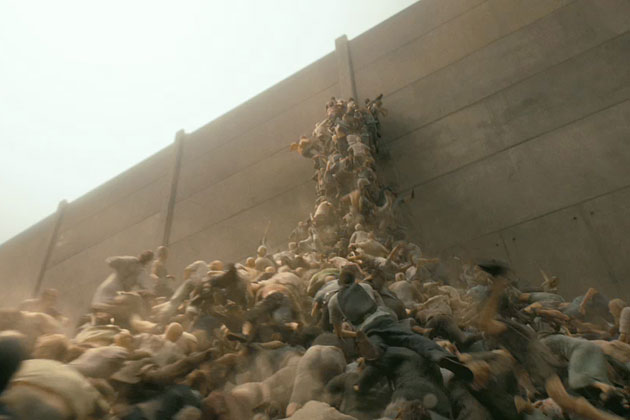 The big-screen version of World War Z bears little resemblance to the book of the same name, and that’s okay. Some adjustments are necessary in adapting, like bringing the actions of the story into the present, centering on a major character. As a book fan, I was somewhat disappointed in the unfulfilled potential presented, but as a movie fan I’m more disappointed by the film’s overall execution. There’s a lot of money in this production, the most expensive zombie film of all time, and a lot of talent on both sides of the camera. And yet after even pulling off a mostly effective ending, World War Z is more middling than it ever should be. Brad Pitt is saving the world from zombies; that should be enough, but it’s not. The movie shows flashes of intelligence, of socio-politico commentary, of something greater, but those moments are fleeting and ground down to make way for a mass-appeal action blockbuster. There’s nothing wrong with those sorts of movies (Roland Emmerich does them exceptionally well), but World War Z doesn’t have the brain-headed flair to pull it off. It’s thrilling, in spurts, interesting, in spurts, and entertaining, in spurts, but it fails to coalesce into something truly worthwhile. My allegiance to the book, as well as zombies in general, guarantees I’ll be there for more if World War Z spawns sequels. Hopefully there will be more because there are so many great stories from the book yet to be told (namely, everything).
Nate’s Grade: B-
Share this:

Disturbia (2007)
 This Rear Window for the Facebook generation starts off strong with a solid performance by Shia LeBouf, but then quickly unravels once the filmmakers think they’re desperately running out of time. The teasing mystery is set up well and elicits some interest, but then, as if afraid of lulling an audience to sleep with a story that takes its damn time, Disturbia throws everything and the kitchen sink at you in the last 20 minutes. The movie falls on its face (the metaphors are flying today) trying to make up for lost time with jump scares and lame thriller conventions. The end gets a tad absurd as well as Shia discovers his serial killer neighbor isn’t just a murderer, but he’s a home decorator on par with the creature from Jeepers Creepers. By the time Shia falls into an underground water cavern filled with corpses, I wanted to scream myself for such wasted potential to a film that seemed like a formless rip-off on the surface.
Grade: C+
Share this:

16 Blocks (2006)
 If you think you’ve heard of 16 Blocks before, you may just be correct. There was a 1977 Clint Eastwood movie called The Guantlet where he was transporting a prostitute/mob witness on a bus, and hordes of dirty cops and mob enforcers are trying to eliminate this witness. So the bus gets shot up beyond all imaginable repair and something of a standoff occurs. If you’d rather rent The Guantlet than pay full price for 16 Blocks I can understand that, but 16 Blocks is an adequately entertaining return to form for director Richard Donner (The Goonies, Lethal Weapon).
Officer Jack Mosley (Bruce Willis) is the kind of New York cop that, when stationed at a crime scene, raids a drug dealer?s cabinet and helps himself to some booze. Jack is like a walking zombie, trudging from assignment to assignment. He’s stuck with one more assignment, transporting Eddie (Mos Def), a key witness in a government trial just 16 blocks away. Everything seems so routine, but then Jack thwarts an attempt to murder Eddie. He reports the attack and takes a breather in a bar. Shortly after, he’s greeted by his old partner, Frank (David Morse), who is ominously familiarity with Eddie. Seems Eddie saw something he shouldn’t have, and now a whole slew of dirty cops are going to go down if he testifies. Frank would appreciate it if Jack stepped aside, gave up Eddie, and everything would be square again. All he has to do is make sure Eddie misses his testimony deadline in an hour, dead or alive. A sudden conscience gives Jack a new life, and he?s determined to escort Eddie to the courthouse, no matter the cost. Frank is willing to stop this, no matter the cost. Let the countdown begin.
 16 Blocks is a solid genre picture up until a bus standoff lets all the air out and kills the film’s jumpy momentum. Yes, it’s assembled out of worn clichés and plot elements from other flicks, but this cut-and-paste action flick is a cut above out of its determination. When 16 Blocks is cooking, and it does for stretches, the movie seems to be moving forward by sheer force of will. It’s somewhat admirable, and I’m convinced Donner is responsible for this as he settles into familiar territory. 16 Blocks successfully introduces obstacles and then lets our heroes find believable and entertaining ways to skirt past the danger and into the next obstacle. New York City really feels like its own integral character that’s central to the unfolding plot. 16 Blocks is nothing spectacular but it’s proficiently fun, that is, until that protracted bus standoff gums up the film’s flow. The contrivances become too glaring and 16 Blocks settles into an overly redemptive finish. 16 Blocks succeeds as long as it can, which is surprisingly longer than I would have estimated, but it eventually winds down with too much time left on the clock.
What the hell is up with Mos Def’s voice in this movie? I don’t know if he was trying to stretch his thespian wings, but going the entire film sounding like you’re a cartoon is not helpful (unless you’re Joey Lauren Adams). I seriously expected a tank of helium to be connected. It’s so mannered, so annoying, and so purposely “different” that you’re almost glad he may die in the film’s opening minutes. However, if this was Donner’s attempt to put the audience in Jack’s place, make us just as bedraggled and frustrated, then well done sire. It’s still not forgivable but at least I may understand.
Willis comes across perhaps a bit too realistic as a doughy, down-on-his-luck cop. It’s getting all too natural to see Willis wearing a badge, or at least holstering a weapon, so at least it’s nice to know he changes it up every once and a while. In 16 Blocks he’s overweight, over the hill, and even sports a limp; not exactly action star material unless you still consider your dad the Strongest Person in the World. It adds an interesting, gritty charm to the picture and Willis coasts on our goodwill. 16 Blocks tries to do too much with his character towards the end, encasing him in a crusade to better himself. There just isn’t that much substance there, folks.
I don’t understand why Jack or Eddie doesn’t phone the media as soon as they know the trigger-happy cops are gunning for them. Seriously, you’d think one call to the press and they’d be swarmed with TV cameras, and as a rule the more TV cameras pointed around you, the less likely someone is going to shoot you. This seems like a no brainier to me, as well as an opportunity to put the media in the cross hairs of danger; it’s win-win.
 There are some moments in 16 Blocks that are perfect indicators about how familiar a movie like this has become. First, the “gotcha” edit. We see two sequences of action, Group A in a fixed location and Group B quickly descending toward that location when “voila” we’ve been had. The film reveals Group A has already left. I usually enjoy this bit of action sleight-of-hand, but when a movie has to pull the “gotcha” edit twice, then it’s a little like the boy who cried wolf. There’s also some stupid character slips meant to squeeze in tension. At the film’s sleepy climax, Jack is surrounded by men with their guns trained on him. He says he has a key piece of evidence is tucked away inside his coat pocket… and then he reaches in to grab it. Now wouldn’t an astute individual, let alone an experienced man of the law, just ask someone to grab it from him instead of reaching inside and giving people a reason to shoot? 16 Blocks has moments like these because the characters are all stock, so what does it matter if they alternate between brainy one second and bone-headed the next?
16 Blocks is an enjoyably retro genre flick, pasted together with stock characters, contrivances, and cliches, and yet the entire project nearly makes it to the finish line by sheer force of will. Despite the well-worn territory, Donner’s precision and some clever obstacle/resolution conflict keeps 16 Blocks passably entertaining. Willis and Def lack any real camaraderie, and you may want to strangle Def after listening to five seconds of his cartoonish voice, but it doesn’t matter because this film is about the journey, not the journeymen. 16 Blocks loses its way when it forgets this, spending the last act focusing on character dreams, morals, and redemption. 16 Blocks is a redemption of sorts for Donner; the man can still make nervy action sequences and keep an audience entertained, if even for only two acts. That’s worth a walk to the movie theater for most.
Nate’s Grade: C+
Share this:

Proof of Life (2000)
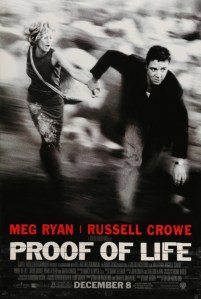 Proof of Life is more an interesting idea than an intelligent or well done thriller. The whole concept of the politics involved in K&R (kidnap and rescue) are duly fascinating. But Proof decides to build a different film around this premise and detours into mediocrity. The film ends with the standard take-down in the jungle I’ve seen many times over except I have the pleasure of seeing David Caruso do it this time.
David Morse is an environmentalist hired by an oil conglomerate to build a dam in a small fictional Ecuador looking country. He gets kidnapped by some radical revolutionaries and is held for ransom. Russel Crowe steps in as the hired K&R expert from Morse’s insurance agency.
The supposed romance on set between Crowe and Ryan is beyond my guess. On screen they have little chemistry and any romance bubbling rates a DOA on Dr. Love’s scale. Meg Ryan betrays herself as an actress and wanders the film minus a bra and constantly sniffling.
During play is a long going friction between Morse, who starts to look like he was auditioning for Cast Away, and some revolutionary hot-headed youth. It’s almost laughable the more it goes on. The will-they-or-won’t-they romance gets snuffed every time we cut back to Ryan’s husband enduring hardships. The editing and the concept ruin whatever sexual tension is supposed to build. The flick also has an unsettling theme that if you aren’t an English speaking white person you can’t be trusted.
The film starts off well with Crowe tangled in Russia but shifts into the mundane rather fast. Proof of Life is proof that what transpires off camera doesn’t always connect on camera.
Nate’s Grade: C+
Share this:

Dancer in the Dark (2000)
Lars von Trier’s latest shaky video opus is likely the most unique movie going experience you’ll have all year. Dancer in the Dark is a clever, heartfelt, and achingly beautiful tale of sorrow and redemption. Dancer stars Iceland’s version of Madonna in the elfin Bjork. She plays Selma, quite possibly the nicest but also most stubborn person in the world. She’s an immigrant in 1960s America working long and odd hours to ensure that she can raise enough money for her son. You see Selma is slowly going blind but continuing to work so she can make sure her son will not have to suffer the same inherited illness. So she works late on heavy industrial machinery causing accidents as her condition worsens all to stop her son’s genetic curse she will give to him. Selma’s escape has always been musicals. In life she hears music in unusual places and visualizes life stopping to burst out into a vibrant fully choreographed musical number. Selma’s life continues to degenerate along with her vision as events pile on worse and worse until they all come crashing together.
Dancer in the Dark is no picnic in the park. The movie is haunting but incredibly depressing. Lars von Trier’s previous film (Breaking the Waves) was another wrenching drama with good people going through rough times with no fraction of light at any end of a tunnel. His jerky handheld video work is back capturing the life of Selma and seemingly framing it in a more realistic sense. The video images are edited to look like a documentary and the whole feel is one of raw power. You aren’t merely watching a film, it’s like you are in it witnessing the actions from the sidelines. The escapist musical numbers are shot in glorious still film to contrast the drab realism of video. The colors are bright, the faces are happy, and the cinematography is a wonder to envision.
Bjork soars and delivers what should be an Oscar-caliber performance. I never knew the queen of alt-rock had such emotive powers. Selma’s innocence is keenly expressed in Bjork and her glassy eyes. Her love for her son is no more evident then all the suffering and tragedy she goes through. All of the suffering and tragedy could be avoided – except her son would not be helped.
The ensemble around Bjork work fantastic magic as well. Peter Stormare is a sad figure trying to just get a glimpse of Selma’s attention. David Morse is a down-and-out policeman who is Selma’s landlord and in need of some cash. He’s afraid to tell his bourgeois wife they’ve run empty with money. Catherine Deneuve turns in the brightest supporting performance as Selma’s co-worker and friend Kathy. She’s torn between trying to stop Selma from continuing on her acts that could cause her harm and helping her along her determination. A great scene as example of her care for Selma is when the two of them are in a theater watching an old Hollywood musical. At this point Selma is completely blind and can’t see what’s going on, so Kathy takes Selma’s palm and dances her fingers in correlation with the actions on screen to Selma’s delight. A simple scene yet so elegant and beautiful.
Dancer in the Dark is a wonderful piece of original film making that gives us the escape of hope and the crush of despair. Selma’s love of musicals and their role in life is perfect symbolism for discussion. Dancer will leave you with a distinct feeling by the end credits. Whether it’s sorrow or bewilderment Dancer in the Dark is a film not to miss.
Nate’s Grade: A
Reviewed 20 years later as part of the “Reviews Re-View: 2000” article.
Share this:

The Green Mile (1999)
 A prison in the heart of the deep South during the era of the Great Depression is not usually the locale you’d find a somber tale of earnest discovery and passionate awareness to the follies of life. Yet here arrives the long anticipated The Green Mile, the second in tag-team efforts from director Frank Darabont and novelist Stephen King in their own genre creation of nostalgic feel-good prison flicks. All the swelling hype could manage to make the movie seem overbearing, but if you’ve got a free afternoon and a butt made of steel then try The Green Mile.
Darabont seems like the perfect visual interpreter to King’s epic narrative spinning of good, evil, and all that fall between. The movie moves at the pace of molasses and clocks in at over three hours in length. Not exactly audience friendly fodder but one and all will be grateful for the decisions taken to build character development and tension instead of blindly rushing through.
Tom Hanks plays a prison guard on the Death Row block of a Southern penitentiary. Despite the bleak and grim surroundings his humanity still shines through. He escorts and oversees the final moments of many men’s remaining breaths along the final walk of green linoleum tile to the electric chair. Enter one mysterious morn John Coffey (Michael Clark Duncan), a towering giant that seems to break all the rules each of the guards on cell block E has come to realize through their years. Coffey has been convicted of the rape and murder of two little girls, but as Hanks soon learns things aren’t always what they seem. The 7-foot miracle worker displays scenes of empathetic healing like to Christ himself. Hanks views are turned and his eyes open, and that’s just the beginning of the heartstrings being pulled. To release anymore of the plot would be a crime punishable by Ole’ Sparky himself in the Green Mile.
 The pacing is smooth and wrings out every droplet of mystery and drama needed. The Green Mile‘s comprehensive fable quality transcends the period just like The Shawshank Redemption did as well prior. ‘Mile’ should be expected to be a front-runner for Oscars when balloting begins.
The ensemble acting is magnificently eclectic and truly inspiring. Hanks’ name is so synonymous with Oscar that he might as well shave his head and paint his body gold because come nomination time this man’s name is going straight to the ballot. Other stars give thoughtfully deep and refreshing performances guaranteed to turn a few heads. Duncan’s gentle child-like giant is serene and a benevolently touching figure of innocence and warmth. But one can not forget the presence of a very special rodent by the name of Mr. jingles that deserves billing above the credits itself for the quality performance it puts on.
The Green Mile is a sad, touching ,and rather powerful movie that speaks to the viewer’s emotions and gladly earns every one of them. In the end The Green Mile is nothing beyond a long yarn of a fairy tale; but one told so exceptionally, one performed so extraordinarily, and one directed so deftly that you’ll gladly journey down that mile with ease.
Nate’s Grade: B


 nathanzoebl
You must be logged in to post a comment.