Blog Archives
Quantum of Solace (2008)
 We pick up things almost immediately from where we last left James Bond (Daniel Craig). He’s been wounded by being betrayed by his deceased lover, Vesper (Eva Green). A shadow organization known as Quantum kidnapped Vesper’s boyfriend and threatened to kill him if she did not get close to Bond and then betray him. So now Mr. 007 is on the hunt for anyone associated with this secret club responsible for his lover’s demise. Dominic Greene (Mathieu Amalric) is a slimy businessman who fronts an environmental company but really wants to control world resources. He’s a bigwig with Quantum and Bond follows along, leaving a trail of bodies behind that makes his agency believe he’s gone rogue. But Bond isn’t alone when it comes t seeking vengeance. Camille (Olga Kurylenko) is out to avenge the murder of her family by a Bolivian general, a close ally to Greene. She and Bond form a partnership that naturally extends into the bedroom.
Quantum of Solace feels less like a sequel than a plot hangover. Nothing remarkably new is thrown into the mix, and the story is drilled down to the brass tacks of finding whoever was responsible for Vesper’s betrayal and untimely death. Revenge is a fine motivating factor, and many great movies have been developed around the idea of vengeance, but Quantum of Solace barely takes a breath from the action because it really doesn’t have anything else holding together its tale. By the end of this caper we know precious little more than what we started with. We know there is a big bad shadow organization that “has people everywhere,” as big bad shadow organizations are wont to do in the Bond universe, and we know it’s name is Quantum and that it does bad things. That’s just about it, people. There’s even one plot point that is such a huge rip-off of an iconic image from Goldfinger that I’m baffled that either nobody caught it or they were naïve to think it would be a well-received homage (you’ll know it the instant you see it). The movie is the shortest Bond film ever, barely cracking 100 minutes, a full 40 minutes shorter than Casino Royale. It’s as if the filmmakers are expecting everyone’s good feelings from Casino Royale to cover up for the fact that the story is a leftover. It’s like the plot for Quantum was accomplished by the previous movie; therefore, this flick can be nothing but brawn and steely nerve. I’m not expecting my Bond movies, or even my action movies, to dazzle me with nuanced screenwriting, but I do expect there to be a little more something going on than, “Man chases intel. Gunshots and explosions occur. End.”
 Naturally any hiccups or lapses in plot would be overlooked if the action sequences were something to get excited about. Quantum has taken the Bourne mantra to heart, far more so than its Bourne-flavored predecessor, and that means lots of bursts of action but told through quick-cuts that assault the senses. Now, I’m not one of those who complain about the Bourne fighting style and its infamous editing, but imitators generally fail to find the same pizzazz. The flick is front-loaded with 45 minutes or so of solid action but there’s never really any set-up to the action; it just sort of happens. What really hurts the movie is that none of the action sequences is truly memorable. I can easily recall three or four sequences from Casino Royale, but the only sequence in Quantum that I think will stick in my mind is a fight sequence over scaffolding where the camera follows the plunging actors. There are car chases, boat chases, airplane chases, foot chases, and it all has a more realistic vibe without the assistance of technological wizardry. The stunt work is still sterling but it?s fleeting moments of awe in a landscape of forgetful action sequences.
Making the franchise more closely mirror our own world is an interesting and mildly refreshing decision; it sure has helped the Batman franchise. But there are problems when the typical over-the-top fantastical Bond elements sneak back into the movie. The villainous organization Quantum is pretty vague. They look to rule the planet by some means, but then again if the Bond franchise is taking a more realistic approach then having a world-wide secret organization that can infiltrate loads of covert agencies is pushing it. The baddie of this go-round is an effete Euro trash businessman, fine, but don’t give him an axe and pretend that he’s going to be an effective force against Bond. Also, what’s the point of having a glass hotel in the middle of a desert? Why to blow it all to hell, of course. It reminded me a bit of the ridiculous ice palace in 2002’s Die Another Day.
 Craig is still one of the best decisions the Bond producers ever made. He brings the same level of intensity he did to his blockbuster introduction to the series. Craig is all bruises and determination, doing whatever he can to get his answers. He does his best to show the humanity beneath the brutality, but the script fails him. He’s more reactionary this time and seems to behave like a missile that’s in search of its target ready to explode. The caged fury is still there but it seems put to less good use. Kurylenko (Max Payne) is less a Bond girl than an ass-kicking sidekick. She’s given some minute amount of back-story but she’s essentially the pretty face that gets to handle the big guns. Amalric (The Diving Bell and the Butterfly) can be a sleazeball thanks to his natural bug eyes and he doesn’t get much more to do than sneer. He never comes across as being a fierce threat. Gemma Arterton (RocknRolla) is a fairly pedestrian Bond girl with a fairly tame name, Strawberry Fields. She plays the role like a hot librarian coming alive after being seduced by the sexiest man on the planet. Her time in the movie is so short that I question what significance she had other than supplying a requisite sex scene. Dame Judi Dench is still holding her head high amongst all the spy hijinks.
I think I have figured out a way to make Quantum of Solace feel like its own movie, though it does require some creative license. Pretend that Casino Royale ended shortly after Bond was freed from his naked genital torture (it still hurt to think about it). Now, imagine that the opening of Quantum of Solace is the last twenty minutes of Royale, where Bond and Vesper are canoodling in Venice before the bad stuff happens. That sets up Qauntum‘s conflicts and provides a plausible plot trajectory that makes the movie more its own entity; Vesper establishes the conflict, the conflict is resolved by the end of minute 100 (though it would be minute 120 if we’re adding and subtracting parts). Wouldn’t that be a better Bond movie? At least the film would then have one memorable action sequence, albeit the sequence was stolen from another movie.
I suppose my disappointment is coming across more than I intend, because Quantum of Solace is a rather solid action caper with exotic locations, some nifty camerawork, and a brutal efficiency when it comes to pacing out the action. I certainly was entertained and had a fun time with Quantum of Solace, and I?m sure most filmgoers will echo that experience. But in the age of a realistic James Bond cribbing from the Bourne franchise, I was expecting more than a leftover from an earlier albeit terrific movie.
Nate’s Grade:C+
Share this:

The Invasion (2007)
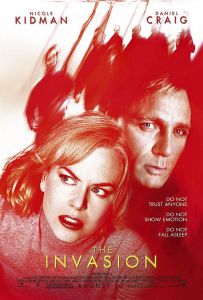 The fourth remake of The Invasion of the Body Snatchers is a more interesting behind-the-scenes story than as a film. German director Oliver Hirschbiegel (Downfall) created a movie that was described as more psychological thriller than action chase movie. The studio and producers scrapped many pieces of the film, hired the Wachowski brothers to rewrite portions of the story and cram in some action, and then James McTeigue (V for Vendetta) directed the reshoots. As a result, the movie is wildly displaced and hacked together and never feels whole. There’s a slow burn of intrigue and mob madness and paranoia that gives way to chase scenes, car wrecks, and a ridiculously contrived happy ending. I’m sorry, but when you do The Invasion of the Body Snatchers, you cannot have humanity win; that destroys the entire point of the story. It’s like having King Kong climb the Empire State Building and deciding to live there and dance for peanuts. Nicole Kidman and her lithe frame seem like an odd choice as humanity’s last hope with a gun. The Invasion flirts with some philosophical ideas about free will, assimilation, and the cost of peace, but then it speeds headfirst into an abrupt finish. This movie is unsatisfying to all parties.
Nate’s Grade: C
Share this:

The Golden Compass (2007)
 Beloved by many and condemned by others, Philip Pullman’s fantasy series, His Dark Materials, is widely popular. New Line Cinema placed an expensive wager in adapting the first book of the series, The Golden Compass, with the express desire of having their own Narnia-style franchise. Chris Weitz (American Pie, About a Boy) was hired to adapt and direct the enterprise. The final tally had the budget somewhere around $180 million, add in an extra $60 million for marketing, and New Line was pretty much banking their studio’s fortunes on this would-be fantasy blockbuster. Trouble is, there is not built in audience for a Golden Compass movie. The books are more popular overseas and less than ten years old, so there hasn’t been enough time to build a sense of lore or greater anticipation, like with Narnia. As of this writing, it looks like The Golden Compass is going to tap out at about $70 million domestic haul, and while I have no doubt that figure will be much higher overseas, I do not think it is a coincidence that soon after The Golden Compass fizzled New Line buried the hatchet with Peter Jackson and started the process on engineering two Hobbit movies. You see, that’s guaranteed money in the bank unlike The Golden Compass.
On a parallel Earth, people walk around with their souls in the form of animals known as daemons. These creatures serve as conscience, servant, and protector. Until a child reaches adulthood the daemon will often change form until it settles on one creature, be it a cat or a hawk or a toad. Lord Asriel (Daniel Craig) has discovered an inter-dimensional hole around the Arctic Circle, and a magical substance known as Dust is seeping through. The all-powerful Magisterium feels that they know best for others and that people need to be told what to do, and they most certainly do not appreciate Lord Asriel’s scientific discovery. They have decided to silence him permanently as he travels to the Arctic.
 Meanwhile, Lord Asriel’s niece Lyra (Dakota Blue Richards) is investigating poor orphans that seem to be vanishing around her school. The Magisterium has taken an interest in Lyra and “asked” that she accompany Mrs. Coulter (Nicole Kidman), an icy woman with a wicked monkey as a daemon. She has great hopes for Lyra, but soon the child realizes she is a prisoner in the care of Mrs.. Coulter and that the Magisterium is responsible for abducting children and conducting experiments to remove their daemons from them forever.
She escapes and heads to the North, and finds help amongst nomadic people known as Gyptians, an air cowboy (Sam Elliott), a group of flying witches led by Serafina (Eva Green, as lovely as ever), and a scarred and grumpy polar bear named Lorek (voiced by Ian McKellen) who has been exiled from the Ice Bear kingdom after losing in one-on-one combat with the cruel current king, Ragnar (voiced by Ian McShane). Lyra leads this motley crew to the Arctic where the Magisterium is keeping the absconded children for experiments.
Most noticeably absent is a sense of wonder. The Golden Compass kind of plods along, and when new magical creatures are introduced they’re done so with such matter-of-fact complacency. If they can’t pretend to be impressed then why should I? There’s a difference between playing the fantastic straight and just shrugging it off. The structure of the screenplay doesn’t help things much. Many subplots feel rushed or grafted on to a lumbering plot that collects minor characters like static cling; it isn’t until the climax that the whole slew of people combines forces. As a result, some subplots are far more interesting than others, like the world of armored polar bears. This imaginative diversion, like much of Golden Compass, reveals itself as simply a side step in a plot littered with nothing but side steps. Just as soon as the storyline has started it’s pretty much over and the movie has moved on to new ground.
The movie fluctuates between the silly and the confusing. The hardest part of any fantasy film is establishing the rules and laws of this new realm, and The Golden Compass seems a tad overburdened in trying to explain its world. Weitz’s adaptation is heavy in lugubrious exposition without the benefit of drawn-out explanation. Often some character will explain something briefly and then the audience is left to orient themselves with this new morsel of information. Cosmic dust, alternate dimensions, Magesteriums, daemons, Gyptians, polar bears, witches, prophecies, it’s a bit much to decipher for an adult let alone a child (I’m convinced that the sluggish pace and confusing jumble of a story will totally bore kids). The golden compass itself is a very awkward creation and really has little purpose or connection to the events of the film. First off, in order to pose a question a person must align three hands to varying pictures to best describe what they will ask (how many pictures do you need to ask where you left your keys?).
The book’s anti-ideology stance has been severely watered down and replaced with half-hearted euphemisms. Gone are any overt references to the church or Christianity, instead the movie couches its ire in vague authoritarian terms, a giant entity that wants to separate children from their daemons (souls) to purify them from Dust (sin). I do find it amusing that the villainess is a tall, thin blonde woman named Mrs. Coulter, though this seems more coincidence than indignation. There is a brief scene in the film where a bunch of frowning, older white men (one of them Christopher Lee) sit around a table clucking their tongues and talking up their evil scheme; that’s about as provocative as the movie gets. But by sanitizing the book’s provocative nature, Weitz has produced a movie adaptation that feels too silly to be taken at face value and too bland to be taken as anything but.
 From an effects-driven perspective, The Golden Compass is admirable even if few of the CGI works manage to truly dazzle. The special effects are sturdy for a tale with such demands as talking animals and winter icescapes. The bear battle is the film’s highlight but a climax involving a sprawling brawl, which visually indicates a person’s death by a daemon vanishing into a cloud of gold smoke, is fun to watch. Sadly, an ongoing sense of fun or enjoyment is missing from most of The Golden Compass. It feels more dutiful when it should be wondrous and timid when it should be exciting.
The Golden Compass is a less spirited fantasy adventure that skimps on what makes the genre special. It has no sense of awe and wonder, and even worse the movie is structured in a rush with little time for clarification and growing characters. The film is crammed with cheerless exposition and the bulk of the plot is built around a lame rescue attempt. Weitz has sanitized the intellectual and religious provocations of the book to appeal to greater mass audiences, but by doing so he’s robbed the audience of substantial subtext. The Golden Compass even ends on kind of an unresolved, Fellowship of the Ring, “Oh, it’s over” kind of way, finishing before even reaching the climax of the first book it’s based upon. I have read that the studio shot these scenes, and you can even see them in the original trailer and access them via the video game tie-in. They wanted to save them for the start of a second movie. It may be painfully obvious to most, but allow me to say it: there is not going to be a second movie. The Golden Compass is a slightly entertaining but mostly charmless fantasy film. Someone figure out the right three pictures to ask, “How could we have made this movie better?”
Nate’s Grade: C+
Share this:

Casino Royale (2006)
 This is very different James Bond and it’s about time. The Bond film franchise began all the way back in 1962, and it essentially became the blueprint for the modern action movie. Quips, alluring women, exotic locations, car chases, colorful villains, and spoiled plans for greed or world domination. But even if Bond got the ball rolling, the action movie became its own insatiable beast, thanks to the likes of studio bean counters and the ubiquitous uber-producer Jerry Bruckheimer. The 90s Bond revival followed suit. The movies became more about extravagant fireballs, throwaway characters, and preposterous scenarios. After 2002’s Die Another Day, where Pierce Brosnan’s Bond drives an invisible car through a melting ice palace caused by a solar laser from space run by a yuppie playboy who really had the DNA of a North Korean dictator… well, you don’t need to be an expert to figure out that something was rotten in that state of Bond.
The Bond films have great history to them, but let’s not get overly romantic here; a majority of the James Bond movies are outright crap, especially the ones with Roger Moore. There were jaunts into space, men with metal teeth, Timothy Dalton, a title called Octopussy, and Christopher Walken trying to have California fall into the ocean. Let’s face it, half the movies are rubbish. Someone, anyone try and tell me the redeeming qualities of Moonraker. The last good-to-great Bond movie was Brosnan’s debut, 1995’s Goldeneye. The Bond franchise has been in desperate need for a makeover. This is it.
 The producers went back to Bond basics. The long-time producers had the rights to every Ian Fleming novel, except for Casino Royale, which was turned into a cheesy comedy lampooning Bond instead of competing with the franchise. Several decades later, we’re given a serious adaptation of Royale, Fleming’s introductory book about the secret agent that rewrote movie rules. The new Bond has a splash of Jason Bourne in him and seems more tightly wound and hard-boiled. He doesn’t have time for trivial decisions like shaken or stirred. “Does it look like I give a damn?” he barks at the bartender.
Bond (Daniel Craig) is more thug with a badge than a suave secret agent. He’s just risen to double-O status and his boss, M (the incomparable Judi Dench), doesn’t feel that he’s ready or can be trusted. But then, he is the best poker player MI5 has. Le Chiffre (Mads Mikkelsen) is entering into a high stakes poker game worth millions of dollars. He’s playing with the money of African warlords and terrorists and has promised them a great return on their investment. Bond is assigned to gather information and stop Le Chiffre from financing terrorism. Vesper Lynd (Eva Green) is a representative of the bank that will be sponsoring Bond in the card game. It’s up to her to keep tabs on Bond and make sure her bank?s money is wisely invested.
Now this is what action movies should be like. Casino Royale is a terrific ride with great action sequences, great intrigue, strong acting, and some wonderfully exotic locations. The movie, like Bond to Vesper, sure feels the need to prove money was well spent. The story is smart and filled with sharp dialogue, perhaps thanks to co-writer Paul Haggis (Million Dollar Baby, Crash). This is Bond dialed back, stripped of fancy gimmicks and gadgets and left to battle with his wits and his brutality. This is a meat-and-potatoes action movie without irony or frills. It’s serious about its business and business, let me tell you, is good. Casino Royale is monstrously entertaining.
 There was a lot of grumbling when Craig was selected as the next actor to fill the 007 shoes. Some scoffed at the idea of a blonde Bond, as if hair color had shot to the top of the list of important qualifiers. I wrote this about Craig after seeing 2005’s Layer Cake: “This man is a modern day Steve McQueen with those piercing blue eyes, cheekbones that could cut glass, and the casual swagger of coolness. We may never see Craig sweat but he still expresses a remarkable slow burn of fear so effectively through those baby blues.” This man is the perfect candidate for a Bond reboot. He has a boxer’s face, those wonderful eyes, and a sculpted body that will take many a breath away. But even better, Craig is likely the best actor that has even been tapped for 007. Connery will always be the sentimental favorite, and rightfully so, but Craig imbues his Bond with startling amounts of emotion and vulnerability. In the dramatic black and white opening, his first kill isn’t clean and quick, it’s long, drawn out, messy, and leaves Bond shaken, not stirred. His relationship with Vesper gives him even more opportunities to feel and be tortured, sometimes literally (Note: a naked torture sequence is far too intense for children, especially those with their genitals on the outside). Craig gives a rich performance. When he’s chasing bad guys you see the determination of his running, the anguish on his face. When he’s flirting with women you can practically feel the smolder. This is a far more pragmatic Bond and Craig is the right actor for the job.
Green leaves her mark as one of the best Bond girls in the franchise. Usually the Bond women are either respites for fine-tuned lovemaking, or damsels wronged by the eminent domain of evil. She has a nice moment where she sits in the shower in shock after being witness to the reality of murder. She showed a lot of promise and gives a commanding performance on her biggest stage.
Director Martin Campbell has some history with the Bond franchise, restarting it with Goldeneye. He’s a pro at orchestrating action sequences, and there are some doozies in Casino Royale. The beginning sequence is a thrilling foot chase inside a construction zone. Bond’s target, a bomb maker, bounces off walls, swings along ledges, and motors around beams and ladders like he was a trained monkey. It’s an exciting French style of acrobatics called Parkour, and it was used to dizzying effect in this year?s District B13. The chase just goes from one level to another, and the stunts are brutal and of the death-defying variety. It’s a showstopper opening. An airport sequence is also quite memorable, as Bond races to stop a bomb from reaching an airplane. Campbell has taken a hint from the Jason Bourne spy movies and made Bond more reactionary to his surroundings. Many fight sequences feel tense and un-choreographed, even though we know that isn’t the case. When this Bond gets into scuffles you don’t know whether he’ll make it out unscathed. Campbell keeps the pace steady and the visuals crisp. Best of all, Campbell allows the audience to fully see what’s taking place. There’s no MTV-style edits. The film feels totally in control like the best action movies do. You’ll feel battered, bruised, but exhilarated all the same.
 However, Casino Royale is not a perfect action movie. It feels way too front-loaded; all the big action sequences seem to occur within the first hour. The film then settles in for a climactic game of… cards? I’m not one who fell into the spell over Poker on TV the last few years. It just doesn’t seem that thrilling to me to watch one guy turn over his cards and then wait for another to turn over their cards. There are only so many combinations to be had, and hoping for Bond to have a flush to beat out four of a kind is just not high drama. It’s luck. The poker scenes seem to last longer than they should, as does the film as a whole. This is on record the longest Bond movie ever, clocking in at 144 minutes. It’s a whole hell of a lot of fun, but the tacked on ending in Venice seems like an entirely different movie slapped together for closure. The villain is somewhat weak. He’s given a nifty visual item, weeping tears of blood, but it is meaningless. The plot also gets too convoluted for its own good, with double-crosses, triple-crosses, and finally a reveal as to who the Big Bad in Charge was and I could not for the life of me remember who he was. Seriously, there are so many characters and faces shoved in that the producers could throw us a bone. All I’m asking for is some clarity while I chow down on my popcorn.
Casino Royale is the Bond movie Ian Fleming would have paid to see. Craig and Campbell have given new life to a teetering franchise. This Bond is much scrappier and more cunning. The action sequences are slick and the movie is fun and engrossing, plain and simple. In the closing seconds, when the familiar notes of the James Bond musical theme come alive you will feel like the journey has been earned.
Nate’s Grade: A-
Share this:

Munich (2005)
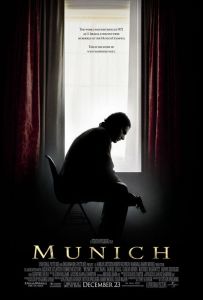 If 2005’s War of the Worlds was Steven Spielberg’s look at 9/11, then Munich should be considered his examination of the aftermath. What could be more relevant today than a film about combating terrorism, violent reprisals, and where a government leader says, “Every civilization finds it necessary to negotiate compromises with its own values?” Anyone seen the news lately? Spy eavesdropping, prison abuses, hemming and hawing on what the definition of torture is, it’s all compromised values in the name of security. This is our world and Spielberg analyzes the costs of war. Munich is visceral, haunting, thoughtful, and compelling as both an idea piece and as a mainstream thriller. It’s Spielberg’s most mature work in a decade.
In 1972, a group of Palestinian terrorists known as Black September took 11 Israeli athletes hostage during the Munich Olympics. The world watched as the standoff stretched for hours, finally ending in a firefight at the airport and the terrorists throwing grenades into helicopters housing their hostages. Every Israeli athlete and Black September member had been killed. “They’re all gone.”
But it doesn’t stop there. Israel Prime Minister Golda Meir (Lynne Cohen) recruits Mossad agent Avner (Eric Bana) to run a secretive counter strike. Avner is to assemble a team, track down the architects of the Munich massacre, and assassinate each one. Their mission is only known by a select few, and their only contact is via a handler (Geoffrey Rush) and a safety deposit box that fills up with money. Joining Avner are Steve (Daniel Craig), the South African with a hot-head, Robert (Mathieu Kassovitch), the toymaker turned bomb maker, Hans (Hanns Zischler), the document forger, and Carl (Ciarán Hinds), the clean-up man. The men crisscross the globe hunting down their targets, and with each successful kill there is escalating retaliation by Black September. Soon Avner’s group becomes a target themselves and he questions if the men they are snuffing out have any connection to Munich.
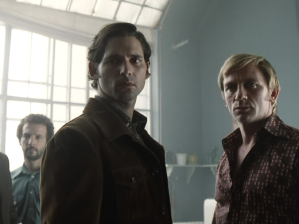 When I first heard about Munich I thought it would be a dramatization of the hostage situation, and Spielberg does revisit the sequence in horrifying and bloody flashbacks. The film’s focus is on the aftermath of Munich, though it does not pretend to be fact. This is a made up story based on rumors. As new evidence clears, it looks like the Munich retaliatory slayings were unrelated Palestinian men.
For events that began in 1972, Spielberg punctuates his drama with a gnawing sense of timeliness, closing his film with the very image of the World Trade Center in the New York skyline, connecting an invisible line from Munich to our world today. This is a mature, meditative examination on the retaliatory response to terror. Munich is even-handed in its views and dives into challenging territory where an easy answer is an insult. This isn’t a pro-Israeli movie or an anti-Palestine movie (though it’s already earned condemnation from fundamentalists on both sides), and every side gets a moment in the spotlight to effectively argue their case. The result is a movie that thoughtfully and reflectively looks at the cost of vengeance and compromising our values. Munich, even with its glut of important messages and mouth pieces, never forgets to be entertaining. The cameras are often handheld and Speilberg’s winding shot compositions give a visceral feeling to the events.
Bana (Troy) is the moral anchor of the film and gives a staggering performance. He begins proud and humbled, living in the shadow of his father’s name, an Israeli war hero. As the assassinations play out, each changes Avner and Bana expertly expresses his character’s turmoil, finally succumbing to paranoia and fear. The final act has relatives telling Avner he has done right, that his dead family is smiling with approval, and Bana’s sad, haunting eyes tell the full story of what he truly believes. He looks like he’s aged ten years in such a short time span. Each member of the hit squad fills out their role nicely, with Craig (Layer Cake) imparting tough, hip savvy, Kassovitch (the director of Gothika, oddly enough) is nebbish and the first to morally crack, Zischler is stoic button-lipped,and then there’s the fantastic Hinds (Julius Caesar on HBO’s Rome), an experienced man that?s so calm and knowing and wryly warm-hearted. He’s such a delightful onscreen presence. Rush is only onscreen in spurts but is brash, humorous, and unsentimental to the very end. He’s an actor that rarely misfires, if ever.
Too often we bandy about the term “evil;” our enemies are “evil,” atrocities are brought about by “evildoers,” but by painting in such broad, simplistic strokes, demonizing the enemy as “evil” (and conversely implying you are the side of good) you strip away the reality of the situation. The worst thing you could do in this war on terror is simplify the situation. These are not evildoers; these are people deciding to commit atrocious acts. If they are dubbed monsters or simply evil then we’ve reduced the argument to a kindergarten lesson. Munich doesn’t show the Palestinian targets as mustache-twirling evil doers (no one is spotted tying a damsel to railroad tracks). These are men with convictions, family, and humanity. “Evil” is too tidy a term, and Spielberg understands this. Are evil acts necessary to combat evil? Do we become our enemies when we resort to their ruthless tactics? Robert, shaken from a recent kill, pleads that Jews are supposed to be righteous, that’s what separates them from their persecutors. Assassination is not a righteous act, despite what Pat Robertson may spout off on TV. In the end, the only trustworthy people in the film may be a strange French family that sells information to the highest bidder, regardless of politics.
 There’s one moment in the middle of Munich that will stick with me forever. There’s only one pure vengeance murder in the movie and it involves a female killer (Marie-Josée Croze). It’s a kill the audience is thirsting for and demanding; the other assassinations were murky, men unknown to have any involvement in terror other than being a name on a sheet. This is an instance where the audience wants revenge and then Spielberg gives exactly what we want and disgusts us. The kill is so sharp, so uncompromising that the violence is startling and, more importantly, it hurts. The reality of it is painful to watch. Spielberg has masterfully turned our quench for violence and shown the ugly reality.
Munich also succeeds as a thriller, pulsing with immediate danger and drawing the viewer in. There were key moments that I was chewing on my knuckles because of how taut the suspense was. As a thriller, Munich briefs us on these men’s mission like all good spy movies, brings us into their fraternal order, and then we watch each assassination play out, many never going according to plan. What elevates Munich is how real everything feels and how dangerous every moment comes across. This is a thriller that it makes the heart pound but also courses with subtext, and exquisite dialogue by Tony Kushner (Angles in America), who magnificently frames his characters with the tiniest details, who crafts deft symbolism in moments of doubt and paranoia, and who, channeled with the film’s masterful acting all around, creates a stirring study of the cost of violence and the broken bodies it leaves behind, even those that live to ponder another day. Kushner’s writing is a perfect match for Spielberg’s effortless artistry.
This is Spielberg maturing as a filmmaker, despite some missteps here and there, mostly with the length and a late sequence where he juxtaposes the final Munich hostage flashback with Avner climaxing in coitus with his wife. The characters are sharp, the acting is resonant, and the thrills are palpably engrossing, giving the film a refined sense of danger where anything could happen. Munich is more than a thriller and more than a think-piece. It’s a close examination of the cyclical nature of retaliation and reprisal, dooming both parties into an endless bloodbath. Don’t be frightened by all this heady talk because it’s also a very entertaining movie. Munich isn’t the best film of the year; it’s pretty good but it’s definitely one of the more important movies of the year and worth seeing.
Nate’s Grade: B
Share this:

Layer Cake (2005)
 Layer Cake may be the least intimidating name ever for a crime movie. It conjures images of bridal showers, cooking shows, and birthday parties. It does not necessarily bring to mind thoughts of gangsters, assassins, drug trafficking, and the seamy underbelly of London’s criminal underground. Unless you’re watching some really awesome cooking show I don’t know about. The “layer cake” in question refers to the hierarchy of criminals. This isn’t unfamiliar territory for Matthew Vaughn, who produced Guy Ritchie’s Lock, Stock, and Two Smoking Barrels and Snatch. This time it’s Vaughn sitting in the director’s chair and the results are exceptionally entertaining. Layer Cake is a cinematic treat.
Daniel Craig (Road to Perdition) plays our untitled lead, referred to in the end credits as “XXXX.” He’s a cocaine dealer but not a gangster by any means. He wants to make his money, not step on any important toes, and then walk away on top and without any gaping holes in his body. Craig is summoned by his boss Jimmy (Kenneth Cranham) and given two missions, whether he wants to accept them or not. The first is to relocate the missing daughter of a very powerful friend of Jimmy’s. The second, and far more dangerous job, is to secure a package of millions of stolen ecstasy pills and make a profit. Complicating matters is the angry Serbian mob that the pills were stolen from. They’ve dispatched a deadly assassin known as Dragan to track down their stolen drugs and kill anyone involved. Craig is left to juggle the investigation, find a buyer, stay ahead of Serbian hitmen, get some time in with a hot new girl, and all the while keeping his higher-ups content enough not to kill him themselves.
 Layer Cake should be the film that makes Craig the star he so rightfully deserves to be. This man is a modern day Steve McQueen with those piercing blue eyes, cheekbones that could cut glass, and the casual swagger of coolness. Craig grabs the audience from his opening narration as he explains the ins and outs of his business. We may never see Craig sweat but he still expresses a remarkable slow burn of fear so effectively through those baby blues. He’s in over his head and the audience feels his frustrations. In an interesting character twist, when Craig does resort to killing, he’s actually tormented and haunted by his actions.
As with most British gangster flicks, there are a batch of colorful characters that leave their mark. Dragan (Dragan Micanovic) is a wonderfully enigmatic ghost of an assassin always one step ahead of Craig and the audience. Morty (George Harris) and Gene (Colm Meaney) add heart and bluster as Craig’s trusted right hand men. But the actor who steals the whole film with a malevolent glee is Michael Gambon (Harry Potter and the Prisoner of Azkaban). He plays Eddie Temple, the man behind the men behind the scenes. Gambon delivers the harshest of speeches with a velvety pragmatic calm. We don’t know what runs deeper with Eddie, his tan or his scheming.
Sienna Miller plays the thankless love interest to Craig. She’s pretty, sure, but there isn’t much acting ability on display in Layer Cake beside some smoldering glances. We never really know what Craig sees in her besides being another cute blonde to choose over. Miller isn’t alone in the “underwritten character department.” Layer Cake is crammed with secondary characters that pop in and out when it’s necessary. It’s not too annoying but it does mess around with an audience?s ability to follow along coherently.
Layer Cake is not one of the slick, whack-a-mole ventures Ritchie has given us (pre-Madonna). No sir, this is a brooding, serious and nearly terrifying look at the old adage “crime doesn’t pay.” Very few crime centered films express the day-to-day anxiety of just being a criminal. Jimmy reminds Craig that he’ll never be able to walk away because he?s too good an earner for his higher-ups. In Layer Cake, you can get killed for being too greedy, being too careless, being too good at your job, and even just being in the wrong place. Eddie sums it up best whilst describing Faust: “Man sells his soul to the devil. It all ends in tears. These things always do.”
 Vaughn has a polished visual sensibility that doesn’t overwhelm the viewer. He keeps the camera fluid and steady with a minimal amount of cuts. A nifty opening scene involves an imaginary drug store (stocked with pot, cocaine, and the like) melting into a real drug store (one hour photo, impulse items at the register). When the tension does mount Vaughn knows just how to turn the screws. A late sequence involving a chase between the SWAT team and our batch of criminals had me on the edge of my seat. For a first time director, Vaughn also has great patience. He doesn’t rush his storyline and he doesn’t suffocate his movie with visual flourishes. He also has a great deal of faith in his audience’s intelligence. This isn’t as lively as Snatch or Lock, Stock, but that’s because Vaughn’s film is also much more serious and dangerous.
This is an intricate and gripping film but it might be a little too complex for its own good. Twists and double-crosses are expected in this genre, but writer J.J. Connolly has so many characters running around and so many hidden agendas that it’s nearly impossible to keep track. Some of the subplots and back stories add very little like the inexplicable “Crazy Larry” flashbacks. I left the theater still confused about plot points but refreshingly satisfied nonetheless.
Layer Cake is the most thoroughly exhilarating time I’ve had at a theater this year. This pulpy daylight-noir caper is full of memorable hoods, plenty of twists and turns, and a star making performance by the steely-eyed wonder that is Daniel Craig (rumored to be the next 007, though in my heart I’ll always root for Clive Owen). Fans of Ritchie’s frenetic gangster flicks should be entertained. Anyone looking for a clever and exciting potboiler that treats violence and crime seriously should start lining up immediately. If you’re suffering from the cinematic wasteland that 2005 has shaped up to be so far, then have yourself a generous helping of Layer Cake and thank the Brits.
Nate’s Grade: A
Share this:

The Jacket (2005)
 In The Jacket, Adrien Brody plays a mentally disturbed soldier sentenced to spend his days in a treatment facility. He gets strapped into a straight jacket and locked inside a morgue drawer as part of his “therapy.” Inside these closed quarters, for whatever unexplained reason, Brody has the ability to travel through time. This got me thinking about some other weird/lame ways people travel through time in films. In 2004’s The Butterfly Effect a bearded Ashton Kutcher is able to jump through time by reading his childhood journals. Sure this is weird, and may give false hope to a nation of gloomy journal-scribbling teenagers, but when it comes to incompetent time travel techniques, 1980’s Somewhere in Time is number one with a bullet. Christopher Reeve’s character desperately wants to travel back to 1912. So he removed all modern furniture, clothing, and anything post-1912. Then he lies down on his hotel bed and keeps repeating to himself that he’s living in 1912. Somehow this works and Reeve gets to embark on romance, 1912-style y’all.
Jack Starks (Brody) is a helpful and well-meaning guy that just can’t catch a break. As a soldier in the 1991 Gulf War, an Iraqi kid he was trying to befriend shoots him in the head. When he returns home he starts a long trek through the Northeast. Starks helps out a mother and daughter whose car has stalled. He befriends the non-gun wielding little girl, Jackie, but her drunken mom nearly accosts Starks and they drive away. Then he gets a ride with a drifter (Brad Renfro). They get pulled over by a cop. The drifter kills the cop; Starks gets knocked out and framed for the murder. He’s sentenced to spend the rest of his days in a clinic for the mentally disturbed. And you thought you were having a bad day.
 The operator of the clinic (Kris Kristofferson) has some unconventional methods of therapy, like locking Starks in a straight jacket and sliding him into a morgue drawer. Inside this confined space Starks can zip through time to 2007. In the future he goes home with an angsty young woman (Keira Knightley) who, surprise, ends up being an adult Jackie, the girl he helped at the side of the road. They’re both confused and freaked out, but what spooks Starks even more is the knowledge that he dies on New Year’s Day, 1993. Starks must now get into that jacket so he can visit 2007 some more, fall in love with Jackie, and piece together clues to prevent his soon-to-be death.
Brody seems to be having as much bad luck post-Oscar as Halle Berry and Nicole Kidman. He’s in some funk playing glum character after glum character. Brody and his gaunt figure do have a natural haunted quality and he does excel at emoting grief and horror (hence the 2002 Best Actor Oscar for The Pianist). Brody gives the film more intensity than it deserves.
Knightley is a decent actress but has little to work with. Her role is wrapped in a slab of Gothic traits posing as characterization. When she talks it sounds like she has a cold. I don’t know if this is because of her attempted American accent, the glum character, or maybe she just had a cold from all that outdoor shooting in the snow.
Director John Maybury has the irritating habit of filming scenes entirely in jagged close-ups. Two people will be talking and then -WAM!- huge close-up of an eyeball. Then -POW!- giant mouth filling up the screen. Then -WAM! (again)- more of the same. This editing decision is a distraction but it also lacks purpose. It doesn’t effectively communicate character emotion or scene tension; it just annoys the crap out of you.
 The Jacket is fairly interesting for a good while. The premise is almost ingenious: a man must travel to the future to collect information to prevent his mysterious death in the past. The Jacket adds further intrigue with the question of whether Starks really is traveling through time. Maybe he truly is disturbed and this is all in his head. Sadly, but as expected, The Jacket disproves this tantalizing possibility after an hour of tease.
When the film does transition into its final half, the possibility it showcased seems to go slack. The answers seem either overly tidy or simply anticlimactic, like the truth behind Starks’ death. The Jacket opens strong and strings us along with some intriguing prospects but the end results merely peter out the film’s potential until The Jacket seems completely drained of blood.
Their relationship also has some unexpected creepy moments. Starks, in 1992, visits the little girl he will eventually have sex with in 2007. Yes she’s an adult when they take their tussle in the sheets, but having him later visit her when she’s a child is just plain cre-eeeee-py.
For a while, The Jacket aims to be an intelligent mind-bender but the film squanders its potential. The answers don’t seem nearly as thought-out as the film’s initially intriguing questions. Brody gives the movie more brooding intensity than it deserves. The Jacket is irritatingly directed, alternating between pale shots of white wilderness, extreme close-ups, and overkill on style. The Jacket seems like a nice fit for a while but becomes too frayed to be memorable.
Nate’s Grade: C+
Share this:

Tomb Raider (2001)
 Lara Croft is an adventurer with a taste for action along the lines of the Raiders of the Lost Ark kind. It seems that time is drawing close to a planetary alignment that occurs once every 5,000 years as they always do in movies. This alignment supposedly unleashes an ancient object that has the ability to alter time itself. Croft is drawn in by a secret society that wants a mysterious artifact she discovers in her property that can lead to the locations for the time altering device. Now Croft must step out and try and beat the big bad guy (Ian Glenn) to the chase and get to the device before he and his society get their grubby hands all over it.
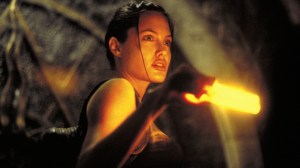 This is a movie that is light on characters yet at the same time has so many extraneous ones. The bad men are being led by fellow tomb raider Alex Cross (Daniel Craig), who also happens to be a former flame of Croft’s. Lara is saddled with a geeky computer whiz who just happens to be British, because he keeps spouting phrases like “blimey” and “bugger” all the freakin’ time. Croft also employs a butler, because, someone has to take care of that huge house. If this wasn’t enough the big bad employs an assortment of typical evil henchmen that are distinguishable by tattoos alone. Add on top of this heap the flashbacks Croft has of her long missing father Lord Croft (played by Jolie’s real father, Jon Voight). All of these dueling personalities clog the action and the pacing.
Front and center, Angelina Jolie is the living embodiment of Lara Croft. She fills out the attitude and the look to a perfected T. Jolie gives Croft the muscle but the screenwriters fail her in giving her the flesh and blood. Tomb Raider falls into the “rule of five”: if there are five or more people credited with the script (including in this instance the director himself) then there was no script at all.
The action of Tomb Raider is loud and explosive but rather lifeless and dull. West has managed to create bombastically mundane action sequences. Never once did anything from the screen arouse my interest, except for the female lead of course. The story has its characters travel to exotic locales and impressive sets of ancient caves and temples, but it’s all window dressing. The pretty scenery and locations only mask how ineffective and boring the action is. And for an action picture, when the audience begins to notice how pretty the scenery is compared with the action – you’re not doing your job.
 Simon West is not exactly a director to be trusted with any sort of project. West brought audiences Con Air and The General’s Daughter, a film that tried to decry rape but then took sadistic pleasure in recreating it again and again. So what better man to helm the project of the buxom video game heroine than a man who has brought us cartoonish violence and horrific rape? The camera framing of Tomb Raider takes a few notes from the Jennifer Love Hewitt experiment that was I Still Know What You Did Last Summer. Jolie’s breasts are always in frame, and at certain times it seems like the camera is lowering just to get them in there for the sake of exposure.
Despite the attempt this video game turned into a movie feels exactly like a video game turned into a movie. It’s complete with some laughably atrocious dialogue (“You know what today is?” “The 15th.” “And that is never a good day.”), and despite the running time of an hour and a half, it feels like an eternity longer. Tomb Raider never gets off the ground even with the added push of some pretty good special effects. Jolie may have an action vehicle at her helm and that’s fine with me. Keep her. Just make sure to get rid of everyone else.
Nate’s Grade: D


 nathanzoebl
You must be logged in to post a comment.