Blog Archives
Sicario (2015)
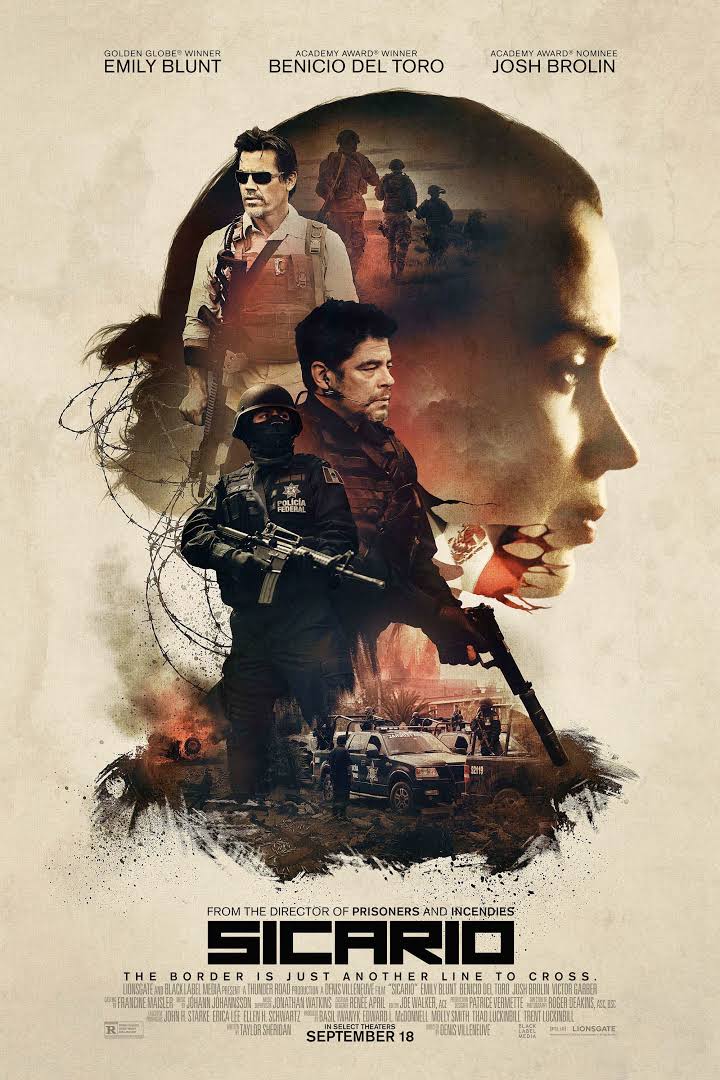 The word “sicario” is Spanish for hitman, we’re told in a helpful opening text. It’s a term that has greater meaning in the landscape of the war on drugs, a war that has ravaged Mexico and its citizens. Sicario, the film, is grim and gripping and director Denis Villeneuve doesn’t hold back from the brutality of its reality. Sicario is a flat-out tremendous film. It’s the most intense film I’ve sat through since 2012’s Zero Dark Thirty, so much so that for long stretches of the 121-minute film I was literally tearing my hair out with delicious anxiety.
Kate Mercer (Emily Blunt) is a Phoenix FBI Agent called in by her superiors with a very special offer. Matt (Josh Brolin), a government agent whose affiliation is classified, has a task force that he would like Kate to join. She’ll be taking it to the drug cartels by destabilizing their chain of power. Kate accepts the job. Alejandro (Benicio Del Toro) is a foreign agent in alliance with Matt, and he seems to be deeply knowledgeable of the cartel and their practices. As the chaos swirls and the team gets closer to the cartel bosses, Kate has to reckon with what she is part of.
Let Sicario be a blueprint for how to brilliantly develop suspense sequences in mainstream cinema. I’ve written about it before but the key to suspense and horror is simply characters we care about and the worry of what will happen next. Sicario places our characters in the middle of an ongoing battle and serves them up as the change agent, the proverbial stick rattling the hornet’s nest of deadly cartels. There’s a wonderful sequence when Kate joins up with the team for her first mission. She’s been told she’ll be based in El Paso but in reality she and a team of Army Rangers are venturing across the Mexican border into Juarez. They’re picking up a high-level cartel informant and transporting him back to American soil. The ride into the country sets the stage as the caravan of black SUVs tears through the streets of Jaurez, bracketed by Mexican state police vehicles. We’ve previously been told at what points a likely trap might be staged, and so we wait, taking in the terrain, the distance, the exits, the personnel. We’re already sizing up the Mexican state police cars; is that one on the take? It’s at the end that the scene coalesces into an even stronger whole, as we literally have a climax in traffic. The border entrance is backed up, and so Kate and our team wait, all the while identifying some suspicious armed men in traffic lanes parallel to their vehicles. They’re told they cannot fire until deadly force is used, and so they wait and we wait. It’s a top-notch sequence where you’re nervously waiting for the boil, waiting for the explosion.
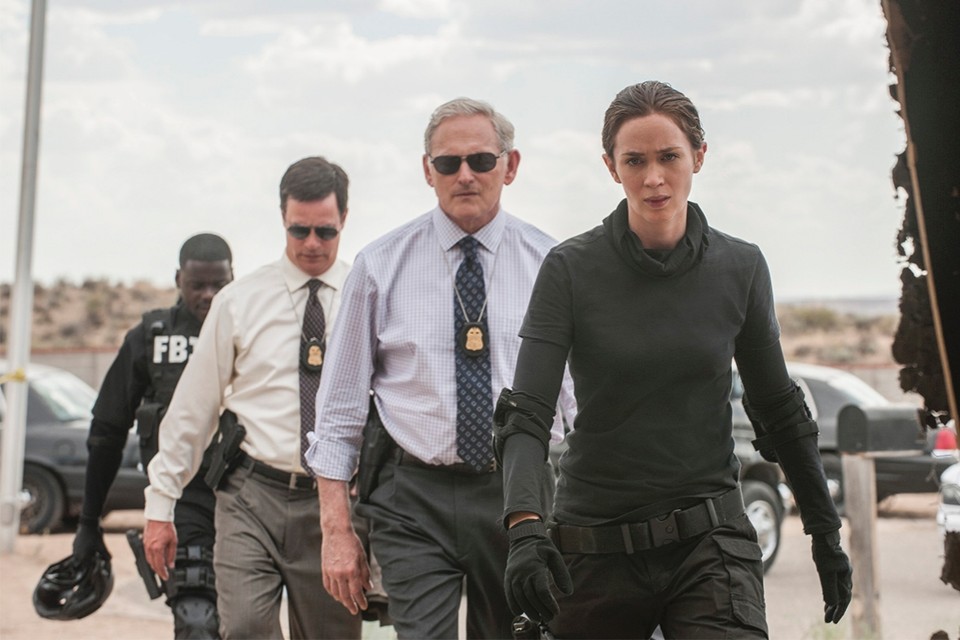 Writer Taylor Sheridan (best known as Deputy Chief Hale on Sons of Anarchy) has taken what could have been an empty Michael Bay-styled drug war thriller and given it a soul. Sheridan’s structure is ingeniously tied into his larger message about the moral futility of the escalating war on drugs. As Kate becomes more immersed into the costs of her new role, of the mounting ethical compromises and legal loopholes, she becomes a background player and Alejandro takes center stage. Rather than simply harden up and sacrifice her ideals for the sake of her mission, Kate holds true to her principles, even if she might be the only one continuing to stick to the rules and a need for oversight. It makes her a far more interesting character and it all comes to a terrific climactic scene that hinges upon two characters at a forceful crossroads, each with diametrically opposed viewpoints. For all the action, Sheridan has found a great way for his story to have a character-based climax that hits harder than simply killing the Worst Bad Guy. As we learn more about the reasons Kate was selected, her literal marginalization in the story makes thematic sense, especially as she’s unwilling to become a “wolf” in a “country of wolves.” Alejandro is that wolf, and in the last act he becomes the film’s focus as the pieces of their destabilization plan fall into place. There’s a scene with Alejandro that is so cold-blooded yet badass that it made my audience gasp. As the bodies drop and blood is shed, Sicario doesn’t lose sight of its characters even to the very end.
Sheridan’s script tackles its subject with a propensity for acknowledging the messy reality. There are no easy solutions and perhaps the best solution is really one that is at odds with conventional legality. The United States is losing the war on drugs, and innocents are suffering in droves. Matt’s cavalier attitude is in response to the overwhelming evidence that the war on drugs has done little except to enshrine certain violent elements into power. He’s trying to clear a path for Alejandro, but for what aim afterward is ethically questionable. When you’ve got nothing but bad solutions, perhaps the best option is still one that’s a step too far. Sicario tackles the harsh realities of the war on drugs without ever dragging out a soapbox. The messages and debates are suffused in every frame, every taut sequence, even pained expression. It’s a message movie where the morality and the escalating action go hand-in-hand.
With Prisoners and now Sicario, Villeneuve has proven to be one of our finest directors when it comes to making adult movies that get your palms sweaty. The execution of these suspense sequences left me breathless. Villeneuve uses long takes of aerial photography hovering over the topography of Mexico and the American southwest. It has the effect of feeling like you’re surveying an alien planet. Added with the ominous score by Johann Johannsson (The Theory of Everything), the tension can feel overwhelming at times. The menacing and percussion-heavy score makes it feel like an army is approaching. The movie also looks absolutely beautiful thanks to the cinematography from Roger Deakens. There are several lovely shots lit with the dying rays of sunlight, which I would admire further if my heart weren’t in my throat while watching. Villeneuve also knows when to pump the brakes, letting his film breathe, and letting his actors take center stage. There are several moments of restraint that allow the actors to flourish. From top to bottom, Sicario is a technical marvel that impresses as it continues to horrify.
Blunt as a badass is nothing new after her killer turn in last year’s vastly underrated Edge of Tomorrow, but there’s way more to her than being a superhero with a gun. She’s the moral conscience of the movie and you may discover, as she does, how irrelevant such a stance may be in this underground world. She’s trying to make sense of it all, trying to go along with what she thinks is right, or at least making a difference, and swallowing her frustrations. She saves the best for last in a finale scene that pushes her character to the breaking point of her ethics, and Blunt floors you. While Blunt is our entry point into this world, and Brolin is amusing as a cavalier rogue agent, this is very much Del Toro’s movie. Alejandro could easily be the slick movie-cool hitman, a soulless killing-machine, but he’s a haunted man who knows he’s damned and goes about his business with steely resolve. Benicio Del Toro can often be confused with doing little acting because he so naturally underplays his characters, but keep watch and you’ll see a man who inherently knows his character. There are subtle shifts and small reveals that open up Alejandro, who is so hardened that this will be all you get.

There have been some complaints citing the film’s lack of perspective from the Mexican side of the border, which is fair but also overlooking Sicario’s complexity. With its fear of cartel war violence spilling over into American neighborhoods, it’s not hard to see this film becoming supposed evidence in a xenophobic political campaign. Surely Donald Trump will be talking about Sicario. There is a small degree of representation with a minor character involved in the drug trade. The movie flashes back to him and his family a few times, setting us up to expect he’ll return at a pivotal moment later. He’s a completely unremarkable character and the brief scenes we spend with him made me anxious to get back to Kate and the main story. I didn’t care, and then he did reappear and I was quite surprised to find myself actively caring for this minor character’s well being. In a scenario where it seems like there’s a lack of vulnerability, this character provides it. He’s not a bad person per se as just another cog in a corrupt machine trying to provide for his loved ones. It’s a window into the larger ramifications of Kate and Matt’s actions. The very last bittersweet image doesn’t feel like victory, more like a warning of impending consequences that will befall innocents, and they aren’t Americans.
It’s rare to get a Hollywood thriller that excels at what it does and exceeds lofty expectations, but Sicario is that movie. Here is a thriller that excites, unnerves, provokes thought as well as terrible anxiety that you sweat in buckets over. The general feeling while watching Sicario is one of disquieting dread. The challenging and disturbing reality of the war on drugs blends with the brilliantly executed suspense sequences. The characters don’t get lost midst the clatter of violence, the direction enhances the actors and allows them to better inhabit their engaging characters, and the overall orchestration of all the many moving parts is so polished, so in tune, so electric that Sicario often does more than just entertain, it forces you to react. Leaving my theater was akin to coming down off an adrenaline high and I wanted to tell everyone I knew to see this movie. That’s the power of great cinema and Villeneuve has created a compelling feature that deserves to be soaked up and studied. This is exhilarating moviemaking, folks.
Nate’s Grade: A
Share this:

Run All Night (2015)
 Nobody quite expected the second act that Liam Neeson is currently having. Before 2009, he was seen a dramatic leading man best known for portraying the titular businessman in Schindler’s List. And then Taken came out, and the world decided they liked their action stars with a dash of actorly gravitas, the kind of which was all too lacking from the likes of your Van Dammes. After so many films of Neeson pointing guns and barking at people, you forget that the man can act. That’s because, with few exceptions, the Neeson canon of action vehicles have been found enjoyable but insubstantial, momentary pleasures to be forgotten. The same can be said of Run All Night, a promising urban jungle thriller that’s a step above in several areas but ultimately another mildly entertaining film where Neeson points guns and barks at people.
Jimmy (Neeson) is a man haunted by his memories of his life as a hired gun for his pal, mob boss Shawn Maguire (Ed Harris). Jimmy is a drunk who is living off of Shawn, holed up in a crummy home, and eking out his lonely days. He walked out on his son, Mike (Joel Kinnaman), when he was young because he wanted him to have a better life. Jimmy thought his misdeeds would create a bad influence. Shawn is also experiencing his own problems with fatherhood. His son, Danny (Boyd Holbrook) is ambitious, dangerous, and addicted to drugs. He agrees to a business arrangement with Armenian mobsters before dad gives him the A-okay; when dad balks, Danny is on the hook. He murders the two Armenian mobsters who are looking for their money back. Unfortunately, Mike just happened to witness this execution. Jimmy defends his son, shooting and killing Danny. For the rest of a very fraught night, Jimmy tries to protect his son from the many forces of violence that Shawn has sent for vengeance. 
The premise of Run All Night is strong unless you say it out loud and examine it. I admire the film’s manner of weaving together storylines in a way that they feel like they’re crashing into one another and yet you could see their trajectory coming. That’s not to mean it’s predictable, which it is of course, but that the conflicts are properly established and set in motion. However, when you analyze the revenge-laden intricacies, it can seem like self-parody: “You murdered my son before he could murder your son. So I’m going to murder you.” “Oh yeah? Well I’m gonna murder you before you murder me for murdering your son before he murdered my son.” Gentlemen, commence your murdering. It reminded me of 2002’s Road to Perdition where a crime lord who readily admitted that his son was a dangerous hotheaded screw-up and had made a mess of things… and yet, he had to stick by him because… family. It’s a frustrating contradiction but it’s believable enough to hold onto. I just wish these crime guys could objectively calculate how guilty and irresponsible their kids are and cut them loose. Seriously, what exactly was Danny thinking when he killed the Armenian mobsters? Did he not think they were going to retaliate? Danny is the kind of irritating screw-up you want to strangle because he endangers others with his constant failures.
Screenwriter Brad Ingelsby (Out of the Furnace) has done his genre homework, and Run All Night is a slightly above average thriller that finds ways to flesh out its tropes amidst the urban jungle. After a steady first act, the majority of the movie is a series of chase scenes, several of which are shot and edited well by Neeson’s favorite director of his run and gun pictures, Juame Collet-Sera (Non-Stop, Unknown). The chase scenes make smart use of geography and the way Collet-Sera cuts back and forth with his parallel lines of action does a nice job of quickening pulses. A chase through a train terminal is well choreographed with Jimmy having to out run and out muscle goons and Mike ducking from encroaching police presence on the platform. Ingelsby has a knack for setting up organic suspense pieces and letting them loose. The final act feels a little pat from an action standpoint as well as a moral climax, but it does work. While the characters are birthed from familiar genre archetypes, the film adds interesting shadings to them. Jimmy’s loyalties are tested and he has a strong personal revelation that ties into this theme. The movies finest moment is likely a tense sit-down between Shawn and Jimmy shortly after the events of the night has been set in motion. It’s like Harris and Neeson are competing to see who can be more intimidating Oscar-nominated actor. Bonus: Bruce McGill (Lincoln) plays Harris’ number two and I love some Bruce McGill.
 And yet, I kept wishing for Run All Night to go back to the power of its possibilities. There’s a segment where the movie truly feels like it’s being taken to the next level, namely after the crooked cops have been taken out. Instead of just Maguire’s muscle coming after them, now Jimmy and Mike have the NYPD hot on their tail and none too happy about cop killers. That’s another category of antagonists, another chase participant. I also wanted the movie to keep going, bringing in the Armenian mob, which would be incensed and seeking vengeance after their ambassadors were killed. This movie could have had three categories of antagonists (Shawn’s goons, NYPD, Armenian mob) chasing after Jimmy and his son, and the ongoing conflict would have been terrific. The more people that are on the hunt, for their varied reasons, the more possibilities there are for strong and escalating suspense pieces. It could have easily gotten too complicated and convoluted for a mass audience, which is probably why the movie doesn’t reach its true suspenseful potential and follows a conventional route. The NYPD angle is only really incorporated during a building-wide search of an apartment complex where Jimmy and son are hiding. Likewise, the addition of a contract killer played by now Oscar-winner Common (Selma) is a wasted antagonist that doesn’t add much more to the group of bad guys. He’s better at killing, sure, but he doesn’t offer anything new except some hardware. He’s essentially an elevated heavy. He’s meant to serve as the threat after the threat, and no surprise, he does. I wish the character had more personality because he’s just too rote to separate himself. He’s just another ho hum killer in the mix.
There’s a plot point that annoys me to the point that I need to talk about it in more detail, though to do so requires some spoilers, so tread carefully, reader. At one point, Jimmy insists his son does not pull the trigger and kill Common. His wish is that his son would turn out better, and so he doesn’t want him to be forced to commit murder. They leave the contract killer who, you guessed it, continues to try and hunt them down and kills innocent people in the way. I understand the moral imperative Jimmy is going for, but let’s analyze this. It’s self-defense, he’s determined to come back and kill you, and you know innocent lives will suffer if he stays alive and well, whether on this job or future jobs. If ever there was a situation where maybe Mike isn’t going to be racked with guilt into the odd hours of the night debating the descent of his soul into moral decay, this might be the one. It’s one of those moments where the characters have to behave this way because the plot demands it and we need, as stated above, a threat after the main threat. Again, I’m reminded of Road to Perdition, which had a much better additional hitman.
Some things are better enjoyed at your leisure, and Liam Neeson’s action ouvere fits into that category. With few exceptions, a Neeson action film checks the boxes of what you’re looking for in genre entertainment, and with a strong Neeson finish, but rarely will you be surprised or elated. Entertained, sure, for the time being. Run All Night is an action thriller that has its moments and some well-drawn suspense sequences, and I appreciate that it tries to provide more depth to the main characters besides their preferred killing weapon of choice. However, there’s just too much squandered potential, underwritten supporting characters, and heavy-handed messages about the sins of the father. Run All Night is a solid genre thriller that does enough well to be worth your time, though you certainly don’t need to exert any energy to run out and see it.
Nate’s Grade: B-
Share this:

Nightcrawler (2014)
 The surprise of Nightcrawler is that it works well on different levels: as a psychological descent with a deranged lead, as a media critique on sensationalism, and as a genre thriller. Jake Gyllenhaal (Prisoners) gives a truly transfixing performance as Leo Bloom, an ambitious sociopath who will stop at nothing to become the best at what he does. It so happens he films accident and crime footage to sell to the local news stations, and he’s not beyond getting his hands dirty if it means a better camera angle or a better payday. The actor reportedly lost 30 pounds and he appears otherworldly, his lanky frame and gaunt face making his bulging eyes pop. There’s a hypnotic intensity to his performance and a darkly comic irony that he speaks almost entirely in business buzzwords and jargon. The film chronicles his rise to power and how he uses his leverage to manipulate the people around him. The media satire is a little heavy-handed but still makes its points, especially in an age of scandal and hysteria. Rene Russo is also great as the desperate and bloodthirsty news producer who is charmed by Bloom but then gets too far in. Writer/director Dan Gilroy (brother of Tony) has crafted a haunting central figure that is morally repulsive yet entirely engaging, especially with a career-best performance from Gyllenhaal. He’s a fascinating psychological case, even if he remains relatively the same character from the start. He makes every moment an opportunity in suspense. Gilroy has a natural sense for visuals and especially how to pace his tension, drawing it out with precision in the final act as Bloom’s arrangements cause disaster. The nighttime Los Angeles setting and swirling tension remind me of Michael Mann’s Collateral. This is a movie that sticks with you long after thanks especially to the power of Gyllenhaal.
Nate’s Grade: B+
Share this:

Dom Hemingway (2014)
 Undeservingly lost in the shuffle, Dom Hemingway is a brash and wildly entertaining dark crime comedy. Jude Law is a sheer force of nature as the title character, a charismatic and garrulous criminal with no shortness of ego or volume. He’s just getting out of a 12-year jail sentence and taking stock of his life. His wife is dead, his grown-up daughter (Game of Thrones’ Emilia Clarke) hates him for his absence, and his bosses are ready to reward him for his long silence. The only person who could screw things is up is Dom, and he does, as he’s prone to impulsive fits, shouting matches, and oversized bravado. This is really a series of comic vignettes and vulgar monologues, but the writing by Richard Shepard (The Matador) is slyly hilarious, leaving me in stitches throughout (“I am not burying your body today! I didn’t bring the right shoes for it.”). The comic voice here is assured and finely attuned to the broad wavelengths the characters. It’s not exactly he colorful, cartoon criminal universe of early Guy Ritchie films, but there’s a definitely heightened atmosphere here that blends well with the manic nature of Dom. Law is bouncing off the walls; you may have to wash the spittle off your TV. But he’s compelling from his first minute onscreen to his last. The third act squeezes in a degree of emotions though by then we’ve been enjoying the depravity too much to switch focus. I don’t think the work has been put in to make Dom a three-dimensional character, but that won’t stop Dom’s film from being a blast of entertainment with swagger to spare.
Nate’s Grade: A-
Share this:

Gone Girl (2014)
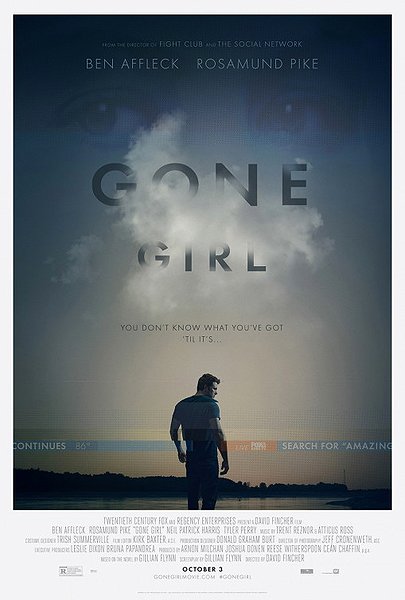 Rest easy fans of Gillian Flynn’s runaway bestseller, because Gone Girl the movie is pretty much exactly Gone Girl the novel. There were rumors that Flynn and director David Fincher had drastically retooled the controversial ending, but this was only premature speculation. Fun fact: it’s easy to tell the people who didn’t read the book in your audience because they will more than likely be the ones who groan once the end credits kick in. The fealty to the book is a relief because, as we book readers know from those late nights compulsively turning Flynn’s pages, the real star of the movie is the story, which was ready-made for a grand, pulpy thriller, and that is Gone Girl the movie. Whether it’s anything more than an exceptionally well made thriller is up for debate
Amy Dunne (Rosamund Pike) has gone missing from her supposedly perfect life. Her husband, Nick Dunne (Ben Affleck), starts off as the tortured, grieving husband. He comes home one day to find his home wrecked and his wife missing. The police (Kim Dickens, Patrick Fugit) are worrisome about Nick’s abnormal reaction to his wife’s disappearance. He doesn’t seem to know much about his wife. He seems like he’s hiding something. Even Nick’s twin sister Margo (Carrie Coon) has her doubts that Nick is telling the full truth. Amy’s diary paints a different portrait of her husband, a man prone to increasing anger, mostly stemming from the loss of his job and a relocation from New York City to Missouri. Most of Nick’s anger is focused squarely on Amy, enough that she fears for her life. As various clues keep piling up and Nick’s public behavior appears suspicious, the media spotlight transforms him from victim to prime suspect.
 No question having an artist of Fincher’s caliber raises the quality level to its highest degree, but it’s the perfect marriage of filmmaker and material that allows this movie to soar. Both Fincher and Flynn have a cold manipulative streak that twists an audience into knots. It’s a terrific whodunit with several booby-trapped surprises that only make you dig in more. It seems like every few minutes we’re learning more about Nick and what he’s been hiding from others. Flynn, who also adapted the screenplay, does a terrific job of playing with our loyalties, getting us to doubt what we see and who these people really are, and she does this even to the final minute, leaving us with no clear-cut answers to wash away our reservations. Flynn’s strengths as a writer are how she reveals her tale over time, how she makes us rethink the past and the characters and their sincerity. It’s a patient film, and just under two and a half hours perhaps too patient, but it’s not the least bit lackadaisical. Flynn’s story is wrapping a web around Nick and watching him get caught, and every perfectly timed reveal only widens that web. Gone Girl is a film bursting with intrigue. It snares you and then fiendishly plays with your expectations.
Affleck (Argo) was an obvious choice for the role of Nick Dunne, the charming man whose self-effacing smile rubs people the wrong way. He’s rarely been better onscreen, giving strong life to all the conflicting parts of Nick, from his calm aloofness at his wife’s disappearance to his cunning way with his own truths. He gets way in over his head, and watching Affleck navigate the tenuous situation is one of the film’s many twisted pleasures. Pike (The World’s End, Pride and Prejudice) is going to be an unfamiliar face to most American audiences but not for much longer. This is the biggest role of Pike’s career and much like Fincher’s other “find” Rooney Mara in Dragon Tattoo, she knocks it out of the park. In just a look she conveys Amy’s upper-class upbringing, her icy demeanor being interpreted as disdain. Through Amy’s journals, the character opens up to us, becoming better defined, making us fear for her, and Pike sells it. Hers is a performance of layers; it’s like she gets to play several Amy’s in this movie. Her demeanor is always so composed, so modulated and controlled, so the big moments that draw out her anger and horror register even more. It’s too early to determine what kind of awards buzz Gone Girl will have through the season, but if anyone has a chance, it’s her.
From top to bottom, the supporting cast adds great value to the film. Most surprising is Tyler Perry (yes, that Tyler Perry) as Nick’s high profile, slick, morally flexible defense attorney. It is no stretch to say this is Perry’s finest acting ever put to film, in or outside a dress. I wanted more of him, and that’s not something I’ve ever said before. Dickens (TV’s Treme, Footloose) would ordinarily be the best performance in most movies; smart, empathetic but no-nonsense, and wryly funny. In an ordinary crime thriller, she’d be our lead character. Coon (the breakout actress from HBO’s The Leftovers) is the audience’s voice of sanity, providing necessary gallows humor to punctuate all the discomforting dread. Casey Wilson (TV’s Marry Me) is a suburban housewife send-up and provides some laughs too. Even Emily Ratajkowski, otherwise known as one of the topless models in the “Blurred Lines” video, is pretty good as a naive coed. Thus is the power Fincher wields as a director of actors, a quality often overlooked by his technical prowess. The one casting question is Neill Patrick Harris (TV’s How I Met Your Mother) as Desi, Amy’s creepy ex-boyfriend who still very much clings to the notion they should be together. Harris tries too hard to be creepy, concentrating too much that his style becomes mannered and halting.
 With Fincher’s name attached it’s almost redundant to talk about the technical superlatives of the movie; it goes without saying. One of the finest visual stylists of his generation, Fincher impeccably composes his shots. The man finds a kindred spirit with Amy and her color-coded meticulous organization. The cinematography is crisp and suitably eerie and dreamlike (or nightmarish), the mood always pulsating with a beautiful dread to tap into the unsettling unease of Nick’s dire situation. The editing is rock-solid, keeping the audience guessing with the balance of Amy and Nick perspectives. There is a chilling sequence late that involves a mass amount of blood, but it’s made even more unnerving thanks to the judicious edits and fade outs, heightening the horror. The only technical aspect I found wanting is the same with Fincher’s Dragon Tattoo, namely the score by Atticus Ross and Trent Reznor. Twice now I’ve labored through musical scores of theirs that could best be described as ominous ambient noise. You keep expecting it to build but it doesn’t. Perhaps it’s just the change of material, as it’s also been two films in a row based upon dark and grisly crime paperbacks, but consider me disappointed yet again. There’s nothing memorable here and that’s a shame considering how buoyant their Oscar-winning score was for the still amazing Social Network.
But even with that Fincher polish and the sinister snap of Flynn’s plot, I can’t say that Gone Girl the movie rises to the level of its lofty ambitions. Much like Dragon Tattoo, this is a skillfully made crime thriller, but is it anything beyond that description? That’s not to say there’s anything particularly wrong with being a skillfully made thriller; Fincher’s Seven is one of my favorite films of all time, and yet despite its end-of-times philosophy about the dark hearts of man, it’s really nothing more than a exceptionally made thriller, and that’s fine because that movie is near perfect. With Gone Girl, the stabs at deeper analysis and social commentary feel just out of grasp. The tabloid news fixation, a landscape littered with missing wives and presumably guilty husbands, is ripe for satire, but it feels always on the peripheral, like Fincher is checking in to take the temperature and then going back to the muck. There’s much more that could have been done, but that’s fine. The larger missed commentary is with marital relationships. This is not, as some critics have labeled, a How We Live Now kind of film, a jarring wake-up call that human beings more or less suck. Nick and Amy are far from being relatable analogues for the masses, and that’s fine. They are allowed to just be interesting characters, which they are, rather than stand-ins for searing social commentary. The fact that five years into their marriage they’re both still strangers says something about them, but does it say something novel about marriage itself or human relationships in the twenty-first century? The idea of people wearing false masks isn’t exactly new. The average couple is not probably going to go to bed thinking, “Who is the real person I’m with?” The average couple is just going to go along for the ride and think, “Wow, these are some messed up characters.”
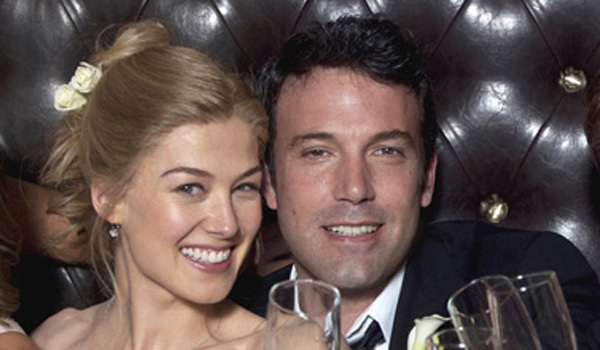 And now some spoilers as I delve into Gone Girl’s ending, so if you choose to remain clean please skip to the next paragraph. The ending is unsettling and disappointing for people because the only person who gets what she wants is our main antagonist, Amy. The final shot, a replay of the opening image but with clarifying context, is her triumph, staring coldly, head atop her husband, as if she were a cat purring. She has won. And this ending pisses people off. For my money, this is the absolute perfect ending for a story about toxic relationships and a morass of a marriage. Nick is rescued by Amy’s reappearance, engineered through some canny media manipulation by Nick, but now he’s stuck, and stuck with his lovely psychopathic wife. The police know she’s guilty but won’t proceed further thanks to looking inept on a national stage. Nick can’t leave because then his child will be raised by Amy, twisting him or her into mommy’s little psychopath. The only way he saves that child is by staying, by sacrificing his own freedom, to become prisoner to his wife, to play the part she has wanted him to play, and he does it. He is condemned. I find that to be poetic and darkly satisfying, and it’s very true tonally for this sort of sordid tale, but I understand why people hate it. I just think a happy ending or one where the villain is vanquished would feel trite.
Gone Girl is a toxic relationship movie, an involving and pulpy suspense thriller, a rewarding character study that plumbs some pretty dark depths, and most of all a sickly entertaining movie with excellent craftsmanship. It is everything fans of the novel could have hoped for with Fincher attached. As our tormented husband and wife, Affleck and Pike deliver career-best and career-making, in her case, performances. The ending will divide audiences sharply just as it did readers but I consider it the correct denouement. The movie doesn’t provide much in the way of stinging, applicable social commentary or media satire that hasn’t already been covered by the likes of Jon Stewart and Stephen Colbert. But does it have to be anything more than a terrific thriller? An exceptional thriller can be entertainment enough, and Gone Girl is definitely that.
Nate’s Grade: A-
Share this:

A Walk Among the Tombstones (2014)
 Scott Frank has only directed one movie, The Lookout, but as a screenwriter his fingerprints are everywhere in Hollywood. The man’s name is all over projects such as Out of Sight, Minority Report, Get Shorty, The Wolverine, Marley & Me, and those are just the ones that made it across the finish line. As any aspiring screenwriter knows, Hollywood is built upon an ever-amassing burial ground of unproduced screenplays. A Walk Among the Tombstones is only his second directing feature, which tells me it must have had significant personal value for this famous scribe. You can definitely tell Frank has an affinity for hard-boiled film noir of old, though the splashes of in-your-face sadism may be too much for certain audiences. It’s a genre movie all right, but it’s also a grisly one that bothers to take its time setting up character, plot, and resolution.
It’s New York City on the cusp of Y2K, and retired cop Matt Scudder (Liam Neeson) is just trying to enjoy his dinner. He’s pulled into a complex kidnapping scenario at the behest of one of his AA peers. Two men have been targeting the city’s drug traffickers, men with big pockets who cannot go to the police. These psychopaths enjoy abducting the trafficker’s wives, ransoming them for hundreds of thousands, and then slicing and dicing their victims anyway. Matt initially turns down the offer, working around the edges f the law, but the viciousness is too much to ignore. He reawakens his old detective habbits, falling back into a routine, and tracking down those responsible.
 Those expecting a regular Liam Neeson afternoon of top-draw face punching may be in for a slight disappointment, because A Walk Among the Tombstones is a gritty detective tale that swims amidst an ocean of moral decay and queasy sexual violence. It’s a detective yarn that unwinds at a casual pace but one that feels like a natural connecting of plot points. Thankfully, this isn’t a movie that treats the identity of the killers as a mystery that needs to be dragged out as long as possible, with the ultimate pained reveal being one of the otherwise harmless characters we’ve previously been introduced. We know who these two psychopaths are after about twenty minutes, so there’s no prolonged guessing game. Rather than linger on who they are we now await the ultimate satisfaction of Matt Scuder finally facing off against our two psychopathic killers, and they are indeed psychopaths. These two are very wicked men, gathering sadistic pleasure from torturing their captive women. The two men are kept as unsettling ciphers; we don’t know much about them except they have an addiction to killing. It’s not about the hundreds of thousands they scam from the drug traffickers; it’s really about the thrill of the hunt. While I wish there was more depth, they were menacing enough. I was itchy with anticipation for them to get some comeuppance. I’ve read reviews indicating that our two remorseless killers are a gay couple; if this is true it’s kept very vague for interpretation. In the age of equality, it could be homophobic to declare, in absolutes, that psychopathic killers couldn’t also be gay or lesbian. That would be… wrong?
With two strong villains, you need a strong hero to bring them down, and Neeson fits the part like a natural. To be fair, the role is somewhat stock from a passing description: the loner former cop with the tragic past, a drinking problem, the gruff style, the over-the-hill age, the man trying to adapt to a new and changing world, sometimes not for the better. It’s a role that feels ripped from the tropes of crime thrillers, a world we’ve also become accustomed to seeing Neeson. The detective role is familiar but, like most within Frank’s film, it’s given more time to breath and a surprising degree of attention. This doesn’t come close to last year’s Prisoners in the realm of character work, but it’s still an above-average entry for a genre too often ignored when it comes to realistic and satisfying characterization. Matt Scudder exists in a New York City that owes a debt to the pulpy noir page-turners of old, but it’s not exactly stylized, and neither is he. The man still uses microfilm and needs the assistance of a street-smart homeless teenager to assist him with this newfangled Internet thing. While it feels somewhat forced, the relationship with Matt Scuder and his young protégée is the strongest in the film, opening up the character’s redemptive arc. It’s always appreciated to watch Neeson get to flex his acting muscles rather than just being given action choreography and trite tough guy bravado.
There’s one other actor I’d like to single out, and I’ll thank my mother for this. Fans of Downton Abbey (like dear old mom) may recall Dan Stevens as the dashing and departed Matt Crawley, but he is almost unrecognizable as the grieving husband/drug trafficker that kicks off our story. For one, the guy lost a decent amount of weight and his gaunt face makes him seem all the more mercurial and intense. The characters plays against type with our expectations for a drug dealer, and you may find yourself, like I did, warming to him and yearning for the man’s vengeance for his wife.
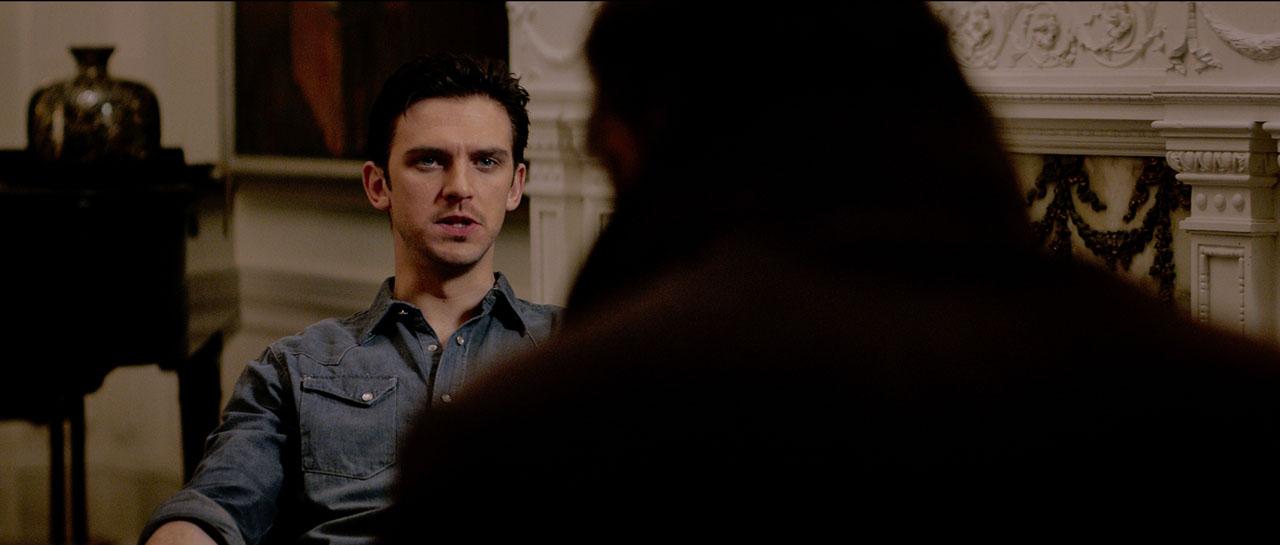 Frank’s direction is awash in the grime and seediness of New York City, with dark shadows washing over his troubled characters, and a sense of style that, while omnipresent in tone, doesn’t distract from the story. The rich cinematography by Mihai Malaimare Jr. (The Master, Tetro) is a great asset. The film noir elements are here in abundance and with due diligence. It rains in just about every scene. Why? All the better for a moody and eerier atmosphere, though the rain does actually factor into a character-based conflict for Matt’s protégée. It’s a moody thriller that is assuredly above average for its genre. Not everything quite works (the third act is too drawn out; a montage of AA 12 steps narration over sequences of violence is more than a little heavy-handed; the explicit Y2K setting doesn’t really have a purpose other than to limit certain technological advances not becoming of the genre) but Frank knows how to draw out the strengths of the genre.
A Walk Among the Tombstones is a gritty genre throwback, but what really jumped out to me was the hook of the premise. Neeson plays a man on the outer edges of the law but a man who still bends toward the justice system he once worked for. What makes this character unique, or at least the promise of, is that he ends up becoming the private detective for the criminal world, and that I find to be fascinating. We think of criminals, especially drug traffickers, are tough men who can handle their own problems with extreme authority. But they are also just people and can get in over their head as well, and when they need someone with private eye skills, who knows how to operate inside the bounds of the law and out of them, that’s where Neeson comes in. He does such a good job that he gets recommended around the New York ring of drug traffickers. He’s like a Michael Clayton-style fix-it guy but for the criminal underworld, and I think this concept it rife with juicy potential. Tombstones is based upon a series of books by Lawrence Block, so there could be further adventures, and I would welcome them, especially if the finished product is as entertaining as this first foray.
Nate’s Grade: B
Share this:

Devil’s Knot (2014)
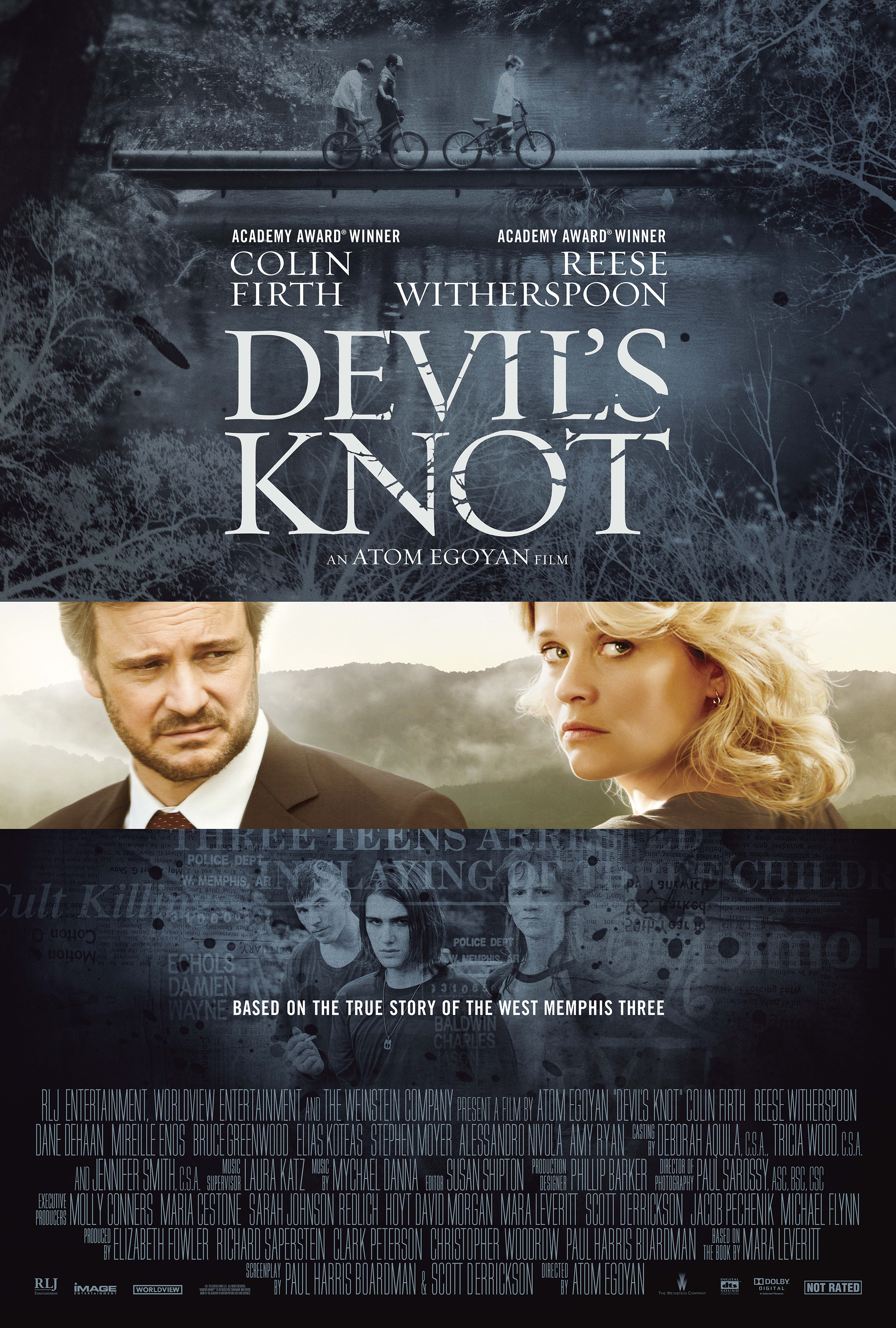 In 1993 in West Memphis, Arkansas, three eight-year-old boys went out late one night to ride their bikes. They were never seen alive again. The ensuing media circus that erupted lead to the conviction of three teenagers (The West Memphis Three) who many believed were innocent of these heinous crimes. Stop me if you’ve heard this story before. It was the basis of three stirring, powerful, galvanizing documentaries by Joe Berlinger and Bruce Sinofsky, two men credited with saving the West Memphis Three. Now after their release from prison, here comes Devil’s Knot, the first fictional film about the notorious case, Hollywood’s first crack at well-tread material. Is there anything new to be found?
Director Atom Egoyan (The Sweet Hereafter, Chloe) and his screenwriters do a credible job of distilling the complicated case against the West Memphis Three to its basics, relying on a modulated tone that shies away from the sensationalism that dominated the case back in 1993. With the benefit of time and hindsight, it’s easy for the movie to point out the erroneous thinking of the prosecution, the jump to conclusions, and the Satanic panic engulfing the community of Arkansas. We’re told by a police officer that they knew this “Satanic cult stuff” would hit town; they’ve just been waiting for the day. To its credit, the movie does a fine job of calmly and objectively pointing out the deficiencies in the police and prosecution’s case against the West Memphis Three. We’re told that from the twelve hours of interrogation with Jessie Misskelley, only 40-some minutes was recorded. The obvious mistakes in his confession, as well as the police coaching and coaxing him to their desired response, is made readily apparent. There’s “witness” Vicki Hutchernson (Mireille Enos of the oft-canceled The Killing) who says she say chief suspect Damien in a Satanic ritual, but the film cuts back from the imaginary to Vicki watching a movie on TV, the real source of her descriptive flourishes. Egoyan’s direction has a calm, objective overview that is reverent and respectful of the dead and the bereaved. It’s rarely boring and the facts of this case are such that any retelling would be somewhat compelling.
 So that brings me to the ultimate question: why even make a fictional movie about this subject? Four lengthy documentaries have covered the intricacies of the legal story, the breakdown in justice, and the personal toll on all sides of the crime. The only thing a fictional movie provides is: 1) the fun/distracting game of seeing relatively famous actors play the real-life people we’ve previously seen, and, 2) as an option for people who hate documentaries. If you’re one of those people who dislikes documentaries and doesn’t view them as “real movies,” then Devil’s Knot is for you, you dismissive filmgoer. Otherwise, literally everything was handled better in the Paradise Lost films. With the West Memphis Three thankfully out of prison, the omnipresent sense of urgency from the documentaries is now absent, replaced with a Monday morning quarterback sensibility pointing out all the obvious bias, judicial hypocrisy, and flaws of the case. And as anyone who has plowed through the powerful and addicting documentaries knows, there are plenty of flaws to point out for harsh scrutiny and incredulity. Movies have a long history of showing us an example of judicial injustice, and this is a prime example. However, Egoyan has put the emphasis of his movie on two outsiders rather than people in the center of this case. The West Memphis Three themselves are barely supporting actors in their own movie. I suppose the filmmakers may have wanted to present a different angle to the case since the Paradise Lost films showed the accused up close and personal. The construction of this plot just doesn’t work under the perspectives of Pam (Reese Witherspoon) and Ron (Colin Firth).
Ron serves as a pro-bono adviser to the defense, but that doesn’t mean he has the same access inside and outside the court. He can gather evidence on his own but really this guy is meant to be a fly-on-the-wall for the planning and frustration of all the legal roadblocks thrown at the defense. Is an added body in the room necessary? Could not one of the defense attorneys have provided the same purpose? Instead, he gets to grumble in the court and out about all the legal shenanigans going on to railroad innocent boys. He is essentially spelling it out to an audience. Pam has even less narrative purpose in the film. Her perspective makes sense early on as the mother of one of the murdered young children. Her panic, her worst nightmare come to life, it all makes for the stuff of major drama, which is why you’d imagine Witherspoon was drawn to the part. But once the case against the West Memphis Three gets going, Pam transforms into our Chief Reaction Shot Provider. Whenever a curious moment happens in court, we cut back to Pam and Witherspoon cocking her head in dawning curiosity and uncertainty. It’s as if she is meant to symbolically represent the entire community that was so fervent in their beliefs that these boys were guilty… until they heard the shaky case and the questionable experts put on the stand. So Pam and Ron end up becoming signals to the audience on how to feel and what to think. The movie doesn’t have enough faith in its audience to keep up with the minutia of the trail, or even the lawyers’ arguments, reducing a complex legal trial down to two nonessential characters nodding or shaking their heads.
 I’ll admit that I had some interest watching the actors inhabit the roles, and there are scads of people involved in this story. Bruce Greenwood (Star Trek) does a valiant job showcasing the head-scratching decisions of the trail judge, David Burnett, and his slimy dismissive nature. Stephen Moyer (TV’s True Blood) is particularly infuriating as John Fogleman, chief prosecuting attorney. Seth Meriwether (Trouble with the Curve) looks eerily like his character, the young and accused Jason Baldwin, and he nails his moral convictions and gentle nature. Dane DeHaan (The Amazing Spider-Man 2) gets to do his troubled youth thing he does so well. Kevin Durand is an actor I normally enjoy but even he can’t do justice to John Mark Byers, step-father to one of the slain boys, and easily the most memorable figure in the Paradise Lost films; the man is so theatrical and larger-than-life, and yet Devil’s Knot treats him like a featured extra, with many of his speaking scenes off camera. There isn’t a bad actor in the extremely large cast, though Firth’s Southern accent isn’t the most refined. If the movie lacks much reason for existing, at least the bevy of good actors respectfully bringing new life to these people, good, bad, and many somewhere in between, is the one credible quality to this movie.
What to make of Devil’s Knot, an example of a decent, modulated, and well acted movie that ultimately has no reason to exist in the wake of three excellent documentaries (Paradise Lost) and one other pretty good one (West of Memphis). The ground has been covered. However, that doesn’t mean that a well-told story can’t be told again, with a different angle, with a different approach, but Devil’s Knot hinges on two characters serving as metaphorical barometers to teach the audience what to think and how to feel. Then there’s the matter that the trail covers the entire 114-minute running time. There’s so much more that happens after the initial trial, so much that the last two minutes of this movie are almost a nonstop barrage of text updating the audience on many of the post-trial developments, including the West Memphis Three being released from prison in 2011. The movie feels too limited; there is so much more depth here, to the details of the case, to the personalities and human drama, to the story after the trial. Egoyan and his cast and crew have made a respectful fictional version of these sensational events, but the problem is that they don’t do enough to justify their own film’s existence. Unless you have an irrational hatred for documentaries, just watch those instead.
Nate’s Grade: C+
Share this:

The Raid 2 (2014)
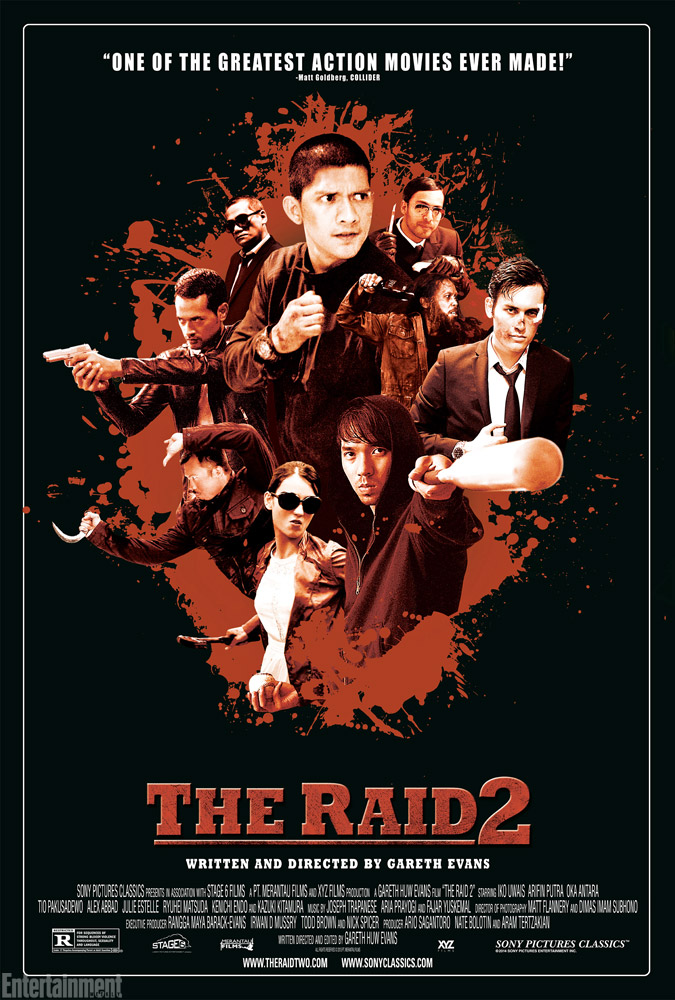 Rare is the movie that I feel I don’t even need to go into great detail rather than just scream, in a fashion suiting madness, “See this! See it!” Such is the case for The Raid 2, the sequel to the 2012 Indonesian action film that melted faces with its inventive and brutal action. The original movie had a confined location, a gang-run tenement building, and a simple premise of reaching the top and nabbing the bad guy. When people weren’t punching or shooting each other, the original Raid lagged, but director/writer Gareth Evans has solved the problem with his action-packed sequel. The world expands greatly, establishing the uneasy peace kept by powerful and warring criminal organizations. The plot ends up becoming something akin to The Departed meets A Prophet, following our hero cop from the first movie now placed undercover to gain the trust of the criminal overlords and work his way up the food chain. When the action isn’t cooking, you’re still engaged with the story and the suspense simmers in clever ways. But getting back to the film’s calling card, the action sequences are impeccably choreographed and edited, have a wide variety of locations for fun, and are bloody intoxicating. This is a movie soaked in adrenaline, and the action sequences will be hard to beat for the rest of the year. Evans finds ways to provide flair for his supporting characters, including a family duo that involves a deaf woman whose weapon of choice is hammers and a guy who prefers a baseball and a bat. The Raid 2 fires on all cylinders so well, so brilliantly filmed, that it puts just about every American action thriller to shame. It doesn’t need to be as long as it is (pushing two and a half hours), and it takes a little while to set up the players, but this is even more of an entertaining rush than the original, because now we get a sense of what Evans and his team can do with fewer restrictions. When Evans gets to Hollywood, and he will, just make sure you give him all the money to do whatever he wants.
Nate’s Grade: A-
Share this:

The Wolf of Wall Street (2013)
 Martin Scorsese. The greatest living filmmaker on the planet. Enough said. When his latest, The Wolf of Wall Street, was pushed back due to an editing crunch, the rumor mill started as it normally does. Are there problems? Is it any good? Will it be forgotten this late into the awards season? While I can’t speak for the Academy, but for me The Wolf of Wall Street just about blows every competing movie out of the water this season. It’s brash, exhilarating, uproarious, mesmerizing, and just about every other adjective you can fetch from a dictionary. This is first-class filmmaking from a master, and consider Wolf of Wall Street the white-collar companion piece to Scorsese’s gangster masterpiece, Goodfellas. It’s that good, folks.
Based on his memoirs, Jordan Belfort (Leonardo DiCaprio) rises on Wall Street from a rookie stock trader to the king of his own empire. From the late 80s to the 90s, Jordan assembles a cutthroat team that knowingly sells lousy stocks to gullible investors and stuffing their pockets with hefty commissions. “Better there money was with me. I knew how to spend it better,” he admits. His closest friend and business partner, Donnie Azoff (Jonah Hill), literally quits his job to work for Jordan after spying one of his pay stubs. The guys start their own firm, specializing in high-pressure sales and on penny stock commissions. From there, they expand and expand until they’re making their own noise on Wall Street. The trading floor more closely resembles a frathouse party, complete with chimp, strippers, marching bands in their underwear, midget tossing, and other objectionable behavior. Jordan easily succumbs to the sex and drugs of the high-finance world of money, leaving his plain wife for Naomi (Margot Robbie), a gorgeous underwear model. He’s got a giant estate, a huge yacht, his own helicopter, and more money than he can spend. He’s also got the attention of the FBI and Agent Patrick Denham (Kyle Chandler). With the feds circling in, Jordan has to take extra steps to keep the good times rolling.
 With a running time exactly one minute shy of three hours, it’s easy to call The Wolf of Wall Street self-indulgent and excessive, except that’s exactly the point. The movie is an orgy of unchecked male ego, a perverse bacchanal of Earthly pleasures that Caligula might blushingly admire. They are literally two orgies depicted in the movie and plenty of thrust-heavy sexual congress (I counted eight walkouts in my theater, most of them the little old lady variety). Here is a tilt-o-wheel of madness. These people were living like there was no tomorrow, had more money than they knew what to possibly do with, and would figuratively dance while Rome burns (in this instance, the stability of the U.S. economy). What’s important is to communicate that these individuals were having the time of their lives. It wasn’t just the hedonistic pleasures and the mountains of drugs; it was the power, the uninhibited embrace of a life available via poorly regulated capitalism. Many of those brokers in Jordan’s company were people from ordinary backgrounds. Their self-made success (that wasn’t so much earned as swindled) is a point of pride that fills them with purpose. They are seizing their full potential. There is no doubt in my mind that every broker in this movie would do it all again in a heartbeat. There is no remorse on display anywhere. The only remorse is having the ride unceremoniously end. “Was it obscene? Yeah it was obscene. In the normal world,” Jordan narrates. “And who wants to live there?”
I won’t say that there aren’t scenes and moments that could have been trimmed, but I was enjoying myself way too much to care about the bloat. This is the fastest three hours you’ll ever experience in your life. There’s some fat, yes, but man does this picture just move along like a freight train. The screenplay by Terence Winter (creator of HBO’s Boardwalk Empire) is impeccably drawn. The movie just courses with energy and watching it is often an exhilarating rush, communicating the highs the characters are undergoing. The supporting players are used to great effect to punctuate the comedy moment to moment. I loved Rob Reiner’s exasperated and profane performance as Jordan’s father. Naturally the bad behavior is entertaining in how absurd and over-the-top it can get, but one key sequence ranks up there with the finest sequences Scorsese has ever put to film. It’s the “Lemon” sequence, named after a legendarily potent batch of Quaaludes. It is a sequence of pure movie bliss, brilliantly edited and staged, as Jordan is placed in a precarious position when the drugs kick in, and his comic floundering is riotous. Winter and Scorsese have taken what, in other hands, could have been a modern American tragedy and decided to portray it as a darkly comic fantasia. I laughed long and hard throughout the movie. There are numerous scenes I can think back on and start laughing again. The ridiculous nature of moments, like discussing the logistics of tossing midgets at a dart board (“This is their gift”) is to be expected, but it’s the overall degenerate lifestyle these clowns chase after with impunity that kept me laughing.
I’ve read cantankerous critiques of the film, chastising Scorsese for celebrating the lavish lifestyle and excessive hedonism of his characters. I could not disagree with this appraisal more. The error is assuming that witnessing Jordan behaving badly is akin to celebrating it, as if adopting the perspective of our lead is the same as excusing his actions. Scorsese makes it clear early, and often, that Jordan Belfort is not a good person. Hopefully you don’t need him hitting his wife for this point to stick. This guy is fleecing people out of their life savings, living high off the fat of the land, and openly admitting to the camera how deeply illegal his activities are. But you’re under his spell, much like his brokers that worship him with unflinching zeal. Jordan, especially as portrayed by DiCaprio, is a volcano of energy and single-minded determination. He whips his troops up like a religious revival, manipulating you with every tactic in his employ. Early on, he’s defrauding ordinary middle-class and low-income clients, but because we’re all addicted to the adrenaline rush of the sale, of the con, we push this troubling reality from our minds. When he moves onto wealthier clients, we adopt a similar attitude of Teresa, Jordan’s first wife, mainly that these people can afford the losses and therefore get what they deserve from a silver-tongued shyster. It’s the audience that proves to have a selective memory because we’re drawn to Jordan’s charisma, expertise, and talent, so we ignore the pesky details of who gets stuck with the bill. Don’t pin that on Scorsese. He makes it abundantly clear that Jordan is a bad man, and the depths of his greed is but the tip of the iceberg when it comes to Wall Street. Jordan’s firm was a tiny player. Think of what horror stories Goldman Sachs or Lehman Brothers would offer if ever exposed.
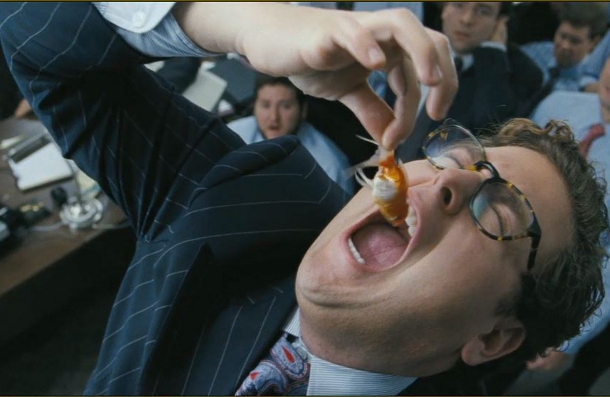 This is my favorite Scorsese film since Goodfellas, and they have plenty of similarities. It makes sense because these men of finance take their cues from movie gangsters, styling themselves as tough guys. At one point, brokers hold a guy over a building to intimidate him. There’s also certainly as much cocaine as there may have been in Scarface. But like that classic of the gangster cinema, Scorsese propels us into the hidden world of the financial institution run amok, allowing us a backstage pass to the people profiting from wrecking the economy. It’s a fascinating perspective that confirms some of our worst fears about stockbrokers. It’s a misogynistic boys club and the few women that do participate have to play by their hyper masculine, juvenile rules. These are people that find any number of ways to skirt the law, rip off their clients, and live in luxury until they can find another sucker. It’s a system built for the entertainment of the few on the backs of the many, and it’s just as relevant today as it was in the 90s. With Jordan’s inside knowledge, we’re educated on the many corrupt ways of Wall Street.
Marking the fifth collaboration with Scorsese, this may be the finest DiCaprio (The Great Gatsby) performance yet. The man sheds his vanity, easily fitting into the shark that is Jordan Belfort. He’s ruthless in one moment and completely inept in another, at the whim of his vices. DiCaprio taps into Jordan’s leadership qualities with the dynamite sales speeches, but he also shows what an insecure man he is at heart. He’s got a taste for the good life and is reinventing himself, including trading up in wives to attain that proverbial American Dream. He’s living empty pleasure to empty pleasure and he doesn’t care. DiCaprio acts as our ringmaster through his own circus, and you’ll be delighted and horrified by his actions (and also his peculiar, bird-like dance moves). There’s not a bad performance in the whole cast, and this is one huge cast. Hill (This is the End) is a becoming more and more credible as a dramatic actor, though he excels at the blustery outrageousness as Jordan’s number two. He’s a treat. Robbie (About Time) nails her New Yawk accent but more importantly nails the portrayal of a trophy wife who recognizes and eventually resents her lifestyle. And oh does she just exude sexual heat.
I want to focus on the very end of the film, so there will be some mild spoilers in this paragraph but nothing I feel that would ruin the viewing experience. You have been warned, spoiler phobes. As expected, Jordan eventually winds up in jail for his felonious misdeeds. Ordinarily this would be the end of our traditional law-and-order morality tales; the bad guys are locked away to pay for their crimes. Jordan tells us how nervous he was on his first day of prison, that is, until he remembered one very important fact: he’s rich. White-collar prison is not the same as other penitentiaries, and we see Jordan loftily playing tennis. His sentence is only three years as well, which seems like an insult given the thousands of lives he may have instrumentally ruined. But that’s the ultimate condemnation in the end: the system is rigged for people like Jordan, people with money. In the end, he wins. He goes to prison, his family life is torn asunder, and his personal relationships are strained, but the guy wins. He continues his speaking engagements motivating everyday saps how, with his cherished expertise, they too can rake in wealth. The final shot of the movie tells me everything I need to know. It’s a slight pan out to the crowd in attendance of Jordan’s speaking session. We see the collection of faces, each person hanging onto Jordan’s every word, each filled with idolatry. They want to be him. Despite everything, the bad behavior, the crimes, the waste, they all want to be him, and that’s why people like Jordan will always succeed, will always prevail, will always have the last laugh. There will always be a healthy supply of suckers that want to believe whatever nonsense he’s peddling. That’s the point. He won.
 Recently I watched the very good crime caper American Hustle and noted that its director looked to be fashioning a loving Martin Scorsese homage. Well, after watching The Wolf of Wall Street twice (not back to back, mind you; I’m not nuts) I can say that there is no Scorsese like the source. This is vintage Scorsese. This is brilliant filmmaking, a bold movie that practically sings, it flies by with exhilarating force and acumen, daring you to keep watching. The fact that 71-year-old Scorsese could make a movie this highly energetic, this debased, this brash, this borderline indecent, and this awesomely entertaining is encouraging. It’s even more hilarious to me that older Academy members at a recent screening of the film accosted Scorsese, essentially being termed a “debauched scoundrel.” That’s got to count as some badge of honor. Yes, at three hours the movie can get long but it’s never dull or taxing. The propulsive narrative, the hilarious humor, the shrewd characterization, the wanton excess, the filmmaking bravado that hums, it all coalesces into a disturbing and disturbingly enjoyable condemnation of greed and our inherent celebration of this lifestyle. There is not one aspect of this movie that falls flat. The Wolf of Wall Street is an invigorating piece of cinema. The choice of music, the swinging cinematography, the wide ensemble of actors, the feverish editing, it all comes beautifully together to form a whole that surpasses everything else in cinema this year. Dig in.
Nate’s Grade: A
Share this:

American Hustle (2013)
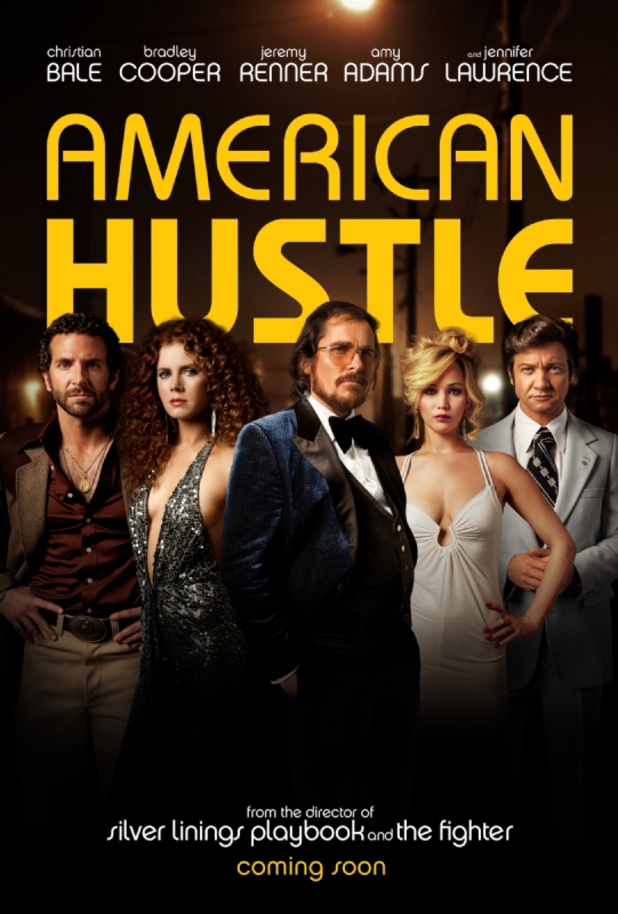 With two movies, writer/director David O. Russell has vaulted to the top of Hollywood. Previously known for his own difficult behavior, Russell’s last two films, The Fighter and Silver Linings Playbook, were both critical and commercial hits (Silver Linings made over $230 million worldwide). Both brought a bushel of Oscar nominations as well, making Russell one of the hottest directors for actors and producers. But a new side seems to have emerged over these last two movies, one less of Russell the domineering director and one of Russell the open collaborator. It feels like he’s just hitting his stride too. American Hustle is Russell’s latest and it’s sharply written, engrossing, lively, surprisingly comic, and readily entertaining.
In the late 1970s, the FBI set up an undercover sting to nail political corruption, ultimately nabbing several U.S. congressmen and one standing U.S. Senator. Richie DiMaso (Bradley Cooper) is an FBI agent who snags the perfect assistance. To catch a crook you have to think like a crook, and so Richie has strong-armed a pair of lucrative con artists into helping him. Irving Rosenfeld (Christian Bale) is a professional down to his elaborate hairpiece. He’s used to fleecing desperate people and selling phony artwork to the gullible, but he’s been too shy about making too much noise. If you stay small, you go unnoticed. Irving’s partner in crime is Sydney Prosser (Amy Adams), a kindred spirit who has reinvented her self. She and Irving are in love, and now they’re trapped by Richie to set up New Jersey mayor Carmine Polito (Jeremy Renner). The one unpredictable element is Irving’s young wife, Rosalyn (Jennifer Lawrence), who could blow up the whole operation with her careless and self-involved tantrums.
 Russell has once again given audiences one of the most entertaining films of the year, this time allowing them to participate vicariously in a con game, trying to anticipate the twists and turns and assessing everyone’s personal angle. This is a fictionalized rendition of the Abscam case (the opening text drolly says, “Some of this actually happened”) and it gives us a slew of meaty characters that have something going on. The central point elaborated in this pop crime caper is that we’re all cons, we’re all pretending, on some level, to be different people; Russell’s film just takes this notion to the extreme. Irving and Sydney are trying to escape lives of ordinary malaise, of being victims, of the more powerful dictating their options for them. With Sydney, she’s pretending to fall for Richie, but we don’t fully know which side she may choose to end up on. Richie is trying to also escape his dull life of desk jobs and lower middle-class dinners. His ambitions get hold of him, and with Irving’s aid, he catapults himself toward achieving those oversized dreams of his, never mind the ethical lapses in nabbing the bad guys. For Carmine, he’s so fiercely devoted to his community that you don’t doubt his loyalty for a second. He’s a man who sincerely wants to help others and is knowledgeable enough about how the world works, knowing he may have to grease some wheels to get the progress started. He is the most moral figure of the five main players and you may find yourself rooting for him to escape the snare closing in on him. Then there’s Rosalyn who has her hooks in Irving, looking for a sense of stability for her and her child. She’s a volatile cocktail of emotion but she knows what she needs to do to keep Irving anchored to her needs, though she’s also cognizant enough to latch onto a better provider if one materializes. Mixing and matching those characters, you have an eclectic mix of personalities clashing, many at odds with one another as far as goals, and the conflict stirred up is delicious.
Russell also attaches on his Martin Scorsese filter, delivering a freewheeling film about criminals from their wizened point of view, explaining the ins and outs of their hustle with flamboyance, style, and vigor. While the opening is a tad slow, including an opening minute watching Irving work his almost breathtaking comb over hairstyle, we plow right along into this world of hustlers and con men, learning tricks of their trade (hint: desperate people are desperate) and the tools to stay ahead of detection. We’re awash in multiple perspectives, each with voice over, a frenetic camera, and emboldened editing. It’s the Scorsese approach given studious application to the Abscam affair. It’s a great thing that Scorsese is the finest living filmmaker and devoting a two-hour-plus homage to the man’s most stylized crime pictures is a plus. Russell’s movie feels alive but also hungry, like many of his characters, restlessly searching for something. The scenes land but they don’t feel like they’re standing still; everything is propulsive in this movie. The small operation of Irving and Sydney is taken to the big leagues thanks to Richie’s ego, and the FBI’s desire for splashy headline busts, but wider exposure also exponentially multiplies the danger. Once the gambling scheme attracts the investment of the Mob, that’s when everyone has gone too far. I was clenching my fists in suspense toward the end, worried that our fictional cons may be too far in to survive.
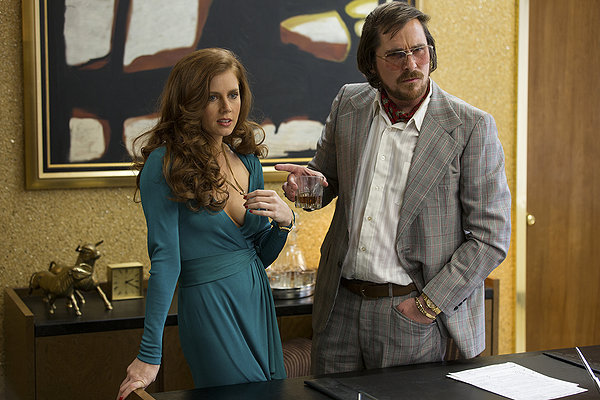 Russell hasn’t lost his magic touch with actors. His last two films have netted seven acting Oscar nominations and three wins, and the cast of American Hustle meets that same level of excellence. Perhaps even more so than The Fighter, the characters are given a very broadly comic brush, easily and routinely stepping into a carnival row of over-the-top behavior. It provides plenty of entertainment of the mishap and absurd variety, but there are also lone piercing moments of great empathy with these messy people. Mostly, the various actors all seem to be in a great syncopation, each one contributing where the other left off, building a great and compelling picture. When this ensemble is firing, it’s hard to beat. Special mention to comedian Louis C.K. (TV’s Louie) making the most of every scene he’s in as an FBI party pooper. His running gag involving a personal ice-fishing story is one of the film’s best jokes.
Bale (Out of the Furnace) is our guiding voice in this world, a flimflam man of the first order who fools maybe even himself. He’s got his own code of ethics and a heart behind that pot belly (another physical transformative performance by Bale the chameleon). He’s briskly entertaining but my only complaint is that, by being so suave and slick, he seems a tad too low-key at points given the risk involved. I know it’s part of the act, but from an audience standpoint, it makes him seem a tad too modulated. His equal is Renner (The Bourne Legacy) who is so earnest that it practically breaks your heart when he oversteps into morally murky territory.
However, Bale’s performance is compensated by the sheer craziness of the Silver Linings co-stars, Cooper and Lawrence. Cooper (The Place Beyond the Pines) is a lawman but also the film’s biggest antagonist. He gets drunk with power and the credit he’s receiving at the FBI. He’s also a deeply insecure man who is trying to style himself like Irving and Sydney as a posh reinvention. Cooper gives him a manic energy and taps back into his reservoir of eager-to-please egotism. Lawrence (Catching Fire) is the most unpredictable character. She acts on impulse, flirts with sabotage, and soaks up the spotlight she’s so rarely afforded. Lawrence is having the time of her life playing a loud, shrewish, vampy housewife who has a noticeable habit of starting house fires.
Beforehand, I would have thought that Lawrence and Adams should have swapped roles (still an interesting experiment), but having now seen the film, each suits them well. Adams (Man of Steel) is the saddest character of them all to me because she’s the bruised dreamer anxious to be anyone but who she really was. She relishes the con, more so than Irving, and ties much of her self-identity to her shyster skills.
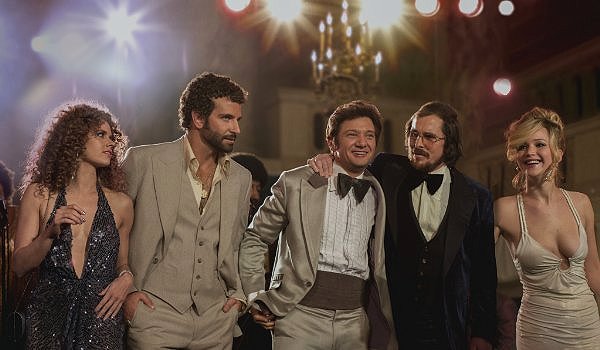 I’ve been dragging my feet writing my review and I’ve been trying to determine why, beyond, obviously, holiday-related sloth. American Hustle is readily a good movie that provides plenty of entertainment, meaty characters, and fun, but why do I keep feeling like it’s missing one undetermined ingredient? I can’t even articulate what at the moment but after having seen the film two times now, I feel like perhaps my emotional involvement was stunted. It’s a finely tuned script that delivers big performances for big-time actors, with a dandy ending that manages to dish out satisfying conclusions to its bevy of wheeler-dealers. But why didn’t I care more, why didn’t I feel more resonance by the time the end credits landed? The best theory I can surmise at this time is that we’re caught up in the con game, where everyone is pretending to be somebody else out of necessity or desire, that when it’s all over, we reflect on what a fun ride it’s been with fun characters but do we feel like we’ve gotten anywhere? I feel like I was more interested in the characters than attached to them. Again, American Hustle is still a sensationally entertaining movie and this paragraph is but a quibble, but it’s enough to thwart me from fully embracing and celebrating Russell’s film (confession: having already seen Scorsese’s brilliant Wolf of Wall Street, this could be coloring things for me with Russell’s Scorsese homage).
American Hustle is a fun ride with arresting performances, oodles of style, energy, and comedy. It’s a crime caper of the first order, easing you into this world and watching people play all sides. Even better, we’re given a volatile mix of personalities that clash, forming new and lasting conflicts, some of which could endanger the entire operation. These are interesting people to spend time with and so we can excuse the indulgences of a 140-minute movie that offers even more with this fantastic cast. Russell with a Scorsese filter is an even more improbably entertaining filmmaker. This is a crowd-pleasing sort of movie, much like Silver Linings, that doles out punchlines and payoffs with aplomb. It’s easy to go along for the ride, laugh uproariously, and then by the end sort of wonder whether it was all worth it. The emotional detachment to the characters may be a minor complaint for a film this largely satisfying, but since we’re spending so much time on our characters, I think I would have preferred something a tad more substantive by the end. It’s a great ride, with great characters and great humor, but there is a nagging concern that it may have been a better ride than a story. Regardless, American Hustle is an enjoyably alluring con that mines the absurdist fashions, personalities, and political overreach of the 1970s, painting a tale of criminals who may be the real heroes of the American dream.
Nate’s Grade: A-


 nathanzoebl
You must be logged in to post a comment.