Blog Archives
Seven Psychopaths (2012)
 Writer/director Martin McDonagh only has one movie to his name but the man has already accrued legendary status in some circles. The 2008 dark comedy In Bruges didn’t create much of a blip at the box-office, but its blend of absurdist comedy, dark drama, shocking violence, and languid contemplation found a rabid cult following. I have several friends who regard In Bruges as the best film of 2008 (WALL-E still reigns supreme for me but I quite enjoyed In Bruges).McDonuagh’s latest, Seven Psychopaths, reminds me of Barton Fink: both are about struggling writers, both are satires of the film industry, and both have sudden splashes of violence and a serial killer who pushes the protagonist to artistic completion. In other words, Seven Psychopaths is a fun film and a great time at the movies.
Marty (Colin Farrell) is experiencing some killer writer’s block. He’s stuck on his new screenplay titled “Seven Psychopaths.” His buddy Billy (Sam Rockwell) is eager to help out. The guys run afoul of another psychopath, mob boss Charlie (Woody Harrelson), due to Billy’s side business. He kidnaps rich people’s dogs and then his partner, Hans (Christopher Walken), returns them and collects a reward. Billy and Hans have kidnapped the wrong shih tzu, and now Charlie and his muscle is going to make them pay.
 The refreshing thing about the bloody, wickedly entertaining Seven Psychopaths is that it constantly surprises you. This is such a rarity with modern movies, particularly Hollywood movies that attract as notable a cast as this one. McDonagh is wonderfully adept at throwing narrative curveballs. There were a few surprises where I literally jumped in my seat. You constantly think you have the movie figured out, and then it goes down a different alley and becomes more interesting. One of the pleasures of having psychopathic lead characters is that they are impulsive and do not have to follow the normal purview of logical decision making. They might just call the bad guys and divulge where they are hiding. They can do anything at any moment, and part of that unpredictability is what makes the movie feel so electric, so creatively alive. I must stress that McDonagh surprises in ways that feel satisfying and yet believable given the world he’s concocted. Part of the fun in the first half is just figuring out who the seven psychopaths will be. It’s not like it’s some laconic chamber piece mystery but the psychopaths are an eclectic mix from the real to the fictional to real characters doubling as inspiration for fictional ones. I think in the end there may only be six psychopaths, unless McDonagh is counting himself amongst the numbers.
McDonagh also has a blast deconstructing the very kind of movie that he’s providing. Marty bemoans writing another rote psychopathic killer movie where the violence is fetishized and the bad guys are mythologized into idols. You think the film is headed in one direction, in the Guy Ritchie-style standoffs and shootouts, and then it takes a less traveled path, one where it criticizes these sorts of movies and ponders existential questions about the nature of self-expression and death. It began as a care-free movie about thugs and writers and transformed into a movie that manages to have something to say about life, philosophy, and the cyclical nature of vengeance. Two of our three main protagonists are pacifists and remain so to their imperilment. At one point, a character narrates how this story as a proper movie would end, and it covers all the nihilistic clichés of vengeance and epic body counts. But then Marty, and McDonagh as well, wants to turn away from the expected, from violence for the sake of violence, from the exploitation of stylized suffering. McDonagh doesn’t forget to entertain while he’s making you think in between those handfuls of popcorn. The female characters in the movie (Abbie Cornish, Olga Kurylenko) are generally wasted, in different senses, but McDonagh uses this as another charge against this type of film (a boy’s night out of carnage). This is an accessible movie that can be enjoyed on a whole other meta level. I loved the various gear changes. For me it took the pulpy action material and elevated it to another level of genius.
 McDonagh still maintains his darkly sardonic streak of humor that made In Bruges such a riot. I was laughing throughout Seven Psychopaths; chortles, snorts, giggles, big belly laughs. With its heedless violence, obviously this will not be a film that runs on every person’s wavelength of funny. The very opening involves two mafia hitman debating whether shooting somebody in the eye takes actual precision or just dumb luck. It’s the sort of mundane conversation you’d see in a Quentin Tarantino movie, and also the precursor to something nasty and ironic. McDonagh’s sense of humor is similar to Ritchie or the Coen brothers, but the man establishes his own sense of wicked whimsy. The absurdist dialogue is always a hoot and can generate serious malice, especially when delivered by stern psychopaths. Rockwell (Moon) in particular is outstanding and delivers a virtuoso performance of the unhinged. The man just radiates energy. You’ll feel jacked up just watching him. I keep waiting for this underrated actor to break out with each star-making turn, and his comedic zing is played to perfection in Seven Psychopaths. In contrast, Walken (Hairspray) is rather reserved as he underplays his character, one of the saner men he’s played. It feels like the passing of the torch from the older generation of psychopath to the newer generation.
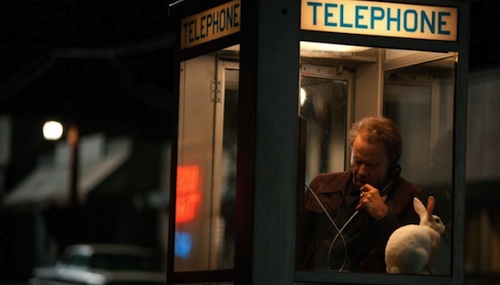
Being a colorful movie about colorful bad guys, and girls, you’d expect there to be some grade-A oddballs, and McDonagh does not disappoint. Some of the psychopaths in question have little bearing on the story plot-wise. There’s Zachariah played by the impeccable Tom Waits (The Imaginarium of Doctor Parnassus). He answers an ad that Billy set up for psychopaths to share their stories to Marty. His tale involves cross-country spree killing of serial killers, rabbit petting, and the love of his life, and partner in crime, leaving him. As far as plot, this little aside has little significance to the plot other than setting up a superb joke to end the movie with. But the character is so interesting, multidimensional, and played with equal parts aloofness and sincerity by Waits, that you can’t imagine the movie without him. Several of these psychopaths could have been the stars of their own movie, from the vigilante killing mob thugs to the tale of one father’s long path to vengeance. Even the fictional psychopath, the Vietnamese man (Long Nguyen) seeking vengeance against G.I.’s, could have enough weight to carry a feature film. The amazing part of the movie is that you don’t feel like any of these characters are shortchanged. McDonagh finds ways to emotionally ground his characters, allowing the audience to empathize amidst the bloodshed and loony characters. We care about Hans and his ailing wife; we care about the friendship between Marty and Billy. It’s real for these characters and so it feels real to us, despite the hyper-real flourishes of the movie.
If you’re a fan of In Bruges, or just dark comedies mixed with sudden violence, then you’ll probably find something to enjoy with Seven Psychopaths. You don’t have to be nuts but it helps. McDonagh has crafted another winner with sharp dialogue, a twisty plot full of surprises, incisive commentary on movies and movie expectations, as well as some sincere soul-searching and poignancy. This baby has it all, folks. Above all else, it’s just a blast of fun. the actors all seem to be having the times of their lives, notably Rockwell, and the morbid laughs and off-kilter thrills should cement another McDonaugh film for cult status. Seven Psychopaths is a palyful movie along the lines of Kiss Kiss Bang Bang and even Adaptation. It’s bursting with ideas and comments and jokes. when you leave the theater you almost want to get back in line and start the ride all over again.
Nate’s Grade: A-
Share this:

Lawless (2012)
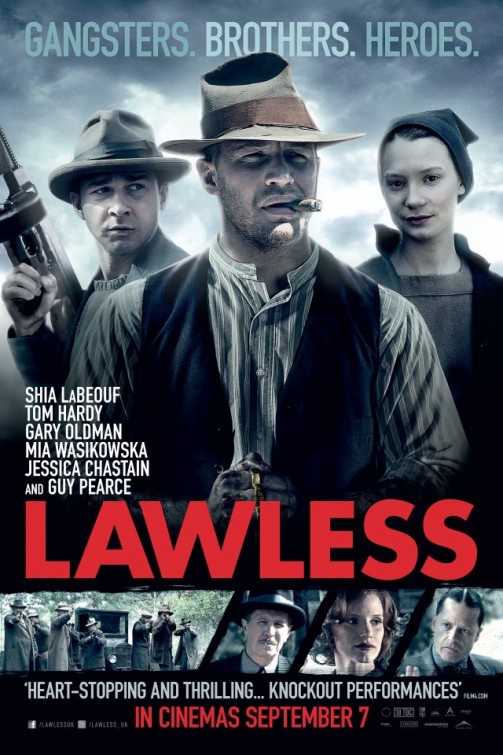 The bootlegging drama Lawless certainly has all the right elements to be an enjoyable movie. It’s by the men who gave us the great noir-Western The Proposition (director John Hillcoat, writer Nick Cave), it’s got a star-studded cast, plenty of bloody action, and a handsomely recreated production of the Prohibition era. But as I watched the Bondurant boys struggle against those who would like to put them in jail and/or murder them, I kept noticing something odd. I wasn’t that engaged. There was plenty of life-and-death drama, but why wasn’t I involved in the story more? Lawless feels like a series of scenes rather than a movie. Even when the plot changes it doesn’t feel like the movie is advancing. Even when things are more desperate it doesn’t feel like the momentum is building. The characters are somewhat sluggish as well, Shia LaBeouf as the scared youngest brother, Tom Hardy as the grumbly big brother who talks like his mouth is full of molasses. Jessica Chastain as the abused Good Woman who opens herself up to our Strong Hurting Man. Then you got a plot with a mobster (Gary Oldman) that weirdly climaxes with an hour left in the movie. He’s ignored for the remainder. Then there’s Guy Pearce as a colorfully fiendish and foppish special deputy that terrorizes the town. I am a Pearce fan but this guy is acting like he’s in his own weirder personal movie; it’s the kind of stuff Marlon Brando did. I appreciated that Lawless kept things gritty and bloody for realism, but I kept finding moments that ripped me out, namely the indestructible nature of Tom Hardy. Seriously, this guy has to be the Terminator. When he miraculously survives yet another seemingly fatal injury, all you can do is laugh. Lawless is passable entertainment but with its pedigree this should have been better.
Nate’s Grade: B-
Share this:

Killer Joe (2012)
 This is one nasty, alarming, but very involving movie that wallows in darkness and plays it up for laughs. Killer Joe is a dysfunctional family drama, a crime thriller, and a mesmerizing character study when it comes to the lessons of amorality. Based on the play by Tracy Letts (August: Osage County), Joe (Matthew McConaughey) is a crooked cop who works as an assassin on the side. A weasely loser (Emile Hirsch) and his family hire Joe to kill their mother for the insurance money. Things get out of hand in frequent measure, with splashes of brutal violence, healthy amounts of sex and full-frontal nudity, and a disturbing sexual act with chicken that more than earn this film its adults-only NC-17 rating. What makes the movie rise above base exploitation is its depraved, deep-fried sense of humor. There is plenty of uncomfortable laughter and guffaws. The end of the film, during a fever-pitch of violence, is so sudden, so kooky, so debauched, that my friend and I burst out laughing. Without its wicked sense of humor, and its sharp ear for working-class dialogue, the movie could be accused of wallowing in the muck. There’s also the terrific acting, chiefly from McConaughey. He gives a hypnotic performance, chilling, unpredictable, and deeply committed to retribution. When he zeroes his cold eyes on you, boy does the flesh crawl. It’s an intense performance and arguably the best of the man’s career. Directed by William Friedkin (who also directed the 2006 adaptation of Letts’ play, Bug) with brutish élan, Killer Joe is one nasty piece of work, but given the right audience, it could prove to be a perverse entertainment.
Nate’s Grade: B
Share this:

Savages (2012)
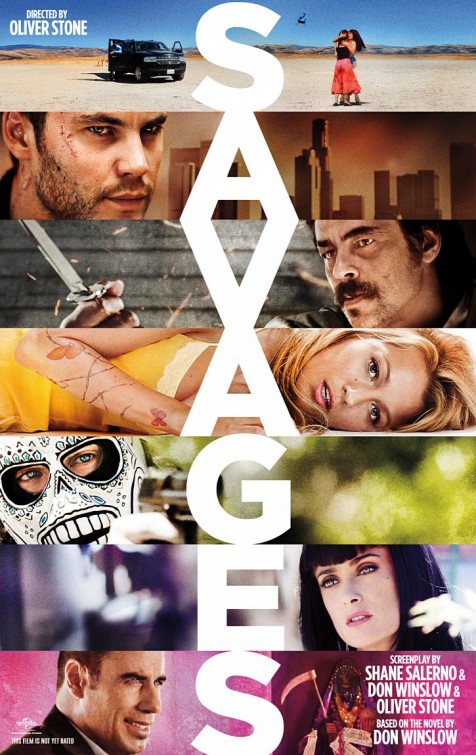 Savages has been described as a “return to form” from prolific director Oliver Stone, who has spent the last decade making straight biopics (W., Alexander) and safe feel-good movies (World Trade Center). The less said about Wall Street: Money Never Sleeps the better. You never thought one of the world’s edgiest filmmakers would follow such a square path. I can’t fault people for getting excited by Savages, hoping this drug-addled crime thriller can revive the gonzo sensibilities of the man. Well, Savages isn’t going to satisfy most people, especially those looking for a cohesive story, characters that grab your interest, and an ending that manages to stay true thematically with the rest of the movie. In short, Savages is a savage mess of a movie but not even an entertaining mess. It’s just a boring mess, and that is the film’s biggest sin.
Best friends Chon (Taylor Kitsch) and Ben (Aaron Johnson) are living the American dream. They began farming their own marijuana plants, using the best seeds form Afghanistan while Chon was on tour with the military. Together, the guys have produced a product high in THC that blows away the competition. They have flourished in California. Now a Mexican cartel, lead by Elena (Salma Hayek), wants in on their business, and they won’t take no for an answer. The cartel kidnaps the boys’ shared girlfriend, O (Blake Lively), and promises to hold her ransom for one year unless the boys agree to their terms. Chon and Ben decide to use their considerable resources to put the squeeze on Elena and her team of scumbags, all the while looking for a way to rescue their shared love of their life.
 It’s a lurid movie all right. Plenty of sex, drugs, and violence, but man oh man is it all just empty diversions because the movie cannot survive its trio of unlikable, uninteresting, and painfully dull characters. O, Chon, and Ben have a dearth of charisma; light cannot escape their black hole of charisma. What sinks Savages is the realization that it’s just a shoddy movie filled with a lot of skuzzy characters but hardly anyone that merits genuine interest. We’ve got skuzzy good guys, skuzzy bad guys, but where are the personalities? Where are the quirks or the hooks to drive our interest? Just having Benicio del Toro (The Wolfman) act weird and mumbly is not enough to cover the shortcomings of his character. I’ve read reviews where critics cite del Toro as “hypnotic.” I have no idea what they’re talking about. He’s just your average skuzzy bad guy you’d find in any mediocre crime picture; he just so happens to be played by Benicio del Toro. The DEA Agent John Travolta (From Paris with Love) plays is your typical skuzzy desk weasel; he just so happens to be played by John Travolta. And that’s where the movie falters. We have all these characters on all sides of the law but we couldn’t give a damn for any of them. O comes across like an annoying, privileged, faux intellectual. Chon is a meathead. Ben is an amorphous do-gooder. I don’t care about their problems and I especially don’t care about them retrieving O so they can return to their vague polyamorous lifestyle. She wasn’t worth all the effort, nor where these men worth dying over. At any point in the film, I wanted these characters to hastily die so that I might, just out of chance, come across a more interesting figure. I received no salvation.
Our trio of bland characters is made flesh by a trio of bad performances. First off, people have got to be realizing that the kind of lived-in, edgy, and compelling performance Lively pulled off in 2010’s The Town is more the exception than the rule. Stop casting her in gritty parts unless they are directed by Ben Affleck. As O, our zombie narrator, she does little to make us sympathize with her dumb plight. Then there’s Kitsch (Battleship) who is just having a record year of high-profile flops. He’s done fine acting work before, but as Chon he’s just another ramped-up hothead with little else on his mind. Johnson (Kick-Ass) has the most “flavor” of the trio, acting granola-y and with philanthropic ambitions, but he’s still just another meathead just in different clothes. All three of these characters are idiots and the young actors don’t find any way to redeem them.
Actually, I found Salma Hayerk’s character the most interesting and would have enjoyed a movie based around her dilemma. Elena’s husband was the head of a drug cartel. He was assassinated, so the duties would have fallen to her son, but in order to protect him she assumed power. She has an estranged relationship with her youngest daughter, Magda (Sandra Echeverria), who is ashamed of her mother. This, Elena tells us, makes her produ; she is proud that her daughter is ashamed. Now just look at all those contradictions and complexities inherent with this character. She’s assumed a duty she did not want, something she knows is morally wrong, but she does so in the interest of protecting her children, even if it means pushing them away and having them despise her. And because she’s a woman, any wrong move and her competitors would be ready to pounce. Plus you add the day-to-day anxieties of a life of crime, the threat of betrayal or some upstart wanting to make a name for himself, and you have the makings of a great character drama. But do we get even a little of this? No. Instead, Elena’s just portrayed as another colorful villain. The supporting cast is peopled with what should be seen as “colorful” characters, but really these people are just as skuzzy and boring and personality-free as our loser ménage a trois.
I suppose there is a certain pleasure seeing Stone return to his blood-soaked, violent, gonzo self. The man has a certain enviable madness when it comes to composing a movie, a mad fever of images and sensations. From that standpoint, Savages is at least watchable even though you would rather see most of the characters get hit by a car. I just wish if Stone was going to go nuts that he committed and went all the way, bathing this movie in his lurid predilections as we tumbled down the rabbit hole of the underground world of organized crime. If you’re going to assault my senses with excess then at least have the gall to be excessive. How can you make a lurid movie but EVERY woman onscreen engaging in sex is clothed? That seems unrealistic even for a movie this stupid. Stone seems to have no problem dragging out uncomfortable rape scenes, so who knows what the further implications of that are. There are several grisly torture scenes and some random brutality, so you’ll at least be kept awake in spurts by people screaming.
 Too much of this supposed crime picture is caught up in the oppressively irritating soap opera between O, Chon, and Ben (a little part of my soul dies every time I have to type “Chon” as a main character name). The script, based upon Dan Winslow’s novel, adapted by Shane Salerno, Stone and Winslow as well, is a mess but not even an enjoyable mess. Some of this dialogue is just laugh-out-loud bad. O opens the movie saying she has orgasms but Chon, you see, has… “wargasms.” Oh ye God, that one hurt. Every time we’re subjected to O’s protracted, monotone narration the movie loses whatever momentum it may have had.
She keeps saying, “Just because I’m telling this story, doesn’t mean I’m alive at the end.” Can you promise me that? Then there’s the very stupid ending, where the movie tries to have it both ways. It gets its bloody, operatic, tragic lovers ending…. and then in the next breath a happy ending as well, a ridiculously inappropriate happy ending. At least bloody and dead would have been satisfying. It’s a cop-out, a cheat, and a mystifying way to end a movie.
I wanted Savages to be a wild thrill ride. I never expected to be bored. Even when things go off the rails, the movie struggles to keep your interest. Blame the inane screenplay that eventually resorts to a cheap, cop-out of an ending, one that barely rises above the “it was all a dream” blunder. Blame the pathetic character and their lack of personality. Blame the strange feeling that Stone is holding back. Blame the bad performances. Blame the lack of fun. Blame the overwrought nature of the title the movie twists into knots trying to give some philosophical meaning. And finally, you might want to blame yourself for thinking that this movie would be any good in the first place. When movies are this mediocre, this lacking in intrigue, you almost wish they had tipped over completely into irredeemable garbage just so you’d at least have something worth watching. Savages is a strange crime thriller that manages to assemble all sorts of exploitation elements and then fumbles them all. If this is Stone in a “return to form,” I weep for what that entails.
Nate’s Grade: C
Share this:

Rampart (2012)
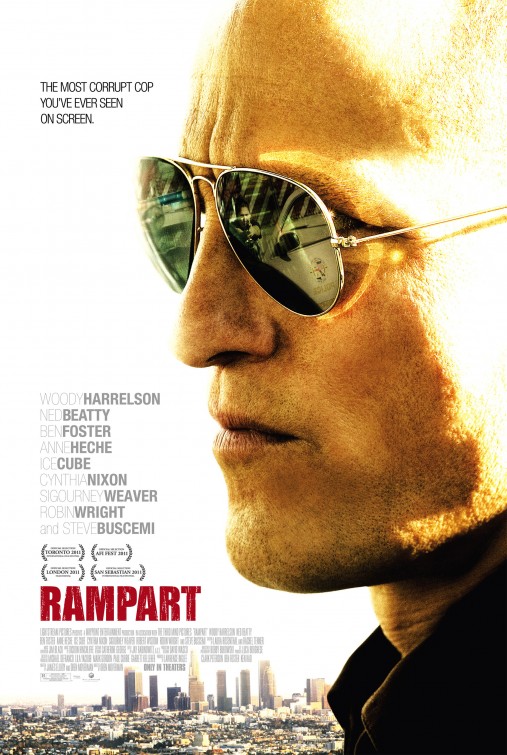 Stop me if you’ve heard this one before. A corrupt L.A. cop (Woody Harrelson) makes bad choices, alienated and frightens his family, and looks to be on the way out as a career of taking the law into his own hands is at long last catching up with him. Yeah, you probably stopped me after the third word in that sentence. This dour character-study showcases Harrelson nicely as a cocksure cop who’s so self-destructive and paranoid that he pushes everyone away. Co-written and directed by Oren Moverman, who made the terrific and searing drama The Messenger, this movie just about turns into high-gloss navel-gazing. The plot is quite loose and there’s very little traction. We get to see scene after scene of Harrelson behaving badly or violent, but what does it all add up to? We already know he’s a bad cop tortured by his own sins and the demands of the job. In a way, there’s an intriguing connection between law enforcement and soldiers who are often called to bear incredible burdens and just deal with it, forgotten by a public complacent with being safe. But really this movie is just one long trip with an angry man who keeps everyone, including the audience, pushed away. He’s complex but I can’t say we ever got to know him better. The film is well acted with plenty of recognizable stars, but why should I care? The central message about the prevailing influence of corruption is a bit heavy-handed as well; at one point Harreslon’s wife says, “You made us dirty.” Rampart is a disappointing venture for Moverman despite Harrelson’s best efforts. In the end, when you’re stuck with a dirty cop he better be worth the time.
Nate’s Grade: C
Share this:

Miss Bala (2011)
 Miss Bala (Mexico’s foreign film entry for 2011) is an unwavering, startling, and deeply tense movie about one woman’s tragic and unwilling association with a powerful drug cartel. Laura (Stephanie Sigman) wants to be the next Miss Baja California, but she’s unwittingly pulled into a life of crime after she witnesses a gang hit. The cartel ensures that Laura wins the beauty pageant and becomes a courier for them. The movie takes a Lars von Trier approach to storytelling, putting its heroine through a torture chamber of anxiety and terror. This woman only wants to escape the hell she has accidentally found herself a part of, but every attempt to escape, be it going to the police or confessing assassination plots to the intended targets, gets her corralled back into the fray. For Laura, there is no escape. The movie packs a near-constant surge of paranoia, as we fear that at any time something awful will happen. In fact it’s usually only a matter of time. Laura is more a symbol of the collateral damage of Mexico’s billion-dollar drug war than a character, and she kind of becomes a numb zombie by the movie’s latter half, perhaps accepting her doomed fate. Director Gerado Naranjo favors long unwinding takes and handheld cameras, which add a gritty realism and sense of compounding dread to the picture. The movie has an unflinching level of realism to it that makes it all the more haunting, stripping the romanticism from a life of crime. Much like Italy’s heralded crime film Gomorrah, this bleak but impassioned movie shows the inescapable tentacles of organized crime and gives a face to innocents caught in the middle. Miss Bala is a testament to the hidden toll of a nation at war with itself.
Nate’s Grade: B+
Share this:

Passion Play (2011)
 You would think that a movie where a jazz musician (Mickey Rourke) gets in trouble with a mobster (played by Bill Murray!) and while on the lam he discovers a girl (Megan Fox) with angel wings working in a circus sideshow would be interesting. How could you go wrong with all those interesting elements? Mobsters, circus freaks, angels, Mickey Rourke! Well Passion Play found a way, a triumph of failure. This would-be parable just sleepwalks from scene to scene, rarely making much of its fantastical sci-fi elements. Fox swears she’s no angel, just a girl born with bird wings, and people let this be a conversation ender. Rourke’s character is a pathetic coward who nets little empathy. Not reverent or weird enough, Passion Play was the passion project of writer/director Mitch Glazer but the movie feels devoid of anything approaching passion. The actors seem bored, the romance between Fox and Rourke is a non-starter, and the lame ending borrows a page from An Occurrence at Owl Creek as a last-ditch attempt to interject some meaning into this unholy mess. The only reason I can foresee (sober) people watching this is for the mistaken belief that they might glance upon some heavenly nudity from Fox. Sorry boys, the gal keeps her purity. The entire production is just so wrong-headed and listless; I can’t even work up a good dose of bile to proclaim its utter inanities. This is a terrible, silly, puzzling, dopey movie made even worse by its pseudo-intellectual twist ending.
Nate’s Grade: D
Share this:

The Girl with the Dragon Tattoo (2011)
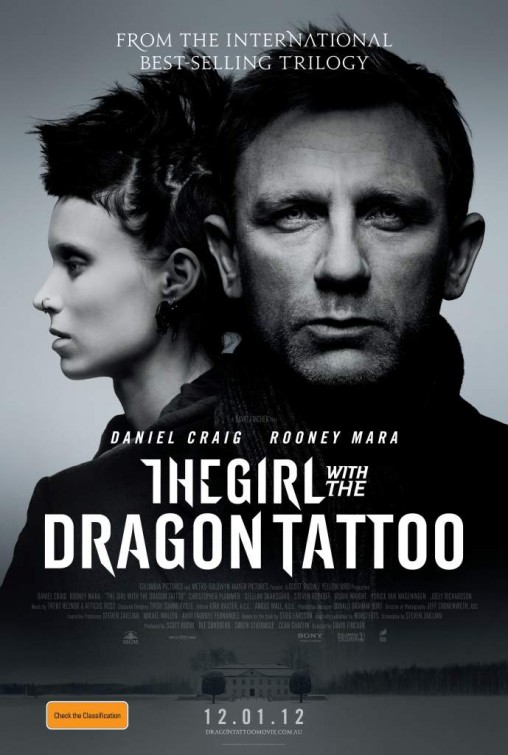 Nothing says holiday treat for the whole family like a nearly three-hour movie about rape. Late author Stieg Larsson’s best-selling trilogy made three very successful Swedish films, all released last year in indie theaters. It was only a matter of time before Hollywood optioned The Girl with the Dragon Tattoo, benefiting those averse to reading subtitles. At least they hired the right director in David Fincher, a man used to plumbing the depths of human depravity in films like Seven, Fight Club, and Zodiac. Fincher’s take is pretty dark and hardcore, but once you wash all that perfectionist grime off, I prefer the Swedish film in just about every way.
Crusading journalist Mikael Blomkvist (Daniel Craig) is smarting from a court case that found him guilty of libel. He’s commissioned by a wealthy businessman Henrik Vagner (Christopher Plummer) to investigate the 40-year-old disappearance of his granddaughter, Harriet. Henrik strongly believes she was murdered by one of the sinister members of his extended family, a group of shady characters with some allegiance to Nazism. Mikael is assisted by the unorthodox computer hacker Lisbeth Salander (Rooney Mara), a rail-thin Gothic gal clad in tattoos and piercings. Their partnership sometimes gets blurry as they grow closer over the course of the investigation. Together the pair investigates a series of grisly, ritualistic murders related to Harriet’s disappearance, and the closer they get to discover the truth the more dangerous things get.
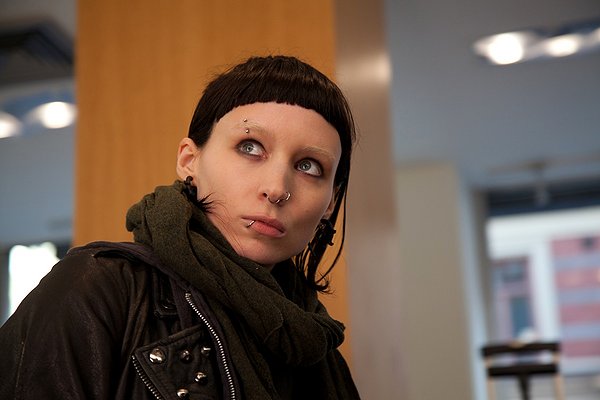 So the burning question: is Fincher’s take better than the original Swedish version? Well, in some areas yes but in many areas I’d have to say no, that I prefer the lower budget, no-name Swedish version. Obviously a director of Fincher’s caliber is going to significantly raise the quality of a production, and the technical merits of Fincher’s Dragon Tattoo are without question. This is a seedy, grimy, prurient, and very dark (in both lighting and thematic material) little movie. There’s always been an eerie beauty to Fincher’s cool aesthetics, and it’s on display here as well. Many of Fincher’s Social Network crew carried right over to Dragon Tattoo, so the editing is crisp, the cinematography sleek, and Trent Reznor and Atticus Ross’ score is a storm of ominous tones. Their plaintive score is actually a fairly unmemorable muddle, never approaching the energy, intricacy, or diversity of their Oscar-winning score for The Social Network. However, the extra polish and the glut of familiar actors takes away from the intrigue of the movie. When something meant to be gritty is too artistically stunning, it detracts from the thematic intent of the story. That sounds like a contrary way to insult Fincher for making his movie look too good, but perhaps that’s the best way of stating the point. Niels Arden Oplev is nowhere near the filmmaker that Fincher is, nor did he have the budget or creative freedom afforded Fincher, but perhaps someone of lesser talents was better suited to best tell this tale. By all means, the American Dragon Tattoo is a more visually alluring film, but Oplev’s film is more fully felt. I recently rewatched the Swedish version again for points of comparison and found myself much more involved in the characters, the story, and the actors, even though I had already seen the movie. Fincher’s version may be the better-looking movie, but surprisingly Oplev’s is just the better movie, period.
The adaptation by Steven Zallian (Schindler’s List) actually hews closer to Larsson’s book than the Swedish film, though Zallian redirects the film into a new ending. But the additions don’t seem to add anything of substance to the narrative (Blomkvist’s teenage daughter; dead cat), and the new ending feels more confused than helpful. Most of all, Zallian’s script devotes less time to the characters of Lisbeth and Blomkvist. I had a better understanding of these characters and their complicated, shifting relationship in the Swedish film. That narrative was much cleaner with helpful, clarifying procedural details and a dose of ambiguity. Simply put, the story just flowed better in the Swedish film. The personal connection Blomkvist had to Harriet (she was his babysitter long ago) has also been severed. Many of the story’s problems are still the same regardless of language or adapter. There is a clear disparity when it comes to audience interest in the two leads. What’s more interesting, a punky, bisexual, computer hacker or a disgraced, somewhat bland journalist? Exactly. Also, the story takes far too long to put our lead characters together, over an hour at that. The murder mystery is filled with murky plot points, pieces that seem like they might be integral but then turn out to be incidental. It takes a good while to process and familiarize oneself with the expository details of the case, but under Zallian’s draft, the mystery is given less room to breath. For a movie clocking in at 150 minutes, things feel untidy and rushed. The resolution feels drawn out to ungodly Lord of the Rings-lengths; I swear there must be a solid 20 minutes after the eventual serial killer is dealt with. It just feels like it goes on forever. Still, the characters are what ultimately makes Dragon Tattoo engaging, and Zallian’s efforts cannot dampen the captivating, curious nature of Lisbeth Salander.
Both Craig and Mara give fine performances but I prefer both Swedish actors to the A-listers. Craig is certainly a better actor than his Swedish counterpart, but the role is a middle-aged journalist and not James Bond, and thus a better fit for the unknown Swedish actor, Michael Nyqvist (Mission: impossible: Ghosts Protocol). Blomkvist isn’t supposed to be an ass-kicker. As a result, you don’t feel his terror as he gets in deeper and lands in serious physical jeopardy. Likewise, following in Noomi Rapace’s (Sherlock Holmes: A Game of Shadows) shoes was going to be a difficult feat for any actress, but Fincher got the girl he wanted, Mara, who tore down Mark Zuckerberg with precision in The Social Network. Mara commits herself completely to the role and undergoes a severe physical transformation (bleached eyebrows, wiry frame, nipple piercings), but she lacks the intensity of Rapace, the spiteful attitude, the recklessness and the resourcefulness. Rapace felt like a caged animal that could explode at any moment; Mara feels more like a lost puppy. I’m being intentionally cavalier with my word choice. Mara is quite good as Lisbeth; it’s just that Mara can’t quite measure up to the preceding tattooed girl. It feels like there’s a lot more going on with the Swedish Salander, whereas the American (still Swedish) Salander is waiting for her cue. It’s like Mara has dressed the part and waits for the character to just click over.
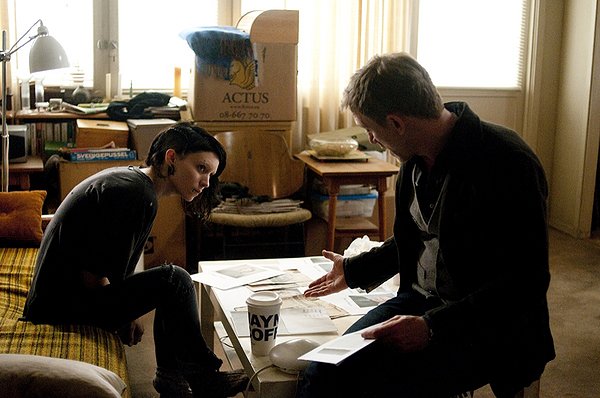 I’m not one for lazy analysis, but I feel like the uncomfortable issue of sexual violence/ voyeurism needs to be addressed, and I find that everything I wrote a year ago in my original Girl with the Dragon Tattoo review could readily apply to its Hollywood counterpart. So here goes: “The book’s original title was ‘Men Who Hate Women’ and that seems apt given what occurs on screen. Sure there’s a serial murderer on the loose but that’s par for the course. Even the grisly ritualistic killing stuff. But Lisbeth encounters a lot of malice and hostile male aggression, some of it very sickening. There’s a startlingly extended rape sequence, followed by some sadistic, if justifiable, revenge. It all contributes to an overall tone of queasy misogyny that seems to waver between intentional and unintentional. I’m not sure tone-wise whether the movie ever creeps into unsettling voyeurism at the behest of women in explicit sexual peril, but it certainly is a distraction. It can get pretty hard to watch at times in this disturbing thriller. I hope the eventual sequels don’t follow this same queasy, upsetting tone but I also worry that this may be unfortunately part of the books/movies’ appeal.”
For those new to Lisbeth and Larsson’s sordid saga, The Girl with the Dragon Tattoo will more than likely play well, a squalid thriller with the nicest coat of gloss you could ever hope for given the material. This is dark, rape-heavy stuff, and an odd adult drama to position as a Christmas release, but the collective appeal of the best-selling books should guarantee so many butts in the seats. It’s likely a safe bet that a high majority of those paying customers are unfamiliar with the Swedish version of the same story, which is a shame because, short of a few technical advances, I believe the Swedish film to be the superior movie. It had better acting, more appropriate casting, a rounder narrative that fleshed out the characters, their relationships, and their histories better, and a better score (sorry Trent, better luck next time). It’s still a movie that registers a “good” on most critical accounts, and Lisbeth Salander is still a fascinating person, a wounded warrior that catches the imagination. I’ll be curious to see if the subtitle-free Girl with the Dragon Tattoo does well enough at the box-office to warrant filming the next two decidedly lesser books. Whatever the case, there will always be the Swedish films and Ms. Rapace’s star-making performance.
Nate’s Grade: B
Share this:

Limitless (2011)
 With a dream premise for a pill-popping culture, Limitless is a visually fervent thriller that manages to stay a step ahead of the pack. Bradley Cooper takes a pill and can unlock full potential of his brain, which involves, obviously, scoring big paydays and women. It’s a silly fantasy but a universal curiosity of what we could do if given full access to our noodle. Director Neil Burger (The Illusionist) uses every visual trick in the book to represent the new brainpowers, as we watch words, numbers, and memories drift through a colorful explosion of imagery. It’s all very pretty to look at. Burger’s visual prowess elevates the more pedestrian moments of Limitless, but the film has a way of surprising you. The Mob takes an interest in this wonder pill, operating at a new peak of production. A woman being hunted down takes the magic pill and is able to quickly formulate an escape. So what if the profound existential questions regarding human capacity and possibility are thrown aside, we got some nifty visual flourishes and foot chases here people. The pacing is relentless and the plot manages to find intriguing ways to keep a superbrainiac in danger. Limitless is a perfectly enjoyable movie with enough juice to forgive its lamer moments and contrived ending.
Nate’s Grade: B
Share this:

The Girl Who Kicked the Hornet’s Nest (2010)
 The worldwide publishing phenomenon comes to a close with the third and final film, The Girl Who Kicked the Hornet’s Nest. In the span of nine months, all three Swedish films, based on the late Stieg Larsson’s best-selling books, have been released stateside. Hollywood is already filming the first of three remakes directed by David Fincher (Fight Club), with Fincher’s Social Network star Rooney Mara in Lisbeth’s chunky shoes. Releasing three films in one year, mere months apart, has given the series the feeling of an event. The Girl Who Played with Fire left a lot to tie up, but audiences steeped in the Larsson’s sordid particulars should find something rewarding, albeit unspectacular, in this final chapter.
The third film picks up immediately after events from the previous story. Lisbeth Salander (Noomi Rapace), punky computer hacker and international badass, is being airlifted to a hospital. She is recovering from a brawl with her father that left her with a bullet in her skull and him with an axe lodged in his (surprisingly, both live. Credit Swedish healthcare). Her father, Zalachenko (Georgi Staykov), was a Soviet spy that defected to Sweden in the 1970s. He is a high-value informant, which means that anyone who would compromise or expose Zalachenko needs to be dealt with. And if Zalachenko is going to speak his mind, perhaps he needs to be silenced as well. Mikael Blomkvist (Michael Nyqvist), muckraking journalist and Lisbeth’s staunch ally, is trying to protect his friend and one-time lover by exposing the corrupt and powerful. Lisbeth is trying to be silenced, and if assassins don’t work then the state will try her for attempted murder and lock her away in a mental institution, the same institution that Lisbeth was committed to at 12 when she tried to save her mother by setting her abusive father ablaze. The sinister Dr. Teleborian (Anders Ahlbom) admitted Lisbeth when she was a child and is eager to have her back in his clutches. He and the other crooked government officials will stop at nothing to put her away and stop Mikael from publishing the truth.
 So at the axe-swingin’ conclusion of Girl Who Played with Fire, I felt that some of my conclusion had to be put on hold until I could see the third film, the conclusion to what seemed like one larger film. For Fire I wrote: “As such, it’s hard to fully analyze certain storylines at play. I imagine that the sex trafficking storyline will carry on with the third film because of the tease that high-profile figures in government and police offices were involved. It already establishes a conflict and a set of antagonists ready for the third film. Then again, I may be too hopeful and the storylines of interest in Part Two may be completely dropped or mishandled by Part Three (see: Matrix sequels, Pirates of the Caribbean sequels).” Guess what happened? Dropped storylines abound as well as a lack of follow-through on most everything but the major storylines involving Lisbeth’s tortured personal history.
Now that we can all witness how Lisbeth and Mikael have walked off into that Swedish sunset, I can finally and conclusively say that the second film is incomplete and will never be complete. The loose ends abound and characters are completely forgotten, like Lisbeth’s Asian friend/sometime-lover and her boxing pal who took a beating. Apparently their narrative purpose was to take Lisbeth’s licks (could this be the greatest double entendre in the history of film criticism? Yes). The brute that dished out those bruises is a blonde baddie named Neidermann who looks like he was ripped from a bad James Bond flick. He is a straggling loose end that circles the narrative like a lost child in a supermarket (“Are you my mother?”). The high-reaching sex trafficking ring featured in Fire has a tenuous connection to Hornet’s Nest; in Fire we talk about an Evil Shadowy Government and in Hornet’s Nest we see the faces of that Evil Shadowy Government Agents.
If the first film was a slow-burning and lurid thriller, the second film a preposterous action film, then the third film falls clearly into the genre of legal thriller. The majority of the plot revolves around the People vs. Lisbeth Salander. The sluggish opening gives way to a sluggish series of pre-trial preparations. Mikael assigns his sister to serve as Lisbeth’s attorney, and thus we see the behind-the-scenes arrangements as far as gathering evidence, building a case, plotting arguments and counter-arguments, preparing Lisbeth to confront the men who have caused her such suffering and anguish. And being a courtroom thriller, we also get a heavy dose of new characters, almost all of them elderly and somewhat menacing (a guy with cancer even becomes a hired gun for One Last Job). There are a lot of liver-spotted faces to try and sort through, so it helps when the filmmakers add touches to set them apart (one of them wears a bow tie, another has glasses). Given the lethargic nature of assembling a court case, the pacing can get pretty slack. Then there’s the issue of Lisbeth. She spends almost the entire movie in police custody and the first hour or so confined to a hospital bed. It doesn’t make for pulse-pounding stuff. Lisbeth is a willful, defiant, quick-witted creature so it feels like she’s like a caged bird in this third and final film.
 Rapace is starting to catch serious Hollywood heat and deservedly so because once again she commands the screen. At first when the series began I was unsure of her acting abilities considering her mysterious character is forced to respond through a prism of emotional reserve. She doesn’t speak much but her intense, cold stares speak volumes to the turmoil she has bubbling under the surface. Restrained to a hospital bed or a jail cell, Rapace is given even less to work with. The part is nearly mute for long stretches of plot. Yet Rapace finds new and interesting ways to channel her character’s intensity and allow the audience to view her thought process. It’s a sign of a talented actor when a character’s internal thinking can become transparent without the need for hyperactive expressions. Lisbeth Salander is a complicated character and the audience deserves to have such an intriguing presence fleshed out into three dimensions. I wrote about the disappointing downgrade of Lisbeth’s character in Fire: “We project the interest we felt for her from the first film to the Salander stand-in represented in the second film. She’s still a resourceful, loyal, and cavalier presence, but the plot corners her into being a creature of action. She becomes the fantasy bisexual ass-kicking protagonist that was merely hinted at previously. That sounds like a good thing, but trust me, it does the audience a disservice to box in such a fascinating character.” With Hornet’s Nest, we discover the extent of how men have damaged her, which focuses more attention on the person of Lisbeth rather than the Gothic aesthetics. It’s a return to form even if Lisbeth is still remote.
Luckily, The Girl Who Kicked the Hornet’s Nest does manage to offer a satisfying sense of closure. The series has several bad men doing bad things, so it’s rewarding that after sitting through close to seven hours of material yields some long-awaited justice for Lisbeth Salander. We yearn desperately for this pint-sized gal to get her vengeance and for the powerful to find their comeuppance. Watching the antagonists fall would be more fulfilling if they weren’t only introduced a mere hour ago in this movie. Salander doesn’t get to put on her Gothic war paint until her first court appearance. It feels like a triumphant return, complete with a towering and imposing mohawk. Blomkvist’s storylines will always be the movie’s weak point considering he has to compete with the likes of the audacious Salander. In Hornet’s Nest, his magazine team is threatened but you never really take any of it seriously, because of course the crusading journalist will stick by Lisbeth. The ending is less than desired and tries to recycle some of the same action tropes that lead Girl Who Played with Fire astray. The final scene leaves you with a sense of, “Oh, so that really is it? Better get my coat then.”
 The Girl Who Kicked the Hornet’s Nest works as a mostly fitting capper to a long-standing mystery series. The bad guys are punished, the good guys prevail, there’s an open-ended resolution that leaves you squirming for more, especially now that Lisbeth is a free woman. At a bloated 145 minutes, Hornet’s Nest can often feel like an overextended Swedish episode of Law and Order. There’s a good 45 minutes that probably could have been left on the cutting room floor. At times the movie feels like it’s lurching along, caught up in the mountain of details. But then it generally finds a way to regain momentum and head to a satisfying close. Still, it’s disappointing that for the majority of the two sequels Lisbeth and Blomkvist have rarely been onscreen together. They worked so well as a team in the original Girl with the Dragon Tattoo. I never would have thought that the sequels would take that concept and keep them apart for as long as possible. Too bad author Stieg Larsson isn’t around to write new adventures for his characters, though there are rumors about an unfinished fourth manuscript left on Larsson’s laptop. Until that gets sorted out between Larsson’s widow and his family in Swedish court, I guess the world will have to settle for the forthcoming Hollywood remakes.
Nate’s Grade: B-


 nathanzoebl
You must be logged in to post a comment.