Blog Archives
Mercy (2026)
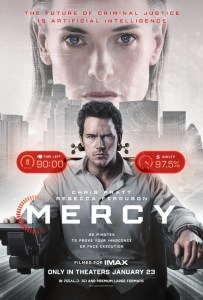 Detective Chris Raven (Chris Pratt) wakes up strapped to a chair. An A.I. judge (Rebecca Ferguson) informs him that he has been changed with the murder of his wife, and thanks to the new Mercy program instituted by the Los Angeles justice system, he will have 90 minutes to prove his innocence to a “reasonable doubt” level of 91% guilty (is that all a “reasonable doubt” is going for these days?). If he fails to convince the A.I. judge, then he will be terminated at the end of those 90 minutes. Start the clock.
Mercy is essentially a screen life movie with a high-concept twist, but at no time was I captivated with the mystery or intellectually satisfied by the application of its storytelling angle. We’ve seen similar movies recently, notably 2018’s Searching and far far less notably the 2025 War of the Worlds, where the movie screen is an extension of a computer screen that holds the borders and tools of our storytelling. In a way it reminds me of the found footage boom of the early 2010s, a hot gimmick that could get studio execs to say yes to projects that they would otherwise have passed on. However, there still needs to be careful ingenuity about how to incorporate these elements and, even more importantly, how to work within the limitations of your gimmick. With Mercy, our main character is basically trying to prove his innocence in real time with an A.I. judge who really functions more like an A.I. assistant, granting him access to people and databases even his police position would not have immediate access to. The recreation of the crime scene with the clues and evidence has a very Detroit Become Human feel (that’s a sci-fi video game that plays more like a movie). The A.I. judge is willing to help out this convicted man as long as he doesn’t admit guilt, because then it’s straight to execution time. For ninety minutes, Chris Raven has to crack his own murder case. The real-time element is meant to provide a sense of urgency, a literal ticking clock, but it’s also quite the misstep when your movie isn’t very good. This allows the audience to mentally count down how much time is left before your movie is finally over. The screen life aspects are pretty superficial and visually dull even if the graphics as being pulled around like interactive three-dimensional objects. The fact that this movie was shot for IMAX is astounding.
 The problem is that the plot is too predictable at every turn. We have a future criminal justice system made for automation and expediency, so it’s not going to be too much of a leap to suspect it might not be operating at the level of success its proponents profess. There’s a long history of stories presenting a new technological leap that is meant to be fool-proof that, shocker, is proven to be anything but. Right away, the audience is already going to be suspecting that the Mercy system is compromised or at least prone to errors like our present criminal justice system. We can safely assume that our protagonist is innocent, and if that’s the case then the implicit question is how many others who were tried and convicted were also ultimately innocent? Some might call it a death row metaphor but it’s literally the same thing just with a high-tech A.I. spin. The next question becomes is the potential error a sign of the limitations of assigning such power to seemingly infallible computers, or is it being deliberately compromised and manipulated? Are certain powers-that-be using this as an excuse to eliminate undesirable peoples and populations? The case of Chris Raven is meant to unveil a larger, systemic problem of justice not being served. And yet, the movie doesn’t exactly explore this obvious implication.
I’m going to dive into spoilers with this next paragraph because I think it’s worthwhile and also I don’t think you’re missing anything with Mercy. If you already assume that Chris is innocent or set up, there’s only so many other places you can go as a story. So with that warning addressed, the Mercy system is really easy to trick, as evidenced by our eventual culprit who has the know-how to digitally erase and alter security footage. Didn’t know this guy had those kinds of skills but, hey, people can surprise you or, more accurately, when the screenplay calls upon enough coincidences. However, there’s another layer of conspiracy afoot. This one guy is responsible for setting Chris Raven up because his own brother was accused and executed by Mercy even after he gave the police an alibi that was ignored. He wants vengeance for the injustice done to his family. This means there’s also the unraveling of who was responsible for this other guy’s wrongful arrest and execution, and wouldn’t you know it happens to be Chris Raven’s own partner, who needed the Mercy program to be seen as trustworthy. The movie never deals with the implications of this. It doesn’t really confront the moral turpitude of killing an innocent man, and it doesn’t think big picture to ask how many other innocent people have been sacrificed as cover. Amazingly, the last line of the movie involves Chris Raven saying, “Humans and A.I., we all make mistakes. And we learn.” What? Technology shouldn’t make mistakes. Alexander Pope didn’t say, “To err is human, and also these new contraptions. Have you seen these textile factories? Wild.” We don’t expect technology to fail us, especially if we are putting judgement over life and death as one of its tasks. This sounds like dubious excuse-making for a system literally killing innocents in the name of the law, and yet our hero treats the whole revelation like, “Well, you gotta break some eggs for an omelette.” It’s such a callous, incompetent response to an immediate problem that his own police force is exploiting. Yet the movie doesn’t blame the faulty A.I. system, which I repeat even some random guy was able to hack and manipulate, and instead looks at it as a tool, like when people try to separate guns from gun violence. However, in this case, the gun is making its own calculations on who deserves to die, and, again, being manipulated by randos. This gets a little more unseemly when you realize that the movie studio’s release is from Amazon, which would very much like you, dear citizen, to stop villainizing A.I. and accept its omnipresence in your new digital life.
 Mercifully, Mercy holds to its countdown, though there’s an extra period of “stoppage time” with an action sequence outside of the chair as climax. The mystery is dull, the plot is predictable (if you don’t suspect who the real killer is after 30 minutes, this might be your first movie, so I’ll tell you now – they get better), the world building is underwritten (who needs an exploration of the large-ranging moral implications of this system when we get police on drone cycles!), and the fun of its creative ingenuity is gasping. It’s forever going to be the Chris-Pratt-stuck-in-a-death-chair movie. This concept could have worked but there needed to be significant revisions, especially unpacking the larger implications for this new system of justice outsourcing justice to all-knowing machines. That’s not this movie. Mercy isn’t even overtly critical of artificial intelligence, instead excusing its faults as “user error” from bad actors. It’s a film too afraid to have any strong sentiments, which makes for a pretty lifeless time at the movies. The machines have won.
Nate’s Grade: D+
Share this:

The Rip (2026)
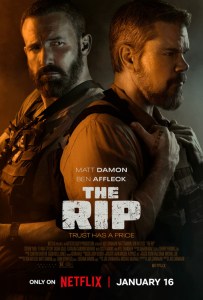
Director Joe Carnahan (The A-Team, Narc) excels at machismo, and I mean that not as a detriment. He makes muscular action-thrillers, often about corrupted men coming to terms with their ruination. 2012’s The Grey is still one of the best movies I’ve ever seen released in January. Well here comes The Rip, also released in January, starring Matt Damon and Ben Affleck as combustible Miami cops who follow a tip to a cartel stash house that holds a cache of twenty million dollars. The cops are supposed to follow protocol, call it into their superiors, but with that kind of money, much more than what the tip reported, it’s hard to resist the life-altering implications of indulging in that kind of haul. I thought The Rip, named after the seizure of contraband, was going to be a modern-day Treasure of the Sierra Madre, where the power of greed is irresistible and leads to betrayals and murder among our characters. It does that, with each questionable decision going against protocol making us question who might be most susceptible and who might be heading for a collision. The movie, co-written by Carnahan, is strictly genre boilerplate. The characters are never more than archetypes, the dialogue is aggressively expository often reminding us of all the conflicts and characters on the periphery that haven’t been brought back yet, and the majority of the film is a contained thriller awaiting trouble at the stash house. And yet I was entertained from start to finish thanks to the cast and a simmering tension that Carnahan unleashes between his paranoid characters. There are some late plot turns that I don’t know if they’re actually clever, convoluted, or both. It’s the kind of thing that’s meant to excuse bizarre behavior that we’d have no reason to assume differently, so it feels a little bit like being jerked around. However, The Rip is a fairly fun way to blow through two hours built upon movie stars unleashing their swagger.
Nate’s Grade: B-
Share this:

The Alto Knights (2025)
 The Alto Knights, from the creative team behind famous mafia movies like Bugsy and Goodfellas, feels like a dozen mob movies thrown into a blender: recognizable elements mashed together but lacking a cohesive vision and distinction. There’s also a major creative choice that makes little sense, mainly Robert De Niro plays two different roles. I assumed they would be twins or at the least brothers but no they are actually two different, unrelated people, Frank Costello and Vito Genovese. Why? I understand the appeal to De Niro fro an acting standpoint, as well as the potential marketing hook, but what about this makes sense for the viewer? What about this movie made it better by having one actor portray the two main characters? It made it harder for me to keep track, and that’s before there’s flash-forward interviews from an older Frank as well. The story is mostly set n the 1950s New York following the rivalry of two childhood friends-turned-mafia bosses but it feels so haphazard and jumbled, with story events crashing into one another but minus a clear sense of progression and consequence. It’s a strange experience to watch a movie with murders and marriages and the dissolution of personal relationships through paranoia and greed, and yet The Alto Knights lacks energy and direction. It’s hard to follow why these two guys are worthy of their own movie or even what their role in the larger mob ecosystem was, so watching scene after scene creates a “So what?” question. Unless you’re a non-discriminating fan of all mafia movies, The Alto Knights is the disappointing residue at the bottom of the mob blender. But hey you got extra De Niro!
Nate’s Grade: C
Share this:

Play Dirty (2025)
 Shane Black is one of the best known writers in Hollywood across three-plus decades. His brand of witty, self-referential genre writing became its own appealing sub-genre of action cinema from the 1980s into the 90s. He resurrected Robert Downey Jr.’s career with Black’s directorial debut, the rollicking and immensely entertaining Kiss Kiss Bang Bang. Downey returned the favor by getting Black the gig writing and directing Iron Man 3. It’s been eight years since Black’s last directing effort, 2018’s messy and ultimately disappointing Predator reboot (Black actually had a small acting role in the original film). Shane Black movies are never ever boring even when they’re not completely working. Play Dirty is based on the Parker book series, a character portrayed by six other actors including Mel Gibson, Jason Statham, and Jim Brown. There are 26 of these Parker books, but after watching Play Dirty, by far Black’s worst movie, I don’t even understand what the appeal would be. This character just plain sucks.
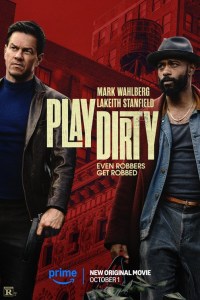
Parker (Mark Wahlberg) is a slick professional criminal trying to score big and get his revenge. In the opening sequence, one of his heist crew, Zen (Rosa Salazar), betrays the group, steals the money, and kills everybody except Parker. He tracks her down and she’s in the middle of an even bigger scheme, one involving billions of dollars from uncovering literal sunken treasure on the ocean floor. He doesn’t like her or trust her but he sure could use his cut of a billion dollars. He taps old colleagues from other old jobs, the colleagues who haven’t been killed, and they must all work together to get their next big score.
 I was blown away by how powerfully unlikable the main character comes across. I don’t need characters to all be beholden to my opinion of likeability, but deficits in this matter are typically offset by writing the character with some degree of personality, menace, or intrigue, something that makes you want to keep watching them onscreen even if you don’t agree with everything they’re doing. However, this Parker guy, as portrayed by Wahlberg, is a big dumb guy who doesn’t recognize he’s a big dumb guy. As a result, he’s beholden to impulsive decisions that come across as cruel to the point of being sociopathic. Again, we’re used to criminal characters being flippant or prone to violence in other stories, but the introductory presentation of this character simply befuddles me and rubbed me the wrong way throughout.
Take for instance the literal opening minutes of Play Dirty. It’s in the middle of a heist but the story doesn’t start us off with the perspective of our thieves collecting their loot. It starts instead with a security guard stumbling onto their heist. He’s with his wife and child in the car and decides, rather than intervening, he’s going to use this opportunity to steal himself some of their ill-gotten loot. Right there, we’re starting with a character making a consequential choice, and our perspectives are not aligned with the robbers but with the robber of the robbers. I wanted him to get away, and frankly, following his story could have proven compelling as well, as someone who gets in over their head and tracked down by professional criminals who want what was taken. Parker gives chase through a race track and eventually shoots this man dead in front of his wife and child. Lest you think Parker is an irredeemable, unfeeling cretin, he takes stock of this woman’s grief and trauma and offers her ten thousand dollars of their loot, to bribe her silence and make amends for the murder of her spouse (that’s not even a good life insurance payout). I don’t know why Black wanted us to begin empathizing from the perspective of some guy who was only intended to be unceremoniously killed, in front of his wife and child. This move made me immediately dislike Parker, and then his little gift for the wife’s trauma felt completely insulting.
 This incident isn’t the only example of Parker being a shoot-first-ask-questions-never brute of limited intelligence. When he reunites with Zen, she’s talking with some guy who planned her new big scheme. Parker doesn’t know anything about this guy other than his physical proximity to Zen. He shoots him dead. For what reason? I don’t know what he was trying to accomplish except an expression of his impatience and hatred for life. I wonder if an elderly nun had been standing next to Zen at this moment and would Parker have committed the same rash act of violence. What about if it was his own mother? To make matters even worse, Parker accompanies Zen to break the news to the dead man’s boyfriend, and it’s in this moment of shock and grief that Parker harasses this bereaved man that Parker berates for crying. He seems to take amusement in how bluntly he informs the other man that his love is never coming back, though leaving out the key part where he carelessly murdered the man. He also shoots Mark Cuban in the leg while he dines in a restaurant for no reason other than being near the guy that he wanted. Again, much of this could be workable if the character of Parker was… anything. He’s not funny, he’s not charming, he’s not really clever or good with plans; he’s just a big dumb guy prone to violence, scowling, and deep sighs. Wahlberg looks bored throughout the whole movie and it makes the character even harder to entertain. If this guy doesn’t want to be here, can we select someone else to be our requisite protagonist?
We might have a leaden dud of a lead, but what about the rest of our enterprising team of thieves and conmen? Do we have any winners here to compensate? Sadly, the team is just as listless. Take Grofield (Lakieth Stanfield) who fraternizes as a theater owner, one who is constantly losing money. That setup has some interest, a criminal who possibly longs to be more of a professional actor, perhaps that eagerness even pushes him into suggesting different covers and roles he could play in their heists. Perhaps he might even see himself above the others since he feels like he is trying to promote the arts. There’s all kinds of ways this introduction could better shape his personality, interests, and contrasts with the other crew. For the rest of the movie, Grofield is just another guy on screen, just another guy driving a car or shooting a gun. There is one brief moment that takes advantage of his interest in acting as he poses as a drunk on a rooftop threatening to jump. After a security guard arrives on the scene, he and Parker subdue the guard, coat him in the same outfit Grofield was wearing, and then toss him off the roof to his death (ho ho). There’s a husband and wife team of crooks (Keegan-Michael Key, Claire Lovering) and that could be interesting, especially if they’re mixing professional and romantic squabbles, or maybe working together is the thing that keeps their spark going, the showcase for their real teamwork. They have one scene with some passing bickering but otherwise they too are just more indiscriminate people onscreen, another person to hold a gun or drive a car. Even the bad guys are boring. Who should I actually care about? I was rooting for that grieving mother and the one guy’s sad boyfriend to team up and punish Parker’s crew.
 Part of the fun of heist crews and con artists are the colorful personalities, the peculiarities, the intra-group conflicts and dynamics, but this movie gives us so little. It’s almost as if the characters are merely meant to trick the brain of a viewer barely paying attention, providing an assurance, “These are the guys,” without forcing thinking over differentiation. It’s like the film equivalent of not wanting to arouse like your elderly grandfather with conflicting evidence contrary to his memories. It’s like accepting defeat.
So the characters are lousy, are there any outstanding or fun caper or action scenes? Black is known for his snappy style and pulpy sensibilities across genres. He hasn’t made a boring movie yet, so I had hoped that even if Play Dirty ultimately proved lackluster, at least it would provide some flash and fun. Nope. Many of the action scenes are Parker and company just throwing caution to the wind and shooting a bunch of guys. There’s one sequence in the middle that involves actually planning and steps to draw our interest, it’s a ridiculously over-the-top plan that shows once again the crew’s disregard for collateral damage. Their valuable cargo is being shipped through the city on an elevated train, so the team decides to derail the train in the middle of the city. Not in a deserted area unpopulated by civilians, in the middle of town. As expected, the train careens off the tracks and through the city, likely causing the deaths of dozens of innocents we’ll never know because their existence is unworthy of the movie’s attention, much like the suffering of that widow and child in the opening sequence. The sequence is the equivalent of killing a mosquito with a flamethrower, and while overkill can certainly be cinematic and pleasingly entertaining, just ask Michael Bay or James Wan, it needs to exist in a world where that overkill is normalized. Otherwise, it just stands out as excessive and causes us to poke holes at the baseline reality.
Play Dirty is astoundingly dull and witless, lacking any of the spark and personality flair I expect from a Shane Black vehicle. Mark Wahlberg’s somnambulist performance is the best symbol for this entire enterprise, a crime thriller going through the motions but with its mind elsewhere. I know I certainly felt my mind going elsewhere while watching. Not just dull and tedious, Play Dirty is also just an uncomfortable experience because we’re stuck watching a group of unrepentantly amoral characters endanger and kill innocent lives in the pursuit of ill-gotten gains, but these characters aren’t intriguing, complex, memorable, or even cool, so the whole movies feels like you’re watching a pack of dude bros just randomly terrorize anecdotal characters out of sheer detached boredom and nihilism. It’s not fun, it’s actually quite the opposite of fun, and I wish Black had put more of himself into this enterprise (hey, the Christmas setting is present). Who wants to play with characters this boring and repulsive for two hours?
Nate’s Grade: C-
Share this:

Honey Don’t (2025)
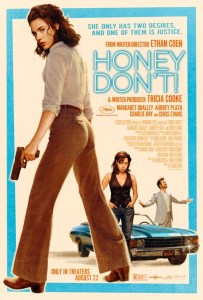 It’s the second collaboration between Ethan Coen and his wife Tricia Cooke and reportedly the second in their “B-movie lesbian trilogy” (the planned third film is tentatively titled Go Beavers). It’s better than 2024’s Drive-Away Dolls, a randy cartoon that was so overpowering and underwhelming. This time the filmmakers play around in the film noir genre with Margaret Qualley as a wily private eye, Honey O’Donahue. The whodunnit plot is a series of disconnected threads and plotlines that don’t connect together in interesting or surprising ways. It begins with an immediate mystery: a woman, dressed right out of Faster, Pussycat! Kill! Kill!, walking down an embankment to inspect an overturned auto and the body inside. Boom. I’m intrigued right away. Sadly, this might be the high point. A third of Honey Don’t involves Chris Evans playing a debauched minister selling drugs on the side and exploiting his congregation. His storyline seems to run in parallel with Honey’s investigation without really crossing in meaningful ways. It even resolves without her intervention. It’s also incredibly dull and repetitive, with Evans’ reverend being interrupted during sex multiple times for comedy, I guess. Honey Don’t exists as a winky flip on the noir genre, this time with lesbians! It doesn’t so much feel like a compelling story with colorful characters as it does a writing exercise. Qualley fares better as the straight-laced yet flirty private eye than she did as the horny caricature in Drive-Away Dolls. She’s got a self-possessed charisma and determination that works. If only the rest of the movie didn’t repeatedly let her down. It’s not offensively bad, or even as aggressively cringey as their previous collaboration, but Honey Don’t is another middling, daffy, disposable genre riff by Ethan Coen that makes me long for an eventual reunion with his brother.
Nate’s Grade: C
Share this:

Layer Cake (2005) [Review Re-View]
 Originally released June 10, 2005:
Layer Cake may be the least intimidating name ever for a crime movie. It conjures images of bridal showers, cooking shows, and birthday parties. It does not necessarily bring to mind thoughts of gangsters, assassins, drug trafficking, and the seamy underbelly of London’s criminal underground. Unless you’re watching some really awesome cooking show I don’t know about. The “layer cake” in question refers to the hierarchy of criminals. This isn’t unfamiliar territory for Matthew Vaughn, who produced Guy Ritchie’s Lock, Stock, and Two Smoking Barrels and Snatch. This time it’s Vaughn sitting in the director’s chair and the results are exceptionally entertaining. Layer Cake is a cinematic treat.
Daniel Craig (Road to Perdition) plays our untitled lead, referred to in the end credits as “XXXX.” He’s a cocaine dealer but not a gangster by any means. He wants to make his money, not step on any important toes, and then walk away on top and without any gaping holes in his body. Craig is summoned by his boss Jimmy (Kenneth Cranham) and given two missions, whether he wants to accept them or not. The first is to relocate the missing daughter of a very powerful friend of Jimmy’s. The second, and far more dangerous job, is to secure a package of millions of stolen ecstasy pills and make a profit. Complicating matters is the angry Serbian mob that the pills were stolen from. They’ve dispatched a deadly assassin known as Dragan to track down their stolen drugs and kill anyone involved. Craig is left to juggle the investigation, find a buyer, stay ahead of Serbian hitmen, get some time in with a hot new girl, and all the while keeping his higher-ups content enough not to kill him themselves.
 Layer Cake should be the film that makes Craig the star he so rightfully deserves to be. This man is a modern day Steve McQueen with those piercing blue eyes, cheekbones that could cut glass, and the casual swagger of coolness. Craig grabs the audience from his opening narration as he explains the ins and outs of his business. We may never see Craig sweat but he still expresses a remarkable slow burn of fear so effectively through those baby blues. He’s in over his head and the audience feels his frustrations. In an interesting character twist, when Craig does resort to killing, he’s actually tormented and haunted by his actions.
As with most British gangster flicks, there are a batch of colorful characters that leave their mark. Dragan (Dragan Micanovic) is a wonderfully enigmatic ghost of an assassin always one step ahead of Craig and the audience. Morty (George Harris) and Gene (Colm Meaney) add heart and bluster as Craig’s trusted right hand men. But the actor who steals the whole film with a malevolent glee is Michael Gambon (Harry Potter and the Prisoner of Azkaban). He plays Eddie Temple, the man behind the men behind the scenes. Gambon delivers the harshest of speeches with a velvety pragmatic calm. We don’t know what runs deeper with Eddie, his tan or his scheming.
Sienna Miller plays the thankless love interest to Craig. She’s pretty, sure, but there isn’t much acting ability on display in Layer Cake beside some smoldering glances. We never really know what Craig sees in her besides being another cute blonde to choose over. Miller isn’t alone in the “underwritten character department.” Layer Cake is crammed with secondary characters that pop in and out when it’s necessary. It’s not too annoying but it does mess around with an audience?s ability to follow along coherently.
Layer Cake is not one of the slick, whack-a-mole ventures Ritchie has given us (pre-Madonna). No sir, this is a brooding, serious and nearly terrifying look at the old adage “crime doesn’t pay.” Very few crime centered films express the day-to-day anxiety of just being a criminal. Jimmy reminds Craig that he’ll never be able to walk away because he’s too good an earner for his higher-ups. In Layer Cake, you can get killed for being too greedy, being too careless, being too good at your job, and even just being in the wrong place. Eddie sums it up best whilst describing Faust: “Man sells his soul to the devil. It all ends in tears. These things always do.”
 Vaughn has a polished visual sensibility that doesn’t overwhelm the viewer. He keeps the camera fluid and steady with a minimal amount of cuts. A nifty opening scene involves an imaginary drug store (stocked with pot, cocaine, and the like) melting into a real drug store (one hour photo, impulse items at the register). When the tension does mount Vaughn knows just how to turn the screws. A late sequence involving a chase between the SWAT team and our batch of criminals had me on the edge of my seat. For a first time director, Vaughn also has great patience. He doesn’t rush his storyline and he doesn’t suffocate his movie with visual flourishes. He also has a great deal of faith in his audience’s intelligence. This isn’t as lively as Snatch or Lock, Stock, but that’s because Vaughn’s film is also much more serious and dangerous.
This is an intricate and gripping film but it might be a little too complex for its own good. Twists and double-crosses are expected in this genre, but writer J.J. Connolly has so many characters running around and so many hidden agendas that it’s nearly impossible to keep track. Some of the subplots and back stories add very little like the inexplicable “Crazy Larry” flashbacks. I left the theater still confused about plot points but refreshingly satisfied nonetheless.
Layer Cake is the most thoroughly exhilarating time I’ve had at a theater this year. This pulpy daylight-noir caper is full of memorable hoods, plenty of twists and turns, and a star making performance by the steely-eyed wonder that is Daniel Craig (rumored to be the next 007, though in my heart I’ll always root for Clive Owen). Fans of Ritchie’s frenetic gangster flicks should be entertained. Anyone looking for a clever and exciting potboiler that treats violence and crime seriously should start lining up immediately. If you’re suffering from the cinematic wasteland that 2005 has shaped up to be so far, then have yourself a generous helping of Layer Cake and thank the Brits.
Nate’s Grade: A
——————————————————
WRITER REFLECTIONS 20 YEARS LATER

Back in 2005, Layer Cake was really a proof of concept movie for many items. It was proof that someone could take a Guy Ritchie-style crime pot boiler with colorful Cockney criminals and plenty of twists and unexpected violence and play it straight and serious. It was proof of Matthew Vaughn as a director, who had previously served as a producer of those early Ritchie films. It was proof of Sienna Miller as the next It Girl, a proclamation that carried her for years despite mixed results with the movies. Most of all, it was proof of its lead, Daniel Craig, as being so suave he should be considered the next possible 007. James Bond producer Barbara Broccoli has gone on the record saying this movie is what officially put Craig on their radar and got him the gig that has defined his career trajectory. Twenty years later, Layer Cake is still a potent and smooth little thriller that glides right by on its intelligence, sex appeal, and Craig’s charisma
I find myself agreeing with so many of my original points from 2005 so I don’t want this re-examination to be merely a “ditto” without some additional critical analysis. Even though it’s based on a book by J.J. Connolly, who adapted his own novel, the movie feels very much in the company of those early Guy Ritchie movies that Vaughn began producing. Ritchie burst onto the international scene with 1998’s Lock, Stock, and Two Smoking Barrels, a brash and stylish crime comedy with outlandish characters, violence that alternated between visceral and slapstick, and twisty plots that often left your head spinning. It was like a mixture of Tarantino and a more lewd Looney Tunes cartoon. While the early Ritchie films, including my favorite, 2001’s Snatch, have their share of characters with grounded stakes, the reality is exaggerated, with the appeal being these grandiose personalities butting against one another. No one would confuse one of these Ritchie movies with a realistic portrayal of London criminals. They’re fun. What Layer Cake does so well is take a Ritchie-esque premise with plenty of low-life screw-ups and hardasses and plays it straight. It takes this middle-level drug distributor and makes his life less a comedy of errors and more a never-ending anxiety attack about how he can become undone from any angle. The movie sure doesn’t make a life of crime look appealing.
 Craig’s character, named XXXX, is a smart guy just trying to keep his head down and do his job. The problem for him is that he’s too good at earning money for bad men who like money. In this life, you can get killed for any number of reasons, some of them logical and pragmatic, and others rash and illogical: not being a good enough criminal, being too good of a criminal, thinking he’s too good of a criminal, someone else wanting to make a name for themself and establish cred by going after you, dumb luck, etc. XXXX has his rules and standards to live by to ensure he limits his risk, but when your profession is literally dealing with money and unscrupulous types, there is no absolute zero in that risk. He may be smart and measured but he’s also working with plenty of stupid people who don’t know they’re stupid, and then you mix in vice and avarice with that, and it can be a combustible cocktail of dangerous idiots intruding on whatever peace and distance XXXX has cultivated for himself. In the movie, XXXX is burdened with competing tasks. He’s been offered a stash of stolen ecstasy pills, and his slimy boss wants them sold no matter what, but the assassin hired to retrieve them definitely wants them back too. Either way, our lead character is endangering himself by making someone unhappy. He’s dropped into the sticky morass of power plays and competing interests that will challenge his intended neutrality.
I think the ending for Layer Cake is brilliant and very fitting. For almost two hours, we’ve followed XXXX through hell and back and it looks like he’s found a way out, siding with the right hoodlums and eliminating different risky angles needing to be resolved. He’s kept to his stated retirement of not going out on top and instead going out while comfortable and capable. He’ll leave the business to his associates because he’s tired of looking over his shoulder. And as he walks out with his pretty lady (Sienna Miller) around his arm, that’s when he abruptly gets shot by Sidney (Ben Whishaw – yes, the future James Bond is killed by his future Q). This isn’t some tough or some hotshot; he’s a lanky nephew to another gangster, and he hasn’t exactly shown anything close to a killer instinct. In his brief appearances beforehand, he’s seemed out of place, like a latchkey kid who wandered into a criminal enterprise and everyone has been humoring him for good measure. The only thing he has is… was… the blonde girlfriend (Miller) who’s clearly not interested in him. After playing it so cool and calculated, he’s taken out by this twerpy nobody because he had the audacity to try and steal “his girl.” Even if you are the smartest guy in the room and you’ve made all the right moves, all it takes is one twitchy trigger finger and one grumbling grievance to take you from living to dead. Our hero is denied his happy ending driving off into the sunset with his modest sums of money and his newly acquired pretty woman. Try as he might, XXXX, gunned down mid-sentence as he reveals his real name, becomes just another unfortunate corpse.
 Vaughn’s skilled direction immediately made him an attractive target for bigger studio fare. He was originally attached to direct 2006’s X-Men: The Last Stand but left weeks before filming for stated “family reasons.” In 2023, Vaughn revealed that he left because of the tight production timeline, going from pre-production to a complete movie in under a year, but it was really the shady behavior of Fox execs that pushed him out the door. Apparently one exec put together a fake script to lure Halle Berry back, including scenes of her character Storm saving vulnerable children in Africa to appease Berry, scenes that were never intended to ever be filmed. It was a ploy to trick her into signing onto the film. After two more geek-friendly adaptations, 2007’s Stardust and 2010’s Kick-Ass, Vaughn was courted yet again back to the X-Men franchise. Once again there was a tight one-year turnaround deadline but Vaughn stayed on board and delivered what I consider to be the best X-Men movie, 2011’s First Class. It revitalized the declining franchise, enough so to lure Bryan Singer back. Singer had departed in 2005 to make his Superman movie, opening the door for Vaughn’s first foray with the world of mutants. Now that Vaughn had reinvigorated the franchise with a new cast of younger actors, Singer was ready to take it back to helm 2014’s Days of Future Past. Vaughn was rumored as one of the potential names to make the first new Star Wars movie in ten years. Instead, he made his own action franchise with 2015’s Kingsman. Granted it was based upon the comic by Mark Millar, the same author behind Kick-Ass and Wanted, but it was Vaughn’s signature all over this new spy franchise. Vaughn had constructed a new Bond for a new age. At this point, I was dubbing Vaughn the best working director to use studio money. Each movie was different but made with style and panache with great structure and payoffs. And then…
I think he got so enraptured with the world of Kingsman that he’s now trapped himself creatively. In the ensuing years, he’s made one Kingsman sequel and one prequel, both of them varying degrees of underwhelming, and another action spy-thriller that might as well be called Kingsman-lite, 2024’s Argyle. For an artist that was dabbling with so many genres beforehand and finding sure footing and a way to make his stamp within each, he now feels stuck, finding diminished returns with each iteration of yet another swanky spy action movie with snark. I’m not even an Argyle hater, a movie that appeared on numerous Worst of the Year roundups but one I consider perfectly fine as a TNT Sunday-afternoon kind of chill entertainment. I loved Kingsman when it was originally released in 2015, but looking back, it appears like this was Vaughn building his own prison brick by brick. Maybe he was too preoccupied with turning it into a franchise with many tendrils stretching all over. I truly wish Vaughn would hop genres once again and leave the realm of spy action to others at this point. Maybe he needs a return to something straight akin to Layer Cake without its tongue already so firmly implanted in-cheek.
 But this movie will forever be known as the movie that secured Craig as the next James Bond. He had been working in movies for a while with some high-profile supporting roles like 1998’s Elizabeth and 2001’s Tomb Raider and 2002’s Road to Perdition, but this was a platform that showcased the suave presence of this actor like nothing before. He was so magnetic and a perfect choice for this character, and just listening to him try and talk his way out of jams with so many loose canons was as impressive and entertaining as any high-stakes chase or shootout. These sort of star-making roles are rare and even more rare when they do indeed prove to be star-making. It becomes an artifact to analyze what qualities people with money and influence were won over by. It’s interesting that Craig’s character is so anti-guns and wanting nothing to do with the more unsavory and violent aspects of his profession. When he does hold a gun for the first time, one he compliments as being “really pretty,” he holds it out and strikes a pose, dashing through a hallway like he was James Bond, and it’s just especially funny with hindsight.
The movie is also filled with familiar faces that would become even more familiar over the years, including Tom Hardy, Sally Hawkins, Whishaw, Burn Gorman, and some Vaughn regulars, alums from Snatch and Lock, Stock, Jason Flemyng and Dexter Fletcher. Flemyng became Vaughn’s lucky charm, appearing in his first four movies in some capacity, much like Greg Grumberg does for J.J. Abrams. There you go, an SAT-style relationship sentence I never thought I’d write: Jason Flemyng is to Matthew Vaughn as Greg Grumberg is to J.J. Abrams. My original review in 2005 highlighted Michael Gambon as the biggest honcho, the top tier of this criminal layer cake. I wrote: “He plays Eddie Temple, the man behind the men behind the scenes. Gambon delivers the harshest of speeches with a velvety pragmatic calm. We don’t know what runs deeper with Eddie, his tan or his scheming.” He’s so good at being so malevolent without ever having to raise his voice or anything outwardly hostile.
 This movie has a personal factor for me because I was so highly anticipating it that, during a trip through the British Isles with my father in May 2005, I bought it on VHS overseas. I naively thought that while DVDs had different regions to thwart piracy, that VHS tapes would be rather universal considering it’s just tape being read. I got home, popped it into my American machine, and the thing wouldn’t work. This was one of the biggest souvenirs I got for myself during that trip, which my father wanted to embark as something memorable we could share together, and now that he’s recently passed, I do think back on those experiences and part of me wishes my 23-year-old self would have been more actively appreciative. So now with Layer Cake, part of me will always think about that VHS tape, and that trip, and my father, and it will make me miss him more, but I am glad we got to share that experience.
Ever since I’ve been doing this re-review project, now going on five years, it’s a relief to see my twenty-year-younger self having written a smart and articulate review, especially when I mostly agree with it even so many years later. Again, I find myself nodding along to just about everything I had written with my past critique, from singing the praises of Craig and the general examination of day-to-day anxiety, to shaking my head at the underdeveloped Sienna Miller character served as little more than a trophy for our hero to take with him into retirement. It still is a movie overstuffed with characters and storylines and antics that probably could have been trimmed around the edges, but that same burdensome feeling connects with the emotional state of our lead, the anxious feeling of having too much to do and not enough time to achieve it, so in a way, it’s excusable. I don’t know if I think the movie is quite at the same level, calling it “thoroughly exhilarating” seems a bit much, but Layer Cake is still a movie that proves fresh even twenty years later, and one worth a second helping.
Re-View Grade: A-
Share this:

Havoc (2025)/ Novocaine (2025)

Action cinema has long been one of the most satisfying experiences for the always-insatiable moviegoer, being presented with the thrum of kinetic editing, expert choreography, and visceral photography to produce a sensory thrill. Watching a well-developed action sequence is akin to watching a stupendously choreographed dance, where the movement and struggle are part of the storytelling momentum. Two recent action movies show what can be achieved, one through intensity of the familiar and the other through elevating its concept. Both are fairly enjoyable escapes and reminders that, with the right hook or sense of passion, action cinema can be some of the most gleefully transporting sensory experiences.
One of the best genre filmmakers is Gareth Evans, a man who blew the industry away with his intense Indonesian martial arts epics, The Raid and its even better sequel. After watching those movies, and taking time to catch your breath, you have to wonder why Evans isn’t directing every Hollywood action movie, or at least been tapped to try his hand at juicing some studio franchise with his visionary feel for action. It’s still a mystery to me that Evans has only helmed two movies since 2014. Both of them happen to be from Netflix, and while I don’t pretend to understand the creative machinations behind this streaming giant, if I were them I would give Evans a $20-million budget every three years and tell him to do whatever he wants as long as it involves people getting hurt. At first glance, Havoc looks fairly conventional, a crime drama about corrupt cops and hoodlums fighting over who can get to a target first. You have to keep reminding yourself that Havoc is not The Raid and not aspiring to be, so the fact that it cannot rise to that extreme level of action excellence does not mean it is a failure. It’s not in that upper echelon of action cinema, like your John Wicks, but Havoc is most definitely a step above many of Netflix’s junky action-thrillers with A-listers that inevitably disappoint in their flailing execution.

Tom Hardy plays Walker, a veteran cop who works as an enforcer when the money’s right. He’s tired of being a tool to the rich and powerful and looking to get out and be a better family man. You know, the stuff of formulaic action boilerplate. He gets involved in a job gone wrong that leads to a gang war spreading and plenty of hired guns looking to find the son of the mayor (Forest Whitaker). That’s about it as far as the plot. It’s about different groups racing to get what they want first at whatever bloody cost.
Whereas The Raid was a martial arts action extravaganza with professionals at the top of their game getting the platform and material to showcase their amazing skills, Havoc is not that kind of movie; in fact there’s very few moments where the action consists of fisticuffs. This is an action movie built on car chases and mainly gunfights. It’s a cops and robbers kind of action movie, which puts less emphasis on hand-to-hand and more on room clearing. While the accumulated thrills might not be as gratifying as watching professional athletes launch exciting routines, there is still plenty to enjoy when watching finely developed gunfight sequences. The boring approach is simply to convey a shot-reverse shot dynamic: Character A fires a gun, then cuts to Character B being shot or dodging, repeat. Good directors will think about how to better stage a sequence so that each one has its own purpose, its own set of mini-goals, a set of organic complications that keep the conflict roiling, and ways to connect to character. Action sequences should not just be excuses to blow something up. With Havoc, it takes quite a bit to get going, but there are two standout action sequences that make it worthwhile and will satisfy most action aficionados.

The first sequence is a fight in a club that kicks off the movie’s shift to constant scrambling action. It’s about 50 minutes into the movie and all the respective characters have been slotted into their conflicting positions. We know who the good guys are, the bad guys, the goals in opposition, and what the stakes are, and from there the movie just takes off in a sprint until its final blast. The club involves different levels and different factions fighting and mixing, providing a series of changing complications that makes the sequence feel more lively and engaging. There are several inventive moves to avoid gunfire or reach guns, and the cinematography keeps the action centered and easy to comprehend. The best action sequences are planned like moving puzzles, and the more work that is put into the preparation, the more enjoyable the action can become. This club shootout scene finds numerous ways to keep the stakes upended and to place the characters in new forms of danger they have to quickly adapt to survive.
The second sequence is a climactic confrontation at a cabin in the middle of a snowy forest. It’s a prolonged siege sequence where the bad guys are attempting to break through into this secure location and take out our heroes. From this claustrophobic setting, Evans presents the antagonistic intrusions as unrelenting and coming from all four walls and even below as well. The characters have to constantly be moving and reacting to an assembly of threats while their protective walls begin to literally crumble. It is a literal onslaught. I’m shocked the cabin is still standing by the end. It’s an immensely engaging sequence that communicates the frenzy and anxiety of being under constant attack. The gunplay can be brutal and there are satisfying kills and battles between side characters throughout this sequence to avoid the sequence from feeling too repetitive. It feels in many ways like the whole movie has been leading up to this sequence, not just in a traditional linear-plotting fashion but also the viewer has been waiting for the director to fully go off with a celebration of action mayhem. This is Evans unleashing his best, and he’s adapted his creativity to the setting and the action sub-genre, so there’s different moments meant to present immediate gunfire problems and fast-paced responses. In this world, people aren’t all gifted as expert fighters, and thus even our heroes can falter under the harried circumstances.

Short of these sequences, the rest of Havoc has difficulty breaking free from the gravitational pull of its own genre cliches. Evans wrote the screenplay by himself and I’m surprised how flimsy so much of the story and characters come across. With 2011’s Raid, there wasn’t much of a story once the action stopped, but with 2014’s Raid 2, Evans was able to compose an undercover cop story that was just as compelling even when people weren’t getting kicked in the face. He can write colorful side characters that feel like they stepped out of a Tarantino-favorite grindhouse movie. He can write tense sequences that don’t have to rely upon action. He can do so much more than what Havoc provides, so it’s hard not to feel like this wasn’t exactly a passion project. It feels more like a serviceable vehicle to achieve the kind of action that Evans was looking to achieve. Now, if you’ve underwritten a genre movie because your real interest is staging the action, then you would expect there to be more action, correct? Strangely, Evans spends most of those first fifty minutes setting up his story, the same story that is awash in genre stock roles and cliches without much intrigue beyond a one-sentence description. Simply put, if you’re going to stick us with underdeveloped characters, don’t keep us waiting for the action. There’s so many characters in this movie that I think Evans gets overwhelmed trying to set them all up and involve them in the larger story. If they’re only going to be stock roles, why do we need 30 when 10 can do? I think Evans keeps his cast so big so he can unceremoniously bump off so many of them, which can be surprising, but I would have preferred doing more with the space their absence might have provided the narrative. There’s also an odd stylistic choice where any exterior shots are much more stylized, looking more like video game cut-scenes or something out of the realm of Sin City. It’s at odds with the rest of the film’s stripped-down look.
Havoc is a gritty and bloody action movie that can overwhelm at moments and underwhelm at others. The genre grist is pretty familiar, from our troubled antihero lead trying to atone for his past sins, to the dumb kids in the middle of a gang war they don’t understand, to the good-natured partner who has to grow up, so to speak, by getting their hands dirty. You’ve seen variations of these stories before, but the real draw is once Evans works up enough space to really unleash his invigorating action best. It’s a movie I wish was better but it’s functional enough for Evans to do his extraordinary thing. I just want more of his specialty.
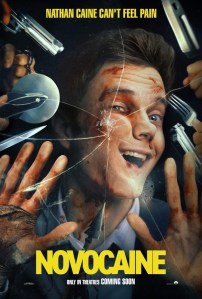
In comparison, Novocaine isn’t going to be defined by stylish choreography or exceptional style. It’s a high-concept action comedy driven by flipping the genre script. Instead of our hero inflicting great pain on his foes, this movie is about a hero enduring amazing amounts of pain. It’s an underdog story where a novice is thrust into an unfamiliar situation and has to utilize his unique disorder, a blessing and a curse, in order to rescue the girl and save the day. It’s a great premise that lends itself to plenty of fun scenarios to fully capitalize on its bizarre potential, and that’s where Novocaine hits a sweet spot of entertainment.
Nate (Jack Quaid) is a shy assistant manager at a small bank in San Diego. He suffers from a unique medical condition where he doesn’t feel the burdens of physical pain. You might think this a luxury but it’s actually a great worry for Nate. Without his body’s alarm system he can stumble into grave danger without even knowing it, so he’s been living an overly cautious life as a result. That all changes when he meets Sherry (Amber Midthunder), a new coworker who takes an interest in him. They go out on a date and really hit it off. Things are looking up for Nate until bank robbers storm his work, kill his boss, and take Sherry hostage. Nate hijacks a cop car and goes chasing after the bandits to rescue Sherry. He’ll undergo lots of trials of pain to win back the girl who makes him feel things.

How do you make a person invulnerable to pain an exciting character? It’s the lingering Superman question, except nobody is going to confuse the character of Nate with Krypton’s orphaned son; if a character cannot feel pain how can we worry over their well-being? Now there’s a reason writers have been able to tell Superman stories for decades, even if the movies often struggle with representing the figure, and that’s because it just forces you to have to think harder. It can be done. With Novocaine, Nate is a hapless naif thrown into an action movie and trying his best to fit in. He lacks physical prowess, weapons training, and tactical planning. However, the only thing he has going for him is his inability to feel physical pain, and the filmmakers routinely find funny and entertaining methods to test how far one could go with this pain threshold. While his body isn’t registering pain he is still taking all the punishment. Nate is nowhere near indestructible, and a running gag becomes how utterly mangled and deformed his hand becomes from event after event (I thought it was just going to be a stump by the end). He takes quite a beating but because of the whole “mind over matter” matter, he’s surprisingly able to persevere where others could not. This allows Nate to become an unexpected hero where the rest of us would pass out from shock. The appeal of the movie isn’t so much the action itself but the ongoing response to all of said action.
The set pieces are what makes this movie so much fun, pushing Naate into action hero mode when he’s clearly awkward and not ready for the promotion. I loved his dry responses to every new injury, from mild annoyance to feigned surprise. There’s a scene where one of the villains is torturing Nate and he has to go along with the charade in order to appease his tormentor and get valuable information out of him. It’s a reverse interrogation where the target is actually trying to manipulate the guy with the pliers. I loved how quickly he could bounce back from whatever trauma, from catching a knife blade first and quickly yanking it out of his hand, to casually writing an address on his hand with a tattoo gun. There is a crafty ingenuity to how the filmmakers can make the best use of this superpower. There are some impressive kills that also made me wince in response, like reaching for a gun at the bottom of a deep fryer, or literally stabbing a person in the face with an exposed arm bone. Novocaine has a delightfully demented sense of humor that keeps everything grounded with mordant laughs even when it’s dishing out the punishment.

Even more surprising, there’s a buoyant love story that genuinely feels sweet that could have benefited from a little more development and attention. Sherry is the one who activates our protagonist and pushes him outside of his comfort zone. He lacks confidence in himself and has been living an overly cautious existence from fear of not being able to respond to his body’s emergencies. The man has been eating his food as liquefied goop out of a fear of choking. She introduces him to the simple joys of eating one’s food before it’s been vigorously blended, like the wonders of pie. Their first date was genuinely charming and I liked the chemistry between both actors. Midthunder has been a favorite of mine since Prey and I want to see her in more varied roles. When the bank robbery commences, I actually had an emotional response to these two being in danger and watching the other being put in danger. Once she becomes a hostage, Sherry is placed as the damsel to be saved, which is disappointing because I liked her contributions to the story and especially what she brought out of Nate. There is a revelation with her later that reorients our understanding of her but I don’t think it was fully necessary. Their budding romance is quite enjoyable and so I wish the story could also continue to develop this connection over its wild series of mishaps.
Novocaine is a great example of a movie that maximizes its unique premise to stand out. It’s structured like a traditional action-thriller but it never takes itself seriously, pushing forward a stumbling protagonist whose real gift is that he’s the human equivalent of a punching bag. This dynamic is ingeniously developed and showcased, and just when I was worrying the premise might get old or become repetitive, the filmmakers find new ways to twist their story into even better twisted results. I wish the female supporting role was more tied into the action and fun, and the villains are a bland blend of overly confident paramilitary goons. Still, the fun comes from Quaid and his light-footed screwball performance anchoring the bloody hi-jinks and demented humor. Novocaine is a fresh reworking of action movie tropes with a twist that allows the audience to heartily laugh at our hero’s pain and pratfalls. It’s the kind of humor and energy that reminds me of the Crank filmmakers. If you’re looking for a winning dark comedy bouncing against the formulas of action movies of old, settle in for some Novocaine and enjoy the pain.
Nate’s Grades:
Havoc: B-
Novocaine: B+
Share this:

Emilia Perez (2024)

Movie musicals can be sweeping, invigorating, and at their very best transporting, They mingle the high-flying fantasies and visual potential of the cinema, and we’ve gone through many waves of kinds of musicals. Today, we’re in an outlandish world of the outlandish musical, an experience in ironic air 210quotes, where stories that you never would have thought could be musicals would then dare to be different and attempt to be musicals. The much-anticipated Joker sequel, Folie a Deux, dares to be a challenging jukebox musical of old favorites. The French movie Emilia Perez tells the story of a cartel leader that undergoes a sex change and tries to do good with her second life. Both movies are deeply interesting messes as well as experiences I don’t think work as musicals.
In contrast, Netflix’s Emilia Perez is like an entire season of a telenovela streamlined into a two-hour-plus movie that manages to also, for better or worse, be a musical. It is filled with many outlandish and provocative elements you would never expect to be associated with singing and dancing, like a sex change surgery center. This movie mixes so many genres and tones that at one point it feels like you’re watching a crime thriller about Mexican cartels and their manipulation of those in power, and then the next moment it feels like you’re watching an absurd rendition of Mrs. Doubtfire, where a spouse has adopted a new identity and uses this to spend time with their kids they otherwise would not be able to do so. It’s a wild film-going experience; I can’t recall too many musicals that use street stabbings in syncopation with percussion. Because of its go-for-broke ambitions and veering tones, Emilia Perez is destined to be a cult movie, some that fall in love with its bizarre mishmash of elements, but most will probably be stupefied by the entire experience and questioning why, exactly, this was made into a musical.

In Mexico City, Rita Castro (Zoe Saldana) is a savvy defense lawyer tired of living in the shadows of her buffoonish bosses that rely upon her writing prowess to win cases. Someone sees great potential with her, and it happens to be Manitas del Monte (Karla Sofia Gascon), the head of a dangerous cartel. He wants Rita to find the international means to finish the process of Manitas surgically becoming a woman. Under the gun, metaphorically and literally, Rita finds the doctors who will transform the dangerous him into a new her. Manitas then fakes their death, leaving his old life behind to start anew, including their children and wife, Jessi (Selena Gomez). Manitas becomes the titular Emila Perez, but rather retire in luxury, she wants to do good, and Emilia begins a non-profit organization that exhumes bodies, victims from the cartels, to provide closure for their widows and grieving families. Emilia then invites Jessi and their kids to come live in her estate, explaining she is a formerly unknown “aunt” to Manitas. Now Rita is trying to run Emilia’s organization, keeps Emilia from going too far in revealing her identity, and looking out for her own sake considering she’s one of the few that knows about a life before Emila Perez.
I know there will be hand-wringing and cultural tut-tut-ing about the movie’s implicit and explicit themes dealing with trans issues, exploring one woman’s exploration of self and securing the identity she’s always wanted through the lens of a lurid soap opera trading in stereotypes. It’s a lot of movie to digest, and while it feels entirely sincere in every one of its strange creative decisions, it’s also the kind of movie whose tone can invite snickers or derision, like the sex change clinic where a heavily bandaged chorus repeats words like, “vagioplastia” and “penoplastia.” It’s a movie with extreme feelings to go along with its extreme plot turns, but the whole movie feels like it’s trying to settle on a better calibrated wavelength of melodrama.

I think this could have been significantly improved by director/co-writer Jacques Audiard (Rust and Bone, A Prophet) had he embraced more of the movie’s outlandish reality breaking through. Too few of the musical numbers actually do something more than witness someone singing. The opening number, one of the best, involves Rita trying to compose a defense through the streets of Mexico City, while a crowd sweeps around her, often stopping to chime in as an impromptu chorus, sometimes setting up props for her use. It’s a great kickoff, the energy crackling, and I was looking forward to what the rest of the movie could offer. There’s only one other musical number that recreates this significant energy and engagement, a fundraising dinner for Emilia’s organization amongst the powerful members of society. While Emilia speaks at a podium, Rita struts around the floor, sashaying between the tables, and informing the audience about all the dirty deeds and skeletons of the assembled muckety-mucks. She’s literally manhandling the frozen participants, dancing atop their tables in defiance, and it’s a magnificent moment because of how it breaks from our reality to lean into the storytelling potential of musicals. These sequences work so well that it’s flabbergasting that Audiard has, essentially, settled for far less creatively for too much of his movie’s staging. The big Selena Gomez song is just her listlessly singing to the camera while shifting her weight while standing, like the laziest music video of her career. Why tease the audience with the crazy heights as a musical if you’re unwilling?
And now let’s tackle the music, which to my ears was too often rather underwhelming.It sounds like temp music that was intended to be replaced and never was. It’s lacking distinct personality, catchy or memorable melodies, anthems and themes, the things that make musicals enjoyable. The best songs also happen to be the best staged sequences, both involving Rita. These songs have a different vivacious energy by incorporating a hip-hop style of syncopation. “El Mar,” the song during the fundraising dinner, offers an infectious chorus adding extra percussive elements like people slamming fists down onto tables, listening to plates and glasses rattle. These are the moments that enliven a musical and convey its style and panache. Alas, too many of the songs lack that vitality, and can best be described as blandly competent and too readily forgettable.

It’s a shame because Saldana is giving her finest screen performance to date (to be fair, I never watched her Nina Simone biopic). The actress best known for being the strong warrior in sci-fi franchises like Avatar, Guardians of the Galaxy, and Star Trek plays an intriguing character with a rising fire of purpose and paranoia. Early on. Rita is ambitious but unhappy, practically dowdy in appearance, and she begins to come alive under her new role for Emilia. Saldana is electric as she sings and dances and slips effortlessly between Spanish and English, possibly to her first Oscar nomination. She’s the standout, which is slightly strange considering the role of Emilia Perez should be the breakout. Gascon, a trans actress, is quite good in such an outsized role, and gets to play her pre-transitioned identity as well under gobs of masculine makeup and tattoos. The fault isn’t with Gascon’s performance, the issue is that her character has such amazing potential but feels criminally underdeveloped. There is a world of issues of self-identity, culture, repression, shame, anger, jealousy, desire, to name but a few, that could be richly explored from the perspective of the leader of a deadly gang wanting to become a woman. The character is left too inscrutable for my tastes, leaving behind so much unobserved drama. As a result, even though the movie is literally named after her, Emilia Perez feels like a projection more than a character, and if that was indeed the point, then we needed more conflict about that friction.
Emilia Perez is a lot of things all at once; campy, ridiculous, sincere, crazy. It’s messy but it’s an admirably ambitious mess, one that even the faults can be the unexpected charms for someone else. I didn’t fall in love with this genre-bending experiment, although I found portions to be fascinating and others to be confounding. I don’t even think the musical aspects were finely integrated and explored, and so they feel like more of a gimmick, a splashy attempt to marry the high-art of musical theater with the perceived lower-art of grisly crime thrillers and melodrama. It earns marks for daring but the execution is haphazard and scattershot at best. There are moments that elevate the material, where the musical elements feel confidently integrated and supported with the dramatic sequence of events, providing an unexpected and rousing response. However, those moments are few and far between, and the absence only further cements what could have been. Emilia Perez might be your worst movie of the year, a grave miscalculation in tone and storytelling, or it might be a transporting and wild experience, one that can lock up multiple Academy Award combinations for its artistic bravura, a middle-aged Frenchman telling the story of trans empowerment through the guise of a Spanish-speaking musical framework. It sounds like so much and yet paradoxically I was left disappointed that it wasn’t more.
Nate’s Grade: C+
Share this:

Wolfs (2024)
 George Clooney and Brad Pitt star as rival fixers, unscrupulous men the rich and powerful call upon to clean up the messes of the rich and powerful, as Clooney portrayed in 2007’s Michael Clayton. It’s clearly playing upon the movie world depiction of these kinds of characters, whose titular name comes from the famous Pulp Fiction fixer played by Harvey Keitel. I don’t know what writer/director Jon Watts (Cop Car, Spider-Man: No Way Home) wanted to say or even achieve once he brings these two bickering and aging alphas together on-screen. The first ten minutes is played completely straight, as the drama of a high-powered woman in peril (Amy Ryan) leads to dueling fixers with different bosses being put in charge of disposing of a body and returning stacks of ill-gotten goods. You might assume with this premise that the movie will be a cantankerous buddy movie, with the professionals trying to measure their competition over the course of one long hectic night. It plays with this professional rivalry for a while, but then Wolfs gets bogged down by mafia wars, double crosses, and convoluted conspiracies the fixers are trying to untangle while bringing on an unexpected third wheel to the night of shenanigans. The plot gets easily lost, and the comedy feels lacking and underwritten, relying upon the star power of its leads to serve some kind of ironic undercurrent of energy. I kept thinking to myself that this premise, with these actors, should be a lot more fun. By the end, it feels almost like a setup for a wacky TV series for further adventures, but if this is the level of entertainment we’re getting from this pairing, let the old men die off-screen, thank you.
Nate’s Grade: C+
Share this:

Rebel Ridge (2024)
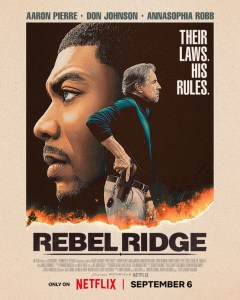 It only took minutes for me to be both engrossed and enraged by Rebel Ridge, the latest film from Jeremy Saulnier, a master of genre elevation. The scene begins with Terry Richmond (Aaron Pierce) riding his bike down a country road. A police cruiser appears behind him impatient to get around, and eventually the officer decides to use his vehicle to ram the bicyclist off the road. Afterwards, the officer tells Terry to stay on the ground and, upon a search of his belongings, discovers a stack of cash. Terry explains he cashed out his ownership in a restaurant and he’s on his way to do two things: buy a truck, and post bail for his cousin who was recently arrested for a minor drug possession. The police confiscate the money, accuse Terry of being involved with a drug conspiracy, and tell him that if he wants to fight for his money back, he’ll need to hire a lawyer and petition the court. Oh, and also the casual racism of the police officers is galling. With just his opening scene, Saulnier and his actors have made me feel vivid emotions and given me an underdog who I’m pulling for, a man who will come to serve as an honorable wrecking ball to this small-town police force who think they are above the law as it suits them. Saulnier’s movie tackles pertinent social topics with great care and detail, but it also delivers a masterful and satisfying action-thriller that knows how to entertain first and foremost rather than just incite.
 There are some serious criminal justice topics here dealt with unusually convincing clarity and accessibility, and that proves to be the ethos of Rebel Ridge, a message movie that knows it needs to be a movie first and a good one. Saulnier’s prior film work just oozes with dread and menace, though Blue Ruin and Green Room and even 2018’s Hold the Dark, by far the lesser work, dwell in bleak human outlooks. Very bad things will happen to people who stumbled into situations beyond their control, and usually by the end of the movie, there’s no recompense and we’re left to wonder about the empty cost of suffering. With Rebel Ridge, it feels like Saulnier has taken an assignment, like Netflix said to make one of your movies with your level of craft and thought, but also make it so the underdog is a badass and wins. I suppose one could argue that it’s turning a formula meant to defy convention back to convention, but by providing a crusader, we’re given a champion to root along that we can share confidence with. Terry isn’t invincible, some fearless behemoth who goes unopposed at every turn. He’s a formidable force but he’s also one man fighting against the forces of injustice and one black man fighting against racist white men in authority (superbly epitomized by Don Johnson’s good ole’ boy chief). Even with the power at his disposal, there are still limitations, which still makes the movie thrilling even if we ultimately suspect good might win out at the end. There’s nothing wrong with a triumphant ending as long as the work before establishes it as a fitting conclusion; tragedy and misery are not somehow more meaningful endings just because they are more serious or subversive. More people will learn valuable lessons about civil asset forfeiture and bail reform from this movie because it has a stirring and accessible story for a mass audience. The genuine thrills allow the messages to prosper.
And what thrills there are. There’s a staggeringly taut sequence where Terry is racing against time to get his cousin’s bail money deposited to prevent him from being transferred to prison. He’s checking the clock, looking down the small courthouse hallways, waiting for the officers he indisposed to come rushing back to arrest him. If only he can get this money deposited first. Saulnier does his own editing and creates a masterful sequence that left me nervously tapping my foot and awaiting the worst. The later confrontations with the police have a deeply satisfying turnabout, as these bullies come to realize far too late that they picked on the wrong man. Terry is an ex-Marine who taught martial arts and hand-to-hand combat to the Corps, but the most dangerous weapon he has is his mind. He’s constantly thinking about plans and implementation and adaptation. He’s intimidating already, but then when he starts to adapt, the sheer force of what this man is capable of makes him that much more incomparable. Even as a man on a mission, he’s still one black man fighting against a system of entrenched power that doesn’t like to bend when it comes to compromise or imposed oversight. He’s still got institutional power against him, and in one of Sauliner’s other movies, he probably would end with Terry winning a Pyrrhic victory but with the system ultimately standing, readjusting to maintain its dominance against further reforms. Here, that may still be true in a larger sense, but at least this one man can make a difference and bust a few racist bullies.
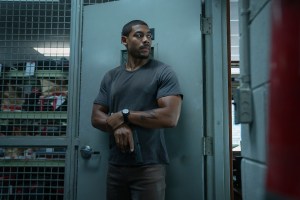 This experience wouldn’t be nearly as awesome without the commanding presence of its leading man. Pierce has had some noteworthy roles in Krypton and The Underground Railroad (he was also the amazingly named rapper “Mid-Sized Sedan” in M. Night Shyalaman’s Old). Originally, John Boyega (Star Wars: The Rise of Skywalker) was the lead role of Terry but Boyega bowed out weeks into filming in 2021 reportedly for “creative differences.” I cannot fathom any other actor in this role now that I have seen how thoroughly magnetic Pierce comes across. He’s a future star in the making and this should serve as a showcase for Hollywood. I like Boyega as an actor and have since 2011’s Attack the Block, but Pierce is a far more intimidating presence and likely candidate for action retribution. I cannot overstate how much better this movie is because it found the perfect leading man for its hero. Saulnier’s excellent command of the genre and tension is made even more compelling because of Pierce being our vehicle for comeuppance. His smooth intensity beautifully amplifies Saulnier’s percolating dialogue, finding the exact right tone and presence to make the challenges to power feel oh so combustible.
I wish the second half of Rebel Ridge was as perfectly structured and executed as that first scene. The second half gets a little lost in the details of its overarching small-town conspiracy. The momentum of the movie starts to slag a bit, and the clear connection of cause-effect plotting gets bogged down. There’s still important revelations and you get nice moments from the likes of James Cromwell as a judge and Steve Zissis as a courthouse clerk trying not to make waves within a system he acknowledges is unjust. The real significant supporting character is Summer (AnnaSophia Robb) as a lawyer with a past of drug addiction that she’s still trying to put behind her to earn back parental rights to her kids. She’s a good foil for our crusading hero, and her storyline also smartly allows for more social-political tangents to be hit about the difficulty of addicts and ex-cons to try and start over in the workforce. I wish she was more involved in the climax, as she’s relegated to being mostly a damsel needing to be saved after she proved so capable and cunning throughout the rest of the movie assisting Terry. The second half just isn’t as strong as the first half because the movie overextends with its conspiracy and history without the same tremendous clarity and urgency that drove the first hour of Rebel Ridge. The ultimate conclusion, while still satisfying, lacks the fireworks that we crave. It’s more a race against time and hoping that certain elements finally stand up against the corrupt police forces. It’s a solid ending, enough for a catharsis that Saulnier so rarely allows, but it’s not quite the release we might want, and maybe that’s the ultimate point.
 Rebel Ridge is a great genre movie that flirts with true excellence. It’s Jeremy Saulnier’s most accessible and crowd-pleasing movie, an action-thriller that executes its sequences of tension and retribution with as much care as it incorporates its Big Ideas for viewers to think over. Genre movies have long tackled relevant social and political topics, sometimes in ways that are far more meaningful and impactful than message movies that get bogged down in didactic dogma. But if you can link a relevant social issue to a story that grabs us and makes us want to inch closer to the screen, something that links a larger problem to a personal story, then you’ve found an accessible illustration that people will actually want to see. Rebel Ridge stands out among the Netflix house of action movies and proves that even a mainstream Saulnier can deliver the goods. Just because he’s working with a more conventional formula doesn’t mean that he hasn’t put thought and care into his characters and action. Rebel Ridge may leave you wanting a little more with its ending, but what it supplies is so engaging and entertaining that I’m happy to report Saulnier hasn’t lost his edge. Keep ‘em coming like this, Jeremy.
Nate’s Grade: B+


 nathanzoebl
You must be logged in to post a comment.