Blog Archives
The Other Guys (2010)
 Surprisingly consistent in its belly laughs, The Other Guys proves that Will Ferrell is at his best when he re-teams with his greatest collaborator, co-writer and director Adam McKay (Anchorman, Step Brothers). The duo takes on the cop genre with a loving parody that manages to send up the genre while celebrating its excesses. Ferrell and his partner (Mark Wahlberg) stumble onto a mostly convoluted financial scam with banks, traders, and the police. The movie takes scene after scene and gives it a little twist for the self-aware characters to comment, usually to great comedic effect. There were some stretches that I was near tears from laughing so hard (the tuna vs. lion argument is an instant classic). I expected to be amused by the movie since nobody does silly smarter than Ferrell with McKay, but I was not prepared for how much I genuinely liked this movie. From scene to scene, I found something different to laugh at. There’s an undercurrent of rage from McKay concerning the economic stickup Wall Street got away with in 2008. The end credits are an animated statistics presentation on how large Wall Street firms screwed over the American public and are still profiting off of pubic misery. It’s a bit odd tonally to cover at the end of the film, like McKay wanted his legions of fans to get some morsel of education by the end of a film with goofy action and juvenile sex gags. The joke is on us all.
Nate’s Grade: B+
Share this:

Bad Lieutenant: Port of Call New Orleans (2009)
 This is a crazy movie. It is not weird, it is not bizarre; it is not silly. Werner Herzog’s whacked-out movie is a remake of a 1992 movie that wasn’t that good to begin with. This certifiably crazy movie mostly involves Nicolas Cage as a corrupt cop playing all sides and snorting everything that isn’t bolted down in the Big Easy up his nose. For a stretch during the middle, he starts to sound like Jimmy Stewart with lockjaw. The central murder investigation plot is pretty much an afterthought in an environment like this. You want the crazy, and with Cage and Herzog, it is in no short supply. There’s Cage threatening an elderly woman at gunpoint, crawling reptile POV shots, a man’s “soul” break-dancing after the man lies dead, and neon iguanas that may exist only in Cage’s drugged-out mind. The film has been described as a trippy parody of standard cops-and-robbers fare, or as a seriously demented anti-drug message, but I think the best description is just “crazy-ass movie.” It has moments that make you do nothing but shake your head and laugh, like when Cage is about to hit rock bottom and EVERY case/storyline gets solved in a matter of seconds to his bemused disbelief. The comedy is straight-faced but it is definitely there. Cage harnesses his eccentricities and delivers an insanely entertaining performance that reconfirms that there is indeed an actor underneath his Hollywood veneer. He is compulsively enjoyable and the movie is compulsively watchable, every crazy freaking second of it. Iguanas!
Nate’s Grade: B
Share this:

Observe & Report (2009)
 During the middle of a mean prank, a police officer walks out of hiding and says, “I thought this would be funny but it?s really just sad.” That’s my feelings with Observe and Report, the second mall cop comedy of 2009. Writer/director Jody Hill specializes in pained, awkward, tasteless humor, but with this it’s like he made a comedy and forgot to put jokes in it. The ongoing joke is how crazy a bipolar mall security guard named Ronnie (Seth Rogen) is, but it’s hard to laugh when he just keeps coming across as scary. Hill’s movie has more in common with Taxi Driver than other comedies. We follow one dangerous man with delusions of grandeur who has violent tendencies. The humor can be daring, off-putting, and extremely risqué, like a date rape joke where Anna Farris wakes up in the middle of the act and encourages Ronnie to continue. What is the point of all the provocative envelope pushing, in the end? Is Hill trying to lock his movie into a ready-made cult status? I enjoyed Hill’s TV show Eastbound & Down starring Danny McBride (who makes a cameo here as a crack dealer). That show succeeds with a blustery, unhinged, delusional lead character because we know the character is a vulnerable loser lashing out because he realizes he is a loser, we can empathize and eventually root for the brute. Rogen, often a chubby teddy bear in comedies like Knocked Up and Zack and Miri Make a Porno, is lashing out because he won’t stay on his meds. He’s too dim to even realize his lowly place in the universe, so his bluster and rude behavior is ultimately just repellent because it provides no insight to his character. And yet, after having said all that, the movie is consistently interesting, if you want to call it that, and goes in unforeseen directions. This is a challenging movie and the biggest challenge is to try liking it. Good luck.
Nate’s Grade: C
Share this:

88 Minutes (2008)
 Typically you can smell something wrong when a movie is continually delayed or held from release for well over a year. The serial killer thriller 88 Minutes actually began filming during the fall of 2005 (!). It was released in the United States well after it had been available on DVD in Europe for over a year. After watching all 108 minutes of 88 Minutes, it’s easy to see why the studio and the film’s astounding 20 producers (!!) were trying to hide this from public eyes.
Dr. Jack Gramm (Al Pacino) is the top forensic psychiatrist in Seattle. His testimony is responsible for convicting Jon Forster (Neal McDonough) of a death sentence. Many years later, Jon is now hours away from execution and still professing his innocence, claiming the real “Seattle Slayer” is still out there. Gramm works as a college professor and he can still woo the young ladies and beds them regularly. His assistant (Amy Brenneman) informs Gramm that a woman in his class has been murdered and her murder is patterned after the “Seattle Slayer” killings. Gramm believes that Forster is collaborating with someone on the outside to cast doubt on his conviction. Then as Gramm walks to class he gets an anonymous phone call that tells him he has 88 minutes to live. Gramm scrambles to try and use the time to figure out who is targeting him, framing him, and why. Could it be his assistant, his T.A. (Alicia Witt), his skeptical students (Benjamin McKenzie, Leelee Sobieski), the skeezy campus cop, or maybe the starting second baseman for the Seattle Mariners?
 First off, the time frame doesn’t work at all. 88 minutes is too short a time frame to do crack investigation, and Gramm runs all over the city of Seattle at least three times without getting caught in any gridlock. The movie establishes a real-time ticking clock but then decides to follow a different set of time. Occasionally the movie will be faster than real life, meaning that it says 10 minutes have passed when only say 6 have, and occasionally the movie will be slower than real life, like when the third act probably takes all of 10 minutes in the film’s universe. It’s not consistent and points out the flaw of the structure. The 88-minute countdown was supposed to add a feeling of suspense but what it does is add an extra level of incredulity. There is no way that 88 minutes would be a sufficient time for the killer to stage murder and mayhem around a large metropolitan city known for inclement weather. Seriously, is the killer trying to set unreasonable personal goals? Why not a three-hour window of time? That way the killer could have a healthy planning period without worrying that everything would collapse if they got stuck in traffic. Also, the 88-minute time frame allows glimpses into the anal retentive nature of our killer. Gramm is harassed by phone calls updating him on his declining time, but what’s truly special is when the killer defaces Gramm’s car saying how long he has to live to the minute. The killer must have known to the second when Gramm would come by his car because had the doc taken a different route, gotten a coffee, gone to the bathroom, or performed whatever other million actions then the death threat would be inaccurate.
Next, all the women are helpless sycophants. They think the world of Gramm and several of these twenty-something college girls have big time crushes on the aged Pacino. It’s hard to take seriously the idea that Gramm, in this context, is still a Lothario that he can bed any coed he sets his sleepy eyes upon. The fact that the movie opens with him waking up from his latest and naked conquest already gives the film a squeamish start, but when multiple characters all confess to having crushes on Gramm then the whole idea transforms into an uncomfortable stroking of Pacino’s vanity and virility. I suppose I shouldn’t expect too much from the plethora of female characters because they’re all in need of comfort and every one of them winds up a pitiful damsel in distress. We’re supposed to believe these are strong and capable women, all of them working alongside a criminal expert so perhaps they know a thing or two about self-defense. They fawn over the man and then inexplicably wind up in danger. Occasionally the women will experience dramatic setbacks and they all take a backseat toward getting a hug from Gramm. These women react to the sight of death in puzzling ways and then will just as easily move on to another topic.
 This is the kind of wretched movie where a flashback tragedy is defined by a memory so inane that it becomes insulting. Gramm keeps flashing back to a simple memory of his long deceased younger sister; she is running along the bank of a rather filthy looking river with a kite trailing inches behind her. Now, 88 Minutes is the type of movie where she has to giggle innocently and say something ridiculously non-descript, which in this case is, “[Giggle], dad look at the kite.” Of course Gramm is not her father (or is he?) and her call to look at the kite makes little sense because 1) its string is about three feet so it cannot go very high at all, and 2) it’s usually flying lower than the girl. I just find this image, this idea, this whole flashback construct to be emblematic of how truly awful and derivative and excruciating 88 Minutes can be.
I must confess there is one scene in 88 Minutes that I will remember for the rest of my life specifically because of how ridiculously appalling it is. Few scenes cause me to simultaneously stare in wide-eyed amazement and resist the urge to vomit. Here goes. Gramm is confronted by his FBI agent pal (William Forsythe) who has some bad news for Gramm. It turns out Gramm’s semen was found inside the “vaginal cavity” of the victim. We know Gramm wasn’t sexually involved with her because he was sexually involved with our opening naked escort lady, Sara Pollard (Leah Caims). Gramm then argues that someone out there framed him by killing Sara Pollard (oh don’t act surprised), retrieving Gramm’s semen from inside her, and then injecting it into the “vaginal cavity” of the victim. Hearing an actor of Pacino’s credit verbalize this theory is akin to having the “sex talk” with your parents, nay, grandparents — it’s just so intensely uncomfortable to watch. I just picture a lab tech with a long syringe that has to run around Seattle to make his semen import/export deadlines. This one icky moment stands out as the most ridiculously awful in a movie that is nothing but collective scenes of awful.
88 Minutes has no characters, only red herrings. Each of the numerous supporting characters is given the chance to act suspiciously and for no real good reason. Gramm takes his turn going through accusing nearly every supporting character he comes across as being in league with Forster. The screenplay even establishes characters like the painfully named Guy LaForge (Stephen Moyer, True Blood‘s Bill the Vampire) who serves no purpose other than to wear a leather jacket and squint in backgrounds.
 Forget anything approaching characterization because writer Gary Scott Thompson (The Fast and the Furious) has created a script that is woeful in every department, including thrills. The reveal of the killer is mishandled, as is most every plot point, and I’m at a total loss at the rationale of attempting to commit murder in a building the killer called in a bomb threat. Yeah there may not be students but there will be plenty of police sniffing around. More than half of the scenes involve people talking on cell phones. The dialogue is unintentionally hilarious more often than not, with lines like “Someone has penetrated my most secret place” and, “If I can’t forgive you I don’t deserve you,” and the killer taunting, “You see Jacko, I’m a true believer.” Need I remind you of the “vaginal cavity” conversation? This is a complete laughable mess that would have been just another half-rate direct-to-TV movies airing late nights on cable channels were it not for Pacino’s involvement.
Pacino doesn’t even try to hide his disillusionment with the movie. He comes across as sleepy-eyed to the point of being a zombie with a permanent case of bedhead (seriously, Pacino’s crazy hair steals the show). The man is going through the motions to collect a paycheck, and he even gets a couple scenes to work up the frothy barking Pacino voice that he has settled into for the past 15 years of acting. He never seems to be worried that he only has so many minutes to live, so why should we bother sweating? The rest of the cast is awful and they were likely lured to this doomed project because of the chance to work alongside Pacino. Leelee Sobieski must be singled out for being particularly atrocious, especially when she tries to play a tough girl. This has got to be her worst performance since she started speaking. Then again, she has worked with Uwe Boll (Fun fact: one of 88 Minutes‘ many producers is Boll’s longtime producer).
88 Minutes is bad in every possible manner of filmmaking. This is an embarrassment for everyone whose name’s is attached to this film. From the overly anxious musical score, to the choppy editing, to the lackluster cinematography, to the abysmal story and outlandish acting and the lazy direction, 88 Minutes is a cinematic catastrophe. It should only be watched at a safe distance and only with the intention of derisive enjoyment. Because while this movie fails at every level it may just end up becoming the funniest comedy of the year.
Nate’s Grade: D
Share this:

Street Kings (2008)
 This is a wildly overwrought and sleazy drama is hoping to come across as edgy but everything is so overdone. It fulfills all the requisite elements of the modern crime picture; double crosses, forlorn anti-heroes, bloody violence, but Street Kings misses the mark big time when it comes to any nuance. Every beat of this murky, convoluted dirty cops mystery is plain and obvious. If you cannot guess within minutes who the eventual culprits will be then you haven’t seen enough movies. Every character is a cliché of a cliché, every unrestrained actor is constantly speaking in nothing but exclamation marks, and the dialogue is some of the worst I’ve heard all year. Keanu Reeves is a listless leading man who is blank and lifeless, unable to wrestle the dark and complicated emotions needed for a “cop on the edge” role. I can practically feel Forest Whitaker’s spittle every time he speaks. Street Kings feels like a route retread of rogue cop pictures, which are director David Ayer’s specialty. It wants to shine a light on the seedy underbelly of the law but it can’t stop from feeling like a lobotomized version of L.A. Confidential (Note to Ayer: Jay Mohr + mustache = an arrangement that benefits neither party).
Nate’s Grade: D
Share this:

Seed (2008)
 Uwe Boll had some things he wanted to say with his low-rent horror flick, Seed. Like much of Boll’s output it’s based upon a video game. However, Boll opens the flick with a warning that footage of animal abuse and disturbing images will be incorporated into the movie. Seed gets the ball rolling with a two-minute montage of animals being cruelly beaten and mutilated before the title ever finds its place on screen. Boll’s opening text says that he decided to use this disturbing snuff footage because he “wanted to make a statement about humanity.” Yeah, sure Boll. Isn’t it a bit trite and easy to castigate the human condition for evil when you just roll out visceral real-life footage of cruelty? By highlighting the real stuff Boll is calling into question the significance of his whole stupid slasher movie. It opens with real-life cruelty and then plays out 90 minutes of fake cruelty, so what’s the point? I don’t think Seed has any interest in the subtext that can elevate horror movies. I think Boll just wanted to make his own torture-heavy horror film and found some animal abuse footage on the cheap (PETA probably gave it to him free of charge). The opening smacks of exploitation and opportunism and has zero thematic connection to the flaccid and empty-headed horror movie that follows. If I sound angry that’s because I don’t need to see animals having their skulls crushed in to get it.
Seed (William Sanderson) is a killer of astounding proficiency (for further details: see below). Matt Bishop (Boll BFF, Michael Paré) is the detective that’s been tracking Seed all these years. You can tell he’s a haunted cop because he has a drinking problem and hears the cries of dead babies. Eventually, Bishop tracks down Seed’s hideout and he arrests the murderous fiend. Seed is sentenced to die by the electric chair. The problem is that the prison doesn’t have a pristine electric chair, and the law says that if a man survives three jolts of juice then he’s free to go (for further details: see below). The warden (Ralf Moeller) decides to take command. He and a group of prison employees bury Seed alive and tell the world he died on the faulty electric chair. Of course Seed comes back and rekindles that old killing feeling.

 If Sanctimony was Boll’s attempt to manufacture the clever Saw-esque serial killer, a higher scale of serial killers, then Seed is at the opposite end of the serial killer equation. This is a dull slasher movie and Seed is about as dull as killers can be. His main attributes are that he’s a huge guy with a sack on his head, which is kind of similar to about 1000 different slasher movies. He looks particularly close to Leatherface from The Texas Chainsaw Massacre. I guess the slasher recipe is add one obscure mask plus one set of overalls plus dirt = killer. The guy has zero personality and is merely a silent killing machine that, in typical slasher fashion, always roams around at a deliberately slow pace. Sanderson (star of SEVEN Boll films) is unrecognizable as Seed and this is mostly because he wears a sack on his head and says maybe one thing for the entire 90-minute running time. I don’t recall Sanderson being as bulky either. Boll’s attempt at a horror movie wallows in exploitation and prolonged torture. As always, he’s late to the party.
Seed is credited as bring solely written by Boll, and the man screws it all up within minutes. When it comes to horror movies there will always need to be a somewhat healthy suspension of disbelief but only up to a point. Every movie no matter the genre or internal logic will have a breaking point. Seed cruises through that breaking point alarmingly early. Through the use of newspaper clippings, Boll introduces us to the backstory of Mr. Seed (he uses newspaper clippings for 90 percent of all exposition, meaning someone at the police department has a big thing for scrapbooking). We are told that from 1973-1979, Seed killed an astounding, and numerologically convenient, 666 people in those six years. Just take a second and think that figure over. One person in a ratty cloth mask and overalls killed 666 people. Ted Bundy and John Wayne Gacey weren’t even anywhere near that figure and they are highly prolific serial killers. Boll wanted to make his serial killer scary but he totally overcompensates and destroys any credibility the film could possibly attain. Why 666? There’s no way it’s a coincidence considering the pull of that number in our pop culture. Was that a target quota for Seed? Did he make a chart to know when he was falling behind?
The sheer magnitude of that number obliterates the facade of “reality” Boll wants to create in his movie. These cops have to be the worst investigative unit in history. Seriously, could they not tabulate any clues or patterns or habits of Seed after 665 murders? I think the FBI would have stepped in hundreds of unsolved murders ago. And yet Boll then shows again how staggeringly inept these local cops are. They find out Seed’s home, which is of course a dilapidated shack in the middle of nowhere. This naturally begs the question that Seed would have to venture out long distances to find so many victims, and yet no witnesses of any sort? But Boll ignores this and steamrolls ahead. What showcases the utter stupidity of these boys in blue is that they ride out in the middle of the night, into the middle of the woods, and decide to raid Seed’s house with only six officers. I’m sorry, but if any man killed 666 people with his own hands then you don’t plan on taking him down with a small unit of cops who have already proven to be inept. You bring in tanks.
 The premise itself is deeply flawed and begging for mockery. Seed proposes that there is a law on the books that somehow mandates prisoners must be set free if you can’t kill them after three jolts from the electric chair. We’re talking 45 second long jolts of 15,000 volts of electricity frying your brain. Your heart will eventually explode with all that electricity. So how does this law truly work? Surely no one would actually abide by it or fear that the government would punish them for breaking this law? Seed never specifies where it takes place, though the vibe I get is more southern, and they love to kill people in the South, especially Texas. Did the electric company propose this three-strikes-and-you’re-alive policy as an incentive to inmates? Do low-income prisons have a higher turnaround rate? Does this law cover firing squads and hangings as well? A judge and jury have found Seed guilty and sentenced him to be executed. That judicial ruling is not absolved because an inmate could withstand a high degree of voltage. The premise turns an execution into a contest.
Most slasher movies involve a near superhuman antagonist, and Seed follows suit. He can attack and kill four prison guards who try to gang rape him in his cell (what part of 666 kills says, “please expose your penis near me”?). He can step on a prison guard’s forearm and crush it so that it looks like a swaying doll part. He can bust out of a coffin and dig himself out of a grave. Now I did some quick math and a 6 feet by 6 feet by 3 feet grave is 108 total cubic feet. The lightest dirt will weigh is 42 pounds per cubic foot. That means that Seed had 4536 pounds of force weighing down on him in that grave. Yet he was able to free himself and go on his rampage. If Seed is this indestructible force then it’s ridiculous that Pare could kick him a few times and the man went down during the police capture. Which is the worse screenwriting sin? Having Seed wiggle out of 4500 pounds of force or the fact that the prison guards did a lousy job of BURYING ALIVE a man who killed 666 people! Why would you ever bury this maniac alive?! That seems hardly definitive. Common sense begs cutting off the man’s head just to be certain.
When it comes to horror movies, building an atmosphere is essential but there’s a notable difference between building dread and simply killing time. Boll does not know this difference. Seed doesn’t even get placed on the electric chair until 46 minutes in. The first 33 minutes of the movie is pointless because it retells Seed’s capture via a flashback while he sits on death row. Watching Seed finally get captured isn’t really important to the story, and a good half of that misspent time is simply gross and grainy home videos. Seed sends videotapes to the police to taunt them. The tapes are shot in a dungeon-like location and involve living creatures rotting thanks to the miracles of time-lapse photography. Naturally this raises two quibbles: 1) No one had personal video recording devices in the mid 1970s, let alone a maniac living in the middle of nowhere, and 2) watching dogs and babies die of dehydration and then decompose to ash means that these video projects took many weeks to accomplish. That’s a lot of time. Boll spends five plus minutes of screen time just showing these grainy snuff videos with the police recoiling. Perhaps the extent of their investigation was watching these gross videos and making faces. How many videos do the police have from Seed? It seems like Seed’s version of the fruit of the month club.
 But getting back to misspent time, Boll thinks just holding onto a shot and not cutting makes it scary or tense. It doesn’t. I don’t need nearly two minutes uninterrupted of watching guards fiddle with Seed’s chains as they try and latch him into the electric chair. I don’t need almost a minute of one shot panning around a boat departing the prison isle. I don’t need nearly two uninterrupted minutes of watching the prison doctor’s bedtime rituals before he eventually gets murdered. I especially don’t need over five uninterrupted minutes of watching Seed hit a woman in the head with a mallet. I’m not being facetious when I tell you that he literally hits her 40 times until her head is purified into a bloody stump of a neck. Seed literally paints the walls with this old woman’s blood (how did this genius not get caught?). The soundtrack soars to laughable heights and the scene just goes on and on, figuratively bludgeoning the audience as well. Boll believes that just holding onto a moment of depravity makes it sinister. It doesn’t when there’s no audience connection whatsoever to the tired material. Boll does craft one nicely tense sequence where Pare and the cops capture Seed. There’s a moment when one officer is tiptoeing through the basement of Seed’s home and the only source of light is the flicker of the police siren. It’s visually appealing and works to create tension as well. But this moment is short-lived. I’ll never know how a burly guy can see through a cloth mask in the dark and sneak around in a dilapidated home filled with crap covered in tetanus.
It may be hard to notice for some, but Uwe Boll is actually improving as a filmmaker, at least from a technical standard. Seed looks like an actual movie. Seed is grisly and nihilistic and futile. The killer is a bore and the story is poorly structured, taking far too long to get Seed in the ground and wrecking havoc. Boll’s screenwriting shortcomings are fully evident as he strings together genre clichés and ridiculous plot points that obliterate credibility. He grasps at making statements about the human capacity for cruelty. Well I didn’t need a Uwe Boll movie to educate me on man’s inhumanity to man, especially one this shoddy and empty. This movie isn’t even entertaining; it’s a chore to sit through. This is the first Boll movie that I sat just waiting for it to be over. There is no reason to watch this thing. During the extended scenes of video watching by the police, one of the cops watches a baby decompose and replies, “Sick bastard.” I think Boll was projecting here. And I didn’t need footage of animals being slaughtered to reach that conclusion either.
Nate’s Grade: D-
Share this:

Gone Baby Gone (2007)
 Ben Affleck doesn’t necessarily establish any gifted visual style with his directing debut, however, Affleck the Screenwriter and Affleck the Actor ensure that the movie succeeds swimmingly as a murky morality play. The film is an actor’s showcase and they get plenty of room to maneuver, with standout performances by Ed Harris as an embittered cop and Amy Ryan as the living embodiment of the worst white trash would-be mother on the planet. Where Affleck earns his artistic stripes is by asking hard questions with moral ambiguity and not dishing out easy answers. This is an above average crime thriller that uses its lower class Boston setting as an additional character. There are only a handful of relevant flaws, like Michelle Mongahan’s character being pointless except to cry, and a mystery that clever moviegoers will have figured it out early thanks to the economy of characters and some shifty glances. The missing child mystery allows Affleck to explore some very dark places and non darker than the human soul. Affleck may not dazzle with visual prowess, but the man sure knows how to tell a damn good story and direct actors to award-winning levels. Give this man another movie.
Nate’s Grade: A-
Share this:

Southland Tales (2007)
 Richard Kelly is a talented writer/director who scored big with his first film, modern cult classic Donnie Darko. I was in love with the ominous yet inspired Darko from the moment I saw it, which, not to toot my own horn, was February 2002, way before the cult got started. I have been eagerly anticipating Southland Tales, Kelly’s writing/directing follow-up, even after its notorious 2006 Cannes Film Festival reception where critics readily cited terms like “indulgent,” “bloated,” “messy,” and, “disaster.” My love of Darko shielded me from such negative affronts, and so I watched Southland Tales undaunted and with as open a mind as possible. The regrettable truth is that even after Kelly shaved off a half-hour from the Cannes version, Southland Tales is every bit a mess as had been advertised; however, it is occasionally worthwhile and subversively ambitious.
Kelly begins his massive yarn with a nuclear attack on Abilene, Texas in 2005. America is plunged into World War III and fights, simultaneously, Iran, Syria, Afghanistan, and North Korea, while the conflict with Iraq continues. The Internet is now in control of the government, who passes sweeping security measures, chief among them IdentiCorp. This government arm uses thousands of trained cameras to keep watch over the lives of ordinary citizens, including when they duck into public bathroom stalls. Violent neo-Marxist groups have placed cells around the country, ready and willing to strike to destroy the last vestiges of American capitalism.
 Fuel resources have almost run dry and the world looks to scientist Baron Von Westphalen (Wallace Shawn, hamming it up and having a good time) for a solution. The Baron has devised a substance known as Fluid Karma, which works under the properties of the churning oceans and will produce a radius of power. Fluid Karma also works as a powerful hallucinogenic drug and the Baron tested it on wounded Iraqi vets like Pilot Abilene (Justin Timberlake). Coldly narrating the film, Abilene stands guard outside the Baron’s laboratory and also peddles the drug on the side.
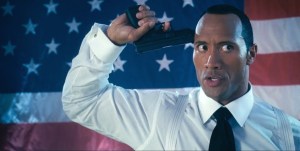
It is the summer of 2008 and the presidential election is months away. The Republican candidate, Senator Bobby Frost (Holmes Osborne), is in crisis mode. His spoiled daughter (Mandy Moore) is frantic because her husband, actor Boxer Santaros (Dwayne “The Rock” Johnson), has vanished. He’s awakened in the California desert with amnesia and shacked up with porn star Krysta Now (Sarah Michelle Gellar); the duo has written a prophetic screenplay called “The Power.” Krysta and a pair of tattoo babes (Nora Dunn) plan to blackmail the Frost campaign with video of Boxer frolicking with the adult movie star. They want the campaign to endorse Proposition 69, which would rescind the encroachments on civil liberties by the U.S. government.
A group of neo-Marxists, led by pint-sized Zora Carmichaels (Cheri Oteri), have kidnapped a police officer, Roland Taverner, and are using his twin brother Ronald (both played by Seann William Scott) to frame the police and Boxer. And I haven’t even begun to talk about Senator Frost’s wife (Miranda Richardson), the president of Japan having his hand lopped off in a loony sequence, the frequent inverting of T.S. Elitot’s quote about the way the world ends, a commercial where two cars literally have sex, and a rip in the space-time continuum that people are putting monkeys inside.
Extraordinarily messy and scattershot, Southland Tales has 1000 ideas rolling around inside without much traction. It’s as if Kelly thought he was never going to get the chance to make another movie again so he crammed every thought and topic he ever had into one 144-minute cross-pollinated jumble. The movie veers wildly and chaotically from political satire, to crude comedy, to sci-fi head-trip, all the way to Busby Berkley musical. There’s a little of everything here but few of the dispirited elements mesh and the film runs a good two hours before any sort of overall context becomes remotely approachable. One second the movie is satirizing a Big Brother control state and the loss of American civil liberties, and in the next second a character is threatening to kill herself unless Boxer allows her to orally pleasure him. You got, among other things, zeppelins, global deceleration, perpetual motion machines, Zelda Rubenstein, drugs, holes in time, twins, a murderous Jon Lovitz, ice cream trucks that house military-grade weapons, blackmail, Kevin Smith in a ZZ Top beard and no legs, reality TV, the American national anthem cut together with an ATM robbery, Biblical Revelation quotes courtesy of Timberlake, and, why not, the end of the world. What does it all mean? I have no idea but I credit Kelly for his ambition.
 Plenty of stuff happens for a solid two hours but little to nothing feels like it amounts to anything, and several subplots just get dropped. There are long stretches where I cannot explain even “what’s happening” from a literal description. This sprawling, magnificently self-indulgent meditative opus consists too much of side characters running into each other and having vague, pseudo-intellectual conversations that go nowhere. There are a lot of nonsensical speed bumps in this narrative. Sometimes the screen is just nothing but a series of newscasts overloading the audience with details on the reality of this alternative America; it’s filler. The conclusion is rather frustratingly abrupt; after slogging through two-plus hours of oblique questions it finally seems like we may reach some tentative answers, and then Kelly pulls the pin on his grenade and collapses his tale. Krysta tells Boxer in a moment of clarity, “It had to end this way.” Really? It did? This way?
The movie feels like a giant garage sale with scattered treasures hard to find but buried beneath loads of kitsch. Kelly clearly has bitten off more than he can chew and yet there is a bizarre undeniable power to some moments here. Roland (or is it Ronald) Taverner watches his mirror reflection a step behind; it’s unsettling and eerie and very cool. Timberlake has a drug-induced dance number where his scarred (both physically and mentally) Iraq veteran character is covered in blood, drinks beer, and lip synchs to the Killers’ song “All the Things I’ve Done,” which has the pertinent lyrics, “I’ve got soul but I’m not a solider,” and “You gotta help me out.” All the while, leggy dancing girls in blonde bobs strut and coo around him. It’s weird and tangential to the plot but it has a certain draw to it. The conclusion featuring the Taverner twins seeking forgiveness even generates some redemptive quality. Religious questioning and the philosophy of souls occupying the same realm plays a heavy part and gives the film an approachable reflection that tickles the brain, even if Timecop, sort of, visited the same ground, albeit secular, first (you’ll kind of understand when you see the movie). Southland Tales is grasping at profound and relevant messages, and yet some images achieve this easily, like a toy soldier crawling on the L.A. streets or a tank with Hustler stamped across its side for product placement. These simple images are able to transcend Kelly’s pop manifesto.
 None of the actors really equip themselves well with the outrageousness. Scott comes off the best but that’s because his character(s) is/are the only figure(s) the audience is given a chance to emotionally connect with. The Rock, listed for the first time simply as Dwayne Johnson, is an actor that I genuinely like and think has tremendous comic ability, as evidenced by 2003’s The Rundown. With this film, however, he comes across too constantly bewildered and shifty, like he really needs to pee and cannot find a bathroom. Gellar is woefully miscast and I think she knows it given her leaden performance. Southland Tales is the kind of film where every role, even the two-bit nothing parts, is played by a known face, be it Christopher Lambert, John Larroquette, Curtis “Booger” Armstrong, Will Sasso, and a horde of Saturday Night Live alums.
Kelly’s previous film succeeded partially because an audience was able to relate and care about the central characters, which is not the case with the comically broad Southland Tales. Kelly seems to work best when he has some restraint, be it financially or artistically; the director’s cut of Donnie Darko explained far too much and took some of the magic out of interpreting the movie on your own terms. Southland Tales runs wildly in the opposite direction and is a giant mess unseen in Hollywood for some time, though for the doomsayers comparing Southland Tales to studio-killing, self-indulgent, era-defining Heaven’s Gate, may I argue that Oliver Stone’s Alexander was far more self-indulgent, longer, wackier, and duller. Due to its unpredictable nature, you can never say Southland Tales is boring.
Southland Tales the movie begins as Chapter Four of Kelly’s saga, the first three chapters being made into comic books, and really, when I think about it, a comic book is the right medium for this material. The confines of narrative film are too daunting for Kelly’s overloaded imagination. Southland Tales is oblique, incoherent, strange, and unfocused but not without merit. I doubt Kelly will ever be given the same artistic legroom to create another picture like this, so perhaps Southland Tales has helped to reign in Kelly’s filmmaking. A reigned-in Kelly is where he does his best work, and I look forward to Kelly’s remake of Richard Matheson’s story, “The Box,” presumably with no dance numbers and sexually active motor vehicles.
Nate’s Grade: C
Share this:

The Black Dahlia (2006)
 Hey, I got an idea. How about we make a Black Dahlia movie and hardly involve anything having to do with the notorious Black Dahlia murder? I’ve got an even better idea; let’s center the action around a love triangle involving cops who are, say it with me, too close to the case. And then we’ll have a wacked out rich family where the mother (Fiona Shaw, God bless her) gives a performance that isn’t three-sheets-to-the-wind drunk, she is staggering, cataclysmically, powerfully, off-the-wall drunk. Watching her sway and sneer and hiccup is like watching Daffy Duck in this Brian DePalma mess. The central actors feel too young for their parts (the best actor is Mia Kirshner, seen briefly in an audition reel as the soon to be eviscerated Elizabeth Short), and the ending is an insipid caper to an ongoing, unsolved murder mystery. The Black Dahlia is appallingly boring and yet also appallingly dimwitted, but it does occasionally look good thanks to the technical proficiency of its director. DePalma has had a very up and down career. Consider this one of his valleys.
Nate’s Grade: D
Share this:

Superbad (2007)
 Seth Rogen makes me feel like a slacker. I’m two months older than him, but already he’s broken out as a comic actor on great-but-cancelled shows like Freaks and Geeks and Undeclared, and now he has risen to headlining star thanks to the runaway success of Knocked Up. Now here comes Superbad, a comedy he’s co-written with his friend Evan Goldberg, and I haven’t even gotten one movie off the ground or, for that matter, a starring role in any TV series, canceled or on the air. Oh well. At least Rogen’s consistent attachment to quality projects makes me a happy, if marginally envious, moviegoer.
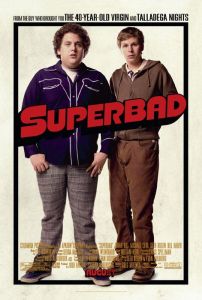
Seth (Jonah Hill) and Evan (Michael Cera) are high school seniors looking to score with the ladies. Their nerdy friend Fogell (Chistopher Mintz-Plasse) has a scheme to get himself a fake ID, and the trio seizes upon this opportunity to become important figures in the teen circuit. With the promise of the fake ID, Jules (Emma Stone) has asked Seth to provide all the alcohol for a house part that she’s throwing that night. Not only that, Evan’s unrequited crush Becca (Martha MacIsaac) is going to be there. Seth and Evan figure that this party will be the best chance they have ever had to get lucky thanks to the miracles of what some would call, “liquid panty remover.” They just have to get the booze first. Fogell’s ID lists him as simply as McLovin. He is set back when his attempt to purchase alcohol is interrupted by a robber. He’s interviewed by Officers Michaels (Rogen) and Slater (Bill Hader) who take a shine to McLovin (“It sounds like a sexy hamburger”). The threesome spend a madcap night drinking, busting crime, sharing worldly wisdom, and running away at the faintest sign of other police officers.
 First off, Superbad is raucously funny. It’s plenty profane and has several memorable moments, like Seth’s imaginative scenarios for buying alcohol and a dance that goes in a very unexpected direction. The humor is timeless and built around the nervous interaction between the sexes; there are very few jokes that reference pop culture or dependent on a specific context. I imagine what makes Superbad hilarious will still make it hilarious in 20 years to a new audience that can relate to the same trials and tribulations of teen life, though perhaps at that point we will be replaced by robots.
What separates Superbad from other offensive sex comedies is that it’s really a story about male friendship. I don’t mean in the tacky, Hollywood vein of working together for a common goal, which is commonly to lose one’s virginity. Superbad is another entry into the Judd Apatow (40-Year Old Virgin, Knocked Up) school of comedy that professes that a comedy should be character-based and that those characters should be painfully human. This is no mere genre movie. Underneath all the boobs and booze discussion is the pain and worry of a long-standing friendship being able to survive. Seth and Evan have been close friends all of their lives, but many good friends have grown apart in time thanks to their lives moving in different places. There’s unspoken tension between the two of them and Seth is concerned he’s about to be abandoned by the person that means the most to him. Many films touch upon the indelible companionship between men but few can accurately articulate the authentic love that can foster bonds of friendship. Superbad explores the exploits of real friendship, and while it’s chock full of funny the film also has its fair share of moderately touching moments. You really do care about the characters and want them to triumph. Fogell’s ascension to becoming a confidant, cool lady’s man is one of the summer’s true pleasures. Apatow’s fingerprints are all over this, and that is a glorious thing.
But this isn’t some phony Porky’s-style high school sex comedy with male fantasy set pieces and lots of dunderheaded beauties prone to bouts of frequent nakedness. Superbad is a relatively realistic portrayal of high school life in the world of movies. This isn’t a school ordered by cliques of entrenched stereotypes like the jocks, the Goths, etc. In fact, I don’t think Superbad makes any social distinction between the students.
 Superbad is a celebration of the glories and anxieties of the male members’ member. Even for a teen sex comedy, the film is very phallus-centric, complete with a hilarious anecdote about a “treasure chest of dick drawings.” It seems Seth, at a young age, was stricken with the unique compulsion to draw a phalanx of penises. The anecdote is quite unexpected and funny and underscores how often the penis prevails in the minds of young men. The boys discuss at length the life and times of the penis, especially how women can compliment this. The constant dick-chat may get old after a while for most of the female audience in attendance (a.k.a. those without), and I can’t exactly blame them, but Superbad does convey, in a convincing manner, how much teenagers think about sex (“You know how many foods are shaped like dicks? The best kind”). Some have argued that there’s an undercurrent of misogyny with Superbad, but I feel like those detractors are missing the deeper point. These guys are totally terrified of women and go through one wild night just to avoid actually confessing their feelings to the objects of their affection. These guys don’t hate women, they’re just frightened and utterly bewildered by them, and so they rely on what pop culture and their peers have taught them is the way to a woman’s heart: booze.
The movie is taken to an extra level of excellence thanks primarily to the outstanding comedic performances by its cast. Cera was a star of brilliant understatement on TV’s Arrested Development, and when it comes to portraying awkwardness, Cera is king. The gangly teen is a textbook example on high school awkwardness; he feels uncomfortable in his own skin. He seems antsy to leave most scenes. His self-effacing smile, wide-eyed gawk, and nattering stutter are spot-on signals of clumsy, confused, and embarrassed teen life. Cera is a master with impeccably punctuated line deliveries. The kid could make any line funny by flawlessly placing a pause in the right place. Arrested Development was a great showcase for Cera’s comedic chops, and now Superbad is a juicy platform for the funniest straight man on the planet (and he’s only 18 years old).
 Hill has been a supporting player in previous Apatow productions, but this is his first major role. Hill is the loud, boorish, vulgar, and more outlandish half of the duo. When he gets worked into a frothy rage you can practically feel his indignant teen spittle. What makes Hill special is that, in an instant, he can go from foul-mouthed cretin to a vulnerable buffoon. In the end, when the police bust a party, Seth runs on instinct and his instinct is to save his friend. It’s the versatility of Hill that allows Superbad to channel the sweet, gooey center behind all the sex-obsessed hijinks.
Not all the different elements of Superbad seem to fit together. The cops subplot is played very broad and relies on a lot of physical comedy; it feels at odds with the genuine teen comedy that is the heart and soul of the movie. The subplot is indeed full of laughs and it turns McLovin into a legendary teen character, but it feels like a separate movie, albeit an interesting one. For a male-dominated comedy, the female roles are pretty sparse but even those take heed not to slip into empty stereotypes. Becca and Jules are portrayed as sensible and approachable.
In short, Superbad is super good, and it’s thanks to relatable characters, a sweet sensibility, plenty of raunch, and some excellent performances. Apatow has opened the 2007 summer with a winner and now he closes it with another one.
Nate’s Grade: B+


 nathanzoebl
You must be logged in to post a comment.