Blog Archives
The Heat (2013)
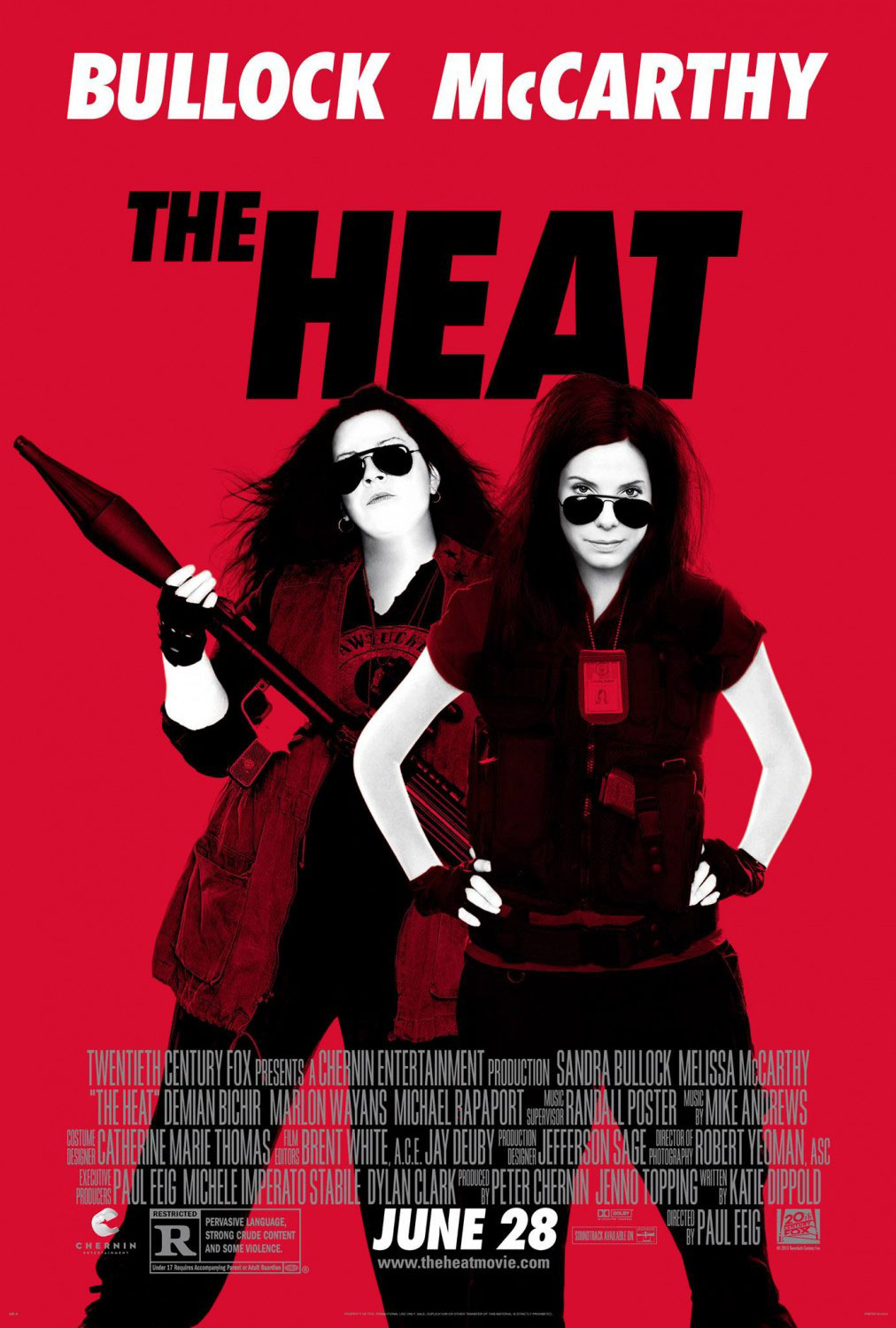 Essentially a buddy cop movie with the typically macho roles swapped out to women, The Heat is an intermittently enjoyable action comedy thanks to the chemistry between Sandra Bullock and Melissa McCarthy. The joke ratio of hits to misses has a lot of whiffs but I laughed solidly every ten minutes or so, some of the comedic set pieces were well developed, and McCarthy’s strong ability to improv saved many flailing scenes. I enjoyed that these two women were seen as professionals and didn’t need to be bogged down with the kind of plot elements you’d find in your standard Katherine Heigl vehicle. There isn’t a romantic interest nor a love story; in fact, various guys come up to McCarthy throughout asking why she hadn’t called them back after a one-night stand. It’s a little thing but it establishes that a woman like McCarthy’s can have a fruitful love life and have it be no big deal. The overall plot about a dangerous drug baron with a mole inside the government is given more complexity than necessary, and I’m not sure the action bits feel well integrated into the movie as a whole. Part of this may just be because director Paul Feig (Bridesmaids) seems much more interested in grounded, human comedy, but I think it’s mostly because we’d rather be spending more time with our leads arguing. Bullock and McCarthy are an engaging team, their comedic styles nicely ping-ponging off one another, and there are enough ribald gags to justify watching it. The Heat isn’t revolutionary by any sort but maybe, in the end, that’s the point. Also it’s got Dan Bakkeddahl (TV’s Veep) as an albino DEA agent. So there’s that too.
Nate’s Grade: C+
Share this:

End of Watch (2012)
 David Ayer has written seven movies and directed three, and almost all of them have followed the Los Angeles police department. The man wrote a character that got Denzel Washington a Best Actor Oscar, and from there it’s been all cops all the time, some dirty, some noble, but all residing in the LAPD. I suppose Ayer knows what he does best and is sticking to his wheelhouse. End of Watch is Ayer’s newest tale featuring one of the protagonists recording his activities on the force to put together for a documentary. And with that flimsy excuse, we have ourselves the first found footage cop drama.
Officers Brian Taylor (Jake Gyllenhaal) and Mike Zavala (Michael Pena) are two young police officers patrolling the mean streets of Los Angeles. Rather than dark and brooding, these guys are often quick with a joke and get along peachy. That doesn’t mean they don’t take their jobs seriously, and we watch them take down suspects, save children from burning buildings, and discover horrible mass slayings by Mexican cartels. During their off duty time, Taylor is dating a spunky woman (Anna Kendrick) whereas Mike has a wife (Natalie Martinez) and children of his own. The guys are honorable cops and run afoul of the local gang leader Big Evil (Maurice Compte), a man with connections to those dangerous cartels.
 The best reason to watch End of Watch is the ebullient yet natural chemistry between Pena (World Trade Center) and Gyllenhaal (Source Code). These guys really come across like partners that have been through thick and thin. Their interaction is arguably the best part of the movie, watching two guys who defy cop movie stereotypes. First off, neither is naïve or world-weary; they’re idealistic but grounded. Both men get to be complex individuals, each funny, each warm, each flinty when called upon, each dealing with the heavy toll of protecting and serving, each an honorable police officer trying his best. These guys feel like real-life partners and not just Movie Partners, and that is a great testament to Ayer’s script and the performances by Pena and Gyllenhaal. I also appreciated that the guys are presented as co-leads; I would have assumed Gyllenhaal was going to anchor the movie. These guys really love one another and you understand their camaraderie. The actors went on ride alongs for a solid five months before shooting, and that must have been an invaluable tool for an actor because these guys are so natural with one another. They can bicker but it’s mostly playful, and the dialogue feels authentic and crisp. The performances are measured and meaty and we emotionally invest in these characters and fear for their welfare. These guys are great together and so you worry that we may not see them both live by the end credits.
These guys are such pals, you’ll start to ask yourself, “Hey, shouldn’t there be like some conflict some time?” For almost tow full acts, we are immersed in police procedure details, routines, mundane realities, with the occasional burst of action. Except it takes until the very end of Act Two before there’s a real conflict, one that lasts beyond an individual sequence. These guys are so chummy, so lovingly buddy-buddy, so there’s no tangible conflict between the two of them. The LAPD seems mostly supportive despite some paranoid warnings that do not bear fruit. Even the local thug, Big Evil, doesn’t prove to be an active threat until the Mexican cartel pays him to kill our lead cops (the cartel also wants an expense report of the hit). But this threat doesn’t emerge until well into the film, so much so that the plot feels rather aimless, like we’re on one eternal ride along with our boys in blue. It’s a good thing I enjoy their company.
Here’s why I speculate why Ayer chose to tell his story through the guise of found footage. I don’t out rightly see it as a cash grab, Ayer’s attempt to repackage something old with something new (that is quickly becoming something old). Ayer is not particularly dogmatic about the found footage approach; often we’ll get first-person angles, gun POV angles, or just general angles that could not have been captured through the found footage mechanics. I think Ayer chose this route because he felt it afforded him greater latitude to craft a realistic depiction of the daily grind of the embattled LAPD officer. This approach allows Ayer more freedom to flout cop movie clichés we’ve become well accustomed to. There are no wildly mismatched partners, no long gun heroics, and no long-suffering personal relationships. Though I find it extremely unbelievable that the LAPD would be so casual and blasé about an officer recording his activities and internal workings. That seems like an open invitation for a lawsuit or a subpoena especially if a criminal attorney gets wind. To a degree, the found footage edict works and the authenticity of End of Watch is never in question, but it also seems like Ayer’s convenient go-to excuse when you’re looking for that missing conflict. It is a fictional movie after all.
 The visceral nature of the camerawork, and the extra emotional attachment we feel for the leads, makes for some pretty nail-biting suspense, though only after the cartel issues their hit. The movie teases you with a gutsy ending, one that exemplifies the men’s sense of brotherhood in arms and the fatalistic prospect of protecting the City of Angels. It felt fitting and poignant. I was surprised that Ayer was taking an audience in this direction… and then he didn’t. The film chickens out and gives us a miraculous plot turn that also reinforces the Hollywood pecking order of racial significance. It’s a misstep and one that costs End of Watch from being more emotionally resonant.
As a side note, I’m not a prude when it comes to the use of salty language. Films that reflect certain realities should not curtail the way people genuinely speak. Some people just have filthy mouths. However, the profanity level in End of Watch is off the chart, notably concerning the character of Big Evil. I am dead certain that every second or third word out of this guy’s mouth is some variation of the f-word. If you catalogued all of his dialogue, I bet over 75% of total words would be profanity. It starts to get ridiculous and even funny when you hear nothing but the same three words during an angry outburst. And this is no David Mamet or Kevin Smith poetic composition of vulgarity and the profane; this is just lazy dialogue, like Ayer told his actor that, when in doubt, let loose a litany of f-bombs. Perhaps Big Evil would be less evil if people just helped him with his limited vocabulary.
End of Watch is an involving police procedural with some gripping moments of tension thanks to the stellar performances from its pair of police officers, Pena and Gyllenhaal. Ayer’s found footage motif gets some visceral excitement out of an old story, but what really sucks us in are the emotional bonds we’ve forged with these two men over the course of an hour. That makes the danger feel very dire. The movie feels like a bromance at times. I wish Ayer hadn’t pulled back from his more dour ending but it’s not enough to spoil what is an above average genre film with a spiffy new visual polish. I don’t know how many films Ayer can keep cranking out about the LAPD but as long as he pays due attention to character, and gives us the occasional break from the ubiquitous antihero with a badge, then at least he’ll keep making compelling genre cinema.
Nate’s Grade: B
Share this:

One for the Money (2012)
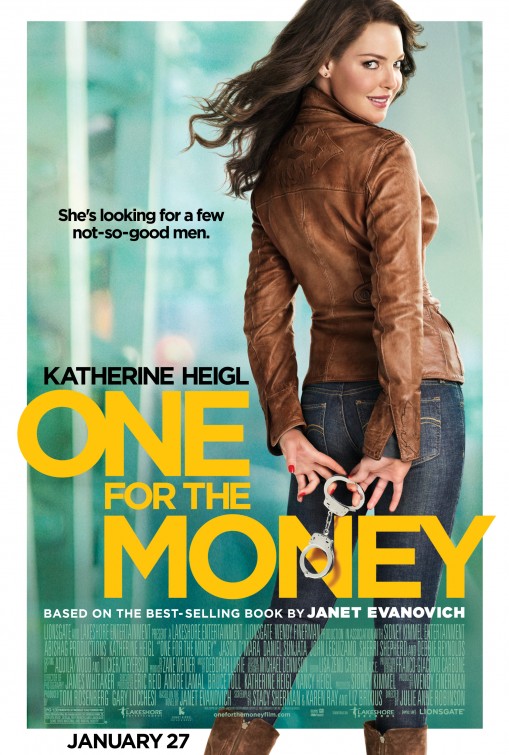 I think it’s about time we all conduct an intervention for actress Katherine Heigl, whatever it takes to stop her from starring, and producing, such middling junk like One for the Money. Heigl plays a novice bounty hunter, a Jersey girl on hard times who is tracking down her ex-boyfriend for a big payday. Yes, it’s essentially a gender reversal of the loathsome Jennifer Anniston movie, The Bounty Hunter, but at least this movie doesn’t foster a forced romance. I give the movie some credit for presenting two potential love interests for Heigl and by film’s end she’s still on her own. Bravo. The rest of the movie, however, is all strictly by the book, including the colorful characters that Heigl seems to collect. One for the Money isn’t particularly funny or particularly good. It also isn’t particularly offensive; it’s just the standard pap you expect from Heigl at this point. Here’s a confession: I really, truly enjoy Heigl as an actress. She’s terrific at comedy and has star-power charisma, and even in junk she’s still effortlessly enjoyable to watch. This woman has talent, she just doesn’t have taste when it comes to picking movie roles. Or maybe she’s content with churning out a mediocre rom-com every year or so for her fans. I just wish Heigl would gain some confidence and bounce from the ghetto of rom-coms, or at least poorly written, blandly formulaic ones. She’s taken the rom-com crown that once belonged to Julia Roberts, Meg Ryan, and Sandra Bullock, but look to them as example. You will have to adapt or die, because eventually Hollywood will find the next Katherine Heigl and supplant the old one.
Nate’s Grade: C
Share this:

Rampart (2012)
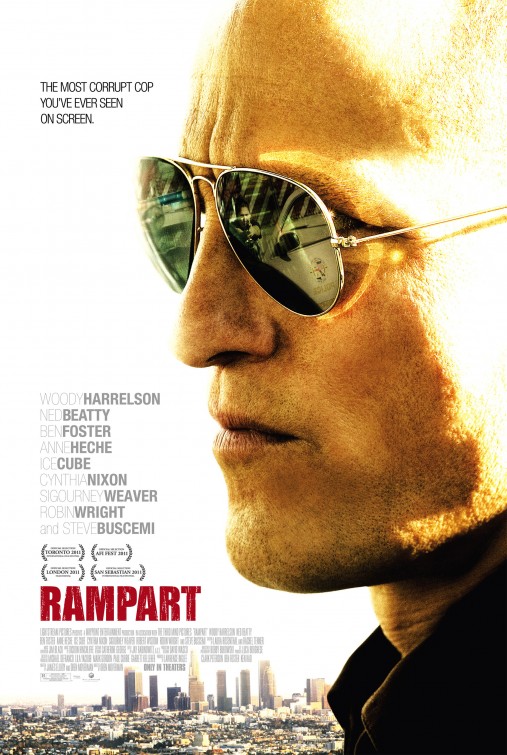 Stop me if you’ve heard this one before. A corrupt L.A. cop (Woody Harrelson) makes bad choices, alienated and frightens his family, and looks to be on the way out as a career of taking the law into his own hands is at long last catching up with him. Yeah, you probably stopped me after the third word in that sentence. This dour character-study showcases Harrelson nicely as a cocksure cop who’s so self-destructive and paranoid that he pushes everyone away. Co-written and directed by Oren Moverman, who made the terrific and searing drama The Messenger, this movie just about turns into high-gloss navel-gazing. The plot is quite loose and there’s very little traction. We get to see scene after scene of Harrelson behaving badly or violent, but what does it all add up to? We already know he’s a bad cop tortured by his own sins and the demands of the job. In a way, there’s an intriguing connection between law enforcement and soldiers who are often called to bear incredible burdens and just deal with it, forgotten by a public complacent with being safe. But really this movie is just one long trip with an angry man who keeps everyone, including the audience, pushed away. He’s complex but I can’t say we ever got to know him better. The film is well acted with plenty of recognizable stars, but why should I care? The central message about the prevailing influence of corruption is a bit heavy-handed as well; at one point Harreslon’s wife says, “You made us dirty.” Rampart is a disappointing venture for Moverman despite Harrelson’s best efforts. In the end, when you’re stuck with a dirty cop he better be worth the time.
Nate’s Grade: C
Share this:

The Raid: Redemption (2012)
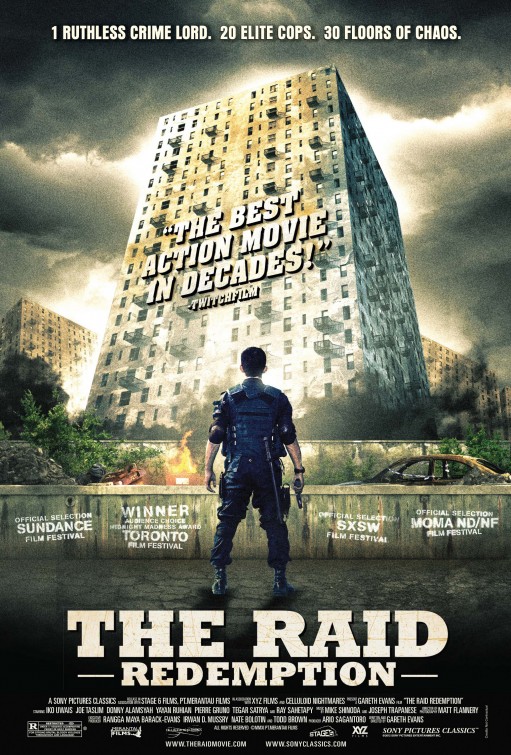 If you’ve been let down by flaccid Hollywood blockbusters in the action department, then give Indonesia’s The Raid: Redemption (part one of a planned trilogy) a try. The movie is like 90 minutes of getting kicked in the face, but in the best possible way. The flimsy premise almost seems like that of a video game. An elite forces police team storms the tenement building of a crime lord. He traps them inside and alerts the unruly residents there will be a reward for whomever takes out the cops. Each floor presents a new level of danger, from machete-wielding gangs to thugs that could show Bruce Lee a thing or two when it comes to wizardly martial arts. When the action is pumping, you feel every electric second of it. Writer/director Gareth Evans uses every part of the buffalo when it comes to action cinema. He kills guys in ways you didn’t know existed. The action is brutal and often relentless, but Evans draws out scenes organically, making fine use of geography. Guys will break through walls, jump down floors, blow up gas tanks, and use everything from filing cabinets to broken doorframes to and florescent light tubes as weapons. It’s a thrill to be able to take in the beautifully balletic choreographed fight sequences; there one that goes on for seven minutes and should already be considered an all-time Top 5 contender in movie history. There’s a fairly pedestrian plot about police corruptions and some family connections, but that’s just gristle. The real meat is the action. It’s so exhilarating and gratifying that the rest is meaningless. The Raid is the best video-game-turned-movie ever, and I don’t even care that it was never a video game. Have you seen these special movies?
Nate’s Grade: B+
Share this:

Miss Bala (2011)
 Miss Bala (Mexico’s foreign film entry for 2011) is an unwavering, startling, and deeply tense movie about one woman’s tragic and unwilling association with a powerful drug cartel. Laura (Stephanie Sigman) wants to be the next Miss Baja California, but she’s unwittingly pulled into a life of crime after she witnesses a gang hit. The cartel ensures that Laura wins the beauty pageant and becomes a courier for them. The movie takes a Lars von Trier approach to storytelling, putting its heroine through a torture chamber of anxiety and terror. This woman only wants to escape the hell she has accidentally found herself a part of, but every attempt to escape, be it going to the police or confessing assassination plots to the intended targets, gets her corralled back into the fray. For Laura, there is no escape. The movie packs a near-constant surge of paranoia, as we fear that at any time something awful will happen. In fact it’s usually only a matter of time. Laura is more a symbol of the collateral damage of Mexico’s billion-dollar drug war than a character, and she kind of becomes a numb zombie by the movie’s latter half, perhaps accepting her doomed fate. Director Gerado Naranjo favors long unwinding takes and handheld cameras, which add a gritty realism and sense of compounding dread to the picture. The movie has an unflinching level of realism to it that makes it all the more haunting, stripping the romanticism from a life of crime. Much like Italy’s heralded crime film Gomorrah, this bleak but impassioned movie shows the inescapable tentacles of organized crime and gives a face to innocents caught in the middle. Miss Bala is a testament to the hidden toll of a nation at war with itself.
Nate’s Grade: B+
Share this:

21 Jump Street (2012)
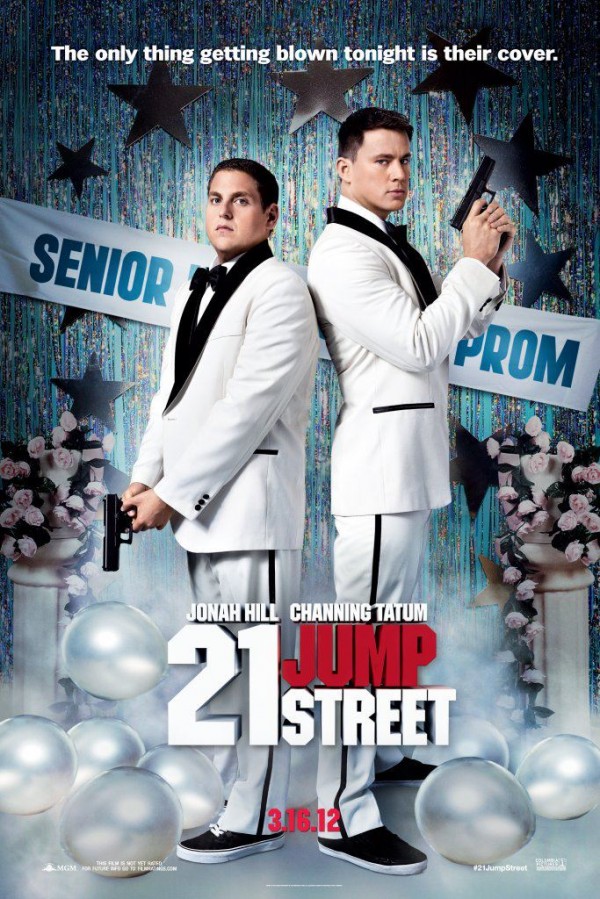 21 Jump Street ran on TV from 1987-1991 and is mainly known as serving as a launching pad for eventual mega movie star Johnny Depp… and Richard Greico too. Youthful looking police officers infiltrated high schools and tackled topical issues of the day (what snap bracelet goes best with my high-waisted jeans?). Why would anyone want to make this movie, let alone comic actor Jonah Hill? Surprising in just about every way, especially when it comes to overall quality, the 21 Jump Street movie is not just a great comedy but also a great movie. How the hell did this happen, Movie Gods?
Officer Schmidt (Hill) is smart but shrimpy (which is saying something considering how dangerous Hill’s weight has been before). Officer Jenko (Channing Tatum) is a stud but pretty dimwitted when it comes to tests. The two form a partnership and get assigned as bicycle cops, not exactly the position of command and authority they were expecting. After a few screw-ups, including failing to read a suspect his Miranda rights (“You… have the right… to be an attorney”), the duo gets bounced to an old undercover program at, you guessed it, 21 Jump Street. The pair is supposed to pose as high school students and find out who’s supplying teenagers a dangerous new club drug. Much has changed since Schmidt and Jenko were in high school together, and both of their profiles were accidentally swapped, meaning Jenko is given AP chemistry and the higher level classes, and Schmidt is given gym and acting courses, where he’s supposed to work his way into the popular circles. Molly (Brie Larson) is a gal in that popular inner circle and Schmidt struggles to accept that a pretty, smart, popular girl might actually “like like” him.
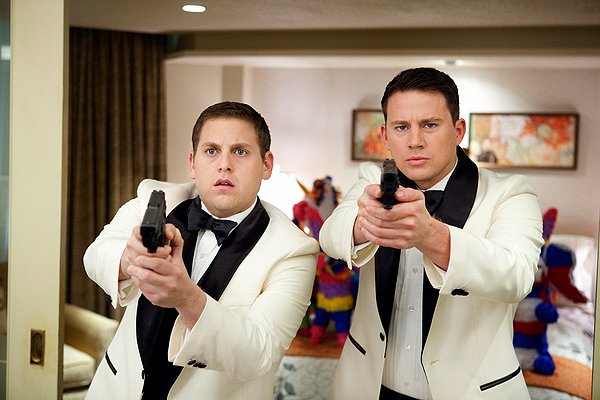 I knew I was in for something special when the movie itself lambastes the very idea of a 21 Jump Street movie, with the police chief (Parks and Recreation’s Nick Offerman) ridiculing the idea of unoriginal nitwits recycling something old that has name recognition and hoping the public will be too dumb to care. The movie beats the audience to the punch every time, mocking the absurdity of its own premise and plot points (many characters note how old Jenko appears). I should have expected more from screenwriter Michael Bacall (co-writer of the Scott Pilgrim movie adaptation) and especially from directors Phil Lord and Chris Hill, the same pair whose rambunctious comedic verve radiated from every frame of Cloudy with a Chance of Meatballs and their brilliant short-lived animated MTV show, Clone High. This movie had me laughing a lot and had me laughing hard, doubling over, with-tears-in-my-eyes laughter at points. Dickson spouts, “Some kid overdoses on drugs. And because he’s white, people actually give a shit,” showing that a movie with a mind-blowing number of male genitalia jokes can provide a few shrewd jabs of social commentary. There’s a great bit where on their first day back in school, Jenko points out the various school cliques. Then he gets to a group of students in skinny jeans, thrift store clothes, and floppy hats, and he looks puzzled. “I don’t know what those kids are?” Ha, because hipsters didn’t exist back in his (my) day.
21 Jump Street is cheeky, rowdy, quick-witted and playful in the best sense of an action comedy. It’s got fish-out-of-water moments as the duo struggle to fit in with a different high school setting. The one-liners and riffs can be gut-busters, but the film does an even better job layering oddball gags (Korean Jesus), loony slapstick, fun but telling character moments (Schmidt not knowing how to end a prayer: “The end, right? ‘The end’?”), strong setups that have stronger payoffs (using the reading of Miranda rights as a genuine emotional climax), and an overall raucous, anarchic spirit.
Here’s one sequence in particular that shows off the film’s clever comedic chops. The film finds a way to satirize the tropes of action movies, particularly buddy cop movies, with such nimble precision. Schmidt and Jenko are on the run but their car chase keeps butting heads with the fabricated reality of Hollywood movie chases. For one, they keep finding themselves getting stuck in traffic on the highway. This forces them to have to keep abandoning cars and finding a new set of wheels ahead of the gridlock. Then, as the bad guys chase them down on motorcycles, the chase causes all sorts of chaotic collateral damage, including oil trucks riddled with bullet holes and dripping the flammable substance all over the road. Then one of the motorcycles skids into the flammable muck, and our heroes wince in preparation of the expected explosion, and then nothing happens. “Huh. I really thought that was going to explode,” one of them remarks casually. And this setup is repeated again, denying us the explosive equation that action movies have pummeled into our brains (car + any tap of force = humungous fireball), and there is a payoff to this comedic tweak on the cliché, and it is silly and terrifically funny. Plus, I haven’t even mentioned that both Schmidt and Jenko are dressed in silly outfits and begin their car chase in a driver’s ed car. This sequence is just one example of the anarchic, robust, and self-aware comedic attitude that the movie flaunts.
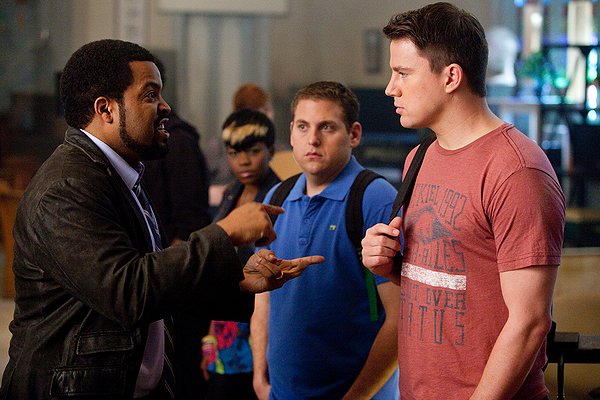 But more than being a hysterical action picture, 21 Jump Street works even better because at its core is a level of sweetness, a satisfying mixture of lewd and heart like the best Judd Apatow ventures. It’s a bromance of epic proportions even by buddy cop standards, the old school bromance vehicle of its day. The guys go back to high school and the movie’s bright switcheroo puts the characters in opposite social spheres, with Schmidt with the cool kids and Jenko struggling with the social misfits and bottom-dwellers, a.k.a. nerds. Of course the whole class assignment also shows the façade of being cool in high school. The movie could have mined this well-worn stereotypical class conflict with ease, but instead it decides to use its contrived scenario as a jumpstart for the guy’s emotional growth. The lessons may be simplistic (perils of ego, believe in yourself, teamwork, personal responsibility) but that doesn’t make them bad lessons, and the fact that the flick seriously uses covalent bonds as a metaphor, and does so in an almost poignant fashion, is worth applauding. The relationship between Schmidt and Jenko engages the audience, and we root for them even when they’re behaving like jerks. They’re misfits who are doubted and reprimanded, which make us hope for their eventual success even more. Refreshingly, the movie doesn’t put them in opposing camps in high school. Schmidt was a dweeb and Jenko was a dumb jock, but that doesn’t mean they needed to be adversarial. When they regroup in the police academy, they form a genuine partnership, realizing they can assist one another. They form an actual friendship and they’re both better cops, and better characters, together.
Hill and Tatum have preposterously good chemistry together as a comic duo. Hill, a co-writer himself, reportedly had to remain steadfast to convince Tatum to join forces, and thank god he stuck it out. Hill’s (Moneyball) already a comic pro at this point, though this role tones down his comical rancor and ups the spaz awkwardness. Tatum (The Vow) is the true revelation. Man does this guy have really great comedic skills; a sharp, instinctive sense of timing, a pliable physicality, and a genial charisma that doesn’t demand solo attention. He’s good at playing dumb without going overboard. He’s not just good, he’s flat-out terrific. Larson (Scott Pilgrim vs. the World) is an adorable and plucky love interest, sure of herself, down to earth, and accessibly quirky. The supporting cast shines in their small roles, notable Ice Cube (Lottery Ticket) as the typical brash and loud police captain, Ellie Kemper (Bridesmaids), in her randiest roll yet, as a chemistry teacher awkwardly flirting with the hunky Jenko, Dave Franco (Fright Night) as an eco-friendly drug dealer, Rob Riggle (The Other Guys) as an aggressive gym teacher, and a special cameo that’s worth leaving unspoiled.
21 Jump Street has some weaker points, namely when the action ramps up it’s pretty mundane when it’s not being funny, but the faults are minor. This is a silly, shrewd, salacious, and outright thrill of giddy entertainment, a comic blast. Hill and Tatum have a wonderful comedic dynamic and the clever screenplay gives them plenty to do with their talents. I didn’t think it was possible to adapt the cheesy TV show into a worthwhile studio comedy, but Hill and company have exceeded every expectation. 21 Jump Street isn’t the most nuanced or subtle comedy, though I will argue spiritedly that it has plenty of smarts in all the right places, but it’s an affectionate, witty, and rambunctious night out at the movies that will be hard to beat this spring.
Nate’s Grade: A-
Share this:

Courageous (2011)
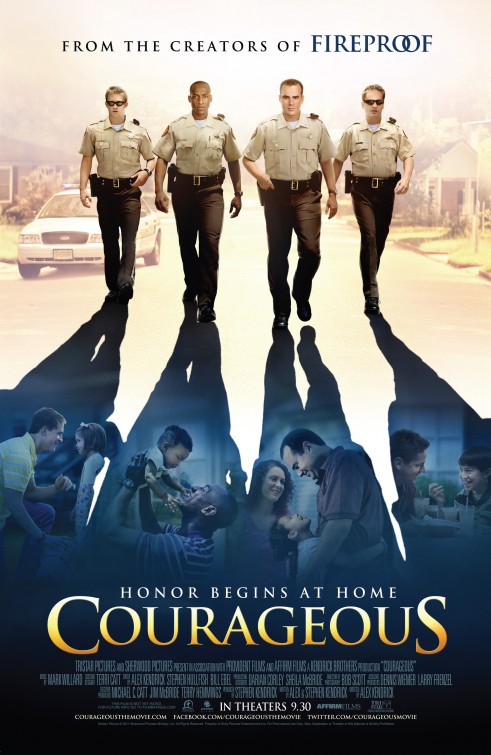 Last fall, Courageous opened to sellout crowds, but unless you or your family is plugged in to Christian media, you probably missed it (you know a movie’s got to be good when it has a quote from former football coach Tony Dungy). This is the latest film from the Kendrick brothers, a pair of pastors that started their own production company and have been making low-budget Christian-themed dramas that score big profits. What they really create, in my estimation, are two-hour film components to go along with a ready-made Bible study/lesson package (and you bet you can purchase your own Courageous companion book). As you’d expect, from an objective standpoint, these films, intended for a select audience of the converted, aren’t paragons of film artistry. And the Kendrick brothers’ last movie, 2008’s Kirk Cameron vehicle Fireproof, was awful on just about every level of filmmaking. Courageous is a better film on every front, but “better” and “good” are not interchangeable descriptions.
In the small town of Albany, Georgia, a group of police officers have al come to a personal crossroads concerning fatherhood. Adam (Alex Kendrick, director and co-writer) has recently lost his 11-year-old daughter in a tragic car accident. Nathan (Ken Bevel) is trying to come to terms to forgive the absent father he never knew. He also has to protect his teen daughter from going out with a young boy who happens to be part of a gang. David (Ben Davies) is the rookie in the group with a shameful secret of his own, namely that he has a small daughter he abandoned with her mother. Javier (Robert Amaya) is struggling to find a stable job to support his wife and children. His wife fears they’ll have no choice but to go back to their home country. Shane (Kevin Downes) is feeling the pressures of the job as well and making bad decisions that will catch up with him. The five gentlemen decide to make a public pledge and sign a written contract promising to be involved, loving, and responsible fathers for their families. But saying it and doing it is another matter.
 As with most of the Christian-funded film efforts, the movie is secondary to the message. Unlike Fireproof, the filmmakers package their wholesome message in a far more easily digestible package. There are moments in the movie that work really well and ring true, mostly the struggle of overcoming grief at the loss of a child. Adam is told that losing a child has been compared to losing a limb (look out if you lose a limb and a child). It’s not going to give Rabbit Hole a run for its money as far as psychological implications, but there are glimpses that feel like genuine and powerful drama. Whether Adam performing a dance with the memory of his deceased daughter is corny or emotional is up to you. Unfortunately, given the scatter-shot nature of the story, these moments only stay as moments, fleeting in their impact. But I was wholly surprised to even have anything genuine after the ridiculousness of Fireproof. Kendrick has improved as a filmmaker and his grasp on characterization is sharper; there are some nice moments of wry humor like when Adam keeps accidentally telling his chief he “loves him” (those declarations were intended for his wife on the other phone line). There’s an amusing bit akin to a “who’s on first?” routine as Adam mistakenly thinks Javier is another Javier he hired for some construction work. The struggle of an immigrant family hovering above the poverty line is a welcome storyline to a pretty middle-class point of view that dominates the story. I don’t know if the Javier character completely works in the context of this story, but he’s an amiable presence as he becomes an adopted member into the boys’ club. The opening even has a rather exciting flash of action with Nathan holding onto his carjacker from outside the speeding vehicle. There’s a foot chase that is crisply edited and filmed with a bit more flair than is normally accustomed to with these movies. It’s something of a small miracle that Courageous seems to exist in a modestly recognizable universe.
While being easily the best movie yet to bear the Kendrick name, Courageous still has enough faults to limit its execution, likely only reaching those already converted to its Christian values. Subtlety is rarely a tactic employed in Kendrick’s wheelhouse. As a result, everything can become rather ham-handed and message-laden. There are far too many different elements that just don’t jibe together to form a cohesive whole; the movie feels like a series of anecdotes that occasionally collide together. The narrative is stuffed with the death of a child, the struggle of immigrant workers to find a foothold, parental abandonment and reconciliation, gang recruitment, and police corruption (if you’re going to steal drugs from the evidence room, at least replace the weight value). They could have easily lost one of these guys from the plot, particularly the corrupt cop. There’s too much going on for real narrative momentum to get going. Structurally, most of the movies conflicts are resolved before we even get into the meat of Act Three, leaving the movie to finish with a hasty shootout with gang members that feels arbitrary. I suppose the Kendrick brothers might argue that the gang members represent the tragic results of boys raised without strong paternal role models, but that’s a rather simplified implication. And why does no one indignantly reject the idea that the death of a little girl was meant to prosper greater goodness in the world? I would imagine a grieving parent, no matter their closeness with God, would feel some modicum of anger at the idea that their daughter needed to die for them to be a better person. Kendrick is not nearly a strong enough actor to sell the various ups and down his lead character endures.
But the biggest problem I have with the movie is that it posits that “Christian values” and “ethics” are synonymous. I have no beef with any religious belief that people rely upon to choose to be better, more caring, conscientious, and active people. However, I bristle with the notion that ONLY religion can give people the tools to achieve these ethical realizations. The group of characters sits around a barbeque and talk about religion, parenting, their own negligent fathers, but they present religion, and specifically Christianity, as the only solution to being a better person. I would argue that mankind can realize moral good and hold to a code ethics without the direct tutelage of Christianity. If this was the case, would this logical argument not suggest that portions of the world that favor other religions are wayward in any sense of moral reasoning and value? What about before Christianity came into being, all that B.C. part of the timeline? Surely Jews would kvetch that they didn’t need Christianity to adhere to a moral order.
 The movie’s patriarchal insistence that men are the only guardians of their family seems ignorant. The women presented in Courageous are pretty much the doting types who wrap their arms around their husbands and remind them what good Godly men that are. The movie puts all the pressure onto the men, somehow missing the point that women can and should be a contributing force when it comes to rearing a family. While the Kendricks have plenty of statistics at hand about the significance of a father, the movie tacitly paints a portrait that a family is doomed when it falls under the complete stewardship of a mother. I’m not going to rip open a feminist rant because I don’t find anything in Courageous to be insidious or malicious, though its depiction of black gang members seems a bit sketchy. I just think the overemphasis on spurring men into taking responsibility doesn’t need to be at the expense of women giving up something. Parenting should be a shared responsibility and not something tagged to whomever holds the title of head of household. And as presented, the movie gives the fathers questionable levels of control. Nathan takes his teen daughter out to a fancy restaurant where he presents her with a fancy ring as a gift in exchange for dad being granted veto-power when it comes to potential boyfriends with no expiration date. I understand it’s meant as a father caring for his daughter, but buying her a ring to celebrate her chastity seems incredibly creepy.
Courageous is an improved effort from the Kendrick brothers and their Sherwood Pictures production house. The movies may improve but they still remain subservient to a message, and the ticket-buyers who look forward to a positive affirmation of that message have fewer demands when it comes to characters, plot, direction, etc. The core audience has a high demand when it comes to spirituality, but I wish they had just as high demands for artistic quality. Why can’t the faithful find inspiration from a movie that isn’t so on-the-nose? Are my only choices when it comes to depictions of spirituality the bludgeoning type (Fireproof, Left Behind, anything with Kirk Cameron really) or the esoteric (The Tree of Life)? Good intentions can only get you so far, and while its core message that men need to be responsible and step it up when it comes to parenting is valid, the rest of the movie jangles with some questionable representations and moral simplification. If people feel truly inspired by these movies to better themselves, then that’s a commendable effect but it doesn’t make the movie any better. At one point a character says that his father was “good enough.” Adam responds, “Well, I don’t want to be just a ‘good enough’ father.” Well, to many Courageous will be a “good enough” Christian drama. To me, mediocrity knows no one faith.
Nate’s Grade: C+
Share this:

The Guard (2011)
 For fans of Brendan Gleeson, one of the best character actors around, a starring role in the profane dark Irish comedy, The Guard, is a starring role long overdue. The man plays an eccentric, self-destructive lawman that follows his own sets of rules and decorum: “Racist? I’m Irish. Racism is part of our culture.” Gleeson’s character gets teamed up with Don Cheadle’s Yankee FBI agent, and for a while it looks like the film might drown in fish-out-of-water gags. Writer/director John Michael McDonagh has a gifted wordsmith’s flourish with words. It may take some concentration to decipher through the thick Irish brogues, but there is a love of language and the witty, looping dialogue is almost musical in its sublime composition. His characters are pretty interesting too. The villains, a band of drug-runners, are introduced arguing philosophy, proving to be the most cultured big screen tough guys since Pulp Fiction. The hyper-literate stock roles trade plenty of insults, which had me regularly laughing. The characters do have a habit of feeling like they know they exist in a movie, so everything, even a man’s final moments, never seems to be that pressing. I just wish these richly drawn characters had a better movie plot to work with. There are too many subplots that don’t seem to reconnect to the main storyline. The Guard seems to lose its way in the middle of too many comic vignettes before going all serious action in climax, much like the similarly flavored In Bruges (written and directed by McDonagh’s brother). The movie feels like a first draft instead of a finished product, though for Gleeson fans, this will be worthy enough.
Nate’s Grade: B-
Share this:

Cop Out (2010)
 As an avid Kevin Smith fan, it pains me to say this but Cop Out might be one of the least funny movies of the year. Sure it made me chuckle here and there, but mostly I sat staring slack-jawed, yawning, and wondering how this movie went so completely wrong. Smith is known without exception as a talent behind the typewriter, not the camera. He’s an ingeniously crass playwright in a filmmaker’s body. To hire Smith solely as director/visual storyteller is like hiring Picasso to mow your lawn — not the best use of his talents. To Smith’s credit, the film has a much stronger visual pulse than anything he’s ever committed to celluloid before, however, it still only looks like a marginal, mediocre Hollywood movie. Is that considered a success? The movie wants to parody the buddy cop action films of the 1980s. One of the more amusing additions is that Harold Faltermeyer (Beverly Hills Cop, Top Gun) fashions a brand new 80s style synth and guitar styled score. It’s the best and funniest part of the movie. Cop Out spends an inordinate amount of time and attention to a tortuous plot that nobody should care about. Another miscalculation is that the tone never really settles and often Smith and company attempt a light touch when it comes to parody, which makes the film just look like an incompetent retread of 80s action movies. Just because we’re familiar with stuff doesn’t mean it can be funny without comment. The movie looks even shabbier in comparison with Will Ferrell’s similarly aimed The Other Guys, a far more winning and funnier venture. I wanted to laugh; I strained to find something to appreciate, which was especially hard as the movie tilts more toward action in the final 20 minutes. The slack pacing, lame dialogue, poor chemistry between lead cops Bruce Willis and Tracy Morgan (who just comes off as an unfunny idiot with a loudspeaker for a mouth), disjointed tonality, and ill-conceived comic setups (car chase in a cemetery leads to? nothing? Morgan chases a suspect while he wears a cell phone costume … *crickets*) all take their toll and make me seriously question what drew the interest of so many, otherwise, talented people. Smith got hours of stories after shooting a small role alongside Willis for Die Hard 4. I hope Smith can justify this load with a few more hours of entertaining and juvenile stories for his road shows and podcasts. If that sounds like a faint attempt to find a silver lining for what is otherwise a tremendously botched comedy, then let it be seen as such.
Nate’s Grade: C-


 nathanzoebl
You must be logged in to post a comment.