Blog Archives
Reprise (2008)
 This very New Wave-styled Norwegian film manages to be thoughtful and intelligent, stylish without being vapid, touching, and it brilliantly captures the exuberance of youth on the cusp of adapting into maturity. Reprise follows two best friends and aspiring writers; Phillip finds success immediately but cannot handle it, and Erik must fight through rejections. Director/co-writer Joachim Trier (cousin to Lars) has given the film a hypnotic triptych narrative structure, meaning there are flashbacks, flash forwards, flashbacks within flashbacks, and the viewer is best advised to just succumb to the thrills of the narrative and sort it all out later. The structure made me feel totally immersed in the lives of this small unit of 20-somethings. You get a lifetime of detail thanks to the tangential narrative structure and the help of an occasional narrator. The film has a remarkably deft touch when it comes to crafting realistic characters; the pangs of uncertainty, jealousy, and insecurity all ring true without being trite or obvious. But the movie never gets dour or pretentious as it covers weighty topics. The movie also has an indelible energy that is hard to ignore. Reprise is playfully edited and constantly moving, sometimes forward, sometimes backwards, sometimes telling us a possible scenario that sounds better than reality. I found several small moments to be provocative, like Phillip trying to replicate the happy memories of time and place by trying to re-stage a photo of his girlfriend with his girlfriend (a lovely Viktoria Winge). Reprise is full of small tender moments that speak volumes. This is a terrific film brimming with life and verve and clearly targets Trier as an inspiring filmmaker to watch.
Nate’s Grade: A
Share this:

Nick and Norah’s Infinite Playlist (2008)
 When you’re a teenager, sometimes there is nothing more important in life than music. Generally one of the most prominent means for a teenager to outwardly define his or her emerging personality is by music. Coming of age and maturing musical tastes seem to go hand in hand. I may date myself here but I can recall my own personal blossoming thanks to the likes of Green Day, the Smashing Pumpkins, and the Offspring (you couldn’t go anywhere in 1995 without hearing “Self Esteem”). Nick and Norah’s romantic interlude begins over common musical tastes and move from there. Having a person “get” you seems to be linked with having a person “get” your music. Nick and Norah’s Infinite Playlist is an inviting and mostly successful teen comedy that “gets” it.
Nick (Michael Cera) is nursing the common teen ailment of a broken heart. He’s one part of a queer core punk band and just happens to be the only heterosexual band member. Nick has been sending mix CDs to his ex-girlfriend, Tris (Alexis Dziena), but she’s been tossing them in the trash. Norah (Kat Dennings) has been fishing those mix CDs and falling in love with her unknown musical soul mate. Norah’s best pal Caroline (Ari Graynor) has informed her that her favorite indie band, Where’s Fluffy?, is playing a secret late-night show in New York City. The slew of characters, Norah and Caroline and Tris and her new boyfriend, attend a nightclub where Nick’s band performs. Awkward. Norah poses as Nick’s new girlfriend and the two take off together to drive a very drunk Caroline home. It is here that they begin an unforgettable odyssey filled with gross toilets, drag queens, Norah’s ex-boyfriend (Jay Baruchel), jaunts to recording studios, and many stops along the way to try and find Where’s Fluffy?
 Nick and Norah isn’t anything altogether remarkable but its charm comes in how, well, unremarkable it comes across. I do not mean this as faint praise or a backhanded compliment. The majority of teen-oriented films have the habit of slotting characters into rigid archetypes. Earlier this year, the documentary American Teen was released and barely made a blip. The director of this documentary condensed an entire high school year into a feature-length film, but she framed her characters as entrenched stereotypes patterned after movies (movies began the stereotype, now is life merely following its lead?). The marketing even had its main “characters” recreate the Breakfast Club poster with the requisite Jock, Geek, Princess, etc. It’s so easy to paint in broad, well-established strokes when it comes to teenage characters and a high school setting. So it’s genuinely entertaining and encouraging to see Nick and Norah where the characters just are people. Granted the gay characters are a bit too cutesy by half, though they never become swishy stereotypes and the slutty manipulative ex-girlfriend character is a pretty familiar and clichéd antagonist. But the real charm of the movie is seeing characters that cannot be painted in broad strokes, characters that do not hide who they are, and characters that refuse to be typecast. Just watching Nick and Norah interact, I felt like I was watching two friends instead of high school archetypes having the same tired class warfare. Making the characters reasonably realistic and unremarkable is a breath of fresh air.
Not all the elements in Nick and Norah entertain; some feel like they’ve been surgically attached from different movies. The entire subplot involving the sloppy drunk escapades of Caroline seems extraneous at best, providing an unnecessary plot point that keeps Nick and Norah together for the night. It provides some laughs due to Graynor’s highly amusing drunken performance, but the subplot also pushes the movie into outlandish gross-out humor, like when Caroline vomits into a toilet, drops her gum in the same toilet, and then decides to foolishly go after the gum. The same piece of chewing gum has its own fantastic journey. The coupling between Nick and Norah is also given a weird and somewhat unseemly addition. Clearly these two kids “like like” each other and the wild night presents different coupling obstacles before these fun kids eventually decide to make a move. In one scene Norah is taunted by Tris about never having had an orgasm. So then the movie makes it a point that when nick and Norah do hook up that we are presented with Norah earning her first O-face (the whole climactic sequence is done off camera and only with audio). Orgasmic proof was not needed to convince the audience that Norah has finally found a worthy guy. The fact that they’re high school-aged students brings an unsettling, seedy element into an otherwise wholesome film. It wasn’t needed.
The plot of Nick and Norah has a few bumps along the way because the emphasis is on the groovy and genial atmosphere. Watching the movie is somewhat akin to attending a party with some cool people. You leave the theater with your spirits lifted a tad, a smile on your face, and some fond memories for the time being. I’m not saying that Nick and Norah is comparable to the best teen comedies of all time but it manages to spin a little magic. I couldn’t help feel wistful as I watched the teen characters romp through the late night music scene of New York City, a character all its own. The movie manages to capture the exciting essence of being young and alive in an authentic way.
 The two leads are deeply enjoyable. Dennings (The 40-Year-Old Virgin) is a great find and comes across as a natural teenager. She’s not precocious or glib, but she seems grounded, unassuming, and yet intelligent in a way that doesn’t pass as hyper-literate. Dennings gives a spunky performance that is tinged with awkwardness and heartache, as she explores the scary yet exhilarating prospect of romance. She’s also got a bashful beauty to her, like the girl next door that would never admit that she could be attractive. She’s got lips like red licorice and classic features that could work in old Hollywood. Dennings gives every scene a boost of heart and the movie shines brightest every minute she’s onscreen. Cera (Juno, Superbad) seems to have patented his nervous stammer that he’s previously showcased. I wonder what Cera’s acting range actually is because he seems to be playing different variations on the same character. However, I have written before that Cera is the living master of comic understatement and the well-timed pause, and he proves it again. He mopes a bit too much through the movie but Cera manages to make him empathetic and not pathetic. The two of them have a sweet chemistry and it’s easy to yearn for their coupling.
Nick and Norah’s Infinite Playlist exists in a world that doesn’t exactly resemble our own but seems like a swell place to visit. The movie almost contains a certain innocence to its teenage shenanigans. Dennings and Cera make for engaging leads and an adorable couple onscreen. Not all of the parts come together as well as Nick and Norah do, but the movie’s overall vibe is authentic and low-key, apt to provoke cheerful smiles more than laughs.
Nate’s Grade: B
Share this:

The Wackness (2008)
 Every Sundance Film Festival seems to coronate new talent and new films that never seem to materialize once they step outside of the happy bubble of festival life. It happened with Happy, Texas, with Tadpole, with Hav Plenty, with Primer and numerous others that never managed to get started with the public. At the 2008 Sundance film festival, the biggest buzz followed the documentary American Teen and The Wackness. Writer/director Jonathan Levine’s coming-of-age tale won the Audience Award for Drama and boasts shimmering visuals, formidable actors, and a hip soundtrack. Too bad the drama gets the least attention in that package. I suspect The Wackness will be yet another Sundance buzz flick that, while well made, fails to leave a mark on mainstream crowds (here’s hoping more for American Teen).
Luke (Josh Peck) has just graduated from a New York City high school and is winding down the summer before he moves on to college. He has a unique summer job: Luke sells marijuana out of an ice cream vendor’s box. One of his clients, Dr. Squires (Ben Kingsley), is a therapist. He trades therapy time to Luke for pot. The two of them form an unanticipated bond and Dr. Squires makes it a point to see that Luke is making the most of his youth. Luke is smitten with the doc’s stepdaughter, Steph (Juno‘s Olivia Thirby, gratifyingly authentic), and determined to lose his virginity and find love before the summer fades away.
 The strength of The Wackness is in the unexpected father/son relationship that forms between Luke and Dr. Squires. Kingsley is sensational in his role and provides all the pathos and unexpected discoveries that the coming-of-age genre is associated with. I think that’s what’s most interesting about Levine’s film, is that Kingsley is going through all the coming-of-age moments reserved for teenage protagonists. Dr. Squires and Luke form a surprising and deep relationship where they learn from each other. Luke learns to talk about his life’s sadness and make it a part of his life, instead of sweeping it under a proverbial rug. Dr. Squires learns to re-embrace life and to kick his heavy supply of pharmaceutical prescriptions. He is coming of age at middle age. He even gets to second base with an Olsen twin (Mary-Kate is only in the film for two scenes and an estimated five minutes). Most of all, Dr. Squires needs a friend and Luke fulfills this desperate void. Kingsley is funny, pathetic, and the real star of The Wackness.
My main problem with The Wackness is how familiar it all comes across. It follows the coming-of-age model down to the end, so a savvy audience is going to realize that Luke will fall in love, get his heart broken, stand up for himself, and gather a bit more wisdom by the time the end credits roll. You’ve seen this movie played in a thousand different ways before, and now The Wackness makes it 1001; you will essentially know every beat of this story before it happens. The film doesn’t break any new ground and doesn’t manage to provide much commentary or lasting insight while it comes of age. The screenwriting fails to hide what disinterests Levine. So we get quick glimpses of Luke’s home life and I swear in every one of them his parents are just yelling. That’s all Levine is interested in, setting up one ten second shot of Luke overhearing his parents shouting again and again. Dr. Squires’ wife (Famke Jannsen) gets the same kind of treatment. She gets a cursory amount of screen time to glower and that’s about it. I can tell Levine is only interested in his three main characters (Luke, Dr. Squires, Steph) but then why does he not concentrate on them further and scuttle what he feels is wasted time?
The Wackness is awash in pointless nostalgia. The movie is set during the summer of 1994 for no real reason. The time setting doesn’t impact the film in any manner except for some digs at Mayor Giuliani’s policies (he was only in office for sixth months or so when the film opens). Levine dishes out pop-culture references like the 8-bit Nintendo game system, old chunky GameBoys, Kurt Cobain’s suicide, mix tapes, and lots of rap music. The Wackness is an ode to mid 90s rap music and Luke is a lover of acts like A Tribe Called Quest, De La Soul, and some up-and-coming guy named The Notorious B.I.G. The soundtrack is also meant to convey good nostalgic vibes of a simpler time only — 14 years ago. Setting the film in 1994 is a lazy attempt to cover the lapses in screenwriting with cozy audience nostalgia. And is there anything really culturally transcendent about the summer of 1994?
 Peck may have lost like 100 pounds since he was fat comic relief on a Nickelodeon kids show, and he’s marginally handsome, but this kid needs some more practice before he’s a dramatic actor. I understand that his character gets stoned often and, as a typical teenager, is trying to pull off a too-cool-for-the-world-“whatever” attitude, but he seems freaking catatonic. He’s too aloof for his own good. His acting is dry and monotone and he feels like he’s constantly zoning out. Again, I understand that this works with his stoned persona but Peck is hardly ever convincing in the part and his acting shortcomings rob the role of a greater level of sympathy. A great actor can make you like a character that eats babies and kicks puppies, or the other way around, but Peck is not that actor. I believe that part of The Wackness‘ failure to connect and elevate beyond its genre trappings is due to Peck’s poor performance. He’s just kind of boring character and, to borrow a term from our pals on the other side of the pond, a bit of a wanker.
As a director, Levine has a playful and visually appealing look for the film, bathing it in arid tones to echo the hot summer days. The cinematography is a character all its own, giving the film a colorful and lively flair that makes every scene worth watching even if the script fails to do likewise. Levine has a handful of clever visual tricks up his sleeve, like a middle finger that moves through a crowd of New Yorkers at rapid speed before finding and dialing a pay phone. Levine has definite talent as a director and it shouldn’t be long before Hollywood comes knocking and plucks him away to make The Fast and the Furious 8: The Search for Curly’s Gold.
The Wackness feels like a coming-of-age film that goes through the motions. The main character is stoned to the point of comatose and he’s a rather boring protagonist, made even duller by Peck’s lackluster acting ability. Writer/director Levine flexes enough visual artistry to make him a talent to watch, however, his screenplay is too familiar with little personality or flavor to stand out against the pack. The movie looks good, it sounds good, and Kingsley is certainly good, it’s just a shame that it isn’t his movie. Steph tells the mopey Luke that all she sees is the goodness life has to offer and all he sees is “the wackness” (you can go home happy to understand the title). I guess I similarly be accused of focusing on the “wackness” of The Wackness because it’s certainly not a bad movie. It just happens to be ordinary. Though it does have some torrid Kingsley-on-Olsen Twin action. I suppose that isn’t too wack.
Nate’s Grade: C+
Share this:

Son of Rambow (2008)
 The film takes a few notes from 2005’s Millions and presents an amateurish tale of English schoolboys making their own amateurish sequel to a Rambo film. From a visual standpoint the film looks great, it has a slightly offbeat appeal, but there just isn’t any substance here beyond the imaginative visuals. The friendship between the two boys, one a bully and the other a lonely kid apart of a strict religious sect, doesn’t draw much out of the characters or the actors. The kooky stunts and homemade moviemaking made me smile and gives the film a fun, quirky energy. But then Son of Rambow seems to butt heads when it enters more serious dramatic territory like family loss and betrayal. The tone is uneven and the mixture of slapstick and whimsy and real pain and suffering never fully works. Certain subplots like a cool French foreign exchange student (who may not be so cool after all) feel grafted onto a story that needs direction and depth. They feel like distractions. Writer/director Garth Jennings (The Hitchhiker’s Guide to the Galaxy) tries to imbue the project with a childlike spirit but the story needs a whole lot more emotional focus and a whole lot more work. This ain’t no Millions.
Nate’s Grade: C+
Share this:

Persepolis (2007)
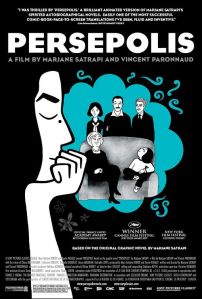 Marjane Satrapi has, by all accounts, a very unique life. Growing up under the repression of the Islamic Revolution, she settled in France and created a series of acclaimed best-selling graphic novels called Persepolis, based upon her life growing up in and out of Iran. The movie was France’s official entry for the 2007 Foreign Language Oscar, bypassing the equally lauded and inventive Diving Bell and the Butterfly. And yet Persepolis did not even make the short list of nine nominees, which eventually gets parred down to five (neither did 4 Months, 3 Weeks, and 2 Days, which WON the Best Film from the European Film Awards, over other movies that managed to make the Academy’s five nominees). I consider this a glaring omission. How could anyone not be entranced by Satrapi and co-director Vincent Paronnaud’s masterwork?
In Tehran, the capital of Iran, young Marjane and her family watch as rebellious forces overthrow the Shah in 1979. The Shah was the ruler of Iran and could readily be described as a dictator. He was friendly to Western countries and wanted Iran to follow their lead. Large forces unified and deposed the Shah, setting the stage for Iran to have its own system of rule that the people would decide upon. Marjane’s father swings her around in his arms and excitedly proclaims that democracy has come to his country at last. Landslide numbers “vote” for radical Islamic leaders to take control of the government, and Iran becomes a militant theocracy. Privileges and reforms are revoked, and women will have to wear long burquas and veils to be righteous. Marjane is too outspoken and her parents, fearing for her safety, send her to Europe to be educated. While she is absent Iraq attacks Iran and the countries are engulfed in a decade-long border war.
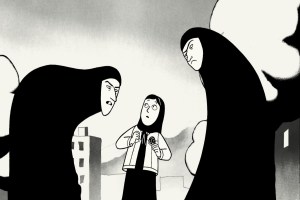 Persepolis is a gem of a movie, at once a personal coming-of-age account that manages to be fascinating and honest and also a universal tale of struggle for cultural identity. The evocative black and white animation is a joy to watch. The crisp drawing style manages to express so much with the seemingly simple, clean images. At times the visuals take on a lovely German expressionistic feel, and the world feels like it is made out of folded layers of paper. I would fall in love with a movement, a facial expression, that fact that smiles look like boomerangs, something small yet immeasurably enjoyable that struck a deep chord inside me. The arresting black and white visuals do not distract from the story in any way, in fact they help to mirror the repressive nature of what befalls Iran. A silhouetted group of protesters is shot at and one of them falls to the ground. Great inky blackness seeps out of the fallen body and merges with the rest of the screen, adding emotional heft that color could never capture.
Told for long stretches from the perspective of a child, Persepolis manages to find unique perceptions. The child point of view allows the film to unfold naturally with innocence and inquisitiveness, qualities that would soon be hard to recapture once the promise of revolution turned sour. Young Marjane feels jealous and competitive that her cousin can brag that her father spent more time as a political prisoner. It’s an odd stance for an adult and yet it feels entirely within reason for children. Marjane deals with issues she cannot fully understand as a child but she tries her best. The eyes of children also let the filmmakers mingle with the fantastic. Marjane speaks to God at points, and after a horrible tragedy God is trying to apologize and explain but little Marjane will not hear any of it. She orders God to leave her and so He departs. A little girl turning her back on God will hit you is the kind of devastating stuff that can put a permanent lump in your throat.
I was dumbfounded at the emotional depths the film plumbs in a scant 95 minutes. This is an incredibly powerful tale, richly told with poignant insights and grace. There were several times I was overcome with emotion and had to dab my eyes. Satrapi achieves great emotional resonance with minute details, making the film exciting in how engaging it continues to be from beginning to end. Marjane’s relationship with her family anchors the movie and you can feel the power of their love and bonds. Imprisoned uncles who spouted communist dogma are released only to be seen as a danger once again. Marjane’s mother is worried when Marjane keeps showing a fiery outspoken spirit. One day she shakes a teenage Marjane, screaming at her the horrid possibilities that can happen to women under this regime. She cites one teenage girl who was executed, but they don’t believe in killing virgins, so the guards took care of that bothersome roadblock. Marjane’s mother is wild-eyed with fear and what might await her little girl, and her gnawing concern is resoundingly powerful. Marjane’s grandmother serves as her emotional compass throughout her life. Grandma stresses that Marjane should be proud of her cultural identity and stay true to herself. When Marjane gets older she hears her grandmother’s voice to set her straight in times of doubt.
 But while the movie can be heartwarming, it does not fall victim to sticky sentimentality. Satrapi deals with some harsh truths about life in Iran and also her time in Europe as a blossoming woman without a country. She doesn’t sugarcoat reality and Marjane’s parents make it a point to be up front with their daughter about what is happening; an uncle tells little Marjane, before he is executed, that knowledge must live on and she, the youth, must be the one to keep it alive. The Iran-Iraq war ends in a stalemate with millions in casualties. Persepolis details life behind the veil and the shift the country took to radical Islamic rule but the film isn’t all doom and gloom. There’s a natural curiosity about a story of a girl who becomes a woman in a repressive society. Marjane’s spiky rebellious spirit makes for genuinely human comedy. She shops for Iron Maiden tapes on the Iranian black market, wears a jacket that states, “Punk is not ded,” and screams with joy at ripping her veil off during a car ride and letting the wind gust through her hair. There is a bounty of humor to be found in unexpected places. Marjane is running to catch a bus and is stopped by two policemen who complain that when she runs her butt moves “in an obscene way.” She simmers and finally yells, “Then stop staring at my ass!”
If Persepolis has any shortcomings it’s that the narrative peaks a bit too early. Seeing a child come of age during the Islamic Revolution is generally more interesting than watching a teenager navigate unfaithful boyfriends in Europe. Persepolis never stops being entertaining or relevant, it just so happens that the greater emotional rewards are tied to life and family in Iran.
Persepolis is a marvelously moving and unique coming-of-age tale set against a unique time. Marjane Satrapi’s graphic novels have fluidly been translated into a film that resonates with great emotional turmoil and inspiration. The alluring black and white visuals and clean animation style dazzle the eyes, while the enthralling personal story reaches deep inside and touches the heart. The film is brilliant, beautiful, harrowing, deeply human, fascinating, and ultimately inspiring. It’s rare to find a movie that can hit so many emotions with finesse, animated or live action. Persepolis is a bold vision and a revealing and lovely film that I cannot wait to revisit often. This is more than just a cartoon, folks. This is art.
Nate’s Grade: A
Share this:

Bridge to Terabithia (2007)
 Much less a Narnia knock-off and more of a coming-of-age tale. It’s a simple story with loads of familiar elements (the strict tough love father, the bully who just needs a friend, the free-spirit kid that goes against conventions) but it plays every moment with a satisfying level of integrity. When a late revelation occurs that shakes up everything, the impact stings and we realize all the steady groundwork that has stealthily been going on. Not everything works, particularly Zooey Deschanel as a music teacher that strums her guitar and does little else, but this is a family movie that has much more on its mind than most.
Nate’s Grade: B
Share this:

Running with Scissors (2006)
 Ever since author James Frey imploded into a million little pieces, the memoir has come under intense scrutiny. At issue is the validity of the written word, whether these people are being honest as they recount their tortured yet inevitably redemptive lives. What is the difference between nonfiction and memoir, and does it implicitly imply personal bias? Running with Scissors is the 2002 best-selling book detailing the bizarre childhood of Augusten Burroughs. It’s a book with lots of out-there claims but they’re all held in check by Burroughs’ tart observation and witty writing. When translated to the silver screen, Running with Scissors loses credibility without the author’s voice. I doubt many people going in cold will even believe what they’re seeing.
In the 1970s, Augusten (Joseph Cross) is a gay teen growing up in the care of his alcoholic father (Alec Baldwin) and his deeply delusional, bipolar, wannabe poet mother (Annette Benning). When their marriage hits one of its many slags they seek out a therapist, Dr. Finch (Bryan Cox). He has a room he dubs his “masturbatorium,” a resemblance to Santa Claus, and a family just as whacked as he is. His oldest daughter, Hope (Gwyneth Paltrow), helps him in his practice and thinks that pets talk to her, even from beyond the grave. Natalie (Evan Rachel Wood) is the rebellious daughter who likes to play doctor via electric shock therapy. Agnes Finch (Jill Clayburgh) is the matriarch of this cracked family that also enjoys eating some dog kibble here and there. When Augusten’s mother signs over adoption papers he becomes the reluctant newest member of this dysfunctional family.
 The trouble with translating a book is that you lose the author’s voice and commentary. Running with Scissors maintains the horrifying living conditions for Augusten and the stable of oddballs, but lost is the author’s snappy humor that carried him through this tumultuous time. It’s definitely weird but it’s far from engaging. Without the wit and dark humor from Augusten’s voice we’re left with a series of loosely bandaged scenes about crazy characters and crazy anecdotes, little of which contains further importance. This is a fan of the book talking here, and I’m afraid that the film adaptation has heightened some of the weaknesses of the book, namely the loose storyline. When pieced together as a film, Running with Scissors can become slightly tiresome and overly reliant on background details. The film treats its wild, kitschy production design and 70s nostalgia as a character on par with anyone. It makes for great production design, true to the spirit of the book, but also serves as a narrative distraction. Too much attention seems to be put on getting things to look right than getting the screenplay to feel right.
Without the author’s voice the results lose credibility. It’s funny to see a Christmas tree up year round, and it’s funny when Dr. Finch is convinced God is communicating to him through his bowel movements, but it all just comes off as another joke like the art direction and nothing more. When fully added together without any sense of pathos, it all seems like a joke. The subplot involving Augusten’s sexual relationship with a much older schizophrenic patient (Joseph Fiennes) seems mishandled without much insight. Running with Scissors presents all examples of dangerous, sometimes illegal, behavior and doesn’t bat an eye, nor does it pass judgment. While this may irk some and seem irresponsible it’s just another case of little mattering. Running with Scissors, as an adaptation, presents little of consequence.
Director Ryan Murphy also adapted the screenplay and knows a thing or two about dysfunction and trashiness, having created the risky TV show Nip/Tuck. His adaptation has a blunted feel, but it also seems too broad. Then again, maybe only fans of the book would notice. He has a good feel for his actors and can stage some nice shot selections, but man, someone needs to slap his hand away from the AM radio. Running with Scissors is crammed with so many popular 70s tunes that it becomes a crutch, with Murphy hitting the soundtrack button whenever he needs some kind of character catharsis. It doesn’t work and comes across as indulgent and simplistic. There are so many zippy classic pop songs you may think Elton John is owed a writing credit.
 The acting is one of the elements that help give life to this adaptation. Benning has been generating Oscar buzz for her deeply self-involved portrayal of a mom held hostage by her illness. Benning digs deep and displays a comic range of absurd behavior and wild paranoia. She’s all over the place and you can’t help but loathe her, that is, if you ever take her seriously. But then, once overly medicated, she gives an entirely secondary performance as an emotionless zombie, and we feel a sliver of sympathy, a true surprise. It’s a good, meaty role, however, I actually think Clayburgh gives the more Oscar-worthy performance. In a lot of ways she’s resigned to her fate and yet manages to be the gauzy heart of the picture. She tells me more with her wrinkles than Benning does in her gesticulating outbursts.
The rest of the cast work admirably. Cross is our focal point of the story and does a fine job of, essentially, gawking and looking perplexed. He’s like a blank, gangly canvas, and I wonder what else Cross is capable of than a performance built around indignant reactions. Wood is developing into a lovely adult actress and has some of the best foul-mouthed lines. It’s just nice to see Paltrow in a movie again. Baldwin has transformed from leading man into incredibly versatile supporting actor that excels as comedic lunkheads. Cox remains one of my favorite character actors of all time. There’s nothing this man cannot do. The actors all do a good job of filling out their zany characters while leaving their own imprint.
The issue with Running with Scissors is that when you strip away the author’s caustic voice, then the movie strains credibility, even with the knowledge that it?s based on a personal memoir. The movie gets all the wackiness but misses out on some of the finer points and humor that helped save Augusten from his unorthodox housing. The story feels dulled and stretched too broad, and yet it still manages to be intermittently entertaining despite these flaws. The actors range from good to great and the art direction is fantastic, even if Murphy expects it to do more work than his screenplay. Running with Scissors isn’t as nervy, engaging, or provocative as its source material. Then again little else is. Consider the film Running with Safety Scissors.
Nate’s Grade: B-
Share this:

The Battle of Shaker Heights (2003)
 Ben Affleck and Matt Damon, being the egalitarian champions we all know celebrities to be, started a contest called Project Greenlight that allowed aspiring screenwriters to enter for a chance to have the winning script made into a movie by Miramax and the process documented for a behind the scenes reality show to run on HBO. Project Greenlight‘s first winner was the hapless Pete Jones. His winning screenplay gave birth to Stolen Summer, a maudlin coming-of-age story about a Catholic boy trying to get his ailing Jewish friend into heaven. You can feel the grating precociousness already. While Stolen Summer was an artistic yawn the HBO series was a hit as we the viewers saw every stupid mistake, naïve decision, and screaming matches during the production. Pete Jones’ pain was our gain.
Unlike the first contest, this one had a separate entry for directors and the tag-team of Efram Potelle and Kyle Rankin were picked to direct the winning screenplay The Battle of Shaker Heights, by Columbus, Ohio (represent) grad student Erica Beeny. Project Greenlight on HBO showcased the tension created by these butting heads. Beeny seemed ready to meltdown at a moments notice, probably because she let her good nature be taken advantage of by the egotistical, passive-aggressive, non-communicative, hilariously self-absorbed directors. This raises the question; did Affleck and Damon pick the best people or the people most likely to create the best television?
 Once again, the winning screenplay involved a coming-of-age story, this time revolving around the life of Kelly (Shia LeBeouf), a glib teenage war re-enactor. Kelly befriends Bart (Elden Henson) during a battle reenactment. Bart is from a wealthy Wasp-y household where his college is already predetermined. Kelly, on the other hand, must sullenly deal with his father (William Sadler), a former junkie who wasted away his college fund, and his flighty mother (Kathleen Quinlan). Bart and Kelly scheme to teach a schoolyard bully a lesson, and in the process Kelly starts falling for Bart’s attractive older sister Tabby (Amy Smart).
The character of Kelly doesn”t seem to have any deep reflections of life or anything of substance, just wicked one-liners. The fact that Kelly comes off as a sympathetic hero goes fully to the charming LeBeouf, who displays a laid back sense of humor and allure that is reminiscent of a young John Cusack. LeBeouf gives a star-making performance that keeps the audience engaged, even if the story is turning them off.
One of several problems Shaker Heights suffers from is that the finished product is a one-man show. Kelly is such a dominating character, a whirlwind of misplaced rage that everyone that gets in his path suffers. His relationship with Tabby seems like nothing more than unrequited puppy love that doesn’t need so much screen time being spent on a tired will they or wont they diversion. Kelly’s parents come off like theyre invisible. If you blink you may miss their entire time on screen. The father is more an absent force to drive Kellys angst, while his mother doesn’t seem to have any purpose or influence whatsoever.
 Shaker Heights feels like a film made by committee because as Project Greenlight astutely documented it was made by a committee. Miramax executives decided they could sell the film better as a pure comedy so they removed most of the winning screenplays drama. So now, with this new incarnation of Shaker Heights, the comedy never really emerges from more than a handful of superficially cute lines, and whenever a bit of drama does emerge it seems alien and disorienting. The heavy-handed direction by Potelle and Rankin paints in broad strokes, so the dramatic efforts come off as forced and overblown when they sneak up on an audience.
This incarnation of the movie may be entertaining to some, but with these cuts and directorial choices Shaker Heights seems horribly ordinary. Kelly is a disaffected teen with smart-ass comments; he lusts after the older girl who, of course, is with a supposed loser; his parents just don’t know what to do with him. The story is dulled down and all the edges seem polished off, and what an audience is left with is scenes, characters, and a story we’re already well familiar with. Does Project Greenlight seem to have a desire to select coming-of-age stories and then water them down to the point of distilling any original voice? The only interesting diversion in Shaker Heights is the war reenactment section, which is tragically too short.
The Battle of Shaker Heights is another theatrical dud from the Project Greenlight crew. Fans of teen melodrama might get some moderate enjoyment from it, but realistically, the only people who are going to pay any sort of money to see Shaker Heights are the people who avidly followed the Project Greenlight TV series. And in the end, one cant shake the feeling that The Battle of Shaker Heights ultimately feels like a disappointing season finale to Project Greenlight.
Nate’s Grade: C+
Share this:

City of God (2003)
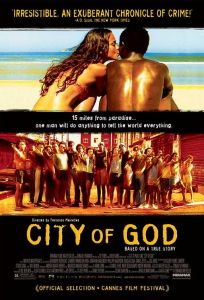 Looking for a film that really packs a genuine wallop? Take the visual panache of a pre-Madonna Guy Ritchie (Snatch) film, the juvenile delinquency and debauchery of a Larry Clark (Kids) film, the propulsive narration and bloody violence of a Martin Scorsese (Raging Bull) film and mix it with a cast of about 40 characters. What you get is City of God, a brilliant and vibrant film that pulsates with exhilarating action, thoughtful commentary and devastating power.
In the 1960s, the Brazilian government transported its impoverished citizens outside of Rio de Janeiro, a glamorous tourist magnet. This new place of residency was a distant housing project of shabby slums, ironically titled City of God. In this begotten neighborhood the police rarely emerge (except to occasionally pick dead people’s pockets) and crime has become rampant. A mixture of poverty and an overabundance of guns and testosterone have bred a culture of criminals where teenagers populate ruthless gangs.
 Our story focuses on Rocket (Alexandre Rodrigues) narrating the rise, and many falls, of all the flashy thugs of the City of God and the ripples they create in the community. Hes a young boy who is too scrawny to be a hoodlum like his older brother Goose. His brother belongs to a gang known as the Tender Trio, who are used to hijacking propane tanks for small gain. They get the idea to knock off a brothel at the urging of Lil Dice, a younger kid with ambition and a heart like a stone. After the successful robbery Lil Dice cleans up after the Trio, sifting through the brothel killing everyone inside and laughing insidiously.
The murder spree has long lasting effects, with each member of the Tender Trio finding an untimely end. Lil Dice grows from calculating child into a big-time burgeoning cruel gangster, who now calls himself Lil Ze (Leandro Firmino De Hora Phellipe). Ze has climbed to the level of kingpin the most pragmatic way possible: systematically eliminating all of the competition. Ze attains reign over the city. He instructs others not to do anything to arouse the outside police (the locals are paid off), and thus has made the City of God a safe place for rich tourists to drive in and purchase their drugs. It seems that Ze ruling by fear has brought newfound safety and prosperity.
Rocket’s path is quite different. As he matures into a teenager he discovers a love of photography. His attempts at a life of crime are short-lived; he simply likes his victims too much to rob them. Ze has Rocket take pictures of his gang strutting their machismo that eventually gets published onto the front page of a newspaper. Rockets reaction is that he thinks his death certificate has been signed. Ze’s reaction is delight. Lil Ze’s great weakness is his self-believed sexual inadequacy. When turned down by a girl he seeks out her good-looking boyfriend, Knockout Ned (Seu Jorge), and humiliates him. He terrorizes Ned, raping his girlfriend in front of him and inspiring him to long bloodthirsty battles of vengeance against Ze that will engulf the City of God.
 A complaint that could be levied against City of God is the numbing effect of its violence. The gangsters in this film aren’t the mustache-twirling types of Gangs of New York, but merely kids. This isn’t any kind of glamorized Hollywood gun battle. When these kids get hit their bodies go limp; they drop to the ground in weeping masses. The films message of the hereditary nature of barbarism is clear. One of the amazing parts of the film is that it was mainly filmed in the actual City of God and uses a cast almost entirely of non-actors.
City of God is a loud announcement to the world of the arrival of a fresh, invigorating and monumental talent with director Fernando Meirelles. The visual flair he utilizes to advance his storyline is amazing yet never falters into the land of gimmickry. The narrative folds in on itself time-wise (much like Tarantino films) yet rhythmically connects the numerous lives and history of the City of God in one lustrous and captivating tapestry of urban decay. A fantastic example is a scene that chronicles the entire history of one apartment and the origins of the entrance of drugs in one un-moving shot. Imagine the Natalie Imbruglia “Torn” video but with drugs and guns.
 There is one sequence of crushing emotional power that has been burned into my memory. The sequence involves a bawling child, no older than seven, being forced to decide where he would rather be shot, in his foot or his tiny trembling hand as punishment for his mischief. The reality of City of God is a harrowing one. As you can clearly see, City of God is not for the weak. The movie has its definite squirm-worthy moments of discomfort and will not be a good choice if you and your date are looking for that perfect weekend movie. This is a difficult movie to sit through at times, and the reality can be grim and uncompromising, but City of God is rewarding in respect to the amazing narrative and visual accomplishments. This is an unforgettable film.
The film piles on the body count while at the same time advancing a pacifist message between the bursts of adrenaline and bullets. Meirelles’ film will leave your jaw dropped to the floor by its sprawling complexity. This is what great filmmaking is all about. City of God is one of those movies that once you’ve left the theater you excitedly claim, “Now thats why I see movies.” City of God is simply a cinematic masterpiece and not only the best film I’d seen in 2003 but also one of the best movies I’ve seen in my life.
Nate’s Grade: A+
Share this:

Almost Famous (2000)
 Cameron Crowe’s semi-autobiographical 70s rock opus is like a gigantic hug. It’s warm, engrossing, feel good, and leaves you with a smile wishing for more. Almost Famous may be the best movie going experience of the year. You likely won’t have a better time from a movie.
Fresh-faced newcomer Patrick Fugit plays the 15 year-old version of Crowe who is a budding writer for Rolling Stone. He’s tapped to tour and send in a story on the fictional band Stillwater fronted by singer Jason Lee and guitarist Billy Crudup. Stillwater is everything the typical early 70s rock band was and should be: long hair, tight pants, and continuous inner turmoil and squabbling. Little Fugit captures all of this with wide-eyed exploration as he stretches away from his overprotective mother played by the lovely Frances McDormand. Phillip Seymour Hoffman also pops in to do a brilliant portrayal of music critic Lester Bangs. Kate Hudson shines in a break-out performance as a “band-aid” to Stillwater; which is an uncertain mix of naive groupie and musical muse. She’s together with fellow “band-aids” Anna Paquin and Faruiza Balk.
 The writing of Almost Famous is textured and fully satisfying. The turns it takes down the road are expert and you know you are in the hands of a true artist. Crowe’s direction again makes leaps and bounds in improvement with every new feature. He and his wife wrote all of the songs the fictional band performs and it sounds like, to my ears, he had a few more job offerings he could have easily been suited for.
The acting is phenomenal with every cast member contributing nicely to the fold. Crudup is the anchor, Hudson is the gleaming star, Fugit is the tender surprise, Lee is the emotional lightening rod, and Frances is the mother that we all would love to have deep down inside. She is at the level that is most difficult for a parent: she must begin to let go so they live their own life, yet she’s raised him from harm since he could spew mashed carrots. Surely, if the world had justice Frances will be winning her second Oscar.
Almost Famous is a breathing work that borderlines perfection. It’s a great time to be had just sitting and experiencing what the movie has to offer.
Nate’s Grade: A
Reviewed 20 years later as part of the “Reviews Re-View: 2000” article.


 nathanzoebl
You must be logged in to post a comment.