Blog Archives
The Station Agent (2003) [Review Re-View]
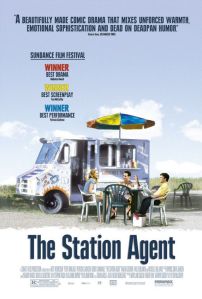 Originally released December 5, 2003:
This is the most charming film of 2003, and Im not just saying this because I had an interview with one of its stars, Michelle Williams (Dawson’s Creek). Fnin McBride (Peter Dinklage) is a man with dwarfism. With every step he takes every look he gives, you witness the years of torture hes been through with glares and comments. Hes shut himself away from people and travels to an isolated train station to live. There he meets two other oddballs, a live-wire hot dog vendor (Bobby Cannavale) and a divorced mother (Patricia Clarkson). Together the three find a wonderful companionship and deep friendship. The moments showing the evolution of the relationship between the three are the films highlights. Its a film driven by characters but well-rounded and remarkable characters. Dinklage gives perhaps one of the coolest performances as the unforgettable Fin. Cannavale is hilarious as the loudmouth best friend that wants a human connection. Clarkson is equally impressive as yet another fragile mother (a similar role in the equally good Pieces of April). The writing and acting of The Station Agent are superb. Its an unforgettable slice of Americana brought together by three oddballs and their real friendship. You;ll leave The Station Agent abuzz in good feelings. This is a film you tell your friends about afterwards. There’s likely no shot for a dwarf to be nominated for an Oscar in our prejudiced times but Dinklage is deserving. The Station Agent is everything you could want in an excellent independent movie. It tells a tale that would normally not get told. And this is one beauty of a tale.
Nate’s Grade: A
——————————————————
WRITER REFLECTIONS 20 YEARS LATER
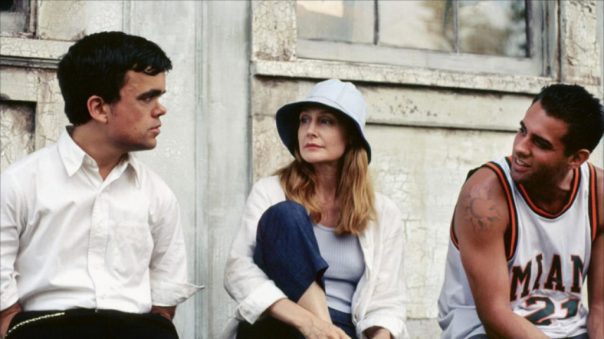
Tom McCarthy didn’t invent the quirky, found family indie but he sure seems to have nearly perfected it, starting with 2003’s The Station Agent. This little gem of a movie is so subdued, so relaxed, and so gentle that it seems to adopt the very personality of its lead character, Fin (Peter Dinklage), a dwarf who just likes trains a lot and wants to live his life in solitude. He’s an unassuming man who keeps to himself as a means of survival, because almost every time he goes into public life Fin is met with stares, snickers, and harassment (the convenience store lady gets his attention to take his unsolicited picture). Very few will get to know this man beyond his superficial physical characteristics, so he retreats within himself, perhaps purposely obsessing over an antiquated hobby as a means of escape to the past. He’s a lonely man and the movie is about him finding his clan, his place in the world, by slowly lowering his defenses. It’s a simple sort of story that is lifted by the strength of its characters and its wonderful ensemble cast.
With such a taciturn main character we need a contrasting character, a much more talkative person with high energy, and this is beautifully embodied by Bobby Cannavale. He plays Joe Oramas, a coffee truck operator who exemplifies joy de vie. He’s charming, garrulous, and relentlessly upbeat, which makes for a magnificent odd couple contrast with Fin, and it allows both characters to gradually change and grow attached to one another’s mutual friendship. Finn allows himself to become more vulnerable and form bonds and Joe starts to see the world from Fin’s point of view, allowing himself to slow down and appreciate the smaller things he might have missed in his excitable and irascible activity. Dinklage’s dry understated performance is a perfect counterpoint to the churning energy emanating from a grinning Cannavale. This is a fine showcase of both actors, who would go on to win six Emmys between them in the years ahead.
The third member of this found family is Olivia, played by Patricia Clarkson, and I actually think the movie might have worked better without her character. She does provide a point of view that our two guys lack; she’s experienced significant grief over a lost child and her life is in shambles as she tries to discover what she wants from her cratering marriage to a young-er John Slattery. Clarkson is also wryly enjoyable and gets some of the best lines in the movie, so she’s not at fault here. I think it’s because I’m confused about how this character is treated, especially compared to the natural opposites-attract dynamic of Fin and Joe’s friendship. Olivia feels like a broken thing that the boys need to try and help get better, but we were already covering this with Finn’s reserve from a lifetime of feeling ostracized. The possible romance between Fin and Olivia is also awkward because there are obvious implications that she sees Fin as a replacement son, even having him sleep in her son’s old bed. At one point, in her anger, she yells at Fin that she’s not his mother, but it feels much more like she’s the one who is looking for a surrogate son, and just because Fin is a dwarf and perhaps of similar heights makes the whole thing feel uncomfortable and ill-advsied. I’m not going to refuse an added Patricia Clarkson in my movie, but upon my re-watch twenty years later, it’s hard not to feel like McCarthy didn’t have as much envisioned for this part.
 McCarthy’s movie acclimates the viewer to the simple charms of its people and the small town, getting to know the various characters and their foibles and hopes, getting used to the rhythms of this life and adjusting much like Fin. There are small victories that are payoffs, like Fin finally getting a library card, or speaking in front of a school class about his affinity for trains. It works so well. McCarthy continued his found family writing with 2007’s The Visitor and 2011’s Win Win, both anchored by the emotional enormity of sad, lonely men learning to open up to companionship. There were some dips in the road but McCarthy worked his found family magic to the biggest stage with 2015’s Best Picture winner, Spotlight, which McCarthy directed and co-wrote. His only follow-up theatrical movie was 2021’s Stillwater, where an oil rig dad (Matt Damon) tries to save his daughter overseas from a very ripped-from-the-headlines scandal (Amanda Knox was very unhappy). There is also a 2020 Disney Plus movie about a kid detective and his imaginary polar bear best friend (that actually sounds adorable). I guess I figured a Best Picture Oscar on your resume, as well as a history of working within the studio system and world of indies, would have given McCarthy more work than directing a handful of episodes for 13 Reasons Why and creating Alaska Daily. I’ll always be looking for the next McCarthy project when I can.
McCarthy’s failures can be just as intriguing as his successes. The Cobbler is just such an astounding idea that it’s hard to imagine anyone thinking it would work out, with Adam Sandler as a magic shoe-maker. However, this same pessimistic mentality probably prevailed when McCarthy was trying to raise money for The Station Agent. His indie successes proved that he could take any jumble of strange characters and turn it into a functional movie. Maybe that hubris, well-earned along with his contributions to the Oscar-nominated Up script, finally caught up with 2014’s The Cobbler. I would pay good money to one day watch that un-aired footage of the original Thrones pilot, the one the producers themselves acknowledged to be deeply troubled. After retooling the show and cast, bringing in Michelle Fairley and Emilia Clarke, McCarthy departed, though is credited for helping to secure Dinklage’s involvement, and it’s impossible to think of the zeitgeist-defining excellence of the HBO series with anyone else playing the iconic role of Tyrion Lannister.
 Re-evaluating The Station Agent twenty years hence, its many charms are still abundant and I appreciated how gentle and relaxed everything felt. When indie movies deal with heavy amounts of quirk and oddities, it can often be heavy-handed and abrasive, never letting the audience forget for a second just how special and strange and different the movie must be (here comes 2024’s look at Napoleon Dynamite). McCarthy’s movie almost feels like a writing exercise where he plucked three very different characters out of a hat and challenged himself to build a grounded movie built upon their unexpected friendships. It’s a movie confident to just let the characters speak for themselves. It’s more a slice-of-life glimpse at people who feel far more real than most Sundance indies built upon oddballs and quirk. I would slightly lower the grade from an A to an A minus simply because of the Olivia character. Clarkson is great but her role feels undeveloped, somewhat redundant, and a little sloppy. Still, the enjoyable performances, the observational detail, and the simple pleasures of a story well told with characters you genuinely care about are what shines through even twenty years later.
Author’s note: In my original review, I cite having interviewed Michelle Williams (yes, surprise, she plays the small-town librarian). While I was my college newspaper’s film critic from January 2002 to May 2004, I did have the opportunity to interview several actors and directors through phone cattle calls with other collegiate journalists. These names include Angelina Jolie (Tomb Raider 2), Billy Bob Thornton (Bad Santa), Kevin Smith (Jersey Girl), and the late Paul Walker (Timeline). However, my school schedule was not accommodating for the Williams interview, so I had my dormitory neighbor and friend Tim Knopp call in and ask my question. It wasn’t me. I’m coming clean after twenty years, folks. I also recall having him quote a line her character says in The Station Agent, saying Fin had “a nice chin,” and being told that she was baffled and blanking on the reference. I’m sorry, eventual multi-Oscar nominee Michelle Williams, for trying to be clever.
Re-View Grade: A-
Share this:

Teenage Mutant Ninja Turtles: Mutant Mayhem (2023)
 As an elder millennial, the Teenage Mutant Ninja Turtles have been a formative franchise for me. I grew up on the cartoon, got the toys for Christmas, died endlessly during the shockingly hard underwater stage of their Nintendo video game, and generally have a soft spot in my 80s nostalgia for the likes of Leonardo, Donatello, Raphael, and Michelangelo, plus their surrogate father, Master Splinter. Apparently Seth Rogen felt the same way, and he and his writing partner Evan Goldberg have spearheaded a new animated variation of TMNT that just so happens to also be co-written and directed by the man behind my favorite film of 2021, The Mitchells vs. The Machines. It was a recipe to guarantee my personal enjoyment, and Mutant Mayhem thusly delivered. The biggest selling point for me was how lovingly realized the “teenage” part of the title was, getting a foursome of actual adolescents to portray our heroes, and using high school experience about acceptance and fitting in as effective and even poignant parallels. I loved just hanging out with these characters, who view their surrogate dad (voied by Jackie Chan) with a mixture of love and embarrassment, and who want to be accepted by a world predisposed to finding them monstrous. Naturally, becoming crime-fighting heroes is their best method for winning over the public, with a young and aspiring journalist April O’Neil (The Bear‘s Ayo Edebiri) hoping to improve her own social standing at school by breaking the existence of these unknown mutants. The comedy is robust and layered while allowing for nice character details and moments, giving each turtle their own satisfying arc. The action is fun and inventively staged while still being thematically relevant. The vocal cast is great, and the young actors are tremendous together, sparking an enviable improvisational energy that made me smile constantly. The art style has an intentional messiness to it, like smeared colored pencil drawings, and the imperfections are themselves part of the vast visual appeal. It’s a family movie that will succeed with old fans and new, and Mutant Mayhem is the best film depiction yet of the famous heroes in a half-shell.
Nate’s Grade: B+
Share this:

The Rundown (2003) [Review Re-View]
 Originally released September 26, 2003:
In the beginning of the new action comedy The Rundown, Beck (The Rock), a bounty hunter, is entering a club on a job. On his way in Arnold Schwarzenegger passes him by and says, ”Have fun.” Consider it a proverbial torch passing, because while Schwarzenegger is going to be busting the campaign trail, The Rundown establishes The Rock as the fresh and capable marquee name for all future action films. This man is a star.
Beck is offered a chance to square off all debts to mobster Billy Walker by agreeing to journey into the Brazilian jungle. His mission is to retrieve Travis (Seann William Scott), a hyperactive screw-up who happens to be Walker’s son. One Beck travels to the Amazon he runs into Hatcher (Christopher Walken) who claims to own the jungle and whatever contents dwell within. He asserts that Travis has stumbled upon a wealthy artifact in his jungle and therefore refuses Beck to leave with Travis. It’s at this point that the chase is on.
I don’t care what your little sister told you, Vin Diesel is not the next face of action, no, it’s The Rock. Despite only appearing in three movies (and he was only in The Mummy Returns for like three minutes), The Rock displays a razor-sharp sense of comedy. He’s also huge, likeable, and he can even emote well during smaller moments, not that The Rundown will stretch you as an actor. He’s also honed in excessive eyebrow arching.
Walken exists in a plane of brilliant weirdness that we simple human will never be able to co-exist upon. His Hatcher is one mean villain who exploits indigenous workers, wears his pants up to his armpits, and says he put the heart in the darkness. Walken’s hysterical tooth fairy monologue is worth the price of admission alone.
Director Peter Berg (Very Bad Things) adds a delectable cartoonish flavor to the film. His action sequences pop with exaggerated energy and zestful humor, like when Travis and Beck roll down a hill for a near minute. This is everything an action film should be: lively, funny, with keen action sequences that are low on CGI but filled with characters we care about. The Rundown is the best summer film not released during the summer.
The Rundown is an adrenalized punch of fabulous action and hilarious banter. When you’re not laughing and spilling your popcorn you’ll be sitting straight up to catch every lovely eyeful of spectacular action. It’s a terrifically entertaining and fun flick. The Rock has arrived.
Nate’s Grade: A
——————————————————
WRITER REFLECTIONS 20 YEARS LATER

Looking back, The Rundown really was a sea change for action cinema, and it also helps that I called it all the way back in 2003, because even a little 21-year-old me could recognize what seems almost blindingly obvious over two decades of hindsight: The Rock was a born star.
The Arnold Schwarzenegger cameo in the opening scene of the movie feels even more like a passing of the baton, as Arnie was stepping out to join the world of politics and Dwayne “The Rock” Johnson was only beginning to get started building a movie career. “Have fun,” Schwarzenegger says in passing. The wrestling phenom had built a powerful following and had begun making the leap into mainstream features with 2002’s one-two-punch of The Mummy Returns and his spinoff, The Scorpion King (did you know there are five Scorpion King movies and the 2012 edition co-starred fellow wrestler-turned-movie star Dave Bautista? Well now you do!). His appearance in the Mummy sequel was minimal, and marred by some of the worst CGI of the new century, but his solo Scorpion King adventure wasn’t quite the launching pad Johnson’s team had hoped. It wasn’t really until his fortuitous inclusion with the re-surging Fast and Furious franchise in 2010 that Johnson finally hit superstardom. However, the same magnetic appeal that would come to define Johnson as one of the biggest and more consistent movie stars in the world can be seen so evidently in 2003’s The Rundown, an action-comedy vehicle that plays to all the man’s many strengths. He’s got an immediate presence, a trained comedian’s command of timing and inflection, a gift for slapstick and lack of vanity about being goofy, and the man is just an agile and impressive physical specimen who throws himself into the rough and tumble stunt work. In short, Johnson knows how to look cool, knows how to look tough, knows how to look silly, and knows when to change gears. He’s a generational talent. My friend Ben Bailey says Johnson should play Superman because he really is Superman hiding among us pitiably frail mortals.
 The Rundown, formerly known as Helldorardo, is also an excellent launching pad for director Peter Berg, who until this time had only one other movie on his resume as a director, 1998’s relentlessly dark comedy, Very Bad Things (a film I remember “enjoying,” if that could even qualify as the correct word). This was Berg’s coming out party for the realm of bigger studio fare, and while it didn’t launch his career much like his leading man, it led to Berg’s breakout, helming 2004’s Friday Night Lights. From there, Berg has directed blockbusters (Hancock), blockbuster misfires (the unjustly maligned Battleship), and five reportedly different Mark Wahlberg action dramas from 2013-2020, though you’d be forgiven if you inadvertently confused a Spenser Confidential with a Mile 22. Berg’s docu-drama style became entrenched in 2004, though it didn’t always suit every movie equally. That’s why the movies that stand out from this default cinema verite visual style are even more remarkable for me, especially when Berg showed he can do over-the-top flashy fun violence just as good as any other big screen movie maker. His zest for the outlandish makes the movie feel like a living cartoon, but in the best way. The screen is coursing with energy but within a dedicated vision of spectacle, unlike say the mass chaos and indifference to coherency that dominates a Micheal Bay extravaganza.
Chiefly, The Rundown is just such an overwhelmingly fun experience. The actors have an infectious and combustible chemistry, bringing to mind the likes of Midnight Run and Romancing the Stone. The plot holds up well and allows for momentous action and a pleasing revolt against an exploitative villain played with panache by none other than a cranky Christopher Walken. Even while being irreverent and ridiculous, the movie still works as a story and a buddy movie, and the ending feels fulfilling and satisfying on its own terms. As I said in my 2003 review, this is everything an action movie should be. It’s exciting with engaging set pieces and outlandish stunt work but it never loses sight of its characters and their fractious screwball relationship. I love movies where the two lead characters are working against odds and constantly one-upping each other, flipping who has the upper hand. It makes for a far more unpredictable experience and ensures neither character is ever too confidently in control.
 This is an excellent movie to just put on and dash away your cares for two hours. I’ve watched The Rundown probably a dozen times, introduced friends and students to it, and everyone walks away a believer. It’s got style and banter and enjoyable characters and surprises and is just one of those movies that nobody really ever talks about but deserves to be on everyone’s DVD shelf.
Re-View Grade: A
Share this:

Gigli (2003) [Review Re-View]
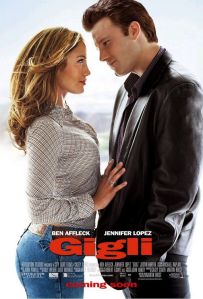 Originally released August 1, 2003:
It’s the feel-good movie of the year revolving around a lunkhead mobster (Ben Affleck) and his mentally challenged kipnapee and their attempts to covert a lesbian hitman (Jennifer Lopez) in between her yoga/horrific monologues concerning the superiority of female genitalia. Believe the hype people; Gigli is indeed as bad as they have told you. It’s not even entertainingly bad, like Bulletproof Monk, no folks; Gigli is just mundane and awful. During the entire two-hour stretch, which feels much much longer, I kept saying one thing aloud: “How could anyone making this think they were making a good movie?” Did they think audiences would find it funny that Affleck’s mother (the mother from My Big Fat Greek Wedding) shows us her big fat Greek behind? Did they really think that a mentally challenged kid (who has an affinity for gangster rap and wishes to travel to the mythical “Baywatch”) would come off as endearing? Well instead it comes across as insulting. And what else is insulting is the laugh-out-loud dialogue Lopez is forced to spit out concerning her attraction for women. I can’t think of any actress that could say the line, “I love my pussy” convincingly. And I’m sure a lot of actresses out there have true affection for it. The writing is just atrocious. And so much else fails as well. The score is a perplexing mix of upbeat jazz and inappropriate string orchestra. I don’t understand what emotions they were going for during scenes in Gigli but a full string orchestra playing music better suited for a real drama does not fit. Maybe it was for a tragedy. In that case, then it’s right on the money. You won’t see a more sloppily executed, horribly acted, painfully written, lazily directed, inept film this year. And what the hell did Christopher Walken walking in have anything to do with anything?
Nate’s Grade: F
——————————————————
WRITER REFLECTIONS 20 YEARS LATER

Gigli. It’s a word that instantly trigger shudders and shivers, a code name for fiasco, for career-destroying miscalculations. Writer/director Martin Brest was a Hollywood heavyweight with hit adult comedies like Going in Style, Beverly Hills Cop, Midnight Run, and Scent of a Woman, and since the cataclysmic disaster that was Gigli in 2003, this man hasn’t directed a single thing in these twenty years. The man is still reeling from the wafting stink from this very bad movie. I thought it might be worthwhile to revisit what I dubbed the worst film of 2003, though I was not the only critic to make this distinction, but now I’m questioning why I even bothered. It’s not like this movie was somehow going to get that much better with two decades of safe distance. The amazingly miscalculated artistic decisions will still be the same, still bad. I guess it must have been primarily my own morbid curiosity, much like revisiting 2001’s Freddy Got Figured, about whether this famous flop could still live up to its reputation. Well, dear reader, allow me to put any lingering doubts to rest you may have had about Gigli. It’s still very very very bad.
I might possibly recommend watching this once in your life (depending upon how many years you are lucky to earn) for the sheer fascination; Hollywood so easily makes mediocre and boring and familiar movies that feel like pale imitators of some prior hit, but Gigli is something different in the realm of studio stinkers, a project where just about every single creative decision warranted the incredulous Tim Robinson gif response: “You sure about that? You sure about that?” Gigli feels like two tonally dissonant movies in conflict at every moment. The plot elements feel lifted from some mid-to-late 90s indie crime comedy, the likes where they would just throw together a grab-bag of ironic provocative plot elements you wouldn’t expect together. “Mobster doofus kidnaps mentally challenged kid who is obsessed with gangster rap and wants to visit the ‘Baywatch’ which he thinks is real! Romance with a lesbian! Severed thumb ruses!” The collection of strange parts feels like it’s supposed to be a madcap, wacky comedy, and yet the tonal approach is complete treacle, with a shockingly syrupy score that rises and falls throughout, trying to convince you that what you’re watching is quixotically aiming for Oscars. It is astounding if you stop and pay attention to the film score at any moment, no matter how strange, as it attempts to provide jazzy saunter to “comedy” scenes, like an ex-girlfriend showing up into an unstable situation, and then it segues to Spielbergian emotional heft, like when that same ex-girlfriend attempts to take her own life to convince Jennifer Lopez to come back. There were so many moments where my only response possible was to avert my eyes, shake my head, and wonder whether anyone at any stage had any misgivings, tried to reach out to Brest, but then shrugged and dismissed their very legitimate worries as, “Well, he made Midnight Run after all. What do I know?” You know enough that these different tonal approaches will not work.
 Apparently, the movie was intended to be a straightforward mob comedy but the studio wanted the focus to shift toward a romance because of the actual romance between its stars, Lopez and Ben Affleck. Whenever actors begin a relationship after a movie or over the course of making one together, it provides another lens to review the movie, to gauge their chemistry and, if you’re so lucky and observant, able to “see” them falling in love with one another. That is nowhere to be found with Gigli. Maybe it was the shared experience of finding what they could to cling to while making this movie that nobody fully understood but committed to anyway (I guess love can be described the same way under some circumstances). Regardless, the romance between the two characters is, like all other plot elements, haphazard and spontaneous and foolhardy.
The characters are all awful and they never remotely come across like relatable or even remotely interesting people. Affleck’s Italian lunkhead Larry Gigli is just awash in early 2000s misogyny and bravado, dubbing himself the “sultan of slick, the rule of cool, the straight-first-foremost, pimp-mack, hustler, original gangster’s gangster.” Allow that macho boast to also exemplify another critical problem with the movie in that almost all the dialogue will make you cringe. There’s an entire monologue by Lopez, while she’s contorting her body in a plethora of lithe yoga positions, all about how superior the vagina is in appearance and function. What about when Lopez, as an indication that she wants to engage in heterosexual congress, utters the immortal phrase: “It’s turkey time. Gobble gobble.” Larry slams a kid’s computer on the ground and triumphantly says to suck an appendage of his, but then adds, “dot com” because the kid’s a nerd or something because he likes computers. Ho ho, the kidnapped young man insists that he be read to before going to bed, and what does Larry have at his disposal? Not books, oh no, so he’s forced to read him instructions on shampoo and toilet paper. Hilarious, right? What about when this same mentally challenged kid says, “When my penis sneezes, I say, ‘God bless you.’” The early 2000s weren’t an enlightened time with depiction of mental handicaps, and poor Justin Bartha (National Treasure, The Hangover) goes fully into the worst of these impulses, making the performance feel like a minstrel show for those with mental challenges. At least this aspect is not alone. Nothing ages well in this movie and its comedy only falls flatter and the drama is only more inexplicable twenty years later. It’s a special kind of bad so rarely achieved at this level of Hollywood.
Given that the majority of the movie consists of kidnapping a naïf, most of the movie is set in Gigli’s apartment keeping the man unseen and unheard from. This makes the movie feel for a long stretch like a glorified one-set play, with special appearances from traveling guest actors popping through for a brief moment in the spotlight. Here’s Christopher Walken dispensing with a monologue and then never being seen again. thanks for coming. Here’s Al Pacino, yelling so hard I’m surprised Lopez and Affleck didn’t need to wash the layers of spittle off. Here’s Lanie Kazan (My Big Fat Greek Wedding) who needs an insulin shot in her butt and let’s make sure we see her thong while we’re at it. These incursions of well-known actors re-explain the plot, not that it was hard to keep up with, and it all feels like stretching for time when the movie is already two hours long. The resolution, where our characters drive off into their sunny endings, lasts twenty minutes itself, which feels as long as the endings of 2003’s Return of the King. It’s a screenplay that feels like it’s holding itself on ice, content that the kooky characters butting heads and trading quips and monologues would be enough, and one that feels unsure of those same impulses, relying upon a revolving door of one-scene guests to remind us what we already know. It makes you feel simultaneously trapped with awful characters yet also in the hands of someone who doesn’t quite think you’re understanding the nuance and hilarity of the strained effort.
 I’m not an automatic Affleck hater. I enjoyed his rise from the films of Kevin Smith to Hollywood leading man. I can understand the draw of working with a filmmaker like Brest, and it’s probably that same appeal that lead him to also star in 2003’s Paycheck, directed by John Woo, who like Brest never worked in Hollywood again. This was the period where Affleck’s star was on the decline, and Bennifer was dominating tabloid space, and if it weren’t for the failures we might not have ever gotten Affleck as film director, so maybe we never would have gotten The Town or Argo or Gone Baby Gone had it not been for Gigli, so there’s a silver lining for you.
Look, you already know you shouldn’t even get near Gigli and with good cause. It’s a rarity to see something this colossally bad with this level of artistic freedom to be bad, not simply having too many cooks in the kitchen but having one very wayward chef nobody felt they could interfere with. This was a runaway chef, the kind of fiasco that only comes from unchecked artistic hubris. In that regard, there may be some rubbernecking appeal here for those who can endure bad characters, bad drama, bad comedy, bad acting, and horrible depictions of human beings who never at any point sound like human beings. It’s hard to watch and two hours of your precious time. 2003 began as a rough year for movies, sporting fascinating disasters like Bulletproof Monk and The League of Extraordinary Gentlemen. Watch those movies if you’re looking for a good-bad time. With Gigli, it’s only going to be a bad-bad time, whether it’s 2003, 2023, or any year until the sun explodes. Hey, if Ben Affleck and Jennifer Lopez could put this movie behind them and reunite, and even get officially married in 2022, then we can put it behind us as well.
Re-View Grade: F
Share this:

Barbie (2023)
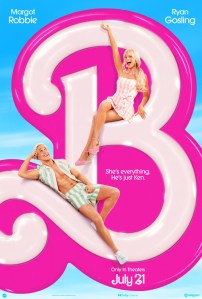
Who would have guessed a movie based upon a ubiquitous doll that dates back to the 1950s would become not just a cultural force and reclamation project but also the biggest moviegoing event of the year, as well as the highest-grossing movie in Warner Brothers’ history, even outpacing The Boy Who Lived? In 2023, it turns out we are all, every one, a Barbie girl living in a Barbie world. I came to this experience late, wondering if writer/director Greta Gerwig’s movie could live up to the lavish hype, the fawning praise, the hilarious offenses that many fragile males have levied against it. It couldn’t possibly be that good, could it? I saw it with three generations of women in my family, something I will privilege, and I must say, it is that good. Barbie is one of the best movies of the year and a shining example of what vision and passion can do to elevate any story. There’s so many ways this movie could have just been cheap corporate slop and instead it becomes an existential yet deeply personal treatise on life and death.
In the world of Barbies, women rule and the men are just afterthoughts. In this creation myth, the Kens were meant to compliment the Barbies. We watch “Stereotypical Barbie” (Margot Robbie) go through her daily routine of fun, frivolity, and nightly dance parties with all her best gal pals (no boys, er Kens, allowed). Then one day, this blonde Barbie started walking differently, started seeing the world differently, and started wondering about dying. Was there something wrong? Her human owner, in the real world, was in trouble, so Barbie sets off on an adventure to find her human owner and save the day, with help from her boyfriend, Ken (Ryan Gosling). Except for these two, the real world is very different from what they were expecting.

It’s easy to see how this movie could have been a mediocre fish-out-of-water comedy, with Barbie clashing in our modern-day world with its modern-day views of fashion, body image, and what skinny, buxom dolls represent to generations of young impressionable children. It’s clear to see what the scrapped version could have been when Amy Schumer was attached to star. What really impressed me with Barbie, beyond its delightful and inspired production values, is how ambitious and well-realized this movie is at every turn. It could have settled for easy jokes about Barbie and Ken not fitting in, not understanding human relationships and sex, and that stuff is there and it’s quite funny, but Gerwig and co-writer Noah Baumbach want to do so much more. This is a studio blockbuster, based upon a decades-long popular toy, that wants to do more with its platform. It aims higher, and in just about every measure, Barbie admirably succeeds. As a comedy, it had me howling with laughter, enough so that my response was providing another level of entertainment for my wife. There are jokes that are so specific, so beautifully targeted, that when they detonated, I was in awe and appreciation, (a reference to the literal definition of fascism and a Snyder Cut throwaway reference were perfectly attuned to my comedy sensibilities, thank you, Greta). As a frothy and fun fantasy, the movie has excellently crafted sets and costumes and retro visual aesthetics, making the movie a pink-accentuated sensory bombardment. But as a satire is where Barbie really becomes special.
Again, it would be easy for Barbie to learn lessons about body diversity and positivity and likely be browbeaten into what a good feminist is supposed to be, that the real world is a harder place for women than she previously thought. All of that is there, along with a consistent and entertaining critique of the faults of patriarchal society, but Barbie isn’t some reductive, man-hating screed to indoctrinate women into thinking they don’t need men (men are already very good at convincing women they don’t need men). This is a treatise on the power of inclusion and how this benefits society, both for men and for women. In Barbie Land, it’s a matriarchal society where girls rule and boys drool, but it’s a fantasy world reminiscent of a caste system, where the Kens will always be lesser afterthoughts because, well, they’re not Barbies, they’re just Kens. They are excluded in their own world. That’s why Gosling’s Ken is so excited by the real world, where the status quo is flipped, where the world is run by men, as he now sees this as an opportunity that has been denied to him. He wants to recreate his own version of the patriarchy not because he thinks women are inferior but because he just wants to be in power and respected, so he’s replicating his misguided understanding of what men in power are like, which naturally involves lots of horses. In the real world, Ken admonishes a suit-wearing corporate executive that they aren’t doing patriarchy right, to which the man winks and says, “We’re just better about hiding it.” The final act isn’t about “bringing down the patriarchy,” it’s about making a more inclusive world where people don’t have to feel marginalized and stuck and resentful.

Besides its social satire, there are other areas where Barbie goes deeper in surprising and affecting ways. There are more than a few applause-worthy moments explaining the perspective of women, particularly a monologue that is destined to be an audition piece for the rest of time, and it all works and is cutting without being too didactic. Gerwig even gets in a few jabs about corporate culture (“Are there any actual women in this boardroom?” “I’m a man with no power, does that make me a woman?”) and Mattel as an organization becomes another force of antagonism spearheaded by hapless buffoonish men (of course you get Will Ferrell to play the Mattel CEO). The biggest surprise is how emotional and deep the movie can become. There will be plenty that tear up just having a big Hollywood movie recognize their day-to-day emotional toil of being a woman in modern society. For me, the questions over what to do with the life we have flirted with some surprising existential contemplation, as Barbie is reminded at several points that death is a reality and yet would she want to move to the human world? An emotional highlight occurs when Stereotypical Barbie is speaking with the equivalent of her creator, and Billie Eilish’s tender-to-the-point-of-breaking song “What Was I Made For” lilts onto the soundtrack, and the sincerity of this sequence, topped with insert home video footage from the production cast and crew, really hit home how much more this movie is going for then bringing different dolls to life. It’s not just jokes about crotch-less creatures and weird feet, it’s about how we can live and why we do so, what inspires us. It’s a big studio summer release that flirts with the profundity and brevity of life.
There is one actor who deserves their own special recognition and that is Gosling (The Nice Guys), who so rarely gets to showcase his sharp comedy skills with the dour, serious, insular roles he gravitates to. Gosling is so committed to his role that he is operating on another plane of excellence, hitting sly jokes within jokes and selling every wonderfully stupid moment with Ken. This man isn’t afraid to look silly, he fully courts it, embraces it at every opportunity, and yet his performance doesn’t detract from Robbie but only makes them both shine brighter. He reminded me of Tommy Wiseau at points. His hilarious ballad “I’m Just Ken,” which segues into a wild West Side Story-style dance battle that is peak peacocking, is a phenomenal run of inspired silliness (the storming of the Malibu beach had me rolling), yet also connected to the character’s co-dependent arc and dissatisfaction with himself (when feeling down, just quote: “I’m just Ken, and I’m enough, and I’m great at doing stuff”). Ken has to learn to think of himself outside his combined definition with Barbie, and they both need to spend time discovering who they really are rather than who they think they’re supposed to be before considering forming attachments. I would not be surprised if Gosling earns a Best Supporting Actor nomination. It was the role he was born to play: insecure accessory doofus.
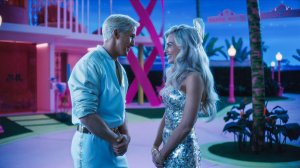
Gerwig has launched to mega-stardom with just three directing efforts (four if you count her co-directing effort in 2008 with Nights and Weekends, back in her early mumblecore breakout days). Already this woman has been nominated for Best Director, one of only seven ever, and she now owns the highest grossing movie of the year as well as in studio history. She’s proven herself with her 2017 coming-of-age semi-autobiographical Lady Bird, richly realized and achingly felt, with an established literary classic that is a foundation to generations, and had been adapted a dozen ways for the cinema, and yet she found ways to make her 2019 Little Women modern and personal, and now, on her biggest stage, being handled corporate IP that would be perfectly fine with just selling more toys, she has made a movie for the moment, something that compelled audiences back to theaters in droves, that will become a staple for a generation of film lovers. With just three movies, Gerwig has established herself in a league of her own as a director. Anyone who can turn the Barbie movie into a hilarious, poignant, and meaningful meditation on our times, on the relationships between mothers and daughters, and on life itself is a talent that deserves every creative latitude to achieve her vision. The voice and vision behind this, even to the smallest detail, is so impressive and fully committed and well developed and fabulous. Barbie is one of the best movies of the year and proof that studio blockbusters can indeed be more.
Nate’s Grade: A
Share this:

Asteroid City (2023)
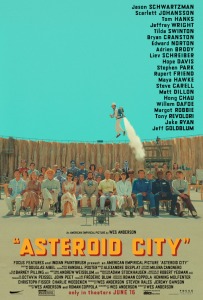 It’s not a good sign that a week after watching a movie I was racking my brain to try and remember what I had watched, and it’s even worse when it’s a movie by Wes Anderson, a filmmaker with such a distinct sense of intricate style it’s now become a go-to A.I. test for untalented people. Asteroid City has the makings of an appealing comic escapade set in a Southwest small town known for its tiny asteroid, and once aliens make their presence known, the entire town and its tourists and wanderers and scientists are quarantined. The problem comes almost immediately, as the movie is presented through several added layers of obfuscating framing devices. The story itself is a play, and we’re watching a movie version, but then also the play of the movie, and the behind the scenes of its now-deceased playwright toiling with his authorial messages and stubborn actors, and it feels like two different movies at odds with one another. The Asteroid City sequence is the more engaging, with some sweet storylines like Jason Schwartzman as a widower processing loss with his family, including his father-in-law (Tom Hanks) who never liked him, while beginning to find a possible romantic kinship with a struggling actress and single mom (Scarlett Johansson). I enjoyed weird little asides about the history of this little town, like a vending machine for land ownership, and s science fair with brainy whiz kids finding their own comradery. There’s even a nice moment in the meta-textual framing where the Schwartzman actor recites an exorcised dialogue scene with the actress who played his deceased wife in the play. It’s elegantly heartfelt. However, the added layers don’t really add extra insight or intrigue but serve as muddy trappings, making meaning less likely rather than more. It feels like Anderson didn’t have enough material with the central story so he added on the meta to make up the difference. There are too many moving pieces and too many characters, and versions of characters, here to settle into something grander. The whimsy and visual style of Anderson is still evident throughout every highly-crafted and pristine arrangement in the movie, so if you’re an Anderson diehard, he still has his charms. This is two Anderson movies in a row that felt disorganized, distracted, and chiefly under-developed, and I’m starting to worry that the form has taken over the function as storyteller.
Nate’s Grade: C+
Share this:

Obstacle Corpse (2022)

Hope Madden has been an esteemed critic, journalist, and writer for many Columbus media publications and television for years. She and her husband, George Wolf, run MaddWolf, a popular film blog, and head the Fright Club podcast and horror film programming at the Gateway Theater. They know movies inside and out and they know horror. So it makes sense for Obstacle Corpse to be Madden’s first feature as a writer and director. It’s a high-concept horror comedy filmed in the Columbus, Ohio area and now available to watch on Amazon. Madden and Wolf are both part of my Columbus film critics’ group, and so I will, as I always strive for with reviewing Ohio-made indies, attempt to be as objective as possible knowing many involved in the cast and crew. Obstacle Corpse is, above all things, enjoyably demented. It’s a low-budget horror movie that understands that an indie horror movie is going to succeed through concept, personality, and mood, and Madden pays attention to each of those winning dimensions.
Sunny (Sylvie Mix) just wants to impress her domineering and dismissive father. She signs up for the Guts and Glory competition, a twelve-event obstacle course, to prove herself. Each contestant is expected to bring a partner, so she brings her best friend Ezra (Alan Tyson) who is ready to get back home and out of the woods pronto. That’s even before they discover that the teams have gathered for some brutal competition. Each team is also required to kill their teammate over the course of the grueling events, so will Sunny and Ezra survive, and will they possibly turn on one another to save themself from the deadly games?

The premise is a quick hook, a deadly version of an obstacle course, and makes twisted sense, not just from a canny take-something-from-childhood-but-make-it-deadly calculus of recent gimmicky horror. There are plenty of adult-oriented obstacle courses known for their physical endurance, like the Tough Mudders and Spartan Race and Ninja Warrior, so an escalation into literal life-and-death stakes as an experiential attraction makes sense in a twisted fashion. Madden has also done what I wish several other indie filmmakers would and distinguished her large net of crazy characters. There’s a wonderful sense of personality to the different groups, which helps the audience keep track of the many different faces, but it also allows the characters to be more playful. I don’t care why some would dress up like clowns for this competition and others as baseball players, I’m just glad that these characters are happy to stand out. I enjoyed a middle-aged man eager to transform every moment into a phony social media tableau. I readily enjoyed the hyper-competitive nature of Stephanie (Gareth Tidball), an intense woman who gets off on the thrill of each challenge. I enjoyed one grumbling angry man (Wolf) who could be counted on to struggle in last place no matter the obstacle. I enjoyed a tracksuit-clad bickering couple. I liked a family of siblings that distinguished itself in paired T-shirts, with one pair wearing “single” and the other wearing “double.” I didn’t quite understand it since they were both pairs but I liked the effort all the same. Even little details can add much.
The mood of Obstacle Corpse is chiefly one of carefree fun, an amiable tone that brings a comedic lightness to even the most ghastly of circumstances. It’s prevalent throughout the movie and makes the 80 minutes easy to digest. Madden’s good times are best summarized by the scene-stealing performance of Mason (Donovan Riley Wolfington, Madden’s son), a costumed chef dishing out cold vengeance from his ice cream truck. This character is presented as a change agent, an unexpected wildcard who is disrupting the establishment overseeing the games. He’s a live-wire of energy, channeling Deadpool or a Looney Tunes cartoon at different points, and he will dismember contestants while gleefully singing his violent versions of Christmas carols. It’s a standout performance in a large cast of varied characters, and Wolfington is just operating on another level of insane amusement. The character also becomes one to easily root for because he’s an antihero underdog taking advantage of others underestimating him, and he’s also that change agent, bringing a bloody sense of justice to those involved in the continuance of the games. A late-in-the-game revelation about his history made me wish for more development to better utilize the key info, but Wolfington is the best mascot for the movie’s demented charms.

Given its large cast, there are several that made a favorable impression as they navigated the comedy aspects. Mix (Poser, Double Walker) is a definite find for Columbus cinema and will be going places in no time. She is a natural actor and serves as our baseline of normality, a shifting concept in a world of violent mayhem. Tyson (Stowaway) is a great foil as Sunny’s friend. He’s more effete and unimposing, at first glance, so his incredulous reactions are a welcomed source of comedy and reason. Tony White does a lot as a clown/mime who befriends our “normal” characters. He gives a very expressive and charming performance, and yet there are a couple of moments where his tortured emotions serve as a surprising well of feelings (he is labeled as Sad Clown, after all). Even producer Jason Tostevin (Hellarious) has a laconic menace as the head of the games security, and he delivers a monologue about achieving your peak greatness that sounds like a self-help guru comfortable into the exploitative routines. He’s our face of the establishment, so as things begin going haywire from our anarchic chef, his discomfort provides a consistent outlet for satisfying comeuppance. You can tell the cast is enjoying themselves, and that casual camaraderie helps to add to the overall silly and bloody fun of the movie.
I wish the parameters of this killer event had a bit more clarity and development to really maximize the possibility. First, I thought that these many obstacles were themselves going to be part of the killer challenge, something akin to Squid Games where familiar childhood playground games have been transformed into life-and-death contests. That’s not the case, so watching characters overcome a cargo net or a set of tires feels somewhat disappointing because what would the appeal of this physical track be beyond the murdering? I think part of the joke is that these are ordinary park obstacles that are causing so many so much struggle. The rules of this course can also be rather murky. We see the enforcement of what happens when a contestant kills outside of an official obstacle course event, but the rest of the rules are left too vague. Contestants are welcome to bring their own weapons, like bats and knives, so could someone simply bring a high-powered gun and mow down the entire competition? How does this work exactly? What prize do the winners receive at the end other than having killed their partner? Did Sunny’s father understand what exactly she was getting into and approved? I’m also left slightly bewildered how many of these teams are family members that are so eager to kill one another. I’m not opposed to the possible fratricide plot, but I think the movie needs to present more conflicts within the couples to present as possible explanation for this murderous intent (maybe an old score to settle like stealing a girlfriend, maybe it’s an inheritance battle, maybe it’s sussing out what the particulars are of the familiar tension, etc.). It’s shocking to watch an older brother pitch his younger brother into a fire and kids killing kids (off-screen), but the shock value only goes so far, and having more setup or context could have added more satisfaction. I guess many are just wannabe psychopaths looking for any excuse to indulge their darker impulses.

I think about the brilliant simplicity of 2019’s Ready or Not. The movie’s premise is essentially a killer game of hide and seek, already a rather uncomplicated children’s game. But the filmmakers carefully established the rules and stakes, with the family holding to he belief they need to kill the person hiding before sunrise or else they will all die thanks to a generational curse. It’s outlandish but the movie presented all the vital information and then let things rip. In the case of Obstacle Corpse, it’s around the fifty-minute mark before our main characters, the normies, discover the actual deadly stakes of the game, and their response seems a tad… relaxed. Part of this is, as earlier described, the amiable low-stakes charm of the movie, so nobody ever brings too much of a sense of actual reality to the absurd competition and its slapstick violence.
I also wish Obstacle Corpse had coalesced more of a class-conscious political commentary. We are introduced to a wealthy couple who are bankrolling the games under the auspices of live online betting, a concept also explored in many other movies that summarize the villains as bored rich people betting on the lives of the poor (Squid Games, Escape Room, The Hunger Games, etc.). That works, though the script only gives us one or two check-ins with our wealthy couple as they seem more interested in canoodling than keeping up with their own spectacle. Maybe that signifies how blase they are about human life but it felt like a missed opportunity. I kept envisioning a version of Obstacle Corpse that really trained its fire on the callousness of the rich, with the teams each being a boss or CEO and some lackey or intern that they’re stringing along, meaning each competitive couple already has a class distinction. The plot informs us that the veterans know they are inviting their guest to their intended doom, so why not project onto a corporate or wealthy head and their contempt for a lower-class worker they see as literally disposable? Perhaps these fragile wealthy men think they’re so much more capable or threatening than they really are, a concept given some attention through the hyper-macho character of Richard (Brian Spangler) who can’t live up to his overblown expectations. There’s an overinflated sense of toxic masculinity that relates to physical dominance that was worthy of even more deconstruction and criticism. I think this dynamic would have allowed the movie to hone and target its ire with more potent satirical firepower.
Even with some of my misgivings about clarity and untapped thematic potential, Obstacle Corpse is an enjoyable horror comedy for fans. The blood gushes constantly and the gore is impressively grotesque for its minimal budget. There are some impressive shots for a movie 95 percent filmed in the woods. Madden has crafted a movie that works regardless of budget, with its larger-than-life characters and conflicts resulting from a strong and memorable high-concept premise. The emphasis is more on comedy than horror, like the world’s most demented summer camp outing. Given the large cast of characters, the movie always has a new batch of people to jump through, which keeps the movie fresh even when the suspense can slacken because of the comedic emphasis. It’s not a one-joke movie, and the fun of the cast can often be felt, especially the grand ball of a time had by Wolfington. There are things left out I wish had been explored further, but this is a solid start for Madden and her team in the realm of indie genre filmmaking. If you enjoy your comedy with a heaping helping of blood and bad taste, give Obstacle Corpse a chance.
Nate’s Grade: B-
Share this:

Robots (2023)
 Robots takes the romantic comedy genre and adds a dash of science fiction satire. Charles (Jack Whitehall) is a sleazy womanizer who likes to use his robot double, named C2, to put in all the getting-to-know-you effort with dates so then Charles can jump in for any later physical intimacy. Elaine (Shailene Woodley) uses her robot double, named E2, to bilk dumb men out of money and gifts. Then one day Charles and Elaine meet cute at an ice skating rink and begin a relationship. She doesn’t know Charles is really C2, and he doesn’t know Elaine is really E2. This confusion is cleared up when E2 and C2 run away together and abandon their human selves. The real Elaine and Charles must work together as they cross the country to find and regain their robots before they cause trouble.
Where Robots goes wrong is with its clunky execution, as its promising premise succumbs to gassed rom-com cliches and some tonally confounding comedy, when it does remember to be a comedy. It’s a given that our two human characters, or at least the flesh-and-blood versions, will grow closer together over the course of their road trip to find their runaway mechanical selves. This unique situation pushes them out of their comfort zones and allows them to better open up. The possibility is there to even follow a strict rom-com formula and still be satisfying, if the romance felt organic and charming. It does not. If anything, the movie uses your knowledge that these two will likely fall in love against you, speeding through the process with haste. The movie’s idea of romance consists of a montage sequence where our two characters laugh, get drunk, and hang out in a hotel room. It’s like the screenplay zapped over the actual development of the romance, the moments where one character saw another differently, where the initial conflict began to thaw, so what we’re left with feels hollow and artificial. The actual robot versions have a stronger bond than their human counterparts (I’m sure this is part of the joke). I didn’t care about our romantic couple because the movie itself didn’t seem to care enough about them to develop their romance beyond the basic framework of convention.
 The comedy and commentary can also be very off-putting and incongruous. The premise deserves more scrutiny, either by the characters or the script itself. These two people are duping their prospective dates, one for money and the other for sex, and the movie just kind of shrugs about using robotic slaves for manipulative gain. I assume the filmmakers wanted to keep things light, but there’s at least more comedy to be had from the bad things these bad people made their innocent robots do for them, even a point of arguing who is the worst person. If they’re bad people, then dig into it. The movie also dispels with the contrasts between the couples too quickly. The screwball romance ramifications are ditched too early to send Charles and Elaine on their mission. When your premise has mistaken identity programmed front and center, you would think the comedy would take full advantage of this and escalate to farcical levels. Nope. There isn’t even anything approaching the cringe comedy co-director/co-writer Casper Christensen (Klown) is better known for. The humor is stuck on broad slapstick and easy jokes that confuse vulgarity with instant comedy. Robots includes a video of C2 and E2 committing a mass shooting. The plot purpose of this is for the robots to vilify their human identities and to force them to hide from the public out of fear of being caught, but why an implied mass shooting, especially in this day and age? Why not have them rob a bank? The purpose is to commit a crime and publicize themselves to make life harder for their humans. It’s too blunt a choice to work.
Likewise, the political commentary that pervades the opening is completely absent throughout the rest of the movie. We open with a buffoonish U.S. president celebrating the construction of a border wall with Mexico, never mind that it’s easy to slip through. Unexpectedly, the cry of “them Mexicans took our jobs” has now been replaced by “them robots took our jobs.” You would think there would be ample room here for satire on the economic struggles of Americans, the salivating exploitation of big business, or even the xenophobia that often coincides with economic distress. Any political commentary is done away with after this opening. If offices can just have robot doubles doing all the boring drudgery, then what does that do for human interaction? Surely businesses would prefer workers who technically lack human rights and never need to eat or sleep. The screenplay gives us one character to discuss any of these topics, an obnoxious best friend (Paul Jurewicz) to air out his hatred of robots. There’s also another character that serves as a plot convenience for how our two leads got their doubles. Other than that, the world seems oddly absent from any significant cultural shifts from robot inclusion. Part of this is the convenient plot point that “personal use” robots are outlawed, which again you would think would produce more conflict with our pair having to hide their ownership. Mostly though, it feels like the writers just didn’t think through how their world would be different in a meaningful way, which robs the movie of better satire, comedy, and simply ideas.
 What makes the movie mildly worth watching are the talents of its two leads. I wouldn’t exactly say Woodley and Whitehall have a spark-worthy chemistry, but both actors are professionals who have no qualms about getting silly in the name of comedy. Whitehall (Jungle Cruise) is amusingly droll, and while his deadpan can be hilarious, it can also sap the energy of certain scenes. Still, he’s an enjoyable performer who has fun playing a louse. Woodley (Divergent) isn’t exactly the actress you’d think of for broad comedy but she has great fun playing the different versions of her character and tweaking sexist male fantasies. Both of these actors are good with the material that they’re given, so it makes you even more wistful about what could have been with even better material for them to really shine.
Robots is a comedy that could use more comedy, a romance that could use better romance, and a social satire that seems to forget pretty suddenly what it’s satirizing. That’s quite a surprise considering one of the co-writers/co-directors has both Borat films on his resume. It feels like a poorly developed episode of Black Mirror; however, I know I’m in the minority on this one, I find the majority of Black Mirror episodes to have intriguing premises that go nowhere. So, by that assessment, it is a Black Mirror episode. The actors are enjoyable and some of the jokes land, but you’re mostly left wondering what could have been from this wasted premise. The whole enterprise just seems to run out of ideas and energy and inspiration halfway through, stranding good actors and a fun premise in a movie that needed more beta testing to be its best version.
Nate’s Grade: C
Share this:

The Flash (2023)/ Spider-Man: Across the Spider-Verse (2023)
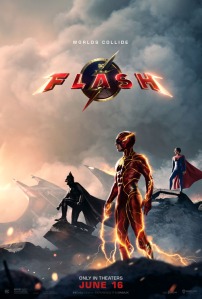
Released within two weeks of one another, two big summer movies take the concept of a multiverse, now becoming the norm in comic book cinema, and explore the imaginative possibilities and wish-fulfillment that it proposes, but only one of them does it well. Spider-Man: Across the Spider-Verse is the sequel to the Oscar-winning 2018 revolutionary animated film, and it’s a glorious and thrilling and visually sumptuous experience, whereas DC’s much-hyped and much-troubled movie The Flash feels like a deflated project running in place and coming apart. Let this be a lesson to any studio executive, that multiverses are harder than they look.
Barry Allen (Ezra Miller) has the ability to travel at fantastic speeds as his superhero alter ego, The Flash. He’s tired of being the Justice League’s errand boy and still fighting to prove his father is innocent of the crime of killing Barry’s mother. Then Barry discovers he can run fast enough to actually travel back in time, so he returns with the intention of trying to save his mother. Except now he’s an extra Flash and has to train his alternate self (also Miller) how to control his powers. In this different timeline, there is no Justice League to combat General Zod (Michael Shannon, so thoroughly bored) from destroying the planet for Kryptonians.

This is the first big screen solo outing for The Flash, and after none other than Tom Cruise, Stephen King, and James Gunn calling it one of the best superhero movies of all time, it’s hard to square how trifling and mediocre so much plays out as an example of a creative enterprise being pulled in too many directions. Miller was cast as the speedster almost ten years ago, and this tale has gone through so much tortured development, leaping through numerous filmmakers and writers, that its purpose has now gone from being a pillar of the expanding DC cinematic universe began with Zack Snyder’s Man of Steel in 2013 to becoming the Snyderverse’s death knell. The premise of traveling back in time is meant for Barry to learn important lessons about grief and responsibility and the limits of his powers, but it’s also intended as the reboot option for the future of these cross-connected comic franchises. It allows Gunn, now the co-head of the new way forward for DC movies and TV, to keep what they want (presumably Margot Robbie and Jason Momoa) and ditch the rest (Henry Cavill, Ben Affleck, Black Adam, Shazam, and Zack Snyder’s overall creative influence). So reviewing The Flash as only a movie is inadequate; it’s also a larger ploy by its corporate overlords to reset their comic book universe. In that regard, the quality level of the movie is secondary to its mission of wiping the creative slate clean.
Where the movie works best is with its personal stakes and the strange but appealing chemistry between the two Millers. It’s an easy starting point to understand why Barry does what he does, to save his mother. This provides a sturdy foundation to build a character arc, with Barry coming to terms with accepting his grief rather than trying to eradicate it. That stuff works, and the final talk he has to wrap up this storyline has an emotional pull that none of the other DCU movies have exhibited. Who wouldn’t want one last conversation with a departed loved one, one last opportunity to say how you feel or to even tell them goodbye? This search for closure is a relatable and an effective vehicle for Barry to learn, and it’s through his tutelage of the other Barry that he gets to see beyond himself. The movie is at its best not with all its assorted cameos and goofy action (more on both later) but when it’s a buddy comedy between the two Barrys. The older Barry becomes a mentor to himself and has to teach this inexperienced version how to hone and control his powers as well as their limits. It puts the hyper-charged character into a teaching position where he has to deal with a student just like him (or just him). It serves as a soft re-education for the audience alongside the other Barry without being a full origin story. The impetuous young Barry wanting to have everything, and the elation he feels about his powers, can be fun, but it’s even more fun with the older Barry having to corral his pupil. It also allows the character an interactive checkpoint for his own maturity and mental growth. Miller’s exuberant performances are quite entertaining and never fail to hit the comedy beats.
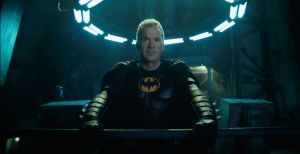
The problem is that the movie puts so much emphasis on too many things outside of its titular hero. Much was made of bringing back Keaton to reprise his Batman after 30 years. I just wish he came back for a better reason and had legitimate things to add. His role is that of the retired gunslinger being called back into action, and there’s an innate understanding with Barry wanting to go back in time and save his family, but too much of this character’s inclusion feels like a stab at stoking audience nostalgia (the callback lines all made me groan). I highly enjoyed Keaton as Batman and appreciated how weird he could make the billionaire-turned-vigilante, but he’s no more formed here than a hologram. The same thing happens with the inclusion of Super Girl a.k.a. Kara Zor-El (Sasha Callie). In this universe, there is no Superman, so she’s our requisite super-powered alien that Zod is hunting to complete his plans for terraforming Earth. She’s an intriguing character as a tortured refugee who has lingering doubts about whether humanity is worth the sacrifice, but much of her usage is meant only to make us think about Superman. She’s not given material to make her own impression, so she simply becomes the imitation of the familiar, the shadow to the archetype already being left behind. But these character additions aren’t even the worst of the nostalgia nods, as the final climactic sequence involves a collision of worlds that harkens to just about every iteration of the famous DC heroes, resurrecting several with dodgy CGI and uncomfortable implications (spoilers… the inclusion of George Reeves, when he felt so typecast as TV’s Superman that he supposedly killed himself because he thought his acting career was over, can be galling).
The action of The Flash is mostly fine but with one exceptional example that boggles my mind. In the opening sequence, no less, Barry is trying to help clean up a crumbling hospital when it collapses and literally sends a reign of babies falling through the air. I was beside myself when this happened, horrified and then stupefied that this absurd action sequence was actually happening. Barry goes into super speed to save the day, which more or less reverts the world into super slow-mo, though he needs to power up first, so we get a quick edit of him stuffing food into his face to load up on calories. We go from Barry breaking into a falling vending machine, stuffing himself in the face with snacks, getting the green light from his suit which I guess measures his caloric intake, and then grab a baby and literally put it in a microwave to shield it from danger. Just describing this event makes me feel insane. I figure the filmmakers were going for an over-the-top approach that also provides light-hearted goofiness to separate the movie from the oppressively dark grist of Snyder’s movies. However, this goes so far into the direction of absurdity that it destroys its credibility. It’s hard for me to fathom many watching this misguided and horrifying CGI baby-juggling sequence and say, “Yes, more please,” rather than scoff and shake their head. It’s not like the rest of the movie keeps to this tone either, which makes the sequence all the more baffling. There are Flash rules that are inconsistently applied to the action; Barry’s caloric intake is never a worry again, and the effects of moving a person during super speed don’t ever seem to be a problem except for one spewing gross-out gag.
While not being an unmitigated disaster, it’s hard for me to see the movie that got so many figures in the entertainment industry raving. The Flash has some notable emotional stakes, some amusing buddy comedy, and some goofy special effects sequences that run the gamut from amusing to confounding, but it’s also quite a mess of a movie, and too many of its nods to the fandom feel like empty gestures of nostalgia compensating for imagination. For all it gets right, or at least keeps interesting, it seems like another cog in a multi-billion-dollar machine, a stopping point also intended to be a reset and starting point. It feels like the character wasn’t trusted enough by the studio to lead his own solo movie even after years of buildup with Miller, nine seasons of the popular TV series, and 80-plus years of prominent placement in DC comics.
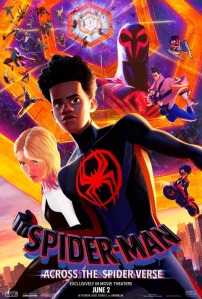
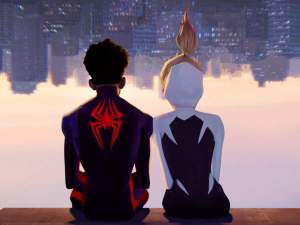
Conversely, Across the Spider-Verse is a sequel that expands an already stuffed story but knows what stories and themes to elevate so they don’t get lost amidst the fast-paced lunacy. Taking place a year later, Miles Morales (voiced by Shameik Moore) has grown into his role as the new Spider-Man for his world. He strains to meet the expectations of his parents, and keep up his grades, while fulfilling the duties of a superhero jumping into danger. When Gwen Stacey (voiced by Hailee Steinfeld) reappears to discuss joining the multiverse police, Miles jumps at the chance, having genuinely missed his other Spider friends, especially Gwen. There are countless Spider people in countless worlds, even including a Spider-T. Rex and a Spider-Car (Peter Parked Car, I believe the name was). Miguel O’Hara (voiced by Oscar Isaac) is the Spider-Man tasked with keeping order across the many interconnected multiverses, and he insists that sacrifice is essential to maintain balance, one that hits too close to home for Miles to abide.
The 2018 original is a hard act to follow, and while Across the Spider-Verse doesn’t quite overrule its predecessor it is a more than worthy sequel that has everything fans loved about the first trip. The visual inventiveness has been taken even higher, with the mixture of even more different animation and art styles. I loved seeing each Spider person and how they fit into their unique art style of their world, like the living water colors of Gwen’s world and the punky paper collage style of Spider-Punk (voiced by Daniel Kaluuya). There’s a villain that comes from a paper universe, so he resembles a three-dimensional paper construction with hand-scribbled notes appearing around him like Da Vinci’s commentary. There is something to dazzle your senses in every second of this movie. The visuals are colorful, creative, and groundbreaking with the level of detail and development. There’s probably even too much to fully take in with just one viewing. I want to see the movie again not just because it’s outstanding but so I can catch the split-second vernacular asterisk boxes that pop up throughout the movie. Going further into living comic book aesthetics, new characters will be introduced with boxes citing their comics issue reference point, and certain names and vocab will get their own citations as well. These are split-second additions, nothing meant to distract from the larger narrative. Simply put, this is one of the most gorgeous looking movies of all time, animated or live action. It’s bursting, thrumming, nearly vibrating with life and love stuffed into every nook and cranny, and it’s exhilarating to just experience a vivid, thriving world with animators operating at peak talent.

However, the movie has an engrossing story to better position all those eye-popping visuals. The worry with any modern multiverse story is that the unlimited possibilities of variations and opportunities for characters to do just about anything will overwhelm a narrative, or like The Flash, become a checklist of overburdened and empty fan service. The screenplay by Phil Lord, Christopher Miller, and Dave Callaham is all about relationships. If Miles’ relationship with his stern police lieutenant father (voiced by Brian Tyree Henry) wasn’t such an important focal point, then the emotional stakes of the movie would be meaningless. We see a relatable struggle from both sides, the parents trying to connect with their growing child and give him enough space to find himself, and the child who clearly loves his parents but doesn’t fully appreciate or understand their concerns. They worry about Miles leaving them and whether others will love and support him like his parents. Miles has to experience a wider world of possibility, but these experiences make him appreciate what he has at home, and what could be permanently lost. I don’t mind saying there were more than a few moments that caused me to tear up. I found Gwen’s storyline equally compelling, and her turmoil over keeping her secret identity and then coming out to her father was rather moving. The family bond resurfacing will get me every time, and the simple action of a hug can be as heartwarming and fulfilling as any romantic ode. Across the Spider-Verse makes sure we care about the characters and their personal journeys.
At a towering 140 minutes, this is the longest (American) animated movie ever, and it’s still only one half of a larger story. I knew ahead of time this was only the first part so as soon as we entered Act Three I kept gearing up for the cliffhanger ending. Every five or so minutes I thought, “Okay, this is going to be the end,” and then it kept going, and I was relieved. Not just because I got to spend more time in this unique universe but each new moment added even more to raise the stakes, twist the intrigue, and make me excited for what could happen next. I was shaking in my seat at different points, from the excitement of different sequences to the emotional catharsis of other moments. I cannot wait to experience this same feeling when the story picks back up reportedly in March 2024, though I fear it will get delayed to late 2024.
Even with the unlimited possibility of jokes and silly mayhem, the filmmakers keenly understand that it doesn’t matter unless we care about the characters and their fates. I am shocked that a goofy character I thought was going to be a one-scene joke, The Spot (voiced by Jason Schwartzman), could end up becoming the ultimate destroyer of worlds. I think this reflection nicely summarizes the impeccable artistry of Across the Spider-Verse, where even the moments or characters misjudged as fleeting or inconsequential can be of great power. It’s a movie that is full of surprises and thrills and laughs, all in equal measure, and a blessed experience for a movie fan. In the crush of comic book multiverse madness, Across the Spider-Verse is a refreshing and rejuvenating creative enterprise, one that builds off the formidable talent of its predecessor and carries it even further into artistic excellence that reminds us how transporting movies can be. If you see one superhero multiverse movie this summer, the choice should be as obvious as an inter-dimensional spider bite.
Nate’s Grades:
The Flash: C
Across the Spider-Verse: A
Share this:

Elemental (2023)
 The joke is how Pixar has taken its storytelling motif of examining The Secret Life Of [Blank] and showing what happens in our world when we just aren’t paying attention. We’ve had toys with emotions, bugs with emotions, fish with emotion, cars with emotion, robots with emotion, rats with emotion, and even emotions with emotions, so why not break things down to their basics and give the elements of carbon-based life their own emotions too?
In Element City, Ember (voiced by Leah Lewis) belongs to the fire community living on the outskirts of town, as the big city wasn’t built for their kind. The earth people, and water people, and air people go about their business while the fire people form their own thriving offshoot. Her father and mother came across the sea to give their baby a new life, and the family shop will pass over to Ember’s management when her traditionalist father thinks she’s ready. Her whole life has been about serving her family and trying to live up to their hopes and dreams. This gets more complicated when Wade (voiced by Mamoudou Athie), a water person and a health inspector, has to report her family’s shop for code violations. They work together to save the shop and also learn from one another’s cultures and differing perspectives, and then this unexpected friendship becomes an even more unexpected romance, but can elements so different stay together?
 I was pleasantly surprised at how enjoyable Elemental is to experience and how wondrous its visual presentation is to watch. It is a certifiable treat for the eyes, with so many dazzling colors and quirky but easily readable character designs. There’s a mixture of hand-drawn animation used as Spider-Verse-style accents that provides a pleasing element that allows the images to pop even more. I was never bored looking at a single second of this movie, and even with my theater’s 3-D presentation, the glasses didn’t darken the screen and lessen my overall enjoyment. By existing within a fantasy universe, it allows for every scene and every location to better inform you about this new world and its rules and highlights (fire baby carriages that are barbecue grills). This is a bright, colorful, and supremely enchanting movie to watch because, at least visually, it feels very well developed as far as its world building and atmosphere. What would a community of fire people tend to look like? What would their jobs be? What would their celebrations be like? Their heritage from the Old Country? Naturally, with any fantasy universe, you can nit-pick it to death with questions, such as why do people even bother wearing clothes in this world? What part of the exposed fire or water is observed as obscene? How exactly do these different communities have their offspring? What does air exactly eat for food?
Where Elemental really takes off is with its charming and affecting romance. It’s been a while since romance was at the forefront for a Pixar movie, since 2008’s WALL-E (a.k.a. the greatest Pixar movie). Now there are themes and resonance that go beyond the romance and also enrich it, like Ember’s personal conflict of being a first-generation immigrant daughter and upholding the traditions and wishes of her family at the expense of her personal desires, but the core of this movie is on the burgeoning feelings between Ember and Wade. The movie begins with them butting heads as two elements seemingly in conflict but it doesn’t exactly follow an enemies-to-lovers path. She runs hot and explosive with trying to keep things under control whereas he is deeply empathetic of others and wants to help them become their best selves. He accepts who he is, and the movie doesn’t equate his full-bodied embrace of big feelings as some point of weakness. It brings about laughs from exaggeration, the streaming rivers that burst forth from his eyes upon crying, but it’s his compassion and acceptance that challenges Ember for the better and helps her assert her sense of self. They’re good together, and Wade helps serve as a guide to the wider world for Ember as she’s been isolated her whole life. Their interactions are cute and heartwarming and elevated by pleasant vocal performances. I was drawn into their story and cared about their well-being, enough that I don’t mind sharing that I shed some water myself by the end (I guess this could also make some people mistake that I peed my pants, and I assure you that was not the case, dear reader).
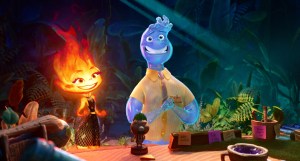 While the core relationships are poignant and winning, the world building and metaphorical allegories feel half-finished and a tad confusing. The movie also goes surprisingly soft exploring its miscegenation metaphor of two elements being forbidden to mix romantically. This universe has four communities of living elements, though air is represented as clouds and those are, literally, water vapor, and the xenophobia and discrimination that the fire people endure feels like a direct parallel to a disadvantaged minority group. However, this isn’t explored in any satisfying depth. We’re told that fire people aren’t really wanted in the city, and the city isn’t really built for them, which is typified by a rail line that splashes water discharge. There’s a lot more that could have gone into this including a more elaborate examination of the harm of red-lining and restricting the economic mobility of one group for bigoted reasons (I know, I can already hear people scolding me for even asking for such socio-political commentary in a family film). However, this metaphor gets a little murky when you take into account the literal danger that living fire exudes. Yes, you can drown, and you can get crushed under earth, but these creatures aren’t walking incendiary devices. This doesn’t translate directly to people, and thus applying class metaphors to actual races can be circumspect. Ember’s worry is that she’ll explode if she gets too angry, and this causes literal physical destruction around her. You can say it’s meant to represent when hurt, angry people lash out that they can inadvertently harm others, but not everyone can incinerate a block because they lose their temper. This kind of undercuts the lesson on misplaced fear.
Also, so much of the external story consists of bad public planning and everyone’s lackadaisical attitude toward fixing this infrastructure miscue. Again, if the larger point was a society that is actively hostile to the fire people, then the ignorant city planning that actively harms a disenfranchised group of people makes sense, but without that larger underlying conflict, it all seems so strangely forgotten. Much of this conflict is on the structure of a wall against a coming buildup of water, something possibly deadly to the fire community, so you would think this community would be a lot more concerned about this looming conflict. You might think that others would organize to provide better safeguards or maybe they would get the city’s attention. That this threat goes unreported and is played at such low stakes makes it all feel forced and manufactured. If the characters don’t seem to think it’s a big deal, then who are we to worry as well? And I can hear some of you trying to branch this out into, say, a metaphor for larger problems that go ignored, like climate change or societal inequalities, but that’s giving Elemental too much credit.
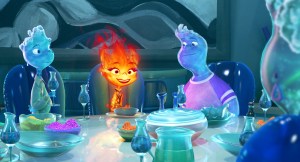 Elemental reminds me of 2020’s Onward, coincidentally one of the last movies I saw in theaters before the pandemic shutdown. I was worried that the core story looked weak but it was actually the world-building that was a bit hazy and under-developed and the emotional core was strong and authentic. It’s the same with Elemental, and while I can quibble about its dropped potential and misshapen world, it has a strong foundation that matters more. The relationships between Wade and Ember and Ember and her family are what makes the movie work and ultimately what made me smile and tear up. It’s an emotional nourishment that makes the movie feel satisfying and worthwhile no matter the lingering questions for this bizarre world. It’s also one of Pixar’s best looking movies, fully deserving of being seen on a large screen for added impact. Elemental has the right DNA for a charming and enjoyable family film for everyone.
Nate’s Grade: B


 nathanzoebl

You must be logged in to post a comment.