Blog Archives
Running with Scissors (2006)
 Ever since author James Frey imploded into a million little pieces, the memoir has come under intense scrutiny. At issue is the validity of the written word, whether these people are being honest as they recount their tortured yet inevitably redemptive lives. What is the difference between nonfiction and memoir, and does it implicitly imply personal bias? Running with Scissors is the 2002 best-selling book detailing the bizarre childhood of Augusten Burroughs. It’s a book with lots of out-there claims but they’re all held in check by Burroughs’ tart observation and witty writing. When translated to the silver screen, Running with Scissors loses credibility without the author’s voice. I doubt many people going in cold will even believe what they’re seeing.
In the 1970s, Augusten (Joseph Cross) is a gay teen growing up in the care of his alcoholic father (Alec Baldwin) and his deeply delusional, bipolar, wannabe poet mother (Annette Benning). When their marriage hits one of its many slags they seek out a therapist, Dr. Finch (Bryan Cox). He has a room he dubs his “masturbatorium,” a resemblance to Santa Claus, and a family just as whacked as he is. His oldest daughter, Hope (Gwyneth Paltrow), helps him in his practice and thinks that pets talk to her, even from beyond the grave. Natalie (Evan Rachel Wood) is the rebellious daughter who likes to play doctor via electric shock therapy. Agnes Finch (Jill Clayburgh) is the matriarch of this cracked family that also enjoys eating some dog kibble here and there. When Augusten’s mother signs over adoption papers he becomes the reluctant newest member of this dysfunctional family.
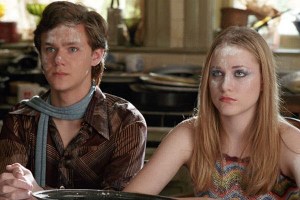 The trouble with translating a book is that you lose the author’s voice and commentary. Running with Scissors maintains the horrifying living conditions for Augusten and the stable of oddballs, but lost is the author’s snappy humor that carried him through this tumultuous time. It’s definitely weird but it’s far from engaging. Without the wit and dark humor from Augusten’s voice we’re left with a series of loosely bandaged scenes about crazy characters and crazy anecdotes, little of which contains further importance. This is a fan of the book talking here, and I’m afraid that the film adaptation has heightened some of the weaknesses of the book, namely the loose storyline. When pieced together as a film, Running with Scissors can become slightly tiresome and overly reliant on background details. The film treats its wild, kitschy production design and 70s nostalgia as a character on par with anyone. It makes for great production design, true to the spirit of the book, but also serves as a narrative distraction. Too much attention seems to be put on getting things to look right than getting the screenplay to feel right.
Without the author’s voice the results lose credibility. It’s funny to see a Christmas tree up year round, and it’s funny when Dr. Finch is convinced God is communicating to him through his bowel movements, but it all just comes off as another joke like the art direction and nothing more. When fully added together without any sense of pathos, it all seems like a joke. The subplot involving Augusten’s sexual relationship with a much older schizophrenic patient (Joseph Fiennes) seems mishandled without much insight. Running with Scissors presents all examples of dangerous, sometimes illegal, behavior and doesn’t bat an eye, nor does it pass judgment. While this may irk some and seem irresponsible it’s just another case of little mattering. Running with Scissors, as an adaptation, presents little of consequence.
Director Ryan Murphy also adapted the screenplay and knows a thing or two about dysfunction and trashiness, having created the risky TV show Nip/Tuck. His adaptation has a blunted feel, but it also seems too broad. Then again, maybe only fans of the book would notice. He has a good feel for his actors and can stage some nice shot selections, but man, someone needs to slap his hand away from the AM radio. Running with Scissors is crammed with so many popular 70s tunes that it becomes a crutch, with Murphy hitting the soundtrack button whenever he needs some kind of character catharsis. It doesn’t work and comes across as indulgent and simplistic. There are so many zippy classic pop songs you may think Elton John is owed a writing credit.
 The acting is one of the elements that help give life to this adaptation. Benning has been generating Oscar buzz for her deeply self-involved portrayal of a mom held hostage by her illness. Benning digs deep and displays a comic range of absurd behavior and wild paranoia. She’s all over the place and you can’t help but loathe her, that is, if you ever take her seriously. But then, once overly medicated, she gives an entirely secondary performance as an emotionless zombie, and we feel a sliver of sympathy, a true surprise. It’s a good, meaty role, however, I actually think Clayburgh gives the more Oscar-worthy performance. In a lot of ways she’s resigned to her fate and yet manages to be the gauzy heart of the picture. She tells me more with her wrinkles than Benning does in her gesticulating outbursts.
The rest of the cast work admirably. Cross is our focal point of the story and does a fine job of, essentially, gawking and looking perplexed. He’s like a blank, gangly canvas, and I wonder what else Cross is capable of than a performance built around indignant reactions. Wood is developing into a lovely adult actress and has some of the best foul-mouthed lines. It’s just nice to see Paltrow in a movie again. Baldwin has transformed from leading man into incredibly versatile supporting actor that excels as comedic lunkheads. Cox remains one of my favorite character actors of all time. There’s nothing this man cannot do. The actors all do a good job of filling out their zany characters while leaving their own imprint.
The issue with Running with Scissors is that when you strip away the author’s caustic voice, then the movie strains credibility, even with the knowledge that it?s based on a personal memoir. The movie gets all the wackiness but misses out on some of the finer points and humor that helped save Augusten from his unorthodox housing. The story feels dulled and stretched too broad, and yet it still manages to be intermittently entertaining despite these flaws. The actors range from good to great and the art direction is fantastic, even if Murphy expects it to do more work than his screenplay. Running with Scissors isn’t as nervy, engaging, or provocative as its source material. Then again little else is. Consider the film Running with Safety Scissors.
Nate’s Grade: B-
Share this:

The Last Kiss (2006)
 Zach Braff has exploded in such a short amount of time. He was underappreciated on the perennially underappreciated Scrubs, but then his breakthrough came in 2004 with Garden State, an aloof, charming love story about personal awakening. After just one movie Braff is now a name-above-the-title headliner. For his second film, The Last Kiss, Braff stars as another young man going through another personal crisis. He even selected the radio-friendly songs for the soundtrack just like he did with Garden State. This new movie is actually a remake of a 2001 Italian film, adapted by Oscar-winning screenwriter Paul Haggis (Crash). But there’s one big difference between Garden State and The Last Kiss? Garden State is actually good.
Michael (Braff) works as an architect in Wisconsin. He’s having a bit of a crisis with the state of his life close to his impending thirtieth birthday. His girlfriend, Jenna (Jacinda Barrett), is pregnant with his child and the two are planning for their future, but all around them relationships are falling apart. Chris (Casey Affleck) feels crushed by the demands of his newborn child and wife. Kenny (Eric Christian Olsen) is looking for guilt-free sex. Izzy (Michael Weston) is a wreck after having his heart broken by his ex. Jenna’s parents (Blythe Danner and Tom Wilkinson) may be splitting after 30 years of marriage, not all of them blissful.
With all this in mind, Michael worries that his life seems too scripted now and deficit in surprises. Then along comes Kim (The O.C.‘s Rachel Bilson), a young flirty college student that shows a strong interest in Michael. He must decide where his life is heading and whose hand he’ll be holding.
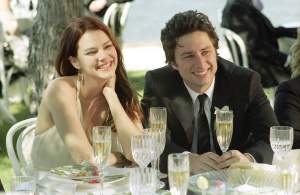 One of the reasons The Last Kiss is hard to get into is that the film never really elaborates why this foursome of guys have it so bad. Chris complains about a dead marriage but maybe his wife would nag him less if he spent more time trying to chip in around the house instead of avoiding his fatherly duties. Kenny is all gung-ho about a hot girl who’s interested in relationship-free sex, but then he runs the other way when, heaven forbid, the girl mentions the idea of commitment. Next thing you know, Kenny is not only running away from this girl but he’s joining Izzy on his cross-country road trip. He’s leaving the state because of the potential whiff of commitment. My friend, after we saw the movie, thought it was too stereotypical (woman: says one thing, wants other, man: scared of anything lasting). She suggested that Kenny slowly turns around his stance and wants to commit to this girl, who he obviously feels to be special. But that would mean The Last Kiss actually cares about the characters of Kenny and Izzy. These two serve more as a spare tire in a male relationship, and both their storylines are tied up with great time to spare.
Worst of all is Michael’s plight. He’s told by his buddies that he’s snagged the “perfect girl,” and from what we see she really is a lovely catch. Michael is freaking out because his life seems too tidy and empty of “surprises” now that a baby on the way. Boo hoo. So to jazz up his surprise-free life he has a fling with a college girl. Surprise! Isn’t your life better now, Michael? If it weren’t for the affable charm of Braff, who emits certain Dustin Hoffman Graduate vibes, the audience would feel no varying degree of sympathy for the dolt. Michael really bruises two innocent people just to needlessly reaffirm what he already knew. It’s hard to get behind all this. We don’t have to like characters, or their actions, but it hurts the drama when you’re simply watching one character hurt others for foolhardy reasons only evident to that character. In Unfaithful, we never really knew why Diane Lane had an affair but at least we saw complexity and strong repercussions.
There’s an element of maturity here and there with the screenplay, but twice as many moments of juvenile fantasies/fears (Look out, women will trap you and control you and expect equal work in return!). The movie has some adult material that works and hits its target but it also falls apart with idiotic musings. The best moments seem to come from the examination of the fading marriage between Jenna’s folks. It’s an interesting slice of life not commonly seen in youth-obsessed Hollywood, and Danner’s outbursts about what it takes to hold a 30-year union together ring true. But this moment falls victim, like many, to a tidy, simpleminded answer. Almost every storyline in The Last Kiss ends with a bow on it all wrapped up. Michael’s told not to give up and he essentially sleeps on his porch, wearing down the anger of his girlfriend through dogged persistence. In fact, the ending reminds me a bit of Secretary, another romance that ended with one lover proving their devotion by staying in one place a really long time. It’s almost insulting that the film presents Michael behaving badly and then excuses him as long as he just sticks it out. It’s not the idea that’s insulting; it’s the fact that The Last Kiss uses this ending as a cheap and easy out.
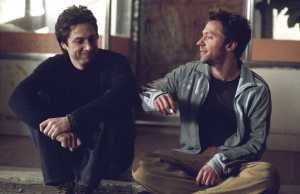 One of the benefits of movies directed by actors is that they tend to generate good performances. Director Tony Goldwyn (A Walk on the Moon) has assembled a nice cast that gives more than the material they get. The real find is Barrett, who may just be the greatest alum of a reality TV show (she was on the London edition of MTV’s The Real World). She showed promise in 2003’s The Human Stain and The Last Kiss is really her declarative ascent. She might start getting a lot of offers that would have normally gone to a Meg Ryan or a Julia Roberts. She shows a range of emotions and her breakdowns are hard to watch because of how well she sells her distress. She handles has a natural ease about her, which pairs nicely with Braff’s laid back, unorthodox charisma. Bilson is cute and crimples her doll face in a way that makes her character seem more naïve than seductress. Braff plays his role a bit subdued. He flashes enough life to not seem like he’s sleepwalking though the same steps he plowed in Garden State. Still, it’s not a very remarkable performance for someone people keep tabbing as a potential voice of a generation (a term nobody could feasibly live up to).
The Last Kiss is an unconvincing, simpleminded, disingenuous drama populated by whiny dolts afraid of the good things they have. It’s hard to sympathize with any of these flawed characters when we never really feel like their gripes hold water. Michael can’t believe his life seems planned out with a wonderful woman who’s having his baby. Solution: screw it up for variety. While it may be the spice of life, it’s also a heedless decision for someone who needs to wreck everything in order to realize what he has/had. This would all be easier to swallow if The Last Kiss didn’t tie everything up with a happy ending that lacked the groundwork. In the end, according to the film, all bad behavior can be wiped clean if you just wear down your significant other. The drama feels forced and the conclusions feel inappropriate. All human beings make mistakes and so do filmmakers.
Nate’s Grade: C
Share this:

Snakes on a Plane (2006)
 Snakes on a Plane. It’s a title, it’s a catch phrase, it’s a way of life. For a tiny horror movie with a blunt title, this flick has caught the imagination of Internet geeks everywhere, myself included. I couldn’t believe the movie was real at first, but then I slowly got onto its weird wavelength and brought my friends along too. For the past year buzz and hype’s been building, fans have made their own songs, T-shirts, trailers, and potential sequel titles (the equation is [animal] + [location]). Due to such unexpected rabid fan support New Line Cinema spent 5 days shooting additional scenes of gore and nudity to bump Snakes from a PG-13 to an R-rating. It’s hard to squeeze in a lot of nudity into a movie predominantly set on a plane not owned by Hugh Heffner. But has Snakes on a Plane run the danger of peaking before the movie ever opened?
FBI Agent Flynn (Samuel L. Jackson) is transporting a witness to a murder. The big bad Hawaiian gangster doesn’t want the witness to testify against him. His solution is elegant in its ludicrousness: the gangster has stashed a hidden supply of various poison snakes in the plane’s cargo hold. A timed release sets the snakes free to slither around the flight and bite as many passengers as possible. Flynn reports to his base, “You know all those scenarios we counted for, well I’m smack dab in one we didn?t count on.” You see, no one suspects snakes on a plane.
 The big question is whether Snakes on a Plane is just another bad B-movie that will line a video store shelf or a truly So Bad It’s Good Movie. In the accompanying months, this movie has caught on like wildfire by hipsters looking for grand, ridiculously stupid entertainment with a wink. Snakes on a Plane is indeed ridiculously stupid but it does so without the wink. The movie never steers for camp, which is sad. This is more like the silly trifles that routinely air on the Sci-Fi Channel (in anticipation, the network aired a whole night of cheesy direct-to-video reptile thrillers). There’s nothing wrong with those dumb escapist flicks, but then again there?s nothing essentially special or memorable about them.
The real funny thing is that if you haven?t seen Snakes on a Plane already, you’ve probably missed the best reason to go see it. This is the type of So Bad It’s Good movie that needs to be seen in a theater with a rowdy crowd, ready to hoot and holler at the mass stupidity on display on the big screen. This is an experience that demands to be shared with like-minded individuals in shared derision. I doubt it will translate as well on DVD. Something will be lost if you ever watch this movie by yourself (even more will be lost if you’re sober).
Without the rowdy viewing atmosphere, the movie itself sort of sucks. The acting is all over the place, the CGI is at times painfully fake like they had a rushed deadline, and the action gets a tad repetitious. You can only watch snakes bite people for so long before it all gets old. People get bit in the face, eye, tongue, neck, ass, breast, and, in one very unfortunate circumstance, the male member itself. Some of the gore effects are grossly fun. The opening pre-snake 20-minutes of the film feels like a lame episode of Hawaii 5-O complete with lame villain. I don’t know how in the world the bad guys found this witness so quickly when they didn’t see his face, license plate, or any identifying characteristics. Every time the movie cuts away from the plane to a handful of subplots on the mainland it loses its flow, and it takes a long while to get things back.
The sheer nakedness of the film’s conception is amazing. We’re all aware that movie studios can create their product in the most artistically void way possible. Snakes on a Plane was cobbled together by an exec?s idea of combining aviophobia (fear of flying) with another common public fear, ophidiophobia (fear of snakes). The absurdity of the entire premise is on full display while watching the movie. If you allow the images to sink in, especially panicked passengers swatting at the reptiles, you will be seized by uncontrollable laughter. Who really would ever have thought of snakes being on a plane? I love that the evil gangster confesses that “he exhausted every other option.” I would have loved to be in that meeting room just to see all the plans that didn’t cut it compared to “poisonous snakes drop into cabin.” If this movie ever catches fire it could spawn a whole new wave of horror films that are mash-ups of common fears. So keep your eyes peeled next summer for Snakes on a Public Speaking Venture (“Oh no, there are snakes everywhere, and I have to speak in public about it!”).
 Snakes on a Plane, unbelievably, tries to play it too straight and serious. There are so many improbabilities and inaccuracies in the film. It has snakes springing like rockets and moving as if they had 1,000 legs, and yet the film won’t fully commit to camp. After a year of hype and a lightning rod of a title, it’s hard not to be disappointed that Snakes on a Plane isn’t something more than… well, snakes on a plane. But then again maybe the simplicity is the whole genius. Maybe there’s still another layer of satire I have yet to penetrate, but I think I’m grasping out of hope for something more that just isn’t there. The movie is entertainingly bad but it doesn’t ever reach the stratosphere of bad, a world inhabited by the likes of Manos, The Land of Faraway, Showgirls, Glitter, and Bulletproof Monk, to name but a few.
There’s plenty of clichés and stereotypes galore. A stewardess, Claire (Julianna Margulies), is on her last flight before retirement. Flynn’s police partner bites it. A novice needs to be talked through landing the plane. The elitist blowhard gets his. There is a flaming gay male flight attendant that’s supposed to be funny. There’s even a laugh-out-loud moment where Flynn hugs Claire and says, “I need you to be strong for me.” Is the movie making fun of these clichés or just relying on them for a story? Does a difference even matter?
I will say that I was waiting in great anticipation for THE line of the summer: “I’m tired of these…” Once it came I couldn’t help but recite it along with Jackson.
Snakes on a Plane is a victim of a year’s worth of hype. It’s ridiculous, stupid, terrible, but then we all knew that when we bought a ticket. What we hoped for is that this blunt horror flick would be a campy send-up of B-movie silliness. Snakes on a Plane is less a canny parody of stupid thrillers than another example of them. The movie’s most ludicrous decision is trying to play this mess as serious material. If the flick had been a little more open to self-analysis then it could have been a real fun ride. Snakes on a Plane is bad, but after the absurdity of its premise dies down it’s never really that entertaining. It’s more mediocre. If you’re late to the Snakes on a Plane phenomenon then you’ve already missed its glory days.
Nate’s Grade: C
Share this:

Talladega Nights (2006)
 When it comes to clowning around, no one does stupid more smartly than Will Ferrell, a man perpetually in a state of arrested development. Talladega Nights: The Ballad of Ricky Bobby succeeds both as a satire on uplifting, redemptive sports movies and on the culture of NASCAR. The product placement is obscene in this movie, but then again, the same can be said with NASCAR racing. PowerAde had a contractual obligation to be cited at every family meal prayer, which itself turns into a competitive sport. Title buffoon Ricky Bobby (Ferrell) is so arrogant that he gets an ad for Fig Newtons on his windshield (“This ad is dangerous… but I do love Fig Newtons.”). Even the title is a perfect send-up. The redneck riffs are never very mean-spirited, but I like that the Southern bar keeps disco on the jukebox to “profile.” The sports clichés are picked apart, like the absentee father (Gary Cole) reappearing to learn the error of his ways. There’s a heavy reliance on slapstick and pretty much everyone in the movie is either a cad, a buffoon, or a jackass, so there are limits to that comedy.
True to 2004’s Anchorman, this movie hits its high points with the spontaneous moments of tangential weirdness, from sports announcers explaining how to put out invisible fire to Ricky Bobby learning to drive with a live cougar as a co-pilot. Talladega Nights doesn’t quite hit the absurdist highs of the infinitely quote-able Anchorman, and the movie spins its wheels all too often, but it’s got a greater number of solid belly laughs than most any movie out there today. Sacha Baron Cohen plays Jean Gerard, the gay, French Formula-One driver that upsets the stock car world. Cohen has great fun in an English language mangled performance Peter Sellers would have loved. When Ferrell and Cohen are face to face, you feel like anything can happen between these two quick-witted comedy titans. Ferrell has assembled another game cast of gifted improvisational artists and their blend of loony comedy feels like jazz. The downside with such a huge cast of very funny people is that not everyone gets the face-time they deserve (Oscar nominee Amy Adams comes to mind).
Talladega Nights is a big broad comedy with a great cast and some inspired chuckles. What other movie this summer could climax so perfectly with a man-on-man smooch and the observation, “You taste like… America”? Only one, baby, and it’s Ricky Bobby.
Nate’s Grade: B
Share this:

Pirates of the Caribbean: Dead Man’s Chest (2006)
 America loves its pirates, plain and simple. We as a nation are infatuated with the characters and the high-seas adventure of 2003’s Pirates of the Caribbean: Curse of the Black Pearl. We?re starving for more, and when the first in a two-part sequel was released it only became one of the biggest movies of all time. Pirates of the Caribbean: Dead Man’s Chest has shattered box-office records, rolling up $100 million in two days and a record $135 million weekend gross, easily surpassing former champ Spider-Man‘s supposedly invincible $118 weekend tally. America loves its pirates more than Spiderman, Star Wars, and who knows, maybe even Jesus. After all, Dead Man’s Chest did just kick out The Passion of the Christ from the top ten all-time grossers. Mel Gibson sure has a lot of grief at this moment.
Jack Sparrow (Johnny Depp) is a wanted man on the high seas. The East India Company, whose emissary now controls the Caribbean town of Port Royal, is after Jack and his special compass. But Captain Jack has bigger fish to fry. Davey Jones (Bill Nighy), ruler of the seas, wants what was promised to him: Jack’s soul. Jack made a bargain with the sea creature and now his time is running out. He must assemble a crew and track down the whereabouts of a buried chest. Inside this chest is the still-beating heart of Davey Jones, and he who controls the heart controls Jones, and thus the seas. That is why the East India Company is so interested in Jack. They’ve made an arrangement with groomis interuptis Will Turner (Orlando Bloom), who had his wedding hijacked and his bride (Keira Knightley) locked away. If he can retrieve Jack’s compass, then he and Elizabeth will be pardoned for aiding and abetting a known pirate. Will and Elizabeth each set off to find Jack Sparrow and to gain their freedom.
 The filmmakers have taken notes in the school of sequels from The Empire Strikes Back. Like the second Star Wars chapter, we’re left with the heroes separated and licking their wounds, evil appears to have the upper hand, and the lives of some beloved characters are left in doubt. Just as long as there’s no Ewoks, Disney has guaranteed my place in line on opening day 2007 for Pirates 3.
It?s hard to fully judge this Pirates sequel because it’s part one of a two-part story. I’m holding out my final say, especially if this movie just turns out to be an expensive 150-minute teaser trailer for Pirates of the Caribbean 3. I can?t fully judge many story and character arcs because we don?t know where movie #3 will carry them. Maybe it’ll end up being like the middling Matrix sequels, where subplots and characters were dropped as if the Wachowski brothers had screenwriting butterfingers (it’s a film critic’s unwritten duty to deride the Matrix sequels at any chance). At least this movie ends with a jolt that I did not see coming.
Most surprisingly, Dead Man’s Chest suffers little from the creative deadlock of sequels. Dead Man’s Chest is more a sci-fi monster fantasy than a swashbuckler. The supernatural edge has swallowed the series whole. Take for example Jack’s broken compass. What once was an oddity befitting its owner is now seen as another element of magic. Some of the interest seems lost if things are simply explained away as being magical. The story, unlike the Matrix sequels (See: above), expands and enriches its universe. Some leftovers from the first film made me cringe. I thought we were headed for a bad track, where the movie uses the audience’s memory as a cheap storytelling device. Familiar characters might pop up every which way, smiling, and saying, “Hey ho, remember me?” Miraculously, the leftovers are integrated so well with the new tale that they really do matter and don’t come across as cheap shortcuts. Norrington (Jack Davenport) and the two comic relief cursed pirates are all smartly woven back into the troupe, and each impacts the story in a non-obtrusive manner. Even the undead monkey is used well.
I made it a point to keep my expectations in check for Pirates of the Caribbean: Dead Man’s Chest. It would be naive to think that you could catch lightning in a bottle again. Yes, now with audience expectation we lose the originality and unpredictability that made the first Pirates adventure so joyously delicious. And yet I found myself getting riled up just the same and being whisked away by spirited entertainment. My expectations may have been tempered for Dead Man’s Chest but I still greatly enjoyed the ride. It seems that my opinion sharply differs from my overly negative critical colleagues; my own sister said Pirates 2 was one of the worst movies she’s ever seen. That seems a bit rash. She hasn’t even seen any Uwe Boll movies.
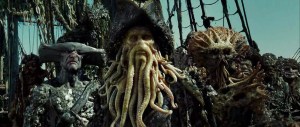 There are moments that seem to stretch the credibility of the story. It’s been said before that it’s not the impossible that bugs you but the improbable, and this holds true for Dead Man’s Chest. I’m able to believe Davey Jones and his creepy crawly crew, but I’m not able to believe that Elizabeth Swan could single-handedly best them all at once in sword fighting. The movie becomes dangerously close to eye-rolls in parts, but generally steers clear of moments that rip you out of the story. Of course a Pirates film would be nothing without Johnny Depp. He’s the main reason the first film was so memorably embraceable and entertaining. It?s not every day someone gets nominated for a Best Actor Oscar playing an addled, swishy comic pirate. He’s truly the star and has been one of our finest actors long before he had any box-office clout. He’s created a character so beloved that he’s crossed over into the cultural lexicon. How many Jack Sparrow outfits do you see come Halloween? I had a friend directing a high school performance of A Midsummer Night’s Dream and every young actor wanted to audition as Captain Jack interpreting Shakespeare. Come to think of it, Jack Sparrow would certainly liven up some of the bard’s dusty works.
Depp is still hilarious and likeable even when he’s being a scoundrel. We simply love this character; I love this character. The unpredictable nature of Jack feels squeezed dry by the demands for familiarity with sequels, but Depp finds new ways to enthrall in Dead Man’s Chest. Some people are going to be uncomfortable with Jack being more dastardly, willing to trade others’ lives to save his own hide. I think desperation is an interesting place to put this character. Besides he has his big hero moments as well.
New dimensions are added to the other characters. Knightley gets to be shrewd and try her hand at pragmatic treachery. It eats her up inside at the end and Knightley, a nice comedic actress, allows us to see the rough seas of guilt within her. Bloom will always be Bloom, meaning he’ll be handsome, British, and seemingly too little for grownup movie stuff. Will is given a whole new set of daddy issues when he actually gets to spend time with dear departed dad (Stellan Skarsgard). Best of the rest (“the rest” being everyone other than Depp) is an unrecognizable Nighy, who saunters his deck with the fiery air of a preacher. Nighy manages to make Davey Jones even more interesting. Naomie Harris (28 Days Later) makes her presence felt as a witchy woman responsible for Jack’s compass.
The action sequences are gigantic and well constructed. They expand with organic complications and a lively, graceful sense of humor. An already fun sword fight atop a watermill wheel gets even more pleasing when the giant wheel breaks free and the fight continues. Three characters climb inside and out, all vying for a key that keeps changing hands thanks to gravity. A human-sized fruit-kabob tied to Jack has a wonderful payoff for something that seemed completely random. The special effects are gorgeous. You can practically taste the slime and sea salt from the creatures. Davey Jones is a fantastic design and I’m dying to know how they did his tentacle beard. Whether it be motion capture, CGI, or puppetry (was someone billed in the credits for “operating” Bill Nighy? Does that sound like a fluffer?), it’s all dazzling to behold. The Kraken is ferocious and so well designed that it’s destined to give an entire nation?s children nightmares for weeks. Coupled with the equally super expensive Superman Returns, it seems that nowadays if you want special effects that will retain their wow-factor, it helps to have a $200 million dollar budget. Director Gore Verbinsky has a terrific eye for shot compositions; I am convinced that if you give this man good material then he will give you popcorn gold. If you give him bad material, well, then you get shiny but pointless stuff like The Weather Man.
 I know this movie, at its center, is empty. It’s grand throwaway entertainment, a true popcorn romp, but yes, when you get down to it the film has little to it. It’s an explosion for the eyes and has some great characters and action choreography, but Dead Man’s Chest is nothing more than very pricey, very tasty cotton candy.
Pirates of the Caribbean: Dead Man’s Chest feels less like a rehash and more like the start of an exciting new voyage. It’s darker, bigger in scale, scarier, louder, brasher, but still barrels of fun. Time will tell whether the back-to-back sequels will support enough intrigue to cover two very long, very expensive action movies. But Dead Man’s Chest has the key Pirates ingredients returning: clever screenwriting duo Terry Rossio and Ted Elliott, and, naturally, the irreplaceable Johnny Depp. An early eye gouging might set the icky tone, but this is one sequel that compares favorably to its source. We’re left in a very Empire Strikes Back position, but not after running out of breath keeping up with the many treasures of Dead Man’s Chest. Nothing will recapture the magic of the 2003 original but this is one summer sequel that delivers without letdown. Then again, after Pirates 3, it could all be for naught. See you in 2007!
Nate?s Grade: B+*
*Final grade pending the outcome of Pirates of the Caribbean 3.
UPDATE: Having just seen the third film, I’m somewhat conflicted. Many items from Dead Man’s Chest have little payoff in the third film, At World’s End. So while I wouldn’t grade Dead Man’s Chest any higher after seeing where it concludes, I still find it to be too fun to rate any lower. Its final grade stands.
Share this:

The Devil Wears Prada (2006)
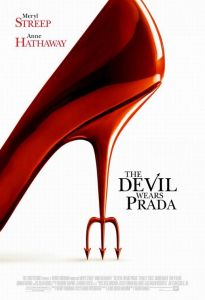 One part fantasy, one part incisive satire on the fashion industry, The Devil Wears Prada, on paper, may not be more than another formulaic entry where a young innocent gets caught up in the temptations of power and influence. I know little about the fashion industry other than what I can gleam from TV’s insanely watchable Project Runway and even I was charmed. Andrea (Anne Hathaway) is an idealistic journalism student paying the bills working as the assistant to Runway magazine’s ferocious editor in chief, Miranda (Meryl Streep). Andrea’s plain style of dress draws sneers and snickers from her rail-thin, nose-raising colleagues, and some smart snark from Miranda, who always seems to eviscerate people without raising the timber of her voice. The movie is typical with its rise-and-fall power structure, but even though it may be lightweight, The Devil Wears Prada is lots of fluffy fun, and all signs of life point to Streep. It’s almost a foregone conclusion that you’ll get a worthy Streep performance, but she’s totally unleashed in The Devil Wears Prada. Every time she sweeps into a scene she commands attention and steals the movie. We’re all just living in this woman’s world on borrowed time, and she knows it. Streep is in grand comedic form, dominating the movie with glares; just an inching of her facial expression can cause titters. It’s a juicy role and, mark my words, the most Oscar-nominated actress in history is going to get another nom for this performance. Hathaway proves to hold her own as well beyond those dark doe-eyes and cherry stem lips. The movie starts to drag in a third act trip to Paris, and Andrea’s empathy seems to get a bit out of tune (she feels worse about being better at her job than a co-worker than missing her boyfriend’s birthday). The Devil Wears Prada is an enjoyable, easily digestible piece of high-gloss fluff elevated by Streep’s dominating turn as a fashion lioness.
Nate’s Grade: B
Share this:

Cars (2006)
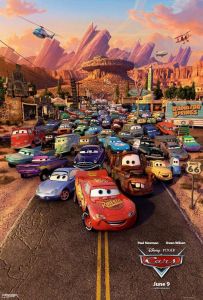 While I’d never call Pixar’s latest animated film a disappointment, it is the company’s first speed bump in their unprecedented reign of unmatched quality. Cars is technically dazzling; it’s almost redundant to say a CGI film is the best-looking ever because the technology keeps improving with time but Cars is incredible to watch. The lushly painted vistas, the way light gleams on surfaces, the blurs of color, the near-photographic likeness of cars themselves, this is a beautifully animated film, obviously. What isn’t as beautiful is the lackluster storyline. I can feel Pixar’s heart in the right place but they don’t put enough effort to touch our own hearts. Cars lacks the depth of Pixar’s other features. The two Toy Story films managed to take a kiddy concept of the secret life of toys when no one’s watching and infuse it with serious moral dilemmas and a mature insight into mortality and community. In Cars, the main storyline involves a cocky hot rod Lightning McQueen (voiced by Owen Wilson) who lives in a glitzy world that revolves around him. He goes off the beaten path and finds himself trapped in Radiator Springs, a tiny town that’s all but been dried up since the interstate took folks away from them. There, Lightning learns there’s more to life than material riches from this eclectic mix of good, honest small-town folk. What I’ve just described to you could be the plot of hundreds of movies championing the likes of small town folk. They surprisingly never really go much deeper, though Paul Newman is terrific as an old time car that had a taste of the glory and arrogance way back.
This is the first Pixar movie to exist in a world without humans, which begs the question how living automobiles were able to construct their world minus opposable thumbs. Cars themselves are weirdly inexpressive creatures.
The climax to Cars is suitable and heartfelt but the movie, at two hours in length, sputters a while in the middle. This is the first film directed by Pixar’s big cheese, John Lasseter, since 1999’s Toy Story 2, so excuse me for expecting a little more. Still, the movie is certainly fun, exciting, more cute than funny, and it has a genuine sweetness to go with its visual prowess. I just wish the 8 credited screenwriters, including Lasseter himself, had revved up their imaginations a bit more beyond the conceptual stage. Cars isn’t a great movie, but coming from Pixar, it’s still very good. Hey, anyone that can make the voice of Larry the Cable Guy tolerable deserves my thanks.
Nate’s Grade: B
Share this:

The Break-Up (2006)
 Real-life couples have a rocky track record when they star together. Sure, for every Mr. and Mrs. Smith there’s also a Proof of Life, Vanilla Sky, or, God help us, a Gigli. The trouble is that what captures the fancies of two actors rarely translates to the big screen. Was anyone more the wiser why Jennifer Lopez and Ben Affleck got together on the set of Gigli? Now here comes The Break-Up, an anti-romantic comedy starring Vince Vaughn and Jennifer Aniston. They’ve been playing a coy game with the media about whether they’ve been dating since the movie wrapped a year ago. Audiences will have difficulty seeing whatever magic the two felt, because The Break-Up isn’t romantic in any sense of the word.
Gary (Vaughn) and Brooke (Aniston) meet cute at a Chicago Cubs game and begin a two-year relationship. Then one evening, after a terribly uncomfortable dinner between their folks, both decide to call off their romantic entanglement. Neither is willing to leave the condo they co-own, so each engages in a battle to convince the other to leave. Gary wardens off the living room as his space. Fine, Brooke invites her brother’s glee-club to perform in her area. He gets the pool table they had talked about waiting to purchase. She throws his clothes into the hall listening to Alanis Morissette. She invites dates over. He has a night of strip poker with actual strippers. At the same time, Brooke is questioning whether she can save their relationship and work things out.
 Audiences expecting a cheeky romantic comedy will be soundly disappointed. The Universal marketing weasels have lied to you! After the 30-minute mark, The Break-Up doesn’t have much comedy, let alone romance. This is really more of a gutsy mainstream drama that prefers to exist in a world similar to ours where heartbreak and yearning are often unresolved. This is a respectably good, if flawed, relationship drama that doesn’t pull its punches. The Break-Up has a very Chasing Amy air to it; both films present atypical Hollywood relationships and both seem to sense a happy ending would just be insulting. Actually, in another similarity, both The Break-Up and Chasing Amy have their comedy completely dissolve by film’s end.
The biggest flaw The Break-Up has is that we don?t generally care if Brooke and Gary get back together. The only good times of yesterday we see are via photographs that are shown during the opening credits. Beyond this brief photo collage, we?re basically starting at the end of their union. There’s a fair amount of gender stereotypes to go along with the characters and their behaviors (men are from Mars, women from Venus?), though it didn’t bother me as much as it would have in a typical romantic comedy. Brooke is a bit of a nag but an altogether good person who just goes about her reconciliation plans in the wrong manner (push him away to have him come back, make him jealous, the famous double-speak). Gary, on the other hand, is pretty much a jerk. The tagline for The Break-Up says, “Pick a side,” but the movie already picks for us. Gary is a lazy, egotistical, unappreciative, selfish jackass and you’re really puzzled why Brooke would keep trying to resuscitate their relationship. Again, part of this is because The Break-Up doesn’t ever show us a moment of these two crazy kids in love. We really have no interest in seeing these unhappy people be unhappy with each other for a longer period of time.
The Break-Up has a lot of intentionally pained awkwardness to it, partly because good portions of the movie is about voyeuristically watching an unhappy couple argue. The Break-Up‘s relatability, something nearly unheard of in the overly saccharine, simplistic world of romantic comedies, is a double-edged sword. Couples may wince and pass knowing looks, thinking, “We’ve had that fight. I too crossed the line like that. I too went about that the wrong way.” Audiences will see pieces of themselves onscreen, but do mainstream audiences really want to see pieces of themselves screaming at each other for a whole movie? I doubt it. I think displeased moviegoers are going to tell their friends to stay away in droves, unless they’re avid tabloid followers.

Vaughn continues his motor mouth lout shtick, though it’s somewhat impressive that he willingly puts himself in such an unflattering light. He’s also a bit puffy in the movie. Aniston is an actress I haven’t been overly enthusiastic with, to say the least, but she’s a winning personality even if she’s replaceable. She seems to be in a frazzled rut. Despite whatever real-life passion the filming ignited, the leads have little chemistry together onscreen. This would be a bigger concern if the film was starting at the end of their relationship, though. The supporting cast of Vaughn’s friends and co-workers is rich with talent. A late scene between Vaughn and Favreau about hiring a hitman to take out Brooke’s supposed new beaux is solid gold. The wonderful John Michael Higgins (Arrested Development), as Brooke’s socially inept brother, provides the biggest laughs. And for those wondering what ever happened to Ralphie from A Christmas Story, here he is all growed up and emasculated by Joey Lauren Adams.
Director Peyton Reed (Bring it On, Down with Love) has a good feel for human comedy and interesting shot selections. He normally keeps his movies brisk and airy. The dialogue is above average and feels naturalistic. I am surprised that I have heard so little about Aniston’s brief nude scene. Then again, I don?t watch that recycled Entertainment Tonight TV vomit. It’s kind of neat to note that there was a 1998 movie itself called The Break Up; they just didn’t have the hyphen. Remember that hyphen in a few months when you’re at your local video store [Author’s note: R.I.P. video stores].
I give Vaughn and the filmmakers credit for trying something challenging and attempting to have a mainstream audience go along. The Break-Up is uncomfortable in how painfully awkward and relatable it is. Whether audiences want to flock to a movie about unhappy people who don’t belong together is a good question. This isn’t as nasty a comedy as The War of the Roses; no, this film is kind of stuck in a thematic middle ground of a gutsy, if flawed, relationship drama. Those expecting promises of comedy and romance might feel cheated. The Break-Up is like a real-life experience: it’s somewhat painful, somewhat expected, and perhaps better once it’s finally over.
Nate’s Grade: B-
Share this:

Scary Movie 4 (2006)
 David Zucker was apart of the team that gave the world Airplane!, The Kentucky Fried Movie, Top Secret, the Naked Gun flicks, Ruthless People, and even Ghost. When the Wayans brothers left the Scary Movie franchise for greener pastures (greener meaning richer), it was Zucker and his stable of writers that came in and gave Scary Movie 3 a fresh kick. Now less than three years later we have Scary Movie 4 poking at the same material, and once again this franchise is starting to feel like a bore.
Cindy Campbell (Anna Farris) is in the home health care business looking after a supposedly haunted house. Inside the house resides those pale, wide-eyed, meowing ghosts from The Grudge. Next door resides Tom Ryan (Craig Bierko), a crappy father watching after his two crappy kids for the weekend. Things get a tad hectic when giant Tr-ipod robots rise from the ground and start zapping everyone. A war of some worlds looks to be in progress. Cindy and Tom go their separate ways, each trying to stay alive and return to each other. Cindy meets her old pal Brenda (Regina Hall) and they journey into the heart of a secluded village, one surrounded by monsters. Somehow they’ll find a way to stop the aliens from destroying the planet. Meanwhile, President Harris (Leslie Nielson), briefed that the country is under attack, is very interested to know what happens to a duck in a children’s story. The only thing missing is a Passion of the Christ parody (talk about a horror movie).
 This is a franchise of diminished returns. Zucker and company feel like they’re badly grasping for something. Scary Movie 4 relies far too heavily on juvenile scatological behavior (a urine sponge bath is simply gross, not a gross-out) and very repetitious slapstick. Your level of enjoyment with Scary Movie 4 will rest solely on the question of how many times you can laugh at someone getting hit in the junk. Zucker’s gone practically overboard on the physical comedy, making this the filmic equivalent of “Football in the Groin.” The sad thing about this franchise is how safe it all feels now. It seems to have its demo sights set squarely on teen males, less discerning folk who will pee their pants with groin kick #86 and roll in the aisles uncontrollably with groin kick #113. I’m no prude when it comes to slapstick mind you; a well-timed kick to the groin can be downright Shakespearean, but when an entire film is stuffed with people knocking the stuffing out of themselves, then the joke loses its original flavor. No one wants to keep chewing on something once its flavor has long vanished.
I seriously think there should be a one-term limit when it comes to the comedy teams working with the Scary Movie films. Scary Movie 2 felt like a bad Xerox copy of Scary Movie, heavily smudged and lacking definition. Seriously, how many times can you go back to the giant semen geyser well? So too does Scary Movie 4, Zucker’s second in the series, resonate with the same hackneyed feeling. Zucker’s first movie dialed down the raunch and upped the PG-13 slapstick, and now his second film feels like a less executed duplicate. In Scary Movie 3, the joke was that the creepy psychic kid could never foresee his own clobbering. Therefore, there was an extra comedic layer to watching a kid accurately predict when a woman would start her period but not when a car back into him. In Scary Movie 4, it’s simply been reduced to watched a kid get beaten a lot. Jokes rarely connect when you rob them of context or set-up or just repeat them ad nasuem. Scary Movie 4 feels a bit overly content just to be a copy of a copy. That’s simply depressing.
 Even the jokes feel out of touch, smacking of a minimal effort. The Scary Movie franchise was never a place for biting satire, but everything seems so curiously outdated. Viagra jokes in 2006? I guess so. When the film does reference modern items (Myspace, Yahoo maps, Michael Jackson) it still feels awkward. The Brokeback Mountain parody, while shocking in how comparatively restrained it is, comes across dead in the water because our market is over-saturated with gay cowboy jokes. It’s like in 1999 when even your invalid grandmother was doing a Blair Witch Project parody (turns out the witch was just the nurse trying to get her to take her pills). I do realize that the plot parodies are mostly a jumble, bits blended together to house the film’s rapid-fire gags. The Million Dollar Baby parody is probably the best sequence in the film and even that spoofs a cultural event 10 years old. If Scary Movie 4 is targeting teens, to the detriment of the film’s funny, then why even bother referencing pop-culture outside their cognizance? I wonder if the inevitable Scary Movie 5 will have a pointed satire on the Iran-Contra scandal.
Zucker just feels too pleased with himself. His movie parodies are spot-on when it comes to technical execution, replicating even the camera angles from his source material. It’s a pity he has little to add with his tweaking. Any form of comedy gets old with repetition but slapstick especially. I would think a man like Zucker would know this.
Farris is the best thing that Scary Movie could have ever hoped for. She’s one of the most gifted comedic actresses working today. She’s at home whether it’s the physical, whether it’s delivering a silly line with pitch-perfect dumb blonde finesse, or whether it’s just making exaggerated facial contortions. There’s a music montage of Farris making funny faces that works so well because of how much Farris throws herself entirely into the joke. Too bad the movie lets her down.
Nate’s Grade: C-
Share this:

Millions (2005)
 This movie feels like someone is projecting straight from the bountiful imagination of a child. It’s wildly whimsical and fantastical; it’s a fantasy film and a family film that never falters into treacle. Director Danny Boyle (Trainspotting) of all people has crafted a masterful living fantasy with great emotional heft. I was left very teary by the end and have remained so with repeat viewings. Millions has great visuals, great acting, and is a great movie.
Nate’s Grade: A


 nathanzoebl
You must be logged in to post a comment.