Blog Archives
The Darjeeling Limited (2007)
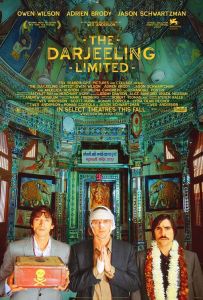 I’m starting to think Wes Anderson may become his own worst enemy. The man seems trapped in his precious, idiosyncratic style that revolves around intricate, dollhouse-style production design, slow-motion and simple pan shots, clever-to-smug characters, family dysfunction that coalesces somewhat by the end, and a soundtrack full of hip, retro songs. I like Wes Anderson; I loved his first three films, was rather lukewarm on 2004’s Life Aquatic, but The Darjeeling Limited is pretty much a bland rehash of the same. Instead of a father reconnecting with his long-forgotten son it’s three brothers reconnecting in the wake of their father’s death and mother’s abandonment. The humor is fairly subdued and while the movie is brief it seems to run out of gas early on and get repetitive. I think Anderson is more interested in showing off his highly elaborate production design than crafting interesting things for his characters to do inside those complex sets. I didn’t feel a blip of emotion for any of the character, all of who have some lasting fear of women ever since their mother ran out to become a nun. There’s kind of an unsettling misogynistic vibe in the movie against women, which is an unfortunate surprise. There’s a spiritual quest that some may relate to but I found it superficial at best, intended to gloss over the plot holes and character miscues. I wish Anderson well, but his next venture behind the camera might work better if he threw out his fraying filmmaker playbook.
Nate’s Grade: C+
Share this:

Meet the Spartans (2008)
 Writer/directors Jason Friedberg and Aaron Seltzer are, and I do not say this lightly, the worst filmmakers of all time. They are worse than Ed Wood, they are worse than Uwe Boll, they are worse than Harold P. Warren, who wrote and directed the worst movie of all time, Manos: The Hands of Fate, because of a bet that he couldn’t make a movie (I’m fairly certain he still lost). Friedberg and Seltzer are the antithesis to funny. They mock funny, they spit at funny. Meet the Spartans is their third spoof in three years, or, as I see it, their third miscarriage of comedy.
The plot to 300 is the framework for Friedberg and Seltzer to purge their juvenile gags. King Leonidas (Sean Maguire, who actually used to be a pop singer) leads a band of 13 Spartan warriors, including Hercules‘ Kevin Sorbo, against the mighty army of Xerxes (Ken Davitian). Back at home, Queen Margo (Carmen Electra) must seduce Traitoro (Deidrich Bader).
Meet the Spartans would be hard-pressed to fit the definition of a movie, no matter how generous you are with the term. True, it is a collection of moving pictures, but surely we must have greater stipulations for our movie going entertainment. The actual flick is only 65 minutes long, barely a little over an hour, and then it’s crammed with 15 minutes of outtakes and needless extra scenes to be strewn over the credits. I should be more upset by the total transparent laziness to even construct a film of suitable length, but every minute I was spared more of this junk was an act of divine mercy.
Friedberg and Seltzer are not filmmakers but regurgiatators, wildly lampooning anything that they feel approaches their young teen male demographic. Meet the Spartans, like Epic Movie and Date Movie, cannot be classified as a “spoof” because all the film is doing is setting up references and the references are supposed to be the joke. The film is like a meaningless and random scrapbook for the year in pop culture; the film’s only function to pacify total idiots with attention-deprivation issues. That’s why the movie just continues reciting 2007 movies and 2007 cultural figures endlessly, with no context and no setup or payoff; the payoff is intended to be the reference. So 12-year-old boys can recline in their chairs and think to themselves, “Hey, I remember Spider-Man 3. Hi-larious.” When the fat guy from Borat turned into a Transformer and then hit his TV screen mid section, which played the “Leave Britney alone!” kid … I swear, part of my soul died.
 Friedberg and Seltzer have little grasp on he tenets of comedy. Their over reliance on lame pop culture references means that they have set a self-imposed expiration date on their movie. Once time passes this film will serve no purpose other than a crushingly unfunny time capsule. Friedberg and Seltzer think they must be the first ones who poked fun at the homo eroticism in 300. The armada of gay jokes they come up with would be on par with a sixth grade locker room. You want another cutting edge joke? They make a joke about how Angelina Jolie likes to adopt kids. Never heard that one before. Ever. In my life.
There is no such thing as wit when it comes to the comedy black hole. They are simply repeating the plot structure of 300 and throwing in aimless appearances by figures like Paris Hilton, Britney Spears, and Lindsay Lohan, and blurred shots of all three’s vaginas. At one point the judging casts from American Idol and America’s Next Top Model appear inexplicably, and then they too get knocked down into the pit of death. I ask this question: had Sylvester Stallone not made another Rocky movie and released it in December 2006, would the figure of Rocky Balboa even appear in this flick? I doubt it. The core audience for these cannibalistic films has such short attention spans that they need their fragile brains stroked, and Meet the Spartans will not challenge them in the slightest.
And yet, astoundingly, the movie still feels like it needs to set up its dumb, obvious gags. The film has one Spartan point off screen and say, “Look, it’s Ghost Rider,” and then we cut to a skeleton biker swinging a chain. Gee, the Ghost Rider movie came out not even a year ago, and the character is rather hard to confuse with, say, Marry Poppins, so why did Friedberg and Seltzer feel the need to name check? It’s even more confusing considering that the audience that would go see Meet the Spartans is likely the same audience that saw Ghost Rider. It happens again when Queen Margo changes into a black Spiderman suit and the narrator assist by saying she’s becoming Venom. I got it with the suit, yeah, because everyone saw Spider-Man 3. I can also recognize Ugly Betty when I see her, thank you useless narrator. I don’t need a handicap for non-obscure pop culture bon mots.
The product placement is also insulting and annoying. At one point the Spartan narrator tells us that the fighters needed to take a break to replenish their electrolytes. We are then treated to quick cuts of the Spartans holding Gatorade bottles until one looks directly into the camera and says, “Gatorade: Is it in you?” I must have missed what the joke was when the film just repeats the advertising slogan word-for-word without any alterations in tone and context. There is also a scene where Xerxes imitates a Dentyne Ice commercial and holds the product up to the camera. What is the purpose of either of these moments? If I wanted to watch commercials verbatim I’d stay at home and tune on QVC.

If you see these guys (Friedberg and Seltzer) please convince them never to make another movie.
From a production standpoint, this movie looks really cheap. The sets and costumes and props look horrible, like something a high school production would ditch. Just because it reuses the same camera styles as 300 doesn’t mean it gets any closer to parody. For God’s sake, they couldn’t even come up with puns on character names, the only exception being Traitoro and Sonio, neither of which will induce a chuckle. Most of the non-reference “humor” is either insipid slapstick or a handful of moderately gross scatological jokes, and, oh, yes, lots of gay jokes, because those just get better the more you hear. Tasteless doesn’t always equal funny, and people drinking urine is rarely funny without some extra setup.
The actors all seem mildly embarrassed and they do nothing with their roles. It’s not their fault the material sucks so deeply, however, it is Electra’s fault for appearing in her third straight Friedberg-Seltzer spoof fest. The key to a good spoof is to play the damn thing straight. It’s annoying and redundant if the film keeps winking back at the audience.
Meet the Spartans is pop culture vomit. No, this is worse, this is cinematic diarrhea. It’s watery pop culture discharge masquerading as entertainment. This movie is offensive to anyone that appreciates laughter. This film and its ilk are offensive to mankind. And plus, it’s just not funny people, not in the slightest. There’s no wit here, no comedic payoffs, no running gags (besides gay jokes), no thought or upheaval of convention; instead, this movie is a lazy, cheap catalog of pop culture events from late 2006 to summer 2007. Even at 80 minutes (really it’s 65) this thing drags and feels exhausted long before it bows out. Just as I said in my review of Epic Movie, Friedberg and Seltzer must be stopped at all costs if comedy is to survive.
Nate’s Grade: F
Share this:

Definitely, Maybe (2008)
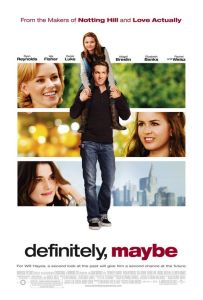 Adam Brooks has spent his whole career in the romantic comedy gutter. His screenwriting credits include French Kiss, Practical Magic, Wimbledon, and the second Bridget Jones flick. Not a whole lot of quality there. Definitely, Maybe is Brooks fourth writing and directing effort but the first to get a major push from the Hollywood studios. Maybe the same purveyors of formula fluff realize that Brooks finally has something good on his hands.
Will Hayes (Ryan Reynolds) picks up his ten-year-old daughter Maya (Abigail Breslin) from school on perhaps the worst day of the school year: sex education day. Kids are crying, parents are stammering to explain, and Maya casually exits her classroom, walks up to dad, and says point blank, “We need to talk.” She wants to know all about the story of how her father and mother, now divorced, met. Finally Will agrees but decides to play a game. He will changes names and identifying characteristics and Maya will have to guess which of his three loves became her mother. Emily (Elizabeth Banks) is Will’s college sweetheart from Wisconsin. Summer (Rachel Weisz) is an ambitious journalist with a taste for older men. April (Isla Fischer) is a Bohemian free spirit that Will meets working on the 1992 Bill Clinton presidential campaign. Maya sits in her bed and pays rapt attention to what she calls a “mystery romance.”
Miraculously, Brooks has written a romantic comedy where the characters are, dare I say it, well developed human beings. These folks are more than stock roles for the genre; in fact, each woman is smart, genuine, charming, fun, and desirable, and yet each woman also has her own set of realistic flaws. Brooks makes sure that we, the audience, admire each woman and recognize that any of the three would make a fine selection. These characters feel real, which is almost unheard of for a genre about ticking biological clocks, cloying and precocious tykes, irrationally sexist and self-absorbed characters, forced misunderstandings that lead to contrived reconciliations that involve some form of chase. Having recently seen 27 Dresses, which plays close to the typical rom-com formula, I appreciate Definitely, Maybe even more.
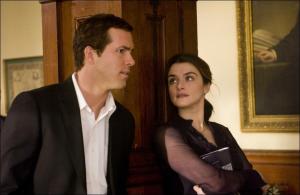
This is a romantic comedy that respects its characters and respects its audience. The people might make bad or impulsive decisions but Brooks doesn’t pass judgment, and, my God, it’s refreshing for the genre. I rolled my eyes when I read blurbs about Definitely, Maybe being “the best romantic comedy since [1976’s] Annie Hall.” While I wouldn’t necessarily go that far, Definitely, Maybe is definitely the best and most enjoyable conventional Hollywood romantic comedies in years (For those wondering what non-conventional romances got me jazzed, here is a small list: Eternal Sunshine of the Spotless Mind, Amelie, Secretary, Once, Sweet Land, A Very Long Engagement, Brokeback Mountain, Aimee and Jaguar, and Before Sunset).
Brooks chronicles Will’s romantic escapades along the timeline of Bill Clinton’s rise in national politics, which is an interesting way to look backwards in time and still be relevant to modern audiences thanks to Mrs. Clinton’s race to reoccupy the White House. I found it interesting that Will’s emotional journey seems to be charted along the same ups and downs as Bill Clinton’s time in office, so when Clinton is mired in the Monica Lewinsky scandal and questioning the definition of the word “is,” Will has lost his idealism and grown into a cynic. He even openly criticizes with great frustration and ire the man he helped put into office. Will’s enthusiasm and disenchantment for Clinton mirrors his budding relationships with women.
Definitely, Maybe has a handful of memorable moments and some amusing dialogue, but Brooks has crafted one hell of a meet-cute scene between Will and April. After an initial first meeting at the campaign headquarters, Will is purchasing a pack of cigarettes when he spots April purchasing a pack of organic cigarettes. He playfully mocks her more expensive purchase. She counter punches and says that her brand is made from better stock and will actually smoke slower, thus being the better purchase. He challenges her to a smoke-off and the two step outside, light up, and for the sake of scientific research they take equally long drags, and sure enough Will’s cigarette cannot last as long. They laugh and eventually Will visits April’s apartment and learns about her poignant search for her lost copy of Jane Eyre out there that has her father’s inscription. It’s a great scene that allows both actors to size each other up.
Thanks to each woman being presented fairly the movie doesn’t make it obvious which woman will eventually become Maya’s mother. The ladies fade in and out through the plot. The guessing game gimmick grabs our intrigue early and Brooks doesn’t tip his hand until the film’s end. What I find interesting is that Will changes with each woman and could feasibly be happy with any of the three, a desirable predicament if ever there was one. The movie even tackles divorce sincerely and without any doom and gloom overly dramatic pronouncements. Definitely, Maybe doesn’t go out on a limb and certainly isn’t remotely edgy, but the flick has a soothing, amiable adult spirit. It may not be revolutionary but simply telling a good story with mildly relatable characters seems like a great step in the right direction for this oft-sneered at genre.
Reynolds knows how to work his suave charisma to a fault. He’s certainly a capable leading man for romantic comedies and he can deadpan with the best of them. He seems like he could use a bit more direction, because there are moments where he seems to be falling back on his standard sly, indignant persona that has characterized his comedy work from 2002’s Van Wilder and on. His interaction with all three women produces varying spikes on the chemistry chart, and for my money he scores the best sparks with the subdued seduction of Weisz.
 The women of Definitely, Maybe are the real winners here even if only one will eventually take home Will. Fisher becomes the heart of the movie and, given the most emotional material, shines the greatest. Banks is wholesome and easy to get cozy with. Weisz is the most enigmatic of the three and offers a beguiling yet very knowing charm. She has a very seasoned sensibility. Her on-again off-again affair with an aging literature professor (a fabulous Kevin Kline playing a fabulous blowhard) adds an intriguing dynamic to her character. The only irritant for me was Breslin’s acting, which was just off enough to annoy me.
Definitely, Maybe is a romantic comedy that proudly treats its characters with respect and develops them into relatable, authentically human characters in a typically inauthentic universe. Brooks mines a gimmick for all its worth, but even after the signs become clear the film is still pleasurable in its predictability thanks to the great characters. It’s rare to see a romantic comedy that bestows a moderate amount of characterization; usually these roles just fall under archetypes. Brooks has shied away from the trappings of the genre (there isn’t a single sing-a-long!) and crafted a genuine romantic comedy that doesn’t rely on sentiment and easy answers even as it heads toward happy ending material. The movie even tackles divorce from a non-judgmental yet honest approach. As far as I’m concerned, Brooks has made amends for his previous screenwriting duds and made a movie that men can truly enjoy as they’re dragged into the theater by their significant other. I would definitely recommend Definitely, Maybe to fans of the genre. This is one worth seeing, folks.
Nate’s Grade: B+
Share this:

Ratatouille (2007)
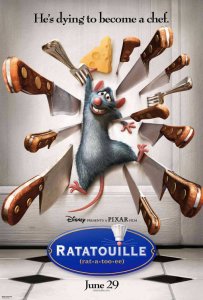 This movie continues to grow on me every day after I saw it. Writer/director Brad Bird yet again impresses with a deceptively simple story that manages to hit big themes in organic ways. The comic possibilities are fully realized with the setup of a man and a rat teaming up to be a great Parisian chef. There is a jubilant spirit alive and well throughout the film, and it’s difficult not to get swept up in the wit, the wonder, and the magnificent visual feast.
Nate’s Grade: A
Share this:

27 Dresses (2008)
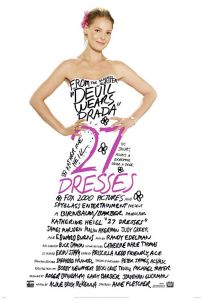 Katherine Hiegl is a likeable enough actress. She got her big break in 1994’s My Father the Hero, which had the exceptionally gross premise of having an adolescent’s father posing as her European lover to score the guy she’s really got her eyes on. The most memorable moment of the movie was a 15-year-old Heigl strutting around in a thong bathing suit. Her resume got better with a steady stream of network TV shows like Roswell and Grey’s Anatomy, and then she broke into another level of stardom thanks to the runaway success of [I]Knocked Up[/I] where she carried Seth Rogen’s baby. Then she told Vanity Fair that she felt Knocked Up was “sexist” and that the women were portrayed as shrews and that the men were fun-loving dudes (I must have seen a somewhat different movie). She’s entitled to her opinion, but what seems very odd is that Heigl’s follow-up to her breakout role is 27 Dresses, a romantic comedy about a woman who is a perennial bridesmaid and yearns for her own perfect wedding when her life will be complete.
Jane (Heigl) busies her time helping others to have heir ideal weddings. She has contributed to so many wedding ceremonies that she has amassed a closet full of 27 bridesmaid dresses that serve as trophies. Jane is in love with weddings. She is also harboring a crush on her boss (Edward Burns, wooden as always) that seems to be going nowhere. Jane’s younger sister Tess (Malin Akerman) comes to visit and immediately hooks up with Jane’s boss/crush. Jane’s wisecracking best friend (Judy Greer) is quick with a quip and declares Tess to be some very negative terms. Poor plain Jane is also taken aback when she meets wedding columnist, Kevin (James Marsden), whose fawning words about weddings are like poetry for Jane. He turns out to be a cynical guy who feels weddings and marriages are “the last legal form of slavery.” When Tess gets engaged to the boss man, wedding responsibilities fall upon Jane and Kevin is right beside her, ready to trade barbs about romance and perhaps start one of his own.
 27 Dresses hews pretty close to the familiar romantic comedy formula trappings. Opposites attract, bickering will lead to romance, and then true love will overcome all misunderstandings, that’s a given. Another given is the fact that we will get a montage of Heigl trying on all 27 titular dresses. 27 Dresses also includes the wisecracking best friend who has no purpose of her own but to comment on the troubles of our heroine with stark bluntness. Once again, this is the type of film where one character has some earlier, negative opinion or statement that resurfaces late to bite them in the ass after they have learned how flawed and shallow that original opinion was (otherwise known as the 11th hour misunderstanding). One party has a personal epiphany and runs to catch the other party leaving by some means of transportation (I’ve seen boats, taxis, motorcycles, barges, but usually they run to catch a plane). And then there’s the sing-a-long; oh what romantic comedy would be worth its salt if it didn’t include a group sing-a-long to some older tune that just united everyone in spontaneous song? 27 Dresses uses Elton John’s “Benny and the Jets” to rock out a beer bar. Really, “Benny and the Jets”? Rocking out a bar? And it’s not even a gay bar? Hmm. 27 Dresses is rather predictable from the first frame onward, but familiarity isn’t necessarily a deal-breaker for a strictly genre movie.
I’ve seen plenty of romantic comedies and I like to judge them fairly, so I use my patented cute-to-cringe count whereby I take stock of the number of times I smile, laugh, or find a moment, line of dialogue, or even choice of song that leaves a favorable impression. I then compare this figure with the number of times I want to roll my eyes, check my watch (if I had one), vomit, or any piece of dialogue or moment that feels so saccharine, so unbelievable even in the rom-com universe that I want to laugh derisively. The final tally for 27 Dresses was somewhere in the middle but I’ll admit it skewed closer to the positive “cute” side of the spectrum.
The acting overall really helps to make the most of the formulaic material. Heigl seems destined to thrive in the rom-com genre; she has an every girl appeal and seems apt making funny faces of seething indignation (take note of the amount of times she uses food in her mouth for comic effect). She seems like the heir apparent to Sandra Bullock movies. Her chemistry with Marsden is ripe and they bring out good thing in one another with their playful give-and-take. Marsden has a terrific smile (seriously, the man might have the best choppers in the industry) and is suitably dreamy but he also has an enjoyably droll delivery. Akerman plays a spoiled brat well, though she isn’t given the opportunities to flash her rather skillful comic skills that she displayed in The Heartbreak Kid remake. Greer is a top-notch scene-stealer and deserves her character deserves her own movie. She has the most fun role to play but Greer sinks her teeth into the character and delivers a juicy performance that feels slightly naughty, uncensored, and carefree.
The movie falters when it trips up in maintaining believability. There’s an extensive scene in a Goth bar/club where the costumed extras are acting like… costumed extras. It’s the least believable Goth club I have ever seen in a movie, not that I was expecting Hollywood fluff to pain an accurate picture. It’s just wall-to-wall stereotypes, but not only that, they’re distracting and lame and dated stereotypes. Then Jane marches outside to scream to the heavens an expletive-filled rant about her bad luck when, ut oh, right next door to the Goth club is an old couple celebrating their 50th wedding anniversary. What? Grandma and grandpa Old People celebrating their marriage vows next door to a Goth club? This incongruous setting takes a long, long while to set up one very blah joke that could have functioned anywhere. Realistically, the joke is that Jane is swearing unbeknownst to others, so why even have it next to the world’s crummiest Goth club? If you’re going that route, why not have grandma and grandpa Old People dressed in tacky Goth apparel as well? This may become my most nit-picky criticism of all of 2008 but it really stuck in my craw.
 A better example is how the film handles Jane’s bratty sister, Tess. For 90 minutes we bare witness to Tess being a thoughtless, self-absorbed, lying, horrible human specimen, and then the movie tries to change strides. In the very end, it wants us to open up and look at Tess’ life and realize that she doesn’t have it so awesome because she was fired and dumped. Oh my, that must be perfectly excusable then for her rampant inexcusable, me-first behavior. If 27 Dresses has an antagonist in its midst than Tess is that bridezilla. The movie plays her bitchiness for comedy but then wants an audience to forget every whine and betrayal because, woe is her life, Tess wants to be happy. Tess remains an unsympathetic twit from beginning to end, no matter how hard the movie and its soft piano score try to change your mind.
The fact that 27 Dresses thought it could throw in some contradictory evidence at the last minute to make an audience forgive Tess is very telling. It showcases that the film has a hard time grasping the realities of characterization; Kevin is cynical about weddings because he was stood up at his; Jane must focus on making others happy because she is afraid of focusing on her self; Ed Burns is a douche. That isn’t necessarily an indictment on the film per se, just my honest opinion. 27 Dresses spells everything out in bold statements that hit like anvils, like when Kevin’s news editor congratulates him on his front-age story ridiculing Jane: “Hey, you got what you wanted, right?” Gag. The movie is too lockstep with the genre’s clichés that it doesn’t push hard enough with its characters, so we get plenty of intermittently cute moments but cute moments that will be easily forgotten and stored away like one of Jane’s hideous bridesmaids gowns.
27 Dresses is more or less par for the course in a genre littered with sappy clichés and cookie-cutter characterizations, and yet the movie possesses enough charm to outdistance its lapses in believability. The acting ensemble help make the movie enjoyable in parts, especially the chemistry between Heigl and Marsden. 27 Dresses passes the time but you wish that Heigl, Marsden, and especially Greer would be teleported to a better movie. One free from bitchy younger sisters, bar sing-a-longs, giddy dress-up montages, and Ed Burns. Did I mention that his character is a douche?
Nate’s Grade: C+
Share this:

Kickin’ It Old School (2007)
 A moderately surprising comedy that’s really much more fish-out-of–water than tired You Got Served dance parody. Jamie Kennedy busts a move as a kid in a man’s body who wakes up after being in a coma for 20 years. There is an overemphasis on recreating the 80s in the early part, with a crushing amount of catch phrases, name drops, and dated toys and fashions. The rest of the film follows the sports formula closely as Kennedy reassembles his aged Funky Fresh Boys to win a dance competition for standard goals like saving his family and winning the girl of his dreams. Kickin’ It is a simpleton comedy that never aims it sights too high, but every now and then the film connects on a gag or a character that produces some real yuks (my favorite being a homeless man convinced he invented break dancing). Some of the jokes are pretty dusty and the romance is, like most of the conflict, forced and contrived, and yet I cannot hate this movie. I never grew weary watching it even though during the climactic dance-off tournament there is a dearth of even attempted comedy.
Nate’s Grade: C
Share this:

The King of Kong: A Fistful of Quarters (2007)
 The King of Kong: A Fistful of Quarters is a short but sweet documentary that follows the lengths two men will go to set the records for the classic arcade game, Donkey Kong. We learn a whole lot about the many faces that populate the world of competitive video games, like Walter Day as official record-keeping referee, Steve Sanders as a fraudulent Donkey Kong champ in his youth who has now become a lawyer, Mr. Awesome, and the gaming world’s superstar, Billy Mitchell. He holds several world records including a score of 800,000 for Donkey Kong. Enter Washington science teacher Steve Wiebe who dutifully plays Donkey Kong in his garage. He challenges Billy’s score and videotapes himself passing 1,000,000 points; all the while you can hear his son in the background screaming to have his butt wiped.
What becomes very apparent is that the entire record-keeping system is tilted in Billy’s favor. It’s both sad and funny to watch a group of grown men who have all gravitated toward one man at video games. Billy’s claim to fame is he’s the best at video games, and he has a restaurant, a line of hot sauce, and other products that sell because he has that small sliver of fame. And this select circle of gamers essentially is a freaking tree house and they don’t like someone from the outside crashing their private party. This group of man-child sycophants is clinging to their small notoriety like a life preserver on a doomed ocean liner. It’s baffling how serious and self-involved they all come across; while on the phone with Billy, Steve Sanders, while dining, says in the most hyperbolic alertness that Steve has come into the restaurant “uninvitedly” like it’s some grave offense. It’s a restaurant! (Billy at one point literally says, “No matter what I say, it draws controversy. It’s sort of like the abortion issue.”) These few established gamers throw hurdles at Steve and even dismantle his Donkey Kong machine to snap pictures looking for some tenuous proof that his score was inflated somehow. When they find a small dew drop of glue in one corner of the control board, they claim that this, compiled with the fact that the board was given to Steve by a known enemy to Billy, is enough to disqualify Steve’s record-breaking million point score.
 They challenge him to break the record in public and that’s what Steve does, which is more than what Billy Mitchell is capable of. Steve travels to renowned New Hampshire arcade FunSpot and, under the glare of Billy lackeys, breaks 900,000 and gets to the heralded “kill screen,” where the old arcade game, because it has exhausted its memory, begins a stage simply to kill Mario within seconds. We’re told only two others have been ever known to reach a kill screen in public.
And then Brain Kuh pops in a videotape that Billy sent. The tape is a recorded game, presumably of Billy playing, where he passes 1,000,000 points on Donkey Kong and undermines Steve’s recent accomplishment. The sycophants are all abuzz, with Kuh on the phone with Billy relaying every moment in hilarious fawning detail. Apparently, it wasn’t kosher for Steve to submit a recorded video of his score but Billy doing the same thing is acceptable. This double-standard is even more dubious when you realize that Billy Mitchell is one of the deciding members on whether or not to credit Steve’s million-point tape; isn’t that a bit of a conflict of interest? Billy’s record-breaking tape has a mysterious blur that only appears on the side of the screen with the score, and the blur conveniently or coincidentally covers the score as it passes into seven digits. Surely that is more questionable than a dollop of glue on a control board, but oh well, the score stands.
The last part of the film involves the Guinness Book of World Records reaching out to Walter Day to setup a section on video game score records. The location for this showdown is even in Billy’s own backyard of Hollywood, Florida. Steve travels 3,000 miles to be there and challenge Billy head-to-head in public, but the many days go by and Billy refuses to put his skills to public scrutiny. Is he afraid to lose in public, or is there really something funny with that record-breaking tape he submitted to FunSpot?
King of Kong is pleasantly structured like a sports movie. Billy is portrayed as the villain, the establishment, and Steve is the underdog that just wants to succeed at something in a life that seems filled with disappointment. Even better, the filmmakers made a training montage set to “Eye of the Tiger.” The movie follows the expectations of a triumph-of-the-will tale, and King of Kong is all the better because of the silliness of the world of competitive old school arcade games. The sincerity and seriousness is so high that you cannot be faulted for asking whether or not this film is a mockumentary. It doesn’t seem to be real but that’s part of what makes it’s so fun to watch. Yes there’s some bias in the editing, but Billy Mitchell sure makes it easy to be characterized as a villain living high on his spoils of long ago. He openly connives and an old woman he’s helping reach a Q-Bert record even refers to him as “devious.” I think Billy even relishes the role of villain.
 King of Kong is filled with great personalities and Kuh may be one of the funniest and most pathetic real-life figures I’ve seen in recent documentaries. He’s a self-described “prodigy” of Billy’s, and he was one of the two people who ventured into Steve’s garage while he wasn’t home. He “retired” at age 30 and was one of the most vocal proponents of Steve proving his skills are valid in a public site. He says the true game player must perform in public, under pressure, with another gamer looking on, possibly playing mind games with you (he really does say this, I swear). Yet when Billy doesn’t follow suit, it’s legit. Steve was playing at the time the video was shown and asks to watch it. Kuh declines, saying it was a “one-play only show,” never mind the fact that Billy could have studied Steve’s own winning tape for hours. His hypocrisy and weasel nature aside, when he speaks directly to the camera to narrate Steve’s ongoing Donkey Kong game is where the true depth of how sad this guy is comes on display. He’s talking about how far Steve is advancing with thinly veiled envy and desperate hopes of a bad turn of events; he advises to be on alert for “wild barrels” and “aggressive fireballs.” It’s altogether pathetic. “For someone else to beat me to the kill screen would be a letdown,” he says, “but let’s see what happens, maybe he’ll crack under the pressure and maybe I’ll get my chance to do it first.”
King of Kong is a vastly entertaining documentary told with wit and visual flair. Debut filmmaker Seth Gordon has crafted a highly enjoyable little glimpse into the strange lives of competitive gaming. Following a sports movie model, it’s easy to root for the underdog and get swept up in the compelling, if bizarre, storyline. King of Kong is arresting and fascinating documentary on the agony of defeat and the thrill of competition.
Nate’s Grade: B+
Share this:

Blades of Glory (2007)
 When the movie sticks to skating, it can often get hilarious with the on-ice performances and flashy, crafty costumes. Will Ferrell works his doughy man-child schtick and generates mostly amusing results.
Nate’s Grade: B-
Share this:

Waitress (2007)
 Kerri Russell is irresistibly charming in this winning romantic comedy from the late write/director Adrienne Shelly. I fell totally in love, head over heels, with Waitress and I’m not ashamed to say it. In a perfect world, Russell would earn an Oscar-nomination for her sure-handed, witty, and incandescent performance as a pregnant woman who has an affair with her new gyno doc (Serenity‘s Nathan Fillion). This is a star-making performance and it is sealed when the movie relies solely on her emerging smile for an entire minute to communicate a blossoming figure. The supporting cast is great in their eccentric roles well and the movie concludes in a happy if unconventional manner. Waitress is the kind of movie that makes you feel great. The sheer exuberance on display is infectious and it makes it an even bigger tragedy that Shelly will never grant the world another wonderful slice of entertainment.
Nate’s Grade: A
Share this:

Southland Tales (2007)
 Richard Kelly is a talented writer/director who scored big with his first film, modern cult classic Donnie Darko. I was in love with the ominous yet inspired Darko from the moment I saw it, which, not to toot my own horn, was February 2002, way before the cult got started. I have been eagerly anticipating Southland Tales, Kelly’s writing/directing follow-up, even after its notorious 2006 Cannes Film Festival reception where critics readily cited terms like “indulgent,” “bloated,” “messy,” and, “disaster.” My love of Darko shielded me from such negative affronts, and so I watched Southland Tales undaunted and with as open a mind as possible. The regrettable truth is that even after Kelly shaved off a half-hour from the Cannes version, Southland Tales is every bit a mess as had been advertised; however, it is occasionally worthwhile and subversively ambitious.
Kelly begins his massive yarn with a nuclear attack on Abilene, Texas in 2005. America is plunged into World War III and fights, simultaneously, Iran, Syria, Afghanistan, and North Korea, while the conflict with Iraq continues. The Internet is now in control of the government, who passes sweeping security measures, chief among them IdentiCorp. This government arm uses thousands of trained cameras to keep watch over the lives of ordinary citizens, including when they duck into public bathroom stalls. Violent neo-Marxist groups have placed cells around the country, ready and willing to strike to destroy the last vestiges of American capitalism.
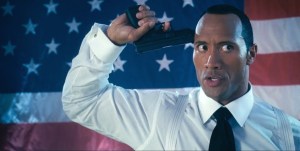 Fuel resources have almost run dry and the world looks to scientist Baron Von Westphalen (Wallace Shawn, hamming it up and having a good time) for a solution. The Baron has devised a substance known as Fluid Karma, which works under the properties of the churning oceans and will produce a radius of power. Fluid Karma also works as a powerful hallucinogenic drug and the Baron tested it on wounded Iraqi vets like Pilot Abilene (Justin Timberlake). Coldly narrating the film, Abilene stands guard outside the Baron’s laboratory and also peddles the drug on the side.
It is the summer of 2008 and the presidential election is months away. The Republican candidate, Senator Bobby Frost (Holmes Osborne), is in crisis mode. His spoiled daughter (Mandy Moore) is frantic because her husband, actor Boxer Santaros (Dwayne “The Rock” Johnson), has vanished. He’s awakened in the California desert with amnesia and shacked up with porn star Krysta Now (Sarah Michelle Gellar); the duo has written a prophetic screenplay called “The Power.” Krysta and a pair of tattoo babes (Nora Dunn) plan to blackmail the Frost campaign with video of Boxer frolicking with the adult movie star. They want the campaign to endorse Proposition 69, which would rescind the encroachments on civil liberties by the U.S. government.
A group of neo-Marxists, led by pint-sized Zora Carmichaels (Cheri Oteri), have kidnapped a police officer, Roland Taverner, and are using his twin brother Ronald (both played by Seann William Scott) to frame the police and Boxer. And I haven’t even begun to talk about Senator Frost’s wife (Miranda Richardson), the president of Japan having his hand lopped off in a loony sequence, the frequent inverting of T.S. Elitot’s quote about the way the world ends, a commercial where two cars literally have sex, and a rip in the space-time continuum that people are putting monkeys inside.
Extraordinarily messy and scattershot, Southland Tales has 1000 ideas rolling around inside without much traction. It’s as if Kelly thought he was never going to get the chance to make another movie again so he crammed every thought and topic he ever had into one 144-minute cross-pollinated jumble. The movie veers wildly and chaotically from political satire, to crude comedy, to sci-fi head-trip, all the way to Busby Berkley musical. There’s a little of everything here but few of the dispirited elements mesh and the film runs a good two hours before any sort of overall context becomes remotely approachable. One second the movie is satirizing a Big Brother control state and the loss of American civil liberties, and in the next second a character is threatening to kill herself unless Boxer allows her to orally pleasure him. You got, among other things, zeppelins, global deceleration, perpetual motion machines, Zelda Rubenstein, drugs, holes in time, twins, a murderous Jon Lovitz, ice cream trucks that house military-grade weapons, blackmail, Kevin Smith in a ZZ Top beard and no legs, reality TV, the American national anthem cut together with an ATM robbery, Biblical Revelation quotes courtesy of Timberlake, and, why not, the end of the world. What does it all mean? I have no idea but I credit Kelly for his ambition.
 Plenty of stuff happens for a solid two hours but little to nothing feels like it amounts to anything, and several subplots just get dropped. There are long stretches where I cannot explain even “what’s happening” from a literal description. This sprawling, magnificently self-indulgent meditative opus consists too much of side characters running into each other and having vague, pseudo-intellectual conversations that go nowhere. There are a lot of nonsensical speed bumps in this narrative. Sometimes the screen is just nothing but a series of newscasts overloading the audience with details on the reality of this alternative America; it’s filler. The conclusion is rather frustratingly abrupt; after slogging through two-plus hours of oblique questions it finally seems like we may reach some tentative answers, and then Kelly pulls the pin on his grenade and collapses his tale. Krysta tells Boxer in a moment of clarity, “It had to end this way.” Really? It did? This way?
The movie feels like a giant garage sale with scattered treasures hard to find but buried beneath loads of kitsch. Kelly clearly has bitten off more than he can chew and yet there is a bizarre undeniable power to some moments here. Roland (or is it Ronald) Taverner watches his mirror reflection a step behind; it’s unsettling and eerie and very cool. Timberlake has a drug-induced dance number where his scarred (both physically and mentally) Iraq veteran character is covered in blood, drinks beer, and lip synchs to the Killers’ song “All the Things I’ve Done,” which has the pertinent lyrics, “I’ve got soul but I’m not a solider,” and “You gotta help me out.” All the while, leggy dancing girls in blonde bobs strut and coo around him. It’s weird and tangential to the plot but it has a certain draw to it. The conclusion featuring the Taverner twins seeking forgiveness even generates some redemptive quality. Religious questioning and the philosophy of souls occupying the same realm plays a heavy part and gives the film an approachable reflection that tickles the brain, even if Timecop, sort of, visited the same ground, albeit secular, first (you’ll kind of understand when you see the movie). Southland Tales is grasping at profound and relevant messages, and yet some images achieve this easily, like a toy soldier crawling on the L.A. streets or a tank with Hustler stamped across its side for product placement. These simple images are able to transcend Kelly’s pop manifesto.
 None of the actors really equip themselves well with the outrageousness. Scott comes off the best but that’s because his character(s) is/are the only figure(s) the audience is given a chance to emotionally connect with. The Rock, listed for the first time simply as Dwayne Johnson, is an actor that I genuinely like and think has tremendous comic ability, as evidenced by 2003’s The Rundown. With this film, however, he comes across too constantly bewildered and shifty, like he really needs to pee and cannot find a bathroom. Gellar is woefully miscast and I think she knows it given her leaden performance. Southland Tales is the kind of film where every role, even the two-bit nothing parts, is played by a known face, be it Christopher Lambert, John Larroquette, Curtis “Booger” Armstrong, Will Sasso, and a horde of Saturday Night Live alums.
Kelly’s previous film succeeded partially because an audience was able to relate and care about the central characters, which is not the case with the comically broad Southland Tales. Kelly seems to work best when he has some restraint, be it financially or artistically; the director’s cut of Donnie Darko explained far too much and took some of the magic out of interpreting the movie on your own terms. Southland Tales runs wildly in the opposite direction and is a giant mess unseen in Hollywood for some time, though for the doomsayers comparing Southland Tales to studio-killing, self-indulgent, era-defining Heaven’s Gate, may I argue that Oliver Stone’s Alexander was far more self-indulgent, longer, wackier, and duller. Due to its unpredictable nature, you can never say Southland Tales is boring.
Southland Tales the movie begins as Chapter Four of Kelly’s saga, the first three chapters being made into comic books, and really, when I think about it, a comic book is the right medium for this material. The confines of narrative film are too daunting for Kelly’s overloaded imagination. Southland Tales is oblique, incoherent, strange, and unfocused but not without merit. I doubt Kelly will ever be given the same artistic legroom to create another picture like this, so perhaps Southland Tales has helped to reign in Kelly’s filmmaking. A reigned-in Kelly is where he does his best work, and I look forward to Kelly’s remake of Richard Matheson’s story, “The Box,” presumably with no dance numbers and sexually active motor vehicles.
Nate’s Grade: C


 nathanzoebl
You must be logged in to post a comment.