Blog Archives
Bruno (2009)
 Sacha Baron Cohen struck comedy gold and financial riches with Borat, his popular anti-Semitic foreign character that skewered American ignorance and xenophobia. Now, he’s back at it as Bruno, an extremely gay Austrian TV host who travels across America in hopes of being famous. The problem this time is that the Borat formula just doesn’t work the same with this character. Borat at heart had an innocence to him that made his outrageous statements tolerable, but Bruno is mostly obnoxious and you feel pity for the dupes that he annoys. The Cohen-Larry Charles technique of crash interviews snares some high profile victims like Congressman Ron Raul and Paula Abdul, but the movie is also thinly staged with corporate compliance from NBC/Universal opening doors for Cohen. There are a small number of worthy targets, from gay brainwashing counselors to stage parents willing to submit their children to anything for a buck, but the best is saved for an Arkansas fighting ring. It’s depressing that a bunch of people foaming at the mouth to see violence would become so incensed and repulsed by men kissing. Regardless, this movie is a string of unfunny skits slapped together with the message of breaking down homophobia. My question to Cohen: how exactly are you going to rid people of homophobia by inundating them with over-the-top gay stereotypes? Doesn’t that reconfirm what they feel? Bruno doesn’t make you feel uncomfortable because he?s gay; he makes you feel uncomfortable because he’s a jerk.
Nate’s Grade: C
Share this:

My Life in Ruins (2009)
 Tacky on nearly all fronts, this Big Fat Greek Wedding wannabe sequel features that hit movie’s star, Nia Vardalos, and plops her in Greece as an unhappy, uptight, undersexed tour guide. The movie follows her exploits to regain her “kefi,” Greek for “mojo.” My Life in Ruins paints in obnoxious broad strokes with its bus of fools, making sure the Australian tourists are never without a can of Fosters in their hand. The stereotypes are plentiful. The lame jokes are easily telegraphed and usually lowbrow (the bus driver’s name is “Poupi Kakas”), the acting is hammy, and the stabs of drama thanks to Richard Dreyfuss as a traveling widower feel alien. Being a romantic comedy replete with stock characters, naturally everything is predictable. Vardalos does a credible job here trying to hold this mess together, though she’s too prone to going for funny faces as a saving grace. Twice characters tell her that she’s not funny, and to this the audience will easily agree. I am dumbfounded that longtime Simpsons writer Mike Reiss wrote this crap. The only real enjoyment you’ll receive from this movie is marveling at all the fabulous Greek sights, from the ancient ruins to the seaside villas. I understand why the cast and crew would sign up to film this movie in Greece, but does that mean I have to subsidize their vacation with my own money? No thank you.
Nate’s Grade: C
Share this:

The Proposal (2009)
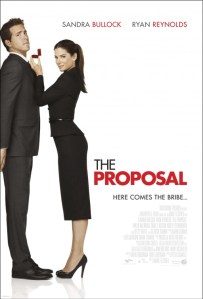 Romantic comedies can be elevated by the chemistry and comic abilities of their leads. I think the most painful modern pairing was Maid in Manhattan, which featured polar opposites Jennifer Lopez and Ralph Fiennes (could you find a more unlikely couple outside of Harold and Maude?). With The Proposal, Sandra Bullock takes a break from her usual pratfalls and finds a worthy sparring partner in the charming, self-effacing Ryan Reynolds. Bullock is a mean book editor who must get married ASAP or be deported back to Canada, and Reynolds plays her beleaguered assistant and surprise sham fiancé. The two actors have a terrific rapport and generous give-and-take, propping the other to higher achievement; they feed off each other. Their spirited, snappy, collaborative, and most significant, fun relationship is what won me over. Otherwise, The Proposal would likely have succumbed to its wealth of genre clichés, like kooky relatives (an irascible Betty White), contrived conflicts (see: premise), last-minute misunderstandings, and the collapsed window of time. These people go from hating each other to loving each other over the course of one weekend in Alaska. Yet through it all, Reynolds and Bullock kept me smiling and alert, saving me from cuteness overdoses. Hopefully Bullock and studio execs will learn from this that bickering couples work best when the actors can play nice together.
Nate’s Grade: B
Share this:

Couples Retreat (2009)
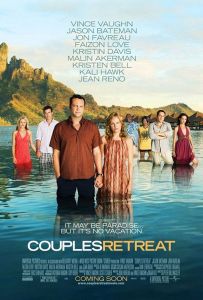 Vince Vaughn is a likable scamp. He’s generally played the same quick-witted, charming, motor-mouth lout in every movie since 2005’s smash, Wedding Crashers. He’s been working fairly nonstop since then and has, by all accounts, become something of a box office draw, which seems bizarre if you think about it long enough. So the best thing I can say about Vaughn’s new comedy Couples Retreat is, hey, at least he’s making sure his pals can pay the bills.
I think it was that famed poet Pat Benatar who said love is a battlefield. She never went through marriage counseling (note: maybe she did, I don’t care to actually research this). The movie centers around four dysfunctional couples that take a vocational to a tropical island resort. Dave (Vaughn) has trouble prioritizing his wife, Ronnie (Malin Akerman). Joey (Jon Favreau) and Lucy (Kristin Davis) have been together ever since she got pregnant in high school. They’re at each other’s throats and secretly looking to cheat on each other. Jason (Jason Bateman) and his way younger wife, Cynthia (Kristen Bell), are unable to conceive a baby. They’re very organized about their life and cannot handle life’s deviations. Finally, Shane (Faizon Love) has been dumped by his wife and is taking the loss hard. He’s found comfort in a flighty twenty-year-old girl (Kali Hawk) that he can barely keep up with. The vacation is interrupted when the couples learn that they must participate in the resort’s relationship therapy sessions or leave. The couples must stick it out to in order to save failing relationships and ride those nifty Jet skis.
 Couples Retreat sure doesn’t feel like any vacation for the audience. Directed by Peter “Ralphie” Billingsley (longtime friend and producing partner for Vaughn and Favreau), the pacing is leaden and the movie feels like its coasting without any momentum. Structurally, the plot is not your series of escalating events but more a relentless parade of tiny plot speed bumps, seemingly indistinguishable from the last. Many scenes just bump right into each other with little transition. Billingsley does not show that he comprehends the rhythms of comedy. Even at a mere 107 minutes, this movie felt twice as long to me. Like Peter Jackson’s King Kong, it just takes way too damn long for these people to get to the freaking island. I don’t need a half hour of setup for stock characters. Many scenes will go on too long and then just sort of come to an abrupt end, like Vaughn and his friends were saying, “Well, we’ve taken this as far as we can go. The scenes don’t end in climaxes or revelations or punch lines, they just end. So after a while I felt like Couples Retreat was one long draggy middle of a mediocre movie stretched out interminably. It’s the equivalent of an eternity of waiting in a doctor’s office.
The character work is haphazard at best. You would think with the premise involving introspection and communication that the screenplay might offer up some deeper characters. You would be mistaken. Each character is given one note/generalized conflict to work, and they stay exactly within that narrow field of play. The male-female dynamics are Joey and Lucy have been together since high school and now they each have wandering eyes. Of course this kind of waffling infidelity is played for such sophomoric yuk-yuks like Joey getting caught masturbating and Joey getting an erection during a massage. You see a trend there? Cynthia and Jason are too anal retentive about their lives and the fun has died out. Sounds like room for some comedy. Oh, and they are also having trouble conceiving, which is way too serious a topic for this kind of movie. It’s somewhat amusing to think of Vaughn as the most stable character in a family comedy; it’s sort of like when Christopher Walken was the voice of reason in 2004’s equally bad, Man on Fire. What is Vaughn’s problem exactly anyway? He’s a “video game seller” who spends too much time… selling video games? The particulars of his job are too nebulous; does he work at a large chain, does he work at a software production company, what does he do that he can’t bother helping out his wife for one afternoon? You could almost certainly eliminate Faizon Love’s character completely. He’s just in the movie to crank out obligatory “older guy with too young girl” jokes, and his resolution is so hackneyed and reliant upon ridiculous coincidence (surprise, his ex-wife has tracked him down to the resort!) that it hurts the brain.
The movie has the benefit of being made in one of the most gorgeous places on earth. I’m sure the cast and crew had a great time making this movie. Too bad it doesn’t translate well to the paying customers. I was surprised at how stodgy the overall film is. I expected it to look down on hedonism, and I appreciated the movie treating marriage as a serious commitment that constantly needs to be engaged, but what is up with how stuffy this message comes across? The people who aren’t in relationships are seen as little party animals looking for their next carefree fix. Sure marriage is going to look better to the masses when you make the alternative so irresponsible. However, prolonging unhappy, extremely dysfunctional couples who can no longer stand each other isn’t helping either. Can’t some dysfunctional couples just grow apart? Why must there be reprehensibly forced happy endings all around? Couples Retreat, after awhile, kind of feels like your grandmother lecturing you about your relationships.
 There’s much potential for laughs with Couples Retreat, but you’ll do no better than scattered chuckles. This is definitely a case where all the good jokes were highlighted in the trailer. Couples Retreat squanders so much talent, mostly consisting of a boy’s club and giving the actresses little to do or play off of. Akerman (The Heartbreak Kid), Bell (Forgetting Sarah Marshall), and Davis (Sex and the City) are all very capable comedic actresses; Kali Hawk quickly becomes irritating with what she’s been given. The island therapists include the hilarious John Michael Higgins (The Ugly Truth) and Ken Jeong (The Hangover), who must be contractually obligated to appear in every movie this year. I would have thought that eccentric therapists plus the natural conflicts of couples counseling would have provided a wealth of funny material. It’s a shame then that the counseling scenes are kept short. It would be a better asset for this movie if it spent more time in therapy and less time doing goofy, trust building exercises by island guru Jean Reno. Seriously, swimming with sharks is supposed to help a deteriorating marriage how? There are comic setups that look like they’re going to lead to something juicy, and then they just fizzle, like a Guitar Hero battle that goes from silly to lame all too quick. A buff and tan yoga instructor (Carlos Ponce) gets a little too in touchy-feely with his female pupils. But then it stays at a distance, hammering home the same PG-13 safe sight gags. It’s like watching people dry hump for laughs. As I expected, the funniest parts are the naturally combative interplay between Vaughn and Favreau. Part of that may be because they’ve been friends for over a decade and part of that might be that both are credited as screenwriters, along with producer Dana Fox (What Happens in Vegas).
Let’s look at how I’ve described Couples Retreat in this review. Waiting in a doctor?s office. Listening to your grandmother condemn your relationship. Doesn’t sound like much of a good time, does it? The comedy consists of mostly one-liners with a whole lot of dead space in between. The characters are so limited, the actors are shamefully wasted, and the comic set pieces are too meandering to be amusing. Somewhere there’s an edgier, R-rated version of this movie that got scrubbed clean to fit a PG-13 mandate. You see glimpses of the naughtier movie Couples Retreat might have been. This is a movie in need of some serious counseling of its own.
Nate’s Grade: C
Share this:

The Invention of Lying (2009)
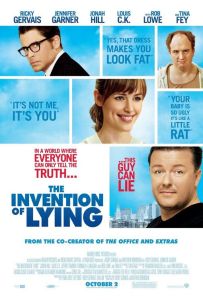 Imagine a world where people could only tell the truth. Sounds scarier than anything in horror movies today.
Mark (Gervais) is trying to romance Anna (Jennifer Garner) but even the waiter tells him she’s out of his league. She tells him upfront that she finds him unattractive and he will never have any hope of having sex with her. She’s more interested in Mark’s snide but handsome co-worker, Brad (Rob Lowe), who she feels is a better genetic match. Mark is about to be fired from his job, writing historical screenplays about the 13th century, and his secretary (Tina Fey) delights in telling him that she loathed every minute they spent together. This is a world without a filter. Until one day Mark goes to take out money from the bank, and something inside his brain switches. His balance is $300 but he asks for $800, and the bank teller apologizes for the computer error and gets Mark his full $800. He explains to his barfly friend Greg (Louis C.K.) that he said something that wasn’t. Nobody understands. “I’m a black Eskimo,” Mark says. Everybody takes him at his word. Mark is the only human on earth who has the ability to tell a lie, which he uses to his great advantage whether it be gambling, getting out of a traffic ticket, or unearthing a “lost” historical chapter about ninjas and aliens that makes for a stirring “non-fiction” film. Mark can’t even explain what he’s done, since the world lacks even a word for “lie.”
Gervais and co-writer Matthew Robinson concoct some interesting and inspired ideas of what a world bereft of lying would be like. Naturally, advertising would be completely different if people had to tell the truth, the whole truth, and nothing but the truth; imagine prescription drug ads that only said, “This is a placebo. Your penis won’t ever grow bigger.” The slogan for Coca-Cola is, “It’s very famous,” and the slogan featured for its rival, Pepsi, is, “When you can’t have Coke.” No one has any concept of fiction, of people pretending to play parts, so movies only consist of an older man sitting comfortably and reading a historical account with some minor dramatic inflection. Movies have become book reports. The sign in front of a retirement center says, “A Sad Place for Hopeless Old People,” and a motel sign reads, “A Cheap Place to Have Intercourse with a Near Stranger.” However, I’m puzzled by how forcefully open every person is. Just because you can only speak the truth doesn’t mean you have to be talking constantly. I understand Gervais’ point about the need for lies to protect people’s feelings, but just because you think someone looks fat doesn’t mean you have to blurt it out. When Mark greets Anna at the door for their date she reveals, “You’re early. I was just masturbating.” It’s funny, sure, but did she feel compelled to link the two statements? It seems in this world, everyone is incapable of keeping their mouths shut.
 The premise of the movie is terrific, and I’m honestly shocked no one has thought of it before. But the premise wears a little thin after the first 30 minutes of people speaking with no filter. You begin to expect outrageous comments that will be hurtful and blunt, and because you expect them it takes away the shock value and lessens the humor. But then The Invention of Lying takes a sharp right turn at about minute forty and becomes a radical and subversive and much funnier movie. Mark is comforting his dying mother (Fionnula Flanagan) who is afraid of leaving existence. She’s afraid of a cold nothingness. So Mark explains to her that there is an afterlife, a world beyond our own, where everybody gets to be around their loved ones in a mansion, and there’s no pain. She closes her eyes and dies in peace with this new knowledge. The doctors and nurses are amazed and beg to know more. Mark has created the idea of religion and God! He’s mobbed by people and camera crews demanding him to explain what he knows. Mark then works up the courage to establish a system of 10 rules to follow, which he tapes onto old pizza boxes. He then addresses his flock and has to explain the complicated minutia of religion, with hilarious questioning from the acolytes. Mark explains that there is a “man in the sky” who watches everything we do and is responsible for everything that happens. “Does that mean the Man in the Sky gave my sister cancer?” someone asks. Mark tries to explain the nature of a loving, all-powerful deity who willingly allows bad things to still happen. “Screw the Man in the Sky,” someone yells, “He’s going to kill us all. We need to fight back!” You try explaining the nature of the unknown to people.
It’s at this point that the movie transforms into a biting satire on belief and belief. I was cackling but I noticed that my theater seemed to get awfully quiet the longer the religious satire went on. I almost spat out my drink when I saw a spinning newspaper headline that said, “Man in the Sky Continues to Give Children AIDS.” It’s offensive but completely within the bounds of religious questioning. Gervais and Robinson aren’t ridiculing religious belief; in fact they seem to prove that it has a definite place of significance within society and can be beneficial psychologically. The satire isn’t savage and still manages to play with the amiable, fable-like nature of the story. Gervais isn’t laying out an argument that believing in an unforeseen deity is stupid. The movie isn’t condescending or hectoring, like Bill Maher’s anti-religion documentary Religulous, but it does take some slyly subversive swipes at the nature of faith and its reliance upon the unproven.
 The Invention of Lying suffers from trying to be a romantic comedy. Too much of its conflict is spent on whether the chubby guy can get the pretty girl. The movie gets a tad sentimental for dealing in bitter-truths, and Gervais and Robinson steer the film to the ultimate romantic comedy setting: objecting at a wedding. I wouldn’t have minded the rom-com asides if they didn’t feel like they kept striking the same chord. Mark wants to be in a relationship with Anna. She points out that he’s fat, has a snub nose, and not a good genetic match. He persists. She points out that he?s fat, has a snub nose, and not a good genetic match. This goes on and on until the inevitable break at the end. Mark, and especially Gervais, is an appealing guy, self-effacing and witty, even downright cute at turns, but when Anna keeps repeating the same looks-first mantra, it makes her seem increasingly shallow and him seem like a glutton for punishment. Garner is a fabulous comedic actress and packs a lot more emotion into her character than I would have expected given the conceit.
Ricky Gervais is catching fire as of late, and it seems that America is finally waking up to the charms and brilliance of this squat comedian. He created The Office, the standard for squirm-based comedy, and appeared in the underrated supernatural comedy Ghost Town last fall. Gervais shows the necessity of lies in our world, from sparing hurt feelings to making mass-market entertainment. The world needs dishonesty. When The Invention of Lying is on-target, it is a hilarious, almost brilliant, comedy, with its best gags saved for taking on “the Man in the Sky.” It’s too bad then that the entire movie doesn’t live up to these flashes of comedic brilliance. Still, the movie is sweet enough and ends on a satisfying level, even if The Invention of Lying begins as one movie and ends as another. Gervais is an appealing lead, though he doesn’t prove much in the way of a director, and he has some real dramatic acting chops too, nicely put to use during his mother’s deathbed scene. I hope more Americans wake up to this man’s charms. Gervais continues to show audiences the sharp wit that has made him one of the world’s foremost funnymen.
Nate’s Grade: B+
Share this:

(500) Days of Summer (2009)
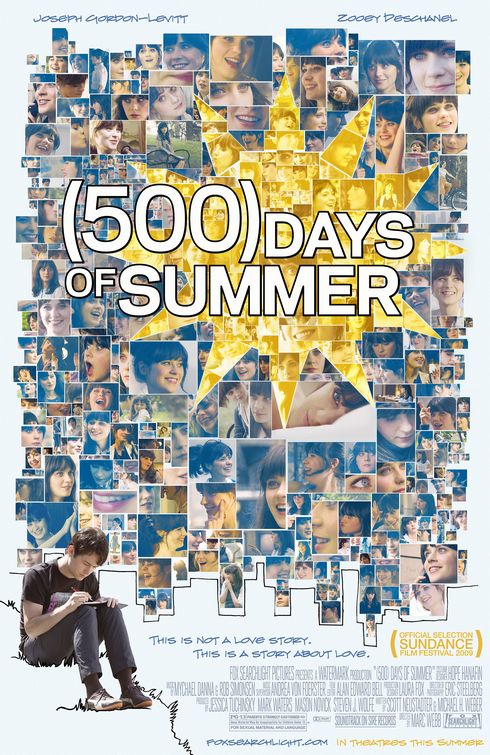
It doesn’t take long before you realize that (500) Days of Summer is a different kind of romantic comedy. In fact, to slap that genre title onto it does a disservice. I’ve watched plenty of romantic comedies (a notable rise in viewership since getting married in 2006), and the traditional Hollywood romantic comedy exists in a world not our own. It is a sitcom world where people blurt out their feelings, interact in bizarre manners, and get into wacky hijinks and contrived misunderstandings. These tales also exist in “movie world”; (500) Days of Summer, on the other hand, is refreshingly recognizable. Granted the characters still have fantastic if slightly off kilter jobs (writer of greeting cards), and the characters live in fabulous and gigantic apartments. Excusing those contextual quirks, the movie is upfront about its intention. “This is a story of boy meets girl,” a narrator intones, “but it is not a love story.”
Tom (Joeseph Gordon-Levitt) recounts the 500 days he has spent with his ex-girlfriend, Summer (Zooey Deschanel), the girl he aches over because he feels her to be his “one.”
This is a movie about love and relationships but it has such a wider scope. It’s perceptive and insightful in the way that human beings engage in coupling. Tom ping-pongs between memories, tying together happy moments and the failed recapturing of those exact happy moments later. I enjoyed how reflexive the film can be with romance. When Tom is infatuated with Summer he lists her attributes: “I love her smile. I love her hair. I love her knees. I love how she licks her lips before she talks. I love her heart-shaped birthmark on her neck.” And then when he is frustrated with Summer, he lists her faults: “I hate her crooked teeth. I hate the way she smacks her lips. I hate her knobby knees. I hate that cockroach shape splotch on her neck.” I appreciate a movie that tries to tackle the complexities of love in a manner that doesn’t seem trite or sensational. A movie doesn’t have to say anything new about romance (is it even possible to scoop the Romantic poets?), but it can still say something true and revealing. It is a story about love, but not a love story.
 It also helps that the characters are meaty and are played by capable actors. Tom is a smart enough guy, though a bit of a foolish romantic. He buys into the love that is talked about in pop songs and greeting cards; he’s not naïve per se but plenty vulnerable enough to get his heart broken in the real world. Summer is an independent woman who says at the start that she is not looking for a boyfriend. She doesn’t wish to be constrained by a relationship and wants to enjoy the carefree days of youth. Yet Tom persists thinking he can wear her down or win her over, waiting for Summer to cave and find solace in Tom’s embrace. He fancies Summer as the “girl of his dreams,” though everyone else isn’t so sure. His little sister argues, “Just because she likes the same bizzaro crap you do doesn’t mean she’s your soul mate.” One of Tom’s friends has a really nice monologue describing his “perfect girl,” and these descriptions noticeably differ from that of his long-term high school sweetheart. But then he stops, reflects, and says that’s what his “perfect girl” would be like, but his current girlfriend, well, she’s better than his imaginary version of a perfect girl. But Summer isn’t a fantasy of romantic perfection, she’s a person. She has her own desires, her own insecurities, her own ambitions, and her own life to lead. These two feel like actual human beings and not stock players, though (500) Days of Summer does carry its own share of stock parts like the square boss (Clark Gregg) and the goofy, horny friend (Geoffrey Arend).
The saying “the camera loves” somebody seems outdated, old fashioned, and liberally applied. But when it comes to actress Zooey Deschanel, well, the camera just loves her. It’s hard not to fall in love with this blue-eyed beauty. She’s adorable, but not in an overly quirky way, and she’s smart, but still approachable, and altogether lovely. She is the face of unrequited love. She can be cold and aloof and jubilant. Deschanel plays the complications and complexities of an enigmatic woman who refuses to abide by labels. Her last conversation with Tom manages to be both crushing and inspirational. Her chemistry with Gordon-Levitt feels entirely naturalistic and pleasant. Gordon-Levitt has been cranking out strong performances in indie films like Brick, Mysterious Skin, and The Lookout. He’s quite possibly becoming one of the premier young actors working today. He has an everyman capability but he also can turn on the charm in a way that doesn’t seem forced, like Shia LaBeouf. Gordon-Levitt is the anchor of this movie and we see the world and Summer through his eyes. He brings great vulnerability to his role and we feel each step of his emotional journey. Both actors deliver terrific performances that don’t stoop to playing by the conventions of the romantic comedy.
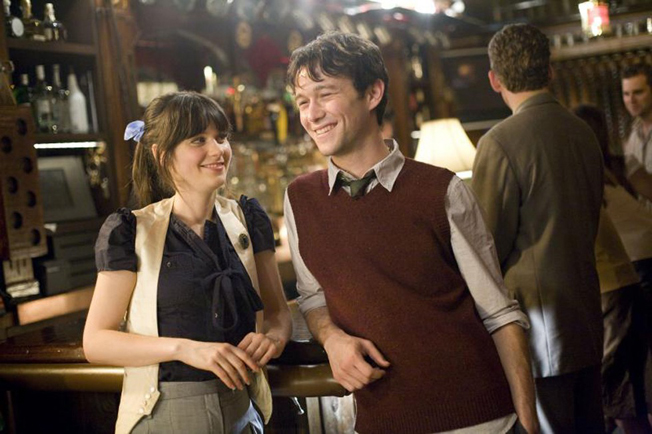 The nonlinear story structure seems like a gimmick until you realize that the writers, Scott Neustadter and Michael H. Weber, have cleverly freed themselves from the contrivances of movie romance time. MRT, for those who prefer their nomenclature in the shorthand, is that unbelievable breadth of time where the characters fall head over in heels in love with each other. It always feels so fast and far too fleeting, so that when complications have to arise late in the second act they too feel rushed. You could apply a healthy dose of montages to signify massive time passages, but those get old unless you’re Sylvester Stallone training to fight another boxing match. (500) Days of Summer tells you right away that this story takes place over a year and a half, and Day One isn’t when boy got girl but when boy met girl. By skipping around to specific dates, Neustadter and Weber are hitting only the highpoints, the memorable moments, and leaving out the unforeseen groundwork. All those mundane yet essential moments of pulling together a successful relationship are there, they are just now implicit. They are implied in the time jumps. The relationship between Tom and Summer, therefore, exists in an expanse of time that feels believable. The nonlinear structure also belies the way our memories work. Human beings don’t remember everything in a straight line, especially in matters of the heart.
There’s a lot of drama to be mined here with the breakup territory, but the movie is also playful and funny. Director Marc Webb, he of the video music world, pokes fun at other filmic expressions of love. At one point, Tom struts down the street and becomes the center of a lively choreographed dance sequence complete with animated blue birds. At another point, during Tom’s heartbreak, the movie descends through Bergman and Fellini visual tropes. It simultaneously communicates Tom’s emotional highs and lows and satirizes the histrionic nature of his feelings. Truly, when one’s in love you couldn’t feel better, or worse, but upon retrospect you can see how silly such in-the-heat-of-the-moment proclamations can be. There’s also a scene later in the film where Tom attends a party that Summer invited him to. The screen cuts in half, and on one side we see Tom’s expectations of what will happen that night and on the other side we see what actually occurs. The visual symmetry is interesting and a great glimpse inside the mind of a hopeful romantic.
 (500) Days of Summer manages to be breezy, moving, delightful, perceptive, charming, and just a great time at the movies. It’s a story about falling in love for the right reasons with the wrong girl. Summer isn’t the villain of the piece but her own woman, and she can be fickle and frustrating but she is not cruel or indifferent. Tom is desperately in search for his “one true love” but he’s playing by a checklist he’s drawn up from movies, TV, and love songs. All of this could have been sticky and formulaic (in fact, the dynamic vaguely resembles the characters from the abysmal Ugly Truth), but the filmmakers and the talented actors make the movie feel honest and relatable. The nonlinear narrative allows the movie to simultaneously be more playful, believable, and actually easier to understand, linking selective memories. No matter your current romantic situation, (500) Days of Summer is a slick antidote to Hollywood’s rom-com factory line.
Nate’s Grade: A
Share this:

New in Town (2009)
 Uninspired, slack, overly sentimental, deeply formulaic, the romantic comedy New in Town is so lazy it could have been written by a committee of trained chimps. This tired fish-out-of-water story takes a big city businesswoman (Renee Zellweger) and drops her in frigid small town Minnesota. Get ready for funny Fargo accents and dated stereotypes, doncha know. First the locals are ridiculed and then our big city gal discovers that these small town folk are to be envied. Just once, I’d like to see a Hollywood movie where a big city professional takes an extended jaunt in some Podunk town and discovers at the end… that small towns are overrated and they’ll take the big city any day. Sorry Sarah Palin, small towns do not have a monopoly on values and are not any more truly American than we city dwellers. Anyway, Zellweger looks like she’s in pain the whole time, then again that could be that natural contortion of her scrunched-up face. There’s a romance between her and the local union rep (Harry Connick Jr.), some lessons to be learned, and a late savior in the form of tapioca pudding. New in Town is moronic at most every step, and given the current wintry economic climate, a romantic comedy about downsizing feels like a bad joke in itself.
Nate’s Grade: C
Share this:

He’s Just Not That Into You (2009)
 Based upon the best-selling nonfiction book, the movie follows the interconnected lives of a cadre of characters trying to get lucky in love. As with any ensemble piece, some storylines are better than others, notably Ginnifer Goodwin (HBO’s Big Love) as a naïve and hapless gal confused by the ever-changing rules and rituals of contemporary courtship. Her scenes with Justin Long, as her dating coach, are the movie’s high-point. The two actors have a light, charming chemistry and their scenes get at the heart of the male/female dating dysfunctionality without feeling trite. But in between, you get a lot of hackneyed yakking about the stereotypical differences between men and women, how dumb men are, how crazy women can be, etc. It’s all been covered to death by other romantic comedies to the point that it feels like common knowledge, which makes it tiring to sit through. Some of the drama feels overly manufactured, like Jennifer Aniston pushing to get married because she her little sister got engaged, there are characters that are just annoying people, like Kevin Connolly continuing to nip at the heels of Scarlett Johansson for some scraps, and Some of the material is weirdly dated, like Drew Barrymore talking about being “Myspace-ed” by a prospective date (Hello, it’s all Facebook all the time now). Naturally, it’s all rather predictable as well, however, this is not the fun date movie it may seem. It hits some rough dramatic patches, like the pains of infidelity, losing trust in a spouse, manipulating people, and occasionally there will be a moment that comes across as genuine and heartfelt, like when Ben Affleck wins over Aniston simply by being thoughtful and doing the dishes. It’s in these sporadic moments that He’s Just Not That Into You feels like it’s tapped something a little deeper and more meaningful than scraping the barrel of romantic comedy clichés.
Nate?s Grade: C+
Share this:

Funny People (2009)
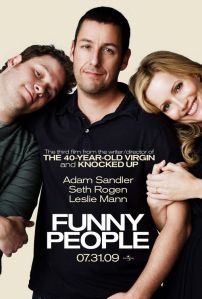 In two short years, Judd Apatow has become the king of comedy. He’s co-written and directed two bona fide hits that will go down as comedy classics (40-Year-Old Virgin, Knocked Up), and produced gut-busters with heart, like Superbad and Forgetting Sarah Marshall. The Apatow brand of comedy centers on characters and less on contrived set pieces. He’s built up enough comedy capital in Hollywood that he felt he could write and direct a project less ideally commercial, something tagged as being more personal and serious like in the James L. Brooks mold. Funny People is the mixed results. I applaud Apatow for trying to grow as an artist, but as the saying goes, if it ain’t broke don’t fix it. Funny People is a broken movie that isn’t funny enough to be fully redeemed.
George Simmons (Adam Sandler) is a famous comedy actor that has made several hit Hollywood comedies. He may live in a giant mansion but his life is extremely isolated and lonely. He has no real close friends and years ago he drove away the love of his life, Laura (Leslie Mann). He has no one to comfort him in his time of need. This prickly man has been informed that he has a terminal blood disease. Simmons decides to go back to his comedy roots, to stand-up, and it is there that he meets the young comedian Ira Wright (Seth Rogen). Ira has grown up with the comedy of George Simmons, so he is flabbergasted when the man himself asks Ira to write jokes for him. Ira’s roommates, fellow stand-up comic Leo (Jonah Hill) and crappy sitcom actor Mark Taylor Jackson (Jason Schwartzman), can’t believe his dumb luck. Ira and Simmons build an unorthodox friendship, and Ira is the only person George has confided in about his disease and his fear of dying. And then something amazing happens. George Simmons gets better. He’s got a new lease on life and he aims his attentions on the girl that got away. Laura is married to Clarke (Eric Bana), a handsome Australian businessman, and she has two adorable kids (Apatow’s own girls), which makes it a very poor time to restart her romance with George.
 Funny People is the first Apatow-helmed film that feels sadly incomplete, even at two and a half hours. The movie is staggeringly sloppy when it comes to plot structure and character work. First off, when a character is informed that he has a terminal illness at minute three, it doesn’t have the impact that it would if the audience got to know and feel for that individual. In fact, the first half of this movie feels like, and this may get confusing, the second half of another movie. It centers on a selfish character coming to grips with his choices in life, mostly wrong, and beginning to reconnect with people once more, building a mentor friendship and finding the “one that got away.” But there are segments during this first half of Funny People where the impact just cannot be felt because the dramatic legwork has not been achieved. Watching Simmons’ estranged family berate him through tears doesn’t have much of an impact when they discover the news. Seeing George Simmons spend his potential last days jamming with Jack White and other musicians is cool, but it doesn’t come across as anything but another indication that the fake George Simmons is famous in this alternative Los Angeles. It doesn’t have setup, like Simmons talking about one of his life’s pleasures is strumming the guitar or playing before things got complicated. So it’s basically just another celebrity cameo snapshot. While I’m on the topic, the multitudes of celebrity cameos are strangely unfunny, save for a bit where Sarah Silverman describes her lady parts.
This is also the first Apatow comedy where it feels like twenty percent of what I saw promised from TV spots, trailers, making-of specials (there was a good one on Comedy Central to check), the advertising unit if you will, was not in the movie. This gave me the distinct impression that even at a lengthy 150 minutes that Funny People feels misshapen, that there are swaths of material on the cutting room floor that would have assisted the narrative and sad amount of underwritten supporting characters. I’m not saying Funny People would necessarily be a better movie at three hours length, but it would at least feel more fully formed and satisfying.
 The main problem with the film, outside of the reverse plot structure, is that everything just goes slack during the uneven second half. George and Ira spend about an hour of the movie with Laura and her family, and it feels like one long uncomfortable detour. Part of the squirmy feeling is intentional, as the audience is supposed to be in Ira’s shoes and see George’s homewrecking as the bad decision train wreck it is. But I also felt uncomfortable because George kept extending his stay day after day and I was getting impatient. I wanted these characters to head back to L.A. and deal more with the Ira/George relationship. During this second half, Ira becomes a background figure that is good for nervous reaction shots. This stalls all the character work that had been done up to this point and Ira goes to pause mode for an hour. This second half section isn’t particularly funny, it isn’t romantic, and it gives little insights into the past between George and Laura. She has established a nice living for herself, with two cute kids and a hunky husband who seems to be a good father when he’s around. In fact, despite the movie’s insistence that Clarke is a cheater (thus ensuring the movie law that it is then acceptable to cheat on him), I found myself liking the hyperactive and sensitive lout. Every plot movement in this second half feels wrong, some of it intentional, but it makes Funny People feel like it has been hijacked and taken hostage. Where did the movie I was kinda liking go? What happened here? This hour feels like a separate movie and one that Funny People would have benefited from simply being dropped entirely.
Perhaps I’ve been watching too much Mad Men in anticipation of its third season, but this movie also disappoints by failing to delve into the creative process of comedians. Despite its running time and subject matter, there isn’t that much standup witnessed. Usually the movie will display about one line or one bit and then cut back to the characters offstage again. We don’t get to see the evolution of comedy or the professionals talking shop about what makes a good joke. There isn’t even much collaboration, so we don’t get to see multiple minds banging out jokes together. There’s a comedian named Randy (Aziz Ansari) who is popular with audiences because he’s loud and spastic, and all the other comedians hate him, but then the movie doesn’t return to this. Go back to this topic. I want to hear more about the divisions within the comedy world, the people that feel like they are more pure or textured in their funny compared to the people that play to the crowd and lap up the easy yuks. Ira’s character work is mostly explored through his changing standup persona, where he seems to gain more confidence and a voice. But there’s this whole other storyline where Ira is a “joke thief” and takes other people’s material and repackages it as his own. This is an interesting story and provides conflict and glimpses into the character of Ira as an insecure and ethically challenged opportunist in a competitive field. It makes him a more dynamic character. I saw more of this storyline in the making-of special for Funny People, and sadly it is only hinted at in the final product. The other comedy players, like Ira’s roommates and his quasi-love interest (Aubrey Plaza), are barely explored as people and professionals.
Apatow comedies are notable for being character-based, but Funny People doesn’t seem too concerned with establishing characters that you want to be around. I found little reason to care. I found most of the characters to not be engaging; some were unlikable but most were simply flat. George Simmons is supposed to be a selfish man, though there’s something inherently selfish about being famous in Hollywood. Comedy itself is inherently selfish, where individuals guard their observations and exploit personal stories for the endorphin highs of audience approval. Is successful comedy linked to selling out? Funny People occasionally visits the dark recesses that comedians utilize for material, like self-lacerating humiliation and family trauma that gets aired out as a means of therapy. Simmons is a selfish and lonely guy and the point of the whole movie is that even after a near-death experience, he’s still selfish and lonely. He’s said he’s changed but has he really? That seems to be the movie’s cosmic joke. This is clearly a personal movie for Apatow, which might explain why it has less resonance for an audience that isn’t as steeped in the history of comedy or the rigors of fame. I just don’t have the same point of interest.
 Sandler revealed his acting talent in 2002’s beguiling Punch-Drunk Love, and in Funny People he plays a completely different character than his other adolescent roles. He doesn’t pander to be likable at any point, and he’s generally standoffish from beginning to end. He hasn’t done a lewd, crude movie in over ten years, and this return to raunch rekindles the Sandler I remember listening to constantly in the mid 1990s. This role isn’t as taxing for him as an actor, nor is he given too many chances to reveal deeper layers to George Simmons. I think this is by design from Apatow. Rogen is less his charming self and during the second half of the movie he pretty much shifts his eyes and makes pained faces. He feels at ease in the stand-up sequences, probably because Rogen performed stand-up comedy when he was 13. Mann gets her biggest acting role in years and cries enough, but it made me realize that she works best as an actress that can steal scenes rather than an actress who has scenes built around her. I think Bana (Star Trek) actually comes off the best. He showcases an exuberance for comedy not seen before, and when his character gets emotional it still manages to be funny and believable.
In the end, Funny People just isn’t that funny. There aren’t any particularly clever comedic setups, the characters don’t get many chances to be humorous even as comedians, and the movie just goes slack during its uncomfortable and uneven second half. The Hollywood satire lacks bite, and the best bits are saved for the scathingly unhip and formulaic “Yo, Teach!” sitcom of Schwartzman’s. Apatow is more interested in purging a personal tale onto the screen rather than fashioning a relatable mainstream comedy. I feel that the salutations that Funny People is “more challenging” and “serious” are unwarranted. This is certainly a different movie but is it any more serious than navigating the uncertainty and awkwardness of an unplanned pregnancy or beginning sexuality at middle age? I don’t think so. Beyond this, the movie doesn’t establish its plot well and spends far too much time in side diversions, failing to round out characters and ignoring intriguing premises and storylines. Even the camaraderie, usually a hallmark of Apatow productions, feels lost as the characters have much more friction. On a personal note, I saw this movie while I was on vacation in the Outer Banks. On our car ride back to our beach house, my then-partner and I got into a car accident. We were both physically fine but her little Ford Focus was totaled. I will now forever associate Funny People with a car accident. If that isn’t enough of an on-the-nose metaphor, while we waited along the hot road for police and tow trucks, I thought to myself, “I just wish the movie was worth this.” It wasn’t.
Nate’s Grade: C
Share this:

I Love You, Beth Cooper (2009)
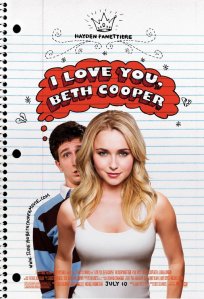 Not the trainwreck it’s been advertised as but still not near the term of “passable,” I Love You, Beth Cooper feels like a forgotten relic from a time capsule of 1980s teen movies. It just feels so powerfully dated and yet unable when to maintain a consistent comedic tone or building interesting characters. During the valedictorian’s (Paul Rust) graduation speech, he loses his filter, lets people know his real thoughts, and Beth Cooper (Hayden Panettiere) gets the titular declaration. Thanks to director Christopher Columbus, the movie wallows in shallow stereotypes; geek goes after head cheerleader. The comedy is ramped-up slapstick that approaches cartoon ridiculousness, including Beth’s ex-boyfriend who assaults and destroys everything in sight without anyone ever calling the police. There are some ham-handed life lessons doled out between the PG-13 randiness. The casting also dooms the flick. Panettiere isn’t a strong actress, and as for Rust, I was irritated by the character’s every movement and word. There are some fun stretches but nothing that ever sticks or resonates. I Love You, Beth Cooper is not worth adulation or scorn, just indifference.
Nate’s Grade: C


 nathanzoebl
You must be logged in to post a comment.