Blog Archives
Valentine’s Day (2010)
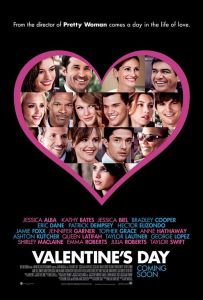 Imagine every romantic comedy cliché and sappy platitude about love stirred together into one giant gelatinous conglomeration of hollow sentiment. That’s Valentine’s Day. Regardless of your thoughts on the holiday, this movie, which aims to celebrate our national day of love, might have the opposite effect. This movie makes He’s Just Not That Into You look like When Harry Met Sally. It?s a fairly large ensemble with plenty of mega-watt stars, but it’s too bad that nobody knows what to do. Jessica Alba’s character literally runs her course an hour into the film and yet she still makes meaningless appearances. This overstuffed Hallmark card has ridiculously safe, candy-coated storylines sanded so that there is no hint of edge or wit (Anne Hathaway is the most ludicrous PG-13 phone sex operator you will ever find). The resolutions of most of these storylines will be predictable to anybody who has ever read a greeting card. Jamie Foxx is supposed to be a bitter TV reporter popping up everywhere reporting about the ills of V-Day. Think he’ll have a change of heart by the film’s end? The cast does offer their small pleasures (there are SIX Oscar nominees/winners in this movie!), except for the kid who has a crush on his teacher (Jennifer Garner). He was insufferably annoying. So was his movie.
Nate’s Grade: D+
Share this:

The Men Who Stare at Goats (2009)
 This movie was a big letdown given the cast, the strange true origins of this fantastic tale, and even with the title. This odd little film feels tonally off. The material feels mishandled, mixing broad humor and with military satire and the dark realities of the war in Iraq. The premise is solid — a Pentagon program training psychic soldiers, men convinced they could run through walls or terminate goats through the power of thought. Why then does the movie feel so misguided and rudderless and, ultimately, boring? Never has such an outlandish concept, based on true events, felt so devoid of edge. The satire picks safe targets and the comedy remains farcically broad. I think the film’s downfall can ultimately be traced to the decision to turn this material into a fictional narrative. I would have preferred an actual documentary detailing the men, women, and goats involved in the real Pentagon program. If truth can be stranger than fiction, why dress it up and then dull it through fiction?
Nate’s Grade: C
Share this:

The Informant! (2009)
 Stephen Soderbergh’s comic farce is highly amusing from start to finish. I even watched it twice and still found myself shaking my head and chuckling in bafflement. That’s the best way to describe the tone of the film — baffled laughter. Matt Damon stars as Mark Whitaker, a corporate whistleblower whose grasp on the truth is tenuous at best. Damon’s character is a cut-up and his delusions of being a spy plus his scatter-brained narration are as fascinating as they are hilarious. This guy thinks he’s James Bond. And yet the film, while deeply comic, never comes across as snide or condescending even if most of the laughs come from Whitaker’s disconnect from reality. The film has a deliberately ironic tongue-in-cheek vibe, from the silly yet undeniably jaunty kazoo-aided score by Marvin Hamlisch to even the amber-colored cinematography (like the film was shot through the prism of a honey jar), the movie is an entertaining series of blunders and revelations. Damon is charismatic and deeply funny and Whitaker makes for such an interesting main character exactly because he is so unpredictable and unreliable. He doles out the truth in pieces like a kid caught. The Informant! is light and breezy but with some well-honed psychology of rationalization and self-deception. I don’t know how true this supposed true-life tale really is, but it’s a hell of a fun tale.
Nate’s Grade: B+
Share this:

Hot Tub Time Machine (2010)
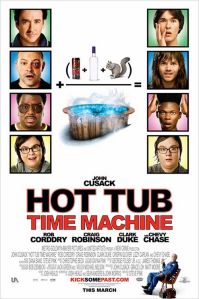 Not nearly as clever as the brilliant title may suggest, Hot Tub Time Machine is a fairly silly yet sloppy comedic enterprise. The purposely moronic nature of it leads to some raunchy enjoyment, and the premise involving a time-traveling Jacuzzi allows for some fun comedic situations. The trouble is that the movie shadows our foursome of dudes (John Cusack, Rob Corddry, Craig Robinson, and Clark Duke) too closely. The movie presents intriguing comedic setups but spends inordinate amounts of time dealing with the fractious falling out between the dudes. We spend more time talking about old friendships than we do the sheer possibilities brought about through time travel. The pacing has some turgid moments; it takes too long to reach the magic hot tub. There’s some good humor at first when the guys believe they must follow the exact path they tread before, lest the butterfly effect destroy the future. Then they decide to walk a different path, taking advantage of their knowledge of the future. The movie doesn’t fully take advantage of its own comedic possibilities and settles for lame payoffs, like an end credits sequence inserting Corddry into a Motley Crue video (it’s not funny). There are a few Farrelly Brother-level gross-out gags, but most of the comedy happens around these guys, not because of their characters. They themselves are not exasperatingly funny, so it’s disappointing when Hot Tub Time Machine flirts with fun comic scenarios (an outlandish bet on a sporting game, performing a modern song, the mystery of how the bellhop loses his arm, Duke making sure he will be conceived in the past) only to give up and spend more time with the guys hashing out their years-old squabbles. Enough with the personal growth and reflection. Get back to messing around with the space-time continuum.
Nate’s Grade: B-
Share this:

Black Dynamite (2009)
 This surprising little gem could have been the third feature in Grindhouse, and it would have been the best movie of the three. This pitch-perfect comedy both celebrates and satirizes blaxploitation movies, but it does so with a raised eyebrow and its tongue-in-cheek, not the wacky spoof antics of I’m Gonna Git you Sucka. Michael Jai White, who also co-wrote the script, is the titular crime fighting, lady-loving, soul brother looking to find some righteous justice and help some orphan kids too. The attention to detail is impressive, from the saturated film stock, to the bare locations, to the choppy edits and film errors, but the film just nails the tone better than Quentin Tarantino or Robert Rodriguez managed in their odes to schlock cinema. The movie is consistently hilarious without being too self-conscious with its humor, and White makes a terrific straight man to the proceedings. The music is authentic, jazzy, and hilarious in its own right. There’s one point where the score even narrates what’s happening. Amusing from its first second to its last, with a nunchuk-baring kung-fu Richard Nixon. Black Dynamite is deliberately silly, highly quotable, and terrific entertainment.
Nate’s Grade: A
Share this:

Extract (2009)
 Writer/director Mike Judge’s third movie isn’t quite as funny or just plain fun as his previous pair, Office Space and Idiocracy. Set in a local factory, we follow the misadventures of the boss (Jason Bateman) as he deals with incompetent employees, looming lawsuits, and a wife (Kristen Wiig) who he feels disconnected with. What Judge has is two competing movies; one of them garners the bulk of the first 45 minutes and proves to be funny. The other gets most of the second half and plays out sloppy and dumb. The more interesting half involves Bateman trying to feel guilt-free about wanting to have an affair, so his friend (Ben Affleck, very funny) hires a clueless gigolo to seduce the wife. This scheme actually works but causes humorous complications, like when the gigolo keeps going back for more. This comedic scenario would be enough for one movie. The other half of the tale involves Bateman trying to sell the company but the buyer is wary of an impending lawsuit due to an accident on the work floor that left a man sans his testicles (so much wasted potential here). Mila Kunis is the sexy con artist behind the scenes, encouraging the ball-less worker not to settle. Obviously Judge had work-related gags he wanted to tackle, but he proves that his real interests lie in the complicated relationship comedy. Extract fumbles forward not knowing what kind of movie its really wants to be, so it settles for hackneyed solutions and abrupt endings. Extract would have been a better comedy completely removed from the workplace.
Nate’s Grade: B-
Share this:

Cloudy with a Chance of Meatballs (2009)
 Thanks to a rambunctious comedic spirit and some delightfully colorful visuals, Cloudy with a Chance of Meatballs is absurdly amusing from start to finish. I was relieved when this animated family film stuck by its own manic comic sensibilities instead of pandering with scatological humor and bizarre and instantly dated pop culture references. The story has the familiar “believe in yourself” elements but it takes it another tasty level. Writer/directors Phil Lord and Chris Miller (MTV’s vastly underrated Clone High) pack the story with jokes of all levels, running gags with surprising payoffs, puns that manage to be funny, satirical one-liners, imaginative visual gags, and inventive action sequences when the film becomes an all-you-can-eat buffet of disaster movies. The pacing is frenetic and the eclectic vocal cast (Bruce Campbell as the villainous mayor! Mr. T as sheriff! Neil Patrick Harris as a talking monkey!) really, as the film says, “carpe some diem.” This isn’t an emotionally engaging movie whatsoever but it’s one of the best comedies of 2009 and certainly one of the most jam-packed, fun 90 minutes you could ask to sit through. Just prepare to be extremely hungry afterward.
Nate’s Grade: A-
Share this:

Adam (2009)
 It’s a romantic comedy with a quirk. Adam (Hugh Dancy) has Asperger’s syndrome, a higher-functioning level of autism that makes social interactions difficult. Lucky for him he?s handsome enough that his new neighbor (Rose Byrne) falls for him anyway. What follows is mostly standard romantic comedy stuff, with boy and girl feeling each other out, except Adam has trouble with figurative language and implied speech. The movie works on a low-key cuteness as it hits all the conventional plot destinations, but then it charts its own path for an ending. I give credit to writer/director Max Mayer for bucking formula and following his convictions, refusing to tie everything together so easily. With that said, the Asperger’s portrayal seems to go into an extreme, Rain Man-level of social disability. Adam is crippled with fear even to leave his home; he is a slave to routine. Dancy is a sympathetic lead, though he’s overly reliant on his character’s quirks. Adam isn’t a freak or some delicate flower needing to be protected from the rigors of reality, and I think the movie would have benefited from a broader look at Adam’s ongoing lifelong struggle with his brain. Mostly, audiences are served up a sweet if somewhat plain romance with an extra dash of eccentricity, but not enough to rock any rom-com sensibilities. It’s a non-threatening alternative to the genre.
Nate’s Grade: B
Share this:

Humpday (2009)
 There’s a definite squeamishness out there when it comes to the idea of men expressing intimacy. Brokeback Mountain proved even liberal Hollywood wasn’t ready to anoint a movie about two gay dudes secretly getting it on. There will be large portions of people that will refuse to give a movie like Humpday a chance simply because of its premise: two guys plotting to have sex. It’s not a dirty movie by any means, nor does it get graphic with details or conversations. But the movie exactingly explores the uncomfortable relationships men have with expressions of romance. Humpday is also extremely funny in that pained, awkward sensibility, and I challenge the squeamish to give this charming indie a shot at love. If it makes it any easier for people to take (SPOILER ALERT) they don’t actually go through with it.
Ben (Mark Duplass) is living a comfortable existence with his wife, Anna (Alycia Delmore). Then one day his old friend from college, Andrew (Joshua Leonard), unexpectedly visits. Andrew has lived a Kerouac-like existence on the road as an aspiring artist. The two guys catch up on old times and Andrew invites Ben over to a party. He ditches his wife, and her pork chops, for the party, which turns out to be hosted by a group of free-love artists. The alcohol-fueled conversation lands on Humpfest, the annual amateur pornography festival held in Seattle. Ben and Andrew come up with their own entry idea: two straight guys that will have sex. “That’s beyond gay,” somebody says. Both men refuse to back down. Ben books a hotel room. The only thing he has to do now is tell his wife about Andrew’s “art project.”
 Humpday explodes male sexual insecurities better than any film since 1997?s Chasing Amy. Each man refuses to back out of having gay sex because they don’t want to be seen as less masculine. It’s masculinity brinksmanship, willing to go all the way to prove superior heterosexuality through a homosexual act, and it?s nothing short of brilliant. Neither Ben nor Andrew wants to “puss out” on their big moment. But neither of them really wants to go through with it either, which leads toward tremendous amounts of awkward comedy. Writer/director Lynn Shelton has fashioned a scenario that is hilarious but also subtlety heartfelt; many films deal with the bromance of heterosexual love, but Shelton pushes it to the limit. These two guys do care about each other, and you can see their camaraderie as they recount old stories and open up to one another, and in the end they might be willing to go to the extremes for their friendship, whatever the consequences may be.
Both Ben and Andrew have deep-seated insecurities about their personal lives; Andrew wants to live a free-spirited artistic lifestyle but is really too scared to fully commit, and too “square” for abandoning all sexual inhibitions like some of his casual artsy pals; Ben has a house, a job, a wife, and feels defensive about his life choices, particularly the idea that he’s settled down and giving up. Both men are also insecure by sexually adept women, so it may be natural that they seek the company of each other for solace and mutual understanding. The final act, where the two friends meet in a hotel room for their big night, is a slice of awkward comedy heaven. They haven’t worked out any logistics, locations, warm-ups, anything, and watching them verbally hatch a game plan is hilarious and oddly touching in equal doses. They really don’t know what they’re doing and why they’re there.
The actors have a naturalistic feel because, as I’ve found, the dialogue was almost entirely improvised. They shot in chronological order so to build from conversation to conversation, and you can feel the character dynamics strengthen and deepen. Duplass (The Puffy Chair) has a great, wide fake smile that hides a lot of anger and dissatisfaction. He’s sort of a schlubby everyman that we can empathize with even as he moves forward with his participation in the “art film.” Leonard (The Blair Witch Project), and his scraggly beard, effectively conveys a man weary about where his rugged life has led him. He is also hiding behind a guise, the guise of being a nonconformist that chooses to have no earthly ties, but bit-by-bit you see that Andrew is tired of disposable human connections. Leonard and Duplass feel like life-long friends. Then there’s Delmore, who really is the wary, incredulous voice of the audience. She too comes across as realistic under the circumstances, and her reaction when she discovers the true purpose of the “art project” is volatile, yes, but also surprisingly reflective. The three leads never feel like actors; the illusion that these are real people is never broken even given the peculiar circumstances of the premise.
 What I really appreciated about Humpday is that every moment feels genuine and every scene has a point. I was amazed that Shelton and her small unit of actors had made it so that every conversation had purpose; there is so little fat to this screenplay. Each scene reveals something new about a character or pushes the narrative forward toward its uncomfortable climax, and each moment never breaks the reality of the story. Given these characters and the amiable direction they follow, Humpday is believable. I suppose it might be easy to dismiss it as another entry in the fly-on-the-wall “mumblecore” film series gaining traction in independent cinema, but Humpday is really more an observational character study that examines male relationships and the sexual politics of being a “man’s man” in today’s world of sexual liberation. There is a nuanced perspective on human sexuality here that I may be erroneously crediting to Shelton simply because she is a woman. It helps to have a more mature, open-minded perspective about the complexities of human behavior for this story to succeed, and I think a female presence behind the camera affords that luxury. There is commentary below the surface; however, Humpday can be entirely enjoyed as a surface-level comedy of an awkward heterosexual showdown.
I find it interesting that the original theatrical poster only featured the two shirtless guys eyeing each other, and with a pink background no less. The DVD cover has inserted Anna between the two guys and gone with the more boy-friendly blue background cover. I think this tiny detail is another reflection of just how uncomfortable the subject matter is for many people. Humpday is an insightful, perceptive little character study that feels real and honest, while at the same time the movie doesn’t allow sexual politics to become the headline. The movie remembers to be funny, often, and any discomfort is worth it.
Nate’s Grade: A
Share this:

Julie & Julia (2009)
 Meryl Streep is as she always is, which means to say she’s terrific as famous jubilant chef Julia Child. She’s got the sing-songy voice down cold, and Julia comes across like a spigot of joy, yelping with delight like a child. It’s hard to not find it adorable, and her husband (Stanley Tucci) is a kind, caring man who complements her well. The scenes between the Childs can be heartwarming and delightfully comic. However, for some weird reason, the Julia Child section is only half of this movie. Writer/director Nora Ephron decided to frame the movie with the biography of Julie Powell (Amy Adams) writing a blog in 2002. Huh? Powell wants to prepare all 500 recipes from Child’s best-selling book on French cuisine in one year. As you might expect, this whole section turns into a lot of narration over food preparation and Powell becoming increasingly narcissistic about her blog fame. The only real purpose this modern storyline serves is to add perspective to the Julia Child storyline, giving historical context to what we see Streep and Tucci struggle over. The real resonance is with Streep as the larger-than-life cooking personality and her upward climb to be taken seriously as a chef and as an author. I don’t care about Julie Powell. She keeps interrupting a better storyline. Apparently the real Julia Child didn’t care for Powell either, because late in the movie Powell discovers that the real Child (who died in 2004) thinks the whole blog thing is a gimmick. And isn’t it? Then again, isn’t having Streep as Julia Child a gimmick of casting? Julie and Julia would have been better served if it had completely carved off the Julie section.
Nate’s Grade: B


 nathanzoebl
You must be logged in to post a comment.