Blog Archives
Jay and Silent Bob Strike Back (2001) [Review Re-View]
 Originally released August 22, 2001:
Kevin Smith returns back to his comedy roots. No more movies with a message (Chasing Amy and Dogma) it’s back to good ole’ snowballing and stink palming. His latest, Jay and Silent Bob Strike Back, is like a giant thank-you card to all his fans that have made the man who he is today. It ties up the entire View Askew universe so Kevin can drift off into uncharted ventures of film making and not have to keep referencing the same damn characters. Plus there’s plenty of good-natured vulgarity to go around.
 The plot of Jay and Silent Bob is nothing too heavy but seems to keep the film on a continuous pace, unlike the sometimes stagnant feel Mallrats had (what, they’re in one location for 90 minutes). It seems that after getting a restraining order at the Quick Stop on them, Jay and Silent Bob learn that Miramax is making a movie from a comic book that is in fact based off of them. Learned of the riches they could make they seek out the comic’s author Holden McNeil (Ben Affleck’s first appearance in the film) and demand a piece of the pie. Holden tells them that he long ago sold his right to his partner Banky Edwards (Jason Lee, in his second appearance in the film) and that there’s nothing they can do to stop the film. Jay suddenly gets the idea that if they stop the movie from ever getting made then they don’t have to worry. So off go our stoner duo on a mission to sabotage and satirize Hollywood.
Along the way are a hitch-hiker (George Carlin) advising the best way to get a ride is to go down in your morals, a confused nun (Carrie Fisher), the cast of Scooby Doo offering a ride (which will be 100x funnier than the feature film coming out next summer), a beautiful band of international diamond thieves (Eliza Dusku, Ali Larter, Jennifer Swalbach-Smith, Shannon Elizabeth), a rescued chimpanzee, a dogged Wildlife agent (Will Ferrell), and a full barrage of hilarity once Hollywood is finally hit.
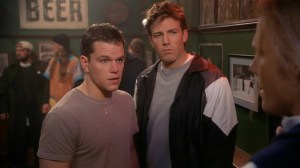
 The best barbs are laid out by Ben Affleck and Matt Damon bickering about the other’s film choices on the set of Good Will Hunting 2: Hunting Season. This moment is truly inspired and full of great humor from Gus van Sant too busy counting his money to yell action to Damon turning into a vigilante hero. I almost fell on the floor laughing during this sequence.
When Jay and Silent Bob hit Hollywood is when the comedy starts hitting its stride as this Jersey Greek chorus interacts with the Hollywood life and encounters many a celebrity. The jokes are usually right on target except for Chris Rock’s performance of a racism obsessed film director. Rock’s portrayal becomes grating to the moviegoer far before it’s over, though he does get a few choice lines.
Smith as a director has finally elevated his visual art into something that can sustain itself instead of his earlier just-hold-the-camera-and-shoot movies. There are pans, zooms, quick cuts, cranes, action sequences, and even CGI. Smith is evolving as an artist but still staying his “dick and fart joke” self, and Jay and Silent Bob Strike Back is evidence. And that’s fine by me.
Nate’s Grade: B
——————————————————
WRITER REFLECTIONS 20 YEARS LATER
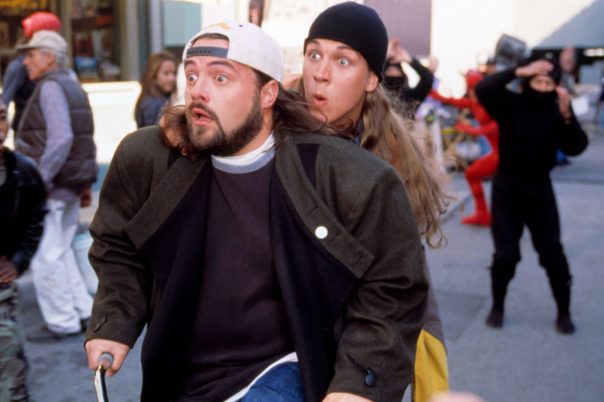
This was the one movie I was dreading more than any others on my 2001 re-watch. I’ve been a Kevin Smith fan since my teenage years and the man’s brilliantly vulgar movies had a formative effect on shaping my love of comedy, cinema, and even language itself. I don’t know if I can say I’ve been a fan of Smith as a filmmaker for some time. He took a more schlocky genre-based turn the last decade to diminished results; I enjoyed the change of pace from 2011’s Red State but found my interest deflating with 2014’s Tusk and 2016’s Yoga Hosiers. It wasn’t until 2019’s Jay and Silent Bob Reboot that my worry was unable to be suppressed. Had the filmmaker stopped growing or had I simply outgrown the filmmaker? The old jokes and self-serving references felt too labored, too stagnant, and like an old man repeating the hits for the same group of fans to laugh at the same recognizable and tired punchlines. By nature, comedy has the shortest shelf life of entertainment, and I was dreading that the original Jay and Silent Bob big screen adventure was going to feel so outdated and pitiful, especially since it’s the least substantial of all of Smith’s early films and was intended as a silly crowd-pleasing romp for his fandom. In 2001, I was a big participant of that group. In 2021, I don’t know if I still am.
This 2001 movie was always intended to be rather insular, pitched to the diehards who would understand references to chocolate-covered pretzels and the backseats of Volkswagens, but the star-studded affair was also intended to close the book on the View Askewniverse, the interconnected world comprising the first five films of Smith’s career. Smith had intended to move on and tell new stories unbound by the confines of his continuity and the demands fans would have that the new stuff tonally aligned with the old stuff. This never really happened. Smith tried something different with 2004’s father/daughter dramedy Jersey Girl and upon its theatrical demise retreated back to the safety of his View Askew universe. To be fair, he has branched out with bold experiments in horror, some of them rather successful, but it always feels like Smith is too afraid to move too far ahead of the fandom he credits so much for his success. Hey, people go to concerts and they want to hear the hits. I understand the appeal. I chuckled at points of familiarity in Jay and Silent Bob Reboot, and also Strike Back upon re-watch, but when you’re talking storytelling and comedy, stagnation isn’t growth. It’s a self-imposed ceiling.
 It was very early that my sinking feeling for Strike Back became my default setting. The characters of Jay and Silent Bob are not built to carry an entire movie, especially when one of them is mostly mute. It becomes the Jay (Jason Mewes) show and he overstays his welcome. There are definite limitations to these two stoners being the primary characters, and that’s why Jay seems to vary from scene-to-scene for the sake of comedy. In some scenes he’ll be clever, in others powerfully stupid, and in others so specific, like when he’s referencing Prince Valiant or rhapsodizing a Planet of the Apes apocalyptic fantasy that is too involved to come from the mind of this dumb stoner. This is the same guy who didn’t know you had to pay to ride a bus. The character unpredictability would be more acceptable if those leaps lead to worthwhile comedy bits that couldn’t otherwise be bridged by the operating persona of the long-haired foul-mouthed horndog. Therein lies the issue. The humor of Strike Back is too scattershot and too obvious to really land consistently. The fourth-wall breaks are painful and plentiful. The constant exclamation of “bong” is never funny. The random inclusion of the Mystery Machine, with a Velma openly lusting after women, is lazy. The fact that people are fighting with bong lightsabers and dildos is lazy. The joke that everyone on the Internet complaining about pop culture is just a teen dweeb is lazy and almost Aaron Sorkin-esque in its snide broad-brush painting of technology and youth. As I said in my review of Reboot: “Smith has never been one to hinge on set pieces and more on character interactions, usually profane conversations with the occasional slapstick element. This is one reason why the original Jay and Silent Bob Strikes Back suffers in comparison to his more character-driven comedies.” This movie is wall-to-wall wacky slapstick and road trip pieces that fail to transcend their cultural references.
And the comedy aspect that has aged the worse, by far, is the rampant gay jokes. At the time of its theatrical release, G.L.A.A.D. was openly decrying the film for its copious jokes at the expense of being mistaken as gay. I’m all but certain that 2001 me would have voiced the opinion that this was absurd, that of course Smith isn’t a homophobe, and he’s merely satirizing homophobia. The problem is that being gay is such a repeated joke of derision and hysteria. Wildlife Marshal Willenholly (Will Ferrell, one of the better reasons to still watch) admits he’s only a man on the outside, and I guess that’s a joke? Gay jokes are definitely one of the kinds of comedy that has aged the worst in the ensuing twenty years. Think back to 2005’s extended riff-fest between Seth Rogen and Paul Rudd in The 40-Year-Old Virgin where they try to top one another how they know the other is really gay. That would never happen in a studio comedy today. Times change and so do the mores of comedy. Things we thought were funny decades ago we might not feel the same way. That’s the nature of comedy. The overall comedy of Jay and Silent Bob Strike Back feels tacky and dated, so the onslaught of gay panic and derision only makes the rest of the comedy feel just as sad and pitiful.
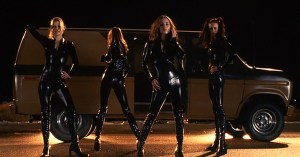
 There are two hooks to this movie, the relationship that forms between Jay and Justice (Shannon Elizabeth), one of the members of a girl gang of jewel thieves, and the havoc and industry satire of the guys running through the Miramax studio lot. Heather Graham reportedly turned down the role of Justice because she could not understand what woman would fall in love with Jay, and she’s completely right. The girl gang seems included because it felt like the hot thing to do at the time after Charlie’s Angels, to include some sexy ladies in cat suits, give them slow-motion scenes where they wink at the camera about how sexy they must look in magazine cover poses, and seem to be in on the joke while just objectifying these one-note characters with air quotes. Just because Smith later has the girl gang underline their cliché nature doesn’t make them any less of a cliché, and their entire inclusion feels like fulfilling a personal demand for Smith rather than satirizing the shallow depiction of “strong action heroine” in Hollywood blockbusters. The other hook is the actual industry satire, strictly under the guidance of lampooning Miramax and their hits and indie darling culture, all of which has the pall of Harvey Weinstein cast over it. The industry jokes aren’t exactly very cutting. It’s difficult to even label this as satire. It’s more a madcap chase that resembles a crude version of Pee Wee Herman’s studio escapades. It too feels predicated on fulfilling personal demands for Smith, like literally fighting Luke Skywalker in a lightsaber duel. I’ll agree with my 2001 self that the comedy is on stronger footing during this final act, but that’s not exactly a ringing endorsement for the rest of the movie. Strike Back doesn’t strike hard enough.
There is one reason to watch this movie and it has always been the unique fascination of Jason Mewes as a performer. He was not even an actor when Smith put him in his indie breakout film, 1994’s Clerks. He has such an unpolished appeal and there were several line readings where he took a bizarre, immediately intriguing angle, something that made the line funny because of his delivery and conviction. Mewes is a genuinely underrated comic actor. He was also battling heroin withdrawal throughout the production and turned to getting drunk as a backup coping mechanism. As soon as filming was done, he began using drugs again and eventually Smith would drive his buddy to rehab and offer a place in his home if it meant he had someone to make sure he stayed sober. The friendship between Mewes and Smith, and the hell they’ve gone through together from his addiction, is truly heartwarming and would genuinely make an interesting movie all its own.
 I come back to my review for Jay and Silent Bob Reboot because I wrestled with these same feelings back then, and re-watching Strike Back only provided disappointing confirmation. As I said in 2019, “The highly verbose filmmaker has been a favorite of mine since I discovered a VHS copy of Clerks in the late 90s. I will always have a special place reserved for the man and see any of his movies, even if I’m discovering that maybe some of the appeal is starting to fade… As a storyteller, I’ll always be front and center for this gregarious and generous man. As a filmmaker, I’ll always be thankful for his impact he had on my fledgling ideas of indie cinema and comedy, even if that means an inevitable parting of ways as he charts a well-trod familiar path.” Going back to the crude comedies of Kevin Smith feels like meeting old friends and realizing how little you might have in common now, and that’s okay. They still were important, they won’t be forgotten, but some things just aren’t built to last, especially comedy. I guess don’t be sad because it’s over but smile because it happened, including the many, many dick and fart jokes.
Re-View Grade: C
Share this:

Jungle Cruise (2021)
 Disney turned a theme park ride that mostly involved sitting into a billion-dollar supernatural adventure franchise, so why not try another swing at reshaping its existing park properties into would-be blockbuster tentpoles? Jungle Cruise owes a lot to the Pirates of the Caribbean franchise, and actually owes a little too much for its own good. For the first half of the movie, it coasts on the charms of stars Dwayne Johnson and Emily Blunt and some light-footed visual misadventures. Then the second half turn involves a significant personal revelation, and that’s where the movie felt like it was being folded and crushed into form to closely resemble the Pirates franchise. It gets quite convoluted and littered with lackluster villains, too many and too stock to ever establish as intriguing or memorable (one of them is a man made of honey, so that’s a thing). I found myself also pulling away in the second half because of the inevitable romance. Their screwball combative banter between Johnson and Blunt gave me some smiles and entertainment and then, as they warm to one another, it sadly dissipated, as did my interest. The comedy is really labored at points. Johnson keeps referring to Blunt as “Pants” because she’s a woman and she wears pants in the twentieth century. It was not funny the first time and it’s not funny or endearing after the 80th rendition. The supernatural elements and curses feel extraneous and tacked on. With the Pirates films, at least the good ones, there are a lot of plot elements they need to keep in the air and you assume they’re be able to land them as needed. The competing character goals were so well established and developed in those movies and served as an anchor even amid the chaos of plot complications and double and triple crosses. With Jungle Cruise, it feels like a lot of effort but also a lot of dropped or mishandled story and thematic elements. This feels more creatively by committee and the heavily green screen action is harder to fully immerse with. As a wacky adventure serial, there may be enough to keep a viewer casually entertained, but Jungle Cruise feels too beholden to the Pirates formula without bringing anything exciting or fresh on its own imagination merits.
Nate’s Grade: C
Share this:

Space Jam: A New Legacy (2021)
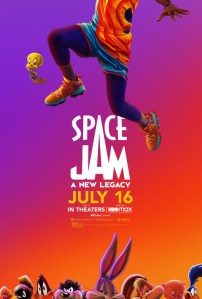 For a generation of millennials, those of us who came of age in the 1990s, Space Jam has miraculously accrued a nostalgic fixation. Michael Jordan starred alongside cartoon favorites and we all learned valuable lessons about teamwork. The soundtrack also, as the kids say, slapped, with that titular banger welcoming us to the jam and the R. Kelly eponymous ballad, “I Believe I Can Fly.” Flash forward 25 years, and a new basketball superstar is looking to relaunch the franchise and reinvigorate the Looney Tunes pals for a new generation. Lebron James plays a fictionalized version of himself struggling to connect with one of his sons. He wants the boy to take basketball seriously but worries about his commitment and thinks video games, the child’s true passion, are a distraction for him. He and his son get sucked into the “server-verse” of Warner Bros. studios thanks to an angry A.I. (Don Cheadle) who just wants respect. The scornful A.I. challenges Lebron to a basketball game while tempting Lebron’s son to the dark side. Lebron teams up with Bugs Bunny to reunite the classic Tunes to put together a winning team.
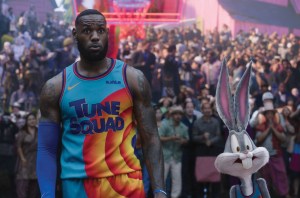 This movie is clearly not intended for adults but at the same time it feels engineered from their references. Are children going to understand William Shatner impressions? Parodies of The Matrix, or Mad Max: Fury Road, or Casablanca? To that end, I question if we’ve come to a point in popular entertainment where the Looney Tunes characters have been eclipsed. When I grew up, cable television, let alone channels devoted to entertaining children, were just beginning in the 1980s, so I did grow up with classic cartoons from decades prior. I knew about Bugs and Daffy and Tom and Jerry and Hannah Barbara and the old guard. Modern American children have grown up with a generation of original cartoons and programming and I would argue they have more nostalgic reverence for shows like The Fairly Odd Parents, Gumball, and other popular Cartoon Network originals. I strongly doubt that the majority of the movie’s stated target audience, children, have any emotional investment or recognition for the old Looney Tunes characters. Perhaps the entire Space Jam sequel is designed to reignite interest in a certain younger demographic, and this wouldn’t surprise me as its real source for existence. To be fair, the original 1996 Space Jam was created to sell sneakers, so it’s not like this is out of step for the franchise’s integrity.
The conception of this movie is less about Lebron James interacting with the classic Looney Tunes characters than Lebron James being the spokesman for a catalogue of Warner Bros. intellectual property (IP). What children are sitting around saying, “I can’t wait to interact with all my favorite Warner properties?” Children do not think like this, they don’t segregate into tribes for different corporate masters. They like what they like and don’t think about whether its corporate parentage is with Disney or Viacom or whatever. Space Jam: A New Legacy feels less like a story or even a movie and more like a catalogue launch for the Warner Bros. gift shop (get your Grandma Matrix sweaters just in time for the fourth movie coming out these holidays!).
 The intermingling of different worlds and properties can be done, see The Lego Movie, but more needs to be done other than transporting characters into a world they do not belong. Watching Granny perform moves from The Matrix isn’t funny because what is even being set up for comedy? It’s not a tweaking or commentary on the original, nor is there any recognizable comedy angle; it’s what Family Guy typically does – repeating the scenarios but with different faces. There is a key difference between reference and parody (a point I have discussed at EXTENSIVE LENGTH in my reviews of the very bad Friedberg and Seltzer spoofs). Nobody cares that much about these characters that just seeing them in a different environment is enough. Watching Wile E. Cayote as one of the War Boys in Fury Road is not enough, and I absolutely adore that movie and consider it an instant classic, but if I wanted to just watch Fury Road, I would gladly just watch Fury Road (they do not even call it “Furry Road,” come on!).
By far, the most confounding part of this new Space Jam is the decision-making process over what IP should be included and what should be excluded. I would be fascinated to watch a documentary series just on the creative clashes with studio execs. There are some bizarre choices selected to attend the culminating basketball game as rowdy spectators. I can understand memorable figures like King Kong, Dorothy from the Wizard of Oz, the Iron Giant, and the Scooby Doo van. Those are immediately recognizable for modern-day children. However, why is Jim Carey’s Mask character there? Why is the grotesque Danny DeVito version of the Penguin there? Why is the Night King from Game of Thrones there? Why is Pennywise the Clown, a vicious and frightening character, there? Why are the droogs from A Clockwork Orange there? Who is that supposed to appeal to? Why would anyone in their right mind include a gang best known for wanton violence and rape to be faces in the crowd to cheer on a basketball game? It would be akin to taking the hillbillies who rape Ned Beatty in Deliverance and placing them side-by-side with cartoons for a movie intended for children. If the droogs and Pennywise made the cut, what inappropriate characters from the vaults of Warner Bros. were denied? This fascinates me.
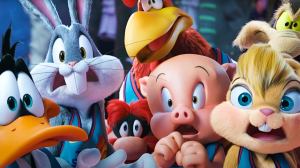 I also have problems when Bugs and the other Tunes step into the third dimension. Characters that were intended for two-dimensions always look awkward when transported into a three-dimensional realm. It was a smart move keeping the cartoons as their standard hand-drawn selves in the original Space Jam. When the big basketball game commences, the Tunes and James are pulled into three dimensions and the characters do not look good. The circumference of their heads and how it relates to their mouths moving looks all wrong. Bugs looks like a Mylar birthday balloon that has somehow gained sentience. This extra step is likely meant to appeal to modern-day audiences who have turned their noses on more traditional hand-drawn animation in feature films (Tangled and Frozen began as 2-D animated films before going to 3-D). It’s another curious case meant to modernize the Looney Tunes and appeal to a younger demo, and yet it runs counter to so much more of the programming choices and contradictory decision-making.
Is Space Jam: A New Legacy a good movie? Quite simply, no, but then by objective standards neither was the original Space Jam. Lebron James may still be trailing his Airness in a few more NBA records but King James has more natural charisma and acting ability than Jordan who settled as straight man/pitch man. There is an occasional joke that earned a laugh from me, the best being the bait-and-switch reveal of Michael Jordan returning to the Tune Squad, which also seems to imply that Sylvester the cat is kind of racist. I liked Lil’ Rel. Congrats also to the filmmakers for bringing back Lola Bunny, having her voiced by Zendaya, and realizing she can just be a lady bunny good at playing basketball. The original Lola Bunny was hyper sexualized and I’ve already read too many comments from dregs on the Internet upset this new rabbit doesn’t make them feel funny in their pants (“IF I CANNOT OBJECTIFY THIS CARTOON RABBIT, THEN WHY AM I EVEN WATCHING A MOVIE INTENDED FOR CHILDREN?”). The moral or message is pretty simple about accepting others for who they are and not how you demand, which is weirdly exemplified in a cross-generational conflict where Lebron will not allow his son to play video games because his coach growing up thought they were a waste of time. As if he’s only allowed to play basketball with every waking and sleeping second of his existence. Lebron grew up in the late 90s when video games were mainstream and great. His son is an obvious game design prodigy, but it will take him the whole movie to see.
 Feeling like the unholy IP orgies that were Ready Player One and The Emoji Movie, the Space Jam sequel (or reboot) feels more like a catalogue launch or a streaming channel opening its vast archives for ready-made consumer consumption. There are several moments where I just shrugged and said to myself, “Well, that happened,” like Granny doing her fancy Matrix moves or Porky Pig battle rapping. I think the idea of Lebron helping the classic Looney Tunes characters in another wacky edition of basketball would have made for a suitable children’s movie. The original only focuses on the Looney Tunes and gets by. For whatever reason, the studio execs insisted to the six credited screenwriters (pity them all, and the sixty un-credited) that this serve not as a franchise relaunch but as a corporate portfolio branding showcase. The movie gets lost in the shuffle from all the haphazard and contradictory impulses to see this through, turning from the game of basketball into decades-past-their-prime Austin Powers jokes. Regardless, Space Jam: A New Legacy is less new and more everything Warner Bros. owns the rights to in the past that they would like to remind you about. Watch it all now on HBO MAX, folks!
Nate’s Grade: C-
Share this:

Werewolves Within (2021)
 Surprisingly based upon a PlayStation VR video game by Ubisoft, Werewolves Within is a fun horror comedy that plays out like a demented Agatha Christie drawing room mystery. Sam Richardson (The Tomorrow War) is a new park ranger assigned to a small snowy town that may or may not be threatened by a werewolf hiding among the townspeople. A series of bloody murders and mangled gas generators points toward some monstrous beast, and over the course of one long night, characters will accuse one another of being the hidden werewolf, and tensions and paranoia mount as the body count rises. Part of the fun comes from the wild whodunit speculation that the filmmakers are aware of. Early on, I started accumulating my band of suspects, and then my red herring suspects, and the movie seems to be fully knowledgeable of this as well, so there’s plenty of little details spilled that, in an ordinary movie would prove conclusive to the detail-oriented viewer; however, Werewolves Within is full of motivations and clever fleeting details to throw you off. Richardson is wonderfully nonplussed as the supremely nice and easy-going ranger who finds himself frantically trying to be the voice of calm and security as the town breaks down. The supporting characters are rather one-note nutjobs but each has a different personality to sprinkle into the chaotic mix. The eventual reveal of the culprit involves a lot of explaining to cover hidden character deception that could have used more setup to feel less forced. I also wished the humor and the horror was a bit crazier. I knew the horror wasn’t going to be pronounced, as most horror-comedies typically favor one more than the other, but I wished the comedy had escalated as the characters further gave in to the insanity of the ridiculous situation. It’s a movie that’s easy going in charm and finely punctuated with some sharp one-liners and silly visual gags. It’s agreeable to its core and a lighthearted yet gory way to spend 90 minutes. By default, it’s also one of the best video game adaptations made into a movie. That’s primarily because it’s a recognizable murder mystery structure just with a genre kick. I wish everything had been given an extra dose of elevation and hijinks, comedy and horror, but that might detract from the overall droll charm, lead by Richardson. Werewolves Within makes me wish for an anthology franchise just transplanting its premise across new settings. Imagine The Hangover but having to also figure out which of your recovering blackout drunk friends was a werewolf. It just works.
Nate’s Grade: B
Share this:

Good on Paper (2021)
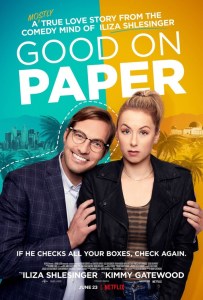 Famed standup comic Iliza Shlesinger had money, a rabid following from several popular Netflix specials, and a boyfriend who went to Yale, was a successful hedge fund manager, and a sweet guy, or so she believed. In real life, Shlesinger was victim to a man who wormed his way into her life and lied about every significant facet of his own life in order to impress. The true-life experience of Schlesinger was her inspiration to write her first screenplay, the “mostly true” Good on Paper. In the Netflix original comedy, Shlesinger plays a fictionalized version of herself, Andrea, a standup comedian who meets Dennis (Ryan Hansen) on an airplane. They form a friendship and he clearly wants more but she’s just not that into him. That doesn’t deter Dennis, who keeps nipping at her heels, and after he tearfully reveals his mother diagnosed with cancer, Andrea decides to give the “nice guy” a chance as a boyfriend. However, his fibs and excuses add up and test the resolve of Andrea, who questions who Dennis really is.
 Where Good on Paper gets good is blowing up the manipulations of the “nice guy” persona that certain men cling to as a shield. There is a contingent of men out there in the dating world that dismissively view the disinterest of select women as a failing not on them but with the women, who just cannot grasp what how much these “nice guys” have to offer. They hold to the adage that “nice guys finish last” as a resentment builder, but it really comes down to this persona being one more version of toxic masculinity. The so-called “nice guys” will never view themselves by those terms, but they’re just as toxic because they proliferate an unhealthy sense of entitlement with their obsessions. Being the nice guy friend to a woman isn’t good enough, and her friendship seemingly isn’t reward enough, no, she must also give of her body if the “nice guy” requests, or so the expectation prevails. The phony “nice guy” accumulates emotional leverage to manipulate and guilt his object of desire and waits. This is gross behavior and I haven’t really seen this blown up before in a romantic comedy setting, so it was a welcomed source of comedy and commentary from Good on Paper. Dennis is a slimeball who uses points of sympathy and charm as pressure points with his targets. For him, it’s about living up to an imaginary standard, a version of himself he thinks others would better respect, and yet had he put in actual effort in self-improvement, chances are somebody out there could have accepted and even been attracted to him on his own terms. But he doesn’t want to put in that level of effort.
The casting of Hansen is also quite helpful because the audience is trying to see the natural charm hidden under the bad greasy haircut, bad fake teeth, and dad bod. Early on, Andrea says she was not physically attracted to Dennis, and this is emphasized by him slipping into a hot tub with his shirtless, untoned body right in her disinterested face. Hansen hasn’t gone full Method and gained weight; his face is cut off for the only shirtless scene, meaning it’s a literal dad bod body double for the actor. Hansen is best known in lunkheaded comic relief roles from TV’s Veronica Mars and Party Down. He has a natural goofy appeal and the casting utilizes this as a weapon. Dennis himself isn’t super charming or super funny, but he’s just funny or charming enough to draft off the actor’s own natural assets that you could understand why a woman like Andrea might find his company interesting. Hansen is great as an oily salesman constantly in flux, and when his elaborate cover stories are jeopardized is when the actor is at his funniest. His pathetic flailing and side-stepping of inconvenient facts pushes the actor to squirm, and since we know he’s the source of such discomfort for our heroine, watching him contort and squirm is gratifying.
 The movie picks up once the lies from Dennis start to converge and multiple, or at least once Andrea begins her personal investigation. The movie’s best scenes are those shared between Shlesinger and her freidn played by Margaret Cho (Drop Dead Diva) as they feed on one another’s nervous energy and wild flights of imagination. The comradery between them has a lively and familial energy and it’s at these moments where the movie really embraces its own chaotic energy. Uncovering the truth about Dennis, and the depths of his deceptions, allows for a steady stream of reveals and payoffs. It’s enough to make me wish the movie spent less time on Dennis’ kooky roommates and a subplot with a rival actress whose seemingly blessed career infuriates and frustrates Andrea and more as a buddy movie between Shlesinger and Cho as bumbling detectives.
I do wish that Shlesinger had pushed further into the realm of farce. The mistaken identity/cover story routine is ready made for extra laughs from going bigger and broader. The movie is at its funniest when it embraces its sitcom setup and rides it for absurdity, like when Dennis is forced to keep adjusting his lies in the presence of Andrea’s friends, some of whom actually went to Yale and know enough to contradict his cover. There are points where it feels like the central premise is being stretched thin because it’s not fully going into the extra machinations and complications of farce. This is evident with a third act that feels misplaced and suddenly too serious, with some gross-out injuries that the proceeding comedy had not prepared us for tonally. There is even a courtroom battle that concludes with a cutaway from the verdict being read to a character explaining what happened. If this was going to be the way of resolving the big climax, why include it? And why include characters literally explaining things offhand in catch-up mode when Shlesinger has already written her stand-up interludes AND her voice over as direct devices? I think perhaps this story was so personal for Shlesinger that she didn’t want to depart too far from the facts of her experiences. As is, it’s definitely an intriguing story and has been featured in her stand-up routines, but as a feature film, Good on Paper could have benefited from some additional jolts of ridiculous comedy.
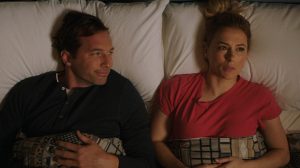 Good on Paper is good for 90 minutes of amusement and some decent chuckles. Shlesinger’s character is in her mid-30s and trying to stake out a successful career as a credible actress, and the real-life Shlesinger is trying to do the same so she wrote herself an acting showcase denied to her by other projects. Shlesinger feels like a ready replacement for the kinds of roles I would have associated with Katherine Heigl at the height of her rom-com run, if she wants it. She has a down-to-earth quality that makes her engaging and obvious comic timing. Her dramatic turns also relatively stick, though this might be the fortuitous alignment of her personal experiences directly translating into the role. I do wish Good on Paper had given a little more attention to filling out its story, punching up its comedy, and maybe pushing everything deeper as at times it can feel like an over-extended anecdote. It’s good enough for a light comedy and serves as a cautionary tale about dating in the digital age.
Nate’s Grade: B-
Share this:

Luca (2021)
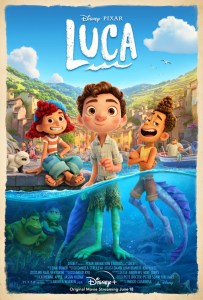 Pixar’s second straight direct-to-Disney-plus outing, Luca, is a decidedly lesser movie from the creative powerhouse. It’s more in keeping with the low stakes and minimal characterization of something like the Cars franchise or Monster’s University. It has its gentle charms and important themes about acceptance, accessibility, and identity, but Luca feels a bit too shallow and lacking in magic. Two sea monster boys want to feel the thrill and freedom of living on land, and it just so happens they transform into looking like humans as long as they don’t get wet. They must learn the ways of blending in, keep their secret, and win the local triathlon to achieve their dream of owning a Vespa scooter. Yes, ostensibly it’s about two kids, and a third once they become friends with a rambunctious redheaded girl in town, wanting to win a race to get a scooter, and you can see the larger theme about friendship and self-acceptance in the name of intolerance, but the movie feels like Ponyo meets The Little Mermaid with the setting of Call Me By Your Name (with maybe some of its coming-of-age queer coding?). The movie barely gets to 84 minutes long, pre-credits, and even that feels very lackadaisical and padded, stretching a thin storyline with minimal development. The animation is expectantly gorgeous and colorful, the lovely daubs of light are so soothing to watch, though I didn’t care for the Gravity Falls-style character designs. The stakes are low and personal but I didn’t really care about the broad characters. There are some fun farcical hijinks trying to hide their monster selves from being seen, and the conclusion has a sweet message without being overtly sentimental, but Luca is little more than a fitfully amusing yet slight seaside vacation for your hungry eyes.
Nate’s Grade: B-
Share this:

In the Heights (2021)
 Weeks ago, I listened to the original Tony Award-winning 2008 Broadway recording for In the Heights, the first major musical by multi-hyphenate artistic virtuoso, Lin-Manuel Miranda. I had never heard the music before and I found that, over the course of a couple hours, little of it stuck with me. There were a handful of tracks where I thought it was nice but nothing grabbed me the way that Hamilton’s soundtrack did from the very start. Because of that musical dip, my expectations lowered slightly for the long-anticipated movie musical of In the Heights. Well, dear reader, let me say what a monumental world of difference seeing the songs in their proper context, with character relationships, and the able performances of the actors can do for making the music come alive. In the Heights is an exuberantly joyous experience, one brimming with energy and good vibes and a warm-hearted welcome that serves as the best argument movie theaters can have to come back and experience the pleasures of the big screen with your friends and family.
Usnavi (Anthony Ramos) is a twenty-something bodega owner in New York City’s Washington Heights neighborhood and dreaming about returning to his home in the Dominican Republic. His young cousin Sonny (Gregory Diaz IV) helps him stock the shelves and keep the family business going. We follow the many faces of the neighborhood, like Abuela (Olga Merediz), who has helped raise everyone as a sweetly matronly figure, Nina (Leslie Grace), returning home from her first year at Stanford as the “girl who made something of herself,” Benny (Corey Hawkins) who was in a relationship with Nina and is looking to work his way up as a cab dispatcher, Daniella (Daphne Rubin-Vega) who is moving her popular salon into another neighborhood, and Vanessa (Melissa Barrera), an aspiring fashion designer who dreams of relocating into Manhattan’s fashion district. Usnavi has been nursing a crush over Vanessa for ages, but will he finally make a move before leaving the country for good to return to the Caribbean?
 This is such a positive and overwhelmingly optimistic story that it becomes infectious, a pleasing balm to sooth all that ails you. It’s very easy to get swept away in the enthusiasm and energy of the movie, enough so that after the exemplary opening number setting up our characters, our setting, and our relationships and goals, people in my theater actually clapped, and I almost felt like joining them. In the Heights succeeds through how relatable and specific it comes across, lovingly showcasing the diverse population of Washington Heights and the community that feels at home here. It’s built upon the celebration of its specific, Latin-American heritage and culture but the movie is also constructed to be so accessible and welcoming to others to learn and join in. The themes and conflicts of these people have specific touchstones to their community, like the threat of deportation and the encroachment of gentrification taking away their neighborhood, but the inner conflicts like feeling the pressure to succeed and questioning whether your dreams are practical are worries that anyone regardless of ethnic background can relate to. In the Heights finds that sweet spot where it’s reverential to its own cultural background and open for anyone.
Naturally, in a musical, much of the appeal will live or die depending upon the quality of the music and the vitality of the performances. With In the Heights, the music and lyrics are quite good and the presentation is phenomenal. If you’re a fan of Hamilton, and if you have ears I assume you would be, it’s fun to listen to the early seeds that would become the signature sound for Lin-Manuel Miranda. There are similar salsa/merengue melodies and hip-hop-infused syncopations that will be familiar to the legions of Hamilton fans, including some rhymes (“Eyes on the horizon” among others). In many ways it’s like watching a junior thesis project of a genius. The opening number does a fantastic job of table setting as well as bringing the audience into this world and getting us excited for more. Usnavi, and Ramos especially, takes full control of our attention and command of the world with fast-paced delivery and extra charisma. There are more bouncy, humorous tunes like “No Me Diga” set in a salon replete with literal bobbing weaves, more traditional Broadway ballads like “Breathe” about a character expressing her doubts and guilt, and the Cole Porter-esque smooth jazz of our young lovers dancing and declaring their affection for one another like “When the Sun Goes Down.”
 But the best moments are the ones that open up the big space and bring the whole community of Washington Heights into the mix. The electricity of the opening number is rekindled in “96,000” where a trip to the local pool turns into a jumping jamboree where everyone dreams about what they would do with a winning lottery ticket sold at Usnavi’s bodega. It allows each character an opportunity to share their dream and what is important to them, providing each person a platform to be more defined. It also taps into that bubbling optimism that permeates the entire movie. The grand finale also has the same effect as characters sing their hearts out about lessons learned and wisdom gained and, thanks to the medium of film, it provides a happy ever after resolution that was unavailable on stage. Miranda is excellent at weaving musical themes to come back into multi-harmonic convergences and crescendos, and it all comes to a rousing and uplifting conclusion.
Another concern about big screen musicals is whether they can translate to the visual landscape of cinema, whether they can escape the trappings of the stage, and In the Heights is exactly how musicals should be filmed. Director John M. Chu (Crazy Rich Asians) got his filmmaking start with the Step Up dance franchise and knows, whatever the film, how to keep things moving swiftly and full of vivacious energy. Even at nearly two-and-a-half hours long, In the Heights doesn’t feel like it has any noticeable down time. The filmmaking choices adapt with the needs and intents of the songs, so when we have a fast-paced multi-part song and dance, the editing adopts this speed, and when we have large ensembles the cinematography widens to take in the expansive group choreography. When things need to slow down and become more intimate, Chu’s camera adopts to this and relies on longer tracking shots and close to medium shots. The pool choreography in “96,000” is splashy fun and lively and very colorful, and the quick visual cues and edits of “In the Heights” incorporates the neighborhood into the music to make New York City feel like a living participant. Chu’s direction takes full advantage of what film can offer but still makes the viewer feel the same intimacy and vibrancy of live theater.
 There are two standout movie moments. The first is the song “Paciencia Y Fe” that does so much symbolic heavy lifting about the immigrant experience, discrimination, and the long struggle for personal dignity, that it made me tear up by the end for a character that, only moments before the empathetic expose, was a nominally nice old lady. The other is “When the Sun Goes Down” between Benny and Nina, which begins with them gazing out a fire escape and takes a magical turn into dancing along the walls of their building like Spider-Man. That transitional moment, from the ordinary to the extraordinary, is the only real magical realism in the show, so Chu has been saving it up for his big moment. The dance is beautiful to behold, and the perspective has an Inception-style spin that alters their balance and perspective of what is up. It’s a beautiful movie moment, captured in long takes, and reminiscent of Fred Astaire’s fanciful fantasias.
Ramos (A Star is Born) played John Laurens in the initial stage show of Hamilton, and its filmed production on Disney Plus, and now he gets his own starring vehicle. He is tremendous as Usnavi, convincingly laid back and charming while also being amusingly anxious around his crush. The awkward romantic fumbles are adorable. Ramos’ singing and skill with the flow of rap lyrics is impressive, but he’s also providing a performance first and worrying about the singing second, not that he should be worried on that front. Hawkins (Straight Outta Compton) surprised me with the range of his singing, and he’s such a pleasant presence to have along. Gregory Diaz IV (Vampires vs. the Bronx) is hilarious at times, like when he’s adopting a macho voice to ask Vanessa adult questions, but he can also break your heart like when he reveals his own legal vulnerability. His poolside solo is also a delightful interjection about what his own rap skills comprise. Merediz (Godmothered) is the only holdover from the original stage show and she is so captivating in her signature number that it’s easy to understand why she was nominated for a Tony Award. There are so many amusing and enjoyable supporting characters populated by familiar faces, like the women of the salon (Rent’s Ruben-Vega, Brooklyn 99’s Stephanie Beatriz, and Orange is the New Black’s Dascha Polanco) providing comic relief and a playful attitude, Jimmy Smits as the noble father giving of himself for his daughter’s future, and Miranda and Hamilton’s Christopher Jackson as dueling sweet treat vendors vying for summer supremacy. You’ll enjoy your time in Washington Heights thanks to these fine folks.
It’s unfair to directly compare In the Heights to Hamilton, like looking at an artist’s portfolio and complaining it isn’t quite up to the standards of Da Vinci, but one area where In the Heights does come up short is the depth of its characterization. The film exudes good vibes as it skips over topical and important political issues with an optimism that might, arguably, borderline on naivete. This feels almost like the opposite-minded compliment to Spike Lee’s Do the Right Thing, another tale of a New York City block one very hot day. The characters are kept at a genial level of interest that makes them enough to feel for and root for, but they’re not exactly deep portrayals with complex conflicts. All the characters have a singularly defined personal conflict that can be resolved by the end, and the lessons about learning to listen to others, appreciate family and self, and find home where you feel it are not exactly revolutionary or complex. Again, this stuff works, and I understand why the story needs characters that have lesser complexity and definition to fulfill the different levels of life. It’s just when compared to the depth of the real people of Hamilton where you realize that maybe the colorful characters of Washington Heights are held to a lesser standard and simply not as multi-dimensional.
 In the Heights is a joyous experience that I think I’ll enjoy more upon re-watching and listening to the soundtrack over the summer months. I can completely understand why people fell in love with this musical upon its initial release and touring, and I can also acknowledge that it’s clearly an earlier artistic steppingstone to greater later achievements for Miranda. That’s not to take anything away from the pleasures of this particular story, these particular characters, and especially these particular songs. In the Heights is a lively and welcoming musical experience that carries a deep affection for its cultural roots and invitation for others to join that celebration. It’s powerfully optimistic that it’s so easy to be swept away and smile with its charms and uplift. In the Heights takes advantage of its cinematic opportunities, the charisma and energy of the talented cast, and the soaring and lovely melodies and catchy rhymes from Miranda. In the Heights is a great way to kick off a return to a summer season at the movies.
Nate’s Grade: A-
Share this:

Cruella (2021)
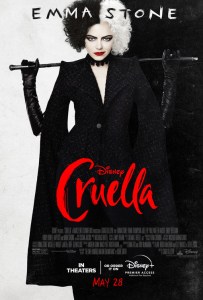 I don’t think I’ll be shocking any readers when I disclose that this Cruella doesn’t kill a single dog in her new movie. I hope I didn’t ruin the experience for anyone hoping for mass puppy slaughter. I figured Disney was going to go this route as they developed a villain biopic for Cruella DeVil, a woman obsessed with making coats from the skin of dalmatians. How exactly does one make a character like that sympathetic? Well by essentially making her a fan fiction version of Cruella DeVil and providing an even more dislikable antagonist to root against. The question then arises does this really count as a villain biopic when the character is so reconstructed? It follows the blueprint of 2014’s Maleficent where it posits that the story we’ve been told has been a matter of misunderstandings and smear campaigns from the Powers That Be. Cruella isn’t a puppy murderer. Now she’s a school outcast, plucky orphan with her own motley crew, and up-and-coming avant garde fashion designer looking to get her big break.
It presents her as an underdog on several fronts and with a back-story that might go down in history for its reclamation. Minor spoilers ahead, considering it’s early in the movie, but Cruella’s mother was literally killed by dalmatians pushing her off a cliff. The blunt re-imagining might even draw titters of laughter as the movie says, “Here’s the real reason she dislikes dogs.” However, even this tragic revision doesn’t make this Cruella hate dogs. There’s even a cute pooch on her team. This is a Cruella that’s not so cuddly but not unlovable either. She’s presented as a scrappy underdog with a punky attitude and whether this works will depend on your adherence to what a Disney villain biopic should be. Personally, I had no fidelity to the character of Cruella DeVil so I didn’t care. I wanted an entertaining movie with a strong lead performance from Emma Stone, and that’s what I got.
 Set in 1970s London, Estella (Stone) is a lonely girl born brilliant but tempered by an uncaring society. After the dalmatian-assisted murder of her mother, Estella and her pals are meeting out their days with small-time grifts and cons. Estella dreams of being a fashion designer and her boys manage to get her an entry level job at a department store. Her experimental window display gets the attention of The Baroness (Emma Thompson), a sharp-tongued and formidable fashionista that makes the world tremble. Estella adopts the identity of “Cruella,” with her natural half-black and half-white hair, to upstage the Baroness, draw publicity for her own unique fashion creations, as well as enact vengeance and retrieve her mother’s missing necklace/family heirloom stolen by the Baroness, as if you needed even more reasons to dislike this lady.
Cruella in many ways feels like The Devil Wears Prada mixed with a superhero origin tale. The Estella/Cruella dynamic is played like a secret identity, wherein she adopts one to achieve a personal goal and becomes seduced by the freedom the alternate identity has to offer. The first half plays quite like Prada, with our fashion upstart working her way up the chain, gaining attention for her insights and designs while fighting against a system meant to squash new ideas. The character of the Baroness is very clearly patterned after Miranda Priestly (Meryl Streep) and the command she wielded in her influential position atop the established fashion industry. At first, Estella wants to gain her approval and become a protégé, and then she wants to topple her, crush her, and it becomes a matter of how far she will go, with characters saying variations on, “You’ve changed. It used to be Estella, now it’s only Cruella.” Even The Devil Wears Prada featured a similar character descent for its protagonist. Except the question never seems too in doubt with Cruella because the character of Cruella is less a person succumbing and fraying, like the Oscar-winning 2019 Joker prequel, and more a tale of self-actualization and empowerment. That’s why it feels more like a superhero origin and less like the Joker’s origin. She’s becoming more confidant, more assertive, and more accepting of her true nature.
 Under the direction of Craig Gillespie (I, Tonya), Cruella feels like a colorful, sprightly caper, something with more attitude and dark humor than I would have believed capable of being forged from the Mouse House with their own intellectual properties. This could have easily been a cash grab but Gillespie and his team of screenwriters, including one of the writers from 2018’s The Favourite, decides to take that big Disney checkbook and have fun with it. This movie reminded me of a PG-friendly version of 2020’s Birds of Prey for adolescents. It’s got slapstick, schemes, contraptions, narrative shuffling, charming and weird characters, and a lot of visual style and attitude to spare. Above all else, this is a fun movie, and one that assembles set pieces and mini-goals that lead to enjoyable payoffs. There’s a funny big heist as the mid-point but it doesn’t go according to plan, as so we watch as Estella and her team have to adapt and get out of a series of escalating traps. The rivalry between Cruella and the Baroness leads to some gaga dress designs I’m certain will get Oscar attention in due time. There’s plenty of life simply coursing through this movie from the actors to the visuals to the extensive music library. Even when the movie is overstaying its welcome (this could have easily been trimmed down by 15 minutes) the movie still finds ways to keep you entertaining and pleased.
Chief among those reasons is Stone (La La Land) as our star. She’s honed her British accent after her Oscar-nominated performance from The Favourite and it’s easy to see a straight-line from that cunning social climber to this new role. Stone finds the right mix of camp and pathos to make the character work. She’s no exaggerated cartoon but she needs a certain energy level to keep you charged. She’s no mousy heroine but a powerful force looking for the right armor that fits. Stone might not be playing the Cruella DeVil of the 1961 cartoon but she’s playing a version of the character that is more capable of carrying a two-hour-plus movie. Special consideration should be paid out to Paul Walter Hauser, who was so memorably dimwitted in I, Tonya, and portrays Horace, a similarly dimwitted member of Cruella’s crew. The man knows what he’s doing when he’s given these roles and it’s easy to see why he keeps getting more.
The amount of needle-drop music cues in this movie puts 2016’s Suicide Squad to shame. I was amazed how that movie could literally go from song-to-song with barely a gap, sometimes only using mere seconds to make its sonic case. The Cruella soundtrack is wall-to-wall music selections, many from the 1960s and 1970s rock and punk scene, and it’s another holdover from I, Tonya that Gillespie has brought with him. The over reliance can become distracting in itself because of the sheer volume of musical selections, many of which can be exceedingly literal (you better believe, yet again, “Sympathy for the Devil” by the Rolling Stones is called in). It’s a sign of just how powerful the Disney brand can be as I’m sure a huge chunk of the movie’s budget went toward getting all these dozens and dozens of music clearances. If you consider it like a kid’s introduction to classic rock songs, it’s excusable, but the number of songs can also be distracting.
 Whether you consider Cruella a faithful or radical reinterpretation of the Disney villain, the live-action showcase is a star vehicle for its shining star. Stone is captivating and having a grand time in her fabulous fashions, and the movie makes it easy to feel her highs as well. It’s not exactly a great movie as many of its supporting characters are underwritten or overly convenient, and its question over the madness and identity of its heroine is more theory than practice, but Gillespie and his team have decided to make Cruella a fun movie, and to that end they have succeeded. It’s colorful, breezy, punky, funny, and consistently amusing, with outlandish set pieces, outlandish characters, and outlandish escapes. Yes, the mom-killed-by-dalmatians tragic back-story might elicit its own howls of bafflement, but the movie doesn’t belabor it for extra ironic impact. Cruella (or Cruella Lite, if you will) is an entertaining reinterpretation that knows what to scuttle to work on its own terms. Whether those alterations are too drastic or defang the character are up to you, but I’d rather watch a kinder, softer, yet still prickly Cruella than one skinning dogs.
Nate’s Grade: B
Share this:

Wolfwalkers (2020)
 Beautifully animated with painterly water color visuals, Wolfwalkers is another treat from the acclaimed Irish studio that is single-handedly trying to bring back hand-drawn animation. The visuals are a delight and styled in a flat dimensional space reminiscent of Medieval tapestries (and Wes Anderson movies). The story brings to life 17th century Celtic mythology in a way that is still relevant today and concerns weighty themes about family identity, female independence, religious persecution, prejudice, colonial occupation and exploitation, and environmental conservation. It’s part Miyazaki and Brave and also reverent to its own cultural heritage, and it’s emotionally affecting and engrossing as well as being a treat for the eyes. We watch a young girl befriend a wild “wolfwalker,” a girl who can transform into a wolf when she sleeps. their bond will push each other to fight against forces trying to dominate the forest and morality. The filmmakers have carefully laid out the rules of their story and the implementation of the special powers so that everything happens through gradual circumstances where the plot feels as if it is following an entirely organic path. The voice acting is excellent and heartrending and perfectly paired for the exaggerated, wood-block-styled character designs. It’s a lovely and entertaining supernatural fable with enough thematic relevance, girl power, and visual grace to reaffirm just how magical traditional animation can still be.
Nate’s Grade: A-
Share this:

Moulin Rouge! (2001) [Review Re-View]

Released May 17, 2001:
Director Baz Luhrmann’s last project was the MTV-friendly William Shakespeare’s Romeo + Juliet (like someone else has a Romeo and Juliet) which was adored by the under 15 set that now buy N*SYNC merchandise. Luhrmann waited a long time for his follow up with Moulin Rogue, a manic musical that seems like candy for the eyes. It may have been a long time but it was well worth the wait.
The sparkling world of Moulin Rogue is around turn of the century France. Christian (Ewan McGregor), an aspiring writer, has traveled to this place against his father’s wishes. Christian believes in the beauty of love and the pull of the heart. Within minutes of setting foot in France he gets wrapped up into a production by a dwarf (John Leguizamo) and his cadre of assistants. Christian is sent to the most provocative club in town, the Moulin Rogue. Here he attempts to persuade the most famous showgirl Satine (Nicole Kidman) to help push for their musical to get financial backing. Satine inadvertently confuses Christian for the man she is supposed to seduce for a large some of money, the Duke (Richard Roxburgh). And thus the merry band of misfits get their play the backing while Christian blossoms a love for Satine. But their love must remain hidden for the Duke is led to believe that Satine is his and his alone.

Kidman owns this movie, plain and simple. From her first shattering entrance being lowered from the ceiling to the last scene, she is absolutely magnificent. McGregor gives a nice performance as the dough-eyed lover. Jim Broadbent plays the Moulin Rogue’s owner, Zidler with howling delight in all his manic expressions. Even Roxburgh gives an underwritten antagonist the right amount of weasely twitch.
One of the more surprising features is how well the two leads can actually sing. Kidman gives a soft and sexy take on “Diamonds are a Girl’s Best Friend” and McGregor can belt out a tune with some admirably throaty pipes. As these two veer in and out of songs it’s a pleasure to watch and hear.
Luhrmann has crafted a musical with ADD, but I say this as a compliment. Moulin Rogue‘s pace is fast and pounding. People twirl above the sky, the camera zooms wildly through town streets, and dump trucks worth of confetti fly through the air. Moulin Rouge is exploding with glitz and never lets up. The editing and visual artistry is stirring. By about ten minutes into the proceedings when a green fairy starts singing a seductive version of “The Hills Are Alive” you know you are in for something else. And what a something else the film delivers. There was not a moment I didn’t have a smile glued to my stupid face.

Moulin Rogue could be described as a musical for people who dislike traditional musicals. In traditional musicals people go along stuffy formula, then break out into great choreography song-and-dance. With Lurhmann’s musical is a breakneck of pomp where the characters zip around to exaggerated Hanna-Barbara sound effects and start chiming away with 70s and 80s pop songs that we all know. After the initial shock/humor of hearing characters belt out renditions of “Roxanne” and “Like A Virgin,” a familiarity sets in and it blends in to produce a surprising artistic addition.
The story of the movie is nothing new or extraordinary; it’s well worn territory. But where Moulin Rouge breaks apart and shines are with its style and exposure. The visuals are astoundingly lush and lively, the music is game and pumping, and the movie is just screaming to be seen. This was a true work of love.
The movie is bursting to the seams with life. I loved every single second, every single frame, every single moment of Moulin Rouge. I can’t wait to go see it again.
Nate’s Grade: A
——————————————————
WRITER REFLECTIONS 20 YEARS LATER

This was a movie I was looking forward to revisiting and was partly dreading. With the movies that I loved in my past, there is more at stake revisiting them and finding that some of the luster, some of that original magic that enchanted me twenty years hence might be missing. Nothing is lost by re-learning that something like Freddy Got Fingered is still as awful today as it was in 2001. I had this same nagging concern with several of my favorites of 1999 and 2000, and not all of them held up (these re-reviews cannot help being partly biographical). Moulin Rouge wasn’t even a movie I had much interest in seeing back in 2001. I went at the behest of my friend Kevin Lowe and I remember my expectations being low, or maybe I wasn’t in the greatest mood, but within ten minutes that all changed. Moulin Rouge is a movie I unabashedly loved at 19 years old and watched repeatedly through my early 20s and consider a personal favorite. I was caught up in the razzle, the dazzle (especially the dazzle), but the sumptuous and crazed artistry of it all, where it could simultaneously be nostalgic and modern, irreverent and deeply serious, hopelessly romantic in the squarest of terms while being so quizzically weird. It could have been a spectacular disaster but it ended up being a spectacular spectacular. I’m happy to report that Moulin Rouge retains its charm and soaring passion even twenty toe-tapping years later.

This has and will always be a love-it-or-hate-it film. I don’t think there are many people who can watch this movie and remark, “Eh, it was okay I guess.” The opening act is relentlessly paced, anarchic and antic, bouncing all over the place, exploding with information, humor, colors, and bawdy and bizarre imagery, intending to shake you from your doldrums of what a modern big screen musical experience can entail. Under the mad genius of co-writer/director Baz Luhrmann, the movie is bracingly transporting and takes you for an immediate rush, and just as it slows down, you’re hooked. Or, if you’re in the hate-it camp, you’ve found the movie to be a scattershot, self-indulgent, ADD-addled, exhausting ride you’re eager to depart. An amusement park ride is a fine analogy for Moulin Rouge, a movie reverberating with energy and movement; it really does feel like it can’t possibly stand still. There’s a seductive green fairy line dancing, and a singing moon performing opera, and a narcoleptic Argentinian, and John Leguizamo as a dwarf, and plenty of ribald sexual humor and goofy slapstick comedy. It is, to put it lightly, a lot to handle.
With apologies to modern poets, for most of us, the poetry of our modern culture is the songs that have shaped us and our biographical experiences, the soaring ballads, the friendly singalongs, the bangers to shout at the top of your lungs, the love songs to swoon along to and melt away. Moulin Rouge is a major musical that only has one original song, the modern wedding staple “Come What May,” which was actually written for Luhrmann’s prior movie, 1995’s Romeo and Juliet, and thus declared ineligible for the Academy Award for Original Song (sorry Randy Newman, but your Monster’s Inc. song cannot compete). It is a musical composed of renditions and snippets of hit music, cementing its amalgamation as a pop-culture chimera. In many ways it previews the viral Glee music mashups and remixes, the effortless blending of one song into another, the melodies gliding like dancers and then becoming something excitingly new. It’s a different kind of creativity because it’s one thing just to hit “play” on some Greatest Hits CD and it’s another to make sure the songs track the emotional journeys and perspectives of its primary players. Early on, as Christian (Ewen McGregor) belts tunes from The Sound of Music, captivating his peers with his apparent genius, we immediately understand the instant appeal this man would have, seeming like a musical prophet to those lucky enough to listen in 1899 Paris. It’s a clever shorthand and another reflection that modern music has enough vitality and depth to serve as the romantic poetry of our age. Moulin Rouge also predates the sharp rise in jukebox musicals, using the songs of the past, usually limited to one artist, as part of the infectious fun.

The singing and song renditions are luscious and odd and beautifully re-calibrated. The introduction of Satine (Nicole Kidman) is a bold move, lowered on trapeze, her pale skin practically glowing, as she breathily sings “Diamonds Are a Girl’s Best Friend.” It’s like the movie perceives Satine as an angel being lowered to the mores of man. A male duet of “Like a Virgin” between club owner Harold Zidler (Jim Broadbent) and the villainous, twitchy, possessive and foppish Duke (Richard Roxburgh) is hilarious and at points unfathomably creepy. Watching “Roxanne” performed as a sultry tango is so good that you’ll never want to hear it any other way. The singing by the famous stars is remarkably polished and without the advent of Autotune, especially from McGregor who belts his tunes with impressive range. The blending of this sonic soundscape, especially McGregor inter-cutting with that “Roxanne” number, can be overwhelming to fully process, like the movie is trying to reach you on a pure emotional, elemental level where you feel it before you can fully process it intellectually. I think that sums up the movie and its lasting appeal well, because I can logically pick apart certain artistic choices, like the exaggerated cartoon sound effects that could have been pared back, but the movie is a messy, joyously messy, exuberant love letter to big messy emotions and cheesy romanticism even to the point of mockery. This is a big screen musical for our modern age, and it’s meant to tap the right combination of buttons to make you fall in love, and I do every time.
It’s amazing to me how Moulin Rouge feels like a crossroads of the old and new, reaching back to the big movie musicals of old but with the hyper-kinetic style of modern music videos. It’s immediately fresh but also familiar, and that clever construction most notably extends to its very specific use of music. It’s not trying to erase the old school musical but drag it into a new century, drafting off of modern music hits to reach a new audience waiting to feel that same heightened reality that those old musicals might not capture for a younger generation. The movie also begat a resurgence of big screen musicals like 2002’s Chicago, 2004’s Phantom of the Opera, 2005’s Rent and The Producers (also co-starring Kidman), 2006’s Dreamgirls, 2007’s Sweeney Todd and Hairspray, and on and on to recent musicals like 2019’s Rocketman (jukebox musical) and 2020’s The Prom (also co-starring Kidman). Everything Chicago did, I felt like Moulin Rouge did better the year before, and I’m convinced Kidman’s Best Actress Oscar for The Hours was a makeup award for being overlooked for her superior performance in Moulin Rouge a year prior. I don’t know if Kidman was ever better than she was here at this moment in her career, fresh off her divorce from Tom Cruise. I feel strongly that Broadbent should have won his 2001 Best Supporting Actor Oscar for this and not Iris. The movie was nominated for eight Oscars and justly won two for Best Art Direction and Costumes, both going to Luhrmann’s wife, Catherine Martin, who would also win two Oscars for her husband’s equally lush and anachronistic 2013 adaptation of The Great Gatsby. The electric editing, glittering cinematography, and all the bravura technical elements blend into a rare artistic vision so complete and so extravagantly bold at this budget level.

It should also be noted that Moulin Rouge was adapted into a Broadway stage musical in 2019, updating with more twenty-first century hits like “Crazy in Love” and “Firework” and “Toxic” and “Bad Romance” among others. Its stage run was postponed because of COVID although a national tour is planned for 2022.
From my original review back in 2001, many of my same points still hold up and it was difficult to perfectly capture the spell this movie can have, the same difficulty I’m running into today in 2021 to try and convey its unique hold on me. Regrettably, it’s another review that I felt I needed to take a potshot on “teenyboppers” from my oh so dismissive position as critic. It’s nice when I find myself agreeing with my twenty years younger self. I especially agree with this one summative statement: “There was not a moment I didn’t have a smile glued to my stupid face.” Moulin Rouge is one of my happy movies and twenty years later my stupid face is still smiling.
Re-Review Grade: A


 nathanzoebl
You must be logged in to post a comment.