Blog Archives
Oppenheimer (2023)
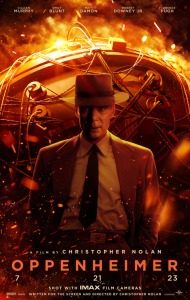 I finally did it. I watched all three hours of Christopher Nolan’s Oppenheimer, one half of the biggest movie-going event of 2023, and arguably the most smarty-pants movie to ever gross a billion dollars. It was a critical darling all year long, sailed through its awards season, and racked up seven Academy Awards including Best Picture and Best Director for Nolan, a coronation for one of Hollywood’s biggest artists whose name alone is each new project’s biggest selling point. I’ve had friends falling over themselves with rapturous praise, and I’m sure you have too, dear reader, so the danger becomes raising your expectations to a level that no movie could ever meet. As I watched all 180 lugubrious minutes of this somber contemplation of man’s hubris, I kept thinking, “All right, this is good, but is it all-time-amazing good?” I can’t fully board the Oppenheimer hype train, and while I respect the movie and its exceptional artistry, I also question some of the key creative decision-making that made this movie exactly what it is, bladder-busting length and all.
As per Nolan’s non-linear preferences, we’re bouncing back and forth between different timelines. The main story follows Robert Oppenheimer (Cillian Murphy) as an upstart theoretical physicist creating his own academic foothold and then being courted to join the Manhattan Project to beat the Nazis in the formation of a nuclear bomb. The other timeline concerns the Senate approval hearing for Lewis Strauss (Robert Downey Jr.), the former head of the Atomic Energy Commission (AEC) with a checkered history with Oppenheimer after the war. A third timeline, serving as a connecting point, involves Oppenheimer undergoing a closed-door questioning over the approval of his security clearance, which brings to light his life of choices and conundrums.
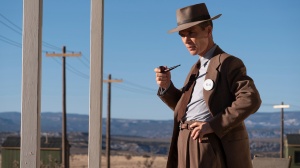 If I was going to be my most glib, I would characterize Oppenheimer in summary as, “Man creates bomb. Man is then sad.” There’s much more to it, obviously, and Nolan is at his most giddy when he’s diving into the heavy minutia of how the project came about, the many brilliant minds working in tandem, and sometimes in conflict, to usher in a new era of science and energy. Of course it also has radical implications for the world outside of academic theory. The world will never be the same because of Oppenheimer dramatically upgrading man’s self-destructive power. The accessible cautionary tale reminds me of a Patton Oswalt stand-up line: “We’re science: all about ‘coulda,’ no about ‘shoulda.’” Oh the folly of man and how it endures.
For the first two hours, the focus is the secretive Manhattan Project out in the New Mexico desert and its myriad logistical challenges, all with the urgency of being in a race with the Nazis who already have a head start (their break is Hitler’s antisemitism pushing out brilliant Jewish minds). That urgency to beat Hitler is a key motivator that allows many of the more hand-wringing members to absolve those pesky worries; Oppenheimer says their mission is to create the bomb and not to determine who or when it is used. That’s true, but it’s also convenient moral relativism, essentially saying America needs to do bad things so that the Germans don’t do worse things, a line of adversarial thinking that hasn’t gone away, only the name of the next competitor adjusts. This portion of the movie works because it adopts a similarly streamlined focus of smart people working together against a tight deadline. Looking at it as a problem needing to surmount allows for an engaging ensemble drama complete with satisfying steps toward solutions and breakthroughs. It makes you root for the all-star team and excitedly follow different elements relating to nuclear fusion and fission that you would have had no real bearing before Nolan’s intellectual epic. For those two galloping hours, the movie plays almost like a brainy heist team trying to pull together the ultimate job.
 It’s the time afterwards where Oppenheimer expands upon the lasting consequences where the movie finds its real meaning as well as loses me as a viewer. The legacy of the bomb is one that modern audiences are going to be readily familiar with 80 years after the events that precipitated their arrival, and they haven’t exactly been shelved or become the world war deterrent hoped for. As one of Oppenheimer’s physicists says, a big bomb only works until someone creates a bigger bomb, and then the arms race starts all over again fighting for incremental supremacy when it comes to whether one’s military might could destroy the world ten times or twelve times over. When Oppenheimer begins having reservations of what he has brought into this world is when his character starts becoming more dynamic, but it’s also too late. He can’t undo what he’s done, the world isn’t going back to a safer existence before nuclear arms, so his tears and fears come as short shrift. There’s a scene where Oppenheimer’s wife, Kitty (Emily Blunt), castigates him and says, “You don’t get to commit the sin and then make all of us to feel sorry for you when there are consequences.” Now this is in reference to a different personal failing of our protagonist, but the message resonates; however, I don’t know if this is Nolan’s grand takeaway. The movie in scope and ambition wants to set up this man as a tragic figure that gave birth to our modern world, but like President Truman says, it’s not about who created the bomb but who uses it. Oppenheimer is treated like a harbinger of regret, but I don’t think the story has enough to merit this examination, which is why Oppenheimer peters out after the bomb’s immediate aftermath.
It reminded me of an Oscar favorite from 2015, Adam McKay’s The Big Short, a true-ish account of real people profiting off the worldwide financial meltdown from 2008. It fools you into taking on the perspective of its main characters who present themselves as underdogs, keepers of a secret knowledge that they are trying to benefit from before an impending deadline. Likewise, the conclusion also makes you question whether you should have been rooting for this scheme all along since it was predicated on the economy crashing; these guys got their money but how many lives were irrevocably ruined to make their big score? With The Big Short, the movie-ness of its telling is part of McKay’s trickery, to ingratiate you in this clandestine financial world and to treat it like a heist or a con, and then to reckon whether you should have ever been rooting for such an adventure. Oppenheimer has a similar effect, lulling you with its admitted entertainment factor and beat-the-deadline structure. Once the mission is over, once the heroes have “won,” now the game doesn’t seem as fun or as justifiable. Except Oppenheimer could have achieved this effect with a judicious resolution rather than an entire third hour of movie shuffled throughout the other two like a mismatched deck of cards.
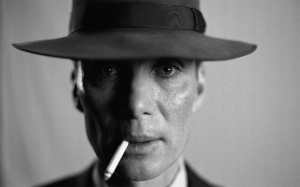 The last hour of the movie features a security clearance interrogation and a Senate confirmation hearing, neither of which have appealing stakes for an audience. After we watch the creation of a bomb, do we really care whether or not this one testy guy gets approved for a cabinet-level position or whether Oppenheimer might get his security clearance back? I understand that these stakes are meaningful for the characters, both essentially on trial for their lives and connections, but Nolan hasn’t made them as necessary for the audience. They’re really systems for exposition and re-examination, to play around with time like it was having a conversation with itself. It’s a neat effect when juggled smoothly, like when Past Oppenheimer is being interviewed by a steely and suspicious military intelligence office (Casey Affleck) while Future Oppenheimer laments to his project superior (Matt Damon) and then Even More Future Oppenheimer regrets his lack of candor to the review board. The shifty wheels-within-wheels nature of it all can be astounding when it’s all firing in alignment, but it can also feel like Nolan having a one-sided conversation with himself too often. It’s another reminder of the layers of narrative trickery and obfuscation that have become staples of a Christopher Nolan movie (I don’t think he could tell a knock-knock joke without making it at least nonlinear). The opposition to Oppenheimer is summarized by Strauss but I would argue the man didn’t need a public witch hunt to rectify what he’s done.
Lest I sound too harsh on Nolan’s latest, there are some virtuoso sequences that are spellbinding with technical artists working to their highest degree of artistry. The speech Oppenheimer gives to his Los Alamos colleagues is a horrifying lurch into a jingoistic pep rally, like he’s the big game coach trying to rally the team. The way the thundering stomps on the bleachers echo the rhythms of a locomotive in motion, driving forward at an alarming rate of acceleration, and then how Nolan drops the background sound so all we hear is Oppenheimer’s disoriented speech while the boisterous applause is muted, it’s all masterful to play with our sense of dread and remorse. This is who this man has become, and his good intentions of scientific discovery will be rendered into easily transmutable us-versus-them fear mongering politics. The ending imagery of Oppenheimer envisioning the world on fire is the exact right ending and hits with the full disquieting force of those three hours. The meeting with Harry Truman (Gary Oldman) is splendid for how undercutting it plays. Kitty’s interview at the hearing is the kind of counter-punching we’ve been waiting for and is an appreciated payoff for an otherwise underwritten character stuck in the Concerned Wife Back at Home role. The best parts are when Oppenheimer and Leslie Groves (Damon) are working in tandem to put together their team and location, as that’s when the movie feels like a well orchestrated buddy movie I didn’t know I wanted. The sterling cinematography, musical score, editing, all of the technical achievements, many of which won Oscars, are sumptuously glorious and immeasurably add to Nolan’s big screen vision.
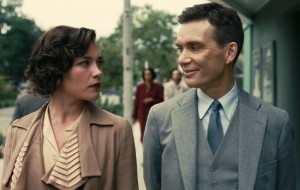 I think I may understand why the subject of sex is something Nolan has conspicuously avoided before. Much has been made about the sex scenes and nudity in Oppenheimer, which seem to be the crux of Florence Pugh’s performance as Jean Tatlock, Oppenheimer’s communist mistress through the years. The moment of Oppenheimer sitting during his hearing about his sexual tryst with an avowed communist leads to him imagining himself in the nude, exposed and vulnerable to these prying eyes and their judgment. Then Kitty imagines seeing Pugh atop her husband in his hearing seat, staring directly at her, and this sequence communicated both of their internal states well and felt justified. It’s the origin of the famous “I am become death” quote where the movie enters an unexpected level of cringe for a movie this serious. I was not prepared for this, so mild spoilers ahead if you care about such things, curious reader. We’re dropped into a sex scene between Oppenheimer and Jean where she takes a break to peruse his library shelves. She’s impressed that he has a Hindu text and pins it against her naked chest and slides atop Oppenheimer once again, requesting he read it to her rather than summarize it. “I am become death,” he utters, as he reads the Hindu Book of the Dead off Pugh’s breasts while they continue to have sex. Yikes. A big ball of yikes. If this is what’s in store, please go back to a sexless universe of men haunted by their lost women.
It’s easy to be swept away by all the ambition of Nolan’s Oppenheimer, a Great Man of History biopic that I think could have been better by being more judiciously critical of its subject. It’s a thoroughly well-acted movie where part of the fun is seeing known and lesser known name actors populate what would have been, like, Crew Member #8 roles for the sake of being part of this movie (Rami Malek as glorified clipboard-holder). Oppenheimer takes some wild swings, many of them paying off tremendously and also a few that made me scratch my head or reel back. It’s a demonstrably good movie with top-level craft, but I can’t quite shake my misgivings that enough of the movie could have been lost to history as well.
Nate’s Grade: B
Share this:

Cold Mountain (2003) [Review Re-View]

Originally released December 25, 2003:
Premise: At the end of the Civil War, Inman (Jude Law, scruffy) deserts the Confederate lines to journey back home to Ada (Nicole Kidman), the love of his life he’s spent a combined 10 minutes with.
Results: Terribly uneven, Cold Mountain‘s drama is shackled by a love story that doesn’t register the faintest of heartbeats. Kidman is wildly miscast, as she was in The Human Stain, and her beauty betrays her character. She also can’t really do a Southern accent to save her life (I’m starting to believe the only accent she can do is faux British). Law’s ever-changing beard is even more interesting than her prissy character. Renee Zellweger, as a no-nonsense Ma Clampett get-your-hands-dirty type, is a breath of fresh air in an overly stuffy film; however, her acting is quite transparent in an, “Aw sucks, give me one ‘dem Oscars, ya’ll” way.
Nate’’s Grade: C
——————————————————
WRITER REFLECTIONS 20 YEARS LATER

I kept meaning to come back to Cold Mountain, a prototypical awards bait kind of movie that never really materialized, but one woman ensured that it would be on my re-watch list for 2003. My wife’s good friend, Abby, was eager to hear my initial thoughts on the movie when I wrote my original review at the age of twenty-one. This is because Cold Mountain is a movie that has stayed with her for the very fact that her grandfather took her to see it when she was only nine years old. While watching, it dawned on nine-year-old Abby that this was not a movie for nine-year-olds, and it’s stuck with her ever since. I think many of us can relate to watching a movie with our parents or family members that unexpectedly made us uncomfortable. For me, it was Species, where I was 13 years old and the movie was about a lady alien trying to procreate. I think my father was happy that I had reached an acceptable age to go see more R-rated movies in theaters. Social media has been awash lately with videos of festive families reacting to the shock value of Saltburn with grumbles and comical discomfort (my advice: don’t watch that movie with your parents). So, Abby, this review is for you, but it’s also, in spirit, for all the Abbys out there accidentally exposed to the adult world uncomfortably in the company of one’s parents or extended family.
Cold Mountain succumbs to the adaptation process of trying to squeeze author Charles Frazier’s 1997 book of the same name into a functional movie structure, but the results, even at 150 minutes, are unwieldy and episodic, arguing for the sake of a wider canvas to do better justice to all the themes and people and minor stories that Frazier had in mind. Director Anthony Minghella’s adaptation hops from protagonist to protagonist, from Inman to Ada, like perspectives for chapters, but there are entirely too many chapters to make this movie feel more like a highly diluted miniseries scrambling to fit all its intended story beats and people into an awards-acceptable running time. This is a star-studded movie, the appeal likely being working with an Oscar-winning filmmaker (1996’s The English Patient) of sweep and scope and with such highly regarded source material, a National Book Award winner. The entire description of Cold Mountain, on paper, sounds like a surefire Oscar smash for Harvey Weisntein to crow over. Yet it was nominated for seven Academy Awards but not Best Picture, and it only eventually won a single Oscar, deservedly for Renee Zellweger. I think the rather muted response to this Oscar bait movie, and its blip in a lasting cultural legacy, is chiefly at how almost comically episodic the entire enterprise feels. This isn’t a bad movie by any means, and quite often a stirring one, but it’s also proof that Cold Mountain could have made a really great miniseries.

The leading story follows a disillusioned Confederate defector, Inman (Jude Law), desperately trying to get back home to reunite with his sworn sweetheart, Ada (Nicole Kidman), who is struggling mightily to maintain her family’s farm after the death of her father. That’s our framework, establishing Inman as a Civil War version of Odysseus fighting against the fates to return home. Along the way he surely encounters a lot of famous faces and they include, deep breath here, Phillip Seymour Hoffman, Natalie Portman, Giovanni Ribisi, Cillian Murphy, Eileen Atkins, Taryn Manning, Melora Walters, Lucas Black, and Jena Malone. Then on Ada’s side of things we have Zellweger, Donald Sutherland, a villainous Ray Winstone, Brendan Gleeson, Charlie Hunam, Kathy Baker, Ethan Suplee, musician Jack White, and Emily Descehanel, and this is the storyline that stays put in the community of Cold Mountain, North Carolina.
That is a mountain of stars, and with only 150 minutes, the uneven results can feel like one of those big shambling movies from the 1950s that have dozens of famous actors step on and as quickly step off the ride. Poor Jena Malone (Rebel Moon) appears as a ferry lady and literally within seconds of offering to prostitute herself she is shot dead and falls into the river (well, thanks for stopping by Jena Malone, please enjoy your parting gift of this handsome check from Miramax). Reducing these actors and the characters they are playing down to their essence means we get, at most, maybe 10-15 minutes with them and storylines that could have been explored in richer detail. Take Portman’s character, a widowed mother with a baby trying to eke out a living, one of many such fates when life had to continue after the men ran to war for misbegotten glory. She looks at Inman with desperate hunger, but it’s not exactly lust, it’s more human connection. When she requests that Inman share her bed, it’s just to feel another warm presence beside her, someone that can hold her while she weeps about the doomed fate of her husband and likely herself. There’s a strong character here but she’s only one stop on our expedited tour. The same with Hoffman’s hedonistic priest, a man introduced by throwing the body of a slave woman he impregnated over a ridge, which might be the darkest incidental moment of the whole movie. His character is played as comic relief, a loquacious man of God who cannot resist the pleasures of the flesh, but even he comes and goes like the rest of our litany of very special guest stars. They feel more like ideas than characters.

This is a shame because there are some fantastic scenes and moments that elevate Cold Mountain. The opening Civil War battle is an interesting and largely forgotten (sorry Civil War buffs) battle that begins with a massive surprise attack that produces a colossal explosion and crater and turns into a hellish nightmare. Granted, the movie wants us to sympathize with the Confederates who were bamboozled by the Yankee explosives buried under their lines, and no thank you. The demise of Hoffman’s character comes when he and Inman are captured and join a chain gang, and they try running up a hill to get free from approaching Union troops. The Confederates shoot at the fleeing men, eventually only with Inman left, who struggles to move forward with the weight of all these dead men attached to him. When they start rolling down the hill, it becomes a deeply macabre and symbolic struggle. The stretch with Portman (May December) is tender until it goes into histrionics, with her literal baby being threatened out in the cold by a trio of desperate and starving Union soldiers (one of which played by Cillian Murphy). It’s a harrowing scene that reminds us about the sad degradation of war that entangles many innocents and always spills over from its desired targets. However, this theme that the war and what it wrought is sheer misery is one Minghella goes to again and again, but without better characterization with more time for nuance, it feels like each character and moment is meant to serve as another supporting detail in an already well-proven thesis of “war is hell.”
Even though I had previously watched the movie back in 2003, I was hoping that after two hours of striving to reunite, that Inman and Ada would finally get together and realize, “Oh, we don’t actually like each other that much,” that their romance was more a quick infatuation before the war, that both had overly romanticized this beginning and projected much more onto it from the years apart, and now that they were back together with the actual person, not their idealized imaginative version, they realized what little they had in common or knew about each other. It would have been a well-played subversion, but it also would have been a welcomed shakeup to the Oscar-bait romantic drama of history. Surely this had to be an inconvenient reality for many, especially considering that the men returning from war, the few that did, were often not the same foolhardy young men who leapt for battle.
Zellweger (Judy) was nominated for Best Actress in the preceding two years, for 2001’s Bridget Jones Diary and 2002’s Chicago, which likely greased the runway for her Supporting Actress win from Cold Mountain. There is little subtlety about her “aw shucks” homespun performance but by the time she shows up, almost fifty minutes into the movie, she is such a brash and sassy relief that I doubt anyone would care. She’s the savior of the Cold Mountain farm, and she’s also the savior of the flagging Ada storyline. Pity Ada who was raised to be a nice dutiful wife and eventual mother but never taught practical life skills and agricultural methods. Still, watching this woman fail at farming will only hold your attention for so long. Zellweger is a hoot and the spitfire of the movie, and she even has a nicely rewarding reconciliation with her besotted old man, played by Brendan Gleeson, doing his own fiddlin’ as an accomplished violin player. As good as Zellweger is in this movie is exactly how equally bad Kidman’s performance is. Her Southern accent is woeful and she cannot help but feel adrift, but maybe that’s just her channeling Ada’s beleaguered plight.

I think there’s an extra layer of entertainment if you view Inman’s journey in league with Odysseus; there’s the dinner that ends up being a trap, the line of suitors trying to steal Ada’s home and hand in the form of the duplicitous Home League boys, Hoffman’s character feels like a lotus eater of the first order, and I suppose one reading could have Portman’s character as the lovesick Calypso. Also, apparently Cold Mountain was turned into an opera in 2015 from the Sante Fe Opera company. You can listen here but I’m not going to pretend I know the difference between good and bad opera. It’s all just forceful shouting to my clumsy ears.
Miramax spent $80 million on Cold Mountain, its most expensive movie until the very next year with 2004’s The Aviator. Miramax was sold in 2010 and had years earlier ceased to be the little studio that roared so mighty during many awards seasons. I think Cold Mountain wasn’t the nail in the coffin for the company but a sign of things to come, the chase for more Oscars and increasingly surging budgets lead the independent film distributor astray from its original mission of being an alternative to the major studio system. Around the turn of the twenty-first century, it had simply become another studio operating from the same playbook. Minghella spent three years bringing Cold Mountain to the big screen, including a full year editing, and only directed one other movie afterwards, 2006’s Breaking and Entering, a middling drama that was his third straight collaboration with Law. Minghella died in 2008 at the still too young age of 54. He never lived to fully appreciate the real legacy of Cold Mountain: making Abby and her grandfather uncomfortable in a theater. If it’s any consolation to you, Abby, I almost engineered my own moment trying to re-watch this movie and having to pause more than once during the sex scene because my two children wanted to keep intruding into the room. At least I had the luxury of a pause button.
Re-View Grade: B-
Share this:

Spiral (2021) / A Quiet Place Part II (2021)
 Chris Rock seems like an odd choice to spearhead a revival of the dormant Saw franchise, but the actor was a rabid fan of the grisly horror series and came to producers with an idea for a new Saw movie, and the results are Spiral: From the Book of Saw, like it’s a Biblical chapter. A Jigsaw copycat killer is targeting corrupt police officers and those who protected them, and Rock plays a detective who dared to turn in his partner after he murdered a crime scene witness. Rock’s character is seen as a traitor by his fellow brethren in blue, and as the Jigsaw copycat continues his or her bloody rampage, the history of police abuse and cover-ups comes to light. The problem with Spiral is that it feels like an entirely different independent script that somebody attached gory Saw set pieces and said, “Reboot.” The Saw set pieces get increasingly ludicrous and gross and the drama in between, where Rock tracks clues and barks at his peers, feels like boring connective tissue the movie can’t even bother to pretend is worth the effort. Both parts feel rote, the police conspiracy thriller and the gory death traps. The movie is also entirely predictable by the nature of the economy of characters. Within 15 minutes, I was able to predict the identity of the copycat killer as well as their connection and motive. This movie desperately needed more time with Rock and Samuel L. Jackson together. Another issue is that the movie ends abruptly and with a needed extra turn missing, perhaps where Rock agrees to work with the killer and justifies the executions as righteous reform. I wanted this new Saw to be more in keeping with Saw 6, the best sequel and most topical of the franchise where health care employees were put to fiendish ironic tests to punish them for denying medical coverage. It feels like targeting bad cops would produce more social commentary, but I guess that would get in the way of watching people try and sever their own spine on a single nail. Spiral doesn’t feel any more promising than the other attempted Jigsaw reboot in 2017 even with its topical elements. It might be cheap enough to earn a sequel, but it feels like a franchise eternally going in circles.
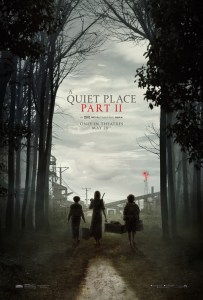 A Quiet Place Part II is the first movie I’ve seen physically in theaters since the middle of March 2020, and I genuinely missed the experience. It’s been the longest I’ve ever gone in my adult life without seeing movies in the theater, and this was one that felt like the presentation would be elevated by the big screen and superior sound system. Taking place nearly minutes after the conclusion of the 2018 hit, the surviving Abbott family ventures off their farm to find refuge and potentially find a way to protect themselves and neighboring communities from the killer monsters attracted to noise. The opening is the only flashback we get; everything else is forward-looking. I would have enjoyed getting more Day One experiences where the monsters first attacked, especially as we become open to new characters and their own harrowing journeys. The movie, written and directed by John Krasinski, isn’t quite as novel and brilliantly executed as its predecessor, but it’s still a strong sequel that gives you more while leaving you wanting more by the end. The majority of this lean 97 minutes is split between the family, one half staying put in a warehouse basement, and the other traveling out into the open to find a radio tower. The set pieces are still taut though rely more on jump scares this go-round, granted well executed jump scares that still got me to jolt in my seat and squeeze my girlfriend’s hand a little tighter. Cillian Murphy (Batman Begins) is the most significant addition as an Abbott family friend who has lost his whole family since that opening flashback. He’s a broken-down man, a parallel for Krasinski’s father figure from the first film, and at points it feels like he’s being set up to appear sinister, or at least hiding some dark secret that never really comes to fruition. The world building is expanded and introduces a very Walking Dead-familiar trope of desperate people being just as dangerous as deadly monsters, though in a world of hearing-enhanced creatures, I would think there’s more danger in larger numbers than security. The movie earns its triumphant ending even if the staging, and cross-cutting, is a little heavy-handed. A Quiet Place Part II is a successful sequel that understands the unique appeal of its franchise and how to keep an audience squirming while also remain emotionally involved and curious for more.
Nate’s Grades:
Spiral: C
A Quiet Place Part II: B+
Share this:

Dunkirk (2017)
 Christopher Nolan is one of the rare filmmakers in the world that can do anything he wants. He’s reached a level of critical and commercial success that he has earned the leeway to tell the stories he wants with a blank check. Apparently he’s been eager to tell the big screen story of Dunkirk, the mass evacuation of 400,000 Allied troops on a French beach in World War II, and it would be the first film of his career to not have a crime or science fiction slant. If this is what he has to turn into in order for mainstream Oscar attention then please go back to making your sci-fi puzzle boxes, Mr. Nolan, and let someone else make the underwhelming WWII epics. Don’t believe the effusive praise from critics saying this is Nolan’s masterpiece or the finest of his career. Dunkirk is Nolan’s least engaging film and maybe even the least ambitious of his otherwise storied Hollywood career.
Dunkirk is less of a cohesive movie and more a series of moments, never eclipsing the next or coalescing into a larger, more meaningful, more satisfying whole. We keep cutting from primarily three perspectives (air, sea, land) but it fails to feel more than a check-in before moving onto the next vantage point. It’s a shame because the opening ten minutes launch you immediately into this world of danger and Nolan sets up the different perspectives with effective visual clarity. I thought it was a great moment having the soldiers collect the fluttering propaganda fliers meant to remind them about how the enemy surround them. The initial burst of violence is visceral and unnerving. The burial of a soldier in the sand is a somber moment. Things were getting good, and then I kept waiting for the movie to escalate, to hit a new gear, and it never came. Instead it repeated the same plotting that just forced the bland characters from one curtailed escape to another. Screenwriting is about setups and payoffs, and that is strangely absent throughout Dunkirk. Bad things just kind of happen, and then they happen again, and then you tune out. That’s even before Nolan throws in needless non-linear elements that I was ignorant about. Dunkirk is Nolan’s first film under two hours since 2002’s Insomnia, and yet it could still stand to lose even more. After a while, your mind drifts when all you’re watching is poorly written characters, many of whom you can’t identify, jump from one crummy situation to another without a stronger storytelling drive. If you want a more personally involving retelling of the heroes of Dunkirk, just watch the film-within-a-film of the underrated 2017 gem, Their Finest.
 The miracle of the Dunkirk evacuation is really lost in this film. Without a more involving story, it’s hard to get a sense about the personal sacrifices and risks of the evacuation. The scope feels mishandled. We’re told that 400,000 men were rescued but I did not get any sense of that scale. We’re stuck to a small corner of a beach, or a small section of the sky and sea, for the far majority of the film, which again traps the film at a lower register. We don’t adequately sense the monumental scale of what is at stake. The embodiment of the threat is condensed down to a single German fighter plane that Tom Hardy has to chase for half the movie. It’s like this guy is the freaking Red Baron. Another aspect that exacerbates this issue is Nolan’s haphazard command of screen geography. When the camera is inside the various ships, your sense of space is uncertain. When things go bad, it just all feels like a mess, with no clear indication of where the characters are, their proximity to others, or even the interior design of the ships. Without a coherent sense of geography, the action and suspense is going to be inherently limited. Nolan locks into a claustrophobic sensation at the expense of audience clarity, and without better-developed action and interesting characters, it’s a decision of diminishing returns.
The characters are so indistinct that most of them in the end credits didn’t even merit names (Irate Soldier, Shivering Soldier, and Furious Soldier are among the lot). This is one of the biggest mistakes of Nolan’s movie. By not providing characters that an audience can engage with he’s handicapped how much an audience can care. We don’t learn about any of the main characters we follow, with the slight exception of Mark Rylance’s even-keeled seafaring father. I challenge audience members to even remember a who’s who of the young men because I don’t think I’d be able to identify them in a lineup. I was still trying to recall which of them may have died. I haven’t had this much trouble keeping people straight in a war film since Terrence Malick’s The Thin Red Line. With Dunkirk, there are faces we follow really more than characters. The most recognizable is Tom Hardy and that’s because he’s Tom Hardy and not because of anything related to his character. Kenneth Branagh’s character just seems to be here to stare off into the distance with awe and say something about “seeing home.” It’s as if Nolan had no interest in telling a war story from a human perspective, which is a vastly strange approach considering the large-scale human cost.
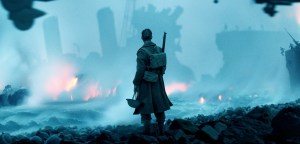 Nolan is a smart filmmaker. He has to know these characters are thinly sketched ciphers at best, so the question becomes why is Nolan choosing to make Dunkirk this way. If I had to hazard a guess I think Nolan was trying to accomplish a visceral, immersive war experience to echo the hopelessness and confusion of those men in jeopardy. They’re meant to be faceless everymen. This would explain why it feels more like a series of moments, of jumping from one failed escape to another and one fraught encounter to another. Nolan does a fine job of introducing conflict (in a wartime setting this also shouldn’t be too hard) but without more distinction he runs the serious risk of everything feeling like more of the same. At the end, thousands of soldiers are ferried back to England and congratulated. One of them is incredulous, not feeling like retreating is worth the fuss. “We just survived,” he says. “Well that’s good enough,” the other says. It’s like Nolan intended to place the audience into a crucible where just getting out was enough to satisfy demands. I don’t think it is.
From a technical standpoint, Dunkirk is often breathtaking, no more so than in its mesmerizing sound design. Nolan uses brilliant sound tacticians to heighten your senses and build a sense of dread. An oncoming fighter plane tearing through the sky can raise the hair on the back of your neck. The sound does the heavy lifting when it comes to creating tension. The score by Hans Zimmer is very effective in that regard as well. Its central musical element sounds literally like a ticking clock, which instantly heightens any scene. Granted adding a ticking clock sound against anything would make it more fraught (you’ll never fill out boring paperwork the same way again). Visually, the aerial photography is gorgeous with the IMAX cameras able to take in such startling depths. Cinematographer Hoyte Van Hoytema (Interstellar) has some beautiful visual compositions, especially as different boats capsize and the water rushes in at odd angles. This is a film that has commendable technical achievements. It’s Nolan who lets down his team.
War movies often run the risk of being overly reliant upon broad themes of heroism, nationalism, patriotism, sacrifice, and such, which can be in replacement of a strong narrative and well developed, interesting characters. War is a film genre like any other, and there are inherent genre shortcuts that can be abused. However, it’s like any other genre in that, regardless of the setting or situation, you are expected to tell an interesting story with characters the audience cares about. Nolan sacrifices all for the immersion in his war experience machine, providing listless, interchangeable characters and a story that amounts to a collection of harrowing moments but not a movie. My pal Joe Marino chided the movie as akin to visiting a planetarium, sitting back, and taking in the wonderful visual spectacle but walking away unmoved. It’s like Nolan has created the Dunkirk Experience: The Ride instead of an actual worthwhile story.
Nate’s Grade: C+
Share this:

Free Fire (2017)
 I don’t understand the praise and hype heaped upon filmmaker Ben Wheatley. He’s got a nice eye for visuals but whenever I see his name attached as a screenwriter, my expectations sink. His 2016 film High Rise was on my list of the worst films of last year. To my mind, Wheatley is Nicolas Refn (Neon Demon) lite, and I don’t even care for Refn. With that being said, the premise and star power for Free Fire looked enough to even out my immediate hesitation about watching another Wheatley film. It looked like fun. How could it not be? Well I’m now debating whether I disliked Free Fire more than High Rise, a scenario with no real winner.
In 1978, two gangs meet in a Boston warehouse to make an exchange of guns and drugs for money. Things go wrong, tempers flare, and bullets are exchanged. Both parties are pinned down, fighting for cover, and looking to come out alive and on top. There’s Cillian Murphy, Oscar-winning Brie Larson, Armie Hammer, Michael Smiley, and Sharlto Copley among this dingy dozen.
Exiting my theater screening, I got into a discussion with my pal, Ben Bailey. He was adamant that the story premise of Free Fire could not be done as a feature film and was, at best, the sort of material for a 20-minute shoot-em-up short. I argued that with the proper development there could be a scraggly feature film here but the key phrase is “proper development,” something that is sorely lacking from Free Fire. Ultimately it feels more like Ben’s assessment: 20 minutes of thin material and thought stretched out to an interminable 85 minutes.
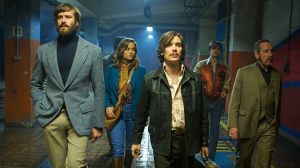 Once the shootout commences, it feels like Wheatley just succumbs to the cacophonous confusion of the action and more or less gives up. For a solid twenty minutes or so, the movie is nothing more than a series of disjointed shots of people firing and people taking cover from wooden boxes and planks, rarely if ever coalescing to produce a sense of direction, momentum, and geography. I didn’t know where anybody was and especially in relationship to anyone else. That is a crucial factor in action sequences especially in a limited location action sequence. You need to know who is where and establish different mini-goals and new challenges. Wheatley only introduces new elements late into the proceedings, and when he does they are anticlimactically resolved. When complications do arrive they are brushed aside and we go back to shooting. Why not involve the guns in those crates as something to be fought over to gain extra leverage? That seems like an obvious goal but not to the characters on screen. I lost track of which characters were with which side, and the movie even tries to make the same joke, as if knowingly acknowledging this aspect forgives Free Fire for its plotting misfires.
As minute after minute of blind shooting went on, I started making connections to a question I have had with Terrence Malick (Tree of Life, Song to Song) movies, namely how does one edit these things? If you’ve never seen a modern Malick movie, first consider yourself fortunate, but the man is known for his whispery, stream-of-consciousness spiritual connections with nature. My question with Malick movies: how does someone know that this shot of light through the leaves needs to be here, and definitely before this shot of a caterpillar moving along a tree branch? How do you edit what is bereft of a traditional coherency? I wondered the same question during Free Fire. Without those mini-goals, how does one edit just gunshot after gunshot after gunshot without any credible change in the story’s impetus as guidance?
Compounding my boredom and general confusion is the reality that these criminal lowlifes are dull characters and not worth the investment. Wheatley and co-screenwriter Amy Jump fail to provide interesting personalities or quirks or anything memorable to enliven these tough-talking bad-shooting bad guys. Some of them have accents, one of them is a woman, one of them likes to smoke pot, but really they’re all slight variations on the same excitable, profane, and shallow archetype, the kind of character that gets their own poster in marketing with a nickname like “The Kid” or something cool-sounding like that, but it’s all posturing. I thought that Free Fire might be reminiscent of the rise of Tarantino knockoff films in the 90s (The Big Hit, 2 Days in the Valley, Things to Do in Denver When You’re Dead, Suicide Kings) but this movie actually made me yearn for a Tarantino knockoff.
 These people are so lifeless. I didn’t care who lived and who died. They were all boring. Some faces are recognizable like Hammer and Smiley and Murphy but a majority of the characters are not, at least initially visually distinctive. It’s a failing of creativity to separate them, make them distinct. Much of the acting is just reacting to squibs going off and squirming on the ground. If you have a fetish for Brie Larson (Kong: Skull Island) wriggling, this is your film. By default the best actor is Copley (Hardcore Henry) as he seems to be on an uncontrollable improv stint, rapidly saying whatever things comes to mind. Something has to fill the audio between gunfire.
Free Fire wants to be a scuzzy, crazy, fun movie that knows it’s trashy and revels in its bad taste and loony characters with nose-thumbing glee. Instead, Free Fire is a nihilistic and tedious enterprise lacking entertaining characters, coherent action, and most importantly any general sense of fun. Watching characters that are unmemorable, who you don’t care about, fire guns indiscriminately for a long time is not a movie, and it’s most certainly not a good movie. It’s a glorified training manual for firearms. Free Fire takes too long to get started with poorly developed characters and when it does kick into action the movie doesn’t really improve too much. Free Fire is a Tarantino knockoff that doesn’t have the courage of its own B-movie convictions. It thinks just dressing the part is enough, substituting style and a blithe attitude for not even substance but the appearance of substance. It only has one truly memorable, queasy death, so even when it comes to bizarre violence it falters. This is one movie that wants to look cool and irreverent but ends up merely firing blanks.
Nate’s Grade: D+
Share this:

In Time (2011)
 Andrew Niccol is a filmmaker that has earned my respect and my hard-earned money. After The Truman Show, Gattaca, and Lord of War, this guy has me hooked. I forgive him 2002’s S1mone, which had some good ideas in need of a better plot. Lo and behold, his latest film, the sci-fi thriller In Time, falls victim to the same issue. Niccol’s premise is more intriguing than the people onscreen.
In the near future, science has solved the age-old question or mortality, for a price. Every human has an internal clock somehow embedded in his or her arm. It kicks in at age 25 and then people have one year remaining. Time is the only currency that matters. People work jobs to add minutes to their time. When it comes to a cup of coffee or a bus fare, you pay in minutes off your time (a hooker says, “I’ll give you ten minutes for an hour”). The rich are well stocked in time but the poor must fight every day just to keep alive. Sam (Justine Timberlake) works in a factory just to make ends meet. His mother (Olivia Wilde, we should al be so lucky) gives her son an extra 30 minutes for his lunch; humans can “pass” time from one to another through touch. This will come back to bite her. One day Sam meets a tall dark stranger who’s lived for over 100 years and is tired of it all. He donates all his time to Sam. This is a no-no in the future. The timekeepers are a police force, lead by Raymond Leon (Cillian Murphy), that polices time allowances. They’re paid to basically make sure that time remains the property of the upper class. Sam hobnobs with the elites, including Philippe Weiss (Vincent Kartheiser), a man who owns thousands of years. When the (Van Damme-less) time cops come looking for Sam, he makes a run for it, taking Sylvia (Amanda Seyfried) as his hostage. The two eventually fall for one another as they dash across the country stealing time.
 In Time has all sorts of ideas running through its system. What it doesn’t have it much of a plot to go with its heady sci-fi setup. Will is a fugitive but he never really formulates any sort of tangible plan. There’s no higher plot or goal here other than “sticking it to the man” but what exactly does that mean in this context? I understand he’s upset about losing a loved one, but his plan for vengeance or justice or whatever you want to call it lacks needed clarity. It feels like he and his cohort are just making it up as they go along. The film is at its worst when it descends into a populist, sci-fi Bonnie and Clyde, where Sam and Sylvia storm these time banks and redistribute the minutes, becoming heroes to the day-to-day drudgers. The ease that these two people have at knocking over bank after bank, armed only with a handgun, seems hard to swallow. The banks aren’t going to have tougher security especially after word gets out? Niccol adds plenty of chase scenes to fill out his plot but it doesn’t do much more than pad a half-baked story. The end confrontation goes in a direction I shall shamefully describe as “action movie idiocy.” You’re going to tell me that a timekeeping pro doesn’t pay attention when his clock is minutes away from death? Furthermore, I’m stunned that the people onscreen don’t act with more urgency when their time runs out. When death is on the line, I imagine a human being would resort to any kind of irrational desperation just to get a few minutes more, yet In Time shows a demoralized populace that just seems to give up. That makes the heroes-as-revolutionaries storyline even more implausible. Here’s a tip to Niccol: if it’s Sylvia’s last day on Earth, maybe you don’t have her racing for her life in heels. I’d think the gal would have purchased some decent running shoes by this time.
The ideas presented are compelling, though I wish Niccol had continued to push further. The social satire is pretty on-the-nose about the class system. I would have liked Niccol to be more biting in his social critique, perhaps carving up the rich as more venal than pampered. It’s true that they can live forever… unless something violent happens. This may be the future but there’s still no cure for a bullet to the head. The rich may live but they must live in sheltered, insular communities; a life encased in bubble-wrap. There is much potential there that goes unexplored. I also wanted a global sense of what was happening. Is time traded on the stock market? Are there different values placed on human time based upon geography? Is a Japanese life more valuable than a Ukrainian? The glimpses we do get about how the world operates are enticing and clever. The time roadblocks, tolls asking increasing amounts of time to pass into more affluent communities, feel authentic to the world and a cruel way to limit class mobility. When Sam pays for his expensive dinner he tells the waitress, “And take a week for yourself.” The timekeepers are only allotted a day at a time, so they can’t get carried away (I think it’s the futuristic equivalent of having the pizza delivery guy only have twenty bucks on him so he’s less likely to be the victim of theft). For the most part, In Time feels like it has some of the neat sociological quirks down but misses the psychological ramifications of its premise. People stop aging at 25. What does that do to a person’s sense of self? What about the peculiarities of dating? There’s definitely a sexual farce waiting to be written here. But let’s focus on the main dilemma – scrapping every day for just enough to stay ahead of the countdown. It’s an apt allusion to the working poor, but we never really see the tremulous stress that such a situation demands. This is life and death stuff, folks. The panic of inflation should also have been something Niccol paid more attention to. Just upsetting their time budgets could rock people’s world. There’s a lot more human drama inherent in this story that Niccol ignores, or flat out dismisses, for some standard Hollywood frills, namely chases and contrived romances.
 Timberlake has shown that he has some chops when it comes to acting in shrewd supporting roles (The Social Network, Black Snake Moan). His skills aren’t really well utilized by In Time. The role of Sam is pretty bland, lacking edge or depth. This part could have been played by anyone not befitting Timberlake’s genetic credentials. Timberlake can make a credible action hero, though his charm covers up for his lack of intimidating presence. There is one regrettable moment where he wails at the death of a loved one, and it hits the wrong notes and feels laughably awkward. Seyfried (Red Riding Hood) also turns on a dime from being a scared hostage to a romantic partner. Her role gets reduced to being dragged by the hand by Timberlake; she’s human luggage. Murphy (Inception) does a fine job of being a dogged, Tommy Lee Jones-style pursuer. Kartheiser works that reptilian sleaze he’s perfected on Mad Men. The guy is like a younger version of Sam Neill (Jurassic Park, Daybreakers), possibly the most reptilian of all living actors. The strangest part about casting is that it’s an Alpha Dog reunion (Timberlake, Seyfried, and Kartheiser all had supporting roles).
In Time is a better idea than a movie, and it’s an idea that deserves more examination. Niccol’s film has some interesting ideas and concepts, but it seems too slavish to a typical Hollywood blockbuster boilerplate. The characters are pretty bland and the thrills are too. I wanted to spend more time in this brave new time-obsessed world; I just wanted to spend it with other characters. The populist Bonnie and Clyde plotline doesn’t seem to gel. If the rich can control the arbitration of time, why don’t they just ungodly raise the price of things? In a a generation or two, the rich will weed out all lower classes thanks to near literal social Darwinism. The social commentary is a bit heavy-handed and simplistic. I wish Niccol had ditched his young heroes/lovers and explored the particulars of his world more, especially the portent psychological implications. In Time doesn’t feel like a complete movie, just a finished one. Ultimately, the film’s greatest sin may be that it wastes too much of your own time.
Nate’s Grade: C+
Share this:

Inception (2010)
 Without a doubt, no movie has piqued curiosity like Christopher Nolan’s Inception. After breaking all sorts of box-office records with The Dark Knight, Nolan earned some capital. He wanted to make an expensive, intellectually demanding, high-concept movie that takes place mostly in the realm of dreams. The studio said yes, anything to keep their golden goose happy before a third Batman can roll out. Nolan has been tinkering with the script for Inception for almost ten years, trying to scale it down but never being content. This is a story that called for the biggest stage, which required a heavy price tag, and could only be fulfilled once Nolan was an established hit-maker. Early images of shifting gravity and folding cityscapes got people buzzing but then the concern was whether Inception would be too smart for audiences to embrace. You know, the same public that made two Alvin and the Chipmunks films blockbusters. Two weeks running, Inception has made a sizeable portion of money and become the “must-see” movie of the summer. Score one for the public.
Dom Cobb (Leonardo DiCaprio) is an expert extractor. He can sneak into your dreams and discover whatever secret you’re hiding from your self, your wife, even your shrink. All for a tidy sum, of course. He’s on the run from U.S. authorities because they believe he killed his wife Mal (Marion Cotillard). A rich businessman, Seito (Ken Watanabe), promises to clear away the pending charges if Cobb can perform one important job. Instead of stealing an idea, Cobb will have to plant an idea, known as inception. A young upstart (Cillian Murphy) will inherit his dying father?s empire, and Seito wants the guy to break up that empire and sell it off. Cobb enlists the help of a skilled team to pull off what is believed to be impossible; Arthur (Joseph Gordon-Levitt) as the point man, Ariadne (Ellen Page), as the architect of the dream world, Eames (Tom Hardy), a forger who can convince the mark he?s other identities, and Yusuf (Dileep Rao), a chemist that creates a compound to put the team under a deep sleep. They’ll need it because Cobb plans to go three levels deep, a dream within a dream within a dream in order for inception to take root. The only way out is a “kick,” the sensation of falling that will awaken the dreamer. The team is under great risk not just from the dream world, but also from Cobb. He?s been secretly keeping memories of his dead wife alive and she keeps intruding into shared dreaming, causing havoc, relying on the same info that Cobb knows. The deeper they go into the dream the deeper they also go into Cobb’s memories.
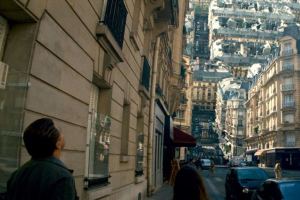 Inception can be many things to many people, as is the nature of dreams. I found the movie to be a master class mousetrap. Watching Nolan and his origami-like script fold and bend and connect is a true pleasure. However, the movie is not a great character piece. Cobb is the only person on the entire team allowed any sort of back-story or inner lives or even personality traits. What do we know about Arthur, Ariadne, Eames? Nothing. They are all members of the team, but it is Cobb who is the only one allowed to have supporting details. Despite Cobb’s tragic past with his wife, emotionally the movie can best be described as a bit distant (not cold, distant). Nor does Inception deal with the psychology of dreams or the interpretation of the subconscious and its links to our own reality; this movie does not have Freudian psychoanalysis in mind. What Inception does deliver is a brilliantly staged heist that takes place in the realm of dreams, and if that doesn’t sound like a fun concept then I don?t know what does. To get to that heist, the audience must slosh through about 90 minutes of solid set-up and exposition (Pages character is essentially an exposition device). There are a lot of rules to digest in order for the final hour to have the impact that it does. If you nod off for a portion of that time, like my father, you will be lost as to why anything is exactly happening. Having seen the film a second time, I can say that once the hyperactive “Oh my gosh, this is awesome!” haze of newness wears off you do realize that the pre-heist portion of the movie can be a bit slow. I think that for future DVD-viewings I will skip to the start of the heist and sit back and relax (much like skipping the first hour of King Kong).
After talking about what Inception is not, let’s focus on what Inception is. It is a massively entertaining, brain-tickling thriller with eye-popping visuals that verge toward the iconic. Nolan isn’t the greatest orchestrator of action (a foot chase in Mombassa is pretty lackluster short of a narrow alleyway) but the man knows how to put together tremendously memorable set pieces. From Paris folding upon itself to a fistfight in a revolving hallway, Inception is packed with stimuli to ignite the senses. It’s the first movie in years that I walked out and thought, “How did they do that?” It renewed my sense of mystery and wonder with the movies. And the last hour is ridiculously fraught with tension as the movie descends level after level of subconscious, juggling four separate action set pieces with mounting climaxes. The revolving hallway fight is perhaps my favorite action scene in years. I still got goose bumps the second time. Gordon-Levitt hops from ceiling to floor like he’s Spiderman, or Gene Kelly, all while the camera remains fixed. Gordon-Levitt gets a lot of zero gravity experience in this movie. He might have qualified for a free ride on the space shuttle.
Like the alternate reality of The Matrix, people can manipulate the world of dreams, which allows for some imaginative visuals. Aside from the dreams-within-dreams impacting one another, there aren’t really playful distortions of reality. There?s a few M. C. Escher-inspired staircases but nothing too out of bounds. Nolan devises a reason for this since the dreamers do not want to call attention to altering the dream. They want to hide among the subconscious projections; get in and get out without being noticed. You do wish that Nolan played to the potential of his flexible reality, but on the other hand, it’s still fairly mind-bending to reach inside a magician?s hat into another magician?s hat and so on. I wonder if there was another story that could have succeeded in this setting, namely competing thieves that have to race against time within the world of dreams. Think about it next time, Nolan. That one?s on me.
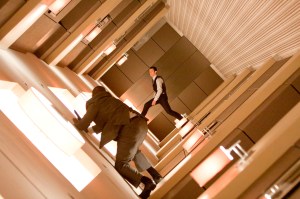 But the most exciting aspect of the movie is how intellectually stimulating it is. The movie is jam-packed with ideas like Nolan’s other works, so much that it’s hard to fully process everything the film offers in one sitting. The pieces do fit together and the movie follows its own internal logic, so if you didn’t skip out on any bathroom breaks, you should be able to follow along reasonably. On first viewing, Inception is bristling with intelligence and narrative complexity, and it rarely stops to pander to an audience. It expects you to keep up for the rewards that will follow, and they are indeed rewarding. The movie isn’t as complicated to follow but it can definitely get complicated when you try and explain action beyond a literal level. Nolan laces all sorts of narrative stops and peculiarities that can be targeted for an alternative thesis statement on the ending. The very ending shot is ambiguous perfection. It keeps the mystery of what constitutes reality while providing an out for people that want to formulate a happy ending. There’s plenty of room for interpretation and analysis but it doesn’t get in the way of telling a good story. Hollywood is pretty risk averse when it comes to anything that makes people think, let along anything expensive that requires active synapses. Nolan has long been a filmmaker of intellectual heft and non-linear narratives. His narratives are complex puzzles that snap together with airtight precision. The joy of a Nolan film is surrendering yourself to his narrative origami and waiting to see the Big Picture. There are new insights to discover with every viewing. Nolan may not be the second-coming of God, as those frothing at the mouth on Internet message boards proclaim, but I can think of no other director working today who harnesses Big Ideas on such a big stage.
Inception is a $160-million dollar studio film with substance, but it also looks like money well spent. The film looks amazing. The cinematography by Wall Pfister (Dark Knight) is gorgeous without being self-consciously arty, pleasing the senses without drawing too much attention away from the story. But with a screenplay that makes all kinds of leaps, you need the help of a good editor to guide the proceedings. Lee Smith (Truman Show, Master and Commander) is that man. While the repeated cutbacks to the van falling in slow motion can be giggle-inducing, Smith gamely holds everything together thanks to his skill in juggling all the parallel storylines/dreamscapes. Finally, the score by Hans Zimmer (The Lion King, Gladiator) is full of ominous, blaring horns that send shivers and get your blood pumping. Johnny Marr (The Smiths, Modest Mouse) even added an assist by strumming the guitar licks on the score. Apparently Zimmer’s key score themes are actually the tune “Non, Je Ne Regrette Rien,” the Edith Piaf signature song used to signal “kicks,” played at a slowed speed. At the risk of sounding like one of those frothing from the mouth on the Internet, that’s insanely cool.
 The acting is uniformly good with a few bumps. DiCaprio (Shutter Island) might need to do something light after continuous roles where he inhabits mean weighed down by guilt and dead wives (three in a row for those counting). He’s a good emotional anchor. Watching the star of 500 Days of Summer and Brick as a suave, cool-as-can-be action star is improbably awesome. Hardy (Bronson) is a scene-stealer mostly because he?s the only member of the team that has a sense of humor. Cotillard (Nine, Public Enemies) who won an Oscar playing Edith Piaf in 2007’s La vie en Rose, gets her best part since then. She gets to do many things as Mal, a projection of a character. This means that she must be limited in how she fills out the character because she is defined by Cobb’s fading memory. Yet she can be malicious, playful, spiteful, loving, vulnerable, and more. Cotillard and her big, glassy eyes do a great service in selling a romance we only see after the fact. Page (Juno) just feels out of place. She seems like the kid among a group of adults. And while the elfin actress will always look youthful until she applies for an AARP card, Page just seems in over her head. Her performance is fine if a bit mealy-mouthed but she still feels miscast.
Inception. Expect it to become a fanboy religion in a matter of weeks. It wears its influences on its sleeve, from The Matrix to Abre Los Ojos (or the American remake, Vanilla Sky). Thrilling, stimulating on different levels, and supremely engrossing, Inception is just about everything you could wish for in a summer blockbuster, except when it can also feel mechanical, distant, and free of emotion and character development save DiCaprio (perhaps this is further evidence that it was all a dream?). Regardless, Inception is easily the brainiest movie of the year, and usually those don?t get packaged as big-budget Hollywood spectacle. Just make sure to bring your totem the second time you watch the movie.
Nate’s Grade: A
Share this:

Sunshine (2007)
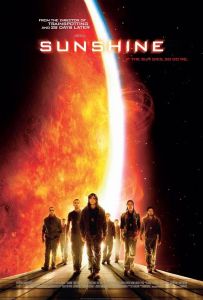 Danny Boyle is one of the more interesting film directors out there today. He seems to dabble in every genre. He’s done paranoid thriller (Shallow Grave), substance abuse drama (Trainspotting), zombies (28 Days Later), and a genuine family film (Millions). Boyle has a bountiful imagination. Now he and his 28 Days Later partner, writer Alex Garland, are going where many have gone before in the film world – outer space. Just don’t confuse the film with the 1999’s Sunshine where Ralph Fiennes plays three generations of a Jewish family with rotten luck. Come to think of it, both Sunshine movies fall apart in the final act. Note to filmmakers: just stay away from this title. It will doom your ending.
Fifty years into the future, the sun is dying. Earth is under a solar winter as it undergoes less and less light. The crew of the Icarus II has a very important mission: restart the sun. Attached to their spacecraft is a giant bomb intended to create a new star inside an old one. They have a giant reflective shield to protect them from the direct heat of the sun. The ship has eight crew members, including the physicist responsible for the bomb (Cillian Murphy), a botanist (Michelle Yeoh) with a garden to provide recyclable oxygen reserves, and a hotheaded handyman (Chris Evans) that believes nothing could be more important than their mission. As they drift closer to the sun they pick up a distress call that belongs to the previous Icarus I spacecraft which vanished under mysterious circumstances seven years ago. The crew decides that two bombs are better than one and changes course to intercept the Icarus I. anyone who has ever seen a horror movie knows you don’t go poking into the spooky place when you don’t have to.
 Boyle sure knows how to make things look pretty, or interesting, or pretty interesting, and this helps because Sunshine is rather shopworn with familiar sci-fi staples. The premise itself almost seems identical to a 1990 film called Solar Crisis, a movie I only remember marginally because of the female nudity my young eyes caught glimpse of (in those days we didn’t have any of yer fancy Internets). Besides this, the film borrows liberally from 2001, Solaris, Star Trek, Alien, Event Horizon, The Core, and the super crappy Supernova. Most every aspect of Sunshine can be traced back to a different science fiction film, but sci-fi is one of the few genres that don’t necessarily suffer from being derivative. A cookie-cutter sci-fi movie is forgivable as long as the filmmakers treat the audience with respect and attempt to be smart with their story. I don’t care that Sunshine reworks plot elements that have been worked since giant alien carrot people frightened necking teenagers in the 1950s, and that’s because the genre is built for being borrowed.
Sunshine is often beautiful to watch with awe-inspiring images of that great ball of fire, our sun, but even better is the fact that the film is pretty much the opposite of Armageddon – it’s smart. The movie discusses the realities of space travel, communication, oxygen levels, trajectories, sub-zero temperatures, sacrifice, and how to live so close to the sun where the human eye can only safely look at 3.1 percent of its light emissions for 10 seconds. It’s a bit slow but rather fascinating just to witness how day-to-day life functions for the crew and how the time, or lack of discernible time, plays with their psychology. This respectful intelligence helps when the crew debates altering their mission to inspect the mysterious space vessel. The audience knows that only bad things will happen but the crew argues with reasonably sound logic about the potential benefits.
Sunshine is a thinking man’s sci-fi treat for its first two acts and then it completely devolves with a disappointing turn of events; it becomes a slasher film in space. There’s genuine awe and intrigue, along with some brainy scientific discussions and some considerable religious/philosophical pondering… and it all just stops dead for a madman chasing people with pointy things. Sigh. It’s an artistic free-fall that Sunshine never quite fully recovers from. Boyle makes the strange decision to keep his space slasher out of focus so the audience never gets a clear look; even stranger are camera shots where the killer will walk into frame and then transform his area to an unfocused blur like a blurry infection. It’s an artistic choice that doesn’t quite work (“The blurry man’s coming to get you, Barbara!”). The film then morphs into your standard race-against-time and then balloons with trippy computer effects and snazzy light filters. Sunshine was exceedingly more entertaining prior to picking up the unwanted visitor.
 The cast does a fine job mulling their life-or-death options, but the two standouts are Murphy and Evans. Murphy and his piercing baby blues make for a strong lead. He provides soulful glimpses into his stock scientist role. Evans is the surprise of the film. Best known as the Human Torch in the dreadful Fantastic Four films, he exhibits a wider range of emotions from macho hardass to duty-bound soldier. This is a film heavy with noble sacrifices, and Evans is the reminder of all that is at stake.
Sunshine is visually pleasing and intellectually stimulating, especially for a sci-fi film built from the discarded pieces of other films. It’s a tense and exciting time, that is, until the movie just throws up its hands and transforms into a laughable slasher film. This movie did not have to go this tiresome route; there could have been an on-board mutiny when they discussed the idea of killing one of their own so they had enough oxygen to complete their mission, there could have been further psychological torments from within the crew, or even easier, the spaceship could just have undergone more malfunctions. Sunshine is a thoughtful, slightly meditative sci-fi thriller, but then it loses all of its better senses.
Nate’s Grade: B-
Share this:

Red Eye (2005)
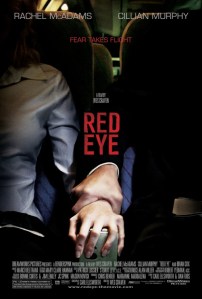 Red Eye is something of a comeback for Wes Craven, the horror master that’s been somewhat grasping at straws for several years (for further proof see Cursed). The concept is ripe for tension and the film has little fat on it, clocking in at a meager 80 minutes. It’s divided like so: 20 minutes set-up, 40 minutes on the plane, and 20 minutes off the plane for the conclusion. Red Eye is so enjoyable when we’re trapped on that flight, catching the icy stares of Cillian Murphy, that I personally would love an additional 20-30 minutes more in the air. There’s a nice chain of cause and effect, as the audience is with Rachel McAdams (fast becoming the Hollywood It girl) as she tries to think her way out of her jam, each time thwarted by the chilling Murphy once more. It’s a great duel of wits. The last act of the film is too conventional and predictable to close out such a great claustrophobic pressure cooker. It’s also a bit insulting that she’s ultimately rescued by a man after we watch 80-minutes of her plucky ingenuity and courage. Red Eye is a solid thriller carried by two great performers on the rise.
Nate’s Grade: B
Share this:

Batman Begins (2005)
 I have been a Batman fan since I was old enough to wear footy pajamas. I watched the campy Adam West TV show all the time, getting sucked into the lead balloon adventures. Tim Burton’s 1989 Batman was the first PG-13 film I ever saw, and I watched it so many times on video that I have practically worn out my copy. Batman Returns was my then most eagerly anticipated movie of my life, and even though it went overboard with the dark vision, I still loved it. Then things got dicey when Warner Brothers decided Batman needed to lighten up. I was only a teenager at the time, but I distinctly remember thinking, “You’re telling the Dark Knight to lighten up?” Director Joel Schumacher’s high-gloss, highly stupid turn with Batman Forever pushed the franchise in a different direction, and then effectively killed it with 1997’s abomination, Batman and Robin. I mean these films were more worried about one-liners and nipples on the Bat suits. Nipples on the Bat suits, people! Is Batman really going, “Man, you know, I’d really like to fight crime today but, whoooo, my nipples are so chaffed. I’m gonna sit this one out”?
For years Batman languished in development hell. Warner Bothers licked their wounds and tried restarting their franchise again and again, only to put it back down. Then around 2003 things got exciting. Writer/director Christopher Nolan was announced to direct. Nolan would also have creative control. Surely, Warner Brothers was looking at what happened when Columbia hired Sam Raimi (most known for low-budget splatterhouse horror) for Spider-Man and got out of his way. After Memento (My #1 movie of 2001) and Insomnia (My #5 movie of 2002), Nolan tackles the Dark Night and creates a Batman film that’s so brilliant that I’ve seen it three times and am itching to go again.
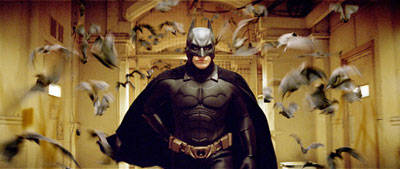 The film opens with a youthful Bruce Wayne (Christian Bale) in a Tibetan prison. He’s living amongst the criminal element searching for something within himself. Henri Ducard (Liam Neeson) offers Bruce the chance to be taught under the guidance of the mysterious Ra’s Al Ghul (Ken Watanabe), the leader of the equally mysterious warrior clan, The League of Shadows. Under Ducard’s direction, Bruce confronts his feelings of guilt and anger over his parents’ murder and his subsequent flee from his hometown, Gotham City. He masters his training and learns how to confront fear and turn it to his advantage. However, Bruce learns that the League of Shadows has its judicial eyes set on a crime ridden Gotham, with intentions to destroy the city for the betterment of the world. Bruce rebels and escapes the Tibetan camp and returns to Gotham with his own plans of saving his city.
With the help of his trusted butler Alfred (Michael Caine), Bruce sets out to regain his footing with his family’s company, Wayne Enterprises. The company is now under the lead of an ethically shady man (Rutger Hauer) with the intentions of turning the company public. Bruce befriends Lucius Fox (Morgan Freeman), the company’s gadget guru banished to the lower levels of the basement for raising his voice. Bruce gradually refines his crime fighting efforts and becomes the hero he’s been planning on since arriving home.
Gotham is in bad shape too. Rachel Dawes (Katie Holmes), a childhood friend to Bruce, is a prosecutor who can’t get anywhere when crime lords like Falcone (Tom Wilkinson) are controlling behind the scenes. Most of the police have been bought off, but Detective Gordon (Gary Oldman) is the possibly the city’s last honest cop, and he sees that Batman is a figure trying to help. Dr. Crane (Cillian Murphy) is a clinical psychologist in cahoots with Falcone. Together they’re bringing in drug shipments for a nefarious plot by The Scarecrow, a villain that uses a hallucinogen to paralyze his victims with vivid accounts of their own worst fears. Bruce is the only one who can unravel the pieces of this plot and save the people of Gotham City.
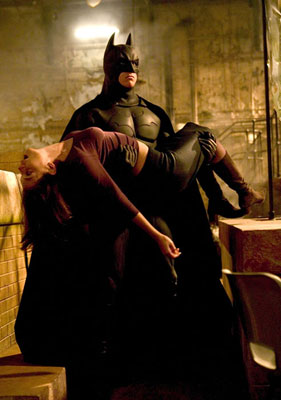 Nolan has done nothing short of resurrecting a franchise. Previous films never treated Batman as an extraordinary character; he was normal in an extraordinary world. Batman Begins places the character in a relatively normal environment. This is a brooding, intelligent approach that all but erases the atrocities of previous Batman incarnations. Nolan presents Bruce Wayne’s story in his typical nonlinear fashion, but really gets to the meat and bone of the character, opening up the hero to new insights and emotions, like his suffocating guilt over his parents murder.
Nolan and co-writer David S. Goyer (the Blade trilogy) really strip away the decadence of the character and present him as a troubled being riddled with guilt and anger. Batman Begins is a character piece first and an action movie second. The film is unique amongst comic book flicks for the amount of detail and attention it pays to characterization, even among the whole sprawling cast. Nolan has assembled an incredible cast and his direction is swimming in confidence. He’s a man that definitely knows what he’s doing, and boy oh boy, is he doing it right. Batman Begins is like a franchise colonic.
This is truly one of the finest casts ever assembled. Bale makes an excellent gloomy hero and really transforms into something almost monstrous when he’s taking out the bad guys. He’s got great presence but also a succinct intensity to nail the quieter moments where Bruce Wayne battles his inner demons. Caine (The Cider House Rules, The Quiet American) is incomparable and a joy to watch, and his scenes with the young Bruce actually had me close to tears. This is by far the first time a comic book movie even had me feeling something so raw and anything close to emotional. Neeson excels in another tough but fair mentor role, which he seems to be playing quite a lot of lately (Kingdom of Heaven, Star Wars Episode One). Freeman steals every scene he’s in as the affable trouble causer at Wayne Enterprises, and he also gets many of the film’s best lines. Oldman (The Fifth Element, Harry Potter and the Prisoner of Azkaban) disappears into his role as Gotham’s last good cop. If ever there was a chameleon (and their name wasn’t Benicio del Toro), it is Oldman. Holmes works to the best of her abilities, which means she’s “okay.”
The cast of villains are uniformly excellent, with Wilkinson’s (In the Bedroom) sardonic Chicagah accented mob boss, to Murphy’s (28 Days Later…) chilling scientific approach to villainy, to Watanabe’s (The Last Samurai) cold silent stares. Even Rutger Hauer (a man experiencing a career renaissance of his own) gives a great performance. Seriously, for a comic book movie this is one of the better acted films of the year. And that’s saying a lot.
Batman Begins is such a serious film that it almost seems a disservice to call it a “comic book movie.” There are no floating sound effects cards and no nipples on the Bat suits. Nolan really goes about answering the tricky question, “What kind of man would become a crime-fightin’ super hero?” Batman Begins answers all kinds of questions about the minutia of the Dark Knight in fascinating ways, yet the film remains grounded in reality. The Schumacher Batmans (and God save us from them) were one large, glitzy, empty-headed Las Vegas entertainment show. No explanation was given to characters or their abilities. Likewise, the Gothic and opulent Burton Batmans had their regrettable leaps of logic as well. It’s hard not to laugh at the end of Batman Returns when Oswald Cobblepot (a.k.a. The Penguin) gets a funeral march from actors in emperor penguin suits. March of the Penguins it ain’t. Nolan’s Batman is the dead-serious affair comic book lovers have been holding their breath for.
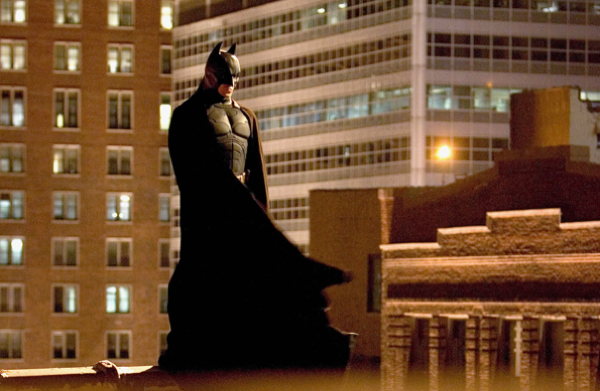 The action is secondary to the story, but Batman Begins still has some great action sequences. Most memorable is a chase sequence between Gotham police and the Batmobile which goes from rooftop to rooftop at one point. Nolan even punctuates the sequence with some fun humor from the police (“It’s a black … tank.”). The climactic action sequence between good guy and bad guy is dutifully thrilling and grandiose in scope. Nolan even squeezes in some horror elements into the film. Batman’s first emergence is played like a horror film, with the caped crusader always around another turn. The Scarecrow’s hallucinogen produces some creepy images, like a face covered in maggots or a demonic bat person.
There are only a handful of flaws that make Batman Begins short of being the best comic book movie ever. The action is too overly edited to see what’s happening. Whenever Batman gets into a fight all you can see are quick cuts of limbs flailing. My cousin Jennifer got so frustrated with the oblique action sequences that she just waited until they were over to see who won (“Oh, Batman won again. There you go.”). Nolan’s editing is usually one of his strong suits; much of Memento’s success was built around its airtight edits. He needs to pull the camera back and let the audience see what’s going on when Batman gets physical.
Another issue is how much plot Batman Begins has to establish. This is the first Batman film to focus solely on Batman and not some colorful villain. Batman doesn’t even show up well into an hour into the movie. As a result, Batman Begins perfects the tortured psychology of Bruce Wayne but leaves little time for villains. The film plays a shell game with its multiple villains, which is fun for awhile. The Scarecrow is really an intriguing character and played to gruesome effect by the brilliant Cillian Murphy. It’s a shame Batman Begins doesn’t have much time to develop and then play with such an intriguing bad guy.
Batman Begins is a reboot for the film franchise. Nolan digs deep at the tortured psyche of Bruce Wayne and come up with a treasure trove of fascinating, exciting, and genuinely engrossing characters. Nolan’s film has a handful of flaws, most notably its oblique editing and limited handling of villains, but Batman Begins excels in storytelling and crafts a superbly intelligent, satisfying, riveting comic book movie. The best bit of praise I can give Batman Begins is that I want everyone responsible to return immediately and start making a host of sequels. This is a franchise reborn and I cannot wait for more of it.
Nate’s Grade: A


 nathanzoebl
You must be logged in to post a comment.