Blog Archives
Dune: Part Two (2024)
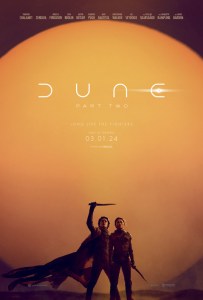 I wasn’t fully taken with the first Dune movie when it arrived in 2021. It was visually sweeping, with dense world building and careful development of characters and themes, but then it just hit the pause button without any certainty there would be a conclusion. Thankfully, director Denis Villanueuve was able to complete his vision, and what a spectacular science fiction landscape this man has fashioned, visually resplendent but also with a story that deepens and improves on all the promise and setup from 2021. The triumphant of Paul (Timothee Chalamet) becoming a hero and avenging his father from their betrayers is tempered by the tragedy of Paul, becoming the false messiah that will bring about mass genocide. The movie doesn’t hold back in its criticisms of its hero while also providing complexity that makes us root for him but uneasily dread what might become. The narrative structure is easy to follow with Paul ingratiating himself with the native culture, rising to power and influence, and organizing a resistance against the well-funded imperial overlords of Arakis. This is the kind of sumptuous, big screen spectacle with intelligence that is so rare in the Hollywood system, and Villaneuve once again shows his ability to perform artful blockbusters that put him in a rarefied class with hew others. After the first Dune, I was hopeful but a little wary. After the second Dune, I feel like all of my concerns were wiped away.
Nate’s Grade: A-
Share this:

The Rundown (2003) [Review Re-View]
 Originally released September 26, 2003:
In the beginning of the new action comedy The Rundown, Beck (The Rock), a bounty hunter, is entering a club on a job. On his way in Arnold Schwarzenegger passes him by and says, ”Have fun.” Consider it a proverbial torch passing, because while Schwarzenegger is going to be busting the campaign trail, The Rundown establishes The Rock as the fresh and capable marquee name for all future action films. This man is a star.
Beck is offered a chance to square off all debts to mobster Billy Walker by agreeing to journey into the Brazilian jungle. His mission is to retrieve Travis (Seann William Scott), a hyperactive screw-up who happens to be Walker’s son. One Beck travels to the Amazon he runs into Hatcher (Christopher Walken) who claims to own the jungle and whatever contents dwell within. He asserts that Travis has stumbled upon a wealthy artifact in his jungle and therefore refuses Beck to leave with Travis. It’s at this point that the chase is on.
I don’t care what your little sister told you, Vin Diesel is not the next face of action, no, it’s The Rock. Despite only appearing in three movies (and he was only in The Mummy Returns for like three minutes), The Rock displays a razor-sharp sense of comedy. He’s also huge, likeable, and he can even emote well during smaller moments, not that The Rundown will stretch you as an actor. He’s also honed in excessive eyebrow arching.
Walken exists in a plane of brilliant weirdness that we simple human will never be able to co-exist upon. His Hatcher is one mean villain who exploits indigenous workers, wears his pants up to his armpits, and says he put the heart in the darkness. Walken’s hysterical tooth fairy monologue is worth the price of admission alone.
Director Peter Berg (Very Bad Things) adds a delectable cartoonish flavor to the film. His action sequences pop with exaggerated energy and zestful humor, like when Travis and Beck roll down a hill for a near minute. This is everything an action film should be: lively, funny, with keen action sequences that are low on CGI but filled with characters we care about. The Rundown is the best summer film not released during the summer.
The Rundown is an adrenalized punch of fabulous action and hilarious banter. When you’re not laughing and spilling your popcorn you’ll be sitting straight up to catch every lovely eyeful of spectacular action. It’s a terrifically entertaining and fun flick. The Rock has arrived.
Nate’s Grade: A
——————————————————
WRITER REFLECTIONS 20 YEARS LATER

Looking back, The Rundown really was a sea change for action cinema, and it also helps that I called it all the way back in 2003, because even a little 21-year-old me could recognize what seems almost blindingly obvious over two decades of hindsight: The Rock was a born star.
The Arnold Schwarzenegger cameo in the opening scene of the movie feels even more like a passing of the baton, as Arnie was stepping out to join the world of politics and Dwayne “The Rock” Johnson was only beginning to get started building a movie career. “Have fun,” Schwarzenegger says in passing. The wrestling phenom had built a powerful following and had begun making the leap into mainstream features with 2002’s one-two-punch of The Mummy Returns and his spinoff, The Scorpion King (did you know there are five Scorpion King movies and the 2012 edition co-starred fellow wrestler-turned-movie star Dave Bautista? Well now you do!). His appearance in the Mummy sequel was minimal, and marred by some of the worst CGI of the new century, but his solo Scorpion King adventure wasn’t quite the launching pad Johnson’s team had hoped. It wasn’t really until his fortuitous inclusion with the re-surging Fast and Furious franchise in 2010 that Johnson finally hit superstardom. However, the same magnetic appeal that would come to define Johnson as one of the biggest and more consistent movie stars in the world can be seen so evidently in 2003’s The Rundown, an action-comedy vehicle that plays to all the man’s many strengths. He’s got an immediate presence, a trained comedian’s command of timing and inflection, a gift for slapstick and lack of vanity about being goofy, and the man is just an agile and impressive physical specimen who throws himself into the rough and tumble stunt work. In short, Johnson knows how to look cool, knows how to look tough, knows how to look silly, and knows when to change gears. He’s a generational talent. My friend Ben Bailey says Johnson should play Superman because he really is Superman hiding among us pitiably frail mortals.
 The Rundown, formerly known as Helldorardo, is also an excellent launching pad for director Peter Berg, who until this time had only one other movie on his resume as a director, 1998’s relentlessly dark comedy, Very Bad Things (a film I remember “enjoying,” if that could even qualify as the correct word). This was Berg’s coming out party for the realm of bigger studio fare, and while it didn’t launch his career much like his leading man, it led to Berg’s breakout, helming 2004’s Friday Night Lights. From there, Berg has directed blockbusters (Hancock), blockbuster misfires (the unjustly maligned Battleship), and five reportedly different Mark Wahlberg action dramas from 2013-2020, though you’d be forgiven if you inadvertently confused a Spenser Confidential with a Mile 22. Berg’s docu-drama style became entrenched in 2004, though it didn’t always suit every movie equally. That’s why the movies that stand out from this default cinema verite visual style are even more remarkable for me, especially when Berg showed he can do over-the-top flashy fun violence just as good as any other big screen movie maker. His zest for the outlandish makes the movie feel like a living cartoon, but in the best way. The screen is coursing with energy but within a dedicated vision of spectacle, unlike say the mass chaos and indifference to coherency that dominates a Micheal Bay extravaganza.
Chiefly, The Rundown is just such an overwhelmingly fun experience. The actors have an infectious and combustible chemistry, bringing to mind the likes of Midnight Run and Romancing the Stone. The plot holds up well and allows for momentous action and a pleasing revolt against an exploitative villain played with panache by none other than a cranky Christopher Walken. Even while being irreverent and ridiculous, the movie still works as a story and a buddy movie, and the ending feels fulfilling and satisfying on its own terms. As I said in my 2003 review, this is everything an action movie should be. It’s exciting with engaging set pieces and outlandish stunt work but it never loses sight of its characters and their fractious screwball relationship. I love movies where the two lead characters are working against odds and constantly one-upping each other, flipping who has the upper hand. It makes for a far more unpredictable experience and ensures neither character is ever too confidently in control.
 This is an excellent movie to just put on and dash away your cares for two hours. I’ve watched The Rundown probably a dozen times, introduced friends and students to it, and everyone walks away a believer. It’s got style and banter and enjoyable characters and surprises and is just one of those movies that nobody really ever talks about but deserves to be on everyone’s DVD shelf.
Re-View Grade: A
Share this:

Gigli (2003) [Review Re-View]
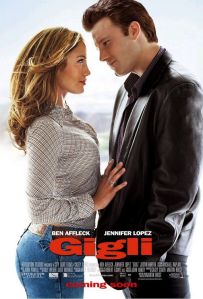 Originally released August 1, 2003:
It’s the feel-good movie of the year revolving around a lunkhead mobster (Ben Affleck) and his mentally challenged kipnapee and their attempts to covert a lesbian hitman (Jennifer Lopez) in between her yoga/horrific monologues concerning the superiority of female genitalia. Believe the hype people; Gigli is indeed as bad as they have told you. It’s not even entertainingly bad, like Bulletproof Monk, no folks; Gigli is just mundane and awful. During the entire two-hour stretch, which feels much much longer, I kept saying one thing aloud: “How could anyone making this think they were making a good movie?” Did they think audiences would find it funny that Affleck’s mother (the mother from My Big Fat Greek Wedding) shows us her big fat Greek behind? Did they really think that a mentally challenged kid (who has an affinity for gangster rap and wishes to travel to the mythical “Baywatch”) would come off as endearing? Well instead it comes across as insulting. And what else is insulting is the laugh-out-loud dialogue Lopez is forced to spit out concerning her attraction for women. I can’t think of any actress that could say the line, “I love my pussy” convincingly. And I’m sure a lot of actresses out there have true affection for it. The writing is just atrocious. And so much else fails as well. The score is a perplexing mix of upbeat jazz and inappropriate string orchestra. I don’t understand what emotions they were going for during scenes in Gigli but a full string orchestra playing music better suited for a real drama does not fit. Maybe it was for a tragedy. In that case, then it’s right on the money. You won’t see a more sloppily executed, horribly acted, painfully written, lazily directed, inept film this year. And what the hell did Christopher Walken walking in have anything to do with anything?
Nate’s Grade: F
——————————————————
WRITER REFLECTIONS 20 YEARS LATER

Gigli. It’s a word that instantly trigger shudders and shivers, a code name for fiasco, for career-destroying miscalculations. Writer/director Martin Brest was a Hollywood heavyweight with hit adult comedies like Going in Style, Beverly Hills Cop, Midnight Run, and Scent of a Woman, and since the cataclysmic disaster that was Gigli in 2003, this man hasn’t directed a single thing in these twenty years. The man is still reeling from the wafting stink from this very bad movie. I thought it might be worthwhile to revisit what I dubbed the worst film of 2003, though I was not the only critic to make this distinction, but now I’m questioning why I even bothered. It’s not like this movie was somehow going to get that much better with two decades of safe distance. The amazingly miscalculated artistic decisions will still be the same, still bad. I guess it must have been primarily my own morbid curiosity, much like revisiting 2001’s Freddy Got Figured, about whether this famous flop could still live up to its reputation. Well, dear reader, allow me to put any lingering doubts to rest you may have had about Gigli. It’s still very very very bad.
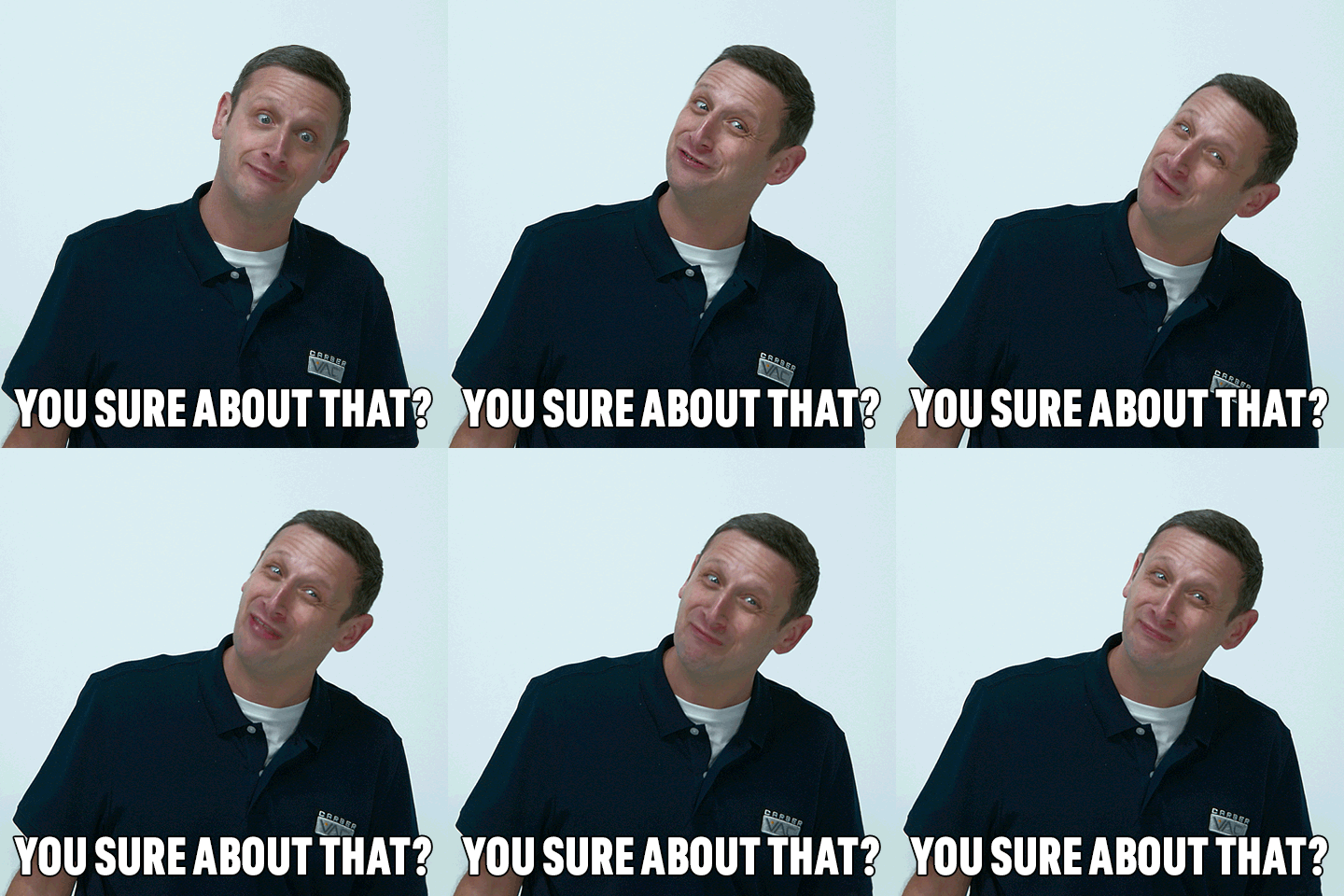
I might possibly recommend watching this once in your life (depending upon how many years you are lucky to earn) for the sheer fascination; Hollywood so easily makes mediocre and boring and familiar movies that feel like pale imitators of some prior hit, but Gigli is something different in the realm of studio stinkers, a project where just about every single creative decision warranted the incredulous Tim Robinson gif response: “You sure about that? You sure about that?” Gigli feels like two tonally dissonant movies in conflict at every moment. The plot elements feel lifted from some mid-to-late 90s indie crime comedy, the likes where they would just throw together a grab-bag of ironic provocative plot elements you wouldn’t expect together. “Mobster doofus kidnaps mentally challenged kid who is obsessed with gangster rap and wants to visit the ‘Baywatch’ which he thinks is real! Romance with a lesbian! Severed thumb ruses!” The collection of strange parts feels like it’s supposed to be a madcap, wacky comedy, and yet the tonal approach is complete treacle, with a shockingly syrupy score that rises and falls throughout, trying to convince you that what you’re watching is quixotically aiming for Oscars. It is astounding if you stop and pay attention to the film score at any moment, no matter how strange, as it attempts to provide jazzy saunter to “comedy” scenes, like an ex-girlfriend showing up into an unstable situation, and then it segues to Spielbergian emotional heft, like when that same ex-girlfriend attempts to take her own life to convince Jennifer Lopez to come back. There were so many moments where my only response possible was to avert my eyes, shake my head, and wonder whether anyone at any stage had any misgivings, tried to reach out to Brest, but then shrugged and dismissed their very legitimate worries as, “Well, he made Midnight Run after all. What do I know?” You know enough that these different tonal approaches will not work.
 Apparently, the movie was intended to be a straightforward mob comedy but the studio wanted the focus to shift toward a romance because of the actual romance between its stars, Lopez and Ben Affleck. Whenever actors begin a relationship after a movie or over the course of making one together, it provides another lens to review the movie, to gauge their chemistry and, if you’re so lucky and observant, able to “see” them falling in love with one another. That is nowhere to be found with Gigli. Maybe it was the shared experience of finding what they could to cling to while making this movie that nobody fully understood but committed to anyway (I guess love can be described the same way under some circumstances). Regardless, the romance between the two characters is, like all other plot elements, haphazard and spontaneous and foolhardy.
The characters are all awful and they never remotely come across like relatable or even remotely interesting people. Affleck’s Italian lunkhead Larry Gigli is just awash in early 2000s misogyny and bravado, dubbing himself the “sultan of slick, the rule of cool, the straight-first-foremost, pimp-mack, hustler, original gangster’s gangster.” Allow that macho boast to also exemplify another critical problem with the movie in that almost all the dialogue will make you cringe. There’s an entire monologue by Lopez, while she’s contorting her body in a plethora of lithe yoga positions, all about how superior the vagina is in appearance and function. What about when Lopez, as an indication that she wants to engage in heterosexual congress, utters the immortal phrase: “It’s turkey time. Gobble gobble.” Larry slams a kid’s computer on the ground and triumphantly says to suck an appendage of his, but then adds, “dot com” because the kid’s a nerd or something because he likes computers. Ho ho, the kidnapped young man insists that he be read to before going to bed, and what does Larry have at his disposal? Not books, oh no, so he’s forced to read him instructions on shampoo and toilet paper. Hilarious, right? What about when this same mentally challenged kid says, “When my penis sneezes, I say, ‘God bless you.’” The early 2000s weren’t an enlightened time with depiction of mental handicaps, and poor Justin Bartha (National Treasure, The Hangover) goes fully into the worst of these impulses, making the performance feel like a minstrel show for those with mental challenges. At least this aspect is not alone. Nothing ages well in this movie and its comedy only falls flatter and the drama is only more inexplicable twenty years later. It’s a special kind of bad so rarely achieved at this level of Hollywood.
Given that the majority of the movie consists of kidnapping a naïf, most of the movie is set in Gigli’s apartment keeping the man unseen and unheard from. This makes the movie feel for a long stretch like a glorified one-set play, with special appearances from traveling guest actors popping through for a brief moment in the spotlight. Here’s Christopher Walken dispensing with a monologue and then never being seen again. thanks for coming. Here’s Al Pacino, yelling so hard I’m surprised Lopez and Affleck didn’t need to wash the layers of spittle off. Here’s Lanie Kazan (My Big Fat Greek Wedding) who needs an insulin shot in her butt and let’s make sure we see her thong while we’re at it. These incursions of well-known actors re-explain the plot, not that it was hard to keep up with, and it all feels like stretching for time when the movie is already two hours long. The resolution, where our characters drive off into their sunny endings, lasts twenty minutes itself, which feels as long as the endings of 2003’s Return of the King. It’s a screenplay that feels like it’s holding itself on ice, content that the kooky characters butting heads and trading quips and monologues would be enough, and one that feels unsure of those same impulses, relying upon a revolving door of one-scene guests to remind us what we already know. It makes you feel simultaneously trapped with awful characters yet also in the hands of someone who doesn’t quite think you’re understanding the nuance and hilarity of the strained effort.
 I’m not an automatic Affleck hater. I enjoyed his rise from the films of Kevin Smith to Hollywood leading man. I can understand the draw of working with a filmmaker like Brest, and it’s probably that same appeal that lead him to also star in 2003’s Paycheck, directed by John Woo, who like Brest never worked in Hollywood again. This was the period where Affleck’s star was on the decline, and Bennifer was dominating tabloid space, and if it weren’t for the failures we might not have ever gotten Affleck as film director, so maybe we never would have gotten The Town or Argo or Gone Baby Gone had it not been for Gigli, so there’s a silver lining for you.
Look, you already know you shouldn’t even get near Gigli and with good cause. It’s a rarity to see something this colossally bad with this level of artistic freedom to be bad, not simply having too many cooks in the kitchen but having one very wayward chef nobody felt they could interfere with. This was a runaway chef, the kind of fiasco that only comes from unchecked artistic hubris. In that regard, there may be some rubbernecking appeal here for those who can endure bad characters, bad drama, bad comedy, bad acting, and horrible depictions of human beings who never at any point sound like human beings. It’s hard to watch and two hours of your precious time. 2003 began as a rough year for movies, sporting fascinating disasters like Bulletproof Monk and The League of Extraordinary Gentlemen. Watch those movies if you’re looking for a good-bad time. With Gigli, it’s only going to be a bad-bad time, whether it’s 2003, 2023, or any year until the sun explodes. Hey, if Ben Affleck and Jennifer Lopez could put this movie behind them and reunite, and even get officially married in 2022, then we can put it behind us as well.
Re-View Grade: F
Share this:

The Jungle Book (2016)
 It seemed like only a matter of time before those in the Mouse House started looking through the back catalogue of hits for inspiration. The Jungle Book is a live-action remake of the 1967 Disney animated film, but it’s only the first of many such translations to come. A live-action Beauty and the Beast is being filmed currently and plans are underway for a possible live-action Aladdin as well, though I pity the actor with the unenviable task of replacing the beloved Robin Williams. I was wary of director Jon Favreau’s (Iron Man) version just because it seemed, on the surface, like a quick attempt to fleece the public of their hard-earned money with a repackaged movie. What I got instead was a brilliantly executed adventure story with a beating heart, amazing special effects, and ultimately an improvement on the original. Imagine that.
Mowgli (Neel Sethi) is a boy raised by a pack of wolves. He tries to fit in with his pack but he grows a bit too slow and he can’t help himself with “tricks,” making tools. During a drought that signals a jungle wide peace between predator and prey, the feared tiger Shere Kahn (Idris Elba) lets the rest of the animals know his demands. The “man cub” is to leave or Kahn will hunt him down. The mother wolf, Raksha (Lupita Nyong’o), refuses to part with her child but Mowgli volunteers to leave to keep his pack safe. Kahn chases him deeper onto the outskirts of the jungle where Mowgli teams up with Baloo (Bill Murray), a lackadaisical bear who makes use of his partner’s affinity for tools and building contraptions. Mowgli’s new life is interrupted when he learns Kahn has attacked the wolf pack with the desire for Mowgli to return and face his wrath. Mowgli must team up with the friends of the jungle and use all his bravery and skills to defeat the ferocious Shere Kahn who has been lusting for vengeance for years.
 Favreau’s version of The Jungle Book is a thrilling and thrillingly immersive visual experience that opens up the big screen as an exciting canvas. The visual wizards have made an entire ecosystem look photo realistic to the point that if somebody said offhand that Jungle Book was shot on location in India, I wouldn’t think twice. The environments are entirely CGI and they are brilliantly brought to life in a seamless recreation I haven’t seen so effective since 2009’s Avatar. It’s stunning what can be accomplished with modern special effects, and then there’s Favreau’s smart decision not to radically anthropomorphize his animal cast. These are not some hybrid human-animal combination but rather flesh-and-blood wild creatures that just happen to speak English when they open their mouths (depending upon your territory). The animals don’t fall into that pesky uncanny valley where your brain is telling you what you’re watching is fake and unsettling to the senses (see: The Polar Express). The animals and behave like the real deal and further cement the exceptional level of realism of the movie. From a purely visual experience, The Jungle Book is a feast for the eyes that helps raise the bar just a little bit higher for the special effects industry and its proper application.
The movie would only succeed so far if it weren’t also for its engaging story. Let’s be honest about the 1967 Disney animated film: it’s not really a good movie. It’s fun and has some memorable songs (more on that below), but as a story it’s pretty redundant and flimsy. Mowgli bounces around one potential animal group to another trying to find a home only to move on to the next prospective foster situation. I never made the connection before but in a way the movie North is this plot, minus the talking animals and general entertainment value. There are long segments of the original Disney film that coast just on the charisma of the vocal actors and the animation. Certainly the Beatles parody characters haven’t aged well. There was plenty that could have been added to this story and screenwriter Justin Marks does just that, making the characters far more emotionally engaging. I felt a swell of sadness as Mowgli is separated from his wolf family, his mother declaring that no matter what he still is her son. Marks also personalizes the stakes between Mowgli and Shere Kahn. Each side has a grudge to settle when it comes to vengeance rather than Kahn rejecting the “man cub” out of general fear. This Mowgli is also a much more interesting protagonist; he’s plucky and uses his “man cub” other-ness as an asset when it comes to problem-solving. We have a better hero, a better villain, wonderfully brought to life through the velvety roar of Elba, and a small band of supporting characters that are more emotionally grounded. The wolf pack feels like a genuine family, a community. The relationship between Mowgli and Baloo becomes the backbone of the second half of a briskly paced movie, and the predictable narrative steps feel earned, from Baloo’s con job to caring for his lil’ buddy. The attention to the characters and their relationships provides a healthy sense of heart.
The vocal cast is expertly matched with their jungle creatures, notably Elba (Beasts of No Nation) and Murray (St Vincent). Murray has an innate way to make his lazy character endearing. Nyong’o (12 Years a Slave) gives a much better motion capture performance as a wolf than whatever the hell she was in The Force Awakens. Scarlet Johansson (The Avengers) is a nice addition as Ka the serpent, and as fans of Her can attest, her breathy voice can indeed be quite hypnotizing. Even the small comic relief animals are well done including the brilliant Gary Shandling in his last film role. Motion capture for non-primates seems like an iffy proposition considering that you’re either forcing the human actors to physically walk on all fours and pretend to be animals, which can be silly, or just copying the direct movements of animal models, which seems redundant then with the technological advances. I don’t know how they did it but it seems like The Jungle Book found a working middle ground that still showcases actor performances.

I think this picture cures infertility.
With a movie that works so well on so many levels, the few faulty areas tend to stand out, and I feel like somewhat of a cad to say that one of the biggest problems is the acting from its child star. I’ll give Sethi some leeway here considering he was never interacting with much more than a giant warehouse of blue screens, which I think we’ve shown doesn’t exactly lend itself toward the best live-acting performances (see: Star Wars prequels). When Sethi is in more action-oriented scenes, like running and jumping and generally being physically mobile, his performance improves. However, when he has to shift to portraying emotions beyond fight-or-flight that is where Sethi has trouble. When he’s playing “happy-go-lucky” early on with his wolf brethren, he’s way too animated in that way that unrestrained child actors can be without a proper anchor to moor their performance. There were moments that made me wince. I see no reason why an actor under ten should be immune to criticism when warranted. We live in an age of amazing child acting performances, notably evidenced by the incredible Jacob Tremblay in Room. We should expect better from our smaller actors. Unfortunately for Sethi, the visual spectacle is so luscious that the one human element sticks out more when he is also delivering a mediocre to poor lead performance.
The other minor detraction for Jungle Book is the inclusion of the two songs that really anyone recalls from the original Disney version, “I Want to Be Like You” and “The Bear Necessities.” I’ll even charitably give “Bear Necessities” a pass as it involves a moment of levity and bonding between Mowgli and Baloo and they’re simply singing to themselves as they relax down the river. It’s also the most famous song and if you think about it the “Hakuna Matata” of its day. “I Want to Be Like You” does not deserve the same consideration. It comes at an awkward time and undercuts the build-up of tension and does nothing short of rip you out of the world of the movie. At this point, we’ve been introduced to the hulking presence of King Louie voiced by Christopher Walken. The giant ape is portrayed like a mafia don and his sit-down with Mowgli has a real menace to it as he wants to provide “protection” for the man club at a price. It’s a moody moment and then this big orangutan starts singing and dancing. The illusion and reality of the movie is broken. At no other point does The Jungle Book come close to breaking its reality and it’s all for such an extraneous moment. There’s nothing conveyed in this song that couldn’t have simply been communicated through speech. Instead, the live-action movie makes a tortured homage to the older Disney source material, and it’s the one major misstep in its approach.
The Jungle Book is a magical movie that actually improves upon its cinematic source material. It’s a visual stunner that is completely transporting and another high-level achievement for the art of modern special effects as well as the proper usage of them in connection with fundamentally good storytelling. Favreau is able to open up a new yet familiar world and allow the viewer a renewed sense of awe. We also get characters that we care about, a strongly grounded sense of emotional stakes, and some thrilling action to go along with the CGI playhouse. I only have a few misgivings with Disney’s new Jungle book and one of those is really a function of its homage to the older Jungle Book. I’ll take the rare step and advise moviegoers to seriously consider seeing this in 3D (I did not). It’s a great visual experience, however, that would only take the movie so far if it wasn’t for Justin Marks screenplay adaptation and Favreua’s skilled direction. Now The Jungle Book can be a great visual experience, a great story, and, simply put, a great movie.
Nate’s Grade: A-
Share this:

Joe Dirt 2: Beautiful Loser (2015)
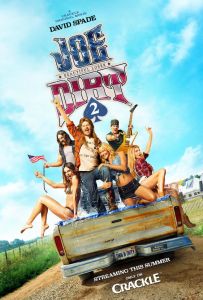 How bad does bad get? That’s the question with Joe Dirt 2: Beautiful Loser, a sequel 14 years in the making to a one-joke character from an actor now in his 50s. It’s so bad that this movie is a Crackle original, a streaming service that I don’t think people know exists. You can feel every degree of sad desperation while you watch. There are so many scenes that just seem to prattle on indefinitely, varying from one or two angles, as if they only had time to film one take and kept encouraging their actors to just keep throwing things out there in the misplaced hope that somehow somebody would strike gold. It does not happen once. David Spade returns and he’s whisked away Wizard of Oz-style into the past where he watches his beloved girlfriend choose his rival (Mark McGrath) over him. It’s a weird Back to the Future Part 2 alternative timeline and one where McGrath also plays his character’s father in an inexplicable scene where he allows his family to unknowingly jerk him off. I hope that last sentence begins to reveal the true depths of comic despair that is Joe Dirt 2. It’s not that it’s powerfully unfunny, it’s not that the plot is completely inconsequential, it’s not that the jokes end up being weird pop-culture references dating back to the 90s (Buffalo Bill in 2015?), it’s not that Spade looks like he’s fulfilling some deal with the devil, it’s not that the movie has no purpose and no reason to exist, it’s that Joe Dirt 2: Beautiful Loser is like a communal funeral. You watch it and you mourn; for those involved and for your lost time. If you can find a more pointless, depressing, past-its-prime sequel, then I think the seventh seal has been opened, spelling the doom of mankind. I figured Adam Sandler would be responsible somehow.
Nate’s Grade: F
Share this:

Wedding Crashers (2005)
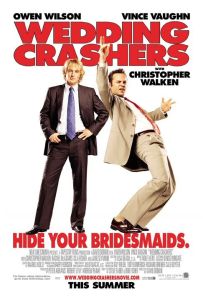 My friend Amanda Evans is quite possibly the biggest Vince Vaughn fan in the United States, nay, the planet Earth. She used to watch Dodgeball every day. Her brother-in-law even went so far as to stage an intervention for her Vaughn addiction. She has been talking about Wedding Crashers for months and months and counting down the days like a kid waiting for Christmas. It’s safe to say that Amanda loved the movie but how would your otherwise non-obsessed moviegoer feel?
Jeremy (Vaughn) and John (Owen Wilson) are divorce attorneys by day and ladies men come nightfall. Both men crash weddings they were not invited to with the strict purpose of getting laid by horny bridesmaids. They have got their honey hunting down to a science, from what relative they’re related to, to when to cry, to whom to slow dance with to convince those bridesmaids that they’re sweet gentlemen. Jeremy says that one day when they?re old men they’ll both look back on these days and smile. John retorts, “We’re not that young.”
The Super Bowl of all weddings is the daughter of the Secretary of the Treasury (Christopher Walken). John has his eye on his other daughter Claire (Rachel McAdams) while Jeremy sets his sights on the Secretary’s other daughter, the wild and vivacious Gloria (Isla Fisher). The only problem for John is that he’s actually falling in love with Claire, oh and she’s engaged to a real jackass (Alias‘ Bradley Cooper). Jeremy and John are such big hits at the wedding that the Secretary invites them both to vacation with his family at their summer home. Jeremy is hesitant and wants to stick to the love-em-and-leave-em lifestyle he and his buddy are so accustomed to, but John drags him along convinced he can win Claire over.
 Vaughn kills in every single scene. He hits punchline after punchline like some king of comedic prizefighter. His mile-a-minute delivery gels ever so nicely with Wilson’s homesy charm and drawl. These two have never been matched before as leading men but now their marriage seems like a match made in heaven. Their chemistry is off the chart. Wilson is essentially the straight man to Vaughn. In most comedies, “straight man” is just another term for boring. However, Wilson gets his shots in as well especially with his give and take with Vaughn, who is in a comedic zone all his own.
Not to be out done by the men, both McAdams and Fisher give great performances. McAdams (Mean Girls) is a rising star and it’s easy to see why. She’s a beautiful woman but also has some good teeth for comedy. In comedy terms, she’s the romantic interest, which means she’s an even straighter (read: boring) man than Wilson’s straight man. And handed with all this, McAdams still shines as a leading lady you can fall in love with. The true scene-stealer of Wedding Crashers is Fisher (Scooby-Doo), who goes hilariously tit-for-tat with Vaughn. You might walk away believing she’s truly out of her mind. Fisher has a physical gift for comedy that hasn’t been showcased before, but with Wedding Crashers she gets unleashed and we?re the better for it.
After the brilliant work of McAdams and Fisher, most of the supporting cast’s performances comes off as being too forced. Cooper is a wide-eyed grinning jackass that?s obvious from the get-go. He plays the role so big that his eyebrows seem permanently pressed to the top of his head. There’s also the weird introverted son who Typical Crazy Grandma berates as being “a homo.” But not only is he gay hes also a freak. The role seems quizzically garish and even a bit homophobic. Jane Seymore jumps at her role as mom in heat, but the film forgets about her fast after an awkward encounter with Wilson. Walken can make me laugh just by watching him stare (and he did), but even he isn’t given much more to work with besides the supportive dad role. It seems odd for a comedy with such huge belly laughs to have several supporting players grind the film’s funny down. All of this is excusable though because the far majority of the film’s attention and laughs are derived from our central quartet.
Wedding Crashers is a raunchy delight. You know you’re in good hands when, in one scene, Wilson and Vaughn are dipping bridesmaids on the dance floor and it cuts to these same bridesmaids now falling topless onto hotel beds. This is one R-rated comedy that proudly wears its rating on its sleeve. And for a sex comedy, there’s a surprising amount of laughs mined just out of an adult discussion on sex, which cannot be curtailed or couched with euphemisms and soft language. I don’t know whether to credit the screenwriters or the off-the-cuff improving of Wilson and Vaughn, but Wedding Crashers proves there’s still more under the sun to talk about and giggle.
Usually with movies revolving around hedonistic characters, they meet one of two ends: 1) they find that One True Girl that makes them want to go straight, or 2) they meet their hedonistic match and rethink their ways now that the shoe is on the other foot. Wedding Crashers doesn’t give you one of these options, oh no, it gives you both. Sure things gets awfully predictable after a great rush out of the gate, but the interplay between Wilson and Vaughn and some genuinely funny gags should keep most laughing until the surprise cameo at the end by the founder/guru of the wedding crashing rule book (it should be no surprise if you’ve seen any movie with Wilson and Vaughn the last three years). The climax is a bit drawn out and Wedding Crashers is still another comedy built around deception whose climax involves apologizing for said deception. It’d be tiresome if the movie weren’t so damn funny.

Despite the sleazy premise, Wedding Crashers has a sweet and gooey center. These are two men who know exactly what women want and they’re eager to give it to them. They just don’t know what they really want, but when they find it both Jeremy and John set their minds to romantic conquests outside of the bedroom. It’s this gooey center that makes the characters likeable despite any misgivings an audience may hold over their wedding crashing plot.
Two hours is a near eternity for most comedies and Wedding Crashers seems to lose its sprint in the last 20-30 minutes. The film starts getting repetitious and overly predictable with few laughs to cover up. Wilson and Vaughn still make it work but the setup seems to have been taken as far as it will go and then some.
Wedding Crashers is a loud, jovial, ribs-in-the-elbows funny return to the crass classics of the 1970s R-rated comedy. Vaughn and Wilson are perfectly matched and McAdams and Fisher shine like stars. Wedding Crashers is a bawdy good time that will leave you aching from laughing so hard. This movie is profane, simple, crude, and joyously so. It does run out of gas toward its protracted climax and some of the supporting performances feel forced, but Wedding Crashers is easily the funniest film of the year. Amanda was foiled in seeing the film three times the weekend it opened. She had to settle for only seeing it twice. I don’t think she has slept since (UPDATE: Amanda has since seen the movie five more times).
Nate’s Grade: B+
Share this:

Man on Fire (2004)
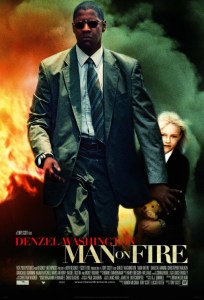 By far, the most entertaining moment of Man on Fire occurs shortly after the movie ends. A message comes on screen more or less saying, Mexico City is a very special place and we thank them. Now, after having watched a lengthy 2 hour and 25 minute film that shows Mexico City as a chaotic equal to the Middle East, a city that experiences four kidnappings a day we are told, these ending sentiments feel like a mea culpa. To say a place is great after showing it to be a corrupt war-zone is hilarious. I doubt Mexico City will be using Man on Fire to lure tourism, just like I doubt Germany uses Hogan’s Heroes for its tourism.
The man on fire is Creasy (Denzel Washington), a former soldier with a drinking problem. Hes hired dirt cheap to be the bodyguard for Pita (Dakota Fanning), the daughter of a wealthy Mexican politician (Marc Anthony). Creasy is pragmatic about his job and shirks Pitas attempts at friendship. Eventually, the precocious tyke gets the better of him and Creasy forgoes his self-loathing for coaching Pita on how to swim better. Creasy has found his recovery in the form of Pita’s love, but his world is ripped apart when Pita is kidnapped and Creasy is left for dead. When he recovers, he vows merciless vengeance on anyone involved in Pita’s kidnapping.
 Denzel Washington is competent in his role, but there aren’t many films that wouldn’t be better by having a Denzel Washington performance in it. Fanning has a robotic nature to her delivery. The wacky Christopher Walken is in this movie somewhere, but you would be hard-pressed to find him in the last hour or so. It’s kind of nutty that Walken of all people plays the voice of reason in a revenge movie.
Director Tony Scott (Crimson Tide, Top Gun) has flat-out forgotten or lost interest in telling stories. His direction of Man on Fire is erratic and heavy on stop-the-action-dead visual flourishes. Scott is a slave to visuals, but so many of them are jarringly miscalculated that the audience can never fully immerse themselves in the film. It’s like a kid fiddling with a new camcorder and wanting to try all the super cool special features (Whoa, I can make things slower … now grittier stock … now sepia … now I can make a mirror of things … etc.).
It takes over an hour to get to the key kidnapping plot point. Until then the audience is relegated to watching scenes of Creasy find redemption through the eyes of a child. Denzel and Fanning have a nice mentor camaraderie, but after an hour the audience is impatiently waiting for the inevitable kidnapping that the movies foreshadowing has been tripping all over.
 When Man on Fire does hit the kidnapping, the ensuing movie gets very messy, and boy does it get ugly. Creasy goes on a grisly killing spree that turns him from a sympathetic loner into a one-man wrecking crew. Vengeance is an easy emotion for an audience to get behind a character, but Man on Fire goes way beyond audience empathy. Are we to cheer when Creasy goes about ruthlessly killing unarmed people and threatening families, pregnant women, and kids? I didn’t cheer. I was somewhat appalled that the filmmakers expected us to revel in this violence as if it was more than justified. It’s just ugly, plain and simple. It is also sickeningly sadistic.
The most bizarre thing about Man on Fire is the subtitles. When I think back on this film in the future, that is the one thing that will stand out for me. These arent your ordinary stay-at-the-bottom-and-do-as-you’re-told subtitles. Oh no. These subtitles dance, jump around, float, fade, expand and shrink in size, and do about everything but make balloon animals (or, I should say, subtitle animals). It’s like a living comic book; however, this is yet another visual trick that draws the audience out of the film. The unusual subtitles call too much attention to themselves, especially when they just pop up for a single word, spoken in English, as if to clue in the audience that this point of information will be vital somehow.
Man on Fire is a sadistic action film that is too full of itself for amusement. By the time that mea culpa comes onscreen its almost a relief to laugh again. The hard-driving ugliness of Man on Fire might make you forget how to. Fans of revenge films may find some redeemable qualities, but Man on Fire is one gruesome 145 minutes to squirm through.
Nate’s Grade: C-
Share this:

The Rundown (2003)
In the beginning of the new action comedy The Rundown, Beck (The Rock), a bounty hunter, is entering a club on a job. On his way in Arnold Schwarzenegger passes him by and says, ”Have fun.” Consider it a proverbial torch passing, because while Schwarzenegger is going to be busting the campaign trail, The Rundown establishes The Rock as the fresh and capable marquee name for all future action films. This man is a star.
Beck is offered a chance to square off all debts to mobster Billy Walker by agreeing to journey into the Brazilian jungle. His mission is to retrieve Travis (Seann William Scott), a hyperactive screw-up who happens to be Walker’s son. One Beck travels to the Amazon he runs into Hatcher (Christopher Walken) who claims to own the jungle and whatever contents dwell within. He asserts that Travis has stumbled upon a wealthy artifact in his jungle and therefore refuses Beck to leave with Travis. It’s at this point that the chase is on.
I don’t care what your little sister told you, Vin Diesel is not the next face of action, no, it’s The Rock. Despite only appearing in three movies (and he was only in The Mummy Returns for like three minutes), The Rock displays a razor-sharp sense of comedy. He’s also huge, likeable, and he can even emote well during smaller moments, not that The Rundown will stretch you as an actor. He’s also honed in excessive eyebrow arching.
Walken exists in a plane of brilliant weirdness that we simple human will never be able to coexist upon. His Hatcher is one mean villain who exploits indigenous workers, wears his pants up to his armpits, and says he put the heart in the darkness. Walken’s hysterical tooth fairy monologue is worth the price of admission alone.
Director Peter Berg (Very Bad Things) adds a delectable cartoonish flavor to the film. His action sequences pop with exaggerated energy and zestful humor, like when Travis and Beck roll down a hill for a near minute. This is everything an action film should be: lively, funny, with keen action sequences that are low on CGI but filled with characters we care about. The Rundown is the best summer film not released during the summer.
The Rundown is an adrenalized punch of fabulous action and hilarious banter. When youre not laughing and spilling your popcorn youll be sitting straight up to catch every lovely eyeful of spectacular action. Its a terrifically entertaining and fun flick. The Rock has arrived.
Nate’s Grade: A
Share this:

Gigli (2003)
It’s the feel-good movie of the year revolving around a lunkhead mobster (Ben Affleck) and his mentally challenged kipnapee and their attempts to covert a lesbian hitman (Jennifer Lopez) in between her yoga/horrific monologues concerning the superiority of female genitalia. Believe the hype people; Gigli is indeed as bad as they have told you. It’s not even entertainingly bad, like Bulletproof Monk, no folks; Gigli is just mundane and awful. During the entire two hour stretch, which feels much much longer, I kept saying one thing aloud: “How could anyone making this think they were making a goodmovie?” Did they think audiences would find it funny that Affleck’s mother (the mother from My Big Fat Greek Wedding) shows us her big fat Greek behind? Did they really think that a mentally retarded kid (who has an affinity for gangster rap and wishes to travel to the mythical “Baywatch”) would come off as endearing? Well instead it comes across as insulting. And what else is insulting is the laugh-out-loud dialogue Lopez is forced to spit out concerning her attraction for women. I can’t think of any actress that could say the line, “I love my pussy” convincingly. And I’m sure a lot of actresses out there have true affection for it. The writing is just atrocious. And so much else fails as well. The score is a perplexing mix of upbeat jazz and inappropriate string orchestra. I don’t understand what emotions they were going for during scenes in Gigli but a full string orchestra playing music better suited for a real drama does not fit. Maybe it was for a tragedy. In that case, then it’s right on the money. You won’t see a more sloppily executed, horribly acted, painfully written, lazily directed, inept film this year. And what the hell did Christopher Walken walking in have anything to do with anything?
Nate’s Grade: F
Share this:

Catch Me If You Can (2002)
January at the theaters is a tale of two kinds of films. One type are the studio bombs (take Just Married and Darkness Falls, please take them far away). The other type are the prestige pictures expanding their releases in hopes of garnering some of that Oscar magic. A lot of prestige films were released around the holidays and though not every one could be a winner, they were all better than Kangaroo Jack. Well, except for The Hours.
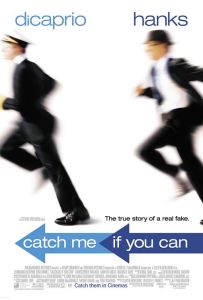 Catch Me If You Can (2002)
Premise: Successful true-life con artist Frank Abagnale Jr. (Leo DiCaprio) zips across the world posing as a pilot, doctor and lawyer all before the age of 18. A mousy Tom Hanks provides the chasing.
Results: Breezy and light-hearted, Catch is an entertaining and fun romp that works with a charming Leo (unlike in Gangs), a jazzy score and a skillful recreation of the 1960s life and mood. Spielberg hasn’t made a film under two hours since 1989, so Catch is a tad long.
Nate’s Grade: B


 nathanzoebl
You must be logged in to post a comment.