Blog Archives
Django Unchained (2012)
 It’s an understatement that no one makes films like Quentin Tarantino, though after Pulp Fiction it seemed like everyone was trying. The famous writer/director is an audacious filmic DJ, taking samples from all genres and mixing and matching them into a new and elevated form of art; he takes low-grade B-movie concepts and genres and turns them into highly literate A-class films. My only quibble is that, while I heartily enjoy the man’s unique efforts, I don’t know if we’re ever going to see a different Tarantino anymore. Since 1997’s Jackie Brown, he seems intent on re-imagining exploitation films and B-movies and putting his articulate spin on them. I have yet to dislike a Tarantino film (I rate Jackie Brown the lowest but that’s still an A-) and I’ll be first in line for anything the man attaches himself to as writer/director. Django Unchained is Tarantino’s ode to spaghetti Westerns, and it’s every bit as violent and tense and entertaining as you’d hope it to be.
In 1858 Texas, an abolitionist bounty hunter, Dr. King Shultz (Christoph Waltz) frees a slave named Django (Jamie Foxx) and enlists his help in tracking down a team of outlaws. They strike up a mentorship, gunning down outlaws for money. “Kill white folk and they pay you for it? What’s not to like?” Django reasons. After a successful season nabbing bad guys and training Django in the ways of shooting, the men come to a crossroads. Django is looking for his wife Broomhilda (Kerry Washington). She was torn away from him and sold off to wealthy Mississippi plantation owner Calvin Candie (Leonardo DiCaprio). Schultz and Django cook up a scheme to rescue Broomhilda. Schultz will pose as a rich power player wanting to enter the “mandingo fighting” game (think savage gladiatorial combat). Django will play a black slaver, and expert when it comes to picking out prized fighters. With a generous offer, the two get invited to Candie’s family plantation, dubbed Candieland. Standing in the way of their plan is Stephen (Samuel L. Jackson), Candie’s head of the house. Stephen is deeply suspicious of their guests and ready to expose them for who they truly are.
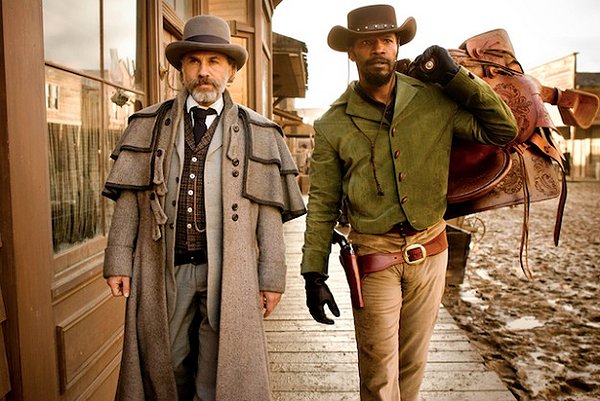 I’ve been dragging my feet writing a review of Django Unchained and I’m trying to determine why that is. Just after typing that sentence I spent 30 minutes checking my e-mail. I’m an avid Tarantino fan, so I’m left wondering what my hesitation is about. I certainly enjoyed the film, thoroughly, but perhaps my question is whether I should have enjoyed the film as much as I did given the historical reality of slavery. No movie will ever approach the true horrors of slavery; even the very act of owning another human is a detestable and crushing reality. Of course I’m coming at this movie from the perspective of a white male, so I feel like aspects of my commentary can only be minor. Is the backdrop of slavery too horrific for Tarantino to stage his spin on a revenge-filled Western? Spike Lee seems to think so via his critical public remarks. Tarantino has great glee in reveling in over-the-top movie violence, the kind that audiences (at least mine) cheer for. I guess the questionable angle is marrying the two realities and tones. You don’t want to take away from the brutality of slavery and at the same time you want to tell a compelling revenge-soaked thriller that satisfies with its buckets of blood. I’d say Django Unchained mostly finds the right balance to hit you in the gut one minute and the next have you clapping along.
It seems like the media is pressing every black celebrity for his or her personal thoughts on Django and especially Tarantino’s copious use of the N-word. Tarantino has gotten into hot water before with his penchant for the N-word, notably his own sequence in Pulp Fiction, but the N-word is entirely period appropriate for Django. Let’s face it, a majority of Americans, let alone Southerners, had really one word for slaves, and it wasn’t kind. This is the word that would have been uttered. However, after seeing the film a second time, I can see the complaints about the overwhelming use of the N-word. If you were to turn this into an awful and disrespectful drinking game, you’d probably pass out before DiCaprio even steps onscreen.
Like Inglourious Basterds, this movie is really a series of sit-downs that simmer with tension. The man has gotten so good with establishing the particulars of a scene, what the characters desire, and to push it to its breaking point when it comes to tension. While I don’t think anything approaches the highpoints of Basterds, this is still a movie that luxuriates in beautifully played tension and the danger lurking underneath Tarantino’s finely crafted words. And let’s talk about those wonderful words of Tarantino talk, the kind that seem so effortless to build sensationally interesting characters. The man sure enjoys writing his umpteenth variances on badasses engaging in verbal pissing contests (the literal kind are far less entertaining, at least for me). When you have character this sharply developed with such counter objectives, I could watch them duke it out all day. There are some pacing concerns with the movie, particularly once we get to Candieland, but when I’m engaged this much in a movie, I’d rather it go overboard than scrimp. Tarantino’s signature cool/funny/funny cool dialogue is alive and well. Every scene advances the plot, pushes it toward its bloody conclusion where bodies explode with sprays of red mist. It’s completely over-the-top in the Kill Bill vein, enough to draw snickers and laughter from a crowd, but Tarantino knows how to serve up a satisfying ending even with a body count to rival Hamlet.
 I don’t want to give the wrong impression that Django Unchained is deadly serious given the subject matter and historical context. I don’t think it disrespectfully sanitizes the horrors of slavery, but Tarantino’s brand of humor finds opportune moments to poke through. There’s a sequence with an early version of the KKK, a group of Southerners on horses arguing over whether they need to wear the ill-fitting bags on their head they prepared (plus Jonah Hill cameo). I was laughing so hard I thought people around me were going to shush me. It may well be the funniest thing Tarantino has ever written. There’s also natural humor to be had in the awkward handling of race relations, something that hasn’t exactly been perfectly ironed out to this day. A wealthy plantation owner (Don Johnson) struggles to explain how his slaves should treat Django, presented as a freeman by Schultz. “You want me to treat him like white people?” someone asks. This is followed promptly with a curt, “No.” There’s also plenty of gallows humor to be had with the over-the-top violence that pervades in the finale. It’s all key moments to blow off steam, so to speak, and make the film more bearable.
Django Unchained follows a traditional Western plot; in fact I’d say what we watch is essentially Tarantino’s whacked out spin on The Count of Monte Cristo (Alexander Dumas is even referenced in the film by name). Our lead character, Django, is in the Clint Eastwood mode of the strong and silent type. Schultz is the one who does all the talking while Django learns and glowers. They make a terrific buddy team and you almost wish that Tarantino had just diverged his story and allowed them to keep doing their bounty business. But Django’s wife needs some saving and that’s where the movie slows down. I wish Broomhilda had been given more character development. She’s pretty much the princess that needs saving, much like the German folk tale we learn is where Broomhilda gets her uncommon name. My sister described Django Unchained as a love story and I think that’s being a little generous (Tarantino did cut much of her torture, physical and sexual, from his script). We certainly feel Django’s desire to rescue her, and we worry about all the plot machinations and masks the characters must wear to accomplish this feat. With that said, the movie still has plenty of sucker punch surprises, much like Basterds, where violence erupts and despicable characters are given arias to illuminate the depths of their depraved worldviews.
I do wish that Tarantino had been a bit more judicious with his editing (the first without longtime editor Sally Menke who died in 2010) and curtailed all his self-indulgent meta film homage nods. We get stuff like Amber Tamblyn (The Sisterhood of the Traveling Pants) in one shot. Why you ask? See her father also stars in the movie in a small role, and he once played a character titled “Son of a Gunfighter.” So in his own credits, Tarantino lists him as “Son of a Gunfighter” and his daughter as, what else, “Daughter of a Son of a Gunfighter.” When all of that contorting is for an end credits gag and one shot in the whole movie, you feel like it was strictly masturbatory. Then there’s the original Django, Franco Nero, asking Foxx how to spell his name. Old Django asking new Django how to spell his name. I guess it’s supposed to be like a cinematic passing of the torch but it’s another moment that feels superfluous in a 165-minute movie. The movie can get a tad exhausting. The final 15 minutes, while still smartly written and boasting some terrific bloody comeuppance, feels like an add-on that wasn’t needed. It does manage to tie some elements back together but at this point the audience is ready for Django to ride off into the sunset, not have another obstacle to overcome in improbable yet badass fashion. At my first viewing, the kid behind me kept complaining to his parents that the movie had failed to end (“This is still going? It’s already been two hours!”). I also understand the fruitless and ironic nature of asking Tarantino to reign in his self-indulgences; that is, after all, what makes him who he is.
As expected from Westerns, the movie is a boy’s show. Foxx (Ray) has a steely screen presence that works very effectively for the character. The man’s quiet confidence and growing insolence play well, as he burrows into a role that boosts his confidence and assertiveness. Foxx’s journey from beleaguered and shell-shocked slave to mighty walking vengeance is definitely a full performance and one that Foxx delivers without any winks to the camera. Waltz (Carnage) will be dinged for playing a character similar to his Oscar-winning role in Basterds, but he’s still joyously entertaining, with that strange speech pattern of his that he plays like a musical instrument. He has a lot to say with plenty of theatrical flourishes, but that’s what makes him so entrancing. Simply put, Waltz and Tarantino are a match made in heaven.
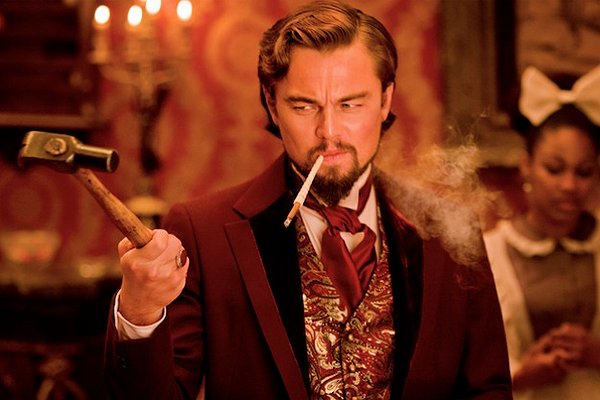
 DiCaprio (Inception) doesn’t appear until over an hour into the film but he’s worth the wait. At my first screening, I thought DiCaprio was good but was unimpressed. Upon a second viewing, I must say my appreciation grew for the man’s performance. Calvin Candie is certainly a vile man and DiCaprio is able to give him such an intriguing brio; he’s not the magnetic source of evil that Waltz was in Basterds, a man able to stay two steps ahead of his prey. Candie is easily taken for a fool. He’s not the smartest guy in the room but he can work up a pretty sizable fury; DiCaprio actually cuts open his hand during a confrontation and remains in character, undeterred. But the best actor in the movie is Jackson (The Avengers). There are far more layers to his head house slave than meets the eyes. It sure seems like he’s really the fist behind the glove. He may put on an act for company, but the man is far more calculating and sinister than anyone else in the film. You know he’s a good villain when the audience cheers the loudest at his demise (don’t act surprised, spoiler-phobes). I wouldn’t be surprised if Waltz, DiCaprio, or even Jackson get nominated for supporting Oscars.
It seems like Tarantino has also stumbled into a hidden lucrative subgenre at the box-office, namely the historical revenge film. Who doesn’t want to see a group historically shafted get some sweet revenge, the bad guys punished, and all with sparkling dialogue? In 2009, Tarantino went on a Nazi scalping spree and got to shoot Hitler in the face. With Django, a brutalized slave becomes the hero of his own story and kills some vile slave owners and traders. It’s essentially a Nat Turner-style rebellion from history, albeit with some harebrained scams and colorful characters. Following this lucrative model, Tarantino could take other maligned minorities and give them cinematic justice. Sadly, there are too many examples to count where Tarantino can take inspiration.
Django Unchained is a bloody, rollicking, talky, messy, exciting, surprising, uncomfortable yet satisfying movie and probably one of the oddest crowd-pleasers in recent memory. I saw it on Christmas day and my theater was a sell out. They loved it, soaking up every minute, laughing at the funny parts and wincing at the gruesome violence. I couldn’t think of a better way to celebrate the birth of baby Jesus. It doesn’t whitewash the evils and viciousness of slavery, but at the same time Tarantino knows how to serve an audience and their demands for big characters, big set pieces, and big vengeance. Django is a sturdy Western/blaxploitation film, and whatever other genres Tarantino feels like tossing into his cinematic blender. Whatever you classify it as, Django Unchained is another Tarantino original specialty and his tremendous talent comes through loud and clear, even with a few false endings and self-indulgences at play. It looks great, has a great soundtrack, and presents great acting talent reciting Tarantino’s great words like they were prized possessions. It’s a bit long and a bit overdone, but when you’re enjoying yourself, who wants to leave the party early?
Nate’s Grade: A
Share this:

Green Hornet (2011)
 Unassuming, impetuous, and with a lowbrow sense of duty, The Green Hornet gets by on its self-aware, campy, chummy tone thanks to co-writer/star Seth Rogen. The slimmed-down comedian plays a news media playboy who tries to right his life by becoming a super hero with his deceased father’s assistant, the kung-fu connoisseur Kato (Jay Chou, making a very poor English acting debut). Where the movie works best is when it upends formula convention, like making every character insecure about their personal standing, including the villain (Oscar-winner Christoph Waltz), who is aggravated that the “Green Hornet” is dazzling criminals with his digital age marketing. When the film thumbs its nose at convention, it plays like a mischievous prank on super hero/crime fighting tales. Green Hornet is a movie that at times is too busy, too childish, bordering on a bromance between Rogen and Chou. But with director Michel Gondry (Eternal Sunshine of the Spotless Mind) at the helm, there are enough quirky visuals to keep things interesting to the noisy climax. Rogen and his film can never be accused of being too serious, and given the material that’s a blessing.
Nate’s Grade: B-
Share this:

Water for Elephants (2011)
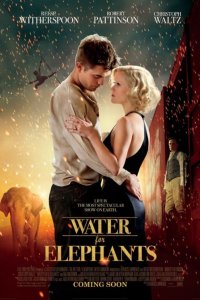 Would you believe at no point does the film Water for Elephants come close to explaining its title? I have never read the best-selling 2007 novel, where I’m sure it’s given some glancing explanation; so allow me to thus pontificate. Rosie the elephant is given tubs of whiskey at several points in the movie, which she happily laps up thanks to her prominent proboscis. So does that mean that the “water” for elephants is whiskey? If that’s the case, then this is really a tale of dangerous enabling. But then again, how do you tell a four-ton pachyderm that she’s cut off?
Jacob (Robert Pattinson) is one exam away from becoming a licensed vet from Cornell in 1931 when he’s delivered some tragic news. His Polish immigrant parents died in a car accident. Distraught, Jacob runs away and hops onto a passing train, stumbling upon a crew of circus performers. The train belongs to the Benzini Brothers circus, led by the fiery August (Christoph Waltz). He’s about to be thrown off the train when he panics and screams that he’s a vet. August hires the kid as the team’s newest vet and Jacob finds animals that are in bad shape and pushed to their limits. He recommends a mercy killing for the main attraction, a white horse that the boss’s wife, Marlena (Reese Witherspoon), performs upon. He takes some initiative and puts the horse out, despite August’s wishes. Lucky for them all, they find a new star attraction – Rosie the elephant. Robert doesn’t know the first thing about elephants, or “bulls” as they’re referred to by performers, but he’s tasked with getting the creature ready to perform or else everyone will be destitute. The man has a way with pachyderms, and the Benzini Brothers experience a windfall of new business, looking to take on Ringling Brothers. But the whole time, Jacob is making moon eyes at the boss’s wife, despite everyone telling him at every turn not to.
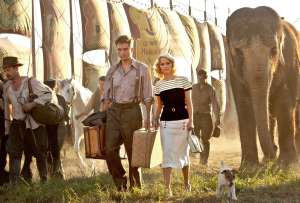 The biggest issue this movie has is that the trio of main characters all feel like they exist in separate movies. There is zero chemistry between Pattinson and Witherspoon, further dampening their lukewarm romance. Robert is a character defined by being young and having a moral center. He’s not a person so much as an alternative. Marlena is the damsel very distressed, and Witherspoon plays her part all in all slow cock-eyed glances. If I had to pick one of the three, I’d choose to go with August’s version of the story just because he’s a more interesting character than our do-gooding Jacob. August is a huckster who needs to take care of a caravan of drifters and sell them to the public as the stuff of dream and legend. He has some charisma, he’s constantly leveraged against debts, and he is pressured to keep things afloat and to keep people from mutinying. This is beyond the heyday of circuses, so he knows that too many shows with too few people means that his troupe will be picked apart by circus carpetbaggers. You actually start to empathize with him at turns, and then he goes off and beats animals or his wife and that’s that. August is an interesting, vulnerable, flawed character, and he’s given the thankless role of being setup as sneering villain. I would have rather watched August try and keep his deteriorating circus together than watch another tired romantic triangle.
The romance that so much rides on is about as sure-footed as a drunken elephant. Part of this is the failure of Pattinson to deliver a performance that doesn’t feel wooden and artificial, as if he’s posing more than acting. But the romance, which dominates the film’s narrative, is given such scant reasoning that it expects the audience to simply fill in the blanks. He’s a young, good-looking guy who loves animals. She loves animals. Her husband is a jerk, so what’s the problem? Naturally, she’d just run to whatever available catch she could find to escape her hell so anything that delves into more character detail would be a waste of time, right? The movie seems to think so. The love triangle all inhabit very rigidly defined parts. Just because a woman is married to a nasty guy doesn’t mean I instantly want her to get together with just any alternative. Sure this lady deserves to be treated better, but just because a film presents “Option B,” and that option happens to set teenage girls aflutter, doesn’t mean I’m rooting for “Option B” just because it’s not “Option A.” That’s not enough for me to make a satisfying romance, but that’s all Water for Elephants has its aim set on. I need more effort, movie. It’s no surprise that the romantic moments are the weakest parts of the film.
 The real star of the movie is Rosie the elephant. She’s a natural performer and she’s got more presence than Witherspoon. I needed more moments with Rosie. After a somewhat boring first act, I started wishing that Rosie would replace someone in this dull love triangle. Imagine how much more interesting this movie would be if it was the heartbreaking story of one man, on woman, and one elephant. Maybe Jacob likes fat-bottomed girls. For animal lovers, there are some wince-inducing sequences of animal cruelty, mostly at the hands of the temperamental August.
The very opening sets the story up for a colossal disaster in the end, and the fact that we are not delivered disaster is a disaster of storytelling (too much?). I’ll try and keep the spoilers in a general sense without going into specifics. The film is bookended by the framing device of Old Jacob (Hal Holbrook) leaving his nursing home to see a circus and tell his life’s story. During his conversation with a circus leader (Paul Schneider), the young man is taken aback when Old Jacob reveals he was apart of the Benzini Brothers troupe when “it” happened. We’re told that it’s like the third biggest circus disaster in history and it has reverberated through decades. I’m set up for something memorable. I’m set up for a tragic ending, likely involving Marlena so that their love will forever have that tinge of unrequited longing. Then when we do eventually head to our big moment in the big top, well it’s far from memorable. Once you assess the ending, you realize that there is very little to make it number three on history’s lists of circus-related mayhem. If this stuff registered as number three, what the hell was number four? A clown catching his hair on fire? And then the movie carries on to some ludicrously happy ending, which seemed tonally inappropriate given the mood of the film and the poorly written romance between Jacob and Marlena. I was prepared for something operatic and terrible, and skimping out on that after an exasperated setup makes me feel hoodwinked, like listening to August bark about the greatest sights and sounds imaginable when they’re all just a trick. Something tells me that screenwriter Richard LaGravenese (Freedom Writers, P.S. I Love You) was not intending to add some meta commentary on how his story is built for dissatisfaction.
 Water for Elephants is a watered-down romance that flounders thanks to three different actors acting like they’re in three different movies. Also, it doesn’t help your romance when so little work is put into making young people fall in love. There are fascinating circus-related tidbits that make me wish the movie was more Depression era circus drama than Depression era circus romance. It’s a handsome enough movie from a technical standpoint, and it has some points of interest and some interesting characters, but its shackled to such a weightless and naïve love story. This movie was described by many as an “old fashioned” kind of film, and generally that can be construed as a warning signal. When people dub something “old fashioned” it can tend to mean “boring except to older people.” It just so happens that my screening of the film was an open caption screening, which attracted dozens of our nation’s elderly and hearing impaired. I didn’t so much mind having grown up with subtitled foreign films. But one delightful accident of seeing this open captioned screening was that they captioned everything. Every sound, every offhand piece of dialogue that would ordinarily go unnoticed and undetected. So now I got to see, as subtitle form, such discoveries as Guy in Background saying, “Hey pick that up,” and Other Guy in Background responding, “Okay. Put it where?” It was more exciting than what was going on between Jacob and Marlena. Now let’s get that elephant drunk!
Nate’s Grade: C
Share this:

Inglourious Basterds (2009)
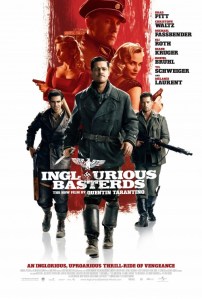 Quentin Tarantino has always been an artist that thumbs his nose at convention. Just as critics accused his last film, Death Proof, as wallowing in exploitation muck, here comes Inglourious Basterds, very loosely based on the correctly spelled 1978 Italian movie. War movies seem like a natural fit for the QT mold with their staunch violence, tough guy bravado, and vengeance-filled storylines. Tarantino has been working on the script for this film for over ten years, taking a break to produce the Kill Bill features. The finished product is a bloody alternative history wish-fulfillment fantasy with little conscience. This isn’t any sentimental, well-meaning, reflective war movie. This is war Tarantino-style and a celebration of war movies in general. Cinema becomes the weapon we win the war with.
In 1944, Lt. Aldo Raine (Brad Pitt) is given a unique mission. He is to assemble and lead a crew of Jewish-American soldiers for one purpose — to kill Nazis. They will be dropped into German-occupied France and will use guerilla tactics to dismember Nazis and strike fear into the higher ranks. Aldo personally assigns each soldier with the task of collecting 100 Nazi scalps. “And I want my scalps,” he commands. The “basterds,” as they’re called, face steep opposition. S.S. Colonel Hans Landa (Christoph Waltz) has earned the nickname “Jew hunter” for his terrifying precision at sniffing out Jews hiding along the French countryside. In the film?s terrific opening sequence, he systematically interrogates a French farmer into giving up the Jews he is hiding. Shoshanna (Melanie Laurent) is a Jewish teenager who manages to miraculously escape this bloodbath.
Years later, she owns and operates a movie theater in Paris. The German high command wants to screen their newest propaganda masterpiece, Nation’s Pride about the exploits of sniper Fredrick Zoller (Daniel Brühl), in Shoshanna’s theater. Finally she can plot her vengeance, except that Landa will be providing security for the special screening. Meanwhile, Aldo and the basterds scheme to meet up with German actress Bridget von Hammersmark (Diane Kruger), who is secretly working with the British as a spy for Operation Kino. The top-secret mission involves attending the movie premier at Shoshanna’s theater and then killing all the high-ranking brass in attendance, thus ending the war.
 Those looking for a rip-roaring good time of watching Pitt prance through the countryside dispatching evil Nazis will be disappointed to learn that Inglourious Basterds is, after all, a Tarantino movie. That means there is talking. Lots of talking, but it’s great, glourious talking with deep undercurrents of menace. The movie boils down to about six set pieces and most of that time involves long, drawn out conversations where the tension percolates underneath the surface. The characters play a cat-and-mouse game of deception, and the conversation transforms into a slow fuse waiting to go off. The characters engage in an “I know, and you know I know” bout of play acting, going about their business as if all is calm, when each is waiting for the next move. Tarantino turns dialogue scenes into slow-burning combat, and eventually those lit fuses do finally go off and the scene will erupt in a great splash of violence. Then we are left to assess the situation and collect our bearings, much like the characters if they are fortunate enough to be alive. This is a talky war movie, and Tarantino does fall in love with his dialogue rhythms and allow his characters to overindulge and circle the same plot points more than is needed, like the sequence with von Hammersmark in the bar, but the naysayers looking for an action romp that complain nothing goes on are missing the point. A tremendous amount is going on, you just have to look beneath the surface, lie in wait, and luxuriate in the simmering tension that Tarantino plays like a pro.
Tarantino has an encyclopedic knowledge of film that allows him to blend and deconstruct genres, and Inglourious Basterds feels like an homage not to World War II but war movies in general, with a dash of spaghetti westerns. When the French farmer watches Landa drive up to his home, linked with the great Enrico Morricone’s score, you definitely feel like you’re in a western transported into mid-twentieth century Europe. The conversations feel like high-noon showdowns. Tarantino’s direction feels less stylized and idiosyncratic this time. He still plays around with time and back-story, even recruiting Samuel L. Jackson to be a God-like narrator, but Ingloruious Basterds is mostly a literal and linear pop deconstruction of war movies. When Tarantino deviates sharply from the known historical timeline, it feels within reason given the cracked mirror world he?s created. Tarantino can turn World War II into a campy Warner Brothers cartoon, replete with goofy over-the-top caricatures of Hitler and Goebbles. He can also takes digressions and hard right turns with his story, allowing characters to chew over the finer intricacies of German silent cinema. It’s bloody, messy, but boy is it entertaining as hell.
 Any conversation over Inglourious Basterds is inevitably going to gravitate to its fascinating central villain, Hans Landa. German actor Waltz plays the infamous “Jew Hunter” and he is astounding to watch; he enlivens every moment onscreen and won a Best Actor award at the Cannes Film Festival. Landa is an extremely intelligent and polite inquisitor. He comes across almost like a diabolical S.S. version of Colombo: he’s three steps ahead, feigns ignorance, circles his prey, and finally strikes after mentally tearing down the suspect. Waltz is practically giddy in some sequences, enthusiastic for such sick endeavors. He likes to screw with people and make them nervous. And yet, thanks to the wily brilliance and magnetism of Waltz, you develop a perverse appreciation for the man. Despite the horrors he is responsible for, you may actually find yourself liking Landa. He has moments of great cunning, like his deliberate reasons for switching to English with the French farmer or his off-the-cuff destruction of von Hammersmark’s alibi. When he suddenly and fluently launches into his fourth language, it is one of the film’s finest “oh crap” moments. This is a truly memorable character that dominates every scene, and Waltz gives an astounding star-making performance destined to be remembered when it comes time to draw Oscar nominees.
The rest of the actors do well but no one approaches the planet that Waltz resides on. Pitt seems to knowingly be shooting for parody with his performance. His accent is twangy and coats every word in a honeyed glaze; you almost expect him to wink at the camera after each line. He’s still amusing to behold in the rather few instances that Aldo graces the movie. Laurent (The Beat That My Heart Skipped) and Kruger (National Treasure) both have intriguing albeit underwritten roles, and both actresses give the best performances in the film after Waltz. Eli Roth (writer/director of Cabin Fever, one of my favorite movie indulgences) looks the part as the commanding “Bear Jew” with his lean physique and Louisville slugger, but I couldn’t tell what he was doing with his accent. Is he supposed to be from New York or Boston? In war movies, there was usually a colorful collection of characters but Inglourious Basterds doesn’t really do much to accentuate its second tier players. The only basterd that leaves an impression is Til Schweiger (Driven, Far Cry), all humorless resolve and flinty stares. And what happened to the basterds in the final act? Where did everybody go? Yes, that really is Mike Myers doing one of his Austin Powers-esque British impressions.
 What is truly surprising is that Basterds unflinchingly looks at all the ugly aspects of war. The movie doesn’t neatly categorize the villains and the heroes. Zoller is a German sniper that killed 300 Allied troops and yet he is portrayed as grounded and romantic, a film lover able to chip away at Shoshanna?s steely reserve. To the basterds, they refuse to see past the uniform and armband; there is no difference between a Nazi and a German soldier. They will mutilate both on principal. Tarantino also gives time to examining the collateral damage of war, watching innocents gunned down in the name of duty. Shoshanna’s plot for vengeance involves the horrific deaths of scads of people whose only sin may have been being German in Paris. Operation Kino is described by Landa as a “terrorist plot” and isn’t it, really? But then Aldo disputes that a “Nazi ain’t got no humanity” and that collaborators and bystanders are just as culpable. Aldo and his basterds march through France committing what could sensibly be described as war crimes, and these are the good guys! Even with all the camp and stylized violence, there may be moments where you want to cringe and ask yourself, “Am I supposed to be enjoying this??
There are those that bemoan that Tarantino is wasting away his remarkable talents on such low-rent enterprises. He is too caught up in genre filmmaking, they claim. He needs to go back to his earlier audacious works, like Reservoir Dogs and Pulp Fiction, films of startling intelligence and playfulness. He needs to stop making collages of movies and go back to making real movies, they cry. Ingloruious Basterds will not please these critics. This is a verbose deconstruction of war movies that runs over 150 minutes and mostly involves characters seated and chatting. It will clearly not be for everyone, especially those sold into thinking Basterds was going to be a more graphic version of The Dirty Dozen. This movie is more Cinema Paradiso than The Dirty Dozen. If Tarantino wants to keep making high-gloss genre goofs, that’s fine with me as long as the end results are as creative and entertaining as this movie. Who else is going to make a World War II fantasy with excellent use of David Bowie’s song “Cat People”? No one makes movies like Tarantino. I rest my case.
Nate’s Grade: A


 nathanzoebl
You must be logged in to post a comment.