Blog Archives
Monster (2003) [Review Re-View]
 Originally released December 24, 2003:
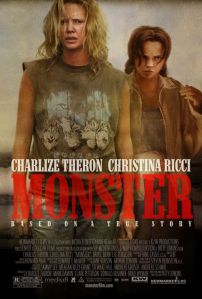
Monster follows the life of Aileen Wuornos (Charlize Theron, now nominated for a Best Actress Oscar), Americas only known female serial killer. In the late 1980s, Wueros was a roadside prostitute flexing her muscles with Florida motorists. She describes hookin’ as the only things shes ever been good at. One day Wuornos has the full intention of taking her own life, but she meets 18-year-old Selby (Christina Ricci) at a lesbian bar and finds a companion. Driven by a growing hatred of men from sexual abuse, Wuorno’s starts killing her johns to try and establish a comfortable life for her and Selby.
Let’s not mince words; Theron gives one of the best performances I have ever seen in my life. Yes, that’s right. One of. The. Best. Performances. Ever. This is no exaggeration. I’m not just throwing out niceties. Theron is completely unrecognizable under a mass of facial prosthetics, 30 extra pounds, fake teeth and a total lack of eyebrows. But this is more than a hollow ploy to attract serious attention to the acting of a pretty face. Theron does more than simple imitation; she fully inhabits the skin of Aileen Wuornos. The closest comparison I can think of is Val Kilmer playing Jim Morrison in The Doors.
Theron is commanding, brave, distressing, ferocious, terrifying, brutal, stirring, mesmerizing and always captivating. It may be a cliché, but you really cannot take your eyes off of her. Her performance is that amazing. To say that Theron in Monster is an acting revelation is perhaps the understatement of the year.
With previous acting roles in Reindeer Games and The Cider House Rules, Theron is usually delegated to pretty girlfriend roles (who occasionally shows her breasts). Who in the world thought she had this kind of acting capability? I certainly did not. If Nicole Kidman can win an Oscar for putting on a fake nose and a so-so performance, surely Theron should win an Oscar for her absolute transformation of character and giving the performance of a lifetime.
With this being said, and most likely over said, Monster is by no means a perfect film. Minus the terrific central performance, Monster is more of an everyday profile of a grotesque personality. The film weakly tries to portray Wuornos more as a victim, but by the end of the film, and six murdered men later, sympathy is eradicated as Wuornos transforms into the titular monster. Some supporting characters, like Ricci’s narrow-minded Christian up bringers, are flat characters bordering on parody. The supporting characters are generally underwritten, especially the male roles that serve as mere cameos in a film dominated by sapphic love.
Monster is proof positive that human beings will never be phased out by advancing machinery when it comes to acting. Monster boasts one of the greatest acting achievements in recent cinematic history, but it also coasts on sharp cinematography and a moody and ambient score by BT (Go). Monster is a haunting film that you won’t want to blink for fear of taking your eyes off of Theron. She gives an unforgettable tour de force performance that will become legendary.
Nate’s Grade: B
——————————————————
WRITER REFLECTIONS 20 YEARS LATER

Monster was a revelation for Charlize Theron, an actress who until then had mostly been known for parts that asked that she be good looking and little else. Twenty years later, Theron is one of the best actresses working in Hollywood and it almost never happened without her breakthrough performance where she brought to startling life the horror of Aileen Wuornos’s tragic life and tragic desperation. When this movie came out originally in 2003, I doubt anyone but Theron’s closest friends suspected she was capable of a performance this raw and spellbinding, but that’s also a condemnation on all of us. How many other actresses out there could maybe rival the best of the best if they just had the right opportunity? How many actresses are stuck playing the same limited roles because that’s all they’re ever asked to do? How many actresses are wrongly assumed to be of limited talent simply because of their comely appearance? That isn’t to say there’s some hidden universal equation that the uglier you are the better at acting you have to be (though it sure has worked out for [insert your example of a conventionally unattractive actor here]), but this movie is a clear indication that too many actors are never given enough opportunities to shine.
Back in early 2004, I credited Theron’s performance as one of the best I’ve ever witnessed in my then-twenty-one years of moviegoing (although that number should be smaller considering I wasn’t keenly watching Scorsese as a baby). She is very good, but I’d like to claw back some of my rapturous words of praise now that we’ve seen twenty years of Theron acting excellence. Looking over her career, I might actually cite 2011’s Young Adult as her finest performance, and that one didn’t even nab an Oscar nomination (she’s since been nominated twice since, for 2005’s North Country and 2019’s Bombshell). The draw of the movie is the head-turning performance from Theron and she just disappears completely inside the skin of her subject. It’s hard to remember at times that this is Theron, thanks to the richness of her startling performance but also the accomplished makeup effects, which were not nominated. At every point, you feel the fire burning behind the stricken complexion of Theron, a fire that will eventually consume her and everything she loves. While highly compelling, this is not a performance of subtlety and restraint. This is a big performance, and the movie is often prone to making loud pronouncements about its subjects and pertinent themes. It’s loud, brash, and maybe for some it will seem a little too loud, a little too unsubtle, but it’s a movie that refuses to be ignored for good reason.
 In my original review I raised some reservations with the rest of the movie, and I’m here to recant one of them. I wrote back in 2004, “The film weakly tries to portray Wuornos more as a victim, but by the end of the film, and six murdered men later, sympathy is eradicated as Wuornos transforms into the titular monster.” I’m positive that many will still cling to this same idea but oh boy have I come around in twenty years. By the time the movie is over, you wonder why more women haven’t just snapped and gone on killing sprees. Wuornos is indeed a victim. She’s responsible for terrible deeds but that doesn’t change the fact that she started as a victim and continued as one until put to death by the state of Florida in 2002. She was a sexual assault survivor, groomed into prostitution, and then trapped by a society that saw her as little other than trash, something to be pitied but ultimately forgotten. She comes of age as an adult thinking her only value is the fleeting moments of pleasure she can provide for men, and in the narration, we hear her dreams that one of these men who repeatedly tell her how pretty she is would take her away to another life, like a princess. Alas. It’s impossible to separate her past as a victim of predatory men from her actions when she turns on predatory men. Being forced into prostitution out of desperation is one of the definitions for sex slavery and trafficking. The movie does try to make her last few johns more ambiguous over whether or not they are “good people” and thus “deserving” of their fates, like a scale is being introduced and we’re doing the calculation whether Wuornos will strike (#NotAllMen, eh felas?). There’s a clear dark path where the murders get considerably worse. She begins by defending herself against a rapist, but by the end, it’s just a kind family man who picked her up without even the intention of having sex. We’re meant to see her transform into the titular monster, but I kept wondering about Aileen Wuornos as the societal stand-in, accounting for thousands of other women who lived and died under similar tragic circumstances.
I also found myself growing increasingly contemptuous of the love interest character played by Christina Ricci (Yellowjackets). When we’re introduced to Selby, she’s a wide-eyed naif testing her boundaries of comfort but clearly tapping into repressed homosexual feelings. Their relationship is meant to serve as the emotional rock for Wuornos, the reason that she’s acting more rash is because she’s trying to earn enough money for the two of them to run away together and build a new life. She is her motivation, but Selby is absolutely the worst. You can excuse some of her hemming and hawing about striking out on her own and leaving her controlling parents, as she’s fighting against repression as well as trepidation for starting out independently, but this lady becomes fully aware of the dangers and dehumanization that Aileen goes through to earn her meager amounts of money, and Selby encourages her to do so. Not just encourages her, Selby pressures her to do so, to get back out there and “provide” for her, knowing fully well what that means, knowing fully well how these men have treated Wournos, repeatedly abusing her. What are you doing to help things out, huh Selby? She’s embarrassed hanging around Wuornos around some other lesbian friends she just met, so she’s already looking to upgrade and move past her lover. By the end, as she’s trying to coax a confession of guilt from her girlfriend to save her own skin, Selby becomes just another user, taking what they want from Wuornos and discarding her when they’ve had their fill.
 This was the directorial debut for Patty Jenkins, who also served as the sole credited screenwriter, and while the indie darling-to-franchise blockbuster pipeline has been alive and well in Hollywood, it was quite a surprising leap that her next movie after Monster was none other than 2017’s Wonder Woman. To go from this small character-driven true crime indie to leading the big screen solo outing for comics’ most famous female hero is quite a bizarre but impressive jump. Her only other feature credit is the much less heralded 2020 Wonder Woman sequel. She was attached to direct a Star Wars movie about fighter pilots but that seems to have gone into turnaround or just canceled. So is the way with Star Wars movies after 2019’s Rise of Skywalker. Just ask the Game of Thrones creators, Josh Trank, and Taika Watiti how that goes.
Monster is a phenomenal performance with a pretty okay movie wrapped around it in support. Twenty years later, Theron is still a monster you can’t take your eyes away from. It changed her career destiny and I think acts as an exemplar for two reasons: leaving the viewer with the question how many other wonderfully talented performers will never get the chance to showcase their true talents because of faulty assumptions, and how many other women are out there living in quiet degradation like Aileen Wuornos.
Re-Veiw Grade: B
Share this:

The Matrix Resurrections (2021)
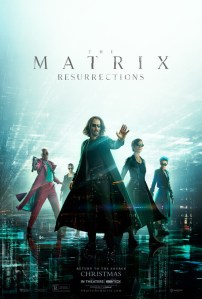 It is hard to overstate how influential The Matrix was upon its release in 1999. It rewrote the science fiction and action genres for Hollywood and introduced American audiences to many of the filmmaking techniques of Eastern cinema. It was exciting, philosophical, challenging, and made an instant brand out of the Wachowskis, the writing/directing siblings who had previously only directed one indie movie. The 2003 sequels were filmed back-to-back and released to great anticipatory fanfare and then, later, derision. The Matrix sequels, Reloaded and Revolutions, became a shorthand joke for bloated artistic miscalculation. They were talky, draggy, and just not what fans were hoping for jacking back into this strange world, and years later I think they’re worth a critical re-evaluation. Flash forward to 2021, and Lana Wachowski has resurrected The Matrix, and with the original actors for Neo and Trinity, both of whom died in Revolutions. Why go back? I think part of this was the declining career of the Wachowskis as directors. I personally loved 2012’s Cloud Atlas but it was an expensive and messy money-loser, the same as 2008’s Speed Racer and 2015’s Jupiter Ascending, a cosmically bad movie. So now it’s back to The Matrix with an older Neo, and older Trinity, and more of the same by design. The Matrix Resurrections just made me sad. It’s a movie that feels resentful for its own inception.
Thomas Anderson/Neo (Reeves) is living out his life as an award-winning game designer. His company and business partner, Smith (Jonathan Groff), are looking for their next big hit, and they’re looking backwards at Anderson’s biggest success… the “Matrix trilogy.” It was a virtual reality program that skewered the difference between reality and fiction. Mr. Anderson might have even based the role of Trinity on Tiffany (Carrie Anne-Moss), a woman he has grown infatuated with over time at a coffee shop. Except Mr. Anderson is having trouble determining what is real and what is only in his head. That’s because a new, younger Morpheus (Yahya Abdul-Mateen II) is telling him that he’s Neo, that he’s destined for greater things, and that he’s been kept in an unorthodox prison to keep him out of the action. Everyone seems interested in reactivating Neo, but for what purpose, and what has happened in the ensuing decades since the end of the war with the machines?
 Part of my struggle with Resurrections is that it too is struggling with its own existence, and not in a meta-textual sort of identity crisis, more like a reason to carry on 18 years later. Fair warning, this movie is far, far more meta than you are anticipating. The entire first hour of the movie features characters justifying rebooting “The Matrix,” the game. It’s a movie where characters glibly talk about parent companies going forward with the IP with or without the involvement of the original creators, so better to be the one trying to staunch the bleeding I suppose. A character literally says Warner Brothers wants a new Matrix and they will not stop until they get one. There are characters that sit around a table and try and break down what made the original Matrix (the game) so cutting-edge, and every person has a different brand slogan. “It was edgy.” “It blew your mind.” “It was a thinking man’s action story.” This prolonged section of Resurrections feels entirely like Wachowski speaking directly to her audience and saying, “Look, I had no reason to be back here. They forced my hand, and I want you to know that I’m not happy about it.” There are literal moments from the 1999 film that are presented as if the characters in the matrix are watching The Matrix to recreate scenes like avid cosplayers. There is one part where a character just starts screaming the word “reboot” with profane intention, promising to get their own spinoff as a threat. The entertainment industry satire about reboots and cash-grab sequels is funny but misplaced and coming from a perspective of defiance. If this was all the movie was then it would have been a fascinating example of an artist burning the bridge to their most successful franchise out of willful spite. However, if we had our own little focus group and asked what made the original Matrix so enjoyable, I doubt anyone would list, “entertainment industry satire and meta humor.”
The Matrix movies are well known for being a smarter, more ambitious viewing experience (“A thinking man’s action story”), blending philosophy and mysticism into anime-style action and kung-fu fights. There’s an intentional repetition here, built upon delivering something familiar and safe to audiences but with a “next gen” feel. We have a new Morpheus and a new Mr. Smith here, but did we require either? When they go through the motions of patterning themselves on characters of old, it feels strained, it feels gassed, and it’s another instance where Wachowski telegraphing to her audience, “Look, the studio demanded I bring back these characters, but I’ll be damned if I know what to do with them.” Morpheus has a little more story leverage as a catalyst for bringing Neo back to his path of enlightenment. Truth be told, I don’t really know half of what was happening in this movie, which lacked the elegant connectivity of the best action movies, linking cause and effect (the Merovingian would be proud of me) and pushing the movie forward to its inevitable conclusion. Even the prior movies felt more like the creators knew what was going on, even if the audience was lagging behind. With Resurrections, it feels like Wachowski and her screenwriters, novelist Dave Mitchell (Cloud Atlas) and Aleksandar Hermon (Sense 8 finale), have just given up trying to make sense of it all.
 Another disappointment is the lack of any signature or memorable action sequences or, in the words of the Matrix round table, moments that “blew your mind.” The use of phones as transport in and out of the matrix has been replaced with mirror portals and doorways, which initially got my hopes up. There are such playful visual possibilities incorporating portals into action (see: Doctor Strange, even Matrix Reloaded), and I felt that Wachowski was up to the imaginative challenge. It too feels like another element that barely registers. The movie takes the anyone-can-become-an-Agent threat of the original trilogy and says, “What if instead of facing deadly Agents, it was just dumb zombies?” The new machines decide to rely upon a hive-mind system of grabbing whatever humans are in the vicinity and taking control of them into mindless foot soldiers. Let’s explore what a downgrade this is. The Agents were dangerous because they had powers that ordinary humans could not hope for, like the bullet dodging. In this movie, ordinary people are easily foiled and often a pathetic excuse for super-powered adversaries. The final act involves an escalation in numbers of the hive mind, but we’ve already been here with the multiple Agents Smiths of the sequels. There is one disturbing change-up where the machines realize how humans can just serve as canon fodder that is dark but a more effective attack. Even the requisite martial arts battles and gravity-defying wire work are humdrum this round.
If there is one thing that Resurrections does well it’s staking its identity out as a romance. Much of the second half prioritizes the relationship between Neo and Trinity, which was always taken for granted in the sequels. It was a romance of more utilitarian purpose, providing Neo with a love interest to motivate him to be saved in times of great peril. With Resurrections, the movie actually takes time to devote to Neo and Trinity as people with desires and what they would find appealing about the other. He’s not the savior of mankind, and she’s not his gateway to knowledge and empowerment. They’re portrayed as people, somewhat unhappy in their lives, and just hoping they might have another chance meeting at their shared coffee shop for one more electrifying conversation. The evolution of the movie places even more importance on this human connection, so I’m glad time has finally been given to exploring what it is that connects Trinity and Neo, especially if their love story is going to play as prominent a resolution to Resurrections. If you have never cared about Trinity and Neo as a couple, then you’ll likely be in for a disappointing second half.
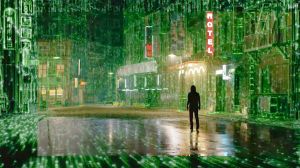 From a technical standpoint, Resurrections is still a feast for the senses. The photography is moody and atmospheric. The musical score is pumping. The special effects are state-of-the-art. There are a lot of talented people working on this sequel. So why then does the movie feel so perfunctory? In some regard each Matrix sequel has felt this way, adding extraneous pieces onto an already perfect standalone film. Having re-watched both Reloaded and Revolutions again, I can affirmatively declare Resurrections to be the weakest Matrix entry yet. We were all a bit too harsh on the prior two Matrix movies, which fall short of capturing the original’s magic alchemy but bring the goods when it comes to memorable set pieces, eye-popping visuals, and narrative zigs instead of zags (It was undercutting audience expectations before it was cool). They are still a bit too stuffy and talk in circles, but there are definite Major Ideas percolating underneath. In contrast, Resurrections feels more powered by resentment, by Wachowski coming back to this world against her better wishes and judgements. Maybe we should have left things alone.
Nate’s Grade: C
Share this:

Speed Racer (2008)
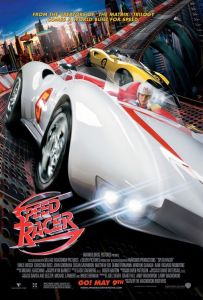 I was wary of this film from the first frame. I think the original Speed Racer cartoon is dopey and insipid. I didn’t really want to pay to have my retinas destroyed by the candy-coated color scheme of the big-budget movie. But I must say, I didn’t hate this movie and that’s a major accomplishment. That’s not to say Speed Racer is a good movie; its script is cheesy, the dialogue is silly, the comedy is dead on arrival, and many of the races end up becoming incoherent flashes of color and noise. But God help me, the Wachowskis have produced a unique movie experience that will likely induce epileptic seizures. Speed Racer has way too much plot going on for a cartoon about a kid who races a fast car. The movie reminds me in a lot of ways of the Wacky Races cartoon where the various teams have theme-driven cars. This provides for plenty of outlandish action sequences that manage to tickle the senses, that is, when the images are somewhat stable. The movie aspires to be a “family film” and with that comes the half-hearted moral message (corporations are evil) and a reminder that family is important. Did I mention there’s also a monkey that gets treated like a member of the family? The movie sometimes feels like the cinematic equivalent of an ice cream headache, but you’re unlikely to see anything like it again in the near future. That may be both a good and a bad thing.
Nate’s Grade: C+
Share this:

Monster (2003)
Monster follows the life of Aileen Wuornos (Charlize Theron, now nominated for a Best Actress Oscar), Americas only known female serial killer. In the late 1980s, Wueros was a roadside prostitute flexing her muscles with Florida motorists. She describes hookin’ as the only things shes ever been good at. One day Wuornos has the full intention of taking her own life, but she meets 18-year-old Selby (Christina Ricci) at a lesbian bar and finds a companion. Driven by a growing hatred of men from sexual abuse, Wuorno’s starts killing her johns to try and establish a comfortable life for her and Selby.
Let’s not mince words; Theron gives one of the best performances I have ever seen in my life. Yes, that’s right. One of. The. Best. Performances. Ever. This is no exaggeration. I’m not just throwing out niceties. Theron is completely unrecognizable under a mass of facial prosthetics, 30 extra pounds, fake teeth and a total lack of eyebrows. But this is more than a hollow ploy to attract serious attention to the acting of a pretty face. Theron does more than simple imitation; she fully inhabits the skin of Aileen Wuornos. The closest comparison I can think of is Val Kilmer playing Jim Morrison in The Doors.
Theron is commanding, brave, distressing, ferocious, terrifying, brutal, stirring, mesmerizing and always captivating. It may be a cliché, but you really cannot take your eyes off of her. Her performance is that amazing. To say that Theron in Monster is an acting revelation is perhaps the understatement of the year.
With previous acting roles in Reindeer Games and The Cider House Rules, Theron is usually delegated to pretty girlfriend roles (who occasionally shows her breasts). Who in the world thought she had this kind of acting capability? I certainly did not. If Nicole Kidman can win an Oscar for putting on a fake nose and a so-so performance, surely Theron should win an Oscar for her absolute transformation of character and giving the performance of a lifetime.
With this being said, and most likely over said, Monster is by no means a perfect film. Minus the terrific central performance, Monster is more of an everyday profile of a grotesque personality. The film weakly tries to portray Wuornos more as a victim, but by the end of the film, and six murdered men later, sympathy is eradicated as Wuornos transforms into the titular monster. Some supporting characters, like Ricci’s narrow-minded Christian up bringers, are flat characters bordering on parody. The supporting characters are generally underwritten, especially the male roles that serve as mere cameos in a film dominated by Sapphic love.
Monster is proof positive that human beings will never be phased out by advancing machinery when it comes to acting. Monster boasts one of the greatest acting achievements in recent cinematic history, but it also coasts on sharp cinematography and a moody and ambient score by BT (Go). Monster is a haunting film that you wont want to blink for fear of taking your eyes off of Theron. She gives an unforgettable tour de force performance that will become legendary.
Nate’s Grade: B
Share this:

Bless the Child (2000)
 How bad is Bless the Child? How bad does bad get? Kim Basinger somehow forgets she actually won an Oscar for something good and takes up the mantle as a nurse or nun or whatever caring for a “special” child. But aren’t they all special in their own way? The child is deemed “the one” and kidnapped by a religious cult led by better-actor-than-this Rufus Sewell. Jimmy Smits comes in somehow as an FBI agent specialized in the field of Satanism. I guess Mulder and Scully couldn’t make the ride. There’s a point in the film where Smits reveals that he entered the bureau so he could have an easier time stopping Satan and his minions. I dare you not to crack a smile from any of this. Is this the movies Jimmy Smits left NYPD Blue over?
The special effects are lame, the story is knee-high in contrivances and loop holes, and the acting is laughable. Christina Ricci has a small part as a reformed cultist that shouldn’t even register if you pay attention – which requires more skill than you would believe. The dialogue in Bless the Child is laughably bad along the lines of Battlefield Earth smack yourself in the head. It’s not as mind-numbingly horrible to sit through, but it’s pure cheese no matter what sheep’s skin it hides under.
Nate’s Grade: D
Share this:

Sleepy Hollow (1999)
 Tim Burton’s latest is a ravishing world of intrigue and brooding awe. The action is note-for-note in Washington Irving’s classic revamped into a Burton Murder She Wrote episode. Sleepy Hollow has plenty of mystery to its credit as well as suspense and fantastic staging. The sets and mood will draw the viewer into a luscious world of cinematic delight. Beautiful to watch, and Burton scores again, though it lacks the depth his other movies had. And what the hell is with Walken’s teeth?
Nate’s Grade: B


 nathanzoebl
You must be logged in to post a comment.