Blog Archives
Moneyball (2011)
 Moneyball, based on the non-fiction book by journalist Michael Lewis (The Blind Side), finds a new way to reinvent the David v. Goliath tale with a man who reinvented the business model of baseball.
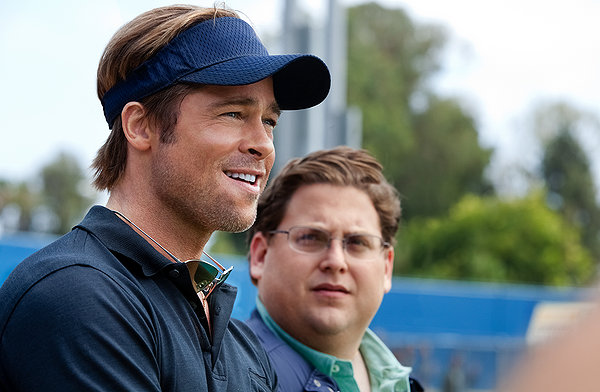
In 2001, the New York Yankees (team payroll: $125 million) have just knocked the Oakland As (team payroll: $41 million) out of the playoffs. Oakland General Manager Billy Beane (Brad Pitt) also has to suffer a summer where his biggest players leave the team to sign hefty free-agent contracts with bigger teams. He’s left with sizeable holes, a meager payroll, and the expectations to carry on winning. Beane is convinced that his group of paid scouts will be of no help. They’re men of an older era, sticking to the old ways of selecting talent (why the hell do these guys even calculate stuff like “good face” and “ugly girlfriend”?). Beane finds a kindred spirit in Peter Brand (Jonah Hill), a Yale grad with a degree in Economics. Brand’s mathematical data focuses on one all-important stat – on-base percentage. Without getting on base a player can’t score runs, and no runs make it hard to win a game. Brand and Beane calculate a series of players undervalued by other teams. Their more cost-efficient model for success becomes known as “moneyball.” Together they put together a team of castoffs and misfits to contend for a championship against teams that have three times the Oakland As’ payroll.
Moneyball could be described as a baseball movie for people who don’t like baseball, but that’s a little too glib by half. It’s very much a sports film but it takes the underdog approach in a new, sleekly modernized manner. It’s about a guy bucking the traditional mode of thinking, the established order, and the chaffing and nay saying of those entrenched in the traditional, outmoded, establishment. There’s always something inherently entertaining about an innovator fighting the system and eventually being proven right after all the trials and tribulations. And with Pitt, a major movie star, giving a movie star-caliber performance, self-effacingly charming with a twinkle and a swagger, Moneyball just seems to fly by like a spirited caper. We’re watching a smooth operator work the room, playing other general managers off one another and secretly accruing his talent while duping his peers. At its best moments, Moneyball feels almost like a breathless con game. The intelligent, stats-heavy dialogue doesn’t stoop for much exposition. The stats and acronyms whiz by, with Social Network-style crispness thanks to Oscar-winning screenwriters Steven Zallian and Aaron Sorkin. It’s a pleasure listening to top actors savoring the smart dialogue. You just want to kick up your heels and relax like you’re watching a game at home, rooting for your team to pull out an unlikely coup. Moneyball plays best for baseball fans who won’t bat an eye at the stat-heavy chat. For non-fans of the game, well, you can watch Pitt spit chewing tobacco into a cup a lot.
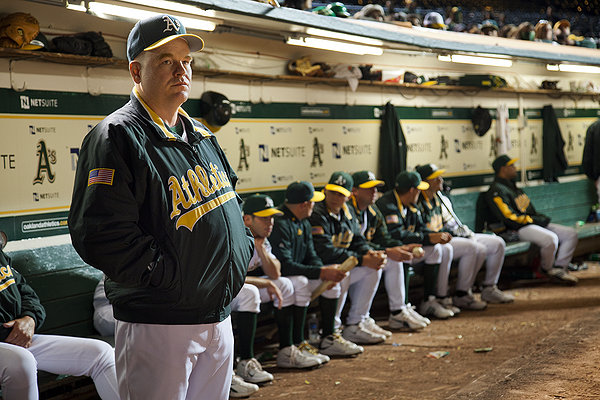
 Beane chooses not to get to close to his players so that eventual roster cuts and trades will be all the easier without emotional involvement. The movie kind of follows suit. The characters are kept at a surprising distance. The movie seems practically ambivalent about people. Moneyball seems to lack an emotional center; and people thought The Social Network was cold. Beane is given flashes of back-story about his flameout in the majors, which supposedly provides the guy a motivation to prove himself against his legion of detractors. But these flashes are not enough. Director Bennet Miller (his first film since 2005’s Capote) incorporates way too many scenes where we watch Beane driving, silently contemplating his life-changes. The feud between Beane and his curmudgeon manager, Art Howe (Phillip Seymour Hoffman with the unkindest of haircuts), never comes to a head. Howe is upset at the thankless job of corralling a team of misfits and cast-offs into a competitive team. But like many other conflicts, the movie ducks from finding a real purpose for its integration. Howe just seems to be another naysayer who shakes his head at Billy. Surely the relationship between GM and manager should be more complicated than as presented. The Beane family flashbacks and his scenes with his daughter (the adorable Kerris Dorsey) are attempts to further humanize a man who has abandoned the advice of people for spreadsheets.
It’s easy to get caught up in the romanticism of the nation’s oldest sporting games, but Moneyball’s tone seems to toggle between reality and romanticism. For Beane, there are no small victories. Even success is deemed failure under the metrics of championship-or-nothing. “People only remember your last out,” he says despondently. So when the Oakland As fail to make a run into the playoffs (is a 2002 playoff series considered a spoiler?) the movie is left with a listless conclusion. Brand tries to prove to his boss the significance of what they have accomplished on their meager payroll, at one point winning a record 20 games in a row. But a winning streak of 20 games is not the same as a championship. Moneyball rightly proclaims the game of baseball as a rigged sport, where the divide between “haves” and “have nots” is vast. It is the only major league sport without a salary cap. The teams with the big pockets can afford the marquee talent. There’s a reason Lewis’ book has the subtitle “The Art of Winning and Unfair Game.” The implications of Beane’s accomplishments are unclear. His cost-efficient, stat-heavy approach was co-opted by the Boston Red Sox and turned into championships in 2004 and 2007. Is that a real vindication for Beane? It seems to me that the game’s issue of wealth disparity is still in full effect. Even if teams follow Bean’s approach, it still means that the bigger city, wealthier teams like the Red Sox or the Yankees can still outspend their competition. So it seems like to me that Bean’s moneyball approach simply meant that the focus changed on less costly talent. It did nothing to alter who could outbid their peers for the now-cheaper talent. It’s hard to squeeze a happy ending out of a story that concludes with the rich getting richer.
 The movie is pretty much a buddy comedy, granted Beane is a much more dominate personality. Pitt feels like he’s coasting on charisma, though the actor gives a greatly entertaining performance. It’s not so much nuanced but he’s enjoying himself. The man looks eerily to be aging into Robert Redford, which begs the question about the nature of time travel. Hill (Superbad, Get Him to the Greek) gives a surprisingly adept dramatic performance. The comedic actor seems subdued next to the charisma of Pitt, like the character is continually awed by Billy. The Oscar-talk for the comedian seems a tad premature. He’s good but just because Hill delivers a good dramatic performance does not mean people should automatically start fielding his name as an award contender. That’s like saying let’s give an award to Paris Hilton because she could remember her lines. It’s also fun watching actors like Chris Pratt (TV’s Parks and Recreation) portray players that are still recognizable.
Moneyball says that baseball is not a game about heart, sweat, or the love of the game. It’s about numbers. That’s something of a cold message but Billy Beane is not one for false comforts. At its best, the film is a breezy caper with crisp dialogue and slick editing, but it’s also hamstrung by an inconsistent tone, a methodical pacing (133 minutes!), and a dearth of strong characterization. Beane was destined to be a baseball star but it wasn’t to be. Baseball is the most mental of all national sports, and it’s hard to crack such an insular model of play. That’s why baseball movies resort so much to romantic staples about the lore of this game. This is not a romantic movie; it toys with romanticism but ultimately sides with the science and number crunching. The emotion seems to have been squeezed out of the story thanks to the statistics. Moneyball is a baseball movie that fantasy baseball nerds have been waiting for. I’m not particularly a baseball fan (too slow), but I still found the movie to be a rewarding night out sans crackerjacks.
Nate’s Grade: B+
Share this:

Bride Wars (2009)
 In early 2007, it seemed like Eddie Murphy was destined to win a Best Supporting Actor Oscar for Dreamgirls. The funnyman was racking up honors for his fiery portrayal of a fallen Motown singer. Then came ads for the atrocious Norbit where Murphy played three roles, including a grotesquely overweight woman and a racist portrayal of an old Asian man. Was it much of a surprise then when Murphy lost out to Alan Arkin (Little Miss Sunshine) whose character died halfway into the film? I suppose Academy voters took long looks at those appalling Norbit ads and said, “Academy Award-winning star of Norbit? I don’t think so.” Earlier in 2008, Anne Hathaway starred in Rachel Getting Married and became a surefire Oscar contender with her bitterly funny portrayal of an ex-druggie released for her big sis’ wedding. Hopefully the Academy will ignore the awful comedy Bride Wars or Hathaway will be doomed to follow Murphy’s lead (personally I think this is Kate Winslet’s year).
Liv (Kate Hudson) and Emma (Hathaway) have been dreaming of getting married since they were little girls. Both girls were at New York City’s Plaza Hotel and witnessed a wedding reception. They both swore that day to get hitched at the luxurious hotel. The girls grow up and Liv works as a hotshot attorney and Emma is a schoolteacher. Both get proposed at the same time and the high-pitched squealing ensues. Emma wants Liv to be her maid of honor and vice versa. The ladies seek the services of Marion St. Claire (Candice Bergen), the greatest wedding planner in the city. She delights the duo by booking them for two June wedding dates at the illustrious Plaza Hotel. Then comes the bad news. The booking dates got mixed up and the weddings are booked on the same day. The next open date at the Plaza is in three years time. Both women refuse to budge. Then a bridal arms race begins. Each would-be bride tries to sabotage the other’s wedding preparations.
 Bride Wars is indulgent and tiring and occasionally obnoxious, much like the main characters. These characters are one-note and the movie drills that one note repeatedly; Liv is domineering and Emma is a pushover. I don’t care about these characters, and when the movie ramps up the sentiment in the final 20 minutes it doesn’t work because I feel no emotional attachment, and waning interest, in these people. Hudson’s Liv serves as the real antagonist for like half the movie’s running time. She comes across as brash, pushy, unlikable, narcissistic, and overbearing, and her unflagging desire to win is what pushes the conflict. Emma and Liv view their husbands-to-be more as accessories to their collective Big Days, and the movie seems to treat them the same way. The three bland male leads (Bryan Greenberg, Chris Pratt, Steve Howey) even look vaguely the same, and Bride Wars just allows them to slowly fade away. Like the Sex and the City movie, the women come across as deeply shallow and petty, people more worried about ceremony than every day after that fairy tale wedding. The film’s comedic focus is on uninspired slapstick and the pranks that the ladies play. Bride Wars practically excuses the bridezilla bedlam because it eventually makes Emma a stronger person who can stand up for her self after long last.
The initial conflict seems trite and readily negotiable. So the girls have their weddings scheduled on the same day, and they can’t work this out? Why such drama if they’re both lifelong best friends? They couldn’t just have a double wedding? Here’s what I don’t understand. Marion tells our ladies that the Plaza has three June openings, two on the 6th and one at the end of the month. Liv gets one date and Emma gets the other date, and then a third woman (co-writer and Saturday Night Live actress Casey Wilson) grabs the final June 6th slot. So when Marion announces that her assistant switched the dates, why wouldn’t the third woman want to swap back? She’s been planning for her wedding to be on June 6, so why wouldn’t she want to keep the date she already agreed upon? Likely this woman has begun to plan around the specific date and it would make much more sense to maintain continuity. And it is this contrived conflict that sets Bride Wars loose.
The script is lazy and the PG-rating all but neuters the bitch fest. This setup was begging for the claws to be unleashed but the filmmakers play it safe. It can’t get too messy because everything must be made nice and tidy by the conclusion. The acts of sabotage never get too out of hand. This is less a war and more of a scuffle. Bride Wars trades in nothing but stereotypes and stock characters (including the late addition of Liv’s brother who obviously has a decade-long crush on Emma), and I expect that from chick flick fluff, but the movie just misses so many obvious comedic opportunities. The girls have a group of friends that offer no commentary on the situation. One of their friends is unhappily newly married and could offer plenty of sarcastic quips. Liv has her hair dyed blue at a salon and nobody in the movie makes a single joke about the wedding staple of wearing something blue? How is this even possible for a movie about weddings? That’s just a glaring oversight.
 Hudson and Hathaway are far better than this material, though Hudson is credited as a producer. Perhaps she can explain why she chose a haircut that makes her head look humongous. Seriously, her head looks gigantic, especially when she stands beside the coltish Hathaway who has quite a cylindrical noggin. Hathaway comes across the better of the two. Hudson has proven adept at goofy comedy but she just comes across as a bully. Kristen Johnston (TV’s Third Rock from the Sun) looks alarmingly thin. Somebody should check up on her.
To dismiss Bride Wars as a chick flick is to miss the point. Women deserve better than this mediocre comedy that showcases women as harpies worshiping marital materialism. The characters are annoying and vapid, the conflict is boneheaded and contrived, the comedy is watered down, and the lead actresses are wasted. Because something is a chick flick does not excuse it for being poorly manufactured. Bride Wars does not reflect well upon anyone involved, from the actors, to the director, to the writers, to the people that got people coffee. The movie isn’t monstrously bad but it is a banal piece of entertainment. Women, men, and all people deserve better no matter the genre classification.
Nate’s Grade: C
Share this:

Wanted (2008)
 Wanted isn’t so much a movie as a fetish vehicle for teen males, with sexy cars, sexy guns, and sexy tatted-up Angelina Jolie, daring the predominantly male audience to decide which is sexiest (I am not a car aficionado nor a gun person, so I’ll say that Jolie easily outpaced her competition).
Wesley (James McAvoy) is a pathetic office drone that sweats out his days never raising his voice. His best friend is constantly screwing Wesley’s bitchy girlfriend, his boss constantly harangues him into panic attacks, and, saddest of all, a Google search results in nothing for Wesley Gibson’s name. He tells us he has done nothing with his life. This all changes when a mysterious woman named Fox (Jolie) tells Wesley that the father he never knew has just died. Not only that, Wesley’s father was one of the world’s greatest assassins and he might just be a chip off the old block. Wesley is recruited into The Fraternity, a thousand year-old organization whose membership includes the best-trained killers. Sloan (Morgan Freeman) is the leader who assigns the targets. He gets his orders, literally, from the Loom of Fate, a weaving loom that writes binary letters via stitches. The Loom of Fate decides whom the planet would be better off without. Fox and her cohorts train Wesley to accept his destiny and avenge his father’s murder.
 The movie fails to establish any form of internal logic or continuity, so anything preposterous suddenly becomes accessible. That means people can jump from one skyscraper to another, you can outrun a moving train, cars will do the damndest things, and that you can curve a bullet simply by rotating your hand and shutting off that little part of your brain that says, “This is defying all laws of physics.” For some reason, people are able to shoot bullets down in mid-air as a defensive maneuver but they rarely take aim at the person, surely a bigger and slower target. It’s like The Matrix outside of the Matrix with no reason for being Matrix-y. The idea is that these super assassins have super hearts that beat like 400 times faster, which pumps more blood and allows their senses to heighten. This somehow allows them to slow down time, zoom in on subjects, and react extra fast. It doesn’t make any sense but then again this is a movie where the killers are taking orders from the Loom of Fate. While I’m on the topic, really, a loom that stitches targets in binary code? Isn’t there an easier way for fate to decree who should be bumped off than someone scrutinizing the stitch work of a rug? What happens when it lists a name with more than one owner? How many “John Smiths” must be killed to secure that the correct Mr. Smith has been erased? My father thought the Loom of Fate was the most bizarre and interesting aspect of the movie.
Despite the freewheeling action, there is something decidedly depraved about fully embracing Wanted. The premise of awesome killers demands awesome carnage, and Wanted dishes out violence as an act to be savored and glorified. Wesley’s self-actualization is linked with getting better at making others suffer, and in the end the film advances a questionable message to follow suit. The movie exists in a hyper-realistic video game universe devoid of consequences. I can see future news reports of idiot teenagers playing their own deadly game of curving bullets (they may have to establish a Wanted category for the Darwin Awards). But yet the most disconcerting feature of Wanted is its dismissive nature toward human life. I’m not even talking about the assassin premise, though trained killer flicks usually work better when the pros have some sort of personal code. Wanted is a fetishistic worship of human bodies being taken apart in loving, gory detail under the auspices of being “cool.” Innocent life barely merits a half-hearted shrug. When Wesley and Fox bring their fight on board a train the eventually force the vehicle off a cliff, and the movie makes no mention of all those innocent people plummeting to their doom. That would get in the way of the film being “cool.”
With all that said, Wanted can feel like a high-octane rush to the senses. This film is soaked in adrenaline. The stunt work is astounding and the action is ramped-up to ridiculous levels. I say ridiculous because the film never establishes any form of internal logic or continuity, but I also say ridiculous because the action can be tremendously exciting and embellished with stylistic flourishes. Wanted is a slick and imaginative action movie, and the fact that it often dances with satisfaction makes me sick for enjoying it so. Summer is the perfect opportunity for empty calorie movies with style to spare, and Wanted is a five-course meal of glossy, disposable artifice. Director Timur Bekmambetov previously directed the Russian vampire films Night Watch and Day Watch, but Wanted is a giant leap forward in budget and sheer scope. Life inside this man’s head must be crazy. He takes the outlandish and makes it seem common.
 The story is rather derivative and smashes the plots of Fight Club and The Matrix together, proving that not only were screenwriters Michael Brandt and Derek Haas alive in 1999 but they were also furiously taking notes. The whole notion has been done to death, a loser who secretly harbors superior talent and ability waiting to be realized. It still proves to be a popular and mostly pleasing storyline because it taps into a universal desire to be special. Brandt and Haas aren’t so much constructing a story as they are constructing a series of eye-popping moments. There is very little substance beneath all the fireworks (stand up for yourself and slay your antagonists?). Normally I’d take issue with a film’s trashy vapidity; however, when that film happens to be so good at being so good looking.
McAvoy is rather believable when he plays the dweeb eking out a miserable existence. He knows how to play meek and anxiety-riddled while maintaining a vulnerability that stops his character from coming across as a figure of annoying inaction. He sure gets beaten up a lot and I’m not quite sure why this is supposed to make him more inclined to join The Fraternity, but then again it hasn’t stopped thousands of college males from wanting to join their own fraternities. McAvoy is less believable when he suddenly transforms into a super soldier, like a pint-sized Rambo. Jolie relies on her exceptional sex appeal in lieu of acting, which is fine with me. It’s good to see her in a role where she can fully make use of her physical talents. Freeman is essentially in the Samuel L. Jackson role and even gets a chance to drop an MF-bomb.
Wanted is a crazy cool and mostly crazy action thriller that is more than a little sick in the head. Its video game universe covets beautiful bloodshed and exquisite carnage. It’s rather depraved and morally questionable not in approach but in execution (no pun intended, well maybe). Wanted is a gory, profane, darkly humorous action movie that secretes adrenaline with every frame. The imagination on display is impressive but you may wish that it had been used for better purposes.
Nate’s Grade: B


 nathanzoebl
You must be logged in to post a comment.