Blog Archives
Hamnet (2025)
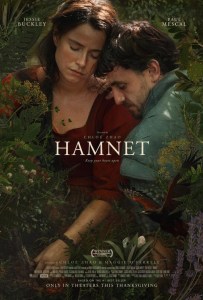 It’s the sad Shakespeare movie, and with Paul Mescal (Gladiator II) as Will, it could just as easily be dubbed the Sad Sexy Shakespeare movie. Hamnet is a fictionalized account of Will and his wife Agnes (Jessie Buckley) processing the death of their young son, Hamnet, which we’re told in opening text is a common name transference for Hamlet. Right away, even before co-writer/director Chloe Zhao (Nomadland, Eternals) brings her usual stately somberness, you know what kind of movie you’re in for. It’s pretty (and famous) people in pain. The entire time I was watching this kid Hamnet and just waiting for the worst. It doesn’t arrive until 75 minutes into the movie, and it’s thoroughly devastating, especially the circumstances surrounding the loss. This is less a Shakespeare movie and more a Mrs. Shakespeare movie, which is more illuminating since she’s typically overshadowed by her verbose husband. She’s an intriguing figure who shares some witchy aspects, communing with nature and even foretelling her future husband’s greatness and dying with only two living children, which presents a pall when she has three eventual children. Once Will finds success as a London playwright, he feels like an absentee father and husband, briefly coming in and out of his family’s life in Stratford. However, the final act is what really doesn’t seal the movie for me. I don’t think it’s really a spoiler to admit the final 15 minutes of the movie is basically watching Hamlet performed on stage, with Agnes as the worst audience member, frequently talking through the show and loudly harassing the actors before finally succumbing to the artistry of the play and finding it a fitting outlet for her grief. In short, the movie is meant to provide more personal insight and tragedy into this famous play, asking the viewer to intuit more meaning (“Oh, Hamlet is his dead son, Hamnet! I get it”), but ultimately the ending is just watching Hamlet. I don’t feel like we get any meaningful insight into William Shakespeare as a person besides his irritation at being a Latin teacher, and frustratingly, Agnes is constrained as well, held in a narrow definition of the grieving mother. This is a shame since she showed such fire and individuality in the first half. Buckley (The Lost Daughter) is terrific, ethereal, earthy, and heartbreaking and a shoo-in for an Oscar. I found her final moments, especially reaching out to her son, so to speak, especially poignant. Hamnet is a good-looking, well-acted movie about sad famous people who then rely upon the arts to help heal their gulf of sadness. There’s not much more to Hamnet than that, but with such exceptional professionals and artists at the ready, it might be more than enough for most.
Nate’s Grade: B-
Share this:

Eternals (2021)

Chloe Zhao is the biggest name Marvel has gotten yet for its cinematic universe (MCU). Sure, they’ve had major directing names before like Kenneth Branagh and Ryan Coogler, and successful populist genre filmmakers like Jon Favreau and Joe Johnston and Joss Whedon and Shane Black, and quirky auteurs like James Gunn and Taika Watiti. However, Zhao is the first Academy Award-winning director to jump into the Marvel sandbox. Zhao seems like an odd fit for something as mainstream and successful as the MCU, but she was excited to tell a big story with the biggest studio operating in Hollywood. Eternals (no “The”) is just as much about the question over what it means to be human as Zhao’s Best Picture-winning Nomadland, and it’s a lot easier to watch with one hundred percent less Frances McDormand pooping in a bucket in her van (granted, she did win an Oscar for that performance). Eternals has received the lowest critical rating of any MCU film in its thirteen-year history and I’m trying to figure out why.
Thousands of years ago, the Eternals were created by the Celestials, powerful beings that are responsible for birthing new galaxies into the universe. The Eternals were sent to protect the inhabitants of Earth from the Deviants, terrifying tendril-heavy monsters that will consume and overrun a world. The Eternals are instructed by their masters not to intervene in human conflicts; only to intervene to save them from Deviants. Now that the last Deviant has been dead for over 500 years, the Eternals have settled into comfortable lives among present-day humans. Then the Deviants return, evolving with added powers and posing a new threat to humanity and the Eternals, but the real threat might be outside the confines of Earth.

Eternals feels like a different kind of Marvel movie in that stretches feel like it’s a Stanley Kubrick movie, or a Terrence Malick movie, or a DC movie. The plot structure and tone even reminded me of Watchmen. Don’t get me wrong, the standard Marvel elements are recognizable, but this is a much slower, more methodical, more cerebral, and more challenging movie that really feels like a distillation of Zhao’s humanist indie naturalism and the crazy cosmos from Jack Kirby’s trippy source material. I can understand why some people would find this movie to be boring and poorly paced. There are extensive flashbacks and setup. It definitely doesn’t need to be a staggering 157 minutes long, second only to the three-plus hours of Endgame. Granted the movie is introducing a dozen characters, their relationships, their powers, their histories, as well as a new history for the universe that doesn’t relate to anything that came before it. There are assorted references to Thanos and the events of Endgame, bringing half the population back, but this is more a standalone movie that can serve as an introduction for those less well-versed in two dozen movies’ previously on’s. I knew going into Eternals it was going to be slow, and I knew several friends that outright hated it, but I think pacing is more to its benefit and detriment. The scenes feel like Denis Villenueve (Dune) is pacing them, where moments are given more time to breathe and where characters are given space to reflect and absorb. Like a Villenueve film, Zhao wants her audience to take in the grandeur of the moment, but she also wants the characters to be able to take in the drama of their circumstances. Some people will find it all too boring, and while there were points that could be trimmed, I was enjoying myself because of the attention to character perspectives that are given precedence over splashy beat-‘em-ups.
I was drawn in by the character reveals, their conflicts, and the time Zhao allows to examine their emotional and philosophical states. Look, it’s still a big, action-packed Marvel movie with plenty of monster fights and a world-saving cataclysm climax, and while those are agreeably executed, I was more taken by letting the characters pontificate on their problems. There’s Sprite (Lia McHugh), an eternally looking child who can never live an adult life she craves. There’s Druid (Barry Keoghan), a man with the power to control the minds of all humans on Earth but is explicitly instructed to remain hands-off with their conflicts. He is severely torn and emotionally wrecked over watching them slaughter one another and knowing he has the power to intervene and resolve genocide, prejudice, and poverty. That’s the eternal question over why a loving God seemingly chooses to be hands-off, all rolled into one character. There’s Thena (Angelina Jolie), a legendary warrior of physical renown but whose mental state is fracturing and who poses a potential lethal threat to her family. There’s her partner, Gilgamesh (Don Lee), who would rather watch over his love as she suffers and potentially declines than have her lose her identity and erase herself. There’s Phastos (Brian Tyree Henry), a man who only wants to help the humans with his technological skills but regrets his contributions and declares humans as unworthy of their keep after Hiroshima. Then there’s a reveal halfway through the Eternals that loads a needs-of-the-many sacrificial debate that positions different characters on different sides of the divide for the final act. I enjoyed that even the villains are presented with their rationale and are tortured over their choices they deem to be necessary for the greater good.

I’ve written a lengthy paragraph all on the meaty character conflicts, and none of them revolve around the goal to gather a magic item or learn a special power. I didn’t mind Zhao’s movie taking its sweet time to allow these conflicts and struggles to be felt because they were evocative, and Zhao’s storytelling shines when she focuses on the noble and often tragic struggles of people being complicated, contradictory, and confusing. Even the big dumb beasts evolve and have a perspective that has an understandable complaint. The final confrontation doesn’t come down to a giant sky beam and an endless army of disposable CGI brutes. It rests upon character conflicts and a romance that spans thousands of years where empathy is the secret weapon. Early on, you think it’s going to be a love triangle, and the movie just teleports out of that trope. I found myself more invested in the ending, even if I could already predict the conclusion. I was more interested in what the conflict was doing to the Eternals as a family fracturing under the weight of their destinies and the consequences of defiance. The film ends on a cliffhanger with significant fallout, and I don’t know how the rest of the MCU is going to square what we learned and accomplished here. This seems in sharp contrast to everything down the road.
Eternals is also an often beautiful-looking movie with Zhao’s penchant for natural landscapes and magic hour lighting. The editing and photography feel nicely matched and allow the viewer to really soak up the natural splendor and the impact of the battles. The action is kept at a human level with the camera tethered to the characters even when in flight. There is the occasionally eye-opening shot of a landscape, or Zhao’s use of visual framing, or the special effects revelations that reminded me of 2001: A Space Odyssey. It’s certainly not the most breezy, action-packed movie in Marvel’s lengthy canon of blockbusters, but it’s not devoid of spectacle.

So then why has Eternals scored so low with film critics and a significant portion of general audiences? Some wonder if the level of diversity and inclusivity of the movie is a factor; we have many non-white characters including a deaf character and a gay male character in a committed relationship, with a genuine and loving onscreen kiss no less (your turn, Star Wars franchise), and that seems like a trigger point for certain fans that grumble about “woke culture.” I’m sure for some that’s a factor. I think the length will be a factor too. I think the elevated emphasis on emotional stakes and philosophical conflicts might be another factor. This doesn’t feel like any Marvel movie that has come before. It’s much more comfortable with silences, with patience, and with cerebral matters (again, not to say the dozens of other MCU entries were absent these). This one is just different, encompassing the directing style and humanist attentions of Zhao and looking at a far larger scope of drama than toppling one super-powered being. I saw this in theaters with my girlfriend’s ten-year-old daughter and her friend and they both said they enjoyed it, so I won’t say it’s too mature or impenetrable for younger viewers. Eternals might be too boring for some, too long, and too different, but I was happy to endure it all.
Nate’s Grade: B
Share this:

Nomadland (2020)
 Part poetic elegy for an America of old, part sunset-tinted road trip, part condemnation of economic fragility, part character study of a lost soul who prefers wide open spaces, Nomadland is a small indie trying to say a lot but in as few words as possible. Consider writer/director Chloe Zhao’s film a mixture of the compassionate, languid colorful character-driven slice-of-life Linklater movies and the romantic, spiritual hymns to nature and the universe from Terrence Malick. It’s ultimately about Fern (Frances McDormand) as a woman who travels the American southwest from season to season in her van, going from one temporary job to another. The temptation would be to make it about her running away from her past, her pain, and need to finally process her grief in a transformative way before she can settle down and make herself a home. Zhao’s movie rejects that easy formula; there are several moments where characters implore Fern to plant roots, to have a comfortable life with a man who adores her, but she can’t. She has to keep moving, from job to job and state to state. It’s not like a rejection of privilege and standing like 2007’s Into the Wild. If Fern could be rich, she’d happily not have to crap into a bucket in her van or sleep in parking lots or scrounge for food. She’s one of millions on the fringes of society because of how disposable so many corporations view their laborers. The opening text tells us that within one year of the factory in Fern’s hometown closing, the chief employer of the town, that its zip code was dissolved. Nomadland doesn’t ever feel like a preachy movie but it definitely has points it wants to raise about how we treat people in need, how business exploits them and their lack of options, and how others view these itinerant Americans and their plight. Really, though, it’s a movie of moments and there are some that are beautiful and powerfully poignant, like a woman stricken with cancer talking about her final desire to return to a lake frequented by birds, or another character discussing the death of his son and how that has informed his view of God and an afterlife. It’s these moments where a character just seems to take center stage and become fully developed, adding to Zhao’s humanist thesis about how every person, no matter their circumstances, is worthy of compassion and consideration. I enjoyed McDormand (Three Billboards) and thought she was a fine entry point into this under-seen world. I also think she was better served as a sort of living journalist letting us discover non-professional actors that open up their hearts and lives and feel like genuine human beings with a wealth of life inside them just waiting to be learned. That gracious, affirmative spirit hangs over every lovely frame and moment in a movie that could be described as Frances McDormand Tries All the Jobs. Still, it’s a movie of moments, and some of them truly sing and others just sort of go by without leaving as much of an impression. Nomadland is a pretty, thoughtful, meditative movie about persistent, stubborn creatures, namely us.
Nate’s Grade: B


 nathanzoebl
You must be logged in to post a comment.