Blog Archives
Dune (2021)
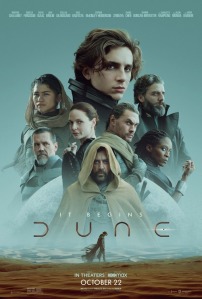
I attempted to read Frank Herbert’s novel Dune when I was in the seventh grade. I had begun to read more fantasy literature and was looking at older, heralded novels. I can still recall my frustration of reading those first five pages and having to repeatedly flip back and forth to a twenty-five-page glossary of terms so that I could even start to comprehend what was happening on the page. After those five excruciating pages, I gave up. Maybe I was too rash, and maybe my older present self would be more accommodating to the struggle, or maybe it just wasn’t worth the effort. I never watched the 1984 David Lynch adaptation that was met with great derision from critics and fans alike, although it does have its vocal defenders (Hindsight alert: Lynch turned down directing Return of the Jedi to helm Dune). So when acclaimed filmmaker Denis Villeneuve (Arrival, Blade Runner 2049) became attached to direct a big-budget, large-scale adaptation of Herbert’s novel, I was finally interested for the first time in my life. It was originally slated to be released in 2020, and after the studio planned to release Dune onto its HBO Max streaming service, Villeneuve and the production company negotiated to make sure a theatrical release would still be an important part of the plan. Alas, I watched the 2021 Dune at home, and I found myself enjoying the experience and development of the world building. However, it’s unlikely to watch this version of Dune and feel like you got a full movie for your money.
In the distant future, like 10,000 A.D., mankind has colonized worlds and the most important planet of them all is Arrakis. It’s a desert world inhabited by poor natives, Freeman, who live a moisture-preserving life mining the natural “spice,” a special substance that makes space travel capable as well as prolonging human life. The top family houses are vying for dominance and House Atreides has been assigned by the unseen Emperor to rule over Arrakis and bring it and its spice production back in line. Duke Leto Atreides (Oscar Isaac) sees great opportunity but also great danger. The other houses will scheme to engineer the failure and desolation of House Atreides, especially House Harkonnen, led by the Baron (Stellan Skarsgard), who is like a mixture between Marlon Brando from Apocalypse Now and Marlon Brando from The Island of Doctor Moreau (plus with levitation powers?). Paul Atriedes (Timothee Chalamet) is his family’s heir and much is expected of him, especially from his mother, Lady Jessica (Rebecca Ferguson), who believes he may be long-prophesied messiah. On Arrakis, Paul and his father must tackle this very delicate new mission while keeping the many adversaries at bay.

As anticipated, Dune is yet another visually stunning and gorgeously immersive visual experience from one of the greatest visual filmmakers working today. If you can watch the movie on a big screen, or at least a bigger screen, then you owe it to yourself to do so. The sweeping vistas and startling science fiction imagery have so much power and grandeur to them. If Lynch’s movie inspired a generation of devotees and impressionable children, I imagine that this superior modern version will do likewise. The production design and costumes are terrific and perfectly in keeping with the larger scope of the expansive visuals. You really feel the size of this world and its imposing weight. Villeneuve has such a natural keen eye for pleasing visual compositions, but he also has the patience many famous big screen stylists lack. He allows the moments to linger and to let scenes breathe in a way that feels more transporting and immersive. If you were simply looking for a visually resplendent movie-going experience, then Dune is the ticket. The sound design is also very smartly aligned and makes use of unconventional and alien sounds to make the movie feel even more like its own thing. When Dune came out in 1965, this was before much of the modern building blocks of our sci-fi pop-culture, so in a way while Dune was the influence it feels partially like an odd after-effect rather than a predecessor. The same thing happened with 2012’s John Carter, based upon a novel a hundred years old that influenced many sci-fi adventure serials and now seems derivative even though it came before the many imitations. I was happy with the first 90 minutes of Dune and felt like the slow pace of the first hour, and its heft of needed but spaced-out exposition, was paying off with a thrilling assault. The concept of the protective shields is a smart way to communicate the casualties of battle, where “kill shots” are illuminated in red, informing the audience of a mortal wound. It makes for an easy to read visual to keep up with the development of battle and stay in a safer PG-13 realm. The whole rescue sequence on the mining station is thrilling at every step.
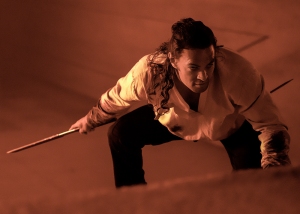
The cast is another major credit to the success of Dune. Chalament (Little Women) has a soulful yearning to him, to learn, to be his own man, to prove his father wrong and then prove worthy of his father’s faith. Surprisingly, the next biggest role isn’t Zendaya (Malcolm and Marie), the woman that Paul dreams about (prophetically?); it’s Rebecca Ferguson (Doctor Sleep) as Paul’s mother. She’s a woman with deep secrets belonging to a powerful religious sect that might be the real power behind the throne. Lady Jessica is more Paul’s mentor than any man. She teaches him to hone and focus his mind, to use the “Voice” to impart his will, and to prepare for the hardships to come. With every new exposition dump, and she has many, we learn about her growing concern for the fate of her son and her possible culpability for that fate. There’s a genuine warmth between them that serves as the film’s emotional core. I enjoyed watching Jason Momoa (Aquaman) and Dave Bautista (Army of the Dead) as opposite ends of Super Good Fighter Guy, though Momoa looked unsettling without a beard. Needless to say, the 2021 movie is far more diverse than the 1984 movie. It makes space feel more lived in when it’s reflective of a diversity of people that we already have at this point in our history.
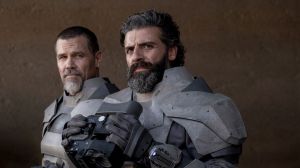
And then, after the hallway mark, Dune became a protracted sequence of chases and then I started to worry that things were just going to end in an unsatisfying manner, relegating the 150 minutes as setup for the as-yet-unplanned sequel, and that’s exactly what happened. My mood began to deflate somewhat during the last hour of Dune. I was still interested and the visuals were still mighty captivating, but the events had the unmistakable feeling of being stretched out to meet a frustrating stopping point, a pause that didn’t produce a satisfying endpoint. I just kept thinking, “Oh, they’re not going to resolve this,” and, “Oh, Zendaya is barely going to be in this movie,” and the movie proved my predictions correct. It’s hard to judge the movie as its own entity since it’s so dependent on a Part Two that has yet to be greenlighted (though its strong opening box-office returns are hopeful). This is an expensive movie, possibly pushing $200 million, so it’s quite a gamble to declare you would only be adapting roughly half of the story. Villeneuve’s Blade Runner sequel, a movie I loved, had a budget of $150 million and a worldwide gross that didn’t make the producers comfortable going forward with a Blade Runner 2050. To be fair, that was an original story, a sequel, and rather well contained. Still, it’s an expensive sci-fi movie that has as much in common with dry art house fare as it does blockbuster adventures, like Villeneuve’s Dune. The promise of a second movie is not secured. If Dune doesn’t do well enough, we’ll forever be left with a movie that feels designed to only be a teaser. It reminds me of the hubris of 2007’s The Golden Compass where the filmmakers had a whole 20-minute finale that they carved out with the intention of having it be the opening for the assumed sequel (welp). Even when designing a multi-movie arc, it’s necessary to plan each entry so that it can exist as its own beginning-middle-end and with a suitable intermediary climax. The Lord of the Rings movies each had their own climax, each moving the larger picture forward, and each had storylines and subplots that came to a head by film’s conclusion. Dune doesn’t. There are more dead characters by the end and certain characters are displaced, but it feels less like the end of the big-budget Dune movie and more like the conclusion of episode two of the Dune mini-series.
My resonance with the source material is minimal, but the world of Dune feels stuffed with stuff and not as deep in the realm of commentary. Fans of the book series will likely thrill at the level of minutia the 2021 movie luxuriates in, allowing fans to lap up the lore. For those of us uninitiated into the fandom, it feels like there could be more going on behind the scenes. The book was released in 1965 and has clear parallels to Middle East occupations and quagmires, a subject even more relevant in the first quarter of this new century. There’s the occupying force coming in to manage the supposedly primitive natives on a desert planet, replacing the last occupier who made bold promises that were unable to be met by the reality on the ground. The parallels of colonialism are there and obvious, but that’s because everything in Dune seems obvious to me. The bad guys are corpse-white and dressed in all black. They look like the alien zombies from 1998’s Dark City (itself referencing the silent sci-fi classic, Metropolis). The leader of House Harkonnen is this noxious man who bathes in black goo and sucks the life force from others. I don’t need my sci-fi to be ambiguous about its heroes and villains. We clearly recognize the bad guys because they’re grotesque. However, the lessons learned by the heroes seem a bit stilted. Its attacks on capitalism are a little more nuanced but not much. The planet of Arrakis could produce water but that’s not in the interest of the power brokers of the galaxy. They need the spice for the economy and thus keep the exploitative status quo. The parallels are there but there’s not much more to be had other than direct summations. The movie has more to say with religion and messiah figures but at this point we’re grading on a curve, and the more complex commentary attached to messiah figures seems reserved for a Part Two.
Another aspect I want to highlight that seems trivial but no less intriguing to me is how Herbert chooses his character names. We’re eight thousand years into the future, spanning multiple planets with names like Arrakis and Giedi Prime and Salusa Secondus, and then we have such anodyne twentieth-century names like… Paul and Jessica? It’s funny to me that Herbert goes to the trouble of coming up with so much jargon and terminology and alien-sounding names and then he says, “Hey, this guy’s name is… Duncan Idaho,” like he’s a supporting character in Point Break. I realize this is a very dubious criticism, and there are other character names to conflict with this assertion, but it made me laugh at the different levels of effort Herbert put into his world-building and universe than selecting character names for that same far away land.
After watching the new Dune, I went and watched the 1984 David Lynch version for the first time and was, quite simply, dumbfounded. I’ll credit Lynch for many of the weird choices in style and how it never stoops to even be accessible for a mass audience, despite having characters explicitly narrate their schemes and motivations out in the open (by scene one, the power play that took up 90 minutes of Dune 2021 is awkwardly explained in full). By the end of Lynch’s movie, it is an incomprehensible campy mess. I only have more appreciation for the 2021 Dune after watching the goofy (those eyebrows!) 1980s version that Lynch has disowned entirely, although that stirring guitar riff from the score still rocks thirty years later. The new Dune is only intended as Part One as its presumptive title promises, and because of this key artistic decision, there’s a feeling of padding and wear by the end. I found myself reflecting back on the first 90 minutes more fondly. It’s not that the last hour is absent great moments or audacious style, but it’s hard to fully judge this Dune when its last line is its own conditioning of expectations: “This is only the beginning.” The 2021 Dune is a visually remarkable movie experience with fantastic artists executing at some of the highest points of their talent. I’m eager to see if a Part Two can provide the satisfaction lacking in this beginning half. It’s a hell of a start but it feels too incomplete and in need of an ending.
Nate’s Grade: B
Share this:

The Little Stranger (2018)

If you’re a fan of slow burning Gothic horror, the kind where characters wander slowly inside ornate and empty houses investigating various noises, then The Little Stranger is the movie for you. It’s about a laconic doctor (Domhnall Gleeson) inserting himself in the lives of a wealthy family who has fallen on hard times, their once glorious estate left to wither in post-WWII Britain. The family is convinced the spirit of a dead little girl haunts their estate and has its ghostly sights set on destroying the last vestiges of their bloodline. It’s a ghost story by design but the supernatural elements get placed on pause for long stretches. The rest of the movie is a restrained romance between the doctor and the introverted and awkward lady of the house, played by Ruth Wilson (TV’s The Affair). In reality, the doctor is more infatuated with the house than the people inside, fondly recalling his early obsession from childhood. It’s easy to see why. The house, and its exquisite production design, is enchanting. At points it feels like the movie has to remember that it’s a ghost story or a mystery as it shifts narrative tracks. The Little Stranger is a movie simmering in eerie atmosphere and is pristinely directed by Lenny Abrahamson (Room), a man proving how readily he can adapt his artistic style. For a good hour, I was on board with the movie and enjoyed its patient, controlled buildup. It’s practically the opposite of the more visceral horror set pieces we’ve become accustomed to. By the end, I was unsure whether the somewhat ambiguous ending justified the time and path taken to get there. If you don’t have a healthy love of Poe-styled Gothic horror, you’ll likely be restless as you watch understated, refined, restrained British family going through understated, refined, restrained drama.
Nate’s Grade: C+
Share this:

Red Sparrow (2018)
 The Cold War-worthy spy thriller Red Sparrow is a misfire that doesn’t seem to be able to commit to what it wants to be. It wants to be provocative but serious; however, it lacks the substance to be serious and lacks the conviction to be provocative. It lands in a middle ground between the sleek genre fun of Atomic Blonde and the understated paranoid realism of a Tinker, Tailor, Soldier, Spy. By landing in the middle zone, Red Sparrow is that rare boring movie plagued by untapped potential.
Dominika (Jennifer Lawrence) is a classically trained Russian ballerina that suffers a gruesome injury. Her leering uncle (Matthias Schoenaerts) enlists her into a state-run school for spies and assassins who specialize in seducing their targets. “Whore school,” as Dominka terms it, is run by the Matron (Charlotte Rampling), who methodically trains her recruits by stripping away every ounce of fear, shame, and defiance. Their bodies belong to the state now, she says, and they will be put to good use for Mother Russia. Nate Nash (Joel Edgerton) is an American spy working in Europe who tries to convince Dominika to switch sides, to take refuge in the United States. Dominika’s superiors order her to get what she can on Nash, find their secret contact, and eliminate them both.
 Firstly, Red Sparrow is far too long and far too leisurely paced at a bladder-unfriendly 140-minutes. When things do get interesting, the overall slow pacing has a tendency to sap whatever momentum was starting to emerge. The entire first act should have been condensed down into an opening ten minutes rather than stretching out into 30-some minutes. We don’t need a full half-hour explaining what Dominika’s life was like before her new life as a deadly state-sponsored seductress. We don’t need all that time to see her life as a ballerina, her life caring for her sick mother, and her hesitancy with her first mission before she’s roped into fully accepting her fate. I don’t need this much convincing that her life was better before or that she was trapped into this decision. I don’t care that Lawrence studied ballet for four months. It’s not integral and it’s a deadly start to a story. Once Dominika is at her spy school, that’s when the movie really starts. I was getting awfully sleepy as the movie just seemed to drift along. I know a high school student who saw the movie and said, “I fell asleep at the beginning, and then I woke up later and it was STILL the beginning!”
Another problem is that the parallel storyline about Nash and the Americans is far less interesting. Every time the movie jumps to his perspective, you can feel the movie stalling. A U.S. spy who is pushing against his own brass and the politics of the agency can’t compete with a woman who is thrust into unfamiliar and dangerous missions that test every physical and psychological boundary she knows. When Nash and Dominika cross paths, he finally starts to justify his placement. Much like the delayed first act, though, the extra time setting up his life before he was important was not time well spent. Their relationship together is mean to appeal to Dominika to convince her to flip allegiances. They don’t feel like they really connect, and part of that is the lackluster chemistry between the actors. The emphasis on their romantic relationship is even more moot because Dominika’s real motivation is revenge. She didn’t need a handsome, doe-eyed American man for that to happen.
 Where Red Sparrow does work is with its unique, high-pressure, destabilizing training environment. There’s a prurient appeal when it comes to watching the training program for assassins who must strip everything away and use their bodies as a weapon. This is where the film is at its most interesting and its most sensational as far as use of genre elements. There is an uncomfortable amount of stark sexual violence depicted in the movie. I lost track of the number of times Dominika is raped, tortured, sexually assaulted, or assault is attempted upon her. I don’t feel like these moments of sexual violence are glamorized or designed for base titillation; it’s a window into the harsh reality these women face. They have been robbed of their agency, their very sex weaponized. There’s a fascinating story to be told from that perspective and the trials and tribulations within “whore school” are harrowing, shocking, and always intriguing, which makes it even sadder when the filmmakers try and posit an arty sheen of self-seriousness. This is a movie about training spies to seduce the enemy and then prove their skills. This is a movie where the head of the spy school runs a play-by-ply analysis on a student’s use of a handjob. This is not going to be John le Carre, and that’s fine. Rather than embrace its inherently trashy side, Red Sparrow tries to stay above the icky stuff, while still indulging in a heaping helping of blunt sexual violence. It’s truly strange. It’s like the filmmakers felt they were making something sober and thoughtful and didn’t want to taint their award-caliber production with too much emphasis on the thing that makes it most interesting. And then instead they threw in a lot more sexual violence, because that’s also serious, and that’s the kind of thing serious movies do to be serious.
Lawrence (mother!) is once again a strong anchor for the audience, even if her Russian accent falters from scene-to-scene. This is a very different role for Lawrence and requires her to simultaneously put much of herself on display physically while finding ways to hide the inner life and thinking of her character from the audience. There’s an interesting character here buried under layers. After her accident, Dominika viciously injures her dance partner and his new leading lady, and it previews the cruelty that Dominika is capable of. Much of the press in the lead up has focused on Jennifer Lawrence’s nudity, and it’s there, okay, but it’s never really emphasized. There is one sequence in particular where she disrobes and taunts her would-be rapist to try and ravish her available body, humiliating him, and it’s one of the few scenes where Dominika turns her body around as a tool of empowerment. Granted, it’s within the prism of a school that’s practically state-run sex slavery, so let’s not get carried away with larger feminist implications. Lawrence keeps the audience guessing scene to scene as she transforms from setting, slipping into different identities that suit her, thinking on her feet, and being, frankly, adult.
 There are a slew of good supporting actors tasked with saying ridiculous and foreboding things, like Charlotte Rampling as the headmistress of “whore school” and Jeremy Irons as a high-level Russian spymaster. What really catch the attention are the accents. We have a group of actors from the U.S., Britain, Belgium, Netherlands, and Germany portraying Russians, and with Edgerton, an Aussie portraying an American. As you might expect, the Ruskie accents can be a bit thick and obviously phony at times.
It’s not too difficult to see the kind of movie that Red Sparrow could have been. It even previews it from time to time, providing a glimpse into an alternative version of the movie that decides to take ownership of its more sensational, sexualized elements with genre pride. Red Sparrow feels like an out-of-time throwback to the erotic thrillers of the go-go 90s. I mean does Russia even need to train sexy assassins any more in the information age where a troll farm and some Facebook ads can get the job done? Director Francis Lawrence (The Hunger Games movies) has a controlled, precise Fincher-like visual acumen that gives the film a sleek and sterile allure to the spy shenanigans. It’s a nice-looking movie to watch, but without a better story, let alone a verdict on tone, it’s a nice-looking movie that runs self-indulgently too long. Consider it a screensaver you forgot was still going on but with Jennifer Lawrence nudity.
Nate’s Grade: C
Share this:

Never Let Me Go (2010)
 You’ll be excused for mistaking Never Let Me Go as one of those austere boardinghouse dramas the English are fond of cranking out. I mean it even has Keira Knightley in the thing for goodness sakes. Pretty lily-white British actors trying to find their place in a reserved society spanning the 1970s to the mid 1990s. You’d be forgiven for stifling a yawn. But then Never Let Me Go takes a sudden left turn into a realm of science fiction morality play. It becomes something much deeper and menacing. I am about to go into some major spoilers concerning the sinister premise of the movie, so if you’d prefer to stay pure then politely excuse yourself from the remainder of this review and come back at a later time. I won’t think less of you but only if you promise to come back.
Kathy (Carey Mulligan) and her pals Tommy (Andrew Garfield) and Ruth (Knightley) all grew up in the remote countryside school of Hailsham. It’s like any other school in most regards, except at Hailsham the children all wear monitoring bracelets, are afraid to leave the boundaries of school for fear of being murdered by outside forces, and are told that her physical fitness and internal health are of “paramount importance.” Figured it out yet? My then-partner leaned over and whispered, “Are these kids organ slaves?” Kathy and her friends find out their true identity when an outside third-grade teacher (Sally Hawkins) takes pity on them. She reveals that the students of Hailsham are clones whose sole purpose is to be raised into healthy adults who will then give “donations” to the ailing public at large. Most clones will go through one to four “donations” before “completing,” unless they so desire. You see Never Let Me Go exists in a realm where medical science has made momentous breakthroughs and now people can live to 100 years of age on average. Kathy and her friends are the dirty details.
 The rest of the movie flashes through our trio’s teen years. Kathy has always been kind and affectionate to Tommy, but before she could seal the deal Ruth swooped in and took Tommy for her own. Kathy has waited in vain for the two to break up, but that day just never comes. The trio ventures out to a small farmhouse in their teens to do some work and see the outside world. They’re living with a few other Hailsham alums that show them the knack for social interaction with outsiders. There are two rumors at play. One is that the Hailsham alums think they’ve found Ruth’s “original,” the person she’s been cloned from. The second rumor has greater significance: if two Hailsham students can prove that they’re in love, deep, honest love, then they can defer their donations for a few years. This idea takes hold of Tommy and consumes him. Except, we don’t really know whether Ruth or Kathy will be his partner in love.
So why don’t these people run away, or fight back, or do anything of defiance once they discover the horrible truth that will befall them? I have read several critics taking the film to task for being so painfully prosaic and passive, and Never Let Me Go can admittedly fall prey to those detractions at times. However, this is not the Hollywood version where the abused (clones) fight back for their survival and regain independence in a hostile world. That movie was called The Island, plus the several other films that Michael Bay sort of ripped off and then added extra loud explosions. Never Let Me Go has nary an explosion or moment of triumphant revolution. There is no revolt coming because the film doesn’t want to let anyone off the hook; these people are society’s collective collateral damage. They have been bred to be walking, talking, mostly demure, fleshy warehouses for spare parts. It’s only a matter of time before they leave everything on the operating room table, and these people benignly accept their doomed fate (“We all complete”). They march forward, trying to find some level of dignity and beauty before they get the call for “donations.” These people don’t know what it means to rebel; they have no real concept of liberty. They’ve been conditioned since childhood to obey, and that’s the whole point of the film. They have no self-preservation instincts. Likely any cloned child that was expressing strong feelings of boldness was removed, and destroyed, so as not to taint the rest of group. These people are like gown-up versions of veal. They’ve been cultivated since birth for the purpose of destruction, and their knowledge of the world is limited and cruelly self-serving. Watching innocent characters march off to a merciless fate can be very emotionally draining. It should also make you angry.
 These people are hopeless so that the movie’s full impact is absorbed. This isn’t some far off nightmarish scenario, because we as a society are already reaping the rewards of a lifestyle, a lifestyle that we’re loath to think about the mechanics of how we got so fat and happy. I can go to a Walmart and buy a T-shirt for a dollar. I am a happy consumer, but what did it take for me to get that product at such a discounted rate? Sure there are variables up the wazoo, but there are many negative factors that go into why that price stays low, invisible hand of the market be damned. Workers clock long hours in unsafe conditions in order to meet supply, earning a penance just enough to keep them alive and moving product. Environmental concerns are overlooked because that would mess with production. Long-term generational poverty can develop. The worker has ceased to be a person and is merely a dispenser of product, much like our clones in the film. This is not a definitive example of what goes on in the world, mind you. Never Let Me Go isn’t some far off scenario; we’re already there, albeit less explicitly. If the price of gas rose a dollar a gallon but it meant that people in other countries could have safe, uncontaminated water and enough food to stay healthy, what do you think would happen?
With all of that said, Never Let Me Go can’t fully fight the trappings of inert drama. For two hours we are watching somewhat nice, somewhat bland British kids gawk and smile their way toward the inevitable. The conceit calls for the breeding of rather milquetoast personalities. It simultaneously makes the characters more innocent and less emotionally involving. The screenplay relies on our sense of outrage and injustice to fill in the gaps of emotional connection. There are little molehills of characterization at best. You’re supposed to be choked up on indignation and sadness so as to not notice that the threesome of character are all rather good-natured but boring. That even may be an aim of the screenplay to accentuate the terrible fate that awaits, or maybe I’m just being overly analytical. Never Let Me Go reveals its awful truth fairly early at about the 40-minute mark, making sure that the audience is fully aware that we are definitely not headed for a happy ending. As it is, the actors are all lovely and talented but there’s only so much silent emoting and teary eyes can conjure.
 It’s credit to the talents of the actors that you do feel a storm of emotions from such otherwise frail characters. Mulligan (An Education) showcases her great gifts for communicating sadness. Her face just crinkles up, her eyes get glassy, and you want to hug her. She’s our dramatic linchpin. Her looks of conflict and yearning do well to communicate the inner struggle of her character’s abbreviated life. There’s a lot left to the imagination and Mulligan once again crushes it. Garfield (The Social Network) is stuck playing a wishy-washy character, which makes him seem a bit thick at times. He’s the most naïve and hopeful of the three, so when those hopes get crushed again and again his breakdowns have the most emotional heft. Knightley (Pride and Prejudice) has been in six period films since 2005, so she’s got this thing down pat. Ruth is a bit more assertive and angry than her friends, and it’s a pleasure seeing a more calculating side from the actress. It seems like the filmmakers had a troublesome time trying to downplay the attractive features of their cast. So it seems that they relied on the actors eating less. Knightley, and particularly Garfield, look rather gaunt and puckish, even before they begin “donations.”
I’ve gone this far without even mentioning director Mark Romanek’s (One Hour Photo) contributions, or the fact that the film is based off the 2005 novel by author Kazuo Ishiguru (Remains of the Day) and is adapted by Alex Garland (28 Days Later). Great artists that shaped the vision of this film. It’s a shame then that the impact of Never Let Me Go is blunted. It’s an intelligent, poetic, haunting, and emotionally wrenching film experience, and yet it could have been far more penetrating and devastating. The passive nature of the characters accentuates their doom and our sense of outrage. But that same passive nature makes them less than engaging characters. It’s been days since I saw the film and it still lingers in my memory, a testament to the moral quandaries and acting prowess. The existential drama of the film is better suited for the page where the questions of identity and morality can be given more careful and rewarding examination. The movie has an oddly detached feel to so much suffering. Never Let Me Go is a hard film to let go but also a hard film to truly embrace.
Nate’s Grade: B


 nathanzoebl
You must be logged in to post a comment.