Blog Archives
Traffic (2000) [Review Re-View]
 Originally released December 27, 2000:
The war on drugs may be one worth fighting but it’s a battle that every day seems more and more impossible. Traffic is a mirror that communicates the fruition of our current procedures to stop the illegal flow of drugs.
Traffic is told through three distinct and different narratives. One involves an Ohio Supreme Court justice (Michael Douglas) newly appointed as the nation’s next Drug Czar. While he accepts his position and promises to fight for our nation’s children, back at home, unbeknownst to him, his daughter is free-basing with her bad influence boyfriend. Another story involves a wealthy bourgeois wife (Catherine Zeta-Jones) awakened to her husband’s arrest. Her shock continues when family lawyer Dennis Quaid informs her of her husband’s true source of income. He’s to be prosecuted by two DEA agents (Don Cheadle and Luis Guzman) unless she can do something. The final and most compelling narrative involves Benicio Del Toro as an honest cop in Tijuana battling frustration with the mass corruption surrounding the city. Each story weaves in and out at various points in the film.
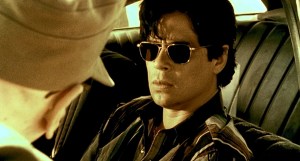 Traffic was photographed and directed by the man with the hottest hand in Hollywood, Steven Soderbergh. He uses a documentary feel to his filming that adds to the realism. Different color tones are assigned toward the three narratives as reflections of the emotional background. Soderbergh expertly handles the many facets of the drug industry and pulls out his typical “career best” performances from his onslaught of actors.
Benicio Del Toro is the emotional center of Traffic. His solemn demeanor and hound dog exterior reflect a good man trying to fight the good fight in a corrupt environment. He effortlessly encompasses determination, courage, and compassion that you’ll easily forget the majority of his lines are in Espanol. Benicio is an incredibly talented actor and one with such vibrant energy whenever he flashes on screen. It’ll be wonderful watching him collect all his awards.
Catherine Zeta-Jones also shows strong signs there may well indeed be an actress under her features. Her role is one of almost terror as you watch her so easily slip into her imprisoned hubby’s shoes. The ease of transformation is startling, but in an “evil begets evil” kind of fashion. The fact that she’s pregnant through the entire movie only makes the shift from loving house wife to drug smuggler more chilling.
 The entire cast does credible acting performances with particular attention paid toward the younger actors deservingly. Don Cheadle throws in another terrific performance showing he’s sublimely one of the best actors around today.
Traffic oversteps its ambitions and aims for a scope far too large. It is based on a 6 hour BBC mini-series, so trying to cram that material into a two hour plus format is taxing. As a result we get an assembly of characters, but too many with too little time in between to do any justice. Screenwriter Stephen Gaghan (Rules of Engagement) condenses the towering impact and influence drugs have well enough, but he intercuts the stories too sporadically that attachment never builds for either of the three narratives. He does balance the Douglas Drug Czar one carefully as not to fall into the cliched vigilante metamorphosis. But the mini-series had more characterization and depth to its tale.
Traffic is a good film but it has edges of greatness never fully visioned. Soderbergh shines bright yet again and all accolades will be deserved. Traffic is undeniably a good film, but it’s one you may not want to watch a second time.
Nate’s Grade: B
——————————————————
WRITER REFLECTIONS 20 YEARS LATER

So twenty years later, how is that war on drugs going? Considering the billions of dollars and countless lives that have gone into trying to stop the intricate infrastructure of supply and demand for the drug trade, the United States has little to show for its efforts. If anything, there has been a dawning realization of the futility of playing cartel whack-a-mole, removing one leader just for another to take their place in the supply chain. There have also been movements toward treating addicts rather than incarcerating them. The country has stubbornly become more accommodating and understanding of the ravages of addiction; it only seemed to take the spread of the opioid crisis where affluent families in the suburbs were affected personally. Tragically, it seems too many Americans have to have an “it could happen to me!” moment before their empathy for another person’s struggles kicks in. These relaxing attitudes have translated into recreational marijuana being legal in 15 states as of this review. Many other states have decriminalized marijuana, and Oregon has recently voted to decriminalize all drugs. It seems that in 2020, our concept of the war on drugs has dramatically changed. Some may find these developments an admission of giving up, of retreating from some moral duty, but others have concluded that maybe we’ve been fighting all wrong for 50 years and the only thing we have to show for our blood-soaked efforts is that multiple criminal elements got much richer.
 It’s an interesting social and cultural landscape for going back and re-watching 2000’s Traffic, the last film on my re-watch of 2000 cinema. Times have changed and this is felt in Steven Soderbergh’s Oscar-winning ensemble covering the globe-trotting scope of the war on drugs. Traffic won four Oscars, including for Soderbergh for Director, Benicio Del Toro for Best Supporting Actor, and for editing and adapted screenplay. The only Oscar it was nominated for that it didn’t win was Best Picture, losing to Ridley Scott’s sword-and-sandals epic, Gladiator. It was an ambitious movie and had over 100 speaking roles. Soderbergh served as his own cinematographer and cameraman, bringing a docu-drama versatility to the movie that added its own sense of realism. 2000 was the year Soderbergh hit his critical peak. He was an indie darling from 1989’s influential sex, lies, and videotape and puttered throughout the 90s with small, personal, weird movies (I loved Schizopolis as a teenager), and then in 1998 he gained a new level of credibility providing sheen and heat to Out of Sight, the movie that cemented George Clooney as a major movie star. The one-two punch of Traffic and Erin Brockovich in 2000 earned Soderbergh two Oscar nominations for director, a feat not accomplished since 1938, and after 2001’s highly successful Ocean’s 11 remake, Soderbergh had jumped to the top of the industry while maintaining his indie artistic credentials. He’s been dabbling and experimenting since (A movie shot on an iPhone!) with mixed results, but the man’s track record is hard to digest into simple categorization. He can jump from an action showcase for an MMA fighter, to a gleeful male stripper romp, to a four-hour epic covering the life of Che Guevera. With Traffic, Soderbergh was working with his biggest budget and cast yet. The decision to use different color tones is smart to easily distinguish the various storyline locations so that an audience can be immediately oriented when jumping around from place to place. It’s also extremely hard on the eyes at times. The Mexican storyline is so washed out in bleached colors that it looks like an atomic bomb just went off in the distance and is filtering the world with an excess of bright light to make you squint. Soderbergh also has a penchant for natural light coming through windows to be seen as giant blocks of white. Again, it achieves its artistic purpose but it also makes you want to avert your gaze.
The 150-minute movie is based on a sprawling 1989 BBC miniseries that totaled six hours. Stephen Gaghan (Syriana) adapted the screenplay and he does a fine job of condensing the major plot points of the mini-series into a manageable feature length. He also does a fine job of articulating the many intertwined players and motivations and contradictions of the drug trade. However, I can’t help but feel like some of the nuance and character development is lost by condensing everything into the body of a manageable American feature production. Take for example the character Catherine Zeta-Jones (Chicago) plays, Helena Ayala. She’s a rich southern California housewife who has her life upturned when she discovers her husband, recently arrested by the DEA, is one of the chief distributors for a Mexican cartel. Her character is in disbelief and shock at first, then she tries to make due with legal bills and mortgage payments. Things get considerably worse when the cartel threatens her children if Helena can’t pay her husband’s outstanding debts that have now fallen onto her. Her character arc goes from an ignorant, privileged housewife into a ruthless co-conspirator willing to do whatever it takes to protect her family and maintain the cushy lifestyle they have become accustomed to. Over the course of the BBC miniseries, you watch that version of the character undergo significant changes in six hours. In the 2000 film, the character undergoes significant changes in a matter of scenes. Helena goes from desperate to duplicitous in literally minutes, and the jump feels too unearned. The rushed storytelling caps some naturalism. A character can go from not trusting the DEA to providing damning evidence to the DEA in three scenes. A character can go from bored, privileged teenager to junkie prostitute in three scenes. For a movie about gritty realism, these character leaps can feel overly forced and inauthentic. There are so many characters and storylines and political points to make that the overall narrative can feel crowded, so while it’s always interesting, it can inadvertently fashion its own ceiling for emotional engagement because the many characters feel like impressions hitting their marks rather than as fully developed portrayals of people.
 The storyline that has aged the worst is Michael Douglas (Ant-Man) playing Robert Wakefield, a newly installed Drug Czar learning the ropes. For the majority, he’s akin to a 60 Minutes journalist just sitting in rooms and asking various professionals about their experiences and advice from their unique positions. From there, the storyline takes up the “it could happen to me!” trapping with Robert’s private school daughter (Erika Christensen) becoming an addict. It may have been surprising for a high-profile politician to have a child as an addict, but now this kind of irony feels passe. We’re used to politicians having ironic skeletons in their closet. The ongoing plot of her descent doesn’t really humanize her even as she makes some drastic decisions to chase that next high. She’s more an ironic counterpoint to shake her father, and the audience, of their preconceived mental imagery of what an addict might look like. It feels slightly retrograde and pearl-clutching, not simply that she goes through hell but that it’s set up to register that, oh my, WHITE PEOPLE, even RICH WHITE PEOPLE, can also be junkies. In 2000, this story might have been jolting and scared some older adults into wondering if this drug menace could find its way into their hallowed gated homes too. Nowadays, it seems obvious. If the storyline of a father dealing with his addict daughter had reveled more about one another as characters it would be worth the attention, but the daughter is kept as an example, a symbol, and Robert just has to take his lumps before the inevitable conclusion that his job is a lot harder than he would have imagined. His speech at his introduction at the White House has the hallmarks of drama ready and waiting, as he chokes over the political boilerplate he no longer believes in, but he simply walks out rather than sharing what he’s learned.
The best storyline in Traffic is, no surprise, the one closest to the action with Benicio Del Toro (Sicario) playing what feels like the only honest cop left in Mexico. Obviously that’s an over simplification, but the police force and political class are heavily corrupted by the cartels and their money. The character Javier Rodriguez has to navigate this tricky world without making himself as a target for those corrupt officials who think he’s an impediment. He’s trying to do good in a deeply flawed system and maybe even he knows he’s fighting a losing battle but he’s decided to keep his integrity while trying to fight what he considers is a worthy cause. A high-ranking general seeking his services reminds him of his lowly pay as a police officer, yet Javier Rodriguez is unmoved. Del Toro made a career of playing oddballs and sleazes, so it’s interesting to watch him play a fairly noble, straight forward role and in a language he didn’t speak before production (while born in Puerto Rico, he moved early and grew up in the U.S. and knew little Spanish). I don’t know if I would have awarded him the Oscar (my favorite for 2000 was Willem Dafoe as a vampire) but it’s certainly an understated performance with real gravitas. Del Toro is the quiet, churning contemplation of this movie and I would have been happy if the whole enterprise had been devoted to his south of the border exploits. I appreciated that the moves in this storyline would have larger effects on others, like a crackdown on a cartel being a reason why they need more money and the reason they now step up the pressure on Helena to pay up or else. It best encapsulates the knotty, interconnected framework that Gaghan and Soderbergh are going for.
 Traffic is one of those movies you know are good. It’s well written, well acted, and has a definite vision it’s going for that it mostly achieves. It’s also a movie that engages more intellectually than emotionally. There are some deaths and downturns but I doubt you’ll feel much regret or catharsis. The movie unfolds like an in-depth journalistic article, and the leaps in rushed characterization feel like a result of a looming deadline and a hard cap with its word count. It’s unfair for me to continue comparing the movie to its miniseries when that project had almost three times the length to fill out its tale (about poppy trafficking and heroin manufacturing in tribal Afghanistan) but it’s a clear-cut case of crammed plotting. My initial review back in 2000 keeps mostly to the plot and the many actors, though I think I overstated Zeta-Jones being “chilling” and I think my love of Del Toro in Way of the Gun that year transferred some extra praise for his performance here. It’s hard to remember but I was really anticipating this film my freshmen year of college. Traffic is a good movie but it’s not exactly one people get excited over. Every aspect is professional, proficient, but there isn’t exactly a lingering takeaway that changes your perception of the war on drugs. I’ll hold to the same grade and say it’s an admirable accomplishment but one better suited for a mini-series (it was adapted back into a TV miniseries in 2004).
Re-View Grade: B
Share this:

Ocean’s 12 (2004)
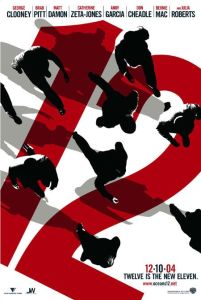 In 2001, Steven Soderbergh’s remake of Ocean’s Eleven was a giant surprise. It was a blast of fun with an impressive collection of Hollywood royalty. It had clever dialogue, fun characters, and a gala of amusing plot twists. It was one of the breeziest, most entertaining movies in years. Now, come late 2004, Ocean’s Twelve is released with the entire cast returning, including the lovely Catherine Zeta-Jones in tow. Expectations are high for another glitzy romp, but what you’re left with in Ocean’s Twelve is all glitz and no romp.
It’s been three years after the gang robbed ruthless casino owner Terry Benedict (Andy Garcia) of 160 million dollars. Benedict tracks down each member of Ocean’s Eleven and gives them the same ultimatum: either pay back what they stole, with interest, in two weeks or they’ll be killed. Danny Ocean (George Clooney) leaves his attempts at normal home life with Tess (Julia Roberts) and reassembles the team, many of whom have burned through their shares of the millions. Danny and his right-hand man Rusty (Brad Pitt) figure they’re too hot stateside so they’ll need to travel overseas if they’re to steal their fortunes. Linus (Matt Damon) also wants to have a greater role in the heist this time around.
In Europe, Ocean is challenged by a French playboy (Vincent Cassel) who moonlights as the notorious thief, the Night Fox. The challenge is to see who can steal a priceless Faberge egg, and if bested the Night Fox promises to pay all of Ocean’s debts to Benedict. Hot on the heels of both thieves is Isabel (Zeta-Jones), an expert police officer that also happens to be the former girlfriend to Rusty.
 Ocean’s Twelve does not work as a heist picture. For starters, the audience has no idea what’s going on for most of it. A general heist movie bylaw is to explain what the heist will entail, and then we watch the team hit it step by step. Forget that. In Ocean’s Twelve we’re never told how they are going to do their heist, and as they commence with their plan it’s not surprising to an audience, only confusing. I had to wait until the very end for some character to go into a monologue to explain how they accomplished their heist, and let me say, it was not worth two hours of waiting and scratching my head. The result seems to push away an audience instead of involving them in the fun of the scheme.
The story doesn’t utilize the talents of the assembled members. There’s a reason you hire a demolitions expert or a pick pocket, and that’s to let them work their skill. Well in Ocean’s Twelve we get none of that. Most of the cast’s skills are not ever put to use, which further gunks up a heist movie. The movie really errs by putting many of its eleven on ice for long stretches of the film. Around the second act almost everyone gets arrested. Pity poor Bernie Mac, who is in jail for near the whole movie. It seems that Soderbergh doesn’t know what to do with all his characters, and the new additions, so he stashes them away for long stages of time hoping an audience won’t notice.
Soderbergh is in danger of becoming a parody of himself. His usual narrative flourishes are present, including jumps in time and perspective; however, they don’t add up to much except unnecessary showmanship. The nonlinear leaps and shell game of information do not add to the film. Soderbergh keeps his audience in the dark for too long and then cheats us with the ending. Ocean’s Twelve is a good looking film (the vistas look beautiful), but it’s a good looking movie with nowhere to go. What’s even more frustrating is the ending to Ocean’s Twelve. You see, in the end we find out that the last hour plus of the movie was unnecessary. Yes, the movie actually makes a reveal that nullifies over half of the film. It’s cheap and unappreciated. Ocean’s Twelve, there’s a difference between tricking an audience and conning them. Maybe some day you’ll realize this.
 The new storylines never really develop. Zeta-Jones doesn’t add much besides another authority figure to chase after Ocean and the boys. Her subplot involving finding her master thief father is abrupt and easy. The best new addition to Ocean’s Twelve was the prospect of a rival, but again nothing really happens with our French thief. He’s more of a catalyst for the plot than anything else, and it’s a shame, because he could have opened the door for a great film pitting two competitive teams of thieves against each other.
Ocean’s Twelve is too satisfied with itself to be that entertaining. It’s now actually reminiscent of the 1960 original film (my grandmother swears it’s wonderful, take that for what you will), starring the Rat Pack. Plot and logic are secondary to a bunch of cool characters having fun. I really enjoyed Ocean’s Eleven (the 2001 film, not my grandmother’s preferred version), but this new sequel lacks any charm and verve. I can’t even say there were many good scenes, just some good ideas that they didn’t fully actualize, like stowing Yen in baggage and then losing their luggage (nothing comes of this). There’s a fun scene involving Topher Grace spoofing his own micro-celebrity, but beyond that many of the scenes and ideas don’t seem developed. The best moment of Ocean’s Twelve, for me, was when I saw Eddie Izzard, the funniest man on the face of the Earth and then some, chat with Hollywood’s A-list on screen. God bless you Eddie Izzard.
Ocean’s Twelve wilts in comparison to its witty, effervescent predecessor. Ocean’s Eleven was fun and hip but didn’t need to coast on star appeal. It had a believable heist, engaging personalities, and it was fun because we knew what was going on and it mattered! I’m sure the cast of Ocean’s Twelve had a blast making the movie together, and their friendly camaraderie shows, but when I left the theater I felt like I had been stuck with the bill for someone else?s good time.
Nate’s Grade: C
Share this:

Intolerable Cruelty (2003)
 Miles Massey (George Clooney) is the preeminent divorce attorney in Los Angeles. But after years of bankrupting homes after people have broken them (this allusion may be too tricky), hes grown tired of the same old same old. Enter Marilyn Roxroth (Catherine Zeta-Jones), a conniving gold digger who has been ruined by Massey defending her dimwitted hubby (Edward Herrmann). Now shes out for revenge, which could be in the form of romancing Massey while bringing him down.
Intolerable Cruelty is something of a strange breed. It’s the Coens most striving foray into mainstream success, with the weight of the world on Clooney and Zeta-Jones exchanging sparks and verbal repartee. For the most part, things work: the leads do have a winning chemistry; Zeta-Jones is positively glowing in Roger Deakins’ beautifully milky cinematography (she found out she pregnant late in the shoot, which could explain the glow).
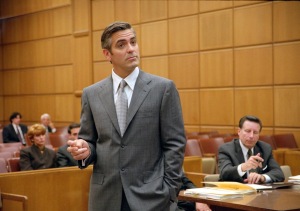 The stumbling block for Intolerable Cruelty and its central romance is that neither of the leads, though at times charming, isn’t exactly likable or able to root for. An integral part of any romantic comedy is empathy for the leads so much that we want them to get together, possibly with swirling crescendos. But in Intolerable Cruelty, both leads make a living off deceiving and taking advantage of others. So while their War of the Roses-esque pursuit to out-scam the other can provide some entertaining twists (and some forced and out of place), the whole duplicitous one-upsmanship doesn’t blossom credible love between the leads or the audience.
I have a strong feeling that Intolerable Cruelty was a story the Coens hopped on late, did some rewrites and invited old Coen friends to join in the jubilee. This is the first time the Coens have worked with other writers (the people who brought us such duds as (Big Trouble and Life), and certain storylines or subplots that glaringly feel disjointed from the screwball-comedy tone of the film. An asthmatic hit man named Wheezy Joe (who got the biggest laugh with his demise) is funny but in the wrong Coen film. When Clooney and Zeta-Jones both hire the services of Wheezy Joe to off the other, you know the story took a fantastical wrong turn. A creepy decrepit owner of Clooney’s law firm also feels like a leftover from a different film. This movie also has the most ripping up of legal documents I’ve ever seen in a movie.
Clooney is quite funny as a chattering legal eagle with a Cary Grant edge. Hes ready and willing to play against his movie star image, which works wonders for comedy, though the running gag where he must look at his teeth in any reflective surface never takes off. It took me until Intolerable Cruelty to realize how much of a beautiful woman Zeta-Jones is. Her warm smile could light up an auditorium. The supporting characters are all underused but very memorable. The opening with Geoffrey Rush’s TV exec walking in on his canoodling wife is very funny, and he plays the long-haired arrogant type well. Cedric the Entertainer is hilarious as a private eye determined to ”nail yo ass” that I started privately wishing the film would spin to follow his life and not Clooney’s.
Intolerable Cruelty is a nice diversion for the Coens, with some good laughs here and there (my favorite being the courtroom scene where Clooney and Zeta-Jones go head-to-head for the first time), but one would hope that the Coens will get back to doing hat they do best, which is quirky yet beautiful independent films. In the end, it seems that the Coens have created an oddity for themselves — a normal movie. We expect more Joel and Ethan.
Nate’s Grade: B-
Share this:

Chicago (2002)
January at the theaters is a tale of two kinds of films. One type are the studio bombs (take Just Married and Darkness Falls, please take them far away). The other type are the prestige pictures expanding their releases in hopes of garnering some of that Oscar magic. A lot of prestige films were released around the holidays and though not every one could be a winner, they were all better than Kangaroo Jack. Well, except for The Hours.
 Chicago (2002)
Premise: Roxie Hart (Renee Zellweger), hungry for fame, finally grasps it when she kills her lover and is put on trial. Silver-tongue lawyer Billy Flynn (Richard Gere) stirs up the media in her defense, as well as for another starlet killer, Velma Kelly (Catherine Zeta-Jones).
Results: A song-and-dance picture thats quite toe-tappin with imaginative numbers, even if I can only remember like two songs. A surprisingly steady Zeta-Jones really shines and Gere can cut a rug. Chicago is just lively fun. Blink and youll miss Lucy Liu in it.
Nate’s Grade: B
Share this:

Traffic (2000)
The war on drugs may be one worth fighting but it’s a battle that every day seems more and more impossible. Traffic is a mirror that communicates the fruition of our current procedures to stop the illegal flow of drugs.
Traffic is told through three distinct and different narratives. One involves an Ohio Supreme Court justice (Michael Douglas) newly appointed as the nation’s next Drug Czar. While he accepts his position and promises to fight for our nation’s children, back at home, unbeknownst to him, his daughter is free-basing with her bad influence boyfriend. Another story involves a wealthy bourgeois wife (Catherine Zeta-Jones) awakened to her husband’s arrest. Her shock continues when family lawyer Dennis Quaid informs her of her husband’s true source of income. He’s to be prosecuted by two DEA agents (Don Cheadle and Luis Guzman) unless she can do something. The final and most compelling narrative involves Benicio Del Toro as an honest cop in Tijuana battling frustration with the mass corruption surrounding the city. Each story weaves in and out at various points in the film.
Traffic was photographed and directed by the man with the hottest hand in Hollywood, Steven Soderbergh. He uses a documentary feel to his filming that adds to the realism. Different color tones are assigned toward the three narratives as reflections of the emotional background. Soderbergh expertly handles the many facets of the drug industry and pulls out his typical “career best” performances from his onslaught of actors.
Benicio Del Toro is the emotional center of Traffic. His solemn demeanor and hound dog exterior reflect a good man trying to fight the good fight in a corrupt environment. He effortlessly encompasses determination, courage, and compassion that you’ll easily forget the majority of his lines are in Espanol. Benicio is an incredibly talented actor and one with such vibrant energy whenever he flashes on screen. It’ll be wonderful watching him collect all his awards.
Catherine Zeta-Jones also shows strong signs there may well indeed be an actress under her features. Her role is one of almost terror as you watch her so easily slip into her imprisoned hubby’s shoes. The ease of transformation is startling, but in an “evil begets evil” kind of fashion. The fact that she’s pregnant through the entire movie only makes the shift from loving house wife to drug smuggler more chilling.
The entire cast does credible acting performances with particular attention paid toward the younger actors deservingly. Don Cheadle throws in another terrific performance showing he’s sublimely one of the best actors around today.
Traffic oversteps its ambitions and aims for a scope far too large. It is based on a 6 hour BBC mini-series, so trying to cram that material into a two hour plus format is taxing. As a result we get an assembly of characters, but too many with too little time in between to do any justice. Screenwriter Stephen Gaghan (Rules of Engagement) condenses the towering impact and influence drugs have well enough, but he intercuts the stories too sporadically that attachment never builds for either of the three narratives. He does balance the Douglas Drug Czar one carefully as not to fall into the cliched vigilante metamorphosis. But the mini-series had more characterization and depth to its tale.
Traffic is a good film but it has edges of greatness never fully visioned. Soderbergh shines bright yet again and all accolades will be deserved. Traffic is undeniably a good film, but it’s one you may not want to watch a second time.
Nate’s Grade: B
Reviewed 20 years later as part of the “Reviews Re-View: 2000” article.
Share this:

The Haunting (1999)
 Is this what passes for horror these days? Get an Irish Jedi, a Spanish sword fighting hot tamale, an indie queen, and the co-writer of Rushmore and Bottle Rocket in a creepy home and have curtains blow in the shapes of faces? Is there anyone out there truly terrified of curtains?
From Jan de Bont, the director most known for making cows fly, comes possibly the weakest horror pic ever assembled on two legs. This is no different than the weekend drive-in where they showed all the wretchedly corny movies of people in giant plastic costumes slowly walking and terrorizing young teenagers in love. Except now the costumes are far more expensive. Beyond that nothing has changed.
The story is a bit of a mystery. It’s light when there needs to be more meat, and heavy when it needs to explain itself. It even goes a step further into fulfilling the dreams of many by making Catherine Zeta-Jones bisexual. And of course then there’s the contrived happy ending that seems like something they tacked on from the outcome of a test screening.
The best asset The Haunting has is the utterly beautiful and breath-taking house and sets. You’ll hear it’s name around Oscar time for set designs, and most likely on the winner’s ballot as well. I was wrapped up in the scenery and fell in love with it. Maybe this is a trick by the movie so you don’t notice how bad it really is, well it almost worked. But this isn’t an episode of This Old House, though that might have been scarier.
With the aid of some cheap jump scares and splashy effects, The Haunting registers nothing in the world of frights and fear. It’s really unintentionally funny at many many parts. In fact the audience I saw this with was laughing far more than they were screaming. So you could label The Haunting as the funniest movie of the summer if you wanted. Some movies are just born bad.
Nate’s Grade: D+


 nathanzoebl
You must be logged in to post a comment.