Blog Archives
The Matrix Resurrections (2021)
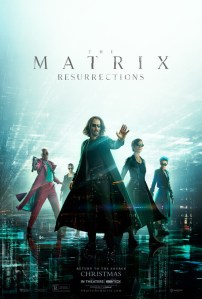 It is hard to overstate how influential The Matrix was upon its release in 1999. It rewrote the science fiction and action genres for Hollywood and introduced American audiences to many of the filmmaking techniques of Eastern cinema. It was exciting, philosophical, challenging, and made an instant brand out of the Wachowskis, the writing/directing siblings who had previously only directed one indie movie. The 2003 sequels were filmed back-to-back and released to great anticipatory fanfare and then, later, derision. The Matrix sequels, Reloaded and Revolutions, became a shorthand joke for bloated artistic miscalculation. They were talky, draggy, and just not what fans were hoping for jacking back into this strange world, and years later I think they’re worth a critical re-evaluation. Flash forward to 2021, and Lana Wachowski has resurrected The Matrix, and with the original actors for Neo and Trinity, both of whom died in Revolutions. Why go back? I think part of this was the declining career of the Wachowskis as directors. I personally loved 2012’s Cloud Atlas but it was an expensive and messy money-loser, the same as 2008’s Speed Racer and 2015’s Jupiter Ascending, a cosmically bad movie. So now it’s back to The Matrix with an older Neo, and older Trinity, and more of the same by design. The Matrix Resurrections just made me sad. It’s a movie that feels resentful for its own inception.
Thomas Anderson/Neo (Reeves) is living out his life as an award-winning game designer. His company and business partner, Smith (Jonathan Groff), are looking for their next big hit, and they’re looking backwards at Anderson’s biggest success… the “Matrix trilogy.” It was a virtual reality program that skewered the difference between reality and fiction. Mr. Anderson might have even based the role of Trinity on Tiffany (Carrie Anne-Moss), a woman he has grown infatuated with over time at a coffee shop. Except Mr. Anderson is having trouble determining what is real and what is only in his head. That’s because a new, younger Morpheus (Yahya Abdul-Mateen II) is telling him that he’s Neo, that he’s destined for greater things, and that he’s been kept in an unorthodox prison to keep him out of the action. Everyone seems interested in reactivating Neo, but for what purpose, and what has happened in the ensuing decades since the end of the war with the machines?
 Part of my struggle with Resurrections is that it too is struggling with its own existence, and not in a meta-textual sort of identity crisis, more like a reason to carry on 18 years later. Fair warning, this movie is far, far more meta than you are anticipating. The entire first hour of the movie features characters justifying rebooting “The Matrix,” the game. It’s a movie where characters glibly talk about parent companies going forward with the IP with or without the involvement of the original creators, so better to be the one trying to staunch the bleeding I suppose. A character literally says Warner Brothers wants a new Matrix and they will not stop until they get one. There are characters that sit around a table and try and break down what made the original Matrix (the game) so cutting-edge, and every person has a different brand slogan. “It was edgy.” “It blew your mind.” “It was a thinking man’s action story.” This prolonged section of Resurrections feels entirely like Wachowski speaking directly to her audience and saying, “Look, I had no reason to be back here. They forced my hand, and I want you to know that I’m not happy about it.” There are literal moments from the 1999 film that are presented as if the characters in the matrix are watching The Matrix to recreate scenes like avid cosplayers. There is one part where a character just starts screaming the word “reboot” with profane intention, promising to get their own spinoff as a threat. The entertainment industry satire about reboots and cash-grab sequels is funny but misplaced and coming from a perspective of defiance. If this was all the movie was then it would have been a fascinating example of an artist burning the bridge to their most successful franchise out of willful spite. However, if we had our own little focus group and asked what made the original Matrix so enjoyable, I doubt anyone would list, “entertainment industry satire and meta humor.”
The Matrix movies are well known for being a smarter, more ambitious viewing experience (“A thinking man’s action story”), blending philosophy and mysticism into anime-style action and kung-fu fights. There’s an intentional repetition here, built upon delivering something familiar and safe to audiences but with a “next gen” feel. We have a new Morpheus and a new Mr. Smith here, but did we require either? When they go through the motions of patterning themselves on characters of old, it feels strained, it feels gassed, and it’s another instance where Wachowski telegraphing to her audience, “Look, the studio demanded I bring back these characters, but I’ll be damned if I know what to do with them.” Morpheus has a little more story leverage as a catalyst for bringing Neo back to his path of enlightenment. Truth be told, I don’t really know half of what was happening in this movie, which lacked the elegant connectivity of the best action movies, linking cause and effect (the Merovingian would be proud of me) and pushing the movie forward to its inevitable conclusion. Even the prior movies felt more like the creators knew what was going on, even if the audience was lagging behind. With Resurrections, it feels like Wachowski and her screenwriters, novelist Dave Mitchell (Cloud Atlas) and Aleksandar Hermon (Sense 8 finale), have just given up trying to make sense of it all.
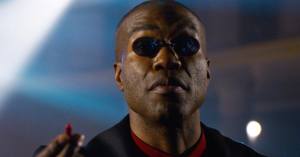 Another disappointment is the lack of any signature or memorable action sequences or, in the words of the Matrix round table, moments that “blew your mind.” The use of phones as transport in and out of the matrix has been replaced with mirror portals and doorways, which initially got my hopes up. There are such playful visual possibilities incorporating portals into action (see: Doctor Strange, even Matrix Reloaded), and I felt that Wachowski was up to the imaginative challenge. It too feels like another element that barely registers. The movie takes the anyone-can-become-an-Agent threat of the original trilogy and says, “What if instead of facing deadly Agents, it was just dumb zombies?” The new machines decide to rely upon a hive-mind system of grabbing whatever humans are in the vicinity and taking control of them into mindless foot soldiers. Let’s explore what a downgrade this is. The Agents were dangerous because they had powers that ordinary humans could not hope for, like the bullet dodging. In this movie, ordinary people are easily foiled and often a pathetic excuse for super-powered adversaries. The final act involves an escalation in numbers of the hive mind, but we’ve already been here with the multiple Agents Smiths of the sequels. There is one disturbing change-up where the machines realize how humans can just serve as canon fodder that is dark but a more effective attack. Even the requisite martial arts battles and gravity-defying wire work are humdrum this round.
If there is one thing that Resurrections does well it’s staking its identity out as a romance. Much of the second half prioritizes the relationship between Neo and Trinity, which was always taken for granted in the sequels. It was a romance of more utilitarian purpose, providing Neo with a love interest to motivate him to be saved in times of great peril. With Resurrections, the movie actually takes time to devote to Neo and Trinity as people with desires and what they would find appealing about the other. He’s not the savior of mankind, and she’s not his gateway to knowledge and empowerment. They’re portrayed as people, somewhat unhappy in their lives, and just hoping they might have another chance meeting at their shared coffee shop for one more electrifying conversation. The evolution of the movie places even more importance on this human connection, so I’m glad time has finally been given to exploring what it is that connects Trinity and Neo, especially if their love story is going to play as prominent a resolution to Resurrections. If you have never cared about Trinity and Neo as a couple, then you’ll likely be in for a disappointing second half.
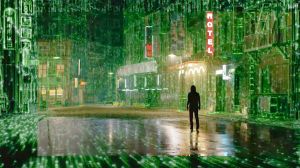 From a technical standpoint, Resurrections is still a feast for the senses. The photography is moody and atmospheric. The musical score is pumping. The special effects are state-of-the-art. There are a lot of talented people working on this sequel. So why then does the movie feel so perfunctory? In some regard each Matrix sequel has felt this way, adding extraneous pieces onto an already perfect standalone film. Having re-watched both Reloaded and Revolutions again, I can affirmatively declare Resurrections to be the weakest Matrix entry yet. We were all a bit too harsh on the prior two Matrix movies, which fall short of capturing the original’s magic alchemy but bring the goods when it comes to memorable set pieces, eye-popping visuals, and narrative zigs instead of zags (It was undercutting audience expectations before it was cool). They are still a bit too stuffy and talk in circles, but there are definite Major Ideas percolating underneath. In contrast, Resurrections feels more powered by resentment, by Wachowski coming back to this world against her better wishes and judgements. Maybe we should have left things alone.
Nate’s Grade: C
Share this:

Memento (2001) [Review Re-View]
 Released March 16, 2001:
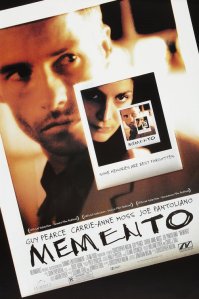
A film is taking the nation by storm and it isn’t anything from a big studio. In fact it’s the first release of a new indie production house called New Market, and these people have lassoed a real winner. Memento is a murder mystery bubbling with perfect elements of noir, suspense, and trickery. Memento is the tale of Leonard Shelby (Guy Pearce) who is searching desperately for John G., the culprit he believes that raped and murdered his wife. Along the way Leonard gets assistance from his friend Teddy (Joe Pantoliano) and Natalie (Carrie Anne-Moss), a down on her luck bartender.
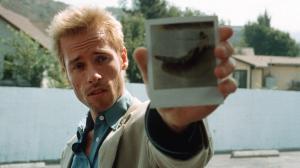 Except Leonard has a peculiar problem plaguing his one-man investigation for justice. After the attack on his wife the assailant knocked him out, and Leonard was left with no short-term memory whatsoever. Leonard cannot develop new memories. So if something happens to him, he is liable to immediately forget it within five minutes. To aid himself he write on small post-its telling him which car is his, what hotel he’s at, etc. all over his body are tattoos of clues he has amassed. He takes Polaroids of people and writes their names on them to remind him of the faces he sees that he won’t remember. Leonard’s investigation is about what his notes tell him. He doesn’t know whom he can trust and whom he cannot.
If this wasn’t enough to make Memento interesting the entire tale is told out of sequence and run from end to beginning. The entire film is told backwards. This action robs the audience of the same information that escapes Leonard. We too know neither who to trust. The effect could fall into gimmick territory but makes the movie fresh and adds for some great comic situations as well, like when Leonard awakens with a bottle of champagne in his hand and tells himself he doesn’t feel drunk.
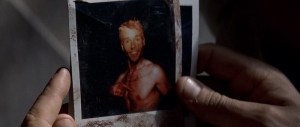 Pearce is gripping as the emotionally shattered and fractured Leonard. He is a man that can trust nothing and must live from repetition but is intent on bringing his wife’s killer to bloody justice. Pantoliano and Moss provide good support as the weary characters that weave into Leonard’s plight. The acting it excellent all around. They leave us guessing and reassembling our perceptions as more of the puzzle unravels.
Memento is top-notch film noir. It’s a breathless thriller of a first rate caliber. The direction given by Christopher Nolan from his screenplay is tight and highly effective. The character of Leonard is fleshed out in all his paranoia, pain, and frustration. Nolan has delivered a gift to movie audiences always hungry for fresh material. One has to see the film a second time just to see how well the segments play together.
Memento is the coolest movie around. Rush out and see it, then see it again, and then again. It’s the best movie of 2001 by far as of now and has the Best Original Screenplay Oscar locked [Editor’s note: it lost to Gosford Park of all things.] It’s destined to be a cinematic classic people will talk about for years.
Nate’s Grade: A
——————————————————
WRITER REFLECTIONS 20 YEARS LATER

Without a doubt, there has been no filmmaker that has had the meteoric rise over the last twenty years than Christopher Nolan. The man has entered that rare, hallowed upper echelon of the Steven Spielbergs and Quentin Tarantinos where his name alone is the selling point. You go to see a Nolan movie because you know it will be an experience that no other filmmaker can quite deliver, and from 2005’s Batman Begins onward, he’s been given immense studio resources and unchecked creative control to make his big dreams come true on the biggest stage. It’s thus very fun to go back to the little 2001 indie movie where it all started for the future box-office titan. It has many of the hallmarks that have followed the director’s ascendant career, like dead wives as back-story, cool emotions, an unreliable protagonist, and especially its crackerjack, air-tight narrative. Memento already had a dynamite premise, an amateur investigator seeking justice who couldn’t hold new memories because of a mental condition. It was based on an unpublished short story by his brother Jonathan (future frequent collaborator and creator of HBO’s Westworld), which is why it qualified as an original screenplay at the Oscars, to which it would eventually lose out to Gosford Park (go figure). Nolan deliberately made the story even harder to follow in a gambit that would come to define his screenwriting experimentation. He told the entire movie backwards, so that the story began at its ending and finished at its beginning. Every few minutes, we, like our memory-challenged lead Leonard Shelby (Guy Pearce), are left to ask, “How did we get here?” It puts you in the stark position of the lead’s perplexed and scrambling sensibility. It’s a raised bet of a storytelling check, one that Nolan delivers with incredible panache, but twenty years later, is Memento more than a brilliantly executed magic trick?
 Even after watching Memento likely half a dozen times in my life, this is still one very confusing movie to follow. There are two current storylines that crisscross and eventually overlap, like tributaries reconnecting to a source. The black-and-white segments of Leonard narrating his rules, tattoos of key clues, practices, and investigative successes as he narrows his search for the mysterious “John G.,” the man he claims assaulted him and his wife, are filmed more objectively, playing out in linear fashion, given to rampant exposition to better orient the audience to the tricks of the movie. The color segments are the main action, watching Leonard go from murdering a confidant to then explaining how we got here, roping in scummy drug dealers, violent men, sad-eyed barmaids, and people looking to take advantage of Leonard and his unique disability (the motel owner rents him multiple rooms). These sequences are played in the backwards trajectory that drives the movie, so every pit stop essentially resets the movie as we know it. It’s an amazing device because it makes every scene its own little movie with its own little payoff, with a dopamine reward for seeing how the opening of the last image came to be. Some of these are played for laughs but many are extremely well thought out to keep an audience guessing. Leonard opens a closet to find a beaten and gagged man who swears it was Leonard who did this to him. Leonard begins in mid-chase, seeing a man running parallel to him. “Oh, I must be chasing this guy,” he comments in voice over, until seeing the man’s gun in hand and his advance. “No, he’s chasing me,” he corrects, and runs in the other direction. Then there’s the question of who Leonard can trust, and your assessment of the supporting characters in his orbit will shift. You’ll feel bamboozled just like Leonard, that is, if he could remember. The backwards-narrative allows Nolan to make his revenge thriller so much more mysterious and audacious and playful, and the director takes full advantage of the possibility. It’s a rare screenplay of near genius quality.
On a later DVD release, there was a hidden special feature that could be unlocked that would play the movie in chronological order, and I feel like this would be like watching a magic performance with X-ray vision. It would completely take away the appeal. While I think the level of details and continuity and thematic connections would be even more apparent with more traditional, linear plotting, it would seriously negate much of the fun and potential of the movie. That’s not to say that Memento is only effective because of its narrative shuffling. It’s still a lean thriller with a brimming confidence that can give you an artistic contact high. The character of Leonard Shelby is a fascinating and tragic figure worth exploration, which the movie allows for deeper discussion off-board. However, when you’re witnessing a thoroughly thought-out magic trick that is performed at such a heightened degree of excellence, why blow it up with asking for convention?
It’s also fun to revisit the 2001 movie and see many of Nolan’s staples of creative collaborators. There’s his brother, who he’s co-wrote a very successful Batman trilogy with, along with Doddy Dorn as the editor (Insomnia), David Julyan (The Prestige, Insomnia) as the composer, and especially Wally Phister as the cinematographer who helmed every Nolan movie from 2001 to 2012, winning an Oscar for 2010’s Inception.
 I’ll preface these next two paragraphs with a spoiler warning, which I acknowledge is perhaps overdoing it for a movie that’s been available for twenty years, but I’m going to discuss the ending (beginning) of Memento and its implications, so if you’d prefer to be surprised and are one of the people on the planet who hasn’t seen this movie, or been spoiled, then go watch it and then come back to this review. The through line of Memento is Leonard’s murder of “John G,” a.k.a. Teddy (Joe Pantoliano), a supposed ally that may work in law enforcement. The movie becomes a question over whether Teddy was guilty or whether Leonard was manipulated from beyond, and this proves to be the case, though the culprit is rather unexpected. It’s not Natalie (Carrie Anne-Moss) seeking vengeance for her dead drug-dealing boyfriend, though she plays her part, but the real manipulator is none other than Leonard himself. Teddy has set up a fall guy for Leonard to take out to get his long-sought vengeance, and maybe he can remember to be satisfied, but as Teddy recounts, it always fades. They’re always back repeating their old loops. Given the circumstances, Teddy sets up his pal to take out local lowlifes and figures why not profit from the experience (his warnings to ditch the drug dealer’s car go unheeded by Leonard, who instead chooses to drive it around town and even wear the clothes of his victim, a nice visual cue that leads to the big sucker punch reveal Nolan has coiled).
Teddy’s real offense, however, is telling Leonard a truth he does not want to accept. The back-story that has driven him is deemed fictional, conflated with an ongoing anecdotal analogy about Sammy Jankis (Stephen Tobolowsky), a memory-impaired man whose wife tests him that results in her overdose on insulin. Leonard’s wife survived the assault. It was she who overdosed on insulin to test her husband’s condition. This truth runs counter to everything Leonard has defined himself by and he rejects it, and through that hostile rejection, he sets Teddy up for a cruel fate. He ensures Teddy will be hunted down as the next “John G.” suspect, and thus Leonard actively chooses to live the fiction than deal with truth. In 2021, especially after four years of a pungent presidency that shamelessly warped reality to whatever was deemed preferable, and with millions of gullible Americans still falling for the fantasy, the story of a man choosing the comforts of self-delusion over uncomfortable accountability is striking for its topicality. It’s about the lies we tell one another. Leonard says he deals with facts because memory can be fickle, it’s unreliable, and then the script proves this to be exactly the case, having hidden the answer right in front of your face. I love that the implications can be deliberated even twenty years later and the question of whether Leonard is a secret villain. He believes he’s doing righteous work, but he also proves he can never be satisfied and will very likely continue to hurt others to sustain his preferred reality. Because of the narrative trickery, or limitations of building from a foundation, it’s hard to say that Leonard is a deep character rather than a blunt force instrument. It’s in the revelation and lingering implications where the depth of Leonard Shelby emerges, and I think it’s a depth that often gets overlooked by those trying to keep up with the admittedly confusing storyline.
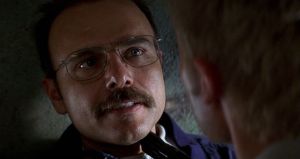 Revisiting Memento, there’s a definite nostalgia quality, watching two stars from The Matrix and the young upstart from L.A. Confidential bouncing around a Polaroid-snapping L.A. noir mystery from the man who would come to redefine blockbuster cinema. It’s not an understatement to say Nolan is in a class of his own, and his critical and commercial success seems to have convinced him that every movie needs his narrative sleight-of-hand. Some of those films didn’t really benefit from the extra complications. I thought the three timelines compressed on top of one another in 2017’s Dunkirk was entirely unnecessary and distracting. It got even worse in 2020’s deliberately palindromic Tenet, which was a puzzle box from Nolan I felt no desire to solve. Nolan has told movies with just about every construction of linear and non-linear plotting imaginable, and it’s hard not to feel like he’s struggling to find some new fix to hold his interest. Maybe the appeal of the Nolan signature magic trick is wearing off for me; I’ve been relatively disappointed with every Nolan movie since 2012’s Dark Knight Rises, which gets a bad rap for not being the zeitgeist-tapping flick that was The Dark Knight. Maybe he’s getting bored. It certainly felt like Tenet was more an intellectual exercise than an accessible entertainment for the masses. It would explain his experiments with indecipherable sound design. You don’t go to a Nolan movie to turn your brain off. There is an explicit demand that you will need to pay close attention. It just feels like the later films haven’t quite been worthy of the extra efforts.
Back in 2001, I recall being blown away by the narrative trickery of Memento. It was my top movie of that year, tying with Moulin Rouge! before I decided my heart was more aligned with Baz Luhrmann’s glitzy extravaganza (I’m looking forward to revisiting this one in two months). I didn’t have much in the way of critical analysis in 2001 beyond my exaltation of its greatness, declaring it a new classic that people would talk about for years. That’s partially true, but mainly because of the huge career that Nolan has undertaken since. My original review was also certain it would win that Best Original Screenplay Oscar and, honestly, this one still befuddles me (Gosford Park?). Twenty years later, Memento is still a daring and confusing movie, one that rewards close reading and invites deliberation and deconstruction. It’s a top-grade magic trick from an excellent illusionist and sometimes even that is enough. While I would argue it is more than its famous gimmick, it’s still enough to warrant two viewings for everyone’s lifetime.
Re-Review Grade: A
Share this:

Disturbia (2007)
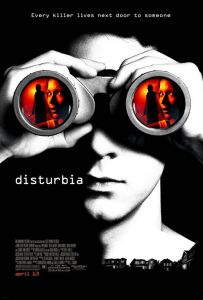 This Rear Window for the Facebook generation starts off strong with a solid performance by Shia LeBouf, but then quickly unravels once the filmmakers think they’re desperately running out of time. The teasing mystery is set up well and elicits some interest, but then, as if afraid of lulling an audience to sleep with a story that takes its damn time, Disturbia throws everything and the kitchen sink at you in the last 20 minutes. The movie falls on its face (the metaphors are flying today) trying to make up for lost time with jump scares and lame thriller conventions. The end gets a tad absurd as well as Shia discovers his serial killer neighbor isn’t just a murderer, but he’s a home decorator on par with the creature from Jeepers Creepers. By the time Shia falls into an underground water cavern filled with corpses, I wanted to scream myself for such wasted potential to a film that seemed like a formless rip-off on the surface.
Grade: C+
Share this:

The Matrix Revolutions (2003)
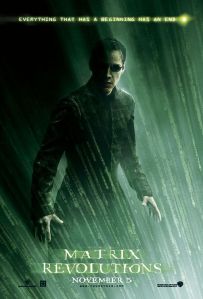 Four years ago the Wachowskis revolutionized the world of cinema, with their surprise sci-fi opus, The Matrix. Their mixture of philosophy, kinetic visuals, and inventive action with style to spare laid waste to all inferior action movies and gave birth to a cult of fan boys. Now six months after the second installment, The Matrix: Reloaded, were left to supposedly close the chapter on Matrix land.
Neo (Keanu Reeves) is caught in a strange limbo between the machine world and the real world. The only passage back to either is through the Merovingians chief hobo, the Trainman (seriously, he’s a hobo with teeth like a jack-o-lantern). Trinity (Carrie-Anne Moss) and Morpheus (Laurence Fishburne) travel to the most spastic fetish club imaginable for negotiations with the Merovingian. He agrees to give them back Neo if they will bring him the eyes of the Oracle, the prophet of the Matrix.
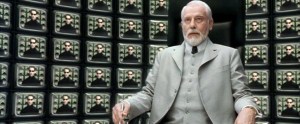
The rest of Revolutions takes place within two storylines. The first involves Morpheus and his former flame Niobe (Jada Pinkett Smith, finally getting a sizeable role she deserves) flying the last remaining ship of the human fleet back to Zion, the last remaining free human city, before the tunneling army of the machines breach the city walls. The other storyline involves Neo and Trinity flying a ship to the heart of Machine Town to have a face-to-face with The Wizard. They want to negotiate a peace between the two factions and put a stop to the increasingly uncontrollable rogue program, Agent Smith (Hugo Weaving), who, left unchecked, could destroy both the human and machine world.
 Reeves has never been confused with a serious actor, or even much of an actor for that matter. And sure, he has a penchant for being out-acted by inanimate objects, but his stint in Revolutions is stiff and wooden, like he’s just punching the clock to get through another day. It doesn’t help his case that half of his scenes involve the woefully inept romance between him and Moss.
The only person that seems to be having any fun in this overly serious melodrama with guns is Weaving. His Agent Smith character has morphed into the true star of the Matrix trilogy. Hes charming and even more likable than the dull-witted Neo. Weaving seems to love the drawn out line delivery, so much so he might be accused of abusing anti-depressants. His insidious cackles are a delight.
The plot of The Matrix: Revolutions has several head-scratching moments. Like the kid who yearns to be in the fight but is too young and clumsy. Anyone who’s ever seen any movie ever will know how that plot point turns out. Then there are questions like, why do people far in the future still use wheelbarrows to lug ammo around? Why, during a shoot-out at the fetish clubs gun check room, do people jump on the ceiling? Why would being on the ceiling make you any more difficult to shoot? The whole sequence comes off like a poorly done rip-off of the Wachowskis’ own bank lobby shoot-out from the original Matrix.
Revolutions is the least densely plotted of the three films. Now, one would think this would be a godsend, especially after the pretensions and bloated mess that was The Matrix: Reloaded. But theres nothing at all memorable in this third installment, and perhaps this is because everything but ten minutes of it takes place in the dingy real world. Who cares about a post-apocalyptic universe where the surviving subterranean humans wear rags and pull all-night raves? I’ve seen that stuff in a thousand other movies (maybe not the raves part, though). Everything is better within the virtual reality Matrix world; from the clothes to the gravity-defying cool acrobatics to the cinematography to, God help me for saying it, the acting and dialogue. At least Reloaded gave us the stylish goods when it came to that heart-thumping freeway chase.
Although Revolutions is a slight improvement over the tedious Reloaded, this is only because after seeing the third and final leg of this trilogy, it makes the second film look worse. The intriguing new elements of Reloaded, like the French Merovingian and his wife (the lovely Monica Bellucci), are now seen to be nothing more than dropped subplots. Even the coolest additions to the Matrix universe the ghostly twins- don’t even show up. Sigh. Now that I know where the story ends, the loose ends of Reloaded don’t justify themselves nearly as much as I would have liked.
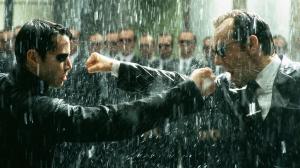
 The showpieces of Revolutions are two long battles in its final act. The first is a near-20 minute assault by the Sentinels, resembling flying mechanical octopi, against the defenses of Zion. It’s exciting for a while but battle fatigue settles in quickly. You can only watch so many CGI robo-exoskeletons shooting CGI machine guns at CGI flying machines as they explode in CGI explosions and CGI shrapnel. The effects are nice, and seem more polished than Reloaded, but the sense of imagination seems to be entirely absent. The second battle is the final fist-fight between Neo and Agent Smith in the pouring rain. Smith has duplicated himself enough to cover miles upon miles of high rises. The fight sequence is impressive and beautifully filmed, but it amounts to a big shoulder shrug after watching Neo battle 100 Smiths in Reloaded. The final confrontation in Revolutions is adequately satisfying if a bit under whelming and unmemorable.
The need for corporate coffers to ring has turned what was a great stand alone film into a mediocre franchise, one whose diminished hopes and lowered expectations can only be judged on par with the Star Wars prequels. My friend Colin equated watching The Matrix: Revolutions to a wet dream: momentarily satisfying but leaving one with nothing but pangs of emptiness. The Matrix trilogy doesn’t end with any sense of urgency; instead it draws to a close with a half-baked artificial fulfillment. The journey of Neo and Trinity and all the rest has come to a whimpering end.
Nate’s Grade: C
Share this:

The Matrix Reloaded (2003)
 Imagine my disappointment as I viewed the highly anticipated sequel to 1999s sci-fi smash The Matrix and learned that the writing and directing team of the Wachowski brothers had taken a page from good ole George Lucas on how to make sequels: the bigger is better and more is more approach. Like the first two Star Wars prequels, the second Matrix movie is overstuffed and unfocused. Unlike the Star Wars prequels, it’s also extremely talky when it comes to psycho-babble that would only impress the bong-carrying peanut gallery.
Reloaded picks up sometime after the first. Morpheus (Lawrence Fishburne), Neo (Keanu Reeves), and Trinity (Carrie-Anne Moss) are late for a pow-wow with other leaders including Morpheus former flame, Niobe (Jada Pinkett Smith). In this meeting, which is within the Matrix, we learn that the humans have discovered that the machines are drilling at an incredible speed and will reach Zion, the last human city far beneath the Earth, in a matter of days. Add this to the bad dreams Neo keeps having where Trinity falls out of a building and gets shot by an Agent, and things are not looking good for our heroes from the first film.
At Zion, Morpheus stokes up the crowd who already believe that Neo is The One in the prophecy of the Oracle (Gloria Foster). They believe he is the one who will lead them to topple the machines. Morpheus informs the many citizens of Zion (okay, the last battalion of the human race lives in caves under the surface and people are STILL wearing sunglasses all the time? Watch your heads.) that the machines are digging to a town near you, and they have 250,000 Sentinels to wipe out what remains of humanity.
 So what do people do next; what would your standard response be? Apparently, in Zion, it involves a massive spontaneous, sex-charged rave. The multitudes of Zion start grinding and sweatily dancing to electronic beats. And curiously, as youll notice with the slow camera movement in the scene, NO ONE in the future wears a bra. Perhaps the machines got those too. So after a tremendously long span of raving with nipples, intercut with Neo and Trinity knockin boots (though could you imagine zero-gravity sex in the Matrix?), the heroes set off to find the Oracle once more. Zion is preparing to mount a counterstrike against the burrowing machines and is hopeful that it will buy them some time. They plan on sending the entire fleet out, save Morpheus ship and one or two to aid him in his quest.
Neo finally regroups with the Oracle along a park bench inside the Matrix. She puts forth more psychological babble about choice and how choices are already made before you make them. You may start zoning out and wondering when people are gonna start punching people again, because it takes a good 45-50 minutes to get into this movie. The Oracle does have an interesting tidbit of information however. She reveals that the Matrix if just chock full of rogue programs living out their days in the confines of this virtual reality. Included in this group are werewolves, vampires, ghosts, angels which are all programming errors that walk among the Matrix. So, wouldn’t it be kind of neat to see Neo fight the monsters from Universal Studios (Hey Frankenstein monster … I know kung-fu Fire baaaaaaaaaad!)?
The supreme drawback of Reloaded is that it introduces us to a plethora of new characters, all with minimal screen time and even more minimal plot impact, and then fails to advance the story. Niobe is pointless except for the old action picture adage of being at the right place at the right time to rescue our seemingly doomed heroes. A rogue program that calls himself The Merovingian (Lambert Wilson), who decides on being a European playboy with an accent that renders all speech useless, snoots and huffs his way around. Monica Bellucci plays his wife. This Italian actress can be enthralling, and not just on the eyes, but she also serves minimal purpose other than some heaving chest shots. Then theres the Keymaker, who will somehow lead Neo to his destiny or whatever. Theres about fifteen or so new characters and hardly any of them matter. The coolest additions are the twins, a pair of pasty dreadlocked fighters who can go through walls and parry any enemy assault. More time is needed for these two before they turn into another wasted villain, like Star Wars‘ Darth Maul.
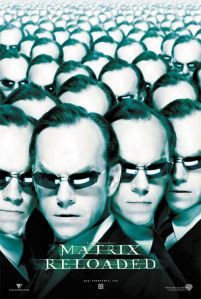
 All of this criticism is moot, of course, because the center of The Matrix is on inventive and pulse-pounding action, right? Well I’d say that is so with the 1999 film but its sequel suffers when its action sequences drone on and become repetitious and dull. Neo fighting twenty or so replicates of Agent Smith (Hugo Weaving) is interesting and fun, but when ninety more show up and its painfully and slightly embarrassing when the people fighting are CGI, then the fun level drops with the film. Neo ends the big brawl by flying away. My friend next to me whispered in my ear once this scene concluded, If he could fly, why didn’t he fly away at the beginning? My response: That would be using your brain. Seriously, this action sequence is nifty and all but it serves no purpose, just like much of the first half of the film.
The freeway chase scene seems to already be famous and with due cause. Trinity and Morpheus zooming through traffic, fighting Agents and the twins, is a fantastic set piece that is reminiscent of the inventive action the first Matrix gave us. When Trinity zooms through oncoming traffic on her motorcycle the film comes alive and my attention was certainly front and center. The scene does fizzle a bit as it segues into Morpheus fighting an Agent atop a speeding semi. Again, the CGI rotoscoping of the landscape and the people is painfully obvious and detracts from the enjoyment.
What ultimately kills The Matrix sequel is that no one had the heart to question if maybe more wasn’t better. Sure the Wachowski brothers had all the riches unto Caesar to make this movie, but what perplexes me is that once we do get much more it only feels like more of the same, and disappointment sets in. Agent Smith is shoved to the side of the film and pops up here and there to glare. He’s more or less just repackaged with nothing new and no personality, like much of the film. The purposely perplexing psycho-babble does not help. Im sure hundreds of websites will dissect the exact philosophical links the movie presents, but man, all this talking about stuff thats shutting down my brain is getting in the way of ass-kicking. I felt bloodlust the more I heard people, usually some old fruitcake, endlessly blab about causality and choice. When it comes to action-packed sequels from 2003, I’ll take X2 any day over Reloaded.
 This is not to say that Reloaded is a bad film because it does have some nice special effects, cinematography, and some cool action sequences. These points of interest do not, however, justify its bloated running time. Some things were better left to the imagination, like the city of Zion, which looks about as dreary and dull as you might expect the last bastion of human civilization to look like in a ruined world, but this is science-fiction. Where’s the fun in dreary and dull? Again, whereas the first Matrix took place mainly in the false virtual reality where we could watch fantastic feats defying the laws of physics, Reloaded spends half its time running around the dank real world.
Some moments did have me giggling, like the Merovingian’s joyous creation — an orgasm cake. A woman has a piece of cake and her temperature rises. Finally the camera zooms into her vagina (its in computer-code so its all columns of sexy green numbers) and we see an explosion of light. Very interesting indeed. Essentially, this is a key metaphor for the film itself: an attempt to have its cake and eat it too.
The Matrix: Reloaded is an occasionally entertaining and often mind-numbingly talky summer entry. Youll get some thrills, maybe the philosophy will connect more for some (even though to me, at the heart, they say very little very eloquently), but because The Matrix is a colossal franchise that will make a gazillion dollars and then some, the power of editing has been kicked to the curb. If that power had been present perhaps someone could have trimmed a few of the many peripheral characters, kicked the pace up a few notches, reworked the fight scenes to advance the plot and stopped events from being so repetitive, and while they were at it maybe they could have done away with all the philosophy and stilted love dialogue. As it stands, The Matrix sequel has lost a lot of edge and this is because of the initial success of the first film. Sure, you might have an intermittently good time, but you should have had a great time. The Wachowski brothers had every tool at their fingertips but they became so enamored with fame and fortune that their work of creativity and genius has morphed into a self-indulgent, adolescent (with its hormone driven sexual events and its stoner philosophy), cash cow.
Nate’s Grade: C+
Share this:

Memento (2001)
A film is taking the nation by storm and it isn’t anything from a big studio. In fact it’s the first release of a new indie production house called New Market, and these people have lassoed a real winner. Memento is a murder mystery bubbling with perfect elements of noir, suspense, and trickery. Memento is the tale of Leonard Shelby (Guy Pearce) who is searching desperately for John G., the culprit he believes that raped and murdered his wife. Along the way Leonard gets assistance from his friend Teddy (Joe Pantoliano) and Natalie (Carrie Anne-Moss), a down on her luck bartender.
Except Leonard has a peculiar problem plaguing his one-man investigation for justice. After the attack on his wife the assailant knocked him out, and Leonard was left with no short-term memory whatsoever. Leonard cannot develop new memories. So if something happens to him, he is liable to immediately forget it within five minutes. To aid himself he write on small post-its telling him which car is his, what hotel he’s at, etc. all over his body are tattoos of clues he has amassed. He takes Polaroids of people and writes their names on them to remind him of the faces he sees that he won’t remember. Leonard’s investigation is about what his notes tell him. He doesn’t know whom he can trust and whom he cannot.
If this wasn’t enough to make Memento interesting the entire tale is told out of sequence and run from end to beginning. The entire film is told backwards. This action robs the audience of the same information that escapes Leonard. We too know neither who to trust. The effect could fall into gimmick territory but makes the movie fresh and adds for some great comic situations as well, like when Leonard awakens with a bottle of champagne in his hand and tells himself he doesn’t feel drunk.
Pearce is gripping as the emotionally shattered and fractured Leonard. He is a man that can trust nothing and must live from repetition, but is intent on bringing his wife’s killer to bloody justice. Pantoliano and Moss provide good support as the weary characters that weave into Leonard’s plight. The acting it excellent all around. They leave us guessing and reassembling our perceptions as more of the puzzle unravels.
Memento is top-notch film noir. It’s a breathless thriller of a first rate caliber. The direction given by Christopher Nolan from his screenplay is tight and highly effective. The character of Leonard is fleshed out in all his paranoia, pain, and frustration. Nolan has delivered a gift to movie audiences always hungry for fresh material. One has to see the film a second time just to see how well the segments play together.
Memento is the coolest movie around. Rush out and see it, then see it again, and then again. It’s the best movie of 2001 by far as of now and has the Best Original Screenplay Oscar locked [Editor’s note: it lost to Gosford Park of all things.] It’s destined to be a cinematic classic people will talk about for years.
Nate’s Grade: A
Reviewed 20 years later as part of the “Reviews Re-View: 2001” article.


 nathanzoebl
You must be logged in to post a comment.