Blog Archives
Harry Potter and the Deathly Hallows Part 1 (2010)
 When author J. K. Rowling dropped off her last 700-page tome in the Harry Potter series, the world went into a state of mourning, right after ravishing every page of The Deathly Hallows. There would be no more literary adventures. You can expect that same sense of longing for the studio suits over at Warner Brothers considering the Harry Potter franchise has grossed over five billion worldwide. The bounty was about to be over, especially with one last book to adapt into an eventual overly long movie. Then the suits came across a genius strategy: split the last book into two separate movies. Filmed simultaneously over a year, Harry Potter and the Deathly Hallows will be released in two parts eight months apart. I understand that it’s hard to say goodbye to the boy wizard that charmed millions, and tow movies almost guarantee that nothing will be left out in the adaptation process. It also ensures that Warner Brothers will have two movies that make giant piles of money instead of one. Deathly Hallows: Part One plays its part setting up the finale, but judging from what we’re given, this series conclusion could have effortlessly been condensed to one overly long film instead of two.
Picking up shortly after the events of Half-Blood Prince, Harry (Daniel Radcliffe) and his best pals, Ron (Rupert Grint) and Hermione (Emma Watson), are on the run. Lord Voldermort (Ralph Fiennes) is determined to be the one to slay the boy wizard. Voldermort and his influence have taken over many facets of the magic world’s infrastructure, and they are all after Harry. Harry learned that his snake-faced nemesis has broken his soul into pieces and hidden them inside magical items known as horcruxes. Unless these horucruxes are destroyed, Voldermort will never be able to truly die. Harry and company has to hunt down those accursed horcruxes while being hounded by evil forces determined to kill them all.
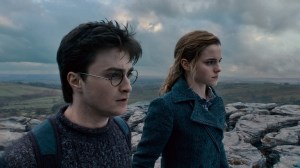 For a solid hour I felt like I was watching the second best Harry Potter film; Alfonso Cuaran’s Prisoner of Azkaban still stands as the artistic highpoint. Watching the characters on the run and constantly in peril spurs your protective feelings. We’ve seen them grow up, vanquish evil and hormones, and now they seem to be in serious danger and you feel real tension. I stopped to realize how much I actually cared for these characters and how concerned I was. There is a somber sense of finality, and I enjoyed characters and events colliding back together for one big finish. It truly feels like everything is coming to a titanic close, and the film manages to be the most emotionally satisfying of the series. That’s likely because it’s building off six films of character growth and goodwill. But it’s also due to the fact that Deathly Hallows spends the most time examining the characters of Harry, Ron, and Hermione. The series has followed a very lockstep plot formula and now it’s been stripped away. The kids are removed from the school setting so we get to spend plenty of time alone with the trio. In fact, it’s a bit too much time. We spend an interminable amount of time with these kids lost in the woods, waiting for something important to happen. While we wait we have the trio address fears, anxieties, and emotional hang-ups, which turns Part One into the most insular, reflective movie in the entire series. While this makes the movie rich with feeling before we come to the finish line, it also makes the film somewhat boring because these kids aren’t that deep.
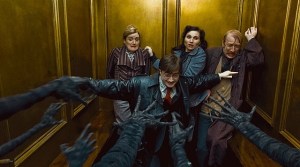
Luckily, Deathly Hallows Part One presents some of the more exciting action sequences and tense mood yet for a franchise mostly built upon investigation and Hardy Boys stuff (with extra magic!). The Harry Potter world has always been more interesting to me the darker it got, and now the series has now firmly converted to the dark side (as far as PG-13 fantasies go). The opening shows each of the three kids being left alone, including Hermione protecting her Muggle parents by wiping away their memory of their daughter. Tough stuff. Then we transition to a floating Hogwarts teacher held prisoner by Voldermort and his legion of Death Eater followers. She’s struck dead and we see a tear roll down her bloodied face right before Voldy’s pet snake eats her. Parents be warned, this is no longer kid’s stuff. Death comes to several supporting characters and there’s plenty of spooky stuff that adds up to a gloomy atmosphere. The infiltration of the Ministry of Magic is a thrilling sequence. Harry and pals disguise themselves as Ministry workers to locate a horcrux from Dolores Umbridge (I cheered at the sight of Imelda Staunton back in pink). The scene is tense and lays out the stakes and important characters to fear. It also produces some potent drama as Ron is disguised as a Ministry member whose innocent wife is being interrogated. The moment culminates in a genuinely exciting chase sequence that got me excited for what was ahead. What I failed to realize is that there was not much more ahead.
 With all that extra attention spent on character, I can also say that Part One has some definite issues with its stagnating narrative. Having never read the books (get over it, Potter nation), I go in blind every time short for the mega-spoilers that I can’t help but learn thanks to all the Potter readers inhabiting my circle of friends and family. I can tell you if something doesn’t make sense because I don’t have the background knowledge of the books to fill me in. There was plenty in Deathly Hallows that made little sense. The adaptation introduces the titular deathly hallows, which ends up being another three super special magic items. There’s a nicely Gothic animated sequence to try and explain the three hallowed items, but it all adds up to a fairy tale that makes little traction. The narrative has already shaped up into a portentous scavenger hunt. Harry and friends are after the remaining horcruxes containing the soul of Mr. Snarly Face. The entire 145 minutes of Part One is spent destroying a single horcrux, leaving 3 or 4 remaining. Now they add three more magic items to find and it all compounds my feelings of fatigue. Did I mention they also have to find a magic sword? How many magical items are these kids going to be responsible to find and how many am I expected to care about?
I left the theater with many questions about what the hell the deathly hallows were, why they mattered, and all sorts of other storylines too. I could not follow all the new characters they threw so late into the game, especially some old wand maker and his connection to wand thievery. And when the hell did everyone gain the ability to teleport at will? Why don’t they teleport all the time then, especially out of danger or when they’re chased through the woods? My friend (an avid Potter reader) had to deal with a litany of stupid questions, likely treating me as a parent would a child asking about where the sun goes when it becomes night.
Also, the film is intended to be a prelude for an epic finale but it mishandles its own sense of climax at several turns. I’ll refrain from heavy spoilers, but one of the most interesting characters, played by an actor I adore, is killed off screen. Off freaking screen! Some other character comes back and says, “Oh yeah, he’s gone,” and then everyone looks glum and goes about their business. It happened so matter-of-factly and anticlimactically that I never made the connection. So later in the film when it’s confirmed that this character is in fact dead, I felt pretty thick. The last chapter of Harry Potter is destined to be a combined 5 hours, and you’re telling me they couldn’t fit in a fight scene that lets this character go out with style? I suppose somebody thought it was more dramatic to just mention a character death offhand. Following this logic, I can’t wait for the grandiose finale where Harry Potter just walks back into a room and says, “Oh, by the way, I just killed Voldermort. So who wants to get a bite to eat?” The emotional climax of the film involves the death of a supporting character I have yet to see onscreen for 8 years. How am I supposed to feel for a character that hasn’t been seen for so long? The ending is sad, sure, but it would have been more effective if: a) I knew what significance the character had in the narrative, and b) it didn’t look like Harry was clutching a rubber doll to his chest. We spend too much time with new characters that end up having minor worth or come across as one-offs. The movie would have benefited from some of the deathly exposition that clogged the first two film’s storylines. As the movie comes to a close it should be clearing things up instead of polluting the narrative with more names and faces.
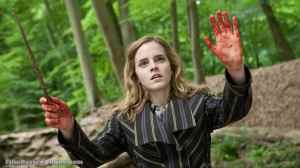 Director David Yates has been captain of the Potter helm since 2007’s Order of the Phoenix, and he seems to have found a unifying visual balance for the series. The film’s tone has gotten heavier and having a singular director take the series to an end looks to be a godsend. Despite a lengthy slog in the middle, Yates keeps the pacing fairly tight and tense. The visuals and special effects are just as luminous as ever. The true treat for me is watching all these splendid British actors assembled: Alan Rickman, Ralph Fiennes, Imelda Staunton, Helena Bonham Carter, Timothy Spall, Jason Isaacs on Team Evil, and Brendan Gleeson, David Thewlis, Rhys Ifans, Julie Waters, Robbie Coltrane, Michael Gambon on Team Good. Then there are new additions like glass-jawed David O’Hara (Wanted) and the great Peter Mullan (Young Adam) making strong yet short appearances. I don’t really care why all these talented thespians are together but I’ll enjoy them all the same.
Harry Potter and the Deathly Hallows: Part One is the beginning of the end, literally a prelude for the finale coming to theaters in summer 2011. The film manages to be exciting and dramatic and equally boring and confusing, especially for someone who has willfully refused to read the books. Spending more time with the teen actors has its pluses and minuses, chief minus being that while they wait for stuff to happen so do we. The manufactured end point for the movie feels far from satisfying, but the film manages to effectively whet the appetite for the follow-up. As the Harry Potter series comes to a close it’s hard not to get nostalgic and apologetic, but I resist this urge. Looking back, many of the Potter films have been fine pieces of entertainment but also too long, misshapen, and too slavish to making a book on tape. Part One of Deathly Hallows still falls victim to some of these faults, but the accumulated goodwill of the series and actors makes a 145-minute prologue easily bearable.
Nate’s Grade: B
Share this:

Green Zone (2010)
 I have noticed that I’ve really been dragging my feet when it comes to writing a Green Zone review. I’ve prioritized it only to have something more necessary (catching up on VH1 reality shows) come to the forefront of my attention span. It’s not like the movie is bad. It may have been misleadingly advertised as Jason Bourne’s tour of Iraq, bringing back together Matt Damon and director Paul Greengrass (The Bourne Supremacy), but it’s not bad. It’s a perfectly fine movie, except in this instance, given the politically explosive and monumentally relevant subject matter, “perfectly fine” sounds like a missed opportunity. This movie should be incendiary, shocking, aggravating, enlightening, and if it happens to be entertaining then that ain’t bad either. The subject matter –the false rationale for war, WMDs– deserves a sober examination. Green Zone is not that movie. Green Zone is about uncovering and righting the mistakes of the Iraq War, and I believe I figured out what keeps Green Zone from being a better, more powerful, more engaging movie — it fictionalizes a story that is already wroth telling. This is a true story that could have stood well on its own merits.
Shortly after the fall of Baghdad in 2003, Chief Warrant Officer Roy Miller (Damon) is on the hunt for those weapons of mass destruction (WMD), the chief argument for invading Iraq. His team investigates suspected weapons sites but they keep coming up empty. The intelligence appears to be in sharp contrast with the reality on the ground. Miller butts heads with shady government officials (Greg Kinnear) and finds aid in a state department realist (Brendan Gleeson) and a reporter (Amy Ryan) who put her reputation at stake parroting the government intelligence as fact. The Iraqi army is disbanded and now the former generals under Saddam Hussein are conferring what the next steps should be. General Al Rawi (Yigal Naor, who played Saddam in a TV mini-series) is waiting for the Americans to extend a hand, and if not then they will become an insurrection. Miller is racing to track down Al Rawi because he knows the truth in the lead up to the war, which is why those shady government officials are also trying to kill him.
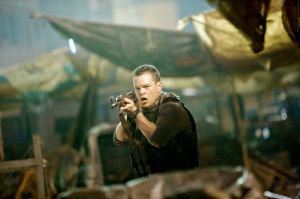 Based upon reporter Rajiv Chandrasekaran’s book Imperial Life in the Emerald City: Life Inside the Green Zone, the filmmakers have resorted to a fictional narrative informed by the real events. My biggest gripe is this: the true story is far more interesting, complicated, and relevant than concocting a story about one military man’s search for answers. The film is laid out like a conspiracy thriller, where our hero gains a small sliver of information that leads to another piece, and another and another, until finally a picture emerges. I get it. With Damon as a soldier, the audience has an obvious rooting point, a protagonist who we can easily be labeled as good. And then when he uncovers the truth, and alerts the media, it provides a tidy, satisfying end for the movie. Except that’s not what happened. In the real world, the hunt for those phantom WMDs carried on for months, and the news trickled drip by drip. There were no smoking guns, no white knights to shine the light of truth (Joe Wilson and Valerie Plame might be the closest in consideration), and there wasn’t anything as conclusive as a military officer writing a report and sending it the mainstream media.
Green Zone attempts to craft a satisfying close to the WMD hunt and likewise the war itself. This is nothing more than revisionist wish fulfillment, wanting to insert a hero of conscience and ability during a time where we had a malaise of responsibility from those in the realms of higher command. And just to make sure they don’t make too many waves, Greengrass and screenwriter Brian Helgeland (Mystic River) wrap their crusading character in the uniform of America’s finest, making it difficult to criticize his noble hunt, striping away politics. The trouble is that the Bush Administration rarely made apolitical decisions; everything was steeped in politics, even the truth about weapons of mass destruction. So Green Zone does the audience a disservice by trying to play nice, setting up a villainous fictional straw man, and forgoing naming the names of those that led this country astray. Because of placing the film’s point of view squarely with Miller, we never get to examine the bigger picture, the manipulations and machinations that led to war. We are stuck in a very limited focus of finding the WMDs.
 Now, I must ask whether or not I’m unfairly judging the movie. Hollywood has often taken fascinating and momentous true-life stories and redirected them toward fiction. Green Zone is certainly a technically proficient film. Greengrass’ trademark shaky camera is ever vigilant, always roving and looking for the action; although in a realistic war setting, the kinetic handheld camerawork can come across as potentially hyperactive. Conversations between two people can come across like intense linguistic battles. Walks down hallways can appear to be speedy jaunts brimming with purpose and anxiety. The tension just doesn’t materialize. Without a nervy story, the Greengrass visual staple can seem over the top, antsy, nervous, and also annoying. This is one narrative for Greengrass that could have improved by the dedicated use of a tripod.
Green Zone is not Bourne at all. The Universal marketing team was trying to hoodwink the public into seeing an Iraq War movie. Damon isn’t as polished and in command as Bourne. Those who argue that Green Zone is anti-American or anti-troops are grossly missing the point. Reactionary, bellicose rhetoric, without a wit of substance, is part of the reason the U.S. is currently in Iraq. You can argue against policy, including war policy, and still be considered a patriot. Patriotism is not synonymous with warmongering. It’s too bad that the filmmakers felt that the true story wasn’t good enough to be told, instead settling for a decent if unmemorable political thriller. This adaptation takes the most significant foreign policy event in modern American history, one where the ramifications will be felt for over a generation, and clears all the hard-boiled details to attach a conventional one-man-fights-for-truth tale. It’s hard to get self-righteous when the movie keeps trying to cover its own ass.
Nate’s Grade: B-
Share this:

Beowulf (2007)
 Taking note of director Robert Zemeckis’ new motion-captured animated version of Beowulf, I began to wonder what other classic works of literature could use a good CGI sprucing up. Dusty old tomes would have greater relevancy to the youth of today if they were coated in animation and presented in a 3-D format. Just think of the works of Jane Austin with a flying, zooming camera and the aristocratic families repeatedly jutting marriage contracts toward an audience. This might be the only way to make The Great Gatsby tolerable.
The 1000-year old story begins in the dining hall for King Hrothgar (Anthony Hopkins). Their loud and drunken reverie is interrupted by the monstrous creature Grendel (Crispin Glover). The creatures rips men apart, lays waste to the hall, and munches on a few heads for the long journey back to his cave. The King offers a reward for anyone who can slay the monster and bring peace to the Danish lands. Enter Beowulf (Ray Winstone), a determined warrior and competitor who seeks eternal glory. He brags that he will kill their monster and then kill Grendel’s mother (Angelina Jolie) next. However, the slinky lass offers a tempting promise that she can make Beowulf the greatest story in all the world.
 This is not the same Beowulf you were forced to read in high school English. I confess never having read the 3,183-line ye olde English poem, but I don’t think it had scenes of burping, public urination, a “coming” sexual joke, and some unexpected man-on-monster action (not the kind you’d readily think). This is a bloody and often exhilarating retelling intent on jazzing up a classic work for a younger generation. The action sequences have tremendous scope and can be relentless, and when witnessed in 3-D they are even more immersive and breathtaking. Stepping aside from the thrills and chills, Beowulf also works as a cautionary tale about the dangers of lust and particularly pride. Beowulf is a boastful and arrogant fellow, enough that he chooses to fight Grendel in the buff so that it will be even more challenging and thus ego stroking (as they battle, objects conveniently obscure the audience from seeing Beowulf’s manhood). The main deviation from the poem, connecting the various characters on a much more personal level, works with he context of the story and the overarching theme about the costs of vanity.
I encourage all potential Beowulf ticket-buyers to seek out where their nearest 3-D screening resides and to plan and, if needed, carpool to that theater immediately. This thing is meant to be seen in three dimensions, and in that environment Beowulf is amazing to behold. This is my first encounter with the next generation of 3-D and it is a giant leap beyond the funny glasses with blue and red lenses. Hollywood has hopes that this technology will be the next great invention that drives people to the movies and turn it into a unique experience that cannot be duplicated in the quiet privacy of your own home. I must say I was thoroughly impressed with how immersive the process becomes. Beware, though, because of the deep focus your eyes will dart around the screen resting from object to object, marveling at the different planes of depth; you may feel some strain and a headache after awhile. Objects keep sneaking into your peripheral vision and the movie takes many opportunities to hurl things at the screen, and thus the audience, be they coins, swords, arrows, limbs, heads, pots, and blood splatters. The CGI animation coupled with the 3-D technology makes for a compulsively stunning first-rate spectacle.
The visual look is a great step forward from 2004’s The Polar Express, the first time Zemeckis used his newfangled motion-capture toys. I really disliked the look of Polar Express, and the kids and their dead, glassy eyes creeped me the hell out. I’m still not entirely sold on what motion-capture even brings to the world of animation; to me, it seems like animators can dictate movement just as well as copying from an actor. Where the animators do make strides is in their depictions of real people. It’s not photo-realism, in fact sometimes the characters look like plastic dolls, but you can see all the pores in the skin and follicles of hair in bristling detail. The look of the movie reminded me a lot of the video game God of War, especially when Beowulf is slicing and dicing one-eyed sea monsters. I think that’s a pretty fair assessment ultimately, that the film better resembled a slickly produced video game cut scene than reality.
 In the end credits, I noticed that someone is specifically singled out and credited for the design of Grendel’s mother. I’m all for credit where it’s due, but Grendel’s mother was simply designed as Angelina Jolie with a tail coming out of her head. The character design looks remarkably like its big name actress and she struts around mostly naked, though her body drips with a melting gold finish that stops the nudity from having any real definition (it’s kind of like she’s in a melty candy shell). This may be enough for frisky moviegoers that must have missed out on the other movies Jolie bares her flesh for, or perhaps the head-tail fetish folk will finally have their day. It makes a lot of sense for Zemeckis to choose Jolie for the seductress role. It seems that mortal men just can’t help themselves around her and they end up doing the nasty, which produces little nasty creatures. If there were anyone in today’s world that could make men weak with overwhelming lust, it would be Jolie. Just ask Brad Pitt.
The character work on Grendel, however, is fascinating and startlingly grotesque. He resembles a cross between Frankenstein, Dobby the elf, and a coffee pot, all covered in rotting, patchy skin. The amount of detail is amazing and simultaneously stomach-churning. Glover offers a magnificently eccentric frame to build from. Grendel comes across less like a monster and more like a misunderstood wretch that just wants some peace and quiet by any means necessary. The screenplay gives Grendel some deeper backstory and a motivation for his murderous rampages (the poor guy is hyper sensitive to music, which blares in his head and causes agony).
Beowulf does have some slow moments and a noticeable lag in the middle before it sets up a climactic dragon battle. I was actually starting to nod off somewhere along the middle. The screenplay, adapted by Neil Gaiman and Roger Avary, squanders a load of underwritten characters, like a queen, a young concubine, and a religious advisor that asks if they should also pray to this new Roman God, Jesus something or other. Zemeckis is too enamored with the 3-D technology at his fingertips and clutters his screen too often to play around with the depth of field. I cannot fathom how this movie would play out in a regular 2-D environment, but needless to say, I’m sure the constant barrage of things pointing at the screen would get old quick.
Beowulf is a rousing and thrilling experience when seen in its intended 3-D format, otherwise it might get a tad tiresome and the visuals would come across as less accomplished. Zemeckis is getting better acquainted with the limitless freedom his motion-capture technology afford him and his imagination, however, I mourn the loss of Zemeckis ever directing another live-action film again. He seems to be completely taken with his technology and while it will improve with age I just wish the man who gave me so many wonderful movies like Back to the Future and Who Framed Roger Rabbit? would just go back to basics.
Nate’s Grade: Movie itself: B
3-D presentation of film: A-
Share this:

Harry Potter and the Goblet of Fire (2005)
 I’m really liking how much more mature this series gets as it goes. I’m also enjoying the fact that they’ve had two talented directors in a row with, surprise, artistic vision. Harry Potter 4 isn’t the best film as far as plot is concerned (if they needed Potter’s blood could they not have done this at any time?). It is, however, the best as far as character, turning near every scene into an awkward coming of age moment. The movie is far more comical than the rest; seriously, nearly every scene has some comedic underpinning. The emergence of the Dark Lord (a nasally-challenged Ralph Fiennes) is creepy, and the series gets better as its outlook gets darker.
Nate’s Grade: B
Share this:

The Village (2004)
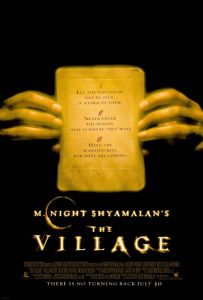 When saying director names you can play a fun little game of word association. Someone says, “George Lucas,” and things like big-budget effects, empty storytelling, and wooden dialogue come to mind. Someone says, “David Lynch,” and weird, abstract, therapy sessions dance in your head. The behemoth of word association is M. Night Shyamalan. He burst onto the scene with 1999’s blockbuster, The Sixth Sense, a crafty, moody, intelligent thriller with a knock-out final twist. Now, though, it seems more and more evident that while The Sixth Sense was the making of M. Night Shyamalan, it also appears to be his undoing. His follow-up films, Unbreakable and Signs, have suffered by comparison, but what seems to be hampering Shyamalan’s growth as a writer is the tightening noose of audience expectation that he kowtows to.
With this in mind, we have Shyamalan’s newest cinematic offering, The Village. Set in 1897, we follow the simple, agrarian lives of the people that inhabit a small secluded hamlet. The town is isolated because of a surrounding dense forest. Mythical creatures referred to as Those We Dont Speak Of populate the woods. An uneasy truce has been agreed upon between the creatures and the villagers, as long as neither camp ventures over into the others territory. When someone does enter the woods, foreboding signs arise. Animals are found skinned, red marks are found on doors, and people worry that the truce may be over. Within this setting, we follow the ordinary lives of the townsfolk. Ivy Walker (Bryce Dallas Howard) is the daughter of the towns self-appointed mayor (William Hurt), and doesnt let a little thing like being blind get in the way of her happiness. She is smitten with Lucius (Joaquin Phoenix), a soft-spoken loner. Noah (Adrien Brody), a mentally challenged man, also has feelings for Ivy, which cause greater conflict.
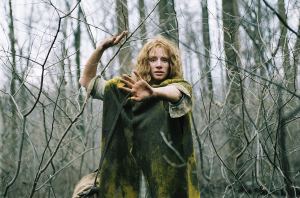 Arguably, the best thing about The Village is the discovery of Howard. She proves herself to be an acting revelation that will have future success long after The Village is forgotten. Her winsome presence, wide radiant smile, and uncanny ability to quickly emote endear the character of Ivy to the audience. She is the only one onscreen with genuine personality and charisma, and when shes flirting and being cute about it you cannot help but fall in love with her. And when she is being torn up inside, the audience feels the same emotional turmoil. I am convinced that this is more so from Howard’s acting than from the writing of Shyamalan. She reminds me of a young Cate Blanchett, both in features and talent.
It seems to me that Shyamalan’s directing is getting better with every movie while his writing is getting proportionately worse. He has a masterful sense of pacing and mood, creating long takes that give the viewer a sense of unease. The first arrival of the creatures is an expertly handled scene that delivers plenty of suspense, and a slow-motion capper, with music swelling, that caused me to pump my fist. The cinematography by Roger Deakins is beautifully elegant. Even the violin-heavy score by James Newton Howard is a great asset to the film’s disposition.
So where does the film go wrong and the entertainment get sucked out?
What kills The Village is its incongruous ending. Beforehand, Shyamalan has built a somewhat unsettling tale, but when he finally lays out all his cards, the whole is most certainly not more than the sum of its parts. In fact, the ending is so illogical and stupid, and raises infinitely more questions than feeble answers, that it undermines the rest of the film. Unlike The Sixth Sense, the twist of The Village does not get better with increased thought.
Shyamalan’s sense of timing with his story revelations is maddening. He drops one twist with 30 minutes left in the film, but whats even more frustrating is he situates a character into supposed danger that the audience knows doesn’t exist anymore with this new knowledge. The audience has already been told the truth, and it deflates nearly all the tension. Its as if Shyamalan reveals a twist and then tells the audience to immediately forget about it. Only the naïve will fall for it.
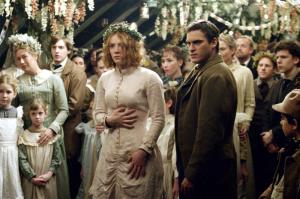 Shyamalan also exhibits a problem fully rendering his characters. They are so understated that they dont ever really jump from the screen. The dialogue is very stilted and flat, as Shyamalan tries to stubbornly fit his message to ye olde English vernacular (which brings about a whole other question when the film’s final shoe is dropped). Shyamalan also seems to strand his characters into soap opera-ish subplots involving forbidden or unrequited love. For a good hour or so, minus one sequence, The Village is really a Jane Austin story with the occasional monster.
The rest of the villagers don’t come away looking as good as Howard. Phoenix’s taciturn delivery seems to suit the brooding Lucius, but at other times he can give the impression of dead space. Hurt is a sturdy actor but can’t find a good balance between his solemn village leader and caring if sneaky father. Sigourney Weaver just seems adrift like shes looking for butter to churn. Brody is given the worst to work with. His mentally-challenged character is a terrible one-note plot device. He seems to inexplicably become clever when its needed.
The Village is a vast disappointment when the weight of the talent involved is accounted for. Shyamalan crafts an interesting premise, a portent sense of dread, and about two thirds of a decent-to-good movie, but as Brian Cox said in Adaptation, ”The last act makes the film. Wow them in the end, and you’ve got a hit. You can have flaws and problems, but wow them in the end, and you’ve got a hit.” It’s not that the final twists and revelations are bad; its that they paint everything that came before them in a worse light. An audience going into The Village wanting to be scared will likely not be pleased, and only Shyamalan’s core followers will walk away fully appreciating the movie. In the end, it may take a village to get Shyamalan to break his writing rut.
Nate’s Grade: C+
Share this:

Cold Mountain (2003)

Cold Mountain (2003)
Premise: At the end of the Civil War, Inman (Jude Law, scruffy) deserts the Confederate lines to journey back home to Ada (Nicole Kidman), the love of his life he’s spent a combined 10 minutes with.
Results: Terribly uneven, Cold Mountain‘s drama is shackled by a love story that doesn’t register the faintest of heartbeats. Kidman is wildly miscast, as she was in The Human Stain, and her beauty betrays her character. She also can’t really do a Southern accent to save her life (I’m starting to believe the only accent she can do is faux British). Law’s ever-changing beard is even more interesting than her prissy character. Renee Zellweger, as a no-nonsense Ma Clampett get-your-hands-dirty type, is a breath of fresh air in an overly stuffy film; however, her acting is quite transparent in an, “Aw sucks, give me one ‘dem Oscars, ya”ll'” way.
Nate’’s Grade: C
Share this:

28 Days Later (2003)
 Zombies have generally seemed one of the little brothers of the horror genre. Certainly not as complicated or Freudian as Frankenstein or Jekyll and Hyde, and no where near as seductive as vampires and werewolves. Zombies are stumbling, bumbling cement-shoe wearing monsters. Theyre usually conduits for some kind of social message, like George Romeros classic Night of the Living Dead and Dawn of the Dead. The scary part of zombies is the methodical eventuality they exhibit. They may be stupid, they may be slow, and they may be really stupid, but theyll keep coming. They’re dead and they got no where to be. And there’s the pull – that they will eventually get you. You’ll give in, something will happen, and they’ll seize upon that unfortunate misstep (I did an extensive paper on the symbolism of zombies in Romero’s films and the connections between religion and horror. I think I deleted it though, so this is the best analysis you’re gonna get). Now there’s director Danny Boyle’s indie horror flick, 28 Days Later, which gives the zombie genre a few good shocks to the system.
We open up with stark television clips of violence, genocide, and all around mayhem around the world. Its basically what the cable news stations are now, except in this case, the viewership of these broadcasts are monkeys. Yes, it seems that the British government is experimenting on the nature of rage by strapping monkeys onto slabs and forcing them, A Clockwork Orange style, to watch all kinds of icky video. Animal rights activists break into the facility and plan on freeing the primate prisoners. A lab assistant tries to deter the monkey theft. He says alarmingly that the animals are infected with rage (as are most drivers it seems), and that this infection is highly contagious. The animal rights activists scoff at his concern and open the cages to the primates. For their altruistic virtues the activists are instantly attacked, bitten, mauled (can one be mauled by monkeys? It just seems like bears and lions have a monopoly on this verb) and infected with this deadly rage disease. This is likely the worst PR set-back for the animal rights activists since PETA clubbed baby seals. Look it up.
 Flash to the titular 28 days later. Jim (Cillian Murphy) comes to in a hospital bed, and like previous films, Boyle finds an outlet to shoehorn in some full-frontal male nudity. Its almost like a directors trademark. Jims a bike messenger and has been in a coma for about, oh, lets just say for the sake of it, 28 days. Jim wanders through the vacant hospital calling out for anyone. He hits the streets of London to find them startlingly empty, like some Twilight Zone episode. City kiosks are papered with numerous pictures for missing relatives or good-bye letters. A scattered newspaper says London has been evacuated. Jim meets two other survivors, Mark (Noah Huntley) and Selena (Naomie Harris). They wax chunky exposition to tell us what we already know: the virus got out, spread rapidly, is transmitted through the blood. Selena does have more unsettling news about the nature of the disease. It turns out that once infected a person has about 10-20 seconds of rational thought left before they fully turn into the rabid, crazed not-dead zombies. Jim demands to see his parents and the two agree to lead him to his home in the morning.
The next morning the surviving trio trek through the empty streets and residential areas. Jim enters his home calling out for his parents. He immediately has to cover his nose with his shirt sleeve. He walks into his parents bedroom to find both curled up next to each other long dead. On the nightstand are a bottle of wine and a slew of pills. His mother holds a picture of Jim as a child. On the back Jim reads: “We left you sleeping. Now we’ll be with you again.” At the bottom it says, ”Don’t wake up.” Jim is devastated.
They find refuge in the apartment building of a Frank (Brendan Gleeson) and his daughter Hannah (Megan Burns). The two have been surviving since the outbreak. Frank is delighted to find other survivors. He shares a radio message he picked up. The message, though slightly garbled, is from a military base a ways away. They say they have discovered the answer for infection and will provide shelter for any survivors. The foursome pack up their belongings in Franks car and head for the military base with a new sense of hope.
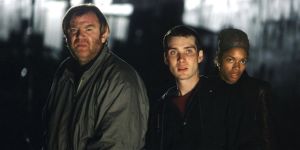 The cinematography of 28 Days Later is wonderful. It’s the best I’ve ever seen digital video. The choice of shooting on that medium also amplifies the horror and creates a more immediate sense of danger. The musical score could have been written by one of those popular Brit-rock bands. It’s propulsive, effectively building, and wonderfully sonic.
Harris is the star of the film, whether the makers know this or not. Shes one tough cookie but also reflects great moments of vulnerability as she opens up to the group and starts kindling some feelings for Jim. Gleeson is one of the best character actors out there, as evidence by a great turn in Scorsese’s Gangs of New York. Acting is never the strongest suit for horror flicks but 28 Days Later has some nice exceptions to this norm.
28 Days Later has a resonating sense of truth to it, if that can be said about apocalyptic cinema. When one character regrettably becomes infected they order their fellows to stand back, but before succumbing they say, Just know that I love you. This felt so genuine to me. Like if a comet was hurtling to decimate the planet within seconds, and your loved ones were around you, would you not act the same way? How does one compress all their feelings and appreciation and love in closing seconds? Something tells me its something like what is displayed in 28 Days Later.
Boyle, as has been ingrained into me from the blurb-heavy ads, has indeed reinvented zombie horror. However, what you may not know is that zombie horror doesn’t exactly have many titles to it. I think I’ve already mentioned most of them. Boyles zombies aren’t dead, just infected human beings. They don’t move at that lumbering drag-your-feet speed of classic zombie lore, no these not-so-undead move with great velocity and ferocity, like rabid junkyard dogs. The new touches here and there provide some interesting dynamics to the genre.
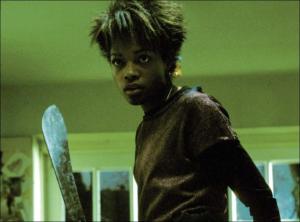 Perhaps what is different than most zombie films is that the audience grows to like the characters and root for their survival. In most horror films the characters are either too stupid or sketchy that it allows the audience to wait in amusement for their eventual horrific deaths. Its simple: we want to see these people die because its titillating (Maybe I was wrong about all the zombie analysis I still had in my head).
Boyle does service a slight message in his zombie film when the group gets to the military base. Perhaps, he muses, our military and trusted leaders are no better than those rabidly wandering the streets. The idea of a thriller set against a biological pandemic also feels very timely and relevant. The film kind of drags in the middle during the stretch between London and the military base. And the end was a bit too much Die Hard for my taste, but is suitably climactic.
Boyle has crafted a creepy, smart, and engrossing piece of entertainment. I hope people dont confuse this film with that Sandra Bullock clunker, 28 Days. They may be spending the entire time wondering where shirtless Viggo is and when Bullock will start her endless pratfalls (You knew I was going to talk about that movie somewhere).
Nate’s Grade: B
Share this:

Gangs of New York (2002)
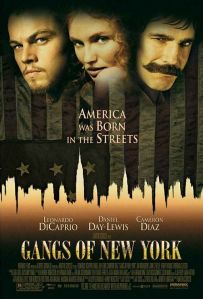 Watching Martin Scorsese’s long-in-the-making Gangs of New York is like watching a 12-round bout between two weary and staggering prize fighters. You witness the onslaught of blows, see the momentum change several times, and in the end cant really tell which fighter is victorious. This is the experience of watching Gangs of New York, and the two fighters are called Ambitions and Flaws.
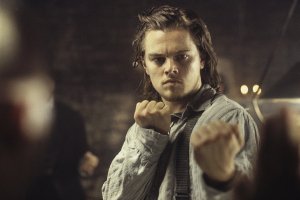
The film begins in the Five Points district of 1840s New York among a vivid gang war over turf. Amsterdam (Leonardo DiCaprio) witnesses the slaying of his father, Priest Vallon (Liam Neeson), at the blade of William Bill the Butcher Cutting (Daniel Day-Lewis) and his Native Americans gang. So what does this son of a dead preacher-man do? Well he grows up, plots revenge by making a name under the wing of the Butcher becoming like a surrogate son. But will vengeance consume him?
 Watch Leo DiCaprio assemble toughs, rake heels, and ne’er do wells to his Irish gang of rapscallions with facial hair that looks to be tweezed! Witness a one-dimensional Leo suck the life out of the film like a black hole! See Leo become the least frightening gangster since Fredo. Watch the horribly miscast Cameron Diaz play pin-the-tail-on-an-accent! Witness as she tries to play a pickpocket with a heart of gold that falls hopelessly and illogically in love with Leo! Marvel how someone looking like Diaz would exist in a mangy slum! See the brilliant Daniel Day-Lewis upstage our stupid hero and steal every scene he inhabits! Witness one of the greatest villains in the last decade of movies! Watch Day-Lewis almost single-handedly compensate for the films flaws with his virtuoso performance! Admire his stove-top hat and handlebar mustache!
Witness a wonderful supporting cast including John C. Reilly, Jim Broadbent and Brendan Gleeson! Wish that they had more screen time to work with! Wonder to yourself why in all good graces this film took nearly two years of delays to get out! Speculate away!
Gangs has the sharp aroma of a film heavily interfered with by its producers. The whole exercise feels like Scorsese being compromised. Gangs is a meticulous recreation of 1860s New York that often evokes an epic sense of awe. The story has more resonance when it flashes to small yet tasty historical asides, like the dueling fire houses and the Draft Riots. But all of these interesting tidbits get pushed aside for our pedantic revenge storyline with Leo front and center. You know the producers wanted a more commercial storyline, which probably explains why Diaz has anything to do with this.
 The script is credited to longtime Scorsese collaborator Jay Cocks, Steven Zallian (Academy Award winner for Schindler’s List) and Kenneth Lonergan (Academy award nominee for You Can Count on Me). So with all these writing credentials, dont you think one of them would realize all of the dumb things going on with the story? The ending is also very anticlimactic and ham-fisted. Just watch as we segue from a graveyard to present day New York, all thanks to the Irish rockers of U2!
I know this much, Day-Lewis needs to stop cobbling shoes and act more often. Gangs is his first visit to the big screen since 1997’s The Boxer. He spent part of this hiatus in Italy actually making shoes. I don’t know about everyone else but this man has too much talent to only be acting once every five years. Somebody buy his shoes and get him a script, post haste!
Scorsese’s Gangs of New York is at times sprawling with entertainment in its historic vision and at other times is infuriating, always dragging behind it a ball and chain called stupid revenge story/love story. I’m sure the film will get plenty of awards and Oscar nods in prominent categories, and this seems like the Academy’s familiar plan: ignore a brilliant artist for the majority of their career and then finally reward them late for one of their lesser films. So here’s hoping Scorsese wins the Oscar he deserved for Raging Bull and Goodfellas.
Nate’s Grade: C+


 nathanzoebl
You must be logged in to post a comment.