Blog Archives
Million Dollar Baby (2004) [Review Re-View]

Originally released December 15, 2004:
Million Dollar Baby, much like its fledgling female boxing character, has come out of nowhere and made a considerable deal of noise. This little homespun film directed by Clint Eastwood didn’t have the glitz and sheen of other awards friendly movies, but now it seems that Eastwood?s own baby may clean up come Oscar time. Can Million Dollar Baby tackle the enormous hype surrounding it? Yes and no.
]Frankie (Eastwood) is a hardened boxing trainer too concerned for his fighters’ welfare to allow them to fight in championship bouts. He’s the kind of cynical old man that enjoys pestering a priest and causing him to unleash an F-bomb. Frankie and his longtime friend Scrap (Morgan Freeman) run a rundown gym and talk un-sentimentally about their older days as prize fighters. Then along comes Maggie (Hilary Swank), a 32-year old waitress who’s got nothing to believe in except her possibility as a boxer. She wants Frank to train her into the champ she knows she can be. He refuses saying he doesn’t train girls. She’s so determined she won’t take no for an answer. Frank finally agrees, especially after some help from Scrap, and starts to teach Maggie everything she needs to know to be a star pugilist. The two begin to open up to each other emotionally and Maggie seems destined to become a force in the ring.
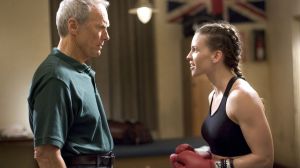
Million Dollar Baby‘s greasiest attribute is its trio of knockout performances. Swank owns every second of this movie. She’s unremittingly perky, conscientious but also dogged, stubborn, and irresistibly lovable. Swank embodies the role with a startling muscular physique and a million dollar smile. Her performance is equal parts charming and heartbreaking. Maggie’s the heart of Million Dollar Baby and Swank doesn’t let you forget it for a millisecond. Come Oscar time, I’m sure she will be walking onstage to grab her second Best Actress Oscar in five years.
No one does grizzled better than Eastwood, and maybe no other actor has made as much of an acting mark by squinting a lot. Million Dollar Baby is probably his best performance to date, though for a good while it sounds like Frank has something lodged in his throat (pride?). Frank has the greatest transformation, and Eastwood brilliantly understates each stop on the journey until landing in a vulnerable, emotionally needy place.
Freeman once again serves as a film’s gentle narrator. There isn’t a movie that can’t be made better by a Morgan Freeman performance. His give-and-take with Frank feels natural and casual to the point that it seems improvised on the spot. Freeman unloads some great monologues like he’s relishing every syllable, chief among them about how he lost his eye. It’s wonderful to watch such a great actor sink his teeth into ripe material and deliver a performance that may net him a long-awaited Oscar (I think he’s due, and likely so will the Academy).
For whatever reason, Eastwood is hitting a directing groove in his twilight years. First came Mystic River, an ordinary police whodunnit made exceptional by incredible acting. Now Eastwood follows up with Baby, an ordinary sports film made extraordinary by incredible acting. Hmmm, a pattern is forming. The cinematography is crisp and makes great use of light and shadow to convey emotion. Eastwood’s score is also appropriately delicate and somber. The boxing sequences are brief but efficient.
Million Dollar Baby is a very traditional story that is at times surprisingly ordinary. Maggie’s the scrappy underdog that just needs a chance, Frank’s the old timer that needs to find personal redemption, and Scrap’s the wise old black man. Once again, an old curmudgeon takes on a rookie and in the process has their tough facade melt away as the inevitable victories pile up. Million Dollar Baby is a very familiar story but then again most boxing tales are fairly the same in scope.
What eventually separates Million Dollar Baby from the pack is its third act twist. You think you know where Eastwood’s film is headed, especially given the well-worn terrain, but you have no clue where this story will wind up. The plot turn deepens the characters and their relationships to each other in very surprising ways. You may be flat-out shocked how much you’ve found yourself caring for the people onscreen. It almost seems like Eastwood and company have used the familiar rags-to-riches underdog drama to sucker punch an audience into Million Dollar Baby‘s final 30 minutes. We’re transported into an uncomfortable and challenging position, and Eastwood won’t let an audience turn away.

Million Dollar Baby is not the colossal masterpiece that critics have been drooling over. For one thing, the group of antagonists is not nearly as textured as our trio of leads. They’re actually more stock roles that further enforce the ordinary story of Million Dollar Baby. Maggie’s trailer trash family is lazy unsupportive batch of stereotypes. The evil female boxing champ just happens to be a German who doesn’t mind playing dirty. One of the boxers at Frank’s gym is an arrogant showboat just waiting to be nasty while the teacher’s back is turned. Million Dollar Baby excels at showing depth and humanity with its lead trio, yet it seems if you aren’t in that circle you’re doomed to wade in the shallow end.
Eastwood shows that great acting and great characters you love can elevate a common framework. The package may be similar to a lot of films before about scrappy underdogs, but Million Dollar Baby lacks comparison in its genre when it comes to its enthralling acting and characters. The father-daughter bond between Frank and Maggie is heartwarming. The final reveal of what her Gaelic boxing name means may just bring tears to your eyes. The results are a very fulfilling movie going experience, albeit one that regrettably may not live up to such hype.
Million Dollar Baby has been showered with heapings of praise and become a formidable Oscar contender. The story treads familiar waters but its outstanding acting and deep and humane characters elevate the material. The film can’t match the hyperbole of critics but Million Dollar Baby is an ordinary but greatly satisfying ride led by compelling acting. The film hums with professionalism and seems to just glide when everything comes together magnificently, particularly in that last 30 minutes. Eastwood is hitting an artistic stride and it’s actually exciting to see what Clint will do next. Million Dollar Baby may not be a first round knockout but it definitely wins by decision.
Nate’s Grade: B+
——————————————————
WRITER REFLECTIONS 20 YEARS LATER

Million Dollar Baby was its own underdog story that showed its strength when it mattered most, taking the 2004 Best Picture Oscar, as well as Best Actress for Hilary Swank and Best Supporting Actor for Morgan Freeman. It wasn’t even on many award prognosticators’ radar until the final month of the year. The odds-on favorite for most of 2004 had been Martin Scorsese’s Howard Hughes biopic The Aviator, a lavish recreation of Old Hollywood with the power of Harvey Weinstein behind it. After 2002’s Gangs of New York went 0-10 with its Oscar nominations, Weinstein vowed this would not happen again and that he would get Scorsese that first directing Academy Award, so no expense was spared with a $110 million-dollar budget, exceeding the previous highest Miramax budget from 2003’s Cold Mountain. The narrative was set, the power of Weinstein was behind it, and the context of Hollywood celebrating its own history has long been an appealing formula for an easy Oscar victory. Then came Clint Eastwood’s scrappy little boxing movie and it sucker-punched the established awards narrative, taking the top prize (Sorry Harvey, but if it was any consolation, The Aviator improved upon Gangs’ ratio, winning 5 of 11 noms).
Twenty years later it’s impossible to discuss the legacy of Million Dollar Baby without talking about the legacy of Eastwood as a director. He’s been directing movies ever since 1971’s Play Misty For Me. He initially stuck to what he knew, thrillers and Westerns, with the occasional passion project like 1988’s Charlie Parker biopic, Bird. It all changed for Eastwood with 1992’s Unforgiven, a searing deconstruction of the Western and masculinity and conveniently digested American myth-making that won Best Picture and Best Director for Eastwood. From there, the flinty-eyed, gravelly-voiced filmmaker was seen as an Oscar favorite, though he was only nominated for Best Director three other times out of the twenty-five films he directed after. Eastwood’s been regarded as some higher-minded adult director, but looking over his long list of directorial efforts, the man has always kept to his preferred milieu of thrillers and Westerns with the occasional somber biopic. The more assumed Academy-friendly projects typically gained minimal traction, usually acting nominations like with Richard Jewell, Invictus, and The Bridges of Madison County. Sometimes they’ve just been complete artistic whiffs, like J. Edgar, Jersey Boys, or Hereafter.
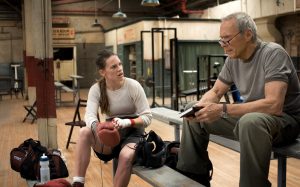
The movies that got the most acclaim from Eastwood as director were the elevated genre movies, be they crime thriller (Mystic River), Western (Unforgiven), or sports underdog drama (Million Dollar Baby). The man has an inherent interest in genre movies. He may make a WWII drama from the point of view of the Japanese, completely in Japanese, but then next he’ll make a movie about being a “Get off my lawn” grumpy grandfather taking on street gangs. He made a movie about sending geezers into space, a juror realizing he may actually be guilty of the crime he’s intended to judge, and a corrupt president covering up his crimes (that guy wasn’t even a convicted felon upon inauguration -ha). The man is at his best when he sticks to what he knows, and when he can collaborate with writers who can get the best out of his instincts, the results can be exceptional. He’s a man interested in telling genre stories, and I can respect that. He’s notoriously spartan in his directorial approach with actors, typically only allowing two or so takes before moving on, a.k.a. the anti-Kubrick. The photography is so stark is might be confused for being black and white. There is a stripped-down-to-its-studs quality to the best of Eastwood’s movies, which is why deconstructionist examinations over genres can be especially rewarding. It allows for a larger space for characters to expand and grow and challenge our expectations, which is where Million Dollar Baby still works so well twenty years after it unexpectedly KO’d the awards circuit.
This is a Cinderella sports story balanced by an invigorating surrogate father-daughter relationship. Maggie Fitzgerald (Swank) is so eager to prove herself as a boxer, and we’re so happy to see her gain success and dignity, helping to give her trainer Frankie Dunn (Eastwood) a new sense of purpose. Everything is going right for this pair and it feels like the Hollywood movie we would all know and love, and then it all gets violently torn away when Maggie is injured in the ring and becomes paralyzed from the neck down. From there, Million Dollar Baby transforms from its sports movie formula and becomes something so much more meaningful and interesting and emotionally affecting. We’re constantly playing a mental contrast from before and after the accident. She’s so optimistic and bouncy and full of life. To see the joyous Maggie using her body to give her confidence and identity and overcoming adversity and intimidating more professional opponents through force of will, and then to see her bedridden, wheezing through a ventilator, and so deeply lost in her slack eyes, it’s something awful. She survived the injury but her spirit has been obliterated. Now, this isn’t a commentary on how disabled people cannot live fulfilling lives and might as well be euthanized. Maggie is the one who makes the choice to be euthanized and she will not be swayed, and this decision puts it to her coach, a lifelong Catholic, to demonstrate his love for his pupil through assisted suicide. To me, all that is WAY more dramatically interesting than if she had simply won the big title fight and proven all her many doubters wrong.

Swank rightfully won her second Oscar for Best Actress with a performance of such vitality and despair. At the end, when she’s stuck in that hospital bed, and she’s trying to chew off her own tongue so she can bleed to death, it’s such a devastating change from the chipper, optimistic scrappy underdog. Eastwood is gruff and growly and nearly unintelligible at points, but his reactions and his generosity as an actor help Swank achieve even higher acting greatness. Strangely enough, while Freeman is perfectly good in his Oscar-winning role, you could have cut him completely from the movie and affected very little, besides needing a new outlet for Eastwood to unintelligibly grumble towards.
It can feel like Million Dollar Baby is two different movies smashed together, one without an ending and one without a beginning. If you felt like you were plugged into that rousing sports underdog movie, I can understand feeling cheated by the rug pull. I feel like the version of this movie, by its end, is the one it wanted to be all along, and it’s using your emotional investment in these characters to make the decisions all the more grueling and tragic. Twenty years later, I think I enjoyed the moments before the accident a little less and the moments after the accident much more, and considering the ending seems like the whole point for Million Dollar Baby, that seems like an endorsement for its staying power two decades hence. It still has enough power today from the performances and where it pushes those characters. Million Dollar Baby is still a winner because it fit so well as a vehicle that Eastwood could elevate. He’s 94 years old and not likely directing too many more movies, but if anyone can keep making movies into their triple digits, it’s this man.
Nate’s Grade: A-
Share this:

Creed III (2023)
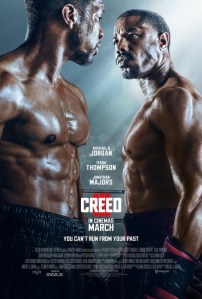 Now three films into its own rebirth, and nine films into the Rocky cinematic universe Sylvester Stallone begat in 1976, the story of Adonis Creed (Michael B. Jordan) fees confidant enough to leave behind Stallone. It’s still a formula-laden yet rousing sports movie, one where every turn will likely be predicted, but because of the conviction of the production, you can still cheer along with the familiar. This time Adonis is at the end of his career when an old face resurfaces with Damian “Dame” Anderson (Jonathan Majors), a childhood friend young Adonis looked up to who took the rap for Adonis’ fighting. He landed in prison and watched the journey of Adonis to being a world-championship boxer, which was Dame’s dream that was deferred. Adonis feels immense guilt and questions whether he’s earned his lot, and this trial of confidence and personal reckoning naturally comes down to an extensive pugilist battle, as all personal conflicts must. I laughed that Bianca (Tessa Thompson) was trying to make a point that not all conflict has to be decided by getting punched in the face, and ultimately that’s exactly where we’re headed. The requisite buildup, betrayal, training montage, and reclamation will be expected, but where the Creed franchise has separated itself was with its non-punching-in-the-face moments. I appreciate the added dimension of the characters and the allowances that make them more complex than simply cartoonish villains of the latter Rocky movies. Creed II humanized Ivan Drago Jr. to the point that I didn’t want either fighter to lose. I liked all the breather moments, from Adonis trying to raise a daughter with hearing impairments, to him reflecting and reminiscing with his forgotten friend like it was old times again, to the looming tragedy of saying goodbye to an ailing loved one (that deathbed scene was tremendously moving), and two men warring over hurt feelings of a friendship that meant so much and is trying to get beyond the pain of abandonment and guilt. When you devote that kind of attention to ensure that the drama matters, the boxing takes on added excitement. This is Jordan’s directorial debut and he does a fine job of helping his actors and providing them the space they need. He also finds some visually dynamic ways to film the boxing scenes and give them extra oomph (reportedly he based his approach off of anime and it honestly shows). Creed III may be more of the same but when the franchise devotes due attention to the small things as well as the big things, it’s still an elevated entertainment experience.
Nate’s Grade: B
Share this:

A Father’s Fight (2021)

Even though it doesn’t quite count as an Ohio indie, filmed primarily in southern Indiana, I was requested to write a review for the low-budget, faith-based film, A Father’s Fight, which is currently enjoying a small theatrical run in West Virginia and in its Hoosier home state. This was a passion project years in the making for director Tyler Sansom (Restore). Its $30,000 budget was fully financed by a local church and many of the cast and crew worked as volunteers, aiding the production which was filmed during COVID. In many ways, the movie is already a success story, a lot of people worked together to see an artistic vision to completion and during some of the most dire and restrictive circumstances of modern times. A Father’s Fight is a rare Christian indie that has more in mind than preaching to the choir. It wants to entertain too as it uplifts.
Bo Lawson (Travis Hancock) is a drunk. He’s also a lousy husband, yelling at his wife, Kacie (Sarah Cleveland), and ignoring her threats to leave with their two kids. Then she does it, and Bo doesn’t know how he can get his life back together. Enter Sal Burton (John French), his old boxing trainer, with an offer of a lifetime. It seems the reigning boxing champ wants to come back to his home town to stage a charity bout for the community, and the champ has personally requested to fight his old rival, Bo. This is his chance to make a statement, to shape up, and to win back his wife and perhaps find a new strength through Christianity.
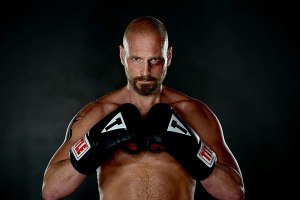
For a faith-based film, I am happy to report that A Father’s Fight is refreshingly more concerned with its characters than purporting a big message. This has been my bias for Christian movies time and again, and it’s usually reinforced by slapdash storytelling that spells out a pragmatic assessment of, “Well they’re coming for the message and not the intricacies of plot and multi-dimensional characters.” Any viewer, no matter their personal belief, deserves a story worthy of their attention and characters that have depth and care. With this movie, it’s far more a domestic drama than a sports film. It has more to do with Marriage Story than Rocky. The boxing doesn’t even come until the final five minutes, which in hindsight also feels like too little boxing. I was impressed that the screenplay by Hannah Mowery does not get pushy with its spiritual message. The first real reference to the power of faith doesn’t even occur until 45 minutes or so into the film, and Bo doesn’t attend church until after an hour into the movie. In the realm of Christian indies, this is remarkable restraint. By no means are the filmmakers soft-pedaling their affirmative message. They just realize that it will be more powerful, and accessible to a wider audience, if you’re sincerely invested in the characters, their humanity, and their redemption. The power of their story will be better translated if they feel like characters rather than bland figures.
It’s here where A Father’s Fight shines brightest, with its depiction of alcoholism and abuse. He’s spiraling, angry all the time, drinking whenever he can, projecting much of his disdain into outbursts against his wife trying to control his behavior, judging him and his failures, and we recognize it as the Drunk Abusive Husband in your standard made-for-TV melodrama. Granted, this is a faith-based film in a PG realm, so the danger of abusive behavior will only go so far, but this movie pushes it. This does a few things for the narrative. It establishes a clear baseline of bad behavior, the Before, that we can judge the protagonist’s progress against, the After period, the triumph. It also makes it more challenging to connect with Bo. He has to earn our respect just like his wife. What’s even more appreciated is how the screenplay really treats Kacie as her own character worthy of consideration, heartache, and struggle. She gets a lot of screen time here, almost equal to Bo during those first 40 minutes, and I thought it was terrific. It’s shockingly rare for the other half of an abusive relationship to be given legitimate consideration and voice. Too often movies will place the wife as a prize needing to be won through penitence or the symbol of How Far the Man Has Fallen, the chief victim that represents the toll of his decline and misery. With A Father’s Fight, my favorite moments where when the script just gives Kacie time to share her complicated feelings, and they are refreshingly complex. She’s torn over what to do, she’s upset with herself that she still worries over this man, she sees her kids and sees her husband in them, and she recognizes her value and that she deserves to be treated better. The brief monologues where Kacie pours out her heart, her frustrations, with Bo, with herself, are the highlights of the film. The characterization is nuanced and empathetic.

The other main characters stand tall. Bo is following a pretty familiar redemption arc, and the vehicle of boxing seems tailor-made for a redemption story, a man voluntarily inflicted with pain to atone or prove a larger point of sacrifice. Adding a spiritual element to that redemption story seems pretty natural and familiar for a formula. The character of Bo isn’t quite as nuanced or clear as Kacie but there’s enough there to qualify as a heartfelt if not entirely satisfying character arc. His apologies and personal growth by the end feel genuine, and his acknowledgement that he has hurt those he loved and doesn’t deserve their forgiveness sets a nice balance for a Christian message about mankind not deserving its own sinful forgiveness. It works, it just could have worked better (more on that later). Bo is strapped into the reliable redemption track but there are points that confused me. At one point, he is backing out of a parking space, almost hits a pedestrian, and the angry pedestrian provokes Bo to almost fight him. This passing incident, with a guy we’ve never seen before, is curiously the thing that almost pushes Bo off the wagon and back to drinking. Why? Why would this one incident have that drastic effect? It’s not like he did get into a fight with the guy. The early Bo is never really clarified why he’s in such a stupor. He’s angry, but angry at what and why? Does he just feel stuck? Emasculated? Unable to provide? A little more time setting up how he fell into drinking and his life before would have smoothed this out. Also, this upcoming fight is with the literal champion of boxing but we don’t ever get a strong sense of what it means for Bo. This is a big deal, something that would attract national media attention, and yet it is never treated like a big deal (Bo is only making a laughably paltry $5,000 for his participation – IN A FIGHT WITH THE CHAMPION). What does this fight, the very title of the movie, represent for him? He’s told he needs to fight for what he believes in, which will ostensibly be the lessons of family, self, faith, etc., but why boxing? Why this guy? Why a champion? Does he want to become a boxer again? Is this his failed dream? It feels just like another odd job for our blue-collar protagonist.
There are two primary areas that detract from the mighty goals of A Father’s Fight: the second act squeeze and the strange editing. There seems to be a switch about 50 minutes into the movie where Act Two and all the personal growth we’re waiting to experience gets severely truncated. It’s hard to explain but the patience and nuance that was exhibited in the first 45 minutes starts to wave and the movie gets sloppy with its storytelling shortcuts. There’s one extending grocery shopping scene that seems to be the changing point. It’s Bo explaining all the changes in his life through one methodical trip down a grocery aisle, chatting to local busybody, Tammy Lynn (Lindsay Rawert). He’s explaining all the changes he’s undergone that we haven’t witnessed. He explains the guy he greeted was his AA sponsor, shows her his chip for being sober for a month, talks about how much he enjoys his time with his kids. All of this is important information and would certainly push Bo along on his predetermined redemption arc, but why are we being told it like we’re catching up with a long-lost friend who only has a few minutes to cover the basics? Why haven’t we been seeing these moments? Why didn’t we see Bo go to an AA meeting, feel uncomfortable and out of place, and then eventually open up, talk about his own history with alcohol and the wreckage it has caused him? It would be a dramatic breakthrough. The same with his interaction with his children. Let’s witness these moments, so that we can see their attitudes changing about their father that once scared and upset them in Act One. Movies are meant to be a visual medium and the screenwriting edict is “show, don’t tell.” The first half of A Father’s Fight was following this model. The second half seems to be rushed to tell us what it feels we need to know to fulfill our redemption obligations and get to the big finish.

The work by three credited editors, including the director, is also a frequent concern. There are several weird editing choices that took me out of the movie or undercut the intended drama. First off, many conversation scenes will awkwardly jump around an assortment of angles, and the pacing feels jumbled, especially when the 180-degree rule is frequently being broken and disorienting the viewer. I’m not a stickler that the 180-degree rule in film should be ironclad but flagrant violation throughout a scene creates unconscious disconnection. That can be put to good use if you’re going for something like loopy David Lynch territory. With a faith-based film, it’s distracting. There are drone shots wedged into montages that don’t need them because the production had drone shots and by golly they were going to be utilized regardless. The inclusion of certain shots and sequences also feels baffling. In the first act, Bo is picked up from the police station by his wife, and during the drive home we get flashbacks of Bo as a child watching his drunken father berate his mother. Minutes later, Bo returns home, immediately starts drinking again, and Kacie confronts him. He berates his wife and his two kids appear, horrified and afraid of how their father is behaving. Wouldn’t it make more thematic sense to include that flashback scene here, to make the connection that he is following in his father’s footsteps, and wouldn’t the scene simply have more dramatic impact here? Likewise, at the end of the movie, when Bo is fighting in the boxing ring, the movie’s big question is not whether Bo will beat the champion but whether Kacie will be present in support (so yes, it’s basically entirely Rocky). Bo gets knocked to the mat. He looks over. He sees his wife. He smiles. He has a reason to get back up, to continue fighting, renewed and stronger. Except that’s not what happens. He gets up, and the ref is checking with him, and he looks over and there she is. This is truly baffling to me. The obvious movie moment is, when he’s at his lowest, after taking the hit, he looks over and there she is. We don’t need to see her enter. It should be a surprise for the audience too and including it at its most dramatic point. We feel Bo’s elation. Fortunately, the movie doesn’t have a plethora of these moments but enough that add up and make me wish there had been a fourth editor to help.
The acting is much more subtle and controlled than what I was expecting from a faith-based indie where big theatrical acting can make the proceedings feel overly staged and phony. The three central performers deliver. Cleveland (End of the Road) is very emotionally affecting as Kacie, and she deftly handles the multiple conflicting emotions of a woman at the end of her patience. She’s the most nuanced character in the movie and Cleveland digs deep. She is not a cliche. Hancock (A Soldier’s Secret) has the more traditional role and leans into that familiarity but carries himself well physically and emotionally. His outbursts can be wince-inducing but his pleas for forgiveness can also ring true, aided by the character’s reflection and personal growth. French (The Right to Remain) has a really strong monologue where he reflects on his own war experiences and what motivated him to keep fighting. It relates to the larger theme of the movie, allows the versatile actor to slow things down, to open up, and become very vulnerable, and it’s a welcomed humanizing aside for a character that could have just been a standard coach cheering on our hero’s conditioning from the sidelines. I must admit this monologue is hampered by poor editing choices with quick camera pans and push-ins that feel entirely wrong. You want to slow things down and let the character have the moment, not ramp things up and distract. There is one major acting curiosity I need to cite and this belongs to Rawert and her thick accent. She sounds like she’s auditioning to be on Fargo (“Oh yay, yer’ goin’ inta tha boxin’ ring, doncha know”), and it’s a pronounced lilt that’s missing from every other actor in the movie. I don’t know if maybe this was her idea of a typical “Midwest voice” or a misplaced character choice.

As a faith-based drama, A Father’s Fight has a lot going for it and a lot I wish more Christian indies would prioritize. It puts its characters and story above its feel-good message, at least for half of the movie. The second half does feel rushed and sloppy, and while it does take away from the conclusion feeling fully earned, it cannot detract from the early good feelings. It’s a strange assessment that a movie has a first act, a third act, and a smushed second act, the one meant to bridge the problems to solutions, but there you have it. It’s quite possible there was more intended for the movie and the reality of budget and filming during COVID caused unfortunate shortcuts and the like. It definitely feels like the promise of the first 45 minutes was unable to be fulfilled for the second half. At 90 minutes, the movie could have even stood an additional 20-30 minutes of material to provide room for that character development and some time to breathe. Still, this is a professional looking production for its budget and the song selections are great finds, even if they quite often literalize the inner emotional state of characters onscreen. There’s much more right than wrong with this polished production, and I’m impressed with the consideration given to the characters, especially from the wife’s perspective. Most Christian indies feel more like elaborate sermons than genuine stories (sometimes they’re just Kirk Cameron lecturing you in a driveway). I think this film will play well with its target audience and even earn some fans from outside the flock, people who recognize the humanity of the people onscreen. Even with its limitations and weird edits, A Father’s Fight knows what it’s fighting for – your entertainment value.
Nate’s Grade: B-
Share this:

Creed II (2018)
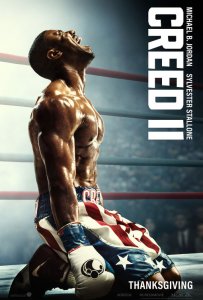 Technically the eighth movie in a franchise spanning five different decades, I think every ticket buyer knows exactly what they are getting with Creed II. It’s more of the same formula that’s been packing in audiences because it works. Once again Adonis Creed (Michael B. Jordan), son of the legendary Apollo Creed, climbs high, only to be brought low by a challenger, the son of Ivan Drago (Dolph Lundgren), the man who killed his father in the ring. Once more he finds himself with something to prove, a personal score to settle that blinds him as a fighter. I was able to predict every major plot beat from early on, and that’s beside the point. Creed II is at its peak performance when it offers small, well-developed character moments to go along with the training montages and boxing beat downs. Spending more time with the characters is where this movie elevates itself from the formula. There’s a potently dramatic subplot where Adonis’s wife, played by Tessa Thompson, worries that she may have past down her degenerative hearing loss their newborn child. There’s a wordless scene of looks that explains everything over the course of an auditory test, and it’s gut wrenching. I wasn’t expecting the film to humanize the villains as well. Ivan has been living in shame since his loss to Rocky (Sylvester Stallone), cast out by the elites of his society, and his own wife walked out on him and his son. They both see this opportunity as a way to prove something to the woman who abandoned them and the country that turned its back. It’s not just a scene either; the Russians (Ukrainians?) get the second biggest storyline of the movie. It made it so that I was genuinely having mixed emotions during the climactic bout, not wanting either side to really lose. That’s solid writing, movie. The performances are uniformly strong (even Lundgren!) and the emotions build and build until it crescendos. Creed II likely won’t be the last in the franchise, and even though I can predict the sequel already, as long as the filmmakers find room to meaningfully flesh out these enjoyable and winning characters, I’m game.
Nate’s Grade: B
Share this:

Fist of the Reich (2012)
 It’s been too long since I’ve last had the pleasure of viewing a Uwe Boll movie. The man is downright prolific when it comes to spitting out multitudes of projects every year sometimes three or four. And yet there’s no guarantee I’ll have a speedy and easily accessible avenue to watch the man’s finished products. Take for instance his biopic on Max Schmeling, finished almost three years ago, and undergone a title change for American audiences to Fist of the Reich. Americans might not know who Max Schmeling was but by God do we know ourselves some Nazis. I can understand why this one was put on the shelf for as long as it was. There’s the fact that it’s entirely in German, Boll’s first completely foreign-language film since 1997. There’s also the fact that it’s still a pretty dull and uninvolving movie, and given the figure and subject matter, that may be enough to make Fist of the Reich the most disappointing film of Boll’s career.
 From 1930-1948, Max Schmeling (Henry Maske) was Germany’s most prolific athlete. He boxed overseas in America quite often, earning the world title in a controversial bout where his opponent was disqualified after a below the belt punch. Schmeling romances a movie star, Anny Ondra (Susanne Wuest), and proposes to her the day their courtship hits the gossip pages. Schmeling also has to fight the growing nationalistic influence of Hitler’s Nazi party, which looks at him as a powerful propaganda opportunity. After a high-profile loss to Joe Louis, in a rematch no less, Schmeling loses value to the Nazi machine and he’s drafted into the oncoming war.
When I say “most disappointing” I know that’s going to strike a chord given Boll’s oeuvre of craptacularcinema, but I really mean it. The biggest failing of the two-plus hours of Fist of the Reich is that it does not provide adequate evidence why Schmeling is a compelling figure of history. It’s a biopic that doesn’t have enough juice to justify why its central hero should even earn a biopic. I don’t think I’ve seen too many movies based upon real people where I left thinking, “Well that person didn’t deserve a movie.” And the ridiculous thing is that Schmeling of course deserves his own movie. The man was an international superstar, the pride of a nation during a tumultuous time, one of only three men to beat Joe Louis in his career, and then became a propaganda pawn for the Nazis. The man was even forced into service in the war and was one of only two survivors during a hellish battle. His manager was Jewish, his wife a Czech movie star, and they had to flee their country home to escape from the advancing Russians. That is some compelling stuff even before you get into the psychological depth at play with a man being pushed as a tool of Nazi propaganda and how that constrictive, humiliating, and infuriating chapter would have taken its toll on Schmeling’s soul. There is a wealth of material there to stage a rousing and engrossing biopic, and the fact that Boll and screenwriter Timo Berndt cannot is just inexcusable.
There’s very little depth given to Schmeling as a character; all the edges are sanded off and we’re left with a rather bland do-gooder that really just wants to box. He’s sort of this nondescript, milquetoast nice guy who trudges from scene to scene, doing bland but nice things. You won’t dislike the lug but you’ll find it hard to explain why he’s interesting. This shallowness just compounds as the movie continues, going further into the war as well as the downturns in Schmeling’s boxing career. His relationship with Anny is also pretty bland. They’re nice together and loving in appearance but also mundane. It’s like the movie is progressing scene-by-scene establishing facts and plot points rather than exploring the relationships of characters. Max gets married. Max gets a big bout. Max wants to give Joe Louis a rematch. The film seems so devoid of passion, bled dry by going through the checklist of what audiences desire in their biopics. The movie even attaches a weak framing device where Schmeling and a war prisoner are walking to a border and Schmeling recounts his life. Except this framing device ends with thirty minutes left to go. Can it be termed a framing device if it doesn’t frame a quarter of the movie? It’s not even necessary except to throw in a bit of war violence at the opening to hook an audience. It feels like nobody knows what to do with Schmeling so they’ll just breeze through his life’s big events, make him seem like a charitable fella, and then pray the audience understands the man’s historical significance.
Another reason for the stilted drama is quite possibly the noticeable acting limitations of our lead, Maske. The man is a former champion boxer in Germany who reportedly underwent eight months of acting training to prepare for this movie. Well, apparently eight was not enough (did I just backend into a pun?). He may be a great boxer but he is a very poor actor. His monotone, caveman-like warble reminds me of the speaking tones of early Arnold Schwarzenegger. I don’t think the guy has more than two sentences at a time. Again, I’d rather have my actors learn how to do something rather than teach a non-actor how to act. Actors can fake singing or boxing, plus there’s editing. Was it really substantial to have an actual boxer in the role? I know Schmeling himself actually wanted Maske to play him in a would-be movie, so there’s some passing approval, but there’s a reason that Maske hasn’t acted in a movie since this one. Maske’s pained acting, limited emotional range, and overall stiffness, combined with the thin characterization, makes for a void at the center of the movie.
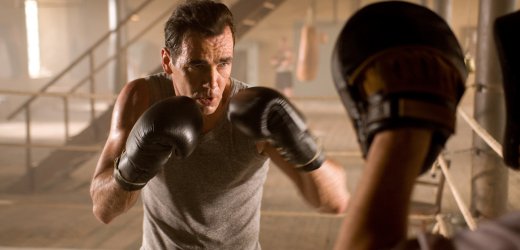 I also assumed given Boll’s own background in boxing (he famously boxed a group of critics several years ago in a publicity stunt) that the onscreen bouts would be thrilling to watch. The excitable German ringside announcer seems to be watching different fights than I am. The fighters just don’t have any fight in them, carefully going through the motions, but when they hit they do so like they’re timid, afraid to put any force behind it. The camerawork and editing also fail to mask this feeling. Boxing is such a ferocious sport and we need to feel the danger and ferocity within the ring, but all too often it just feels like another ho-hum occasion for Schmeling, one where he’s rarely put to the test. Even the boxing matches that go to 15 rounds show us two fighters without any blood on them or bruises or any sign, beyond a glistening coat of faux sweat, that these two men have spent over an hour beating the crap out of each other. This limited sense of realism handicaps the movie as well as drawing out the accomplishments of Schmeling.
Boll’s direction also seems rather remote on this movie, curiously so. He relies almost entirely on bobbling handheld camerawork that can get a bit tiresome when it feels like the camera rarely settles. The movie is almost entirely comprised of a series of medium shots, which further adds to the overall blandness of the movie. The cinematography by longtime collaborator Mathias Neumann is entirely lackluster and downright incompetent. The visual compositions are supremely lacking; I don’t think Boll and Neumann even stumble into one engaging visual shot. And we’re talking about a boxer’s career here. The colors of the movie feel so drab and restrained but not in any sort of elegant artistic manner. It just looks like a drab movie, which suits a drab script with a drab lead actor. I’m also fairly certain that Boll’s longtime musical collaborator Jessica de Rooij borrows liberally, if not outright lifts, the musical themes of John Williams’ score for Saving Private Ryan. Has anyone else caught this?
It may seem foolish of me to admit, especially after twenty movies reviewed, but I actually had some semblance of hope that Fist of the Reich was going to be Boll’s first actual good movie. As it stands, Tunnel Rats is still the best Boll film, relatively speaking. I really thought that Boll’s background and boxing experience would carry over and we’d get a handsomely made, reverent, and absorbing look into the life of Max Schmeling, but time after time, the movie settles for bland. There’s a lot of meat to this guy but it feels about as in depth as a child’s book report, skimming over the drama to cover the significant signposts of the man’s life. As a result, we get an overview of the guy’s life but lack the evidence why we even took the journey. Saying a guy’s a great boxer, or a great humanitarian is one thing, but we need to see this, we need to feel it, and that’s the saddest failure of Fist of the Reich, that it takes an important historical figure and squeezes out all the lingering resonance.
Nate’s Grade: C
Share this:

Real Steel (2011)
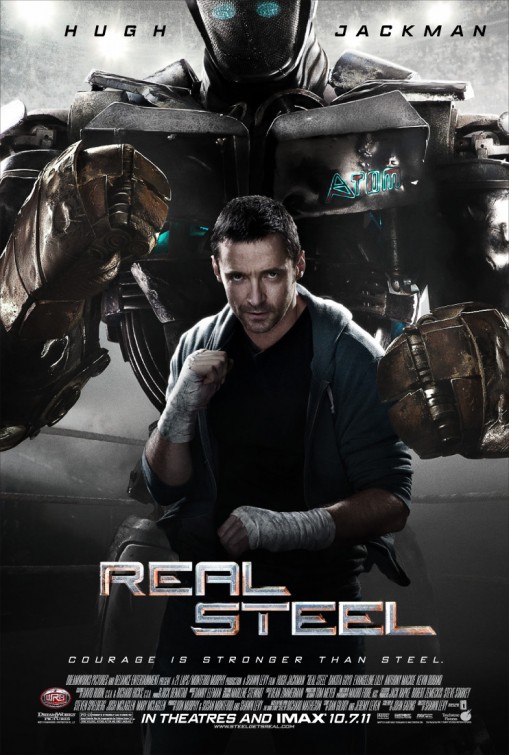 In the future world of Real Steel, set in 2020, robot boxing has become a huge sensation. It seems that audience bloodlust was not being satisfied with flesh and blood hitting the canvas, so robot brutality will do. Whatever happened to mixed martial arts, a sport arguably more popular than boxing in this day and age, popular enough it even got its own uplifting sports drama earlier this year (the overlooked Warrior). I strongly doubt that in only nine years we’d have giant fighting robots and that this “sport” would be nationally recognized. Did anyone see Comedy Central’s mechanical Coliseum showdown, Battlebots? There’s your answer, America.
In this future world where trucks have glass panels to show the world your feet (why? Because it’s “futuristic” you fool), Charlie Kenton (Hugh Jackman) is a has been. He enjoyed a fleeting career as a professional boxer before the mechanical men came into popularity. Now he goes from town to town trying to scrounge up some petty money with small-market robot boxing rings. His only pal is Bailey (Evangeline Lilly), his former flame and the owner of the boxing ring/chop shop that Charlie calls home. Charlie owes plenty of money to plenty of not nice people. His solution arrives in the form of his 11-year-old son, Max (Dakota Goyo). Charlie ran out on Max and his mother when Max was a baby, but now mom’s dead and custody is being discussed. Mom’s aunt (Hope Davis) and her rich hubby want Charlie to sign away his parental rights, which he agrees to do for the right price. Max spends one last/first summer with his estranged father before going off to live with his auntie. The two bond when Max discovers a beat-up old sparring robot when father and son are skimming parts illegally at a junkyard. The old bot, which Max names Atom, becomes a champion fighter. Father and son ride the success all the way to a championship bout with Zeus, a legendary robot that destroys all challengers. Can they stun the world? Can father and son bury the hatchet? If these answers are in doubt, I advise you to see any sports movie ever released.
J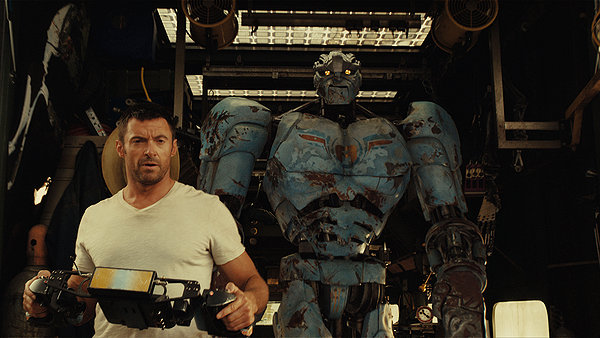 ust in case you stood clueless and slack jawed at the film’s storytelling prowess, you’re in luck because every character will take great pains to explain the significance of plot points, key metaphors and symbols, and personal motivations. Usually this stuff is tucked away as subtext, but Reel Steal decided that it would rather rub the audience’s nose in the architecture of its screenplay. Characters will just go around speaking blurting out their feelings in the most transparent way possible: “I can’t be with you again, I’m afraid of being hurt again, and seeing you in that ring is like seeing my father again in that ring, and fighting this fight is your attempt to regain redemption and prove yourself wrong, and the robot is old and busted but still has some fight in it left, just like you Charlie…” It gets tiresome. Max squeals, “All I’ve ever wanted was for you to fight for me!” Your dad’s kind of a lout, kid. You’d be better off being adopted by your preposterously rich aunt, which is really the moral we learned from Annie. Who talks like these people? It’s astounding how blatant the film is about explaining its sotry mechanics so that the dumbest common denominator in the audience can walk away feeling like Roger Ebert (“Did you notice how the robot was a metaphor for Charlie? I did.”).
Never in my life would I have anticipated that someone would watch Over the Top and say, “What if we added robots?” This movie essentially is a souped-up version of Sylvester Stallone’s 1987 flick where a dad fights for the custody of his kids through the weirdly court-approved process of the gentleman’s game of arm wrestling. First off, who in their right mind would make a movie about professional arm wrestling? There’s a reason this specific sports genre still stands with one entry. Charlie finds redemption over one summer spent with the kid he abandoned and then sold. The strange thing is that Max knows from the start that he’s more a commodity than a valued son. Yet he still bonds with dear old dad though he’s still going off to live with his rich aunt by the end. The father/son relationship becomes the heart of the movie, but what good can come from two annoying characters learning to get along? They’re still too annoying for me.
Charlie’s fight to become a better father is hampered by the fact that I wanted to strangle his kid. There was rarely a moment that passed where I didn’t want to punt this little brat. From the moment he first steps on screen, Max is surly and aggravating. Given that he’s meeting the father who abandoned him, I’d expect some confrontation but this little twerp cops a bratty attitude throughout. He hops on the boxing ring mic and walks around with a phony swagger and challenges the biggest baddest robot. The kid seems like a chip off the ole block, falling victim to hubris just like dead. When Goyo (Thor) screams it becomes a high-pitched caterwaul that caused me to writhe in physical pain. The subplot of Max teaching the robot how to dance is just embarrassing. You better believe the kid teaches his metal friend how to do the robot. The young actor deserves a fair share of the blame. Goyo flounders, overselling every emotion and hovering at a persistant petulant level of acting. I do not advocate the endangerment of children, obviously but I’d be lying if I failed to admit that I would have slept soundly had Max tumbled to his death in the robot junkyard. Goyo is so powerfully awful that he may well be the tarred as the Jake Lloyd of this decade (Lloyd infamously played the twerpy kiddie Darth Vader in the first of the regrettable Star Wars prequels). It’s hard for me to root for the reunion of father and son when I’d rather see father bury son in the ground.
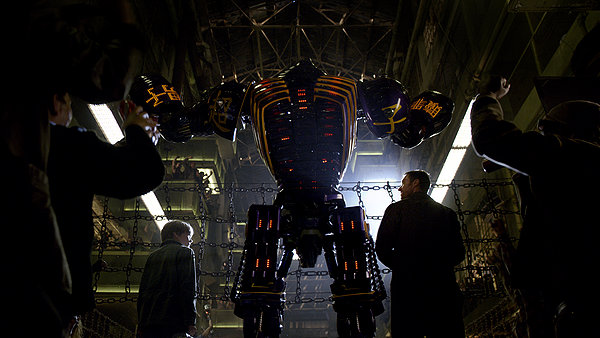 Real Steel is littered with nonsensical or dropped subplots, the worst offense being Atom’s secret. It’s revealed midway into the film that Atom is not just a sparring robot but a sentient being. It’s faking that it can only shadow human movement. When Charlie “teaches” Atom how to box he really is teaching the robot, though conveniently Atom seems to keep this knowledge to itself. Even when it’s being battered mercilessly, Atom doesn’t employ the skills it’s been taught. Maintaining his cover is more important than self-preservation, so suck on that Asimov. The fact that Atom is sentient is the filmmaker’s desperate attempt to add empathy to the robot. Without sentience, the robot is just a junky avatar that can be scrapped. It’s a piece of equipment but if sentient it becomes a character we can feel for. You don’t share empathy with a coffee maker. I kept waiting for this secret to somehow get out because it’s kind of a monumental deal. But it never does get out. The story never once revisits this gigantically important revelation. What does this mean about other robot boxers? Are they too sentient? What do they think about destroying each other for sport? There are important questions here that are ignored. What’s the point of making Atom sentient if you never do anything with it? It’s only a ploy to drum up empathy, but at no point does Atom feel like a character, only a collection of parts. It’s a coffee maker on steroids.
The movie borrows liberally from other sports movies, taking the emotional beats from Rocky and the family drama from a film like The Champ, though loses the downer ending. Everything is too recognizable, too formulaic, as if it was assembled on a factory floor. The only points of surprise are when Real Steel just carelessly drops plotlines, as mentioned above. What’s the point of introducing a plot point like the robots can malfunction if hit correctly in Act One and not have it resurface in Act Three? Jackman (X-Men) acts with all the power his neck veins can afford. He seems to be constantly growling or on the precipice of said growling. The romantic subplot with Bailey is an undeveloped thread only meant to tie back together into a pretty bow at the plot’s earliest convenience. Lily (TV’s Lost) plays the “girl,” which means all she’s given to do is remind the hero of his potential and be the warm body waiting in bed. But this is a family film, so we stop at late-night cuddling. Then Max ends up being a savant at mechanical engineering and electronics because… he plays video games? Give me a break. And it just so happens that every character we’ve been introduced to will be in attendance for the big fight, even the Texas bookie (the great and underutilized Anthony Mackie). Wouldn’t Detroit bookies take umbrage to this?
Do you like reaction shots? Real Steel is chock full of them: people wincing, people yelling and clapping at TVs, people muttering under their breath the optimistic instructions, “C’mon, c’mon, c’mon.” You accept some reaction shots as part pf the terrain of the sports movie, but when they’re presented in excess then it becomes a crutch, the director reminding the audience what to feel with the subtlety of a sharp stick to the eye. Then again subtlety was never the forte of director Shawn Levy, he of Date Night and Night at the Museum fame. The special effects are strong and the boxing sequences even have some livened suspense to them, though why would anyone build a robot boxer with two heads? What advantage does that offer other than two things to hit? Levy gets lost in the special effects and treats the actors with the same indifferent level of care that the humans show the robots.
Real Steel wants to be a rousing, family-friendly crowd pleaser; it just won’t ever let you forget that this is its primary function. This outlandish sports flick is much like its robotic pugilists: big, dumb, loud, and prone to malfunction. The film has no faith in its audience’s intelligence so every feeling and symbol is plainly explained with unwanted diligence. The characters are unlikable or underwritten, the story is shackled by lockstep devotion to formula, and Goyo’s wretched performance makes it damn near impossible to sympathize with the father/son reunion. Filled with unresolved plot setups and a mystifying similarity to Over the Top, Real Steel is just like every other boxing movie on record except this one has robots. I’m fairly certain the screenwriters were robots too. Why else would they make a robot becoming sentient seem like no big deal? Obviously this is propaganda to lull us into complacency before the impending robot war. Real Steel is a classic example of a movie done by committee; it feels like it was crudely assembled from the spare parts of other, better movies.
Nate’s Grade: C
Share this:

The Fighter (2010)
 Somewhere along the line, the boxing film became the perfect metaphor for the underdog story. Two men at battle with only their fists and iron wills. Somehow this match up has come to symbolize man’s eternal struggle against himself and society. From Body and Soul to Rocky and Raging Bull, it’s hard to imagine the filmic landscape without the tropes of boxing. It’s also a pretty staid and tired genre, where filmmakers often rely on those tropes to fill in the gaps for lazy storytelling. The Fighter is a true story that star Mark Wahlberg has been nursing for years trying to get it off the ground. It’s the knockout acting and attention to character that separates The Fighter from the competition. Rarely has such a sedate formula felt so freshly presented.
In the mid 1990s, Mickey Ward (Wahlberg) is a man trying to come to grips with his life. His welterweight boxing career has stalled thanks primarily to his trainer, his unreliable half-brother Dicky Eklund (Christian Bale). Big brother used to be the pride of Lowell, Massachusetts, once fighting Sugar Ray Leonard and boasting about knocking the giant down (this claim is in dispute as replays show that Leonard may have simply tripped). Dicky’s boxing career went away about the same time that Dicky became addicted to crack cocaine, spending long hours inside Lowell’s many crack houses. An HBO documentary crew is following around Dicky, which he mistakenly believes is a ticket to his comeback. Mickey’s mother, Alice (Melissa Leo), also serves as manager to both her boys. Dicky is clearly the apple of her eye and Alice enables his destructive behavior. Mickey is pushed into fights to feed his extended family (eight siblings), and the thrill is gone. Then one day he’s approached by a promoter who will give Mickey one more chance. The only catch is that Mickey has to cut his family loose.
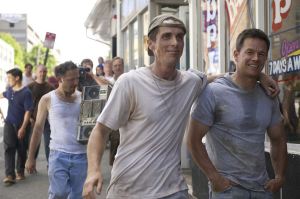 Truth be told, The Fighter isn’t really much of a boxing movie. Sure that’s the selling point and it allows for a rousing, crowd-pleasing finish, but Mickey could just as easily be striving to open a deli or striving to go back to school. The real story is the family. The boxing is only a backdrop, and if it weren’t for the true-story basis I would say it serves as little more than a metaphor for the punishment Mickey has taken in life. The Fighter is about a man working up the courage not to step into the boxing ring but to break away from his self-destructive family weighing him down in misery. This is a dysfunctional family drama disguised as a Rocky-style boxing redemption picture. The boxing aspects are small, mostly contained to the final act as Mickey’s career finally begins to gain some traction. For some, this will be disappointing news. But for me, I loved the family drama stuff. This is a fractured family with deep lines of division, nursing grudges, resentment waiting to boil over, all the marks of meaty drama. The focus is on Mickey trying to break away from the pull of his harmful older half-brother and his boorish mother. His mother enables Dicky, her favorite child, to the detriment of the rest of her brood. Her relationship with Dicky is fascinating and complicated, like a mother sacrificing the rest of her clan to help her most damaged child. You can catch some of the invisible ripples from these decisions, like the seven sisters all forming one unified hive-mind to survive. They’re like a block of cheerleaders for mother, only able to get attention and some form of affection by doing so. The extensive family unit revolves around Leo’s matriarch, fiercely protective and fiercely myopic. She refuses to remove herself from Mickey’s management team, and thus Mickey and his career suffer. It’s downright Oedipal. If only he can escape the clutches of his family, perhaps Mickey can taste success that has eluded him so long. The family drama makes up a good majority of The Fighter, and that’s just fine with me when I get characters this damaged and complicated.
And all of this is blissfully entertaining. Director David O. Russell is miles away from his other films like Three Kings and I Heart Huckabees. This is different kind of redemption story where the main guy winning a title is nice, and we can all celebrate, but it’s really his separation from a harsh family dragging him down. The film also produces an engaging romance for Mickey, which gives him a renewed sense of purpose to finally break free of his family. Amy Adams (Enchanted, Doubt) is a bartender at a local hangout with some college under her belt, a point that irritates Mickey’s family. The Eklund sisters lash out at Mickey’s squeeze in childish ways. Adams, playing Charlene, shies away from the daffy or genteel roles of her past. She gets to spit profanities with glee. Her relationship with Mickey serves as a foil to his family, showing what strength a positive, healthy relationship can achieve. But while the family is presented in an antagonistic sense, they are not blithely demonized. Russell and his team of writers and actors use humor to find surprising pockets of warmth amidst all the darkness and shattered dreams. This isn’t an addiction story that plumbs the depths of human weakness. The production feels bathed in authenticity and the city of Lowell, Massachusetts and its lived-in, blue-collar culture feels like another vital character. When the HBO documentary finally airs, you feel the cloud of hurt that covers the entire town in shame. Nobody wants to be known as a town famous for crack addiction (you can watch the 1995 doc online for free).
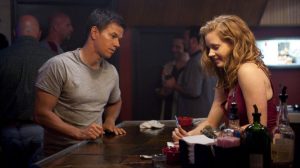 The acting is also some of the best you’ll see all year. Wahlberg is a sturdy center, used to the abuse and underplaying his character’s transformation from punching bag to assertive human being. This is Wahlberg’s home turf, and he’s been shopping the story for years in Hollywood, so it’s no surprise that everything comes so natural for the Beantown kid. But his understated work is going to get obscured with the flamboyant performances from both Bale and Leo. Bale (The Dark Knight, Rescue Dawn) has long been considered one of the finest actors of his generation, his Method devotion and versatility a godsend. In The Fighter, he’s a live wire, a bundle of energy in a haunting skeletal frame. He’s a figure of lost promise, of tragedy and bruised ego, trying to live vicariously through his younger brother. He’s deluded himself into thinking that this HBO documentary will launch a comeback at 40. Bale excels with the bombastic bits, practically bouncing off the walls, but then he nails the quieter, smaller moments of his character, where Dicky realizes that he’s wasted his gifts. Leo (Frozen River) could easily fall into an outsized monster of large hair and nicotine-stained fingers, but the Oscar-nominated actress finds exciting ways to tap into her character’s humanity. She fully knows that her beloved child is a crack addict, but watching her rationalize and justify her actions is exciting.
The Fighter is a meaty family drama, stirring tale of redemption, and a showcase of superior acting. In an awards season where it feels like many films are missing some secret ingredient, The Fighter has it all together. It’s an underdog story of a different flavor that manages to be authentic, entertaining, charitable, and engrossing even while staying within the boundaries of a predictable framework. We all know that Mickey will triumph in the ring; otherwise his tale would never have caught the notice of Hollywood producers. This is a fresh take on old material. The focus is on the fractured family dynamic and the many characters, not on a simplistic rising through the rankings of sport. It’s because of the tremendous acting and character work that the first half of the film easily outshines the second. Once the family is sidelined, and Mickey’s boxing career takes off, The Fighter turns into a more conventional genre picture, though still engaging. The movie ends on a satisfying note of uplift that feels fully earned without a twinge of naiveté. This Oscar season, expect audiences and voters alike to find something to cheer about in this return to the ring.
Nate’s Grade: A-
Share this:

Rocky Balboa (2006)
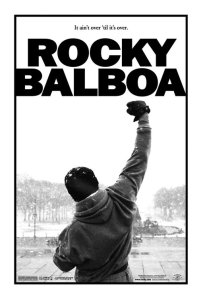 The idea of another Rocky movie, already 16 years since the last installment, sounded as good an idea as a punch to the face. Sylvester Stallone is an actor bottoming out after tons of high profile shit-for-hire jobs, and it looked like the industry was ready to yawn and put him to bed for a long winter?s nap. The idea of a Rocky 6 seemed like a thinly veiled vanity project for Stallone, going back to his bread and butter to try and resurrect some kind of acting pulse. Well, I reasoned, it couldn’t be any worse than Rocky V. I figured we were entering Godfather III territory and that is a scary place. But then I saw Rocky Balboa and realized what Stallone had in mind, and that is a proper sendoff to wipe the acid taste of Rocky V from the collective mouth of the populace. The great big lug can hang up his gloves and rest easy with a job well done.
Rocky (Stallone) has settled into a comfortable retirement. He owns a restaurant named after his deceased wife Adrian, and he regales diners with boxing tales and poses for pictures. His son (Milo Ventimiglia) is trying to make it as a businessman and distance himself from dad. Rocky rediscovers “Little Marie” (Geraldine Hughes), the same girl in 1976 he advised against smoking. She’s got a kid, a lousy job, and a weary perspective. Rocky reconnects with her and gets her to work in his own restaurant. She’s hesitant but he assures her that good ole Rock isn’t expecting anything in return for his kindness.
 Then one day ESPN runs a computer simulation pitting fighters of different eras. Rocky in his prime is paired against the current heavyweight champ Mason “The Line” Dixon (real-life boxer Antonio Tarver). Computer simulation Rocky KO’s computer simulation Dixon and the debate starts. The knock on Dixon is that he has no heart and the current level of boxing competition is beyond barrel scraping. Could an aging fighter from the past last 10 rounds with the current untested champ? Boxing promoters visit Rocky’s restaurant to convince him to an exhibition bout. Rocky mulls over the decision, not wanting “to get mangled and embarrassed.” Ultimately, he feels that he still has something to prove and decides to step back into the ring one more time.
The story is much like past Rocky installments. He spends a lot of time mulling over whether to fight or not, then trains, then we get the fight, though usually it’s some rematch of a Rocky setback. Rocky Balboa doesn’t stray far from the well-worn formula. The character has actually benefited with time and become an underdog once more, one with all sorts of new issues like calcified joints and arthritis. I would have loved a longer training sequence to show how a, presumably, 60-year-old man gets back into shape and how he plans to utilize his strengths (“hurtin’ bombs”). I agree with my friend George Bailey, somewhere along the line Stallone perfected the montage, and Rocky Balboa has an excellent training montage set to the same bom-bom horn theme that will still get your blood pumping.
The film presents some interesting characters but doesn’t spend much time with them. Rocky’s son has to deal with the long shadow his father casts and the idea that, no matter what he accomplishes, he?ll still be seen more as scion than individual. There’s a lot of meat there but Rocky Jr. only gets to huff at dad and then joins the team. Once everyone officially joins the Rocky team they essentially blend into the background of various faces shouting things like, “Come on!” and “Go Rocky!” The biggest supporting player is Hughes who gives a stirring speech for Rocky to confirm that this old man still matters. She has a great sadness to her and the character is played with non-threatening sexuality. Rocky isn’t about to jump anyone’s bones just yet, even years after Adrian’s passing.
 The only reasoning I have for why a so-so plot works as well as it does is because of our warm attachment to Rocky. Arguably the greatest movie figure in the last 30 years, Rocky could do it all, even get a Soviet crowd in Moscow to cheer for the American during the Cold War (don’t neglect to give Rocky his due for the breakup of the Soviet Union). Rocky Balboa, the character, is an old shoe that fits Stallone exceedingly well. Stallone has always been a mumble-heavy droopy dog of an actor, best described like Rocky’s new pet as a “cute ugly.” In short, the man never seemed to fit whatever character he played, and you don’t need to see Stop or My Mom Will Shoot for proof. But Rocky is his masterpiece, and after five sequels and 30 years, America loves its prized prizefighter. When you see the good soul trying to do right you forget all of Stallone’s many cinematic transgressions and you simply fall in love with the character all over again. Old feelings are reawakened and Stallone works his big-hearted, optimistic palooka charm. I watched Rocky Balboa and got swept up. Finally, the great American character can step away with the proper and fitting sendoff he deserves. In some ways, Rocky Balboa feels like a eulogy, as we reflect back on old times and how much these people have meant to us through the years, and the desire to see a lasting legacy intact.
It’s that sense of history that gives this new Rocky movie its heart. It is quite invigorating to see characters in new stations in life when we’ve seen glimpses of these characters for decades. It’s like a high school reunion that can include turtles. Stallone, who also wrote and directed this new movie, really has a strong shopworn affection for his blue-collar characters and a love of Philadelphia. It’s easy to feel the same warm and fuzzy feelings.
Rocky Balboa is a welcomed and surprisingly emotional end for one of American film’s greatest characters. Stallone puts the gloves back on and, like Rocky, still has “stuff in the basement” he needs to get done before he can rest. This is probably the best Rocky movie since the original and time has only made the characters more resonant and endearing. In 1976, Rocky defined the underdog and became well woven into our culture. Who would have guessed that 30 years and countless parodies later Rocky would still pack a punch? Stallone has earned his sendoff. Now about the idea for a Rambo 4.
Nate’s Grade: B
Share this:

Cinderella Man (2005)
 Let’s talk a little about screenwriter Akiva Goldsman. This is the man responsible for travesties like Lost in Space and the franchise killing, pun-crazy Batman and Robin. There’s plenty of junk writers in Hollywood and plenty of good writers just saddled by junk to make a living, and either might apply to Goldsman. How in the world did he become a Hollywood go-to guy?It probably has something to do with Ron Howard. Goldsman adapted the screenplay for Howard’s film A Beautiful Mind and both walked away with Oscars. Suddenly the man who wrote Mr. Freeze saying, “You’re not sending MEEE to the COOLER,” had an Oscar on his mantle. Goldsman and Howard, in retrospect, seem like a match made in heaven. They both enjoy big Hollywood event movies that spoon-feed an audience and shave off the gray areas. Cinderella Man serves as the duo’s second collaboration and it’s exactly what you would expect a big Hollywood event movie to be from them.
Jim Braddock (Russell Crowe) is an up-and-coming New Jersey boxer who’s on a warpath to the heavyweight title. His wife Mae (Renee Zellweger) loves him dearly and he dotes on his three kids. Life seems so perfect in 1929 America. And then the Depression hits. Braddock breaks his hand in a fight and his skills slip tremendously. The boxing commission revokes his license and Braddock is forced to take a dock job to provide for his family. Times are tough and there doesn’t appear to be a way out, until Braddock’s old boxing manager (Paul Giamatti) offers him a one time only bout in the ring. Braddock is seen as a has-been but he knocks his opponent flat out. More fights come and so do more victories, and Jim Braddock seems destined for a remarkable storybook comeback. But then there’s the reigning champ Max Baer (Craig Bierko), an arrogant playboy. Baer also is a ferocious fighter and has actually killed two men in the ring. The championship leads through him and Braddock is unafraid. Mae is terrified she’ll become a widow and pleads with her husband not to fight. But now that he’s been through the gutter, Braddock knows what he?s fighting for: the survival of his family. To do that, he?s headed for a title match with Baer.
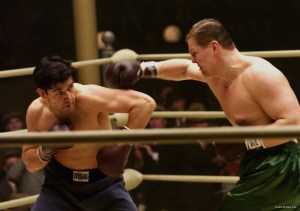 What elevates Cinderella Man from an “okay” film into a “mostly good” film is the singular brilliance of Russell Crowe. This man is simply one of the most amazing actors we’ve ever seen, and he’s been on an incredible hot streak since 1999’s The Insider (forget 2000’s Proof of Life, please). Yet again mastering another accent, Crowe excels at playing a noble man with guarded emotions and honest intentions. He’s an actor that can display such an intense wealth of emotions in the same moment. When he visits his old boxing bosses, hat in hand, begging for enough money to turn the electricity back on, Crowe has laid a sucker punch to your emotions. It’s getting to the point where I will go out and see any movie Russell Crowe stars in just to soak up his brilliant performance. He can throw a phone at my head anytime. Crowe’s stellar and resonant acting will hopefully be noticed come Oscar time; however, I doubt much else of Cinderella Man will be remembered.
Crowe’s sparring partner doesn’t fare as well. I’ve liked Zellweger in a lot of her roles (even the sappy One True Thing), but she’s entirely miscast as Braddock’s underwritten stand-by-your-man wife. She scrunches her face too much and squints for most of the movie.
Two great actors make the most of their meager roles. Giamatti serves as Braddock’s growling pit dog of a corner man and works up a good froth. Bierko almost transcends the film’s one-note villain caste and becomes a figure of showboating sensuality. He struts in the ring with a gallant pride that’s fun to watch, even though you know Howard?s whispering in your ear, “Booooo. Don’t like him. He’s the mean man. Booooo.”
The production design on Cinderella Man is great and really recreates the look and feel of the 1930s in all walks of life. The cinematography, on the other hand, seems washed out and overly dark in spots, though it may have just been my theater?s projection. I miss Roger Deakins, DP on A Beautiful Mind. Deakins knew how to beautifully light a scene and capture the audience with a precise, eye-pleasing angle. In contrast, Cinderella Man seems to think that sepia tones defined the time period of the 1930s.
Howard still has little to no trust in his audience. He can’t rely on the performances of his actors to express their motivation. We know why Braddock is fighting during the Depression, Howard. We don’t need split-second cuts of his family for reminders. It’s almost like Howard wants to point to the screen and tell the audience what to feel. It should be obvious by now but ambiguity doesn’t work here. That’s why Braddock is seen as almost saintly (never mind the connections to organized crime). That’s why Baer is seen as dastardly (never mind that in 1933 Baer heroically wore a Jewish star and knocked out Hitler’s favorite prize fighter, Max Schmeling). It seems that the details just get in the way when Howard wants to turn true-life stories into calculating crowd-pleasers.
At the docks, just in case we don’t get how tragic the Great Depression is (you know, in case you forgot what either the words “great” or “depression” meant), Howard has to bend over backwards to show someone stepping over a newspaper declaring how high unemployment is. When Braddock finds a friend in Hoovertown (Central Park turned into a neighborhood of shanties) we see him run over by a horse and buggy as another man crushed by the system or a runaway metaphor. When Baer fights in the ring Howard makes sure to get that sneering close-up of our villain. And surely anyone who’s a womanizing playboy must go down for the good of the nation. Howard is aggressive in his pandering.
Thanks to Goldsman and Hollingsworth’s mawkish script, Cinderella Man has the myth of complexity to it when it’s really content to go the easy route. It plays this story too close to the rules: embittered hero with humanity intact, stalwart wife, cocky villain, the grumbling manager. Cinderella Man is stripped of complexity and Goldsman and Hollingsworth want to lead the audience by the nose. When Braddock promises his son in a heart-to-heart that he’ll never split up the family, we know it’s only a matter of time before it happens. Their script is also full of workmanlike dialogue that does enough to just push the story forward but give little shading to its people (Zellweger’s, “You are the champion of my heart, Jim Braddock” is particularly not great.
 Cinderella Man really is a film more about the Depression than boxing, except for its pummeling and gritty final act of non-stop boxing. The script paints an almost insulting idea that the Depression was good for people to learn important life lessons, like family comes first, hard work will be rewarded, and one man can heal a nation. Seabiscuit fell into this same trap with its depiction of the Depression but at least Gary Ross’ film dealt with characters that weren’t tired genre archetypes. Cinderella Man could be described as “Seabiscuit in a boxing ring,” as yet again the triumph of an underdog pulls the country back together and gives the common man something to believe in. What I’d like to see is Braddock vs. Seabiscuit in a ring or even on the horse’s turf. Then we can finally decide once and for all who is responsible for getting America out of the Depression (somewhere FDR is spinning in his wheelchair-accessible grave).
The film does come alive when Braddock steps into the ring. The boxing matches are finely choreographed and pack a real wallop. You can practically feel the bruises and taste the sweat during the 15-round bout between Braddock and Baer. These scenes give you a good understanding of the progression of a boxing match and the real strategy that can turn a loser into a winner. Howard also has a smart visual cue during these lively moments. Whenever a bone gets broken, like Braddock’s hand, we cut to an X-ray shot of that scene and see the bone snap. It might seem old in a CSI-drenched landscape of entertainment but it’s effective and neat.
Cinderella Man is a rousing, heartstring-tugging crowd-pleaser that will inspire hope and redemption. Until you look at it more objectively. It?s easy to get sucked into Howard’s underdog tale and that’s because it’s been tailored to satisfy your emotions. Crowe rises above this heavy-handed yesteryear yarn with a riveting performance. I’m positive most people will walk away from Cinderella Man feeling uplifted and touched and would view me as being overly cynical. But with a maudlin story by Goldsman that simplifies the details, Cinderella Man feels like a feel-good-movie that’s been rigged. These people have no trust in their audience, so why should you put your trust in them?
Nate’s Grade: C+
Share this:

Million Dollar Baby (2004)
Million Dollar Baby, much like its fledgling female boxing character, has come out of nowhere and made a considerable deal of noise. This little homespun film directed by Clint Eastwood didn’t have the glitz and sheen of other awards friendly movies, but now it seems that Eastwood?s own baby may clean up come Oscar time. Can Million Dollar Baby tackle the enormous hype surrounding it? Yes and no.
]Frankie (Eastwood) is a hardened boxing trainer too concerned for his fighters’ welfare to allow them to fight in championship bouts. He’s the kind of cynical old man that enjoys pestering a priest and causing him to unleash an F-bomb. Frankie and his longtime friend Scrap (Morgan Freeman) run a rundown gym and talk un-sentimentally about their older days as prize fighters. Then along comes Maggie (Hilary Swank), a 32-year old waitress who’s got nothing to believe in except her possibility as a boxer. She wants Frank to train her into the champ she knows she can be. He refuses saying he doesn’t train girls. She’s so determined she won’t take no for an answer. Frank finally agrees, especially after some help from Scrap, and starts to teach Maggie everything she needs to know to be a star pugilist. The two begin to open up to each other emotionally and Maggie seems destined to become a force in the ring.
Million Dollar Baby‘s greasiest attribute is its trio of knockout performances. Swank owns every second of this movie. She’s unremittingly perky, conscientious but also dogged, stubborn, and irresistibly lovable. Swank embodies the role with a startling muscular physique and a million dollar smile. Her performance is equal parts charming and heartbreaking. Maggie’s the heart of Million Dollar Baby and Swank doesn’t let you forget it for a millisecond. Come Oscar time, I’m sure she will be walking onstage to grab her second Best Actress Oscar in five years.
No one does grizzled better than Eastwood, and maybe no other actor has made as much of an acting mark by squinting a lot. Million Dollar Baby is probably his best performance to date, though for a good while it sounds like Frank has something lodged in his throat (pride?). Frank has the greatest transformation, and Eastwood brilliantly understates each stop on the journey until landing in a vulnerable, emotionally needy place.
Freeman once again serves as a film’s gentle narrator. There isn’t a movie that can’t be made better by a Morgan Freeman performance. His give-and-take with Frank feels natural and casual to the point that it seems improvised on the spot. Freeman unloads some great monologues like he’s relishing every syllable, chief among them about how he lost his eye. It’s wonderful to watch such a great actor sink his teeth into ripe material and deliver a performance that may net him a long-awaited Oscar (I think he’s due, and likely so will the Academy).
For whatever reason, Eastwood is hitting a directing groove in his twilight years. First came Mystic River, an ordinary police whodunnit made exceptional by incredible acting. Now Eastwood follows up with Baby, an ordinary sports film made extraordinary by incredible acting. Hmmm, a pattern is forming. The cinematography is crisp and makes great use of light and shadow to convey emotion. Eastwood’s score is also appropriately delicate and somber. The boxing sequences are brief but efficient.
Million Dollar Baby is a very traditional story that is at times surprisingly ordinary. Maggie’s the scrappy underdog that just needs a chance, Frank’s the old timer that needs to find personal redemption, and Scrap?s the wise old black man. Once again, an old curmudgeon takes on a rookie and in the process has their tough facade melt away as the inevitable victories pile up. Million Dollar Baby is a very familiar story but then again most boxing tales are fairly the same in scope.
What eventually separates Million Dollar Baby from the pack is its third act twist. You think you know where Eastwood’s film is headed, especially given the well-worn terrain, but you have no clue where this story will wind up. The plot turn deepens the characters and their relationships to each other in very surprising ways. You may be flat-out shocked how much you’ve found yourself caring for the people onscreen. It almost seems like Eastwood and company have used the familiar rags-to-riches underdog drama to sucker punch an audience into Million Dollar Baby‘s final 30 minutes. We’re transported into an uncomfortable and challenging position, and Eastwood won’t let an audience turn away.
Million Dollar Baby is not the colossal masterpiece that critics have been drooling over. For one thing, the group of antagonists is not nearly as textured as our trio of leads. They’re actually more stock roles that further enforce the ordinary story of Million Dollar Baby. Maggie’s trailer trash family is lazy unsupportive batch of stereotypes. The evil female boxing champ just happens to be a German who doesn’t mind playing dirty. One of the boxers at Frank’s gym is an arrogant showboat just waiting to be nasty while the teacher’s back is turned. Million Dollar Baby excels at showing depth and humanity with its lead trio, yet it seems if you aren’t in that circle you’re doomed to wade in the shallow end.
Eastwood shows that great acting and great characters you love can elevate a common framework. The package may be similar to a lot of films before about scrappy underdogs, but Million Dollar Baby lacks comparison in its genre when it comes to its enthralling acting and characters. The father-daughter bond between Frank and Maggie is heartwarming. The final reveal of what her Gaelic boxing name means may just bring tears to your eyes. The results are a very fulfilling movie going experience, albeit one that regrettably may not live up to such hype.
Million Dollar Baby has been showered with heapings of praise and become a formidable Oscar contender. The story treads familiar waters but its outstanding acting and deep and humane characters elevate the material. The film can’t match the hyperbole of critics but Million Dollar Baby is an ordinary but greatly satisfying ride led by compelling acting. The film hums with professionalism and seems to just glide when everything comes together magnificently, particularly in that last 30 minutes. Eastwood is hitting an artistic stride and it’s actually exciting to see what Clint will do next. Million Dollar Baby may not be a first round knockout but it definitely wins by decision.
Nate’s Grade: B+


 nathanzoebl
You must be logged in to post a comment.