Blog Archives
Poor Things (2023)
 Poor Things is going to be a lot to many people. It is a lot, and that’s kind of the larger message because ultimately, for all its peculiarities and perversions, the movie is also an inspiring fable about living one’s life to the fullest and embracing the choices that make us happy and content. It’s a feminist Frankenstein allegory as well as an invitation to see the world with new eyes and a fresh perspective, to embrace the same hunger for a life that defines the journey of Bella Baxter from woman to child to woman again. Under the unique care of director Yorgos Lanthimos and screenwriter Terry McNamara (reuniting after 2018’s triumphant and irreverent The Favourite), Poor Things proves to be an invigorating drama, a hilarious comedy, a stunning visual experience, and one of the year’s finest films.
Bella (Emma Stone) lives a life of solitude with her caregiver, a brilliant but disfigured surgeon named Dr. Godwin Baxter (Willem Defoe), who Bella refers to as “God,” and for good reason. Bella is herself one of the doctor’s experiments. Her body belongs to an adult woman of a different name who killed herself. Her mind belongs to the baby that had lived through its mother’s suicide. “God” resuscitated the body of the mother by giving her the brain of her child. She’s curious and defiant and soon yearns for independence and discovering the outside world. A caddish lawyer, Duncan Wedderburn (Mark Ruffalo), is drawn to Bella and offers to take her on a grand adventure to parts of the world. She agrees, and from there Bella gets an education on the plentiful pleasures and pains and puzzles of being a human being.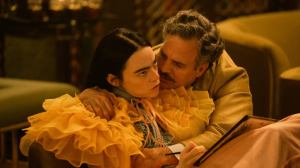 In many ways, Poor Things serves as a fish-out-of-water fairy tale that invites the audience to question and analyze the Way Things Are. Bella’s childlike perspective allows her to strip away the assumptions of adulthood and the cynicism of disappointment. Everything is new and potentially exciting, but she can also cut through the cultural hang-ups and repressive rules of polite Victorian society. This is expressed perhaps most memorably in her embrace of sexuality and the pursuit of physical pleasure. She’s told not to seek out this pleasure except for very specific settings and situations, and this confounds her. Why aren’t people doing this all the time, she asks after an extensive session of vigorous sexual activity. She is a person incapable of shame during a modest time of conditioned shame. This brashly hedonistic reality might prove too morally demented for many viewers uncomfortable with the premise. In context, it is a grown woman’s body being operated by the mind of a child. We are told that she grows and matures as she accumulates her worldly experiences, but the movie keeps it purposely vague how analogous her brain-age might be and whether that maturation is of a pace with traditional aging. It’s a reverse of 1979’s The Tin Drum, a German movie where a child refuses to grow up once he hears the drudgery of the adult world, and so he remains three years old in appearance but continues maturing intellectually and emotionally. There’s a cliche about looking at the world with a child’s unassuming eyes, and that doesn’t necessarily mean only looking at the things that are safe and appropriate for children.
Bella responds with wonder to the many pleasures of being human, but, sadly, it’s not all puff pastries and orgasms. The world is also filled with horrors and injustices, and Bella’s personal journey of discovery is also one discovering the human capacity for cruelty and selfishness. Some of this is a response to Bella wanting to assert herself and independence, as she very reasonably doesn’t understand why all these men get to tell her what to do or expect that they should. At one point, Duncan literally hurls her books into the sea so that she will not continue educating herself. This extends to later in the movie when Bella looks at prostitution in a Parisian brothel as a means of earning a living. Her same sexual appetites, that were enthusiastically encouraged by Duncan, are now paradoxically looked at by the same man as wicked. Absent riches, Bella is treated as a disposable commodity and she’s trying to make sense of why one version of her receives respect and adoration and another version is looked with disgust. It seems that an essential part of maturation is acknowledging the faults of this world and its entrenched systems of thought, but does giving in to these systems make one more human or merely more cynical? Is it a matter of learning or is it a matter of giving up on changing the status quo? These are many of the questions that the movie inspires as we join Bella on her fantastic journey of self-discovery. This movie would not work nearly as well without the fearless performance from Stone (Cruella). She gives everything of herself for this role and rewires the very movements of her body to better portray such a unique elding of a character at so many crossroads. Her early physicality is gangly like she’s learning how to operate this adult body of hers that appears too ungainly, and her expressions are without restraint, as if she’s peeled back every acting impulse to instead find a purity of perception. There is a transparent and transcendent joy in her performance as well as an ache when Bella discovers the awful shortcomings of this world. Lanthimos movies exist in a different world than ours, a cracked mirror universe of deadpan detachment and casual cruelty, so it requires a commitment to a very specific tone of performance. And yet, the requirements of this role work against that Lanthimos model of acting because Bella cannot be detached from this world. As a result, there is the same matter-of-fact reaction to the world but channeled through an idealistic innocence rather than the sarcastic skepticism that can dominate the director’s oeuvre.
The supporting cast contributes wonderfully. Dafoe (The Lighthouse) is a natural at being a weirdo, but he exhibits a paternal love for his creation that is surprisingly earnest. I laughed every time he went into one of his extended wails when he was disconnecting himself from a machine to handle his bodily gasses. Ruffalo (The Adam Project) is devilishly amusing as he abandons all pretense of likeability to play a deeply manipulative but fascinating louse, a character that is almost as transparent about his desires as Bella. His faux elitism is a constant source of comedy. Kathryn Hunter (The Tragedy of Macbeth) has a memorable and sinister turn as the brothel madame who teaches Bella about the nature of capitalism and socialism. Christopher Abbott (Black Bear) appears late as a privileged man from Bella’s past reappearing with his own demands, and his is the most terrifying portrait in the entire wacky movie, an antagonist that’s all too real and scary in a movie given to such brilliantly quixotic flights of fancy.  Under Lanthimos’ direction, the movie presents the world as an awesome discovery and the lurches into the surreal allow the viewers to see the marvels of existence with the same awe as Bella. The movie feels like it takes place in a science fiction universe of crazy visuals and the avant garde incorporation of past, present, and future. It makes every scene something to behold. This is his most visually decadent film of his career. The musical score by Jerskin Fendrix, a first-time film composer, and it works on a thematic level as trying to discover new kinds of sounds along with the journey of its heroine. However, there are sequences where the music feels like an assault on your ears. While intentional, the detours into abrasive dissonance can make one long for something less experimental and more traditional at least for the sake of your own sensitive eardrums.
Life can be decadent, it can be confusing, it can be ridiculous, it can be heartbreaking, it can be terrifying, but it’s an experience worth savoring and embracing, and this ultimately is the message of Poor Things. Stone is brilliant as she confidently carries us along for every moment of an exploration of what it means to be human, and with an ending that is so fitting and satisfying that I wanted to stand and applaud. For those squeamish from the heavy amounts of sexuality, Poor Things is at its core a very pro-life movie. It’s an inspiration to make you think one minute while making you snort laughing the next. May we all see the world with the voracious hunger and curiosity and boldness of Bella Baxter with her second chance at this one life.
Nate’s Grade: A
Share this:

The Zone of Interest (2023)

The Zone of Interest is one of the more maddening film experiences I’ve ever had, and I’m sure that was part of the intention of writer/director Jonathan Glazer (Under the Skin). While based upon a 2014 fictional book by Martin Amis, Glazer had hollowed out the novel’s fake story and replaced it with its inspiration, the Höss family, a real-life German couple and their children who literally had their villa next door to the horrendous Auschwitz concentration camp. The husband was the chief commandant for the camp, and he had his family literally sharing wall space with the notorious factory of death. The entire feature film is then given to observing this family from afar as they try to live a “normal domestic life” in the shadow of something profoundly abnormal and abhorrent. It’s a classic example of a type of movie I will dub the “Yeah, okay, so what?” movie. I get it, I do, but why is this exactly a feature film?
I understand artistically what Glazer is going for here. It’s the ironic juxtaposition of the ordinary and the awful, asking the viewer to think about how many millions of Germans went along with the mounting anti-Semitic and racist policies of Nazi Germany out of self-interest and/or willful ignorance, the banality of evil, as Hannah Arendt termed it. That becomes the challenge of the movie, watching this family tend to the garden, host a birthday party, and read bedtime stories while watching the gloom of the chimneys, listening to the constant soundtrack of scattered gunshots and the screams of victims, including the wails of babies. Every scene is elevated by the dramatic irony of the context that it is happening next door to a concentration camp. We watch them plant flowers, and it just so happens to be next door to a concentration camp. We watch them invite the mother-in-law to make her new bedroom her own, and it just so happens to be next door to a concentration camp. It gets tedious as a viewer because without the irony, we’re just watching a family live their life. I get that’s the point, this example of one family trying to ignore the terrifying reality literally at their very doorstep. I understand that message and I understand why that is even more relevant to our troubled modern times with an alarming rise in anti-Semitism and the celebration of fascism and repressive strongmen. However, I don’t think we get real insights into these characters because they’re more just general ideas intended to forward the critical thesis of the power of self-delusion and excuse-making. That’s fine as a starting point for a provocative movie, but don’t make me watch a family do their laundry for an hour and then tell me it’s an Important Statement because they happen to be next door to the horrors of history.

Let me try this same kind of approach on another human tragedy. Say we have a family drama about a hard-working couple trying to go through the day-to-day challenges of marriage and raising a family, and it JUST SO HAPPENS that they live within distance of… the internment of the Japanese in World War II. Does this magically transform and elevate the ordinary actions on-screen into more than what they are? Perhaps to some, but for me it felt too transparently methodical and quickly redundant. I don’t need a whole movie documenting a family next door that barely scratches the surface of their circumstances of living.
There are a few moments that manage to break through. There’s a scene where the daughters are swimming in the nearby river and the family realizes that the gray streams intruding upon the water are the ashes from the camp. From there they furiously scrub themselves clean, the grotesque horror something they attempt to cleanse, whether they’re horrified because the ash belongs to people or because it specifically belongs to Jews. The mother (Sandra Huller) refuses to move away after her husband Rudolph (Christian Friedel) is reassigned by the Nazi brass. This is the home she’s put her time into remodeling and reshaping and she isn’t going to just let anyone live under her roof. This setback is far more upsetting to her than anything she overhears on the other side of her garden walls. There’s also an ongoing story where one of the Höss children is leaving behind a trail of apples, inspired by a favorite bedtime fable, and this has an unfortunate unintended tragedy for people these children will never know or see. There’s an offhand remark by the mother-in-law as she’s touring the backyard where she wonders if a woman in her book club is among the throng next door in the camps. Rather than use this as a moment of reflection over the genocide occurring next door, she then moves onto lamenting that she never got this same woman’s curtains that she always prized. I wish the movie had more of these character moments that directly confront the willful ignorance rather than keeping the audience simmering with the same meditative Big Picture concept that has been relentlessly winnowed down so finely that it may as well be dust.

Glazer makes very specific choices to highlight the detachment of the movie. His camera angles are often taken from far fixed points, and the coverage makes for smooth edits that let you know there were multiple cameras filming these scenes rather than the stress of multiple setups and different takes to cobble together. This makes the movie feel closer to a documentary where we have captured real life as it is happening instead of a group of actors on a set pretending to be different people putting on a show for our entertainment.
The Zone of Interest is a movie that crushes you in the everyday details, and in that it reminded me of 2020’s The Assistant, another indie that didn’t quite work for me. That film was about a young woman who served as a film production assistant to a producer modeled after Harvey Weinstein, and it asked how much she can ignore for the sake of her own upward mobility. It had a really compelling premise but the movie spent most of its running time just watching her do her job, filing papers, getting coffee, walking home, with the implicit knowledge banging around in our anxious minds to then elevate the mundane (she’s not just fixing the copy machine, she’s fixing the copy machine and Harvey Weinstein might be abusing someone just in the next room!). This ironic juxtaposition proved too tiring for me without also exploring the characters and conflicts more explicitly. Things happening off-screen while far more boring things happen on-screen is not itself great drama. Being drama-adjacent does not automatically magically imbue the ordinary with transcendent meaning. I need more than, “Big things are happening… over there.” The Zone of Interest is a critical favorite for 2023 but I think many viewers will have the same response I did: yeah, okay, so what?
Nate’s Grade: C+
Share this:

Leave the World Behind (2023)
 Apocalyptic thrillers can oddly enough serve as a therapeutic means for dealing with our fears of being helpless against forces well beyond our control, but they’re also reflections of our current state of anxiety as well. There’s more than just giant hurricanes or earthquakes breaking records on the Richter scale, it’s about how we respond to the momentous and alarming changes and what that says about The Way We Live Now. The new Netflix apocalyptic thriller Leave the World Behind, based on the 2020 book of the same name, has some big mysteries that I feel safe to say won’t fully be explained by the end. There is a possible explanation but it’s a movie more consumed with how people respond to tumult than the tumult. I found the majority of the movie to be gripping and engaging, and while it doesn’t exactly nail the landing, writer/director Sam Esmail (Mr. Robot, Homecoming) crafts a paranoid thriller with flair. It’s an apocalyptic thriller at crossroads with a paranoia thriller and a disaster movie, and the biggest challenge of them all is ultimately being able to trust another person during a time of remarkable uncertainty.
Amanda (Julia Roberts) and her husband Clay (Ethan Hawke) have elected to take a spur-of-the-moment family vacation out of New York City and onto a lavish home in Long Island. Everything seems so placid until the phones no longer get a signal, the TV broadcasts are strictly limited to a blank emergency screen, and two strangers show up (Mahershala Ali, Myhal’la) saying this is their house and they would like to stay inside. They claim that the U.S. is under a cyber assault and there’s more to come.
 Leave the World Behind has two intriguing questions to keep the audience hooked: what is actually happening and who are these new people? Most disaster movies put you in the thick of the action, from presidential boardrooms to scientific outposts keeping up with the changing data and going over the options to prevent further loss of life. This movie purposely leaves you in the dark in a well-kept Long Island home and the first thing that goes is the expediency of knowing things from our phones. When two new people come knocking at the door to say the world is falling apart and this is our home, trust us, it’s hard not to hold some level of suspicion. Can we take these people at their word? What kind of agenda could they secretly have? And if so, what does that say about what has happened or what is happening in the outside world? They seem like they know more than what they’re letting on, so how much do they know themselves? It’s the slow drip of information that makes the movie simmer in such an anxious predicament of looking at every new piece as another new question. This places the viewer uncomfortably in similar territory as Amanda, who despite her prejudices might be right not to trust the newcomers. We’re stuck on the outside wondering what has happened and what may be left. The movie is carefully crafted to only give us so much to work with while our minds start reading and rereading everything for more connection and meaning, running rampant and going stir crazy just like the characters. While the second big question naturally gave way and could only produce so much tension, the main thrust of the movie kept me hooked and excited and worried and actively questioning just what exactly was going on.
I appreciate how Esmail is a restlessly ambitious filmmaker. He took on directing duties for the entire second season of Mr. Robot and from there continued coming up with new challenges. There was an episode meant to be told as an episode-length elaborate tracking shot. There was an episode that was told almost without any spoken words, entirely through visual action. There was an episode that was presented like a five-act stage play and it was enthralling. While these are the easy to recall gimmick episodes, Esmail’s directing vision for his series never eclipsed the series itself. It elevated the episodes but the emphasis was still on the significance of the characters and their emotional states (highly recommend Mr. Robot, one of my favorite 2010s TV shows, to anyone who has yet to watch). With Leave the World Behind, only his second feature after 2014’s parallel universe rom-com Comet, Esmail refuses to let any sequence pass without some kind of visual flourish. His camera is constantly swooping through the visual landscape, flipping and spinning and craning above the characters from on high. It reminded me of Brian DePalma, who also loves the high angle pans across rooms and also abides by the dogma that there should be no uninteresting shots in a movie. It’s easy to appreciate but without an engaging story can quickly become a distracting exercise in empty artifice, which is also how I view most DePalma. Here, much like Esmail’s accomplished prestige TV work, the style makes me better appreciate how much effort and thought Esmail has put into his presentation and his ideas. The man wants you to see his work, and there’s no fault in that as long as you’re enjoying the experience, which I was for the most part.
 There are some supremely well-crafted moments played to a breaking point of intensity. Early on, as the family relaxes on the beach, they see a ship in the distance, an ordinary sight on a seemingly ordinary day. Then hours pass and it’s getting closer, and closer, and finally the realization begins to settle in that this thing is now a danger and they need to very much run very much now. Esmail’s camerawork keeps the scene feeling kinetic, with a long take that establishes the colossal danger as the tanker runs aground and the family has narrowly fled in time. In many ways this moment also serves as an ecological metaphor, with problems looming in the distance but ignored until they are at their most dangerous and right on top of us. Another sequence involves Clay venturing outside and discovering what appears to be a dust storm the color of blood. It’s getting closer and closer and the movie is testing how much we can take before you start hitting an imaginary gas pedal to strongly suggest Clay out of there. There’s another sequence that’s a literal pile-up of driver-less cars coming to the same nexus point like they’re all migrating. It makes for an immediately eerie sequence that becomes extra horrifying once the Teslas become unmanned missiles.
The themes of disconnection aren’t exactly subtle but that doesn’t mean they are misguided. This movie is about as subtle as an oil tanker heading straight for you, but I didn’t mind because of the skill of the storytellers and the ongoing mysteries that kept me begging for every new morsel. The messaging isn’t exactly complex. At one point Amanda has a speech that might as well be titled “This is Why Humans Are Terrible and We Deserve This.” Following this, another character tells her that they may not agree on much but she agrees with every word she just uttered with her speech, so you know this is the kind of pessimistic monologue that can reach across the doom-scrolling aisle. The movie almost frustratingly ends without a larger sense of clarity over what has been happening, a fate that would have greatly angered my wife. Esmail gives you something that can work as an explanation without making it definitive; it’s merely a theory but it’s enough to hold onto if you desperately need an explanation. However, the way the movie ends feels less conclusive and more like the conclusion of a season of television where the characters, now grouped together, are in for something fierce next year so stay tuned. The nature of this story is designed to leave you hanging, and that’s why I circle back on it mattering more on how these characters respond to this apocalyptic event versus what is clearly happening.
 Chilling and effectively plotted to keep you guessing until the end, Leave the World Behind is an apocalyptic thriller that really simmers in the anxiety of the unknown. It’s not perfect but it’s pretty good, as long as you can accept not having all the answers. The acting is strong but it’s the control and finesse that Esmail exhibits as director and screenwriter that really makes the material engaging and impactful. It’s an apocalyptic thriller where the scariest proponent might be having to live with one another.
Nate’s Grade: B
Share this:

Cold Mountain (2003) [Review Re-View]
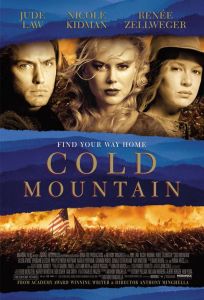
Originally released December 25, 2003:
Premise: At the end of the Civil War, Inman (Jude Law, scruffy) deserts the Confederate lines to journey back home to Ada (Nicole Kidman), the love of his life he’s spent a combined 10 minutes with.
Results: Terribly uneven, Cold Mountain‘s drama is shackled by a love story that doesn’t register the faintest of heartbeats. Kidman is wildly miscast, as she was in The Human Stain, and her beauty betrays her character. She also can’t really do a Southern accent to save her life (I’m starting to believe the only accent she can do is faux British). Law’s ever-changing beard is even more interesting than her prissy character. Renee Zellweger, as a no-nonsense Ma Clampett get-your-hands-dirty type, is a breath of fresh air in an overly stuffy film; however, her acting is quite transparent in an, “Aw sucks, give me one ‘dem Oscars, ya’ll” way.
Nate’’s Grade: C
——————————————————
WRITER REFLECTIONS 20 YEARS LATER
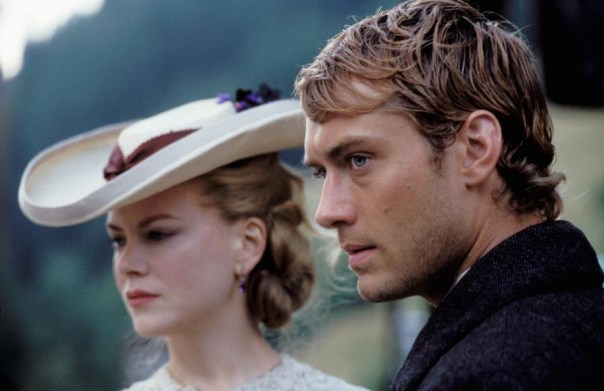
I kept meaning to come back to Cold Mountain, a prototypical awards bait kind of movie that never really materialized, but one woman ensured that it would be on my re-watch list for 2003. My wife’s good friend, Abby, was eager to hear my initial thoughts on the movie when I wrote my original review at the age of twenty-one. This is because Cold Mountain is a movie that has stayed with her for the very fact that her grandfather took her to see it when she was only nine years old. While watching, it dawned on nine-year-old Abby that this was not a movie for nine-year-olds, and it’s stuck with her ever since. I think many of us can relate to watching a movie with our parents or family members that unexpectedly made us uncomfortable. For me, it was Species, where I was 13 years old and the movie was about a lady alien trying to procreate. I think my father was happy that I had reached an acceptable age to go see more R-rated movies in theaters. Social media has been awash lately with videos of festive families reacting to the shock value of Saltburn with grumbles and comical discomfort (my advice: don’t watch that movie with your parents). So, Abby, this review is for you, but it’s also, in spirit, for all the Abbys out there accidentally exposed to the adult world uncomfortably in the company of one’s parents or extended family.
Cold Mountain succumbs to the adaptation process of trying to squeeze author Charles Frazier’s 1997 book of the same name into a functional movie structure, but the results, even at 150 minutes, are unwieldy and episodic, arguing for the sake of a wider canvas to do better justice to all the themes and people and minor stories that Frazier had in mind. Director Anthony Minghella’s adaptation hops from protagonist to protagonist, from Inman to Ada, like perspectives for chapters, but there are entirely too many chapters to make this movie feel more like a highly diluted miniseries scrambling to fit all its intended story beats and people into an awards-acceptable running time. This is a star-studded movie, the appeal likely being working with an Oscar-winning filmmaker (1996’s The English Patient) of sweep and scope and with such highly regarded source material, a National Book Award winner. The entire description of Cold Mountain, on paper, sounds like a surefire Oscar smash for Harvey Weisntein to crow over. Yet it was nominated for seven Academy Awards but not Best Picture, and it only eventually won a single Oscar, deservedly for Renee Zellweger. I think the rather muted response to this Oscar bait movie, and its blip in a lasting cultural legacy, is chiefly at how almost comically episodic the entire enterprise feels. This isn’t a bad movie by any means, and quite often a stirring one, but it’s also proof that Cold Mountain could have made a really great miniseries.

The leading story follows a disillusioned Confederate defector, Inman (Jude Law), desperately trying to get back home to reunite with his sworn sweetheart, Ada (Nicole Kidman), who is struggling mightily to maintain her family’s farm after the death of her father. That’s our framework, establishing Inman as a Civil War version of Odysseus fighting against the fates to return home. Along the way he surely encounters a lot of famous faces and they include, deep breath here, Phillip Seymour Hoffman, Natalie Portman, Giovanni Ribisi, Cillian Murphy, Eileen Atkins, Taryn Manning, Melora Walters, Lucas Black, and Jena Malone. Then on Ada’s side of things we have Zellweger, Donald Sutherland, a villainous Ray Winstone, Brendan Gleeson, Charlie Hunam, Kathy Baker, Ethan Suplee, musician Jack White, and Emily Descehanel, and this is the storyline that stays put in the community of Cold Mountain, North Carolina.
That is a mountain of stars, and with only 150 minutes, the uneven results can feel like one of those big shambling movies from the 1950s that have dozens of famous actors step on and as quickly step off the ride. Poor Jena Malone (Rebel Moon) appears as a ferry lady and literally within seconds of offering to prostitute herself she is shot dead and falls into the river (well, thanks for stopping by Jena Malone, please enjoy your parting gift of this handsome check from Miramax). Reducing these actors and the characters they are playing down to their essence means we get, at most, maybe 10-15 minutes with them and storylines that could have been explored in richer detail. Take Portman’s character, a widowed mother with a baby trying to eke out a living, one of many such fates when life had to continue after the men ran to war for misbegotten glory. She looks at Inman with desperate hunger, but it’s not exactly lust, it’s more human connection. When she requests that Inman share her bed, it’s just to feel another warm presence beside her, someone that can hold her while she weeps about the doomed fate of her husband and likely herself. There’s a strong character here but she’s only one stop on our expedited tour. The same with Hoffman’s hedonistic priest, a man introduced by throwing the body of a slave woman he impregnated over a ridge, which might be the darkest incidental moment of the whole movie. His character is played as comic relief, a loquacious man of God who cannot resist the pleasures of the flesh, but even he comes and goes like the rest of our litany of very special guest stars. They feel more like ideas than characters.

This is a shame because there are some fantastic scenes and moments that elevate Cold Mountain. The opening Civil War battle is an interesting and largely forgotten (sorry Civil War buffs) battle that begins with a massive surprise attack that produces a colossal explosion and crater and turns into a hellish nightmare. Granted, the movie wants us to sympathize with the Confederates who were bamboozled by the Yankee explosives buried under their lines, and no thank you. The demise of Hoffman’s character comes when he and Inman are captured and join a chain gang, and they try running up a hill to get free from approaching Union troops. The Confederates shoot at the fleeing men, eventually only with Inman left, who struggles to move forward with the weight of all these dead men attached to him. When they start rolling down the hill, it becomes a deeply macabre and symbolic struggle. The stretch with Portman (May December) is tender until it goes into histrionics, with her literal baby being threatened out in the cold by a trio of desperate and starving Union soldiers (one of which played by Cillian Murphy). It’s a harrowing scene that reminds us about the sad degradation of war that entangles many innocents and always spills over from its desired targets. However, this theme that the war and what it wrought is sheer misery is one Minghella goes to again and again, but without better characterization with more time for nuance, it feels like each character and moment is meant to serve as another supporting detail in an already well-proven thesis of “war is hell.”
Even though I had previously watched the movie back in 2003, I was hoping that after two hours of striving to reunite, that Inman and Ada would finally get together and realize, “Oh, we don’t actually like each other that much,” that their romance was more a quick infatuation before the war, that both had overly romanticized this beginning and projected much more onto it from the years apart, and now that they were back together with the actual person, not their idealized imaginative version, they realized what little they had in common or knew about each other. It would have been a well-played subversion, but it also would have been a welcomed shakeup to the Oscar-bait romantic drama of history. Surely this had to be an inconvenient reality for many, especially considering that the men returning from war, the few that did, were often not the same foolhardy young men who leapt for battle.
Zellweger (Judy) was nominated for Best Actress in the preceding two years, for 2001’s Bridget Jones Diary and 2002’s Chicago, which likely greased the runway for her Supporting Actress win from Cold Mountain. There is little subtlety about her “aw shucks” homespun performance but by the time she shows up, almost fifty minutes into the movie, she is such a brash and sassy relief that I doubt anyone would care. She’s the savior of the Cold Mountain farm, and she’s also the savior of the flagging Ada storyline. Pity Ada who was raised to be a nice dutiful wife and eventual mother but never taught practical life skills and agricultural methods. Still, watching this woman fail at farming will only hold your attention for so long. Zellweger is a hoot and the spitfire of the movie, and she even has a nicely rewarding reconciliation with her besotted old man, played by Brendan Gleeson, doing his own fiddlin’ as an accomplished violin player. As good as Zellweger is in this movie is exactly how equally bad Kidman’s performance is. Her Southern accent is woeful and she cannot help but feel adrift, but maybe that’s just her channeling Ada’s beleaguered plight.
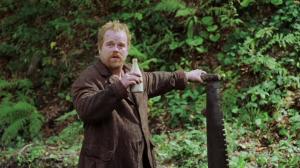
I think there’s an extra layer of entertainment if you view Inman’s journey in league with Odysseus; there’s the dinner that ends up being a trap, the line of suitors trying to steal Ada’s home and hand in the form of the duplicitous Home League boys, Hoffman’s character feels like a lotus eater of the first order, and I suppose one reading could have Portman’s character as the lovesick Calypso. Also, apparently Cold Mountain was turned into an opera in 2015 from the Sante Fe Opera company. You can listen here but I’m not going to pretend I know the difference between good and bad opera. It’s all just forceful shouting to my clumsy ears.
Miramax spent $80 million on Cold Mountain, its most expensive movie until the very next year with 2004’s The Aviator. Miramax was sold in 2010 and had years earlier ceased to be the little studio that roared so mighty during many awards seasons. I think Cold Mountain wasn’t the nail in the coffin for the company but a sign of things to come, the chase for more Oscars and increasingly surging budgets lead the independent film distributor astray from its original mission of being an alternative to the major studio system. Around the turn of the twenty-first century, it had simply become another studio operating from the same playbook. Minghella spent three years bringing Cold Mountain to the big screen, including a full year editing, and only directed one other movie afterwards, 2006’s Breaking and Entering, a middling drama that was his third straight collaboration with Law. Minghella died in 2008 at the still too young age of 54. He never lived to fully appreciate the real legacy of Cold Mountain: making Abby and her grandfather uncomfortable in a theater. If it’s any consolation to you, Abby, I almost engineered my own moment trying to re-watch this movie and having to pause more than once during the sex scene because my two children wanted to keep intruding into the room. At least I had the luxury of a pause button.
Re-View Grade: B-
Share this:

Are You There God? It’s Me, Margret (2023)
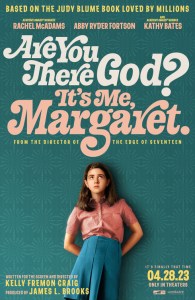 When is it not weird for a 41-year-old man to cry about a young woman getting her first period? When you’re watching the film adaptation of Judy Blume’s long-celebrated coming-of-age novel, Are You There God? It’s Me, Margaret. Blume waited almost fifty years before signing over the rights to writer/director Kelly Fremon Craig, whose 2016 movie Edge of Seventeen showed a downright Blume-esque combination of authenticity, good humor, and grace. That trusted vision is evident with how natural and deeply felt the movie comes across. We’ve had numerous coming-of-age tales since Blume’s influence, so I worried that maybe it would feel outdated or surpassed, but the movie taps into a great reservoir of empathy, bringing to relatable light the uncertainty of puberty, of fitting in, and trying to navigate the ever-approaching adult world. Usually these kinds of movies invite the viewer to reflect back upon their own young adult experiences, which I did even though I was never a teenage girl, but I had my own awkward and vulnerable moments too. I really enjoyed that Craig’s movie makes ample time for the adults too, which is where my relatability was prioritized. Watching Rachel McAdams try and explain why her parents disowned her for marrying a Jewish man is a powerfully affecting moment of an adult trying to explain a very hard truth to their child. The movie is affectionate and uplifting and earnest without being too cloying. It’s a pleasant and wholesome movie that showcases Craig as an agile filmmaker who deserves more opportunities and that even fifty years later, being an adolescent girl is still the same old awkward agony.
Nate’s Grade: B+
Share this:

Big Fish (2003) [Review Re-View]
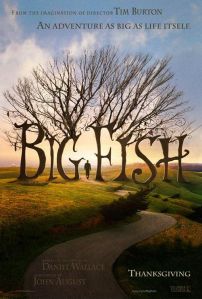
Originally released December 25, 2003:
Premise: Estranged son Will (Billy Crudup) travels back home in an effort to know his ailing father Edward Bloom (Albert Finney; Ewan McGregor as the younger version). Will hopes to learn the truth behind a man who spent a lifetime spinning extravagant tall tales.
Results: Despite a shaky first half, Big Fish becomes a surprisingly elegant romance matched by director Tim Burtion’’s visual whimsy. McGregor’’s shining big-grinned optimism is charming. Not to be confused with the similar but too mawkish Forrest Gump, Burton’’s father-son meditation will have you quite choked up at its moving climax. Fair warning to those with father issues, you may want to steer clear from Big Fish. You know who you are.
Nate’’s Grade: B+
——————————————————
WRITER REFLECTIONS 20 YEARS LATER

Tim Burton has never really made a movie like Big Fish before or in the twenty years since. He’s made movies that are aimed at children, like the Disney live-action remakes for Dumbo and Alice in Wonderland, and he’s made animated movies that are more wholesome while still holding to the man’s creepy-cute aesthetic, but he’s never made a movie so unabashedly sentimental as 2003’s Big Fish. Many of his stories involve alienation and outcasts and outsiders and characters accepting themselves, their unique oddities, and their unconventional families. This movie was different. It was based on the 1998 novel by Daniel Wallace and primarily concerns the relationship between fathers and sons as the paterfamilias is nearing his end, a not unfamiliar plot structure for treacle and tears. It’s about a smooth-talking man of legendary tall tales about his life and his exasperated son trying to find real answers. That’s the movie. It’s purposely small even though the tales are tall. There’s nothing larger than simply resolving the strained relationship between father (Albert Finney) and son (Billy Crudup). It’s the most intimate movie of Burton’s career while still finding a place for his fantastical visual whimsy, as the outlet for Edward Bloom’s (Finney as the dying version, Ewan McGregor as the younger version) fantastical tales of adventure. It’s a movie elevated by Burton’s signature style and it’s one that still, in 2023, had me choking up and tears streaming down my face by the conclusion.
This is an episodic movie by design and it does hamper some of the emotional investment, until that whammy of a culmination. Because we know the younger Edward Bloom is exaggerating his life’s travails for entertainment, and perhaps a dash of pride to heighten his deeds, it makes the many sequences of young Edward and his escapades feel a bit fleeting, as if we’re trying to find the larger meaning hidden within the fables and the fabulous. The ultimate point is that the entertaining diversions and exaggerations are who Edward Bloom is, and ultimately trying to discern truth from legend loses sight of the appeal of this charming man and his wild tales. I can understand this while also slightly disagreeing with the conclusion. It’s a little pat to say, well, the point of all these extravagant stories is simply that they were entertaining, never mind about finding a buried meaning or truth. It’s like saying, “Hey, just enjoy the ride.” The point is to fall in love with the storyteller and see the storytelling itself as its own act of love, which I don’t think works until the very end of the movie. Until then, it’s a transitory series of adventures, from wartime to the circus to aggressively persistent courtships and hidden magical towns, each reflective of the indomitable spirit and cheery optimism of our chief yarn-spinner.

In that way, it’s easy for the viewer to adopt the same perspective as Will (Crudup), and that may be the hidden genius of screenwriter John August (Go), or I may be projecting. Our plight is the same as the son: we’re trying to discover what is actually real about the real man. It’s easy to feel his exasperation as he wants something genuine from this man and only keeps getting the same old tales and stories, and everyone else is smiling broadly and happy to just accept the man on his own terms. That’s where Will’s character arc goes, finally accepting his father on his terms, which means playing along with his rules. It’s a level of empathy and acceptance rolled together, but it’s also like two hours of a character going, “My dad might be a liar and I’m curious who he is,” and then in the end going, “My dad might be a liar but I guess that’s who he is.” It doesn’t feel like the grand epiphany that the movie thinks it is, even with Danny Elfman’s Oscar-nominated score trying to stir every doldrum of your heart (Elfman has only been nominated four times in his storied career, also for Good Will Hunting, Milk, Men in Black). So for much of the movie’s running time I’m pleasantly entertained but a little frustrated that the movie doesn’t seem to be digging closer into the man garnering all this unwavering attention.
However, it’s at the very end where Big Fish really transcends its limitations to become something deeply moving and powerful. As I re-watched, I’m twenty years older, and likewise my own father is twenty years older, and moments like this have more potency to me. It’s about the son accepting his father on the same terms he fought so hard to circumvent, and so the ending becomes a beautiful exchange of the storyteller inviting someone else to finish his story’s ending. It’s surprisingly profound when you boil it down to its essentials, and that may be why I had tears dripping down my face as the adult son narrates one last fantastic tale of helping his father escape from the hospital, dart through traffic in his classic car, and arrive for a farewell with all the many friends he’s made through his many decades of laughter and camaraderie. Edward then transforms into the fish, becoming the very symbol of his “fish tales,” and lives on through the stories and memories of others, simply but effectively communicated with the mourners engaged in retelling Edward Bloom’s escapades through engaged pantomime. It’s one of the most clear-cut examples for me of a perfectly good movie really hitting another level in the end.
Big Fish began a long collaboration between Burton and August, who has become such a prolific Hollywood scribe that he’s likely had his hand on just about every script in town. August would later be trusted to write Charlie and the Chocolate Factory, Corpse Bride, Frankenweenie, and Dark Shadows; that’s five Burton projects in nine years. For those keeping track, this was only the second Helena Bonham Carter appearance in a Burton movie, the first being the misbegotten 2001 Planet of the Apes remake. It’s also fun to watch Marion Cotillard (Inception) in her first American movie as Will’s pregnant wife.
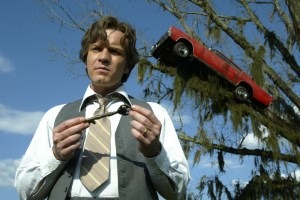
Big Fish also has a strange unintended legacy regarding someone else who connected with it. It was the last film seen by the famous playwright and monologist Spalding Gray, an enormously compelling storyteller who, much like Edward Bloom, favored the oral tradition. He suffered through depression most of his life, which was amplified after a severe car accident and multiple surgeries to recuperate in the early 2000s. On January 10, 2004, he took his children to see Big Fish and the next day was declared missing. His body was found in the East River in New York City and it’s believed Gray took his own life leaping from the Staten Island Ferry. His wife, Kathleen Russo, told New York Magazine in 2008 that Gray had cried throughout the movie and she concluded, “I think it gave him permission to die.” It’s unfair to blame the movie for a suicidal man’s decision-making, but I think it’s interesting that the emotional closure onscreen was so powerfully felt that Gray may have felt a personal level of closure as well.
My original 2003 review was so minimal, one of five or six short capsule reviews I wrote together as end-of-the-year awards contenders (same with the upcoming Cold Mountain re-watch), so I wanted to add more thoughts to the subject. My opinion feels relatively the same twenty years later though the ending had even more power as a 41-year-old than at twenty-one. I’ll keep my review the same for relatively the same reasons, though I hope Burton returns back to telling another Big Fish kind of detour (2014’s Big Eyes was not that).
Re-View Grade: B+
Share this:

Master and Commander: The Far Side of the World (2003) [Review Re-View]

Originally released November 14, 2003:
Without sounding easily amused, this movie really is glorious filmmaking. With Peter Weir’’s steady and skilled direction we get to really know the life of the early 19th century. We also get to know an armada of characters and genuinely feel for them. Russell Crowe is outstanding as Captain Jack Aubrey. His physicality and emotions are expertly showcased. When he gives a motivational speech you’’d understand why people would follow him to the ends of the Earth. Paul Bettany (again buddying up to Crowe after ‘A Beautiful Mind’) is Oscar-worthy for his performance as the ship’s’ doctor and confidant to the Captain. He’’s not afraid to question the Captain’’s motives, like following a dangerous French ship all around South America. ‘Master and Commander ’hums with life, and the battle sequences are heart-stopping and beautifully filmed. It took three studios to produce and release this and every dollar spent can be seen on the screen. ‘Master and Commander’ is fantastic, compelling entertainment with thrills, humanity, and wonder. It’’s grand old school Hollywood filmmaking.
Nate’s Grade: A
——————————————————
WRITER REFLECTIONS 20 YEARS LATER
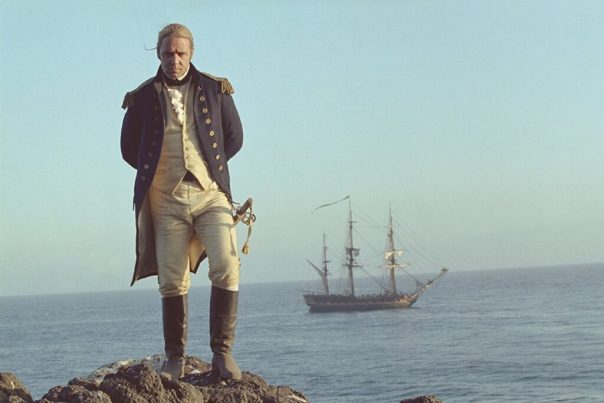
They really don’t make movies like Master and Commander anymore and that is a detriment to every facet of our society. It took three different studios to bankroll this expensive movie, made all the more expensive by being almost entirely set at sea, a very costly and volatile location. In a just world, this would have been the beginning of a cinematic universe to rival Marvel, and the dashing Captain Jack Aubrey (Russell Crowe) would be as beloved as Captain Jack Sparrow, and children would beg their parents to read the dozen naval adventure novels by Patrick O’Brian. Just imagine lines of children for Halloween eagerly dressed in little admiral outfits with long blonde ponytails. Unfortunately, we do not live in this utopian universe, and 2003’s Master and Commander was the one and only movie we ever got. It received ten Academy Award nominations including Best Picture and Best Director for Peter Weir, winning two Oscars for Cinematography and Sound Editing, two of the only categories where runaway champion Return of the King wasn’t nominated. This is a masterpiece and a prime example of Hollywood filmmaking at its best. It’s just as easy to be transported in 2023 as it was back in 2003.

This movie is still effortlessly engaging and enthralling, dropping you onto the HMS Surprise during the Napoleonic wars. Even the opening text starts to get your blood pumping: “Oceans have become battlefields.” The opening act is a tremendous introduction to life onboard an early nineteenth-century ship, giving us a sense of the many crewmen and their responsibilities, as well as the different pieces working in tandem while under attack from a French vessel. The movie is structured as an elongated cat-and-mouse chase between the two ships, with the English trying to outsmart the faster French ship with its heavy cannons that easily outnumber the Surprise. Each stage presents a new challenge. One sequence involves them setting up a ruse with a smaller ship attached with a lantern to trick the French vessel into following the decoy at night. The constant threat of this sleeker ship getting the drop on them and attacking is always present, turning the opposition into a mythic monster breaking forth through the fog. The tests of command and camaraderie lead to important questions over duty and sacrifice. There are several children manning the decks as well, cadets eager to be the next generation of English warriors. It’s a shocking reality to process through our modern perspective, and it’s made even harder when tragedy befalls these youngest sailors just like any of the other crew. The movie is steeped in authentic details and realism that makes you feel like you’ve dropped into living history.
In 2023, Gabriella Paiella wrote a GQ article titled “Why Are Guys So Obsessed with Master and Commander?” noting its enduring popularity with a certain selection of Millennial men (yours truly included). She theorized part of its ongoing appeal is how wholesome the movie comes across, with depictions of positive and healthy male friendships. Even the dedication to service is depicted in a way forgoing jingoism. This is a deeply empathetic movie about men who deeply love one another. The most toxic depiction on screen isn’t one born of masculinity run amok during wartime but more a division in class amplified by superstition. Pity poor midshipman Hollum (Lee Inglebee), a man who cannot make friends with the crew because they disdain his privilege and will never see him as a better or an equal. He becomes a scapegoat for the bad luck of the ship, as they feel he is a “Jonah,” a curse. Poor Hollum, who sees no way out of this dilemma and literally plunges overboard with cannonball in hand, ridding the crew of their reputed curse (the wind picks up the sails the next morning). Beyond this valuable and sad storyline, the men of the Surprise seem so grateful for one another’s company. It’s a guy movie that invites men to escape to the frontier as an inclusive summer camp (no girls allowed!).

By the end of this movie, as we’re utilizing every nautical trick we’ve learned and preparing to seize the elusive French boat, my body was shaking in anticipation. We’ve gone on this journey and gotten to know a dozen faces, and we feel part of the team to the point that we’re onboard too. Seeing any of these men close their eyes permanently is awful. It’s not just keen military strategy and theory being discussed; we feel the real human cost. A small moment at the end, where a young man asks for help to sew the death shroud of his mentor, just hits you in the guts. Even watching poor Hollum processing his final fateful decision is heartbreaking. I still gasp even today watching Doctor Maturin (Paul Bettany) accidentally shot and then have to perform his own surgery. You feel the highs and lows throughout this voyage because the movie has made you care. The sheer adventure of it all is terrific, but it’s the immersive details and the strong character writing for everyone that makes this movie so special. It’s not just a rousing high-seas tale of bravery but also a stirring and empathetic character piece and absorbing drama.
It’s astounding to me that Weir isn’t still one of the hottest working directors. The Australian has earned four Best Director nominations across three decades (1985’s Witness, 1989’s Dead Poets Society, 1998’s Truman Show) and proven he can handle any genre with any style. He’s only directed a single movie since Master and Commander, 2010’s Siberian prisoner of war movie, The Way Back. In twenty years, we’ve only been given one other Peter Weir movie, and that is a travesty. In a recent interview, Weir confirmed he’s essentially retired from directing. If only time had been kinder to this great director. For comparison’s sake, other famous artists that also have four Directing nominations include Clint Eastwood, Stanley Kubrick, and Francis Ford Coppola.

I assumed Master and Commander would still be good to re-watch in 2023, but I was amazed at how quickly I fell back under the movie’s sway so completely absorbed. It’s the kind of movie where everything just feels so natural, so authentic, and so compelling, where the hard work can be too easily undervalued because it all just feels like a documentary. This movie is so captivating and enthralling and every adjective you can devise. It earns them all. Why oh why did we never get a second of these? There were over a dozen novels as source material at the time of the first movie. According to that same 2023 GQ article, the studio head at Fox, Tom Rothman, explained that he was a lifelong fan of the O’Brian novels, having fallen in love with them as a boy. It took the studio chief using his position to get this kind of movie made in 2003, that’s the level of corporate power necessary to circumvent all the naysayers trying to kill this. I guess rather than mourn the lack of sequels I should count my blessings that we have even one. You were too good for this world, Master and Commander: The Far Side of the World.
Re-View Grade: A
Share this:

Peter Pan & Wendy (2023)
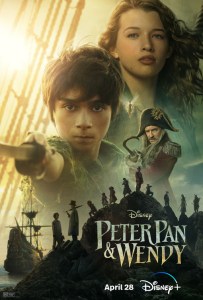 I’m not a big fan of the Peter Pan story. I think it has some meaty themes but the world of Neverland was never that interesting and I always found the characters to be more annoying and flimsy than enchanting and diverting. It also doesn’t help that there have been dozens and dozens of Pan adaptations; by existing in the public domain, one is guaranteed every few years, like 2015’s disastrous Pan by director Joe Wright (Cyrano) and 2020’s Wendy, the long-awaited follow-up from director Benh Zeitlin (Beasts of the Southern Wild). The only aspect that had me even remotely intrigued in Disney’s new live-action version was the creative team behind it. Director/co-writer David Lowery is better known for sumptuous and deeply humanist indies like The Green Knight and Ain’t Them Body Saints, plus having Rooney Mara eat an entire pie for ten minutes of A Ghost Story (thus fulfilling my requirement to mention this baffling moment whenever the opportunity arises). He also happened to make the 2016 live-action remake for Pete’s Dragon, which was soulful and heartwarming and excellent. It’s in fact my favorite of all the recent Disney remakes and proof of what great artists can do when given enough creative latitude, from the parent studio as well as general audiences and their expectations. I think the overriding Disney demands won out, as Peter Pan & Wendy is a rather bland update that every so often gives a glimpse of a more introspective, thoughtful, and possibly better Pan.
You probably know the story already, as we follow the Darling children from their home in London all the way to the magical fantasy island of Neverland thanks to immortal child and would-be lovable scamp, Peter Pan (Alexander Molony). The kids can forever be kids on adventures with the fellow Lost Boys, battling against pirates led by Captain Hook (Jude Law). Except Wendy (Ever Anderson) starts to wonder whether growing up might be a necessity.
 Considering the original Disney animated movie was released in the 1950s, there have been more than a few updates to modernize this tale, which have predictably riled the easily triggered culture warriors always looking for their next outrage. The offensive minority representation has obviously been altered, with actual indigenous actors portraying indigenous roles (no Rooney Mara as Tiger Lily in this go-round), and we have a brown-skinned Peter and Tinkerbell (Yara Shahidi), and the Lost Boys includes girls too in a throwaway explanation that’s entirely credible. Wendy also gets more empowered and has much more influence in the end events. I cannot understand the mentality of anyone that gets this upset over the skin color of fictional characters when it doesn’t alter the story. Who cares what the race of the actress playing Tinkerbell is, she’s a fairy. Why can’t there be darker-skinned fairies, hobbits, and mermaids? There are some exceptions; if Superman was played by a black actor, the world would view this overpowered alien in a completely different light, and that demands to be explored. However, most stories in a fantasy or sci-fi setting are not dependent on specific ethnicity, so why care? Of course, when the Tinkerbell character is such a waste, used solely for wordless reaction shots, it doesn’t matter what the race of the actress is when the character is this inconsequential.
One change I did like was bringing more of a personal fidelity between Peter and Captain Hook, beginning as close friends before falling out. The role of Hook has usually been modeled as an analogue for the Darling’s disapproving father and played by the same actor for the obvious parallels (in this iteration, Alan Tudyk). With Lowery’s version, Hook began as simply James, a Lost Boy who was Peter’s BFF until James started to miss his mother. This cherishing of the past rather than out-rightly rejecting it caused a wedge between the two friends, and James returned home only to eventually return back to Neverland as a grown man. I don’t know if the adult James was seeking out the comfort of his old friend and the familiar or if he was seeking out Peter for the sake of vengeance, blaming him for the years of time he lost and missing the death of his mother. Perhaps Peter’s harsh rejection of his grieving friend sent him into a tailspin. This painful past, when it starts to break through the cracks of family spectacle, can be captivating. Characters who are unable to articulate their loss but they feel it, as if there’s something just below the surface that they know isn’t right in all these redundant clashes. Can these characters even die? There are several that come back from certain demise. There are exchanges where Peter and Hook feel like they’re on auto-pilot, mechanically giving into the demands of a universe keeping its players in tidy and conforming roles. There’s a slight danger when the movie hits these little bumps, like characters becoming aware of more than what they’re used to. It’s like they’re breaking free of the Matrix to briefly realize how they’re being manipulated by fate before succumbing back to it.
 These occasional philosophical glimpses are what kept me going, hoping that somehow the movie would rise above its familiarity into something different and more exciting. I don’t mean adult or darker, though there are clear horror routes one could take with the story of Peter Pan. Pete’s Dragon wasn’t a particularly complex story by any means but it channeled a clear and heartfelt tone and vision, and was executed at a high level to be appealing to all ages. I was hoping for something the same here, but the muck of the Peter Pan expectations ultimately gets the best of Lowery and his team. I liked the idea that Wendy may not be the first Wendy to be lured to Neverland to be the house mother for these wayward children. I liked the idea that Peter Pan could be the real villain of this realm, holding children hostage more or less through their rejection of growing up, and how resentful and remorseful that can make someone when they are cut out of their former life. I liked the idea of James/Hook possibly maybe even being a distant relative of the Darlings and what that could do for their relationship and perspectives meeting. I liked the idea of characters falling into patterns but not able to comprehend why they’re being manipulated. There’s a more penetrating movie here just on the peripheral and it pokes through but only occasionally. It’s frustrating to watch because it feels like uncovering artifacts of an older, more arresting screenplay that has, over the course of numerous rewrites and studio intervention, been diluted. The Peter Pan movie we get in 2023 is fine with some diverting visuals, but it’s a shadow of what could have been had Lowery been allowed to explore more of his creative impulses.
The movie is not without its charms and beauty, and for 106 minutes you can watch it without investing too much of your emotions. Law (Fantastic Beasts) is easily the best part of the movie, really enjoying the snarl of his over-the-top villain but finding opportunities for nuance to showcase his lingering vulnerabilities. Hook comes across like a bigger kid hurt and lashing out, and there’s tragedy to that that Law is able to tap while also playing into the foppish and slapstick comedy. I adored Jim Gaffigan (Linoleum) as Smee and was amused that he becomes the moral center for the pirates, speaking out when he fears they’re crossing a line. The natural scenery has a luscious storybook quality to it, and the mossy ruins made me think of Lowery’s Green Knight and its many visual pleasures. I enjoyed the presentation and physics of a below deck sword fight while the ship is rotating in the air. It made me think of Inception’s famous gravity-defying hallway fight, in a good way. I enjoyed how active the cinematography was, swooping and swirling with the energy of a child radically at play, and the montages of characters feeling the full power of happy memories had a downright ethereal quality of demonstrating a fuller life.
 If you’re hungry for a live-action Peter Pan movie, then try the 2003 version with a deliciously maniacal Jason Isaacs (Mass) as Captain Hook. If you’re looking for a Peter Pan that goes beyond the bounds of the same old story, try Steven Spielberg’s Hook, a touchstone of many Millennial childhoods. Or check out the 1922 silent era Peter Pan. There is no shortage of Pan adaptations to choose from, so there’s a Pan for every occasion, and I’m sure there will be fans of this new live-action update as well. I found it a little too bland. It’s certainly better than the recent Pinocchio, but that itself is not reason enough to watch this. Peter Pan & Wendy offers too little to distinguish it from its predecessors, so it becomes yet another Pan adaptation that fails to fully take flight.
Nate’s Grade: C+
Share this:

Knock at the Cabin (2023)
 Knock at the Cabin continues M. Night Shyamalan’s more streamlined, single-location focus of late, and while it still has some of his trademark miscues, it’s surprisingly intense throughout and Shyamalan continues improving as a director. The premise, based off the novel by Paul Tremblay, is about four strangers (Dave Bautista, Nikki Amuka-Bird, Rupert Grint, Abby Quinn) knocking on the door of a gay couple’s (Jonathan Groff, Ben Aldridge) cabin. These strangers, which couldn’t be any more different from one another, say they have come with a dire mission to see through. Each of them has a prophetic vision of an apocalypse that can only be avoided if one of the family members within the cabin is chosen to be sacrificed. Given this scenario, you would imagine there is only two ways this can go, either 1) the crazy people are just crazy, or 2) the crazy people are right (if you’ve unfortunately watched the trailers for the movie, this will already have been spoiled for you). I figured with only two real story options, though I guess crazy people can be independently crazy and also wrong, that tension would be minimal. I was pleasantly surprised how fraught with suspense the movie comes across, with Shyamalan really making the most of his limited spaces in consistently visually engaging ways. His writing still has issues. Characters will still talk in flat, declarative statements that feel phony (“disquietude”?), the news footage-as-exposition device opens plenty of plot hole questions, and his instincts to over-explain plot or metaphor are still here though thankfully not as bad as the finale of Old, and yet the movie’s simplicity also allows the sinister thought exercise to always stay in the forefront. Even though it’s Shyamalan’s second career R-rating, there’s little emphasis on gore and the violence is more implied and restrained. I don’t think Shyamalan knows what to do with the extra allowance of an R-rating. The chosen couple, and their adopted daughter, are told that if they do not choose a sacrifice, they will all live but walk the Earth as the only survivors. It’s an intriguing alternative, reminding me a bit of The Rapture, an apocalyptic movie where our protagonist refuses to forgive God and literally sits out of heaven (sill worth watching). The stabs at social commentary are a bit weaker here, struggling to make connections with mass delusions and confirmation bias bubbles. I really thought more was going to be made about one of the couple being a reformed believer himself, with the apocalyptic setup tapping into old religious programming. It’s a bit of an over-extended Twilight Zone episode but I found myself nodding along for most of it, excusing the missteps chiefly because of the power of Bautista. This is a very different kind of role for the man, and he brings a quiet intensity to his performance that is unnerving without going into campy self-parody. He can genuinely be great as an actor, and Knock at the Cabin is the best example yet of the man’s range. For me, it’s a ramshackle moral quandary thriller that overcomes Shyamalan’s bad writing impulses and made me actually feel some earned emotion by the end, which is more than I was expecting for an apocalyptic thriller under 100 minutes. What a twist.
Nate’s Grade: B-
Share this:

Gangs of New York (2002) [Review Re-View]
 Originally released December 20, 2002:
Watching Martin Scorsese’s long-in-the-making Gangs of New York is like watching a 12-round bout between two weary and staggering prize fighters. You witness the onslaught of blows, see the momentum change several times, and in the end can’t really tell which fighter is victorious. This is the experience of watching Gangs of New York, and the two fighters are called “Ambitions” and “Flaws.”
The film begins in the Five Points district of 1840s New York among a vivid gang war over turf. Amsterdam (Leonardo DiCaprio) witnesses the slaying of his father, Priest Vallon (Liam Neeson), at the blade of William “Bill the Butcher” Cutting (Daniel Day-Lewis) and his “Native” Americans gang. So what does this son of a dead preacher-man do? Well he grows up, plots revenge by making a name under the wing of the Butcher becoming like a surrogate son. But will vengeance consume him?
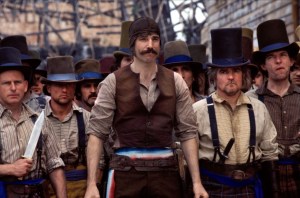 Watch Leo DiCaprio assemble toughs, rake heels, and ne’er do wells to his Irish gang of rapscallions with facial hair that looks to be tweezed! Witness a one-dimensional Leo suck the life out of the film like a black hole! See Leo become the least frightening gangster since Fredo. Watch the horribly miscast Cameron Diaz play pin-the-tail-on-an-accent! Witness as she tries to play a pickpocket with a heart of gold that falls hopelessly and illogically in love with Leo! Marvel how someone looking like Diaz would exist in a mangy slum! See the brilliant Daniel Day-Lewis upstage our stupid hero and steal every scene he inhabits! Witness one of the greatest villains in the last decade of movies! Watch Day-Lewis almost single-handedly compensate for the film’s flaws with his virtuoso performance! Admire his stove-top hat and handlebar mustache!
Witness a wonderful supporting cast including John C. Reilly, Jim Broadbent and Brendan Gleeson! Wish that they had more screen time to work with! Wonder to yourself why in all good graces this film took nearly two years of delays to get out! Speculate away!
Gangs has the sharp aroma of a film heavily interfered with by its producers. The whole exercise feels like Scorsese being compromised. Gangs is a meticulous recreation of 1860s New York that often evokes an epic sense of awe. The story has more resonance when it flashes to small yet tasty historical asides, like the dueling fire houses and the Draft Riots. But all of these interesting tidbits get pushed aside for our pedantic revenge storyline with Leo front and center. You know the producers wanted a more commercial storyline, which probably explains why Diaz has anything to do with this.
 The script is credited to longtime Scorsese collaborator Jay Cocks, Steven Zallian (Academy Award winner for Schindler’’s List) and Kenneth Lonergan (Academy award nominee for You Can Count on Me). So with all these writing credentials, don’t you think one of them would realize all of the dumb things going on with the story? The ending is also very anticlimactic and ham-fisted. Just watch as we segue from a graveyard to present day New York, all thanks to the Irish rockers of U2!
I know this much, Day-Lewis needs to stop cobbling shoes and act more often. Gangs is his first visit to the big screen since 1997’’s The Boxer. He spent part of this hiatus in Italy actually making shoes. I don’’t know about everyone else but this man has too much talent to only be acting once every five years. Somebody buy his shoes and get him a script, post haste!
Scorsese’s Gangs of New York is at times sprawling with entertainment in its historic vision and at other times is infuriating, always dragging behind it a ball and chain called “stupid revenge story/love story.” I’’m sure the film will get plenty of awards and Oscar nods in prominent categories, and this seems like the Academy’’s familiar plan: ignore a brilliant artist for the majority of their career and then finally reward them late for one of their lesser films. So here’’s hoping Scorsese wins the Oscar he deserved for Raging Bull and Goodfellas.
Nate’s Grade: C+
——————————————————
WRITER REFLECTIONS 20 YEARS LATER
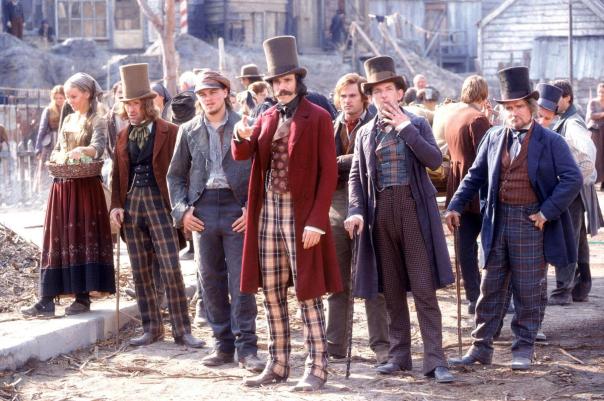
It is rare to find a movie that is almost exact in its percentage of good aspects and poor aspects. This 50/50 balance is best exemplified by 2002’s Gangs of New York. The ten-time Oscar nominated movie (and zero-time winner) was intended to be director Martin Scorsese’s epic, and twenty years later it’s still his biggest movie in size. Scorsese waited twenty years to tell this sprawling story of New York City’s early criminal underworld, so at 160 unwieldy minutes it’s no surprise how overstuffed and unfocused the finished product ended up. It’s a movie with so many engrossing historical anecdotes, amazing texture and supporting actors, and a stunning return to upper-tier acting by Daniel Day-Lewis, and yet it is hampered by Leonardo DiCaprio’s lackluster storylines, both for vengeance and for love (maybe a love of vengeance?). It’s so bizarre to watch this movie because there can be sequences where the movie just excels, and then there are sequences where I just want to sigh deeply. It’s like the movie is in conflict with itself, and you, the viewer, are ultimately the frustrated victim.
Let’s focus on the good first. Day-Lewis had essentially retired from acting and went to work in Italy as a cobbler until Scorsese appealed to him to reconsider acting. Every second this man is onscreen deserves your utmost attention. DiCaprio was the advertised star of the movie but Day-Lewis was the real star. The movie is almost a Trojan horse of sorts, luring you in with a standard revenge plot line only for you to lose all interest and root for the charismatic villain. Day-Lewis is so enthralling, so commanding as Bill the Butcher that every moment he is absent feels like an eternity. He remained in character for the duration of the shoot, spooking waitresses, and learned how to throw knives from circus performers and how to cut meat from an actual butcher. Considering the man’s famous Method-acting approach, I wonder just how many skills Day-Lewis has acquired over decades. This man could be the living embodiment of Michelle Yeoh’s character in Everything Everywhere All at Once, able to, at a moment’s notice, tap into a uniquely honed skill-set upon need. I wish that itself was a movie; Day-Lewis filming a role when terrorists invade the set, and now he has to utilize every lesson and skill of his past acting roles to defeat the baddies and save the day. He may be the most interesting man in the world. Since Gangs, Day-Lewis has only appeared in five other movies, and amazingly he has been nominated for Best Actor three times, winning twice (that averages an Oscar every 2.5 movie roles). This man has become like an acting Halley’s Comet, waiting for him to swing around again and burn brightly and then, just as suddenly, pass back into the lengthy waiting period.
I loved the historical asides in this movie. I loved the scene showing, in one unbroken take, Irish immigrants stepping off the boat into New York harbor and getting immediately signed into service, given a rifle and uniform, and lined up to board another boat to fight the Confederacy. I loved the entire character of Boss Tweed (Jim Broadbent) and how transparently corrupt he is, reminding me of Claude Rains in Casablanca. I loved him competing with the dozens of other firefighting units squabbling over turf while a house burned down to cinders. I loved him scrambling for some entertainment for the masses, and he asks Bill to gather up four nobodies that they can publicly hang, and then we cut right to these relatively innocent men saying their last words before being hanged, including one man’s young son watching. It’s an incredible sequence. The culmination of the 1863 Draft Riots is terrific and maximizes the messy nature of the movie best, communicating the many breaking points that lead to this notorious riot. The opening of this movie is wonderful and a terrific mood setter as we watch the members of the Dead Rabbits assemble for battle, with the rattling percussive score by Howard Shore (The Lord of the Rings), finally breaking outdoors and watching gangs advance like armies. I loved the narrated history of the different gangs settled in New York and their peculiarities and fixations. I loved the before and after stories of Happy Jack (John C. Reilly), who settled as a corrupt police officer, and Monk McGinn (Brendan Gleeson), a mercenary who tries to go straight through, of all things, politics. I loved that the movie reminds us that just because these people reside in the North doesn’t stop them from being racist (an archbishop is especially aghast at a black man being allowed in his church). I loved the occasional P.T. Barnum appearance. I loved the proliferation of so many tall hats amidst all the handlebar mustache-twirling villainy. I loved when the movie felt like a living documentary, soaking up the richness of the recreated history.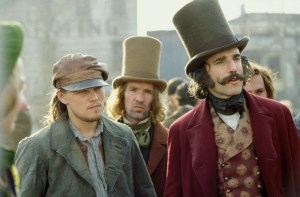
Where the movie sputters is with just about all that involves DiCaprio’s character, Amsterdam. The revenge storyline is just so boring compared to everything else going on, enough so that I think even the movie forgets about it. Amsterdam becomes Bill’s budding protege and literally saves his life at several points (if your goal is for him to die, why save the man?). He’s such a boring character because all he thinks about is vengeance, so every relationship he builds is only about how much closer to achieving his goal he can be. Amsterdam is a thoroughly dull character, and DiCaprio doesn’t come across as a credible tough guy yet, especially diminished in the large shadow from Day-Lewis’s Butcher. It wasn’t until 2006’s The Departed where I felt like he shed his boyishness fully to play a credible adult man. DiCaprio has been great with Scorsese, and this movie was the start of a decade of collaborations (four movies, two Oscar nominations), but he feels miscast here as a brooding hero given inordinate attention.
Worse is the romance with a pick-pocket prostitute played by Cameron Diaz. I pity Diaz. She’s been given the spunky love interest role in the Oscar-bait movie, which is generally underwritten and only viewed as aiding the hero’s journey of our male lead or being the offramp not taken (“Don’ get y’er refenge, Amsti’dam, ‘stead come wit me to San Fran in Calyfer’nia”). This is not a good character and she’s meant to give voice to the female underclass perspective, so it’s even more irksome when her headstrong, defiant nature gets sublimated as a rote romantic option. Diaz is also woefully miscast and my 2002 quip of her playing “pin-the-tail-on-the-accent” is accurate. I might argue that maybe dramas aren’t her strong suit, but she was great in Being John Malkovich and In Her Shoes and The Holiday, though all of those had notable comedy elements. She has the ability but this might just have been too unfamiliar for her, and so she struggles throughout with a character defined by her sexual connections to the villain and the hero.
While these characters and the performances are the biggest misses in Gangs of New York, there are other misguided or poor elements adding to that 50/50 margin. The opening sequence is great until the actual gang warfare begins and you realize that Scorsese, arguably the greatest living American director, cannot direct action to save his life. The action is choppy and lacking any of the kinetic qualities we associate with most Scorsese movies. Not even the talents of editor Thelma Schoonmaker can help save this deficit. The movie’s overall scattershot nature also makes it rather uneven and difficult to build momentum. The ending plays out like a footnote to the Draft Riots and robs the viewer of whatever catharsis could be granted from the long vengeance plot. If the whole movie has been leading up to Amsterdam’s vengeance, well robbing him of it could be meaningful, if the self-destructive nature of vengeance had been a theme. It’s not like Amsterdam has suffered at all, beyond the occasional stab wound or black eye, so him learning a lesson about the futility of vengeance would seem inappropriate and trite. I also want it known for posterity that there is an un-credited actor listed online as playing “Hot Corn Girl.”
”Twenty years later, Gangs of New York is still a frustrating and sometimes exhilarating viewing. It began a road for Scorsese that led to him finally winning his first, and still only, Oscar for directing The Departed. The sprawling nature of the movie is both a blessing and a hindrance. It allows for a wider scope and cast of characters but it also means that if you’re liking a subplot or a supporting character, you’ll have to wait your turn before they re-emerge. My old review back in 2002 perfectly sums up the majority of my feelings in 2022. There’s much to see and much to like with Gangs of New York but also too much to restrain its potential greatness.
Re-View Grade: C+


 nathanzoebl
You must be logged in to post a comment.