Blog Archives
Million Dollar Baby (2004) [Review Re-View]

Originally released December 15, 2004:
Million Dollar Baby, much like its fledgling female boxing character, has come out of nowhere and made a considerable deal of noise. This little homespun film directed by Clint Eastwood didn’t have the glitz and sheen of other awards friendly movies, but now it seems that Eastwood?s own baby may clean up come Oscar time. Can Million Dollar Baby tackle the enormous hype surrounding it? Yes and no.
]Frankie (Eastwood) is a hardened boxing trainer too concerned for his fighters’ welfare to allow them to fight in championship bouts. He’s the kind of cynical old man that enjoys pestering a priest and causing him to unleash an F-bomb. Frankie and his longtime friend Scrap (Morgan Freeman) run a rundown gym and talk un-sentimentally about their older days as prize fighters. Then along comes Maggie (Hilary Swank), a 32-year old waitress who’s got nothing to believe in except her possibility as a boxer. She wants Frank to train her into the champ she knows she can be. He refuses saying he doesn’t train girls. She’s so determined she won’t take no for an answer. Frank finally agrees, especially after some help from Scrap, and starts to teach Maggie everything she needs to know to be a star pugilist. The two begin to open up to each other emotionally and Maggie seems destined to become a force in the ring.
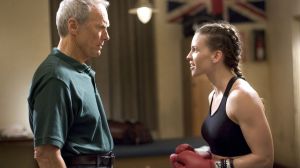
Million Dollar Baby‘s greasiest attribute is its trio of knockout performances. Swank owns every second of this movie. She’s unremittingly perky, conscientious but also dogged, stubborn, and irresistibly lovable. Swank embodies the role with a startling muscular physique and a million dollar smile. Her performance is equal parts charming and heartbreaking. Maggie’s the heart of Million Dollar Baby and Swank doesn’t let you forget it for a millisecond. Come Oscar time, I’m sure she will be walking onstage to grab her second Best Actress Oscar in five years.
No one does grizzled better than Eastwood, and maybe no other actor has made as much of an acting mark by squinting a lot. Million Dollar Baby is probably his best performance to date, though for a good while it sounds like Frank has something lodged in his throat (pride?). Frank has the greatest transformation, and Eastwood brilliantly understates each stop on the journey until landing in a vulnerable, emotionally needy place.
Freeman once again serves as a film’s gentle narrator. There isn’t a movie that can’t be made better by a Morgan Freeman performance. His give-and-take with Frank feels natural and casual to the point that it seems improvised on the spot. Freeman unloads some great monologues like he’s relishing every syllable, chief among them about how he lost his eye. It’s wonderful to watch such a great actor sink his teeth into ripe material and deliver a performance that may net him a long-awaited Oscar (I think he’s due, and likely so will the Academy).
For whatever reason, Eastwood is hitting a directing groove in his twilight years. First came Mystic River, an ordinary police whodunnit made exceptional by incredible acting. Now Eastwood follows up with Baby, an ordinary sports film made extraordinary by incredible acting. Hmmm, a pattern is forming. The cinematography is crisp and makes great use of light and shadow to convey emotion. Eastwood’s score is also appropriately delicate and somber. The boxing sequences are brief but efficient.
Million Dollar Baby is a very traditional story that is at times surprisingly ordinary. Maggie’s the scrappy underdog that just needs a chance, Frank’s the old timer that needs to find personal redemption, and Scrap’s the wise old black man. Once again, an old curmudgeon takes on a rookie and in the process has their tough facade melt away as the inevitable victories pile up. Million Dollar Baby is a very familiar story but then again most boxing tales are fairly the same in scope.
What eventually separates Million Dollar Baby from the pack is its third act twist. You think you know where Eastwood’s film is headed, especially given the well-worn terrain, but you have no clue where this story will wind up. The plot turn deepens the characters and their relationships to each other in very surprising ways. You may be flat-out shocked how much you’ve found yourself caring for the people onscreen. It almost seems like Eastwood and company have used the familiar rags-to-riches underdog drama to sucker punch an audience into Million Dollar Baby‘s final 30 minutes. We’re transported into an uncomfortable and challenging position, and Eastwood won’t let an audience turn away.

Million Dollar Baby is not the colossal masterpiece that critics have been drooling over. For one thing, the group of antagonists is not nearly as textured as our trio of leads. They’re actually more stock roles that further enforce the ordinary story of Million Dollar Baby. Maggie’s trailer trash family is lazy unsupportive batch of stereotypes. The evil female boxing champ just happens to be a German who doesn’t mind playing dirty. One of the boxers at Frank’s gym is an arrogant showboat just waiting to be nasty while the teacher’s back is turned. Million Dollar Baby excels at showing depth and humanity with its lead trio, yet it seems if you aren’t in that circle you’re doomed to wade in the shallow end.
Eastwood shows that great acting and great characters you love can elevate a common framework. The package may be similar to a lot of films before about scrappy underdogs, but Million Dollar Baby lacks comparison in its genre when it comes to its enthralling acting and characters. The father-daughter bond between Frank and Maggie is heartwarming. The final reveal of what her Gaelic boxing name means may just bring tears to your eyes. The results are a very fulfilling movie going experience, albeit one that regrettably may not live up to such hype.
Million Dollar Baby has been showered with heapings of praise and become a formidable Oscar contender. The story treads familiar waters but its outstanding acting and deep and humane characters elevate the material. The film can’t match the hyperbole of critics but Million Dollar Baby is an ordinary but greatly satisfying ride led by compelling acting. The film hums with professionalism and seems to just glide when everything comes together magnificently, particularly in that last 30 minutes. Eastwood is hitting an artistic stride and it’s actually exciting to see what Clint will do next. Million Dollar Baby may not be a first round knockout but it definitely wins by decision.
Nate’s Grade: B+
——————————————————
WRITER REFLECTIONS 20 YEARS LATER

Million Dollar Baby was its own underdog story that showed its strength when it mattered most, taking the 2004 Best Picture Oscar, as well as Best Actress for Hilary Swank and Best Supporting Actor for Morgan Freeman. It wasn’t even on many award prognosticators’ radar until the final month of the year. The odds-on favorite for most of 2004 had been Martin Scorsese’s Howard Hughes biopic The Aviator, a lavish recreation of Old Hollywood with the power of Harvey Weinstein behind it. After 2002’s Gangs of New York went 0-10 with its Oscar nominations, Weinstein vowed this would not happen again and that he would get Scorsese that first directing Academy Award, so no expense was spared with a $110 million-dollar budget, exceeding the previous highest Miramax budget from 2003’s Cold Mountain. The narrative was set, the power of Weinstein was behind it, and the context of Hollywood celebrating its own history has long been an appealing formula for an easy Oscar victory. Then came Clint Eastwood’s scrappy little boxing movie and it sucker-punched the established awards narrative, taking the top prize (Sorry Harvey, but if it was any consolation, The Aviator improved upon Gangs’ ratio, winning 5 of 11 noms).
Twenty years later it’s impossible to discuss the legacy of Million Dollar Baby without talking about the legacy of Eastwood as a director. He’s been directing movies ever since 1971’s Play Misty For Me. He initially stuck to what he knew, thrillers and Westerns, with the occasional passion project like 1988’s Charlie Parker biopic, Bird. It all changed for Eastwood with 1992’s Unforgiven, a searing deconstruction of the Western and masculinity and conveniently digested American myth-making that won Best Picture and Best Director for Eastwood. From there, the flinty-eyed, gravelly-voiced filmmaker was seen as an Oscar favorite, though he was only nominated for Best Director three other times out of the twenty-five films he directed after. Eastwood’s been regarded as some higher-minded adult director, but looking over his long list of directorial efforts, the man has always kept to his preferred milieu of thrillers and Westerns with the occasional somber biopic. The more assumed Academy-friendly projects typically gained minimal traction, usually acting nominations like with Richard Jewell, Invictus, and The Bridges of Madison County. Sometimes they’ve just been complete artistic whiffs, like J. Edgar, Jersey Boys, or Hereafter.
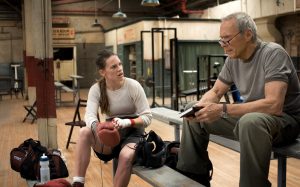
The movies that got the most acclaim from Eastwood as director were the elevated genre movies, be they crime thriller (Mystic River), Western (Unforgiven), or sports underdog drama (Million Dollar Baby). The man has an inherent interest in genre movies. He may make a WWII drama from the point of view of the Japanese, completely in Japanese, but then next he’ll make a movie about being a “Get off my lawn” grumpy grandfather taking on street gangs. He made a movie about sending geezers into space, a juror realizing he may actually be guilty of the crime he’s intended to judge, and a corrupt president covering up his crimes (that guy wasn’t even a convicted felon upon inauguration -ha). The man is at his best when he sticks to what he knows, and when he can collaborate with writers who can get the best out of his instincts, the results can be exceptional. He’s a man interested in telling genre stories, and I can respect that. He’s notoriously spartan in his directorial approach with actors, typically only allowing two or so takes before moving on, a.k.a. the anti-Kubrick. The photography is so stark is might be confused for being black and white. There is a stripped-down-to-its-studs quality to the best of Eastwood’s movies, which is why deconstructionist examinations over genres can be especially rewarding. It allows for a larger space for characters to expand and grow and challenge our expectations, which is where Million Dollar Baby still works so well twenty years after it unexpectedly KO’d the awards circuit.
This is a Cinderella sports story balanced by an invigorating surrogate father-daughter relationship. Maggie Fitzgerald (Swank) is so eager to prove herself as a boxer, and we’re so happy to see her gain success and dignity, helping to give her trainer Frankie Dunn (Eastwood) a new sense of purpose. Everything is going right for this pair and it feels like the Hollywood movie we would all know and love, and then it all gets violently torn away when Maggie is injured in the ring and becomes paralyzed from the neck down. From there, Million Dollar Baby transforms from its sports movie formula and becomes something so much more meaningful and interesting and emotionally affecting. We’re constantly playing a mental contrast from before and after the accident. She’s so optimistic and bouncy and full of life. To see the joyous Maggie using her body to give her confidence and identity and overcoming adversity and intimidating more professional opponents through force of will, and then to see her bedridden, wheezing through a ventilator, and so deeply lost in her slack eyes, it’s something awful. She survived the injury but her spirit has been obliterated. Now, this isn’t a commentary on how disabled people cannot live fulfilling lives and might as well be euthanized. Maggie is the one who makes the choice to be euthanized and she will not be swayed, and this decision puts it to her coach, a lifelong Catholic, to demonstrate his love for his pupil through assisted suicide. To me, all that is WAY more dramatically interesting than if she had simply won the big title fight and proven all her many doubters wrong.

Swank rightfully won her second Oscar for Best Actress with a performance of such vitality and despair. At the end, when she’s stuck in that hospital bed, and she’s trying to chew off her own tongue so she can bleed to death, it’s such a devastating change from the chipper, optimistic scrappy underdog. Eastwood is gruff and growly and nearly unintelligible at points, but his reactions and his generosity as an actor help Swank achieve even higher acting greatness. Strangely enough, while Freeman is perfectly good in his Oscar-winning role, you could have cut him completely from the movie and affected very little, besides needing a new outlet for Eastwood to unintelligibly grumble towards.
It can feel like Million Dollar Baby is two different movies smashed together, one without an ending and one without a beginning. If you felt like you were plugged into that rousing sports underdog movie, I can understand feeling cheated by the rug pull. I feel like the version of this movie, by its end, is the one it wanted to be all along, and it’s using your emotional investment in these characters to make the decisions all the more grueling and tragic. Twenty years later, I think I enjoyed the moments before the accident a little less and the moments after the accident much more, and considering the ending seems like the whole point for Million Dollar Baby, that seems like an endorsement for its staying power two decades hence. It still has enough power today from the performances and where it pushes those characters. Million Dollar Baby is still a winner because it fit so well as a vehicle that Eastwood could elevate. He’s 94 years old and not likely directing too many more movies, but if anyone can keep making movies into their triple digits, it’s this man.
Nate’s Grade: A-
Share this:

Heretic (2024)/ Conclave (2024)
Recently, two religious-based, single-location thrillers have emerged from the confines of indie cinema, and this combination is so rare that I felt a unique opportunity to review them both.
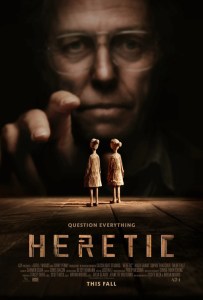 Heretic is a chamber movie about two teen Mormons (Sophie Thatcher, Chloe East) proselytizing to a middle-aged man (Hugh Grant) one dark and stormy night. He invites them in and seems kind and welcoming, but looks can be very deceiving. He has some very strong opinions when it comes to the nature of belief, and he will test both of these young Mormons on the faith of their convictions as he puts them through a series of trials and lectures. That last part might stun people, but Heretic is actually at its best during its lengthy lecture sequences. It might remind people of a nattering Reddit atheist being unleashed, but the movie really comes alive when Grant is challenging the roots of their belief systems as well as the historical contexts of religions. The Mormon ladies push back as well, countering some of the arguments so it’s not so one-sided. There’s a clear point of view to the movie but I wouldn’t say it’s didactic. The thrills ratchet as the two women start to fret about what this man has in store for them, how they might escape from his labyrinthine house, and how to signal for help. Unfortunately, the revelations can never quite match the fun of the mystery of motivations, and once it gets into a really convoluted place of switcheroos, then I think it loses momentum. The performances are all outstanding, led by Grant’s magnetic about-face turn as a snide villain. The same self-effacing charms he worked so well in the realm of rom-coms have a new eerie manipulative quality, luring his prey into his fiendish trap. The end attempts to go a bloodier and more ambiguous route that I don’t know it earns, but by that time, even after stalling out for the last act, Heretic won me over by virtue of its creepy convictions.
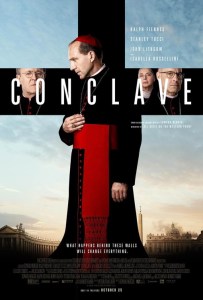 Conclave is an electioneering movie that places the viewer in the middle of the fraught voting process to determine the next pope of the Catholic Church. Ralph Fiennes plays a cardinal tasked with leading the conclave, the gathering of Catholic cardinals who will stay until a nominee has won a majority of their secret votes. Except it’s all not so secret as multiple candidates are openly campaigning for votes, trying to persuade different factions to support their candidacy. Each round of voting without a winner resets the field of play and leaves sides scrambling to reclaim footing. The movie is surprisingly very easy to get into, a crackling political thriller about the behind-the-scenes machinations and politicking for the highest office in the Catholic Church. There is a bevy of twists and turns and plenty of juicy revelations and betrayals, as these holy men start acting a little less holy to eliminate their competition or sully their chances. The constant churning is enough to keep things unsettled and intriguing, but there’s also a larger question for our protagonist, a man of faith who told the prior pope that he wished to leave his faith only to be denied by the pontiff for reasons we aren’t quite sure. Why did this pope specifically pick him for this position? The movie also asks deeper questions about the nature of power and leadership, namely are the people actively seeking it the right candidates for the right reasons? The very end of the movie knocked me out with a twist that I dare say nobody will rightly see coming, but it made me want to applaud. Conclave is an intelligently crafted thriller with weighty ideas and engaging performances.
Nate’s Grades:
Heretic: B
Conclave: B+
Share this:

Wicked: Part One (2024)

It’s shocking that it took this long for Wicked to make its way from the Broadway stage to the big screen. The musical, based upon Gregory Maguire’s novel, began in 2003 and while it may have lost out on the biggest Tony Awards that year to Avenue Q (it seems astonishing now but… you just had to be there in 2004, theater kids) the show has been a smash for over two decades, accruing over a billion dollars as the second highest-grossing stage show of all time. As show after show got its turn as a movie, I kept wondering what was taking so long with an obviously mass appealing show like Wicked. It’s the classic Hollywood desire of “same but different,” a reclamation project for none other than the Wicked Witch of the West, retelling her tale from her perspective. Well, Wicked’s time has eventually dawned, and the studio is going to feast upon its protracted wait. Taking a page from the YA adaptation trend that dominated the 2010s, they’ve split the show into two movies, separated by a full year, hoping to better capitalize on the phenomenon. I was wary about Part One being 150 minutes, the same length as the ENTIRE Wicked stage show, but having seen the finished product, and by “finished” I mean one half, I can safely say that Wicked is genuinely fabulous and deftly defies the gravity of expectations.
In the fantasy world of Oz, the green-skinned outcast Elphaba (Cynthia Erivo) is looked at with scorn, derision, and fear. She’s always been different and never fully accepted by her father who blames her for her mother’s death and her younger sister Nessarose (Marissa Bode) being stricken to a wheelchair. Nessa is going to study at Shiz University with all the other up-and-coming coeds of the land of Oz, including Glinda (Arianna Grande), a popular and frivolous preppie gal peppered in pink pastels. Glinda desperately wants to be taken seriously and become a witch, studying magic under the tutelage of the esteemed Madame Morrible (Michelle Yeoh). Instead, Morrible’s fascination falls upon Elphaba after she reveals her tremendous magical ability in a moment of extreme emotion. Now Elphaba is enrolled at the magic school and learning about the way of the world, and she’s stuck with Glinda as her roommate. The two women couldn’t be any more different but over the course of the movie, we’ll uncover how one became Glinda the Good and the other the Wicked Witch of the West.

At two-and-a-half hours long, again the length of both acts of the stage show, Wicked Part One only covers the events of the show’s first act, and yet it feels complete and satisfying and, even most surprising, extremely well paced. It’s hard for me to fathom what could have been lost to get the running time down as each scene adds something valuable to our better understanding of these characters and their progression and the discovery of the larger world. It’s a movie that feels constantly in motion, propelling forward with such winning ebullient energy that it becomes infectious. It’s also not afraid to slow things down, to allow moments to breathe, and to provide further characterization and shading that wasn’t included in the stage show. The adaptation brings the fireworks for the finale and raises the visual stakes and danger in a manner that feels exciting and compellingly cinematic. Considering the resplendent results, I feel I could argue that the movie is actually -here comes the heretical hyperbole, theater kids- an improvement over the stage musical. It makes me even more excited for a bolder, longer, potentially even more emotionally satisfying second part in November 2025.
One of my primary praises for 2021’s In the Heights was that director John M. Chu, who cut his teeth helming the Step Up movies, knows exactly how to adapt musicals to maximize the potential of the big screen. If you’re a fan of musicals, old and new, you’ll find yourself swept away with the scope and intricacy of these large fantasy worlds, the flourishes of costume and production design, as well as the creative choreography making fine use of spaces and the power of film editing. There’s a rousing dance sequence set in a library with shelves that rotate around the room, making the slippery choreography that much more immersive, impressive, and acrobatic. Even big crowd numbers are given the knowing framing and sense of scale to hit their full potential, from the opening rendition of Munchkinland celebrating the death of the Wicked Witch of the West complete with giant burning effigy that would make a Wickerman envious, to the introduction to the City of Oz where it appears every citizen has a jovial role to play in welcoming strangers to their enchanted capital city. Chu’s nimble camerawork allows us to really enjoy the staging and skills of the talent onscreen, bringing a beating sense of vitality we crave from musical theater writ large. Wicked is simply one of the best stage-to-screen adaptations in musical theater history and a joyous experience that allows the viewer sumptuous visuals.
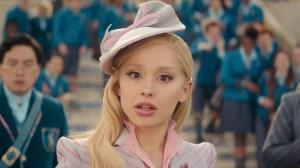
At its core, the story of Wicked is about some pretty resonant themes like self-acceptance, bullying, the fear of what is different or misunderstood, and all of this is built upon an irresistible friendship between Glinda and Elphaba. The rivals-to-allies formula isn’t new but it is tremendously effective and satisfying, especially when both characters are as well drawn and deserving of our empathy as these two ladies. They’re each on a different meaningful character arc for us to chart their personal growth and disillusion with what they’ve been taught is The Way Things Are. One is starting from a disadvantaged position and gaining traction through an outward demonstration of power, and the other is beginning in a position of privilege and becoming humble and more considerate as she acknowledges the challenges of others in a manner that doesn’t have to reconfirm her enviable “goodness.” It just works, and both women are fantastic in their roles. I was on the verge of tears at several points and my heart felt as full as a balloon throughout because of the emotional engagement and heartwarming camaraderie between our two leading ladies. With all its razzle dazzle, Wicked is a story of feminine friendship first and foremost and emotionally rewarding to experience, with the soaring music as a bonus.
Let’s finally talk about the music, a key factor in the enjoyment of any musical, naturally. The music was written by Stephen Schwartz, the Oscar-winning composer for “Colors of the Wind” from Pocahontas as well as “Believe” from The Prince of Egypt. I found his Wicked numbers to range from good to astoundingly good, with catchy ear-worms like “Popular” to the anthemic power and sweep of “Defying Gravity.” The cheeky and toe-tapping “Dancing Through Life” is a showcase for Jonathan Bailey (Bridgerton) and benefits from the aforementioned creative library choreography. “I’m Not That Girl” is a heartbreaking ode to the girls who don’t think of themselves as enough, which is begging for a reappearance in Part Two. The only clunker is “A Sentimental Man” but that’s more the result of the deficiencies of Jeff Goldblum as a singer than the song. I await the reuse of themes and motifs that will make the music even more thematically rich in the eventual Part Two.

Count me as part of the skeptical throng when it was announced that Grande, who hasn’t acted in over ten years, was cast as Glinda. I’m here to say that she is uniformly great. The Glinda role is the more outwardly showy role and thus immediately more memorable. It’s the far more comedic role, in fact the main source of comedy in the show, and Grande has serious comedic chops. Naturally she excels with the singing and its purposeful miasmic bombast, but it’s the subtle comedic styling and the exaggerated physicality that impressed me the most, like a moment of her twirling on the floor as an added dramatic flourish. There’s one scene where she’s just marching up and down a hallway in full exuberance, kicking, dancing, and exploding with joy. I anticipated that Erivo (Bad Times at the El Royale) would be exceptional, and of course the Broadway vet is, as she brings such simmering life to Elphaba. There’s a strength in equal measure to her vulnerability, making the character fully felt. Erivo also delivers during the big moments, like the climax of the movie that can give you goosebumps in hiw it weaves together empowerment and defiance and self-acceptance. Together, the two women are an unbreakable pair of performers and heroes that we’ll want to see triumph over adversity.
After decades of belabored waiting, Wicked finally makes its journey from stage to screen and I must say it was worth every minute. The film, even at only one half, feels complete and richly realized, building upon the strong foundation of the stage show and its numerous winning elements and masterfully translating them to cinema, taking full advantage of the visual possibilities while also expanding upon the story and themes for further enrichment. While born in the early 2000s War on Terror Bush era of politics, Wicked’s themes of anti-immigrant fear-mongering as scapegoats still bears striking resonance today, as do the emerging warnings of fascism in Oz. If you’re a fan of The Wizard of Oz, musical theater, or even just grandiose spectacle that doesn’t dilute grandiose feelings, then step into Wicked and you too will feel like you’re floating on air.
Nate’s Grade: A
Share this:

Harold and the Purple Crayon (2024)
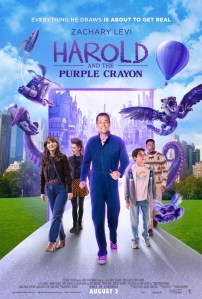 As an elder Millennial, I’ll try and ignore my rising bile for what they did to my boy Harold here, and I’ll simply ask who was this movie for? The big screen adaptation of the classic 1955 children’s book by Crockett Johnson that celebrates the power of imagination is a mishmash of mawkish feel-good family nonsense, fantasy power wish-fulfillment, and grating fish-out-of-water comedic antics. Increasingly missable actor Zachery Levi (Shazam!) plays yet another glorified man-baby, this time as an “adult” Harold who ventures into the Real World to search for his narrator, essentially the god of his purple-hued universe. He befriends a lonely boy with a big imagination and the kid’s single mom (poor Zooey Desceanel) and life lessons are learned while “adult” Harold makes a mess of just about everything as he leaves behind chaos and disaster. Eventually Harold has a full-on wizard duel against a villainous librarian and wannabe published fantasy author played by Jermaine Clement. That’s right, Harold and the Purple Crayon transforms into a magic battle over the fate of the all-powerful ring, I mean crayon. Making matters worse is Levi’s hyperactive schtick that has been growing stale for years and is tiresome and annoying throughout the movie. It’s also quite ironic, and phony, that a movie expressly proclaiming the power of individuality and imagination is so thoroughly and depressingly generic. This should have been animated or left alone, period.
Nate’s Grade: D+
Share this:

The Wild Robot (2024)
 There must be something personally appealing when it concerns movies about hopeful robots that serve as change agents to new communities. WALL-E and The Iron Giant are two of my favorite films of all time, and while The Wild Robot won’t quite enter that all-hallowed echelon, it’s still a heartfelt and lovely movie that can appeal to anyone. We follow Roz (voiced by Lupita Nyong’o), a discarded robot looking for tasks to complete on an island. Fortunately, the robot learns how to communicate with the local wildlife, including a baby goose that our robot feels responsible to train how exactly to be a goose, including how to fly before the advent of winter and the larger flock migrates. The characters are kept pretty simple but that doesn’t mean their emotions are. The movie, based upon a popular children’s book series by Peter Brown, is refreshingly mature about nature’s life cycle, not treating death like a taboo subject too dark for children. The themes of parenting, being different, and finding an accepting home through compassion and courage are all resonant no matter your age, and I’m happy to report that I teared up at several points. The parent-child relationship between the damaged robot and orphaned gosling extends beyond them, inspiring other members of the island’s food chain to work together for common goals and sustainability. There’s a late antagonist thrown in to up the stakes and provide a bit more explosive action, including a magnetic magenta-colored forest fire. The movie doesn’t quite close as strongly as it opens, but writer/director Chris Sanders (Lilo & Stitch, How to Train Your Dragon) knows innately how to execute at such a high level where even simple characters and familiar themes have fully developed stories with soaring emotions that arrive fully earned.
Nate’s Grade: B+
Share this:

It Ends With Us (2024)
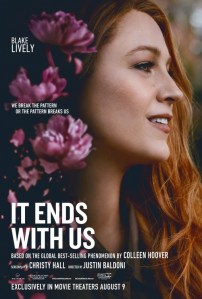 If you’re expecting a charming romantic drama about a young woman moving back home and finding new love and rekindling romance with a past love, then you might be better off scanning the Hallmark Channel. For those blissfully unfamiliar with author Colleen Hoover, It Ends With Us is her best-seller about domestic abuse. The Dickensian-named Lily Bloom (Blake Lively), who wants to open a flower store, comes back home after her abusive father passes, and she reconnects with Atlas Corrigan (Brandon Sklenar), her childhood love who her father chased away. She also falls for child neurosurgeon Ryle Kincaid (director Justin Baldoni) who happens to be an abuser. It takes an hour into the movie before Ryle physically harms Lily, which means the movie up until that point is paced and structured like a typical romantic drama and we’re meant to find him smooth and desirable. Perhaps Hoover and the filmmakers are trying to better place us in the position of the abused spouse, providing context that some might use to excuse toxic behavior and red flags, but if they wanted to set up more of a love triangle, they’ve done a poor job. Atlas mostly appears in flashbacks as the idealistic, impoverished boyfriend she kind of takes in. He then re-establishes himself in the present with a successful fancy restaurant, and the movie more or less just puts him on a shelf and says, “When she’s ready to have someone nice, she’ll settle back with that bland guy from her past.” Feels like we’re spending too much time on stories that we shouldn’t, and less time on ones we should. It’s grandiose soap opera plotting for serious subject matter. Credit director/co-star Baldoni for not soft-pedaling the treacherous nature of his character’s control and insecurity. There’s a great deal of very uncomfortable and disturbing abuse sequences, including a rape, for a PG-13 movie. Domestic abuse, and growing up in the shadow of domestic abuse, makes for some very challenging viewing. If the movie was more insightful, or honest, or even nuanced, it might be worth enduring the discomfort of its two hours. It’s not. It’s just punishing.
Nate’s Grade: D
Share this:

Uglies (2024)
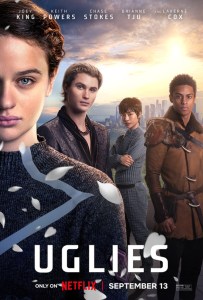
Even though Uglies is based upon a book series that hails back to 2005, it feels so much like it was developed in a vat subsisting on the runny discharge from other YA dystopian projects, finally settling into an unappealing mixture of familiar tropes. In this post-apocalyptic future world, society has rebuilt itself with a caste system that celebrates beauty. Teenagers undergo surgical operations and brainwashing to make themselves a member of the Pretties, the cool kids. If you’re even remotely familiar with YA storytelling, you can likely guess exactly where the movie goes from here. Our heroine is called Squint because society seems to think her eyes need work. There’s another character named Nose for the same reason, meaning that upon birth, I guess the doctor just holds up you baby and starts verbally roasting them. Squint is played by Netflix staple Joey King (The Kissing Booth, A Family Affair) and therein lies one of our central adaptation problems. The rules of Hollywood will not allow unattractive lead actors in movies like this, so the filmmakers give her brunette hair and less makeup, as if we’re supposed to find movie star Joey King to be naturally hideous. It’s the same with every actor in the movie. Now, if you were going to adapt this to a visual medium, maybe you lean into the visual contrasts in a more specific manner: all the “Uglies” are minorities and all the “Pretties” are lighter-skinned or white. That would bring an added colorism commentary but it would also be steering the movie into a more dangerous relevancy. The plot is all simplistic high school battle lines about individualism versus conformity, self-acceptance versus assimilation, though the optics of having a trans woman (Laverne Cox) being the evil head of education forcing surgery on teens and brainwashing them feels quite problematic considering grotesque conservative theories endangering the lives of actual trans people. There is one surprise in Uglies, one that I’ll spoil for you, dear reader. It doesn’t end. It sets up the next adventure with Squint supposedly bringing down the corrupt society from the inside, but I challenge anyone not familiar with the book series to be that compelled to put right the unresolved storylines and character arcs from this stalled launch.
Nate’s Grade: C-
Share this:

I Saw the TV Glow (2024)/ The Watchers (2024)
 I Saw the TV Glow is a strange experience by design, a hallucinatory ode to early 1990s television, coming of age sagas, feeling out of place in one’s own body and mind, and on a Lynchian dream logic wavelength that few filmmakers occupy. From a plot standpoint, Owen (Justice Smith) is a shy kid who looks up to an older girl at school, Maddy (Bridget Lundy-Paine), and they share a love for the TV show The Pink Opaque, a tween-aimed horror series in the vein of Goosebumps or Are You Afraid of the Dark?, which ultimately might be real after all. This movie exists more on a slippery emotional plane than on its story sense. Writer/director Jane Schoenbrun (We’re All Going to the World’s Fair) has created an allegory for self-actualization and self-acceptance through a love of 90s nostalgia and that transitional time of being young and just seeing the cusp of what adulthood promises for the good, the bad, and the mundane. The recreation of the SNICK-era television is perfect, and I loved the little glimpses of these horror monsters taking on new nightmarish incarnations. I wanted the movie to explore its premise more, that this old TV show might be real and posing a danger that only they would uncover. It’s really more a pathway for the characters to explore their selves, what animates them, what confuses them, what provides a sense of community. It’s a movie about the perils of loneliness and finding an outlet, a life raft, whatever that may be, and for Owen it’s this TV show. He connects more with this world than the real one, and when he revisits it later as an adult, it doesn’t live up to his memory. It’s a weird movie but it’s designed for weird kids, or weird adults who used to be weird kids, who found kinship through weird media. It’s a slow and provocative experience that asks you to give yourself over to its vision, but Schoenbrun also makes that engagement quite accessible. While existing as a clear trans allegory, I Saw the TV Glow is open to any outsider who felt unsure of themself and their body and their place in the universe. It’s about obsession and the price of holding onto said childhood obsessions, even if they prove disappointing in your adulthood. It doesn’t offer any general answers or catharsis and is kept on the slowest of slow burns. I began daydreaming of the less arty version of its spooky premise, but that’s simply not going to be this movie. I Saw the TV Glow is impressively personal and surreal and obtuse, but by the end I was hoping for a little more of a foundation to hold onto and its ideas to be fully realized.
Nate’s Grade: B
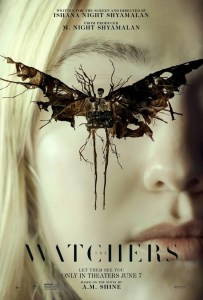 The expansion of the M. Night Shyamalan creative dynasty has begun. While based on a 2022 novel by A.M. Shine, The Watchers is brought to us primarily by Ishana Shyamalan, who makes her feature directing debut and adapted the screenplay. It has a buzzy premise that feels at home in a Shyamalan movie, namely a young woman (Dakota Fanning) who stumbles into a strange location with captive people telling her she cannot leave or her life will be in danger from monsters. The group of survivors have to “perform” for their unseen watchers, staring into a two-way mirror inside a closed room. There are certain rules that are hazy and unevenly applied: don’t go out after dark, never turn your back to the mirror, don’t go into the creatures’ subterranean dwelling. This poses an intriguing mystery for a while as the movie unpacks and reveals more about this world and the creatures. However, The Watchers ultimately cannot help feeling like an over-extended episode of a sci-fi anthology TV series like Black Mirror or maybe even Shyamalan’s own Apple Plus series Servant (Ishana wrote and directed several episodes). There just isn’t enough here. The revelations do not sustain our emotional and intellectual investment. Once it’s revealed what the monsters are, I kept waiting for extra levels of twists and turns, and there really aren’t any. Once we settle into Act Three, the movie becomes more or less about housekeeping and gaining acceptance. The whole reason the protagonist is on her journey is to deliver a bird in a cage, and every time this thing keeps appearing even so late into the movie, while she’s running for her life but cannot forget about the caged bird, I felt like laughing. It’s a case of inelegantly finding a way for the visual metaphor (the bird is her!) to continue being tied to the plot after it long stopped making sense. Likewise, there are cutaways to the captives watching a Love Island/Big Brother-stye reality TV show, but little is made as far as commentary on communal voyeurism, so they just come across as little odd comic asides. The movie loses some serious momentum once we get to the convenient info dump sequence (a Shyamalan family favorite: scientist vlogs) and you realize there are no more tricks to deliver. It’s disappointing that a movie with such potent folklore atmosphere becomes a lackluster variation on The Village.
Nate’s Grade: C
Share this:

Robot Dreams (2023)
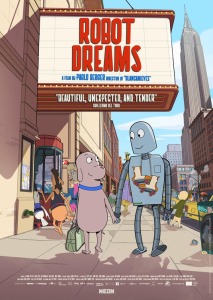 What a delightfully tender little movie Robot Dreams proves to be. It’s based on a picture book and its story is mostly about a lonely Dog who orders a build-your-own-robot for companionship and their friendship. Much of the movie hinges on the Robot being trapped on a Long Island beach closed for the season, so our intrepid Dog must go on living in his New York City apartment through the seasons while he waits to rescue his friend. The movie is wordless and based upon a picture book, but that doesn’t mean this is chiefly kid’s stuff. It touches upon the profound with such elegance and efficiency, brilliantly relatable and recognizably human. It’s all about our need for connections, and even when they are separated, both the Dog and Robot find other connections with other characters, and then it comes back to our worry that they won’t actually reunite after being apart for the majority of the movie. I was reading some gay coding between the two as well but maybe that was my own projection. My nine-year-old son was quite taken with the movie and could easily follow along, though he was also very much not a fan of the bittersweet ending, his first taste of providing the whole “what you need, not what you want” conclusion. Robot Dreams is lovingly realized, its animation so clean and crisp with wonderful characters populating an alternative 1980s NYC. It’s simple and sweet and irresistible.
Nate’s Grade: A-
Share this:

The Hunger Games: The Ballad of Songbirds & Snakes (2023)
 Who exactly was watching The Hunger Games and thought to themselves, I wonder if this evil old fascist dictator played by Donald Sutherland was ever young and sexy and in love? Well fear not, whomever you are, because 2023 gave us the adaptation of The Ballad of Songbirds & Snakes, the far too long adaptation of Suzanne Collins’ prequel book, thus granting the studio more material to grind into products. I guess we should all be grateful that this wasn’t stretched into two movies like the original plan. Taking place 60 years prior to the events of the first movie, young Coriolanus Snow (Tom Blyth) is trying to financially secure his family’s safety in the Capitol, and he’s also mentoring one of the district combatant’s in the tenth annual Hunger Games death match. His charge is District 12’s Lucy Gray Baird (Rachel Zegler), a feisty Romani-esque young woman who uses song as her vehicle for rebellion, and young Snow has to coach her to victory if he has any hope of righting his family’s lost standing. Fortunately, the Hunger Games behind-the-scenes coordination and development is interesting, and filled with top-level actors living it up in these outsized roles (Viola Davis, you national treasure). The deadly games themselves are confined to one dilapidated arena and are visually engaging even in such a limited space. Unfortunately, the would-be Romeo and Juliet romance between Snow and Lucy Gray is far less engaging, and young Snow proves to be a handsome bore. There was potential here in exploring the origin of a monster but the villainy seems awfully contrived to push him along on an arc, with several drastic personal decisions absent believable development. We’re talking big character leaps here, the kind that I can’t even really explain except, “Well, I guess he just had it in him the whole time.” The hazy rationalization and rushed development reminded me of Anakin Skywalker’s underwhelming descent into the dark side. Songbirds & Snakes is only really going to work for the diehard fans of the franchise asking for a little more time in this dystopian universe and daydreaming about the washboard abs and baby blue eyes of their favorite older fascist.
Nate’s Grade: C+


 nathanzoebl
You must be logged in to post a comment.