Blog Archives
Me and Earl and the Dying Girl (2015)
 In many ways Me and Earl and the Dying Girl feels like the perfect specimen that was programmed and brought to life in some mad scientist Sundance film lab. It’s got a hip point of view, a meta commentary on its plot and the directions it doesn’t take, style to spare with lots of self-aware camera movements, and even Wes Anderson-styled intertitles and colorful visual inserts, including stop-motion animation. It’s about two amateur filmmaking teenagers, Greg (Thomas Mann) and Earl (R.J. Cyler), who befriend Rachel (Olivia Cooke) who happens to have terminal leukemia. The movie has a good heart and it deviates from convention with its storyline, though it has to stop and add narration to point out how it does this, like it demands a pat on the back for not being a “typical cancer weepie.” The big problem is that we’re stuck with the perspective of Greg, who is the least interesting character and just trying to stay invisible. He has a low opinion of himself and his friendship with Rachel will somehow make him a better person. Earl and Rachel are both tragically underwritten but valiantly played by their actors. The annoying aspect is that Greg makes everything about him and so does the movie. The supporting parts are broadly portrayed and fit awkwardly with the larger setting, like Greg’s overenthusiastic teacher, Rachel’s lush of a mother who seems one drink away from committing statutory rape, and Greg’s mom, who forces Greg to hang out with Rachel, even though they were acquaintances at best, because the plot demands it. The script by Jesse Andrews, based upon his YA book, sets up the completed tribute film as an emotional climax that cannot be met, and the abstract movie results prove it. This is a likeable, funny, and entertaining indie with a sense of style and wit. It’s good, but it could have been better. I wish the “Me” had been removed from its title.
Nate’s Grade: B-
Share this:

Child 44 (2015)
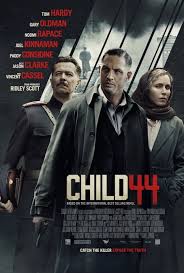 Unfairly cast out like some unwanted vermin, Child 44 is a police procedural based on a best-selling novel that the studio simply wanted to get rid of quietly. It was “dumped” into theaters and, as expected, began its disappearing act. That’s a shame, because it’s actually a rather involving mystery and an especially fascinating perspective into a little known world of being a cop on the other side of the Iron Curtain. Tom Hardy plays Leo, a member of the Soviet state police who is tracking a serial murderer preying upon orphaned children across the countryside in 1953. His wife (Noomi Rapace) is terrified of him and secretly a rebel informer. The two of them get banished to a Soviet outpost when Leo refuses to turn her in; he also refuses to accept the state’s conclusion over the dead children. In a weirdly perplexing turn, the Soviet Union believed murder was a Western byproduct. “There is no murder in paradise,” we are told several times, and since the U.S.S.R. is a communist worker’s “paradise,” whatever reality that doesn’t jibe with the party line is swept away. The murder mystery itself is fairly well developed and suspenseful, but it’s really the glimpse into this bleak and paranoid world that I found so intriguing. Child 44 is a slowly paced film thick with the details of establishing the dour existence of Soviet Union life. You truly get a sense of how wearying and beaten down these people’s lives were, how trapped they felt, how justifiable their paranoia was. The husband and wife relationship grows as they’re forced to reevaluate their sense of one another, and it genuinely becomes a meaty dramatic addition. Child 44 is a slow movie but the pacing serves the deliberate and oppressive tone of the film. It’s a film with some problems and missteps (certain antagonists make little sense in their motivations), including some incoherent action/fight scenes (fighting in the mud? Way to visually obscure everybody, guys). However, this is a better movie than the studio, and a majority of critics, would have you believe. It’s engrossing and taut and ambiguous and consistently interesting, with another standout performance by Hardy. Like many of the characters, this movie deserved a better fate.
Nate’s Grade: B
Share this:

Insurgent (2015)
 A return to the world of Divergent yields little forward momentum, in fact just enough to end on the point that I thought where a sequel would naturally begin. Turns out we needed a whole other movie, Insurgent, to arrive at this obvious narrative next step. Insurgent picks up with Tris (Shailene Woodley) and company on the run following the coup of two of the five social factions. Tris is a Divergent, able to apply herself to multiple factions, and she and her kind are the only ones who can open a secret box left behind by the founders of this post-apocalyptic civilization. The film does enough to hold your attention and we get to visit the other two factions we missed the first time, providing further shape to what is still a confusing world. I think the Divergent series will always fall short of the YA pacesetter, The Hunger Games, but they offer their escapist moments of entertainment. The second film is a bigger, louder, and more heavily coated CGI affair, especially the magic box’s mental trials that amount to a repeat of the first movie’s psychological trials of fear. Woodley is the strong center of the film and she processes her own PTSD over being forced to kill friends in order to survive; you do start to sense that Woodley is growing restless with the franchise. The third book is, as required by the mandate of milking YA franchises, being split into two movies, and while it served little to the Hunger Games, I hope better for the Divergent series, a group of movies inferior and somewhat mystifying but still interesting enough. For now.
Nate’s Grade: C+
Share this:

The Hobbit: The Battle of the Five Armies (2014)
 With all respects to Ice Cube’s would-be family series, the subtitle of the third Hobbit film could have been “Are We Done Yet?” Originally planned as two films, the prequel series based upon J.R.R. Tolkien’s novel was expanded to three, and it’s clear what motivated this decision. Each Hobbit film has made at least $900 million dollars, but goodness has it padded an already bloated series beyond repair. The best part of the second film, which looking back is the best in the new trilogy, Smaug the dragon, is gone in the first ten minutes. What follows is a pointless and tedious series of events, mostly CGI armies crashing into other CGI armies. It’s hard to find much to care about after six plus hours especially when it amounts to squabbles over treasure. It’s also bothersome that the antagonist for a solid hour is Thorin who adopts… gold madness suddenly, and then loses it just as suddenly and as contrived. You can feel the weight of all this filler trying to stretch what amounts to a protracted resolution into a full-blown movie. The battles are relentlessly soulless and have lost any weight to reality. There’s one standout action sequence involving a crumbling tower acting as a makeshift bridge. Beyond that, get ready for overlong battles involving lots of fake soldiers and monsters. With no larger goal in motion, you’re just waiting for the bad guys to die so we can go home. While Battle of the Five Armies is the shortest film in the series, it’s still about 120 minutes longer than it needs to be. The business of the Hobbit has affected the artistry of The Hobbit, and only Tolkien apologists would lap up the extra time in Middle Earth.
Nate’s Grade: C+
Share this:

Men, Women, and Children (2014)
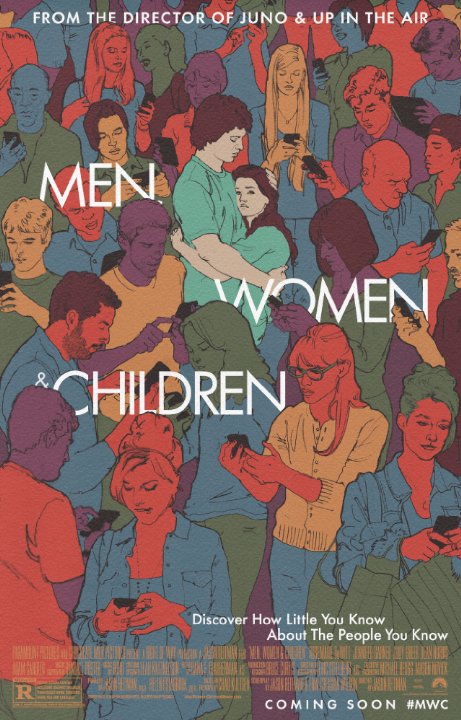 Jason Reitman was a director on the hottest of hot streaks with Hollywood. His first three films (Thank You for Smoking, Juno, Up in the Air) were hits but also an ushering of a new creative voice that felt mature, engaging, and immediate. His 2011 film Young Adult was divisive but I loved its nihilistic narcissism and satire. It looked like this guy couldn’t miss. Then in the span of less than a year, Reitman released Labor Day and Men, Women, and Children, two surprisingly misguided movies. Men, Women, and Children aims to be a Crash-style mosaic of modern-life in the digital age, but what it really feels like is a twenty-first century Reefer Madness.
The movie feels like it was made in the 1990s, like it should be a companion piece to the equally over-the-top and alarmist Sandra Bullock thriller, The Net. The movie’s thesis statement amounts to “the Internet is dangerous,” but this is a statement that everyone already acknowledges. The ensuing evidence from Reitman is so scattershot, so melodramatic, and so cliché-ridden, that it feels like an inauthentic lecture that is already past its prime. Firstly, did you know there is porn on the Internet? I hope you weren’t standing up when I dropped that bombshell. The film posits that because pornography is widely available with a few keystrokes, it has desensitized (primarily) male sexuality. It presents a slippery slop scenario, where the user more or less forms an addiction to online porn and has to keep going to more extreme places to chase that new high. This leads to their inability to accept their imaginations for pleasure or actual flesh-and-blood females. It’s not like Men, Women, and Children is a case study but this feels like the same alarmist rhetoric that’s been hashed since the 1970s. The characters are allowed to have their lives ruined by their pornography addictions, but the storytelling feels particularly disingenuous when it’s squared with the film’s heavy-handed message.  That core message is about the inability to communicate with the people around us thanks to modern technology meant to connect us 24/7 (oh, the unexplored irony). The message of the movie isn’t anything new or profound but it’s cranked up to such a comically over-the-top measure. I have no doubt the filmmakers were well-intentioned but their heavy-handed and tin-earned approach is a wild miscalculation that makes the film, and its dire message, more unintentionally funny than meditative.
It also hurts the film’s overall thesis/message when there are so many characters and storylines vying for attention. Reitman attempts to cover just about every aspect of Internet ills as if there is a mental checklist. We’ve got the porn addiction (check), there’s also a faltering marriage where both parties seek out online affairs (check), an fixation with online role-playing games (check), exploitation of teenagers for personal gain (check), stilted communication via social media (check), harmful communities encouraging body shaming (check), cyber bullying (check), and let’s just throw in general malaise (check). The plot is stretched too thin by the multitude of storylines, many of which fail to be interesting or find some shred of truth. There are two mother characters in this film that simply do not exist in real-life, at least the “regular” social milieu the film wants to portray. Jennifer Garner’s character is so obsessed with her daughter’s online life that she literally goes through every text, every tweet, every online post, and is also secretly recording her keystrokes. This militantly paranoid mother is such a broad and farcical caricature of parental concern. At the other end of the spectrum is Judy Greer’s mother, a failed actress trying to vicariously live through her teenage daughter. She’s photographing her daughter in provocative poses and outfits with the intent to jumpstart a modeling career, but it sure comes across like jailbait child pornography. There’s little chance a character could be this naïve and self-deluded to justify running a pervy website to market her underage daughter. Both of these characters are so removed from relatability that they become the two opposite poles of the film’s cautionary message.
I think Reitman was looking for something along the lines of American Beauty, but that movie had a group of characters that were fleshed out and given careful attention. The characters in Men, Women, and Children rarely break away from their one-sentence summations. That may be the biggest disappointment. Reitman has been exceptionally skilled at developing characters. However, the people that populate the world of Men, Women, and Children are really just slaves to the film’s message, plot points that rarely break away from their overtaxed duties. The teenage characters come across as the better half, especially a budding relationship between the ex-football star (Ansel Elgort, Fault in Our Stars) and Garner’s daughter (Kaitlyn Dever, Short Term 12). While their story is still underdeveloped, the actors work toward something that approximates reality, which is sorely missing throughout the movie. Sure, Dever gets to say clunky lines like, “I have a secret Tumblr account. It’s the only place where I can be who I am,” but at least this storyline goes beyond the obvious. The anorexic teen storyline has a lot of potential, even if she follows the same steps as every disappointing and disillusioned deflowering tale since Fast Times at Ridgemont High. Even the cheating spouses storyline goes slack, taking on the malaise of Adam Sandler’s character. The greater irony is that both parties use the same online service, Ashley Madison, to cheat on one another, though only Sandler pays for the service. I’ll give you one sense to how poorly developed these characters are. Sandler and Rosemarie Dewitt play Words with Friends in bed. She plays “gaze” (insight: she’s feeling undesired), and he responds with the word “sag” (insight: he’s feeling a deficit in passion). 
To make matters worse, the entire film is taken to new pretentious levels of ludicrousness thanks to the entirely superfluous narration of Emma Thompson. She’s a disembodied god commenting on the foibles of these lowly mortals stumbling around, and the narration constantly cuts back and forth to the Voyager satellite and its trek through the outer reaches of our solar system. Huh? Is any of this necessary to tell this story? It creates a larger context that the movie just cannot rise to the occasion. Thompson’s narration provides a further sense of sledgehammer irony, with Thompson’s detached narration giving added weight to describing things like pornographic titles. The movie keeps going back to this floating metaphor as if it means something significant, rather than just feeling like another element that doesn’t belong muddying the narrative and its impact.
The biggest positive the film has going for it is the acting by the deep ensemble. Nobody gives a bad performance, though Sandler does come across a bit sleepy. The problem for the actors is that a good half of the movie is watching characters read or text. Reitman at least gooses up his visuals by superimposing Facebook screens and online texts, but the fact remains that we’re watching people type or scroll through the Internet. It’s not quite cinematic and feels better suited for a written medium (the film is based on a book by Chad Kultgen). You haven’t lived until you watch actors texting for two hours.
At this point in his career, I’m getting worried about the direction Reitman is headed. He started off with four very different but excellent movies, two in collaboration with Diablo Cody. Each was elevated by its careful concentration on character and by its darkly comic worldviews. With Labor Day, Reitman took a sharp left turn into a Douglas Sirk-styled domestic melodrama. It was misguided and corny and could be written off as a momentary misstep. Now with Men, Women, and Children, Reitman has delivered two miscalculated and soapy melodramas that lack any of the acuity and creative voice of his earlier films. Men, Women, and Children especially feels like an alarmist and heavy-handed message about the evils of technology and how it’s warping modern communication; if the film was better written, had fewer characters, had more relatable characters, ditched the pretentious narration, and focused its scattershot message into something more nuanced or definable, then there might be something of merit here. It’s not that the commentary is entirely devoid of merit, but Reitman’s overblown approach does him no service. Men, Women, and Children plays out like a hysterical and outdated warning that is too feeble to be effective and too thin to be entertaining.
Nate’s Grade: C
Share this:

Atlas Shrugged Part III: Who is John Gault? (2014)
 Thank goodness there won’t be any more of these turgid, laborious, and insufferably awful movies that stretch the loose definitions of cinema. Atlas Shrugged Part III concludes a storyline that did not need the bloated, Peter Jackson-style treatment. Mostly because after four hours, the series still fails to justify its film existence. The production values are pretty low, the storyline consists of robotic characters spitting out ideologies rather than dialogue, and the romance between Dagny (our third actress playing the part) and Henry Reardon, which was a focal point for two movies, is casually brushed aside so Dagny can swoon with the mysterious John Gault. The needless subtitle for the film is “Who is John Gault?” and the answer is an innovator who invited the world’s richest CEOs to escape to a magic kingdom of their own. Analyze that hilarious reality. It’s an island of the 1%, but what does being experts on derivatives do when it comes to individual survival in the wilderness? Do these people plant their own vegetables, build their own homes, or do the menial labor they are not accustomed to? Where did they get the materials for all the goods for this libertarian paradise? Nothing about how this world operates makes sense. If the government, set up to be nefarious and inept, was concerned about Gault why can’t they find them with their wealth of spy resources? The entire Atlas world, transported to a near future that still relies heavily on logistics of the past, strains credulity, from the rise of rail to the idea that a copper shortage is crippling the country’s power supply. This is the kind of film where the good guys (business elites) dress in plaid and drive pickups, whereas the bad guys (government) wear suits and smoke and drink in darkly lit restaurants. This is the kind of movie where “Project F,” a nefarious torture device created by the government, is literally nothing more than a glorified car battery. Then there’s the climactic moment when Gault becomes a full-fledged messianic figure, something in sharp contrast with author Ayn Rand’s views on religion. In fact, Jesus is a prime example of self-sacrifice for the benefit of others, which conflicts greatly with the Randian viewpoint that selfishness is all humans should seek. The entire film is about cognitive dissonance, from the characters, the filmmakers, and Rand herself.
Nate’s Grade: D-
Share this:

50 Shades of Grey (2015)
 It’s hard to be ignorant of the publishing phenomenon that is 50 Shades of Grey by E.L. James. The erotic trilogy became notorious for its numerous and often outrageous sex scenes. I have many female friends, and relatives, who read the series, and while not a one will admit to finding the series ostensibly “good,” they each read every book. In a way it reminds me of another popular yet critically maligned romantic series – Twilight. It should be no coincidence then that Grey began its early life as Twilight fan fiction. The movie adaptation was a hotly followed topic. After all, people argued, how could it possibly be rated R? How could you adapt it to the screen? With a female director (Sam Taylor-Johnson, wife to actor Aaron Taylor-Johnson) and a female screenwriter (Kelly Marcel) to steer the adaptation process, I figured I would at least get a sense of exactly what was so uncontrollably appealing about the series. For a film designed to be titillating and provocative, I came away wishing it had more action (of any sort) because the movie was just so freaking boring.
Anna (Dakota Johnson) subs for her sick roommate and gets to interview playboy billionaire Christian Grey (Jamie Dornan). He takes an interest in her innocence. And so he runs into her at the hardware store where she works, he fetches her after a drunken text on her part, and whisks her away to his luxurious Seattle high-rise. Before things can get frisky he has to share a secret. He’s a dominant looking the world over for women who are willing to submit to him and be his submissive. The world of sadomasochism is a new one for Anna, a 22-year-old on the verge of graduating college. However, she’s drawn to Christian and accepts his terms, and that’s when the sex gets taken to another level.
 So much of the film is the drawn out flirtation between two characters that I found painfully uninteresting. Wasn’t this supposed to be the exciting and sexy story of risqué sex and overpowering urges? I’m by no means the target demographic but I felt unmoved by the onscreen sex because it was so sedate by Hollywood standards. I’ve seen more enthusiastic and engaging sex scenes skimming the channels of late-night cable TV. It certainly doesn’t even come close to rivaling some of the steamier sequences of films past, like 9 ½ Weeks, The Dreamers, Henry & June, Last Tango in Paris, The Piano, Risky Business, Sex and Lucia, Don’t Look Now, Y Tu Mama Tambien, Dangerous Liaisons, sex, lies, and videotape, Little Children, Mullholland Drive, and Secretary. For fans of romance with BDSM, please give 2002’s Secretary a chance since it is 500 shades superior to E.L. James.
I understand that most erotic TV series and films are readily designed for men, and 50 Shades was designed for women, and there are differences in approach and stimulation, but for a product that is famous for the degree of kink involved, I was sorely disappointed by the results. In short, the movie needs more kink. It plays out as an introductory guide to bondage and S&M. This aspect isn’t even explored until the very end. It’s too timid to really give in to the thrills of its premise and likewise the demand of its readership. There’s a lot of nudity, mostly from Johnson, but the sex scenes themselves are rather ordinary and sedate, all things considered. There are four of them in total for those curious readers wishing to keep track (I also tried keeping track of the times Anna bit her lower lip but lost count). The sex scenes are filled with plenty of moaning but not a one of them builds up to climax, a strange omission since we’re tracking Anna’s pleasures. I wasn’t expecting the graphic, and graphically drawn out, onscreen sex of Blue is the Warmest Color, but I was certainly expecting more after all the hubbub. In the end, a sexy movie is going to be known for its sexy scenes, which may or may not include sex (I feel like fans are going to be justifiably irked by the absence of full-frontal male nudity – come on, give the fans a bone here). 50 Shades of Grey is ironically far too tepid to register as much more than sub-soft core eroticism.
Then there are the characters, both of which are too one-dimensional, and also boring, to bring much interest. Cinema has always been interested in good-looking people getting it on, but unless there’s careful attention to plot and character, then you’re just recycling the same soft core setups. It is wholly transparent that James’ novel began as Twilight fan fiction because the couple occupies the same unhealthy relationship roles. The female lead is a stand-in for the audience/readers; she’s a mousey, shy, normal girl who gets swept away by a brooding and dangerous man who tells her he’s no good, insists she should not be with him, but cannot help himself falling for her because he sees her inner beauty. He’s more male chauvinist than complex character, and his obsession is less a sign of a tortured psyche and more, as displayed, a clear indication of a sexual predator. Anybody who requires his paramours to sign legal documents about what he can put inside them seems like somebody not worth knowing. He tracks her down across the country when she dares to see her mother because Anna didn’t ask his permission. Control freak or a budding sociopath? With a lack of tawdry sex scenes, the far majority of the film is Anna and Christian ramping up their almost endless sexual tension, which the movie will hit you over the head with. I didn’t feel a single thing between the two of them, partly because of how poorly written they are and also because of the lack of chemistry. We watch her bite her lip a thousand times. We watch her stammer. We watch him stare rather intently like a shark. The filmmakers are doing the work for us rather than allowing a romance to blossom organically. It’s cajoled and manipulated and feels inauthentic in every sense, even before the trip to the playroom begins.
There is one standout scene that is actually sexy, and apparently it’s quite different from the source material. As Anna and Christian go over his legal language for his submissive, they treat it as a business meeting with an arch sense of professionalism. It’s one of the few times Anna displays a spark of personality, as well as decision-making, as she goes line by line and says what she will and will not do. It’s played with a wry sense of humor but there’s also a sexy undercurrent throughout the scene, where these two adults are having fun with the preliminaries. If the rest of 50 Shades of Grey had this same sense of personality and fun, it might have worked as an engrossing erotic fantasy.
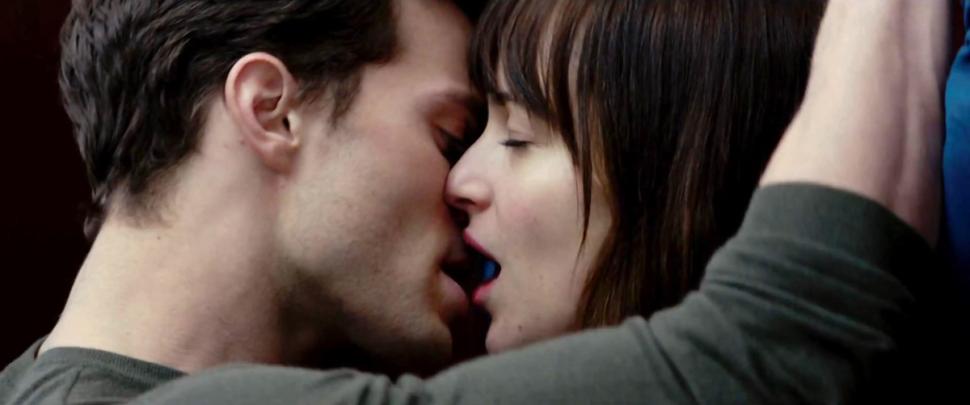 Johnson (Need For Speed) is an enjoyable screen presence even if there’s absolutely nothing interesting about her character. Anna is so absent a personality that it makes it easier for the story to present someone else doing all the work for her, pushing her, prodding her, giving her form. Johnson plays a lot of scenes for laughs, which work in a titter-generating way. I kept hearing Patricia Arquette’s voice whenever she spoke, but I may be alone in this unusual observation. Dornan (TV’s The Fall) on the other hand is terribly wooden. Again, he’s playing a rather terrible character with rather terrible dialogue, but it’s hard to feel any authentic sense of passion from the guy. It’s hard to say whether these actors are miscast or whether there could ever possibly be a suitable matching because of how lacking the simplistic characters are. They’re archetypes, and ones the movie has to keep persuading you are totally hot for one another.
So what is it that makes this property the would-be blockbuster that it is? The story arc has been done before for decades, going all the way back to Rudolph Valentino’s Son of the Sheik: the mysterious prince who comes and sweeps the princess off her feet to his exotic world of privilege. 50 Shades isn’t reinventing the wheel but it has struck a chord, and perhaps it’s the wish fulfillment angle, the introductory angle to a world of BDSM, or the plain Jane ordinary heroine that acts as a cipher for readership. The books are the books and the movie must be judged on its own account. I’m sure most of the series’ fans will be pleased one way or another, though I doubt many of them will find the movie an improvement over the book. Then again it does strip away James’ wretchedly torrid writing. If it wasn’t for the 100 million books sold worldwide, this movie wouldn’t be generating any of the hype it is, but is that the film’s fault? The hype machine unfairly builds expectations that will fail to be met, but then again it’s the over-saturated exposure that has ensured 50 Shades of being a Valentine’s weekend event for half the planet.
Surprisingly boring and rather tepid, 50 Shades of Grey feels too callow to be the provocative film experience it wants to be. It needs more of just about everything; more characterization, more organic coupling, more story, more romance, more kink. It is lacking in too many areas, though the production values are sleek, like it’s the most technically accomplished episode of Red Shoe Diaries. It’s a tedious story of the hazards and joys of giving up control, but I didn’t care about the characters. I need more than pretty people staring at each other for an hour while a breathy remix of a Beyonce song plays over the scene (to be fair that Beyonce remix is hot). The actors don’t connect together and the Christian character comes across as more of a monotone jerk than wounded bad boy. I’m sure 50 Shades has pushed millions into exploring aspects of their own sex lives they would not have felt comfortable exploring beforehand, and good for them. My friend Angie quipped that, if nothing else, the release of 50 Shades of Grey will cause a spike in battery sales for its opening weekend. It’s a shame then that the movie is too limp where it counts to be serviceable.
Nate’s Grade: C
Share this:

The Boxtrolls (2014)
 Another delightful film from the creators of ParaNorman, the whimsical Boxtrolls is another stop-motion treasure that plays just as well for children as it does adults. The fanciful world follows the industrious title creatures that have wrongly been demonized as villains. Snatcher (a tremendous Ben Kingsley) has much to gain by stirring up boxtroll fears, and if he captures them all he’ll finally be allowed to join the town’s inner circle of muckity mucks. We follow “Eggs” a boy who has been raised by the boxtrolls since he was a baby and his re-emergence with the world above ground, notably with the help of a morbid little girl, Winnie (Elle Fanning). The world building is confident and well developed, the storyline finds nuanced ways to be touching and deliver serious messages about peer pressure, assimilation, and the ways which we judge ourselves and whether those are even of merit. But the main draw is the glorious animation, so fluid, so lively, and a landscape that makes full use of color and light and shadow. It’s an immersive experience that your eyes don’t want to blink for fear of missing something. The plot is droll and expertly sequenced with its variety of character and comic asides. The vocal cast does a terrific job, notably Kingsley and a hilarious Tracy Morgan. The film can get a little spooky for young children but should still be comfortable viewing. The Boxtrolls is further proof that the animation house Laika is operating at near-Pixar peak levels of brilliance and deserve the benefit of the doubt with any future films.
Nate’s Grade: A
Share this:

American Sniper (2014)
 When killing is a man’s gift, what effect does that have on the man? American Sniper follows the real-life heroics of the most prolific sniper in United States history. With director Clint Eastwood attached and awards buzz building, you’d expect that the film would get at the heart of a complex man who placed himself back into danger by choice. For a biopic on Chris Kyle, the man seems to get lost in the fog of war (movies).
Chris Kyle (Bradley Cooper) enlisted in the military right before 9/11 and served four tours of duty in Iraq. He served as cover for many missions, protecting thousands of soldiers. The troops just felt better knowing that Kyle had their back. Kyle got married and had several kids with his wife (Sienna Miller) but he kept leaping back into the fight, the place he felt he belonged.
 From the opening sequence on, American Sniper is often a gripping suspense piece. The opening moral dilemma sucks you right in. Should Chris shoot the mother and child? Are they a threat or is there just a misunderstanding? Will they change their minds and turn away? Is there time to debate all this with advancing U.S. troops? Eastwood does a great job of drawing out the tension with shot selections and the precise editing. The bulk of the movie hews closer to a conventional action movie, with Chris and his team clearing out Iraqi insurgents. We get to know a bit about the mechanics of sniper warfare. But Kyle gets restless being the guardian angel of death for the ground troops, and he goes down to their level and clears neighborhoods. This causes some conflict with his superiors because Kyle is far more valuable as a sniper. His reputation for killing is also getting him notoriety with his enemies. There is a price on Kyle’s head and skilled snipers are seeking him out for the prize. This is a natural way to build suspense as Kyle keeps returning back into Iraq with multiple tours, every tour increasing his personal danger. It allows for real consequences for the increasing prowess of our super sniper. There’s a sense of collateral damage to every kill, as every dead body creates more enemies and those enemies grow more incensed to take him out. Even if you know how exactly Kyle met his untimely end, there’s still plenty of suspense and well-orchestrated action sequences to please casual fans of the genre and true-life military thrillers.
It does feel like the complex story of Kyle, as well as the Iraq War, are being simplified into action movie fodder. There’s a steady supply of interchangeable supporting players, soldiers and spotters and the like, all of them without much to distinguish them as characters. They’re here to be sacrificed, to watch the splatter of red, and to increase the sense of loss because we know that Chris Kyle will not be taken down so we need other expendables. As expected, Miller gets rather short shrift as Kyle’s wife who gets to alternate between worry and unease. The screenplay by Jason Hall sets up some excellently harrowing suspense sequences but seems better engineered like its establishing video game stages of combat than complex people. As a result, when we lose characters it doesn’t feel like we’ve lost people we care about. It doesn’t have an impact beyond sudden shock, and even that is tempered in time with the sniper angle. You start expecting characters to get popped in mid-sentence.
 Where the film leaves you lacking is at its center with the man who is supposed to be the focal point of American Sniper. At the start we’re told that Kyle is the deadliest sniper in U.S. history and by the end that’s about all we know about the guy. He’s an ace killer. The movie has some top-notch suspense sequences with Kyle killing people. The early scenes with Kyle’s family do the bare minimum to establish a sense of pride in not backing down from a fight. There’s a scene where his girlfriend explains to him and the audience exactly why he’s difficult. It’s pretty transparent exposition but it’s also the last bout of clear characterization you’ll get until the end. There’s a slight nod to the mounting PTSD that is transforming Kyle into a man who feels whole only on the battlefield, but these are notes of characterization that are only cursory. It’s only at the very end does the movie remember to flesh out Kyle as a person rather than as an action hero, and by then there’s only enough time to hint at elements we’ve seen explored better in other war movies, particularly The Hurt Locker. As an action film, the movie works and works quite ably, but as a biopic on Chris Kyle it forgets what makes him human, instead focusing on his superhuman killing ability.
Cooper (American Hustle) bulked up a considerable amount of muscle to portray Kyle. He fits the part well and has the acting ability to communicate the troubled psychology of a man making sense of his old world after the trauma of war. It’s then a shame that he’s not given more opportunities to use those acting muscles. There is one phone call where Cooper wordlessly finally breaks down, allowing all the scar tissue to finally be seen on his haunted character, but it’s a moment rather than a culmination.
If you go into American Sniper hoping for an elevated thriller with some well-wrought suspense, then you’ll mostly be pleased with the film as a slice of entertainment. As a war commentary or a psychological study of the horrors of war, it comes up lacking, falling back on the action tropes of its genre and neglecting to properly build around its characters. The action is often biting, and a late sequence involving an oncoming sandstorm is an intense climax. However, it’s also emblematic of the shortfalls of the film. While it’s a sequence of action entertainment, it also reduces war into a video game and reminds you that the characters onscreen are not so much portrayed as people but holders of weapons. Kyle was a complex man who was more than his uncanny ability to kill, but you won’t get more in American Sniper. The nature of his death demands a more insightful exploration of the lasting effects of PTSD and what kind of treatment, or failure of treatment, many servicemen receive once they come home.
Nate’s Grade: C+
Share this:

Unbroken (2014)
 Angelina Jolie is one of the biggest stars on the planet but as a director she’s still a mystery. Jolie was so enamored with Lauren Hillenbrand’s best-selling novel Unbroken that she felt like she was the only person who could translate this story to the big screen. Somehow that passion got lost in translation.
Louis Zamperini (Jack O’Connell) is a man who ran for his country in the Olympics. He fought on a bomber plane over the Pacific. He was shot down and survived in a raft for over 40 days at sea. He was taken to a Japanese P.O.W. camp and endured harsh and cruel treatment, and he still persevered and returned home a hero.
It’s hard not to feel a general calculation about the entire film. I’m not trying to say that Jolie or her crew had any sort of nefarious ulterior motives, but the entire product seems like it was made in an Oscar Bait factory. This is the kind of movie that the Academy typically salivates for, and it’s based on a true story, and it’s set during World War II! There’s a reason that, sight unseen, Unbroken was often at the top of the prediction lists for Oscar pundits. It is those same Oscar-friendly elements, though, that act as a detriment to the story, because the thematic elements stand in for the story and sense of commentary. The movie is so caught up with Louis’ dilemma that it forgets that it needs to make you care about him as a person rather than a martyr. The biggest hindrance for Unbroken is just how little it develops its protagonist. The only emotion he seems to exhibit in the two-plus hours is suffering. The guy ends up being a human punching bag with the movie clobbering the audience with the same message again and again as well, the will to survive. Unlike other war stories or concentration camp survival tales, Louis doesn’t survive through any great networking of allies, skill, scheming, or prescient decision-making. We do not see him adapt and outsmart his adversaries. He merely outlasts them as he wastes away. Like what I wrote in my review of last year’s Best Picture winner 12 Years a Slave, I need more characterization than suffering. It’s a frustrating experience because you know there has to be more to this character.
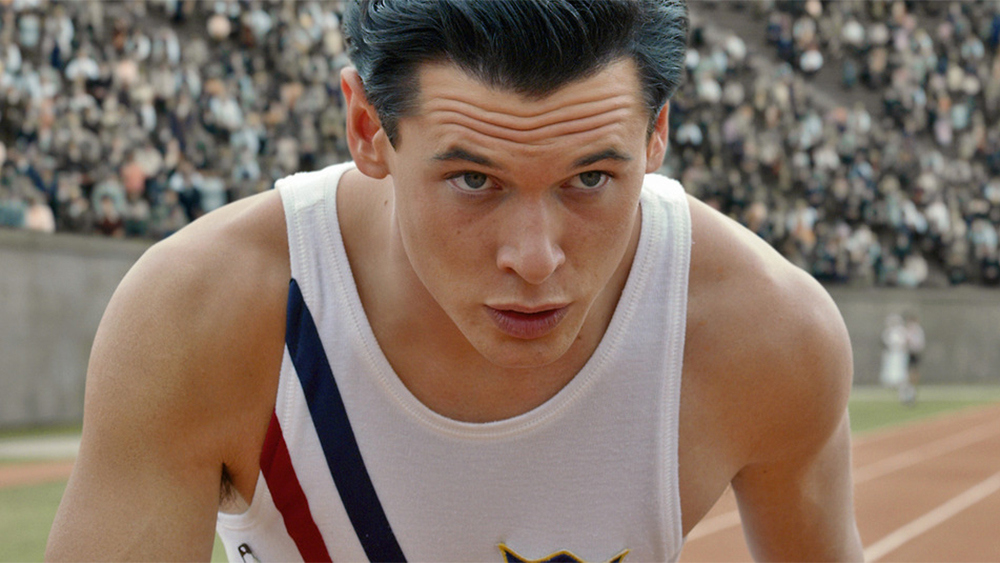 The danger with any film that purports to tell a true story of a hero is making sure the audience doesn’t lose sense of the person beneath the hero. We glorify their positive qualities and what we admire but when placed upon a pedestal, our heroes can start to become otherworldly, separate from the rest of us mortals. A biography that idealizes its subject is called a hagiography, and that is where Unbroken falls. Louis Zamperini is lost in this story, instead replaced with Louis the Survivor or, occasionally, Louis the Runner. Amidst the swelling music, the pretty cinematography, and the supporting characters channeling the audience with their encouraging mutterings of, “Come on,” and the like, Louis is painted more saint than man, which is a shame. Considering all of the peril he survived, it would make sense for him to struggle with his own doubts and fears. The most we get a sense of him and his internal struggle is when he prays aloud to God during a thunderstorm at sea and Louis promises to serve Him somehow if he survives. The movie forgets about this moment until the end credits text. If Louis Zamperini is going to be the focal point for a true story of heroism, then the movie needs to do better to make him human rather than resorting to having him only bleed.
The entire first act flashbacks could likely have been jettisoned. Watching Louis as a young man learn to run and then eventually compete in Berlin’s Olympics (way to take all of his luster away, Jesse Owens), we expect these moments to have relevance again, pointing toward some kind of grit or training regiment or lesson learned that will become useful or comforting solace during his internment. It all boils down to one skill, endurance, and that’s all we keep coming back to. We don’t need to see the Olympics or his younger life to establish as back-story in the P.O.W. camp, just as we didn’t get back-story for the prisoner who was revealed in the moment to be a concert musician. The flashbacks do little to flesh out Louis as a character. He was a troubled son of immigrants and found popularity and purpose with running, which he did to the Olympics, and then… the war. Too bad running doesn’t really come into play during his torment in Japan. I understand that we’re working with a true story but what has been added by including 20-30 minutes of flashbacks, particularly when they fail to illuminate our main character? Skipping right to the war, with perhaps a smattering of brief memories during physically and mentally fraught times, would have been preferable and more useful.
The other aspect that makes Unbroken frustrating is the potential it does flash in sparse moments. For the majority of its running time, the film is a perfectly decent war drama with an extra glossy sheen to it provided by expert cinematographer Roger Deakens (Skyfall). When adrift at sea, there’s an inherently interesting survival story there. Louis and his comrades are still in an active war zone. In one scene, a plane approaches and the guys realize late it’s no rescue but a Japanese fighter plane. They leap into the ocean as the plane fires bullets after them. This scene is made all the worse by the fact that sharks are swimming below. There’s an extra kick of dread worrying what will happen next if anyone gets wounded or killed by that gunfire. It’s a great sequence, but then it’s over and the film goes back to autopilot glorifying the resolute nature of Louis. Likewise the opening with Louis crawling along and having to manually close the bomber plane’s doors during a dogfight is great. Unbroken does get a lift when it introduces its main antagonist, Watanabe (played by rock star Takamasa Ishihara), nicknamed “The Bird.” The film now has a sense of direction and a renewed sense of danger with “The Bird” eager to break down his Olympic prize runner. The story feels more personal and interesting and it feels like this fresh antagonism will allow us to develop Louis more as a character. Sadly, he remains the same film martyr.
 This is Jolie’s second film as a director and she’s revealing some pretty old-fashioned tastes and instincts. Actors are judged at a somewhat harsher standard when they turn to directing, but the audience must simply ask if this person elevated the performances of their actors and whether they found an incisive and insightful way of telling a story. The jury’s still out on Jolie as a directing talent. The direction is more than adequate and quite fine, especially aided by having a team of gifted technicians. If you had taken Jolie’s name off the film I wouldn’t be any more or less effusive. Perhaps a more experienced director would have insisted on fixing the screenplay’s development, but then again, perhaps that director wasn’t going to get the gig of a major Oscar bait film for a studio.
I’ve spent the majority of this review criticizing Unbroken and may have given the impression that it’s a bad movie. It isn’t. It is a perfectly fine film by all accounts and a movie that will likely find a welcoming audience this holiday season. It’s got emotions and survival and danger and all set to a rousing score. It looks the part of an Oscar contender and that will be enough for many ticket-buyers. Unbroken is a perfectly good-looking tale of survival that unravels upon reflection. The necessary work of building up strong, complex, interesting characters takes a backseat to setting up a series of punishing obstacles for our protagonist. It’s like the filmmakers wanted to make an inspirational tale but didn’t want to complicate that with ambiguity and nuance and doubts. Louis is canonized in the movie’s flattering glow, and his suffering is shrugged off as “character-building.” Cogent or potent commentary on war, man’s capability for evil and good, or the nature of forgiveness, are absent, which means the film can only go as far as the immediate impact of its plot beats. Supposedly the whole movie was about forgiveness but I got no sense of that until the end credits. Unbroken is a by-the-book rendition on how to make a movie that looks good and about Important Things. It just lacks the deft storytelling, characterization, and subtext to make it important on its own.
Nate’s Grade: B-


 nathanzoebl
You must be logged in to post a comment.