Blog Archives
Toy Story 4 (2019)
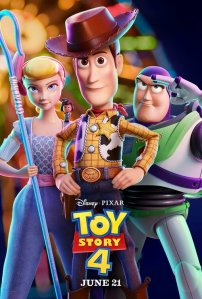 The Toy Story franchise has been the gold standard for Pixar with three excellent movies, the last of which was released back in 2010. When the Pixar bigwigs announced they were making a fourth entry, I felt some degree of concern. The hidden world of toys still felt like an interesting world with more stories to be told, but did we need to revisit Woody and Buzz and the gang? Everything ended so beautifully and perfectly with the third movie, with the toys getting their sendoff from their original owner and a new life in the possession of a new child, little Bonnie. I’ve been more wary about this movie than just about any other Pixar film because the audience had something that could be lost, namely closure. If they harmed that perfect ending in the crass desire to extend the franchise for an extra buck, it would have been aggravating and depressing to disturb something that felt so complete. It’s like when Michael Jordan came out of retirement (the second time) to be a shadow of himself for the Washington Wizards in order to sell tickets for the team he was part owner of. Nobody wanted that. I’m happy to report that Toy Story 4 is a treat of a movie and a worthy addition to the franchise.
Bonnie is gearing up for kindergarten and nervous about the change. She isn’t allowed to take toys with her to school, though that doesn’t stop Woody (voiced by Tom Hanks) from tagging along. In her desire for a friend, and with a little assist from a certain cowboy, Bonnie creates a fork-figure named Forky (Tony Hale), and amazingly it comes to life. Woody tries valiantly to convince Forky that being a toy to a child is the greatest gift but he’s also really reminding himself now that he sees his influence waning with Bonnie as he’s selected for play time less and less. During a family road trip, Forky escapes and Woody leaps to find him, both of them coming into the clutches of Gabby Gabby (Christina Hendricks), an antique doll missing a functional voice box who has her sights set on Woody’s voice box. It’s at this small-town pit stop for a carnival that Woody discovers Bo Peep (Annie Potts), an old flame he never thought he would see again. She’s assured, happy, and preaching a life of being independent from a kid. Woody has defined himself for so long by one identity, and now he must decide which to follow.
 In many ways, Toy Story 4 takes themes and questions from the third movie and improves upon them, making what could have been a retread feel like a do-over you didn’t know you desired. It’s been many years since I saw the third film but I recall the major themes being the fear of change, reconciling one’s self-identity, and the courage of letting go and starting over. The toys had to recognize that their owner was growing up and their old place wasn’t going to be the same. This same issue finds new life in Toy Story 4 primarily through the lens of Woody, who finds himself on the decline with his kid’s interest. He’s not offended or upset by this but is still trying to provide what assistance he can as a beloved toy, even if that relationship becomes more and more one-sided. His identity is in selfless sacrifice for another, but with the re-emergence of Bo, he is now contemplating a life on his own, a life without a kid. This alternate path never seemed a possibility until his former flame stepped back into his life. It challenged Woody in a way that feels more personal and more relevant than it did with 3, especially with the removal of a larger external threat to occupy the attention of our main characters. This places a renewed focus on Woody’s internal dilemma beyond his role as leader and protector.
Toy Story 4 might also be the weirdest movie of the franchise, which really elevates the comedy into another realm. I thought the characters played by Jordan Peele (Us) and Keegan Michael-Key (Predator) were going to quickly wear out their welcome; they seemed to be a heavy part of pre-release teaser trailers. The filmmakers don’t overdo them and use them in clever ways, which is a compliment that can be applied to every new character in this sequel. The plushies by Key and Peele have a hilarious running gag of their increasingly absurd plans to attack a woman, and one instance deliciously prolongs the eventual punchline, becoming more bizarre and macabre to the point that I lost control from laughter. Keanu Reeves (John Wick 3) is fun as a very Canadian Evel Knievel motorcycle driver, and the weird references to the Canada-ness of it are played completely straight, making it even funnier (his laments with the French-Canadian boy’s name made me snicker every time). There’s a trio of action figures, Combat Carls, and one of the three is always left hanging for high-fives and he just leaves his arm up waiting, silently pleading, and then lowers it in defeat, and it’s hysterical even just as a background gag. The ventriloquist dummies are routinely played for creepy laughs and physical humor. There’s a running joke where Buttercup, the unicorn voiced by Jeff Garlin, is always suggesting getting Bonnie’s father sent to jail no matter the circumstances. It’s these touches of weirdness that make the movie stand out that much more from the three others.
 The villain of Toy Story 4 is given a surprising sense of poignancy, enough that I genuinely sympathized with her plight. She’s a damaged doll used to being behind glass, isolated and separated from the children she wishes to be part of. She views her salvation in fixing in her damaged voice box, her perceived disability. She’s after what Woody has physically, the voice box, but it’s a means to an ends to have what Woody has had emotionally, the love of a child in need, the connection she yearns for. I won’t spoil what happens with her but even when there are setbacks the film and the characters don’t give up on Gabby Gabby. Her perspective and desires are still seen as valued, and the eventual resolution of her character put a lump in my throat. She wasn’t really the villain after all. She was just another toy in pain looking for acceptance and having to adjust her identity. I feel like there is a conscious disability empowerment message implanted in Toy Story 4, namely that those who are disfigured, disabled, or seen as “broken” can continue to be valuable and that their lives don’t end.
If this serves as the finale of the franchise, it will end on a fitting and resonant high-point. As much as Toy Story 3 was about change and acceptance, this sequel does a very respectable effort of personalizing that message even more to one central character’s dramatic arc. It also works wonderfully playing off of our collective investment in the character over the course of four movies and twenty-four years. There are some drawbacks to this approach. It makes the majority of the other toy characters feel like they have little to do on the sidelines, other than fret about retrieving Woody and Forky. Buzz is given a cute joke about listening to his inner voice but it doesn’t amount to much more than a cute joke. The inclusion of Forky feels like an exciting and even daring addition, tackling some existential questions and how and when toys are “made” and brought into being, and he presents these for a while. Once we get to our carnival setting and Forky is captured, he seems to be forgotten about. He’s more a motivation point for Woody than overtly anything else. I suppose you could make the analysis that Forky represents how Bonnie is moving on even with invented toys at the expense of Woody. However, these are minor quibbles considering the quality and emotional involvement of what Pixar has produced.
It goes without saying that the animation is beautiful but what amazed me is how expressive the faces of the characters could be, even when they were relatively inflexible toys. The relationship between Woody and Bo actually has a surprising amount of nonverbal dramatic acting to communicate nuance. As the years go by, I continue to be further and further amazed at the Pixar animators and their abilities.
 As protective I was over Toy Story 3’s perfect ending, I am happy to say that Toy Story 4 more than justifies its own existence in this hallowed franchise and even improves from the third film. The themes are something of a repeat but the filmmakers have elected to focus almost entirely on Woody and his personal journey, and it makes the loss and possibility more robustly felt. In many ways the film is an exploration on relationships and the need to redefine ourselves, to move onward when the time is right, and to try something new even if things get scary. Between Woody and Gabby Gabby, ostensibly the hero and villain of the piece, they’re looking for meaningful connections where they can. They may be secondhand, they may be disabled, but that doesn’t mean they aren’t worthy of affection. This is a joyous movie that finds time to be wonderfully weird and often funny. It might not have the set pieces or ensemble showmanship of the prior Toy Story tales, but what it does have is a character-based emphasis on the most complex figure in this universe of toys. The conclusion is moving and satisfying and I don’t mind admitting that tears were shed. I even teared up at different other earlier points. Toy Story 4 could have gone a lot of different ways but I’m relieved and appreciative with this new sendoff we’ve been granted.
Nate’s Grade: A
Share this:

Toy Story 3 (2010)
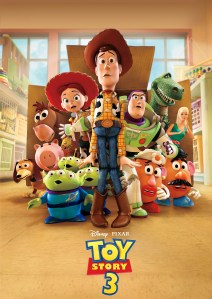 I was completely unprepared for how emotionally involving Toy Story 3 would be. Sure, Pixar has managed to break and melt your heart through ten previous movies, but I suppose I foolishly felt that I was beyond caring for toys. But even in the opening minutes, a tremendous make-believe fantasy, I felt punches of emotion as each character was reintroduced. It felt like I was reconnecting with old friends and it was such a pleasant reunion. It’s okay, guys, to cry over toys.
Cowboy sheriff Woody (voiced by Tom Hanks), the leader of Andy’s toys, is trying to keep hope alive. Andy is now 17 years old and on the verge of leaving for college. His favorite childhood toys have long since been relegated to a chest as Andy has matured. Joining Woody are spaceman Buzz Lightyear (Tim Allen), Jessie the cowgirl (Joan Cusack), Mr. and Mrs. Potato Head (Don Rickles and Estelle Harris), Slinky Dog (Blake Clark), the timid Rex (Wallace Shawn), and the piggy bank, Hamm (John Ratzenberger). They are all the toys in their gang that remain. As Andy leaves their main goal seems to have been accomplished. They were there for their owner and now he no longer needs them like he once did. The toys have a few options left: stuffed into the attic, sort of like a retirement home, until perhaps Andy digs them out for his own kids, or being thrown out with the trash. Woody assures them that Andy would never just throw them all out, though even he has his doubts about their current purpose. They all feel the loss.
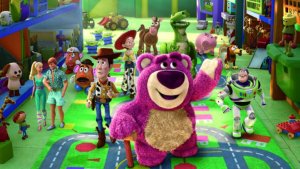 After a mix-up, the toys decide to take matters into heir own adjustable hands. They will sneak away inside a donation box for Sunnyside Day Care. The center seems too good to be true. The courtly Lotso Hugs Bear (Ned Beatty), who seems to lead the center, promises that all toys will never be forgotten again. When the children grow too old then a new batch moves in to play. It’s a toy’s dream, that is, until Buzz and the gang discover that they’re canon fodder for hyperactive, maniacally destructive toddlers. They can’t keep up with the daily abuse. Sunnyside Day Care is less a haven than a prison. New toys have to pay their dues and earn a place in the vaulted Butterfly Room, where young children lovingly interact with their toys. It’s a toy class system. Lotso refuses to cotton to rule-breakers, and toys are locked away nightly so they cannot escape. Woody must try to save his friends by breaking them out and getting back to Andy before he departs for college.
Given that the movie tackles major issues like moving on, growing up, and mortality, I knew I was in for some heavy moments, but absolutely nothing prepared for some of the emotions that clobbered me. You do realize through the course of this third film as the toys try and find a suitable place to retire, if you will, how attached you are to these characters. Late in the movie the toys are in some dire circumstances. There’s a horrifying junkyard sequence that even manages to evoke Holocaust imagery, which means parents are going to have to calm some spooked tykes come bedtime. There’s a silent moment, where the toys all seem to accept their fate, and all they want to do is join hands and face it together, as a united family one last time … and my God, I could not control myself. My face was dripping with tears (even thinking back right now is causing my eyes to well up a bit). Toy Story 3 isn’t the strongest of the trilogy in terms of character or plot (in some respects, the plot is a reworking of The Brave Little Toaster), but you better believe that it delivers emotional resonance in spades. Major credit goes to screenwriter Michael Arndt who won an Oscar for Little Miss Sunshine.
 But fear not, Toy Story 3 is not all sturm und drang, it also provides plenty of laughs and plenty of visual wonder and excitement. The toy’s point of view has always allowed for plenty of amusing insights and satirical riffs. The personality clashes makes for the most jokes, and the new characters pull their own weight, particularly Ken (Michael Keaton), an effeminate clothing-conscious doll who finds his true love with the arrival of Barbie. The use of Big Baby as a malevolent goon is also refreshing and quite creepy. The Spanish Buzz reboot personality seems superfluous but cute. The jokes come by at a steady pace and while they all may not work as well (Ken in a trying-on-clothing montage set to “Le Freak”?) there are still moments of great creative ingenuity. The detailed escape from Sunnyside feels like a terrific parody of prison movies, and they way it utilizes all the different characters as key components is satisfying and fun. But the best moment of the break-out, by far, is when Mr. Potato Head is trapped, hurls his pieces out of an opening, and reassembles thanks to a tortilla body. It’s a weird visual, like something out of Salvador Dali, and yet I could not stop giggling from watching his floppy movements. It’s comedic while at the same time a genius move in drawing out an action sequence — it makes keen use of the players and their skills. From an action standpoint, G-rated Toy Story 3 manages to have more thrills and spills than any other 2010 movie so far.
Director Lee Unkrich (co-director for three previous Pixar flicks) makes quite a debut for himself. The complexity of the action, while still maintaining an internal logic, is hugely rewarding. The Pixar wizards truly know how to craft inventive action sequences and stay true to character. Unkrich’s command of visuals is impressive. The action is well paced, but it’s the man’s use of composition, camera movement, and editing make Toy Story 3 a visual treat. Unkrich fully knows how to best utilize and fill up the screen. The world of Toy Story is popping with color and visual whimsy, as well as plenty of sight gags and subtle movie references for adults. Ten years of advancements in computer effects has also allowed the toys to get a bit of a facelift. The 3-D process enhances the overall experience without calling attention to itself. There aren’t any standard 3-D moments where big and pointy things keep flying out at the audience. The 3-D provides a greater field of depth without distracting you from the pivotal moments of story.
The voice acting is just about perfect from top to bottom. Allen and Hanks are a welcomed pair, Cusack provides plenty of spunk, Rickles brings his usual dish of joyful disdain, and new characters like Timothy Dalton as a stuck-up thespian porcupine and Kristen Schaal (TV’s Flight of the Conchords) as a bubbly triceratops toy are fun additions that don’t overstay their welcome. Blake Clark takes over the voice of Slinky Dog from the late Jim Varney who died in 2000, and he does a fine job without sounding like a direct imitation. I was really delighted by Beatty. He has such a Southern gentlemanly demeanor that underscores the hardened heart of his villainous character. And yet, Lotso gets his own rich back-story of abandonment and bitterness similar to Jesse the cowgirl. Even when he’s dastardly we can see where the big purple Teddy bear who smells like strawberries is coming from. Ned Beatty has finally appeared in another breakthrough cultural film to redefine his identity. Perhaps now he won’t be best remembered as the guy who gets raped in Deliverance. He probably still will be.
A lot has changed in the 15 years since Pixar revolutionized the world of animation and family films with their first feature, Toy Story. Kids at the time are now teenagers; some embarking on college this summer themselves much like Andy. They too have to put away former childish things and move forward. Toy Story 3 is magic confluence of heart, wit, visual whimsy, cleverness, and drama. Not quite as sharp as the first two installments, or as artful as Pixar’s high-water mark, WALL-E, the third Toy Story is still a mighty entertaining piece of work. The last 30 minutes of this movie is harrowing and then deeply satisfying and moving, finding a fitting sendoff for characters that we’ve come to love. It’s all about moving forward, saying goodbye, and reflecting about times shared. I wouldn’t be surprised if Toy Story 3 inspires kids, and adults alike, to go home and play with their old toys, giving them renewed life and purpose.
Nate’s Grade: A
Share this:

Cars (2006)
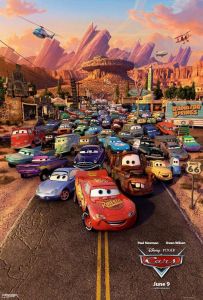 While I’d never call Pixar’s latest animated film a disappointment, it is the company’s first speed bump in their unprecedented reign of unmatched quality. Cars is technically dazzling; it’s almost redundant to say a CGI film is the best-looking ever because the technology keeps improving with time but Cars is incredible to watch. The lushly painted vistas, the way light gleams on surfaces, the blurs of color, the near-photographic likeness of cars themselves, this is a beautifully animated film, obviously. What isn’t as beautiful is the lackluster storyline. I can feel Pixar’s heart in the right place but they don’t put enough effort to touch our own hearts. Cars lacks the depth of Pixar’s other features. The two Toy Story films managed to take a kiddy concept of the secret life of toys when no one’s watching and infuse it with serious moral dilemmas and a mature insight into mortality and community. In Cars, the main storyline involves a cocky hot rod Lightning McQueen (voiced by Owen Wilson) who lives in a glitzy world that revolves around him. He goes off the beaten path and finds himself trapped in Radiator Springs, a tiny town that’s all but been dried up since the interstate took folks away from them. There, Lightning learns there’s more to life than material riches from this eclectic mix of good, honest small-town folk. What I’ve just described to you could be the plot of hundreds of movies championing the likes of small town folk. They surprisingly never really go much deeper, though Paul Newman is terrific as an old time car that had a taste of the glory and arrogance way back.
This is the first Pixar movie to exist in a world without humans, which begs the question how living automobiles were able to construct their world minus opposable thumbs. Cars themselves are weirdly inexpressive creatures.
The climax to Cars is suitable and heartfelt but the movie, at two hours in length, sputters a while in the middle. This is the first film directed by Pixar’s big cheese, John Lasseter, since 1999’s Toy Story 2, so excuse me for expecting a little more. Still, the movie is certainly fun, exciting, more cute than funny, and it has a genuine sweetness to go with its visual prowess. I just wish the 8 credited screenwriters, including Lasseter himself, had revved up their imaginations a bit more beyond the conceptual stage. Cars isn’t a great movie, but coming from Pixar, it’s still very good. Hey, anyone that can make the voice of Larry the Cable Guy tolerable deserves my thanks.
Nate’s Grade: B
Share this:

The Green Mile (1999)
 A prison in the heart of the deep South during the era of the Great Depression is not usually the locale you’d find a somber tale of earnest discovery and passionate awareness to the follies of life. Yet here arrives the long anticipated The Green Mile, the second in tag-team efforts from director Frank Darabont and novelist Stephen King in their own genre creation of nostalgic feel-good prison flicks. All the swelling hype could manage to make the movie seem overbearing, but if you’ve got a free afternoon and a butt made of steel then try The Green Mile.
Darabont seems like the perfect visual interpreter to King’s epic narrative spinning of good, evil, and all that fall between. The movie moves at the pace of molasses and clocks in at over three hours in length. Not exactly audience friendly fodder but one and all will be grateful for the decisions taken to build character development and tension instead of blindly rushing through.
Tom Hanks plays a prison guard on the Death Row block of a Southern penitentiary. Despite the bleak and grim surroundings his humanity still shines through. He escorts and oversees the final moments of many men’s remaining breaths along the final walk of green linoleum tile to the electric chair. Enter one mysterious morn John Coffey (Michael Clark Duncan), a towering giant that seems to break all the rules each of the guards on cell block E has come to realize through their years. Coffey has been convicted of the rape and murder of two little girls, but as Hanks soon learns things aren’t always what they seem. The 7-foot miracle worker displays scenes of empathetic healing like to Christ himself. Hanks views are turned and his eyes open, and that’s just the beginning of the heartstrings being pulled. To release anymore of the plot would be a crime punishable by Ole’ Sparky himself in the Green Mile.
 The pacing is smooth and wrings out every droplet of mystery and drama needed. The Green Mile‘s comprehensive fable quality transcends the period just like The Shawshank Redemption did as well prior. ‘Mile’ should be expected to be a front-runner for Oscars when balloting begins.
The ensemble acting is magnificently eclectic and truly inspiring. Hanks’ name is so synonymous with Oscar that he might as well shave his head and paint his body gold because come nomination time this man’s name is going straight to the ballot. Other stars give thoughtfully deep and refreshing performances guaranteed to turn a few heads. Duncan’s gentle child-like giant is serene and a benevolently touching figure of innocence and warmth. But one can not forget the presence of a very special rodent by the name of Mr. jingles that deserves billing above the credits itself for the quality performance it puts on.
The Green Mile is a sad, touching ,and rather powerful movie that speaks to the viewer’s emotions and gladly earns every one of them. In the end The Green Mile is nothing beyond a long yarn of a fairy tale; but one told so exceptionally, one performed so extraordinarily, and one directed so deftly that you’ll gladly journey down that mile with ease.
Nate’s Grade: B


 nathanzoebl
You must be logged in to post a comment.