Blog Archives
The Station Agent (2003) [Review Re-View]
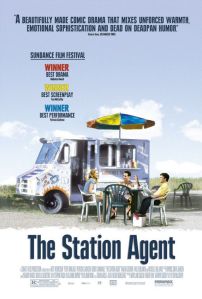 Originally released December 5, 2003:
This is the most charming film of 2003, and Im not just saying this because I had an interview with one of its stars, Michelle Williams (Dawson’s Creek). Fnin McBride (Peter Dinklage) is a man with dwarfism. With every step he takes every look he gives, you witness the years of torture hes been through with glares and comments. Hes shut himself away from people and travels to an isolated train station to live. There he meets two other oddballs, a live-wire hot dog vendor (Bobby Cannavale) and a divorced mother (Patricia Clarkson). Together the three find a wonderful companionship and deep friendship. The moments showing the evolution of the relationship between the three are the films highlights. Its a film driven by characters but well-rounded and remarkable characters. Dinklage gives perhaps one of the coolest performances as the unforgettable Fin. Cannavale is hilarious as the loudmouth best friend that wants a human connection. Clarkson is equally impressive as yet another fragile mother (a similar role in the equally good Pieces of April). The writing and acting of The Station Agent are superb. Its an unforgettable slice of Americana brought together by three oddballs and their real friendship. You;ll leave The Station Agent abuzz in good feelings. This is a film you tell your friends about afterwards. There’s likely no shot for a dwarf to be nominated for an Oscar in our prejudiced times but Dinklage is deserving. The Station Agent is everything you could want in an excellent independent movie. It tells a tale that would normally not get told. And this is one beauty of a tale.
Nate’s Grade: A
——————————————————
WRITER REFLECTIONS 20 YEARS LATER
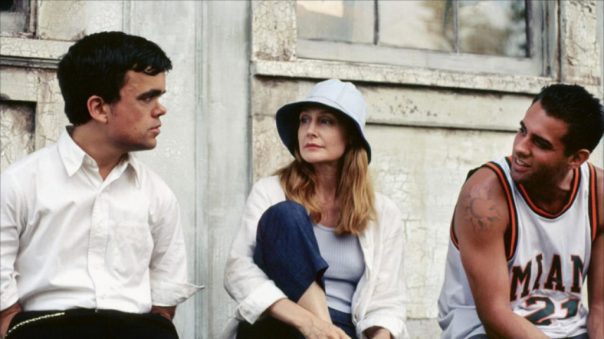
Tom McCarthy didn’t invent the quirky, found family indie but he sure seems to have nearly perfected it, starting with 2003’s The Station Agent. This little gem of a movie is so subdued, so relaxed, and so gentle that it seems to adopt the very personality of its lead character, Fin (Peter Dinklage), a dwarf who just likes trains a lot and wants to live his life in solitude. He’s an unassuming man who keeps to himself as a means of survival, because almost every time he goes into public life Fin is met with stares, snickers, and harassment (the convenience store lady gets his attention to take his unsolicited picture). Very few will get to know this man beyond his superficial physical characteristics, so he retreats within himself, perhaps purposely obsessing over an antiquated hobby as a means of escape to the past. He’s a lonely man and the movie is about him finding his clan, his place in the world, by slowly lowering his defenses. It’s a simple sort of story that is lifted by the strength of its characters and its wonderful ensemble cast.
With such a taciturn main character we need a contrasting character, a much more talkative person with high energy, and this is beautifully embodied by Bobby Cannavale. He plays Joe Oramas, a coffee truck operator who exemplifies joy de vie. He’s charming, garrulous, and relentlessly upbeat, which makes for a magnificent odd couple contrast with Fin, and it allows both characters to gradually change and grow attached to one another’s mutual friendship. Finn allows himself to become more vulnerable and form bonds and Joe starts to see the world from Fin’s point of view, allowing himself to slow down and appreciate the smaller things he might have missed in his excitable and irascible activity. Dinklage’s dry understated performance is a perfect counterpoint to the churning energy emanating from a grinning Cannavale. This is a fine showcase of both actors, who would go on to win six Emmys between them in the years ahead.
The third member of this found family is Olivia, played by Patricia Clarkson, and I actually think the movie might have worked better without her character. She does provide a point of view that our two guys lack; she’s experienced significant grief over a lost child and her life is in shambles as she tries to discover what she wants from her cratering marriage to a young-er John Slattery. Clarkson is also wryly enjoyable and gets some of the best lines in the movie, so she’s not at fault here. I think it’s because I’m confused about how this character is treated, especially compared to the natural opposites-attract dynamic of Fin and Joe’s friendship. Olivia feels like a broken thing that the boys need to try and help get better, but we were already covering this with Finn’s reserve from a lifetime of feeling ostracized. The possible romance between Fin and Olivia is also awkward because there are obvious implications that she sees Fin as a replacement son, even having him sleep in her son’s old bed. At one point, in her anger, she yells at Fin that she’s not his mother, but it feels much more like she’s the one who is looking for a surrogate son, and just because Fin is a dwarf and perhaps of similar heights makes the whole thing feel uncomfortable and ill-advsied. I’m not going to refuse an added Patricia Clarkson in my movie, but upon my re-watch twenty years later, it’s hard not to feel like McCarthy didn’t have as much envisioned for this part.
 McCarthy’s movie acclimates the viewer to the simple charms of its people and the small town, getting to know the various characters and their foibles and hopes, getting used to the rhythms of this life and adjusting much like Fin. There are small victories that are payoffs, like Fin finally getting a library card, or speaking in front of a school class about his affinity for trains. It works so well. McCarthy continued his found family writing with 2007’s The Visitor and 2011’s Win Win, both anchored by the emotional enormity of sad, lonely men learning to open up to companionship. There were some dips in the road but McCarthy worked his found family magic to the biggest stage with 2015’s Best Picture winner, Spotlight, which McCarthy directed and co-wrote. His only follow-up theatrical movie was 2021’s Stillwater, where an oil rig dad (Matt Damon) tries to save his daughter overseas from a very ripped-from-the-headlines scandal (Amanda Knox was very unhappy). There is also a 2020 Disney Plus movie about a kid detective and his imaginary polar bear best friend (that actually sounds adorable). I guess I figured a Best Picture Oscar on your resume, as well as a history of working within the studio system and world of indies, would have given McCarthy more work than directing a handful of episodes for 13 Reasons Why and creating Alaska Daily. I’ll always be looking for the next McCarthy project when I can.
McCarthy’s failures can be just as intriguing as his successes. The Cobbler is just such an astounding idea that it’s hard to imagine anyone thinking it would work out, with Adam Sandler as a magic shoe-maker. However, this same pessimistic mentality probably prevailed when McCarthy was trying to raise money for The Station Agent. His indie successes proved that he could take any jumble of strange characters and turn it into a functional movie. Maybe that hubris, well-earned along with his contributions to the Oscar-nominated Up script, finally caught up with 2014’s The Cobbler. I would pay good money to one day watch that un-aired footage of the original Thrones pilot, the one the producers themselves acknowledged to be deeply troubled. After retooling the show and cast, bringing in Michelle Fairley and Emilia Clarke, McCarthy departed, though is credited for helping to secure Dinklage’s involvement, and it’s impossible to think of the zeitgeist-defining excellence of the HBO series with anyone else playing the iconic role of Tyrion Lannister.
 Re-evaluating The Station Agent twenty years hence, its many charms are still abundant and I appreciated how gentle and relaxed everything felt. When indie movies deal with heavy amounts of quirk and oddities, it can often be heavy-handed and abrasive, never letting the audience forget for a second just how special and strange and different the movie must be (here comes 2024’s look at Napoleon Dynamite). McCarthy’s movie almost feels like a writing exercise where he plucked three very different characters out of a hat and challenged himself to build a grounded movie built upon their unexpected friendships. It’s a movie confident to just let the characters speak for themselves. It’s more a slice-of-life glimpse at people who feel far more real than most Sundance indies built upon oddballs and quirk. I would slightly lower the grade from an A to an A minus simply because of the Olivia character. Clarkson is great but her role feels undeveloped, somewhat redundant, and a little sloppy. Still, the enjoyable performances, the observational detail, and the simple pleasures of a story well told with characters you genuinely care about are what shines through even twenty years later.
Author’s note: In my original review, I cite having interviewed Michelle Williams (yes, surprise, she plays the small-town librarian). While I was my college newspaper’s film critic from January 2002 to May 2004, I did have the opportunity to interview several actors and directors through phone cattle calls with other collegiate journalists. These names include Angelina Jolie (Tomb Raider 2), Billy Bob Thornton (Bad Santa), Kevin Smith (Jersey Girl), and the late Paul Walker (Timeline). However, my school schedule was not accommodating for the Williams interview, so I had my dormitory neighbor and friend Tim Knopp call in and ask my question. It wasn’t me. I’m coming clean after twenty years, folks. I also recall having him quote a line her character says in The Station Agent, saying Fin had “a nice chin,” and being told that she was baffled and blanking on the reference. I’m sorry, eventual multi-Oscar nominee Michelle Williams, for trying to be clever.
Re-View Grade: A-
Share this:

Blonde (2022)
 After receiving such blistering and excoriating responses, I went into writer/director Andrew Dominik’s Blonde with great trepidation. The near-three-hour biopic on the iconic Marilyn Monroe, played by Ana de Armas, is the first movie to earn an NC-17 rating since 2011’s Killer Joe, and as such, there’s a natural curiosity factor to any movie receiving such hostile reactions. Fans and critics have called the movie exploitative, navel-gazing, misogynistic, and redundant misery porn. One critic even said Blonde was “the worst movie Netflix has ever made.” I was a major fan of Dominik’s verbosely titled 2007 film, The Assassination of Jesse James by the Coward Robert Ford, and less so 2012’s Killing Them Softly, though I recognized sparing artistic merit. It’s been ten years since Dominik has directed a movie, so surely Blonde, based upon the novel by Joyce Carol Oates, had to have some merit beyond all its hype and criticism, right? Well, no. I processed my general disgust for Dominik’s three-hour slow-mo car crash. This movie is so stupendously misguided and cruel and filled with bizarre, outlandish, and maddening artistic decisions. For my movie review, I felt I needed to break my standard formula, so I decided to give voice to my analysis and criticisms by writing a pretend conversation between Dominik and a stand-in for the Netflix production. Enjoy, dear reader, and beware.
Andrew Dominick sits in front of the desk of a very concerned Netflix Producer, who fidgets uncomfortably in his seat and shuffles papers in his hands.
Netflix Producer: So, thanks, Andrew for making time for this meeting. We’ve seen your full movie and we have some… well, concerns.
Andrew Dominik: That’s life, man. You can’t tell stories without risk. Break a few eggs.
Netflix Producer: Yes, sure, but, well, I guess one of our biggest questions is why did you need almost three hours to devote entirely to the lengthy suffering of Marilyn Monroe? This is supposed to be a biopic, but all we get, scene after scene, to a fault, is a moment of Marilyn being abused, or crying, or being generally exploited. It’s… a lot to take in, Andrew.
 Andrew Dominik: Hey man, that was her life. She was this glamorous star, but behind the glamor is a lot more dirt and grime. Everyone wanted to be her, and I wanted to show the world how wrong that would be. This is a woman who was desired by the world and she was still a victim in the Old Hollywood system, which was a rape factory. I was just being honest, man.
Netflix Producer: I get that principle, but it really feels like the only version of Marilyn we get in this movie is the role of a long-suffering victim. It’s practically a passion play: The Passion of Marilyn Monroe. You’re cheapening her real-life suffering by making it so redundant to the point of self-parody, and also, if you were so concerned about creating an honest portrayal of what this woman went through, then why are you also making things up to add to her legitimate suffering?
Andrew Dominik: What d’ya mean? I adapted the book.
Netflix Producer: Yes, but you do know that Oates’ book is explicitly fictitious, right? It’s made up. Marilyn never had a throuple relationship with Charlie Chaplain Jr. and Edward G Robinson Jr. Marilyn had a positive relationship with her mother. Even worse, you’re adding fictitious suffering, like her relationship with her mother, or Marilyn being raped during an audition.
Andrew Dominik: Yeah, that might never have happened, but the rape represents the-
Netflix Producer: I’m gonna stop you there. You should refrain from sentences that include the phrase, “The rape represents [blank].” We don’t need literal sexual violence, of which we return to time and again, to stand in for a larger thematic message. Also, it’s quite disingenuous to add extra traumatic experiences when you’re purporting to tell this woman’s real trauma and conflict.
Andrew Dominik: Agree to disagree, then.
Netflix Producer: No, not really, but, okay, Andrew, can you tell me any personable impression you get of Marilyn from this movie? And-and you cannot say “victim.”
 Andrew Dominik: She was…….
Netflix Producer: …Yes?
Andrew Dominik: Sexy?
Netflix Producer: Okay, sex symbol for nearly 60 years after her death, sure. What else?
Andrew Dominik: She was…. Um…. Uh… Can I look this up on my phone?
Netflix Producer: See, Andrew, this is our problem-
Andrew Dominik: Oh, she has daddy issues! There. That.
Netflix Producer: And for an hour you have her referring to all the men in her life as “daddy,” which is very uncomfortable especially when those men are literally abusing her.
Andrew Dominik: But, y’see, she calls ‘em all “daddy” because she has-
Netflix Producer: Oh, we get it. Thank you. You have 160 minutes and you keep hitting the same point over and over, bludgeoning the viewer into submission. It’s more than a bit gratuitous, especially when you factor that you’re adding even more trauma.
Andrew Dominik: What d’ya mean by “gratuitous?”
Netflix Producer: I have prepared several examples. For starters, it might be a bit much within the first twenty minutes of your movie to subject your audience to a mother trying to drown her child in the bathtub and Marilyn being sexually assaulted at one of her first auditions.
Andrew Dominik: Okay. Okay. I get that.
Netflix Producer: Then there’s the ghastly POV shot from inside Marilyn’s vagina, which by God happens twice, and both times it’s during forced abortions. Did we really need that queasy angle that is literally invading her body against her will to accomplish what exactly?
Andrew Dominik: The purpose of any true artist is to go deeper-
 Netflix Producer: I’m gonna stop you there again. It’s just bad taste, Andrew. Also, speaking of bad taste, maybe we don’t need the entire sequence where JFK rapes her and then hires government goons to abduct her and force Marilyn into an abortion. And then, on top of all that, she hears the pleas of her first aborted fetus calling back to her. Yikes. Can you at any point step outside of your position, Andrew, and realize how shockingly gratuitous all of that can be?
Andrew Dominik: It’s all designed to separate the person from the icon. Marilyn Monroe never really existed beyond the fantasies of the public, man. It’s about bringing back her humanity.
Netflix Producer: Separating the legend from the person would be a natural artistic angle, but that means spending time establishing the person, building her up through multiple dimensions, multiple opportunities to flesh her out. You only spend time seeing her as a victim, that is when we’re not meant to partake in the same sexualization of her that you seem to be criticizing. I mean the 1996 HBO TV movie managed by having two different actresses portray her, with Naomi Judd as Norma Jean and Mira Sorvino as Marilyn. That literalized the differences and even had Marilyn converse with her former persona as a plot device. You have none of that.
Andrew Dominik: I might not have that, but my movie has a cross dissolve that goes from Marilyn getting banged to the literal crest line of Niagara Falls.
Netflix Producer: I don’t think that really makes up for a lack of character substance.
Andrew Dominik: Agree to disagree, man.
Netflix Producer: You really can’t keep using that as a defense.
Andrew Dominik: Agree to disagree, man.
Netflix Producer: Your horror show of relentless trauma and bad taste might undercut your stated goal of humanizing this woman. She’s not a character but a symbol of abject suffering, a martyr, and you increase her suffering, and sometimes in grating, absurdly grotesque ways. Do you even care about this woman? You’ve devoted three hours to reanimating her as a powerless punching bag.
Andrew Dominik: Well, I did say Gentlemen Prefer Blondes is about “well-dressed whores” and that Blonde is “just another movie about Marilyn Monroe. And there will be others.” I also said that the most important part of her life was that she killed herself.
 Netflix Producer: Exactly. That makes us question whether you have the passion and sensitivity for this project. Why does this movie even have to be NC-17? Will your three hour torture chamber be bereft of meaning if the audience doesn’t see two inner vaginal camera angles?
Andrew Dominik: How dare you even question my artistic integrity. If you remove those shots, you might as well be removing the soul of this movie. Why even tell this story?
Netflix Producer: Yes, why indeed?
Andrew Dominik: It’s meant to be disorienting.
Netflix Producer: Congrats.
The Netflix producer leans back in his chair and releases an extended, wearying sigh.
Andrew Dominik: So… after everything…. Are you going to make me cut anything?
Netflix Producer: Please. We’re so hungry for Oscar recognition, we don’t care. Go for it.
I want to cite de Armas’ (The Gray Man) performance as one of the few attributes to the movie. It’s hard to watch this woman suffer and cry in literally every scene, but I also just felt so sad for not just her character but for de Armas as an actress herself. She shouldn’t have to endure everything that she does to play this character. She is undercut by Dominik’s artistic antics and avarice at every turn, like the story jumping around incoherently so every scene fails to build upon one another. There is no genuine character exploration to be found here. It’s a cycle of suffering, and the movie wants to rub your nose in the exploitation of Monroe while simultaneously exploiting her. De Armas deserves better. Marilyn Monroe deserves better. Every viewer deserves better. Spare yourself three awful hours of pointless suffering in the name of misapplied art.
Nate’s Grade: F
Share this:

Thunder Force (2021)
 I feel like we were just here a matter of months ago, another aimless Melissa McCarthy comedy vehicle written and directed by her husband and chief enabler, Ben Falcone. With Thunder Force, McCarthy becomes an accidental superhero and that premise should be enough with this star to power a silly and amusing 90 minutes of entertainment. Once again it’s a dispiriting comedy that feels like it’s just sitting around and waiting for the performers to find something funny in their scenes and family-friendly improv ramblings. The energy of this movie is completely slack, and scenes feel adrift, lacking proper direction or purpose. The whole movie feels gassed and grasping. It takes 45 minutes for McCarthy to train to be a hero and sometimes there just aren’t jokes. Take one instance where McCarthy literally throws a bus, a point strangely referred to multiple times earlier as a setup for this long-desired moment, and then under Falcone’s uninspired direction we don’t even see the messy results. We don’t even see the bus crashing into, like, an orphanage or something that would provide an actual punchline. The comedy malpractice can be staggering. It’s the kind of movie that resorts to characterization where everything is clumsily reported to us, like, “You’ve always been this way since…” The chemistry between McCarthy and Octavia Spencer (The Witches) is lukewarm at best for these longtime friends. The buddy comedy doesn’t even seem like it was developed beyond its initial pitch. The shining light of this movie is easily Jason Bateman (Ozark), who plays a crab-armed mutant criminal that becomes an improbable romantic suitor for McCarthy’s character. If there is anything that made me laugh, it was related to this character (and an ordinary henchman named Andrew who may or may not be targeted as the next to get killed by his evil boss played by Bobby Cannavale). I even loved the simple image of Bateman crab walking off screen with his arms in the air. The sheer weirdness is enough to make you realize what potential could have been tapped with this super premise and with McCarthy, who can be so charming and disarming when she gives into her odd impulses. Just give me a full movie where a middle-aged superwoman tries to make a relationship with a crab-man super villain work. I wish that Thunder Force had more courage to chase its weird rather than settle, time and again, as an action comedy that is middling with its action and middling with its comedy. I think I had more fun with 2020’s Super Intelligence, another mediocre Falcone collaboration.
Nate’s Grade: C-
Share this:

Super Intelligence (2020)
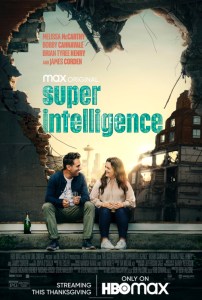 Given the sad and off-putting output from Melissa McCarthy and her husband Ben Falcone when they collaborate, it’s a small victory that Super Intelligence is only really super bland and forgettable. McCarthy stars as an everywoman picked by a highly intelligent A.I. to be the test subject for whether or not humanity should be saved or wiped out of existence. It sounds like an amusing premise but what it becomes is just a boring romantic comedy. The super A.I. (voiced by James Corden) becomes more or less a magic genie, and now our heroine has all her wishes granted. She has a huge new bank account, a new car, a new luxury condo, and all to impress the guy she let get away played by Bobby Canavale. That’s right, the super A.I., meant to test and judge mankind, is really just the world’s most advanced wingman and trying to get his human pal some love. As far as tests go this seems a bit weak. This mighty A.I. should be working against our protagonist, throwing increasing obstacles that push her out of her comfort zone, rather than just handing her everything and looking from afar with approval. The comedy is resolutely flat save for the inherent charms of McCarthy, who doesn’t seem challenged by anything in the movie. Much of the film is watching McCarthy talking into high angle CCTV cameras. Visually, it’s quite boring. Super Intelligence feels like an interesting idea that can’t be bothered to find anything interesting in execution. It’s standard rom-com fluff but the two characters aren’t even appealing together. I found Canavale’s character to be far more annoying than endearing. I’ve found that Falcone is a bad director for his wife. He encourages her worst onscreen habits and doesn’t have the presence or vision to be able to assert restraint or imagination. If Falcone is attached as director, you know you’re getting McCarthy doing her familiar shtick with little self-control. She’s still a highly appealing comedian, and an underrated dramatic actor, but the only super intelligence here are the people who avoid this film.
Nate’s Grade: C
Share this:

Motherless Brooklyn (2019)
 I remember reading this novel back in college, so it’s been a long road for Jonathan Lethem’s crime story to find its way to the big screen. Motherless Brooklyn is a decade-plus passion project for star/adapter/director Edward Norton, and it’s easy to see why an actor would want to latch onto the lead role. Lionel Essrog (Norton) suffers from Tourette’s syndrome and is given to verbal and physical tics he needs to indulge or else his brain feels like it will explode. He’s our eyes and ears into a criminal world that views him as a freak. It’s an intriguing vulnerability given sympathy, forethought, and it’s an intriguing way to make something old new again through a disadvantaged lens. Norton is great in the lead and Lionel feels like a companion portrait to Joaquin Phoenix’s Joker, another struggling man given to unconformable physical outbursts that make him feel isolated from society. The book was fascinating from being inside this unique headspace and understanding how Lionel’s brain operated with obsessions and various pressure valves. The movie, which Norton rewrote completely and set in the 1950s, is an acceptable film noir, but without that specific perspective it would get lost. It’s handsomely made and has plenty of enjoyable actors in supporting roles. There’s an intelligence to the storytelling and power dynamics, but the movie is also a bit too smart for its own good, losing its way in a convoluted mystery where the pieces don’t so much add up as they’re just given to you after a long enough wait. And the wait is long. This is 144 minutes and takes its sweet time, applying more and more layers of intrigue and period settings like Norton is checking a list of Noir Elements to include in his first directing work in 19 years (Keeping the Faith, anyone?). The world itself is surface-level interesting but the main character is the real hook, so getting more of the world without going deeper on the character, or expressly placing him in different predicaments where he can utilize his unheralded abilities, feels like wheel spinning. Motherless Brooklyn is strictly for genre fans or those who don’t need much more from their movies than a high-concept quirk.
Nate’s Grade: B
Share this:

The Irishman (2019)
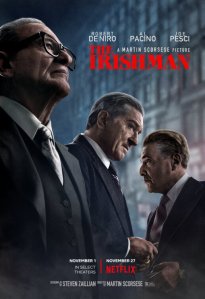 In 2018, Netflix crashed through Oscar biases with Alfonso Cuaron’s personal epic Roma and this year they have their sights set on even bigger prizes. The streaming service has built an empire of original content (and debt) and put up the $150 million budget for Martin Scorsese’s decades-spanning crime drama, The Irishman. It’s a fitting reunion for Joe Pesci, Robert De Niro, and Scorsese, and then to add Al Pacino on top, well it all makes for one supremely entertaining and occasionally striking movie experience. However, I think some critics are getting a bit too carried away with their plaudits. While entertaining throughout its mammoth 3.5 hours, this is much more Casino than Goodfellas.
We follow the life of Frank Sheeran (De Niro), a Philadelphia-based truck driver who rose to be a Teamster union rep and, reportedly, a prolific hired gun for the local mob, headed by Russell Bufalino (Pesci). Sheeran is tasked with helping Jimmy Hoffa (Pacino) with his business, which helps the larger contingent of organized crime that used the Teamsters multi-million-dollar pension as their own slush fund to pay for projects and schemes. After he loses his leadership position, Hoffa begins to think of himself on the same level as the tough guys and just as protected. Sheeran tries to turn his friend back from the self-destructive path he seems destined for, and ultimately, it’s Frank Sheeran who says he pulled the trigger killing Hoffa (is this a spoiler?).
 There are moments that just sing in this movie, buoyed by a wonderful film alchemy of the actors, the storytelling, the skill of Scorsese and his longtime collaborators like editor Thelma Schoonmaker, and it can feel exhilarating. There’s a rich world of day-to-day detail from the character interactions and mob politics, and once Hoffa comes onscreen the movie becomes something more and better. It’s just as much Jimmy Hoffa’s movie as it is Frank Sheeran’s. Here is a live-wire character bursting with unpredictability, later to his great deficit, and who pushes the other characters around in a way that creates instant tension and realignment. Considering the selling point of the movie is its perspective from the claimed killer of Hoffa, it only makes sense that these moments are allowed the most attention. Hoffa sees himself as a champion of the little guy, as an ideologue trying to make life better, never mind his own extravagance, ego, and inability to let go of grievances. Hoffa was the head of the Teamsters union for twenty years and was a well-known public figure, somebody people like Peggy Sheeran (Anna Paquin) could idolize unlike her father and his other cohorts she despised. He’s a larger-than-life figure and those theatrics find a perfect match with Pacino and his bombastic nature. It’s no wonder he steals the movie. Pacino is terrific and has the clearest arc of any character onscreen, a meaty role that gives Pacino new life. I predict he’s the front-runner for supporting Oscar gold. I was transfixed by the amount of details that Scorsese and screenwriter Steve Zallian (The Girl with the Dragon Tattoo) imbue in every scene, propelled by Frank’s narration and a dark sense of humor. It’s very easy to get immersed in this criminal underworld and its many machinations, which provides a steady stream of information points to tantalize. If one scene isn’t working, just give the movie a few minutes and another avenue might open to prove newly fascinating. It makes a difference on its running time, making 3.5 hours feel more mercifully like 2.5 hours. Of course, once it’s released onto Netflix, I feel like its size and scope will become less unwieldy for viewers.
Because of that surfeit of detail, I think The Irishman would have better benefited from being adapted into a miniseries than as a single movie that happens to be 15 minutes longer than Titanic. The finished film feels rather episodic, like three movies attached into one; the introduction into a life of crime and rising in the mob, the friendship and fall of Hoffa, and the finale as an old man. All of these segments have genuine interest and compelling drama but I think they would have been even more compelling with a larger narrative canvas to play out upon. That way each episode could have its own beginning/middle/end and play its part adding to the larger whole, which is essentially what scenes should be doing anyway for a story. The problem is that The Irishman gets a little lost in its own minutia in the middle and the plot stalls. It feels a little too taken with itself. It feels like we’re experiencing the same information just in more settings. How many moments do we need to show Hoffa pushing away sound advice, making enemies of allies, and dooming himself? Admittedly, the Hoffa portion of the movie is the most compelling, and longest, segment of the movie. It’s the best because of Pacino’s spotlight and from the personal involvement in Sheeran, pushing his loyalties to the test when he genuinely grows close to Hoffa and realizes he’ll be the one that has to eliminate his friend. It’s the most dramatic and harrowing and most interesting part of the movie (and no, not the somber final 30 minutes). I think it would have had even more punch over the course of multiple episodes of material and momentum. By going the miniseries route, the film could have also stripped its second and entirely unnecessary framing device, having the men drive their wives across the Midwest to attend Bill Bufalino’s (Ray Romano) wedding. The short scenes fail to lead to any import until it’s revealed late what also happened during this fateful weekend. It’s a long wait to justify its placement, and even after that it doesn’t feel like the occasional road trip updates were worthwhile.
 Much has been made from several dazzled film critics and online pundits about the movie’s concluding half hour, which follows the “after” of a mafioso’s life. We got a taste of this in the conclusion of Goodfellas after Henry Hill and family were relocated to schlubby mundanity through witness protection, implying the boring life that awaited, but The Irishman dedicates its conclusion to demystifying these mob men. Few of them live to old age, so already Sheeran is the exception (he died at age 83 in 2003) but he’s also incapable of introspection. That gives the final half hour a change of pace and an air of contemplation but it’s stagnated. Frank’s family wants nothing to do with him, everyone from his earlier life has passed away, and he shows little regret for his life’s actions, shocking a priest, his only regular visitor. I suppose one could surmise the self-deluded and sad existence of this man who refuses to accept accountability, but I found this final thirty minutes to be interesting, yes, but far from revelatory. I think critics are doing a fair amount of projection by searching for some kind of tidy, accumulative meaning, as if Scorsese is providing some wise, decades-earned statement on his own famed works highlighting the flashy lives of very bad people doing very bad things. People are a little too desperate for The Irishman to provide that neat hook, that definitive statement, and it’s just not there. It may have been too “movie land convenient” but I was begging for a final confrontation from Peggy.
The de-aging CGI is the source of much of the film’s gargantuan budget, which was why studios balked before Netflix welcomed Scorsese with eager arms. The first display of the de-aging effect is jarring and jarringly bad. We see Pesci and De Niro as 40-year-old men and it’s initially horrifying. The effect looks wrong, like somebody drew over their faces to provide some degree of cell-shaded dimension (think of the video game Borderlands). There are also elements that will just never look right, namely the elasticity of the skin, which looks overly smooth and polished, reminding me of the doll faces of the stop-motion film, Anomalisa. It gets better from there. Interiors and lower-light environments are better at masking the unreality. After a while you simply grow accustomed to it and the characters are aging anyway, which means the effect is rarely used after the first half of The Irishman. It’s impressive at parts but even with the digital facelift, these are still 70-year-old men moving their 70-year-old bodies with new shiny faces. There’s a moment when a younger Sheeran beats and stomps on a grocer and it reminded me of professional wrestling with the stiff movements of one participant followed by the extravagant physical overreaction of the recipient. Captain Marvel is still the champ at actor de-aging.
 There’s also the fairly strong possibility that Sheeran made all of this up. Well into his twilight years, he reportedly recounted his amazing tale to a medical malpractice lawyer before he died, and that became the 2003 book, I Heard You Paint Houses. An August 2019 article by Slate.com writer Bill Tonelli (“The Lies of the Irishman”) gives a pretty thorough rundown of the facts of the case, which align in one direction. All of the FBI agents during Sheeran’s time, as well as the local officials, and surviving criminal actors, all come to the same conclusion that Sheeran has grossly overstated his role in mob matters and outright fabricated his most sensational claims. According to Tonelli: “Most amazingly, Sheeran did all that without ever being arrested, charged, or even suspected of those crimes by any law enforcement agency, even though officials were presumably watching him for most of his adult life. To call him the Forrest Gump of organized crime scarcely does him justice. In all the history of the mafia in America or anywhere else, really, nobody even comes close.” It does seem far-fetched, but the next question is whether the enjoyment of the movie matters at all if the story it’s based upon is ninety-nine percent hooey? While I think the impact of the movie is slightly blunted with a fictional account, it plays larger into a self-aggrandizing theme and the first framing device of the movie, having Sheeran narrate his life experiences as an old man, left to rot in a nursing home. Perhaps he’s exaggerating to make himself feel more important and grant himself something of a legacy that is denied to him by a lifetime of self-serving choices that have left him abandoned by family. In this regard, there’s a strange meta-textual level that even helps support the larger tragedy and loneliness of these men, in case you needed it underlined.
There’s a delightful feeling of getting the gang back together for Scorsese’s massive, ambitious, and thrilling return to the world of gangster cinema. There are so many characters that it can be hard to keep things straight as we zip through decades, de-aging, framing devices, Boardwalk Empire supporting actors, prison time, nursing homes, and Jim Norton as a young Don Rickles. I wish the story had been parlayed into an epic miniseries rather than a movie. The finished film is certainly long and imposing but also compelling and entertaining. The personalities don’t have quite the pop as Pacino, a rollicking screen presence relishing the spotlight, but the rock star bravado has been replaced with a somber reality of self-cultivated isolation. Pesci is terrific in what might be his most nuanced, insular, and quiet role of his career. I wish he would continue acting. De Niro is suitably gruff and has a few scenes of trying to hold back a cascade of emotions, but he’s more our impassive face into a world of crime and vengeance. I don’t think the final conclusion has the power that others have claimed and is a result of projection. The Irishman is an entertaining deep dive that I only wish could have gone even deeper.
Nate’s Grade: B+
Share this:

Jumanji: Welcome to the Jungle (2017)
 Jumanji: Welcome to the Jungle is a twenty-year plus sequel that is way more fun than you would have expected for a twenty-year plus sequel. It’s updated to modern-day by ditching a living board game and instead transporting four Breakfast Club high school stereotypes into the world of an old school adventure video game. The biggest boost is the camaraderie and comic interplay of the four leads (Dwayne Johnson, Kevin Hart, Karen Gillan, Jack Black), each blessed with memorable moments to shine and a satisfying arc. The adults are great at playing as children-in-adult-bodies. The film does a good job of introducing the rules of its world while also explaining the mechanics of video games (cut scenes, life meters, re-entering the game), at the same time holding your hand through it all. The satire of video games is often amusing like the strengths/weaknesses discussion, and there’s a very good reason why Gillan is dressed in a skimpy outfit, which even the movie calls out. It’s a simple story told without subtlety but this movie is packed with payoffs and spreads them evenly throughout. The actors are truly delightful and this should be a breakout role for Gillan. She is very adept at being silly with physical comedy and has a wonderful bit where she tries to seduce some guards after some flirting coaching from Jack Black. Thankfully, Black being a self-obsessed teen girl on the inside doesn’t veer into transphobic/homophobic mockery. The awkwardness of the body swap scenario is never forgotten, which lends itself to consistent comedy and heart. There are a lot of great little moments and enjoyable set pieces. Jumanji is a tremendously fun movie that won’t insult fans of the original. If you’re looking for an unexpected amount of entertainment this holiday season, check out the Jumanji sequel and one of the year’s best comic teams.
Nate’s Grade: B+
Share this:

I, Tonya (2017)
 Back in 1994, popular culture was rabidly obsessed with figure skating thanks to Tonya Harding (Margot Robbie), the “bad girl” who was accused of coordinating an attack on her skating rival, Nancy Kerrigan. Tonya’s skuzzy husband, Jeff Gillooly (Sebastian Stan), had hired a friend to “intimidate” Kerrigan, and the end result was a broken knee and the world-famous outcry of, “Why?!” I, Tonya takes a look at the players of this media circus and lets them tell their own stories in their own words.
I,Tonya feels brazenly like a Scorsese movie populated with kooky Coen brothers characters. Director Craig Gillespie (Lars and the Real Girl) cribs from the best and uses all those propulsive camera moves, voice over leading to fourth-wall-breaking, and music needle drops to draw an audience into this crackling crime story. The biggest decision made by screenwriter Steven Rogers (P.S. I Love You) is the dueling perspectives of Tonya and Jeff being given equal treatment. They both sit for a series of on-camera interviews and will even interrupt the flashbacks to object. Jeff will recount a time Tonya chased him around with a loaded shotgun, and then Tonya will turn to the camera and argue that this moment never happened. I, Tonya doesn’t tell you who to believe and who to doubt. The account will purposely contradict one another, often demonizing the other party and painting themselves as a larger victim of fate. The movie is steadily entertaining as it mixes moments of light and dark. Tonya breaking the fourth wall to talk about her domestic abuse is another way of showing just his disassociated she’s become to a life of abuse. It turns fourth wall break into coping mechanism. I was laughing at the buffoonery of Jeff’s goons and moved by the relentless torment of Tonya. It’s a story that’s worth revisiting and is given an invigorating sheen of inept crime thriller. Gillespie goes a little too hard with the Scorsese speed ramp zooms and quantity of literal song selections, but it doesn’t detract from the film’s overall entertainment impact.
 This is a film about reassessing preconceived notions about who the characters are, what the story exactly is, and where the truth lies amidst all the madness. Tonya scoffs, “There is no such thing as truth,” as if she were channeling the forty-fifth president of the United States of America. This becomes a foundational thesis of the movie as we’re presented with conflicting personal accounts where characters will break the fourth wall to criticize the validity of what they are doing or saying. All of these conflicting accounts force the audience to constantly reconsider what we are seeing and being told. We have to consistently think about the source and how there might be bias at play. As expected, Tonya and Jeff’s differing versions of events paint the other as more knowingly duplicitous. Tonya flat-out accuses Jeff of years of physical abuse, the kind of relationship Tonya’s vicious mother had primed her for. LaVona Golden (Allison Janney) would say all of her cruel hostility was valuable in an ends-justify-the-means crucible. Through fighting to earn the approval of an abusive authority figure, Tonya became one of the greatest figure skaters in the world, the first to achieve the vaulted triple axle. LaVona shouts that “nice” doesn’t get you anything in this world (her own mother was nice and LaVona became a waitress). People throughout I, Tonya are reshaping worldviews, angling for sympathy, and spinning history for personal advantage. Everyone wants to be a victim, a martyr, or at least the person who was right in the end. By the end, you don’t know what exactly to believe and whose truth is closest.
This was a media scandal that the public gladly gobbled up every new morsel, bringing out the knives to carve up a villain served up on the Olympic stage, but I, Tonya is a very empathetic portrayal that still doesn’t take the edge off of its title heroine. She grew up poor and scrappy and had to make her own costumes for her skating performances. From a technical standpoint, Tonya Harding could out skate anyone, but she didn’t fit into the cookie cutter beauty pageant image of what a wholesome girl should represent. The same bias against her, the trailer trash girl who couldn’t catch a break, was still dragging her down even when her skating was superior to her competitors. It definitely helps to paint a sympathetic portrayal for the woman, and that’s even before the years of abusive relationships, and a husband she may have returned to in order to appear more “wholesome family.” It’s easy to castigate Tonya Harding as a villain, but it’s even harder to see the person inside the caricature that was sold for mass media consumption.
The use of humor has to be very delicate because of all the controversial material. We have naturally offbeat characters doing incredibly stupid things, and then we have a husband repeatedly hitting his wife. This seesaw of tone means that the comedy needs to be precise or else it will undercut the drama or, worse, cross into gross mitigation of abuse. LaVona is a popular source for verbal abuse, and it’s meant to be shocking, but at no point do I think the film trivializes the conditions of Tonya’s childhood for ironic comic fodder. It’s presenting an abnormal treatment of an abnormal upbringing, and the later detours with “The Incident” are highlighting the naturally cracked criminals. These people were not good at what they were doing and were easily caught. The nimwits-try-their-hands-at-crime subgenre is ripe for laughter, in particular Shawn Eckhardt (Paul Walter Hauser) and his self-professed masterful skills at counter terrorism planning. The Tonya Harding scandal is so inherently sensational and with so many bizarre, colorful characters that to treat it without its penchant of natural humor would be a disservice. Crazy people doing dumb things are going to tend to have some humor value. Where the film falls short is in the realm of media satire. There are a few tasty morsels sprinkled throughout, like LaVona forcing reporters to stand behind a rope line if they wanted to snap her picture, but overall the media satire feels flat. Bobby Cannavale (Spy) feels completely wasted as a Hard Copy reporter/exposition device. He offers few insights and fewer colorful anecdotes. The most pointed the film gets with media commentary is when Tonya looks directly into the camera and accuses each person of being her abuser. It’s a stark turn that stops the action cold, and the audience has to think about their own tacit approval through media consumption. By rewarding this coverage and the easily packaged version of events, have we all played a part in Tonya’s suffering and shame?
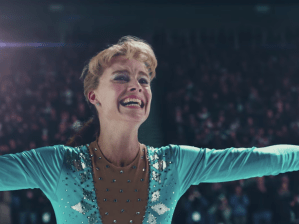 Robbie (Suicide Squad) is sensational in the role, eliciting so much emotion that it can instill whiplash. One moment you’re impressed by the depth of her vulnerability and the next you’re whistling at her hard-as-nails persona and sheer tenacity. It’s an unapologetic performance that goes dark places and serious places, but Robbie doesn’t stoop to pander. Tonya wants your empathy but she doesn’t want your pity, and she sure as hell isn’t going to pretend to be somebody she’s not. The tricky part is the question over who is Tonya Harding. With Robbie, she’s a profane firebrand who is impatient with a world that refuses to accept her and her talents. The scene where Tonya is stripped of ever competing again in professional figure skating is a dazzling piece of acting on Robbie’s part. Tonya has sacrificed much of her own life for this sport, and by her own admission she doesn’t know how to do anything else. To see it all go away with the pound of a gavel, she pleads for jail instead as a more humane punishment. This feels like Robbie marking her grand entrance into the next acting echelon in Hollywood.
The supporting roles nicely serve their purpose, with Janney (The Girl on the Train) being the obvious standout. Her hellish mother is overpowering in every sense. Janney is abrasive and fierce and a crutch for the screenplay when it needs something shocking. I do not doubt the voracity of what the Tonya and other participants have said about LaVona, but the filmmakers don’t know when to leave enough alone. There are insights to be had through LaVona’s relationship with her daughter but it’s too often one-note. She’s the angry older woman berating people for shock, comedy, or a transition.
I, Tonya might change your mind about Tonya Harding. She’s definitely unrepentant in the movie while at the same time asking you to view her with an empathy that was lacking during the parade of 1990s tabloids. She’s an abuse survivor who had to claw for every advantage she could earn. You might not like her, or maybe you’ll grow to appreciate her, but you will understand her better. Robbie is outstanding, Janney is highly memorable and perfectly cast, and the direction provides plenty of jolts, from electric camerawork to the energetic propulsion through its diverging viewpoints. The dark comedy works, the serious drama works, and the domestic violence is not trivialized with so many ironic winks. I, Tonya is an unflinching expose that forces you to question the validity of everything. It’s a movie that dares you to question your perceptions while you’re keenly watching. Perhaps twenty years later, Tonya Harding will get whatever she is due.
Nate’s Grade: B+
Share this:

Win Win (2011)
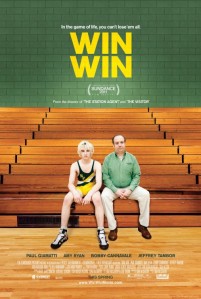 After two stellar movies (The Station Agent, The Visitor), writer/director Thomas McCarthy has proven that he may be one of the greatest humanist voices working in cinema today. He writes wonderful stories about people who find connections via unorthodox family units. McCarthy can spin bizarre elements into deeply felt human dramas. Win Win is another hodge-podge of storytelling elements. It follows the life of Mike Flaherty (Paul Giamatti), a midwestern lawyer and high school wrestling coach struggling to get by. Then a sullen teenager (Alex Shaffer in his acting debut) lands on his doorstop looking to see his grandfather in Mike’s guardianship. The kid also happens to be a gangly wrestling phenom. Things are going great for Mike, that is, until the kid’s mother comes looking for him and wants him back. Win Win assembles a great group of flawed, empathetic, relatable characters that make conflicted choices that they then have to abate. Giamatti is reliably fantastic as the center of McCarthy’s humanist universe. He can communicate so much despair and relief just with his expressions. Teamed up with a cast that includes Amy Ryan, Bobby Cannavale, Burt Young, and Jeffrey Tambor, the movie works best when you can just sit back and take in great actors relishing playing great roles. Win Win doesn’t all come together in the end like other McCarthy films; there’s definitely a missing ingredient feeling to the movie. Shaffer’s limitations as an actor hamper some of the later dramatic moments. The end is satisfying, but I felt like I should have felt more. While it doesn’t strike the same seamless balance of comedy and drama as The Station Agent, this is certainly a film that should be winning for most audiences.
Nate’s Grade: B+
Share this:

The Station Agent (2003)
This is the most charming film of 2003, and Im not just saying this because I had an interview with one of its stars, Michelle Williams (Dawson’s Creek). Fin McBride (Peter Dinklage) is a man with dwarfism. With every step he takes every look he gives, you witness the years of torture hes been through with glares and comments. Hes shut himself away from people and travels to an isolated train station to live. There he meets two other oddballs, a live-wire hot dog vendor (Bobby Cannavale) and a divorced mother (Patricia Clarkson). Together the three find a wonderful companionship and deep friendship. The moments showing the evolution of the relationship between the three are the films highlights. Its a film driven by characters but well-rounded and remarkable characters. Dinklage gives perhaps one of the coolest performances ever as the unforgettable Fin. Cannavale is hilarious as the loudmouth best friend that wants a human connection. Clarkson is equally impressive as yet another fragile mother (a similar role in the equally good Pieces of April). The writing and acting of The Station Agent are superb. Its an unforgettable slice of Americana brought together by three oddballs and their real friendship. Youll leave The Station Agent abuzz in good feelings. This is a film you tell your friends about afterwards. Theres likely no shot for a dwarf to be nominated for an Oscar in our prejudiced times but Dinklage is deserving. The Station Agent is everything you could want in an excellent independent movie. It tells a tale that would normally not get told. And this is one beauty of a tale.
Nate’s Grade: A


 nathanzoebl
You must be logged in to post a comment.