Blog Archives
The French Dispatch (2021)
 Wes Anderson’s latest quirk-fest is his usual cavalcade of straight-laced absurdity, exquisite dollhouse-level production design, famous faces popping in for droll deadpans, and the overall air of not fully getting it. The French Dispatch is structured like you’re watching the issue of a news magazine come to visual life, meaning that the two-hour movie is comprised of mainly three lengthy vignettes and a couple of short asides. This narrative decision limits the emotional involvement and I found myself growing restless with each of the three segments. I was amused throughout but each felt like a short film that had been pushed beyond its breaking point. Perhaps that is Anderson’s wry, subtle point considering the entire journalistic voice of the movie feels like somebody made a movie in the style of one of those esoteric, supposedly “funny” New Yorker cartoons. It’s occasionally so arch and droll that it feels too removed from actual comedy. This is not the most accessible Anderson movie for a newbie; it’s very bourgeois in the kinds of people it follows, the stories it pursues, and the intellectual and political conflicts it demonstrates. The first and best segment follows Tilda Swinton discussing a heralded but imprisoned experimental artist (Benicio del Toro) who is dealing with the pressure to produce. The second segment follows Frances McDormand as she investigates a Parisian student union revolting against the ignorant powers that be. The third segment follows Jeffrey Wright recounting an assignment where he investigated a master police chef (not “chief”) and gets in the middle of a wacky hostage negotiation. Each of them has the requisite charm and random asides we’ve come to expect from Anderson, including a leotard-wearing strongman that is called upon by the police to help during the hostage crisis, but it felt more like a collection of overlong short films than a cohesive whole. If you’re already a fan, by all means, step into The French Dispatch. If you’re new to the idiosyncratic world of indie film’s most precise curator, then I’d advise starting with a more digestible and earlier Anderson entry. I enjoyed myself during stretches, was getting frustrated during other stretches, and I hope Anderson focuses more on the big picture of his next picture.
Nate’s Grade: C+
Share this:

The Invention of Lying (2009)
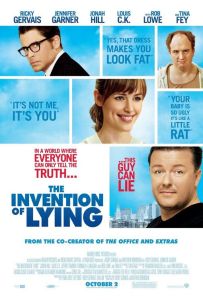 Imagine a world where people could only tell the truth. Sounds scarier than anything in horror movies today.
Mark (Gervais) is trying to romance Anna (Jennifer Garner) but even the waiter tells him she’s out of his league. She tells him upfront that she finds him unattractive and he will never have any hope of having sex with her. She’s more interested in Mark’s snide but handsome co-worker, Brad (Rob Lowe), who she feels is a better genetic match. Mark is about to be fired from his job, writing historical screenplays about the 13th century, and his secretary (Tina Fey) delights in telling him that she loathed every minute they spent together. This is a world without a filter. Until one day Mark goes to take out money from the bank, and something inside his brain switches. His balance is $300 but he asks for $800, and the bank teller apologizes for the computer error and gets Mark his full $800. He explains to his barfly friend Greg (Louis C.K.) that he said something that wasn’t. Nobody understands. “I’m a black Eskimo,” Mark says. Everybody takes him at his word. Mark is the only human on earth who has the ability to tell a lie, which he uses to his great advantage whether it be gambling, getting out of a traffic ticket, or unearthing a “lost” historical chapter about ninjas and aliens that makes for a stirring “non-fiction” film. Mark can’t even explain what he’s done, since the world lacks even a word for “lie.”
Gervais and co-writer Matthew Robinson concoct some interesting and inspired ideas of what a world bereft of lying would be like. Naturally, advertising would be completely different if people had to tell the truth, the whole truth, and nothing but the truth; imagine prescription drug ads that only said, “This is a placebo. Your penis won’t ever grow bigger.” The slogan for Coca-Cola is, “It’s very famous,” and the slogan featured for its rival, Pepsi, is, “When you can’t have Coke.” No one has any concept of fiction, of people pretending to play parts, so movies only consist of an older man sitting comfortably and reading a historical account with some minor dramatic inflection. Movies have become book reports. The sign in front of a retirement center says, “A Sad Place for Hopeless Old People,” and a motel sign reads, “A Cheap Place to Have Intercourse with a Near Stranger.” However, I’m puzzled by how forcefully open every person is. Just because you can only speak the truth doesn’t mean you have to be talking constantly. I understand Gervais’ point about the need for lies to protect people’s feelings, but just because you think someone looks fat doesn’t mean you have to blurt it out. When Mark greets Anna at the door for their date she reveals, “You’re early. I was just masturbating.” It’s funny, sure, but did she feel compelled to link the two statements? It seems in this world, everyone is incapable of keeping their mouths shut.
 The premise of the movie is terrific, and I’m honestly shocked no one has thought of it before. But the premise wears a little thin after the first 30 minutes of people speaking with no filter. You begin to expect outrageous comments that will be hurtful and blunt, and because you expect them it takes away the shock value and lessens the humor. But then The Invention of Lying takes a sharp right turn at about minute forty and becomes a radical and subversive and much funnier movie. Mark is comforting his dying mother (Fionnula Flanagan) who is afraid of leaving existence. She’s afraid of a cold nothingness. So Mark explains to her that there is an afterlife, a world beyond our own, where everybody gets to be around their loved ones in a mansion, and there’s no pain. She closes her eyes and dies in peace with this new knowledge. The doctors and nurses are amazed and beg to know more. Mark has created the idea of religion and God! He’s mobbed by people and camera crews demanding him to explain what he knows. Mark then works up the courage to establish a system of 10 rules to follow, which he tapes onto old pizza boxes. He then addresses his flock and has to explain the complicated minutia of religion, with hilarious questioning from the acolytes. Mark explains that there is a “man in the sky” who watches everything we do and is responsible for everything that happens. “Does that mean the Man in the Sky gave my sister cancer?” someone asks. Mark tries to explain the nature of a loving, all-powerful deity who willingly allows bad things to still happen. “Screw the Man in the Sky,” someone yells, “He’s going to kill us all. We need to fight back!” You try explaining the nature of the unknown to people.
It’s at this point that the movie transforms into a biting satire on belief and belief. I was cackling but I noticed that my theater seemed to get awfully quiet the longer the religious satire went on. I almost spat out my drink when I saw a spinning newspaper headline that said, “Man in the Sky Continues to Give Children AIDS.” It’s offensive but completely within the bounds of religious questioning. Gervais and Robinson aren’t ridiculing religious belief; in fact they seem to prove that it has a definite place of significance within society and can be beneficial psychologically. The satire isn’t savage and still manages to play with the amiable, fable-like nature of the story. Gervais isn’t laying out an argument that believing in an unforeseen deity is stupid. The movie isn’t condescending or hectoring, like Bill Maher’s anti-religion documentary Religulous, but it does take some slyly subversive swipes at the nature of faith and its reliance upon the unproven.
 The Invention of Lying suffers from trying to be a romantic comedy. Too much of its conflict is spent on whether the chubby guy can get the pretty girl. The movie gets a tad sentimental for dealing in bitter-truths, and Gervais and Robinson steer the film to the ultimate romantic comedy setting: objecting at a wedding. I wouldn’t have minded the rom-com asides if they didn’t feel like they kept striking the same chord. Mark wants to be in a relationship with Anna. She points out that he’s fat, has a snub nose, and not a good genetic match. He persists. She points out that he?s fat, has a snub nose, and not a good genetic match. This goes on and on until the inevitable break at the end. Mark, and especially Gervais, is an appealing guy, self-effacing and witty, even downright cute at turns, but when Anna keeps repeating the same looks-first mantra, it makes her seem increasingly shallow and him seem like a glutton for punishment. Garner is a fabulous comedic actress and packs a lot more emotion into her character than I would have expected given the conceit.
Ricky Gervais is catching fire as of late, and it seems that America is finally waking up to the charms and brilliance of this squat comedian. He created The Office, the standard for squirm-based comedy, and appeared in the underrated supernatural comedy Ghost Town last fall. Gervais shows the necessity of lies in our world, from sparing hurt feelings to making mass-market entertainment. The world needs dishonesty. When The Invention of Lying is on-target, it is a hilarious, almost brilliant, comedy, with its best gags saved for taking on “the Man in the Sky.” It’s too bad then that the entire movie doesn’t live up to these flashes of comedic brilliance. Still, the movie is sweet enough and ends on a satisfying level, even if The Invention of Lying begins as one movie and ends as another. Gervais is an appealing lead, though he doesn’t prove much in the way of a director, and he has some real dramatic acting chops too, nicely put to use during his mother’s deathbed scene. I hope more Americans wake up to this man’s charms. Gervais continues to show audiences the sharp wit that has made him one of the world’s foremost funnymen.
Nate’s Grade: B+
Share this:

Lady in the Water (2006)
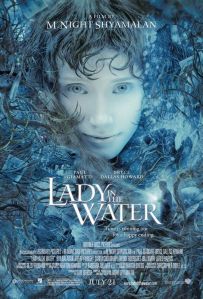
Writer/director/twist-abuser M. Night Shyamalan must have been smarting from the cool reception to his last high-concept thriller, 2004’s The Village. Shyamalan has built a reputation for smart, eerie, complex movies, as well as forced twists and endings that leave the films in shambles. He went back to basics. Lady in Water started as an ongoing story he told his kids at bedtime. His kids participated in the creation of the story. If we didn’t learn from last year’s The Adventures of Sharkboy and Lava Girl, movies where children helped shape the story should be left as bedtime stories. Lady in Water is further proof of this.
Cleveland Heep (Paul Giamatti) is the fix-it man at an apartment complex. Someone’s been swimming in the pool late at night and clogging up the filter. The unexpected culprit is Story (Bryce Dallas Howard), a waif of a girl. She says she is a “narf,” a sea nymph who’s crossed from her world, the Blue World, to ours. Her purpose is to plant the seed of change by finding a special individual. When her mission is complete a giant eagle will carry her back to her world. Cleveland accepts being her guardian and protector and assists her on her quest. He mingles with the apartment complex’s eclectic residents, trying to figure out who fits what role to help Story. There is one hairy problem. A scrunt, a wolf-like beast with twigs and long grass for fur, is after Story. An evil monkey creature is overseeing the whole weird affair.

Early on, Lady in Water was advertised as “a bedtime story by M. Night Shyamalan,” and just like your typical bedtime story, the thing feels entirely made up on the spot. The story sounds like a little kid making up a book report: “There’s this grass wolf, see, and it’s after this sea lady, and there’s these evil monkeys that oversee everything, and an eagle carries her away when she’s done, but she’s like the unknown Queen of the sea ladies, and she has helpers but can’t say who they are, and they all have special abilities, except some of them can only do stuff, and no one can see her leave.” What? Was Dio an unaccredited co-writer for this? Lady in Water feels like Shyamalan is haphazardly throwing spontaneous obstacles and rules into his story, hoping something sticks when it just muddies up the story.
Naturally, there are many unanswered questions brought about by the supernatural subject matter. Why is it an eagle that plucks Story away to safety when she?s fulfilled her mission? Wasn’t part of the schism between man and the Blue World because man moved to land? Wouldn’t something aquatic make more sense to rescue her? What about the entirely unnecessary evil monkey judge? Why is it even there? Why does it just sit there idly if the scrunt breaks the rules (and if the scrunt is a rule-breaker then why not just bust inside Cleveland’s home and eat the chick)? For that matter, if the monkey judge is so evil then why does it even respect the rules? Why don?t the evil monkey judges side with the already evil scrunts? Why do the scrunts hate the narfs so? Who established these systems of rules for narf contact and scrunt hunting? Do the monkey judges allow the narfs to get killed as long as it’s during the right time? Is it like a boxing match (“Touch gloves, to your corners, and no biting after the bell”)? And of course everyone believes this tripe. Shyamalan could fall back on the excuse that his tale is a bedtime story and not meant for extensive examination. Sure, not everything needs to be explained but that doesn’t mean Shyamalan can get away with being lazy.

There’s no finesse in the writing. Shyamalan seems to have taken his frustration with the dwindling critical reception of his works hard. The movie critic character, Mr. Farber (a droll Bob Balaban) is one of two items, either the embodiment of his ire, a figure out of touch with human emotion and the public’s trust, or Shyamalan making a preemptive strike. The critic complains there are no more original stories left in Hollywood; well, Mr. Smarty Pants, what do you think of a tale of narfs and scrunts? The problem is that the film critic is not unlikable, just cynical, and despite how dismissive Shyamalan may wish to be, the critic’s complaints and observations about the film industry are solid. In Lady in Water, characters do speak their feelings so casually. People explain back-stories and motivations like it was written on foreheads. The critic character is so inconsequential as well, so the notion that Shyamalan spends so much energy on him makes it feel like a score being settled.
What’s more irritating is how self-involved the movie comes across. The whole purpose of Story’s venture to our world is to inspire a gifted writer, a writer whose work will be seen as unchecked genius that will cause great change throughout the world. Nations will renounce war, men and women will greet each other as brother and sister, and the world will be a profoundly better place to live, all thanks to one artistic genius that changed the world. And who plays this artistic genius lying in wait? M. Night Shyamalan. In conjunction with the critic character, perhaps Shyamalan is proclaiming that his movies will stand the test of time, despite what those fuddy-duddies at their typewriters say. Lady in Water is either an intense example of artistic insecurity or an unflappable, monstrous ego.
Shyamalan is too gifted a filmmaker to make outright bad movies. However, he is prone to making very misguided choices. The addition of the monkey judge just mucks things up and more unanswerable questions. Are the monkeys like the regional overseer? Is there a tri-state office run by a giraffe with twigs on its head? Shyamalan’s plot is too formless and relies on some garish ethnic stereotypes, like the nattering Jewess and the screechy, rail-thin Korean teen. His sense of direction takes a back seat to his writing. Many moments are filmed out of focus, or the camera bounces around trying to capture whoever’s talking, always seemingly just out of reach. His visual aesthetic feels noticeably simpler. There’s a certain unapologetic yearning in Lady in Water to be a Steven Spielberg film, from the John Williams-like score, to the assembly of characters wanting to believe again, to the heaping helping of schmaltz. Lady in Water is proficiently crafted (special thanks to cinematographer Christopher Doyle) but the movie is an unmistakable artistic misfire.

Giamatti is a dependable sad sack, and he deploys an array of stutters and tics to convey how damaged Cleveland Heep is. He’s good but then he always is, no matter how stupendously awful his material may be (he did survive Big Momma’s House). Howard is one of the more beguiling and intriguing young actors in the movies right now. She bewitched me in The Village, but in Lady in Water she befuddled me. It’s hard acting as a made-up creature. Howard relies on lots of vacant, supposedly, ethereal staring. She comes across as less supernatural and more like a club kid on ecstasy.
Lady in Water is not an unmitigated disaster but it’s definitely not good by any stretch of the imagination. M. Night Shyamalan seems to fray with every new movie, and Lady in Water is by far the man’s most ridiculous and self-involved flick. He’s too great of a talent to write off, even during his misfires, but we can’t be expected to iron out his narrative kinks every time. Shyamalan’s films generally center on broken people looking for their place in the universe and finding a grander plan for their pain. Hopefully, after the birth pain of Lady in Water, Shyamalan can find his place in the artistic landscape and spare us more half-baked bedtime stories.
Nate’s Grade: C-


 nathanzoebl
You must be logged in to post a comment.