Blog Archives
Doctor Strange (2016)
 After eight years and over a dozen movies, the unstoppable box-office juggernaut that is the Marvel Cinematic Universe (MCU) seems like it could successfully sell the public on any concept, no matter how undeniably bizarre. This is the same studio that made us weep over the death of a tree that said three words. At this point, I think I can argue that the MCU has a higher film-to-film consistent quality of excellence than Pixar, the other most trusted brand in cinema (Pixar’s creative/emotional highs are certainly higher but they’ve had their share of misses). Marvel has earned the benefit of the doubt. The common complaint is that their movies feel too formulaic and insubstantial. I would definitely argue against the latter and the former needs no real defense. Marvel has built an empire on a system that works because it delivers crowd-pleasing and character-oriented blockbusters that are packed with payoffs for fans and newcomers. The alternative, chiefly the dour bombast of the fledgling DC film universe, isn’t much more appealing, but then again I have been labeled a “Marvel shill” by those infuriated from my inconceivable pan of the very conceivably terrible Suicide Squad, so take my word with some skepticism. For any other brand, Doctor Strange could be too weird. With the MCU, it’s another comforting sign they really know what they’re doing.
Stephen Strange (Benedict Cumberbatch) is a brilliant New York neurosurgeon who loses full control over his hands after a horrible car accident. He travels to Nepal to seek out holistic remedies to aid his recovery and instead finds the Ancient One (Tilda Swinton), a powerful mystic. She takes a liking to Strange and invites him into their temple to train as a pupil of powerful sorcerers (Chiwetel Ejiofor, Benedict Wong). Former sorcerer, Kaecilius (Mads Mikkelsen), has gone rogue and believes the only way to survive the oncoming cosmic giant Dormammu is to join him. Doctor Strange must summon all the skills of multiple dimensions in order to save the day.
 Doctor Strange is at its core an origin tale and one that feels somewhat familiar at least for its first half. It’s likely not an accident that Stephen Strange bears more than a passing resemblance to Marvel’s other egotistical, arrogant charmer, Mr. Tony Stark. He’s a man who has to be humbled and learn the error of his ways and his outsized hubris, which makes for an effective character arc to structure an introductory movie around. It also makes fine work of Cumberbatch’s otherworldly sense of haughty superiority (I can’t wait to watch future Strange and Stark banter). The first half is essentially Training Montage: The Movie. Strange learns about the ancient mystic arts and, more importantly, super powers. The movie doesn’t follow Thor’s lead and argue that magic is another form of science. It declares magic as its own thing. Strange learns how to open portals, how to shift reality, how to astral project, and even how to stop time. Each new power is given proper attention and the learning curve adjusts as needed, allowing an audience to process the various rules and dramatic stakes. It’s a structurally smart assembly of mini-goals to keep an audience secure in what otherwise could be overwhelming for its New Age mumbo jumbo.
After the origin heavy lifting is taken care of that’s when Doctor Strange becomes everything I could hope for, namely a highly imaginative action movie with a breakneck pace and a boundless sense of imagination. This movie feels kinetically alive and unpredictable in ways that few Marvel movies even approach. Once Strange and Kaecilius meet at the halfway mark it becomes a gallop to the finish line with one highly entertaining action set piece after another, and even better they are wildly different. We don’t have battles about running and firing weapons or just punching bad guys extra hard; instead, it’s reality itself that bends to the will of the fighters. Characters walk on walls, shift the state of architecture, create teleportation portals to hop in and out of, shift the entire gravity of the world to force people away from said portals, and turn New York City into a kaleidoscopic playground. There’s an extended chase scene that literally feels like a series of M. C. Escher paintings come to starling life. The sequence is eye-popping in the best way and, shocking enough, it’s not even the climax of the movie. There are so many fun possibilities for crazy action sequences. There are other sequences that stand out, such as an out-of-body fight between two warring astral projection foes. The real climax of the movie is something I’ve never seen before, a battle that takes place as time resets. The smoldering ruins of a cataclysm are put together brick-by-brick and characters dodge the debris as it rapidly reforms. It’s visually thrilling to watch but it’s also a clever sequence because there are continuous opportunities for danger and in many ways that your brain cannot naturally suspect, like when a wall reforms and traps someone within. Whatever your feeling on the general MCU and its blockbuster formula calibrations, Doctor Strange is a great leap into something different, momentously exhilarating, and inventive.
Director Scott Derrickson (Sinister) was an intriguing choice considering his background in supernatural horror, but, as should be obvious, the MCU overlords score again with their foresight and risk-taking. Derrickson’s visual influences hew much closer to Christopher Nolan and the Wachowski Siblings than the greatest hits of the MCU, and that’s exactly what this world needed to stand out on its own. I cannot overstate just how enjoyable the last hour of the movie can be, though this isn’t meant as a backhanded slight against that first half. The action-packed hour only works because of the setup from before and laying a careful foundation for the characters, their dynamics, and the rules of this trippy universe that bends conventional physics. All the careful world-building and training montages set up the sprint through a fireworks factory of fun, and I had a smile plastered to my face the whole time, eagerly anticipating the next detour into crazy.
I’m even going to impart you, dear reader, with some advice I haven’t given since 2013: if possible, see this movie in 3D. The hypnotic visuals and elusively shifting reality demand to be seen with the added help of the third dimension. The movie will still obviously work in a non-3D format but why deny yourself the full impact of these incredible visual experiences? New York City contorting is worth the extra few bucks alone.
 The acting is another highlight for such an enjoyable movie. Cumberbatch (The Imitation Game) easily makes for a terrific lead actor, someone who can bring a sense of gravitas or dry sarcasm when called upon. His sense of comedy is underrated and this Sorcery Supreme gets his fair share of punctuating the weird and wild with a perfectly delivered joke. A bit with a sentient cape allows for great physical comedy. His American accent is also much improved from earlier far spottier efforts in 2013’s August: Osage County and 2015’s Black Mass, which featured perhaps the worst “Baustun” accent in recent memory. Cumberbatch is the charming smartass, the know-it-all who realizes how much he still has yet to learn, and his final showdown with the Big Bad Evil sheds large-scale disaster for something much more personal (no giant portal in the sky or faceless army of monsters/aliens, hooray!). His character arc of learning that it’s not about himself culminates in a brilliantly conceived sequence that satisfies. The other standout is Swinton (Snowpiercer) who once again melds with her character, who happens to be a mysterious Celtic mystic who may not even be human. The early half is instantly elevated when Swinton is on screen. She presents a matter-of-fact sense of the preposterous that is downright serene. It’s also a role that is more than just a requisite mentor as The Ancient One has some secrets that will be revealed. I was also genuinely pleased with how much screen time Mikkelsen (TV’s Hannibal, Rogue One) gets for his villain, who has a wicked deadpan. I pity Rachel McAdams (Spotlight) who plays the underwritten love interest role we’ve seen similar to Natalie Portman prior performances. She at least gets a few good scenes before being forgotten.
With each additional entry into the ever-expanding Marvel Cinematic Universe, the fan in me gets to reexamine and realign the pecking order of quality. In my own subjective rankings I would say that Doctor Strange is just below the top tier of the MCU (Guardians of the Galaxy, Civil War, Iron Man) and on par with Winter Soldier. This is a highly enjoyable and highly imaginative action movie teeming with eye-popping visuals. Many of the visual set pieces are stunning and demand to be witnessed on the largest screen possible. The movie never loses its sense of fun and wonder while still respecting the dramatic stakes of the cataclysmic events, and when it goes big it makes it matter. I have no previous attachment to this character and Doctor Strange was just about everything I wanted the film to be and then some. It’s another sign that Marvel can take any property and find the formula to make it a satisfying smash. I enjoyed Doctor Strange enough that I want to see it again, and this time even bigger to better soak up the strange.
Nate’s Grade: A-
Share this:

Black Mass (2015)
 For decades, James “Whitey” Bulger (Johnny Depp) was the most feared man in Boston. After being released from Alcatraz, he returned home to his Massachusetts roots and consolidated power with an iorn grip. He and his cronies ruled Boston’s criminal underworld and were given protection from none other than the FBI. Thanks to agent John Connolly (Joel Edgerton), a childhood pal of Bulger’s, his crimes were given an implicit blessing (as long as he didn’t go too far) as he served as an FBI informant. In reality he was just ratting out his competition and abusing his power. This charade lasted for decades until Bulger went on the run, not being caught until 2011.
Black Mass really suffers from its two core characters, Bulger and Connolly, who are just not that interesting, which is a great surprise for a true-story about corruption and murder. Crime drama have an allure to them and this is accentuated by their colorful and usually larger-than-life figures that we watch commit all those terrible yet cinematic acts of vicious violence. Being the inspiration for Jack Nicholson’s crime lord in The Departed, you’d assume that the real-life Bulger would have a menace and personality that fills up the big screen, leaving you asking for more. Shockingly, he doesn’t. He’s a mean guy and he has his moments of severe intimidation, but he’s also practically a 1990s action movie villain with a sneer and one-dimensional sense of posturing. He doesn’t come across as a character but more as a boogeyman. We see him help some old ladies in the neighborhood, but you never get a sense he has any care or loyalty for his old stomping grounds, especially as he pumps drugs into the impoverished community. We don’t get any sense about how his mind works or what motivates Bulger beyond unchecked greed. We don’t get a sense of any discernable personality. We don’t have any scene that feels tailored toward the character (even though I assume many are based on true events); instead, Bulger feels unmoored and generally unimportant to Black Mass because he could be replaced by any standard movie tough guy. How in the world has a movie about notorious criminal Whitey Bulger found a way to make him this boring?
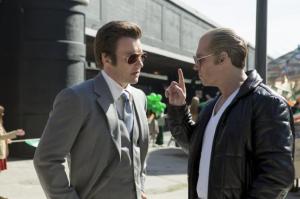 Then there are the underdeveloped supporting characters of Connolly and Bulger’s brother, Billy (Benedict Cumberbatch). The guy responsible for Bulger’s misdeeds getting the green light should be a far more important person in this story but he’s mostly portrayed as a stooge. He wants to look out for Bulger but despite one “you’ve changed” speech from his beleaguered wife, you don’t truly get any sense that Connolly has changed. You don’t get a sense of his moral dilemma or even his desperation as new leadership in the FBI starts to see through his poor obfuscations. He’s a stooge from the beginning and we feel nothing when his self-serving alliance comes to an unceremonious end. There is even less when it comes to Billy, a character that seems to pretend his brother is a different person. Billy works as a state senator. His political position must have supplied more inherent drama than what they movie affords. Black Mass is doomed when its three central characters are this dull.
Another problem is that the movie makes Bulger too protected for too long to the point it becomes comical. The script follows a routine where an associate of Bulger’s knows too much or is going to confess to the police, and within usually the next scene that character is easily dispatched, sometimes in broad daylight and with scores of witnesses. There are several recognizable actors who must have filmed for a weekend. I understand Connolly was protecting his meal ticket here with the Bureau, but Bulger is so brazen that we as an audience need more justification for how Connolly could cover for so long. It feels like Bulger has free reign and that extends into the screenplay as well. Without a stronger sense of opposition, or at least watching Bulger rise through the mob ranks, we’re left with a collection of scenes of the status quo being repeatedly reconfirmed.
I’ve figured out the way to revise Black Mass and make it far more entertaining. As stated above, Bulger is just too much a one-note boogeyman to deserve the screen time he’s given, and his onscreen dominance hampers what should be the movie’s true focus, Agent Connolly. Here is where the movie’s focal point should be because this is the transformation of a person. Bulger is the same from start to finish, only shifting in degrees of power, but it’s Connolly who goes on the moral descent. His is the more interesting journey, as he tries to use his childhood connections to get ahead in the FBI, but he consistently has to make compromise after compromise, and after awhile he’s gone too deep. Now he has to worry about being caught or being too expendable to Bulger. This character arc, given its proper due, would make for a terrific thriller that’s also churning with an intense moral ambiguity of a man trying to justify the choices he has made to stay ahead. It’s a more tragic hero sort of focus but one that has far more potential to illuminate the inner anxiety and psychological torment of the human heart rather than constantly going back to Buger to watch him whack another person. It’s far more interesting to watch a man sink into the mire he has knowingly constructed, and that’s why the narrative needed to shift its focus to Connolly to really succeed.
 Depp (Pirates of the Caribbean) takes a few steps back from his more eccentric oddballs to portray the unnerving ferocity of Bulger, and he’s quite good at playing a human being again, though Bulger strains the definition of human. He underplays several scenes and his eyes burrow into you with such animosity that it might make you shudder. He’s a thoroughly convincing cold-blooded killer, though I wonder if part of my praise is grading Depp on a curve since Bulger is so unlike his recent parts. Regardless, Depp is the most enjoyable aspect of Black Mass and a reconfirmation that he can be a peerless actor when he sinks his teeth into a role rather than a series of tics. He also handles the Boston accent far better than his peers. Cumberbatch (The Imitation Game) and Edgerton (The Gift) are more than capable actors but oh boy do both flounder with their speaking voices. They are greatly miscast as two native Massachusetts sons.
If you’re a fan of crime thrillers steeped in true-life details of heinous men (it’s typically men) committing heinous acts, even you will likely be underwhelmed or marginally disappointed by Black Mass. There just isn’t enough going on here besides a series of bad events that don’t feel like they properly escalate, complicate, or alter our characters until the film’s very end when the plot requires it. The screenplay has propped up Bulger by his rep, told Depp to crank up his considerable glower, and called it a day. It’s a Boston mob story that needed more intensive attention to its characters to survive. Black Mass is a crime story that dissolves into its stock period details and genre trappings, becoming a good-looking but ultimately meaningless window into a hidden world.
Nate’s Grade: C+
Share this:

The Hobbit: The Battle of the Five Armies (2014)
 With all respects to Ice Cube’s would-be family series, the subtitle of the third Hobbit film could have been “Are We Done Yet?” Originally planned as two films, the prequel series based upon J.R.R. Tolkien’s novel was expanded to three, and it’s clear what motivated this decision. Each Hobbit film has made at least $900 million dollars, but goodness has it padded an already bloated series beyond repair. The best part of the second film, which looking back is the best in the new trilogy, Smaug the dragon, is gone in the first ten minutes. What follows is a pointless and tedious series of events, mostly CGI armies crashing into other CGI armies. It’s hard to find much to care about after six plus hours especially when it amounts to squabbles over treasure. It’s also bothersome that the antagonist for a solid hour is Thorin who adopts… gold madness suddenly, and then loses it just as suddenly and as contrived. You can feel the weight of all this filler trying to stretch what amounts to a protracted resolution into a full-blown movie. The battles are relentlessly soulless and have lost any weight to reality. There’s one standout action sequence involving a crumbling tower acting as a makeshift bridge. Beyond that, get ready for overlong battles involving lots of fake soldiers and monsters. With no larger goal in motion, you’re just waiting for the bad guys to die so we can go home. While Battle of the Five Armies is the shortest film in the series, it’s still about 120 minutes longer than it needs to be. The business of the Hobbit has affected the artistry of The Hobbit, and only Tolkien apologists would lap up the extra time in Middle Earth.
Nate’s Grade: C+
Share this:

The Hobbit: The Desolation of Smaug (2013)
 Back to another three-hour trip to Middle Earth. While the second Hobbit film is an improvement in just about every way, it’s still a clear example of a franchise stretching to the breaking point. Peter Jackson gets the second installment moving a lot quicker, and there are several standout action sequences that are glorious on the big screen. Unfortunately it still takes almost two full hours to get to the dragon of the title, but when it does, oh does the movie become that much grander. Benedict Cumberbatch gives frightful life to Smaug (pronounced, for whatever reason, as “Smaa-oog”), and the special effects are top-notch. The last forty minutes of the movie are solid gold, as Bilbo and the dwarves work together to battle Smaug in a virtuoso development of imaginative action; it’s wonderful how many moving parts are involved in this action set piece. However, Hobbit 2 still feels needlessly padded to meet out a trilogy. Does Gandalf (Ian McKellen) need to just disappear on his own mission that accomplishes what? Do I care at all about the people of Lake Town let alone their populist revolts? Do I need a parallel storyline about an injured dwarf? And for that matter, do I need a budding lady elf-dwarf romance? J.R.R. Tolkien fans will be in heaven (though maybe just purgatory with all the changes) to gawk at the realm of Middle Earth, but I always feel antsy (“Get on with it already”). Still, The Desolation of Smaug is an entertaining and at times majestic fantasy epic, I just wish Jackson and company didn’t take so many pit stops. Well at least we won’t have to wait so long for the dragon in Hobbit 3.
Nate’s Grade: B
Share this:

August: Osage County (2013)
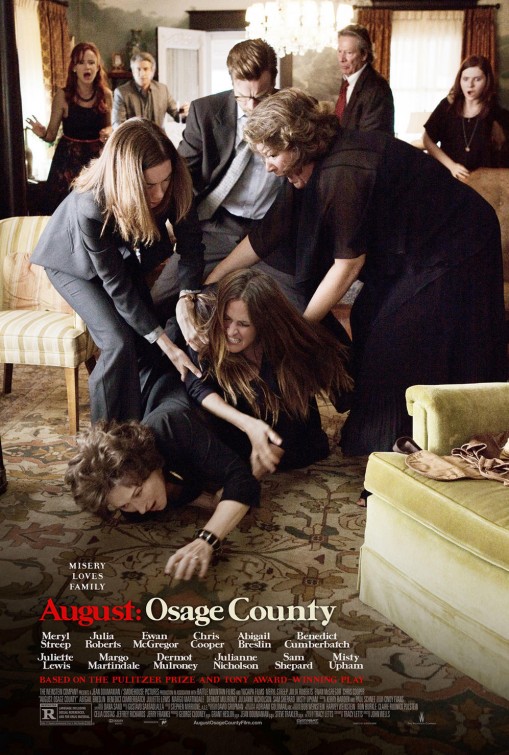 This holiday season, the movie with the most acting, by far, is likely to be August: Osage County, the adaptation of Tracy Letts’ Tony award-winning play. It’s a large dysfunctional family getting back together and opening old wounds, so, you know, the most relatable Christmas movie for some. It’s easy to see what attracted such A-list talent to this project because these characters are actor catnip; each is overflowing with drama, secrets, revelations, anger, and it’s all channeled through Letts’ barbed sense of humor and wickedly skillful dialogue. With Meryl Streep as the pill-popping matriarch, Julia Roberts as her resentful daughter, and a host of other inter-generational conflicts and secrets, you may feel exhausted by the end of its 130-minute running time (the stage play was 3.5 hours, respectively). The emotional confrontations feel like grueling pugilist matches, the melodrama kept at a fever pitch, but the film is never boring. Streep is her usual astonishing self and the deep ensemble gives each actor something to chew over. This is the best Roberts has been in years, and she’s not afraid to get nasty (“Eat your fish!”). Just when you think the story might soften, Letts unleashes another body blow, allowing no uncertainty that this is a family doomed. The story also provides insights into tracking the path of cruelty through the family tree, limb by limb. August: Osage County is stridently funny but also punishing in its no-holds-barred approach to family drama. If you’re looking for a movie that makes your family seem normal and even-tempered, this may be it.
Nate’s Grade: B
Share this:

12 Years a Slave (2013)
 In 1841, free black man Solomon Northup (Chiwetel Ejiofor) lives in Saratoga Spring, New York, performing as a trained violinist. Some traveling performers offer him serious money if he’ll play with their circus act in Washington, D.C. Solomon bids goodbye to his family, never knowing he will not see them again for a dozen years. He’s kidnapped, imprisoned, and sold down South to a series of plantation owners. He insists he is a free man, but who will believe him? He’s a black man in chains, and frankly many people just do not care. He learns to adjust to the rules of his new life, finding some companionship with the fiery Patsey (Lupita Nyong’o), and looking for a trusted source to mail a letter to Solomon’s family. It’s a life of daily terror and Solomon could be killed at any moment if word got out that he knew how to read and write.
12 Years a Slave is, as expected, a hard movie to watch at times but it is an essential movie to be seen. A friend of mine literally had this conversation with a movie patron (I wish I was only making this up):
Customer: “Yeah, I don’t think I’ll end up seeing 12 Years.”
Friend: “Oh. Well it is a hard movie to watch.”
Customer: “It’s not that. I’m just waiting for a movie that finally shows all the good slave owners doing nice things. It wasn’t all bad.”
 This brief conversation exemplifies for me why a searing drama like 12 Years of a Slave is still vital in 21st century America. This is a slice of history that cannot be forgotten, but just as sinister is the amelioration of its cruelty. As time passes, and those with direct personal experience are long gone, then the mitigation begins, and you have ignorance consuming people who want to whitewash America’s original sin, like the above movie patron. I’ve even read, simply on message boards for this very film, a dubious prospect I admit, people arguing, “Can’t we just move on already?” and posing false equivalences like, “Well the poor Southerners who worked as indentured servants had it just as bad.” I swear I am not deliberately setting up a straw man argument, these are actual gripes people have. It’s as if acknowledging the totality of the horror of slavery is, in itself, some kind of insult to people today. It’s history and vital history that need not ever be forgotten or mitigated, and we need more films dealing with this subject.
There is zero equivalency to treating people as subhuman property, stripping them of all human rights and dignity, separating them from their families, beating them, raping them, murdering them without consequence, being punished for defending yourself, and kept in a constant state of terror where anything horrible can happen to you at any time without reason. Sorry slavery apologists, but even the notion of a “kindly slaver,” which the movie actually showcases, is erroneous. Whether they don’t beat their slaves as often or addressed them as people, slave owners are still profiting from the institution of slavery, and as such the notion of a “good slave owner” is antithetical to the very insidious nature of plainly owning another human being.
With all that said, 12 Years a Slave is an unflinching look at the cruel reality of slavery but one that demands to be seen. Director Steve McQueen (Shame, Hunger) doesn’t pull his punches when it comes examining the unrelenting misery of slavery. There’s a whipping scene where he are in the safe position of focusing on the faces of those involved, studying their horror, but then McQueen has the camera turn around and you see, in graphic detail, the ravaged back of an innocent woman, the bloody result of every one of those whippings that we watched at a comfortable distance at first. This is a gory example, and the film is rather restrained when it comes to this aspect. This is not simply wallowing in sadism. Hollywood has yet to have a definitive film showcase the traumatic reality of slavery. 1997’s Amistad gave you glimpses, but most of Steven Spielberg’s movie was set in courtrooms arguing the philosophical nature of inherent rights. I wish they would remake the classic miniseries Roots; today’s TV landscape would be more permissible at showing the graphic terror of slavery than 1970s network television. With 12 Years a Slave, there are several uncomfortable moments that will make you gasp, but overall, while retrained on the gore, you feel the overall devastation of a slave’s predicament. Every moment of life was at the whims of another, and a victim could be trapped at every turn. Solomon is beaten soundly, and after he defends himself, he is rounded up to be lynched for his audacity. The aftermath is portrayed with stark tension, as Solomon is left hanging by a noose, his feet barely touching the muddied ground, trying to maintain his stance or else choke to death. And like the long takes in shame, McQueen’s camera just holds us there, trapping the audience in the same strenuous dilemma. The worst goes to Patsey, who is raped by her master and tormented by the master’s jealous wife. Both Solomon and Patsey are damned with every decision. By the end, Solomon is rescued and reunited with his family, but you can’t help but think about all those other unfortunate souls left to mire in slavery. For millions of them, there was no set limit to their desolation.
 From a script standpoint, the movie flows more as a series of scenes rather than a traditional three-act arc. Writer John Ridley (Red Tails, Three Kings) works from Solomon’s own autobiography and does an incisive job of recreating the dimensions of mid-19th century America and the diseased mentality that accepted slavery. No more is this evident than in the frightening character of Edwin Epps, played with chilling absorption by Michael Fassbender, McQueen’s favorite collaborator. Epps is the kind of man who uses selective Scripture to justify his heinous actions. “A man can treat his property how he likes,” he quips with authority. Epps’ plantation is the worst along Solomon’s hellish odyssey. Fassbender (X-Men: First Class, Prometheus) spookily possesses Epps with great ardor, bringing out the snarling dangers of a man and his unsavory convictions. You’ll cringe over all the unwanted lascivious attention he gives to Patsey. He is a weak man through and through, but one who rages against others with his weaknesses. Fassbender is electric and keeps an audience extra alert when onscreen.
The acting is exceptional and infuriating. Ejiofor (Serenity, Salt) is commanding in a performance that stays with you. There is so much the man has to communicate with his eyes, those great orbs of his. Because of his circumstances he must hold back his ire, do what he can to make it another day, and his adjustment to the horrors of slavery are heartbreaking in itself. He must always be cautious, and when he dares to risk trusting a white man, we feel the same tremors of trepidation. There’s a great scene where Solomon, having been betrayed, has to come up with a credible alternative in the moment, with so much riding on his improvisation skills. It’s as suspenseful a moment as most Hollywood thrillers. The most heartbreaking performance, though, belong to Nyong’o, who is making her film debut in a major way. As Patsey, she symbolizes the mounting torment of unremitting victimization, a woman begging for death but too proud to make it happen. She has some intense monologues where not one word feels false. She is a broken woman struggling to find her footing, and watching her get abused in so many different ways is gut wrenching. She’s more than a martyr and Nyong’o shows you that.
Undeniably a good movie, there are still enough filmmaking choices that hold it back for me, and it all comes down to Solomon as the protagonist. The movie’s center was not as strong as it needed to be, and that is chiefly because our focal point, Solomon, is not well developed as a character. I feel pings of something approaching shame just bringing up the subject, but I must profess that Solomon is just not given much to do beyond suffer. As a free man, his adjustment to the absurd cruelty of the institution of slavery is meant to serve as an entry point for a modern audience, to have the safety of our lives suddenly stripped away. But if I had to describe Solomon as a character, I could say that he mostly vacillates between two modes: shock and solemn dignity (“I don’t want to survive. I want to live.”). Strange that Patsey and Epps and even Epps’ wife are shown more dimension than the lead character. I’m not asking for Solomon to suddenly become a more active character and to rise up, Django Unchained-style; the context of slavery limits his opportunities to express himself. I just wanted more to this guy to separate him from the others suffering onscreen. And maybe, ultimately, that’s the point, that Solomon is, at heart, no different than any other slave. I can agree with that in philosophy, however, this approach also nullifies my ultimate investment in the protagonist. I feel for him because he suffers, I feel for him because I want him to find some semblance of justice (an impossible scenario given the circumstances, I know), and I feel for him because he is a good, honorable man. But I do not feel for him because I have an insight into the character of Solomon Northup. Fortunately, Ejiofor does a superb job of communicating as much as he can non-verbally. It just wasn’t enough for me.
 To criticize 12 Years a Slave makes me feel awkward due to the seriousness of its subject matter, but hey, plenty of people make mediocre movies exploring Holocaust atrocities too (does anyone ever dare say, “Get over it,” to Holocaust survivors?). A horrifying historical subject does not give filmmakers cart blanche to slack when it comes to the important elements of storytelling, like story and characterization. 12 Years a Slave, by extension, is an exceptionally made movie with moments to make you wince and cry, gifted with powerful acting and sensitive direction. It is a searing recreation of the many facets of slavery, not just the sheer brutality of the beatings. You will understand on multiple levels the terrorism that was the institution of slavery, a vicious reality that should never be forgotten by a complacent citizenry. I can applaud 12 Years a Slave for its technical excellence, depth of performance, and historical accuracy; however, my personal investment in the protagonist was somewhat limited because Solomon Northup was not developed sufficiently enough. I certainly empathized with the man, but too often I felt like I was watching Solomon as a suffering symbol rather than a character. He’s obviously an interesting figure and I wanted more dimension. While not exactly rising to the level of a Schindler’s List for the institution of slavery (as some have dubbed), 12 Years a Slave is an enthralling movie in so many ways. It’s just a shame that an underdeveloped protagonist would hobble a film so otherwise worthy.
Nate’s Grade: B+
Share this:

Star Trek Into Darkness (2013)
J.J. Abrams’ return to the final frontier had me extremely excited for what the sequel to 2009’s smash Star Trek would be. It’s a different sort of Trek, a more rough-and-tumble, popcorn entertainment with the recognizable flavor of that other famous space opera that Abrams is steering into theaters come 2015. Having seen Star Trek Into Darkness twice, certain things became very clear to me. First, this is about everything you could ask for in a summer popcorn action movie. The set pieces are thrilling (my fave may be a human bullet shoot through a field of debris), there’s something new and dangerous going on just about every fifteen minutes, the stakes are constantly changing, and there are a bevy of well plotted character arcs for a deep and well acted ensemble. It’s about everything you’d want in a Star Trek movie… if you were a big fan of the 2009 film. If you’re a lifelong fan, you may have some reservations, notably the inclusion of a famous villain that shouldn’t be too hard to guess. The second half references to Trek cannon, especially Star Trek 2, feel weird for a film that broke away into a parallel universe so that it could chart its own course rather than relive the old stories. There’s homage and then there’s just subservience. Still, there are plenty of resonant themes, like friendship, sacrifice, and family, that are given adequate attention, amidst all the big-budget escapist thrills. There are even some surprisingly poignant moments that the actors ace. Benedict Cumberbatch (TV’s Sherlock) is incredible as the villain, a terrorist with a menacing, velvety voice that I could listen to all day. The vast majority of Into Darkness is tremendously entertaining, with a great pulse and sense of scene construction. The Abrams team knows how to make blockbusters in the old Spielberg variety, spectacle with humanity and humor and sweep. If this is what he can do with the Trek universe, just wait until Episode VII people.
Nate’s Grade: A-
Share this:

Tinker, Tailor, Soldier, Spy (2011)
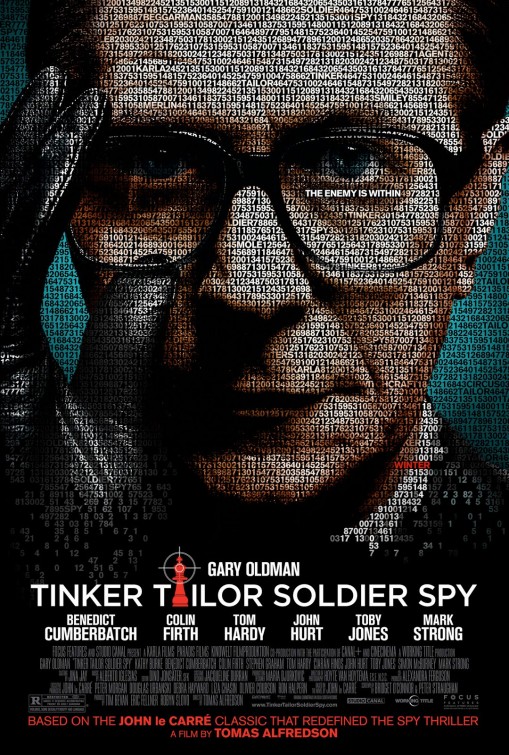 Billed as one of the most dense films of the holiday season, I was startled to discover that Tinker, Tailor, Soldier, Spy is not nearly as puzzling as people have protested. The adaptation of John le Carre’s famous novel follows retired British spy George Smiley (Gary Oldman) performing a clandestine investigation to flesh out a mole in the highest level of the agency. Directed by Tomas Alfredson (Let the Right One In), condensed form a 7-hour BBC miniseries, and stuffed with a wealth of terrific Brits, the movie is tricky, clever, and rather brainy, ultimately coming to the conclusion that these little communities of intelligence knew little. The movie has a rich array of characters and teases out back-story in flashbacks, meaning the film hops around time wise and will also take turns with different perspectives. It demands your attention but, honestly, I found it easy enough to follow. But in the end, what does all that narrative trickery and obfuscation get you? It’s a fairly dispassionate film about dispassionate people played out in a dispassionate manner. For some this will be hailed as a virtue, communicating the duty-first sacrifices and compartmentalization of these secret spies. For me, that just sounds like a cop out. Beyond the mystery, it’s hard to get involved in the movie. The reveal of the mole is anti-climactic, though the resolution, set to the tones of Julio Iglesias, is aces. The meticulous production design is stellar, including an agency meeting room that looks like it was wallpapered with checkerboards. The details of the ins and outs of the agency are absorbing. I’m debating whether I should watch the movie again, looking for nuance I must have missed. Tinker, Tailor, Soldier, Spy is an espionage thriller with a bit too many stiff upper lips.
Nate’s Grade: B
Share this:

War Horse (2011)
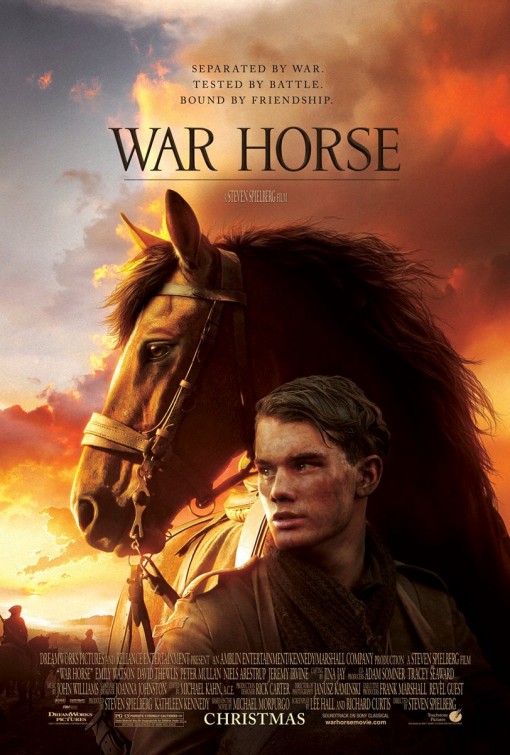 Steven Spielberg and war seem like a dynamite combination. The popular director puts away his childish things and becomes a much more mature, thoughtful artist, with the obvious exception of 1979’s 1941. War Horse is the adaptation of a children’s book-turned-Tony-Award-winning play, where the title star was brought to life on stage via skilled puppeteers. And lo, did people weep for that puppet horse on stage, and lo will they likely weep for the flesh-and-blood version on the big screen. However, I’d hardly call this movie a mature examination on the horrors of World War I. It’s more of a touchy-feely, stodgy, vignette-heavy drama that brings out the worst in Spielberg’s sentimental side.
We’re introduced to our young horse early on, where young Albert (Jeremy Irvine) spies the colt and forms an instant bond. Albert’s father Ted (Peter Mullen) buys the horse on a whim, even though the family could really use a plow horse. Albert names the horse Joey and is determined to prove everybody wrong who doubts the both of them. Together they indeed plow that rocky field and Albert’s family keeps their farm. Then World War I breaks out across Europe and the family ends up losing the horse. Joey is confiscated by the English cavalry and goes on a fantastic journey, switching sides over the course of the war (and allegiances?). Albert enlists in the military so that he can find his long-lost horse. I guess they’ll be no “Dear John” letter when your beloved only has hooves.
 War Horse is a throwback to old-fashioned Hollywood epics. It’s like John Ford took control of this movie from beyond the grave (note to self: premise for a supernatural comedy). My theater was filled to the rafters with old people. It was like the nursing home emptied out for the Greatest generation’s couples night. It’s easy to see why the movie would appeal to such an older crowd. It’s a simple story told with its emotions squarely on its sleeve like a badge of honor (mixed metaphors!). It’s so unflappably earnest and sentimental that it can occasionally fall into cornball territory. There’s the greedy landlord who wants to kick the poor family off their farm. Being a Spielberg movie, no expense is spared in milking as many emotions as possible. Spielberg demands tears and you will deliver them, or so help him. It’s all about Joey the horse prancing through people’s lives, touching hearts, bringing enemies together. The movie is primed for mass (older) audience appeal; for God’s sake there is a sassy goose that Spielberg can’t help himself but continue to include. Sassy goose equals money in the bank. This is the only movie I can imagine where plowing is treated as a point of dramatic catharsis. Suffice to say, War Horse is a stodgy war drama that won’t offend anyone with delicate sensibilities.
I wasn’t expecting War Horse to be the equine version of The Red Violin (if you unfamiliar with the masterful 1999 film The Red Violin, go see it immediately instead of watching this flick). We see the horrors of war through a series of vignettes as Joey passes from owner to owner, each befalling some unfortunate fate, though I don’t think the horse is to blame (or is he…?). The vignettes run about 15-20 minutes or so apiece and because the one constant is the horse, that means we have to feature characters talking out loud explaining everything they do and feel. The horse just kind of takes in everyone’s secrets, probably wishing these people would stop their yapping. The characters are drawn rather broad so we get the German brothers who desert their posts, a French girl wanting to learn to ride a horse, and a noble English cavalry marshal, amongst others. It’s hard to get attached to such disposable characters that fail to leave a modest dent. I thought maybe all these characters would converge in the end for an emotional climax, but then I remembered that many of them were dead, so nope. It’s a strange screenwriting shortcoming when the most engaging character for most of the movie is on four legs and never says a word.
It’s hard not to emote when Spielberg lathers on the sentimentality with aplomb. But if you took away John Williams’ earnest score, Spielberg’s sappy staging, and all those close-ups of animals, would you feel anything for this story or these characters; would you feel anything without all the reminders to feel? I doubt it. Don’t count me heartless, for I’ll have you know I bawled like a baby who just watched another baby hit with a shovel at Marley & Me, but does the life of one horse matter so much more than the millions of lives lost at war? We watch all those boys, many not old enough to be called men, run into the unforgiving gauntlet of war, but someone the life of one horse is supposed to outweigh the countless death. I understand a tight narrative focus so that large, unfathomable horrors can feel personable and better felt. Shindler’s List is that kind of movie. War Horse is not. This isn’t even Black Beauty or National Velvet. One of the English soldiers chides the sobbing Albert with a sharp quip: “It’s not a dog, boy, it’s just a horse.” I felt sad when the horse was in danger; I’m not a heartless bastard.
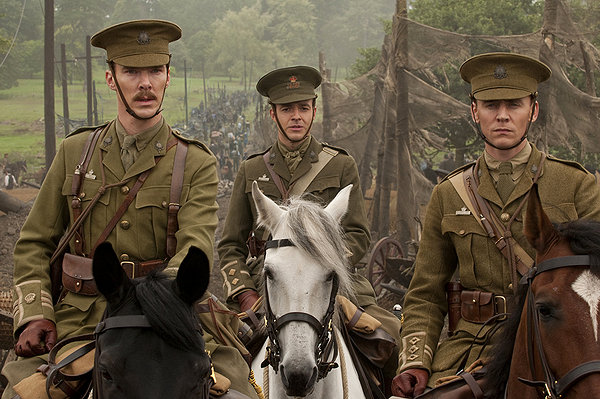 And oh does this horse seem to be Spielberg’s symbol of purity, mankind’s ultimate accomplishment, or, you know, something Big and Important. At one point, Joey gets tangled in a mess of barbed wire and the English and Germans all come to some sort of uneasy truce to work together to free this beautiful animal (if only more hapless horses had gotten lost in No Man’s Land maybe the war would’ve been over sooner – now I sound heartless). The horse is supposed to represent some messianic cost of war, where we destroy nature, turning majestic creatures into weapons of war, etc. I don’t really know what the message/symbolism is striving for but it’s constantly grappling, looking for a suitable sticking point. Honestly, if Joey was supposed to represent purity, goodness, nature, then that filly needed to get turned into glue by film’s end (spoiler alert). I erroneously predicted War Horse to be the “Marley & Me of war pictures.” The horse lives, rejoice America. Never mind the millions of people who died horribly. You can’t have a messianic symbol without martyrdom. If Spielberg wants to drive home the loss of innocence that many underwent thanks to the War to End All Wars (oh, if only), then the horse, a symbol of innocence and nature, needed to die at the machines of war. Otherwise the movie becomes an episodic journey of a single horse, an equine Forrest Gump. I can’t imagine that’s what Spielberg had in mind. I envisioned an M. Night Shyamalan-esque ending wherein the horse does eventually die, get turned into glue, and that glue is sued to construct a bomber plane for World War II. That plane? The Enola Gay. Cut to end credits. War Horse!
This movie has deteriorate in my mind the more I think back, picking away its cornball earnestness and stodgy sensibilities. When the horse is your greatest character then your war drama has some problems. War Horse is not a bad movie by most counts. It looks swell, the emotions are big, and hey horses are pretty aren’t they? But for any discerning moviegoer looking for a strong narrative, incisive commentary on the war, or even moderately appealing characters, well I hope you like looking at horses.
Nate’s Grade: B-
Share this:

Atonement (2007)
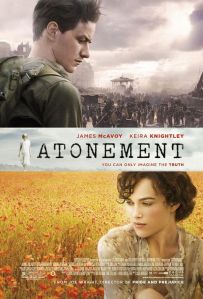 No film this awards season seems to have been kicked and beaten more than the sweeping period romance, Atonement. This poor movie has a strong stable of well-respected British thespians, a red-hot young director in Joe Wright (2005’s Pride and Prejudice), plenty of lofty, top-notch production values, and the whole enterprise is based off a highly acclaimed novel by author Ian McEwan. Where did all the hate come from? I think it has something to do with the fact that somewhere along the line Atonement became, on paper, the presumptive favorite to win Best Picture. Then reality hit and it hit hard. Atonement wasn’t even nominated by the Writer’s Guild, the Producer’s Guild, or the Director’s Guild and yet the film still managed to eek out a Best Picture nomination for 2007. I became suspicious that Atonement would turn out to be this year’s Dreamgirls, namely a presumptive front-runner that was too calculating and self-conscious and ultimately free of substance to make its mark. While Atonement is perfunctory and nothing altogether special, the film still succeeds as a worthy piece of entertainment that doesn’t deserve to be dragged through the mud.
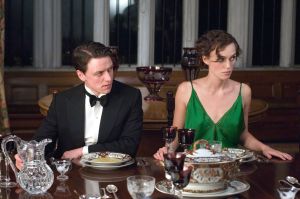 In the mid 1930s, Robbie (James McAvoy) works as a housekeeper’s son on a lovely English estate. He has his eye on Celia (Keira Knightley) and puts his burning passion to paper, typing two very different notes. The first one is blunt (and features a naughty word that rhymes with “blunt”) and the second one is more of a poetic declaration of his affections. Robbie has instructed Celia’s younger sister, Briony (Saoirse Ronan), to pass his love letter to the rightful party. He realizes too late that he sent her off with the wrong letter and Briony reads it herself, dumbfounded at the message and terminology. Briony is a bright child that fancies herself a playwright, but she’s still a child that cannot fully grasp the meaning of Robbie’s advancements. When she intrudes on Robbie and Celia having spontaneous sex against a library wall, she can only assume that Robbie is attacking her older sister (stupidly, neither says anything to clear up the awkwardness and just leaves the scene wordless). That same night Briony discovers her cousin being attacked and she’s certain that Robbie is the culprit, or is she? Her false confession sends Robbie to jail and alters lives forever.
Flash ahead to World War II, and Robbie has joined the Army to be released from jail, Celia reunites with him for the first time in years, and a now 18-year-old Briony (Romola Garai) realizes her foolishness as a child and tries expunging her overwhelming feelings of guilt by working as a nurse and tending to the ghastly numbers of wounded soldiers.
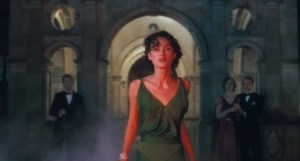
Atonement is visually ravishing to watch. The cinematography by Seamus McGarvey is lushly colorful and blends light and shadow to an extraordinarily effective degree, draping the performers in contrasting colors that pop. Wright’s camera always seems to be perfectly located to discover beautiful compositions indoors and out; the movie is just visually pleasing on all fronts, like seeing Knightley in her dark green dress bathed in the glow of police lights at night. At several points, however, the film’s look does get overly soft and glossy, like the cameraman smeared gobs of Vaseline over the lens. The period costumes and production design are agreeably period-y. The musical score has moments of great lyrical poignancy and then it shatters when the score resorts to integrating the sound of a clacking typewriter as a percussive instrument. I wanted to beat my head against a typewriter to make it stop.
 There’s a vague mechanical air over the entire two hours, like the filmmakers felt that merely assembling all the right pieces and having the right, awards-friendly pedigree would be enough. The five-minute uninterrupted tracking shot along the Dunkirk beach epitomizes this flawed belief. This superfluous shot wanders around soldiers stationed on a beach, winds around the outskirts of the bombed out city, and finally rests in a pub crawling with Brits, but nothing is added by the shot continuing uninterrupted and the staging fails to illuminate anything remarkable about the expensive set. The shot exists simply to call attention to its self and to serve as another bragging point for the filmmakers. The Dunkirk shot adds little to the atmosphere of the film because the scene barely flirts with giving a bigger picture of what is happening. Instead, that shot, like the movie, while well composed and entertaining, is an exercise in self-congratulation.
The film loses serious momentum as it transitions into war and its period of titular atoning. The movie just isn’t as compelling watching Robbie shuffle around at war. Rarely is he in any danger and he just seems to be biding time. Atonement is a tad too prim, a tad too demure to really go deep enough. The romance is intended to be of the unrequited variety but it feels malnourished even at an unrequited level, which is truly saying something. There is so much more beneath the surface but the film never wants to push too far for whatever reason. Knightley and McAvoy have a nice workable chemistry and that’s part of what makes the first half of Atonement the better half. So much of the story involves internal struggle but the movie doesn’t wish to invest the time needed to explore serious psychological wounds. Atonement never capitalizes on the intriguing if melodramatic opening of the film. This is by no means a love story, no matter what the marketers wish to convince otherwise. The romance between Celia and Robbie has little setup to seem believable or worthwhile. This is a movie about the power of words, which naturally is a topic that functions better in books.
After Kinsey and now Atonement, Vanessa Redgrave seems to have found a contemporary niche or her talents: she shows up in the final minutes to give a monologue that demands that the audience reflect from a fresh perspective. Redgrave plays an older adult Briony who has written several best selling books and is being interviewed for television. The ending is designed to be more devastating in print form, and it wants to call into question the nature of fiction and whether or not one lie and be absolved by another. But in the medium of film, the shockwaves are minimal because the language of film is visual. The stutter-step plot structure, which occasionally bends backwards to replay an event from an alternative perspective, is an extraneous annoyance that’s finally justified by Redgrave’s late appearance. What is the true cost for a “happy” ending?
 While Knightley and McAvoy get all the attention and cause teen girls to swoon uncontrollably, the real star of Atonement is 13-year-old Ronan. The young actress is a revelation as a sophisticated girl entering the earliest stages of womanhood. She’s nursing some serious puppy love on Robbie and his disinterest fuels her false confession; she means to punish him. Ronan is eloquently precocious at the start, acting wise beyond her years, but when she steels a glimpse at Robbie’s unfortunate letter, she drops her older pretensions and presents the spirited and unrestrained eagerness of a girl that’s madly curious and madly in love. Ronan effortlessly switches between the two sides of Briony, playing the astute, proper young lady or the nervy, confused girl trying to make sense of her budding sexuality. Kudos to the casting director as well for casting an older actress to play the 18-year-old Briony that genuinely looks like a grown-up Ronan.
Naysayers dismissing Atonement as outdated rubbish are diluted; it’s a well-crafted movie from considerably all angles. Then again, those that champion the film as a testament to bravura filmmaking are also diluted; the film is good, yes, but entirely unexceptional. Atonement is a fine film that takes a reportedly unfilmable novel and gives it a good attempt.
Nate’s Grade: B


 nathanzoebl
You must be logged in to post a comment.