Blog Archives
Hurry Up Tomorrow (2025)
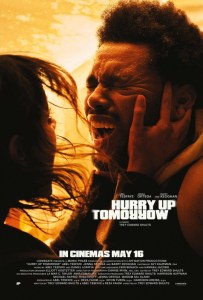
The pop star vanity project is a dubious film enterprise, though it’s been quite a while since we had a theatrically released bauble from one of the most popular singers in the world. Typically, if musicians want to get experimental and “arty” with a visual medium, they turn to longer-form music videos for even the entirety of a new album release, like what Beyonce and Halsey have done. That wasn’t good enough for The Weeknd, a.k.a. Abel Tesfaye, as he co-wrote a starring vehicle for himself that could be filmed alongside his world tour where he essentially plays an enigmatic version of himself that Jenna Ortega is obsessed with. At this rate, I’m surprised he didn’t write a scene where a bunch of women congratulate him on being the world’s best lover. Hurry Up Tomorrow is a glorified longer-form music video collection of extended musical performances and some more trippy experimental videos in the second half. It’s also a low-rent Misery with Ortega being a crazy fan who eventually takes her target of obsession hostage. She thinks she can help the troubled singer confront his past through her extreme therapy. If this was the whole dynamic, this could have been the movie rather than the final twenty minutes of it. It’s gob-smacking that Tesfaye is able to spare his life through the unquestioned power of song and his talent (“You had it in you all along, most talented superstar”). By the end, I don’t think anyone has learned anything after all the kidnapping and murders and arson except that Tesfaye has a pretty high opinion of himself. Unless you’re the biggest Weeknd fan, you’ll be left blinded by the meandering artistic hubris of Hurry Up Tomorrow. There’s just nothing here to grapple with besides the self-serious self-indulgence. What to expect from two of the three credited creators of HBO’s abysmal and cringe-inducing canceled-after-one-season show, The Idol?
Nate’s Grade: D
Share this:

Saltburn (2023)

Promising Young Woman was easily one of my favorite films of 2020. It used the structure of a rape-revenge genre movie to tell a hard-hitting drama and pitch-black comedy. Writer/director Emerald Fennell was nominated for Best Director and won the Oscar for Best Original Screenplay, so I wasn’t alone in singing her praises (my critics group declared it the top film of 2020, huzzah). It was, in short, pastiche elevated into something jarring and relevant and daring. With her follow-up Saltburn, she has taken the British class drama of an outsider trying to fake their way in the world of the rich and powerful, a Vanity Fair or Brideshead Revisited if you will, and attached a whole lot of salacious campy nonsense. If Promising Young Woman was elevating a trashy genre movie with vision and daring, then Saltburn is taking the soapy costume drama and degrading it with cheap shock, and “degrade” is quite the appropriate term.
Oliver Quick (Barry Keoghan) is a young Oxford student who doesn’t quite fit in with his peers. He doesn’t come from money and instead from a broken home, but he’s set his sights on success, and that includes winning over the handsome Felix Catton (Jacob Elordi). He’s popular and athletic and from a rich family, and Felix takes a liking to Oliver, even defending him against his posh peers. Oliver is infatuated with Felix and convinced that he’s in love. After a personal tragedy, Felix invites Oliver to summer at Saltburn, his family’s enormous private estate in the country. Oliver amuses Felix’s parents (Richard E. Grant, Rosamund Pike) and sister (Alison Oliver) and settles into the black-tie dinners and racchous parties. He might not ever want to leave, and he might not be able to leave, and he might not ever want to be able to leave.
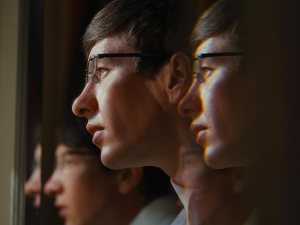
Saltburn is like if The Talented Mr. Ripley was made by the auteur of tawdry trash Larry Clark (Kids, Bully). It’s trashy nouveau camp that works as a sour class comedy until it becomes too sour and most definitely doesn’t work as any sort of engaging character piece or legitimate thriller. I don’t really know what Fernell was going for here and it doesn’t feel like she does either. I think back on the similar tale of Mr. Ripley as an advantageous upstart who got a taste of the good life and didn’t want to give it up. Like Saltburn, we know about our lead’s duplicitous and untrustworthy nature early, but with that movie we could see why others could be charmed by Tom Ripley, and we understood why he would want to stay in this privileged life. With Saltburn, when the rich are treated as shallow twits practically bored with one another from their opulence, the question remains what exactly is the appeal beyond simply attaining more? Also, the appeal of watching con artists slip into a world not their own includes seeing how they will get away with everything, how they’ll cleverly avoid all the traps that materialize. With Saltburn, there is no thrill of clever escapes because the insidious force is obvious and the other characters are too stupid to recognize because they’re meant to be satirical send-ups. It’s a would-be thriller that has gutted all its thrills by eliminating a foreboding sense of consequences.
However, the movie cannot work because all of the surprises were alleviated through poor character development of Oliver and in the performance of Keoghan. I don’t think anyone who ever watches this movie will be even the slightest surprised that Oliver isn’t quite the noble and honest young coed that he may have appeared to be. Except after maybe a couple of early scenes of nerdy awkwardness, Oliver has been depicted as an obvious predator. From the beginning, as he’s sharing his sad family back-story, I was already shaking my head in skepticism and predicting that the truth would be something ordinary and boring that he would choose to cover-up. It’s just too obvious where this scheming, covetous character is going, and Fennell doesn’t do anything to counter this overwhelming and, again, transparent assessment. If you have a character acting all weird and shifty and literally slurping up spent bathwater belonging to the target of his obsession, you shouldn’t then make the later machinations a big reveal. I wanted to laugh that Fennell thought the audience would need flashbacks to better clarify Oliver’s scheming nature behind a series of tragic events. I always assumed it was him because who else would it be? It’s an obsessive young man with oblique and yet obvious motivation to have what he desires from the privileged. We get it. The problem is that the movie never really better examines this desire from his outsider status. We already know he’s the malignant force.
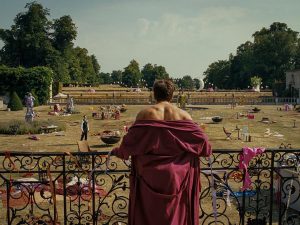
Keoghan is a great actor but “naif” is not a comfortable role for the man. By his casting alone, you’re already looking at Oliver with measured distance and scrutiny. He’s already got a leer that will set people ill at ease. The way the character is written only further confirms this judgment. If Tom Ripley was acting this outlandishly bizarre and creepy from the get-go then he would have been arrested immediately. It’s not even a lack of nuance that hurts Oliver. Not all villains and screen psychos require a full three dimensions, but the characterization is just so lazy and unexplored. He’s just a font of unchecked lust. At least in 2017’s Killing of a Sacred Deer, where Keoghan also played a malevolent young man tearing apart a family unit, his character was meant to have a mythic quality of inescapable retribution, like the Greek tragedy its title was in reference to. With Saltburn, he’s just a creepy perv, but he’s also a boring and redundant creepy perv by the ongoing refusal to provide other context. He’s less a character than a proverbial set of hands to prod characters and poke the viewer in the eye. He’s a recycled program of tedious provocation.
Given how masterfully Fennell utilized and subverted salacious elements in Promising Young Woman, I’m shocked there wasn’t much more than empty shock value. Whatever intended satirical value of this movie is glancing and fleeting. Did you know rich people can be, wait for this, superficial? Saltburn becomes a gross-out game of how far this daft creeper will go with his deadly obsessions, and on that front it all feels too annoyingly flimsy, constructed merely to be transgressive for its own provocative sake. Watching the lengths Oliver will go to prove his disturbing bonafides, it overwhelms the movie and simply becomes the movie’s purpose itself, a measurement between how far Fennell can repulse you before you reach a breaking point. It’s not merely that the characters are easy jokes, it’s that they’re bad jokes. I will say though that the ending shot is so joyously performed that I wish the rest of the movie had this kind of entertainment.
I do think there is an audience for Saltburn, the kind of people who celebrate Harmony Korine’s art-trash movies (Gummo, Spring Breakers), the kind of people who love candy-colored stylistic excess and tongue-in-cheek provocations, and people that seek out twisted love stories and dark romances. Satburn styles itself as a romance, at least early, but it’s clear that there’s nothing romantic about watching a predator set his sights on his prey and work through the family. Sadly, there’s also nothing truly entertaining here either, other than wondering when the next extreme yet desperate attempt at shock value would appear. The characters are too thin and unexplored to support this movie, and the antagonist is too obvious, as are his machinations, though his motivation remains cloudy and also undeveloped. This movie would be akin to watching a bad flu work its way through a family for all the personality Oliver offers. Fennell is a talented storyteller and exceptional at spinning genre pastiche into something so much more, so it’s quite disappointing that Saltburn is so much less than even the sum of its sundry parts.
Nate’s Grade: C
Share this:

The Banshees of Inisherin (2022)
 The Banshees of Inisherin is a melancholy movie that aspires for tragi-comedy but comes up short. I’m a big fan of writer/director Martin McDonagh’s past films, especially 2017’s Three Billboards and 2008’s In Bruges, and his command of character writing and finely hewn tonal shifts. With Banshees, it’s the tale of a falling out between two friends, Colm (Brendan Gleeson) and Padraic (Colin Farrell), and the repercussions of this disunion. Colm (pronounced Call-em) looks at his long-time daily drinking partner as unrepentantly dull and as a drain on his emotional energy. As he’s getting older, he’s more mindful of his time and wants to try and create a violin piece to outlive him. Padraic (pronounced Patrick) cannot accept that his friend can just abruptly end things, so he persists, wanting to know why, wanting to know what he can do to mend this friendship, and not listening to Colm’s threats if he doesn’t leave well enough alone. The film is set in 1923 on the island of Inisherin during the short-term Irish civil war, and the backdrop gives way to gorgeous landscapes and an overwhelming sense of isolation. Every character in this movie is feeling some gnawing sense of loneliness and discontent, from Colm and Padraic looking at their friend and wondering why, to Padraic’s sister Siobhan (Kerry Condon) who pines to leave and start a life on the mainland on her own, to Dominic (Barry Koeghan) who is looking for any human connection beyond his alcoholic and abusive father. McDonagh is terrific at writing his characters and interspersing droll humor and establishing the staid rhythms of this small world. The actors are all uniformly fantastic with special attention to the sad-eyed Farrell and super-charged Koeghan. I was enjoying my time but then I started to worry what this would all amount to, and the answer remains a big question mark. The movie’s story feels like an over-extended parable, and in doing so that holds many of the characters to be less developed and nuanced, serving their role as perspectives or victims of the folly of fate. By the end, I don’t really know what the larger theme or message of McDonagh’s movie. Maybe it’s about the facile nature of so many friendships, maybe it’s about what we choose to signify the fullness of a life lived, or maybe it’s just that a man’s donkey is nothing to trifle with. The Banshees of Inisherin is more funny than profound, but even kept too strictly in parable terms, it’s still an entertaining and occasionally heartbreaking watch.
Nate’s Grade: B
Share this:

Eternals (2021)

Chloe Zhao is the biggest name Marvel has gotten yet for its cinematic universe (MCU). Sure, they’ve had major directing names before like Kenneth Branagh and Ryan Coogler, and successful populist genre filmmakers like Jon Favreau and Joe Johnston and Joss Whedon and Shane Black, and quirky auteurs like James Gunn and Taika Watiti. However, Zhao is the first Academy Award-winning director to jump into the Marvel sandbox. Zhao seems like an odd fit for something as mainstream and successful as the MCU, but she was excited to tell a big story with the biggest studio operating in Hollywood. Eternals (no “The”) is just as much about the question over what it means to be human as Zhao’s Best Picture-winning Nomadland, and it’s a lot easier to watch with one hundred percent less Frances McDormand pooping in a bucket in her van (granted, she did win an Oscar for that performance). Eternals has received the lowest critical rating of any MCU film in its thirteen-year history and I’m trying to figure out why.
Thousands of years ago, the Eternals were created by the Celestials, powerful beings that are responsible for birthing new galaxies into the universe. The Eternals were sent to protect the inhabitants of Earth from the Deviants, terrifying tendril-heavy monsters that will consume and overrun a world. The Eternals are instructed by their masters not to intervene in human conflicts; only to intervene to save them from Deviants. Now that the last Deviant has been dead for over 500 years, the Eternals have settled into comfortable lives among present-day humans. Then the Deviants return, evolving with added powers and posing a new threat to humanity and the Eternals, but the real threat might be outside the confines of Earth.

Eternals feels like a different kind of Marvel movie in that stretches feel like it’s a Stanley Kubrick movie, or a Terrence Malick movie, or a DC movie. The plot structure and tone even reminded me of Watchmen. Don’t get me wrong, the standard Marvel elements are recognizable, but this is a much slower, more methodical, more cerebral, and more challenging movie that really feels like a distillation of Zhao’s humanist indie naturalism and the crazy cosmos from Jack Kirby’s trippy source material. I can understand why some people would find this movie to be boring and poorly paced. There are extensive flashbacks and setup. It definitely doesn’t need to be a staggering 157 minutes long, second only to the three-plus hours of Endgame. Granted the movie is introducing a dozen characters, their relationships, their powers, their histories, as well as a new history for the universe that doesn’t relate to anything that came before it. There are assorted references to Thanos and the events of Endgame, bringing half the population back, but this is more a standalone movie that can serve as an introduction for those less well-versed in two dozen movies’ previously on’s. I knew going into Eternals it was going to be slow, and I knew several friends that outright hated it, but I think pacing is more to its benefit and detriment. The scenes feel like Denis Villenueve (Dune) is pacing them, where moments are given more time to breathe and where characters are given space to reflect and absorb. Like a Villenueve film, Zhao wants her audience to take in the grandeur of the moment, but she also wants the characters to be able to take in the drama of their circumstances. Some people will find it all too boring, and while there were points that could be trimmed, I was enjoying myself because of the attention to character perspectives that are given precedence over splashy beat-‘em-ups.
I was drawn in by the character reveals, their conflicts, and the time Zhao allows to examine their emotional and philosophical states. Look, it’s still a big, action-packed Marvel movie with plenty of monster fights and a world-saving cataclysm climax, and while those are agreeably executed, I was more taken by letting the characters pontificate on their problems. There’s Sprite (Lia McHugh), an eternally looking child who can never live an adult life she craves. There’s Druid (Barry Keoghan), a man with the power to control the minds of all humans on Earth but is explicitly instructed to remain hands-off with their conflicts. He is severely torn and emotionally wrecked over watching them slaughter one another and knowing he has the power to intervene and resolve genocide, prejudice, and poverty. That’s the eternal question over why a loving God seemingly chooses to be hands-off, all rolled into one character. There’s Thena (Angelina Jolie), a legendary warrior of physical renown but whose mental state is fracturing and who poses a potential lethal threat to her family. There’s her partner, Gilgamesh (Don Lee), who would rather watch over his love as she suffers and potentially declines than have her lose her identity and erase herself. There’s Phastos (Brian Tyree Henry), a man who only wants to help the humans with his technological skills but regrets his contributions and declares humans as unworthy of their keep after Hiroshima. Then there’s a reveal halfway through the Eternals that loads a needs-of-the-many sacrificial debate that positions different characters on different sides of the divide for the final act. I enjoyed that even the villains are presented with their rationale and are tortured over their choices they deem to be necessary for the greater good.

I’ve written a lengthy paragraph all on the meaty character conflicts, and none of them revolve around the goal to gather a magic item or learn a special power. I didn’t mind Zhao’s movie taking its sweet time to allow these conflicts and struggles to be felt because they were evocative, and Zhao’s storytelling shines when she focuses on the noble and often tragic struggles of people being complicated, contradictory, and confusing. Even the big dumb beasts evolve and have a perspective that has an understandable complaint. The final confrontation doesn’t come down to a giant sky beam and an endless army of disposable CGI brutes. It rests upon character conflicts and a romance that spans thousands of years where empathy is the secret weapon. Early on, you think it’s going to be a love triangle, and the movie just teleports out of that trope. I found myself more invested in the ending, even if I could already predict the conclusion. I was more interested in what the conflict was doing to the Eternals as a family fracturing under the weight of their destinies and the consequences of defiance. The film ends on a cliffhanger with significant fallout, and I don’t know how the rest of the MCU is going to square what we learned and accomplished here. This seems in sharp contrast to everything down the road.
Eternals is also an often beautiful-looking movie with Zhao’s penchant for natural landscapes and magic hour lighting. The editing and photography feel nicely matched and allow the viewer to really soak up the natural splendor and the impact of the battles. The action is kept at a human level with the camera tethered to the characters even when in flight. There is the occasionally eye-opening shot of a landscape, or Zhao’s use of visual framing, or the special effects revelations that reminded me of 2001: A Space Odyssey. It’s certainly not the most breezy, action-packed movie in Marvel’s lengthy canon of blockbusters, but it’s not devoid of spectacle.

So then why has Eternals scored so low with film critics and a significant portion of general audiences? Some wonder if the level of diversity and inclusivity of the movie is a factor; we have many non-white characters including a deaf character and a gay male character in a committed relationship, with a genuine and loving onscreen kiss no less (your turn, Star Wars franchise), and that seems like a trigger point for certain fans that grumble about “woke culture.” I’m sure for some that’s a factor. I think the length will be a factor too. I think the elevated emphasis on emotional stakes and philosophical conflicts might be another factor. This doesn’t feel like any Marvel movie that has come before. It’s much more comfortable with silences, with patience, and with cerebral matters (again, not to say the dozens of other MCU entries were absent these). This one is just different, encompassing the directing style and humanist attentions of Zhao and looking at a far larger scope of drama than toppling one super-powered being. I saw this in theaters with my girlfriend’s ten-year-old daughter and her friend and they both said they enjoyed it, so I won’t say it’s too mature or impenetrable for younger viewers. Eternals might be too boring for some, too long, and too different, but I was happy to endure it all.
Nate’s Grade: B
Share this:

American Animals (2018)
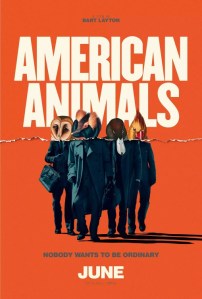 This review is weeks late after having sat down and watched American Animals, and it’s stuck with me in a powerful way. It’s a movie that pulls back the disparity between crime in the movies, so stylized and slick and carefree, and crime in real life, often traumatic, dehumanizing, and with lifelong complications for both victim and perpetrator. It’s a movie that examines a youthful sense of ennui that their lives are missing out on something extraordinary, and a step too far over a very clear moral line thanks to a fantasy given shape by escapist movies and other media. It’s also a slippery I, Tonya-style look at memory and contradiction but this time from the real-life people involved. It’s an entertaining dark comedy, an unexpected true-crime caper, and most resonating of all, a nerve-wracking thriller that left me morally queasy and unwell, but in a good way. In short, American Animals is one of the best films I have seen so far in 2018.
In 2004, at a small Kentucky liberal arts university, four young men are planning their own version of the “perfect crime.” The school has a rare books section including an original copy of Darwin’s Origin of Species and a large and valuable edition of John James Audobon’s The Birds of America. The books are appraised at $12 million dollars. Spencer (Barry Keoghan), an art student, teams up with Warren (Evan Peters), Erik (Jared Abrahamson), and Chas (Blake Jenner) to plot a daring heist. The men feel like their lives are missing something exciting and a heist is just the ticket. They just have to break in, steal the books, and subdue a librarian (Ann Dowd). Easy stuff, right?
 For the first half of the movie, American Animals plays out like a dark comedy. I had no prior knowledge that we were going to get the real-life subjects appearing as themselves in interviews cut throughout the film (their family members are still actors though). The film even plays around with this narrative hook for a few laughs, making quick cuts for punchlines and trying to square conflicting accounts, like having one scene alternate between two locations in dispute of its telling. It also helps set one of the major themes going forward in a nimble fashion, namely the difference between the reality of events and the whimsical, fantasy movie version of what an excursion into crime would be like. Having been bred on cinema’s glorified depictions of heists, the guys come to assume that a heist is sexy and fun and something that doesn’t end up hurting anyone. There’s a charming quality to the fact that Spencer uses his art skills to create models of the rare books room. There’s a laughable ingenuity to the fact that they’re planning on holding the heist in the middle of their class exams, since who would suspect students during that important time? There’s a bemused naiveté about the power of their disguises when they dress as a shuffling group of old men in powdered faces. We’re set up for a funny story about bumbling students falling all over themselves at attempted criminal shenanigans.
I was expecting a relatively light movie just from the plot particulars. It’s a heist film and the goal is to steal a bunch of books. It seemed small-scale in scope and anodyne. What trouble could a group of students get into attempting to steal books? Writer/director Bart Layton (The Imposter) seems to know this, lulling the audience into a false sense of security. He even teases the movie version of what the heist might be like, with our characters suavely stepping into their parts with practiced precision, all while music reminiscent of the Ocean’s Eleven franchise hums in the background. This is the cool-movie version, the version the characters have fantasized over in their minds, and the version that the audience is more attuned to expect. What we actually get is something very different. The heist itself plays out in excruciating detail and it runs counter to their planning. The reality of subduing the librarian is upsetting. It’s supposed to be so simple, after all, but the reality is anything but. The characters almost avoid this whole scenario, aborting their heist only to return back to it the next day. You feel the anguish of how close they were to turning away at several steps, the moments this ordeal could have been avoided, and yet fate barrels onward, energized by a misplaced sense of purpose. American Animals doesn’t let you or its characters off the hook either. I was fidgeting and sweating nervously throughout the heist and its subsequent fallout. Again, this is all about a bunch of stolen books, and I was beside myself with anxiety.
 It’s only afterwards and looking back that you realize how masterfully Layton has built up his scenes and the necessary information to make you squirm. With every heist, the particulars of the setting, the challenges and tight window need to be established, and once that occurs, we’re hoping for unexpected complications. But in order for those unexpected consequences to really hit hard, we have to be trained with what Plan A was going to be, and American Animals does this superbly. People have their designated roles and areas they refuse to partake in, like Eric makes it clearly known he will not be responsible for subduing the librarian in any way. Of course, you can expect what will eventually happen, pushing his character to an even more uncomfortable place. I was very appreciative that there’s an extended resolution after the heist, where the guys try to unload the books to a seller, and the further complications. You really feel the screws being tightened and the overwhelming feeling of dread. It’s another confirmation for me that I’m just not cut out for a life of crime. The day-to-day anxiety is just too much.
I left this movie feeling a strange mixture of jubilation and sadness, still reeling from the expertly developed and executed moral tension. The technical skills are just as strong, each working in succinct harmonious sequence to bring about Layton’s vision to startling effect. The editing is extremely tightly constructed. The smooth cinematography by Ole Bratt Birkeland frames the tension and comedy expertly, and the ominous music by Anne Nikitin kept me on the edge of my seat. It’s almost like a full-blown David Fincher film by the end. The acting is another strong point, with each actor initially relegated into a stock role (“The Muscle,” “The Wheelman,” etc.) we’ve come to associate with these kinds of movies. The film nicely pushes the characters beyond a casual, cursory understanding, blurring the lines of who they are as they blur lines of their own. A surprise standout is Blake Jenner (unrelated to the Kardashians/Jenner clan) who joins the team the latest, seems like a stereotypical rich jock lunkhead, but when he breaks down and articulates why the team is as screwed as they are, his clarity can catch you off guard. He’s the first to realize they’ve trashed their lives and are doomed and for nothing. Also deserving of praise is the always-wonderful Ann Dowd (The Handmaid’s Tale); your heart hurts for this poor woman who is confused, scared, and undeserving of her harrowing ordeal.
 American Animals hasn’t been able to leave my thoughts for weeks, which is usually the sign of a pretty good movie. It upset me. It rattled me. It entertained me. Most of all, it made me think, about the lines people cross in the name of missing out on some vague sense of grand experience, of the differences between the reality of crime and our appealing fantasy versions of crime, and why those stories appeal to us in general. I kept thinking about the pain these four men had caused themselves and others and their regrets. I kept thinking about how smartly Layton utilizes documentary storytelling techniques to enhance his film as well as better examine the disconnect of reality-versus-movies. It’s a movie that could have been told as a documentary but excels best as a hybrid of the two, one that challenges our conception. I’m shocked it wasn’t credited to a book or news article as its source material, meaning Layton compiled all of this impressively on his own. This is a movie that got under my skin, that made me uncomfortable, but also thrilled me and entertained me from its first minute until its very last. I highly advise looking for American Animals once it becomes readily available.
Nate’s Grade: A
Share this:

The Killing of a Sacred Deer (2017)
 Greek filmmaker Yorgos Lanthimos might just be the most perversely ingenious creative mind working in movies today. After Dogtooth and The Lobster, I will see anything that has this man’s name attached to it, especially as a writer/director. Lanthimos’ latest, The Killing of a Sacred Deer, is a challenging revenge thriller, a macabre comedy, a morality play, and a generally uncomfortable watch that is just as alienating as it is totally brilliant.
Steven Murphy (Colin Farrell) is a heart surgeon with a loving family that includes his wife, Anna (Nicole Kidman), teen daughter Kim (Tomorrowland’s Raffrey Cassidy), and young song Bob (Sunny Suljic). Then there’s Martin (Barry Keoghan), the lonely son of a patient who died on Steven’s operating table. He won’t leave Steven alone and doesn’t understand boundaries, even trying to hook up Steven with his lonely mother (Alicia Silverstone, yep you read that right). Martin even takes an interest in Kim. However, once Steven’s son falls victim of a mysterious illness and becomes paralyzed, Martin makes his true intentions clear. He’s poisoned all three of the Murphy family members and they are destined to die slowly unless Steven kills one of them. He has to choose which family member’s life to take with his own hands, or else they all die.
 It’s hard for me to think of whom exactly to recommend this movie to because it is so intentionally off-putting. It’s intended to make you awkwardly squirm and question what you are watching. This will not be a fun watch by most accounts unless you’re a very select person who has a dark sense of humor and an appreciation for something different. Lanthimos seems to be purposely testing his audience’s endurance from the start. We open on several seconds of black to test our patience and then an extended close-up of real open-heart surgery. My pal Ben Bailey had to shield his face from the screen. From there, the movie defies your expectations at most turns and digs further into its depths of darkness. This is one of those movies where you wonder whether it will go “there” and it most assuredly goes there and beyond. One minute you’ll be cringing, the next you’ll be cackling, and the next you’ll be deeply unsettled, and then maybe back to laughing if you’re like me. Much like Lanthimos’ other movies, his deadpan sense of comedy is his prescription for an absurd world. It’s a movie where you have to actively work to adjust to its bizarre wavelength, but if you can, there are rewards aplenty. I can’t stop thinking about it.
Unlike The Lobster, this doesn’t exist in a completely parallel universe but more of a cracked, heightened version of our own. Lanthimos’ breakout film, 2009’s Dogtooth, dropped the audience into a strange world and expected us to catch up. This is similar. The flatly comic conversations become a sort of absurdist poetry. Everyday moments can be given one extra strange beat and become hilarious. Scene to scene, I didn’t know what would happen. The movie allows its story to properly breathe while finding room for its characters to discover intriguing diversions and insights, like Martin’s recollection of how he and his father eat spaghetti the same way. There’s an unusual sexual kink that involves giving oneself completely to another that makes more than one appearance, enough to question the connection between them. The very geneses of that kink I think alligns with a character’s god complex, but that’s my working interpretation. It made me rethink about the aberrant concepts of sexuality in Dogtooth, a.k.a. the nightmare result of helicopter parenting. The handling of pubescent sexuality, and the idea of incorrectly applying information learned from other settings, is just one more tool to make the audience uneasy. Killing of a Sacred Deer exists in a closer approximation of our world in order for there to be a better sense of stakes. Somebody is going to die, and if Steven cannot choose then everyone will die. This isn’t a fantasy world but a real family being terrorized by a demented and vengeful stalker. This gangly teenager is more terrifying and determined than just about any standard slasher villain.
 This is a modern-day Greek tragedy literally inspired by an ancient one. Prior to the Trojan War, Agamemnon was hunting and killed one of the sacred deer belonging to Artemis. The angry goddess stranded Agamemnon’s ships and demanded a sacrifice in order for the winds to return. He had to choose one of his family members to kill, and Iphigenia got the short end of that one. Euripides’ classic work gets a fresh retooling and Lanthimos is not one to merely stand on ceremony. He smartly develops his premise and takes it in organic directions that feel believable even given the ludicrous circumstances. That is Lanthimos’ gift as a storyteller, being able to make the ludicrous feel genuine. After the half-hour mark, where Martin comes clean, the movie really takes off. Does Steven tell his family and how much? Does he take matters into his own hands to convince Martin to stop? Is he actually culpable for the death of Martin’s father? Once the reality becomes clear and people starting getting increasingly sick, the movie becomes even direr. Steven is given the unenviable position to choose life and death, though he frequently shucks responsibility and only continues to make matters worse. Once his family comes to terms with the reality of Martin’s threat, they each try different methods to argue their personal favor to dear old dad. They vie to be father’s favorite or, at least, not his most expendable loved one. It’s a richly macabre jockeying that had me laughing and then cackling from the plain absurdity. Lanthimos presents a tragedy and forces the audience to simmer and contemplate it, but he doesn’t put his characters on hold either. They are adapting and have their own agendas, mostly doing whatever they can to campaign for their lives at the expense of their family (Vin Diesel’s Fast and Furious character would loath this movie with a sleeveless fury).
The end deserves its own mention but fear not dear reader I won’t spoil it. It’s a sequence that had me literally biting my own hand in anxiety. I was pushing myself backwards in my chair, trying to instinctively escape the moment. It’s the culmination of the movie and feels entirely in keeping with Lanthimos’ twisted vision and the depiction of Steven as a weak man. There’s a strange sense of inevitability to it all that marks the best tragedies. I don’t know if I’ll sit through a more intense, uncomfortable few minutes in 2017, and yes I’ve seen, and appreciate, Darren Aronofsky’s mother! of difficult 2017 sits.
As much as this is a thriller it also feels just as much a satire of overwrought Hollywood thrillers. The killer isn’t some shadowy evil genius. He’s just a very determined teenager in your neighborhood. There are several moments that are difficult to describe but I know Lanthimos is doing them on purpose as a critique of thrillers. At the end, a character shakes a generous heaping of ketchup onto a plate of French fries, and we’re meant to get the lazy metaphor of the sloshing ketchup as spilled blood. However, under Lanthimos’ heavy direction, the shot holds longer, the accompanying soundtrack becomes an operatic crescendo, and the whole thing turns comic. Lanthimos has to know what he’s doing here, commenting on the lazy symbolism of dread in overwrought thrillers. There’s another instance where Martin has severely bitten into Steven’s arm. Martin’s apologetic and promises to make it right and then proceeds to bite a chunk of flesh out of his own arm and spit it onto the floor as an offering. That would have been creepy enough but then Lanthimos goes one step further. “Get it, it’s a metaphor,” Martin explains. It’s one in a series of moments where Lanthimos goes a step further into pointed genre satire. It’s possible I’m reading too much into the rationale behind some of these oddities but I don’t really think so. It seems too knowing, too intentional.
 The Killing of a Sacred Deer is a movie that invites discussion, analysis, and just a general debriefing in the “what the hell did I just watch?” vein. This is a movie experience that calls upon the full range of human emotions, and sometimes in the same moment. Lanthimos’ modern Greek tragedy serves up a self-aware critique of its own genre, as he puts his personal stamp on the serial killer thriller. This is also an alienating film that doesn’t try to be accessible for a wider audience. It almost feels like Andy Kaufman doing an experiment replicating Stanley Kubrick (and it was filmed in Cincinnati). Even if you loved Lathimos’ most high profile work, The Lobster, I don’t know if you’d feel the same way about Killing of a Sacred Deer. It wears its off-putting and moody nature as a badge of honor. I found it equally ridiculous and compelling, reflective and over-the-top, sardonic and serious. Dear reader, I have no idea what you’ll think of this thing. If you’re game for a demanding and unique filmgoing experience and don’t mind being pushed in painfully awkward places, then drop into the stunning world of Lanthimos’ purely twisted imagination. Killing of a Sacred Deer just gets better the more I dissect it, finding new meaning and connections. If you can handle its burdens of discomfort, The Killing of a Sacred Deer is one of the most memorable films of the year and also one of the best.
Nate’s Grade: A-


 nathanzoebl
You must be logged in to post a comment.