Blog Archives
Wicked: For Good (2025)

To paraphrase a famous debate line, I knew Wicked, Wicked was one of my top films of 2024, and you, Wicked: For Good, are no Wicked. Obviously that’s not completely true as For Good is the second half of the adaptation of the popular Broadway musical, of which only the first act compromised the prior movie released a year ago. The problem was that the first Wicked movie felt complete, and had there never been another second after, it would have served as a fitting and even moving portrait of the unknown back-story to the Wicked Witch of the West and the implied propaganda that would taint the perception of the citizens of Oz. The movie was two hours and forty minutes but it felt extremely well-paced and developed. It felt, more or less, complete, even though I know it was only adapting half the musical. In short, it did too good of a job, and now Wicked: For Good suffers as a sequel because what’s left to tell just isn’t as compelling or as emotionally or thematically coherent as its charming predecessor. Plus, all the banger songs were clearly in the first movie.
After the events of the first movie, Elphaba (Cynthia Erivio) has assumed the mantle of the Wicked Witch of the West and is sabotaging the Wizard of Oz’s (Jeff Goldblum) plans at expansion and animal abuse. Glinda (Ariana Grande) is the Wizard’s public ambassador and the “good witch” to inspire the masses, even though she doesn’t possess actual magical abilities. Glinda wishes dearly that Elphaba will change her mind and decide to work with her and the Wizard. However, Elphaba wants to expose corruption, and the Wizard is at the top of her list of the corrupt and powerful needing to be toppled for good.

For Good suffers from the adaptation struggles the 2024 Wicked film was able to avoid. The first movie was an effervescent treat built upon a poignant friendship and some killer songs given the full showstopper visual treatment. It was a vibrant adaptation, and while it expanded upon the stage show significantly, the extra time with the characters felt like breathing space, and it all contributed to what felt to me like an extremely well paced and well developed and arguably complete movie experience. Now the second act of a musical is almost always the shorter of the two, and For Good is about 30 minutes shorter than its predecessor. The filmmakers even added two new songs for Oscar eligibility and further padding, neither of which are winners (more on the songs later in the review). That sense of care is not present in For Good, as characters are frustratingly repeating beats they already worked through. Take for instance Glinda, who begins the first movie as an entitled popular girl used to getting her own way, and by the end of the movie, she’s grown to see the world differently and through her sisterly friendship with Elphaba, she has a more empathetic and grounded perspective. She has already changed for the better, and yet in For Good it feels like the movie kicks her character growth backwards. She has to again learn that maybe the Wizard and others are not the best people in charge just because they are. Wicked is a victim of its own success. The character development and arc was so well realized in the first movie that Glinda feels like she’s repeating lessons she’s already learned. I also don’t buy Elphaba being seriously tempted by the Wizard’s offer of collaboration after all she experienced and learned earlier. It’s irksome to have the characters seem curiously different from where we left them in 2024’s Wicked. There is also a character relationship revelation that I and many others had figured out FROM THE OPENING SCENE of the first movie. Behold, dear reader, For Good doesn’t even address this until the last twenty minutes of the movie and it does absolutely nothing with this revelation. I was flabbergasted.
The biggest time-waster and padding is when Wicked drags The Wizard of Oz characters and plot incidents awkwardly into its own universe. Granted, the entire enterprise is supposed to be the unknown back-story for the villain of The Wizard of Oz which gives it its identity. Except Dorothy and her lot are not essential at all to telling this story, as evident with the sense that the 2024 Wicked could feel complete. Dorothy and her motley crew of locals, some of whom are made up of previously established characters, are given the Rosencrantz and Gildenstern treatment, meaning they’re primarily kept off-screen and incidental. You don’t even see Dorothy’s face once. These characters feel annoyingly tacked-on and inconsequential to the story we’ve already spent three hours with. They’re knowing nods for the audience and they’re also making efforts to better pad out the running time. I don’t fully comprehend their importance in this new retelling. The treacherous Madame Morrible (Michelle Yeoh) sees the presence of Dorothy as an advantageous development, like she can use her as a Chosen One to thwart Elphaba. It’s never remotely explained why this makes sense. Why this person versus any other Oz citizen? Dorothy possesses special shoes but we’ve seen what can be accomplished with them. They’re not really some superpower or a weapon, more an item of personal attachment for Elphaba she would like returned. In this retelling, the entire inclusion of Dorothy and her friends is a means to an end for a public ruse. It might seem odd to say this Wizard of Oz back-story would have been better minus Dorothy but there it is.

Now it’s time to discuss the actual songs for this movie musical. The best known and most popular tunes were all in the first act and thus the first movie. The songs for For Good are a combination of middling ballads and continuation of the leitmotifs and themes of the previous one. There’s perhaps a bigger emotional current when characters bring back melodies and lyrics from the first movie to expand or contrast, like “I’m Not That Girl.” Did you want another song with Goldblum singing? The biggest number is “For Good” where Elphaba and Glinda face off and admit their shared sisterly love for one another, but again this was already established by the end of 2024’s Wicked. It’s more explicitly stated through song but the sentiment was evident to me already. Adding further disappointment, returning director John M. Chu (Into the Heights, Crazy Rich Asians) lacks the same thoughtful staging of the musical numbers in this edition. He is a filmmaker who innately knows how to adapt stage musicals into the medium of film, and he did so splendidly with 2024’s Wicked. With For Good, the staging lacks a real immersion and visual dynamism, often murky or overly saturated, like “No Good Deed” being performed almost entirely with intrusive sunsetting silhouettes dominating the screen. The less engaging songs, added with less engaging visual staging, make the movie feel longer and less jubilant. I don’t know if “For Good” has the intended emotional crescendo simply because this movie isn’t nearly as good.
As a personal note, the 2024 Wicked was the last movie I saw in theaters with my father while he was alive. We were supposed to see Gladiator II together as a family after Thanksgiving but he wasn’t feeling up to it, and then a little more than two weeks later he was unresponsive. I’m happy Wicked was such a pleasant and enjoyable experience for him, but as we left the theater, he asked me, “Wasn’t there supposed to be more?” We had seen the stage show when it toured through our city many years ago, and I remarked that there was going to be a whole second movie adapting the second act of the musical and it was going to be released in a year. He nodded and I felt the silent acknowledgement shared between us: he would not be around to see the conclusion, that it was a future unavailable to him. So it’s hard for me to not have some melancholy feelings with For Good, and I’ll admit maybe that’s influencing my critique.

Wicked: For Good is a frustrating, disappointing extension of what had been a sterling and magical original movie. It doesn’t outright ruin what came before it but confirms for me that 2024’s Wicked could stand on its own. The songs aren’t as good. The staging and visuals aren’t as good. The character development feels repeated and occasionally confounding. The plotting is stretched and unsatisfying. The inclusion of the more direct Wizard of Oz characters feels arbitrary and unnecessary. The actors are still charming and affecting and sing wonderfully, but they’re also unable to defy the gravity of the material they’re stuck with. If you’re a super fan of the source material, albeit the original story by L. Frank Baum, the 1939 Wizard of Oz movie, the Gregory Maguire book, the 2000s stage musical, or even the first movie, you will probably find enough to sing along to and walk away fairly happy. I loved the 2024 Wicked and was left mostly cold at the concluding half but I realize I very well may be a curmudgeonly minority here. My advice would be to consider the 2024 Wicked a complete movie and skip For Good.
Nate’s Grade: C+
Share this:

Wicked: Part One (2024)

It’s shocking that it took this long for Wicked to make its way from the Broadway stage to the big screen. The musical, based upon Gregory Maguire’s novel, began in 2003 and while it may have lost out on the biggest Tony Awards that year to Avenue Q (it seems astonishing now but… you just had to be there in 2004, theater kids) the show has been a smash for over two decades, accruing over a billion dollars as the second highest-grossing stage show of all time. As show after show got its turn as a movie, I kept wondering what was taking so long with an obviously mass appealing show like Wicked. It’s the classic Hollywood desire of “same but different,” a reclamation project for none other than the Wicked Witch of the West, retelling her tale from her perspective. Well, Wicked’s time has eventually dawned, and the studio is going to feast upon its protracted wait. Taking a page from the YA adaptation trend that dominated the 2010s, they’ve split the show into two movies, separated by a full year, hoping to better capitalize on the phenomenon. I was wary about Part One being 150 minutes, the same length as the ENTIRE Wicked stage show, but having seen the finished product, and by “finished” I mean one half, I can safely say that Wicked is genuinely fabulous and deftly defies the gravity of expectations.
In the fantasy world of Oz, the green-skinned outcast Elphaba (Cynthia Erivo) is looked at with scorn, derision, and fear. She’s always been different and never fully accepted by her father who blames her for her mother’s death and her younger sister Nessarose (Marissa Bode) being stricken to a wheelchair. Nessa is going to study at Shiz University with all the other up-and-coming coeds of the land of Oz, including Glinda (Arianna Grande), a popular and frivolous preppie gal peppered in pink pastels. Glinda desperately wants to be taken seriously and become a witch, studying magic under the tutelage of the esteemed Madame Morrible (Michelle Yeoh). Instead, Morrible’s fascination falls upon Elphaba after she reveals her tremendous magical ability in a moment of extreme emotion. Now Elphaba is enrolled at the magic school and learning about the way of the world, and she’s stuck with Glinda as her roommate. The two women couldn’t be any more different but over the course of the movie, we’ll uncover how one became Glinda the Good and the other the Wicked Witch of the West.

At two-and-a-half hours long, again the length of both acts of the stage show, Wicked Part One only covers the events of the show’s first act, and yet it feels complete and satisfying and, even most surprising, extremely well paced. It’s hard for me to fathom what could have been lost to get the running time down as each scene adds something valuable to our better understanding of these characters and their progression and the discovery of the larger world. It’s a movie that feels constantly in motion, propelling forward with such winning ebullient energy that it becomes infectious. It’s also not afraid to slow things down, to allow moments to breathe, and to provide further characterization and shading that wasn’t included in the stage show. The adaptation brings the fireworks for the finale and raises the visual stakes and danger in a manner that feels exciting and compellingly cinematic. Considering the resplendent results, I feel I could argue that the movie is actually -here comes the heretical hyperbole, theater kids- an improvement over the stage musical. It makes me even more excited for a bolder, longer, potentially even more emotionally satisfying second part in November 2025.
One of my primary praises for 2021’s In the Heights was that director John M. Chu, who cut his teeth helming the Step Up movies, knows exactly how to adapt musicals to maximize the potential of the big screen. If you’re a fan of musicals, old and new, you’ll find yourself swept away with the scope and intricacy of these large fantasy worlds, the flourishes of costume and production design, as well as the creative choreography making fine use of spaces and the power of film editing. There’s a rousing dance sequence set in a library with shelves that rotate around the room, making the slippery choreography that much more immersive, impressive, and acrobatic. Even big crowd numbers are given the knowing framing and sense of scale to hit their full potential, from the opening rendition of Munchkinland celebrating the death of the Wicked Witch of the West complete with giant burning effigy that would make a Wickerman envious, to the introduction to the City of Oz where it appears every citizen has a jovial role to play in welcoming strangers to their enchanted capital city. Chu’s nimble camerawork allows us to really enjoy the staging and skills of the talent onscreen, bringing a beating sense of vitality we crave from musical theater writ large. Wicked is simply one of the best stage-to-screen adaptations in musical theater history and a joyous experience that allows the viewer sumptuous visuals.
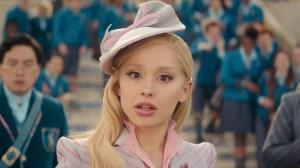
At its core, the story of Wicked is about some pretty resonant themes like self-acceptance, bullying, the fear of what is different or misunderstood, and all of this is built upon an irresistible friendship between Glinda and Elphaba. The rivals-to-allies formula isn’t new but it is tremendously effective and satisfying, especially when both characters are as well drawn and deserving of our empathy as these two ladies. They’re each on a different meaningful character arc for us to chart their personal growth and disillusion with what they’ve been taught is The Way Things Are. One is starting from a disadvantaged position and gaining traction through an outward demonstration of power, and the other is beginning in a position of privilege and becoming humble and more considerate as she acknowledges the challenges of others in a manner that doesn’t have to reconfirm her enviable “goodness.” It just works, and both women are fantastic in their roles. I was on the verge of tears at several points and my heart felt as full as a balloon throughout because of the emotional engagement and heartwarming camaraderie between our two leading ladies. With all its razzle dazzle, Wicked is a story of feminine friendship first and foremost and emotionally rewarding to experience, with the soaring music as a bonus.
Let’s finally talk about the music, a key factor in the enjoyment of any musical, naturally. The music was written by Stephen Schwartz, the Oscar-winning composer for “Colors of the Wind” from Pocahontas as well as “Believe” from The Prince of Egypt. I found his Wicked numbers to range from good to astoundingly good, with catchy ear-worms like “Popular” to the anthemic power and sweep of “Defying Gravity.” The cheeky and toe-tapping “Dancing Through Life” is a showcase for Jonathan Bailey (Bridgerton) and benefits from the aforementioned creative library choreography. “I’m Not That Girl” is a heartbreaking ode to the girls who don’t think of themselves as enough, which is begging for a reappearance in Part Two. The only clunker is “A Sentimental Man” but that’s more the result of the deficiencies of Jeff Goldblum as a singer than the song. I await the reuse of themes and motifs that will make the music even more thematically rich in the eventual Part Two.

Count me as part of the skeptical throng when it was announced that Grande, who hasn’t acted in over ten years, was cast as Glinda. I’m here to say that she is uniformly great. The Glinda role is the more outwardly showy role and thus immediately more memorable. It’s the far more comedic role, in fact the main source of comedy in the show, and Grande has serious comedic chops. Naturally she excels with the singing and its purposeful miasmic bombast, but it’s the subtle comedic styling and the exaggerated physicality that impressed me the most, like a moment of her twirling on the floor as an added dramatic flourish. There’s one scene where she’s just marching up and down a hallway in full exuberance, kicking, dancing, and exploding with joy. I anticipated that Erivo (Bad Times at the El Royale) would be exceptional, and of course the Broadway vet is, as she brings such simmering life to Elphaba. There’s a strength in equal measure to her vulnerability, making the character fully felt. Erivo also delivers during the big moments, like the climax of the movie that can give you goosebumps in hiw it weaves together empowerment and defiance and self-acceptance. Together, the two women are an unbreakable pair of performers and heroes that we’ll want to see triumph over adversity.
After decades of belabored waiting, Wicked finally makes its journey from stage to screen and I must say it was worth every minute. The film, even at only one half, feels complete and richly realized, building upon the strong foundation of the stage show and its numerous winning elements and masterfully translating them to cinema, taking full advantage of the visual possibilities while also expanding upon the story and themes for further enrichment. While born in the early 2000s War on Terror Bush era of politics, Wicked’s themes of anti-immigrant fear-mongering as scapegoats still bears striking resonance today, as do the emerging warnings of fascism in Oz. If you’re a fan of The Wizard of Oz, musical theater, or even just grandiose spectacle that doesn’t dilute grandiose feelings, then step into Wicked and you too will feel like you’re floating on air.
Nate’s Grade: A


 nathanzoebl
You must be logged in to post a comment.