Blog Archives
Kraven the Hunter (2024)
 Kraven the Hunter feels like a movie that was never meant to be seen. That seems paradoxical considering the efforts of many talented people over years took place to bring the Spider-Man villain solo movie to some form of creaking, wheezing life. Since 2017, Sony has decided to create their own Spider-Man universes minus, of course, Spider-Man. They’ve been making solo movies about Spider-Man villains and while the Venom movies have been inexplicably popular, the rest have been regarded as unmitigated disasters. In 2022, Morbius was bad enough that Sony thought they could re-release it to capitalize on the memes and derisive entertainment factor. To no avail and a total lack of morbin’ time. In 2024, Sony released three Spider-Man villain movies, though Madame Web was never really a villain per se, but then again nobody really wanted a Madame Web movie anyhow, though it once again gave us some memorable memes. Now Kraven is reportedly closing out this shared cinematic universe experiment, and the president of Sony is blaming those mean ole film critics for the failures of these would-be superhero classics (always a smart movie, assuming audiences are incapable of making up their own minds). Delayed almost two years from its original January 2023 release date, Kraven the Hunter is the death knell of this enterprise and it comes to a thoroughly mediocre conclusion, feeling even more disposable, poorly developed, and mechanical, and ultimately a footnote to a footnote of superhero cinema.
Kraven, nee Sergei Kravinoff (Aaron Taylor-Johnson, portraying his third superhero) is the son of a notorious Russian crime boss, Nikolai (Russell Crowe). One day on a hunting trip in Ghana, Sergei rescues his brother Dimitri (Fred Hechinger) from a lion. The lion injures Sergei and takes him for food, but thanks to a magic elixir from a tourist, Calypso (Ariana DeBose), who saves him. Now he has animal-like senses and speed and strength. As an adult, Kraven seeks out villains to bring to justice, but he’s also trying to square the legacy of his father and whether he is like dad. 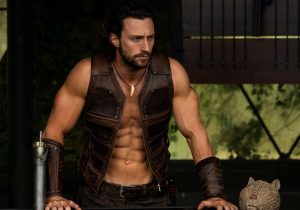
The problem with these Spider-Man-Minus-Spider-Man movies is making people get interested in the famous web-slinger’s rogues gallery. This usually means treating the character’s best known for trading punches with another hero as their own individual anti-hero, complete with a more villainous villain for our future villains to have to topple. Usually these villains (the actual individual movie antagonists, not the protagonists) are an imitation of our heroes (still referencing the future villains), the mirror version of them. So if your protagonist is going to be a vampire, then your antagonist is going to be a slightly more evil vampire. If your protagonist is an alien goo monster who likes to eat heads, then your antagonist is going to be a slightly more evil alien goo monster that likes to eat heads. You get the idea. However, you digest enough of these, and it all seems a bit too perfunctory, the main character having to defeat a version of themself. The main challenge is finding a way to make an audience care about these characters, and having them rescue a love interest or defeat a new-but-same villain with the implicit promise that maybe, if you’re patient enough, you might see them eventually try to murder Spider-Man, is not it. I’m not against the idea of giving these villains their origin tales, but it feels like in order to make them more palatable to a mass audience means they’re neutering the nature of these characters. The hypothetical future Sinister Six movie can’t all be six misunderstandings against Spider-Man.
Alas, Kraven is a real bore of an action movie even with its R-rating, the first for these Spider-Man villain movies. The added bloodshed and curse words don’t exactly make the movie feel more adult when we’re still dealing with plotlines like a super lion biting our hero and giving him super lion powers, much like the origin story of Spider-Man, or another villain suffering from a very silly and similar Amazing Spider-Man 2 Goblin-itus medical malady. This is not a serious movie in the slightest but that doesn’t mean it can’t be passably fun, but everyone is just so dour and passionless that it drains all entertainment. At least Madame Web was perplexingly interesting with its bad decisions. There’s such little energy to be had through the middling two hours. Kraven is gifted superhuman powers and he uses them to hunt down bad men and big game poachers, becoming let’s say Captain Planet if he watched nothing but Charles Bronson movies. There’s got to be an exciting movie there, or at least a more interesting one than what we eventually got here. It’s hijacked by some pretty rote family drama of a bad dad who was too hard on his kids and rescuing a kidnapped little brother who he feels guilty about leaving with the bad dad after Kraven got his new powers. The family drama is pretty rote and uninspired, with both of the other characters kept to the sidelines for most of the movie, which makes it hard to care that much about either of their impacts. The haphazard integration of a romantic subplot with Calypso is even more perfunctory when I would much rather see Kraven fall in love with a lion instead.
 I like J.C. Chandor as a director, and he’s someone who leaps at new challenges. His debut movie, 2011’s Margin Call, was an engrossing character piece about Wall Street traders and execs on the verge of the 2008 financial meltdown. It was so bare-bones that it was practically a play. His next film, 2013’s All is Lost, was the exact opposite: a movie completely told through visual storytelling and with a minimum of spoken words as Robert Redford tries to patch up his sinking boat. 2014’s A Most Violent Year was a slow-burn crime drama about the lengths people will go to escape their past and their nature. From there, Chandor has been circling larger studio projects, leaving 2016’s Deepwater Horizon and then replacing Kathryn Bigelow for Netflix’s action thriller, 2019 Triple Frontier. He’s a chameleon of a director and the only real point of interest I had with Kraven. What would he do in the superhero space? Well, the answer is not much. The visual flourishes we’ve seen before in other movies but without a sense of humor. Watching Kraven periodically run on all fours may make him more animal-like but it doesn’t look good. The movie gets lost in the convoluted mythology and rules of its characters and what they’re capable of, and so the action sequences feel cobbled together and short on imagination. The climax is during a stampede of buffalo but there’s no real danger here like dodging around the animals. They very conveniently allow space for our hero to fight his battle, thus becoming a thundering backdrop. Even if you’re overly generous, there’s not much here to excite the senses or even your morbid curiosity.
There is one line of dialogue that needs to be singled out for its absurdity. While Madame Web was ridiculed for its “researching spiders in the Amazon with my mother before she died” line, the filmmakers had the good sense to eliminate it from the final film, though not the good sense not to include it in their initial marketing. With Kraven the Hunter, there’s a character who talks about her mother and literally says, “She died and I never saw her again.” That’s usually how that works.
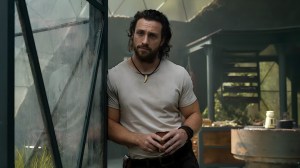 As the final piece of Sony’s Spider-Man villain spinoff universe, Kraven the Hunter brings this diversionary superhero franchise to a merciful end. The frustrating thing is that Kraven as a character can work, as recently demonstrated in the popular Spider-Man PlayStation video game sequel. He’s supposed to be the ultimate hunter, a force of nature, but that doesn’t mean he needs to carry his own movie, just like Morbius or Madame Web or any other Spidey villain. Launching these characters could have worked but needed much more imagination and care. Instead, it was Spider-Man movies without Spider-Man and, with the exception of the Venom movies with their goofy buddy movie appeal, audiences have responded with the indifference you would assume. It’s not enough for these movies to merely be adjacent to Spider-Man to be appealing. They need to be good, to be able to stand on their own, and to support an extended time with this character. It’s hard not to see the larger machinations for eager franchise-extension as the primary motivation. But if these are the impressions of the characters we’re getting, who would want any more? Turns out nobody was actively cravin’ another underdeveloped and mediocre superhero movie.
Nate’s Grade: C-
Share this:

Argylle (2024)
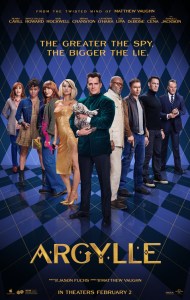 Knocked around by critics and tagged as the latest excuse for the Death of Filmmaking thanks to its overwhelming budget and general ironic indifference, Argylle is a goofy spy comedy that, while lesser, is an easy watch and would earn regular rotation as a TNT afternoon giant. It’s not trying to be more than a good time, and while its quippy attitude can feel forced and approaching irony overload, it’s also the kind of movie that entertains as breezy escapism. It’s fun. Enough.
Elly Conway (Bryce Dallas Howard) is a best-selling spy novelist with a dashing super spy Lothario lead character by the name of Argylle (Henry Cavill in the worst haircut of his career). She’s journeying with her pet cat, her closest relationship, when she’s stopped on a train by Aidan Wilde (Sam Rockwell). He tells her that he’s a real spy and that everything she’s written in her five novels has come true, and different covert agencies are taking notice. She’s got teams of assassins and spies coming for her, while Aidan tries his best to protect her and get her to remember key details that could save the world from nefarious forces.
 Argylle is too breezy and too predictable by half. It’s a spy thriller that I’m positive many will be able to predict the big twists miles before they occur. Why do all these spies want Elly Conway, and how could she know about the intricate world of international spy craft? The answer is exactly what you’d expect, if you’ve watched more than your share of twist-laden thrillers. Thankfully, director Matthew Vaughn (Kingsman, X-Men: First Class) and company dispatch with this central twist after an hour, providing more time to deal with the aftermath and build off of its story impact. Ah, dear reader, but there’s going to be another twist once you know the first, and again, if you can predict the first, you’re likely to predict the second, because stories about universally good people are often dull, and movies have provided a new medical maxim that characters use maladies to re-evaluate their prior life and choose to be better (oh how nimbly I’m dancing around these spoilers). What makes these predictions forgivable is that the movie seems to know you will anticipate them and has more to offer.
That’s because in this silly universe, very little seems to matter besides getting to the next scene. It’s not a satirical send-up of the genre like Vaughn’s Kingsman movies. Instead, it’s more of a generic distillation of spy thrillers, complete with bad guys walking through mission control banks of computers and barking impotent orders. The only added cleverness that sets the Argylle world apart is Elly’s writing, the fictional version of this far more bland spy universe. In the book parts, Vaughn takes note to raise the style as well as the tongue-in-cheek comedy. It’s supposed to be tone-deaf and dumb and ridiculous, because it’s the big screen version of bad genre writing. You can have fun with that, with characters so serious to the point of parody, with nonsensical technology and near escapes. But when you try to do the same thing in the so-called real world, then the movie starts to eradicate any sense of a baseline for credulity. I did like the practical advice of Aidan on how to crush the skulls of your downed enemy (“Just imagine you’re dancing The Twist.. twist and smash”). By the end of Argylle, Elly and Aidan can do just about anything because they’re practically superheroes. The entertainment of the fish-out-of-water aspect of Elly’s story is short-lived and unfulfilled because the movie becomes more of a tale of automatic self-actualization rather than growth.
 The direction feels rather drab at points, and many locations and scenes have a general sense of missing… something. Just watch any set and it appears so drastically empty that I questioned whether they cut back on the set dressers and props. Empty dance clubs. Empty streets. Empty hallways. Everything is too pristine, too sleek, and too empty and green screened (might be a result of COVID filmmaking). This carries over into the disappointing visual aesthetic, as Vaughn’s signature style feels dampened by the pesky CGI additions of many sequences, adding to the unreality rather than building out this minimalist world. If there had been an extra EXTRA twist that everything was also a story-within-a-spy-story, I would not have been that shocked, and it honestly would have explained the underwritten and underwhelming world of clandestine spy-making.
Vaughn errs in the core creative decision of having his main character mix reality and fantasy, not through the idea itself, which could be ripe, but through its confusing execution and editing. Having Elly hallucinate Agent Argylle in place of a real secret agent is fine, as we can contrast from her idealized version of a super spy, her James Bond, versus the actual grunts struggling to win the day. There are a couple problems with this execution though and firstly that the “reality” isn’t that far removed from the fantasy. This is still a world where Rockwell’s spy is able to commit amazing acts of dexterity and martial arts and balletic violence flying around rooms, but I guess he falls down more. The difference isn’t that fantastic when it’s already a hyper-stylized action world. The bigger issue is just how confusing it all plays out visually because we’re seeing Elly’s perspective and in rapid blinks Cavill will turn into Rockwell and vice versa. It makes for a jarring sequence that doesn’t fully capitalize on the comic potential while keeping the audience distant from fully engaging with the sheer simple pleasures of watching a fun fight. This happens throughout the first half of the movie and severely hampers the action scenes from being accessible. I think we needed a longer duration for this to work. We see Elly’s version for a period of time, and then we cut to the real world where Aidan is bouncing into walls, falling down, and flailing. By continuously jumping back and forth, not just in the scenes but in the same shots, Vaughn has made his movie harder to watch and harder to comprehend, and with a loud soundtrack blaring.
 There is one sequence of great filmmaking for Vaughn, but to explain such will require some spoilers, so beware, dear reader. There are three instances of the whirly-bird dance where a woman is lifted spread-eagle atop a man’s shoulders who then spins her around. The first time, it’s Agent Argylle and Legrange, played by Dua Lipa (Barbie) dripping with sexual energy. The second time is when Elly and Aidan are on a mission and he lifts her up, to her amusement and flirtation. She’s living out her fantasy version, with Rockwell standing in for Cavill and Howard standing in for Dua Lipa. We’ve gone from these stunningly attractive human specimens to people who look more ordinary, including a fuller figured woman engaging in the same sexy shenanigans as the conventional blonde bombshell. She can be her dream version of herself. Finally, the third occurrence happens during a climactic showdown where Elly and Aidan team up against an onslaught of faceless armed henchmen. With the aid of colorful smoke canisters, their offensive surge plays out like a couples’ dance routine, including holding one another for high kicks to incendiary devices. It’s all set to Leona Lewis’ cover of Snow Patrol’s “Run,” and as the music swells, it’s easy to get swept up too. Even the gunshots are set to the beats of the song, culminating in the final whirly-bird dance, except it’s not Elly being lifted, this time it’s Aidan. See, she’s not the Bond girl bombshell, she’s James Bond. It’s a silly moment but with the added setup, thematic underpinnings, and Vaughn’s virtuoso stylistic seizing of the moment, it plays out as empowerment and an expression of love. For real.
I can understand being generally disappointed with Argylle. It looks and feels like it’s been built on the parts of other better spy franchises and desperately lacks the charisma and personality of Vaughn’s Kingsman movies, themselves giddy and perverse satires. I wasn’t the biggest fan of 2017’s The Golden Circle sequel, but it’s got oodles of style to spare compared with Argylle. I wish Vaughn would push himself beyond the orbit of making cheeky, winky spy action comedies, the same genre he’s been playing in since 2015 and now for four movies. While the original Kingsman was a breath of fresh air with fun characters, a snarky attitude, and slick style, Argylle is all snark and minimal style. There’s so much comedy that feels like it should be funnier, from the travails of Elly’s CGI-enchanced cat to the floundering hand-to-hand combat. When recognizable names start showing up playing forgettable genre stock types, and then they start dabbling in accents as other genre stock types, it feels like the whole exercise is a miss. However, the central buddy relationship between Rockwell and Howard is where the movie works, and fortunately that’s the element that has the most foundational effort. This is a movie that, in the future, if it was on TV during a lazy day, you’d sit down and watch the rest and mostly be happy about it. Argylle isn’t anything new or fresh but it’s buoyed by its stars, and not the magazine cover models but its real stars, Rockwell and Howard. In their hands, even lesser spy comedies can still be fairly worthwhile escapist entertainment. Still, I must deduct some points for the movie missing a perfectly setup opportunity to have Henry Cavill and John Cena kiss onscreen at the end. It was right there, folks, and we all deserved it.
Nate’s Grade: C+


 nathanzoebl
You must be logged in to post a comment.