Blog Archives
Pain & Gain (2013)
 I think the audience for Pain and Gain is going to know exactly who they are, and I count myself amongst that number. The latest from director Michael Bay, often treated tantamount to Satan in many critical circles, has the based-on-a-true-story hook but really it’s the big stars, stylish violence, peculiar criminal antics, and overall overflowing machismo of the picture that will draw its audience. I knew after one watch of the trailer that I wanted to see it, though I was somewhat ashamed of the level of my interest (don’t want to taint your critical credentials with too much sympathy for the devil, after all). Pain and Gain is a trashy and entertaining jaunt, just as I hoped it would be, but it overstays its welcome and may leave you fatigued and possibly dejected (so… a typical Michael Bay movie? Still got it).
In 1995, three Miami, Florida goons enacted one of the most bizarre and sordid criminal schemes, a story that could supply a tabloid with enough juicy exposes for a year. Daniel Lugo (Mark Wahlberg) and his co-worker Adrian Doorbal (Anthony Mackie) are personal trainers at Sun Gym. Their days consist of pumping iron and hitting on ladies. One of Lugo’s clients is Victor Kershaw (Tony Shalhoub), a wealthy businessman with a nasty temper. Lugo and Doorbal, with the help of an ex-con and ex-junkie (Dwayne “The Rock” Johnson), kidnap Kershaw, hold him hostage for weeks, torture him, and eventually get him to sign over his assets to them. Afterwards they try to stage his “accidental” death, though like most things, it does not go according to plan. Penniless and broken, Kershaw seeks out help from a retired private eye, ED DuBois (Ed Harris), to provide validation for his case. The Miami police are laughing off his claims. Kershaw is concerned that the Sun Gym gang will strike again when their lavish lifestyle dips, and he’s right. Lugo and company get into even more trouble and the body count rises.
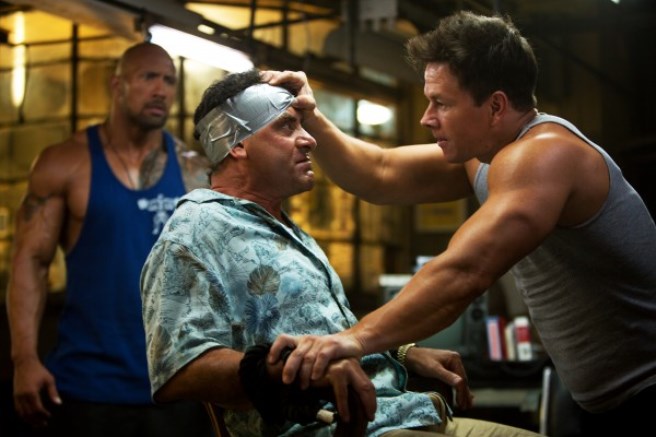 The results on screen are often entertaining in an over-the-top fashion, sustaining a rubbernecking captivation much like a horrendous car wreck. You just have to see how much crazier this thing gets, all the while muttering to yourself, “This was a true story?” It even gets to the point where the movie will remind you, via onscreen text as a man barbecues a batch of severed hands, that yes this is still a true story. Naturally there have been fictional inventions, character composites, and some details have been dropped to fit into the confines of a film narrative, but online research shows me that most of the larger plot beats are accurate, thus making the film even more compelling and disturbing. When the film is on, it feels manically alive with intrigue and absurdity. The problem is that it cannot keep this manic tone alive forever especially when actual innocent bodies start piling up (more on that later). There’s a certain uncomfortable tonal incongruity as the film develops and the comedy picks up a distasteful resonance. I love a well-executed dark comedy but just because something is macabre or unexpected does not automatically make it funny. Still, the movie has enough high-energy antisocial antics to keep you planted in your seat, laughing through bafflement.
Pain and Gain isn’t subtle in the slightest and yet it’s easily the most nuanced film of Bay’s career. Of course there are still the sleek cars, sexy babes, emphasis on style, and wanton destruction that are hallmarks of the man’s career, but the perspective is given a satirical prism, dropping us into the deluded, sub-American Psycho perspective of Lugo, a man with a very cracked view of the American Dream. The moral message reminds me of Marge Gunderson’s concluding musing in Fargo, telling a captured criminal, “There’s more to life than a little money, you know.” There’s some slight social commentary on wealth and the dirty tricks of capitalism, but really it’s the narcissistic delusions of a jacked-up criminal who believes he can succeed because he’s “seen a lot of movies.” You may even find yourself sympathizing with some of these knuckleheads, that is, until things get way out of hand. The screenplay by Christopher Markus and Stephen McFeely (Captain America: The First Avenger) is briskly paced and packed with bizarre details and even jumps into six different characters for voice over (Wahlberg, Johnson, Mackie, Shalhoub, Harris, and Bar Paly). For some characters it works as a great insight into their twisted logic but for others it’s just an easy set up for ridicule. The juvenile humor (did we really need a visual pubic hair joke?), candy-coated film palate, and sugar-rush, roid-rage plotting feel like a suitable match for the talents of the bombastic Bay.
The last thirty minutes of the movie will test your sensibilities of good taste. I’m all for having unlikable central characters just as long as the writer makes them interesting (what good is likeable but boring, the “friend zone” of characterization?). Some of movie history’s most fascinating characters have been scumbags and psychos. However, with that being said, I need my unlikeable characters to at least progress. When I’m stuck with a bad dude who keeps making the same bad mistakes, it can grow tiresome, and that’s where Pain and Gain ultimately lost me. Bay can’t quite keep up the charade of ironic bemusement forever, and a saggy second half starts to tread water, forcing the characters to act even more outlandish and inept. Did we need The Rock losing his big toe and then inexplicably giving it to a dog? It feels like the movie is filling time until the accidental murders come into being, raising the stakes. For a movie that’s 130 minutes, there should not be any need to fill time. During that long sad stretch, you start to feel disquiet, like the movie has lost its sense of perspective and the jokes have gotten too mean, too ugly, too outlandish. It doesn’t feel funny any more, and maybe that’s ultimately the point, but by the end Pain and Gain has soured. It overstays its welcome and then some.
 Its tone and connection to the real world raises an interesting and thorny question over whether something like this is appropriate. Should a story that involved the murders of innocent people end up becoming an over-the-top, stylized, lavishly glamorized Hollywood crime comedy? It has been over 15 years since the events of the Sun Gym gang, but is there a statue of limitations on good taste? Are we eventually destined for a vulgar film tackling the poor lives of the victims of 9/11? The answer is almost certain. What is off limits, or more pressingly, should anything be off limits to a comedic narrative? Is anyone really furious with Trey Parker and Matt Stone over their first film, Cannibal the Musical, transforming nineteenth century murder into song and dance? I doubt it, and yet there was something very off-putting about 2011’s 30 Minutes or Less, an unfunny comedy based around the true story of a pizza guy strapped with a bomb and ordered to rob a bank. The guy was blown to bits in real life (ha ha?). I guess I, as well as audiences, would have been more forgiving if the movie had been funny. I’m sure there would be fewer objections if Bay’s film had been more of a sober, contemplative drama on the sad acts of a bunch of desperate criminals, but with all the hyperbolic elements, machismo, and so-crazy-it-must-be-true plot turns, how could you turn this story into a serious drama? Not from the perspective of the nitwit criminals, at least. I don’t think the movie is ever positioning these guys as anti-heroes or excuses their excess.
Wahlberg (Ted) broke out as an actor thanks to a similar role as a wannabe star whose ambitions exceeded his grasp, and the man does dumb as good as just about anyone in Hollywood. It’s a specific kind of dumb, the angry, arrogant, pissy, self-involved kind of dumb that makes it acceptable to ridicule his character to no end. Johnson (G.I. Joe: Retaliation) gets to explore some interesting range as an actor, pacing around the demons of his character before just going hog-wild with the excess. Mackie (Gangster Squad) is arguable the most sympathetic of the group but also with the most to lose. Compared to his peers, he’s practically mild-mannered even though he takes injections into his penis. Shalhoub (TV’s Monk) is amusingly apoplectic and just enough of a jerk that you excuse his misfortune, at least for a little while. Ken Jeong (The Hangover) and Israeli model-turned-actor Bar Paly give the exact performances you would expect them to deliver. The best actor in the whole movie, though truth be told there isn’t a stinker in the bunch, is Emily Rutherford (Elizabethtown, TV’s The New Adventures of Old Christine) who plays Dubois’ wife. She has this calming, down-to-earth presence that seems to bring a small sense of peace to the madcap antics. She doesn’t have a lot of screen time but you’ll wish she had lots more.
Perhaps I’m being unfair to a movie that clearly isn’t intending to be anything but naughty, tacky, and gleefully excessive. In a way Pain and Gain reminds me of Tony Scott’s Domino, loosely based upon a true story but crushed to death by narrative kabuki and Scott’s characteristic excess. If I wanted to defend the much maligned Michael Bay, I’d argue what the real difference is between his excess and the excess of the more critically lauded Scott? Bay doesn’t have a slate of movies to his credit the likes of Top Gun, Crimson Tide, or True Romance. But isn’t flashy, artistic excess all the same when in the name of empty storytelling? Domino is also an apt comparison because it’s ultimately tiresome and far overstays its welcome, losing its audience with an endless array of odd sidesteps and moronic, deviant characters. While Pain and Gain has enough quirk and style to justify consideration, you may not respect yourself once it’s over.
Nate’s Grade: C+
Share this:

Gangster Squad (2013)
 It’s hard to mention the action thriller Gangster Squad without a passing reference to the Aurora, Colorado movie theater shooting in the summer of 2012, the reason for the film’s five-month delay and reshot action sequence. Gone is a shootout at the movies and now we have a confrontation in the streets of Chinatown. I wish they hadn’t stopped there. If given the opportunity, and remember they did have an additional five months, I would have scrapped Gangster Squad almost completely and started fresh.
In 1949, former boxer Mickey Cohen (Sean Penn) has seized control of Los Angeles organized crime. His influence extends even into a police, which forces Chief Parker (Nick Nolte) to go to desperate measures. He asks Sgt. John O’Mara (Josh Brolin) to assemble a team of enforcers to fight back. They won’t have badges but they will be pushed to use whatever means necessary to carry out their mission, which means blurring the line between what is considered lawful. O’Mara assembles a super group of former officers and one of them, Sgt. Jerry Wooters (Ryan Gosling) gets into even deeper danger when he starts seeing Mickey Cohen’s main squeeze, Grace Faraday (Emma Stone).
This movie is like if The Untouchables and L.A. Confidential had an illegitimate child and then abandoned it in a sewer where degenerate hobos raised it. Gangster Squad rips off other gangster movies with liberal abandon that I can’t even begin to list the lifts. I’d be less offended if I felt that the movie had more on its mind than just replicating the tone and look of noir cinema. Actually, it feels more like what they want to replicate is the tone or style of the video game L.A. Noir.
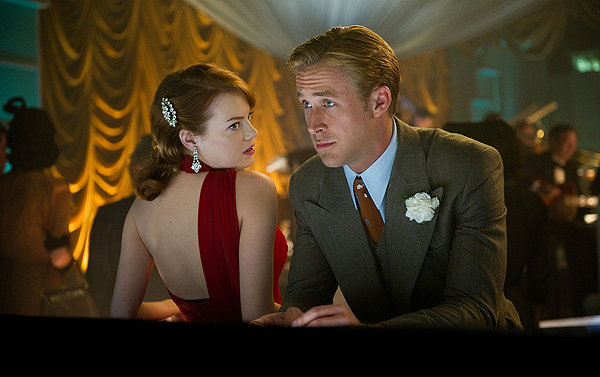 The main problem is that Gangster Squad really only has the skeletal outline of a plot. It’s missing any essential character and plot development. Here, I’ll summarize the barebones plot for you: Mickey Cohen is a bad guy. O’Mara forms a team. They have a montage taking out bad guys. Mickey takes out one of them. They have a showdown. That, ladies and gents, is it. There really aren’t any scenes that diverge from those scant descriptions. It felt like only five minutes passed from one of O’Mara’s guys getting killed (and just like The Untouchables, it’s the nerdy one) to them descending on Cohen’s headquarters and duking it out. Why does the film introduce the conflict of Wooters seeing Cohen’s girl if he never finds out? There isn’t even one scene presented to take advantage of this conflict. It just ends up being another half-baked plotline. It feels like the only development we get with Gangster Squad is through montages. What is also apparent is that O’Mara and his team really don’t have anything resembling the faintest notion of a plan. We watch them take out some bad guys via fights and shootouts but there’s no higher plotting to it. You get a sense that these former cops are just playing it by ear, looking for a fight every night. It’s hard to imagine that these people, even with their law enforcement and war experience, could be effective in the long term. Without any formative organization or greater planning, these guys just seem like dull bruisers bouncing from fight to fight with no sense of direction.
Then there’s the paucity of character work, relying solely on genre archetypes to do its work for the movie. O’Mara is the determined family man but his team can best be described by one-word classifications: The Black Guy (Anthony Mackie), The Nerdy Guy (Giovanni Ribisi), The Mexican Guy (Michael Pena), The Young Guy (Gosling), The Old Guy (Robert Patrick). That’s about it, though I suppose they do have different weapon preferences meant to supply all that missing characterization. Oh look, Officer Harris (Mackie) brings a knife to gunfights. That’s pretty much the beginning and end of his character. Wooters is so lackadaisical he feels like he’s on drugs, and Gosling’s soft-spoken, mealy-mouthed line delivery only adds to the effect. It feels like Gosling, in a stretch to find something interesting out of the mundane, said to himself, “I wonder if I could give a whole performance where I only speak under a certain vocal register.” Then there’s the woefully miscast Stone (The Amazing Spider-Man) as the femme fatale/mol to Mickey. I love Stone as an actress, but man-eater she is not and sultry seductress doesn’t fit her well either. Perhaps with the aid of a sharper script and a greater depth of character she could rise to the challenge. At no point does Gangster Squad really even attempt to make these people multi-dimensional. They never reflect on the moral turpitude of their own vigilante justice or the ramifications of their actions. There’s no room for ambiguity here.
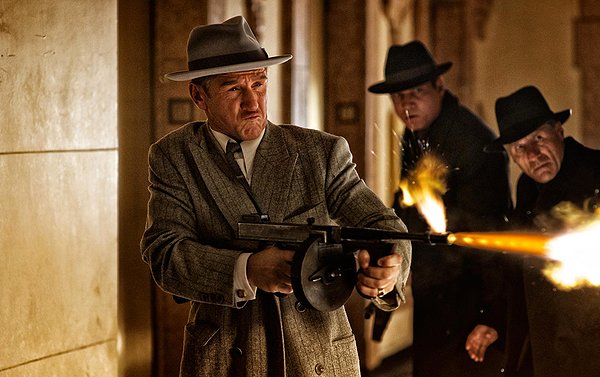 Finally, we must speak of Mr. Sean Penn (Milk). The man’s actorly gumbo goes into campy overdrive. In these rare circumstances, you aren’t watching Sean Penn Esteemed Actor so much as Sean Penn Human Vortex of Overacting. Normally I would criticize Penn for going over the top but over the course of 110 minutes, he single-handedly becomes the only entertaining thing in the movie. He’s chewing scenery up a storm, yes, but at least he’s channeling the pulpy silliness of the whole movie. I came to enjoy his antics and outbursts and thus became more empathetic of Mickey Cohen and his efforts than I did with O’Mara. Such is the danger screenwriters run when they spend more time crafting an interesting villain than a hero.
Gangster Squad is what happens when a movie is sold on title and genre elements. To be fair, it’s a bang-up title. The plot is half-baked at best, really only serving as a thin outline of a gangster movie, but instead of adding complexity and intrigue and characterization, they just ran with it. The actors are either camping it up or out of their element, the action and shootouts are pretty mundane, and the story is just uninvolving, even for fans of film noir like myself. It’s a good-looking film from a technical standpoint, but that’s as far as I’ll go in my recommendation (it could be an odd pairing with Milk considering the two shared actors). It feels like it just wants the setting elements of film noir, the atmosphere, and then figures just having good guys and bad guys shoot it out will suffice. That glossy, high-sheen period look just seems like a cool façade, and a cool façade seems like the only ambition of Gangster Squad. I can’t really recall any signature action sequence, snappy quote, plot development, or peculiarity worthy of remembering. It may be one of the most forgettable gangster movies Hollywood has produced.
Nate’s Grade: C
Share this:

Abraham Lincoln: Vampire Hunter (2012)
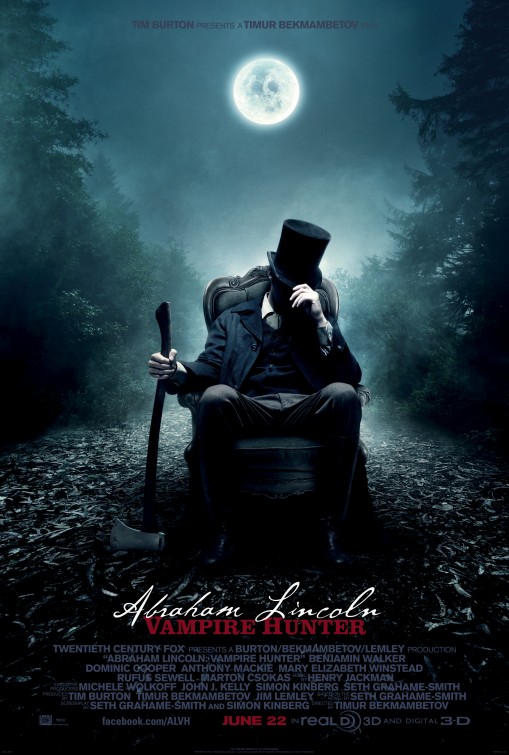 Did you know that our sixteenth president had a rather unorthodox hobby, and it was really the purpose that drove him into politics and later the White House? That’s what the gonzo best-selling book Abraham Lincoln: Vampire Hunter purports. When he was talking about a house divided not being able to stand, he was secretly talking about vampires, you see. The film version, under the tutelage of producer Tim Burton, looks like it’d be an axe-swinging good time. I realize the absurdity of wishing the filmmakers had hewn closer to the source material, a radical reinterpretation of American history, but there it is. I cannot tell a lie.
Abraham Lincoln (Benjamin Walker) is a man determined to rid this new country of the scourge of vampires. His mother was murdered by a vampire landlord, Jack Barts (Marton Csokas), when Lincoln was only a little boy. As an adult, Lincoln tries to avenge his mother’s death but Barts is too strong. Henry (Dominic Cooper) saves Lincoln and teaches him all about vampires and, more importantly, how to hunt and kill them. They strike up a partnership: Henry will provide names of vampire targets and Lincoln will dispatch them with extreme prejudice. Lincoln tries to live a solitary life but keeps building attachments; to his co-worker Joshua Speed (Jimmi Simpson), to his childhood friend Will (Anthony Mackie), who needs Lincoln’s help to forge some slave papers, and the enchanting Mary Todd (Mary Elizabeth Winstead). Abe realizes the limitations of killing vampires one by one. The vampires are exploiting Southern slavery as an all-you-can-eat buffet. Lincoln realizes the only way to foil the vampires is to eliminate slavery, and to do so he must be in a high government position, and so Lincoln retires his axe to turn to abolitionist politics.
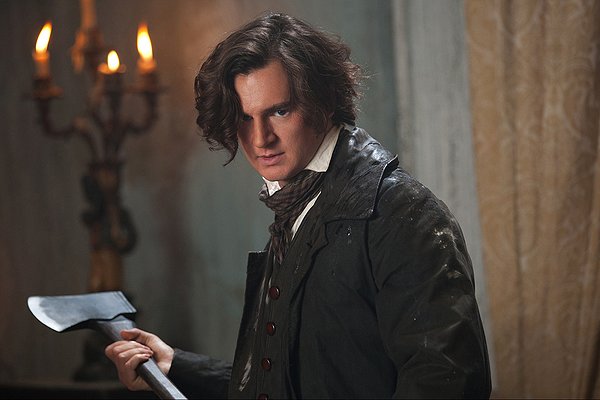 It feels that rather than embrace the courage of its convictions, the movie is trying to please as many mass markets as possible. So many characters and storylines are inserted wholesale without any connection to the book. The film is almost unrecognizable from the book. Now, I’ll quit my bemoaning for the time being because a movie has to exist on its own merits, but Abraham Lincoln: Vampire Hunter is just a mess. As far as new characters included only to appeal to broad audiences, there’s the Black Best Friend, long a staple in movies meant to say, “Hey, our lead character is hip and has no problems with race,” but really it’s always been a depressing act of pander and I always feel sympathy for the thousands of black actors who have to compete over the limited best friend parts. Giving Lincoln a black best friend seems to remind the audience that Lincoln was against slavery, you know, in case anyone didn’t know anything about the man nicknamed the Great Emancipator. Then there’s the ascension of Mary Todd Lincoln into a feisty, strong-willed, formidable ally rather than the insular, clinically depressed woman she was in real life and in the book. Mary even gets some grand hero moments taking out a vampire in slow-mo coolness. The transformation of Mary feels just as big a pander as the character of Will. Then there’s the idea that Lincoln and his small inner circle of pals are placed in the center of action, like they alone and their heroic escapades single-handedly turn the tide of war. It’s handled so ham-handedly that it all plays out like they’re the Scooby Doo gang solving the Case of the Vampire Insurrection.
Lincoln’s history is given such shrift attention, just enough to fill out the standard tortured hero’s backstory for the aims of the story. We see Lincoln as a child but just enough to establish his tragedy and hunger for revenge. Then we cut to him as an adult and going to kill Barts. That’s quite a big leap in time with little careful setup. The time before Lincoln’s presidency is just enough to supply him with a stock character posse and a plucky love interest, and then it’s right to the Civil War. So much time in between the main events just gets squeezed out, and so Abraham Lincoln: Vampire Hunter feels like it’s always one scene away from a clumsy montage.
The vampire threat, as presented, also feels too insurmountable. Not only can these vampires walk in the daylight, they’re super strong, super fast, and can make themselves invisible, a neat new trick. When they ally with the South they seem nigh unbeatable. The movie makes the mistake of making the adversary seem too powerful, so the eventual thwarting of the vampire Confederacy feels too easy and far-fetched given the magnitude of the threat. Adam (Rufus Sewell) is hinted at being like the first vampire, but then this idea is never picked up again. Why even hint at something significant if you have no intention of pursuing it? There’s another new wrinkle where vampires are incapable of killing their own kind. If this is the case then why aren’t the vampires turning every single person they can find into vampires? It shores up their side and guarantees less potential people that could kill them. I’m curious how certain swaths of southerners are going to react to seeing their beloved Confederacy teeming with devilish creatures. Then again, I think the romanticism of the Confederacy is hogwash. When insurrections win we call them revolutions of independence, and when they lose we call them treason. Guess what? The South lost.
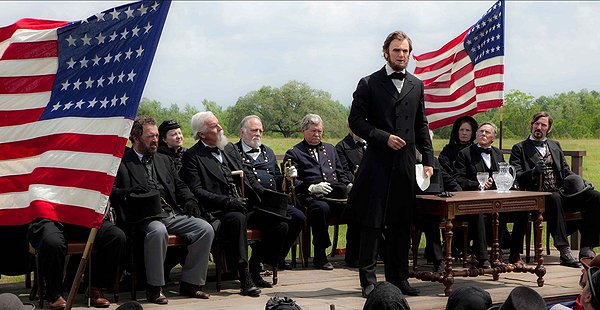 As much as I enjoyed his book, I have to lay the blame at the hands of Seth Grahame-Smith, who adapted his book into the screenplay (he’s 0-2 this summer after his disastrous screenplay for the other vampire movie this summer, Burton’s Dark Shadows). Granted, I’m sure he got intensive notes on how to alter his story for the big screen; the whole projects reeks like it had too many cooks in the kitchen. The interconnection from the book, finding clever ways to marry history and alternative history together, have been ground down to stream line Lincoln into an American super hero. Not only is he handy with an axe, this Honest Abe can leap from racing horse back to racing horse back, and even get clobbered by a horse and keep on going. The coda at the end feels like a missed opportunity to carry on the Lincoln tradition into our modern age. With the clever reworking replaced by blockbuster superficiality, the film merely takes history and has it perform the outrageous rather than finding smart ways to connect all the outrageousness to the established facts.
What the movie has to the credit of director Timur Bekmambetov is a strong visual pulse. Bekmambetov directed 2008’s testosterone-soaked Wanted, so you know you’re going to get some crazy and eye-catching images on display. The action sequences do pack a punch and I’ll admit that seeing an axe utilized as an inventive martial arts weapon is considerably cool. There are two standout set pieces. The first is a fistfight between Abe and Barts in the middle of stampeding horses. You feel right in the thick of the action, horses stampeding all around, the sun setting to offer an eerie yet beautiful glow to the ordeal. It’s one of the more reality-stretching moments, as I noted above, but man if it isn’t thrilling and lovely to watch. The other standout sequence is a climax aboard a speeding locomotive itself atop a large wooden bridge engulfed in flames. Abe and Will stand back to back, swapping the axe to kill vampires, and then hey have to outrun the collapsing train. In these moments, the movie is joltingly alive, bursting with excitement and that rare yet glorious feeling of watching something beautifully different. I just wish this sensation wasn’t so fleeting in the movie.
Abraham Lincoln: Vampire Hunter is a violent historical reworking that isn’t good enough to be properly entertaining and it isn’t bad enough to be considered camp. The film is mostly disappointing because it should feel far more engaging given its whacked-out premise the very cheeky promise of its title, and strong source material, a pulpy, ripsnorter of a read. The movie has some stellar standout moments but I think what ultimately hinders the entertainment value is how dumb everything comes across. This is not dumb in the winking, self-aware, satiric sense, but dumb in more of the blockheaded, Michael Bay, formulaic blockbuster sense. I wouldn’t even classify this movie as an enjoyably dumb, a silly summer slice of escapism like Battleship, which is looking better every week after new, disappointing summer releases (and it’s not even July yet!). The spirit of this movie is missing, the cleverness of the conceit drained, and the fun is bottled up. What this movie reminds me of is the stupid 2003 film The League of Extraordinary Gentlemen, which took classic literary characters and threw them into a genre movie. Both movies figure the exercise alone, seeing classic literary or historical figures in absurd contexts, was enough to justify entertainment. I say that you have to work harder.
Nate’s Grade: C+
Share this:

The Adjustment Bureau (2011)
 Gentlemen, if you were looking for an original excuse about not calling a girl back, try this one on for size: I couldn’t call because a team of men who control human destiny told me that if I did they would erase my memory and keep you from the fame that you are destined to achieve. She’ll probably at least give you points for originality before throwing a drink in your face (but it was all part of The Plan, or was it?).
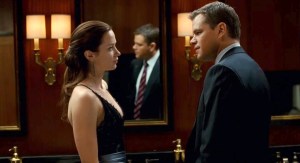
David Norris (Matt Damon) has just lost a New York congressional election thanks to his frat boy ways of old resurfacing. As he composes his concession speech inside the men’s restroom, he meets Elise (Emily Blunt), a ballet dancer hiding out. They have one of those crazy only-in-a-movie conversations that manages to feel authentic. Then they kiss. She inspires him to ditch his prepared remarks and speak from the heart to the national TV audience, which eats it up. David spends the rest of his days trying to meet the enchanting Elise again. Then he runs into a big stumbling block. He’s late to a meeting and catches a group of mysterious men in suits and fedoras fiddling around with people frozen like statues. They are the adjusters, the ones who ensure that the participants of mankind follow The Plan. These are the people responsible for the illusion of choice in our lives. If we deviate too far from The Plan, causing ripple effects that too need to be accounted for and adjusted, they step in. Richardson (John Slattery) is the spokesmen for the group and decides to just level with David. He is not supposed to be with Elise. He has a different future ahead of him, so sayeth The Plan. They will throw obstacles between the two of them. David seeks out Elise and fights against the whole universe for the two of them to make a future together.
 Horrible title aside, The Adjustment Bureau is a sometimes corny but often deeply satisfying movie. It may distract with some efficient and just-smart-enough sci-fi leanings and magic tricks, but it’s really a unabashed romance at its core. Not just that, it’s a good romance, once that flutter the heart and causes the ends of your mouth to do that thing, you know – smile. It helps when you have movie tars as gorgeous as Blunt and Damon, and are such good actors that they can fill their roles with dangerous amounts of charm, but let’s credit writer/director George Nolfi (The Bourne Ultimatum, Ocean’s Twelve). He takes a fairly routine concept (powerful forces control our lives and choices) and turns it into a finely tuned character-driven romance. Immediately from their first meeting in a men’s room, Blunt and Damon have that electric dynamic that you can genuinely believe in. Their chemistry will knock you over. You feel the spark between these two, which is essential because the two characters spend years apart at times, forever hoping to reunite. In that brief encounter, you fall in love as well and realize that this character, and this actress, is worth waiting for. I think people are going to be surprised that The Adjustment Bureau is a big gooey, stars-in-the-eyes love story, and it’s actually good. It’s a really enchanting love story, tackling the question of whether whom we love is a result of choice or destiny. This central concept is what every sci-fi element and thriller sequence is spun from. Here’s a funny thought: it’s all in service to the story.
It’s rare to see a studio movie that mixes so many different elements together to such effective, satisfying results. The film doesn’t get overly dark despite the cosmically long-reach and determination of the adjusters. There’s never any real threat of danger, only a broken heart or dashed dreams. The film has many light moments throughout, creating a rather bouncy tone that suits the romance angle nicely. The adjusters aren’t very menacing, more so comically perturbed. John Slattery, all silvery Mad Men appeal, is a perfect foil as the face of the adjusters. He feels like an exasperated parent baffled by the thought-processes of his youthful charge. It helps that these cosmic accounting agents have a finite level of power. If they had unlimited power then the film would fail to have any hope for David and Elise. But we learn that there are only so many adjusters that there are limitations to their powers, and that they can be outsmarted with enough gumption. Mingling with that light touch is enough whimsical science fiction to engage your brain. The concept of the adjusters and their supernatural abilities is nicely teased, setup, and then developed, making sure never to rock the audience with too much weirdness at one time. It’s a gradual process of discovery and it leads to a somewhat goofy, but infectiously amusing, climax that involves multiple doorway portals and magic hats. Yes, I said magic hats, which means there is an honest to God good reason why that stupid fedora hat, seen so prominently in advertising that it feels like the third-billed star, is featured. Admittedly, a concept like a magic hat that allows you to teleport through doorways would seem silly, but Nolfi makes it all work. The hardest aspect to believe (in a film with, I repeat, magic hats) is that Blunt could be a ballet dancer, let alone a future star of the medium. I’m by no means saying that the British beauty has anything to worry about in appearance, but she does not have a ballet dancer’s dangerously minuscule physique. Natalie Portman in Black Swan looked like a real-deal ballerina of fragile frame. Blunt doesn’t have the movement or the physique.
 In his directorial debut, Nolfi does enough good things, and does them with a smooth sense of style, to impress. The visual trick of going in one door and opening to another world walks a dangerous line of over saturation, but it’s playfully utilized enough to forgive. Nolfi is not perfect with his plotting, falling to misstep that can push back momentum. Characters will be chatting, and then they’ll walk away and we’ll get a title card that says something like, “Three years later,” and it sort of makes it feel like we have to start all over again. The fact that this happens more than once means that Nolfi might have wanted to plot his story around a series of events that occurred more often than Senate election terms. If we have to begin with David losing one campaign at the start and then zoom ahead at several points through another campaign, then perhaps the timeline could have been condensed a bit in retrospect. The film manages to be religious and faith affirming without pushing an agenda or overstating its romantic cause. The ones behind the plan are only referenced in oblique business terms, never confirming a certain high power but definitely nodding in that general direction.
Damon and Blunt are a terrific team. This is easily Blunt’s finest role as an actress since breaking out in 2006’s Devil Wears Prada. The actress has taken many a role that makes use of her large crystalline eyes and her sometimes go-to acting response of simpering. But in this film, she finally finds that perfect role that makes use of Blunt’s modest, goofy charm. She’s never been a leading actress in a traditional set; there’s always been a delightful goofy appeal that set her apart. When Blunt offers her playful smiles and asserts those glassy eyes of hers, you too will be smitten. Her character is a charming woman thanks to Nolfi’s writing, but having an actress of Blunt’s ability fill her out is a blessing. Damon is at a point in his career where he just grinds out good-to-great performances that manage to be convincing in unassuming, dignified ways. Damon has never been an actor given to the superfluous. His character feels like a sincere sport, which is amazing considering he’s supposed to be playing a politician. He’s the kind of guy you’d actually stand in the rain to vote for, and you understand why Elise would keep a place tucked away deep in her heart for the dashing Damon.
While the movie hinges on the coupling of Damon and Blunt, the rest of the supporting cast does fine work matching tone and making the most of their roles. Actors like Anthony Mackie (The Hurt Locker), Terrence Stamp (Valkyrie), and Michael Kelly (Changling) can make any movie better.
 The Adjustment Bureau, on paper, should not work. A sci-fi fantasy that’s unapologetically grounded in romance. A tone that nestles firmly in a safe, bubble-wrapped whimsy. And those magic hats, need we forget them? On paper this should be one overly silly, dumb, tonally disjointed, cornball movie worth venomous mocking. And yet it works; it does better than “works,” it succeeds. Blunt and Damon are terrifically charming together and imbue the movie with a sense of cheerful optimism in the face of uncertainty (and perhaps heaven itself). You desperately want these two crazy kids to get back together; they’re good, decent, charming people, winning personalities apart and even better together. What might have fallen apart in other hands becomes this endearing, fizzy piece of studio entertainment that fulfills and exceeds most expectations. I was really taken by this movie, won over by its effusive charm offensive, and left buoyant with happiness by the time the tidy, perhaps too tidy ending, came rolling. The Adjustment Bureau is hooey but it’s my kind of hooey.
Nate’s Grade: A-
Share this:

The Hurt Locker (2009)
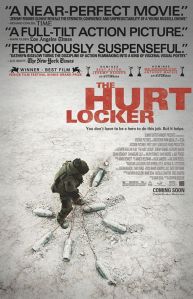 The Hurt Locker is an action movie on a very human scale. Sure there is a time and place for your Michael Bay-esque action vehicles, the type that scorch square miles and leave recognizable world cities in ruins. However, those kinds of action movies are never the kind where storytelling ever enters the fray beyond a meager question of how to get from Point/Explosion A to Point/Explosion B. In fact, Bay openly admits to planning the story of Transformers 2 by working on various action sequences during the 2007 writer’s strike and then tasking screenwriters to connect the dots. The Hurt Locker exists in a frighteningly believable world. This isn’t a movie about explosions but about the extinguishing of explosions. It follows the Explosives Ordinance Disposal (EOD) unit, tasked with detecting and detonating bombs and other improvised incendiary explosives (IED) in the field of combat. You will not be restless for loud “booms” while watching The Hurt Locker. In fact, you will be on pins and needles hoping that you never hear another loud “boom.”
Delta Company are the men responsible for protecting the other soldiers by disposing of bombs. The new team leader, Staff Sgt. William James (Jeremy Renner) has defused over 800 bombs during his tour of duty. He knows he’s the best and he’s addicted to the thrill of being so close to death. He will make occasionally reckless decisions putting himself, but not his fellow company men, at higher risk. This does not sit well with Sergeant JT Sanborn (Anthony Mackie), a by-the-book type that doesn’t appreciate his officer chasing a thrill. The other EOD unit member, Specialist Owen Eldridge (Brian Geraghty), is a man more accustomed to taking orders than giving them, and his indecision may have actually cost the life of the former head of the EOD. Both Sanborn and Eldridge worry that their new team member is going to get them all killed.
 Director Kathryn Bigelow (Near Dark, Point Break) has been directing male-centered action flicks for over two decades; it’s been seven years since her last feature, the regrettable Harrison Ford submarine flick, K-19: The Widowmaker. The Hurt Locker is her finest work to date by far. Her action sequences are visceral and downright agonizing to sit through. She is masterful at setting up the geography of the set piece, ratcheting up the suspense, adding organic obstacles and complications, and then makes sure with her camera and editing that an audience knows exactly what’s happening to whom for every minute that ticks off the clock. Bigelow takes her time to establish the particulars of her locations and sequences, allowing the audience to, surprise, understand what is happening and better engage in the movie. Bigelow chose to shoot the movie in Jordan, the neighboring country to Iraq, and the locations and actual refugee extras add an unvarnished sense of realism. The movie goes without music during much of the action, which makes it all the more uneasy. There isn’t any over eager composer telling you how you should feel, no direction that now things will get even more hairy. You will feel every second of danger, and Bigelow crams in a whole lot of danger. Things can go wrong very, very quickly.
There’s nothing to action cinema quite like the bomb that’s only a few tick-tocks away from doing its dirty work. Do you cut the yellow wire or the green wire? Never cut the red wire. The bombs found in Iraq are a stark range of death. There’s the crude incendiary device just wrapped up in garbage, but then there’s also the fiendishly clever devices with multiple charges and there are grotesque devices as well. At perhaps the film’s most guttural and shocking moment, Staff Sgt. William James finds the corpse of an innocent stuffed with explosives. The easiest thing would be to simply detonate the bomb, but that would also desecrate the body of someone we have come to know. Watching James snip open the crude stitching and dig inside the chest cavity, if we didn’t know then we know now, Bigelow has made sure that The Hurt Locker is the most emotionally resonating contemporary war film in memory.
 Bigelow and screenwriter Mark Boal, an Iraq War journalist, create a vivid sense of dread, antipathy, and most of all, paranoia. Is that a kite flying in the air or is that a signal? Is that a nondescript observer with a cell phone or is that a terrorist with a remote detonator? Is that child being friendly or collecting intelligence? Your mind will race through all these possibilities because Bigelow teases out her action sequences to an unbearably taut level. The audience cares about these soldiers and wants to see them make it back home (we’re informed how many days Delta Company has left on their tour throughout the film), which Bigelow uses to her advantage at every turn. What happens matters. My nerves were frayed during several sequences, including one where the soldiers are pinned down by distant enemy gunfire. The moment turns into a duel and a chess game, as each side tries to adjust their gaze in the searing heat and measure their long-range shot before the other side beats them to it. Then the sequence turns into a waiting game. This is the kind of movie that keeps you poised on the edge of your seat fearful that at any moment something disastrous will suddenly happen. Every time Staff Sgt. William James went back out to defuse another bomb, my sense of dread intensified. I began to doubt everything that I would ordinarily take for granted in other movies.
While being a top-notch action movie, Boal (In the Valley of Elah) has also crafted a great character study. In between the bomb episodes we learn more about these men, which makes it all the more hard to see them then head out to defuse another explosive. The film opens on a quote equating war as a drug, and we explore this notion through the character of Staff Sgt. William James and the weight his unique duty bears. It takes a special person to volunteer for defusing roadside bombs. The defuser must be extremely intelligent, be extremely cool under pressure, and be able to work in a giant suit that makes them look like a chubby astronaut, while enduring debilitating desert temperatures of 110 degrees. It sounds like a suicide mission. James is an adrenaline junkie and war is his drug. He exudes a Zen-like calm in the heat of the moment and this is now the only life for him. Shopping for cereal back home has lost its meaning. Being a husband has lost its meaning. His life now has one purpose. Renner (28 Weeks Later, North Country) gives a stirring performance laced with cavalier confidence and resignation. Mackie (Eagle Eye, We Are Marshall) is also another standout in the pared down cast. When he laments about the dishonor of having no one to remember you in death, you feel the man’s existential sorrow.
 Ignore the political cranks that decry The Hurt Locker as another partisan anti-war film from Hollywood. The American public has been mostly indifferent to any contemporary movie that aims to tackle our current military conflicts in Iraq and Afghanistan, but The Hurt Locker eschews the politics of war to focus on the realities and dangers of its characters. These guys are more concerned with surviving the next bomb than the politics of why they’re in the Middle East. The public has voted with their wallets and does not want to see the reality of war onscreen, or at least the Hollywood version of war reality, but I pray that those same people give The Hurt Locker a fighting chance. There is no preaching to be found here. The Hurt Locker could just have easily taken place during other wars, though the current Iraq War allows for added cultural dissonance (Is the central goal of bomb-defusing a metaphor for our conflict in the region?). This is a film that transcends politics and genre.
The Hurt Locker is more than an action movie, more than a war movie, more than a psychological study; this is an outstanding movie. This movie is a drug to the adrenaline senses and I need another hit. This is one of the finest films of the year and as it expands across the nation, I highly encourage everyone to seek out The Hurt Locker.
Nate’s Grade: A
Share this:

Half Nelson (2006)
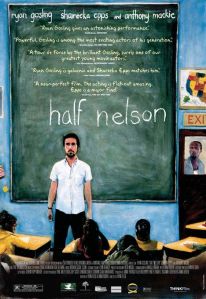 Ryan Gosling gives a devastating performance as an inner city schoolteacher addicted to crack. This is a thoughtful look at friendship and vice as Gosling befriends one of his female students and becomes something of a mentor, trying to steer her in a good direction. The film is refreshing because of how awkward and authentic it is, and it does not pull punches; there are no happy endings or storylines wrapped with bows. The biggest drawback from this powerful film is that it’s too insular and doesn’t get much of an outside perspective. Scenes have a tendency to drag, but the movie is set ablaze by the troubled yet hopeful turn by Gosling, already firmly established as the most astonishing talent of his age. Who ever would have guessed a former Mousekateer would be our next Marlon Brando?
Nate’s Grade: B+


 nathanzoebl
You must be logged in to post a comment.