Blog Archives
Rebel Moon: Director’s Cut (2024)
 What a rarity for a movie to potentially appear twice on my worst of the year list, and such is the destiny of Zack Snyder’s Rebel Moon, originally released in 2023 and the first half of 2024, and now with added lengthier director’s cuts. So what do you get in the newest “Snyder cuts” besides fewer hours in your day? Let’s tackle the opening sequence demonstrating the power and villainy of our evil empire as they invade a crumbling city in resistance. Within short order we’ve witnessed: 1) female priestesses being forcefully disrobed and having their breasts branded, 2) an adorable little CGI pet become a literal suicide bomber, 3) a son brutally beating his father’s brains out of his skull to spare their family only for them all to be massacred anyway. Yikes. While there is a little more world-building absent from Snyder’s prior cuts, like a religious sect that turns the teeth of their conquered victims into a decorative washboard, even the extra time, and it is literally hours over the course of the two parts, feels strained and still poorly developed to better understand the world, the characters, the conflict, the history, anything that could make Snyder’s hopeful franchise its own universe. Theres now a giant metal goddess whose tears fuel space travel. All right then. One of the more interesting characters, the samurai-esque loner robot, is given more material but he’s still just as inscrutable. There’s plenty more cruelty here, slow-motion head shots painting the screen in sticky viscera. There’s also plenty more breathless and awkwardly extended sex scenes, but hey, at least those are consensual, so there’s that. I’m just stunned why Netflix would want different versions of these movies when they’re ultimately all housed under the same banner. It sure feels like the “Snyder cut” brand is now an expected marketing ploy to be exploited for added publicity. After all, why watch one long slightly bloody poorly written sci-fi space opera, when you could watch TWO versions, one of which being even bloodier and more miserable? Will there be an even Snyderier Snyder cut, adding more scenes of side characters suffering and even more festishized gore in even slower motion? Will the whole movie just be played in slow motion, now requiring nine hours? Where does it even end, Netflix?
Nate’s Grade: D
Share this:

Rebel Moon – Part Two: The Scargiver (2024)
 Back in December, Zack Snyder offered his very Snyder-y holiday take on big-budget space operas with Rebel Moon, a project that began as his Star Wars pitch that was turned down. It was what you would expect from a Snyder movie: big, loud, silly yet played completely serious, and drained of all vibrant color. Rebel Moon Part One was on my worst of 2023 list and I felt was a waste of two hours. I was not looking forward to the concluding Part Two. I was worried it would be two more hours of the same, and now having seen Part Two, a.k.a. The Scargiver, the edgy nickname of our lead rebel Kora (Sofia Boutella) fighting the good fight against the Evil Empire, I can now say that the Rebel Moon duology is now a dreary waste of four of your waking hours.
Saying Scargiver might be minimally better than Child of Fire (did you remember that was the subtitle for Part One? Don’t lie to me, dear reader, you know you didn’t) is a nominal victory. There’s more action and a clearer sense of climax, with our underdogs planning their guerrilla war against the overpowering forces approaching (we’re basically watching the training of a Vietcong-like insurgency) and then pulling off their unexpected victory. The problem is that we’re still stuck with all the same characters from Part One, few of which will prove to be emotionally engaging or intriguing. We’ve assembled our fighting force thanks to the events of Part One, but far too many of them are interchangeable and punishingly free of personality besides the default character creation setting of “stoic badass.” There’s one lady who has laser swords so at least that sets her apart. When it comes to attitude, personality, perspective, and even skill level, these characters are awash, which makes the action falter when it comes to any sort of meaningful emotional involvement. The bare bones story is so plain with broadly drawn good versus evil characters from its obvious cultural influences. The fact that it’s derivative is not itself a major fault, it’s the fact that it does so little with these familiar pieces that the movie feels like it’s trying to skate by on your familiarity. After four hours, it’s clear to me that Snyder and his co-writers composed this not as a living, breathing universe with its own lore and history and intrigue, but as a story where he could have used the Star Wars universe to fill in the gaps.
 Snyder can be a first-class visual stylist but his sense of fluid and engaging action stops at “cool images,” like living splash pages from comic books. Like Part One, there is no sense of weight to these action sequences. Things are just happening, and then in the next shot things are just happening. Occasionally there will be a sliver of relation, but whether it’s 60 minutes or 6 minutes, the effect is still the same. The action feels like it’s all happening in a vacuum, and the momentum we feel the upstarts are gaining is hampered. We went through the trouble of explaining their counter-offensives, so why does so much of it feel like it’s just watching a jumbled, ashen group of characters fire guns? This is best epitomized by Jimmy the robot (voiced by Anthony Hopkins) who has gone rogue from his programming and sits out much of the action for reasons entirely unknown. Then he arrives, takes down a few evil tanks, and I guess decides to sit back out. If this is our fighting force, what exactly has it amounted to? This makes the entire movie, and its predecessor, a frustrating viewing even for forgiving action fans. Things blow up good, and there are a few impressive visual orchestrations, but it’s so fleeting and slim.
Over the course of two two-hour movies, totaling four hours, with the promise (threat?) of more, it’s clear that what we really had here was perhaps one underdeveloped movie at best that has been unfortunately spread out over two (and counting) movies of time. Part One was entirely about assembling the team of rugged defenders, and this could have served as the first 45 minutes of the overall movie, with the events of Part Two filling in the rest. With Scargiver, the defenders don’t even start training the villagers until 40 minutes into the movie and the big battle doesn’t kick in until a full hour. Structurally, this doesn’t feel like we’re using our time wisely, and this is best evidenced by the fact that after AN ENTIRE MOVIE of character back-story, Snyder still stops the action to have his characters sit around and share their sad back-stories. Did these characters just not talk at all to each other after initially gathering person-by-person? Tarak (Staz Nair) still hasn’t put a shirt on. I felt like yelling at my TV as the character took turns, and another 15 minutes, for each member to share their tortured back-story again but with different visuals. I was almost worried that right before the battle another character would say, “Wait, before it all really goes down, I need to share, yet again, more of my back-story.” It’s not like these extra glimpses give us new understanding or even meaningfully differentiate their characters; they’re all just victims of an abusive space government that imposes its terrible will most forcefully.
 There is one tragic back-story that does separate itself from the pack, notably because it literally separates itself from the pack and is told well before our group share. Kora explains her part in the assassination of the royal family, securing the military coup that left the Evil Empire extra evil, and I guess the guy named Balisarius as supreme leader (oh how this man must have been teased for his name as a schoolchild, which might be his own tragic back-story that we’ll get three helpings of with an eventual Part Three). This betrayal is personal and stands out, with Kora being the one to shoot the little princess, a girl who, in her dying breath, says she forgives Kora. That’s rough. This is actually a good sequence from a character standpoint as it establishes Kora’s accountability and guilt convincingly. However, Snyder makes some baffling creative choices that blunt the impact of this sequence. During the assassination, the musical score favors a string quartet, which is an emotionally plaintive choice. However, the music is actually diegetic to the scene, meaning it’s coming live from the room. There is literally a string quartet of musicians playing in the room while the royal family is betrayed and slaughtered. These guys are really dedicated to their art to keep playing throughout, and I assume they must also be part of the conspiracy or else big bad Balisarus (snicker) would kill them too. You might as well have them also start stabbing the royal family with their bows. It’s details like this that trip up Snyder, a man beholden to images and ideas but lacking the finesse to make them work.
An issue I had with this conflict was the disparity in scale between the forces, mainly my nagging question of why put together a ragtag group of space adventurers to defend this town if the Evil Empire could just nuke the planet from space? Well Snyder attempts to answer this early with Part Two, and the answer appears to be… grain. This community theorizes that the empire needs their grain yield so badly that they wouldn’t do anything to damage it, so their plan is to harvest all their wheat, turn it into grain, and then use the grain like human shields, hiding behind the valuable resource as cover and distributing it across the village. This is beyond silly. First, this isn’t like an entire planet harvesting grain, it’s one little village on the outskirts. It’s not like we’ve seen a giant warehouse that goes for miles and miles stockpiled with thousands if not millions of deposits of this food. Also, we’re talking grain here (stay tuned for my exclusive Rebel Moon-related podcast called “Talkin’ Grain”). It’s not like we’re talking about some super rare mineral or substance that is only found on this one planet, something linked toward like the power source for an ultimate weapon or space travel. We’re talking about grain here. Grain. You think this Evil Empire won’t nuke the planet because they’re worried they won’t get enough grain, the same crop that can be harvested on multitudes of other planets? How about they just kill everyone and then repopulate the planet with robots to harvest the precious grain? Or how about this simple village make some upgrades as we’re in a future world with space travel and artificial intelligence but people are still harvesting wheat by hand like they’re the Amish. Regardless, I hope you love slow-mo montages of grain harvesting because that’s what you’re getting for the first 40 minutes, as if Snyder is rubbing your face in his silly non-answer.
 In the conclusion to Rebel Moon Part Two, once the dust has settled, and long since that grain has been harvested, the last five minutes sets up a would-be Part Three, informing us that an unresolved storyline is next up on the docket. The characters gang up for their next adventure, and you’re expected to be chomping at the bit for this continuation. I openly sighed. Every movie feels like a tease for the next adventure, and it seems to promise that this one will be the real one you’ve been waiting for, but it feels like franchise bait-and-switch. It’s more than incomplete or lazy storytelling, it’s a scheme to leverage interest in a world and series that deserves little. The universe of Rebel Moon is not interesting. The characters of Rebel Moon are not interesting. The visuals of Rebel Moon are fine, though some of the costume choices again can rip you right out of the reality of this universe (a guy fighting in blue jean overalls?!). In short, not enough has been established, developed, or even paid off to make Rebel Moon an interesting and satisfying movie, let alone two, let alone three, let alone however many Snyder wants to leech out of Netflix. I would say Part Two is better because at least it provides an ending but it doesn’t even do that, merely an intentional passing of the baton to the next movie, and round and round we go. Rebel Moon is a living poster stretched to its breaking point. Leave this shallow universe behind.
Nate’s Grade: C-
Share this:

Rebel Moon – Part One: A Child of Fire (2023)
 Creating an original sci-fi/fantasy universe is hard work. It involves bringing to life an entire new universe of characters, worlds, back-stories, rules, conflicts, cultures, and classes. There’s a reason major studios look to scoop already established creative universes rather than build their own from scratch. This is what director Zack Snyder had in mind when he pitched a darker, grittier, more mature Star Wars to Disney, who passed. Over the ensuing decade, Snyder and his collaborators, Shay Hatten and Kurt Johnstad, continued working on their concept, transforming it into an original movie series, resulting in Netflix’s big-budget holiday release, Rebel Moon – Part One: A Child of Fire, a clunky title I will not be retyping in full again. Snyder’s original results of the “darker, grittier Star Wars” are rather underwhelming and don’t make me excited for the concluding second movie being released in April. Why go to the trouble of building your own universe if you don’t want to fill in the details about what makes it important or at least even unique? I can see why Snyder would have preferred Rebel Moon as a Star Wars pitch, because they could attach all the established world-building from George Lucas and his creative collaborators as a quick cheat code.
In another galaxy, the imperial Motherworld is the power in the universe. The king and his family have been assassinated, and in the power struggle that follows, several planets have taken up arms to fight for independence. On a distant moon, Kora (Sofia Boutella) is doing her best to live a nondescript life as a farmer, helping to provide for her community and stay out of trouble. Well trouble comes knockin’ anyway with Admiral Atticus Noble (Ed Skrein) and his fleet looking for resources and powerless villagers to abuse. Kora’s history of violence comes back to her as she fights back against the Motherworld soldiers with cool precision. Her only hope is to gather a team of the most formidable warriors to protect her village from reprisals. Kora and company band together while her mysterious past will come back to haunt her reluctant return to prominence.
 For the first thirty to forty minutes of Rebel Moon, I was nodding along and enjoying it well enough, at least enough to start to wonder if the tsunami of negative reviews had been unfairly harsh, and then the rest of the movie went downhill. One of the major problems of this Part One of a story is that it feels like a movie entirely made up of Act Two plotting. Once our hero sets off on her mission, the movie becomes a broken carousel of meeting the next member of the team, seeing them do something impressive as a fighter, getting some info dump about their mediocre tragic backstory, and then we’re off to the next planet to repeat the process. After the fifth time, when a character says, “Anyone else you know?” I thought that the rest of the movie, and the ensuring Part Two, would be nothing but recruiting members until every character in the galaxy had joined these ragtag revolutionaries, like it was all one elaborate practical joke by Snyder. Some part of me may still be watching Rebel Moon, my eyes glazing over while we add the eight hundred and sixty-sixth person who is strong but also shoots guns real good. Then the movie manufactures an ending that isn’t really an ending, merely a pause point, but without any larger revelations or escalations to further our anticipation for Part Two in four months’ time. What good are these handful of warriors going to be defending a village in a sci-fi universe where the bad guys could just nuke the planet from orbit? Find out in April 2024, folks!
The entire 124-minute enterprise feels not just like an incomplete movie but an incomplete idea. This is because the influences are obvious and copious for Snyder. Rebel Moon starts feeling entirely like Star Wars, but then it very much becomes a space opera version of The Magnificent Seven, itself a remake of Akira Kurosawa’s Seven Samurai. With our humble farmer, our high plains drifter trying to turn their back on an old life of violence, and the recruitment of our noble fighters to ward off the evil bandits coming to harass this small outpost, it’s clearly The Magnificent Seven, except Snyder doesn’t provide us the necessary material to invest in this scrappy team. The characters are all different variations of the same stoic badass archetype, like you took one character mold and simply sliced it into ten little shear pieces. The characters don’t even have the most basic difference you could offer in an action movie, variation in skill and weapons. One lady has laser swords (a.k.a. lens flair makers) but pretty much everyone else is just the same heavy gun fighter. One guy doesn’t even bother to put on a shirt. Some of them are slightly bigger or more slender than others but the whole get-the-gang-together plot only really works if we have interesting characters. If we don’t like the prospective team members, it’s like we’re stuck in an endless job interview with only lousy candidates.
 The fact that Rebel Moon is derivative is not in itself damaging. Science fiction is often the sum of its many earlier influences, including Star Wars. Rebel Moon cannot transcend its many film influences because it fails to reform them into something coherent of its own. There is no internal logic or connection within this new universe. The original world building amounts to a slain royal family, an evil fascist regime, and maybe a magic princess connected to a prophecy of balance, and that’s it. All the flashbacks and expository data dumps fail to create a clearer, larger picture of how this sci-fi universe operates. The inner workings are kept so broad and abstract. We have an imperial evil and assorted good-hearted little guys. The movie begins by introducing a robot clan of knights that are dying out, and even a young Motherworld soldier who seems likely to defect, both opportunities to go into greater character detail and open up this world and its complications. So what does Snyder do? He leaves both behind shortly. Even though we visit a half dozen planets, these alien worlds don’t feel connected, as if Snyder just told concept artists to follow whatever whim they had. They don’t even feel that interesting as places. One of them is desert. One of them has a saloon. One of them is a mining planet. It’s like the worlds have been procedurally generated from a computer for all we learn about them. They’re just glorified painted backdrops that don’t compliment the already shaky world building. They’re too interchangeable for all the impact on the plot and characters and any declining sense of wonder.
Given the open parameters of imagination with inventing your own sci-fi/fantasy universe, I am deeply confused by some of the choices that Snyder makes that visually weigh down this movie in anachronistic acts of self-sabotage. Firstly, the villains are clearly meant to be a one-to-one obvious analog for the Empire in Star Wars, itself an analog for the fascists of World War II, but Lucas decided having them as stand-ins was good enough without literally having them dress in the same style of uniforms as the literal fascists from World War II. You have an interconnected galaxy of future alien cultures and the bad guys dress like they stepped out of The Man in the High Castle. It’s too familiar while being too specific, and the fact that it’s also completely transparent with its iconic source references is yet another failure of imagination and subtext. I just accepted that the Space Nazis were going to look like literal Nazis, but what broke my brain was the costuming of Skrein’s big baddie in the second half of the movie. At some point he changes into a white dress shirt with a long thin black tie and all I could think about was that our space opera villain looks like one of those door-to-door Mormon missionaries (“Hello, have you heard the Good Word of [whatever Snyder is calling The Force in this universe]?”). Every scene with this outfit ripped me out of the movie; it was like someone had photo-shopped a character from a different movie. It certainly didn’t make the devious character of Atticus Noble more threatening or even interesting. I view this entire creative decision as a microcosm for Rebel Moon: a confused fusion of the literal, the derivative, and the dissonant.
 Snyder is still a premiere visual stylist so even at its worst Rebel Moon can still be an arresting watch. He’s one of the best at realizing the awe of selecting the right combination of images, a man who creates living comic book splash pages. I realized midway through Rebel Moon why the action just wasn’t as exciting for me. There’s a decided lack of weight. It’s not just that scenes don’t feel well choreographed or developed to make use of geography, mini-goals, and organic complications, the hallmarks of great action, it’s that too little feels concrete. It feels too phony. I’m not condemning the special effects, which are mostly fine. The action amounts to Character A shoots at Bad Guy and Character B shoots at Other Bad Guy, maybe behind some cover. There’s only one sequence that brings in specifics to its action, with the challenge of defeating a rotating turret gun pinning the team down from escape. That sequence established a specific obstacle and stakes. It worked, and it presented one of the only challenges that wasn’t immediately overcome by our heroes.
The Snyder action signature of slow-mo ramps has long ago entered into self-parody territory (I’m convinced a full hour of his four-hour Justice League cut was slow motion), so its use has to be even more self-aware here, especially in quizzical contexts. There are moments where it accentuates the visceral appeal of the vivid imagery, like a man leaping atop the back of a flying griffin, akin to an 80s metal album cover come to life. Then there are other times that just leave you questioning why Snyder decided to slow things down… for this? One such example is where a spaceship enters the atmosphere in the first twenty minutes, and a character drops their seeds in alarm, and those seeds falling are detailed in loving slow motion. Why show a character’s face to impart an emotion when you can instead see things falling onto the ground so dramatically?
 The actors are given little to do other than strike poses and attitudes, and for that they all do a fine job of making themselves available for stills and posters and trailers. Boutella (The Mummy) is good at being a stoic badass. I just wish there was something memorable for her to do or make use of her athleticism. The best actor in the movie is Skrein (Deadpool) who really relishes being a smarmy villain. He’s not an interesting bad guy but Skrein at least makes him worth watching even when he’s in the most ridiculous outfit and awful Hitler youth haircut. There’s also Jena Malone (Sucker Punch) as a widowed spider-woman creature. So there’s that. Cleopatra Coleman (Dopesick), who plays one half of a revolutionary set of siblings along with Ray Fisher, sounds remarkably like Jennifer Garner. Close your eyes when she’s speaking, dear reader, and test for yourself. I was most interested in Anthony Hopkins as the voice of our malfunctioning android (literally named “Jimmy the Robot”) operating on mysterious programming that hints at something larger in place relating to perhaps the princess being alive. Fun fact: Rebel Moon features both actors who played the role of Daario on Game of Thrones (Skrien and Michiel Husiman).
Even with all the money at Netflix’s mighty disposal, Rebel Moon can’t make up for its paltry imagination and thus feels like an empty enterprise. I’m reminded of 2011’s Sucker Punch, the last time Snyder was left completely to his own devices. I wrote back then, “Expect nothing more than top-of-the-line eye candy. Expect nothing to make sense. Expect nothing to really matter. In fact, go in expecting nothing but a two-hour ogling session, because that’s the aim of the film. Look at all those shiny things and pretty ladies, gentlemen.” That assessment seems fitting for Rebel Moon as well, a movie that can’t be bothered to provide compelling characters, drama, or world-building to invest in over two to four hours, once you consider the approaching Part Two. I wish this movie had a more distinct vision and sense of humor, something akin to Luc Besson’s lively Fifth Element, but fun is not allowed in the Zack Snyder universe, so everything must be grim, because grim means mature, and mature means automatically better, right? Rebel Moon is a space opera where you’ll prefer the void.
Nate’s Grade: C-
Share this:

Hannibal (2001) [Review Re-View]
 Released February 9, 2001:
Trying to sequelize Silence of the Lambs is surely harder than trying to sequelize The Blair Witch Project. The novel Hannibal by Thomas Harris I don’t think will be confused as a necessary burst of creative ambition and more of a chance to cash in on the love of Hannibal Lector. Though I’ve not read a line from the book from what I’m told the movie is faithful until the much hated ending. Starting a film off a so-so book isn’t a good way to begin, especially when you lose four of the components that made it shine Oscar gold.
 The element that Silence of the Lambs carried with it was stealthily gripping psychological horror. It hung with you in every closed breath you would take, surrounding you and blanketing your mind. I mean, there aren’t many serial killer movies that win a slew of Oscars. Lambs excelled at psychological horror, but with Hannibal the horror turns into a slasher film more or less. What Lambs held back and left us terrified, Hannibal joyfully bathes in excess and gore.
Julianne Moore, a competent actress, takes over from the ditching Jodie Foster to fill the shoes of FBI agent Clarice Starling. Throughout the picture you know she’s trying her damndest to get that Foster backwoods drawl she used on the original down. The problem for poor Moore though is that her character spends half of the film in the FBI basement being ogled by higher-up Ray Liotta. She doesn’t even meet Hannibal Lector until 3/4 through. Then again, the title of the film isn’t Starling.
Anthony Hopkins returns back to the devil in the flesh and seems to have a grand old time de-boweling everyone. Lector worked in Lambs because he was caged up, like a wild animal not meant for four glass walls, and you never knew what would happen. He’d get in your head and he would know what to do with your grey matter – not that he doesn’t have a culinary degree in that department in this film. Lector on the loose is no better than a man with a chainsaw and a hockey mask, though he has a better knowledge of Dante and Florentine romantic literature. Lector worked bottled up, staring at you with dead unblinking calm. He doesn’t work saying goofy “goody-goody” lines and popping out of the shadows.
Since the director, screenwriter, and female lead didn’t show up for the Lambs rehash, it feels a tad chilled with Ridley Scott’s fluid and smooth direction. The cinematography is lush and very warm. Gary Oldman steals the show as the horribly disfigured former client of Lector’s seeking out revenge. His make-up is utterly magnificent and the best part of the film; he is made to look like a human peeled grape. Oldman instills a Texan drawl into the character yet making him the Meryl Streep of villainy.
Hannibal is nowhere near the landmark in excellence that Silence of the Lambs was but it’s not too bad. It might even be good if it wasn’t the sequel to a great film. As it is, it stands as it stands.
Nate’s Grade: B-
——————————————————
WRITER REFLECTIONS 20 YEARS LATER
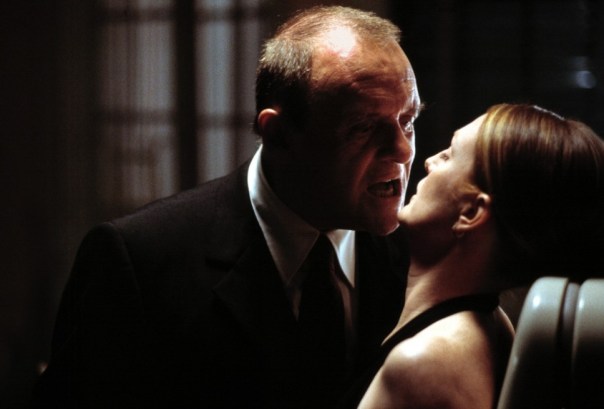
Serial killer culture dominated the 1990s and oddly enough it’s only gotten more highbrow since. Oh, that’s not to say that you won’t have any shortage of hacky, exploitative movies featuring elaborate murderers with gimmicky calling cards (The Hangman, a killer who literally stages his crime scenes like an ongoing game of hangman). However, the dark obsession with dangerous men (it’s almost always men) has given life to thousands of prestige cable documentaries, true-crime books, and high-profile podcasts like Serial and My Favorite Murder. We still very much have an unchecked fascination for these real and fictitious serial killers and what that may say about our society. In 1992, a serial killer thriller swept the Oscars, one of only three movies to win Best Picture, Actress, Actor, Director, and Screenplay (the others: It Happened One Night, One Flew Over the Cuckoo’s Nest, and American Beauty came close if it hadn’t been for Hilary Swank). That’s how good The Silence of the Lambs was as a movie to overcome the genre biases of older Academy membership (it also helped that there were other genre biases at play for the other Best Picture nominees like Beauty and the Beast, Bugsy, and JFK). It was special.
All of this is to say that Silence of the Lambs was a near impossible project to follow, and author Thomas Harris proved it with the middling-yet-best-selling sequel novel in 1999. It was obvious that it would be adapted into a major feature film, but the only returning Oscar winner from that first foray was Anthony Hopkins, which is kind of important considering his character is the title. The sequel was directed by Ridley Scott (Gladiator), adapted by none other than screenwriting titans David Mamet (The Untouchables) and Steven Zallian (Schindler’s List), and the movie made over $350 million worldwide at the box-office. By all accounts, it was a hit, but was it any good, or was it simply coasting from the acclaim and good will of its predecessor and the A-list cast and crew?
 The first thing that becomes immediately apparent while watching Hannibal is that this is not Silence of the Lambs and not in a sense of its accomplishments but more in its chosen ambitions. This is not a psychological thriller in the slightest. It’s a boogeyman monster movie. Nobody here is given to intense introspection about man’s inhumanity to man and other such Topics of Grand Weight. Scott’s sequel is more a Gothic B-movie content to spill stomachs rather than quicken pulses. The opening botched FBI raid is chaotic, action-packed, and the flimsy excuse for why Clarice Starling (Julianne Moore taking over for Jodie Foster) is shelved for most of the movie. It feels like the filmmakers know they need to delay the reunion of our favorite cannibal therapist and FBI agent as long as possible, so the 130-minute film feels like a protracted setup to tease how far audience anticipation can possibly be sustained.
In the meantime, the plot alternates between Dr. Hannibal Lector living it up in Florence, Italy and Starling slumming it in the FBI basement. Slowly, oh so slowly, she picks up the pieces to track Lector’s whereabouts, but until then we indulge a lot of narrative bloat. Do we need to follow an Italian inspector who suspects “Dr. Fell” is not who he says he is and then enact plans to prove his identity and eventually cash in? This man is literally on screen longer than Clarice Starling. We’re introduced to a rich villain, Mason Verger (Gary Oldman), but he’s more plot device than character, an all-expenses bank account to track and apprehend Lector for his bloody violence. I wish there was more to Oldman’s character given the actor and the impressive practical make-up application. He’s a symbol of rot, of vengeance, of obsession. Likewise, Ray Liotta’s lecherous FBI superior to Starling is less a character and more a plot device. He’s the stand-in for the harassment and dismissal Starling receives from her male colleagues, but a little of him goes a long way. His scenes where every other word is some creepy come-on, some sexual entreaty, or some off-color joke (he refers to Lector in homophobic slurs) are excessive. He’s an awful person but every line doesn’t have to be eye-rolling in how obviously terrible he can be. Spending extended time with all of these supporting characters is just a reminder that the movie is looking for excuses to keep its chief participants as far away for as long as possible. It’s frustrating.
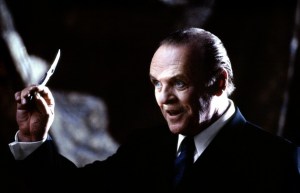 The depiction of Hannibal Lector in Silence versus Hannibal is also quite noticeably different. Like most things in this sequel, the character is baser, key characteristics heightened and broadened, and bordering on farce. He’s less a scary intellectual opponent and master manipulator and more a well-read serial killer on vacation. He is profoundly less interesting in Hannibal. That doesn’t mean there isn’t a pleasure to be had watching Hopkins slice and dice his way through Italy and elude capture. Hopkins seems to relish the amplification of the campy and grand Guignol tone of the sequel. He looks to be having a blast as an unleashed beast. His performance is fun but teeters over into self-parody at times. Hearing the erudite man spout ironic catchphrases meant for incongruous comedy de-fangs some of his mystique and intensity.
And yet there are things I still starkly remember even twenty years later. Hannibal is no Oscar-winning thriller operating at an ascendant technical level with engrossing multi-dimensional characters. It’s a boogeyman movie with a scary old man. The ambitions are just lower, but that doesn’t mean that Hannibal is subpar by those lowered goals. It’s still entertaining even when it’s getting silly or overly long. Scott’s visual presentation keeps things engaging and the lovely Italian art and locales are a definite benefit to establishing the gory, Gothic atmosphere. The makeup is outstanding and, as I said back in 2001, Verger resembles a human peeled grape. Feeding a man to wild boars is also quite memorable. The conclusion still has its squirm-worthy high-point with serving Liotta’s fresh brains to himself. It’s a gory comeuppance that feels fitting. In the original book, apparently Starling then bares her breast to Lector, and he goes down on one knee, and they run off together as fugitive lovers. Needless to say, this ending was met with controversy. The film smartly nixes this, especially since I never for one second felt a romantic coupling between these two embittered characters. The movie doesn’t kill the allure of the Hannibal character but it also positions him on the same level as Michael Myers instead of, say, John Doe (Seven). It’s like a Halloween mask version of a real serial killer, dulled and magnified in some ways, but still leaving a fair impression of its source.
 The Hannibal Lector incarnation had two more big screen ventures, the 2002 prequel Red Dragon and 2007’s even-further prequel, Hannibal Rising. Neither was terrific, neither was awful, though the answers that Rising offered as to what made Lector the man he is would inevitably prove disappointing (hello, childhood trauma). Arguably the best incarnation of the character, more so than Hopkins or Brian Cox (Succession) as the first big-screen Lector in 1986’s Manhunter, was from NBC’s television series from 2013-2015. Developed by Bryan Fuller (Pushing Daisies, American Gods), and starring Mads Mikkelsen (Casino Royale, Doctor Strange) as America’s favorite high-class cannibal, the series found a way to make a weekly crime procedural operatic and hypnotic and disgustingly beautiful. It’s like the artistic sensibilities from Silence and Hannibal were perfectly blended into a strange lovechild that deserved an even longer time to shine. Recently, just the week of this writing, CBS has begun a 2021 Clarice Starling TV series, though because of rights issues they cannot even reference Hannibal Lector. They have the rights to the senator and her daughter who was kidnapped by Buffalo Bill, as if those characters were what the fanbase was really clamoring for more time with. It looks like any other grisly CBS crime procedural just with a different name. I fully expect it to be canceled after one season.
Looking back at my review from 2001, I found myself nodding in agreement with my younger self from the past. I try not to read my earlier reviews before re-watching the films in question and perhaps might surprise myself by coming up with the same critiques independently. I also quite enjoy this line: “Lector on the loose is no better than a man with a chainsaw and a hockey mask, though he has a better knowledge of Dante and Florentine romantic literature.” I would even keep my grade the same. Twenty years later, the Hannibal Lector character still captures our intrigue and fascination even if he’s deposited in a lesser escapade not fully worth his full abilities.
Re-View Grade: B-
Share this:

The Father (2020)
 The Father is the kind of movie I’ve been clamoring for years from Hollywood, an Alzheimer’s empathy experiment using the rigors of a visual medium to place a viewer inside the mind of someone haunted by this debilitating mental illness. Film is inherently an immersive experience with a defined point of view, and I always thought it could be helpful in illuminating what it would be like to lose a sense of time, memory, and place as memories blend together and fragment. The Father is based on a play by director Florian Zeller. It’s a deeply empathetic and heartbreaking experience that works as a puzzle to decode but also as a character piece on the end of one ordinary man’s life.
Not much is known about Anthony (Anthony Hopkins) before his gradual mental decline. He had an apartment he lived in for thirty years, there’s definitely hints that a younger daughter had an accident and is no longer alive, and he listens to opera quite frequently. I think there’s a benefit to the audience knowing so little of Anthony before his illness; we do not know what variation of this man is the honest, lucid version from before. We’re only getting impressions and glimmers and some of them are non-linear, where we’ll get the context of a scene after the start of a scene, so it challenges a viewer to be constantly trying to contextualize what we’re seeing with what we know, and it’s an ongoing puzzle to determine a slippery orientation. It makes for an engaging and constantly changing environment and one tailored to engrossing empathy.
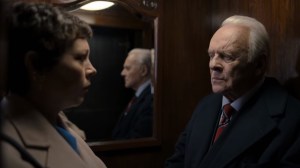 It sounds like the movie might be an overwhelming downer, and most assuredly it will leave an emotional devastation, but it’s also a very fascinating experience. From the beginning, you’re dropped into a scenario that announces to you not to fully trust your eyes and ears. You’re trying to assess character relationships. Who is this woman? Is she Anthony’s adult daughter Anne (Olivia Colman)? Is she a figment of his imagination? Is she the possibly dead daughter? Sometimes characters will be referred to by the same name but be played by different actors, and you must question which version was real, or whether either of them was? Is he projecting his dead daughter onto the face of another woman? Is he projecting an antagonistic man (Mark Gattis) onto the face of a former son-in-law (Rufus Sewell)? Which home is he in at this time? There is much to unpack here and I’m positive that additional viewings would unveil even more clues hiding in plain sight. I’m certain that the paintings on walls in backgrounds are regularly changing with the timeline, and this small detail of set design is never even emphasized. It’s just one aspect of the presentation that has been thoughtfully developed to support its artistic vision.
As one would expect from the premise and its beginnings as a play, this is an actor’s showcase. Hopkins (The Two Popes) delivers one of the best performances of his storied career. We’re so used to seeing Hopkins play men in control, dominating others. I even just re-watched him killing people in the shadows from 2001’s Hannibal sequel. This is the most vulnerable the actor has ever been on screen, and I’ll freely admit that by the end tears were streaming down my face as Anthony has descended into a childish state of need. Hopkins goes through a gamut of emotions and shifts rapidly. In one moment, he can be gregarious and charming, another cold and paranoid, cruel and cutting, but often he’s confused and afraid. He’s trying to maintain his dignity throughout. By being our focal point, we feel the same feelings that this elderly man is experiencing in this moment out of time. Colman (The Favourite) is also terrific as Anthony’s put-upon daughter trying her best but reaching her limits. The accumulation of this man’s experiences, and the weight of the burden on his family, is a devastating conclusion that reminds you what millions of families are going through every day.
 The trappings of plays adapted to film is the struggle to make them feel bigger than potent conversations happening in confined spaces. Zeller’s debut as a director does a fine job of using the techniques of filmmaking to his advantage. With editing and camera placement, he can better orient or disorient an audience, and the impact of character changes has more intensity with our proximity to the actors themselves. The attention toward the visual parallels like hallway shots and people being confined to shadows present an extra layer of symbolism to be decoded. Zeller has clearly thought out how to transcend the stage and to use the immersion of film and freedom of being non-linear with editing to shape the presentation and make it even more effective.
I’ll be honest with you, dear reader, and that is that Alzheimer’s terrifies me. We’re all the accumulation of our memories and experiences, and to think those could be stripped away, muddled and tainted, and change your conception of self, well that is absolutely haunting. It’s the kind of stuff that keeps me up at night, and while my maternal grandfather went through a spell of dementia before passing away at 92 years old, fortunately this illness does not run in my family. I have friends that are dealing with it currently with grandparents and it’s like approaching death before the actual death, watching that version of the person you love shrink to the point where they have been replaced by a stranger, all the while you are helpless to thwart this process. For those people, The Father will hit close to home and might even be too much to handle. It’s such an open-hearted and empathetic portrayal that puts you in the position of having to live with the ravages of Alzheimer’s. It’s so frustrating and confounding and sad, and yet film can open us all to the experiences of others like few other mediums, and The Father might be the closest any of us ever get to understanding what this terrible illness is like for those caught in its snare. It’s a fantastic movie with fantastic performances but even more than that it’s a wonderful experiment in empathy and understanding.
Nate’s Grade: A-
Share this:

Thor: Ragnarok (2017)
 With the continued runaway success of the box-office juggernaut that is the Marvel Cinematic Universe (MCU), it becomes more and more preposterous just how strange and unique it can be. You would think a mega franchise this valuable would be more prone to playing it safe, hiring established visual stylists who can produce product. Instead, the MCU finds interesting creative voices that can succeed within their very big sandbox. Enter New Zealand actor and quirky director Taika Waititi (What We Do in the Shadows), one of the most surprising directorial hires in a decade of blockbusters. The Thor movies are generally considered some of the weakest films in the MCU, so there’s already plenty of room for improvement. With Waititi, Thor: Ragnarok is easily the best Thor movie and one of the funniest to date for the MCU. It’s finally a Thor movie that embraces its silly, campy, ridiculous world and finds space to cram in more eccentricity.
Thor (Chris Hemsworth) has returned to his home world of Asgard to find it in great peril. His brother Loki (Tom Hiddleston) has been ruling in their father’s stead, and that’s not even the worst part. Thor’s heretofore-unannounced older sister Hera (Cate Blanchett) has been unleashed from her prison and is seeking the throne she feels is rightfully hers. She is the goddess of death and chafes at Asgard’s revisionist history, trying to paint over its history as conquerors for something kinder and gentler. Thor is banished to an outlying planet, Sakaar, that’s essentially a junkyard for the universe. He’s captured by Valkyrie (Tessa Thompson) and sold to fight in the Grandmaster’s (Jeff Goldblum) arena. Thor is trained to fight in gladiatorial combat, and his opponent and reigning champion is none other than the Hulk a.k.a. Bruce Banner’s (Mark Ruffalo) alter ego. Thor must break free, convince the Hulk for help, get off this planet, and save Asgard before it’s too late.
 Waititi has acclimated himself extremely well in the large-scaled world of blockbuster filmmaking, and yet his signature quirky sense of style and humor are still evident throughout, making Ragnarok the best Thor film. Let’s face it, the Thor films are completely ridiculous and trying to treat them as anything but is wasted effort. These movies involve alien Norse gods traveling by rainbow bridges and even though they can traverse the cosmos in spaceships they still sling giant broad swords. The more the films embrace the inherent silliness of the series the better. Ragnarok is the Thor movie that gets all the serious stuff out of the way in the first act, tying up loose ends from 2013’s Dark World, checking in with Anthony Hopkins’ Odin and the requisite MCU cameo (a superfluous Doctor Strange), and then introducing Thor’s long-lost twisted sister. From Blanchett’s intro, the movie becomes what it was set out to be, a lavish and consistently funny buddy comedy. Gone are all the Earthly constraints from the prior two films. It’s all aliens from here on out. Thor has everything stripped from him, his hammer, his family, his hair, and becomes an underdog once again. It’s a surefire way to make a living god more relatable. Fighting from the ground up, Thor makes all sorts of new friends and enemies, and it’s this evolution into an ensemble comedy where Waititi’s film shines. There’s a jovial touch to the world building that extends from the visuals to the variety of odd characters. Thor has never been more entertaining as Hemsworth (Ghostbusters) is able to stop being so serious and embrace his underutilized comedic chops. The man has a stunning sense of comedic delivery and a dry wit that’s right at home for Waititi. Hemsworth and his daffy sense of humor have never been better in the MCU.
Even with the added comic refinery, Thor is still the most boring of the Avengers, so Ragnarok solves this by introducing a new bevy of side characters that steal the show. The wacky world of the Thor universe was always its best aspect, and each new film pushes the boundaries a little further out, revealing more weird and wild planets and creatures. It feels like a Star Wars where we spend our time with the weird, scuzzy part of the universe. Ragnarok pushes those boundaries the furthest yet and introduces an entire cadre of loveable supporting players that you want to spend more time with. Tessa Thompson has a wonderful and intimidating introduction as she swoops in on a spaceship, makes her badass claim of her prized bounty, and then trips and falls, as she is quite tipsy from drinking. She regains her literal footing and still seems a bit out of it, but the ensuring process she goes through to claim what is hers is thoroughly impressive. As a Valkyrie, this is one tough woman, and Thompson (Creed) has great fun playing bad. She really reminded me of a female Han Solo. Thompson has a wily screwball chemistry with Hemsworth, and both actors elevate the other with lively give-and-take. Thompson is a terrific new addition. She has an enticing, irascible appeal without overt sexualization that sometimes befalls the Marvel female sidekicks (Black Widow, Pepper Potts).
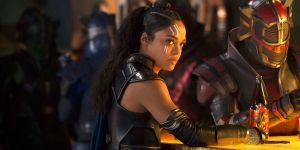 Another character you’ll fall in love with is Korg, a rock monster gladiator played in motion-capture and drolly voiced by director Waititi himself. My question: is it possible for a director to steal his own movie? This is a character that feels stripped from one of Waititi’s dry, absurdist comedies and placed into the MCU. Korg is a would-be revolutionary but really he’s a joke machine and just about every line is gold. By the end of the movie, I needed a Korg spin-off series to further explore this unusual character.
The requisite villains of the film definitely play their roles to full camp, enjoying every moment. Blanchett (Carol) is like a Gothic Joan Crawford, marching with a slinky step and a sneer. Her multi-antler helmet completes the operatic sweep of the character. You’ll forgive me for my above comment on recognizing female characters independent of their sexuality, but man oh man does Goth Blanchett make me happy (especially with her hair down). It’s a shame that the movie doesn’t really know what to do with Hela though. Every time we cut back to her I found myself getting somewhat impatient. I wanted to return back to the weird and wild world Thor was on. Blanchett is entertaining but her character can’t help but feel a bit shoehorned in (“Hey, you had a long-lost sister, and oh by the way, she’s basically Death itself, and she’s coming by to retake everything, so have fun with that and sorry for the short notice”). Goldblum (Independence Day: Resurgence) is left to his Goldblum devices and it’s everything you would want. His signature stuttering deadpan is just as potent in the MCU, and the film finds strange little asides for him to make him even more entertaining. Karl Urban (Star Trek Beyond) has a plum role as Hela’s second-in-command who doesn’t really want the job. They actually gave this guy a character arc. It’s simple, sure, but it was more than I was expecting.
 Ragnarok is a swan dive into a stylized, candy-colored explosion of 80s album covers come alive. The visuals and action feel inspired as much from the art of Jack Kirby as they do the pages of Heavy Metal. The overwhelming feel is one of irresistible fun, something you lean back, soak up, and smile from ear to ear in between handfuls of popcorn. The final battle feels suitably climactic and revisits Led Zeppelin’s immortal “Immigrant Song” once the action peaks, coalescing into a crescendo of cool. The trinkly 80s synth score from Mark Mothersbaugh (The Lego Movie) is fantastic and helps to achieve an extra kitschy kick. This movie is just flat-out fun throughout. It finds fun things for the characters to do, like when Banner has to not Hulk out on an alien world filled with stressors to trigger such an occurrence. That sequence almost feels like the grown-up, polished version of Adam West desperately running around as TV’s Batman in need of trying to find a place to dispose of a lit bomb. There’s an archness to the action and character interactions that is playful without being obnoxiously glib. I also enjoyed a climax that involved more than just out-punching the villains. Some might even charitably read it as a commentary on the over reliance of apocalyptic grandeur.
Playing from behind because of its hero’s limitations, Thor: Ragnarok finally embraces the silliness of its franchise, opening up more comic channels and vastly improving its entertainment quotient. The weird word and its collection of odd and oddly compelling characters is the best feature, and though it takes Ragnarok a bit of time for house cleaning, it becomes a steadily amusing big-budget blockbuster that maintains a cracked and lively sense of humor. It’s allowed to be strange and silly and campy. Waititi’s imaginative voice is still very present throughout the film, pushing the movie into fun and funny directions while still delivering the sci-fi action spectacle we’ve come to expect from the MCU. Ragnarok isn’t as deep as Civil War, as perfectly structured as Homecoming, or as subversive and different as Guardians of the Galaxy, but with a droll creative mind like Waititi, it becomes about the best possible Thor movie it can be.
Nate’s Grade: B+
Share this:

Transformers: The Last Knight (2017)
 Unlike many of my critical brethren, I do not view Michael Bay as the devil incarnate. I think the man has definite talent and is one of the finest visual stylists working in the realm of film. I’ve enjoyed about half of the Transformers franchise and don’t consider it the end-all-be-all of modern American cinema. Transformers: The Last Knight is exactly what the detractors have railed against from the start: a cacophonous ejaculation of incomprehensible nonsense. The charge has often been made against Bay’s long filmography that his stories are unintelligible, but Transformers 5 proves to be the new measuring point for incensed incredulity. This isn’t only the worst Transformers entry in a seemingly never-ending franchise (thanks product placement, merchandising, and toy sales) but an early contender for worst film of 2017.
Cade Yeager (Mark Wahlberg) is hiding out with other Autobots in a South Dakota junkyard awaiting the return of Optimus Prime (voiced by Peter Cullen). Prime ventured into space to find the remnants of the Autobot home world, Cybertron. Once found, he’s brainwashed by the Cybertron goddess Quintessa (Gemma Chan) into being her servant. She’s after an ancient staff that will prove to be the key to restarting Cybertron. It was last seen on Earth during the Dark Ages and rumor has it was given to Merlin. Cade is enlisted by a centuries-long secret society to help find the staff before the evil forces at bay get hold of it.
 It feels like the Transformers 5 writers were on a week-long cocaine bender when they cobbled together this impenetrable narrative. Let me give you but a taste of the confusing, muddled, and overall mind-numbing plot as it exists. There’s a magic staff from the robot world that will recharge the robot world, and it just so happens 12 robot knights, which form a giant robot dragon, landed on Earth and gave it to Merlin, played by a soused Stanley Tucci who was already a different character in the fourth Transformers movie, who then established a secret order that would keep the giant alien robots secret even as they were doing things as high-profile as literally killing Hitler, and the members of this secret society include Frederick Douglass and Queen Elizabeth and Shia LeBouf, and this staff needs to be retrieved from an underwater spaceship under Stonehenge by Merlin’s blood progeny and will be aided by an alien talisman that forms an alien sword that does something, and the evil alien robots are going to recharge their planet by scraping the Earth’s crust, which has horns protruding from it that once aligned with Pangaea, and there’s an evil alien robot goddess who brainwashes Optimus Prime to retrieve her magical items on demand and then Megatron is being hired the U.S. government and a team of special ops are trailing him to get to the staff and… I’m sorry; did your brain start bleeding out your ears? I looked over to my friend Ben Bailey during the screening and saw him slumped over in his chair and thought, for a fraction of a second, that the movie had literally killed him (he had just fallen asleep for the third time). What an ignoble end.
The movie is a nonstop barrage of yelling and movement, an assault on the senses that leaves you dumbfounded and dazed, and without anything to moor onto. Almost every single actor is on screen for one of two purposes: quips or exposition. These are not characters but devices for words that ultimately don’t make sense. Wahlberg has two different female sidekicks. For the first half, he’s got a plucky teen that serves as a surrogate daughter figure. Izabella (Isabella Moner) is a kid with attitude and carefully arranged strands of hair that always fall over her face in every single shot in the entire movie. Izabella’s introduction actually might be the highlight of an otherwise soul-crushing experience. Then Wahlberg leaves for England and he adopts a new sidekick, this time the hot smart woman who changes into a more comfortable outfit but literally keeps her heels. Vivian (Laura Haddock) is pretty much the next in a long line of highly sexualized, tawny female characters under Bay’s alluring gaze (I wrote about the second film: “Women don’t seem to exist in the Michael Bay world, only parts and pieces of women.”). Her mother doesn’t care about the end of the human world, or her daughter’s many academic credentials, and instead pesters her about getting herself a man. This leads to one of the film’s worst comedic moments, as Vivian’s mother and friends giggle and eavesdrop on her and Wahlberg trashing a library as a spontaneous bout of sexy time. Wouldn’t it be weird for anyone’s mother to take pleasure in listening to your escapades and offer a play-by-play?
 But the strangest characters are Anthony Hopkins’ Sir Edmund Burton and his 4-foot robot ninja (voiced by Jim Carter). You can clearly tell that Hopkins didn’t care at all what he was saying. He uncorks ungainly monologues with relish and then transitions into strained comedy as a doddering old man. The robot butler begins as a C3PO-esque prim and proper servant with a disarming fighting ability, and it works. However, as the movie progresses, the robot butler gets downright belligerent and seemingly drunk. It’s truly bizarre, as if this robot is acting out to be seen like he’s one of the cool kids, but whom exactly is he trying to impress? At one point, he tells Wahlberg that he is “on my shit list” and torpedoes out of a submarine, brings back fish, prepares a sushi dinner for the humans while supplying ingredients that were totally not found on a WWII-era sub that was parked as a tourist locale up until 20 minutes ago. The character makes no sense and seems to bounce around behavioral extremes. Take this passage late into the film:
Robot Butler: “Of all the earls I’ve served-“
Me: “You were the greatest?”
Robot Butler: “-You were the coolest.”
Me: “Whaaaaaaaa?”
Another confusing part of the film is the setting of its story. We’re five movies in to an alien civil war taking place on Earth, so you would assume that normal life shouldn’t feel normal after so many catastrophes. Egypt was destroyed in the second film (only Six Wonders of the World left in your punch card, Bay), Chicago was decimated in the third film, and China was blown up in the fourth film. It’s about time that people started paying attention to these things and behaving differently. A new government agency is tasked with hunting down Transformers and there are war zone portions of the world that are quarantined, but that’s about it. I initially thought this fifth movie was going to take place in a somewhat post-apocalyptic Earth where human beings have to struggle to survive. That’s not Transformers 5 at all. It seems all too easy to ignore reality; Wahlberg’s daughter is away at college. After four movies, the world of this franchise needed a jump in its stakes. Bay’s films have always possessed an alarming sense of urgency but it rarely feels earned. Characters yelling, running, and explosions going off like fireworks isn’t the same thing as genuinely developed stakes.
 Another confusing aspect of Transformers 5 is Bay’s jumbled aspect ratios (i.e. how wide the frame of the movie is presented). Sizeable portions were shot on IMAX, which has become all the rage for action movie directors since Nolan’s The Dark Knight. I expected that. What I didn’t expect was three different aspect ratios that jumped from shot to shot. Two characters will be having a conversation and the aspect ratio will cycle and it rips me out of the movie every time (there are SIX credited editors). The Dark Knight’s IMAX sequences worked because they were sustained sequences. I expect the higher-grade IMAX film stock for the expansive action or picturesque landscapes to take in the natural splendor. What I wasn’t expecting was measly interior conversations to be filmed in IMAX. Did I really need to watch a conversation with Vivian and her mother in IMAX to fully appreciate their bookshelf? Like much else in this perfunctory movie, this game of pin-the-tail-on-the-aspect-ratio makes no sense.
I don’t normally like to quote myself, but reading over my concluding paragraph of 2011’s Dark of the Moon, I was struck by how much of my assessment could equally apply to the fifth film, even down to the exact running-time: “Transformers: Dark of the Moon is likely everything fans would want from a franchise built around the concept of robots that fight. There’s wanton destruction, a plethora of noisy explosions, and plenty of eye candy both in special effects wizardry and pouty, full-lipped women. But at a colossal 150-minute running time, this is a Transformers film that punishes as much as it entertains. There’s really no reason a movie about brawling robots should be this long. There’s no reason it should have to resort to so much dumb comedy. There’s no reason that the women should be fetishized as if they were another sleek line of sexy cars. There’s no reason why something labeled a ‘popcorn movie’ can’t deliver escapist thrills and have a brain too.” Take this assessment and times it by ten for The Last Knight. The incomprehensible plotting, infantile humor, nonchalant misogyny, empty action bombast, and dispiriting nature of the film are enough to suck the life out of you. I was bored tremendously and contemplated walking out on the movie (I stayed for you, dear reader). It feels like the screenplay was put into a blender. Transformers 5 is exhausting and exhaustively mechanical, and if this is the first start in a larger Expanded Transformers Cinematic Universe (ETCU?) then resistance may be futile. Still, it’s worth fighting against brain-dead spectacle that only moves you to the exits.
Nate’s Grade: D
Share this:

Thor: The Dark World (2013)
 Loosely based off the Norse mythology, Marvel’s hammer-wielding hero isn’t exactly the easiest character to relate to even as a superhero. Thor is a god after all. Not to be outdone, the man is also royalty, next in line to be king, so he’s in a special class of privilege. And yet 2011’s Thor was a pleasant surprise, a superhero movie that didn’t take itself too seriously, had modest aims, and embraced its sci-fi fantasy mélange. It was a movie where the sillier it got the better it worked. Now Thor: The Dark World, a.k.a. Thor 2, is ready to dominate the fall box-office and prove that Joe and Jane Popcorn can cheer for a pagan god.
Following the events of The Avengers, Loki (Tom Hiddleston) is taken back to his home world of Asgard and put in prison. Loki’s brother, Thor (Chris Hemsworth), is trying to get back to Earth to reunite with his love, scientist Jane Foster (Natalie Portman). Thor is being groomed for the throne of Asgard by his father, Odin (Anthony Hopkins). Meanwhile, the nine worlds are nearing a convergence and dimensional gateways are opening, including one that infects Jane with an ancient biological weapon, the aether. The aether was used as a weapon by the dark elves, a race of creatures that was long ago defeated but its general, Malekith (Christopher Eccleston), has been dormant and in hiding. Alterted, he assembles his surviving army to attack Asgard, kidnap Jane Foster, retrieve the aether, and destroy all life in the universe.
 Thor is still a second tier character when it comes to Marvel superheroes (the guy just isn’t that interesting) but his franchise has, in only two starring films, become the most interesting. The scope of the Thor movies seems infinite. Whereas the other Marvel heroes are Earthbound and straightforward, Thor transports an audience to all sorts of alien worlds/cultures/conflicts, all of which open up more tantalizing storytelling avenues. Nothing seems out of place in a setting such as this, and so the surprises are more satisfying. I thought the best parts of 2011’s Thor were the Asgard moments, less the strained fish-out-of-water comedy of Thor assimilating on Earth. Thankfully, almost all of Thor 2 takes place off Earth save for a rousing, creative, inter-dimensional hopscotch of a climax. The realm of Asgard is given suitable scope thanks to the screenwriters and first-time feature film director Alan Taylor, who worked in TV for years. Taylor’s notable work on HBO’s Game of Thrones is probably what got him this gig, and his vision with fantasy is given significant breadth here. The Thor universe is an interesting mix of fantasy and sci-fi, reminiscent of Star Wars, and Taylor provides the necessary sweeping visuals, exciting action, and glorious shirtless close-ups we come to expect from our fantasy vistas. I was consistently impressed with Taylor’s command of visuals and shot selection, particularly how the man was able to juggle the various tones and needs of the script while still keeping an exposition-heavy film fun and light.
With rainbow bridges, dark elves, and enchanted hammers, thank goodness that Thor 2 keeps a steady and welcome sense of humor, never getting too serious even with the end of existence on the line. This jovial tone is refreshing when properly executed and contributes to the overall fun of the picture. We’ve had such sturm und drang when it comes to our superhero movies, particularly last summer’s Man of Steel misfire. I appreciate a dark and gloomy superhero tale like Nolan’s Batman films, or a satirical swipe like the original Kick-Ass, but we need stories that fit with their tone. When it comes to Thor, he’s still saving the world, rescuing his damsel, but the attitude, while on its face regal and serious, is anything but. The Thor movies accept the absurdities of its setting and just shrugs, plowing along. And now with Jane on Asgard, the fish-out-of-water comedy gets a different perspective. She gets to meet Thor’s parents (awkward) and an Asgardian who has a thing for the hunky Norseman (double awkward… I’ll stop the 90s catch phrases now). Thor 2 also gives Jane Foster much more to do, placing her front and center as a person integral to the stability of the universe. During the snazzy climax, she gets to run around and contribute in a meaningful manner. The there’s the plucky Kat Dennings (TV’s 2 Broke Girls) who gets to rattle off one-liners like a pro, many of them grounding the elevated levels of silliness. Much of the humor comes from the cocksure characters and their quips, particularly Loki.
And that’s as good as any place to interject my notion that Thor isn’t truly the main character in this film, despite what the title preceding the colon may lead you to believe. That honor goes to Loki, the greatest villain in any modern Marvel movie by far. He’s got the clearest arc in the movie, going through arguably the most personal pain, coming to a crossroads, and his conclusion certainly sets up sizable ramifications down the road for the presumptive Thor 3. Played by Hiddleston (War Horse), the character draws you in, even when he’s throwing his self-aggrandized temper tantrums you want to spend more time with him. He’s far and away the most developed and interesting character onscreen, and Hiddleston has such a gleeful malevolence to him that makes the character all the more electric and unpredictable. Thor 2 is really the story of Loki coming to terms with his life’s choices, the choices his adopted parents made, his sense of self and birthright, and moving forward, becoming his own man again. This is why Thor 2 ascends another entertainment rung by tying Loki into the main story, forcing him and Thor to work together against a common enemy.
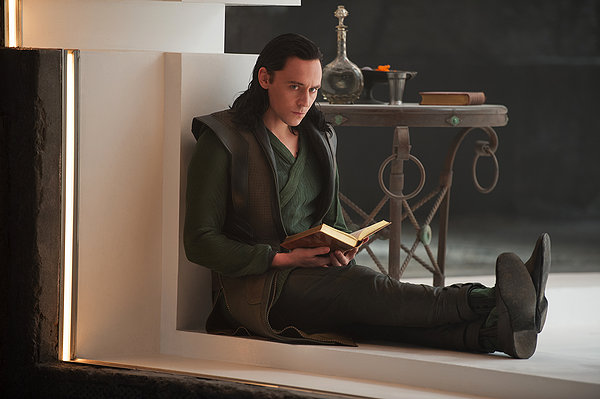 In a film dominated by a charismatic Loki, it’s no wonder that Thor 2’s real bad guy falls woefully short. Malekith is a confusing and altogether lackluster antagonist in every conceivable way. He has no personality to him; he’s simple-minded with the goal of eradicating the universe. I don’t know about you, but my bad guys better have a pretty good reason for destroying the universe since they kinda live there too. This is one of the lazier villain plot devices because it has no nuance, no shading. Apparently before there was a universe there were dark elves. I don’t want to get caught in a chicken-egg paradox here, but was there a universe before the universe, cause I look at the universe like existence’s garage. The cars inside may change but the garage was standing before it all. Anyway, Malekith wants to destroy all life because he wants to, because certainly you’d think there would be enough space in space. He’s not even that threatening or given any particular advantage beyond some firepower. It’s no wonder that Loki runs circles around this chump in the villain department. Eccleston (Unfinished Song) is not at fault. The heavy makeup he’s under smothers the actor’s ability to polish this terrible character.
The rest of the acting fares better. At this point, we know what we’re getting with Hemsworth (Snow White and the Huntsman) as the title character. He’s a sturdy leading man with just enough appeal to satisfy, though part of it is that Thor is just dull as a hero. He was more entertaining when he was cocky and irresponsible. Portman (Black Swan) holds her own though the romance between her and Thor feels more forced. Hopkins (Red 2) strikes the right mix between regal and camp. While their roles aren’t exactly integral, it’s nice having a superhero movie stuffed with great actors like Idris Elba, Ray Stevenson, Adewale Akinnuoye-Agbaje, Clive Russell, and there’s even an amusing appearance by Chris O’Dowd, who effortlessly oozes charm (take note, Thor).
This a superhero movie that separates itself by its sheer sense of fun. Thor: The Dark World takes what worked in the previous movie and provides more of it. The campy, silly Asgard stuff is given even more time, the mischievous sense of humor is renewed, the fantasy worlds given more depth and better action/effects, and fan favorite Loki gets a big starring role this time with extra brotherly bickering. It’s not the best superhero movie, nor is it the best Marvel film of recent years, but Thor 2 knows what kind of movie it wishes to be and how to best achieve this. It’s a loopy, droll, and rather imaginative big-budget superhero film, while still finding ways to be somewhat generic with its overall plotting and character turns. While the action is suitably epic, it’s the character interactions that are the most enjoyable aspect. It seems excessively lazy to say that if you enjoyed the first Thor, you’ll probably enjoy the second one as well, but there it is. Perhaps next time the storyline won’t be as convoluted and we can get even more Loki. Barring that, I’ll accept additional Chris O’Dowd screen time.
Nate’s Grade: B
Share this:

RED 2 (2013)
 Pretty much more of the same, RED 2 feels too safe, too breezy and light-hearted, and while still fun in spots, you garner the impression that what was once sufficiently silly has gone overboard. The jokes feel flat and the characters aren’t properly integrated, especially Helen Mirren and a vengeful hired killer (Byung-hun Lee). The villains are a tad bland, but we’re here for the wacky retired special agents, so it’s forgivable. However, the good guys feel like they’d rather be elsewhere. Too much of the story is taken up by the frustrating Bad Girlfriend Plot wherein our hero Frank (Bruce Willis) is harangued by his girlfriend, Sarah (Mary-Louise Parker). I’m not even saying that her character is nagging or shrewish or anything like that, but the movie treats her like she’s dragging him down. We’re also treated to many comedic setups of Sarah trying her hand as a spy to mixed results. Parker is actually the best part of the movie, and maybe because she’s the only character that gets to do something different. RED 2 lacks the visual style of the first film and, inevitably, the freshness of its cavalier old fogies. The action is passable but is that really the adjective you want for a movie? I don’t know what more I was expecting since the first RED felt like a well-executed lark, but at least it had enough style and an impish attitude to leave me entertained. Its sequel is likeable but mostly trying to get by on your good feelings for the last movie.
Nate’s Grade: C+
Share this:

Hitchcock (2012)
 I think Alfred Hitchcock would be amused at his continued notoriety, not just from the quality of his films but also from the magnitude of his own presence. 2012 offers not one but two different movies about the master of suspense, both of which are oddly close in time period. HBO’s The Girl explored Tippi Hedren’s account of what it was like to film The Birds, with Hitchcock being a provocateur. The more straight-forwardly named Hitchcock looks at Alfred’s trials to make one of his seminal films, 1960’s Psycho. I only wish that the movie spent more time on Psycho and less time on the Hitchcock marriage.
Alfred Hitchcock (Anthony Hopkins) is starting to feel like he’s being left behind in Hollywood. He’s looking for his new project, something to rekindle his creative fervor, get those juices flowing once more. Then he comes across the book Psycho, based upon the murders of Ed Gein, a man who thought his dead mother was telling him to kill and make skin suits of his victims (Gein is also the inspiration for The Texas Chainsaw Massacre and Buffalo Bill in Silence of the Lambs; truly the gift that keeps on giving for horror). Murder, cross-dressing, incest. You can understand the hesitation from studio heads to bankroll the picture, even with the great Hitchcock name attached. With the sturdy support of his unflappable wife, Alma (Helen Mirren), Hitchcock puts his own money and clout on the line to see Psycho through. As the pressure mounts, Alfred is worried that his wife is spending a bit too much of her time with a certain screenwriter who wishes to woo her efforts away.
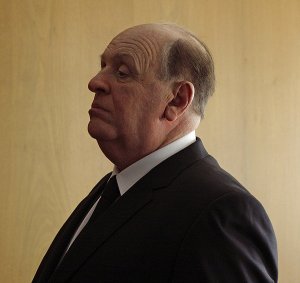 Sir Alfred was a blunt individual so I will follow suit and mince no words – this movie is terrible. How could it possibly be? It has tremendous acting talent and the rich angle of looking at the making of one of Hollywood’s most controversial and famous movies of all time the groundbreaking Psycho. Alas, it’s when the movie takes its many sidesteps away from the behind-the-scenes action of Psycho is where it goes astray. First off, I find the narrative framing around the marriage of the Hitchcocks to be superficial and hamstrung. We’re telling this vastly interesting story and grounding it in a very slight manner, gauging every creative struggle through the prism of whether or not Alfred and Alma will stick together. I assume it’s supposed to provide an emotional entry point for the movie, but I just didn’t care. I didn’t care about the jealous spasms Alfred felt as his wife spent more and more time with a caddish screenwriter, and boy did that storyline get tiresome. I want to know more about Psycho and not this dumb portrayal of martial woes told with such graceless handling. The whole portrayal seems so minute and clumsy and such a poor framing device when the making of Psycho is a juicy enough story. I didn’t need the focus to be on whether the Hitchcock marriage will persevere. Oh, and the resolution for this feels completely pulled from thin air, without any groundwork laid to explain the about-face into compassion in those final minutes.
Then there’s the portrayal of Alfred Hitchcock himself, which is so dubiously shallow when it comes to psychology. Oh, he’s obsessed with blonde leading ladies? Oh he’s a bit of a control freak? Oh he can be overbearing and demanding and standoffish? Wow, what powerful insights into arguably the most famous director in movie history. The movie, adapted by John J. McLaughlin (Black Swan), feels like it was made by someone who did the bare minimum of research on the man. There are no new insights or even mildly interesting ones to be found. It’s the standard boilerplate repeated with different actors. And then there are the nails-on-a-chalkboard scenes where Hitchcock imagines himself talking confessionally to none other than Ed Gein (Michael Wincott). Excuse me? Oh my goodness do these tacky sequences just grate. I don’t even understand their inclusion. Is this a manifestation of Hitchcock’s own sense of madness when it comes to moviemaking? Does he feel some connection to the horrible disturbed man who inspired his newest film? Does Hitchcock only feel like he can communicate to a figment of his own imagination? Whatever the reason, I wanted to smack myself in the head every time Hitch and Gein had a heart-to-heart. I should have known I’d be in for a bumpy ride when, in the movie’s opening minutes, a news reporter asks Hitchcock, after the premier of 1959’s North by Northwest, why he doesn’t just hang it up? Did this idiot even see North by Northwest? Would you ask Spielberg if he should retire after viewing Saving Private Ryan or Kubrick after A Clockwork Orange?
Then there’s the matter of Hopkins as Hitchcock. It never feels like the right fit. Turkey jowls aside, the man doesn’t look too similar to Hitchcock nor does he adopt a demeanor that proves convincing. Sure he goes for that highly imitable voice and cadence that Hitch is well remembered for, particularly his openings on his own TV show. You never feel like Hopkins has a real strong bead on the character, and surely the fault lies with the weak characterization relying on the collective knowledge of Hitchcock’s outsized public persona. Likewise, Mirren (The Debt) is fine but gets to play another of her steely strong-willed matriarchs. Mirren won’t let you done when it comes to performance but, given the lack of strong characterization, she goes on autopilot. The best actor in the movie is surprisingly Scarlett Johansson (The Avengers) who has a striking similarity to Janet Leigh, and not just in what you’re thinking. She’s instantly likeable and takes the Hitchcock peculiarities in stride, putting up a strong front but voicing her concerns when appropriate.
 Director Sacha Gervasi (Anvil! The Story of Anvil!) gooses up his story with all sorts of horror genre techniques, including editing fake outs and violent edits. I’m also unsure why so many liberties needed to be taken with the retelling of this story. I’m not going to be a person decrying the use of fictionalized elements in a true-life story for dramatic effect (I loved Argo), but you have to do so in a way that tells a better story without getting too far away from the essential truth of the matter. Hitchcock, in raising the talents of Alma, attributes many of Psycho’s development achievements to her keen womanly insights when they came from others. That’s fine, except that the movie portrays her in such a rarefied state of genius that she quickly becomes the movie’s surefire narrative cheat. Having problem with the last act? Let’s have Alma fix it. Having problems with the editing? Let’s have Alma fix that. It’s not compelling of a story for one character to chiefly have all the answers instinctively and without any sense of struggle. I understand that Alma did a lot of unaccredited work on Hitchcock’s movies, though it wasn’t uncommon for women to be screenwriters at that time and you’d think the pull of being a Mrs. Hitchcock would get her well-deserved credit. Regardless, I wish that Gervasi and McLaughlin had given Alma more depth than being put upon wife/secret savant collaborator.
It’s a shame because there’s a genuinely interesting movie to be had somewhere in here. The making of Psycho was fraught with difficulties and the studios just didn’t get it. Watching Hitchcock work through that process and persevere would be far more interesting. I enjoyed the multitude of famous cameos, like Michael Stuhlbarg as Lew Wasserman, Hitchcock’s agent and eventual head of Universal Studios, and even Ralph Macchio as Psycho screenwriter Joseph Stefano. I suppose the ins and outs concerning one of the most famous movies of all time could be considered, erroneously I feel, to be too “inside baseball.” That’s why I think the filmmakers expanded the romantic drama angle and had it consume the majority of the running time. Often the stupid perils of the will-they-or-won’t-they romantic squabbles feel so petty and cheap considering the magnitude of the work going on. Hitchcock feels like a movie that found the least interesting and essential angle to tell the story of the making of Psycho. Diehard movie fans might find some fun to be had with the minutia of Hollywood and Hitchcock’s life, but I cannot fathom how anyone could view this portrayal as effective. It’s not insightful, it’s not challenging, it’s not relevant, and it’s certainly not entertaining. This movie is not deserving of the name it bears.
Nate’s Grade: C


 nathanzoebl
You must be logged in to post a comment.