Blog Archives
Love and Other Drugs (2010)
 Director Edward Zwick has spent the last two decades making mass-friendly action films with designed to teach us all some valuable lesson, like Blood Diamond and Glory. But the idealistic filmmaker began his career with realistic relationship dramas like About Last Night… and the seminal TV show thirtysomething. There wasn’t an explosion to be had, unless you count the emotional ennui of middleclass white people. Love and Other Drugs is adapted from the biography of a Viagra salesman, which seems like a strange jumping off point for a romantic drama. Watch out for those unexpected side effects.
It’s 1996, and Jamie (Jake Gyllenhaal) is a smooth-talking, suave pharmaceutical rep for the medical giant Pfizer. He’s been dispatched to the Ohio River valley area with a mission to push his drug samples on doctors and raise his quotas. While posing as an intern, he meets Maggie Murdock (Anne Hathaway), a coffee shop beauty in stage one of Parkinson’s (don’t attack me, they reveal this spoiler before you even see Hathaway’s face). She spurs his advances but he persists, and the two agree to a strictly sexual relationship. Because of her illness, Maggie is wary of getting attached to people. She sees Jamie as a shallow, well-muscled lunkhead who won’t want anything else but a slew of orgasms from a pretty girl. And Jamie is content, until, of course, he falls in love. Maggie feels she’s sparing her lover the pains that will accompany her Parkinson’s. The two struggle with her illness, the toll it takes on their relationship, and the possible future they will have together… in between lots of sex.
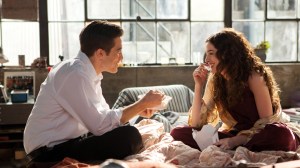 The true pleasure of Love and Other Drugs is watching Hathaway and Gyllenhaal together onscreen. The Brokeback Mountain buddies have tremendous chemistry that makes their give-and-take exciting and pleasing. Hathaway and Gyllenhaal may be the best onscreen couple I’ve seen since 2005’s Mr. and Mrs. Smith. Chemistry is such an indelible component for romance and yet it is so elusive to capture. So when a cinematic couple really create some serious sparks, it’s a memorable exchange. Hathaway and Gyllenhaal are a terrific team but also the rare screen couple that raises the performance of their partner. You are easily convinced that these two enjoy the company of one another; they’re so confident with each other even as they’re tumbling around naked. Hathaway has grown into an actress of surprising range, making keen use of her animated Disney heroine features. She has a knack for playing defiant, spunky women that have an alluring fragility, and that also describes her Maggie (how does a coffee shop give Hathaway the health insurance she needs for Parkinson’s meds?). Gyllenhaal has always had his boyish charm, but he seems catapulted to new charisma heights with Love and Other Drugs. He’s exploding with energy and comes across bursting with life onscreen. He starts as a suave Lothario drunk on his own charms but, as movie journeys dictate, he morphs into a committed, mature man. The roles are pretty standard (slick selfish salesman, sad girl with illness) but the duo bring extra vitality and heat that makes Love and Other Drugs compulsively watchable in its finer moments.
It’s refreshing to witness a major Hollywood movie that treats human sexuality without the standard artifices of Hollywood. Love and Other Drugs is not coy when it comes to physical lovemaking. This isn’t a blockheaded movie where the woman goes through the entire night of passion while wearing a bra the entire time (the epitome of PG-13 sex). This isn’t a movie where after a healthy bout of sex the couple feels the need to cover up their goods as they lay beside one another. Like after a vigorous sexual experience now the lovers suddenly become bashful at their own state of nakedness (get the fig leaves – stat!). So it’s refreshing to watch a film deal with sexuality without giving undue attention to how “risqué” everything is. The nudity is European-style casual, and while the film manages to be quite sexy, the nudity and sex scenes do not play as shameless titillation. The sex and copious nudity is just another part of the storytelling. Of course it also happens to be a prominent and highly marketable storytelling aspect. It’s not like Hathaway and Gyllenhaal are homely actors. Watching beautiful people writhe together on screen and nonchalantly walk around without a stitch on has always been a sure-fire way to sell tickets. Love and Other Drugs utilizes all that skin to lure boys into a traditional romantic drama. It’s to Zwick’s writing and directing credits, and the natural chemistry of his two high-wattage stars, that the parade of flesh doesn’t feel like naked, prurient exploitation. It’s not exactly an edgy film by any means but it’s assuredly adult in its portrayal of sexuality. Or at least it thinks it is. The sex isn’t really a topic to be explored with nuance and clarity; it’s more something to keep the actors busy.
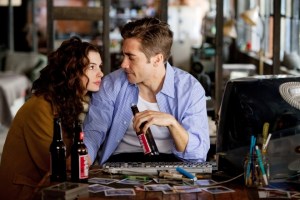 Ultimately, the tonal inconsistency is what hampers the momentum of Love and Other Drugs. It’s hard to build narrative momentum when the film just seems to be starting over time and again. Zwick bounces around different tones, sometimes wildly from scene to scene. At heart it’s a weepie romance, the sick girl and her paramour coming to terms with their doomed love. But then the movie also wants to be an energetic, smart-alecky comedy, then there are all sorts of crude gags (hope you like boner jokes), and then the film also wants to be a satire on high-powered pharmaceutical companies and their sleazy influence romancing doctors. And then in between all that is the weepie drama stuff as Maggie has to deal with the (movie) realities of her illness. Here’s an example of the tonal whiplash that did the movie no favors: Jamie stumbles in on his disgusting younger brother (see below) masturbating to a sex tape of Jamie and Maggie, of his own brother and his brother’s girlfriend. The scene is played for broad comic laughs and ends with Jamie beating his brother off screen with that very sex tape. If people needed another reason not to make sex tapes, here it is: Josh Gad might one day view them and pleasure himself. You don’t want that, trust me. But then the very next scene involves Maggie working on her art and unable to control her Parkinson’s symptoms, namely finger tremors. We watch as Maggie diligently and patiently tries to open a bottle of pills, the childproof locked top confounding her stubborn fingers, only to eventually find that the bottle is empty and her symptoms will only increase. The fact that these scenes coexist right next to one another makes their differences all the more jarring. Love and Other Drugs tries to jostle diverse genres but the different tones never coalesce. As a result, you feel violently ripped from one movie to another.
Let me give due attention to just how revolting the character of Jamie’s younger brother is. Josh is a cancer on the movie. He doesn’t make a scene better but rather drags it down to a lower level. He’s slovenly, boorish, coarse, and routinely unfunny. You can practically feel his sweaty fingerprints pawing at the movie for attention. This character is abominable and repulsive. He inserts himself into Jamie’s home and offers no dramatic value. His purpose seems to be solely as a cheap go-to plot device whenever Zwick feels he needs a random profane joke. Gad (The Rocker, 21) is a comic that I have enjoyed in other contexts, but he’s got the wrong energy and feel here, succumbing to the angry desperation of his character. Josh serves no worthwhile purpose and just becomes a pathetic distraction for a movie that already doesn’t seem to have full focus on what matters. He’s supposed to be an annoying presence but this annoying? You probably won’t find a more unnecessary and loathsome fictional character in a movie all year.
 Zwick can’t keep tired clichés from clipping how high the film can fly. The film’s message about family over business feels trite no matter how much nudity tries to obfuscate it. The Parkinson’s angle is too easily transformed into melodrama. The film takes a trip to a Parkinson’s meeting in Chicago with real-life people suffering through different stages of the debilitating disorder. It draws a poor comparison with Maggie’s tremors, which start to seem like a lightweight Hollywood example of illness (like when a character coughs onscreen and it somehow communicates a quickly metastasized cancer). Even after shirking Hollywood conventions the movie manages to end in that tried-and-true fashion where the man has to chase after the woman to give the Big Speech about how he truly feels. The Pfizer storyline that follows the launch of impotence-crushing super drug Viagra feels like the first draft of a different screenplay or the last remnants of a different story that’s been hollowed out. It’s fairly superficial and meant to serve merely as the male lead’s occupation that he has to reconsider when love’s on the line. The side stories and side characters feel like distractions. Oliver Platt is a fine actor to have in your movie, just make sure he has something to do other than drive Gyllenhaal around. Also, the movie follows the lead from the cancelled TV show Cold Case in that every scene from the past has to be accompanied by some generic hit of the day, like a simplistic scrapbook of the times.
Love and Other Drugs feels tragically overextended and if only Zwick had only been more judicious this could have been a really solid film. There are three or four different films at play here. The tone never settles down, bouncing from broad comedy to weepie Lifetime-related drama. Gyllenhaal and Hathaway work wonders together with and without clothes. Their performances make the film stronger, and they make you wish that the movie had more going on for it than spirited rolls in the hay. You even wish there was more to the sex than simply large amounts of it. Zwick will always wear his liberal idealism on his sleeve and slip a message into his films, but this time the message is completely eaten alive. If anybody walks away from Love and Other Drugs with a blinding passion for prescription drug reform, then they must have been watching a different movie. The one I watched was amusing in spurts and had nudity.
Nate’s Grade: B-
Share this:

Valentine’s Day (2010)
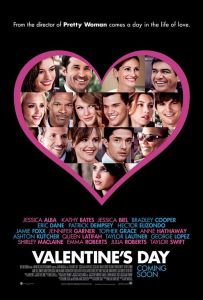 Imagine every romantic comedy cliché and sappy platitude about love stirred together into one giant gelatinous conglomeration of hollow sentiment. That’s Valentine’s Day. Regardless of your thoughts on the holiday, this movie, which aims to celebrate our national day of love, might have the opposite effect. This movie makes He’s Just Not That Into You look like When Harry Met Sally. It?s a fairly large ensemble with plenty of mega-watt stars, but it’s too bad that nobody knows what to do. Jessica Alba’s character literally runs her course an hour into the film and yet she still makes meaningless appearances. This overstuffed Hallmark card has ridiculously safe, candy-coated storylines sanded so that there is no hint of edge or wit (Anne Hathaway is the most ludicrous PG-13 phone sex operator you will ever find). The resolutions of most of these storylines will be predictable to anybody who has ever read a greeting card. Jamie Foxx is supposed to be a bitter TV reporter popping up everywhere reporting about the ills of V-Day. Think he’ll have a change of heart by the film’s end? The cast does offer their small pleasures (there are SIX Oscar nominees/winners in this movie!), except for the kid who has a crush on his teacher (Jennifer Garner). He was insufferably annoying. So was his movie.
Nate’s Grade: D+
Share this:

Alice in Wonderland (2010)
 Director Tim Burton seems like the perfect candidate to take on the imagery of author Lewis Carroll. I would argue that, short of Dickens’ Christmas Carol, Alice in Wonderland is the most reproduced piece of literature in modern history. It’s going to take a keen vision to make these old characters interesting (the macabre American McGee video game sure felt like it could have been born from the mind of Tim Burton). Unfortunately, Burton and some 3-D wizardry are not enough to compensate for a story that only works in one dimension.
Alice (Mia Wasikoswki) is now a teenager girl who can barely remember her jaunt to Wonderland in her youth. She’s assigned to marry a simpering lord because in Victorian England that’s how women took care of their futures. Alice is more interested in taking over her dead father’s trading company. So when the time comes for her lord to ask for her hand in marriage, Alice stammers, says she needs some air, and chases after what looks like a rabbit with a pocket watch. She falls down a rabbit hole and winds up back in Wonderland, however it’s really known as Underland. It’s been 13 years since Alice visited this magical world, and in the meantime the Red Queen (Helena Bonham Carter) has ruled as a tyrant quite fond of removing the bond between head and neck. Her sister, the White Queen (Anne Hathaway), was deposed and lives in exile. The (W)underland residents live in hope that an Alice will return and free them as an old prophecy foretells. She’ll have to rely on old friends, like the Cheshire Cat (Stephen Fry) and the Mad Hatter (Johnny Depp) to fulfill her destiny, and, why not, slay the Red Queen’s fearsome dragon, the Jabberwocky.
 You would think that the combination of Burton, Depp, Lewis Carroll, and 3-D would produce an irrefutable masterpiece, at least from a visual and entertainment standpoint. I’m compelled to argue that the finished results are pretty much a mixed bag. The world of (W)underland seems fairly drab. Sure it was some big stuff and some weird stuff but from a color standpoint everything comes across as washed out, like Burton took one look and said, “Bright colors equate happiness. We can’t have that.” I understand the world wanting to convey a dispirited mood, but this isn’t any regular Burton film, this is Alice in Wonderland and we need a sense of, wait for it, wonder. Instead, we get an overwhelming feeling of drabness. Now, full disclosure, I didn’t catch the 3-D version of this movie for two reasons: 1) my then partner’s head was hurting and she couldn’t take 90 minutes wearing nose-pinching, eye-hurting glasses that play with her depth of field, and 2) the 3-D shows were all sold out. I could tell which elements where intended to pop in a 3-D environment, namely the Hare always throwing objects as a calling card and the materialization of the Cheshire Cat. The tone isn’t too dark to scare the Disney families but at the same time there’s a bit more menace to the proceedings. The Red Queen’s bulbous, disproportionate head makes for an eye-catching visual that doesn’t get stale. (W)underland is a more hostile world but at the same time it’s not too threatening. Pretty much all the villains have some moment of redemption that makes them less threatening. The weirdest motif in the movie is eye gouging, which happens twice thanks to the same diminutive character.
Having said that, this is a visual decision that I could live with if the story engaged my senses more. Alice is now an older 19-year-old girl that has to defend (W)underland by fighting a dragon and suiting up in armor. She has to accept her destiny and be THE Alice and save the kingdom. The mystery of whether Alice is the one true Alice, look no further than the title, folks. He doesn’t remember anything from her first encounter in (W)underland and yet she has no sense of awe or curiosity. Also, why now do the residents of (W)unerland seek out Alice to rescue them? They never thought about reaching out in the 13 years the Red Queen has been ruling?
 The plot is a fairly pedestrian “hero’s quest” that ends in a fairly pedestrian battle sequence where the armies of good and evil clash in CGI combat. The problem is that the original Alice in Wonderland source material really didn’t have much of a plot to it; it was really more a satire of the times, which featured Alice essentially going from one oddball to the other. The appeal was more the language than the story. It’s not the easiest piece of literature to adapt, to find a through line for a plot, so I guess making it about a hero’s destiny seems like the easiest, laziest path. The screenplay by Linda Woolverton (Beauty and the Beast) assembles all the memorable characters but gives them little else to do, other than act mad. You may start to feel Alice’s sense of frustration after a while. Because of the threadbare story, you know exactly where the movie is going to be headed (wow, unintentional pun). In some ways this movie functions as a sequel and in some ways this movie functions as a remake, meaning that the plot is pretty much stuck trying to decide where to go next in a standard fantasy narrative device.
And then there’s the dance scene. Oh, the dance scene. How do I approach this gingerly? The climax that’s established is not Alice slaying the dragon, accepting her destiny, and (W)underland triumphing over the Red Queen’s tyranny. The climax is Depp break-dancing. You read that right, though the residents refer to his crazy legs movement as “futterwackin,” which sounds suspiciously naughty. It’s a moment so goofy, so tonally inappropriate that it shatters the entire notion of suspension of disbelief. It rips you out of the movie and all for a cheap laugh. It’s bizarre. I acknowledge that, given the fantasy framework, that the ending ought to stay in touch with the fantastical setting. But break-dancing? Would The Wizard of Oz have ended better if the Tin Man and the Scarecrow started break-dancing? At least the Tin Man could effectively perform the Robot. It’s a real-world artifact that has no place in the world of fantasy.
 Depp is usually such a valued performer, digging deep into his character and reveling in their eccentricities. He’s the strangest and most exciting character actor that has become a box-office star. But that doesn’t mean he’s immune from giving a rare bad performance. While nowhere near as off-putting as his Willy Wonka, Depp’s Hatter is more distraction than anything. He comes across like a figure grappling with post-traumatic stress, causing him to mutter incomprehensibly in a Scottish brogue. He’s tiresome after a while. Carter (Sweeny Todd) can be pretty shrill, playing the same overwrought note time and again, but she still manages to give the best performance in the movie. Hathaway just sort of acts flighty and raises her arms, waltzing around like she’s trying to imitate Depp’s Jack Sparrow. She’s entirely wasted. Stephen Fry (V for Vendetta) is a delight as the voice of the Cheshire Cat, and our heroine, Wasikowska (HBO’s In Treatment) has a striking Grecian presence, even if her performance is more dour than it needs to be given the fanciful environment.
Tim Burton and Johnny Depp usually make for an unbeatable creative team, but I think Disney was the key figure in this arrangement. Alice in Wonderland wants to thrill without getting too scary, wants to delight without getting too original, and wants to dazzle without getting too weird. Burton’s visual inventiveness manages to make the movie entrancing at times and bewildering when the rest of the movie fails to live up to those fleeting moments. Truth be told, I actually enjoyed the real-world Victorian scenes more than many of the ones in (W)udnerland. The film is just too disjointed and uneven to fully embrace, regardless of the 3-D upgrade. There are moments that I adored and moments that I could have lived without — like the break-dancing finale. The finished product isn’t a terrible night out at the movies, and there are plenty of enjoyable elements to savor. However, Alice plays like a familiar fantasy that takes Lewis Carroll’s creatures and rearranged them into a watered-down Lord of the Rings hybrid.
Nate’s Grade: C+
Share this:

Rachel Getting Married (2008)
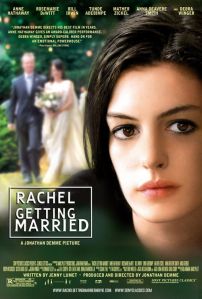 Jonathan Demme’s dark comedy is a movie at battle with its context. At heart, there is a fantastic and engrossing family dysfunction that rears its ugly head and re-opens old wounds. Watching Rachel (Rosemarrie DeWitt, who didn’t get nominated for an Oscar why?) unleash years of repressed pain upon the likes of her toxic, needy, narcissistic little sister Kym (Anne Hathaway), just fresh from drug rehab, is enthralling because of how raw and hurtful the emotions are. You can feel the sting of the words. Through the arguments, a picture emerges of this family’s tragic history and he emotional tug-of-war between the siblings. This is the great stuff, but then the setting of the movie overpowers the drama and sidelines it. Rachel Getting Married will make you feel like you are apart of this martial extravaganza, so we see about fifteen minutes of toasting from EVERY PERSON, because, really, much of this is all exposition from characters who won’t be heard from again. We also see about 15-20 minutes of eclectic musical performances, dancing, and all the rest that comes at the close of a reception. While the wedding/reception is an interesting multicultural blend, it feels like an unyielding intermission from the terrific family drama. Hathaway is as good as advertised and soaks up the troubled life of a notorious problem child defined by little else than her problems. DeWitt is outstanding as the big sister tired of being pushed aside. Demme’s handheld camerawork, and the extensive ensemble of slightly eccentric characters, made me feel like this was an Oscar-serious version of one of the Christopher Guest mockumentaries like Waiting for Guffman. There is succulent family misfortune here, with great acting, but I wanted less wedding and more Rachel and friends.
Nate’s Grade: B
Share this:

Bride Wars (2009)
 In early 2007, it seemed like Eddie Murphy was destined to win a Best Supporting Actor Oscar for Dreamgirls. The funnyman was racking up honors for his fiery portrayal of a fallen Motown singer. Then came ads for the atrocious Norbit where Murphy played three roles, including a grotesquely overweight woman and a racist portrayal of an old Asian man. Was it much of a surprise then when Murphy lost out to Alan Arkin (Little Miss Sunshine) whose character died halfway into the film? I suppose Academy voters took long looks at those appalling Norbit ads and said, “Academy Award-winning star of Norbit? I don’t think so.” Earlier in 2008, Anne Hathaway starred in Rachel Getting Married and became a surefire Oscar contender with her bitterly funny portrayal of an ex-druggie released for her big sis’ wedding. Hopefully the Academy will ignore the awful comedy Bride Wars or Hathaway will be doomed to follow Murphy’s lead (personally I think this is Kate Winslet’s year).
Liv (Kate Hudson) and Emma (Hathaway) have been dreaming of getting married since they were little girls. Both girls were at New York City’s Plaza Hotel and witnessed a wedding reception. They both swore that day to get hitched at the luxurious hotel. The girls grow up and Liv works as a hotshot attorney and Emma is a schoolteacher. Both get proposed at the same time and the high-pitched squealing ensues. Emma wants Liv to be her maid of honor and vice versa. The ladies seek the services of Marion St. Claire (Candice Bergen), the greatest wedding planner in the city. She delights the duo by booking them for two June wedding dates at the illustrious Plaza Hotel. Then comes the bad news. The booking dates got mixed up and the weddings are booked on the same day. The next open date at the Plaza is in three years time. Both women refuse to budge. Then a bridal arms race begins. Each would-be bride tries to sabotage the other’s wedding preparations.
 Bride Wars is indulgent and tiring and occasionally obnoxious, much like the main characters. These characters are one-note and the movie drills that one note repeatedly; Liv is domineering and Emma is a pushover. I don’t care about these characters, and when the movie ramps up the sentiment in the final 20 minutes it doesn’t work because I feel no emotional attachment, and waning interest, in these people. Hudson’s Liv serves as the real antagonist for like half the movie’s running time. She comes across as brash, pushy, unlikable, narcissistic, and overbearing, and her unflagging desire to win is what pushes the conflict. Emma and Liv view their husbands-to-be more as accessories to their collective Big Days, and the movie seems to treat them the same way. The three bland male leads (Bryan Greenberg, Chris Pratt, Steve Howey) even look vaguely the same, and Bride Wars just allows them to slowly fade away. Like the Sex and the City movie, the women come across as deeply shallow and petty, people more worried about ceremony than every day after that fairy tale wedding. The film’s comedic focus is on uninspired slapstick and the pranks that the ladies play. Bride Wars practically excuses the bridezilla bedlam because it eventually makes Emma a stronger person who can stand up for her self after long last.
The initial conflict seems trite and readily negotiable. So the girls have their weddings scheduled on the same day, and they can’t work this out? Why such drama if they’re both lifelong best friends? They couldn’t just have a double wedding? Here’s what I don’t understand. Marion tells our ladies that the Plaza has three June openings, two on the 6th and one at the end of the month. Liv gets one date and Emma gets the other date, and then a third woman (co-writer and Saturday Night Live actress Casey Wilson) grabs the final June 6th slot. So when Marion announces that her assistant switched the dates, why wouldn’t the third woman want to swap back? She’s been planning for her wedding to be on June 6, so why wouldn’t she want to keep the date she already agreed upon? Likely this woman has begun to plan around the specific date and it would make much more sense to maintain continuity. And it is this contrived conflict that sets Bride Wars loose.
The script is lazy and the PG-rating all but neuters the bitch fest. This setup was begging for the claws to be unleashed but the filmmakers play it safe. It can’t get too messy because everything must be made nice and tidy by the conclusion. The acts of sabotage never get too out of hand. This is less a war and more of a scuffle. Bride Wars trades in nothing but stereotypes and stock characters (including the late addition of Liv’s brother who obviously has a decade-long crush on Emma), and I expect that from chick flick fluff, but the movie just misses so many obvious comedic opportunities. The girls have a group of friends that offer no commentary on the situation. One of their friends is unhappily newly married and could offer plenty of sarcastic quips. Liv has her hair dyed blue at a salon and nobody in the movie makes a single joke about the wedding staple of wearing something blue? How is this even possible for a movie about weddings? That’s just a glaring oversight.
 Hudson and Hathaway are far better than this material, though Hudson is credited as a producer. Perhaps she can explain why she chose a haircut that makes her head look humongous. Seriously, her head looks gigantic, especially when she stands beside the coltish Hathaway who has quite a cylindrical noggin. Hathaway comes across the better of the two. Hudson has proven adept at goofy comedy but she just comes across as a bully. Kristen Johnston (TV’s Third Rock from the Sun) looks alarmingly thin. Somebody should check up on her.
To dismiss Bride Wars as a chick flick is to miss the point. Women deserve better than this mediocre comedy that showcases women as harpies worshiping marital materialism. The characters are annoying and vapid, the conflict is boneheaded and contrived, the comedy is watered down, and the lead actresses are wasted. Because something is a chick flick does not excuse it for being poorly manufactured. Bride Wars does not reflect well upon anyone involved, from the actors, to the director, to the writers, to the people that got people coffee. The movie isn’t monstrously bad but it is a banal piece of entertainment. Women, men, and all people deserve better no matter the genre classification.
Nate’s Grade: C
Share this:

Get Smart (2008)
 Get Smart was a beloved spy satire that aired on television from 1965 to 1970. Don Adams starred as Agent 86 and he bungled his way through scene after scene, oblivious to his shortcomings. The show was created by Mel Brooks and Buck Henry and maintained a genial, goofball appeal as it satirized James Bond style spy movies and tweaked Cold War paranoia. And as is written in stone by Hollywood, anything that was ever once on television must eventually become a big screen theatrical version. Get Smart already produced one unfortunate movie, 1980’s The Nude Bomb (which doesn’t sound too different from the U.S. Air Force’s plan to create a Gay Bomb — true story). I’m pleased to report that the big-budget modern Get Smart retains enough of the show’s flavor even while producing something with little resemblance to the source.
The updated Get Smart exists in a world not too different from our own (the president is still a boob). CONTROL is still in operation but secretly underground. Agent Maxwell Smart (Steve Carell) is an expert analyst who specializes in knowing the enemy and compiling 400-page reports. He’s failed the field agent test several times and desperately wants to get out from behind a desk. The Chief (Alan Arkin) says that he needs more men like Max. He gets his chance when CONTROL is attacked by KAOS. Many of the Agents identities have been compromised. The only agents remaining are the dashing and hulky Agent 23 (Dwayne “The Rock” Johnson), the svelte and beautiful Agent 99 (Anne Hathaway), a group of science techs (including Heroes‘ Masi Oka), the Chief, and newly appointed Agent 86, Maxwell Smart. KAOS, perhaps thanks to the end of the Cold War, has become a group of shadowy men making ties to terrorist groups worldwide. Siegfried (Terence Stamp) and his henchmen are aiming to sell nuclear devices to terrorists. Agent 99 and Max must travel across the globe to ensure that KAOS does not fulfill its villainous schemes.
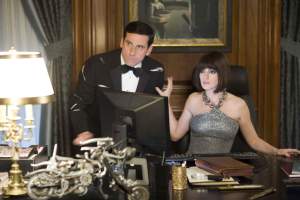 The plot is fairly workmanlike and it doesn’t really establish much in the way of an ongoing threat. As a result, the movie feels like it lives in the moment, going from gag to gag, but it just so happens that a decent number of those gags are funny. Get Smart is mostly a chuckler of a movie, sure to bring smiles and giggles but rarely hard, gut-busting laughter. I never found myself laughing too hard but I did find myself enjoying the time. Get Smart is a very amiable experience that manages to maintain a healthy level of silliness without ever falling victim to stupidity. It’s pleasantly goofy without becoming farce. Sure there is crude slapstick but the film, and Carell in general, manage to give them a slight edge that elevates them beyond your typical juvenile behavior. There may be a pee joke or a quasi-homophobic joke but Carell manages to make it worth your time.
The relationship between Carell and Hathaway provides significantly more interest than the ho-hum plot. The filmmakers find a clever way around the potentially unsettling reality of the age difference between Carell and Hathaway, who is nearly 20 years younger. The two have a spunky chemistry and their combative interaction elicits some of the most amusing laughs. Hathaway, with her doe eyes and dewy features, is just as eager and up to the task as Carell, so watching them spar and tease gives the movie a bit more juice. Kudos to the casting director because the cast is packed with capable comic actors that know when to seize the moment, and Arkin seizes every one of them (it seems that with every new film, my man crush on The Rock only grows greater).
The film is a hybrid of comedy and ramped-up action set pieces, and surprisingly they aren’t that bad. Director Peter Segal, who has directed three Adam Sandler vehicles, stages some fairly exciting action sequences with a decent degree of visual flair but the film overindulges on action. The movie should focus more on its cast of characters instead of loud, brash action sequences. It’s a little weird watching Maxwell Smart expertly shoot people like he went to a John Woo camp. The tones never fully match up, and Get Smart begins to feel like a comedy that thinks it?s a James Bond movie or an action film that thinks its overly absurd. The tonal struggle means that the comedy is handicapped by all the action interrupting and stalling the pace of jokes. There are times when Carell and Hathaway are firing one-liners at one another and then -WHAM!- they have to dodge bullets and kick bad guys. The stunts are impressive but I kept feeling a sense of disappointment when the action would cut short the momentum of the comedy. The spurts of action shortchange the humor. Segal’s direction is also blunt at times, so whenever a character thinks reflectively we have to witness a mash-up of past clips to visualize what the character is reflecting upon, in case our memories of a two-hour movie fail us while it’s still ongoing.
 Get Smart is greatly benefited by the considerable comic charms of Carrell. His Agent 86 isn’t so much incompetent as he is bumbling, but best of all the man keeps a gloriously self-deprecating and deadpan sense of humor from beginning to end. He doesn’t lack self-awareness, and is not ignorant of the feminine charms of his partner, and as a result this new version of Maxwell Smart ends up being, well, kind of smart. Carrell shoulders the film and is able to save lackluster gags by his sheer comic ability and immense likeability. The film doesn’t push the envelope in any regard but it also doesn’t condescend or try and flirt with being too clever for its own good. Thanks to Carell, Get Smart manages to be much more entertaining than it has any right to be.
Fans of the Get Smart TV show, such as myself, will find it hard to recognize the source material inside the big screen transformation. The filmmakers have turned a goofy satire of Cold War paranoia into a full-fledged summer popcorn action cartoon. The movie moves at a brisk pace, despite pushing toward the two-hour mark, and its screenplay is packed with enough enjoyably silly and smartly stupid jokes to guarantee a string of smiles. Like Carell’s 2007 entry Dan in Real Life, the movie presents such a jovial, good-natured spirit that becomes mildly infectious. You may roll your eyes a few times but you forgive and forget. Carell proves he is fast becoming one of the most capable and leading comics, and he proves yet again that his force of personality can elevate material that doesn’t meet his same qualities. I just wish that Get Smart had focused more on the yuks and less on gunplay and explosions. I guess, to quote a certain agent, you could say they missed it by that much.
Nate’s Grade: B
Share this:

The Devil Wears Prada (2006)
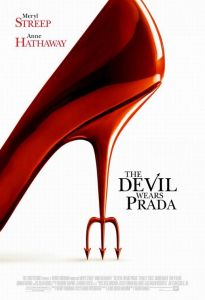 One part fantasy, one part incisive satire on the fashion industry, The Devil Wears Prada, on paper, may not be more than another formulaic entry where a young innocent gets caught up in the temptations of power and influence. I know little about the fashion industry other than what I can gleam from TV’s insanely watchable Project Runway and even I was charmed. Andrea (Anne Hathaway) is an idealistic journalism student paying the bills working as the assistant to Runway magazine’s ferocious editor in chief, Miranda (Meryl Streep). Andrea’s plain style of dress draws sneers and snickers from her rail-thin, nose-raising colleagues, and some smart snark from Miranda, who always seems to eviscerate people without raising the timber of her voice. The movie is typical with its rise-and-fall power structure, but even though it may be lightweight, The Devil Wears Prada is lots of fluffy fun, and all signs of life point to Streep. It’s almost a foregone conclusion that you’ll get a worthy Streep performance, but she’s totally unleashed in The Devil Wears Prada. Every time she sweeps into a scene she commands attention and steals the movie. We’re all just living in this woman’s world on borrowed time, and she knows it. Streep is in grand comedic form, dominating the movie with glares; just an inching of her facial expression can cause titters. It’s a juicy role and, mark my words, the most Oscar-nominated actress in history is going to get another nom for this performance. Hathaway proves to hold her own as well beyond those dark doe-eyes and cherry stem lips. The movie starts to drag in a third act trip to Paris, and Andrea’s empathy seems to get a bit out of tune (she feels worse about being better at her job than a co-worker than missing her boyfriend’s birthday). The Devil Wears Prada is an enjoyable, easily digestible piece of high-gloss fluff elevated by Streep’s dominating turn as a fashion lioness.
Nate’s Grade: B
Share this:

Brokeback Mountain (2005)
 Go ahead and work the snickers out of your system. Brokeback Mountain has been dubbed “that gay cowboy movie,” and been condemned by certain fundamentalist Christian organizations as “a very dangerous and insidious message to America.” But what message is Ang Lee’s film even putting out there? It seems to me that Brokeback Mountain is putting a human face on a slur, making homosexuals look like you or me. For some that prospect may be terrifying. The movie is playing well on the blue-state coasts, expectedly, but it’s also surprisingly playing well in America’s heartland. It seems that people are lining up all over to see a movie about two gay cowboys in love. And perhaps the more people that witness Brokeback Mountain, the harder it will be to listen to those so-called family advocacy groups with their sterling Christian morals. Maybe people will really see what’s behind many of the words of outcry – hate and ignorance (I am in no way insinuating that disliking the flick means you are homophobic). Despite all this political talk, Brokeback Mountain is by no means a political movie. It’s a love story, above all, and it’s a doozy.
In the summer of 1963, Ennis Del Mar (Heath Ledger) is a quiet man looking for work in rustic Wyoming. He finds a job as a sheep herder working atop the canyons and mountains of Brokeback. Working alongside Ennis is Jack Twist (Jake Gyllenhaal), a charismatic rodeo rider. The weeks are long and Ennis and Jack are all the company they have, excluding the hundreds of sheep they tend. Eventually, the more taciturn Ennis finally opens up and bonds with his herding partner. “That’s more words than you’ve spoken in two weeks,” Jack says. “Hell,” Ennis adds, “That’s the most I’ve spoken in a year.” The rules have been laid out: every night one man sleeps in a tent campsite, the other sleeps next to the sheep to guard them. Well one night Ennis has had too much whisky and cannot make it back to the sheep. Jack invites him to sleep in the tent instead of freezing outside. Then something surprising takes place – both men have an alcohol-fueled bout of rough sex. The next morning both men stress they “ain’t queer,” but they have a hard time fighting their feelings inside. Ennis warns that, “If this thing, it grabs hold of us again… at the wrong place… at the wrong time… and we’re dead.” He recounts a childhood memory where his father showed him the corpse of an older homosexual man, brutally beaten and mutilated. For them, their love must stay on Brokeback Mountain.
 The men part ways. Ennis marries Alma (Michelle Williams), a quiet woman after his own heart, and fathers two daughters. In Texas, Jack meets fellow rodeo rider Lureen (Anne Hathaway) and gets involved in a relationship with her, fathering a son of his own. But Jack still thinks of his Brokeback pal and sends him a postcard. Ennis nearly lights up at the returned sight of Jack and the two passionately embrace. He tells Alma that Jack is an old “fishing buddy” and they sneak away every few months for a fishing getaway. Really the men are returning to the countryside to rekindle the love that they haven’t left behind. But can they keep their love a secret, and should they even have to?
I wonder if Lee would ever have directed this if 2003’s Hulk didn’t bomb so badly. Lucky for us, he’s taken the Brokeback helm and infuses lots of emotion into the story. The Wyoming countryside (actually Canada, but it’s all close enough) is gorgeous, and the film has a great earthy feel. Best of all, Lee allows his love story to breathe and go at its own pace, never cutting corners or rushing an emotion. There’s a lovely, lilting feel to the film, and Lee’s guided hand allows the story to play out to its grand promise. Based on Pulitzer Prize winner Anne Proulx’s 11-page short story, screenwriters Diana Ossana and Larry McMurtry (Lonesome Dove, The Last Picture Show) have given incredible depth and subtext to the tale. McMurtry, in particular, has great knowledge of the West and the cowboy lifestyle, and the screenplay gives you an idea of small-town Western life. There are a few moments at bars, social scenes, stores, but they brilliantly give you every detail you’d need to know about this way of life. I even loved how the people of Wyoming wore fashions that were five years removed from their height of popularity, which is exactly how fashion moves around to the smaller parts of America. Ossana and McMurtry are also commended for presenting their characters as people first and never as agenda bulletins. All three lend a level of authenticity that makes the story feel organic and never trite.
In films about forbidden desire and heartbreak, the acting is the cornerstone for how powerful the tale resonates. The acting in Brokeback Mountain is phenomenal. Ledger is the breakout star and the majority of the film’s focus. He gives the performance of his life. Ledger is outstanding as the reserved, taciturn Ennis, brought to believe that queers were something sub-human and now he wrestles with his own identity. He may be a restrained man of few words but you see every emotion bubble under the surface, every conflict played out in his eyes. Ledger’s few violent or emotional outbursts are startling because they show an uncontrollable feeling, one even he can’t withhold 24/7.
Gyllenhaal has the showier role but masterfully displays the frustration of forbidden love. He’s willing to sacrifice everything for Ennis, and the fact that Ennis won’t do likewise tears him apart. Isn’t love enough, he wonders. There’s a moment in the film that so sharply displays Jack and Gyllenhaal as an actor. It involves two different shots in a moving truck. The first is Jack headed to Ennis’ ranch, singing, bouncing, and with a wall-to-wall smile. The second is Jack driving away from the ranch unfulfilled, sullen, broken, and seemingly unable to cry another tear. It’s two small moments and they sum up Jack and Gyllenhaal perfectly. The only thing unsettling about Gyllenhaal’s performance is his late 70s porn star ‘stach. With his tremendous work in Jarhead and now Brokeback Mountian, Gyllenhaal is in class all his own (he’s got the dreamiest doe-eyes in Hollywood).
The ladies of Brokeback Mountain have less screen time to play with but they each deliver fine performances. Williams is a silent, put-upon mother and is shattered when she discovers her husband’s secret love. She just crumbles. She’s never the same and Williams showcases her character’s distress and mounting bitterness. One of the film’s highpoints is her confrontation with Ennis, many years later, finally sharing all that she knows. Me thinks an Oscar nod is headed in her post-Dawson’s Creek future. Hathaway plays quite an opposite character. She begins as a wild, headstrong cowgirl with a healthy sexual appetite, something perhaps Jack sees as a reflection of his self. Then their love dies at some point and she pours herself into work, but Hathaway illuminates every step along the way. Her small smile during a scene where Jack finally browbeats her obnoxious father is terrific.
This is an elegiac, engrossing love story. Brokeback Mountain is not necessarily a “gay thing,” more so it’s a story about forbidden love and about the consequences of moving forward without ever letting go. That sounds universal, right? Nothing “gay” about that. Brokeback Mountain explores the force of love and shows how uncontrollable and unpredictable it is. Jack and Ennis are just as surprised by their feelings and their rough night of passion as the audience, but the happiness they share is hard to argue.
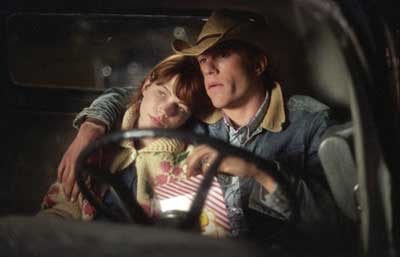 Because of the film’s gentle pace, and Lee’s loose control, we really immerse ourselves in their relationship as they frit away the hours looking after sheep. There was a woman in my theater (I won’t name names, partly because I don’t know hers) who felt that Brokeback Mountain was far too slow and could have been put to better use by cutting 2 hours out. The film’s placid pace is integral to the story’s success; you need to see how expansive that countryside is to feel alone, you need to have the many small conversations to draw out a closer camaraderie, you need the added time to open up to these men, and then once you have –BAM! — they turn their worlds upside down. This buildup is necessary for our connection to the characters but it’s also essential so we can understand what happens. Yes, the film portrays love as it truly is: an all-encompassing emotion that can be as maddening as it is passionate. But Brokeback Mountain doesn’t dare introduce a gay romance, something so dangerous in this land, all lickity-split. It’s supposed to be a surprise to these men, grown up with John Wayne movies and strong, silent role models. The movie enjoyably takes its time to seduce an audience with its tale before choking out every last tear in the end.
The tragedy of Lee’s film is that these men have each found the love of their life but, because of society’s prejudices, are not allowed to act. As a result, each man puts on a different face and pretends they’re a happy heterosexual Western buck for the public, but each is being eaten away inside. Ennis drinks a lot and is full of self-loathing. Jack is less publicly reserved about his feelings and finds momentary comfort with other warm bodies, mostly through silent nods with other closeted gay men. I’m reminded of a line in Paul Thomas Anderson’s Magnolia: “I have a lot of love to give; I just don’t know where to put it.” Ennis and Jack cannot quit each other but they also tragically can never fully commit to one another, at least without any threat of ostracism or death. That’s the power of Brokeback, that it shows you these simple men, shows you their love, and then won’t let that happy ending ever manifest that we yearn for. When we reach our somber, haunting conclusion there weren’t many dry eyes in the theater, mine included. Brokeback Mountain is a love story that won’t let itself be happy, and that’s what provides all the kicks to the gut and lumps in your throat.
I think some of the more hostile criticism of Brokeback Mountain is because of how normal Jack and Ennis are presented. Neither is a swishy stereotype, neither is any less of a man, and that notion probably terrifies the homophobes: “Well, they look normal, and if they get gay then maybe I will too!” That’s a shame really, because those ignorant few will miss out on a powerful, sweeping, complex, aching love story with fantastic acting. Ledger and Gyllenhaal will make you feel every moment of joy, every moment of pain, and every lingering conflict on what makes them whom they are. Lee stressed that he wanted to show the world a love story where you really felt that love was an uncontrollable force. His heartfelt, touching film is a revolution for being a normal love story, albeit with two classic Marlboro men. There is no propaganda, no gay agenda, but perhaps the film will open people’s eyes and strip away any narrow definitions we have toward the ownership of love. Brokeback Mountain set out to merely tell a good story, not change the world. It’s accomplished the first part and maybe, just maybe, it’ll spark discussion, debate, and lasting memories to lay groundwork for the second.


 nathanzoebl
You must be logged in to post a comment.