Blog Archives
A Mighty Heart (2007)
 Good intentions and some proficient camerawork can only go so far to make a film worthwhile. Angelina Jolie gives the best performance of her career as kidnapped Wall Street Journal reporter Daniel Pearl’s wife (she’s French and Cuban, making for one really tricky accent). I wanted to like this movie more. The subject matter is serious and timely, the filmmaking has a sturdy docu-drama look, and the acting never comes across as phony, but alas, I think I mentally checked out because much of the film is a detective story that I already know the ending to. Daniel Pearl was infamously beheaded, so watching an hour of his wife, friends, and local police scramble to track down key figures, their allegiances and acquaintances, and the whereabouts of Daniels can come across as fruitless and somewhat cruel. This film doesn’t have the same cathartic feel that United 93 had because that moment was universal, and while I can admire the cinematography and superb acting I can’t ignore the fact that watching people search and fail gives me little emotional reward as a viewer.
Nate’s Grade: B
Share this:

Beowulf (2007)
 Taking note of director Robert Zemeckis’ new motion-captured animated version of Beowulf, I began to wonder what other classic works of literature could use a good CGI sprucing up. Dusty old tomes would have greater relevancy to the youth of today if they were coated in animation and presented in a 3-D format. Just think of the works of Jane Austin with a flying, zooming camera and the aristocratic families repeatedly jutting marriage contracts toward an audience. This might be the only way to make The Great Gatsby tolerable.
The 1000-year old story begins in the dining hall for King Hrothgar (Anthony Hopkins). Their loud and drunken reverie is interrupted by the monstrous creature Grendel (Crispin Glover). The creatures rips men apart, lays waste to the hall, and munches on a few heads for the long journey back to his cave. The King offers a reward for anyone who can slay the monster and bring peace to the Danish lands. Enter Beowulf (Ray Winstone), a determined warrior and competitor who seeks eternal glory. He brags that he will kill their monster and then kill Grendel’s mother (Angelina Jolie) next. However, the slinky lass offers a tempting promise that she can make Beowulf the greatest story in all the world.
 This is not the same Beowulf you were forced to read in high school English. I confess never having read the 3,183-line ye olde English poem, but I don’t think it had scenes of burping, public urination, a “coming” sexual joke, and some unexpected man-on-monster action (not the kind you’d readily think). This is a bloody and often exhilarating retelling intent on jazzing up a classic work for a younger generation. The action sequences have tremendous scope and can be relentless, and when witnessed in 3-D they are even more immersive and breathtaking. Stepping aside from the thrills and chills, Beowulf also works as a cautionary tale about the dangers of lust and particularly pride. Beowulf is a boastful and arrogant fellow, enough that he chooses to fight Grendel in the buff so that it will be even more challenging and thus ego stroking (as they battle, objects conveniently obscure the audience from seeing Beowulf’s manhood). The main deviation from the poem, connecting the various characters on a much more personal level, works with he context of the story and the overarching theme about the costs of vanity.
I encourage all potential Beowulf ticket-buyers to seek out where their nearest 3-D screening resides and to plan and, if needed, carpool to that theater immediately. This thing is meant to be seen in three dimensions, and in that environment Beowulf is amazing to behold. This is my first encounter with the next generation of 3-D and it is a giant leap beyond the funny glasses with blue and red lenses. Hollywood has hopes that this technology will be the next great invention that drives people to the movies and turn it into a unique experience that cannot be duplicated in the quiet privacy of your own home. I must say I was thoroughly impressed with how immersive the process becomes. Beware, though, because of the deep focus your eyes will dart around the screen resting from object to object, marveling at the different planes of depth; you may feel some strain and a headache after awhile. Objects keep sneaking into your peripheral vision and the movie takes many opportunities to hurl things at the screen, and thus the audience, be they coins, swords, arrows, limbs, heads, pots, and blood splatters. The CGI animation coupled with the 3-D technology makes for a compulsively stunning first-rate spectacle.
The visual look is a great step forward from 2004’s The Polar Express, the first time Zemeckis used his newfangled motion-capture toys. I really disliked the look of Polar Express, and the kids and their dead, glassy eyes creeped me the hell out. I’m still not entirely sold on what motion-capture even brings to the world of animation; to me, it seems like animators can dictate movement just as well as copying from an actor. Where the animators do make strides is in their depictions of real people. It’s not photo-realism, in fact sometimes the characters look like plastic dolls, but you can see all the pores in the skin and follicles of hair in bristling detail. The look of the movie reminded me a lot of the video game God of War, especially when Beowulf is slicing and dicing one-eyed sea monsters. I think that’s a pretty fair assessment ultimately, that the film better resembled a slickly produced video game cut scene than reality.
 In the end credits, I noticed that someone is specifically singled out and credited for the design of Grendel’s mother. I’m all for credit where it’s due, but Grendel’s mother was simply designed as Angelina Jolie with a tail coming out of her head. The character design looks remarkably like its big name actress and she struts around mostly naked, though her body drips with a melting gold finish that stops the nudity from having any real definition (it’s kind of like she’s in a melty candy shell). This may be enough for frisky moviegoers that must have missed out on the other movies Jolie bares her flesh for, or perhaps the head-tail fetish folk will finally have their day. It makes a lot of sense for Zemeckis to choose Jolie for the seductress role. It seems that mortal men just can’t help themselves around her and they end up doing the nasty, which produces little nasty creatures. If there were anyone in today’s world that could make men weak with overwhelming lust, it would be Jolie. Just ask Brad Pitt.
The character work on Grendel, however, is fascinating and startlingly grotesque. He resembles a cross between Frankenstein, Dobby the elf, and a coffee pot, all covered in rotting, patchy skin. The amount of detail is amazing and simultaneously stomach-churning. Glover offers a magnificently eccentric frame to build from. Grendel comes across less like a monster and more like a misunderstood wretch that just wants some peace and quiet by any means necessary. The screenplay gives Grendel some deeper backstory and a motivation for his murderous rampages (the poor guy is hyper sensitive to music, which blares in his head and causes agony).
Beowulf does have some slow moments and a noticeable lag in the middle before it sets up a climactic dragon battle. I was actually starting to nod off somewhere along the middle. The screenplay, adapted by Neil Gaiman and Roger Avary, squanders a load of underwritten characters, like a queen, a young concubine, and a religious advisor that asks if they should also pray to this new Roman God, Jesus something or other. Zemeckis is too enamored with the 3-D technology at his fingertips and clutters his screen too often to play around with the depth of field. I cannot fathom how this movie would play out in a regular 2-D environment, but needless to say, I’m sure the constant barrage of things pointing at the screen would get old quick.
Beowulf is a rousing and thrilling experience when seen in its intended 3-D format, otherwise it might get a tad tiresome and the visuals would come across as less accomplished. Zemeckis is getting better acquainted with the limitless freedom his motion-capture technology afford him and his imagination, however, I mourn the loss of Zemeckis ever directing another live-action film again. He seems to be completely taken with his technology and while it will improve with age I just wish the man who gave me so many wonderful movies like Back to the Future and Who Framed Roger Rabbit? would just go back to basics.
Nate’s Grade: Movie itself: B
3-D presentation of film: A-
Share this:

Mr. and Mrs. Smith (2005)
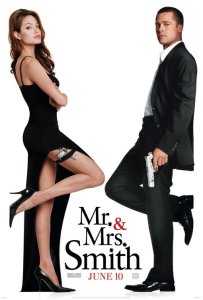 The new action comedy Mr. and Mrs. Smith sure seems to be in the headlines a lot. Most from tabloids trying to connect Angelina Jolie as the catalyst for why Brad Pitt and Jennifer Aniston have filed for divorce. You can’t walk past a checkout counter without being screamed at by 15 magazine covers. Too bad the actual movie seems to be forgotten in the process. That’s a shame because Mr. and Mrs. Smith is one terrifically fun summer ride that you don’t want to get off of (kind of like Jolie and/or Pitt, depending upon which way you swing).
Things aren’t so peachy for the Smiths (Jolie and Pitt). They met and married in Columbia amid a flurry of action but now it seems like their lives have become quite mundane as husband and wife. Life at work, though, is quite the opposite. Mr. and Mrs. Smith are hiding a whopper of a secret — that they’re hired assassins. They’ve both been hired to take out the same mark (Adam Brody) and accidentally discover each other’s true identity. Of course both spies are now compromised so they’re assigned to bump off their spouse. And you thought your marriage was murder. Mr. and Mrs. Smith combat their real feelings and put the spark back into their marriage by trying to kill each other, the little taught alternative in marriage counseling courses.
Mr. and Mrs. Smith has a vibrant sex appeal to it. Pitt and Jolie are extraordinarily beautiful people, no question, but they also have sizzling chemistry. The looks they give could ignite the screen. Even when they’re at each other’s throats you like them and hope for the best. The stars’ sex appeal and the film’s off kilter tone collides in fun ways. A knockout, drag-out fight between husband and wife turns into foreplay that literally brings the house down. The most unbelievable aspect of the movie is the idea that these gorgeous people would grow sexually tired with one another.
 The leads are terrific and terrific together. Jolie has finally found the right role for her. She’s the perfect balance between tough and sexy. She could very easily kick my ass and look good doing it. Originally Nicole Kidman was going to play Mrs. Smith before scheduling conflicts put the kibosh on that. I can not see Kidman working. I’m not afraid of Kidman, but with Jolie I’d do whatever she says. Jolie has a real kick in Mr. and Mrs. Smith and the audience can feel it too. It also helps that she looks absolutely magnificent. Finally, her beauty and wildness are put to excellent use. I’ve always thought Pitt got a bad rap as an actor for being pretty. Sure, he’s built like a Greek God (and played one in Troy) but this man can act. People seem to forget he was nominated for an Oscar for Twelve Monkeys. Pitt exudes a natural calm and always seems a smirk away from getting out of anything. These traits serve him well as a smooth criminal. Even when he’s whacking people with a golf club he seems easygoing.
The tone needs to be very specific for Mr. and Mrs. Smith to work. I mean, one false step and husband and wife revitalizing their marriage by trying to kill each other turns from funny to horrifying. Mrs. and Mrs. Smith walks that delicate line but nails the jaunty, tongue-in-cheek tone needed to make this movie soar. When you boil it down, Mr. and Mrs. Smith is essentially a modern day screwball romance. Instead of sparring with witticisms they spar with heavy-duty weaponry (I can only imagine what Spencer Tracy and Katherine Hepburn could have done with knives and bazookas).
After Mr. and Mrs. Smith find out the true identities of their spouses, they both know it’s kill-or-be-killed. Both tread very carefully and are highly suspicious that any little thing, like a glass of wine, a trip to the bathroom, could be the trigger to their demise. Now, if the tone weren’t exactly perfect, this sequence would seem overly silly or overly cruel. Instead, the sequence comes across as being very funny. Pitt and Jolie nail the casual awkwardness as they test one another. Even the ending of Mr. and Mrs. Smith is laugh-out-loud perfect with the film’s vibe. I will go so far to say it’s the greatest ending line for a film since 1959’s Some Like it Hot.
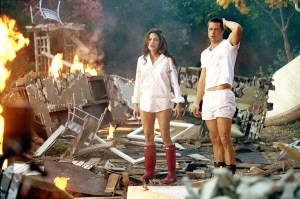 It seems that if you want your action done right, you call Doug Liman to be director. Liman, as he did with 2002’s stellar The Bourne Identity, can craft highly imaginative, stylish, and playful action sequences that are low on pesky CGI and high on thrills. He makes sure the audience can witness every balletic move of his orchestration. He’s likes his fireballs big, though not Michael Bay the-sun-is-exploding big. If you want an inventive use of ordinary objects, Liman’s your man. There’s a fabulous car chase that utilizes a mini-van in surprising and gleeful ways. While dodging bullets and bad guys, Mr. Smith slides the vehicle’s doors open on both sides. When a bad guy jumps into the car, he grabs the baddie and swings him out the other side in one continuous motion.
This isn’t a movie to take too seriously. Yes, the plot is pretty goofy at turns and the Smiths seem nigh invincible. Yes, the bad guys are all terrible shots. Yes, it would be unlikely for the Smiths to take out 100 or so armed men surrounding them. Yes, it seems like the resolution would be cloudy because they’d still be wanted as husband and wife assassins. Yes, Brody is wearing a Fight Club T-shirt. None of this matters. Of course a world of super spies and gadgets is going to be goofy, but Mr. and Mrs. Smith never winks at the camera. This is one romantic comedy with a macabre edge and a devilish sense of humor. I was thoroughly entertained from start to finish.
Mr. and Mrs. Smith is the big blast of fun I’ve been waiting Hollywood to deliver all year. The action sequences are inventive, exciting, and quite sexy. Seeing the two hottest people on the planet (Thora Birch excluded, obviously) kiss, fight, shoot each other, and blow stuff up is entertainment in itself, but the chemistry between Jolie and Pitt is in the five-alarm area. This will not be a movie for everyone. Mr. and Mrs. Smith is about married assassins who do kill people and get off on trying to kill each other. But for people who like their summer ventures to have a little malevolent glee, Mr. and Mrs. Smith will hit the right note. I can only hope for the eventual sequel – Mr. and Mrs. Smith Go to Washington. Imagine that potential filibuster sequence and try not to smile. You can’t!
Nate’s Grade: A-
Share this:

Alexander (2004)
 I was standing in a theater weeks ago and saw a large banner for Oliver Stone’s epic about Alexander the Great. I listed the names; Colin Farrell, Angelina Jolie, Val Kilmer, Rosario Dawson, Jared Leto. This had to be perhaps the greatest assembly of pretty actors ever in a motion picture. There’s a whole lot of sex appeal there, and Anthony Hopkins, as the film’s reflective narrator, isn’t too shabby looking himself for a man his age. After having seen Alexander, it’s safe to say the actors sure are pretty but the movie is far from it.
Alexander (Farrell) is one of the greatest historical figures. He rose to become a Macedonian king, dominated much of the known world before he was 30, and then died mysteriously at a young age. In flashes to his youth, we see Olympias (Jolie) coaching young Alexander on his future glory. Standing in her way is one-eyed King Phillip (Kilmer), Olympias’ husband though not the father to Alexander. She frets that he will sire a direct heir to the throne, and upon Phillip’s assassination, Alexander reaches new heights. He travels to Babylon with the purpose of avenging his father’s death, rumored to be paid for by Persian gold.
Alexander keeps traveling east conquering new lands but returning kings to their rule and assimilating “barbarians” into his armies. His generals begin to question Alexander’s actions, especially his surprise marriage to an Asian peasant woman (Dawson). He is unable to sire a male heir with her. Hephaistion (Leto), Alexander’s childhood friend and lifelong lover, worries that Alexander has become power hungry and distrustful of those around him. Many of his men only want to see home after seven years of battle. After defeat in India, Alexander decides to turn back but he never sees home again.
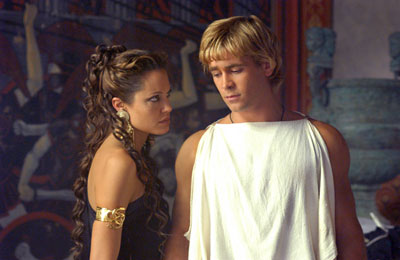 For such a lavish biopic, Alexander seems fairly remote. We don’t really get to know much about the psychology of Alexander. He’s a historical figure with equal parts good and bad ready for debate, but whenever Alexander does hit some of its star’s less-than-stellar moments, it seems to gloss right over them. Hopkins will narrate about some town that resisted, then we’ll see a quick image of it burning, and then we move on. Or we’ll see a slew of dead army officials and Hopkins will say, “He slaughtered all he felt were responsible for mutiny, but I’d expect any general to do the same.” There are several moments where we’ll hear Alexander massacred a town, or sold people into slavery, and then we get the next scene. It’s quite comical, almost as if Hopkins is a tour guide at a museum saying things like, “And then Alexander ate all of the first born babies. Moving on now…”
There are just so many awful laugh-out-loud, loopy moments in Alexander. It’s not enough that Jolie speaks in some bizarre accent; to make sure the audience understands that she’s duplicitous she has a snake wrapped around her in every scene. I’m not kidding; every scene that Jolie is in she has snakes coiled around her.
There’s a moment late in the film that is so hilariously dreadful, it’s hard to believe what you’re seeing. Hephaistion has caught ill and is on his death bed. Alexander is wrought with emotion but then strolls over to a window and begins another huge speech that ends up being all about his glory. What makes the scene go from bad to I-cannot-believe-they’re-doing-this bad is that Hephaistion, in the background, is convulsing and dying. You see his body tense up, twitch, leap into the air, and practically do some kind of triple axle, all while Alexander speechifies blithely unaware. I challenge anyone not to laugh.
Stone needlessly complicates his film with flashbacks, giant leaps forward in chronology skipping Alexander’s rise to respected leader, and skittish hallucinations. Stone is accustomed to breaking up the chronology of his films, but Alexander is too long and too campy to play around with for effect.
The acting of Alexander is set to overkill. Farrell seems miscast and doesn’t have the weight to carry such a historically meaty role. He looks pretty, and he can snarl like a pro, but the only thing worse than his overblown performance is his terrible blonde hair. This just wasn’t the right role for this talented actor. Jolie is so naturally seductive that she could have played her role mute and been effective, maybe more so. Kilmer seems to be working some kind of Irish accent but he comes off the best of the three. Leto gets overshadowed by his bangs.
Alexander also seems to speed over its star’s bisexuality. It wasn’t uncommon for men to bed both sexes, but the movie seems terrified of portraying anything beyond longing glances. Alexander and Hephaistion are reduced to some whispers here and there, but the limit of their physical affection stops at hugs. It actually is kind of funny the amount of times they hug, which I think is over five. You can tell the filmmakers wanted more but then were like, “Eh, let them hug again.” In some weird turn, it seems the film shows more depth with Alexander’s relationship with his horse than with his lifelong lover.
For a three hour movie about a military man who conquered much of the known world, there’s a shocking lack of action. Alexander has two action set-pieces and then that’s it. The first set-piece is a battle between Alexander and the vastly numbered forces of the King of Persia. The battle lasts twenty minutes and is disjointed, bloody, and perfectly indicative of the confusion of war. Stone cuts back and forth between majestic aerial shots showing the progress of battle and hand-to-hand combat amid the sand and dust clouds. Stone also labels certain sections of the armies, which gives a greater understanding of the battle. It shouldn’t be a surprise that this battle is the highlight of Alexander.
The only other action set-piece comes very late in the movie. Alexander’s forces have marched all the way into India. Warriors on the backs of monstrous elephants stampede onward to intercept Alexander’s armies. This battle is also chaotic, and Stone utilizes a lot of quick point-of-view shots like people getting squashed by pachyderms. The action is satisfying if a bit over the top (a warrior gets impaled on a slow-moving elephant’s tusks), that is until Stone goes off the deep end. Alexander gets wounded in battle and suddenly the film switches tints, bathing everything in reddish and bright neon hues. Everything has a tin outline. It’s rather ridiculous and unfortunately reminds me of Ralph Bakshi’s misguided animated Lord of the Rings.
 That’s all you get for action, so I hope you like speeches rich with superfluous historical name-drops, because that’s what Alexander is all about. I’d bet money that nearly an hour of this three-hour opus involves people delivering speeches. Alexander rallies his men, Phillip talks about the Greek tragedies, Olympias strokes Alexander’s greatness and need for kingship, his generals talk about his decisions, and then we get endless moments of Alexander talking about a new world, bringing people together, and respecting other cultures. Alexander seems to go dead as soon as some character pulls out a soapbox. Worst of all, many speeches involve lots of historical references that an audience cannot be expected to keep up with. The overall effect is like listening to an unwanted party guest drone on. Alexander may be trying to talk to death his enemy.
What makes all of this worse is that the dialogue and the drama are so melodramatic. The center of Alexander’s creaky psychology is a domineering mother and a scornful father who scream at each other a lot. Whenever someone has a disagreement in Alexander they resort to over emotive screaming. You may start tuning the actors out after awhile. Much of the dialogue is terrible, but there is the occasional howler line like, “It is said that the only defeat Alexander suffered was Hephaistion’s thighs.” You may concur with Alexander’s men and want to return to your family as soon as possible after watching this.
I was trying to think how something like this, so misguided and off the rails, could chug along without a peep from someone saying, “Hey, maybe this isn’t working.” Then I got it. You see, Alexander is Oliver Stone. Both men are revered for previous victories, both men are generals that take full control of their armies, and both men are fiercely stubborn. If someone questioned Alexander’s decisions, chances are they could be killed. Now I’m fairly certain Stone wouldn’t go that far (there may be many graves dug over the grumblings over U-Turn), but I can see how difficult voicing dissension might have been.
Stone’s long in the waiting Alexander epic is bloody, ponderous, exaggerated, talky, sumptuous and off-the-charts loony. This is a giant mess only a visionary director could amass. Only historical junkies might be entertained by Alexander, and the rest of us will just be glazed over. We never get to really know Alexander, nor do we even get our money’s worth for action, so unless you click your heels to the thought of hours of speeches, skip Alexander. Trust me, it’s far from great.
Nate’s Grade: C-
Share this:

Sky Captain and the World of Tomorrow (2004)
 Sky Captain and the World of Tomorrow started as a six-minute home movie by Kerry Conran. He used computer software and blue screens to recreate New York City and depict a zeppelin docking at the top of the Empire State building. The six-minute short, which Conran spent several years completing, caught the attention of producer John Avnet (Fried Green Tomatoes). He commissioned Conran to flesh out a feature film, where computers would fill in everything except the actors (he even used the original short in the feature film). The dazzling, imaginative results are Sky Captain and the World of Tomorrow.
Polly (Gwyneth Paltrow) is a reporter in 1930s New York. She?s investigating the mysterious disappearance of World War scientists when the city is invaded by a fleet of robots. The city calls out for the aid of Sky Captain, a.k.a. Joe (Jude Law), a dashing flying ace that happens to also be Polly?s ex. Joe and Polly form an uneasy alliance. He wants to stop Totenkopf (archived footage of Laurence Olivier) from sending robots around the globe and rescue his kidnapped mechanic, Dex (Giovanni Ribisi). She wants to get the story of a lifetime, a madman spanning the world to abduct scientists, parts, and the required elements to start a doomsday device. Along the way, Captain Franky Cook (Angelina Jolie) lends her help with her flying amphibious brigade. Together they might stop Totenkopf on his island of mystery.
 Sky Captain is a visual marvel. It isn’t necessary a landmark, as actors have performed long hours behind green screen before (just look at the Star Wars prequels). Sky Captain is the first film where everything, excluding props the actors handle, is digitally brought to life inside those wonderful computers. The results are breath-taking, like when Polly enters Radio City Music Hall or during an underwater dogfight with Franky’s amphibious squadron. Sky Captain is brimming with visual excitement. The film is such an idiosyncratic vision that there’s no way it could have been made within the studio system.
Sky Captain has definite problems. For one, the characters are little more than stock characters going through the motions. The story also takes a backseat to the visuals. The dialogue is wooden and full of clunkers like, “You won’t need high heels where we’re going.” Generally the dialogue consists of one actor yelling the name of another character (examples include: “Dex!” “Joe!” “Polly!” and “Totenkopf!”). My father remarked that watching Sky Captain was akin to watching What Dreams May Come, because you’re captivated by the painterly visuals enough to stop paying attention to the less-than-there story and characters. The characters running onscreen also appears awkward, like they’re running on treadmills we can’t see, reminiscent of early 1990s video games.
Let’s talk then about those characters then. Paltrow’s character is generally unlikable. She’ll scheme her way toward whatever gains she wishes, but not in a chirpy Lois Lane style, more like a tabloid reporter. She whines, she yells, she complains, she berates, and she doesn’t so much banter as she does argue. Sky Captain is more enigmatic as a character. He seems forever vexed. Jolie’s Captain Franky Cook gives her another opportunity for her to use her faux-British accent. Jolie’s character is the strong-willed, sexy, helpful heroine that should be the center of the film, not Paltrow’s pesky reporter.
It’s also a bit undignified to assemble Laurence Olivier as the villain. It’s very unnecessary, but at least he wasn’t dancing with a vacuum cleaner.
 Now, having acknowledged the flaws of Sky Captain, I must now say this: I do not care at all. This is the first time I’ve totally sidestepped a film’s flaws because of overall enjoyment. I have never felt as giddy as I did while watching Sky Captain and the World of Tomorrow. When the giant robots first showed up I was hopping in my seat. When I saw the mixture of 1930s sci-fi, adventure serials, and Max Fleischer cartoons, I was transported to being a little kid again. No movie has done this so effectively for me since perhaps the first Back to the Future. I loved that we saw map lines when we traveled from country to country. I love the fact that the radio signal hailing Sky Captain is reminiscent of the RKO Pictures opening.This is a whirling, lovelorn homage that will make generations of classic movie geeks will smile from ear to ear. I don’t pretend to brush over the flaws, with which story and characters might be number one, but Sky Captain left me on such a cotton-candy high that my eyes were glazing over.
One could actually make a legitimate argument that the stock characters, stiff dialogue, and anemic story are in themselves a clever homage to the sci-fi serials of old, where the good guys were brave, the women plucky, and the bad guys always bent on world domination. I won?t make this argument, but it could lend credence more toward the general flaws of Sky Captain and the World of Tomorrow.
Sky Captain is an exciting ode to influences of old. It’s periodically breath-taking in its visuals and periodically head scratching with its story, but the film might awaken childhood glee within the viewer. I won’t pretend the film isn’t flawed, and I know the primary audience that will love Sky Captain are Boomers with a love and appreciation for classic cinema. Sky Captain and the World of Tomorrow will be a blast for a select audience, but outside of that group the film’s flaws may be too overwhelming.
Nate’s Grade: B+
Share this:

Taking Lives (2004)
 While viewing Taking Lives my mind wandered quite a bit. There was one point where I actually gave credence to a theory that Taking Lives was so intensely bland that is was parodying the glut of serial killer films. Then I just concluded that the movie was dumb. Angelina Jolie plays one of those hard-as-nails criminal investigators who just happen to be drop dead gorgeous. She’s on the hunt for a Canadian serial killer who murders then assumes the lives of his victims. He’s been doing this for over 20 years. My main question is … how? Taking someones identity has so many variables to it. What if any family member found you? Theyd know for sure you wouldn’t be their loved one. Oh yes, and the killer masks the identity of his victims by cutting off their hands and smashing their faces in. Would that even work? All you have to do is draw some blood and do a DNA test. Taking Lives is so by-the-book that it even dares to have a scene where the serial killer calls Jolie and claims that he and her are exactly alike. The ending veers so far off track into the land of implausibility that its almost entertaining. Almost. The only reason to even poke your head in a theater to see this is for a gratuitous nude scene involving Jolie, and even that you’ve seen before in better movies.
Nate’s Grade: C-
Share this:

Tomb Raider: Cradle of Life (2003)
 As I type this I feel a slight twinge of guilt about what I feel I have to do. After all, I did interview Angelina Jolie for my college newspaper in the spring. But if I hold back it would be doing a disservice to all those faithful theater patrons that pay upwards of ten dollars for cinematic entertainment. So, just to start off, I’d like to give just a few examples on the idiocy and ribald stupidity of Lara Croft: Tomb Raider: The Cradle of Life.
SHARK: In the opening sequence our voluptuous adventurer Lara Croft (Jolie) has discovered an underwater temple. Rival raiders kill her crew and damage her underwater equipment. The temple starts to flood and Croft is trapped. So what does she do? She cuts her leg to let the exposed blood draw a shark we had seen previously. She punches the advancing shark in its nose and then rides its dorsal fin as the shark speeds to the surface. What? How can anyone know the direction a shark is going to go? Is it like a friggin elevator; press for up?
 HIDE OUT: So the nefarious villain in this sequel is actually a guy who looks a whole lot like Alfred Molina (Frida). This bad guy (his name is Jonathon Reiss if youre inclined, but the name, like the character, are instantly forgettable) is the foremost chef in the field of cooking up new bio-terrorism threats. Put some Ebola with some flu and BAM! Thats one spicy meatball. So he runs this bio-terror outfit in Hong Kong. But he runs it, and I am so not kidding with this, he runs it on the second floor of a shopping mall. Yes, that’s right, a shopping mall. You know, for customer convenience when they want to get something from the Gap, stop by an Orange Julius and then, if they’re up to it, maybe purchase a horrible biological weapon.
SHOOT OUT: What’s even worse than the location of Mr. Bad Guys lair is that Croft and her shady partner Terry Sheridan (Gerald Butler), who also happens to be a dangerous old flame, infiltrate the lab. And what do they and the bad guys proceed to do? Why they have a shoot out in a biological weapons lab! Gee Ms. Croft, hope none of those horribly debilitating biological weapons are airborne. Its like an extreme and humorless update of the bull-in-china-shop metaphor.
WALL: Croft and Sheridan are discussing possible routes to Mr. Bad Guys Hong Kong Bio Lab. Sheridan says the bad guys will be watching all the roads. Croft smirks and says, All but one. Cut to Croft riding a motorcycle on the Great Wall of China. Yes. The Great Wall. Itd be like, Well theres one place the bad guys will never expect us! and then they bungee jump off the Sphinx.
AFRICA: When Mr. Bad Guy finally decodes the map to the location of a desired artifact they witness scenes of an African prairie. Good, he says, It’s in Africa. And then he trots off. Because, you know, it’s not like Africa is a continent or anything. Apparently these people need no more specification.
 Tomb Raider 2 is a deeply flawed film. To compare this film, or its predecessor, to any of the Indiana Jones films (even the lowly second one) is just sheer lunacy. Pity Jolie, because this woman just cant get a good script sent her way so she, Croft, and yet again the audience, are saddled with a dumb adventure story that ratchets few thrills. The premise is on Jonathon Reiss (see, I bet you’re ALREADY saying who?) trying to find the location of Pandora’s Box so he can encapsulate the evil inside it and sell it to the highest bidder. Uh, sure, whatever. Did anyone fail to mention that the whole myth of Pandora’s Box centered on the things … being released? So that the only thing remaining in the box was hope? I don’t think hope will go well on the auction block among world terrorists.
An action movie is forgiven its plot trespasses if it can deliver when it comes to the action. Sadly, even the addition of Jan de Bont (Speed, Twister) as the director doesn’t seem to squeeze too much juice. Tomb Raider 2 visits lovely locales like Hong Kong, Greece, Africa, but what does it say when the locations are often the most exciting parts of your action film? Excluding one terrific death-defying stunt off a skyscraper, the action for Tomb Raider 2 is just mundane and a little too tidy.
Not everything is bad with the flick. It is better than the first one, but that’s like saying cholera is better than tuberculosis. When the bar is set so low by the first movie its easier to trip over it than ascend it. Butler adds a nice character for Croft to play off of. Sheridan is a fun character because he’s genuinely mysterious and we don’t know which side he’ll eventually turn. Having his character needling Croft about her darker past with him gives the film its best scenes. He does have smoking chemistry with Jolie too. She herself has always seemed a natural with the character. I like Jolie as an actress, I do, but I just wish someone would craft a decent script.
Nate’s Grade: C
Share this:

Tomb Raider (2001)
 Lara Croft is an adventurer with a taste for action along the lines of the Raiders of the Lost Ark kind. It seems that time is drawing close to a planetary alignment that occurs once every 5,000 years as they always do in movies. This alignment supposedly unleashes an ancient object that has the ability to alter time itself. Croft is drawn in by a secret society that wants a mysterious artifact she discovers in her property that can lead to the locations for the time altering device. Now Croft must step out and try and beat the big bad guy (Ian Glenn) to the chase and get to the device before he and his society get their grubby hands all over it.
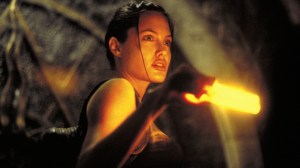 This is a movie that is light on characters yet at the same time has so many extraneous ones. The bad men are being led by fellow tomb raider Alex Cross (Daniel Craig), who also happens to be a former flame of Croft’s. Lara is saddled with a geeky computer whiz who just happens to be British, because he keeps spouting phrases like “blimey” and “bugger” all the freakin’ time. Croft also employs a butler, because, someone has to take care of that huge house. If this wasn’t enough the big bad employs an assortment of typical evil henchmen that are distinguishable by tattoos alone. Add on top of this heap the flashbacks Croft has of her long missing father Lord Croft (played by Jolie’s real father, Jon Voight). All of these dueling personalities clog the action and the pacing.
Front and center, Angelina Jolie is the living embodiment of Lara Croft. She fills out the attitude and the look to a perfected T. Jolie gives Croft the muscle but the screenwriters fail her in giving her the flesh and blood. Tomb Raider falls into the “rule of five”: if there are five or more people credited with the script (including in this instance the director himself) then there was no script at all.
The action of Tomb Raider is loud and explosive but rather lifeless and dull. West has managed to create bombastically mundane action sequences. Never once did anything from the screen arouse my interest, except for the female lead of course. The story has its characters travel to exotic locales and impressive sets of ancient caves and temples, but it’s all window dressing. The pretty scenery and locations only mask how ineffective and boring the action is. And for an action picture, when the audience begins to notice how pretty the scenery is compared with the action – you’re not doing your job.
 Simon West is not exactly a director to be trusted with any sort of project. West brought audiences Con Air and The General’s Daughter, a film that tried to decry rape but then took sadistic pleasure in recreating it again and again. So what better man to helm the project of the buxom video game heroine than a man who has brought us cartoonish violence and horrific rape? The camera framing of Tomb Raider takes a few notes from the Jennifer Love Hewitt experiment that was I Still Know What You Did Last Summer. Jolie’s breasts are always in frame, and at certain times it seems like the camera is lowering just to get them in there for the sake of exposure.
Despite the attempt this video game turned into a movie feels exactly like a video game turned into a movie. It’s complete with some laughably atrocious dialogue (“You know what today is?” “The 15th.” “And that is never a good day.”), and despite the running time of an hour and a half, it feels like an eternity longer. Tomb Raider never gets off the ground even with the added push of some pretty good special effects. Jolie may have an action vehicle at her helm and that’s fine with me. Keep her. Just make sure to get rid of everyone else.
Nate’s Grade: D
Share this:

Gone in 60 Seconds (2000)
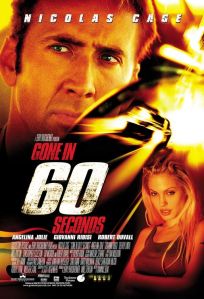 The movie I’ve seen trailers for since last summer finally hits theaters in a summer full of hungry patrons all wishing for the biggest explosion and coolest effects. But with its star heavy cast and array of sleek cars can Gone in 60 Seconds propel itself to the front of the race with audiences?
Nicolas Cage plays a reformed car thief forced back into the fray when his screw-up brother (Giovanni Ribisi) botches a deal for a local toughie. To rescue his delinquent bro Cage must steal 50 cars over the next three days for the man. So Cage wastes two days assembling his team of usual stereotype frat kids who are “the best and brightest” to aid in the mission. That leaves 24 hours for Cage and company to steal 50 cars and save the day minding any moral objections over grand theft auto.
 Gone in 60 Seconds is a living dream of testosterone with fast cars, sexy girls, and colossal explosions. But all the action is mercilessly loud yet surprisingly tame and empty. All the action lacks true tension or any real semblance of excitement. The director uses poor choices of rapid quick-cut edits that dull any build up of excitement. Most of the action doesn’t even center on the theft of cars, it just happens. Excluding one chase scene toward the end Gone in 60 Seconds is a popcorn movie with no flavor.
The script and characters take a back seat toward the effects and speeding cars but this to be expected from producer Jerry Bruckheimer, the man who gave us the equally boisterous Con Air and The Rock. This time the holes of the plot are easier to see and the dialogue no less cheesy especially when car talk turn innuendous. It’s easy to argue that story should be forgotten because audiences came to see cool cars and cool crashes, but it’s also easy to argue that those cool crashes and cars are distractions (as is Angelina Jolie) from the thinly strained story. When you have time to really analyze the plot in an action film you know the action isn’t up to par.
Gone in 60 Seconds could also serve as an apt description for Angelina Jolie’s running time. The recent Oscar winner dons bleached dreads and those pouty lips but is still seen less than Waldo – and that is a criminal mistake with someone like her. Gone in 60 Seconds has a bounty of Oscar winners with scant supporting screen time yet it can’t fool the crowd.
Gone in 60 Seconds may fit the criteria for a grand summer fireworks show but can never deliver the goods. It may be flashy, loud, and fast but this flick just isn’t running on empty, it’s past the “E.”
Nate’s Grade: C-
Share this:

The Bone Collector (1999)
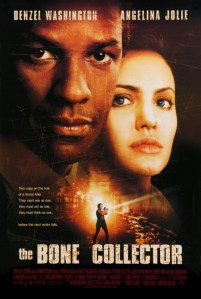 Another serial killer movie? Didn’t we as an audience learn our lesson already with Kiss the Girls? Apparently not with this latest adaption of standards and predictability that does nothing more then reinvent the old blaming the butler routine. And may I affimingly add that whoever the critic who gasped that this is on par with the masterpieces of Silence of the Lambs and Se7en either is lying through their teeth or has their children’s college education payed exclusively by Universal.
The Bone Collector has fancy gloom, grit, and gore, but it has no substance whatsoever. The script has the feel of being pasted together from leftovers of earlier better movies. It takes one illogical shift after another until the supposedly “surprise payoff” ending comes charging in but echoes more of a unified feel of rip-off instead. Contrivances are in abundance with every scene, and further prove the superiority of Lambs and Se7en in how well they achieved perfectly tuned thrills. The Bone Collector‘s biggest disappointment is in its utter lack of substantial entertainment when the core of the movie is Angelina Jolie getting dirty in dark places wielding a flash light. This kind of stuff may have worked at summer camp around the fire to scare people, but on the big screen the only ones to cower in terror will be the extensively naive.
Not to lambast this clunker too much, because there is some credible acting from the star leads. Denzel Washington at least makes his role non-laughable which is saying a lot in respect, and Jolie looks like she is a fresh talent but this ain’t her vehicle to hitch on to. Her “gifted” police specialist at finding evidence doesn’t seem to special to me with the easily found clues that anyone could trip over.
The suspense in The Bone Collector boils down to flashes of gore and jumps to frighten instead of the meticulous psychological and intense battles in Lambs and Se7en. The serial killer genre is at a glut again, and The Bone Collector is merely the fat of that over-extension that would serve best to be cut loose.
Nate’s Grade: C-


 nathanzoebl
You must be logged in to post a comment.