Blog Archives
Dawn of the Planet of the Apes (2014)
 Anyone else think the titles of these Apes prequels should be retroactively switched? Coming off the heels of the surprisingly excellent flick Rise of the Planet of the Apes, those damn dirty apes are back with another summer blockbuster that’s just as mature, engrossing, emotionally resonant, and visually remarkable. Dawn of the Planet of the Apes takes place ten years after the events of the previous entry, with mankind devastated by the “Simian Flu,” the same bug that has kick-started the evolution of the primates. Caesar (Andy Serkis in motion capture) is leading a fairly conservative life; he has a home, a family, a wife, and a community he’s trying to build. Then a group of humans wander into their territory needing access to the remains of a dam for a power supply. The apes do not trust the humans, but Caesar accepts their terms, looking to avoid war. However, fear, resentment, and hate fester on both sides, and it’s not long before it’s apes vs. humans and you witness one of the greatest things your eyeballs will ever see – an ape firing two machine guns while riding a horse. Plot-wise, this film is more a bridge to a larger conflict between the two factions. The human characters (including Jason Clarke, Keri Russell, and Gary Oldman) are given short shrift. And that’s fine because the movie belongs to the apes; they are the stars rightfully. Half of this movie is in subtitles for ape sign language. Director Matt Reeves (Let Me In, Cloverfield) dwells in the moments other blockbusters don’t have time for. He lingers in the shadows, with silences, and we slowly integrate into the world of the apes and their own power dynamics. The all-out action of the third act doesn’t feel like a natural fit for the thoughtful movie that has played out until that point. The visual effects are again top-notch and the motion capture tech captures a stunning range of human emotions that you can witness play out across the CGI creations. Toby Kebbell (Wrath of the Titans) portrays Koba, the more hawkish member of the ape tribe, and he is just as good as Serkis, which is saying a lot. I’d still call Rise a better overall film, but Dawn is a more than worthy follow-up that reminds audiences what great storytelling can achieve with the right people behind the scenes.
Nate’s Grade: A-
Share this:

Rise of the Planet of the Apes (2011)
 I owe the makers behind Rise of the Planet of the Apes a huge apology. I have been vocally dismissive of a new Apes film from the first moments I heard about the project. I just thought rehashing this material was a stupid move. Then I heard James Franco (127 Hours) was going to be the lead, and I sighed. Then I saw the trailers and verbally impugned them in my theaters. Upon the conclusion of the trailer I yelled, “You can still shoot them!” and my criticism drew applause from those around me. The concept that we suddenly made apes smarter and they could now enter the Bronze Age, brandishing spears, didn’t overwhelm me. Just because the apes suddenly had tools didn’t seem like enough to topple mankind from the top of the evolutionary ladder. So in the months and weeks ahead I sneer, jeered, and overall dismissed Rise of the Planet of the Apes. And then the reviews came out and they weren’t just good, they were ecstatic. I went begrudgingly into the theater, waiting to hurl my own feces at the screen (figuratively, of course). Then I was completely taken aback by how much I unabashedly loved it.
Will Rodman (Franco) is a young scientists working hard at create a miracle cure for Alzheimer’s. His corporate company has been testing their drugs on chimps to mixed results. One day a promising ape, made smarter by a dose of ALZ 112, goes bananas and is put down by security. The lady ape left behind a baby ape that has taken on traits from the ALZ 112. Will takes the little chimp home to care for the “company property.” But then he ends up adopting the chimp, which his ailing father (John Lithgow) names Caesar. Due to the super drug, Caesar shows remarkable intelligence and looks to be getting even stronger. It looks like Will might have found his cure, and his boss (David Oyelowo) will make billions. But then complications ensue, as they always do, and Caesar is taken to an animal preserve facility run by a crooked father/son team (Brian Cox and Harry Potter’s Tom Felton). Caesar is mistreated and distraught to adjust to a life in pens. He makes plans to escape but then decides to rally his fellow imprisoned apes to a greater cause with the help of some of the ALZ 112.
Even through Franco is the headliner he’s really nothing more than a supporting character, a catalyst. The real star of the movie is undoubtedly Caesar the chimp. After about he 45-minute mark, Franco is reduced to making frowny faces while he scowls, trying to ascertain where his favorite monkey is. His dialogue is mostly reduced to different iterations of yelling Caesar’s name in different locations (the guy even manages to smirk in his sleep in one scene). But the major surprise is that Caesar is not only a compelling leading character but also a well-developed one at that. This is a living, breathing character brought to life thanks to top-notch computer wizardry and the talents of Andy Serkis, the leading authority for soulful motion-capture performances. Caesar may be the greatest single special effect of all time, not because of its life-like quality (it’s close, but again the creature’s features seem too waxy). But the reason Caesar is so impressive is because of the depth of emotion that can be read onscreen. This is a textured performance where you can read varying emotions through the looks of eyes, the twitching of facial muscles, the biting of lips. The emotions are genuinely recognizable; he flashes guilt, anger, frustration, heartache, disbelief, betrayal, fear, shame, just about everything in the book. From a DNA standpoint, chimps and humans share 96 percent of the same genes, so it’s understandable that we can relate to the plight of our distant relatives. Serkis is responsible for providing the groundwork for CGI creations like Gollum and King Kong, so he’s the world’s go-to guy when it comes to providing a framework for animators (Robert Zemeckis, why have you never called this guy?). It’s an amazing special effect accomplishment and works side-by-side with the storytelling to make Caesar a complicated, interesting, and deeply empathetic hero. He’s a terrific center for the movie and a figure that you root for, even with the tacit understanding that cheering on the apes’ escape is also tantamount to cheering the decline of the human race. But by God, during the apes-run-amok climactic sequences you are cheering for mankind’s downfall hardcore.
The Planet of the Apes saga (six films) is, let’s be honest here, rather abysmal. Everybody loves the first movie but the quality sharply drops from there, with four sequels in four years each managing to answer the depressing question, “Can this thing really get any worse?” The 2001 Tim Burton “re-imagining” was just embarrassing and filled with loopy logic (how can the apes take over Earth’s past when Marky Mark crashes on a DIFFERENT planet in the FUTURE?). Given that, the filmmakers behind Rise of the Planet of the Apes did not have to achieve much to separate themselves from the monkey-stank of the sci-fi franchise. The film serves as a prequel to the series but it’s easily the best film since the original. Easily. For one, the storytelling is not overwhelmed by the allegory of sci-fi packaging. The world is decidedly our own and the problems the characters grapple with are fairly relatable. Will may be responsible for the annihilation of the human race but his motivation is pure – he wants to save his ailing father. That’s a believable motivating force that would push the character to action over caution, testing his special serum without fully examining all the side effects. You know what they say about the road to Hell (my friend Eric Muller always suspected Franco would be linked to the end of civilization)? But in a Planet of the Apes movie there is a wealth of thoughtful human drama. Animal rights are one of the more obvious messages the movie deals with, but the film takes a character-driven approach following the animal himself. You care about these characters and when one CGI ape was cradling a dying CGI ape, I swear I was getting choked up over those computer pixels. That’s how emotionally involving this new Apes film can be. It’s refreshing to have a Hollywood action film that has more on its mind than blowing stuff up all good like.
 But when the action shapes up, mostly during a stirring man vs. apes climax, the film easily delivers. The nimble screenplay by Rick Jaffa and Amanda Silver (their first film since 1997’s Relic!) is a terrific example of economical big-budget pacing. Every scene moves the story forward and doesn’t waste a frame. The final running time is only 105 brisk minutes but it squeezes in so much entertainment and emotion. Director Rupert Wyatt keeps the thrills coming on a human-scale, never letting the enormity of the events getting too out of hand. Sure suddenly there are like 500 apes all of a sudden and all of them are super smart, but I can roll with that. The stakes are always clear and the action is easy to follow and easier to get swept up in. There are a few shout-outs to the original film’s iconic lines, which will either come across as fun or ham-handed. And thankfully a plausible scenario is put forth to explain why the humans would be overtaken by the apes. That’s not to say that everything is smartly woven into the narrative. Several of the side characters are but crude renderings. Frieda Pinto’s (Slumdog Millionaire) underdeveloped love interest could be completely taken out with minimal effect on the plot. Likewise the Evil Business Head seems to have nothing but speeches that remind you his sole interest is making lots of moolah.
Rise of the Planet of the Apes is a Hollywood movie with a soul. Finally late in the summer a major studio movie emerges that has the right balance of brains, brawn, and thrills. It’s an exciting action movie, a poignant drama from an animal’s point of view, a tour de force of special effects that manage to make the film more emotionally involving, and a sci-fi prequel that’s actually worthy of its name. Serkis’ gifts for physical performance are invaluable to the emotional core of the movie. By going back to its DNA, Rise of the Planet of the Apes has given new life to a franchise whose best days were 40 years ago. I don’t see where the series can go from here. A prequel to the prequel seems superfluous. A sequel would only really showcase the waning days of humanity and also seem superfluous. Then again, until the moment I was watching Rise of the Planet of the Apes I would have said this very movie was superfluous too. Instead this is the finest summer spectacle of the year and destined to make my top ten list for the year. If you can’t beat them, join them, damn dirty apes and all.
Nate’s Grade: A
Share this:

The Prestige (2006)
 Christopher Nolan can do no wrong in my book. The director of Memento, Insomnia, and Batman Begins has bewitched me with his clever non-linear storylines and artistic vision. The Prestige is 2006’s second period set magician movie, and in my opinion it’s the better of the two. Nolan’s film lacks the magic of The Illusionist, instead focusing more on the bitter realities of obsession, self-destruction, and the lengths that men will travel for vengeance. The script centers on a pair of dueling magicians (Christian Bale, Hugh Jackman) that are each trying to discover the other’s trick and top them. The storyline is as twisty as a pretzel and told in Nolan’s familiar non-linear fashion, building to a very dark reveal. Whereas The Illusionist sweeps viewers up with the wonder of magic, The Prestige is all about how tricks are orchestrated both on and offstage. The results are a tad cold; you don’t really feel for either magician. The movie is itself a trick but one grandly told with excellent slight of hand. The final act takes a step outside of the film’s tone but it works for me, and it’s been weeks since I last saw the haunting final images and I still cannot get them out of my mind. The Prestige is another notch on my Nolan love meter.
Nate’s Grade: A
Share this:

King Kong (2005)
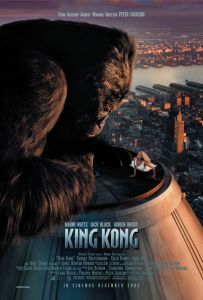 Has there been any movie this year that’s had a bigger hype machine than Peter Jackson’s King Kong? Coming after his Lord of the Rings trilogy, about two billion in revenue and a slew of Oscars in tow, Jackson decided to recreate the movie that captured his imagination as a child. It was King Kong that made Jackson want to become a filmmaker, so now he is returning the favor. Universal ponied up a staggering 200 million dollars for a budget and paid Jackson a record 20 million to sit in the director’s chair. Like his Rings series, this Kong clocks in at a gargantuan 3-hour running time. Will audiences share Jackson’s adoration with the story of a woman, a big ape, and a bigger building?
Carl Denham (Jack Black) is a filmmaker feeling studio pressure. The suits want to reel him in before he even starts shooting his next picture. Carl scrambles to get his crew and equipment onto a boat before the studio can shut him down. He?s on the prowl for a new lead actress and spots Ann Darrow (Naomi Watts), a hungry out of work vaudeville actress. He quickly convinces her to be apart of his movie and hurries her aboard, the selling point being that Jack Driscoll (Adrien Brody) has written the story. Carl practically kidnaps Jack and they all set a course for the mysterious Skull Island, a place only rumored to exist. The ship’s captain and crew are wary but sure enough their vessel washes ashore on an exotic island. But this is no sunny getaway, as the crew is immediately besieged by hostile natives and Ann is taken prisoner and offered as a sacrifice to Kong, a 25-foot gorilla. Jack leads an expedition to retrieve Ann, who begins to bond with her hairy captor (Stockholm syndrome, anybody?). Kong rescues Ann from dangers, be it bug or dinosaur, but flies into a vicious rage when she’s plucked away from him. Carl realizes an even bigger attraction: a giant ape to headline Broadway and line his own pockets. His schemes come true as Kong is knocked out and transported back to New York City. However, no stage is too great for Kong, as he busts free and looks all over for the love of his life, Ann.
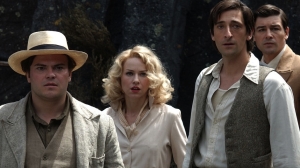 The sweet love story gives Jackson’s update a surprising emotional richness. In the 1933 original, Fay Wray never stopped shrieking until the big guy toppled off the Empire State building. She had no emotional connection to her furry captor and his unrequited love. In the 2005 King Kong, the strength of the movie is the relationship between Ann and Kong. Jackson of course stacks the deck of his story to all but guarantee an audience will fall in love with the big brute (he appreciates sunsets, how romantic!). There?s not much choice whether or not to sympathize with Kong, especially those moments where we stare into his soulful eyes welling up with emotion. King Kong has always been a tale of exploitation with man as the true monster. By administering time to fully develop a convincing relationship between beauty and beast, it makes the later scenes of exploitation have a larger sense of tragedy. Immense credit goes to Watts for selling this relationship and spurring our sympathy for Kong, instead of making their bond something for snickers and eye-rolling. Poor Adrien Brody though. It’s pretty bad in a romantic triangle when you’d rather pick a giant primate than Brody.
The performances go a long way to adding to the enjoyment of King Kong. Watts is a luminous actress and a natural beauty. It’s because of her that the second half of the movie has a beating heart and some kicks to the gut. Brody is ho-hum but given little to work with as a, wait for it, second banana. Black works wonders to make his villainous role so charismatic. Denham is a huckster that would step over his dying mother to make a buck, and yet Black’s charming and funny even at his most dastardly and cowardly. I don’t think King Kong would have worked the same with different actors; few could bring the heart and emotion Watts emotes, and few could bring Black’s comic virtuosity that makes it plausible why others would follow his showman character. Colin Hanks (also along side Black in Orange County), as Denham’s assistant, imparts a favorable impression. I’d like to see him paired up with Topher Grace sometime. Give it some consideration, Hollywood.
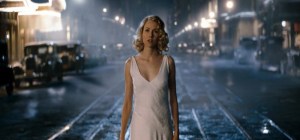 King Kong is a spectacular vision by one of cinema’s greatest visionaries. Jackson has lavishly recreated the excitement of his youth, bringing the story of Kong into the modern age with studly panache. The film is marvelously beautiful to take in and has plenty of moments that will reawaken the child within you, transporting you to an age when movies truly seemed larger than life. During the epic battle between Kong and the T. Rexes, I knew the exact curiosity and excitement Jackson felt when he saw the 1933 original. The action is intense and rarely lets up once our adventurers reach Skull Island. The special effects are some of the best movies have ever seen. Kong moves with expressive accuracy that goes a long way toward expressing his humanity, whether it is in a sigh or a tantrum. Andy Serkis has yet again brought life to another entirely CGI character. King Kong is well worth the price of admission just to sneak a peek at the Jackson’s limitless imagination.
With Jackson’s beefed-up recreation, he has also brought with him a terrible amount of bloat. This King Kong runs a frightful 3-hours plus, and most viewers will just feel exhausted by the time the lights go back up in their theater. Jackson’s love affair with his material is indisputable but it also seems to cloud his judgment as far as pacing is concerned. Numerous scenes seem to stretch longer than necessary and lose their point of interest, the first hour seems too drawn out and prosaic, and the movie haphazardly mixes in the serious with the soapy (Kong on ice?). Some scenes lose their sense of believability the longer they stretch on, even in a movie filled with giant monsters. Certain subplots have set-up but no follow-through, like all the added attention to Jimmy (Jamie Bell), the ship’s teen that wants to experience danger too. Jackson even makes sure we catch that he’s reading Heart of Darkness. So where does this character go? Nowhere and very slowly at that. The character has no bearing on anything that happens with the plot and is dropped entirely once they leave the island. There’s no point. Did something get cut from the inevitable 8-hour extended edition DVD that will prove how pivotal Jimmy really was? I doubt it.
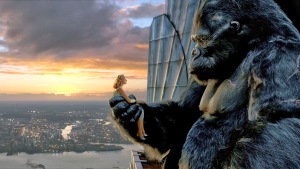 Some nipping and tucking and a comprehensive editing overhaul would certainly make King Kong a better movie, but it would lose its sense of spectacle. I can’t complain about length too much since Jackson packs such a wallop of entertainment like few others, so while King Kong certainly is a bloated and exhaustive film, it’s also an artistically bloated, exhaustive film. Jackson sure does have reverence for his source material (some lines and scenes are directly lifted), though he may have overlooked the 1933 King Kong‘s 100-minute running time.
Peter Jackson’s King Kong is an epic, epically grandiose, epically imaginative, epically action-packed, and epically bloated. The update is a bit exhausting but Jackson packs more entertainment per minute than few others in the film business, even if he has too many minutes to work with. Watts really sells her tender relationship with Kong and gives the film a surprising emotional heft absent from the 1933 original. Because of our emotional investment the film has a greater sense of sadness and tragedy as it plays out. King Kong was the 800-pound gorilla of the movie year and Jackson knows how to deliver a visual epic, even if he tiptoes into self-indulgence. While I can protest the length, pacing, and some subplots that go nowhere or strain credibility, it’s hard to argue that King Kong is the popcorn spectacle of the year. Your bladder may hate you by the end of it but you won’t want to miss a second.
Nate’s Grade: B
Share this:

Lord of the Rings: Return of the King (2003)
 To all those hairy-footed Tolkien geeks that chewed me out for having the audacity to call 2002’s Two Towers, of all things, boring, let me say this: while I still find the second entry of The Lord of the Rings to be disappointing and pretty flawed, the final chapter, Return of the King, is a glorious and satisfying conclusion. Instead of doing a usual review (plot synopsis, strengths/weaknesses, etc.), I’m going to bring back the charges I had against Two Towers and explain why Return of the King does not suffer from these ills. Will the defendant please rise as I read aloud the charges.
Charge Number One: Two Towers has nothing going on for its majority except hyping an oncoming battle.
And I still feel this way. Short of the great Helms Deep battle, there was oh so little going on in Two Towers that they could have easily trimmed an hour away from it. And don’t give me this crap about the whole kingdom of man subplot or Aragorn (Viggo Mortensen) realizing his eventual responsibilities. Whatever. Now, in Return of the King, there is so much going on and the pacing is so tight, that despite being the longest film by far (3 hours and 20 minutes), this is the FIRST Lord of the Rings films that has not put me to sleep in the theaters. The nearly hour-long battle involving the 200,000 Orc army with its huge elephant creatures is mesmerizing and visually stunning. But even after the battle and before, unlike Two Towers, there is plenty going on that actually matters, not just three characters running around endlessly.
 Charge Number Two: Despite nothing going on except waiting for a battle, Two Towers has little characterization of any of its characters.
So even though little is going on, Two Towers still doesn’t use all this free space to deepen characters. But in Return of the King, the characters come through and shine. The hobbits are back to the front burner and the film is better for it. Sam (Sean Astin, in the finest performance of the film) and Frodos journey becomes increasingly important and the strain and deception of Gollum puts a wedge between their friendship. When Frodo (Elijah Wood) looks scornfully at Sam and dismisses him from their journey, it’s heartbreaking. Why? Because after two years we as an audience have come attached to these characters and do feel for their struggle. When Sam, toward the climax, says, “I may not be able to carry the ring, Mr. Frodo, but I can carry you!” I dare anyone to try not choking up. We also get deeper moments of character with peripheral characters, like Faramir realizing he can only satisfy his father by a suicidal mission. Even the smaller characters from the second film, like Eowyn (Miranda Otto) and her kingly father Theoden (Bernard Hill), have wonderful moments where the emphasis is on characterization. Return of the King is filled with rich character moments that remind us how much we enjoy and feel for these people … uh, and hobbits.
Charge Number Three: Most of the characters from Fellowship of the Ring have scant appearances in Two Towers.
This still holds true. Gandalf (Ian McKellen, brilliant) returned from the dead but had about three minutes of screen time. The elves (Liv Tyler, Hugo Weaving, Cate Blanchett) were given the amount of screen time most people would consider cameos. And then the hobbits were left alone for the overlong subplot involving Theoden and his clan. What Two Towers really was was the dwarf, elf, and Aragorn movie. And I like each of those characters but this story is not theirs its the hobbits. So the disproportionate amount of time spent with Gimli (John Rhys-Davies), Legolas (Orlando Bloom) and Aragorn felt like what would happen if, in Star Wars, C-3PO and R2D2 had their own film. It wasn’t as interesting and it wasn’t right. But with Return of the King, the attention is back to the hobbits, and all of the characters in the entire film have at least one stirring moment of quality time. Gandalf is back in a big way and its welcomed. What else is welcomed is the increasing attention Merry (Dominic Monaghan) and Pippin (Billy Boyd) have. They started as merrymakers, but by this trilogys end they are desperate to join the ranks and fight. The shared moments between Merry and Eowyn in battle are great. The moments between Pippin and Gandalf are even better. And even though the elves still get the short end of the stick, they make lengthier appearances that are more satisfying. It appears, though, that Cate Blanchett’s longest amount of time in this whole trilogy was narrating the opening prologue.
 Charge Number Four: Excessive dwarf jokes.
Even if you disagree with me on the previous three charges, you must agree with me that Two Towers had about a million dwarf jokes too many. Return of the King, to my knowledge, doesn’t even have ONE dwarf joke. Fabulous. This is not to say I want less Gimli. The subplot involving the Two Towers trio seeking an army of the dead (a tad deus ex machine) is intriguing, and his competitive banter with Legolas is still ripe (Bah! That still counts as one!).
Return of the King is an amazing experience and one that is a fully satisfying conclusion, unlike say, I don’t know, maybe the last two Matrix films. The danger feels more abundant now that the end is near and the tension mounts. The payoffs are rewarding and the climax is fittingly climactic. However, the 20-minute resolution is a bit drawn out. It seems director Peter Jackson can give us three hours of fast-paced action but cant speed through a medley of hugs. You think its over…. and then theres more, then you think its over…. then there’s more. This is a small quibble for such an epic trilogy, and Return of the King proves that it’s really one large triumphant film, with a bit of a sag in the middle. What? Did you think I’d get through all this Lord of the Rings love-fest and not take one last jab at Two Towers? Though I still prefer Fellowship of the Ring out of the three, Return of the King cements the trilogys cinematic greatness in our time. Oh yeah, and the cinematography, special effects, production design, makeup, and score are magnificent too.
The defendant is cleared of all charges.
Nate’s Grade: A
Share this:

Lord of the Rings: The Two Towers (2002)
 My countrymen and fellow Americans, I come here not to praise Lord of the Rings: The Two Towers but to bury it. I don’t know if it’s a result of being the bridge between the beginning and end of this saga (taking the role of neglected middle child), or a result of unmet sky-high expectations, but I may be alone here in saying that Two Towers was a letdown. I’ll try and frame my reasoning as to not be attacked by hairy hobbits and men with pointy hats and long flowing beards.
1) Story structure. Unlike Fellowship of the Ring, where were introduced to a rich world and have suitable character set-up, the second LOTR film puts almost all our characters on the backburner and gives us an insufferably long subplot involving a king and his brood. The movie peters out an ending and seems to throw its hands in the air saying, “See ya a year from now.”
2) Length. This wasn’t a problem with the previous film but man did Two Towers become unbearable as it went. Some described the first film as three hours of walking; well the second could be described as two plus hours of folks hyping a battle and then — a battle. Seriously, theres a lot of talk about a significant battle and that’s it. An hour could have easily been cut from this. It got to the point where my then-girlfriend was sprawled across my lap pleading for me to somehow make the movie end.
3) Characterization. So much time is spent doing nothing you think the film would further round the characters? Oh how stupid you would be. Nothing new seems to be drawn from any character, with the exception of the treacherous yet likable Gollum. Several people from Fellowship (Liv Tyler, Cate Blanchett, Hugo Weaving, Ian McKellen) have screen time that amounts to no more than a cameo, so why in the world aren’t we getting anything more from our already established heroes? Everyone just looks friggin bored. As was I.
4) Excessive dwarf jokes.
I re-watched Fellowship and all of the reasons Two Towers suffered were not evident. So what does this tell me? Nothing particularly, except not to see the movie in the theater again. Two Towers is by no means a bad film. The cinematography, production and special effects are all breath-taking and sweeping. I’ll still look forward to seeing the next, and last, installment in Peter Jackson’s Rings epic, but Two Towers has left a bitter taste of disappointment to linger upon.
Nate’s Grade: B-


 nathanzoebl
You must be logged in to post a comment.