Blog Archives
Star Wars: Revenge of the Sith (2005)
 I was in Dublin, Ireland of all places when I saw Star Wars Episode III: Revenge of the Sith. I was enticed to get off my sick bed and see George Lucas’ final Star Wars installment. As a kid I loved the original trilogy. My expectations were piqued by the promise that Revenge of the Sith would be bigger, badder, and suitably darker than any previous Star Wars installment. It did get the series’ first PG-13 rating and a stern warning to parents from Lucas for nothing. I had equal hopes for the other two prequels, 1999’s The Phantom Menace and 2002’s Attack of the Clones, but said hopes were dashed upon actually watching the movies. This was the last film and I had my fingers crossed ole George would finally get it right.
It’s now several years into the war between the Galactic Republic and the separatists led by General Grievous, leader of the droid army. Anakin (Hayden Christenson) and Obi-Wan (Ewan McGreggor) fight for the Republic and the chancellor of the Senate, Palpatine (Ian McDiarmid). Anakin is having nightmare that his secret wife Amidala (Natalie Portman) will die in childbirth. He seeks out a way to save her and is tempted by certain promises by shadowy figures that the dark side of the force can restore life. From there things are set into motion that turn the Republic into an evil Empire, the Jedi into a near extinct band of warriors, and Anakin into the iconic Darth Vader.
My friend Josh Browning brought up the idea that Star Wars would be so much cooler without George Lucas. I gave this idea some thought and have come to the same conclusion. Can anyone ever say “no” to the Jedi master in plaid? Directing flaws aside, where Lucas really needs assistance is his writing. The biggest qualms I’ve had with the new set of Star Wars, horrible acting aside, is how unforgivably boring they are and the tepid romance. The original Star Wars were about action, adventure, and things that mattered. The prequel set has been mostly about trade, taxation, Senatorial control, and separatists. The majority of the prequels have been sleep-inducing and riddled with pacing issues.
 In an Entertainment Weekly interview, Lucas said 60% of his prequel story was related to the final film. With some quick calculations, that means that there was 20% plot in The Phantom Menace and the remaining 20% in Attack of the Clones. No wonder nothing seemed to be going on! This also creates the problem of Sith having far too much plot to deal with in too short of a reasonable time frame. Things feel left out or not fully explained, like why the hell does General Grievous have a cold? I know I’m missing something but it’s lazy filmmaking to make an audience do extra homework to flesh out your storytelling.
As stated, my other main gripe was the half-baked romance Lucas had between Anakin and Amidala. In Attack of the Clones, the romance is spontaneous. He hasn’t seen her in like 10 years and now they’re instantly smitten? There is no beginning to this romance, no nurturing, no progress. The romantic troubles are worsened by Lucas’ disinterested writing. Lucas cannot write dialogue to save his life. Romantic bon mots like “Hold me like you did at the lake” and “I’ve been dying a little bit day by day, ever since you reentered my life” will not exactly stoke a fire in your loins. Plus Portman and Christenson have as absolutely no chemistry.
Now, the reason I’ve reviewed the romance from Attack of the Clones is because it serves as the linchpin for why Anakin goes bad and becomes Darth Vader. It’s a mighty big question about what turned Anakin from man into one bad mutha, and his quest to save his wife is a satisfyingly plausible answer. But the transition doesn’t have near the punch Lucas intends because of his weak romance he’s penned. Lucas’s shortcomings as a writer finally pull the rug out from Anakin’s big moment.
The acting is another weakness. True, the acting hasn’t always been the top priority with any Star Wars film, but these prequels have shown that Lucas would rather stand behind a computer than in front of an actor. Portman has generally seemed bored and lacks any interest in hiding it. In Attack of the Clones she seemed sedated. In Revenge of the Sith she gets to cry a bunch. In Lucas land, that’s seen as character development.
 I thought Anakin could not get any more annoying than Jake Lloyd’s awful “yippee”-filled run in Menace, but I’m starting to reconsider this. Anakin mopes around and when he gets upset he whines in a falsetto voice. I will say Christenson was rather good in Shattered Glass where his arrested development acting techniques expertly channeled the manipulative Stephen Glass (if you do have a choice, go rent Shattered Glass). But in the more operatic Star Wars world, Christenson routinely comes off like a kid playing dress-up. Even after he’s gone full evil and growls and screams and glares, he comes off like nothing more than a poodle trying to be a guard dog. Of course neither performer is helped any by Lucas’ absentee directing style with actors.
The only members of the Star Wars prequels that will walk away unblemished are Ewan McGreggor and Ian McDiarmid. McGreggor has got the Alec Guinness voice down and proves to be a capable and dignified leading hero. McDiarmid has a juicer role than Anakin and really relishes his villainy.
Sith is the best of the three Star Wars prequels but that isn’t saying a whole lot. Whereas Menace and Clones were boring, Sith is just kind of slow and okay. It’s an improvement but the bar wasn’t exactly set very high. The formula is about the same: the first two acts are again quite plodding and then Lucas unleashes a torrent of action to close out his film. Sith does break apart because, surprise, things actually happen and they actually matter. After about six hours of buildup, actions meet consequences, characters meet their demise, and our boy wonder becomes the dark Jedi. People have been waiting decades for these moments and when they arrive they hit like a thunder bolt. Most of the time at least.
 The special effects are uniformly fantastic, which has never been an issue for Lucas. Yoda moves and emotes fantastically, actually besting some of his flesh and blood thespians. The interaction of live elements and CGI seems improved. Planets are rendered beautifully and the lava world is simply visually stunning and just plain cool.
The action is exciting but a bit overly edited in light saber battles. As we march into Act Three, there’s a terrific sense of climax with Yoda going off to battle Palpatine and Obi-Wan knowing he must put down Anakin. At long last I felt jolts, shivers, and goose bumps at what was to come. The concluding half of Sith is great rollicking entertainment and visually luxurious to watch. See George, light saber duels and character deaths are far more entertaining than trade disputes and embargo talk. The excitement’s back in the Star Wars franchise but it’s a shame it had to only appear this close to the finish line.
The final chapter on the Star Wars universe is closed. Well, for now. The lure of mountains of cash will probably ensure we haven’t seen the last of some of these beloved characters. Revenge of the Sith is a moderately satisfying closing episode to the Star Wars saga. The film still is an exhibition of Lucas’ filmmaking flaws (writing, pacing, his handling of actors) but Sith finally reaches the excitement and grandeur the original Star Wars had. My Dublin theater was roaring, clapping, yelling and screaming throughout. And for the first time during the prequels, so was I for awhile. And you know what the absolute best part was? Not one single word from Jar-Jar Binks!
Nate’s Grade: B-
Share this:

The Hitchhiker’s Guide to the Galaxy (2005)
 I’m a big fan of the late Douglas Adams’ series, so going in I had a slate of expectations but also a working knowledge of this kooky universe. I really don’t think this film will work for anyone but the fans. The movie isn’t even structured like a screenplay, it has more of the novel’s loose loopy feel. Some things work wonderful, like the Vogons, giant marvelous looking puppets made by Jim Henson’s studio. The cast is mostly excellent (Alan Rickman steals the show as the voice of Marvin, a very depressed robot). The animated guide entries in the Hitchhiker’s book are colorful, stylistic, and witty. Somethings, however, don’t work at all. The additions to the story, an increased romantic angle between our lead Arthur Dent (Martin Freeman) and Trillian (Zooey Descehanel) as well as a flat happy ending that rewrites all the opening danger. The Hitchhiker’s Guide to the Galaxy occasionally serves up some juicy bits of wacky humor or visual fantasy (John Malkovich’s bit part is weird) but unless you were a fan of the book series, you’re really not going to be able to follow along or have any interest in keeping up.
Nate’s Grade: C+
Share this:

The Forgotten (2004)
 Fair warning: This screed contains huge spoilers about the movie as I rip it apart. The press release for The Forgotten says, “What if you were told that every moment you experienced and every memory you held dear never happened?” And now, upon having seen The Forgotten, I say, “Oh, if only.”
Telly (Julianne Moore) is still grieving the loss of her nine-year-old son who died in a plane crash 14 months ago. She’s seeing a psychiatrist (Gary Sinise) and slowly coming to terms with her loss. One day she discovers all remnants of her son missing. His clothes, baseball glove, even his appearance in pictures has vanished. She accuses her husband (Anthony Edwards) of stealing them, but then is shocked when her hubby and doc both tell her that Telly never had a son. She’s been delusional for years since a miscarriage and has created an imaginary son. Telly refuses to accept the possibility that she’s nuts, and finds initial resistance and then acceptance from another parent (Dominic West) who also remembers a daughter that died in the same plane crash. Together they set off to learn the truth, all the while being hunted down by the NSA for some mysterious reason.
 The Forgotten shares a very dubious honor. Only twice in my life have I been strongly tempted to walk out on a movie, and that was while watching Lost in Space and The Thin Red Line. Six years later, The Forgotten became the third. It got so bad during the second half that I was fashioning my moveable armrest into a crude headboard for me to sleep upon. I was that bored. I can explain the reasons for my boredom very easily: terrible plot structure.
The Forgotten opens with Telly grieving over the loss of her son, and Moore is so good at grief that she can hook an audience as soon as her face crinkles into sadness. Around the 20-minute mark, Telly is told that she never had a son and has been delusional the whole time. Now, stop right there. That’s a great premise. If the makers of The Forgotten had stretched this part of the movie to about 90 minutes, put some thought and skill toward it, then we could have had something fascinating and heartfelt. Instead, you’re given the easily expected and the very boring.
At the 20-minute mark, Telly is told she has no child and she’s crazy. At around the 30-minute mark, none of this matters. The movie doesn’t even allow an opportunity for Telly to even doubt for a sheer second about her wild hunch that everyone in her life, including The New York Times, being apart of some global conspiracy to hide the fact she had a child. And of course, because she?s our heroine and this is Hollywood, her incredibly outlandish theories will be proven right. I understand that, but to reveal her theory’s accuracy only TEN MINUTES later is ridiculous. The Forgotten wastes no time proving Telly’s wild ranting as being correct. It’s as if The Forgotten feels that its audience is cultivated from the dumbest common denominator.
At the 40-minute mark the “A-word” is used, and before the 60-minutes mark, the audience knows everything. The last hour of the film is so obvious; no, it’s beyond obvious. It’s super obvious. It can’t even be obvious because The Forgotten has told you EVERYTHING. You’re not waiting around for predictability to play its way out, because you’ve been told everything. All that’s left is to sit and watch dull chase scenes (a book editor outrun NSA trained agents? Please).
There will be some heavy spoilers in my discussion of the film’s plot. I’m posting fair warning now, but doubt they’ll be too surprising given the ads on TV for The Forgotten (who else would you think was responsible?).
I have no idea what the makers of The Forgotten were thinking. They blow all their secrets in the first half and then mill around for another hour. It’d be like if The Sixth Sense revealed Haley Joel Osment sees ghosts and Bruce Willis is dead in the first hour, and then for another hour they sit uncomfortably and ask about the weather. Anyone think that movie would have worked the same? This is why I was so bored. I could have fallen asleep and accurately predicted everything that would happen in the second hour. There didn’t even need to be a second half to this film. It was all irritatingly explained to us in the first hour. Once the mystery’s gone, the only thing the audience has to keep its faltering attention are the questions of whether Telly can win back her son, and who will be vacuumed out of the universe next. That’s not much to justify another tension-free, revelation-free hour of awful movie.
The ending is also steeped in lunacy. So apparently all-powerful aliens love to play experiments on us and basically control our whole lives. Peachy. Telly is apart of an experiment, and the creepy, slim alien tells her that she’s the anomaly. All the other test subjects have forgotten, but not her, and the little green men want to know why. What’s even more peculiar is that this specimen of a supposedly advanced race is mad at Telly for gunking up the project, and he’s (its?) going to beat her until she forgets and the project is finished. But the alien just said she was the lone anomaly. By definition the project worked if everyone else succeeded. I’m no advanced race and I figured that out. Guess I’m smarter than the screenwriter of The Forgotten.
Once again, humans miraculously triumph over supposedly all-powerful alien species. I realize an audience wants to see our heroes succeed at the end and conquer evil, but is it even plausible when this evil can alter everyone’s existence at a moment’s notice? In the end, Telly gets her son back and her life is fulfilled. The makers of The Forgotten expect you to take this for a happy, victorious ending. Don’t. Sure, Telly has her kid back, but what’s to stop these all-powerful aliens from doing it again. For that matter, since she was the anomaly, wouldn’t they continue to perform experiments on her to see what makes her tick?
 What makes The Forgotten even more irksome is that it’s a blatant rip-off of Alex Proyas’ visionary 1998 sci-fi noir, Dark City. The plot of Dark City is about all-powerful aliens that experiment with human beings. They plant different memories into their heads, allow their human test subjects to live multiple identities, to see what makes us work. A reluctant doctor helps the aliens but is really rooting for the one test subject that seems beyond their power. The aliens are baffled about this anomaly. This is practically the entire plot for The Forgotten; trade Shell Beach for Quest Air, lose all the style, thrills, imagination, and pacing of Dark City, and what you’re left with is The Forgotten.
It’s not enough that The Forgotten is possibly the most ineptly plotted movie ever, or that the trailer and commercials gave away too much (I knew the ending before stepping into the theater), the ails of The Forgotten are exacerbated by the fact that it’s a shallow, homely, incompetent rip-off of Dark City.
I do not fault Moore. She is one of the finest working actresses today and will elevate anything she is in to some degree. She’s stranded by the material. The only performance I even took any note of was the surprise appearance of Lee Tergesen. He’s shown equally impressive comedic chops (USA’s Weird Science) as dramatic chops (He was the closest thing to a hero on HBO’s Oz). It’s always fun to see personally beloved character actors, even if it is in an abomination like The Forgotten.
Director Joseph Ruben (Money Train, The Good Son) finds astonishing ways to make The Forgotten even worse. He overplays his hand early, like having many overhead shots cued with weird, aerial noises. There’s also an ominous and extremely mobile cloud formation that spells out the antagonists. The second half is filled with pointless chase scenes, and Ruben can’t manage to make any part of them exciting. He does have one interesting jump moment while Telly is riding in a car, but I already saw it this year in the superior Bourne Supremacy.
The Forgotten may end up being the worst film of 2004, and with a year dotted by the likes of Hellboy, Van Helsing, Catwoman, and National Lampoon’s Gold Diggers, that may be all I need to say. I suppose someone out there may find something redeemable about The Forgotten (if they haven’t already seen Dark City), but the film’s tepid pacing, mind-numbingly foolish plot structure, and mounting illogical doom the poor audience to two hours of head-smacking boredom. This is a first-class Hollywood train wreck. It doesn’t work as a drama about grief, it doesn’t work as a psychological thriller, and it really doesn’t work as a half-baked X-Files episode. The Forgotten is a really great title, because in a few weeks it’ll be exactly that.
Nate’s Grade: F
Share this:

Dreamcatcher (2003)
 Stephen King movie adaptations are usually a mixed bag. For every Carrie there’s a Sleep Walkers or a Sometimes They Come Back. Let’s not even discuss how many straight-to-video Children of the Corn releases there are (the answer, of course, is far too many). So what can we expect from a novel that featured butt weasels?
Dreamcatcher centers on four friends and their annual hunting trip in the woods recounting an earlier time when they befriended a mentally retarded child who would later give each of them psychic gifts. At the same time it appears an alien invasion is nearby, the military are to quarantine the area, and the lost hunter has expelled a bloody serpentine-like creature from his bowels. What does it add up to? The craziest spring break ever man!
There are several moments in Dreamcatcher where you think to yourself, ”Well, it can’t possibly get more stupid,” and yet the movie routinely will find a way. It doesn’t know when to stop. Just when you think the bottom of the Stupid Hole has been hit, here comes an alien possession where the alien uses a freaking British accent (and actually says the word ”guvna,” proving to be the most dangerous interstellar chimney sweep). The only reason I knew what was going on was because I read the book over the summer.
The story is a mixture of different King staples: schmaltzy coming-of-age buddy stuff (It), alien invasions (Tommyknockers), gory monsters (take your pick). Dreamcatcher feels like a Stephen King greatest hits tape. The different narrative elements have great trouble gelling, as you can only segue from mentally challenged boy with mystical powers to crazy Morgan Freeman shootin’ up slimy aliens so often. The story does not work and has too many leftover bits it doesn’t know what to do with. Dreamcatcher is a proverbial square peg being jammed into a round hole.
 The movie shows some promise in its opening, displaying the camaraderie of actors Thomas Jane, Jason Lee, Damien Lewis and Timothy Olyphant (a younger looking Bill Paxton if I ever saw one). The notion of the memory warehouse is a fun idea that is used for nice comic touches.
Director/co-writer Lawrence Kasdan has written some of the most exciting films of the past 25 years, and screenwriter William Goldman is an old hand at adapting King (having done the masterful Misery and the mawkish Hearts in Atlantis). So what in the world went so horrendously wrong? For starters, the book is a whopping 620 pages and would be more suited in the frame of mini-series. Condensed into a messy two-hour movie, Dreamcatcher is sloppy with its pacing and scope. The movie drags for an eternity and then makes a mad dash at a finish (I wont spoil its unbelievable awfulness but will say it veers SHARPLY from the novel).
The most interesting part of the novel, for me, was the second half that involved the alien (Mr. Gray) taking over the body of Jonesy (Lewis). What kept me reading was Mr. Gray finding a liking to human temptations like bacon and, later, murder. Seeing Mr. Gray become intoxicated with humanity and perplexed by it at the same time was interesting. Sadly, all you get in the movie is the British accent and some goofy faces as Lewis holds two conversations in one person.
Few movies come along that are as incredibly stupid as Dreamcatcher. I cant exactly recommend it for this quality. They are playing that Matrix cartoon after it (my theater showed it before the film started). It looks like a video game and features a woman doing flips and sword fighting in a thong, because, quite simply, that’s what women do in these things. It’s not really that good either.
Nate’s Grade: D
Share this:

Lilo and Stitch (2002)
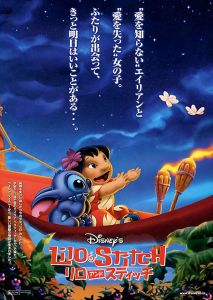 Disney’s track record the last few summers is not exactly sparkling. Did anyone out there see Dinosaur or Atlantis? Anybody? You know you’re in for a different take when the film’s heroine, Lilo, in her opening scene punches another little girl and tries to beat her to the ground. Lilo is a troubled child living with her older twenty-something sis, Nani, in Hawaii after a car accident claimed their parents’ lives. Nani is stretched thin trying to find a job, look after her troublesome little sister, and also stay a step ahead of the social services representative. Lilo is saddened at her situation and deeply longs for a friend.
In a galaxy far far away, a mad alien scientist is on trial for creating the ultimate in destructive evil-ness – a manic six armed blue dog lookin’ thing named Stitch. Through a series of circumstances Stitch manages to daringly escape and runs off to Earth, a protected planet because of a rare endangered species I won’t spoil. Stitch meets up with Lilo at an animal shelter and she immediately takes a liking to this offbeat pet. Stitch isn’t the friendliest or most well-behaved creature but he eventually warms up to his new family. You can pretty much take it from there.
What makes Lilo and Stitch so much better than the last few Diz offerings, besides a total lack of songs, is that it’s a fresh and Disney animated film. The focus is on an unconventional family with no pristine smooth edges around them (hello opening) and the material is shown a remarkable level of maturity. That isn’t to say that Lilo and Stitch isn’t funny, because it has many charming and hilarious moments, many due to the sputtering and wild Stitch.
Not all the elements entirely gel well, especially the sci-fi with the family struggle. The animation has an old-fashioned look to it complete with backgrounds that look dusty, like the ones that were used in the 1970s. The characters have a slight anime tinge to them, like half-moon mouths and noses like dinner rolls. Lilo and Stitch is the hippest Disney outing in a long while and the best non-Pixar animated film since the underrated Hercules.
Nate’s Grade: B
Share this:

Star Wars: Attack of the Clones (2002)
 Yes, it’s easy to say that Attack of the Clones is better than Phantom Menace, but hey, most anything was better than watching that movie about trade and taxes. The truth of the matter is that for a long while Clones is just as boring as Menace, especially anything involving Anakin onscreen. It’s slow moving, dull, and remarkably poorly written. Lucas cannot write dialogue and someone needs to take away his yellow writing notebooks before he strikes again. The movie only shows life during the last 45 minutes when it finally cooks with a non-stop rush of action. Before then though I would recommend resting up for this period.
Can anyone ever say “no” to the Jedi master in plaid? What Lucas needs desperately is collaboration, writing and directing. Lucas needs to loosen up the reign of his empire before the three Star Wars prequels undermine the original set. He may have the technology to create any manner of CGI creature but he has no power to get his actors to show any of the realistic and animated life. It seems all Lucas cares about is directing blue screens and leaving his actors out to dry.
 And that much ballyhooed romance between Anakin and Amidala? Oh ye God, what romance? You could find something more alive in a monastery. Portman and Christenson have as absolutely no chemistry (unlike the romantic pairs in another, huge Hollywood movie out now). Portman has perfected the staring ahead method. I don’t know if that’s supposed to be romantic. Now I like Natalie Portman, I really do. Her performance in The Professional gets me every time, but her acting is stiff and overly serious here.
I thought Anakin could not get any more annoying than Jake Lloyd’s awful “yippee”-filled run in Menace, but I’m starting to reconsider this begrudgingly. It’s easy to see why Christenson was chosen, he looks like the lost N’SYNC member. His acting on the other hand is not with the force. The Clones Anakin mopes around and when he gets upset he whines in a falsetto voice. It’s actually quite funny to see the future Darth Vader, evil master of the Dark Side and much feared, whining like a six year old throwing a tantrum. This Anakin needs a time out and a lolly.
When Anakin returns to become a protector for the senator, upon their first meet in ten years he shoots her the puppy eyes and says, “I see you have grown as well — grown more beautiful.” Subtlety, thy name is not Anakin Skywalker. The very next scene where they’re alone he’s trying to put the moves on her, though he does not try and use the force to undo her bra. Then somewhere along the line his dogged persistence just wears Amidala down and she relents. She says, “I’ve been dying a little bit day by day, ever since you re-entered my life.” Ugh. You’re likely to find more romantic passages in a Harlequin bodice ripper at 7-11.
 The romance in Clones is like spontaneous romance. There is no beginning, the nurturing of it is not shown, we don’t see the eventual progress. All that happens is he shows up and then instant romance. It just happens. I don’t think so. It’s like a kid went to a girl’s third grade birthday party, then they meet in high school for the first time since that day and are instantly in love. Do you buy that? Well I certainly don’t.
The scenes revolving around Obi-Wan are the only ones worth opening your eyes for. Ewan McGregor has got the Alec Guiness voice down and proves to be a capable leading hero. His voyage to see the clone army and Jango Fett is the subplot that we want, but the movie keeps skipping back and forth between this and the inept romance. By this time everyone knows that Yoda shows off his fighting mettle with a light saber. This is a great idea and the audience I saw it with was having the time of their life during this moment. It’s the only part of the movie that taps into the feeling of whimsical fun of the original trilogy.
Lucas curtailed the criticism of Menace saying it was the setup for all five other movies. I imagine he’ll say the same thing with this one, except that it was setup for four movies. Yes it’ll make a huge amount of bank. Yes it’s a technical achievement but what good are all the bells and whistles if we as an audience are bored? You’ve got one more Star Wars left George, please do it right.
Nate’s Grade: C+
Share this:

Final Fantasy: The Spirits Within (2001)
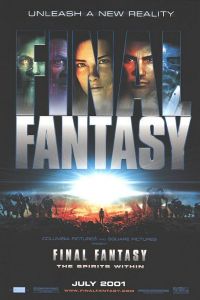 Final Fantasy is an exciting venture in the history of animation. It’s the second video game to be turned into a feature film this summer, though exponentially better than Tomb Raider. It took the makers of Final Fantasy four years and the creation of new technology to capture what will be a benchmark in animation for years to come.
The story concerns a future Earth where aliens have crashed and invaded long ago. These “phantoms” are slightly invisible energy creatures of different size and roam around various areas with the ability to suck the life force or soul from a human being. General Hein (James Woods) is trying to convince the Earth council to allow him to fire a satellite called the Zeus Cannon to obliterate the alien menace. In opposition to Hein is Dr. Sid (Donald Sutherland) who believes with his adventurous pupil Aki Ross (Ming-Na) that the Zeus Cannon will obliterate the “spirit” of Earth. Their solution it to collect eight spirits in whatever forms they might be including plants and small animals to gather together and… do something that will send the alien life force repelling.
 Now I know Hein is supposed to be the bad guy as he’s a military man complete with the evil looking black leather cloak, but I couldn’t help but find myself agreeing with his logic. He wants to use something that has already been proven to kill the aliens whereas these two new age scientists want to collect a bunch of plants and animals and have their collective spirits ward off the interplanetary menace. I’d stand in my chair and say thank you to Hein when he dismisses the doctor’s plot. I know that Aki and Sid are the heroes and of course whatever theories they have will be proven true, but hell, I found myself agreeing more with General Hein than these two.
Complicating matters Aki is infected with a piece of the alien phantom that is slowly taking control over her body. Along in her quest to discover the final spirits is aided by a military commander Grey (Alec Baldwin) and his company of men. Turns out Grey and Aki are former sweethearts, so of course expect them to reconcile before the end credits.
The plot consists of something that could be an average episode on Star Trek: Voyager but does meander along at times. The dialogue is typical sci-fi buzzwords like “Fire in the hole” “The perimeter’s been breached” and the sort. Final Fantasy does have great excitement to it and some terrific action sequences better than most anything this summer. The ending is a disappointment as all the action hinges on two globs of energy propelled against one another. Globs or energy are not exciting. I thought we would have learned this by now.
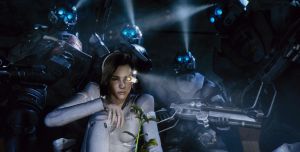 Final Fantasy is a landmark in animation. Never has so much detail been put into a movie and pulled off so amazingly well. To the nit-pickers out there the animation isn’t exactly the Holy Grail of photo-realism, but it’s closer than anything ever before. At times the characters come off as too plasticy (like Jude Law in A.I.) and tend to move too much, notwithstanding that their mouths don’t always follow the words coming out of them. Put aside these small grievances and what you have is stunning animation that makes one constantly forget it is animation. There are numerous moments of eerie precision like when a character’s nostril flares and their nose scrunches up in response, and the movement of every one of Aki’s 60,000 strands of gorgeous hair, to even a kiss between two characters. Even inanimate objects like a crumbled wall, a glass of alcohol, or a gun and its rounds are given startling accuracy. Backgrounds and scenic vistas are beautifully rendered with great care. There has been nothing ever like Final Fantasy before and it is the first movements toward an exciting area in animation.
The discussion must be raised can actors be phased out by computers now and will they ever? No, never. Actors can portray nuances that computers will never be able to master. Despite some actors best attempts to prove otherwise, we will always need actors. Now that you have the near photo realism one might be led to question what is the greatness of creating a fully realistic looking CGI tree when one can just be shot on film for millions of dollars cheaper. The all CGI world will not replace the real world of film making.
The mediocre story can be excused by the awe-inspiring animation. Despite the clunker of a plot Final Fantasy is entirely enjoyable because it always gives the viewer something to sit in wonder and take in. There’s always something to mesmerize the eyes on screen.
Nate’s Grade: B
Reviewed 20 years later as part of the “Reviews Re-View: 2001” article.
Share this:

Titan A.E. (2000)
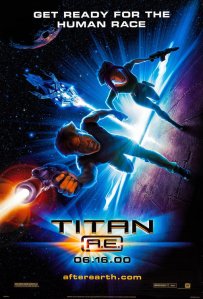 In the year 3000-something an alien race of blue figurines known simply as the Drej pretty much obliterate Earth. There’s your starting point for a movie – a few billion deaths. The last survivors drift through the ends of the universe at the bottom of the interstellar ladder. One survivor (voiced by Matt Damon) is later visited upon by a rag-tag ship led by Korso (Bill Pullman) and the shapely purple-locked Akima (Drew Barrymore), survivors of Earth as well. They rescue Damon and inform him that in his hand he holds the key to reaching a ship his father hid long ago that could create a new home world for all the drifter humans. And the Drej don’t like this idea and will stop at nothing chasing him until they find the location of this ship, the Titan, for themselves.
Sure, the effects and painted backgrounds are nice but the animation is choppy at times and the constant rotating of sets incorporated with traditional 2-D animation rates high on the annoyance scale and only shows how the 2-D stands out even more. To learn how to mix and match these styles effectively watch The Prince of Egypt. There are some sequences that are truly visionary, most notably a cat-and-mouse chase through a cluster of gigantic reflective ice crystals. But a movie is not made or saved by one scene.
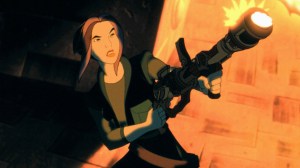 The most disappointing aspect of Titan A.E. is the flat and tired script from three incredibly talented writers I admire very much (the creator of The Tick, Joss Whedon – creator of Buffy the Vampire Slayer, and John August – writer of Go). The story owes many debts to ‘Star Wars’ but even more to ‘The Wizard of Oz’. The Drej are merely faceless pop-up bad guys with zero personality or development. They wish to destroy humanity but no explanation as to “why” is ever given. They’re clouded in lifeless ambiguities. As a result you can never really care for the heroes when you could care less about the villains.
Why is Titan A.E. rated PG? Well despite its lack of fear to show some blood, and gun shots for that matter, it features the animated posterior of Damon with some light sexual banter that will thankfully fly over most kids’ heads. A quibble of mine is for equal opportunity for animated nudity. If I can see a cartoon male ass in a PG-flick, or on prime time television even, why must female nudity be slapped with an R? Let’s erase this gender double standard and let all sexes be equal under one animated nudity.
Titan A.E. may have the look but it never can maintain the feel of good sci-fi. Often times it’s either heavy-handed or overly dull. Everything is “been there, done that” but set to a non-stop playing of a soundtrack that just keeps screaming “BUY ME! BUY ME! BUY ME!” For those hoping for Disney to take its stranglehold off animation and entertainment, this picture isn’t your fabled messiah. You’ll have to wait… again.
Nate’s Grade: C
Share this:

Battlefield Earth (2000)
 I don’t have enough time nor the patience to actually write down a full review for this “movie” so instead I’m going to just list things that make this movie the toilet paper it is.
1) It’s based on a 1000+ page novel that even sci-fi purists regard as corny. Writer/Religious founder L. Ron Hubbarb certainly hasn’t found any grail in writing. The film of his novel only covers half of the book with the other half Travolta had planned for a sequel. Let me tell ya, you’d have to be a really REALLY devout Scientologist to believe that a sequel’s on its way here. There’s more of a chance that Howard’s End will be granted a sequel then Battlefield Earth.
2) Travolta has never been more nasal-voiced annoying before in his life. He’s the snarling Security head of the vastly “advanced” alien species that has enslaved Earth yet he knows nothing about his prisoners. Doesn’t sound like the person (or alien) you want in charge of… security now does it?
3) Why are the aliens 9-feet tall? Why do they have nose tubes? Why do they have long tongues — except for a really awful overt oral sex joke? Why do they do and look like anything if nothing happens? All they are is tall and that’s it. So form a basketball team out of them and tell them to watch their heads. Nothing makes sense, it’s all just added for the sake of being added – with the consistency of chicken broth.
4) Travolta hatches a plan to steal gold from the planet. My God, did we just fall into a Western? Because of course gold is worth the same amount and value on a distant alien home world as it is here. Makes total sense. This part I actually hit myself in the head over.
5) The human survivors dupe Travolta with gold bars they find at Ft. Knox — just stumbling onto it 1000 years later. Man who needs any sense of direction in a post apocalyptic war-world?
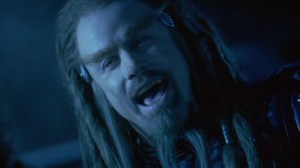 6) The humans counter the aliens in the end by flying 1000 year old ARMY aircraft. These fighter planes are spic and span and fully mobile after 1000 years of rust and mildew Cascade couldn’t touch?
7) Everything is shot tilted, I mean EVERY single shot in the damn movie — EVERYONE! You’ll come out with a stiff neck to compensate. It’s like the camera man fell asleep and nobody had the heart to wake him up during the whole picture. I know I’d want to get away.
8) The aliens figure man to be incompetent and no threat despite the fact that he was highly civilized beforehand with plenty of weapons accessible. Go fig.
9) Every action sequence in this movie is either a blithe series of close-ups or slow mo shots. And don’t forget the slanted pictures.
10) Travolta is so annoying, even his action figure I saw on a clearance sale is just as annoying, he gets mentioned twice. How the hell did he think this movie would sell I’ll never know?
11) There’s only one hot girl in the entire scavenged world and she has to end up being Barry Pepper’s love interest, probably because he is given his “knowledge” back which means he also is now only interested in hot girls. And what is her fate? Only to be eventually held hostage later… of course!
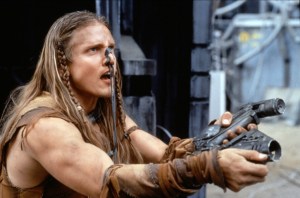 12) Travolta’s character is the greatest moron in the universe! No person would even have them in charge of anything except a cafeteria lunch line.
13) The effects are really cheesy.
14) The dialogue is BEYOND the realm of cheese.
15) Battlefield Earth tried to brainwash me into a 9-foot tall Scientologist with a thirst for gold and a requisite for calling those around me “rat brain” to mask my own insecurities and nasal voice.
I think The Washington Post said it best when they said “A million monkeys with a million crayons in a million years could write something better then Battlefield Earth,” and I’d have to agree.
Nate’s Grade: F
Share this:

Mission to Mars (2000)
 Mission to Mars begins with a team of astronauts making the first manned mission to the red planet. Unfortunately things go… um, bad, and thus with no knowledge of any survivors and the six month time period it takes to travel to Mars, NASA sends out a rescue mission. More things go bad.
The setting is supposed to be 2020 but everything looks exactly like 1980. In the future there seems to be heavy reliance on product placement. From Dr. Pepper, to M&Ms, to having the damn Mars buggy plastered with Penzoil and Kawasaki. Are these astronauts Earth’s interstellar door-to-door salesmen? I was half expecting them to nix the American flag and firmly plant one for Nike. Maybe the future’s just this way because they drink from square beer.
Director Brian DePalma unleashes fantastic special effect after another, but they can only sugarcoat the bitter taste Mars leaves in your mouth. Mission to Mars is tragically slow paced, full of interchangeable and indiscernible characters, and begging for some kind of insight. Don Cheadle and Gary Sinise prove that no matter how great an actor you are, when you’re given cheesy sci-fi dialogue, it’s still cheesy.
The fault lies with the more than three screenwriters and DePalma himself. Plain and simple, DePalma has lost his touch. His good days (The Untouchables) are clearly behind him on his new downward slide. Mars in any other director’s hands would no doubt be different — and that’s no bad thing. DePalma’s style of appropriations rips off the earlier, better, and more insightful 2001 and Close Encounters of the Third Kind.
Mars is surprisingly and sadly devoid of any tension or suspense. The suspense was likely killed in the efforts to portray an “accurate and realistic NASA manned planetary exploration.” Yet the scientific inaccuracies in this “accurate” portrayal are far too numerous to mention – let alone remember all of them. You cannot have tension during a problematic situation when the score is blaring church organs.
One can suspend belief and enjoy movies but Mars is a listless journey toward sentimental other-worldly beings that just want a hug. Can we have them destroying our cities again? Pretty please.
Nate’s Grade: C


 nathanzoebl
You must be logged in to post a comment.