Blog Archives
Knowing (2009)
 Knowing is a movie about the consequences of seeing the Eternal Plan. If you could know the exact day of your death, would you want to know? How would that impact your life? Would you feel motivated to live every other day to its fullest, or would it cast a pall over the rest of your time? One character in Knowing is told the day of her death and it destroys the rest of her life. I think this topic is interesting but perhaps I’m in the minority. Knowing has been savaged by film critics, and I can certainly see the validity of some of their complaints. It’s not a flawless movie by any means, but I found Knowing to be an effective and suspenseful B-movie.
In 1959, a Massachusetts school buried a time capsule with drawn predictions of what students though the world would be like in 2009 (lots of robots and rockets, how we’ve let them down). One girl, Lucinda Embry, wrote a series of numbers. Flash forward 50 years. MIT professor John Koestler (Nicolas Cage) is a widower raising his eight-year-old son, Caleb (Chandler Canterbury). When the school reopens the time capsule, the schoolteachers pass out the individual letters to students. Naturally Caleb is given the envelope with the number code. He brings it home to show his father, who becomes intrigued and looks for patterns. John reasons that the string of numbers is an eerie predictor for major disasters around the world. They predict the date, the number that die, and the location via longitude and latitude. All of the numbered disasters have already taken place (including the hotel fire that killed John’s wife), but there are three more numbered disasters that have yet to happen. It?s about this time that Caleb is visited by mysterious thin men in long black trench coats. John seeks out assistance from Lucinda’s daughter (Rose Byrne), whose daughter also hears the same voices that Caleb does about an impending doom.
 Count me genuinely surprised at how taut I found Knowing. This movie builds a good head of steam and I dreaded what was to follow (in the good sense). When John figures out the exact design of the numbers, pinpointing date and location of disasters, he feels compelled to try and prevent the loss of life. Would you do the same? I think if I had been given a secret celestial code that predicted cataclysmic disasters that I would make sure to steer clear from those locales, rather than running to them. Director Alex Proyas (Dark City, I, Robot) expertly stages the carnage, to the point that I was grimacing and wincing. The plane crash, all shown in one unending shot, is a realistic nightmare that gets more and more disturbing. John hops through the wreckage to attempt to save people and encounters one burning victims after another, all screaming in terror. There are subsequent explosions amongst the wreckage that engulf more people in flames. The scene is spellbinding and unflinchingly horrific. The same can be said about the second disaster sequence in New York City, indelicately evoking some 9/11 memories. After these sequences I was dreading every moment leading up to the next, yet I was also perversely interested to see what would happen next.
I?m glad that the screenwriters tackled the fallacy of numerology early. One of John’s MIT colleagues says that people see what they want to see in the numbers, and surprise then they find them. This was completely the case with the ridiculous 2007 thriller, The Number 23. Jim Carrey went crazy deducing everything to one number, but it was the human mind projecting what it desired to see. The same thing goes for psychics who express vague statements so that the poor saps paying can fill in the details and make it personally relevant (“I’m thinking of a grandfather who died… He was a man?”). I had less of a logic gap with the numbers in Knowing. Granted, I have no idea which set of numbers the code is going with. For example, it lists a set number of deaths for the 2004 tsunami that killed over 250,000 people. But with such a massive event, how do we calculate the dead? There could be loads of people missing and presumed killed by the tsunami. Do people that die as a result of injuries count as direct victims, or are they victims of infection? My point is either the number code is going by the reported estimate on the news or has the exact number, which would be different than what the estimate was in the press. Either way, it presents a mild discrepancy for John.
The movie paints itself into a corner and the astute viewer will realize that it?s only a matter of time before one of the two supernatural A-words gets dropped as the force behind the strange occurrences (or a hybrid of both options). While the movie gets somewhat silly toward the end with its apocalyptic resolution, Knowing refrains from getting stupid. Yes it’s weird that John somehow lives in a giant house decorated to look like some peeling haunted mansion. Yes it’s weird that some supernatural force could predict every man-made disaster yet decide not to intervene in the biggest one. Yes it’s weird when Cage screams, “We have to go where the numbers want us to go.” But here’s the thing, Knowing is packed with ideas, some of them derivative (the ending borrows liberally from Arthur C. Clarke’s novel, Childhood’s End), but there is an ongoing discussion over the nature of science, religion, destiny and free will, and this discussion does not pander. I would have expected a conventional movie to transform John back into a man of faith over the amazing course of events, but it never fully happens. The movie never deduces that religious faith is the right prescription for our ailing times, and it even questions the ideas of divine intervention, namely that we live in a universe of determination rather than randomness, though it won’t specify what that determination is. The movie adheres to its pessimistic viewpoint right down to the end, which result in some ballsy choices for a mainstream Hollywood thriller. The heavy-handed ending didn’t break the enjoyment of the movie for me, though I expect it will for many.
 Not that it was needed but Knowing offers some nice little moments of characterization. I really enjoyed John’s monologue about his wife’s passing. He laments what he was doing at the time of her death, mainly blowing leaves off the lawn. He thought you were supposed to know, to feel something when your loved ones are in peril. He was just tending to the leaves, unaware of his wife’s fiery death. I really appreciated this insight into John and also how realistic the scenario felt: the depressing realization that the universe let you down. This seems like a much more believable reason for John’s scientific atheism than anything Mel Gibson went through in Signs.
The acting is cranked up to an exaggerated level of screaming. Cage spends a good portion of the movie with his mouth agape. The rest of the time he’s frantically screaming, which could account for most of the acting. It alternates between catatonic and hysterical. Cage is rather decent as his life is consumed by mysteries. I must say though that the acting only made me raise my eyebrow a few times and never pulled me out of the movie. This is no Wicker Man embarrassment of monumental proportions.
[Knowing is a solid B-movie with some super special effects to go along with its haunting scenes of disaster. It?s a step above your average sci-fi flick thanks to a lack of pandering to easy answers. I’m somewhat amazed that a movie this fatalistic and bleak would be greenlighted and given the budget it has. Proyas make sure the movie doesn’t succumb to numerology hokum, though the movie does tilt a bit toward the silly by its conclusion. I went into Knowing knowing little beyond the fact that the movie was ripped apart by other critics. Perhaps my positive reaction is born completely out of low expectations, but I found Knowing to be a juicy bit of sci-fi escapism that diverted the time nicely
Nate’s Grade: B
Share this:

I, Robot (2004)
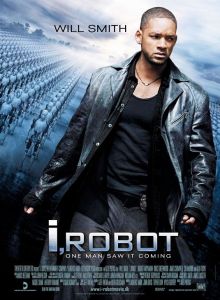 No doubt about it, Will Smith is the best hope our planet has in the face of adversity. He’s taken down aliens three times, foiled one conspiracy, stopped the South from rising again, and the man still finds the time to help Matt Damon with his golf swing. I fear we almost may be taking Smith’s world-saving exploits for granted. Smith’s newest chance to save the world arrives in I, Robot. Can Big Willie save the world yet again, or has he punched his time card one too many times?
In 2035, man has a new class of immigrants to do all the menial tasks no one wants to do – robots that look like crash test dummies. U.S. Robotics (USR) wants to push their new fall line of robots and make sure every happy home has a happy robot. Del Spooner (Will Smith) is a detective wary of our robotic friends. His colleagues laugh at his paranoia, remarking that no robot has ever committed a crime. This is thanks to the three laws hard-wired into every robot: 1) A robot cannot harm a human being, 2) A robot must obey a human beings order as long as it does not conflict with Law #1, and 3) A robot can do whatever to survive as long as this does not conflict with the other laws.
 This sounds great, except the robot creator (James Cromwell, always there if you need an old guy role) has apparently plummeted to his death from his USR office and the circumstances involving his demise are dubious at best. Spooner works alongside a robot technician/shrink (Bridget Moynahan) to find out more about what exactly is going on within USR and its suspicious CEO (the always shady Bruce Greenwood). Spooner discovers that a robot, who wishes to go by the name of Sonny, may have sent his creator to his death and may also be the first step toward uncovering the truth behind a grim conspiracy.
Smith has never really been a great actor but he is likable and charming enough, so that gets him through the day. The problem is that when hes saving the world in summer blockbusters he has a tendency to go into Will Smith Mode, which plays out like hes on auto-pilot. His stares, awkward mannerisms and aw shucks humor seem to be the same in every film. This isn’t to say that Smith cannot be a capable actor, but it seems that when a movies budget goes over a certain amount he resorts to playing Will Smith: World Saver and not so much a character of real value.
The other actors are more so playing vague archetypes than they are anything else. Greenwood is the sneaky, oily executive; Moynahan is the cold scientist learning how to be human once more; the invaluable Chi McBride is the no-nonsense police chief who rolls his eyes at Spooner’s crazy theories; and Shia LeBeof actually shows up for all of three minutes playing some kind of juvenile delinquent that is wholly unnecessary to the film.
The movie’s greatest accomplishment is the character of Sonny, modeled after a physical performance by actor Alan Tudyk. Sonny’s calm line readings, bursts of emotion, and questions on humanity make him a character the audience connects with, especially with the detached nature of Smith and Moynahan’s acting. Bet you never would have guessed this is from the same guy who played Steve the Pirate in Dodgeball.
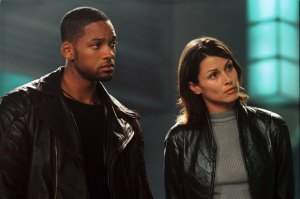 I, Robot isn’t exactly going to establish new ground in the world of science fiction. Its mostly a detective story with some twinges of sci-fi philosophy. As a detective story it adheres to the laws of detective movies, like how NO ONE ever believes the hero on his hypothetical assumptions and paranoia, which will of course always be right, and how the hero can only solve the case after he is thrown off it and gives up his badge. For two thirds of I, Robot we get an amiable, if average, detective story set in the future. Then we get a slightly incoherent final act where robots go all-out crazy.
Director Alex Proyas takes a step back from the grim, noir-ish worlds he worked with so effectively in The Crow and Dark City, and presents a cleaner and more sterilized world. His technical elements, like cinematography and musical score, are still well above par for the summer blockbuster. Proyas is a gifted visual tactician that knows how to wow an audience.
The sleek production design, fancy special effects, and strong visionary directing help lift an average story. Some of the story elements may not all work -like Spooner’s flimsy reason he hates all robots, and Moynahan’s character being very cold because she works around robots (get it? get it?)- but the professionalism of the people behind the scenes help make a rather exciting and occasionally thoughtful movie. Sonny’s questions about life and death as hes near termination are a nice addition to add something more to a summer blockbuster than explosions and car chases. Of course I, Robot also has some exciting car chases and action sequences. Certainly other, better sci-fi movies have dealt with these issues much deeper, and I, Robot seems to only skim the surface of intellectual debate, but at least it’s something (though this sounds really defeatist).
Bearing little resemblance to Asimovs collection of short stories, I, Robot is more a stream-lined sci-fi action flick, but its still a satisfying and stylishly entertaining diversion. Sci-fi fans may grumble at the notion of transforming a complex novel into a watered down action film, but I, Robot is a crowd pleaser that delivers the thrills when it needs to. If Will Smith keeps up this world saving pace he may get a little haggard and start turning into Danny Glover’s Lethal Weapon character: I’m getting too old for this aliens/robots/other aliens/more aliens/giant mechanical spiders shit. Well, at least Smith’s good at it.
Nate’s Grade: B


 nathanzoebl
You must be logged in to post a comment.