Power Rangers (2017)
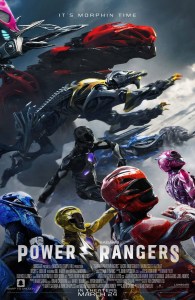 If you were a 90s kid, you know about Power Rangers. Who would have known that a TV show that combined Japanese monster fighting footage with cheesy teen drama and slapstick would become a pop phenom and nostalgic touchstone for a generation of kids? As Hollywood is want to do with anything nostalgic, it was only a matter of time before the series got its own mighty morphin’ big screen revision.
In the coastal town of Angel Grove, five teenagers meet in detention and are destined for monster-smashing greatness. Jason (Dacre Montogmery) is a star football player and natural leader. Billy (RJ Cyler) is a nerdy whiz kid on the spectrum. Kimberly (Naomi Scott) is a former cheerleader who has been abandoned by her friends. Zack (Ludi Lin) and Trini (Becky G) are barely at school, both of them tracking their loner paths. One day the fivesome come across strange glowing rocks that imbue them with powers like super strength and agility. “Are we like Spider-Man or Iron Man?” Billy asks, to help orient a superhero savvy audience. They’re neither, of course, for they are the Power Rangers, an intergalactic warrior organization meant to protect worlds from threats. Zordon (Bryan Crantson) used to be a ranger millions of years ago and is now a floating head. He assembles the teens because of the looming threat of Rita Repulsa (Elizabeth Banks), a former ranger tuned bad and bent on your standard world destruction. The angst-ridden, misunderstood teens must come together to stop Rita and save the Earth.
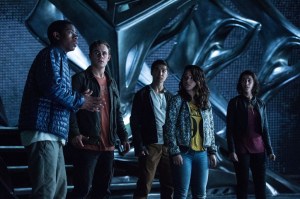 What tone does one adopt for a $100 million dollar reboot of a popular decades-spanning franchise intended for children that involves such names as Zords, Rita Repulsa, Zordon, Goldar, and the catch-phrase, “It’s morphin’ time”? Apparently the answer is a cross between Chronicle and Iron Man. For a show that even the most ardent fans would say was anything but serious, we have a fairly serious take on the material, at least serious enough when it wants to be. The filmmakers take a somewhat grounded approach to the sillier elements and that means a lot of palpable Breakfast Club-style teen angst and alienation, and it works. I was genuinely surprised that the second act’s focus on the teamwork and training of the five rangers was my favorite part of the film. It is an origin movie so expect a learning curve as the characters adjust to mastering their powers and abilities and the alien technology. You can’t just throw out a movie about space ninja cops that ride inside giant robot dinosaurs and battle monsters at the behest of a giant alien floating head without some setup. The training sessions cover a lot of ground but in fun ways that also build sequentially. The ascension of skills and confidence helps the characters open up and bond, and while some moments can be clunky (are any of their parents concerned where these kids go for seeming days on end?) it’s pleasant and satisfying to watch the outsiders finally find an understanding community of peers. The teen stars leave a positive impression, most notably Cyler (Earl of Me, Earl, and the Dying Girl) and Scott (The 33), who definitely seems poised for bigger things.
The characters have enough relatable conflicts, drama, and insecurities to produce just enough shades of characterization to make them interesting and worth rooting for. Those conflicts are also somewhat surprisingly adult and modern, often in clash with their parents’ requests, something that might lead to some weird conversations in the car if parents bring their young kids. Jason is fighting against his popular image, Billy has a hard time fitting in and making friends because of being autistic, and Zack is the caregiver to his dying mother, and these guys are in a lesser tier of adult conflicts, so think about that. Trini is stifling against her parents expectations and labels, notably implying her own sexual orientation that seems to be tearing her up on the inside, something that she cannot even fully articulate at this time. Maybe the movie is trying to have it both ways by not referencing the word “gay” but it at least felt like a more valid inclusion of conflict and diversity than the recent live-action Beauty and the Beast. Lastly, Kimberly used to be the chief mean girl and the reason why she was jettisoned by the popular set is because she was cyber bullying a would-be friend. She spread a private nude picture her friend sent her boyfriend and shared it throughout school (Jason tries to helpfully mitigate this by saying, “Thousands of pictures are sent in school,” which begs the question about Angel Grove’s underreported sexting epidemic). The team dynamic and the characters opening up to one another were enjoyable enough that I didn’t mind the relative dearth of action for 90 minutes of the two-hour running time.
 It’s a backdoor superhero movie that finds some interesting dark twists on its source material. The original TV show sought, in the most 90s way, “teenagers with attitude,” but the would-be rangers were just sort of normal teenagers. The 2017 movie at least provides that attitude and edge in a way that doesn’t feel as generic as a kid riding a skateboard and drinking a Mountain Dew eight inches away from his face. The TV show was campy and colorful and relatively trifling, and the movie version attempts to put more danger and loss into the emotional stakes. Zordon is given a new back-story; no longer is he simply a disembodied mentor, now he has a scheming reason for the rangers to succeed. It’s a small thing but it opens up the character of a floating alien head, and I cannot believe I just wrote that sentence. The friendship between our core group of characters matters so that, in the end, when it looks like they might lose, it does feel like something is going to be lost. With that being said, this isn’t a reboot that’s all gloom and doom. The reality of waking up one day and having super powers is played to the hilt of teen wish fulfillment and it makes for a fun series of self-discovery moments. These are teenagers adjusting to their new powers (heavy-handed puberty metaphor?) and enjoying the new potential unleashed for them. Their fun is contagious as is their camaraderie.
In fact, the conclusion where the rangers do morph and don their armored suits and drive their robotic dinosaur Zords may be the weakest part of the movie. The ultimate payoff feels a bit lackluster and mechanical, as if it’s simply falling back on cataclysmic citywide destructive action because that’s what is expected in these kinds of movies. Every person should anticipate a giant monster on giant robot brawl to conclude the story as it concluded every one of the 830 episodes. It’s just not that interesting especially since the big bad Goldar is simply a big personality-free heavy that looks like he’s made from runny Velveeta cheese. Rita, as portrayed with screechy, kooky camp by Banks (Pitch Perfect 2), feels like she’s been transported from a different Rangers universe. She literally gobbles gold to summon her colossal champion. She didn’t feel like an effective antagonist, and that’s even before her wicked scheme correlated with shameless product placement. Rita, Goldar, and their overall evil scheme makes for a rather perfunctory conclusion that feels like a downturn from the earlier, better events. Director Dean Israelite (Project Almanac) has a directorial style I’ll dub “Michael Bay lite” considering how much his hyperkinetic, blue-tinted, light flared universe jibes with fellow Bay production disciple, Jonathan Liebesman (Teenage Mutant Ninja Turtles). His visual compositions can get excessively busy at the worst times, making it hard to fully engage in the onscreen action especially during the climax. There isn’t that much action until the final confrontation, and I think this unexpectedly works as an asset to a franchise-starter that functions as an origin tale. Akin to the elongated tease from 2014’s Godzilla, there is a sense of relief from watching the rangers in their full suits and fighting with full powers. However, it lacks more payoffs. The movie expects that delaying the final presentation of its heroes is good enough to arouse audience satisfaction, and it’s not.
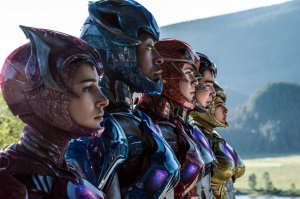 The revised, souped-up Power Rangers (nee Mighty Morphin’ Power Rangers) is a fitfully entertaining movie that works more often than it doesn’t. Fans of the TV show will probably be pleased with the big budget big screen heroics and the reverence shown, though older fans might feel a bit closed off from the teen-centric tone. The relatable angst and group camaraderie made for efficient characterization that helped make the rangers feel like people rather than suits of armor and superfluous gymnastics. I enjoyed the characters enough so that I didn’t miss the scattershot action and its slow motion stylistic indulgences. The special effects are fine and transparent its filmic influences, from Chronicle to Iron Man to even The Breakfast Club. It feels familiar but yet still different enough from the cheesy TV show, so it manages to justify itself. As far as my own history, I was just a bit too old once Power Rangers hit, so it was never my nostalgia. I found the new movie an acceptable origin tale that walks a delicate tone that allows serious moments to have weight and non-serious moments to be fun. If you’re a Power Rangers kid, I’m sure you’ll find enough to sate your demands. If you watched the trailer and thought it looked like something worthwhile, you might find enough to be suitably entertained, especially with well-calibrated expectations. If you’re anyone else, then I doubt there’s enough to necessitate your mighty morphin’ dollars.
Nate’s Grade: B-
Share this:

Beauty and the Beast (2017)
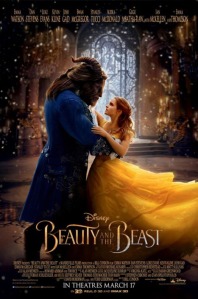 Disney has been on a tear lately with its slate of live-action remakes but Beauty and the Beast is the first title to come from the relatively recent Renaissance period of the early 1990s. The 1991 classic, based upon the French fairy tale, was the first animated film ever nominated for Best Picture, and back when the Academy was only proffering five nominees for the category (Toy Story 3 and Up earned Best Picture nominations after the category expanded up to ten). This is a beloved movie still fresh in people’s minds. I was curious what Disney and director Bill Condon (Dreamgirls) would do with the material, what potential new spins, and how faithful they might be. Regrettably, the 2017 Beauty and the Beast is a charmless, inferior remake of a Disney classic. In short, there is no reason for this movie to exist.
Belle (Emma Watson) is a small French town’s least favorite daughter, namely because she always has her nose in a book and wants “more than this provincial life.” Gaston (Luke Evans) is the most popular man in town and a dreamboat that ladies savor, and maybe also Gaston’s silly sidekick, LeFou (Josh Gad). The hunk is determined to marry Belle at all costs but she wants nothing to do with the brute. Belle’s father (Kevin Kline) falls prisoner to a ghastly Beast (Dan Stevens), a monster who used to be a prince who was cursed for his vanity. The Beast’s servants were also cursed, turned into living objects, like cowardly clock Cogsworth (Ian McKellen), lively lamp Lumiere (Ewan McGregor), and a tea kettle (Emma Thompson), feather duster (Gugu Mbatha-Raw), harpsichord (Stanley Tucci), dresser (Audra McDonald), and probably a chamber pot somewhere. Belle trades places with her father, becoming the Beast’s captive. The servants encourage the Beast to put on a charm offensive and change his ways to woo Belle, because if he cannot earn reciprocal love before the last pedal falls from an enchanted rose, then they will all be doomed to live their current fates.
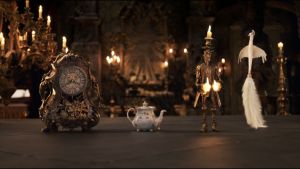 I figured, at worst, I would be indifferent to the live-action version of a great animated musical, especially since they were following the plot fairly closely. I was not indifferent; I was bored silly, and as the boredom consumed me I felt the strong urge to simply get up and leave. Now I didn’t do that, dear reader, because I owed all of you my complete thoughts on the complete film. I’d be lying if I didn’t say I debated escape, which is a rarity for me (I’ve never walked out of a movie, but Beauty and the Beast now joins a small number of films where I considered the inclination). The source of my urges spring directly from the realization that I knew exactly what was going to be coming at every step, even down to shots, and I knew it was going to be worse than the source material. It felt like watching the soul slowly get sucked out of the 1991 film. It was imitation that squeezed out all the delightful feelings from the original, stamping out joy and replacing it with an awkward, stilted facsimile. There’s also the problem of live-action being a medium that distorts some of the charming elements from the animated movie. The anthropomorphic servants are especially unsettling to watch.
The new additions are few and completely unnecessary, adding a half hour to a classic’s efficient running time. It’s kind of like remaking Casablanca and adding forty minutes of stuff that doesn’t belong, which might as well be known today as Peter Jackson Syndrome. With Beauty and the Beast, there are four or five new songs added, and they are awful and needless. Two of them are back-stories for Belle and the Beast/Prince, both of which were already covered earlier either explicitly or implicitly. They are the clear clunkers and further evidence that the 2017 additions are artistic anchors hampering an otherwise great musical. The Prince is given more screentime pre-Beast transformation but it covers the same ground that a simple voice over achieves in the original. I don’t think much is added seeing Stevens get gussied up and partying with the pretty people of his village except as an excuse for costuming excess. Some of the elements added also feel remarkably tacked on and feebly integrated, like the Beast’s magic teleportation book. He has a book that will take the user anywhere in the world, which Belle uses once to visit her parents’ old home and learn redundant information. At no point is this powerful magical device ever used. Why introduce a teleporting book and never bring it up again, especially if only to reveal something superfluous? Why does the Beast need a magic mirror to spy on people if he can teleport there? These are the unintended questions that befall poorly planned story elements that nobody asked for.
 The 2017 Beast also wants to celebrate itself for being more inclusive, feminist, and forward thinking than its predecessor, but this claim is overblown. Much has been made out of Condon’s claims of an “exclusively gay moment” in the movie devoted to LeFou, which wouldn’t be that surprising considering his Gaston-adoring behavior walks a homoerotic line in the original. This “exclusive” moment is LeFou dancing with another man and seeming to enjoy himself, or at least not hating the idea. It lasts for a grand total of two seconds on screen as part of a closing epilogue scanning across our happy characters reunited on the dance floor. It seems like much ado about nothing, especially since the 1991 film had the exact same comic beat of a man discovering an unknown joy of dressing in women’s clothing. Watson has been an outspoken actress, a UN human rights ambassador, and has said in multiple media interviews that it was important to make Belle a more actionable feminist figure. There was certainly room for improvement considering it’s a romance that many have cited as a clear case of Stockholm syndrome. If a modern remake of Beauty and the Beast were going to make socially conscious strides, it would be here, naturally. It’s pretty much the same movie except now she creates a washing machine by completely occupying the town fountain. That’s it. Considering that the movie added thirty minutes to the running time, you would think a majority of that would be judiciously devoted to building a plausible bridge from the Beast being Belle’s captor to being her lover. Nope. It’s a more forward thinking movie in fairly superficial ways that feel overly designed to warrant applause, like the inclusion of two interracial couples in the small staff of a seventeenth century French castle.
I went in and thought, if all else, I would at least have the instantly humable and highly pleasurable songs to fall back on. Then I realized this imagined respite was a fallacy. Like every other element in the film, the singing was going to be worse than the originals, and it was. The biggest aural offender belongs to our heroine, Miss Watson (The Bling Ring), whose singing vocals are Auto tuned within an inch of their lives. I have no idea what Watson’s singing voice sounds like in real life but I can almost assuredly bet it does not sound like what comes out of her mouth in this movie. The Auto tune effect was immediate, and overwhelming, and it felt like daggers in my ears for the entirety of the film. Auto tune flattens out a singer’s vocals and makes them sound tinny, unreal, almost like the comedown from sucking helium. I listened attentively to the other performers and it seemed like Watson was the only one given this exaggerated treatment. I’ve said before I’m not a fan of Watson as an actress, feeling she plateaued at a young age from the Harry Potter series, and her performance here will not change my mind. Similarly, the Beast’s vocals are so enhanced with bass that it would be hard to judge Stevens authentic singing voice. McGregor (T2 Trainspotting) has proven his singing chops before but a French accent was clearly something that got away from him. Evans (The Girl on the Train) is acceptable as a singer but lacks something of the brio that makes Gaston a larger-than-life pompous ass. Gad (Frozen) is right at home with musical theater. If I had to pick a musical highlight I would cite “Be Our Guest” simply for the visual barrage of colors and playful imagery that is absent most of a rather dreary looking movie. The other performers are adequate and sing their parts with equal parts gusto and reverence, but they’re all clearly weaker singers than the less known cast of the 1991 edition. It leaves one with the impression of a shabby celebrity karaoke version of a better movie.
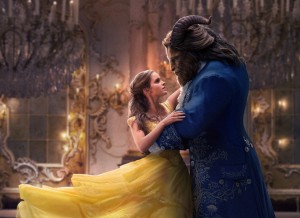 Beauty and the Beast isn’t just a disappointment, it’s an artistic misfire on multiple fronts that is looking for applause but doing too little to even earn such consideration. It wants to be forward thinking for a contemporary audience but they’re empty gestures, as it just copies the 1991 movie down to similar shot selections. The 1991 movie is great, no question, but I don’t need a Gus van Sant Psycho-style remake that only serves to make me appreciate the original more. This movie has no reason to exist outside of the oodles of cash that Disney will probably collect from repackaging its much beloved classic to a new generation of fans and an older generation seeking out millennial nostalgia. The singing is off, especially from a painfully Auto tuned Watson, the new songs and scenes are pointless, and even some of the production design resembles a play that ran out of budget halfway through. If you’re a fan of the original, you may find entertainment just reliving the familiar beats and notes from the 1991 film, just to a patently lesser degree of success. It’s not like Disney’s other live-action remakes of their extensive back catalogue of titles. The Jungle Book and Pete’s Dragon were sizeable improvements, and the agreeable Cinderella found some welcomed maturity to go with its fairy dust. Those movies found new angles, and in some cases had little relationship to their original material as in the case of the wonderful and heartfelt Pete’s Dragon. These are examples of filmmakers who were inspired by their sources but told their own stories. Beauty and the Beast, in contrast, is just the hollowed out husk of the original, now made putrid.
Nate’s Grade: C
Share this:

Kong: Skull Island (2017)
 Some of Hollywood’s most famous characters are its monsters, and no I’m not referring to studio executives. Kong was one of cinema’s first international stars, a stop-motion marvel in 1933 that had a hankering for blonde women. His legend has endured many different incarnations and once again the gigantic gorilla is given his close-up, in Kong: Skull Island, the second phase in a would-be MonsterVerse after 2014’s Godzilla. This time the monster comes through. Skull Island is a pleasing two hours spent with just enough style, thrills, and comedy to enjoyably pass the time best accompanied by a big bag of popcorn.
In 1973, a geological surveying team has discovered a heretofore-unknown island ominously shaped like a skull. Everyone is heading there for different reasons. Bill Randa (John Goodman) wants to prove the existence of monsters, and that he’s right. Preston Packard (Samuel L. Jackson) wants one last mission before returning home from the Vietnam War and its anticlimactic ending. James Conrad (Tom Hiddleston) is one of the world’s best big game trackers and wants a new challenge. Mason Weaver (Brie Larson) is an award-winning war photographer who wants a new scoop. Their plans are put on hold when a 100-foot tall ape, Kong, violently knocks their helicopters out of the sky. The survivors scramble to regroup and escape the hostile locals on Skull Island along with the aid of Hank Marow (John C. Reilly), a WWII fighter pilot who crashed on the island thirty years ago and might have a few screws loose from the experiences.
 Kong: Skull Island is a monster mash-up that knows how to entertain in grand smash-em-up style. It is not a remake of the original King Kong story, and being free of that “twas beauty killed the beast” narrative opens the movie to be its own thing, a high-concept action vehicle and clear Vietnam War parallel. It’s like someone watched Peter Jackson’s agreeable if bloated 2005 King Kong and said, “Hey, what if we shaved off the first hour and spent the whole time on Skull Island, the undisputed best part of the movie?” It’s the equivalent of an-all marshmallow box of Lucky Charms (Simpsons reference!). The unique environment boasts a retinue of fun surprises and a variety of action set pieces that keeps the movie from falling into a valley of repetition. It’s not just giant apes and dinosaurs, there’s also giant bulls, insects, and in one creepily terrifying moment a giant spider that uses its stalks of long legs to try and impale its prey down below. It’s a long lost world that allows for a constant sense of discovery that doesn’t get old. When the characters stumble upon a graveyard I wanted to soak up every detail of the spectacular collection of bones. I was grateful that Vogt-Roberts made fine use of his locations, real and computer enhanced, to build a sense of space and atmosphere.
One of the best aspects is that the producers have apparently learned from 2014’s Godzilla and elected not to play an elaborate game of hide and seek. My biggest complaint is that I wanted more Godzilla in my Godzilla movie. I was not content to settle for a shadowy impression or a glimpse of a tail here and a foot there. It was an artistic decision that toyed with audience anticipation but it also felt like we were being lead on. Too much teasing and not enough of the good stuff. This is not a problem with Kong: Skull Island; the title beast makes his presence known in spectacular fashion around the half-hour mark, and there’s no tiresome visual obfuscation to blunt the impact. You see Kong smash and it’s glorious carnage. He’s established as ornery protector, a sheriff of Skull Island keeping order with the fragile ecosystem. It makes the world of monsters seem much larger and more balanced. I wish there was more for Kong to do as a character but without his familiar arc he’s less character and more a testy god. There is a moment or two that hint at the soul inside the giant ape, but he’s mostly the physical embodiment of implacable force and the good and bad that goes with such power.
The Vietnam parallels are plentiful and provide a dollop of subtext to the conflicts, but this is a movie that doesn’t forget to have fun. The imagery can often fall into Apocalypse Now flashbacks and other war movie iconography, from the burnt orange sunsets casting dusky silhouette to the slow motion explosions trailing after teams of helicopters. The ever-present 70s rock soundtrack almost reaches Suicide Squad levels of needle-drop proportions in the first half, constantly reminding you of its time period. Skull Island isn’t a very deep movie but it does subvert some genre expectations at turns. A character given significant attention is taken out rather unceremoniously. An appeal to a greater sense of humanity is curtly brushed off. A lone heroic sacrifice that proves to be fruitless. Our more photographic heroes are evidently the worst, most useless characters (more on that below). For a movie that doesn’t strive for more than two hours of entertainment, it finds interesting sub routes.
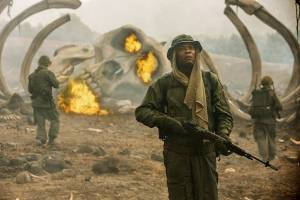 I’m shocked at what director Vogt-Roberts has proven capable of considering his only other film was the low-budget, rather unremarkable coming-of-age comedy The Kings of Summer. This is a Russo brothers-esque statement, a Colin Trevorrow-style jump from minor indie to full-blown big screen spectacle. Is Hollywood going to sign up Joe Swanberg or Shane Caruth to direct the next four-quadrant blockbuster based on a toy? He does an adept job of capturing the action with style, and his shot compositions are routinely visually pleasing, confidently guiding an audience’s eyeballs to key info within the frame. I loved Kong’s immediate introduction as the camera circled him in a 360-degree pan, stopping at points to slow down before ramping up once more. There are amusing angles that highlight the comedy or tension of a scene, and Vogt-Roberts’ sense of geography and scale enhances the destruction. The prologue even had me hooked, as we watch a pair of enemy WWII soldiers parachute on the beach and continue their fight on the new territory. It was such a slam-bang opener and Vogt-Roberts’ use of camera placement reminded me of Spielberg. The special effects are reliably terrific even if they don’t seem like leaps and bounds from Jackson’s Kong. The skull-faced lizard monsters are scary enough to be threatening while still cool. The monster mayhem is lovingly reproduced and in environments where an audience can see the spectacle.
Another improvement is that the human cast has just enough characterization to make me care. With the newest Godzilla, I didn’t care if the giant lizard stepped on any of them, short of maybe Bryan Cranston. However, in this film I wasn’t impatient for the monsters to return that much. The best characters are, ostensibly, the antagonists. Jackson (The Hateful Eight) who goes full on heart of darkness, obsessed with killing the mighty Kong, asserting man’s dominance, and winning a war that others tell him cannot be won. He’s still sore and frustrated from the Vietnam War’s conclusion. He’s convinced that brute force and intractable persistence will win out, and he’s trying to prove something to himself, to the brass in D.C., and perhaps to all the lives lost under his watch. It’s not subtle characterization by any means but neither is a movie with a giant ape fighting monsters. Goodman (10 Cloverfield Lane) uses any opportunity to prove his life’s research about the existence of ancient monsters who he claims are the ones who rightfully have dominion. He’s using the looming possibility of a threat, and the paranoia of the U.S. government in the Cold War, to his sneaky advantage. Watching Goodman and Jackson glare at each other, neither side refusing to back down in their stolid beliefs and personal, self-destructive obsessions, is the non-monkey highlight of the film.
The closest thing approaching human drama, and even tragedy, is Reilly’s distaff character, and I don’t know the last time that John C. Reilly was asked to be a movie’s human compass (Magnolia?). His out-of-time character has a definite degree of cabin fever wonkiness. Reilly excels at being the offbeat oddball and has some welcomed comic relief moments, but it’s the drama related to the character that stuck with me. With the appearance of new human faces, he can take stock just how much of his life he’s missed out on and the family he’s been absent for. His genuine melancholy provides a depth to a character that would ordinarily just be made fun of for being kooky. Still, he’s got some great gallows humor that keeps the movie alive comically while also reminding of the dangers at stake.
 The rest of the characters are rather interchangeable or curiously have little impact on the plot, and that unfortunately includes the headlining stars. Hiddleston (Thor) is a big game tracker and he’s the most useless character. Think about that. He’s supposed to be a wildlife expert and a tracker and he provides no real purpose other than he fills out a tight shirt nicely. Hiddleston is eye candy and little else, which is strange considering his skill set should have factored into the plot somehow. He points them in the direction of water and that’s about it. Larson (Room) is a recent Oscar-winner and has tremendous skill burrowing into her characters and finding a raw vulnerability. With Kong, her anti-war photographer gets off a few ideological shots with Jackson, but there’s little to separate her from the other diverse supporting castmates who are just bodies meant to be sacrificed. They’re all waiting to be eliminated in fantastic, gruesome, or unexpected ways. You won’t exactly be shedding a tear for these people when they become monster chow. Fun fact: ⅔ of the core cast of Straight Outta Compton are here (Corey Hawkins, Jason Mitchell), which apparently shows that Ice Cube isn’t a fan of long travel.
Enjoyably dumb at points and smart enough to know it, Kong: Skull Island is an admirably efficient monster movie that delivers its share of fun. Vogt-Roberts makes a major statement as a visual stylist and director of big-time smash-em-ups. The action is varied, intense, and vividly realized from carefully positioned camera angles and a team of high-class special effects wizards. Kong: Skull Island knows what an audience wants and happily delivers. The actors, for the most part, are enjoyable or enjoyably expendable. If this is the next step in the growing MonsterVerse, then I saw bring on the cataclysms and world-destruction. Friendly tip, stay for a post-credits scene that sets up future installments and try not to pump your fist in excitement. Kong: Skull Island is a boisterous B-movie that can make you feel like a kid again watching the amazing film feats of classic monsters.
Nate’s Grade: B+
Share this:

Logan (2017)
 The Wolverine solo films have not been good movies. The 2008 first film was widely lambasted and while it made its money it was an obvious artistic misfire. The second film, The Wolverine, directed by James Mangold was an improvement even though it had its silly moments and fell apart with a contrived final confrontation. The Wolverine movies were definitely the lesser, unworthy sidekick to the X-Men franchise, and this was a franchise that recently suffered from the near abysmal Apocalypse. Mangold returns for another Wolverine sequel but I was cautious. And then the cheerfully profane Deadpool broke box-office records and gave the Fox execs the latitude needed for a darker, bloodier, and more adult movie that’s more interested in character regrets than toy tie-ins. Thank goodness for the success of Deadpool because Logan is the X-Men movie, and in particular the Wolverine movie, I’ve been waiting for since the mutants burst onto the big screen some seventeen years ago. It is everything you could want in a Wolverine movie.
In the year 2029, mutants have become all but extinct. Logan (Jackman) is keeping a low profile as a limo driver and taking care of an ailing Charles Xavier (Patrick Stewart) south of the border. Xavier is losing his mind and a danger to others with his out-of-control psychic powers that need to be drugged. Caliban (Stephen Merchant) is also helping, a light-sensitive mutant with the ability to innately track people across the globe. Logan is ailing because his healing power is dwindling and he can’t keep up with the steady poison of his adamantium bones. A scared Mexican nurse tries to convince Logan to help out the little girl in her care, Laura (Dafne Keen, feral and a better non-verbal actor). She’s an angry, violent child and built from the DNA of Logan. She too has unbreakably sharp claws and a healing ability. Bounty hunter Pierce (Boyd Holbrook) is trying to recapture the runaway merchandise/science experiment, capturing Caliban and torturing him to track his prey. Logan goes on the run with Xavier and they try to make sense of what to do with Laura, a.k.a. X-23. They’re headed north to Eden, a hypothetical refuge for mutants to sneak over into freedom in Canada, and along the way are deadly hunters who aren’t afraid of leaving behind a trail of bodies to get their girl back.
 It feels like it shouldn’t haven taken Jackman’s reported final outing for the execs to realize that a guy with freaking knives attached to his hands might be a concept that would work in the more grisly, more adult territory an R-rating creatively affords. It’s about time this man got to fully use his claws, and it was a joyous explosion of violence and gore built up for fans such as myself for a long time coming. It feels like Fox has been planning for this event as well, as if they stationed a production lackey to devise all sorts of grotesquely fun ways that Wolverine might skewer his competition in bloody beauty (“Finally, your preparation will not be in vain, Ronald”). There’s one scene in particular where a bunch of armed henchmen are psychically frozen in place and Logan struggles to move past each, and we get to anticipate just how each one will be viciously stabbed. For a series that has shied away from overly gory violence, Logan certainly celebrates its new opportunities with bloody glee. The fact that the first word spoken is an f-bomb and there’s a gratuitous moment of drunken sorority girl boob flashing is like the producers trying to directly communicate to the millions of ticket buyers and saying, “Hey, we’re sorry it took so long. Hope it was worth the wait.” Oh dear reader, it was worth the wait.
It’s not just the action that’s invigorating but the emotional core of the film is deeper and more compelling and ruminative than ever before, and finally these great actors are given material to deliver great performances worthy of their talent. Stewart and Jackman have never been bad in their respective roles even if and when the movies have been. They just have never been called upon for much more than genre heroics, anguish, and pained moral dilemmas. With Logan, both actors are finally given meaty material that affords nuance and ambiguity, and they are excellent. Charles Xavier is losing his battle with Alzheimer’s and ALS, which is a major concern when his mind is considered a weapon of mass destruction by the government. He’s going through his own end of life deliberations (“You’re waiting for me to die,” he groans at Logan) and it brings out a far different Xavier than we’ve ever seen, even with the youthful cockiness from James McAvoy. This is a cranky, defiant, and doddering Xavier, someone who is barely outpacing his sense of grief, guilt, and depression. There’s a tragic back-story we only get a glimpse of but it’s suitably devastating for a man who has devoted his life to others. He’s looking for a few last moments of grace and looking to hold onto something by journey’s end.
 Thanks to his healing ability and the star wattage of Jackman, there was little fear that anything serious would ever befall Wolverine in his many previous film appearances. Sure bad things happened to him and he lost plenty of female love interests, but you never feared that he wouldn’t be able to ultimately handle himself. That’s not the case in Logan, which opens with a Wolverine who has clearly lost more than a step or two. He’s tired, rundown, and his adamantium skeleton is slowly poisoning his body. His healing powers are slowing down and he’s not as berserker fast and agile as he used to be. For once there’s an uncertainty attached to the character and a vulnerability. This turn greatly increases the intensity of the fight sequences and the greater stakes of the drama. The comparisons of the samurai were rife in The Wolverine and now the comparisons to the aging, lone gunslinger are ever-present in Logan. He’s drawn into a conflict that he was not seeking and he’s found a little bit of his remaining humanity and compassion to do right in the face of overwhelming odds and near certain destruction. There’s a subtle moment that the film doesn’t even dwell on that stuck with me. It’s after an accident, and in the thick of confusion, Logan is trying to save his mentor but he’s also worried that Xavier will think he betrayed him. “It wasn’t me,” he repeats over and over, not wanting this man to suffer more. It’s a small moment that doesn’t get much attention and yet it really spoke of their relationship and the depth of feeling during these fraught final days. This is the first Wolverine movie that feels like the characters matter as human beings just as much as purveyors of punching and kicking (now with gruesome slashing at no extra cost). Jackman showcases more than his impressive physique this go-round; he delivers a wounded performance that’s built upon generations of scars that he’s been ignoring. It’s the serious character examination we’ve been waiting for.
I also want to single out Merchant (Extras) who gives a performance I never would have anticipated from the awkwardly comedic beanpole. He even gets a badass moment and I never would have thought Stephen Merchant would ever have a badass moment in life.
Mangold’s film plays as a love letter to Western cinema and uses the genre trappings in ways to further comment on the characters and their plight. This is a bleak movie. It’s not a dystopia. In fact it resembles our own world pretty closely with a few technological additions; automated machines and trucks, the common knowledge that mutants have been wiped out like the measles. Knowing that it’s reportedly the end for Stewart and Jackman playing these characters, I was anticipating the film to strike an elegiac chord. His past and legacy are catching up with Logan. He becomes an unlikely guardian to Laura and explores a fatherhood dynamic that was never afforded to him before. The unlikely partnership, and it is a partnership as she’s a pint-sized chip off the block of her tempestuous father, blossoms along a cross-country road trip for a paradise that may or may not exist, while desperadoes and powerful black hat villains are out to impose their will upon the weak. This is explored in a leisurely pit stop with a working class family (welcome back, Eriq La Sale) that welcomes Logan and his posse into their home. We get a small respite and learn about greedy landowners trying to pressure them into giving up the family farm. It’s completely reminiscent of something you might see in a classic Western of old, just transported to a new setting. There’s even an extended bit where Laura watches 1953’s Shane on TV, and when those final words come back in expected yet clunky fashion, I’d be lying if they didn’t push the right emotions at the right time.
 But when it comes to action, Logan more than satisfies. The action is cleanly orchestrated by Mangold in fluid takes that allow the audience to readily engage. The film doesn’t go overboard on the Grand Guignol and lose sight of the key aspects of great action sequences. There’s a refreshing variety of the action and combat, and the action is framed tightly to the characters and their goals. It makes for an exhilarating viewing. If there is anything I would cite as a detriment for an otherwise incredible sendoff, I think the movie peaks too soon action-wise. The emotional climax is definitely where it ought to be (tears will be shed whether you like it or not) but the third act action doesn’t have quite the pop. Also, while Holbrook (Narcos) is an entertaining and slyly charismatic heavy, the villains in the movie are kept relatively vague as is their overall plan. The vacuum of villainy is kept more one-dimensional, which is fine as it allows more complexity and character moments to be doled out to our heroes, but it is a noticeable missing element.
One of the best attributes I cited from last year’s Captain America: Civil War is that the full weight of the character histories was felt, giving real emotional stakes to all the explosions and moralizing. When our characters went toe-to-toe, we felt a dozen films’ worth of setup that made the conflict matter. Logan carries that same emotional weight. We’ve been watching Wolverine and Professor Xavier for almost two decades and across nine films. These characters have gotten old, tired, and they carry their years like taciturn gunslingers looking for solitude and trying to justify the regrets of their lives. It’s a surprisingly emotional, serious, and altogether mature final chapter, one that provides just as many enjoyable character moments and stretches of ruminative silence as it does jolts of gritty, dirty, hard-charging action and bloody violence. It’s as much a character study as it is a superhero movie or Western. I cannot imagine this story as a watered down, PG-13 neutered version of what I saw on screen. This is a movie for adults and it pays great justice to the characters and the demands of the audience. The final image is note-perfect and can speak volumes about the ultimate legacy of Wolverine and by extension Xavier and his school for gifted youngsters. Logan is the second-best X-Men movie (First Class still rules the roost) and a thoughtful and poignant finish that left me dizzy with happiness, emotionally drained, and extremely satisfied as a longtime fan.
Nate’s Grade: A-
Share this:

Get Out (2017)
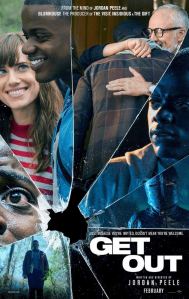 After years as a brilliant sketch comedian, Get Out is Jordan Peele’s first foray into horror, and if this gifted comic mind only wanted to make suspense thrillers from now on, that would be mighty fine. This is the first horror movie in years that left me buzzing, feeling charged and anxious, anxious to share with others so they too can feel the full effect of this live wire of a movie. It may be my favorite theatrical horror film since 2012’s The Cabin in the Woods, and what they both have in common is a knowing understanding of their genres and expectations, a delicately balanced sense of tone, and a funhouse of darkly clever surprises. This is a movie rich with commentary, suspense, payoffs, and it all begins by exploring the dread-filled everyday existence of African-American men in this country as a waking horror movie that cannot be escaped.
Before even going further, I advise most readers to go into Get Out with as little knowledge as possible, which I understand means delaying reading this review. I can accept the loss of eyeballs knowing that more people will go in with an even greater ability to be surprised (I’ll avoid significant spoilers below, so fear not, dear reader).
Chris (Daniel Kaluuya) is visiting the parents of his girlfriend for the first time. He’s worried that Rose Armitage (Allison Williams) hasn’t mentioned that he’s black. She assures him that her rich, wealthy, and liberal family won’t care in the slightest. Rose swears her parents are the least racist people she can think of. Dean (Bradley Whitford) is a retired brain surgeon, Missy (Catherine Keener) is a hypnotherapist who volunteers to help Chris stop smoking, and Rose’s younger brother, Jeremy (Caleb Landry Jones), is obsessed with martial arts and lacrosse. They also have black housekeepers, which Dean says he hates how it looks. It isn’t long before Chris’ sense of unease starts to make him rethink this weekend getaway and whether or not something sinister is under the surface.
 Early on, Peele tips his hand to the sharp social and genre criticism. In the opening scene we watch Andrew (Lakeith Stanfield), a young black man, walking around lost in a tony suburban neighborhood. He checks his phone for an address when a lone car drives past him, stops, and turns around, pulling up next to Andrew and idling, blasting the old song “Run Rabbit Run.” He takes one look at the situation and immediately turns around, heading in the opposite direction. “Not today,” he says to himself, clearly providing voice to the audience’s apprehension. And yet, he’s incapacitated, and abducted by masked assailants. Even self-awareness and avoidance will not be enough for this man to survive if captured within the crosshairs of modern White America. He becomes another horror victim just like we might see splashed across the news all too often.
Peele’s biting social commentary is ever-present but it never outpaces the genuine fun and entertainment from his genre storytelling. It’s a condemnation of the fallacy of a post-racial society and an exploration of the uncomfortable burdens African-Americans are disproportionately expected to bear in general. Rose’s family is all too happy to show off how seemingly inclusive they are. Rose’s father confesses, with no legitimate conversational prompting, that he would have voted for Obama a third time (trust me, there’s a lot of people in the camp, Dean). Yet he seems to enjoy awkwardly inserting recitations of “my man” while also trying to openly explain why he has eerily subservient black housekeepers. Rose’s antic brother seems to hungrily size Chris up as a physical challenge to battle, openly admiring his “genetic gifts.” Despite their self-styled liberalism and protests to the contrary that race doesn’t matter, the family can’t help but treat Chris like an other. Race “doesn’t matter” to people who have the position where it might not matter, the same going for those who elect to be “color blind.”
This stifling sense of condescension and pandering is best exemplified in a deeply awkward sequence where Chris is introduced at a party to the whole older majority-white neighborhood. One man informs him he likes Tiger Woods. Another says being black is hip. A woman squeezes his muscles in transparent lust. Another asks what the “African-American experience” is like and whether Chris feels being born black is an advantage. All through this meet-and-greet gauntlet, Chris is holding his carefully crafted smile, trying to shrug off the mounting discomfort, and being told not to make a big deal out of it. After all, these are well-educated liberals, the “good ones.” They can’t be racist too.
 Get Out is also an excellent example of a movie that straddles a precise tone to perfection. Peele has a carefully refined comedy sensibility, but I was genuinely awed in his ability to go from sardonically funny to creepy funny to just plain creepy. There’s an increasingly heightened sense of dread from the get-go. It’s like any other horror premise where our protagonist goes into the house they shouldn’t and combats a host of horrors be they supernatural or superhuman. In this case, the scary scenario is white people. There’s a general off feeling about the Armitage estate and this is best encapsulated with their hired help, Walter (Marcus Henderson) and Georgina (Betty Gabriel). They seem to be in a robotic daze, smiles plastered to their faces, their tone of voice disquietingly calm and meticulous. Even the antiquated and culturally incongruous vocabulary they employ contributes to their unsettling vibes. Something is wrong here. There is a remarkable scene where Chris speaks with Georgina, and she hovers closer to him to apologize. Peele keeps the camera locked on his actor’s faces in extreme close-ups and he has a damn good reason for it. Gabriel (The Purge: Election Year) tries to reassure him all is normal and in one mesmerizing moment the camera fixates on her as she repeats “no,” each time a different reflection, her eyes tearing up as she tries to fight back subverted emotions. It feels like you’re watching twenty emotions and impulses fighting for dominance behind an impassive mask of compliance. Peele magnificently finds ways to keep his elements intensely upsetting while still finding room to laugh and break tension and increase tension.
While more a suspense thriller than a traditional horror film, Peele proves himself shockingly adept at a genre that I would have assumed outside his comfort zone. The shot arrangements and the natural development of tension shows clear knowledge and affinity for the horror genre; Peele knows when to hold onto a moment for extra suspense, when to pull back, and especially when to litter the camera frame with something to draw the eye. Peele has a great eye for his troubling, surreal visuals. When Chris is hypnotized and instructed to “sink into the floor” it’s like he’s falling into an inky void while his consciousness plays out on a square, like his life is a movie only he can watch from a distance. You feel the helplessness but it’s also a beautiful and beautifully unnerving image. There are a few jump scares accompanied by loud musical stings but the far majority of the movie is the overwhelming discomfort and dread marvelously kept at a continual simmer. I was squirming in my seat for long stretches and started backpedaling in others, and I can’t remember another movie in years affecting me that well. It’s partly the terrific execution of his genre elements but also partly because I liked the protagonist and had no idea what would happen to him next, which is the foundation of all horror. The last act cranks up the genre elements but Peele has brilliantly structured his script, laying out all the pieces he’ll need that provide an array of payoffs when we’re breaking for the finish line. This is a movie that knows how to satisfy all audiences, rest assured.
The actors are pitch-perfect and Kaluuya (Sicario, Black Mirror) delivers a star-making performance. He has to wear his own mask to deal with the small and large iniquities of whether or not these people are sinister or whether they’re just oblivious cretins. Chris is a black man expected to mind his manners and to laugh away the casual ignorance afforded by the oblivious privilege of others. He can never be unaware as the lone black man in a sea of white faces. It’s a position I think many people in the audience will be able to relate to and hopefully others can empathize with. Kaluuya has some standout emotional sequences where he digs deep to show the real depth of a character others fetishize or dismiss. Kaluuya is also British and you’d never know it. The Armitage family clan are each their own slice of weird. Whitford (The Cabin in the Woods) is exploding with thinly veiled smarm and great comic awkwardness. Keener (Capote) is chilling in her icy WASP den mother role with her weapon of choice, and hypnotic aid, being a literal silver spoon. Williams is like her blithely privileged character stepped out of HBO’s Girls, and her flippant attitude to Chris’s perspective belies something familiar and darker. The other best actor in the movie is LilRel Howrey (The Carmichael Show) who play’s a friend to Chris that works for the TSA. He’s a reliable and reliable crude source of comic relief but he’s also our ally on the outside, and he behaves like an intelligent investigator trying to save him. I was actually applauding his sensible steps to see through the sinister conspiracy.
 It’s been hours since I saw Get Out and I’m still buzzing from the experience. I was unprepared for how genuinely unnerving and invigorating the movie was as a horror thriller, character piece, but also as a trenchant social satire on race. Jordan Peele has established himself as an immediate visionary in the world of horror, taking the black protagonist who might usually be the first to get killed in a Hollywood slasher flick and widening the boundaries of horror. The real-lie horror film is day-to-day existence in the United States as a person of color. Get Out was conceived in the Obama era but has even more renewed resonance under the beginnings of the Age of Trump. I remember people saying that America now existed in a post-racial world, but we live in the kind of world that takes a call for innocent black lives to stop being executed by police officers and transforms it into All Lives Matter. It’s a hazardous world and Peele has created a marvelous movie where the insidious, ever-present force that cannot be escaped is not a maniac with a chainsaw or some cranky ghost, it’s white society itself. As the news has indicated, from Trayvon Martin to Sandra Bland and numerous others, there isn’t exactly a safe territory to escape to. Danger and death can come at any moment as long as a larger society perceives black skin as a threat first and a person second. Get Out is a timely movie but also timeless, thanks to how brilliantly conceived, developed, and executed Peel’s movie performs. This will make my top ten list for the year. Simply put, stop whatever you’re doing and go out to go see Get Out as soon as possible.
Nate’s Grade: A
Share this:

The Great Wall (2017)
 The Great Wall is the most expensive film in Chinese history and the first major co-production between an American film studio and a Chinese-owned studio. While Matt Damon is the name above the title, it’s filled with recognizable Chinese stars, like Andy Lau, Eddie Peng, and pop star Lu Han. China’s most renowned action filmmaker, Zhang Yimou, serves as the director. It has the look and feel of a Hollywood special effects epic but it’s very much a Chinese film in ownership and execution, perhaps marking a new synergy of East meets West blockbusters. With a whopping budget of $150 million, the same as the last Star Trek movie, it looks like a typical Hollywood big-budget epic with visual spectacle and sweeping vistas. It’s up to the viewer whether a majority-Chinese production successfully imitating Hollywood middlebrow action spectacle is a brave step forward or just another source for mediocrity.
In the 11th centruy, traveling European mercenaries William (Damon) and Tovar (Game of Thrones’ Pedro Pascal) are looking for black powder, an explosive substance that’s worth serious money back home. A mysterious feral creature attacks them and William cuts off the beast’s hand, taking it as a trophy. The Nameless Order, Chinese military officials stationed at the titular great wall, capture them and want to know exactly how these foreigners were able to defeat this beast. Legend states that long ago a meteor crashed to Earth, and with it came a horde of green monsters with big teeth lead by a queen that psychically controls her thousands of attack drones. Every 60 years the creatures emerge searching for food for their ravenous appetites. The Imperial City must be protected at all costs and that is why the wall was constructed. Lin Mae (Tian Jing) is thrown into command when her male superiors are killed, and she relies upon her unexpected Western allies to throw back the evolving horde of monsters.
 As the first major big-budget collaboration between studios in China and the United States, The Great Wall feels like something that would have escaped from the 1990s era of tentpole filmmaking, and it’s clearly a paycheck film for all involved. Now that doesn’t condemn in either regard. There’s a certain charm to the relatively dumb sci-fi action movies that started being prepped with steady regularity in the 1990s when advancing special effects made it possible for hordes of CGI monsters to thwart. There’s an obvious point of engagement that crosses all translations: man versus monsters. The film even somewhat admirably knows its own ridiculousness and embraces it. I was reminded of the go-for-broke silliness of Jerry Bruckheimer’s movies like National Treasure’s positing that maybe, just maybe, there’s a treasure map on the back of the Declaration of Independence. This feels like the biggest budget Asylum movie you can imagine, and that in itself is not necessarily a problem. However, because of the mechanical nature of so much of its storytelling and the safe territory it resolutely occupies, The Great Wall is a mediocre monster movie that aims right down the middle for cross-continental mass appeal and nothing more. I’m almost certain that Damon had to have been paid $20 million dollars to justify his participation. The actors and the director go about their business in a professional manner but you feel the lack of passion. It’s a film looking to appeal to the most people and losing any sense of distinction.
Credit director Yimou (Hero, House of Flying Daggers) for keeping the film on life support, providing just enough action variety and pleasing visuals to stir an audience awake. The monsters are introduced very early into the film, around the twenty-minute mark, and their CGI horde definitely presents a worthy challenge. In fact they feel too overwhelming in their numbers. Early on we see that the ferocious creatures, which closely resemble the Ghostbusters demon dog painted green, are hard to kill outside of a straight shot to their shoulder-eyes (they have eyes on their shoulders… because…). The first creature that successfully scales the wall takes out a slew of Chinese warriors. If one of these things is that hard to kill, how in the world can a limited number of people, even with high ground, defend against a sea of a hundred thousand? The mismatched numbers deflate the stakes and lessen the tension, which isn’t helped from subpar characterization. The world building is certainly hazy (Why do they come out once every 60 years? Why do magnets affect them? Why all the effort for small food supplies?) and some of the elements feel inserted just for their “cool” factor. A group of female warriors bungee jump off platforms to spear the monsters, but why is this necessary when we’ve already seen that China has fiery projectiles that are far more effective? It is cool though.
Thankfully a movie with little going for it other than spectacle at least knows to vary up its action sequences. Each encounter with one of the monsters is structured differently. The best sequence may be William and Tovar navigating through a blinding fog and relying upon the sounds of whizzing arrows to alert them to approaching hungry monsters. It provides some fun tension and pop-out moments. There’s a beautiful sequence commemorating a fallen friend with the launching of hundreds of floating lanterns. The concluding sequence involves our remaining characters climbing to the top of a pagoda lined with stained glass. As the characters rush up flights of stairs, the screen is lovingly diluted with colored shafts of light, which also add extra visual flourishes when the monsters begin to leap through the glass level by level. Yimou’s use of color has always been a hallmark of his career and it translates even into the color-coded amour of the different divisions of the Nameless Order. They look like ancient Power Rangers. While lacking a great deal of overall tension due to its predictable nature and dull characters, there are fleeting moments of suspense drawn out in individual action set-pieces. The overall movie is generally unremarkable CGI carnage reminiscent of a too-late Lord of the Rings rip-off, and yet there’s at least a general professionalism to its unremarkable CGI carnage.
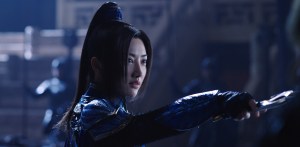 Early on the movie was hit with accusations of whitewashing, and given Hollywood’s recent track record with the likes of Exodus, Aloha, and Gods of Egypt, it would be entirely conceivable that producers felt Damon needed to be a white savior role. That’s not the case at all and in fact the Chinese forces are shown to be flawless specimens. Damon’s character is the out-of-place European (complete with hard to place accent) who represents selfish and arrogant Western attitudes. He’s routinely awed by the ability and precision of the Chinese warriors, who dutifully sacrifice for the greater good and safety of others they will never know. They are symbols of power, teamwork, courage, strength, and dignity. The lessons can be rather blunt (a woman… in charge?!). The portrayal of the Chinese forces is so honorable and so empowered that they come across as boring moral paragons without an ounce of traceably human nuance. They don’t come across like characters so much as interchangeable warriors, and so when they start dying one-by-one their sacrifices ultimately leave little impact. It turns out that the non-Chinese actors, Damon and Pascal, supply the most interesting characters because their roles are allowed personality, basic moral ambiguity, and inner conflict beyond a sense of duty and the requirements of achieving that duty. The Great Wall drafts off Damon’s worldwide star power to teach him a lesson about Eastern values. It certainly presents China and Chinese characters in a very positive perspective, but being so broad sanitizes their humanity and transforms people into boring paragons.
Given the pedigree of those involved, it’s completely expected to be underwhelmed by the end results of such an expensive East meets West collaboration. The Great Wall is ultimately too safe and stately to satisfy beyond generic genre thrills; lowering one’s expectations is highly advised in order to properly appreciate the goofy action spectacle. The Great Wall of China being constructed to protect from a horde of ravenous, possibly extraterrestrial monsters is certainly a silly premise, but the movie doesn’t pretend it’s anything than what it is, a large-scale monster movie with a sense of fun. It’s not soaked in deconstructive irony or meta commentary. Instead, The Great Wall is a straight-laced action spectacle that treats its absurdity with conviction. It’s not much better or worse than other empty-headed big-budget action cinema from the Hollywood assembly line, but is that progress? Is making an indistinguishable mediocre B-movie a success story?
Nate’s Grade: C
Share this:

The Lego Batman Movie (2017)
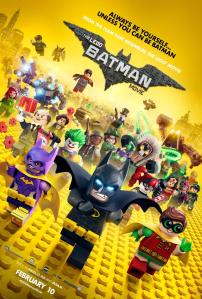 The Lego Batman Movie intends to expand the world of a movie that was designed to sell toys and was far better than anyone ever imagined. It’s frenetic, silly, and paced at spoof level speed with genial gags flying fast every ten seconds or so. It’s also flat, and while intermittently amusing I only chuckled, at best, a handful of times. Will Arnett’s self-involved Batman was a fun side character in the original Lego Movie but there’s not exactly enough there for his own starring vehicle (Jack Sparrow Syndrome). He’s saddled with a weak plot about letting others get closer and not having to be a loner. Besides a brief comedy bit about a cataclysm, the movie could have just been a broad Batman movie. It doesn’t really utilize the landscape of a Lego universe in any way. While many of the jokes didn’t work for me, I knew another one was mere seconds later, so I shrugged off the misfires. The final act of the movie involves a separate league of villains, all conveniently connected to other Warner Brothers properties. Lego Batman wore me down after the opening sequence where Batman battles his entire rogues gallery. It was high-energy but its aim was just too low for my tastes, and the results made me appreciate even more the cleverness and plain comedic accomplishments of the original Lego movie. There aren’t any memorable moments or jokes and there’s far too much Batman rapping. It’s colorful, it’s wacky, it’s filled with fine vocal actors with very little to do other than Arnett and an amusingly awed Michael Cera as The Boy Wonder himself, adopted sidekick Robin. It’s an acceptable albeit numbing experience that I wanted to enjoy more. I don’t know if this is the start of Lego spin-off movies but if it is I hope others do better with their own building blocks.
Nate’s Grade: C+
Share this:

50 Shades Darker (2017)
 I’ll admit not understanding the appeal of the 50 Shades of Grey phenomenon. The introduction into BDSM was a worldwide sensation and the 2015 first film made half a billion dollars, the kind of money usually reserved for movies featuring muscular men in rubber costumes that use whips and chains for different purposes. I happily watched the first film to get a sense of what the big deal was and was unmoved. For a film designed to be titillating and provocative, I came away wishing it had more action (of any sort). With great success, author E.L. James asserted more authority in the film series. Out went original director Sam Taylor-Johnson, who at least provided a sleek sheen to the final product and sexual tension where able, and in came new director, James Foley (Glengarry Glen Ross). Out went the original screenwriter Kelly Marcel and in came a new screenwriter, James own husband Niall Leonard, which could only mean the threat of the film hewing closer to the book was a guarantee. James is giving fans of her popular though critically savaged romance novels more of what they want, and I guess what they think they want are relatively bad movies, limp sex scenes, and an inert romance.
Anastasia Steele (Dakota Johnson) is trying to get back on her feet after leaving her ex, billionaire and bondage enthusiast Christian Grey (Jamie Dornan). He’s got serious issues but won’t stay out of her life. He has to have her back, and rather easily the on-again off-again couple is back on and back getting it on. However, their sex life is threatened with women from Christian’s past and the question of whether he can settle down for good with such a plain Jane submissive like Ana.
 There is a mystifying lack of conflict in the movie that makes 50 Shades Darker feel aimless. There are occasional bumps in the road in the form of old girlfriends still looking for their turn, and Ana’s aggressively inappropriate boss (Eric Johnson), but they’re dealt with almost immediately and without larger consequence. One of these antagonists is foiled by nothing more than a stiff drink to the face like a full-on Dynasty parody. Dealing with Christian’s past seems like natural territory for a sequel. A character as cold and self-serving as Christian could very likely attract a host of dangerous women. Stalkers who cannot let go would present an organic threat to their relationship and Ana’s literal life. A deranged former lover would provide a substantive question for Ana to deliberate. Is she doomed to the same fate? Bella Heathcote’s troubled character is begging for attention but she is so unceremoniously sidelined to the point of hilarity, and then she’s never seen again. Why should the story provide any question that these star-crossed lovers might not magically work out in the end? None of the mini-conflicts last longer than fifteen minutes before being effortlessly overcome, including a helicopter death scare. The shapeless plot structure is tediously airy, leaving too much space for characters and a world that doesn’t warrant the consideration. You would think the extra time would be spent with lengthy, over-the-top sex scenes stripping away all inhibitions and pushing the boundaries of cinematic good taste, but that’s not so much the case (more below). I knew we were in trouble when a sequence of Ana sailing Christian’s yacht was as long as one of the so-called outrageous sex scenes.
Here’s a prime example of just how poorly 50 Shades Darker is plotted. While dressing up for the masquerade, Christian admires Ana in lingerie. “You just going to stand there gawking?” she asks. “Yes,” he replies. Later, she walks in on him exercising shirtless and getting all sweaty while practicing for the Olympics on a pommel horse. It’s a flip of the male gaze, for once in the movie’s two hours. This is obviously a prime spot to repeat the dialogue exchange for a clever payoff, have Christian ask if she is going to just stand there gawking and her answer be in the affirmative. This movie cannot even do that! 50 Shades Darker doesn’t just fumble the big things, like plot and character and tone, it fails to even achieve modest, easily reachable payoffs that can be as ludicrously obvious.
Devoting more time with Ana and Christian outside of the bedroom is also best not advised. These one-dimensional characters are also barely removed archetypes from late night soft-core porn. Ana is an audience cipher but she’s also one incredibly dense human being. Forget the annoyingly mousey acting tics that Johnson (How to Be Single) is instructed to never abandon, this is a lady who just doesn’t get it. She’s had sex with her dude like minimum a dozen times and she’s never noticed the array of scars across his chest? After her boss tries to force himself on her, she fights back and runs into Christian’s arms, and he gets the guy fired (because a woman reporting a sexual assault on her own is not convincing enough?). Hearing the news, Ana acts deeply confused, as if she cannot understand why her boss is now not her boss. Did she just forget the upsetting assault? Every man in this universe seems to find Ana uncontrollably irresistible. She’s the ultimate prize to be owned. Even her own friend, who clearly has a crush on her, creepily makes her the centerpiece of his photography gallery show without her consent. She can huff and puff all she wants about agency but Ana is still a woman looking for her prince to sweep her away to a land of exotic privilege. Her reason for accepting a dinner date with Christian: she’s hungry. That’s fine, not every romance needs to be progressive or healthy, but when that guy is as controlling and worrisome as Christian Grey, then the romance starts to sour and become an exhibit of toxic misogyny. And that’s before Christian reveals that Ana, as well as his previous subs, looks like his dead mother.
 Christian is your dark, brooding, oh so attractive as the bad boy but he’s defanged, turned into proper boyfriend material, the kind of guy who would drop down for an old-fashioned proposal of a girl’s dreams. In other words, the movie makes him boring. He’s still problematic as a romantic partner. While he swears this time will be different and no finely worded legal contracts are necessary, he’s still a controlling jerk and a boor. Even during his “please take me back” dinner he’s attempting to order for Ana. He deposits money in her account despite her protests, he buys the publishing company she works for to become her ultimate boss even outside their relationship, and he’s constantly insisting she is his and his alone in the creepiest of declarations. The movie seems to think it’s found a palatable excuse to explain away his warning signs. His mother, depicted in a hilariously sad picture that looks like a Wal-Mart family photo from a refugee camp, died of a drug overdose at a young age and he was physically abused by his father. It’s a slapdash, simplistic cover for his bad behavior. Another strange discovery: the childhood bedroom of Christian Grey has a framed poster of 2004’s The Chronicles of Riddick. I know Universal is trying to play some studio synergy here, but come on. How old is Christian supposed to be? Also, HE HAS A FRAMED POSTER OF THE CHRONICLES OF RIDDICK.
All of this can be moderately forgivable if the movie more than makes up for where it counts with fans, namely steamy and scorching sex scenes that were the hallmark of the lurid book series. While the first film was far from perfect, or even adequate, let it be said it still could constitute an erotic charge when it desired. With the sequel, the sex is shockingly lackluster. There are only four full sex scenes and they start to become weirdly routine. You anticipate that Christian will spend a little time here doing this, and little time there doing that, and then as soon as would-be penetration comes into being they oddly jump forward and spare the audience the sight of sexual congress. It’s different minor tracks of foreplay and then the movie seems to shy away from the sex itself. For something this supposedly kinky it becomes strangely mechanical, predictable, and boring. Another irritating feature is that every sex scene is accompanied by a blaring rock or pop song. It announces itself with what I call “sex guitar music.” It blares over the scene and makes it difficult for the viewer to better immerse in the scene. Some of the music is downright nails-on-chalkboard awful from a tonal standpoint, creating its own source of comedy. The absolute most hilarious musical pairing is Van Morrison’s “Moondance” while Christian is fooling around surreptitiously with Ana in a crowded elevator. Go ahead and look up the song and come back to this review, I can wait. The jazz flute playing over the scene is certainly… different. It might be the worst sex scene song pairing since Leonard Cohen’s “Hallelujah” in Watchmen. I stayed until the end credits and counted 27 songs used in a 118-minute movie. Reportedly there’s a score by Danny Elfman in the film but I challenge you to find it (easiest paycheck of his career).
 If you’d like to be spared the turgid two-hour experience, I’ll spoil the specifics of the sex scenes in this paragraph so you can see how truly tame the movie is for something so reportedly transgressive and kinky. The first sex scene is their reunion as a couple and he undresses her, goes down on her, then climbs atop, then it’s over. The second involves him spanking her, upon her request, then he goes down on her, climbs atop her, then it’s over. The third sex scene involved Ben Wa balls as foreplay reminiscent of the superior and far more erotic Handmaiden (seriously see that Korean movie like 1,000 times before this), or was that the second sex scene? As I type this, it’s only been mere hours since I left my screening and I can’t recall the general details of the third sex scene, that’s how boring it was. The fourth is more montage but it’s an unleashed exuberance of sexual id. Christian dumps an entire bottle of massage oil onto Ana’s breasts, which seemed impatient and wasteful to me, but I’m not a billionaire. I cannot overstate just how dull and lazily staged the sex scenes are in the film, extinguishing any kind of titillation and strangely demurring once things get passionate. The nubile bodies are on display, Johnson’s in semi-permanent arched back, though Dornan is often coquettishly obscured (sorry again, ladies). The word that seems most appropriate for the sex scenes is “anticlimactic.” Ana jokes that she’s a vanilla girl and trapping Christian into a plain relationship, and their big screen sex life typifies this (anyone remember Ana’s question about what a butt plug was?). It’s a world of kink where nipple clamps are giggle-worthy accessories to the participants and the go-to sexual position is missionary. This movie is not the daring dip into untapped sensuality it’s been made out to be. It’s much more conservative at heart.
Ironically, 50 Shades Darker is a curiously reserved romance that lacks serious heat. The actors have very little chemistry and are fighting losing effort to convince you just how sexy they find one another. Dornan still seems like a dead-eyed shark to me. I know people aren’t going to this movie for the story, but some better effort could have been afforded rather than false conflicts that are arbitrarily resolved one after another. It’s an empty fantasy with boring characters and timid sex scenes that register as sub-soft-core eroticism. I wrote of the original film: “Surprisingly boring and rather tepid, 50 Shades of Grey feels too callow to be the provocative film experience it wants to be. It needs more of just about everything; more characterization, more organic coupling, more story, more romance, more kink. It is lacking in too many areas, though the production values are sleek, like it’s the most technically accomplished episode of Red Shoe Diaries.” Every criticism is still valid and even more so. Whereas the first film was about the flirtation and exploration of the coupling, the sequel inevitably treads the same ground, watching pretty dull people get dressed in pretty clothes and then take them off. For a book series so infamous for its tawdry smut, I was expecting more smut or at least better smut.
Nate’s Grade: C-
Share this:

The Founder (2016)
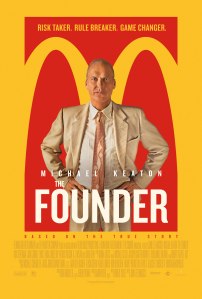 The Founder aims to be The Social Network of hamburgers and milkshakes, a warts-and-all biopic of a huckster who glommed onto other’s success and transformed it into an empire, a pragmatically ruthless entrepreneur run rampant with ambition and leaving behind a trail of lawsuits and disgruntled little people. Michael Keaton, on a roll since Birdman, teams up with screenwriter Robert Siegel (The Wrestler) and director John Lee Hancock (Saving Mr. Banks) to bring to life the story of the man behind the ubiquitous golden arches. The details are routinely fascinating and the movie presents a larger thesis on shifting and conflicting concepts of the American Dream and whether a ruthless yet victorious huckster is to be celebrated, pitied, scorned, or all of the above.
In the mid 1950s, Ray Kroc (Keaton) was a struggling milkshake mixer salesman striking out with just about every drive-in and dinner in the Midwest. His wife Ethel (Laura Dern) is exasperated by Kroc’s flights of fancy, shilling whatever new product might be his ticket to riches. His life changes thanks to one very efficient hamburger stand in San Bernardino, California. The McDonald brothers, Mac (John Caroll Lynch) and Dick (Nick Offerman), have ordered eight of Kroc’s milkshake mixers because they can barely keep up with demand. Kroc travels out West to see for himself and discovers a tasty and speedy hamburger assembly line that nobody else is doing. He pushes the McDonald brothers to franchise their model with him in the lead. They’re wary but agree with a strict contract that still gives full executive decision-making to the brothers. Kroc languishes at first but finds growing success, barely able to keep ahead with the mounting overhead costs. Kroc wants to keep going but the McDonald brothers are unyielding over their terms of business. Kroc schemes to push them out of their own business, establish himself as the founder, and take their very name for himself.
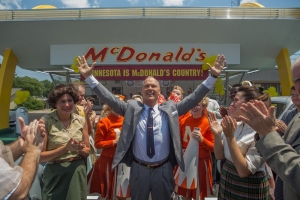 Firstly, the story of the formation of McDonald’s is probably far less known than the formation of Facebook, and this provides plenty of opportunities for illumination. It is an inherently interesting story. There’s the invention of the modern-day fast food assembly line and the difficulty in perfecting this process and getting customers acquainted with the new reality. Initially, after years of drive-in service, customers are befuddled that they have to physically walk up to a window and order and throw away their own trash. The early history, hiccups, and adjustments are interesting, but it all gets more engrossing once Kroc comes aboard. It’s here where the film becomes very business-like in its examination of Kroc’s ruthless business tactics that lead to his ascent. Without Kroc’s intervention, perhaps the world would never have known the name McDonalds. He’s not an instant success either. He’s already middle-aged when he comes across the McDonald brothers. He’s not a brilliant salesman by nature. He’s cunning and doggedly persistent, the key he tells us since the world is rife with talented, educated, and good people who go nowhere. Kroc is a constant motor that can never be satisfied. Ethel asks him if anything will ever be enough, and after a short pause he replies without pretense, “Probably not.” He cannot enjoy success because he always feels he should be entitled to more. It’s the kind of unmoored ambition that leads him to throw his litigious weight around, knowingly breaking legal contracts and handshake deals to get exactly what he wants. Kroc’s business triumphs will remind certain viewers of Donald Trump, a man who uses similar advantages of wealth to exploit others and force them into advantageous deals. Even when explicitly in the wrong he just rolls along undeterred.
It is Keaton’s (Spotlight) movie and he more than delivers under pressure. Keaton adopts a speaking affect that makes the character weirdly magnetic without being wholly charming, an interesting combination that reflects the conflicted nature of Kroc. He’s a fast-talking salesman who enjoys the sound of his own voice but he doesn’t fool himself. He’s a man who knows what he wants and it just happens to be everything. He knows his limitations but he strides forward. He is bursting at the seams to get out from under the thumb of the McDonald brothers, who he sees as limiting the growth of a company that is more his than theirs. Kroc delights in being treated to the upper echelons of power. He loves having people proverbially kiss his ring and lavish his greatness. It’s the story of a man who scraped by his entire life until stumbling upon someone else’s genius idea. Keaton plays the man with a wily canniness that is always entertaining, channeling the actor’s natural oddball energy and style into a Midwestern McBeth. He says if he saw his competitor drowning he’d “shove a hose down his throat.” He’s generally cold but Keaton and Siegel don’t present him with a standard redemption arc. He’s kind of a hapless jerk at the start and becomes a powerful, egotistical jerk by the end. Keaton’s layered performance gives the film a solid anchor to keep viewers invested in the film.
 If only the other parts of The Founder had as much nuance and care as Keaton’s role. The supporting characters have flashes of interest but are too relegated to be much more than symbols or less developed foils to Kroc. The McDonald brothers have a poignant level of tenderness to them but they’re set up to be symbols of American values that will inevitably be trampled upon by Kroc’s corporatist version of the American Dream. Mac is the hopeful and trusting brother, Dick is the no-nonsense devote to quality and ethics, and together they could use additional ambiguity or depth. They’re meant to represent an older way of doing business, the familiar edict that hard work, dedication to customers, and quality will pay off. The brothers are successful and content at their level of success; they lack the naked ambition of Kroc and his disregard for the rules. They’re set up to be defeated and swindled and victims of Kroc’s tactics, which limits them as characters. There’s a sliver of detail with Dick’s concern for his brother’s diabetes threatening him, but the brothers are more martyrs than anything else. You anticipate their defeat with slight dread but more a sense of impending inevitability. Their good-natured values are no match for the winner-takes-all mentality of a man on a mendacious mission.
Similarly, Kroc’s wife is another figure set up from the start to be trampled upon. She’s supportive but not supportive enough Kroc feels. Like the McDonald brothers, she’s too content within her station and what she deems a good existence, a life of dinners at the club with a retinue of upper middle class friends. Ethel is a plain looking woman of simple pleasures. You already know that there’s a ticking clock before Kroc will trade up. With these expectations, more could have been done to establish her character. Too often Kroc’s selfish, indifferent, or casually hurtful broadsides are treated with silent suffering from Ethel. She’s set up as a walking pained reaction shot. It almost gets to comical levels as the pattern repeats itself and you anticipate a slightly elongated, wounded reaction shot. Kroc’s second wife, Joan Smith (Linda Cardellini), is a sweetly smiling prize but proves herself more than a pretty face. She shares Kroc’s ambitions and proposes swapping real milk for instant milk mix to save refrigeration costs. There’s obviously more to this woman, who we meet already married to a business associate of Kroc’s, but the movie keeps her as a mostly symbolic, almost Fitzgerald-esque trophy. The other side characters that come into Kroc’s orbit, B.J. Novak’s scheming real estate fixer, Kate Neeland’s esteemed secretary, Justin Randell Brooke’s loyal lieutenant, are clipped so that they only appear in the film when they offer some service or advice useful to Kroc. Perhaps there’s a meta level here exploring how Kroc views those seemingly closest to him in strict transactional terms, or perhaps I’m just reaching for more.
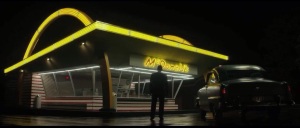 The other liability from an otherwise still entertaining script is the director. Hancock is better known for softer, feel-good films about American values. The Founder is a story that subverts all of those notions and Hancock doesn’t seem to master the skills in order for the satirical and darker implications to land. The onscreen visuals seem to clash with the movie’s overall disquieting tone. The colors are bright and the musical score by Carter Burwell seems curiously jolly at points, confusing the tone of darker scenes. It just doesn’t feel like Hancock had a good feel for the material and how best to execute it. It feels like he’s missing the layers of potential with Siegel’s screenplay. I’ll readily credit Hancock for part of Keaton’s terrific performance but Hancock’s touches are best realized in the art direction details recreating a bygone era. I feel that somebody like a Steven Soderbergh would have tapped more into this story’s satirical potential.
The Founder is an entertaining biopic of a scoundrel who ran roughshod over others dreams and turned their success into his own. It’s anchored by a complex performance from Keaton. It’s a rags-to-riches story that doesn’t tell the audience how to think about its centerpiece character. He’s underhanded, sure, but he’s also got everything he wanted and his tactics proved successful. Is this an ends justify the means story to rationalize the power of avarice, or is this an exploration of the darker undercurrents of the passing American Dream usurping others’ dreams and accomplishments (closing text informs us that McDonald’s feeds one percent of the world’s population every day)? The movie doesn’t seem to take a stand, neither fully condemning nor excusing Kroc’s actions. The tale behind the worldwide fast food giant is full of supersized drama and interesting procedural details about the rise of the most recognizable name in burgers. It’s unfortunate then that the movie struggles to reach the same heights as Keaton. The supporting characters are tragically underdeveloped and kept as figures for comparison to chart Kroc’s ascendance. Director John Lee Hancock also feels like an poor fit for the material, his instincts seemingly at odds with the film’s tone and intentions. The Founder is an interesting movie with a strong central performance but it can’t help but feel like its destiny was far greater, that it’s not meeting the full potential of the material.
Nate’s Grade: B
Share this:

Noirvember: Double Indemnity (1944)
 Billy Wilder’s Double Indemnity is a classic film noir and a classic crime drama about bad people doing bad things and doing them badly. It’s a rich narrative environment that has been explored in droves before and after. Double Indemnity was a box-office sensation, critical hit that was nominated for seven Oscars, and solidified Wilder as one of the most creative and daring writing and directing voices in cinema. This was only his third directing effort and it provided the freedom to make his own way through Hollywood. There’s a certain danger in going back to cinematic classics. It’s easy to see their influence in a sea of imitators and sometimes the accomplishments can be taken for granted just because the viewer is too removed from the initial splash the film made. Double Indemnity is a sharp, surefooted, and highly influential film that still resonates with suspense and intrigue. The formula was refined with Wilder at the helm and his genius can be readily recognized.
Walter Neff (Fred MacMurray) is a mid 30s insurance salesman in Los Angeles. He gets into some big trouble when a prospective client, Phyllis Dietrichson (Barbara Stanwyck), intimates that she would like to bump off her husband and profit from the act. Walter is appalled but also intrigued, drawn to the charms of the sexy Mrs. Dietrichson. He agrees and says they’re going to do it right. She takes out a hefty insurance policy on her husband that pays double for rare accidents, which spurs Neff to stage a phony accident where the injured Mr. Dietrichson (Tom Powers) fell to his death off a train. The scheme is elaborate, with alibis, swapped identities, hiding places, and a minimal of public interactions. It seems perfectly executed that is until Neff’s boss, Barton Keyes (Edward G. Robinson), starts inspecting closer feeling something is amiss. Neff must outwit his boss and co-workers and keep the scheme from getting further out of control.
“I killed him for money – and a woman – and I didn’t get the money and I didn’t get the woman.”
 Thanks to the morally and creatively restrictive Hays Code, it’s easy to see all the roadblocks that could have sabotaged the movie from getting made, let alone becoming a great film. It’s a movie not just about adulterers but they’re also murderers, and the script places you in their perspective, clinging to hope they might succeed in their scheme. Admittedly, the characters are punished for their misdeeds by the film’s end as the Hays Code would demand, but the film experience was different, and Wilder made it so early on. Within minutes, as Walter Neff dictates his confession in his boss’ empty office, he admits to being a killer, to killing Mr. Dietrichson, and in doing so out of a desire for Mrs. Dietrichson. By the very fact that he’s slumped over, panting heavily, and confessing in sordid detail, we can rightfully assume that he did not get away with it. What’s left for the audience to discover? Wilder has already established the major turns of his story for his audience and seemingly robbed us of any notion of surprise. But that’s where Wilder’s storytelling prowess emerges, because it’s not so much a story of whether something was done or would be done, it’s a story of how and how to elude capture.
We’re locked into Neff’s perspective, and with it as an experienced insurance salesman, he knows the proper way to stage a murder, make it look like an accident, and not get caught. It’s in the details that Wilder hooks us, and as we watch the trap unravel, the movie becomes an exercise in nervous tension wondering what will trip up our lovers. An audience generally gravitates to smart characters trying to outwit others, appreciating the wiles but also, perhaps, wanting to see if the scheme can be accomplished. It pushes the audience into an interesting position of rooting for our murderer. There’s a wonderful scene right after Neff and Phyllis have deposited the body of her dead husband. They’ve hopped in her car and are ready to flee the scene of the crime, and that’s when her car won’t start. Wilder simmers in the moment, luxuriating in the encroaching panic as key turn after key turn only results in the sounds of a stalled engine. Finally, it starts, but during the sequence you empathize with the killers and their panic. Wilder and company have done their job and at least some part of the audience is pushing for them to escape. What happens later tests audience loyalty, but we’re still firmly in the perspective and in the shoes of the film’s killer, the only killer in the picture at that. He’s our man.
“I think you’re rotten.”
“I think you’re swell – so long as I’m not your husband.”
 The staples of noir cinema really came alive with Wilder’s excellent crime drama. The visual signifiers we associate with the genre are all here in accordance, like the chiaroscuro lighting that bathed the actors in swaths of invading darkness. The lighting does a great job of reflecting the sordid schemes of our lovers. As soon as Walter accepts, the lighting changes drastically and the layers of dark creep in on the actors’ faces. The dialogue by Wilder and Raymond Chandler (his first screenwriting gig in Hollywood) has that robust rat-a-tat rhythms of hardboiled genre fiction that we love. The twists and turns keep an audience glued even though we have already been told the major plot particulars. The inclusion of Mr. Dietrich’s twenty-something daughter Lola (Jean Heather) from his previous marriage presents an intriguing complication. She suspects her wicked stepmother might have something to do with her father’s death as well as her mother’s death. Walter Neff keeps tabs on her as a means of trying to dissuade whom she tells her suspicions to, as a means of manipulating her, but then when Lola reveals that her ex-boyfriend has been seeing Phyllis on a nightly basis, we don’t know what to think. Is Phyllis setting up her own scheme to kill Neff? Is Lola knowingly manipulating Neff to enact vengeance against her hated stepmother? Is there anyone a guy can trust? It’s a fine character and played sincerely by Heather (Going My Way) almost to the point of ache. She stopped acting altogether in 1949, to the detriment of us all.
But the ultimate femme fatale is Stanwyck (The Lady Eve). I think what makes her work is the fact that she doesn’t immediately leap to mind as a femme fatale. She’s not the most gorgeous actress in Hollywood, though clearly still an attractive woman. The stiff blonde wig they saddled her with doesn’t help on that front. She’s a temptress that doesn’t sizzle off the screen so much as step from the mind because she feels more realistic. Working within the repressive confines of the Hays Code, Stanwyck still knows how to provide a sexy smirk to things left unsaid with her character. There are a few looks she employs that could make you melt. A standout scene focuses entirely on her face. Her husband is being murdered just off screen. That violent act is left to our morbid imaginations while we watch Stanwyck’s subtle expression of satisfaction cross her face only to dissolve when she knows better. I wish MacMurray (The Absentminded Professor) was a better scene partner with her. He seems overly stiff like he’s trying harder to get out the stylized dialogue in the tone the director wants. Wilder finds ways to subvert the actor’s tendencies but I feel like he’s at best a likable but limited dolt of an actor.
“You’re not smarter, Walter… you’re just a little taller.”
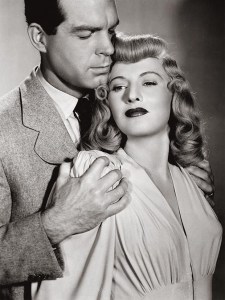 Phyllis is a classic femme fatale figure and Stanwyck plays her with a beautifully controlled sense of menace, but I want to offer a different theory as to what kind of twisted love story inhabits Double Indemnity. I think Walter Neff was never in love with Phyllis, though he acknowledged her beauty and general seductive effect. This much is clear from his first meeting with her where the insurance veteran can’t help himself with how forward and transparent his flirting is. He’s interested, though he’s also interested in getting a sale, and then when she floats the idea of life insurance, his tone immediately changes. The flirting stops cold and he promptly sees himself out. But he can’t stop thinking it over. I propose he isn’t drawn to Phyllis so much as he’s drawn to the intellectual challenge of pulling off the “perfect crime.” He considers himself a clever man and this would put all his skills to the test. He knows what agents look for to suss out foul play. He knows what the police ask about. Now he gets to see if he can fool them all. In this interpretation of mine it’s not Neff’s love for the dame that gets him but his love of his ego. There’s a cold manner in how often he calls Phyllis “baby,” lacking apparent affection and instead seemingly turning the pet name into something dutiful. Oh, but you’ll argue, his voice over goes into great detail about the magnetic and sexual appeal of Mrs. Dietrichson, and that’s the point to remember, that it’s his voice over. Neff is retelling this story, knowingly dictating his confession, and perhaps he’s playing into a narrative that removes some of the emphasis from his true intentions. I propose Neff is an unreliable narrator. Since it’s from his perspective, his words are all we know about Phyllis and her assumed seductress ways. Having the final word on his story would provide a perfect opportunity for Walter to alter the story as best he sees fit, shifting some blame onto the woman who done him wrong. I believe that in the end it was Walter Neff’s desire to prove he could outsmart the world of law enforcement and get away with murder that drove him onto this wayward path and not a woman as fetching as Stanwyck and her anklet may have been.
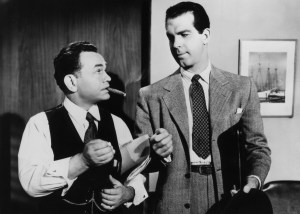 There’s a very unexpected emotional current that surfaces fully by the conclusion of Double Indemnity. Edward G. Robinson was at a transitional point in his career, having been the lead in a slew of older crime pictures. An audience was prepped from association to consider Robinson a disreputable character, just as they had prepped to consider MacMurray’s character a likeable fellow from his previous comedic roles. Wilder’s film flips audience expectations to great effect. MacMurray is the cunning murderer and Robinson is the moral center. Keyes is exceptionally skilled at insurance fraud and it naturally should be him that unknowingly tightens the noose around his beloved employee as he gets closer and closer to the truth. He just can’t see it; Walter Neff is so close he inhabits a blind spot. When Keyes does discover the truth, his crushing sense of disappointment he tries to hold back is an emotional moment that hits hard. It’s the professional and loving relationship between these men that helps to add something more to Double Indemnity; it’s got the noir staples we come to expect nowadays but it also has a surprisingly sweet and affecting father/son relationship between mentor and student. Robinson is terrific in the bravado moments like when he unleashes a torrent of statistical categories on suicide types and methods and he also sells the quiet hurt of a proud man who must admit he placed his trust in the wrong recipient.
“I couldn’t hear my own footsteps. It was the walk of a dead man.”
Double Indemnity is a film classic that holds up thanks to deft plotting that puts the audience in the place of the killers, solid twists and turns, and a clear understanding of the strengths of the genre. It’s a standout film noir that still stands rather tall. It’s always reassuring when the great pieces of art can still transport, still excite, and still resonate with the same feeling that communicates why they deserve their decades of plaudits and acclaim. Wilder was one of Hollywood’s greatest storytellers who could hop genres like few others. His foray into noir cinema left a long lasting legacy for the genre and its fans to follow, and Double Indemnity is still the crackling crime thriller it was under the Hays Code. Perhaps the scrutiny of censorship forced Wilder and Chandler to get more creative, and the finished product is a taut and stylish imprint that others eagerly copied. There’s just something inherently interesting about bad people doing bad things badly no matter the best intentions of the moral crusaders of its day.
Nate’s Grade: A


 nathanzoebl
You must be logged in to post a comment.