Cast Away (2000) [Review Re-View]
 Released December 22, 2000:
Strand Tom Hanks on a desert island for years? Sounds too good to be true to many a disgruntled movie goer. Such is the state in Cast Away, Robert Zemeckis’ existential meditation on man, nature, FedEx and their product placement checks, and of course… volleyballs.
Hanks is yet another everyman, except he’s a real stickler for time and order as a FedEx supervisor. His girlfriend (Helen Hunt) is pushing for marriage but hey – they’ve got all the time in the world, right? So Tom boards a FedEx flight headed for the South Pacific that hits a nasty collision with a powerful storm. The plane goes down abruptly in what is likely the most terrifying plane crash ever performed on film. Hanks washes ashore onto a mysterious deserted island after drifting alone in the vast ocean. Without civilization and without human contact he must start all over just to survive the day. So becomes the odyssey of Island Tom.
Cast Away hits one out of the park with its near dialogue free middle act with Tom’s first days upon his new island home. Hanks struggles to do everyday things from finding food to creating a makeshift shelter. As Hanks goes through these daily troubles the audience is with him every moment and learns as he does. Cast Away‘s middle is fascinating to watch. After a few days some packages from the crash wash ashore including a volleyball that Tom turns into his best friend. “Wilson” is Hanks’ companion and is totally understandable how one would branch out for contact under the circumstances. Plus, Wilson’s a dynamite celebrity of his own right now.
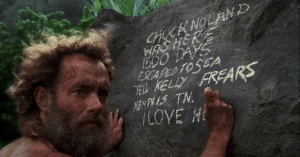 Hanks’ acting is his usually above average output, but his whole role seems more like a showcase for his method acting than the acting itself. The first half of Cast Away was shot then they took a year off so Hanks could become scruffy, thin Caveman/Unibomber Hanks. The transition is fun to watch and remarkable for an actor to devote himself completely to their role. But the part itself, and Hanks’ show, seem more spectacle than substance. Helen Hunt pops up in the beginning and end proving that she can somehow manage to be in every film in December. Pretty much the next actor in the film would be… well, a volleyball. Cast Away is basically a one-man show.
Despite a wonderful middle Cast Away is suffering from the opposite syndrome of Saving Private Ryan: strong middle, weaker beginning and end sandwiching it. Our opening plays like an extended commercial for FedEx, complete with the dazzling FedEx package POV cam (coming soon!). The end plays like a thank you card to FedEx. The ending also suffers from extreme let-down from multiple climaxes that don’t end the film but just give way to another climax. By the time the movie does end you’re exhausted.
Zemeckis lends a skilled hand toward the direction, the script plays to the strengths of the tale good enough, and Cast Away has its moments but becomes too heavy-handed at certain periods. Still, the volleyball is good. Go for the volleyball.
Nate’s Grade: B
(For fun, count the amount of times FedEx is mentioned or seen in the film. Hell, do it with this review too. I’ll even help you out – FedEx, FedEX, FedEx, FedEx, FedEx, FedEx, FedEx, FedEx, FedEx, FedEx, FedEx, FedEx, FedEx, FedEx, FedEx. Oh fun.)
——————————————————
WRITER REFLECTIONS 20 YEARS LATER

Twenty years later, Cast Away feels almost like finding a message in a bottle of another time, a time when director Robert Zemeckis was routinely making great movies, and when Tom Hanks ruled the box office and awards circuit (he has only been nominated for one Oscar since Cast Away, in 2019 for playing Fred Rogers). It’s also a movie that reminds you that despite all else that concept is king. It’s an especially easy movie to watch, and its middle portion is so beautifully clear and accessible that any group of people could keep up and find the island plot thrilling and fascinating. There are long, long portions where the only dialogue spoken in the movie is between one very harried man and a volleyball he has adopted as his only friend. Cast Away is in many ways a textbook example of elegant visual storytelling and also an example of the limitations of emotional engagement when there’s not much else going on but survival.
Please don’t get me wrong, I was mesmerized during the island portion of this movie, which makes about 80 minutes of an otherwise overly long 140-minute movie. When it’s Chuck Noland (Hanks) stranded on a deserted island and having to think step-by-step for shelter, food, and basic care, I was hooked. I was thinking each step of the way, learning and applying that new knowledge base with the main character, and it’s just an imminently enjoyable formula to witness a character work through problems and triumph under extreme circumstances. I felt the same thing with 2015’s The Martian, which was dubbed “Cast Away on Mars.” It even goes back to arguably the first novel, Robinson Crusoe, following one man and his wits and will alone on a perilous island. Very often the protagonist in these man-versus-nature stories is a stand-in for all of us, representing humanity’s quest to conquer the elements and prove our collective mettle to the universe. There is an immensely satisfying pleasure watching storytelling that is precise, efficient, and clean, imparting the necessary information to build onto the next scene and for each setup to expand your understanding and trace to the next payoff. Screenwriter William Broyles Jr. (Apollo 13, Planet of the Apes) deserves more plaudits than he has been given. The island portion of Cast Away is beautiful and near brilliant. Each moment builds so naturally. You learn the geography of the island, the mini goals of cracking open a coconut, building a fire, turning the FedEx trinkets into valuable tools of adaptation, it all builds and at your own pace.
 When we make that four-year time jump, Zemeckis definitely wants it to be a showstopper moment and it is earned. The camera slowly pans to linger on the image of Chuck, much more tan, gaunt, and with a beard that I wrote in 2000 could rival the Unibomber. It’s such a striking image coming right after an unexpected time jump. That’s Tom Hanks, one of the members of Hollywood royalty, and he looks so different from his earlier, schlubby everyman self. The sight is also a stark reminder of Hanks’ physical dedication to the role. He spent a year losing 50 pounds and growing out his scraggly beard. The entire film production went on hiatus and Zemeckis shot an entire other movie released in 2000 (the unremarkable What Lies Beneath). His performance is genuinely great and perhaps more deserving of the Oscar that year than eventual winner Russell Crowe for Gladiator. It’s a performance that is more than a Method physical transformation. His terror, elation, and worry are readily apparent onscreen. It’s a one-man show so you better not get complacent because the audience has nothing else to hold its attention than watching your face, your expressions, your tumult. Not everyone can share the screen with a volleyball and make you feel something when that ball drifts away.
It’s all the rest of Cast Away that can’t quite add up. The first act is mostly establishing Chuck as a figure fated for grand ironic punishment, a workaholic taskmaster who has all the time in the world and nothing more to do but sit with his thoughts. The first act establishes his Before life for our contrast, so we know what he will be leaving behind, and this only really works when the final act rolls around to offer the After period. Now we check in on these minor characters and what four years have done for their lives, how they mourned and moved on from Chuck, and how they’re handling his miraculous re-appearance. You could make an entire movie about a woman whose former love comes back years later after being presumed dead and how this shakes up her current relationship and her own mental sense of self and yearning. That’s a tremendous amount of internal struggle to sift through. Except, with Cast Away, Chuck has lost something but it doesn’t really feel like he’s lost much. Our only time spent with Kelly (Helen Hunt) is during the first act, and while he holds onto her memory and she ostensibly serves as a motivational force for him to get off the island, it’s not felt by the viewer. So when we learn she’s married and a mother, it doesn’t feel so tragic as it does mundane. Life carries on.
 By then it’s too late to make Chuck a more substantially interesting character. The point of interest was watching his survival on the island. Back at home, he’s just another guy, and there isn’t enough from an emotional standpoint to make him compelling. It’s not about him trying to readjust to a society he was ripped away from, catching up on lost time, feeling like a man who was in a coma and now has to pick up everything he’s been asleep for. These characterization shortcomings don’t become more notable until after Chuck gets rescued. Beforehand, I was caught in the immediate physical danger and conflicts of survival, but once we’re off the island, we’re just left with some guy. He hasn’t gone through a radical internal synthesis through his time on the island. He’ll probably be fine and live a normal life. The movie literally leaves him at a crossroads and sets up a handy romantic consolation for him. Does the audience really care which road Chuck takes from here? I doubt it. Chuck stops being interesting when he is saved.
Cast Away really was the last even semi-great movie by Zemeckis. He spent the bulk of the 2000s making animated movies using state-of-the-art motion capture technology. He’s since retreated back to live-action after his mo-cap experiments became too costly for studios. Strangely, Zemeckis has taken to remaking documentaries into entirely unnecessary dramatic features (2015’s The Walk, 2018’s Welcome to Marwen). The passion and pure filmmaking chops that placed Zemeckis as one of the most exciting filmmakers in Hollywood seems to have dimmed. Watch 2016’s Allied and tell me you feel passion. It’s like his interests in the technical side of filmmaking have swallowed his drive and creative expression as a storyteller. With Cast Away, it’s a return to basics of pure visual storytelling and Zemeckis excels so strongly. It makes me mourn what could have been considering Zemeckis abandoned live-action filmmaking, his own lost decade chasing after animated movies that felt like 3-D theme park rides. This is a man responsible for two of my favorite movies of all time (Back to the Future, Who Framed Roger Rabbit?) so I’ll always have hope that I can see glimmers of the same artist that delighted me.
Looking back at my original review from 2000, I’m becoming more and more proud of my younger self and his ability to analyze and articulate his film criticism. It’s a little fun to read words I wrote twenty years ago about a movie and nod along and go, “Right on,” with the same agreement to this day. I don’t want to get ahead of myself and say this was a shift in the complexity of my film reviews, but my major points still stand in 2020 as they did in 2000. Apparently, FedEx did not pay a dime for product placement, though the company reaped financial rewards for years after the exposure. They even made a Super Bowl ad in 2003 that provides a further epilogue where Chuck (Hanks again) finds out the one package he refused to open just had all these handy tools that could have saved him. Cast Away is still an invigorating movie today, even if that only amounts to 80 of its 140 minutes.
Re-View Grade: B+
Share this:

Super Intelligence (2020)
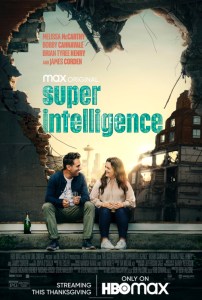 Given the sad and off-putting output from Melissa McCarthy and her husband Ben Falcone when they collaborate, it’s a small victory that Super Intelligence is only really super bland and forgettable. McCarthy stars as an everywoman picked by a highly intelligent A.I. to be the test subject for whether or not humanity should be saved or wiped out of existence. It sounds like an amusing premise but what it becomes is just a boring romantic comedy. The super A.I. (voiced by James Corden) becomes more or less a magic genie, and now our heroine has all her wishes granted. She has a huge new bank account, a new car, a new luxury condo, and all to impress the guy she let get away played by Bobby Canavale. That’s right, the super A.I., meant to test and judge mankind, is really just the world’s most advanced wingman and trying to get his human pal some love. As far as tests go this seems a bit weak. This mighty A.I. should be working against our protagonist, throwing increasing obstacles that push her out of her comfort zone, rather than just handing her everything and looking from afar with approval. The comedy is resolutely flat save for the inherent charms of McCarthy, who doesn’t seem challenged by anything in the movie. Much of the film is watching McCarthy talking into high angle CCTV cameras. Visually, it’s quite boring. Super Intelligence feels like an interesting idea that can’t be bothered to find anything interesting in execution. It’s standard rom-com fluff but the two characters aren’t even appealing together. I found Canavale’s character to be far more annoying than endearing. I’ve found that Falcone is a bad director for his wife. He encourages her worst onscreen habits and doesn’t have the presence or vision to be able to assert restraint or imagination. If Falcone is attached as director, you know you’re getting McCarthy doing her familiar shtick with little self-control. She’s still a highly appealing comedian, and an underrated dramatic actor, but the only super intelligence here are the people who avoid this film.
Nate’s Grade: C
Share this:

Happiest Season (2020)
 It’s about time that gay people were better represented in holiday rom-coms (according to my girlfriend, 2020 was the first year Hallmark featured a gay protagonist in a Christmas movie, which is astounding). Why shouldn’t queer people be able to enjoy cute, low-key holiday fluff that also better represents their stories and perspectives? That’s the goal of Happiest Season, written and directed by Clea DuVall, an actress best known for her 90s output like The Faculty and But I’m a Cheerleader who has transitioned behind the camera. The story follows a lesbian couple, Abby (Kristen Stewart) and Harper (Mackenzie Davis), celebrating their first Christmas together. Harper invites her girlfriend to meet her family, however, she hasn’t come out to her conservative parents and sisters. Abby will have to pretend to only be the “roommate” and from there the movie sets us up farcical misunderstandings and comic mishap. The problem with Happiest Season is that everyone is a big jerk. Harper’s parents are jerks. Her overly competitive sister played by Alison Brie is a jerk. Even her young niece and nephew are jerks. Why would it be such a big deal for a conservative politician’s daughter to be gay… in 2020? Hell, Dick Cheney has a gay daughter and he’s done okay for himself. Why would Harper want her girlfriend to spend upwards of five days with these awful people and under the guise of having to hide who she is and their relationship? I think it’s because Harper is also a jerk. She dismisses Abby’s feelings and misgivings, ditches her to hang out with an old boyfriend, and doesn’t seem to recognize how uncomfortable any of this is making the woman she reportedly loves. And then it’s revealed that Harper outed her high school girlfriend (Aubrey Plaza) and said she was obsessed with her in an effort to not be seen as gay when she was younger. That’s not endearing. This person doesn’t deserve Abby, and that’s the problem because when the happy ending and sweet kisses fortuitously come I wasn’t feeling joy but contempt. I kept yelling at turn after turn for Abby to leave this family to their own miserable devices. I wanted the movie to somehow transform into a separate story about the only people I genuinely liked, Dan Levy as Abby’s friend and Mary Holland as the youngest daughter, a sweet goofball, the only one in Harper’s family with a soul. The comedy bits run the gamut between cute and clumsy, though the escalations don’t rise to the farcical levels you would expect from compounded misunderstandings and secret-keeping. Happiest Season is an adequate holiday movie, and a boon for greater representation even in a genre with a low bar, but it would have been even better with characters you actually liked and wanted to spend the yuletide season with.
Nate’s Grade: B-
Share this:

Alan and the Fullness of Time (2020)
 I don’t think I’ve come across a movie with a title as curious in recent years as Alan and the Fullness of Time. This Ohio-made indie was created for a predominantly Christian marketplace so, fairly or unfairly, I went in expecting more emphasis on the message than the storytelling. I figured the titular “fullness of time” would be a larger lesson about using the time God has given you, seizing the day and such, or maybe even related to time travel (no such luck). What I got certainly felt like it was far from the fullness of its own meager running time and ideas.
Alan (Brooks Harvey) is a normal teenage boy except he isn’t. His parents belong to a Christian sect that has for generations plotted to protect a special savior. Alan wants to live a normal life, hanging with friends and going to parties, but he is thrust into a war between heaven and hell. After an attack at home, Alan is on the run to learn about his identity and accept his destiny.
This movie is maddeningly unclear in just about every aspect of storytelling. It feels like you’re watching a Mad Libs version of a story with missing blanks where there should be essential information. It seems like Alan is a classic Chosen One archetype along the lines of a Christian Harry Potter or Percy Jackson. Writer/director Markus Cook (The Deceived) repeatedly reminds the viewer how important Alan is in the larger scheme and how special he is but this is never fully explained except in very general terms meant to apply to any person watching, contributing to the idea that every life is important. That works as a comforting message but it doesn’t work explaining why Alan alone is so special. Likewise, if he’s so special and in hiding, why was he allowed to leave the house or go to a public school? The character would be far more compelling if he was a recluse not allowed to leave the house because his parents were overly protective with good reason. Sending the Chosen One that demons are looking for to a public school just seems careless (not an indictment on the quality of education). For that matter, why do these demons even bother waiting to attack? The Act One break involves demons attacking Alan’s parents and forcing him on the run, but if they’ve already infiltrated his school and are posing as his friends, why are they waiting? These are the kinds of things that add up and make a plot feel careless and under developed, and it starts early and often with Alan.
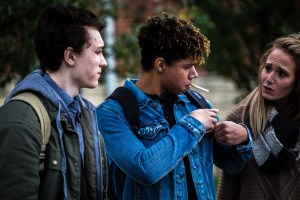 This lack of clarity extends beyond the first act and muddles so much of the conflict and characterization. After Alan’s parents are harmed, why does he not go to the police? What reason would he have for hiding at his school? He doesn’t know his fellow students were demons, at least not in a fully confirmed way of this hidden world of monsters. For that matter, why is Alan on the run and there is national media attention given to what happened to his parents? What reason does he have to not resort to the police? It would make far more sense for the demons to frame Alan for the violence at his home. That way he would have a reason not to turn to the authorities and make him feel more isolated and hunted. He would be limited seeking out help and refuge. This would also better explain why anyone even remotely cares about finding this kid from a media standpoint. I can’t imagine round-the-clock media updates on where the son of one crime has been if he is not clearly the chief suspect. Alan spends much of the rest of the movie learning about his parents’ hidden life and his own part in a larger war, but the world-building is far too vague for a story involving hidden conspiracies of good guys and bad guys. I think the movie is presenting an alternate world where some Christianity is outlawed by the government but this too is flagrantly unclear. Are these people being persecuted for their beliefs? It doesn’t feel like it onscreen aside from a few snarky comments from Alan’s teenage peers about his perceived boring life (and remember, they were really demons). Regardless, there is a branch of the NSA (or some other acronym) that is being run by a a centuries-old demon with Jedi mind trick powers, and yet even this is unclear too. What are the rules here? What are the limitations? What are the objectives? What are the stakes? If you’re presenting a “hidden world” story with powerful creatures and faith as a weapon, then we need a lifeline to grasp.
Alan is a fairly boring blank of a character. He’s angry because he keeps moving schools and feels like he doesn’t fit in, but once he’s on the run Alan becomes a receptive set of ears for people to fill him in on the power of faith, God, and his divine place in the world. Will Alan triumph? You know the answer but I can’t exactly explain it beyond him simply having more faith. Frankly, this character is not interesting enough to warrant a franchise. Even his vague powers as a Chosen One are not interesting enough to warrant further adventures. The most interesting character, by far, is Weston (Lucas Bentley) and he could have been cut completely from the narrative. He’s introduced early, apparently trying to escape to… the Chinese border for… reasons I’m still unsure about from the opening that literally begins with footage and audio of 9/11 (this inclusion is never fully earned and, at best, quite tacky). He was part of the same splinter group that Alan’s parents belong to, but Weston lost his faith after his wife was killed. He seems like he’s on a redemptive arc, the old gunslinger being called into one last battle to save a youth and find something worth fighting for. This doesn’t exactly happen but this setup made Weston the character I knew the most about, who had the most accessible struggle, and who could have easily been the lead perspective of the movie rather than the vacant Alan.
I think the filmmakers were going for a combination of an indie Christian YA character and their own version of a Jason Bourne spy thriller (you better believe I’m trademarking the term “Jesus Bourne” for future franchises). This would not have been the first indie to treat a Christian protagonist as a fugitive being hunted down for their beliefs, an externalization of a self-persecution complex I’ve never personally understood when a majority of Americans identify as some form of Christian. This scenario plays into the fears of its ready-made audience and it at least also provides a ready-made story for danger and intrigue. Rarely, however, have I seen a Christian indie that seems so taken with providing the “other half” of a Bourne movie, and by that I mean the desk jockeys clacking keyboards. With every Bourne movie, there is the Chief Chaser and his or her team of NSA agents manning banks of computer terminals and tracking down the whereabouts of our target. In normal spy thrillers, these moments provide scene changes and exposition, but they can also ratchet up tension as we, the audience, know how much closer these antagonists are getting to our hero. With Alan and the Fullness of Time, there are numerous check-ins with the agent half of this pursuit but it never raises tension or provides helpful clarity about the world or this agency. Part of this is because the boss Malkam (no first name, just… Malkam) is established as supernatural too early. Do the other agents know they’re working for a demon? Detective Lowell (Brittany Picard) pushes back occasionally saying they are misusing their government office, but nobody else seems to give much mind. I even think the end involves a siege of a church with literal gunshots and people killed, but again, the movie is too vague to clarify whether or not this escalation and the consequences made much sense.
 It’s not like there wasn’t room to better develop this story, its world, the history and lore, and the characters. Alan and the Fullness of Time clocks in at 82 minutes, but for my online screening, the first three was an introduction by the lead actor, and if you wanted to discount opening credits and a minute of closing credits before a mid-credits sequence (why?), that means that Alan is actually approximately 76 minutes of material. There was more than enough space there to better flesh out, well, anything. If it was a concern about budget limitations, I don’t fully accept that because budget doesn’t limit how well you write for characters and conversations. The movie concludes with “Alan will return” and the promise of a sequel with a very Percy Jackson-sounding string of subtitles, Alan and the Rulers of the Air. If I had paid good money to watch this movie, I might be chuffed that the movie wants to carry over into a sequel when they didn’t even have enough material for 76 paltry minutes.
The dialogue can often be painful and stilted. For an action movie, there isn’t very much action. Most of the scenes from the Act One break onward are people chatting in cars, people chatting in churches, people chatting in homes, people chatting on the street. That would be great opportunities for the needed clarity and characterization lacking. It doesn’t help when these conversations include clunkers like, “At least we have that in common – dead parents. At least half of mine.” Dear reader, that line made me outwardly wince in pain. At another point the villain shows up with armed guards and says, “This is real lead and real brass, and they will pump you full of it.” Alan says he doesn’t have time and another character says, “Time has you, Alan. It has all of us. And it’s squeezing.” In reference to his school friends, who I remind you were demons that harmed his parents, he says, “They’re not my friends anymore.” Well, that’s good to know given the circumstances. Alan turns on a turncoat and says, “You sold me out. No wonder you can’t call us family.” I was a little worried about the implications of the line, “If you can pray, then you can fight.” At the conclusion, a character asks Alan how to teach her how to fight, and he hands her a bible, and we cut to credits. These are just the examples that stood out to me of bad dialogue. If we’re left with these characters and their thoughts, it is apparent that the filmmakers just were not equipped to provide them with appealing words to speak.
I don’t blame the performers because it feels like they were all following the same poor direction. Everyone in this movie is so subdued that I thought they would slip into a coma. This is intended to be a spy thriller, a chase movie, a world where demons can take human form and hunt the Chosen One, and nobody seems to be acting like it’s urgent. This does a tremendous disservice to establishing and maintaining tension. It completely saps the energy out of the movie. If the characters aren’t anxious or worried, then why should we be watching them? It’s too early to land a verdict on Harvey as an actor as this is his debut. I hope the future adventures of Alan provide the actor a better showcase and more energy. I want to single out one actor who was only onscreen for a few minutes but left quite an impression. In a movie filled with vague evildoers that seem too low-key, Kira Wilson (The Right to Remain) is definitely felt as the spooky principal to Alan’s school. She has a fun malevolence that is missing from the other bad guys and I can tell the actress is enjoying her wicked side. We could have used more of her.
 I will credit the filmmakers for making a film that looks and sounds like a professional movie. The cinematography by Josh Bedsole doesn’t have a lot of focus depth but it looks crisp. The persistent hand-held camerawork provides an extra dose of energy to the proceedings and is another reminder of the film’s aspirations to be its own Bourne-style escapade. It’s a low budget movie, all things considered, but it doesn’t feel glaringly so that it’s distracting or compromising. The best part about the movie is the score by Josh McCausland and Jake Halm that adds excitement when it’s not being felt otherwise from the writing and direction. At points the electronic-infused score even reminded me of the work of Trent Reznor and Atticus Ross.
Alan and the Fullness of Time doesn’t really justify your own investment of time. When you don’t provide enough explanation for your world when it’s different, when you don’t make it clear what the rules and limitations are, and when you don’t produce relatable and engaging character arcs, then you’re not really making a movie and more so making an inaccessible puzzle for the audience to piece together for their own fledgling entertainment. Alan and the Fullness of Time is not exactly an audience-friendly movie, despite the fact that its core audience will likely ignore its storytelling pitfalls because it admires its core message. I can feel the lack of storytelling finesse, as if the filmmakers shrugged and said, “It only has to be good enough to get us the next one.” I’ll even admit that the clips for the upcoming sequel look much more enticing and action-packed, but I haven’t been given enough from the first movie to hold out faith the second will deliver. This could have been Jesus Bourne, people.
Nate’s Grade: C-
Share this:

Shithouse (2020)
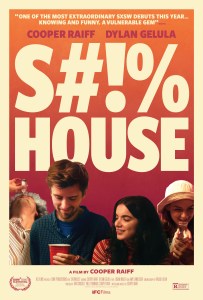 This should have been a winner for me. I’m a fan of mumblecore dramas that drop you into people’s ordinary lives. They’re character-driven and built upon naturalistic dialogue that can still be compelling and revealing of its participants. However, Shithouse seems to have found that middle zone between stylized dialogue and naturalistic dialogue; throughout the 100 minutes, the movie involves ordinary people sounding like they’re having real conversations, which means they are generally boring. If you were eavesdropping on these people in real life you would leave. There’s a fine difference between natural but still plot-driving and engaging dialogue and dithering dialogue that holds to the awkward starts and stops of real life but fails to keep your attention. Just because the scene feels realistic does not mean it is the same as being interesting. Writer/director Cooper Raiff stars as Alex, a college freshman with a serious case of homesickness. He spends one long night with his RA, Maggie (Dylan Gelula), and it feels like maybe these two will connect and become romantic. The problem with Shithouse is that it feels like each half-hour is its own different movie. The first is introducing an emotionally fragile young man having difficulty adjusting to collegiate life away from his family. The problem is that I didn’t care about Alex and I didn’t find him being mopey intriguing. It took too long to open him up. The next part is the film’s best and it’s Alex and Maggie spending hours together walking, chatting, having little adventures on the path to burying her dead turtle. It’s the best part of the film and where I felt the movie was starting to coalesce, even with a protracted setup. This is the Before Sunrise part. However, the next morning, Alex and Maggie seem to have very different views of their long night and eventual hookup. He’s overloading her with messages and she’s being distant and indifferent, and this is where the movie becomes like 500 Days of Summer, holding up for scrutiny the romantic aspirations of those grown up with the media of pop-culture happy endings. Had Raff left us in this direction, I could even argue that his structure served a larger point of condemning his protagonist’s viewpoint. I might not enjoy it but I could mildly respect it. However, Shithouse then undoes this part with a resolution set two-plus years in the future that doesn’t feel earned and is tonally disjointed from this prior section. If this was the intent, then why did Raiff even prolong us with this extended morass of missed Instagram messages and angry outbursts over misreading what the night meant to both parties? Regardless, there are glimmers and moments in this gentle little movie that worked, that hit upon a deeper truth, but mostly you’re stuck with dull people having boring conversations.
Nate’s Grade: C+
Share this:

Hillbilly Elegy (2020)/ Feels Good Man (2020)
 Hillbilly Elegy is based upon the memoir by JD Vance and in 2016 it became a hot commodity in the wake of Trump’s surprising electoral ascent, with liberals seeing it as a Rosetta Stone to understanding just how so many working-class white people could vote for a billionaire with a gold toilet. The movie, directed by Ron Howard (Apollo 13) and currently available on Netflix, follows an adult JD (Gabriel Basso). He’s a Yale law candidate forced to go back home to Middletown, Ohio after his mother Bev (Amy Adams) lands in the hospital for a heroin overdose. It’s 2011, and Bev has been fighting a losing battle with opioids for over a decade, costing her a string of boyfriends and jobs. JD’s homecoming isn’t quite so rosy. While he can take comfort in fried bologna sandwiches and his sister (Haley Bennett), the town is not what it once was. The factory has closed, poverty is generational, and his mother is one of many struggling to stay clean. In flashback, we watch MeeMaw (Glenn Close) take in the young JD (Owen Asztalos) and raise him on the right path. JD must decide how far the bonds of family go and how much he may be willing to forgive his mother even if she can never ask for help.
The subtitle of Vance’s novel was “A Memoir of a Family and a Culture in Crisis,” and it’s that latter part that got the most attention for the book and critical examination. Many a think piece was born from Vance’s best-selling expose on the hardscrabble beginnings of his personal story along the hills of Kentucky and the Ohio River Valley and his recipe for success. Given his libertarian political leanings, it’s not a surprise that his solutions don’t involve a more interventionist government and social safety nets. According to Vance’s book, he saw poverty as self-perpetuating and conquerable. It was the “learned helplessness” of his fellow Rust Belt inhabitants that Vance saw as their downfall. For me, this seems quite lacking in basic empathy. You see these people aren’t poor because they’ve been betrayed by greedy corporations, indifferent politicians, a gutted infrastructure and educational system in rural America, pill mills flooding Appalachia with cheap opioids, and a prison system that incentivizes incarceration over rehabilitation. For Vance and his like-minded fellows, upward mobility is a matter of mind over matter, and these working-class folks have just given up or won’t work as hard as before.
 Now, as should be evident, I strongly disagree with this cultural diagnosis, but at least Vance is trying to use his own story as a launching point to address larger points about a portion of America that feels forgotten. The movie strips all of this away. Screenwriter Vanessa Taylor (The Shape of Water) juggles multiple timelines and flashbacks within flashbacks as Vance follows the formula of prodigal son returning back to his home. The entire draw of the book, its purported insights into a culture too removed from the coastal elites, is replaced with a standard formula about a boy rediscovering his roots and assessing his dysfunctional family. At this rate, I’m surprised they didn’t even time it so that Vance was returning home for Thanksgiving.
Removed of relevant social commentary, Hillbilly Elegy becomes little more than a gauzy, awards-bait entry meant to uplift but instead can’t help itself from being overwrought poverty porn. If we’re not looking at the bigger picture of how Appalachia got to be this way, then Vance becomes less our entry point into a world and more just an escaped prisoner. Except the movie doesn’t raise Vance up as exceptional and instead just a regular guy who pulled himself up by his bootstraps through will and family support. I’m not saying he is exceptional, I don’t know the man, but this approach then ignores the reality of why so many others just aren’t following his footsteps of simply trying harder. Without granting a more empathetic and careful understanding of the circumstances of poverty, Howard has made his movie the equivalent of a higher-caliber Running with Scissors, a memoir about a young man persevering through his “quirky, messed up family” to make something of himself on the outside. This reductive approach is meant to avoid the trappings of social commentary, and yet in trying to make his film studiously apolitical to be safer and more appealing, Howard has stumbled into making Hillbilly Elegy more insulting to its Appalachia roots. Systemic poverty is seen as a choice, as people that just aren’t trying as hard, that have given up and accepted their diminished fates. Never mind mitigating economic, psychotropic, and educational circumstances. I imagine Howard wanted to deliver something along the lines of Winter’s Bone, unsparing but deeply aware of its culture, but instead the movie is far more akin to a sloppy compilation of Hallmark movies and catchy self-deprecating bumper sticker slogans. Seriously, about every other line of dialogue feels like it was meant to be on a T-shirt, from “Where we come from is who we are, but we choose every day who we become,” to, “There are three types of people in this world: good Terminators, bad Terminators, and neutral.” Well, maybe not that last one. The insights are fleeting and surface-level, with vague patronizing along the fringes.
The personal story of J.D. Vance takes the center stage and yet he’s the biggest blank of characters, and what we do get isn’t exactly that encouraging. I think we’re meant to engage with his triumph over adversity, but he has such disdain for his background while clinging to it as an identity, and this intriguing dichotomy is never explored. Vance as a character is merely there. His awkward experiences relating to the rich elites are just silly. He calls his girlfriend (Freida Pinto) in a panic over what fork to use at a fancy dinner table, as if this perceived social faux pau would be the difference between getting a law firm gig. He’s supposed to feel like an outsider, both at home and away, unable to escape his past that defines him, but the movie doesn’t even make Vance feel alive in the present. Most of the movie he is just there while big acting takes place around him. He listens to the life lessons bestowed upon him, good and bad, and it makes him the kind of man that when he grows up will join Peter Thiel’s venture capital firm, so hooray? I sighed when the movie established the stakes as he needs to get back in time for his big lawyer job interview, a literal family vs. future crossroads. The movie treats its frustrating main character as a witness to history rather than an active participant, and his personal growth is what? Coming to terms with the limitations of his mother? Accepting himself? Leaving them all behind to survive? I don’t know. There is literally a montage where he gets his life back on track, starts getting better grades, ditches his no-good friends, and heads out into the world. This could have been a better articulated character study but instead Vance comes across as much a tourist to this downtrodden world and eager to return to safer confines as any morbidly curious viewer at home.
 I simply felt bad for the actors. This is the kind of movie where subtlety isn’t exactly on the agenda, so I expected big showcases of big acting with all capitals and exclamation marks, and even that didn’t prepare me. I watched as Amy Adams (Vice) worked her mouth around an accent that always seemed elusive, with a character that veered wildly depending upon the timing of a scene. Almost every moment with Bev ends in some alarming escalation or outburst, like when a new puppy ends with Bev declaring she will “kill that dog in front of you,” or a ride back home descends into a high-speed promise of killing herself and child out of spite. This woman is troubled, to say the least, and her addictions and mental illness are what defines the character. With that guiding her, Adams is left unrestrained and usually screaming. There’s just so much screaming and wailing and crying and shouting. It’s an off-the-mark performance that reminded me of Julianne Moore in 2006’s Freedomland, where a usually bulletproof actress is left on her own in the deep end, and the resulting struggle leans upon histrionics. Was I supposed to feel sympathy for Bev at some point? Does the movie ever feel sympathy for this woman who terrorizes and beats her child? The broad portrayal lacks humanizing nuance, so Bev feels less like a symbolic victim of a larger rot of a society abandoned and betrayed and more a TV movie villain.
Close (The Wife) disappears into the heavy prosthetics and baggy T-shirts of MeeMaw, but you could have convinced me the character was a pile of coats come to life. Truthfully, MeeMaw is, by far, the most interesting character and the story would have greatly benefited from being re-calibrated from her painful perspective. She’s the one who bears witness to just how far Middletown has fallen since her and PawPaw ventured as young adults with the promise of a secure new life thanks to the thriving factory. She’s the one symbolizing the past and its grip as the present withers. She’s the one who has a history of abuse only to watch her daughter fall into similar patterns. Think of the guilt and torment and desire to rescue her grandson for a better life and save her family. That’s an inherently interesting perspective, but with JD Vance as our mundane lead, MeeMaw is more a slow-walking curmudgeon taken to doling out profane one-liners and grumpy life lessons. Close is easily the best part of Hillbilly Elegy and deserved more attention and consideration. A moment where she clings to JD’s high-scoring math test like a life raft is heartfelt and earned, more so than anything with JD.
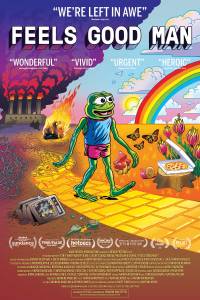 Another slice of America that feels forgotten and angry is on display with the documentary Feels Good Man, a.k.a. the Pepe the Frog documentary. Who is Pepe? He’s a cartoon frog created by Matt Furie as part of a comic series of post-college ennui between four friends. The character was adopted by the commenters on the message board 4Chan as their own symbol, and as their memes spread and became more popular with mainstream suers, and that’s when the 4Chan warriors had to do something drastic to save their favorite frog. They began transforming Pepe into a symbol of hate in order to make him toxic for outside use, and then the irony of their attempts at reclamation faded away and Pepe became a real symbol for Neo-Nazis and white supremacists. The character is currently listed on the Anti-Defamation League’s list of symbols of hate. The movie explores this evolution and de-evolution of Matt Furie’s creation and serves as a cautionary tale about the scary shadows of Internet culture and the nature of reclaiming meaning and intent with art.
Firstly, is there enough material here for a full-fledged documentary? We’re talking about a cartoon frog filling up the memes of Internet trolls. Is that enough? I think so, though I wish the movie shed even more critical scrutiny upon the 4Chan fringes of the Internet that have become a toxic cesspool of alienation and recrimination. These are people that self-identify and celebrate their social isolationism. The acronym N.E.E.T. stands for NOT Employed, Educated, or Trained and is adopted by many as an odd badge of honor. We even see home video footage of people sharing their personal lives in cluttered, trash-strewn basements. These are people electing not to engage with a larger functioning society and yet also feeling hostile to those that choose otherwise. Maybe it’s all a big joke to them, so why even bother; maybe it’s a defeatist mentality that plays upon social anxiety and learned helplessness. Maybe it’s just a noisy, nihilistic club that doesn’t want anything for themselves other than to disrupt others. The interview subjects from the 4Chan community are few but offer chilling peeks into this subculture. They see the world in terms of a very high school-level of social hierarchy, and the people who are pretty, successful, and having sexual relationships are the “popular kids” keeping them down. I think in terms of a Venn diagram, that incels and these NEET freaks are a flat circle. It almost feels like Vance’s cultural critiques of his poor Appalachia roots syncs up with the disenchanted 4Chan kids. This self-imposed isolation and self-persecution stews into a hateful mess of resentment. It’s not a surprise that several mass shooters have partaken in 4Chan and 8Chan communities.
 This scary subsection of Internet culture has been left to fester and it went next level for the 2016 presidential election. The trolls recognized their own sensibilities in Donald Trump, a candidate whose entire presidency seemed on the precipice of being a bad joke. The alt-right celebrated the man and used Pepe as a symbol for Trump’s trolling of norms and decorum, and the 4Chan message boards became an army of meme makers to steer Internet chatter. It’s hard to say what exactly the cumulative effect of these memes and trolling efforts achieved, in addition to the successful efforts of Russian hackers and a media environment that gave Trump billions of dollars in free airtime, but the 4Chan crowd celebrated their victory. “We memed him to the White House,” they declared. From there, Pepe became a synonymous symbol of a newly emboldened white supremacist coalition and any pretenses of ironic detachment dissolved away.
The rise and mutation of Pepe makes up most of the movie, and it’s certainly the most fascinating and scary part of Feels Good Man. However, there is a larger question about the ownership of art and interpretation that the movie presents without conclusive answers. Symbols are a tricky thing. They’re not permanent. The swastika wasn’t always associated with Hitler and Nazis. A pentagram has significantly different meanings depending upon a Wiccan and conservative Christian audience. Feels Good Man examines Furie as a humble albeit slightly naïve creator. He’s a nice guy who just can’t get his head around what has happened to his creation. How far does the artist’s intent go when it comes to credible meaning? At one point, Furie tried stemming the negativity by killing off Pepe in a limited comic, but it didn’t matter. The 4Chan followers simply remade him as they desired because at that point Pepe was their own. He has been built and rebuilt over and over again, that no one person can claim interpretative supremacy. Furie’s version of Pepe might be gone but there are millions of others alive and well. This gets into the nature of art and how every creator in some regard must make amends with letting go of their creation. Once it enters the larger world for consumption, they can steer conversations but art can take on its own life. The last third of the movie follows Furie taking action to enforce his copyright law to push back against the more outlandish uses of Pepe the frog, including from InfoWars’ Alex Jones, the same man who told us the government was making frogs gay for some unexplained conspiracy. Jones makes for a pretty easy villain to enjoy seeing defeated, and the conclusion of the movie involves dueling taped depositions between Furie and Jones over intellectual trademarks and free speech. It makes for an easy to navigate victory for Furie to end the movie upon, but is this larger war winnable? I have my doubts and I don’t think the trolls of the darker reaches of the Internet are going away.
I also want to single out the beautiful animation that appears throughout Feels Good Man, giving a visual representation to Pepe in a manner that’s like trying to give him a say in his own intent.
 So, dear reader, why did I pair both of these movies for a joint review? I found both of them as investigations into a sliver of America that feels forgotten, left behind, stuck in ruts outside their control, and resentful of a changing culture they see as exclusive to their hard-hit communities. I thought both Hillbilly Elegy and Feels Good Man could provide me, and others, greater insight into these subcultures and perhaps solutions that can make them feel more seen and heard. The problem is that Elegy doesn’t provide solutions other than “pull up your bootstraps” and Feels Good Man involves a destructive coalition that I don’t want better seen and heard. Both movies in their own ways deal with the nature of how very human it can be to retreat to their safe confines of people who too feel ostracized, hurt, and overwhelmed. I have pity for the people of the Rust Belt, the hillbillies experiencing generational poverty and hardships, though “economic anxiety” is not simply a regional or whites-only worry. I have less pity for the basement trolls of 4Chan trying to celebrate school shooters because it’s somehow funny. I’m amazed that so many talented people were part of Hillbilly Elegy and had such high hopes. For all of its full-tilt screaming, the movie is thoroughly boring and formulaic. Given the nature of an elegy, I was expecting Howard’s movie would be more considerate of its people, but their humanity is lost in this pared-down characterization, and the tragedy of society failing its own becomes an inauthentic Horatio Alger story of the plucky kid who went to Yale and became a real somebody. Feels Good Man might not be the best documentary but it feels more authentic and owns up to its inability to answer larger questions about human behavior, art, and interpretation. Both of these movies will prove horrifying to watch but only one is intentionally so.
Nate’s Grades:
Hillbilly Elegy: C-
Feels Good Man: B
Share this:

Run (2020)
 With Run, now available through Hulu thanks to COVID, we follow Chloe (newcomer Kiera Allen) as she yearns to leave home for college. She was born with multiple physical maladies and has been living at home in her wheelchair. Her mother, Diane (Sarah Paulson), tends to her needs but runs a tight ship, holding Chloe to a high academic standard. One day, while looking for college returns, Chloe finds a prescription for her mother that she denies is hers. This causes Chloe to investigate the myriad of medications she’s on and her mother’s cagey behavior. She comes to one conclusion: she is being held prisoner by her own mother.
I don’t consider it a spoiler to confirm that Run is exactly the movie it assures you from its start. Because the movie was so early and upfront about its distrust with the mother, part of me began to wonder, after watching so many Hollywood thrillers over the years, if I was being set up into false complacency. I began theorizing what a late twist could be, how we’re being lulled into one perspective so maybe the final twist would be that the big bad mom is actually the hero. This is not the case at all. There are later revelations that clarify just how disturbed and committed Diane is as a doting mother, but the core relationship dynamic is the same from the get-go. That means that Run might not have much going for it other than as an escape thriller. It’s not going to give you deeper insights into life with mental illness or physical disabilities, nor is it going to channel some relatable struggles with motherhood. It’s about a crazy woman holding a teenager captive and the great obstacles that teenager must overcome to reach freedom and safety. That’s all the movie has to offer but under the guidance of its filmmakers it does so with finesse.
 Let Run serve as a prime example of how you can take a simple story and create a lean, mean thriller that provides doses of satisfaction and triumph. The focus is so condensed that writer/director Aneesh Chaganty (Searching) can provide set piece after set piece to demonstrate his skills in suspense. The first act involves Chloe learning of her alarming state and getting confirmation that her medicine and ailments might not be true. From there, the next two acts are a series of planning escapes and escalating attempts at escape. There is a lovely sense of fulfillment in watching smart characters intelligently think their way through challenges. I recently re-watched 2015’s The Martian and was reminded how enjoyable it can be to just watch smart people smartly confront problems. Chloe is a formidable young woman with obvious vulnerabilities to overcome, but she has a sharp mind for science and can act like a plucky Zoomer MacGyver. It’s resolutely fun to watch her overcome her challenges. Each new set piece and setback presents a challenge and her thinking is logical and capable throughout. Even when the plot isn’t much more than a series of escape attempts, every time I wondered to myself how exactly Chloe was going to get through the next dilemma and admiring her as she persevered.
The photography, editing, and score work nicely in tandem to raise the level of suspense. The command that Chaganty has over all facets of filmmaking to serve a common purpose is impressive. It’s the same kind of assured vision he displayed with 2018’s Searching where the film screen was confined to the parameters of a computer monitor. As with that earlier inventive thriller, Chaganty has an innate understanding of how to make his moments matter, where every twist and turn has a connection to what came before it so it all feels of a whole. That is essential especially for a filmmaker working within a thriller genre. If you can tell even the simple stories well, where the pieces connect with perfect precision, and ratchet up tension efficiently no matter the scenario, then you’re already operating at an extremely high level. Given his first two entries, I would watch any movie, especially a thriller, that has Chaganty’s name attached.
 This is primarily a mother-daughter two-hander in terms of acting, though Paulson is off-screen for long portions. After several Ryan Murphy TV series, including Netflix’s Ratched, I’ve come to automatically assume I should be wary of whatever character Paulson is playing. This role is well within her unstable wheelhouse and she gets to better shine in her increased desperation in the second half when Diane no longer has to pretend to be sane. Her doting manipulation and intense mood changes can be quite creepy. The real star is Allen in a very physical performance. There is much the young actress has to communicate non-verbally, from her distress and paranoia to her doubts and fears and righteous anger. Plus all the crawling. She’s great, and I fully imagine this will be the start of Allen’s promising career as she finds even more high-profile roles to demonstrate her talent.
If you’re a fan of slick, intelligent, and sneaky fun thrillers, and why wouldn’t you, then seek out Run (not to be confused with the TV series of the same name on HBO in 2020). It’s well honed, well developed, and smartly constructed to deliver enjoyable thrills and payoffs for viewers. It might not have more on its mind than entertainment but that’s fine when the movie is this well done.
Nate’s Grade: B+
Share this:

You Can Count on Me (2000) [Review Re-View]
 Released November 17, 2000:
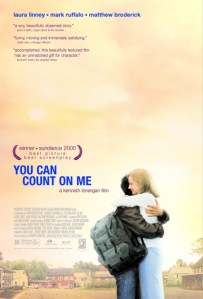
Kenneth Lonergan has had quite an up and down year. He started the year co-writing the atrocious What Planet Are You From? and writing The Adventures of Rocky and Bullwinkle to ending it with the character ensemble piece that ran away with an armful of awards at Sundance. Lonergan uses subtle moves to create a vivid mosaic of small town America and family relationships with You Can Count on Me. In film, quite often do we see the relationships of sisters or brothers (maybe too often). Rarely, though, do we see a thorough drama hinged upon the relationship of a brother and sister. Both torn by their genders yet always drawn together. You may kid, and get angry, but when danger arises you will always come to the defense of your sibling. It’s this seperational friction yet togetherness that creates the brother-sister bond.
Laura Linney and Mark Ruffalo are brother and sister who years ago lost their parents to a horrible automobile accident when they were young. Forced with the battle of growing up with grief, each goes their separate way. Ruffalo is branded the “difficult” rebellious one, yet deep down he knows that his publicly deified sister is just as much the rebel. Linney is a single mother dealing with the pressures of raising her son (a Culkin kid) and working in her town’s bank branch headed by her new boss (Matthew Broderick). Her brother reappears in her life suddenly and the two learn a little form each other. With her brother she can rely on someone else to watch her child and experiences another flash of the mischief that she had to forfeit from her childhood in order to raise her younger brother. Ruffalo provides the male figure her son is lacking and begins to shed the boy’s over protection and opens him up to the world. One experiences responsibility, one experiences release. but do either learn? That is a good question.
 Lonergan crafts a subtle texture that allows his characters to breathe and grow but not necessarily learn. His modest character-driven picture may make you think of Made for TV but its a slice of life that’s immersible. It’s hard to find a film that is subtle, at its own pace, and restrained when it needs to be.
Linney is fantastic as the sister that breaks loose and winds up sleeping with her boss with reckless childish rebellion. Her performance is an Oscar nomination lock as her character runs the emotional gamut. Ruffalo is amazing and establishes himself as one to surely look out for. his mannerisms and expressions are wonderful and his demeanor is reminiscent of Marlon Brando.
You Can Count On Me is a wonderfully affecting story about people who are more complicated then simple plot synopsis will allow. Lonergan has crafted something of an anomaly in modern cinema: a film that takes its time, doesn’t answer any questions, but makes us feel all the better after seeing it.
Nate’s Grade: B+
——————————————————
WRITER REFLECTIONS 20 YEARS LATER

You Can Count on Me was a breath of fresh air in 2000. It was an impressive star-making performance for Mark Ruffalo, who would go onto three Oscar nominations and be the Hulk people actually wanted to see. It was a showcase for Laura Linney, her biggest big screen role to date and earned her an Oscar nomination, her first of three. It was the first personal movie by writer/director Kenneth Lonergan, a playwright who had become one of Hollywood’s popular writers for rewriting studio projects trapped in hell. Lonergan was nominated for Best Original Screenplay, losing to Cameron Crowe’s Almost Famous, and then finally winning the same award for 2016’s emotionally devastating Manchester by the Sea. It’s strange to recall that the biggest name involved with this small, character-driven indie wasn’t any of these three but Matthew Broderick, drafting off his mordant turn in Alexander Payne’s Election. This is one of those slice-of-life movies where the characters are the driving force of the plot, where the small connections and mistakes are the ones that resonate most. And yet, I didn’t see it back in 2000 but I did upon my re-watch, there’s a degree of broad sentimental contrivance as well, an element missing in Lonergan’s latter efforts, including possible masterpiece, 2011’s Margaret.
 We follow the lives of two very different and not so different siblings coming back together. They’ve been orphans since they were children and had to rely upon one another. Sammy (Linney) is the responsible one with the good job and a young son she’s raising on her own. Terry (Ruffalo) is the irresponsible one who gets into fights, can’t keep a job, and served a little time in jail he was embarrassed to tell his sister about. He comes back initially for some quick money, to the disappointment of Sammy, and then sticks around longer and longer, bonding with his nephew and going through old and new arguments with his sister over his life decisions and direction.
It doesn’t take long to realize Lonergan’s striking ability to compose naturalistic dialogue that has pinpoint precision when it comes to characterization. Watching any pairing of characters has the wonderful effect of the best plays, where that intriguing combination of character interactions is like an exciting chemical reaction, creating something new and welcomed. Every conversation then takes on meaning to see how the character interactions change or influence the participants. It means that Lonergan is generous and judicious with his details. A dinner meant to be celebratory can become a re-airing of grievances and disappointments. A night out hustling pool can go from being a bad idea to becoming a male bonding experience that has to stay a secret. The characters are so richly observed and developed that You Can Count on Me is implicitly saying to its audience, “Hey, no matter the scene, you can count on me.”
The relationship between Sammy and Terry is the most emotionally resonant and complex, with each of them defying the easy characterization they’ve been assigned as Good Kid and Bad Kid. He’s resentful of his sister and her judgement when he thinks she can be just as irresponsible. She’s resentful of her brother and his immaturity and inability to put down roots, bumming around and getting into the same old scrapes. Coming back together, each reconnects on a personal and family level where they may be combustible but they realize how much they need and love one another. A final heartfelt goodbye between them, while waiting for a bus to take Terry away, becomes an awkward but affecting moment because they really don’t know when their paths will cross once again. Sammy sure hopes it’s sooner, as her young son has grown attached to Terry. I think deep down Terry hopes it is as well and likes the comfort and support offered from this family that has an open spot in waiting for him on call. He’s ostensibly leaving to make things right with his girlfriend (or ex-girlfriend? It’s unclear since he’s been away) and has grown as a person from the experience of being an uncle. He’s not at the end of his arc, wherever that may eventually lead, but he’s moved closer on that journey. That’s a good summation for all the characters. There aren’t clearly designated arcs but nudges along a very human path to growing and learning.
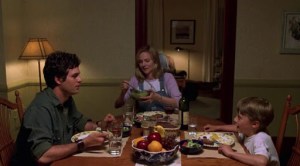 Ruffalo (Spotlight) instantly grabs your attention. His performance almost has a shy obstinance, like he doesn’t want to be seen by the viewer, tired of the judgement he knows is coming, and he’s constantly retreating inward in defense and score-settling. He’s so immersed in the character that the actor dissolves entirely. His commitment to character is immediate. There was a reason he was drawing comparisons to Marlon Brando upon release. Linney (Love Actually) is terrific as well as the flabbergasted older sibling tired of having to play parent to her rebellious brother. She has many moments of exasperation with her brother, the men of this small town, her ineffectual boss she has a short-lived affair with. She’s drifting just like Terry but doesn’t realize it; Sammy vacillates between wanting to settle down with a nice boring guy who says he loves her. She’s been stuck fulfilling responsibilities for so long that her brother’s return allows her to cut loose a little bit, to be bad again, to make careless and selfish choices. Linney serves as a strong anchor for us as well as an example that being an adult doesn’t mean being in control.
Where You Can Count on Me slightly falters, and not by much, is the inclusion of storylines that feel a bit too maudlin and TV-movie-of-the-week. There are two tracks of emotions in the movie, subtle and overt, and it’s become clearer which is which upon re-watch twenty years later. I almost feel like Lonergan included some of these parts because they made selling his indie easier to studio executives. The affair Sammy has with her boring yet sleazy boss (Broderick) offers no real insights beyond Sammy’s capacity for self-destructive whims. She keeps coming back to this weak man, maybe because there’s no future with him since he’s married and his wife is pregnant, and maybe because she knows she can drop him. I started groaning whenever her boss called again, so desperate for one more last time, and that is likely the point. It’s watching someone continue down a path we all know should be avoided. It also explains how she might have ended up with her son’s father, played by Josh Lucas (villain in 2003’s first Hulk movie). Terry decides the little kid deserves to see his father and the unannounced visit doesn’t end well. The bad dad denies he is even the father, they get into a fistfight, and the little kid gets to feel abandoned all again. These broad dramatic moments stick out amidst the more subtle and naturalistic movements throughout. It’s not enough to drag down the whole of Lonergan’s enterprise but they feel like discordant notes in an otherwise sumptuous symphony where all the players are working in impressive synchronicity.
 Looking back at my original review in 2000, it hits a lot of the same observations that came to me in 2020 re-watching the movie. The complexity of the characters, the unobtrusive direction, and the naturalism of top performers is as evident back then as it is now. It’s easy to see what drew such celebrated actors to bring life to these people. Lonergan gained confidence as a writer/director and held true to his visions, including a five-year struggle with producers over his ambitious artistic intentions for Margaret that brought in none other than Martin Scorsese to play as elder statesman deal-breaker. His works have become more intimate and insular. Looking back on his first film, which Lonergan even has a small acting role as the town pastor, is like watching the first steps of an artist who would later sprint. You Can Count on Me is a funny, poignant, and engrossing character piece on sibling rivalry and small-town conformity, but it’s also got a few issues that Lonergan would shed later in his career. Come to see a young Ruffalo tear through scenes and Linney match him moment-for-moment.
Re-View Grade: B+
Share this:

Class Action Park (2020)
 It feels like a tale ready made for a fun yet frightening examination, a New Jersey theme park famous for its dangerous and indeed killer attractions. Action Park, which operated out of Vernon from 1978 until 1996, was known for its poorly designed water and motor rides for thrill-seekers, often under the guide of going higher, faster, and being cooler. The documentary Class Action Park explores the park’s beginnings, a brainchild from disgraced Wall Street traders, and its heyday fondly remembered by many in a shared survivor’s bond. I was worried the movie was going to glorify the park and its rickety rides as some sort of macho “kids today are wimps and not like us” sort of generational braggadocio. I was worried the documentary would consist of a nostalgic ode to a dangerous theme park that would never be allowed to operate as it did today. And to some extent, Class Action Park does revel in the bizarre reality of its dangerous ride designs, apathetic teenagers given managerial and lifeguard power, and an owner who would simply refuse to pay any fines or punishments and freeze out the authorities. There is grand morbid curiosity as the film dissects different rides and explains, with the help of crude animation, why they would not work and could cause potential grievous injury. Dirty rivers filled with snakes, malfunctioning equipment, and ride designs that didn’t account for gravity and traction and other important physics. These jaunty, nostalgia-filled moments contrast sharply with the more somber tone the film is less successful achieving when it examines the human cost of the park. Over its tenure, six people are known to have died at the park, from drowning to electrocution to brain trauma. The movie doesn’t earn its somber reflection and doesn’t feel like the tones ever mesh. The interview subjects can also be pretty lackluster. Adults recalling childhood memories seems rife for reaching and generalization. The people who mattered most in this story don’t seem to be featured on camera, so instead we have a lot of people opining about a dead amusement park who went there many decades ago and still sing its virtues even while acknowledging its many flaws and safety violations. The movie never really digs deeper, asking the interview subjects what is the cost, what are the lessons of Action Park, and the entire enterprise feels too un-probing and superficial. Even the visuals can be pretty stale, like simply using cut-out newspaper clipping headlines repeatedly for insert shots. The subject has definite appeal for a documentary. This park is crazy. Unfortunately, Class Action Park only skims the surface and misses out on more engaging revelations about our collective love affair for danger at the expense of common sense.
Nate’s Grade: C+
Share this:

Kajillionaire (2020)
 If you’re not familiar with quirky writer/director/performance artist Miranda July, she specializes in a special kind of weird that borders on surreal and also a surprising emotional poignancy. It’s been 9 years since her last feature film, The Future, and she’s back with what might be her most narratively focused and accessible yet still wonderfully weird movie yet. We follow a family of grifters (Richard Jenkins and Debra Winger as the parents) and their day-to-day struggle to con, skim, or steal enough money to get by to the next day. Old Dolio (Evan Rachel Wood) is their only child, and her role in the family is thrown into question when a new member joins their team. Melanie (Gina Rodriguez) has connections to a raft of senior citizens so desperate for attention that, if they all pose as Melanie’s family, they should be able to con these old folks of possessions they can resell. From there, the movie becomes a push-and-pull relationship between Old Dolio and the influence of her shifty family, and she questions her place in this fringe unit and whether her parents actually love her or see her as another means to get a score. Kajillionaire is loose in plot but populated with interesting characters who feel fully realized by July’s writing. She’s so good at studying human behavior and capturing it that the quirky details all feel so genuine and meaningful. Even Old Dolio’s name is a reminder of her parents’ opportunism and problematic parenting skills. She was named after a homeless man who won the lottery under the hopes that he would be grateful and put her in his will (he ended up spending his fortune on experimental cancer drugs). That’s the difference with July. A silly name could just be a disposable oddity, but for her it’s a reflection of a character’s worth and history. There are moments in the movie that achieve a level of artistic transcendence where every piece is humming beautifully together, like one moment where a dying elderly man off-screen directs the grifter family to pretend to be like his own flesh-and-blood family. They play pretend at domesticity, each assuming a doting role, and the tranquil scene of a fake family feels beautifully attuned. The moments stand out more than the whole but July’s empathetic appreciation of human fallibility keeps her from ever condemning Old Dolio’s scheming parents too much. Even the very end finds a way to turn betrayal into a message of humility. Wood (Westworld) drops her voice several octaves, wears baggy clothing, and looks extremely awkward when it comes to human contact. Rodriguez (Annihilation) is the voice of the audience and her test of how far she’s willing to excuse the selfish behavior of this clan of cons. Her burgeoning friendship and maybe more with Old Dolio is a rewarding enterprise for the characters and the audience. Kajillionaire is a gentle little movie that plays at a low-key range of human emotions yet it can still be deftly funny and surprising and heartfelt on its own unique terms. With Miranda July, she makes weird entrancing and human.
Nate’s Grade: B+


 nathanzoebl
You must be logged in to post a comment.