Star Wars: Attack of the Clones (2002) [Review Re-View]

Originally released May 16, 2002:
Yes, it’s easy to say that Attack of the Clones is better than Phantom Menace, but hey, most anything was better than watching that movie about trade and taxes. The truth of the matter is that for a long while Clones is just as boring as Menace, especially anything involving Anakin onscreen. It’s slow moving, dull, and remarkably poorly written. Lucas cannot write dialogue and someone needs to take away his yellow writing notebooks before he strikes again. The movie only shows life during the last 45 minutes when it finally cooks with a non-stop rush of action. Before then though I would recommend resting up for this period.
Can anyone ever say “no” to the Jedi master in plaid? What Lucas needs desperately is collaboration, writing and directing. Lucas needs to loosen up the reign of his empire before the three Star Wars prequels undermine the original set. He may have the technology to create any manner of CGI creature but he has no power to get his actors to show any of the realistic and animated life. It seems all Lucas cares about is directing blue screens and leaving his actors out to dry.

And that much ballyhooed romance between Anakin and Amidala? Oh ye God, what romance? You could find something more alive in a monastery. Portman and Christensen have as absolutely no chemistry (unlike the romantic pairs in another, huge Hollywood movie out now). Portman has perfected the staring ahead method. I don’t know if that’s supposed to be romantic. Now I like Natalie Portman, I really do. Her performance in The Professional gets me every time, but her acting is stiff and overly serious here.
I thought Anakin could not get any more annoying than Jake Lloyd’s awful “yippee”-filled run in Menace, but I’m starting to reconsider this begrudgingly. It’s easy to see why Christensen was chosen, he looks like the lost N’SYNC member. His acting on the other hand is not with the force. The Clones Anakin mopes around and when he gets upset he whines in a falsetto voice. It’s actually quite funny to see the future Darth Vader, evil master of the Dark Side and much feared, whining like a six year old throwing a tantrum. This Anakin needs a time out and a lolly.
When Anakin returns to become a protector for the senator, upon their first meet in ten years he shoots her the puppy eyes and says, “I see you have grown as well — grown more beautiful.” Subtlety, thy name is not Anakin Skywalker. The very next scene where they’re alone he’s trying to put the moves on her, though he does not try and use the force to undo her bra. Then somewhere along the line his dogged persistence just wears Amidala down and she relents. She says, “I’ve been dying a little bit day by day, ever since you re-entered my life.” Ugh. You’re likely to find more romantic passages in a Harlequin bodice ripper at 7-11.

The romance in Clones is like spontaneous romance. There is no beginning, the nurturing of it is not shown, we don’t see the eventual progress. All that happens is he shows up and then instant romance. It just happens. I don’t think so. It’s like a kid went to a girl’s third grade birthday party, then they meet in high school for the first time since that day and are instantly in love. Do you buy that? Well I certainly don’t.
The scenes revolving around Obi-Wan are the only ones worth opening your eyes for. Ewan McGregor has got the Alec Guiness voice down and proves to be a capable leading hero. His voyage to see the clone army and Jango Fett is the subplot that we want, but the movie keeps skipping back and forth between this and the inept romance. By this time everyone knows that Yoda shows off his fighting mettle with a light saber. This is a great idea and the audience I saw it with was having the time of their life during this moment. It’s the only part of the movie that taps into the feeling of whimsical fun of the original trilogy.
Lucas curtailed the criticism of Menace saying it was the setup for all five other movies. I imagine he’ll say the same thing with this one, except that it was setup for four movies. Yes it’ll make a huge amount of bank. Yes it’s a technical achievement but what good are all the bells and whistles if we as an audience are bored? You’ve got one more Star Wars left George, please do it right.
Nate’s Grade: C+
——————————————————
WRITER REFLECTIONS 20 YEARS LATER

Something unexpected has happened in the ensuring twenty years since the Star Wars prequels were first released to a generally muted response from the rabid fandom. A generation has grown up with these movies as “their Star Wars.” In my own anecdotal experiences, many teenagers do not just view Episodes I-III as entertaining movies, they even view them as their preferable Star Wars trilogy. After the latest Star Wars movies, Episodes VII-IX, some fans have even been looking back on George Lucas’ much maligned prequels with revised appreciation. “At least there was a cohesive vision,” they’ll say, in comparison to the wild pendulum swings between directors J.J. Abrams (Force Awakens, Rise of Skywalker) and Rian Johnson (Last Jedi). Have we all been too harsh on Lucas and his moribund attempts to inject life into his three-movie arc charting the fall from grace from legendary villain, Darth Vader a.k.a. Anakin Skywalker? The short answer is… no. While I agree that children who grew up with the likes of Jar Jar Binks and CGI overkill will consider Episodes I-III more their style, the flaws of these films are undeniable when compared to the superior storytelling and characterization of the others. Even in comparison to the new Star Wars, these movies still suffer. So please remove your rose-colored glasses, fandom, and accept that even with time, Attack of the Clones is still a lousy adventure.
I think a majority of Star Wars fans experienced the five stages of grief upon the 1999 release of The Phantom Menace, the first new Star Wars movie in 16 years. I remember a classmate who wore Star Wars T-shirts every day for weeks in fevered anticipation of the new movie, including T-shirts relating to the new characters and merchandizing opportunities (what the “new characters” were, even Darth Maul). After the movie came out, I remember charting over the last weeks of school his response, going from claiming that, “Of course it was great,” to a more measured, “Well, it wasn’t what the originals were, but it’s still good,” to, “It has its problems but…” and finally the acceptance that it just wasn’t a very good Star Wars movie or even a good movie. He stopped wearing T-shirts emblazoned with Phantom Menace characters.

This was the backdrop for the production of 2002’s Attack of the Clones, a realization that must have spurred Lucas to do better. During the many years of pre-production for Phantom Menace, Lucas was cloistered by yes men agreeing that every new addition was going to be sensational. Lucas was astonished to learn about the volume of hatred against Jar Jar Binks, a character he thought would transcend and become the most popular character in all of Star Wars. The intense negative feedback threw the old Jedi Master in plaid for a loop. Maybe residing in a creative bubble that only reinforces everything you say isn’t the best environment. We were told that Lucas had learned from his mistakes from Phantom Menace. He even brought on another screenwriter to help him, Jonathan Hale (The Young Indiana Jones TV series), something he didn’t do for the concluding Episode III: Revenge of the Sith. At the time, I was among the throng of fandom that wanted to cling to hope, that maybe The Phantom Menace was an aberration, that maybe that same feeling of elation could return of the Star Wars of old. And then I watched Attack of the Clones and it confirmed what I and many feared: Phantom Menace was no fluke; it was merely the way things were going to be from here onward.
The prequels had two major storytelling goals: 1) to explain the transformation of Anakin Skyler into the mighty Darth Vader, and 2) to explain the rise of the evil Empire and its Emperor. To offer some compliments before the onslaught of criticisms is unleashed, I think Lucas does an agreeable job with developing the latter goal. This movie came out around the time of Bush’s War on Terror where the threat of attack was enough to call pre-emptive strikes and where the president was given special war powers that, to this day, and the formal conclusion of the wars in Iraq and Afghanistan, haven’t been fully relinquished. There are several obvious and eerie parallels to the political instability of its initial release but also for today in 2022. We are witnessing one political party lurching toward rampant authoritarianism, a repudiation of democratic norms and ideals, and celebrating personality over principles and winning at any cost. Watching the different alien races of the Republic champion the need for a strong, decisive ruler to cut through the bureaucratic red tape of representative democracy, someone who seems above politics, someone who will protect the people, and someone who sees opponents as enemies of the state, well it’s not hard to make the connections. This is the path of fascism, the rise of dictators, and it was the same brew of nationalism, grievance, fear-mongering, bigotry, scape-goating, and information distortion during the 1930s as it is during the 2020s. For those angry Star Wars fans upset by the diversity of the newer movies, screaming, “Keep politics out of my Star Wars,” you do understand the entire thing has been a metaphor for fighting fascism, right? It’s not even subtle.

However, where the movie pitifully fails is by linking Anakin’s downfall with his romantic relationship with Padme (Natalie Portman). There was potential here with a forbidden romance where Anakin fights against the oath of chastity to the Jedi and both must try their best to subsume their out-of-control feelings. I’m sure that’s what Lucas thought he was making. It didn’t quite work out that way. The romance in Attack of the Clones is laughably bad. The dialogue is cringe-worthy and deeply inauthentic. Every character speaks like a robot. When Anakin starts to finally court Padme, he shares his infamous “I don’t like sand” observation, but he directly pivots toward liking his current location because it’s “soft and smooth,” and it is WITHIN SECONDS of saying this that he stares weirdly at Padme and they share their first kiss. That line worked! Upon meeting Anakin, almost every character remarks how much he’s grown up, as if Lucas is trying to say, “He’s no longer a kid, so it’s okay for him to try and get some.” Padme repeats this observation at several points, and I started to question what exactly was the age difference between these two. Nothing about this romance feels genuine. At one point, they literally roll down a hill like two children rough housing. The romance is so hilarious juvenile and poorly developed. In my original review in 2002, I referred to it as a “spontaneous romance,” and that’s exactly what it feels like. Anakin’s yearning looks more like a child having a temper tantrum. Also, Padme ignores a host of red flags including when Anakin confesses to killing “men, women, and children” in a blind rage upon his mother dying. She also tells him to stop looking at her because it makes her uncomfortable, and does he stop? No.
The other problem is that the actors are clearly bored with one another. Natalie Portman has since become of my favorite actors, but she’s always been an actress that has trouble hiding her boredom with a role she doesn’t connect with. You can feel her eagerness to be done with the franchise in every green screen scene (just keep chanting, “Only one more movie, Natalie”). Her destiny is to be a mother and to be the catalyst for Darth Vader becoming Darth Vader, and she’s never been looked as anything more. Sure, you can argue she’s headstrong and resourceful in a general sense, but then she has to be scraped by an arena monster so she can bare her midriff during the climactic action scuffle. I don’t think any actress can make this clunky dialogue work, like, “I’ve been dying a little every day since you came back into my life.” Is that supposed to be complimentary? Another quick dialogue criticism: EVERYONE is always addressing everyone all the time with titles. “My old friend,” and, “Master,” and, “My Padewan,” and, “Master Jedi,” in case anyone forgets for a moment what the character relationships are.
This was Hayden Christenson’s first movie as Anakin and it’s worth noting that for a time being he was regarded as a hot up and coming actor. He was nominated for a Screen Actor’s Guild Award for 2001’s My Life as a House, and he’s genuinely fantastic in 2003’s genuinely fantastic Shattered Glass, a film role that takes full advantage of the actor’s whiny, pubescent acting tendencies. Christenson was widely lambasted for his performances in Episodes II and III. His performance is definitely weak, especially compared to the heft of James Earl Jones’ voice. He’s not good as Anakin Skywalker but nobody would have survived this role. It was one thing to find out big bad Darth Vader used to be an annoying little twerp of a kid, and it’s not that much better to also discover that annoying kid matured into an annoying, moody teenager. It’s demystifying one of cinema’s greatest villains and providing so very little in return. Patton Oswalt had a comedy bit about not caring where the stuff you love actually comes from. There was a rash of villain back-stories in 2000s cinema, with Vader and Hannibal Lector and Michael Myers, and none of these stories lived up to providing a satisfying explanation. Christensen has been unable to exit the shadow of the Star Wars series. He has a brief stint as a leading man, most notably in 2008’s Jumper, but has receded into the world of direct-to-DVD offerings, appearing in five movies since 2010. He’ll be reprising Darth Vader in Disney’s upcoming Star Wars TV series, so it will be interesting to see if the brunt of fandom that once rejected him now accepts him.

The other sad aspect of the prequel trilogy is just how meaningless so much of the action feels. I was watching the extended climax on Genosis, which feels clearly inspired by 2000’s Gladiator, and just shrugging at all the onscreen CGI carnage. I just didn’t care. While the prequels have more action and special effects wizardry, and the lightsaber battles are more intense and acrobatic, the emotional stakes are still so absent. Watching a dozen CGI characters kill a different dozen CGI characters is no more exciting than watching dominoes fall unless there is an emotional connection to what is happening. Any emotional connection with the prequels is strictly imported from the prior movies. I find it hard to believe that people can watch Episodes I-III and genuinely care about the conflicts of these characters. The prequels also reveal that Lucas was at his best not just with collaboration but also with restraints. With all the money in the world, the man doubles down on his worst directing and writing impulses, and everything onscreen feels weightless and vapid and intended to sell a new line of toys. The movie takes so long to get going because it divides its time between a romance that does not work and an investigation into a clone army that can only go so far. It’s memorable and a little fun to watch Yoda (voiced by Frank Oz) as a mighty Jedi lightsaber warrior, but that’s about all that I found Attack of the Clones had for me as far as intentional entertainment value.
I also want to note that the movie really clears any doubt about the aura and competency of the Jedi. These guys suck at everything. They get killed pretty easily. They are terrible at sensing the encroaching Sith and Dark Side. They are terrible at upholding rules, order, galactic safety. They just suck at everything they do. They carry a cool laser sword and can play mind tricks and that’s about it. Maybe Lucas was intentionally laying a critique at the guardrails of democracy, saying we cannot trust the guardians to stand alone to protect against the rise of fascism, but I think I’m projecting too much thematic clarity onto a man that thought Jar Jar Binks was destined for greatness. Another side note: it’s hilarious to me that Lucas has Jar Jar as the Senator that proposes giving Palpatine the emergency war powers. It’s like Lucas said, “Oh, you don’t like my silly Jamaican rabbit alien? Well, what if I made him an essential footnote to the end of the Republic? You can’t erase him now, unless you’re me, and I’ll tinker however I want!”
My 2002 movie review was right on, which has been something of a rarity for the early part of this re-review. I enjoyed the line about this Anakin needing a “timeout and a lolly.” I would probably lower my rating down to a C. I’d rather watch this or any of the prequels before 2019’s Rise of Skywalker, but that’s because I was more invested in those characters and their stories and thus far more disappointed in how Abrams handled his finale. Maybe that’s to its benefit, that the characters are so poorly written, and poorly acted, and the CGI action is so blandly imagined, that I’d rather watch Attack of the Clones and let my eyes glaze over.
Re-View Grade: C
Share this:

The Northman (2022)
 Consider writer/director Robert Eggers’ bloody Viking revenge movie as a companion piece to 2021’s The Green Knight. Both movies take mythical, supernatural-aided tales of heroics and medieval masculinity and feed into the spectacle while also cleaving the legend to make way for a sense of humanity. We follow Amleth (Alexander Skatsgard) who is a displaced prince who has sworn to kill his treacherous uncle and rescue his mother (Nicole Kidman). It’s a tale so old that it inspired Shakespeare’s Hamlet, though that play could have benefited from a climax involving two hulking naked men dueling to the death atop an exploding volcano. The Northman reminds me a lot of Mel Gibson’s Apocalypto, a movie I described back in the day as “an art film for jocks.” It’s immersive and impressive down to the exact detail, and it doesn’t shirk on the blood and combat. It’s also unmistakably the work of Eggers, a very precise and idiosyncratic indie director whose prior movies felt like stylistic dares. The camerawork is often long with single takes, making all the visual arrangements and coordination that much more impressive. It’s staggering that a studio provided Eggers with $90 million to go make his version of Conan the Barbarian. At a lugubrious 140 minutes, there’s enough sticky carnage to satiate fans of brutish medieval action movies, but I appreciated how Eggers keeps his story purposely streamlined and simplistic until a few keen reveals force the audience and protagonist to re-examine the assumptions and fleeting honor of vengeance in this harsh, unfair environment of men out-killing one another. It’s a movie that provides the red meat and then makes you question whether you might want to go vegan. There’s more that can be unpacked but I wish Eggers had cut back at points. This is a slow movie, which does contribute to its mood and atmosphere, but I also wish Eggers had gotten to some of his plot points with a bit more haste and vigor. The Northman is transporting and bold and also more than a bit bloated. You could laugh at some of its over-the-top machismo but I feel like Eggers is inviting criticism of that very machismo, so enjoy the movie on one level where it indulges all the Old World violence, and then enjoy it on another level where it subverts and castigates the same Old World violence. Or you could just watch for the glistening muscles, famous faces, bad accents, bad wigs, guttural score, and weird imagery.
Nate’s Grade: B
Share this:

Firestarter (2022)
 I have never seen the 1984 original movie starring Drew Barrymore but I have to assume it’s got to be better than the 2022 Blumhouse remake. Stephen King adaptations have a very wide range in quality, and from other reports Firestarter is one of King’s most straightforward novels. The most interesting aspect of this movie is that the score is provided by legendary horror director John Carpenter, as well as Cody Carpenter and Daniel A. Davies, and Carpenter was going to be the director of the 1984 Firestarter before the studio replaced him after the poor box-office performance of 1982’s The Thing, widely regarded now as a classic of its genre. Otherwise this is a pretty generic chase movie where people with superpowers are trying to stay hidden from evil government agencies looking to capture them and use them as weapons. I was reminded of that X-Men TV series The Gifted that lasted one season in 2017 for much of the movie. The dialogue is quite bad, including one climactic line that had me howling: “Liar, liar, pants on fire,” and she doesn’t even set the person’s pants on fire. The parenting miscues for Zac Efron’s psychic dad character are manifest, and it’s still strange to see the High School Musical star enter the dad part of his career. Efron’s character and his onscreen wife bicker about how best to protect and support their powerful little daughter who could go nuclear and has, in anger, set her mom on fire. Apparently, ignoring a problem isn’t the best solution. Regardless, the father-daughter moments are weakly written and you won’t care about any characters. There’s also a really extended and disturbing sequence of an animal in misery after being burned by out little firestarter, so that’s great at creating empathy. Even at just 90 minutes, this movie is a boring slog. By the end, I didn’t care who was being set on fire because the big thing that went up in smoke was my patience and my time.
Nate’s Grade: C-
Share this:

Morbius (2022)
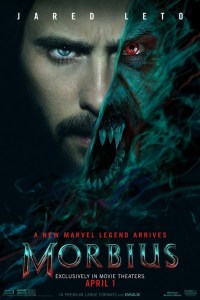 Not the train wreck the advertising made it seem, Morbius is merely a bland superhero retread that reminded me of the early 2000s superhero output like Daredevil and the Tim Story Fantastic Four. Having been delayed almost two years thanks to COVID-19, the film was released on April 1 for full unintended irony, and it’s a silly mess but also nothing worth getting too worked up over. Method actor extraordinaire Jared Leto (Suicide Squad) plays Dr. Michael Morbius who is suffering from a rare disease and finds a solution via a serum mixing vampire bat DNA but it has some consequences. He has super powers but needs to feast on blood every six hours and is dreading the point where he may not be able to resist the allure of feeding on humans. It’s a very Jekyll/Hyde concept, man trying to control his inner demons made literal, and once again we have a villain that essentially has the same powers as the hero. Matt Smith (Doctor Who) play’s Morbius’ childhood friend who also suffers from the same rare blood disease, but Dr. Morbius refused to share the cure because he explains it’s a “curse,” although maybe let the man suffering make that personal health choice. Bless you, Matt Smith, because you’re the only one having any fun with this movie, and that includes in the audience. Leto is actually fine though not much about the Morbius character is really imparted. The action sequences are erratic and the stylistic flourishes, like the “look at me” slow-mo ramps and the inexplicable wispy colorful smoke clouds trailing Morbius in action, hamper the ability to even discern what is happening onscreen. Maybe that’s on purpose after two years delay. The movie establishes a basic structure, series of goals, antagonist, and problems efficiently enough to make it to the end credits after 90 minutes. It’s just that we’ve come to expect better from our super hero cinema by now. As a disposable monster B-movie, Morbius is okay. It’s not recognizably campy, it’s not so-bad-it’s-good, it’s just a generic origin story/Dr. Jekyll and Mr. Hyde territory with a lot of dropped subplots and subpar CGI. I have my serious doubts about Sony’s plan to hatch solo movies for all these different Spider-Man villains, and the creakiness of this plan is even more evident with their contrived post-credit scenes trying to awkwardly establish their retinue of villains to confront Spider-Man. Does Morbius know who Spider-Man even is? Morbius the movie and character just feels too half-hearted for anyone to care.
Nate’s Grade: C
Share this:

2000 Mules (2022)
 I swore I would be done with conservative filmmaker Dinesh D’Souza after 2020’s pseudo-documentary Trump Card, just as I also wrote that I was ready to be done with Donald Trump as president, and yet both have persisted and still pose a danger to the general public. Trump had been priming his voters to not trust any election outcome where he lost and now the Big Lie has become fundamental dogma for millions. 2000 Mules is intended to be D’Souza’s smoking gun, his proof that the election was stolen by nefarious Democrats and their cronies taking advantage of making absentee ballots easiest to access during a world-altering pandemic. D’Souza says he has amassed cellular data proving that ballots were stuffed into voting drop boxes, and these “mules” have been “trafficking” votes, and posits that 400,000 votes were invalid and tilted the presidency.
The entire rhetorical argument D’Souza and his co-conspirators have gathered amounts to a lot of, “Yeah, buddy, trust us on this,” when they’ve earned no such faith except for those who are already desperate for confirmation bias. D’Souza has built a lifetime of bad faith arguments, and anyone he brings on board to further his thesis statements is likewise to be dubiously trusted. True The Vote is listed as a “non-profit organization” about “voter integrity” when it’s really looking to restrict access to voting. They made the same baseless accusations after 2016’s election. The movie says we should trust this organization because they even helped solve a cold case murder by tracking cell phone data and contacting the Atlanta Bureau of Investigations. The problem with this noble claim is that True The Vote contacted Georgia officials two months AFTER they had already indicted two suspects for the 2021 murder of Secoriea Turner. You don’t get credit for solving a cold case that 1) wasn’t cold, and 2) where the police had already solved it. Should I get credit for reporting to the FBI that I know who’s responsible for Ted Bundy’s murders with my own evidence? True The Vote’s executive director, Catherine Engelbrecht, and board member, Gregg Phillips, are listed as executive producers, so I find it especially odd when, confronted by this discrepancy by NPR, Englerecht responded via email that her movie “did not have the benefit of full context.” Well, as an executive producer, and someone featured prominently on camera, would you not have the ability and say to provide that important context and clarity?
 D’Souza states, “Bold accusations require bold evidence,” although this has never stopped the man from making documentaries that make the most baseless of accusations and disingenuous conclusions, but 2000 Mules lacks the potency to support its claims. It doesn’t have security footage of people dumping tons of ballots, although D’Souza somehow says the data they do have is even better than video footage (“No no, this Tiger handheld game is way better than any Game Boy, grandson”). It doesn’t have any important testimony from people involved outside of True The Vote with the exception of one “whistleblower” who cannot go into accompanying details and speaks in racist generalities about Mexicans. Just because D’Souza and a few of his friends got together (Sebastian Gorka didn’t bring his Nazi medal) and talk about 400,000 false votes doesn’t make them magically appear from nothing. It’s always worth remembering that D’Souza was a convicted felon for campaign finance fraud before being pardoned by Trump after a movie courting his incalculable ego.
The only thing that D’Souza presents is assorted cellular data points that he wants to infer only nefarious conclusions. The technology for data pings is not that exact, according to several Associated Press reports, which means True The Vote cannot even be certain that these points of data are people dropping off ballots rather than simply standing ten to twenty feet away from the drop boxes. Nor can they tell if these data points aren’t cab drivers, election workers, or people that would frequent the area for work. Nor can they tell if these multiple data points aren’t merely people wearing multiple pieces of technology (phones, watch, tablet, laptops, etc.). The fact that the movie is purporting that it was busy around a space adjacent to a drop box is not exactly bold or revelatory when they were always intended to be placed in busy metro areas for better civic engagement. Never mind that ballot drop boxes have been utilized in Democrat and Republican-run states for decades and are tamper-proof. It’s the flimsiest of evidence blown to massive proportions that breaks down upon the most minimal dollop of intellectual scrutiny, but this is true of every dysfunctional D’Souza political polemic.
However, even if I was the most generous person in the world and took D’Souza’s assertions at face value, and again no human being should ever do this for their own mental and ethical well being, 2000 Mules falls apart because it’s not ever asserting that these ballots are phony. Even if someone was stuffing ballots, each one of these would be verified through a rigorous system of checks. Absentee ballots are tracked via signature and anyone can track their ballot online, which is what I did for my own 2020 absentee ballot. Casting extra ballots is really difficult when everything is finely tracked. One of the references True The Vote made to Georgia officials was investigated and found to be a man dropping off ballots for the rest of his family, completely legal under Georgia law. It is legal in 31 states for someone else to drop off your ballot for you even if they aren’t your family. All of this also assumes that anyone voting absentee would be voting for Biden over Trump, and while more Democratic voters did make use of the absentee process during a pandemic, to just assume absentee equals Democrat and thus equals untrustworthy is an escalating blend of bad faith.
 The votes have been counted, recounted, and in some states and counties recounted again and again, and yet Joe Biden still tops Donald Trump by seven million votes and still serves as president. Even if D’Souza’s incredulous account is true, and these people “trafficked ballots,” they would have been easily discovered and larger discrepancies would have been uncovered especially with so many partisans scouring for even the faintest hint of fraud. And yet, the scant cases of 2020 election fraud have been Republican voters trying to vote twice or vote for their relatives, living and dead (the call is coming from inside the house, True The Vote). According to the Associated Press, in the 2020 election there were fewer than 475 potential voter fraud cases in the six battleground states of Arizona, Georgia, Wisconsin, Pennsylvania, Nevada, and Michigan (out of a combined 25.5 million votes cast, being approximately .00002%). No matter how many times fraud is claimed, no matter how loud its champions get, it’s never verified in a statistically meaningful way. The Atlanta Journal-Constitution reported only finding four cases of dead people voting in Georgia, not the “thousands” that Donald Trump swore up and down had wrongly cost him the state. Trump’s own legal team had sixty chances in court to substantiate his claims of widespread voter fraud. It didn’t happen. True The Vote even told the Wisconsin legislature that they aren’t arguing the ballots were illegal, only that the process was somehow abused. So if the votes are legal then should not every legal vote be counted in free and fair elections? Where exactly is the controversy there? The controversy occurs when politicians, and bad actors, try to forge dubious claims about “protecting voting” by providing more obstacles between a voter and a ballot, less so protections after voting.
So in the end, what does D’Souza’s reportedly “explosive” “game-changing” “documentary” actually legitimately prove? It proves how easy misinformed organizations can buy consumer metadata. It proves that there were people around ballot drop boxes in cities. Or it proves that people exist in cities. It proves that D’Souza and his fellow bottom-scraping partisans will keep looking for any fig leaf, no matter how insignificant or made up, to still hold onto their quixotic claim that the 2020 election was stolen. It doesn’t matter that recounts have occurred and confirmed the totals, it doesn’t matter that these recount totals have been confirmed by Republican-led legislatures and committees, it’s become a defacto belief for over half of registered Republicans that the only way Donald Trump, an immensely unpopular president with a lifetime of self-serving bluster, could have lost the 2020 presidential election was because it must have been rigged. Somehow. This new Lost Cause is corrosive and becoming the purity test for Republicans seeking office. That’s why it’s important to rebut obvious falsehoods that undermine the integrity of our elections.
 2000 Mules has no real experts, no real smoking guns, no real legitimate evidence beyond purchased cell data it has extrapolated into grossly malicious conclusions. Even by D’Souza’s ridiculously low standards, there just isn’t any merit to his phony points. That’s because this man isn’t formulating a real-world argument. This is an alternate world argument for people living in bubbles of confirmation bias delusion. But that’s always been this man’s audience and he knows it. There’s no persuasive points here to convince anyone outside the circle of election deniers. D’Souza’s round table of pals, including Charlie Kirk and Dennis Prager, has Kirk saying, “Millions of Americans know something went wrong, and they have little pieces, and no one’s really put it together.” By the end of the movie, all of D’Souza’s friends have been amazingly convinced from his amazingly unconvincing evidence. Even Gorka says the 2020 election was the “perfect crime” because it “cannot be curated after it’s been committed.” So there you have it, folks. They don’t ever have to prove the fraud because it cannot be proven because it was so perfect, therefore there had to have been fraud all along. 2000 Mules is a deeply un-serious documentary about a serious subject for people willfully ignorant.
Nate’s Grade: F
[Update: Since the release of D’Souza’s movie, a Fulton County Superior Court judge ordered True the Vote to prove their evidence of voter fraud and to submit any witnesses or witness statements. They admitted they had no evidence. Funny how when it comes to court, and penalties of perjury and jail, all these “massive voter fraud” Kraken-conspiracy mongers eventually reveal they’re completely full of it. It’s all a money-making scam, folks. Wise up.]
Share this:

Doctor Strange in the Multiverse of Madness (2022)
 The first Doctor Strange is one of my favorite movies in the ever-expanding and incredibly popular Marvel Cinematic Universe (MCU). It was a visually audacious and imaginative sci-fi action movie that just had one standout set piece after another. The original director, Scott Derickson, departed over creative differences with the MCU brass, and having now seen Doctor Strange in the Multiverse of Madness, I might have the same stark differences of opinion.
Dr. Stephen Strange (Benedict Cumberbatch) is still nursing his regret over his former flame, Dr. Christine Palmer (Rachel McAdams), who is now getting married to another man. During their wedding reception, Strange helps a young woman being chased by a giant one-eyed monster. America Chavez (Xochitil Gomez) is from another universe and has the power to open portals to other dimensions. Unfortunately, she doesn’t know how to control these powers and they only seem to activate when she’s reached a level of fear. Strange protects America Chavez from a malevolent force that wants to gain her unique power and open the multiverse for conquest.

It’s been almost ten years since Sam Raimi directed a movie and Multiverse of Madness is at its best when it feels most like a Raimi picture. The man’s beginnings in low-budget horror comedy are still evident, and it’s that campy combination that entertained me the most in Multiverse of Madness. There are some creepy, goofy moments that definitely reminded me of Evil Dead 2 and Army of Darkness. If you’re not a fan of these heightened levels of horror that incorporate slapstick and camp, then you might roll your eyes and find these moments to be too goofy for the MCU. As much attention as this movie has gotten for being darker, which is a tad overblown, it’s also one of the goofier Marvel movies. The MCU has a relatively breezy, wiseacre sense of humor that can occasionally undercut some of its more serious or sentimental moments of drama, but with Multiverse of Madness, Raimi is inviting the audience to laugh and cringe in equal measure. A horror sequence where reflections are a vulnerable point has both laughs and creeps. It’s a different kind of tone for a Marvel movie, which propelled my entertainment level when it occurred. Raimi getting to play once again in the superhero sandbox and still retain his signature style and impulses, which is exactly what I would want from this man as a blockbuster filmmaker. I loved the match cuts of Wanda experiencing two different universes in one smooth camera move. I cackled when Doctor Strange took his final form for the finale, and how ridiculous it looked, and that screenwriter Michael Waldron (creator of Loki) set it up with Chekov’s corpse.
For a movie with “multiverse” in its title, we don’t really get much of an exploration of the alternate universes. The concept of a multiverse is mostly kept at a thematic level and as a delivery system for wishes. The villain views the prospect of a multiverse as their means of fulfilling a vision of their life that is unrealized in their present reality. Strange thinks of an alternate version of himself where he got the girl. Beyond these reflections, that’s really about it. We jump to about two alternate realms and the only real exploration we have is that, hey, in this version of the universe people walk on red lights. It’s a bit trifling considering that there are endless imaginative possibilities, some of which are showcased during some stylish visual transition sequences crashing through different realms. It feels far too small for a concept with boundless possibility. Strange was already in another multiverse movie six months earlier with 2021’s Spider-Man: No Way Home. That movie also explored the idea of second chances, redemption, and sacrifice but far better. For a better multiverse movie that really lets loose on the wild possibilities of alternate realities, as well as grounding the feats of imagination in relatable human drama enriched by its theme, see the amazing Everything Everywhere All At Once.

I’m not just disappointed because the movie doesn’t take full advantage of its plot possibility, it’s because what it settles for is so much more predictable and disposable as fan service. This current phase of the MCU is setting up a dilemma of multiverse proportions, so things are getting very expansive and their slate of Disney Plus TV series are becoming more incorporated into the direction they’re heading. The danger starts to become whether the entire process is becoming more and more specialized, insular, and directed for the most hardcore of hardcore fans, and whether or not such a heavy undertaking, across platforms and franchises, can be done well. Marvel has earned some faith from me with how they’ve handled their interconnected franchises and film universe, but my main complaint with 2010’s Iron Man 2 and 2015’s Age of Ultron was that they were spread too thin trying to set up other movies and offshoot franchises, so this still remains a danger. As the MCU gets more and more successful, and integrates more characters, this is always a risk, the balancing of the spinning plates, making the movies their own but fitting into a larger whole. With Multiverse of Madness, it feels like the mighty gears of the Marvel machine are a little too forceful and crushing for this endeavor. This doesn’t feel like an essential next chapter in Doctor Strange’s ongoing cinematic journey. The first film was already about him regretting what his life could have been, an expert surgeon, and learning to accept his new role as a sorcerer and ultimately sacrificing his ego and old sense of self. We’re running through the same motions this time but instead of lamenting he could have been a great surgeon he’s lamenting he could have gotten the girl. It’s again coming to terms with his personal regrets.
The other notable aspect of the multiverse is the inclusion of fun but diverting cameos that don’t so much as serve this story as provide winks and nods of what is down the line. I won’t spoil who shows up in the middle portion of the movie but there are a few alternate version characters and a few characters that have yet to be fully integrated in the MCU, meaning these early appearances also serve as confirmation of the intention to bring these characters, stories, and worlds into the ever-expanding reach of their storytelling. This sequence is best as throwaway fun and has some neat visual moments including a disturbing death played for effective gallows humor. Ultimately though, it’s meaningless because it’s one other universe of characters who only serve as reflections of the past and coming attractions for the future. Even the mid-credits sequence is just more of this (and it’s becoming a trend). It’s disposable fan service and no more meaningful than serving as a tacit promise of what’s to come.
But the biggest problem I have with Multiverse of Madness is also its biggest storyline, which concerns a certain character making a big villainous turn and becoming the primary antagonist. I was getting a lot of Game of Thrones season 8 vibes from this plotting insofar as the end result is not out of the question but it sure feels like we skipped a lot of necessary stops along the way. I won’t be able to go into greater detail without delving into spoilers, so dear reader now is the time to skip to the last paragraph if you wish to remain pure. I like the concept of a friend becoming a foe because we already have an investment in that relationship and therefore there’s more at stake with the fights and possible consequences. That’s the kind of drama that lends itself to heartache and tragedy. When it feels forced, that’s a tragedy of characterization.

I have to imagine that fans of Wanda Maximoff (Elizabeth Olsen) a.k.a. The Scarlet Witch are going to be let down from this movie’s calamitous turn of events. I wasn’t the biggest fan of the character prior to the WandaVision TV series, which I also found to be pastiche that wore thin before finally settling on what the show’s core would examine, the messy process of one woman dealing with her powerful grief. I liked that they didn’t excuse Wanda’s misdeeds, namely holding an entire town of people hostage to her reality-bending whims. However, by the end, the show had her come to terms with letting go of Vision and her fake life with him she had manifested. To then have her next film appearance revolve around her universe-destroying mission to get her fake kids back doesn’t just feel like backtracking, it feels like we’ve erased the character journey and growth from her TV series. If you hadn’t watched the series, then this villainous turn would feel especially jarring. The whole “You’re a monster’/”No, I’m a mother” hysterical villain lady is tiresome. This is why I was making the Game of Thrones season 8 comparisons. It’s cool to see Wanda fully unleashed and how formidable she can be, but it’s at the expense of wiping out her character’s growth for a single-minded crazy momma. It’s reductive. If she can assume the life of her multiverse self, why not just do that? Also, what’s the great urgency? Wanda wants to kill America Chavez and absorb her power so she can jump through multiverses. Why can’t she just wait a matter of months to allow America to learn how best to control her powers? The movie never explains why the villain can’t just work with her magic MacGuffin rather than kill her. And then it all comes to Wanda realizing, “Oh no, what have I become?” and allowing herself to die as penance for the hundreds if not thousands she has killed over the multiverses. It’s all just a rather dispiriting development and questionable end for a character that I feel deserved better.
Walking away from Doctor Strange in the Multiverse of Madness, I feel like there’s a better movie buried under everything (everywhere all at once). This movie was originally supposed to come out before Spider-Man: No Way Home, and America Chavez was the original reason for Spider-Man’s multiverse dilemma, but it was delayed because of COVID. Raimi has gone on record that they figured out the plot of the movie while filming and conceived of the ending halfway through the film shoot. That’s not a great place to be for creativity, but then again, neither is being the twenty-eighth film in an ongoing interconnected chain of franchises. I won’t harp on that too much because plenty other MCU movies have excelled under such conditions and requirements, but every now and then one of Marvel’s movies just feels like a sacrificial offering to the greater altar of the MCU’s need to keep progressing with its multiple projects. Doctor Strange in the Multiverse of Madness isn’t a good Doctor Strange sequel, it isn’t a good multiverse movie, and it could have even used a little more madness, as those were my favorite moments, excluding the sharp villainous turn. I’d consider this film in the bottom tier of the MCU, among the likes of Iron Man 2 and Age of Ultron, other similar altar offerings.
Nate’s Grade: C+
Share this:

Spider-Man (2002) [Review Re-View]
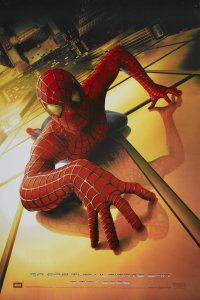 Originally released May 3, 2002:
Hollywood take note, Spider-Man is the prototype for a summer popcorn movie. It has all the necessary elements. It has exciting action, great effects used effectively, characters an audience can care for, a well toned story that gives shades of humanity to those onscreen, fine acting and proper and expert direction. I recommend movie execs take several note pads and go see Spider-Man (if they can get in one of the many sold out shows). What summer needs are more movies in the same vein as Spider-Man, and less Tomb Raider’s and Planet of the Apes.
Peter Parker (Tobey Maguire) is a dweebish photographer for his school yearbook clinging to the lowest rung of the popularity ladder. He lives with his loving Aunt and Uncle who treat him like a son. Peter has been smitten with girl-next-door Mary Jane Watson (Kirsten Dunst) ever since he can remember, but he’s been too timid to say anything.
At a field trip to the genetically altered spider place (there’s one in every town) Peter is snapping pictures when he is bitten by one of the eight-legged creatures. He thinks nothing of it and awakes the next day to a startling change. He has no need for his rimmed glasses anymore and has a physique that diet ads would kill for. He also discovers he can cling to surfaces, jump tall building in a single bound and shoot a sticky rope-like substance from his wrists. Hairs on his palms and shooting a sticky substance from his body? Hello puberty allusion! Peter tries to use his new abilities to win the girl and when that doesn’t work out he turns to profiting from them. He enters a wrestling contest in a homemade costume and proceeds to whup Randy Savage. Following the fight Peter’s Uncle Ben is dying after being involved in a car jacking Peter inadvertently let happen. Haunted by grief Peter becomes Spider-Man and swings from building to building as an amazing arachnid crime stopper.
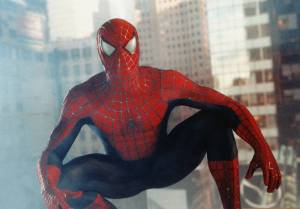 But every hero needs a villain, and that is personified in the Norman Osborn (Willem Dafoe), scientist and businessman. Osborn is experimenting with an aerial rocket glider and a dangerous growth serum. When the military threatens to cut his funding and shop elsewhere Osborn haphazardly undergoes the serum himself. What it creates is a duality of personalities; one is Norman, the other is a sinister and pragmatic one. The evil alter ego dons the glider and an exoskeleton suit and calls himself the Green Goblin. The Goblin destroys all that are in his way, and has his yellow eyes set on the pesky Spider-Man.
The casting of mopey-eyed indie actor Tobey Maguire over more commercial names like a DiCaprio or a Prinze Jr. (I shudder to think of a Freddie Prinze Jr. Spider-Man) left some people scratching their heads. Of course the casting of Mr. Mom to portray the Dark Knight likely got the same reaction in the 80s. Maguire plays the nerdish and nervous Peter Parker to a perfected awkwardness with his sensitive passivity. When he explores his new powers with exuberant abandon then begins crime fighting, we as an audience are with him every step of the way pulling for Peter.
Kirsten Dunst was also a surprising casting choice but works out very well. She allows the audience to fall for her along with Peter. Her chemistry with Maguire is great and could be a major reason why rumors have surfaced about the two leads taking the onscreen romance off screen.
Willem Dafoe is one of the creepiest actors in the business (though he made an effective creepy-free Jesus) and delves deliciously headfirst into the cackling menace of Spider-Man’s nemesis. Dafoe, with a face that looks like hardened silly putty and jutting rows of teeth, relishes every maniacal glare and endless evil grin. But instead of being one-note he adds certain amounts of sympathy and understanding as Norman Obsorn. No one could have done this role better than Dafoe.
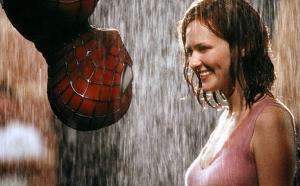 Director Sam Raimi was most known for his cult splatter house Evil Dead series, but he’s got a new resume topper now. Raimi was chosen over a field of directors because of his passion for the character and story. Raimi brings along integrity but with a joyous gluttony of spectacular action sequences. He expertly handles the action and daring-do all the while smoothly transitioning to the sweet love story. He has created the movie Spidey fans have been dreaming of for 40 years.
Spider-Man swings because of the respect the source material has been given, much like 2000’s X-Men. The story follows the exploits of the comic fairly well but has some stable legs of its own. The multitudes of characters are filled with life and roundness to them, as well as definite elements of humanity. You can feel the sweet romance budding between the two young stars, the tension and affection between Osborn and son, but also the struggle with Norman and his new sinister alter ego.We all know villains are the coolest part anyway. Isn’t that the only reason the last two Batman films were made?
There’s the occasional cheesy dialogue piece but there is that one standard groaner line. In X-Men it was Halle Berry’s query about what happens when lightening hits a toad. In Spider-Manit was the response to the Green Goblin’s offer to join him, to which he asked “Are you in or are you out?” (Obviously channeling George Clooney). The dreaded response: “You’re the one who’s out Goblin. Out of his mind!” Sigh. Maybe a well placed “freaking” before “mind” would have made the line better.
Spider-Man is the best kind of popcorn film: one that leaves me anxiously anticipating the sequel (which will come out two years to the day the first one was released).
Nate’s Grade: A-
——————————————————
WRITER REFLECTIONS 20 YEARS LATER
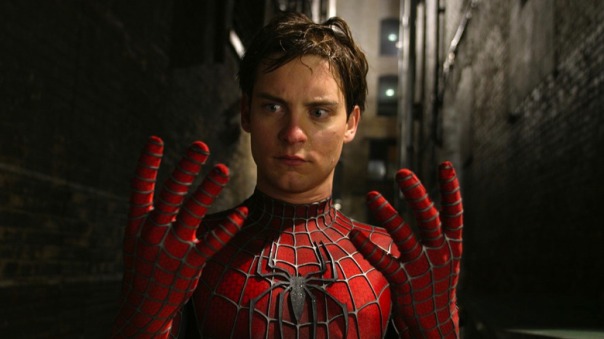
Twenty years ago, 2002’s Spider-Man changed the landscape of studio blockbusters. Since swinging into theaters twenty years ago, we’ve gone through three different actors playing three different Spider-Men in three different franchises, plus an Oscar-winning animated movie, and oodles of toys. If X-Men’s success in 2000 made Spider-Man possible, then Spider-Man’s record-breaking success, the first film to earn more than $100 million in a weekend, made the Marvel Cinematic Universe, the defining chain of blockbusters for our age, possible. X-Men provided a template and Spider-Man was the confirmation for those curious bean counters in studio offices. From there, it was a gold rush to secure their own superhero franchise. Universal launched Hulk. Fox launched Daredevil and the Fantastic Four. Warner Brothers started trying to reboot Batman and Superman again. It was an IP scramble and not every property proved worthy (see: 2004’s Catwoman, or better yet don’t see it). For better or worse, 2002’s Spider-Man ushered in the modern era of superhero mega blockbusters. Now with twenty years of hindsight and influence, it’s interesting to go back to the OG Spider-Man, especially after the nostalgic revisit with 2021’s Spider-Man: No Way Home, and see why this movie was so successful.
Created in 1962 by Steve Ditko and Stan Lee, the friendly neighborhood Spider-Man took a circuitous path toward big screen stardom. He had a popular cartoon in the 1970s, a cheesy U.S. tv show, and Lee even licensed the character into a 1978 television series in Japan that is well and truly insane. The main character is a racer injected with alien blood, from planet Spider no less, who leaps into a giant robot to fight giant monsters (it’s basically Power Rangers before Power Rangers). Legendary genre house Cannon Films bought the film rights and then sold them to Carolco, the studio killed by Cutthroat Island’s bombing in 1995. Carolco reached out to reported king of the (blockbuster) world James Cameron to rewrite an existing draft with Peter in college. He envisioned Edward Furlong as Perter Parker and Arnold Schwarzenegger as Doctor Octopus. Later, his new Spider-Man script was reset in high school, brought back in a previously absent Mary Jane, and involved Electro and Sandman as the primary villains, and apparently was going for an R-rating with language and an intended sex scene between Peter and Mary Jane on the Brooklyn Bridge, which brings into further question his organic web-shooting inclusion.
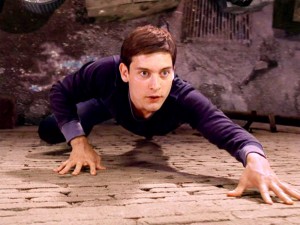 It all fell apart when it was revealed Carolco didn’t actually own the full rights to Spider-Man. After Carolco’s bankruptcy and the ensuing legal wrangling, Sony eventually ended up with the rights for a deal that is absolutely brutal in retrospect: a mere $7 million plus five percent of film grosses and half of merchandising. That’s it. For a character that earns over a literal billion dollars a year in merchandise even when there are no movies being released. As of this writing, No Way Home has made almost two billion dollars world-wide at the box-office.
Sam Raimi was picked as director because he was so passionate for the project, owning over 20,000 comic books and knowing the character and his universe inside and out. It’s not like Raimi was some schlub that Sony just drafted from the street in a contest either. The man was a genre visionary from the beginning with the chaotically kinetic Evil Dead movies. When the studios were unsure about tapping him for comic book movies, Raimi decided to make his own with 1991’s Darkman, a gloriously fun, weird, and gory Phantom of the Opera-esque action movie with Liam Neeson and Frances McDormand. After that, Raimi expanded his style by directing four very different movies in different genres (The Quick and the Dead, A Simple Plan, For Love of the Game, The Gift), and by that time the studios had come around to embracing Raimi as their trusted shepherd of coveted comic book IP. Director Chris Columbus also turned down the job first, instead opting for the Harry Potter cinematic universe. I don’t know if Spider-Man would have been as successful with anyone else at the helm. Let’s not pretend that the movie would have been a commercial failure with some other director attached (I’m sure, prior to Cutthroat Island, there was a very real chance of “Renny Harlan’s Spider-Man” – that’s right, the hits just keep on coming, Cutthroat Island). But Sam Raimi perfectly encapsulates the combination that has worked so well for other later superhero directors: passion and peculiarity.
Raimi is a first-rate visual stylist with the comedy of The Three Stooges, and I don’t mean this as a negative. He has a rare, instinctive sense, much like Cameron and Steven Spielberg, about what will play best on the big screen with a packed crowd, those kinds of blockbuster moments. The one thing you can say about any Raimi feature is that they are exploding with verve and energy. The man nailed a camera to a plank of wood and chased after Bruce Campbell in 1980, and he’s been running wild ever since. That gleeful, childlike sense of entertainment exists in a Raimi picture. His horror instincts and influences are readily apparent in his editing, tone, and setup, across all pictures and genres. Horror is such a precise genre, and Raimi knows the ins and outs of developing scares, tension, and payoffs, and he also knows that editing can make everything sing. A Raimi film might be more self-conscious with its antic camera angles, movements, and editing, but this man is a natural conductor of the chaos of moviemaking. He is a natural for big stages and has only made one movie for less than a hundred million in the last twenty years (2009’s throwback, Drag Me to Hell). It’s also a little disappointing that Raimi has only directed one movie in the last 13 years (2013’s failed franchise-starter, Oz: The Great and Powerful).
 Raimi’s movies also have a deep sense of humor, twisted and loony, not afraid to get gross or goofy. When I watched Drag Me to Hell, his first film after leaving Peter Parker’s orbit, I was busting a gut as often as my stomach was churning. Raimi’s Spider-Man 2 sequence where Doctor Octopus (Alfred Molina) awakens and his cybernetic arms slaughter the doctors has been repeatedly re-evaluated in social media circles as a nigh perfect sequence. Raimi isn’t afraid to veer to the edges of what is considered conventional; he’s not afraid to be goofy just as he’s not afraid to be sincere. This is a director who embraces his peculiarities but also has a reverence for visual storytelling and blockbusters. With the exception of Oz, I cannot recall a Raimi film that just felt like a slapdash work-for-hire job. The man has a signature style. It was what Marvel insisted they wanted when they hired him to direct the Doctor Strange sequel (now in theaters!). Finding auteurs with peculiar sensibilities, zany humor, and new ideas for studio projects is what has allowed directors such as Joss Whedon (Avengers), James Gunn (Guardians of the Galaxy), Taika Waititi (Thor: Ragnarok), and Jon Watts (the Tom Holland Spidey films) to flourish.
Revisiting OG Spider-Man, we have two more versions of this universe to compare with, three if you count the animated escapades of 2018’s Into the Spider-Verse, so some things just seem a little more quaint, like an old story from your childhood. Part of this is because the character and his lore have become as familiar in popular culture as Batman or Superman. That’s why the Holland version skipped the origin part of how Peter Parker got his super powers and lost his dear old dead Uncle Ben (just like we don’t need to ever see Batman’s parents die onscreen again). The first two Spider-Man films still hold up; I re-watched Spider-Man 2 shortly after 2017’s Homecoming to see which was the overall best Spider-Man film, and it was still very good. They’re earnest and cheesy but easily transporting and you feel the passion for those involved. Raimi clearly loves this character and wants you to love him as well, and we do. There are a few moments that just speak to the dated nature of culture from twenty years hence, like Peter Parker cracking an unfortunate homophobic joke about his wrestling opponent. The special effects are still strong throughout and benefit from Spider-Man’s costume lacking exposed skin. The action sequences are a bit tame and especially lacking compared to even later Spider-Man films.
Maguire might even be regarded as the least favorite Spider-Man actor at this time after the successful revamping of Andrew Garfield’s version from No Way Home. He stands out from Garfield and forever boyish Holland. He was 26 when he began playing Peter the high schooler. His prior indie film roles would make him seem more likely to be cast as a moody school shooter than as a clean-cut superhero (I guess it worked for Ezra Miller), and the fact that he pulled it off is a credit to both Maguire and Raimi. Maguire hasn’t been able to escape the long shadow of Spider-Man and he seems to be fine with that, having only appeared in one movie since 2014. The conniving celebrity poker player that Michael Cera played in Molly’s Game is believed to be Maguire in real life. Dunst was maligned throughout the original trilogy and you can clearly see her disinterest in the character. To her credit, this iteration of Mary Jane is fairly one-dimensional. She’s little more than the object of Peter’s desires and a damsel to be saved. Dunst has become a much more interesting actress after shedding the Spider-Man universe with Melancholia, season 2 of Fargo, and The Power of the Dog, earning her first Oscar nomination.
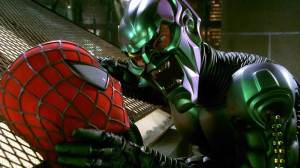 Dafoe had to beat out many actors for the role that seems perfected by him. Raimi intended for Billy Crudup (Almost Famous) to be his Norman Osbourn but the producers worried Crudup was too young to portray a middle-aged scientist. Dafoe’s normal face already resembles the Goblin mask. He demanded to do as many of his stunts as possible, and apparently he was a natural learner with the Green Goblin’s winged glider. Dafoe loved the part so much he begged Raimi to find ways to include him again even after his character died. I grew to love him even more after No Way Home reminded everyone of the mental anguish of Norman, a man torn apart by his demons. Dafoe is so maniacal and vulnerable and indispensable in this role. It’s no wonder they even bent space and time to have him generously visit us once more.
I was worried that my older review from 2002 was going to be overly flattering, gushing about what the filmmakers had gotten right and a little too pleased with results that haven’t aged as well with so many others running with what Raimi and company established. It’s still a solidly enjoyable movie that moves along at a steady pace and still finds time to have important character moments so that the quiet still matters paired with the spectacle. We’ve had a generation grow up with the Maguire Spider-Man trilogy and for many of us these early superhero films have a special place in our hearts. There’s a nostalgic factor. The first Spider-Man was more successful in creating an exciting kickoff than X-Men, though that film had bigger hurdles in adaptation, and it still has a lasting appeal at its core because of the skill and passion of the filmmakers involved. I’m very curious about revisiting 2007’s Spider-Man 3, where it all fell apart and seeing if it’s due some begrudging respect, though I doubt it (I know what I’ll be watching in 2027). Spider-Man is a little dated but still swings mighty high.
Re-View Grade: B+
Share this:

365 Days: This Day (2022)
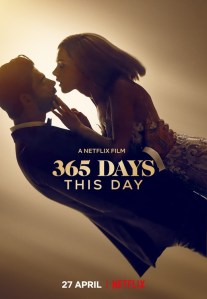 At this point, every viewer turning into 365 Days: This Day is doing so for very specific reasons: either for an erotic charge or morbid curiosity to see how bad this bad franchise can sink. The original film was a pandemic breakout for Netflix in 2020, reigning supreme as their number one movie for over a month internationally. It’s based on Polish writer Barbara Bialowas’ trilogy of best-selling erotic novels, clearly inspired from the successful Fifty Shades of Grey series, itself inspired from the Twilight series, the gift that keeps on giving. The first 365 Days got its name from its lead character being held captive by a mafia scion who just knew that this woman would fall in love with him during the time it took the Earth to revolve around the sun. This obviously problematic dynamic led many viewers to detest the movie and its depiction of romance where consent is definitely a concern, not that it would be the first Stockholm syndrome romance in cinema history. 365 Days was a hit explicitly for its explicit and off-putting aggressive sex scenes. Now that we have two sequels prepped, the question remains whether it can still maintain its performance or whether the franchise suffers from diminished returns. Simply put, this sequel isn’t as problematic as the first movie but it’s just as boring and possibly more pointless.
At the end of the first film, Laura (Anna-Maria Sieklucka) survived her tunnel attack but lost her pregnancy. She hasn’t told her jailer/boyfriend/now-husband Massimo (Michael Morrone) about the baby. They wed, they honeymoon, and she begins to resent feeling like a caged woman (oh lady, I thought that was what won you over?) and then she sees Massimo having sex with his ex-girlfriend. She runs away with Nacho (Simone Susinna), a hunky gardener with even more tattoos than Massimo. The new man whisks her away to his beachfront abode and says he only wants to protect her. Masismo is flummoxed trying to find the absentee Laura while a rival crime family schemes to take her out and make a move while Massimo is so torn and distracted.
 The first thing you’ll realize very early on in 365 Days: This Day is that there simply is not enough material here to cover almost two hours of running time. This movie is starched beyond the breaking point, and I’m not even making a pun here. There are twenty-two songs credited to this movie, and when a song plays, it’s not like some needle drop that only plays for a few seconds to impart a very specific impression. These songs are like full renditions. That’s why the movie often feels like a collection of music videos and luxury resort commercials. We’ll watch Laura and Massimo frolic on the beach, go horseback riding, and slinking into a bubble bath, all inter-cut together. If you just cut to an R&B group occasionally singing to the camera, it would all feel complete. Sometimes we are mere seconds between songs. Just as one is ending, another begins, and after 40 minutes of this, I began to question whether this was a deliberate creative decision by the filmmakers to limit the number of scenes relying upon the actors speaking. This is a blessing because both Sieklucka and Morrone have difficulty making the pseudo-smoldering dialogue sound right through broken English. There are lines like, “I can’t calm down, I’m Polish!” and Laura referring to her bedroom activities as “a sex.” The literal second line of dialogue is a reference to the bride not wearing any underwear. I think there might be 200 words spoken in this entire movie and a high percentage of them will make you groan or roll your eyes.
I have to devote an entire section to discussing the golf scene. You see, on their luxurious honeymoon, Massimo and Laura spend some time on the links but their kinky foreplay doesn’t take a break. She lays on the green, spreads her legs, and his grips his golf club (do you get it? do you get it?) and then literally putts a white ball across the green and between her open legs (do you get it? do you get it?). As it was happening onscreen, I joked to my girlfriend that it would follow this route, and sure enough, the filmmakers could not resist. It is the comedy high-point of the movie.
 It’s not like all these songs are soundtracking sequences of arched backs and heavy thrusting. There are even more music montages for luxury porn than for the soft-core porn. We watch Laura and her friend shop in luxury. We watch them drive in luxury. We watch them walk along the luxurious beach. We watch them jet ski in luxury. We watch them dine in luxury. This is why the majority of the first half of the movie feels like the raw footage from a commercial shoot for a getaway vacation. It’s padding upon padding because the characters of Massimo and Laura are wafer-thin. I was trying to even come up with adjectives to describe either lover, let alone full sentences, and my efforts sounded like a second grader trying to bluff their way through a book report. These characters are so boring that the movie won’t allow them to have any drawn out conversations because then the jig would be up. Even when Massimo confesses to having a brother he never toward Laura, this moment isn’t given extended time for her to interrogate. It’s off to the next shopping or driving montage with sun-dappled cinematography. This is also why the filmmakers have inserted a second couple for us to watch their own blossoming romance, but even this gets resolved so quickly with Massimo’s buddy proposing to Laura’s best pal Olga while they’re all still at the same honeymoon location. They’re supposed to be a distraction and they can’t keep our attention because it’s more characters without defining characteristics beyond their body parts.
The sex is put on hold for half of the movie (with the exception of an occasional frisky dream filling the gap, no pun intended) and 365 Days: This Day becomes a ridiculous soap opera. To fully detail the depths this movie resorts to I’ll need to go into spoilers, if that’s really a concern for you, like this movie is being watched for its storyline. The turning point of the film is when Laura catches Massimo fornicating with his ex BUT WAIT because that wasn’t Massimo but… his coke-addicted, twitchy identical twin brother, Adriano (Morrone is actually far more enjoyable in this dual part). He and the ex are scheming to drive Laura and Massimo apart and then kill them both. They’re being paid by the rival crime family that Nacho belongs to, being the son of the competing mafia boss. This overcooked drama reaches such absurdist heights that it ends on a Mexican standoff with the villains being gunned down, Laura getting shot badly in her abdomen, Massimo finally finding out about his lost child, and a question over where Nacho’s loyalty lies, possibly eliminating Massimo so he can have Laura to himself once and for all. This is like three seasons of soap opera storytelling crammed for the very end of what had otherwise been a ploddingly paced movie lacking needed plot events. Even this sequence is stretched thin by the inane cross-cutting from Laura in danger with Adriano to Massimo and Nacho walking down hallways in excessive slow-motion. I laughed out loud as we jumped from overcooked drama to languidly paced hall walking. The movie has the audacity to end on a cliffhanger, which I suppose also happened with the first movie. If you’re dying to find out what happens to these people in Part Three, I just feel sorry for you.
 While the sequel is less problematic over consent than 365 Days, it’s also more boring and tediously forced to draw out the weakest, basest of stories that was never meant to be more than a wish-fulfillment appeal to people’s baser impulses. I don’t want to shame anyone that finds this movie sexy or stimulating. Good for you; attraction is uniquely personal and your found yours. However, this series is making me re-evaluate the Fifty Shades of Grey movies, none of which were good but man at least they were better than this. All of this makes me think the next franchise, inspired by the international streaming success of 365 Days, will be even worse to make me re-evaluate the artistic accomplishment of this very boring, very dumb movie. It is a spiral that will never end and only make us sadder.
Nate’s Grade: D
Share this:

White Hot: The Rise & Fall of Ambercrombie & Fitch (2022)
 I don’t know if the superficial fashion company Ambercrombie & Fitch deserves a better expose but a superficial documentary now on Netflix feels like a nostalgia trip that trades in too many glancing, annoying generalities. White Hot: The Rise & Fall of Ambercrombie & Fitch feels like an extended segment from one of those old I Love the 90s specials that used to dominate VH1 where a group of talking heads chatted nostalgically about whatever pop culture bon mot of the past that deserved reverence or being forgotten. I think there could be a story here too. Ambercrombie’s success was built upon two men, both of them gay, creating a brand image basically around the kind of man they found most alluring and attractive: WASPy, muscular, young, and their idea of what it meant to be American (a.k.a. white frat boys). One of those men was closeted and mercurial, and the other was a prominent photographer who was also a predator, but both of these men were responsible for a largely heterosexual cultural landscape accepting their vision and wanting to match their personal preferences. There’s also a story about their wantonly discriminatory hiring practices, keeping minorities in the back or with overnight shifts, wanting to maintain their CEO’s image of people in stores, including hiring people based upon attraction (i.e. thin and white) and not even whether they could be a functional employee. However, director Alison Klayman, no stranger to documentaries that feel rushed and uninformative (Jagged, The Brink, Take Your Pills), would rather speed through an armada of interview talking heads for clipped sound bytes and vague explanations for what made Ambercrombie so popular and then stopped being so (“It was really cool… and then I guess it wasn’t”). The doc completely misses relevant subjects like the online shopping revolution, the decline of malls and mall culture, or anything of actual meaningful cultural contribution beyond the rise of social media. According to the movie, because of social media, more people have voices, I guess just forgetting there was an Internet beforehand. It is strange, by today’s standards, for a large fashion company to be willfully uninterested in its brand being more inclusive. By the end, the documentary even seems to sell a redemption story, so it doesn’t go far enough in its condemnation because that would get in the way of its nostalgia trip and would actually push the interview subjects to confront more of their own actions or inaction. Alas, White Hot is yesterday’s news without any lasting appeal or insight.
Nate’s Grade: C
Share this:

Human Nature (2002) [Review Re-View]
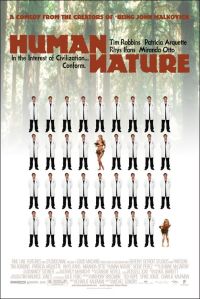 Originally released April 12, 2002:
Screenwriter Charlie Kaufman jumped on to Hollywood’s A-list when his feature debut Being John Malkovich was unleashed in 1999. Malkovich was a brilliant original satire on identity, be it celebrity or sexual, and was filled with riotous humor but also blended beautifully with a rich story that bordered on genius that longer it went. Now Kaufman tries his hand expounding at the meaning of civilization versus animal instinct in Human Nature. As one character tells another, “Just remember, don’t do whatever your body is telling you to do and you’ll be fine.”
Lila (Patricia Arquette) is a woman burdened with excessive body hair ever since she was old enough for a training bra (with the younger version played by Disney’s Lizzie McGuire). Lila feels ashamed by her body and morbidly humiliated. She runs away to the forest to enjoy a life free from the critical eyes of other men. Here she can commune with nature and feel that she belongs.
 Nathan (Tim Robbins) is an anal retentive scientist obsessed with etiquette. As a young boy Nathan was sent to his room for picking the wrong fork to eat his meal with. He is now trying his best to teach mice table manners so he can prove that if etiquette can be taught to animals it can be ingrained toward humanity. Lila and Nathan become lovers when she ventures back into the city, eliminating her body hair for now, because of something infinitely in human nature – hormones. The two of them find a form of content, as neither had known the intimate touch of another human being.
“Puff” (Rhys Ifans) is a grown man living his life in the woods convinced by his father that he is an ape. One day while walking through the woods, Nathan and Lila discover the ape-man and have differing opinions on what should be done with him. Nathan is convinced that he should be brought into civilization and be taught the rules, etiquette, and things that make us “human.” It would also be his greatest experiment. Lila feels that he should maintain his freedom and live as he does in nature, how he feels he should.
What follows is a bizarre love triangle over the reeducation of “Puff,” as Nathan’s slinky French assistant Gabrielle (Miranda Otto) names him. Lila is torn over the treatment of Puff and also her own society induced shame of her abundant amount of body hair. Nathan feels like he is saving Puff from his wayward primal urges, as he himself becomes a victim of them when he starts having an affair with Gabrielle. Puff, as he tells a congressional committee, was playing their game so he could find some action and “get a piece of that.”
 Kaufman has written a movie in the same vein as Being John Malkovich but missing the pathos and, sadly, the humor. Human Nature tries too hard to be funny and isn’t nearly as funny as it thinks it is. Many quirky elements are thrown out but don’t have the same sticking power as Kaufman’s previous film. It’s a fine line between being quirky just for quirky’s sake (like the atrocious Gummo) and turning quirky into something fantastic (like Rushmore or Raising Arizona). Human Nature is too quirky for its own good without having the balance of substance to enhance the weirdness further. There are many interesting parts to this story but as a whole they don’t ever seriously gel.
Debut director Michel Gondry cut his teeth in the realm of MTV making surreal videos for Bjork and others (including the Lego animated one for The White Stripes). He also has done numerous commercials, most infamously the creepy-as-all-hell singing navels Levi ad. Gondry does have a vision, and that vision is “Copy What Spike Jonze Did as Best as Possible.” Gondry’s direction never really registers, except for some attractive time shifts, but feels more like a rehash of Jonze’s work on, yep you guessed it, Being John Malkovich.
Arquette and Robbins do fine jobs in their roles with Arquette given a bit more, dare I say it, humanity. Her Lila is trapped between knowing what is true to herself and fitting into a society that tells her that it’s unhealthy and wrong. Ifans has fun with his character and lets it show. The acting in Human Nature is never really the problem.
While Human Nature is certainly an interesting film (hey it has Arquette singing a song in the buff and Rosie Perez as an electrologist) but the sum of its whole is lacking. It’s unfair to keep comparing it to the earlier Malkovich but the film is trying too hard to emulate what made that movie so successful. Human Nature just doesn’t have the gravity that could turn a quirky film into a brilliant one.
Nate’s Grade: C+
——————————————————
WRITER REFLECTIONS 20 YEARS LATER

I’m at a loss with 2002’s Human Nature. I thought in the ensuing twenty years I would have more to say with coming back to the early burst of brilliant writer Charlie Kaufman in the immediate wake of his successful debut, 1999’s Being John Malkovich. 2002 was a big year for Kaufman; he had three movies released that he wrote, all of them wildly different. His best work was Adaptation, a reteaming with Malkovich’s Oscar-nominated director Spike Jonze, that earned Chris Cooper a Best Supporting Actor Oscar and Kaufman was close to winning for Best Original Screenplay and sharing the honor with his pretend twin brother, the both of whom were portrayed by Nicolas Cage. It was the most challenging and creative and fulfilling of the three. There was also Confessions of a Dangerous Mind, the debut for George Clooney as a director, was a lark of a movie, taking Gong Show host Chuck Barris’ “unauthorized autobiography” where he claimed he was doubling as a CIA black ops hitman. I recently re-watched this one months ago and my opinion even lowered because there’s nothing to the movie beyond the central irony of the unexpected reality of this unexpected man being a spy and assassin. There’s no real insight into Barris as a character and he comes across as scummy and unworthy of a big screen examination. It’s a story that only exists to be ironic and missing the messy humanity and pathos of Kaufman’s best.
But Kaufman’s most forgotten movie in his screenwriting career is definitely Human Nature, the debut film for Michel Gondry, one of Kaufman’s other collaborators along with Jonze, both men having gained great acclaim for eclectic and visionary and just plain weird music videos. It follows three main characters, each debriefing their tale to an audience. Lila (Patricia Arquette) is accused of murder and discussing her lifelong malady of growing intense amounts of body hair, enough so that she worked as a gorilla woman in a circus sideshow. Puff (Rhys Ifans) is a man raised in the wild who intended to be an ape and returned to society, been trained in etiquette, and become an example of the transformative power of civilization. Dr. Nathan Bronfman (Tim Robbins) is telling his story after death with a bullet hole in the middle of his pasty forehead, as the scientist who found Puff, trained him, and romanced Lila before cheating on her with his French assistant (Miranda Otto). Immediately, the movie presents questions for us to unpack: how did Nathan die? Who was really responsible? What will be the connections between these three very different characters? Then there are assorted kooky side characters that come in and out, but the focus is mostly on this trio, perhaps a foursome with Otto, and the shame is that there is only one really interesting character among them.
Lila is the only protagonist worth following. She feels like a freak, even served in a “freak show,” and must hide her secret from lovers who would object to her untamed mane. She’s vulnerable and hopeful but pressured to conform to be accepted, and her journey to radical self-acceptance would have been an entertaining movie all on its own. However, by fragmenting the narrative with Puff and Nathan, she gets far less attention and her story becomes, for far too long, just her willfully sublimating herself to Nathan’s standards of beauty. Lila frustratingly feels like a character furiously trying to do whatever she can to keep the affections of a bad man. It’s reductive to the movie’s most interesting character. Puff and Nathan, in contrast, just feel like ideas, opposite poles in a discussion over the differences between animal instinct and the ideals of human civilization in all its hypocritical splendor. Even though both men are given comic-tragic back-stories, neither is really a richly defined character. Puff is all impulses and his urges become a tiresome comic device when we watch him hump somebody or something for the eightieth time. Nathan’s preoccupation with social niceties is meant to be absurd (teaching table manners to mice?) and petty, a meaningless articulation of “high culture and values.” I did laugh out loud when Nathan was teaching Puff how to respond at the opera, complete with a constructed box seat. Nathan is a satirical punching bag for a bourgeois sensibility. Neither him nor Puff feel like characters, instead more like conflicting points of view of humanity.
 The other disappointing aspect to Human Nature is as I declared in 2002, it feels like quirky for quirky’s sake screenwriting. Kaufman has become a screenwriting legend and he’s able to marry absurd, bizarre, and dangerous elements into meaningful and subversive and satirical masterstrokes, but the man cannot be expected to perform at the highest heights every time. Human Nature is stuffed full of wacky moments and wacky characters and it doesn’t feel like it ever amounts to more than the sum of its transitory parts. In contrast, 2022’s Everything Everywhere All At Once is an example of how one can take the most bizarre ideas and still find ways to tie them back in meaningful ways that braid into the larger theme. However, much of Human Nature feels like a quirk dartboard being hit over and over, a catalog of strange visuals and goofy ideas (Lila breaks out into song!) that fails to coalesce into a larger thesis like an Adaptation or an Eternal Sunshine of the Spotless Mind or the vastly underrated Synecdoche, New York, Kaufman’s directorial debut. He’s a master of the idiosyncratic, but Human Nature suffers because ultimately what does it have to say? Puff is set up for ridicule. Nathan is set up for ridicule. Even Lila is set up, though for murder. In the end, when Puff returns to the wild in a public galivanting that feels like a ceremonial bon voyage from the society that came to love him, he then scampers out of the woods and escapes back to the comforts of society with Nathan’s French mistress. In the end, is the point that we’re all rubes and hypocrites?
This was Gondry’s first film and it feels like a training vehicle for what would be his real masterpiece, 2004’s Eternal Sunshine of the Spotless Mind, one of my favorite films ever. Gondry’s style is still recognizable, especially reminiscent of his tactile, kitschy, avant garde music videos he directed for Bjork, the queen of weird 1990s music videos. Gondry’s hardscrabble, idiosyncratic style was a natural match with Kaufman’s vivid imagination. It’s surprising that they never reunited after Eternal Sunshine. Gondry had a few movies (2006’s The Science of Sleep, 2008’s Be Kind Rewind) but they felt lacking, trifling without a stronger writer to guide and ground them in human drama. Gondry even tried his hand at studio action to middling results with 2010’s The Green Hornet. He mostly retreated back to music videos and commercials and had a short lived series on Showtime with Jim Carrey as a former children’s TV entertainer whose fantasy is blending with reality. It seemed like a good fit for Gondry, and a nice starring role for Carrey, but it was canceled after two seasons. Even the realm of music videos seems so far removed now, where Hollywood was snatching up every visual virtuoso.
Human Nature has plenty of familiar faces, no doubt eager to attach their names to a daring Kaufman movie. Arquette is winning and the best part of the movie. She would later win an Academy Award for her decade-in-the-making performance in Richard Linklater’s Boyhood. Now I enjoy her in a chilly, villainous role as the shady corporate boss on Apple TV’s stunning sci-fi satire, Severance. Robbins is officious to a fault here. He too would later win an Oscar for 2003’s Mystic River. Poor Ifans, so big after his scene-stealing role in 1999’s Notting Hill, who never seemed to capitalize on his success (even his Spider-Man villain got the weakest treatment in No Way Home). He’s had a long career and prominent TV roles with Berlin Station and the Game of Thrones prequel series, House of the Dragon. I did laugh out loud at his “yahoo” after being zapped by his electric shock collar. You’ll also see Rosie Perez, Peter Dinklage, Robert Forster, Toby Huss, Hillary Duff, and Mary Kay Place. As I said in 2002, acting is not the problem with Human Nature. It’s the writing and characterization that lets these people down.
I usually like to devote a paragraph to going back and re-evaluating my initial words from twenty years ago, but I agree with everything I wrote. Everything. That’s initially why I thought this would be a shorter review. What more am I going to say other than my initial opinion of this movie is the same opinion I have upon re-watching? With the distance, it’s even more clear to me that Human Nature is the weakest film of Kaufman’s career. Even a movie I didn’t really gel with, like 2020’s I’m Thinking of Ending Things, at least has a lot more ambition I can recognize. It’s a character study obfuscated with too much eccentric clutter but there’s still an artistic vision there, even if it didn’t work for me. Kaufman is too unique a voice to only have made three movies in the last 14 years, and it makes it even more frustrating when I don’t connect with his long-in-the-making projects. Human Nature is too limited in scope and characterization. It’s slightly interesting as a footnote to a great screenwriter but little more.
Re-Review Grade: C


 nathanzoebl
You must be logged in to post a comment.