Ghosted (2023)
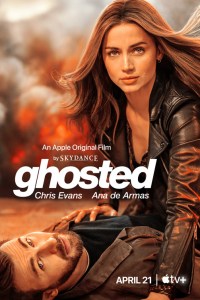
Have you ever watched a movie that felt like it was created by soulless robots? That was the overwhelming feeling I had with Ghosted, a supposed “romantic” “comedy” and spy thriller debuting on Apple Plus with big stars and a big budget and lacking anything that feels recognizably human. 2023 has been a year of exciting and precarious technological advances, and the emergence of A.I.-assisted chat and performative generators, from art to stories, is a Pandora’s Box that will not go away, especially for an industry looking to cut corners wherever possible to save a buck. Super producer Joe Russo has bleakly predicted it’s only a matter of time before studios lean into A.I. programs to help them write bankable screenplays. When that dark day arrives, if we haven’t already crossed that Rubicon, I imagine those A.I. ghostwritten scripts will feel a lot like Ghosted, a movie that feels like it was constructed from imperfect observers.
It all begins when boy meets girl at a farmer’s market. Cole (Chris Evans) refuses to sell a potted plant to Sadie (Ana de Armas) because her job keeps her away for up to months at a time. He cannot, in good conscience, sell this woman a plant he knows will be neglected. From there, they spend a whirlwind first date getting to know one another in and out of the bedroom. Then Sadie never returns Cole’s messages and calls again. He frets that he’s yet another modern dating victim of being ghosted when strange men kidnap him and ask him scary questions about things he has no clue about. He’s rescued from this interrogation by none other than a gun-toting Sadie. She reveals she’s really a secret C.I.A. agent and somehow her enemies have mistaken Cole for “The Tax Man,” a dangerous and mysterious assassin that’s actually Sadie. Now they’re on the run and Cole has to learn the ropes of spy business or else, and maybe he can get a second date while he’s at it.

The premise alone is a workable high-concept we’ve seen comedy variations of before, from Charade to Knight and Day to The Spy Who Dumped Me (remember that movie, anyone?). It’s the perspective of the novice being plunged into the chaotic and overwhelming world of spy-craft and having to rapidly adjust to a world they thought was just the stuff of movies and beach reads. It’s the kind of story that pokes fun at spy movies while embracing them as well, and it posits what would happen if one of us normies ever accidentally found ourselves in this high-stakes world. Where Ghosted doesn’t work is that the characters are both awful versions of the Novice and the Expert. There’s a slight amusement watching Evans plays out of his depth in action contexts, running counter to a decade of Marvel heroics, but this is short-lived. He eventually begins to be a capable partner for Sadie as she learns to trust another, which is the most expected and basic character arc for each of these people. However, Sadie is also boring, and even when the truth about her profession is revealed, it doesn’t make her that much more interesting. I was already doubtful when we opened with her talking to her therapist over her car’s phone and this was the first scene. She’s been slotted as Killing Machine with Trust Issues, and he’s been slotted as Too Afraid to Seek His Dreams, and so their conclusions are predictable and bland. There’s even a lack of a technique that Sadie teaches Cole that comes into play at a pivotal moment. That’s the most basic thing and they miss that.
There is also a notable absence of chemistry between the leads. While de Armas and Evans have co-starred in two prior films, they were opposed in 2019’s Knives Out and 2022’s The Grey Man. Actor chemistry is one of those ineffable qualities that you can tell pretty quickly whether it’s evident or lacking, and within minutes of the tortured house plant meet-cute, I sensed a gaping black hole of palpable chemistry. It’s even more obnoxious when MULTIPLE characters in MULTIPLE scenes implore the two to “get a room” because their supposed sexual tension is off the charts. Sure thing, movie.
Another quality that becomes very apparent is how forced everything in Ghosted feels. The romance feels forced but the comedy especially feels forced. The four screenwriters include the writers behind the Deadpool, Zombieland, Ant-Man, Spider-Man, and recent Jumanji movies, so we know these credited writers have a keen understanding of comedy. It makes the results on screen all the more mystifying and disappointing. The jokes generally feel off (“He expected a hottie not Mata Hari,” womp womp), the rhythm and tone feel a little too much, too forced, like the actors are desperately trying to compensate. It comes across like they were instructed to speak at a more fast-paced and clipped rate to attempt to emulate screwball comedy patter, but the material isn’t there to match the hyperactive verbal presentation. The music is also another factor in trying to better compensate. It’s trying to provide a jaunty, breezy energy level that isn’t sustained in the movie by its comedy, action, or romance. The number of needle drop song selections can also be insufferable and dumbfounding. The characters will start a gun fight and then “My Sharona” will crank up or, even more inexplicably, “Uptown Funk.” The relentless fallback of familiar pop and rock ditties intruding over the action doesn’t so much elevate the moment as make you realize just what would be missing without the song. I’m all for the clever use of music to jazz up a scene, but the final action sequence shouldn’t have to rely on Bruno Mars for any nascent fun.

There are a handful of moments and ideas here that could have worked in a better movie. I enjoyed a stretch in the middle where Sadie and Cole are ambushed by one bounty hunter with an absurd name after another, and each is a cameo from a familiar face and each gets dispatched swiftly. The movie also takes pains to make fun of Cole’s smothering qualities, including his snapping a picture of Sadie while she slept in his arms post-coitus and unaware. I wish this line of criticism would pick up more momentum but there’s only so much heat that Cole will take when he still needs to be the handsome and appealing lead. I also liked the idea of a villain, played by Adrien Brody like his copy of the screenplay didn’t have a single joke inside it, who is simply trying not to be revealed to be incompetent. I think there was especially more room to mine with the confusion over which character was the infamous Tax Man. The assumption that it must be a man could have opened up a broader and interesting subplot over sexist gender assumptions, with nobody believing that a g-g-g-girl could be such an accomplished trained killer (alas, the “girls can do it too” message seems to be all the movie offers in response).
Ghosted is not a good action movie, as it’s poorly sourced and edited, it’s not a good comedy, as the jokes are iffy and delivered in such an exaggerated and clunky manner, and it’s not a good romance, with two bland and under-developed genre character cliches portrayed by two actors who have a startling lack of chemistry together. The music is obnoxious and trying to compensate for the flagging energy level and forced comedy, the movie runs too long at almost two hours, and director Dexter Fletcher (Rocketman) has no feel for action or romance. It’s the comedy that made me most depressed, as no character talked like a semblance of a real human being, nor was their fast-paced, quippy dialogue truly zingy and entertaining. t was like watching a desperate person try and prove they are not, in fact desperate, but with every word only proving more and more their desperation. I’m sure some people out there will find this movie passably breezy or charming or at least inoffensive for two hours of inattention. It all felt so forced and inauthentic and tired to me. It’s best to just ghost this film in real life.
Nate’s Grade: C-
Share this:

Bulletproof Monk (2003) [Review Re-View]
 Originally released April 16, 2003:
This is one of the dumbest movies you will ever see. I don’t mean to sound overly sensational or alarmist, but this is the honest truth if you sit and watch all of Bulletproof Monk. Item #1: The bad guys in the film are –get this– the grandchildren of Nazis. Yes, that’s right, Nazis. We had to have Nazis as the bad guys. There’s actually a scene where a blonde-haired blue-eyed granddaughter wheels her decrepit Nazi grandpa around. Oh yeah, and one of the Nazis runs the –get this– Museum of Tolerance. Oh stop it, you’re killing me. Item #2: The titular monk (Chow-Yun Fat, pray for him) recruits pick-pocket Kar (Seann William Scott) to be his apprentice. Kar is an idiot. The Monk doesn’t help. His big mystery is –get this– why hot dogs and hot dog buns come in different numbers? Man, haven’t heard that one since the third grade. That would heartily explain why a character is called “Mr. Funktastic.” Item 3#: The monk teaches in stupid opposite talk (“You cannot be free until you have been taken. You cannot be cold until you are hot. You cannot die until you have lived,” you try some). One of the monk’s lessons is that the laws of physics, mind you the LAWS of physics, can be bent just by putting your mind to it. He says gravity can be overcome if you just don’t believe in it. This is insane. At least in The Matrix it had some plausibility. Item #4: The movie is a complete rip-off of The Matrix. I’m not just talking style, no, I’m talking everything. There is a scene where the monk and Kar run through a street and building, defying gravity, being chased by men in suits and sunglasses, and they get to a roof where they must combat a helicopter. What movie does this sound like, hmmm? Item #5: The visual effects are done by –get this– Burt Ward’s effects house. Yes, that’s right, the guy who played Robin on the campy 60s Batman show has an effects company. And they did the horrible work on Bulletproof Monk. This movie is so terrible at every level of filmmaking that it becomes enjoyable to watch, in the same vein as 2001’s stinker Dungeons and Dragons. I defy anyone to find merit in any of it. Sometimes you have to wonder what Hollywood was thinking.
Nate’s Grade: F
——————————————————
WRITER REFLECTIONS 20 YEARS LATER
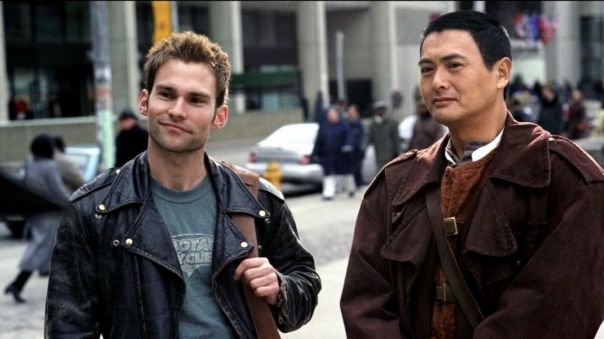
This is, without a doubt, one of the worst movies I have ever seen, and I was entertained for every bizarre, outlandish, and awful second of it. Bulletproof Monk is based on a comic book series but it’s really an incompetently designed and executed $50-million mock version of The Matrix. Within seconds of the movie, I was already laughing out loud, and I need to go into detail just for the first ten minutes, which I highly recommend to everyone as a taste setter. We open with two monks battling atop a rope bridge and, even accounting for the poor aging of special effects two decades later, it is some of the hokiest green screen I’ve ever seen. The way both characters leap, the way the movie haphazardly edits around the fight, the speedy levitating like a video game glitch, the duel spinning that goes on and on without orienting the audience, and then it all concludes with the apprentice grabbing the elder monk’s incongruous rubber sneaker before he falls. In just a short couple of minutes, we already have a clear indication what a mess this will be. Then the Nazis show up and kill the Tibetan monks and search for a mystical scroll that has the power to destroy all life on the planet, which is a good enough reason not to leave it easily accessible to Nazis. The lead Nazi massacres the monks with the exception of Chow Yun-Fat’s nameless monk who has just recently been dubbed the supreme monk in charge of scroll security. The main Nazi shoots him and the monk falls off a cliff, but not before the Nazi says “monk” a dozen times, including screaming it to the heavens to conclude the scene when he cannot find the fallen body. I defy anyone to watch and appreciate the opening on an intentional level.
The action goes from incomprehensible to boring. It’s the kind of movie where the bad guys will just show up with a helicopter with attached Gatling guns and fire into a warehouse even though there’s been no established reason they know our characters are inside or where inside they should start firing. It doesn’t matter because all the movie wants is a sudden burst of action with a vroom-vroom going pew-pew-pew until there’s a big boom. These same goons are also perhaps the dumbest hired goons in memory, as they’ll miraculously get the jump on our heroes, complete with helicopter action, but not check behind doors when coming onto a roof. There’s a moment where Sean William Scott is overpowering a man six inches taller than him and clearly with a hundred more pounds on him. This isn’t through some ingenious example of outsmarting the competition or using torque to your advantage, it’s just Scott out-pulling this guy, and this is before he even adopts the fantasy-blurring superpowers the monk will teach him.
The action scenes are all chopped up with jumbled edits. The choreography can be passable at points but seems to emphasize the exact wrong moments, like the duel spinning monks that twirl needlessly forever in the opening or Fat leaning forward and spinning around the floor while casually eating a bowl of noodles to clown Scott. It’s badly composed and badly edited. The action scenes are so silly and stupid and then you throw in the willful distortion of gravity because, as we’re told, physics are only real if you believe in them. The world of bending reality worked in The Matrix because reality was an illusion (or, as the Merovingian would say, “an eloooschean”) and a virtual reality setting where rules could be bent. What we’re entering here is a realm closer to 2008’s Wanted, where the tried-and-true laws of nature are merely suggestions, and all the cool kids can curve bullets if they really put their mind to it. It’s not like action movies don’t already exist in a heightened world of expectations and genre pyrotechnics, and then you add martial arts mysticism on top of it with wire-fu and we’re already stretching the bounds. I think what rubs me the wrong way thoroughly with Bulletproof Monk is how lazy it is. It’s not like this monk has some special power that allows him to overcome physics, some master knowledge that will educate his protégé. He just tells him that belief is stronger than physics, like this was a sentimental children’s movie about Santa Claus. If that’s the level of explanation that’s acceptable, it’s a bad sign how much more effort will be put into any storytelling or entertainment factor in this ridiculous mess.
Let’s also zero in on the apprentice character played by Scott, an actor I’ve generally enjoyed and who was hitting his commercial heights circa 2003. He plays Kar, though when the monk informs him that he is mispronouncing the Cantonese word for “family,” the American pickpocket brushes away the cultural correction from the native speaker. Here is a man who lives and works in an old Chinese movie theater with a crotchety old Japanese owner (Mako) and where he watches classic kung-fu movies and teaches himself martial arts. I suppose Kar could be a self-taught genius but he displays little dedication or skill beyond pickpocketing, which has always been a nagging movie cheat to me where people can just barely bump into you and magically gone inside your coat pocket and lifted a wallet all without your awareness. He’s the wise-cracking sidekick-slash-protégé learning about the wider world and breaking the rules, like Neo. Except he’s mostly obnoxious and useless, that is, whenever he isn’t inexplicably taking out professionally trained mercenaries with moves he learned from Bruce Lee marathons. Kar is not even an enjoyable annoying role for Scott like in 2003’s The Rundown.
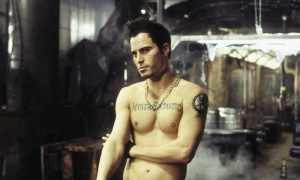
Another ridiculous character and storyline involves the leader of the underground street gang and his name is Mr. Funktastic. I know this because Marcus Jean Pirae (Girl Next) literally has “Mister Funktastic” tattooed on his bare chest (though it looks like he might be missing a well-placed “N” as well). He’s British and the leader of a gang of would-be street toughs and orphans, and it’s like the movie has dipped into something downright Dickensian, or maybe the 1991 Teenage Mutant Ninja Turtles movie. These guys are upset that Kar is stealing on their turf and challenge him to prove his mettle. I don’t know what this idiot character adds to this universe besides further making it incredulous. He and “his girl” even party in the underground raves in old subway cars, and all of this just makes me wonder what adults think goes on in subway systems. Oh, and that’s right, the female love interest is named Jade, played by Jaimie King (Sin City, Pearl Harbor), and this plays into one of the most stupid yet hyper specific ancient prophecies that tips off the monk to Kar’s potential. All you need to know about the supporting characters in this movie is that there are multiple generations of Nazis and they are running a Holocaust museum secretly to hold onto their trophies under the cover of enlightening the world about anti-Semitism and white supremacy.
Bulletproof Monk is the only movie directed by Paul Hunter, a respected music video director who has worked for decades and is responsible for Aaliyah’s “One in a Million,” Mariah Carey’s “Honey,” the “Lady Marmalade” remake from Moulin Rouge, and the unfortunately titled duet by Jay-Z and convicted rapist R. Kelly, “Guilty Until Proven Innocent.” This experience must have been so bad that Hunter swore off ever helming another feature-length movie again. The nature of music video direction attracts stylists, but this movie is so overburdened with trying to ape The Matrix on a scaled-down budget, with janky bullet-time effects and wire work (our heroes are even on the run from men in suits and sunglasses). The wire work doesn’t add grandeur and majesty to the movie because it doesn’t have the understanding of how to present it so that it looks cool; it always just seems goofy and inferior to better references. I think Hunter’s personal vision and style were just swallowed whole by the demands of making this silly movie, encroaching studio pressure, and it feels like he just gave up and the movie was benignly born by committee. I don’t blame Hunter for giving up on this movie and I guess on all movies.
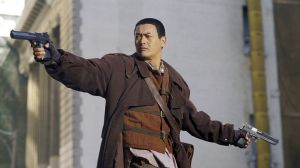
Can you enjoy Bulletproof Monk on a so-bad-it’s-good level? Do hotdogs come in packages of ten and hotdog buns come in packages of eight? The answer is an enthusiastic yes. This movie is ridiculous in every moment, only forming a somehow more ridiculous whole that defies not just the laws of physics but conventional storytelling and good taste. It’s a movie that has no idea what to do with Chow Yun-Fat and his abilities, instead coasting on the idea of the man’s involvement like the geezer teasers of recent memory that don’t so much challenge their famous stars as advertise they could afford them for a weekend or two of un-taxing demands. It’s a movie that begs to exist on a dumbed-down level of action movie junk science but doesn’t understand how to, properly, have fun within that setting. It’s so transparently indifferent or lazy or ripping off its many action/sci-fi inspirations, chiefly The Matrix. John Woo is a producer on the movie and it’s not hard to see how a Woo-directed Monk would have played to its outlandish peaks. Instead, everything is an inferior version of the better reference point. It’s silly and worthy of a night with friends, adult beverages, and lots of boorish and increasingly incoherent commentary.
Looking back at my initial review from 2003, I think my criticisms still hold but I would elevate the grade simply from its unintentional entertainment value. This is pure unintended camp, and as such Bulletproof Monk might be one of the worst movies I’ve watched and still undeserving of a failing grade, and so I will charitably raise it a letter to a D grade (on a curve, a bullet curve).
Nate’s Grade: D
Share this:

Three Quarters Dead (2023)

I don’t normally review short films but I was asked to by an Ohio filmmaker, and so I agreed to do my best in providing a review of a movie that runs a total of only seven minutes. Three Quarters Dead is the latest from writer/director Angelo Thomas, a rising Ohio filmmaker who already has two movies under his belt, The Incredible Jake Parker and the documentary, DeRosa: Life, Love & Art in Transition. Short films must still function under the same guiding rules as feature-length films: there needs to be a beginning, middle, and end; characters should be engaging; conflict should be clear and developed; and the audience needs a reason to care. Granted, you expect more from an 80-minute movie than an eight-minute movie but you’re still expecting the basics of story, character, and entertainment to land. Three Quarters Dead is a cute little movie that nibbles at the edges of some profound concepts but settles a little too quickly.
We begin at the end, well the end of Zach’s (Eric Six) life. He’s moved on from the mortal plane and wakes up inside a peculiar movie theater. There are only three other patrons sitting in attendance and two of them are skeletons. David (David Reid Hatfield) is the only other living patron, though perhaps that term doesn’t even qualify. He has a sickly, zombie-like pallor and prefers to munch on popcorn sprinkled with maggots. David serves as a guide for wayward spirits, helping them transfer to the Great Beyond outside the theater. Until then, they can sit and watch movies for possibly an eternity of downtime.
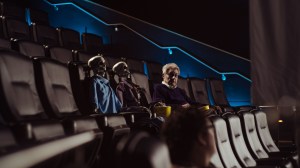
The premise of a movie theater as purgatory is a fun concept and has several areas to connect with the theological and philosophical aspects inherent in any life-after-death story. I liked the projectionist being the equivalent of God looking down from above, offering light and diversion while the mortals sit and wait for answers that might never come. I liked the idea that David has been here so long that he forgot who he is. He is literally deteriorating physically and mentally. The presence of skeletons implies that you can possibly rot away and never even make it to the other side (unless these are just for ambience). Whenever you present a fantasy setting, the audience is going to be keen to adjust to the rules and expectations of this abnormal setting. The premise begs plenty more questions. I was surprised at no point does the short imply what the souls are even watching. This would provide more material either for comedy, like complaining about being stuck watching only so many movies so many times, for character exploration, maybe the movies are chosen that have a specific meaning to each soul, or some melodramatic rumination, like the characters are watching home movies of their own life and its ups and downs, regrets but also the joys that fill the bounds of a life lived. Considering that Zach is revealed to have taken his own life (he even has the note still with him, though its words are not shared either), it would have been helpful to either shed more details about this unique space and its connections for our newcomer or the newcomer’s life that he’s bidding goodbye to. I was left with an unrequited desire for more than the story was willing to offer for its seven minutes.
The central metaphor of a movie theater as a supernatural setting is a good starting point. The script was a little too locked-in on the discovery period and needed more development. Zach is such a blank from a character standpoint, which is acceptable since he’s the audience’s entry point. He seems to emit no real strong emotions or defiance about his strange situation. This may be a result of just being overwhelmed by the sheer existence of another spiritual plane, or this could also be him trying to remember who he was when he was alive. The dynamic of New Guy/Veteran is a comedy staple, learning the ropes from the charming and wily veteran. It seems like a storytelling disadvantage to limit the knowledge base of both parties. We’ve just spent a few minutes with David when he learns that Zach will actually be his replacement. I wish this had been revealed upfront rather than reserved for an ending meant to provide some uplift and reward. We still could have had the same end results but now there would have been an immediate urgency, David only having so many minutes (maybe even make it real-time) to teach his replacement the ropes before he gets recalled to that Great Beyond. If Zach is taking on this new responsibility, you would think he’d need to understand how exactly he’s supposed to help souls transition.

The movie is technically polished and has a nice score from Brooks Leibee (DeRosa). The shot selections are somewhat minimal, likely a result of budgetary time limits, but it also makes the movie visually staid. Many of the edits are simply from two shots from the same angle. It’s efficient but can also be bland over time. Also, I’m surprised there wasn’t a godlike point of view shot from the projectionist booth, at least a high angle looking down from above, but that might have given away the fact that nothing was actually on the screen during filming. The makeup effects for David are simple but effective and do well to assist the actor’s mordant performance.
I enjoyed both actors, though Hatfield (Dogwood Pass, Quarantwinned) has the more fun role as the decrepit veteran teaching us all about this unique space. He gives glimpses of even more honed comedic skills that I wish the short could have utilized. Six (Christmas Collision) is given the less fun role of being responsive but the character is so subdued that he can feel like a proverbial and literal seat-filler. I liked the two actors together and wished their interaction had a bit more energy to it.
Three Quarters Dead is an amusing and light-hearted short even as it skirts over some more meaningful and darker material. It’s a promising idea with more intriguing directions that are unexplored. Partly because of the limits of short-form storytelling but also partly because the concept just wasn’t creatively pushed further. It’s a quick seven minutes that elicits some smiles and maybe even a chuckle (I enjoyed the quarters classification of its title). You won’t regret watching it, and trust me, I’ve watched dozens of short films that I do very much regret ever having seen. Even with a few precious minutes, bad filmmaking and a paucity of coherent ideas can become most evident. Three Quarters Dead is a fun little horror comedy that coasts on charm, good vibes, and the tantalizing possibility of more, but like the characters trapped inside that theater, you’ll be left waiting.
Nate’s Grade: B-
Share this:

John Wick Chapter 4 (2023)
 As many of you are well aware, I believe great action can be some of the highest cinematic highs one can experience through the transporting thrill of the movies. It’s the larger-than-life quality, the symbiosis of so many tactical teams working in harmony to pull off the breakneck stunts, rapidly escalating stakes, and organic story complications, that it all feels like the best kind of magic trick. For my money, Mad Max: Fury Road is closer to the pinnacle of the artform than a majority of self-serious Oscar bait drivel. In many ways, musicals are very similar to action movies, as fight choreography is nothing more than a rehearsed dance between professionals. Both must incorporate geography, spacing, and interaction to maximize their appeal. It is from this perspective that I approach the John Wick franchise, a series that I have enjoyed and has gotten more popular with every new entry. John Wick: Chapter 4 is about as action-packed as they come, running at nearly three hours long. I purposely waited and saw the movie with my father, a fellow lifelong lover of big screen action and particularly Fury Road. We both had a blast, and rather than write a review of exclamatory nonsense, I thought I’d look over some of my finer critical points with 2019’s John Wick 3 and analyze how 4 excels beyond.
John Wick (Keanu Reeves) is a legendary assassin in a world where I think half the population are secretly, or not so secretly, trained assassins. I have to think the union collective bargaining negotiations are brutal. Regardless, John has been on the run ever since he upset the High Table, the cloak-and-dagger authority over this clandestine universe. He’s had a bounty on his head getting larger and larger with every foiled assassination, and there have been hundreds at this point. To finally clear his name, John plans on challenging the Marquis (Bill Skarsgard), the new controlling High Table member who is un-sanctioning every international hotel that gives refuge to Wick. The old rules state that Wick can challenge the Marquis to a duel, but getting to the actual dueling site might be murder.
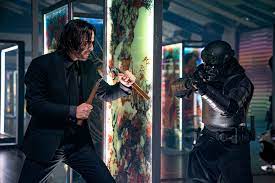 As I wrote in 2019: “Most other action movies have one or two moments that make you wince or make you shake your head in astonishment of something intense, gnarly, or self-evidently awesome. John Wick 3 is packed with these moments… For action fans, the John Wick series is a simplified adrenaline shot where the director and star are working in unison to compose goose bump-triggering action cinema for the masses.”
This compliment is still applicable because the lasting draw of the John Wick franchise has always been its highly polished and intense action sequences. Series director Chad Stahelski has an intimate understanding of his star’s physical capabilities, having served as Reeves stunt double for years, and he and his team stress the fidelity of visceral realism with their overtly preposterous movie. The action is displayed in long takes, wide shots, and gloriously accessible visual arrangements to allow the audience to truly enjoy the splendor of the moment. This philosophy stretches to car chases, like an exciting roundabout of the Arc de Triomphe making bodies fly through the air, and even horseback chases, like an opening evoking Lawrence of Arabia. There were several moments that made me giggle in giddiness, like a woman relentlessly stabbing a man she rode piggyback up the stairs, and a sustained high angle where Wick clears room after room of baddies with fiery canisters that turn each target into a burst of flames, and a fight ascending many flights of stairs that has echoes of Wile E. Coyote slapstick. If you are a lover of action, these movies will not disappoint in that department. The movie takes about 30-40 minutes to set up its stakes and goals, and from there it’s relentless. The best compliment I can give is that Chapter 4 did not feel like three hours because it just flew by for me.
This is where my small criticisms of 2019’s third entry began, and I’ll address them one-by-one: “Because the movie rarely catches its collective breath, it can also feel like a mindless video game, with each new location a new level and with innumerable, faceless cohorts rushing in to be battled. The violence can be brutal but also feel a bit programmed, lacking some of the visceral dynamic realism of The Raid movies, the closest equivalent action franchise.”
 This was a concern I was beginning to notice with Chapter 3, that the movies were in danger of becoming repetitive as Wick clears room after room of opponents. In general, that is the plot of all four movies, so the emphasis needs to be on how each sequence differentiates itself. Chapter 4 does this very well by giving every sequence its own underlying identity. This can be through unique locations or even weapon preference. One sequence is entirely John battling with nunchucks. One sequence is John fighting through a rainy Berlin club that becomes an ax fight. There’s a fight that utilizes well-placed doorbells to cue a blind swordsman Caine (Donnie Yen). The change in locations also helps differentiate the action sequences, with trips to Osaka, Berlin, and finally Paris each adding their own style. It’s a lot more fun to change things up and make sure that the change in scenery, weapon preference, and character is incorporated into the fight.
Another undervalued aspect of the Wick franchise is how damn good looking these movies are. Stahelski can frame some beautifully lit sequences to make all the subsequent carnage and fisticuffs that much more pleasing. We’ve been settling for far less for far too long, folks. There’s no reason our grungy, dank, overly gray action movies cannot look as pristine and striking as the John Wick series.
I also wrote in 2019: “The further and further we get from the events of the original John Wick, the less emotional involvement the series seems to ingratiate, especially with its central baddies onscreen. Every dog-loving audience member was willing Wick to get his vengeance in the first movie. We wanted him to get the bad guy in the sequel. Now it’s basically wave after wave of hired guns that he has to defeat, and without a better connection to that opposing force, the movie franchise runs the risk of losing any long standing personal stakes. The bad guys are just interchangeable and only present to be dispatched. There’s no emotional victory or satisfaction for the audience if Bad Guy #12 gets toppled by the climax.”
 I was beginning to worry that by the time of John Wick 12 he would have killed the entire world’s population and forgotten it all started because of one dog. It’s not that story is the preeminent feature of the Wick franchise but there is more thought and curiosity put into this world building and it would be a shame to ignore it simply for wall-to-wall violence. Fortunately, I think Chapter 4 does the best about introducing new and engaging characters. The John Wick series has introduced new faces but rarely do they seem like more than overly glorified NPCs meant to root for John or take stock of the current predicament (they’ve never found a meaningful use of Laurence Fishburne). With Chapter 4, the new characters actually matter, and they’re great. The best addition is Caine, made even more intriguing by being a blind assassin and made even more fantastic through the performance of Yen (Rogue One, Ip Man). He’s a friend to John and feels great guilt about trying to kill him (his daughter’s life is threatened as leverage). He’s a conflicted killer, the rueful warrior, and his disability makes every fight worthy of watching how exactly he’ll take down his next opponent. It’s enough that I could foresee a Caine spinoff if the fortunes of the universe demand even more Wick spinoffs (Ballerina, a spinoff starring Ana de Armas, is expected to be released summer 2024).
The other new characters are also strong. Skarsgard (It) makes a great hiss-able villain and he really eats up his French dandy accent. There’s also Mr. Nobody (Shamier Anderson) who spies from afar, biding his time until the bounty on Wick gets high enough. He has a dog too that is trained to attack men in a very vulnerable spot first. Then there’s Scott Adkins (Ip Man 3) in perhaps the performance of his career. He gets to slather on makeup, a fat suit, false teeth, and really becomes a broad character, a German crime lord but more a menacing fairy tale behemoth. The way Adkins relishes every syllable is a delight. The man isn’t known much for his acting, other than his finely honed martial arts skills, but he showcases plenty of potential if given a chance. It’s fun to watch all these martial arts experts cut loose, most in their middle age. Recording artist Rina Sawayama makes a killer acting debut as the concierge of the Osaka Continental hotel, and she wreaks havoc with a bow and arrow and some intense knife work.
Because of having more interesting characters meaningfully involved, including those who have a familial history with John Wick, it brings a new emotional stakes to the franchise because we don’t know what will happen to these new faces. I cared enough to be newly invested.
 And lastly, in 2019, I concluded with: “I’ll happily continue watching further adventures of John Wick, though I’d be just as interested in an exploration of the world without its titular star. At some point it may be necessary to retire John Wick (Reeves seems to have lost a step, but he’s still like a hundred steps beyond most of us) and when they do, I hope this interesting and peculiar world is allowed to house further weird and exciting adventures.”
By the end of Chapter 4, you question whether this universe can exist beyond the bloodshed of Mr. Wick, and my answer would be yes. A Continental TV series is premiering in the fall on Peacock, taking place in the 1970s with younger versions of Winston (Ian McShane) and Charon (the late Lance Reddick). There’s at least one spinoff in the works I’ve mentioned earlier. It very much appears that Reeves and Stahelski intended for Chapter 4 to be the definite conclusion to their story they began in 2014. I doubt things will stay that way, especially with Chapter 4 becoming the biggest earner in the franchise. I would suspect the studio would be begging for a Chapter 5. Regardless, if this is the intended series finale, then Reeves and Stahelski have gone out on top. John Wick: Chapter 4 is action movie nirvana.
Nate’s Grade: A-
Share this:

65 (2023)
 It’s a movie about Adam Driver as a spaceman fighting dinosaurs. What could go wrong? 65 (as in 65 million Years Ago) is a sci-fi action thriller with a ripe concept overworked by blockheaded studio notes that mitigate its potential and engagement. I was initially intrigued because it was the directorial debut of the writers of A Quiet Place, Scott Beck and Bryan Woods. That 2018 movie was a masterful genre exercise, though director John Krasinski was also a key contributor and rewrote their initial script. First off, I don’t know why this movie makes the decision to have Driver from an advanced alien species that crash lands on a prehistoric Earth unless it was related to the eventual development of humans on this planet. The opening segment explains in text and then a “Dad, don’t go” flashback before jumping into the action of the crashing spaceship. Even the dramatically protracted title reveal (65…………. MILLION YEARS AGO!) makes little sense considering the timeline was conveyed earlier. It makes me think about studio execs questioning whether audiences would get it, so what follows is mostly a survivor story of surrogate father and surrogate daughter (Arianna Greenblatt). A lot of our emotional involvement hinges on this relationship and I don’t think it carries the film. There’s a language barrier with the little kid, which is an interesting complication for their cooperation, but it also means Driver’s absent father is projecting a whole lot onto this little kid as if she were his daughter. The central relationship is serviceable but unremarkable, which could also suffice for discussing 65 as a whole. Driver trying to escape from a dinosaur territory dispute could have been plenty for survivor thrills, plus with little Predator-style advanced weapons to even the playing field of man and beast. What I didn’t need was a literal apocalyptic final act where Driver and the kid must not only survive dinosaurs but get off-planet before the big dinosaur-killing meteor strikes. It’s excessive bombast that feels tacked-on, like studio execs worried that dinosaurs by themselves would be boring. 65 is loud and obvious and only 90 minutes, and that can be enough for escapist entertainment, but it squanders its bigger concept.
Nate’s Grade: C+
Share this:

Dungeons & Dragons: Honor Among Thieves (2023)
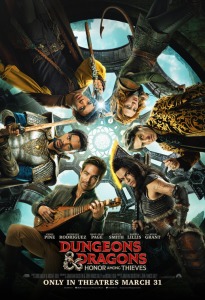 As required for every film critic before discussing the new Dungeons and Dragons movie, subtitled Honor Among Thieves, I must tell you my personal history with the seminal tabletop game. Well, I don’t think D&D is for me. Many of my friends are heavily involved in D&D, several as the quest-fashioning dungeon masters, and I’ve even sat in for a few games, but there’s something about the group improv experience that I never feel comfortable while playing, like my mind just runs into imagination roadblocks trying to come up with options in a near limitless space. Plus I think character creation is one of my lesser storytelling skills; I typically build characters more out of plot and concept and theme. Also, the demanding time commitment to play a game that can take possibly months or years to conclude makes me hesitant. I already think Monopoly lasts too long and has a habit of ruining friendships (if I was ever paid to write a Monopoly movie, that would be my starting point, not bringing to life Mr. Moneybags).
Anyway, D&D has had something of a cultural renaissance the last decade, reaching new levels of wider acceptance partly thanks to its prominent placement in Stranger Things. Pretty good for an ever-evolving 50-year-old game system that was at one point blamed for luring impressionable youth into the ways of Satanism and insanity (see the ridiculous 1982 movie Mazes and Monsters starring a young Tom Hanks as a student who cannot distinguish between reality and the game world to murderous effect). It’s such a substantial fantasy property that it was only a matter of time for movies to follow. There was an abysmal D&D movie from 2000 co-starring Thora Birch and a go-for-broke Jeremy Irons that isn’t worth your time. I wasn’t excited for a new Dungeons and Dragons movie until I saw that its directors and co-writers were Jonathan Goldstein and John Francis Daley. I was a big fan of 2018’s Game Night, their last directing effort, and they’ve been a dependable comedic writing duo. It was with them that I placed my faith and that faith was fully rewarded when my wife and I watched Honor Among Thieves and had a delightful time. This is a wildly fun D&D movie for every viewer.
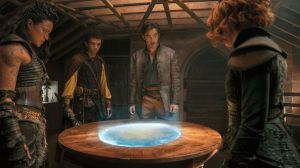 In the world of owl bears and sorcerers, Edgin (Chris Pine) and his trusted partner, Holga (Michelle Rodriguez), are looking to settle the score. They’ve broken out of prison and are trying to gather their old team back together but everyone has a grudge. Forge (Hugh Grant) has betrayed the group for power and especially riches, serving as the city’s reigning lord. He’s recommissioned a gathering of games and sport, drawing crowds back to the city, and with games comes betting and with betting come large sums of money from the rich. Edgin plans to rob from the treasure hold for the games and with that score he can regain his daughter and possibly reclaim a magical totem that can bring his dearly departed wife back.
I have no prior understanding of anything relating to the world and lore of D&D, and I found it to be extremely accessible and engaging. That’s because Goldstein and Daley have put the emphasis of their movie not on its lore or history or locations but on its characters. I appreciate that here is a major work of IP for a studio that is attempting to tell one very good and accessible story for the masses rather than set up a cinematic universe and ready it for possible sequel bait. Get the movie right and have that make me desire more movies rather than establishing a world that has potential but otherwise goes unfulfilled. The very concept of Honor Among Thieves helps to keep things light-hearted and moving. My pal Ben Bailey and I have been clamoring for years for a heist movie set within a fantasy world. It was ready-made to satisfy with the genre structure of heists, and putting a team together that rolls with unexpected adversity, and the cleverness of incorporating fantasy abilities and elements into heist genre familiarities. Thankfully, Goldstein and Daley realized how entertainingly plentiful this combo can prove.
The fun characters are what help to make the movie so enchanting. Rather than settling on a subsection of class representation (one dwarf, one elf, one wizard, etc.), the characters are more about what they bring to the team and what motivates them for character arcs. We have a shapeshifter (Sophia Lillis) who is trying to protect the kingdom’s encroachment on her kind. We have a shaky wizard (Justice Smith) who is battling for his own self-confidence and respect. Nobody feels like a token appointment. Even characters that would seem like a D&D player’s dream, a powerful paladin played by the dashing Rege-Jean Page (Bridgerton), are given more purpose. He serves as a contrast to our hero’s journey back to respectability, and the character is so noble and serious that it’s yet another shade of comedy to explore. His obliviousness to irony and sarcasm reminded me of the very literal-minded Drax (Guardians of the Galaxy). This is a character that would appear in standard fantasy epics, and yet he’s played for laughs just through sheer juxtaposition without ever mocking the reality of this world. At no point will characters condescend to their reality, saying self-aware critiques like, “Well that’s a very inconvenient and stupid place to put a castle,” etc. There is a cameo where the gag is that this person is much smaller. The appearance is played for goofy laughs and yet it’s also shocking in its emotional sincerity. If you removed the size differential, this would be a dramatic and eventful scene (I did enjoy the unspoken preference of this individual when it comes to a romantic partner). The movie is very funny and very skilled at being funny without reliance upon meta genre riffs.
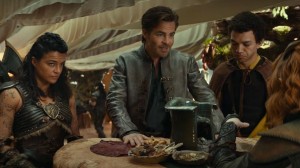 Elevating an already great movie, Pine (Don’t Worry Darling) is robustly charming as a bard/secret agent. He secured my loyalty within two minutes of the movie when he gave up on his prison knitting project and said, summarily, “I’m just gonna make a mitten. Who am I trying to impress?” Pine has long been one of our most effortlessly charming leading men, and playing a rakish heist leader who also sings will only magnify the man’s innate appeal to the masses. He works even better alongside Rodriguez (any Fast and Furious movie after 6) who becomes the real physical presence. This is a career-best performance with Rodriguez sliding right into exactly the comedy wavelength she’s needed for – the gruff and cynical worldview of the weary warrior. They make for a great bantering lead duo.
The set pieces are also tailored to the character arcs while still being memorable and entertaining. This is a movie that doesn’t get complacent over its 134 minutes. Each sequence must stand out, whether it’s because of creative and intuitive fight choreography that makes keen use of geography and circumstance, or a graveyard Q&A with very constrained magical rules to follow that leads to a lot of digging to find the right corpse with the right information, or escaping from an obese dragon (with its “widdle wings”) that resembles a chonky cat, or a dangerous trip through a maze that abruptly reconfigures itself, or a prison escape that doesn’t quite go as you expect, nor at the characters expect. Every scene has a purpose. Every magical item has a specific use, and every set piece sets itself apart visually and from a story standpoint.
Goldstein and Daley have excelled as writers, but they’re also proving to be visually adept directors. With the emphasis on characters, it’s not CGI spectacle for spectacle’s sake. There’s a pleasing physicality to this world. The budget is in the $150-million range, which is quite a show of confidence for the directors, but the emphasis is on what best elevates the moment. There’s a thrilling escape performed as a tracking shot with a zooming camera tracing the escape of our shapeshifter from harm, and there’s fantastic visual inventiveness with a magic portal and its application for the film’s equivalent of a rollicking stagecoach robbery. There’s a noted intention here with the shots and scenes and visual arrangements, so Honor Among Thieves feels like a studio film with vision.
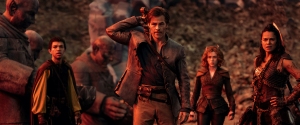 Allow me to take one very fleeting moment to digress just how much care Goldstein and Daley put into even the smallest of details. After we’ve met the last core member of our crew, he confidently leans backwards and falls into a pit leading to an underground cavern. The rest of the crew creep toward the opening and stare down below with trepidation. Simon then says, “I’m going last.” We then cut to the group at the bottom of the cavern. It’s such a small detail, but the previous scene ends on a character-appropriate punchline for Simon reconfirming his squeamishness, but then by transitioning to the entire collected crew together, we know he was last and so we’re ready to move forward. Again, it’s a small detail but it’s a microscopic example that proves, to me, how much thought and care the directors have given.
As a novice to the famous role-playing world, I found Dungeons & Dragons: Honor Among Thieves to be an exhilarating and highly entertaining fantasy adventure where fun is the chief priority. It’s not at the expense of great characters, good humor, and satisfying payoffs with well-developed setups strewn throughout. It’s a reminder how enjoyable and escapist blockbusters can be when you have the right artists using the expansive box of paints. It’s great for all ages and families too. I don’t have any personal connection to this sword-and-sorcery universe but now I want many more adventures if this is kind of quality they’re offering.
Nate’s Grade: A-
Share this:

Tetris (2023)
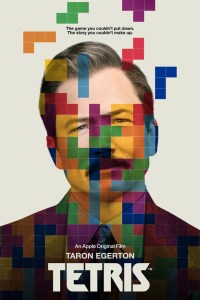 The “real” story behind the addictive puzzle game is an engaging tale of underdogs and corporate intrigue that might prove surprisingly fun and complicated for such a simplistic and straightforward game. We zoom back to the late 1980s and two converging storylines: the rise of handheld gaming and the decline of the Soviet Union. Taron Egerton (Rocketman) plays Herk Rogers, an American businessman living in Tokyo with his wife and family who has put all his hopes on the Japanese license rights of a small little game made in Russia. What follows is one man trying to finagle a system of questionable IP rights between scheming businessmen and Soviet KGB agents. The numerous players fighting for dominance over the course of legal copy, meeting rooms, and offers and counter offers was, for me, the most entertaining part of the movie, and the version that felt the most tethered to reality. There are some Hollywood exaggerations in this retelling, especially in the final act where the movie takes a cue from Argo and has its heroes in a careening car chase to get to the Moscow airport and eave the country (externalizing the internal feelings, much like Argo). Since we all know that the game ultimately ends up as one of the best-selling and most iconic, and packaged with the launch of Nintendo’s GameBoy, the appeal of the behind-the-scenes story is the struggle that our heroes overcome, and Tetris succeeds through its accessible but ever-moving plot mosaic that feels like legal knots trying to come undone. I think the movie gets even better when Herk becomes friends with Alexey, the state worker who created the game in his spare time and is hassled by KGB agents for the game harming national productivity. There are a few too many cutesy touches the movie could do without, like the inclusion of 8-bit sprites as visual transitions, something that is layered over the climactic car chase making it look much duller. I also feel like the honeypot twist feels a little too overinflated Hollywood drama for its own sake. There’s already plenty of drama here that didn’t need the help. Regardless, Tetris is a solid drama that stacks up.
Nate’s Grade: B
Share this:

Scream 6 (2023)
 When horror franchises dramatically shift their locations to somewhere new, like New York City, it’s usually a bad sign that the series is desperately looking for new creative life. Not every franchise can rebound like a Leprechaun in Space. Most of them just become another Jason Takes Manhattan, where now instead of Character Group A running and dying from the masked killer, it’s now Character Group B running and dying from the same masked killer. It’s more reminiscent of cartoons where the backgrounds might change but the on screen events are stuck in the same drab routines. The Scream franchise was rebooted with 2022’s satisfying fifth installment, so I hoped that a sixth Scream could at least exceed where so many others have failed. Those hopes were quickly fulfilled in what I consider to be one of the best sequels of the seminal slasher series with all of its air-quote irony.
There are more than a few entertaining new turns as the bloody hi-jinks head to the Big Apple. It feels bloodier and gorier than most of the Scream movies, but it also has well-developed suspense sequences that work extremely well at making you squirm. Every brutal burst of violence elicited a “oomph” exhalation from me, and I found myself tensing up as the initial scene constructions transformed. I was quite enjoying myself from set piece to set piece. Take for instance an escape that requires the characters to flee from one high-rise window to another across an alley via a rickety ladder. Or take a subway escape packed with masked Halloween revelers to make you paranoid who among the many Ghostfaces might be the potential killer (I enjoyed the other costumes of horror old and new – I saw you Midsommar May Queen). Even a hide and seek sequence inside a convenience store can be thrilling. All credit to returning Scream 5 directors Matt Bettinelli-Opin and Tyler Gillet, the same pair that delivered 2019’s wonderfully twisted Ready or Not. These gentlemen have proven that they know how to squeeze the most tension from any scenario no matter how bizarre. I loved that the opening kill (Ready or Night alum Samara Weaving) goes in a different direction, revealing the culprit right away, and then it goes in even another direction. There are still some new cool tricks to be had with the sixth installment in a 27-year-old horror series.
 I was asked if you had to watch any of the prior Scream movies to enjoy Scream 6, and while it’s not necessary, you will be missing out on some of the larger connective tissue and themes. You should definitely have familiarity with Scream 5 since it’s a direct sequel and continuation of the core (four) characters. I was surprised how much more emotional resonance I found with the Carpenter sisters than any of the other characters, new or legacy, from the earlier movies. I think it was smart having Sam (Melissa Barrera) be the daughter of the first Ghostface as was her seeing visions of her late father, this time as an adult Skeet Ulrich, which might have been the wrong choice considering the character never lived to be this age (is her imagination doing one of those age approximations you see for runaway kids?). Our lead heroine is trying to navigate where her instincts are taking her, which might be a darker path that she feels trepidation about ignoring for only so long. Sam’s therapist balks when he discovers her actual parentage, which makes him maybe the worst therapist. Her relationship with her younger sister Tara (Jenna Ortega) is more complex than any of the close friendships of Sydney Bristow. Even with all the carnage and bloodshed, Scream 6 still finds breather moments to let the sisters react realistically to their dilemma and how it affects their own relationship. I’m glad these characters returned because they serve as the emotional focal point of an otherwise famously glib franchise.
The biggest drawback from Scream 6 is the tacit understanding that this will not be the final film in the franchise given its box-office success, the first film to cross the $100 million-dollar threshold since 1997’s Scream 2. This feels like a culminating climax as the characters now view their lives not as their own but as part of a “franchise,” which means the stories will keep going on beyond them and that nobody is safe, not even the “leads.” For a series entrenched in heavy meta-textual irony, it feels like it’s reaching the end of its genre self-awareness cycle when the movie acknowledges itself as its own IP. The scope of the movie is retrospective, not just reaching back and acknowledging the history of where things began for the legacy characters but for every movie. Each one of the former Ghostfaces is being collected and commented upon, with murder nerd Easter eggs left at each crime scene or in its contextual arrangement. It’s the kind of totality that I would expect from a movie franchise coming to an end, and nodding at its various twists and turns, finding places to even include elements from the lesser beloved Scream sequels. There’s even an unspoken satirical jab at the number of characters that miraculously survive, as if the film is throwing up its hands and saying why not, as if this is the last movie and the rules of who survives and who dies are inconsequential because we’re subverting expectations, as we’ve been explicitly told, so expect the unexpected.
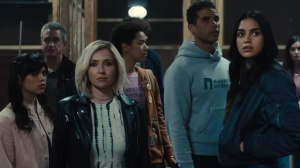 The other aspect of this drawback involves some slight spoilers but I’ll try and tread lightly. After our genre-savvy movie geek explains the stakes of this new episode, the characters start to review one another as potential suspects, and the new supporting characters even cast an accusing eye on the returning characters saying they could have cracked from their trauma. There’s emphasis on the drive to subvert expectations and break away from the patterns of old.
And here is where I’ll venture into some light spoilers so if you want to skip ahead to the next paragraph, please do so, dear reader. There is an ongoing thread where an Internet subculture has re-framed the Carpenter sisters as the real villains of their own horrendous story, and it’s an intriguing element that brings the echo chambers and confirmation bias and novice sleuths-in-the-making of the Internet to further examination. It’s reminiscent of any bottom-feeding conspiracy that asks people to pick apart their reality for “the real story” magically hidden in plain sight. The Scream franchise is famous for its fun guessing game of who the real killers could be from our gallery of suspects, and Scream 6 is no exception. However, the subversion that could have really separated this Scream from its elders is by having the killers actually be… nobodies (the Rian Johnson twist). What if the mask comes off and it’s a brand new character? I’m sure many viewers would feel like they had been betrayed, but then the point emerges that it’s simply some conspiracy theorist who has gone full-tilt crazy into the cult and taken matters into their own hands, attempting to hold “the real killers” to account or to prove they were truly guilty. And the larger point is that the “fake news” has already won out. It doesn’t matter what happens from here, what news coverage should stamp out ignorance, because you can’t pull every cult member out of their self-inflicted cocoon of delusion, which means there will always be more to take their place. That’s the legacy of what has transpired, that there will never be a real escape any longer. I thought that would be such a jarring and thematically intriguing and summative ending.
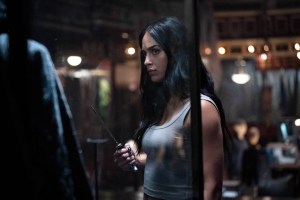 For the many fans of the slasher series, I believe Scream 6 retains plenty of the same pleasures of its prior movies while stretching out into new and interesting directions. It helps that I cared about the central sisters, at least enough by the low bar of horror movie standards. It’s bloody, fun, twisty, and satisfying enough that it could have served as a capper for the entire franchise. But it won’t be. I look forward to this new creative team re-evaluating trilogies better than Scream 3 did. In the meantime, this is a bloody good time to be had for long-term fans and newcomers from the 2022 reboot alike.
Nate’s Grade: B
Share this:

Shazam! Fury of the Gods (2023)
 I enjoyed 2019’s Shazam! because it felt like a breath of fresh air, a lighter story compared to the relentless gloom and doom of the DCU. It was more a silly Big-style body swap movie than a super hero romp, tapping into childhood wish fulfillment of getting to transform not just as an adult but as a super-powered adult on a whim. It was funny, sweet, and different. The 2023 sequel, Shazam! Fury of the Gods, feels like the definition of a sequel for the sake of a sequel. It is thoroughly mediocre and lacking the charm and heart of the original. I’ll try and deduce why this super-charged sequel feels so lacking and why the fun feels so forced.
Billy Batson (Asher Angel) can turn into Shazam (Zachary Levi) by uttering the magic name, and now his foster family share his same super abilities. They’re trying to adjust back to “normal life” when the Daughters of Atlas, Hespera (Helen Mirren) and Kalypso (Luicy Lui), arrive with a vengeance. Turns out Shazam’s powers were stolen from the Greek gods, and now they want them back, and if they don’t reclaim their power, the gods will destroy the world of man.
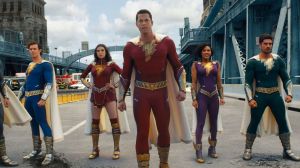 I think one of the most lacking elements of Fury of the Gods is that it loses its core appeal. The first movie was about a child fulfilling their adult dreams and leaping into maturity before their time. Levi (Apollo 10 1/2) was goofy and enjoyable in his broadly comical fish-out-of-water portrayal as a kid in an adult’s body. Now, the growing pains of being an adult, and a superhero, have been eclipsed. In fact, the amount of time we spend with Billy is pretty sparing. It’s all Shazam all the time, and this hurts presenting a worthwhile contrast between the mythic and the recognizably human. You forget the initial dynamic of this kid pretending to be an adult and what advantages this affords. At this point, being an adult is the same as being Billy Batson, who is approaching 18 and will age out of the foster system. This reality creates an existential crisis for Billy, as he’s afraid his family will move on so he’s eager to keep them together all the time, trying to maintain control. It’s about fear of change; however, I never fully understood why Billy was so worried. He’s already found a home with a loving mother, father, and extended clan of siblings, so why does aging out matter? He’s not going to be removed from his home. His siblings also aren’t talking about shipping out to the different corners of the world to begin careers or higher education. It’s a forced conflict to make the character uneasy about growing up. If the first movie was about a kid coming to terms with himself and letting others in, then this movie is all about a kid worrying his relationships will arbitrarily evaporate. This anxiety over losing something meaningful could have been an interesting storyline, but it’s all so contrived, and the whole body swap dynamic, the selling point of the first film, feels strangely absent.
Likewise, the villains have questionable motivation and character development. The movie begins with cloaked and masked figures wreaking havoc in a museum, and then it makes a big deal that these figures happen to be… women (also middle-aged and older at that). The opening is meant to be surprising in a way that feels out of date (what… g-g-girls can be powerful too?). It’s a strange point considering we’ve already had Wonder Woman. This same easily-satisfied, lowest common denominator plotting is disappointingly prevalent. These powerful gods want their father’s powers back but they already seem pretty powerful, so the movie lacks a fitting explanation of why these extra powers are worth all this effort. I suppose there’s a general revenge and righting of wrongs but the characters don’t play their parts too scorned. They’re more annoyed and tired, which doesn’t make for the most compelling villains. Another Daughter of Atlas has the power to mix and match the world like a volatile Rubix cube, but what is this power? It’s virtual obstacle-making but it feels arbitrary too in the world of superpowers. The ultimate scheme to conquer the world is as flimsy as the reasons it’s ultimately defeated.
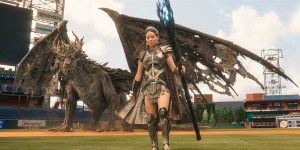 Let me dissect that part for a few words, the solutions to overcoming our vengeful gods. They raise an army of mythical creatures to destroy Philadelphia and it’s Ray Harryhausen character designs with cyclops and unicorns and the like. The way to reach through to the monsters and bring them on your side is to offer them a gift of “ambrosia,” some tasteful bounty that they can’t help but fall in love with. So what is the solution to this? One of the kids literally drops a handful of Skittles onto the street and the unicorn happily snarfs them down. Yes, through the power of Skittles-brand candy the heroes are able to save the day. There’s even a moment where the kid is riding the unicorns into battle and screams, “Taste the rainbow,” before the movie cheekily cuts her off before she can unleash an added “MF-er.” What is this? I’m usually agnostic on product placement in movies; characters have to eat and drink, etc. But when it’s egregiously transparent and played as the key to victory against all odds, that’s a bit much. If the joke is that contemporary food is a blast of flavor that nobody would have been prepared for thousands of years ago with their palettes, then any modern food could have worked. It didn’t have to be a brand-name candy with its brand-name slogan screamed in battle. This is but the first of several contrived and unsatisfying deus ex machina solutions that erase consequences.
Even with returning director David F. Sandberg (Lights Out), the enterprise feels like an empty retread relying too much on rote spectacle and missing the heart and perspective of its predecessor. There is an action sequence atop a collapsing suspension bridge and the song “Holding Out for a Hero” plays, and then we have a character comment on it, and it all seems like a desperate attempt to add some energy or style or fun to the sequence that is absent. The action relies on a lot of watching characters zip pedestrians to safety, but it’s the end result we see, not the whoosh and flurry of the arduous mission. The whole sequence feels like it’s going through the motions, as much of the movie does, falling back on a formula of superhero blockbuster autopilot. The CGI army of villains, the face-offs between characters shooting magic beams at one another, the overly quippy and tiresome dialogue and mugging cranked up to overdrive, the world-saving stakes feeling so minor. I was longing for some of the ’80s Amblin tone of the original, which got surprisingly dark. With Fury of the Gods, everything feels so safe and settled, with the stakes feeling inauthentic and the action reinforcing this with effects sequences that feel like Saturday morning cartoon filler.
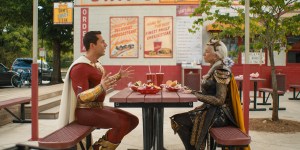 There’s a strange question with the family powers. The extended brothers and sisters can utter “Shazam” and turn into adult alter egos, but the character of Mary (Grace Caroline Currey, Fall) now transforms into a super suited version of herself with slightly different hair. In 2019, she transformed into actress Michelle Borth (Hawaii 5-0). Mary is the oldest sibling, and we’ve undergone a time jump of years to account for the ages of the kid actors, so does this mean that as the kids get older they will just turn into versions of themselves? Does this mean that the Zachary Levi-persona is set to expire once Billy turns legally an adult at 18? The implications of this casting choice made me question the very reality of the Shazam universe’s mechanics.
I can see certain audiences enjoying the slapstick and gee-whiz goofiness of Shazam! Fury of the Gods, and I have no doubt that the people making the movie wanted to tap into that childlike wonder of magic and myth. The problem is that this feels like the most inessential of the dozen DCU movies, going through the motions rather than exploring cogent and potent drama. Just take the character of Pedro (Jovan Armand) who is unhappy with his larger body and transforms into a handsome, slim, musclebound version of himself as a fantasy. That’s an interesting psychological exploration for the character, on top of his own self acceptance on a whole other front. Or take the sidekick from the first movie, Freddy (Jack Dylan Grazer), and his Romeo and Juliet-esque romance of a super-powered being from the other side of the conflict. There’s some drama there as well as his understanding of who the good and bad guys can be. Or simply take the perspectives of the parents trying to raise a household of kids who can transform at whim and what worries and joys this can offer. There’s material here to be finely explored, fun dynamics going beyond just repeating the Big-style body swap hi-jinks. Unfortunately, this is a sequel that feels like what made the original special has been replaced by blockbuster status quo.
Nate’s Grade: C
Share this:

80 For Brady (2023)
 I did some minor research and yes, three out of the four actresses of 80 for Brady are indeed in their 80s, with Rita Moreno in her 90s, so there is some truth in advertising still. Speaking of that, this geriatric comedy is about everything you would expect from its very basic premise. Inspired by a true story, four lifelong friends (Moreno, Jane Fonda, Sally Field, Lily Tomlin) are diehard New England Patriots fans and more so fans of the team’s famous quarterback, Mr. Tom Brady (playing himself). They’re determined to make one last big trip to support their team at the 2017 Super Bowl, as Tomlin is afraid she doesn’t have much time left. What follows is standard road trip hi-jinks and celebrity cameos the likes of which from Billy Porter and Guy Fieri and Patton Oswalt. Most of the jokes are mild and easily telegraphed, and the formula hews very close to other studio entries in the “old people still got it” ensemble comedy subgenre (Last Vegas, Book Club, The Bucket List, Going in Style, Best Exotic Marigold Hotel, Calendar Girls, etc.). The target audience is looking for something nice and reassuring with familiar faces. To that end, 80 for Brady mostly succeeds, but for anyone else outside it’s older demographic, it will be a middling and hokey comedy. I laughed out loud at the assertion that the Pats comeback from a 28-3 deficit versus the Atlanta Falcons was the result of one very determined, yet also obsessive to the point of hallucinating, elderly fan giving Brady a special pep talk that motivated him to try harder at winning. The movie isn’t meant to elicit big laughs, more pleasant smiles, and to that end it’s agreeably inoffensive right down to its predictability and easy conclusions. Entirely skippable if you’re under the age of 50.
Nate’s Grade: C


 nathanzoebl
You must be logged in to post a comment.