MacGuber (2010)
 Far far worse than I was expecting, this is what happens when you expand a 30-second Saturday Night Live sketch to a full-blown movie. MacGruber, a one-joke parody of MacGyver, becomes a one-joke movie. It’s about an inept special agent who has to save the world from a criminal madman (Val Kilmer, why?). The flimsy plot would be acceptable if the movie had any sort of comedic momentum, but the jokes are sloppy and uninspired, often confusing naughtiness with humor. Just because something is brash or raunchy or shocking doesn’t necessarily mean it’s funny. Will Forte, as the title agent, tries too hard with material that doesn’t work hard enough. Villains with naughty sounding names? Sight gags a plenty? This movie makes the Austin Powers franchise look cutting edge. There isn’t enough focus for this to work as parody. MacGruber feels like what a bunch of 12-year-old boys would throw together if left unattended for a weekend with their parent’s credit card. The sketch was never meant to last over a minute by design, so you can expect what 87 more dreary minutes would produce.
Nate’s Grade: D
Share this:

Let Me In (2010)
 Essentially a faithful remake of the Swedish pre-teen vampire romance, Let the Right One In, this American reinterpretation loses points in originality and freshness but makes up for it with a bigger budget and better acting. Even fans of the original, and count me as one, must admit that Chloe Grace Moretz (Kick-Ass) as a pint-sized vampire stuck forever in pre-pubescence, and Richard Jenkins (The Visitor) as her aging caretaker, are upgrades. The true surprise is the eerie assuredness of the entire production from director Matt Reeves, he of shaky-cam Cloverfield fame. The entire film just feels so placidly precise, even as it draws tension and sets up for one vicious poolside climax. Some of the audience unfriendly moments from the original have been exorcised (say goodbye to lingering gender identity questions), but Let Me In still happily dwells in an unsettling place, forcing its characters to do questionable things in the name of companionship and forcing the audience to decide how they fell about that. Also, the film still retains its ambiguity for interpretation; whether you view it as a depressing saga of use and abuse, or an disaffected teen romance is entirely up to you. Let Me In won’t grab peoples’ attention in the same way its Scandinavian predecessor did, but it doesn’t screw it up either. And these days, that’s got to count for a lot.
Nate’s Grade: B+
Share this:

I Am Number Four (2011)
 Despite being based upon a young adult book series, I Am Number Four is an unfortunate title. What do you call the sequel? I Am Number Four 2? I Remain Number Four? Let’s not even mention the obvious pan that is begging to be covered by that title (“I Am Number Four? More like I Am Number Two!”).
Number Four, a.k.a. “John” (Alex Pettyfer), is your normal teenage alien hiding on Planet Earth and trying to live a regular life while eluding intergalactic mercenaries. Numero Quatro has relocated to the town of Paradise, Ohio with Henri (Timothy Olyphant), his alien guardian who poses as dear old dad. The two are trying to keep a low profile because Number Four is one of the last nine super-powered aliens from a dead planet. The aliens develop different special abilities as they mature and Number Four has begun to notice that his hands glow in the dark. Number Four catches the attention of Sarah (Dianna Agron), a pretty gal whose ex-boyfriend happens to be the super jealous quarterback. Number Four also befriends the school’s nerd (Callan McAuliffe) who thinks his father was taken by aliens. He’s not exactly keeping the desire low profile. Numbers 1-3 have been killed by a pack of alien mercenaries who intend to dominate Earth, and now Number Four is next.
While neither special nor afflicting, I Am Number Four is a pretty mundane, mediocre, special effects driven goof aimed primarily at young teen males. The plot lacks any trace of nuance and seems fantastical in what should even be ordinary. The Ohio town is one of those small towns that exist in the minds of west coast studio executives, where everyone gathers round for a carnival and the roads are mostly of the dirt variety. Sarah’s family is one of those ideal, chatty families that exist primarily in the minds of nostalgia. They don’t just sit around and chew their food; they are actively involved in dinner cutesy dinnertime games and cutesy embarrassing interactivity. But the movie never lets you think about these inauthentic tidbits for long before more explosions or colorful special effects rattle you. The plot follows an almost mechanical process, supplying some PG-13 skin (ladies in low rise jeans! Cleavage!) or some rudimentary chase scenes at a fairly brisk pace. The story borrows liberally from many sources, including a dash of super powered loner Spiderman stuff, angsty teen romance from Twilight, and a sprinkle of whatever is playing on TV right now as you sit reading this.
 The action is never really takes off beyond the general concept of Things Exploding and People Running. Director D.J. Caruso (Eagle Eye, Disturbia) can string together a series of pleasing visuals but they never amount to much. The film lacks real suspense and any risible sense of excitement. The action sequences are disposable but at least Caruso makes sure that the audience can follow along. I thought with all the sci-fi elements that the film would make more interesting choices, but alas I Am Number Four relies all too easily along commonplace action tropes like it’s an accomplishment. Number Six (Teresa Palmer) gets to walk away from an explosion in slow-motion (while she wears sunglasses). Nobody in town seems to ever pick up on the mounting collateral damage of this interstellar spat. Caruso and the screenwriters are too content to just be happy playing with the special effects toolbox, emulating the favorite moments of the sci-fi action genre. And one of those tropes is that ANIMALS CAN NEVER DIE. Number 4 has a shape-shifting guardian pet that decides to take the form of a dog. Then when things get rough, this dog mutates into a hulking CGI creature, which still looks like a dog. And when he gets wounded fighting another CGI monster, it’s not enough that we get the pained dog cry but the filmmakers decide that he also has to transform back into a regular Earth dog at this point to hammer home the image of pooch in trouble. Shameless to the very end. And then, during our resolution this space dog has to come hobbling out.
Fortunately for the audience, the actors are all rather beautiful. Pettyfer (Alex Rider) isn’t much when it comes to this thing called acting, but he’s got abs you could scrub laundry with and really that’s half the part of playing a hunk from outer space. I give the guy more credit just for having to be saddled with the lame superpower of glowy hands. It’s a long wait for those glowy hands to become instruments that launch glowy fireballs. For most of their screen time, Pettyfer’s power just looks like he’s clenching two very powerfully charged indigo-glowing cell phones. Olyphant (Deadwood, Hitman) is too young for me to be covering as the dad to a 17-year-old kid. I still remember Olyphant in 1999’s Go. Maybe that’s just my hang-up. The ladies are all gorgeous are all in the flawless skin and teeth variety, you know, the ones that populate every small town. No one truly makes much of an impression but they’re easy on the eyes. It’s like an Abercrombie and Fitch catalogue come to life with extra explosions (and more clothes).
 The only actor that stands out is Kevin Durand and he’s under pounds of makeup as the chief villain. Durand first came to serious attention as a season-long villain on TV’s Lost as Martin Keamy. He has a real distinct menace that doesn’t come across as self-satisfying or ironic. He’s got a real presence and it seems like casting directors have caught on to this former Canadian standup comedian. From there Durand has become something of a go-to guy when it comes to large intimidating men and men with some kind of mild speech impediment; his characters in X-Men Origins: Wolverine, Legion, and even Robin Hood all sounded like they had their mouths stuffed with cotton. Durand always has a good time with his bad guy roles, whether they are flinty or over-the-top. I enjoy watching this man onscreen even if he’s under some fairly lackluster creature makeup that makes him look like a tattooed shark man.
The point that caught my attention, and was scantily mentioned but once without nary a rejoinder from any character, was the fact that the big bad evil aliens are killing the alien teens in order. No reason is ever attempted. There are nine super alien teens but for some reason these interstellar killers are uncontrollably anal-retentive (“We may be vicious monsters, but we respect the value of numerology”). It makes little strategic sense to stick to the doctrine of taking out your enemy one at a time and in a predetermined order that everyone knows about. It also means that presumably Number 9 will be the hardest to vanquish since they will have the longest time to master their super power. Later on, Number 4 gets an added boost from a sexy, slinky Aussie who happens to be Number 6. My first thought: “What the hell happened to Number 5?” Then I figured that Number 5 has to be locked away somewhere in a protective safe house at an unknown location. Because that affords Number 6 to do whatever the hell she wants; the evil aliens would just have to stop and say, “Look Number 6, we’d really, truly love to vaporize you right now, but first we gotta go find and kill Number 5 first. See ya later.” If that’s the case then Number’s 7-9 need to get off the bench and team up. Number 4 can’t keep this up forever, guys.
I Am Number Four is tailor-made for a young male audience that doesn’t have the urge to see something harder or edgier. It’s got superfluous jet-ski stunts, girls with flat tummies, explosions, cool space weaponry, CGI monsters, villains in long black trench coats, failed attempts at romance, a dog, and even a reference to famous Cleveland Browns quarterback Bernie Kosar. It’s not an incoherent cacophony of light and sound like you’d find in a Michael Bay film; director D.J. Caruso is like Bay lite with more self-discipline. I Am Number Four is fairly derivative stuff but nothing worth getting upset about. After you see derivatives of derivatives, you start forgiving the final product for lacking any discernible flavor. All of the elements come together in rather harmless fashion making a rather empty but harmless sci-fi action flick.
Nate’s Grade: C
Share this:

Dogtooth (2010)
 Dogtooth is a surprising, sometimes shocking, sometimes maddening vicious little film that serves up dark satire with plenty of tense, incredulous laughter. But make no mistake; this is no comedy in the traditional sense. This Greek flick is deceptively slow-witted, drawing us in to a very different world. The film chronicles the three teenage children (one older brother, two twin sisters) kept at home in isolation by their parents. These kids have been taught to fear the outside world, they have been taught erroneous vocabulary (a “zombie” is a yellow flower; a woman’s privates are known as a “typewriter”), they believe that cats are man-eating beasts, that Frank Sinatra is their grandfather singing to them, their dead little brother lives on the other side of a hedge that they toss food to, and that overhead planes can be plucked from the sky. They even have to get on all fours and bark to scare away intruders. And then there’s a troubling budding sexual element, made considerably more complicated once the woman the father hires to satisfy his son introduces sexual curiosity to the twin sisters. Dogtooth is a detached yet fascinating portrait of one seriously screwed up family, where children are trying to make sense of the limited and sometimes fantastical concepts they’ve learned through severe sheltering. This manufactured artificial world, a satiric swipe at those who believe ignorance to be a suitable protection, is perilous yet believable. Dogtooth raises plenty of questions about the nature of society, parenting, knowledge, responsibility, and identity all in a package of bleak social satire that Luis Bunuel could admire. It may take some effort, but give yourself over to this Greek oddity and enjoy the unique weirdness.
Nate’s Grade: A-
Share this:

The Mechanic (2011)
 The Mechanic is a routine remake of a 1972 Charles Bronson hitman thriller. But when did “mechanic” ever become commonplace slang for “killer”? The film treats this concept like everyday knowledge. Bishop asks, “You know what a mechanic is?” A character responds matter-of-fact: “A hitman.” And the “mechanic” services are advertised via a system that includes a Craigslist style message board. It makes me wonder what the “adult services” section on Craigslist was really all about this whole time.
Arthur Bishop (Jason Statham) is the world’s greatest hitman. He meticulously plans his hits, deciding whether to make it look like a suicide or an accident or whether to send a message. He’s the cleanest of the cleaners. Then he gets a very delicate assignment – he’s to take out his mentor, Harry McKenna (Donald Sutherland, taking a paycheck). Bishop’s boss (Tony Goldwyn) tells him that somebody is going to kill Harry. If it’s Bishop at least he can make it more humane. Bishop takes out his mentor and makes it look like a carjacking. Then Harry’s screw-up of a son, Steve (Ben Foster), appears to get vengeance for his old man. Bishop takes the hotheaded kid under his wing and trains his to be an assassin. Then, naturally, Bishop discovers he was set up and played by his employers, which brings about a larger examination on the cyclical nature of violence. Just kidding. There’s more killings.
 To say that The Mechanic is a well-oiled formula picture is probably the kindest thing that can be said. It follows the path of its hitman forbears fairly close. The opening pre-credit sequence is a hit that established the abilities of our deadly lead, Donald Sutherland pops up just long enough to lay down the necessary exposition for the film, and then before we even finish the first reel (20-minute mark) the movie manages to introduce a sexy female (Mini Anden) whose only purpose, in grand action movie tradition, is to have enthusiastic sex with the lead whenever his tank is low. The rest of the movie follows rather lockstep with the various beats of the genre, meaning that Bishop takes on an apprentice, shows him the ropes, they bond by taking out the bad guys, and then of course the final show drops and the truth about Bishop killing Harry is revealed. Along the way, The Mechanic does enough to satisfy genre fans looking for the goods when it comes to thrills.
The best moments are the tag-team hitman efforts of Bishop and Steve. The stuntwork is occasionally impressive like when Bishop and Steve repel down a large hotel building or when a car literally drives all the way inside a bus. There’s a brutal, visceral fight between Steve and his first kill that serves as the film’s highpoint. It was these sequences that made me actually sit back and think, “You know, I think this concept would actually play best as an ongoing TV series.” Think about it: you’d have your target of the week, the planning and execution that always make for satisfying payoffs, and then week-to-week Bishop and Steve would continue their complicated relationship with Bishop’s guilt eating away at him while he tries to keep the truth at arm’s length away from his neophyte partner. To me, that sounds much more dramatically rich while still keeping the body count consistently high.
Of course by hewing so close to the confines of genre, The Mechanic also has very little going on outside of the mini-missions of the hit jobs. Bishop obviously has been misled and setup by his sleazy employers. It’s fairly clear early on that when a guy gets out of a limo in a three-piece suit and tells you that the old man in the wheelchair is the bad guy, red flags should be waving. There doesn’t seem to be a formidable opponent in this fight mostly because Bishop is long described as the best at what he does. So how do you stop the best? You’d think you’d hire other players of comparable skill or offer an incalculable amount of money to kill the guy. But our villain doesn’t do any of this. Five minutes prior to his death, our villain fails to even once threaten Bishop (don’t even pretend like that’s a spoiler). The main conflict is really the complicated connection between Bishop and Steve; however, this relationship is kept at a slow simmer the whole film, even after Steve pieces together the ugly truth. The character development is left mostly at an inferential level. That means that there are long stretches where the characters glare, dispense with macho cool speak, glare with sunglasses, and then fall back on some unique hitman quirk they all have to relax (Bishop listens to classical music on vinyl records because he takes life yet appreciates beauty! IRONY!).
 But the ending needs to be further discussed because it leaves a terrible aftertaste. Given the dramatic dynamic at work, you pretty much know that Bishop and Steve will eventually come to a head. Bishop regrets what he’s done and is trying to make amends and find some meager form of redemption by taking Steve under his wing. He’s trying to make amends for the many sins in his life. He’s coming to terms with his life’s choices. So then you would assume (spoilers to follow) that when Steve ultimately seeks his own very deserved sense of vengeance, that the old pro would accept his doomed fate. It makes the most sense. It provides an end for the character’s journey, it provides closure to Steve, and it allows for an ending where people have to pay for their life’s mistakes. It’s not even downbeat because it feels right; it’s the correct ending for this material. It’s also the way the original Mechanic ended. But why end the movie on Statham accepting death? That would shuttle any chances for Mechanic sequels. And so, in a colossal cop-out, our hero narrowly survives and even manages to set up a bomb to take out Steve. While his young partner was emotionally unstable and looking for an outlet for his billowing anger, but the man was warranted in his vengeance. It’s entirely the wrong ending for not just this kind of movie but this movie specifically. It smacks of a pathetic attempt to leave the option open for a would-be franchise. It eliminates the entire idea of consequences mattering.
Statham gives the exact same performance he’s been giving in every movie for a decade plus. You know what you’re getting with a Statham action vehicle, for better or worse. He’s going to get shirtless, he’s going to dispatch the bad guys with relative ease, and never once will an expression flash across his stony face. He even verbalizes guilt while still being completely stone-faced. You don’t really buy any inner turmoil with this guy; he’s too “cool” to have feelings other than anger and vengeance. But then Foster practically redeems the entire movie. The young actor has been delivering intense performances for years now, whether it is an emotionally unstable guy in Alpha Dog, an emotionally unstable guy in Hostage, an emotionally unstable guy in 3:10 to Yuma, or an emotionally unstable guy in The Messenger. Notice a pattern? I’m amazed the reservoir of little tricks Foster finds to make Steve pop. Foster gives a far better performance than the movie deserves.
The Mechanic is a routine action movie that fails to rise above its genre conventions due to a lackluster plot, some vapid character development, and a horrendous ending. Statham does his thing, his shirtless chest gets due prominence, but the movie lets both he and a game Foster down. The kills are rather sloppy leaving behind mountains of evidence and dead bodies, and yet there seem to be no consequences. That makes for a long march to an inevitable conclusion with a few bursts of colorful violence to entertain. But what actually exists on the screen isn’t half bad. It’s fairly unremarkable, straightforward genre pap, but that can be suitable for the right audience and the right frame of mind. I was seeking something brainless to excite me when I caught The Mechanic, and it modestly achieved these modest goals.
Nate’s Grade: C
Share this:

Saw 7 (2010)
 The story behind Saw 7 (or as presented in theaters, Saw 3D) is more intriguing than anything you’ll find in this lackluster chum bucket of guts. The director of Saw 6, series editor Kevin Greutert, was all prepared to go off and direct the sequel to the surprise smash, Paranormal Activity. The folks at Paramount even penciled in a Halloween release date, long the fertile ground for the annual Saw sequels. It seemed like Paramount was rubbing in the fact that they now had the more exciting, buzz-worthy franchise and they would tap dance on the grave of Saw. Well the studio suits didn’t take too kindly to this broadside, so they activated a clause in Greuter’s contract. The man was legally required to leave the Paranormal Activity 2 project so that he could direct a seventh Saw film. Because nothing says “work of art” like forcing your director to make a movie by threat of legal action.
Saw 7 is billed as the “Final Chapter” but it doesn’t feel like a satisfying conclusion, more like an overdue mercy killing. It’s no secret that the Saw franchise has been flailing and sputtering for quite some time, with the bizarre exception of Saw 6 (my friend Eric proudly deems it the “Godfather II of the Saw franchise”). It was because of Saw 6, a fascinating return-to-form by tackling the topical issue of health care reform, that got my hopes slightly renewed for the franchise’s finale. Having health insurance employees as the victims gave the franchise some much-needed populist anger, a renewed morbid fascination that was surprisingly enjoyable. Imagine Saw 7 taking on the extension of the Bush tax cuts? Alas, my fledgling hope was for naught.
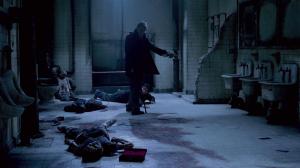 Part Seven follows a self-help guru Bobby Dragan (Sean Patrick Flanery) who talks about surviving a Jigsaw death trap as a spiritual awakening. Except that he’s a fake; he’s devised this phony survival tale as a scheme to get rich. Naturally Jigsaw (Tobin Bell, as always, in flashback) doesn’t take too kindly to this misrepresentation. Dragan would seem like a prime candidate for the haunted warehouse of horrors that Jigsaw usually specializes with, except that Jigsaw has been dead for four films now. His second apprentice, Hoffman (Costas Mandylor), is wanted by the police and FBI and even Jigsaw’s own widow (Betsy Russell), who unsuccessfully tried killing Hoffman with one of the series’ infamous bear traps masks. So let’s stop and think this out. Hoffman, who is on the run and established as a serial murdering fiend, still takes time out to set up a warehouse full of death traps for Dragan to fulfill his late employer’s wishes. If it’s not obvious now let me make it pointedly clear – in whatever city these murders, take place, it has the most incompetent police force in the history of the universe. Did they literally hire the Police Academy crew? That would make for an entertaining diversion that might reboot two franchises.
As always, the sinister death traps are the real draw of the franchise, and these convoluted killing devices have been getting less inspired from each shallow sequel. These contrived contraptions always bothered me in their uniform intricacy. The franchise began with some pretty simple scenarios: crawl through barbed wire to reach an exit, while covered in kerosene hold a candle to see a written combination, saw off your feet if you want to escape a filthy bathroom of doom. Then in order to top the previous film, the death traps got more contrived and involved a lot more engineering muscle. The more complex they got the less interesting they became. Now with Part Seven, some traps include a three-headed saw with each member of a love triangle in its aim. Two guys, the boyfriend and the “other man,” have to overpower a saw or they can relax and let the woman that’s come betwixt them lower onto a saw blade. This opening trap is the start of some dubious misogyny even for a genre as female punishing as horror. There’s a gauntlet of grisly horror in store for a bevy of female characters, usually involving something sharp penetrating them. But for the lone man who falls into a Jigsaw trap he meets his death by… hanging. Yes, a simple almost merciful hanging compared to the gruesome fates the women encounter. I’m not seeking feminist sensibilities from a genre that profits from their half-naked terror, but Saw 7 is even sicklier because of the undercurrents of misogyny. The traps in number seven aren’t memorable, interesting, and they feel like they’ve been done before in some earlier incarnation (a woman being “smoked” in a mechanical pig does seem to be different).
 The biggest problem with Saw 7 is that it doesn’t feel like anybody gives a damn anymore, including the filmmakers and actors. The production values seem like a world away from other movies in the series. The entire affair reeks of “direct to video” even though it was shopped as a 3-D theatrical experience. As you can imagine, because of the gimmicky 3-D, the movie is filled with plenty of pointy objects pointed at the screen. When watching in traditional 2-D, it gets fairly tiresome. Also because of the 3-D presentation, the filmmakers had to compensate for how dark the 3-D glasses make the movie. That means that the spurts of blood are in a rather unrealistic pink lemonade shade, like the retro blood from 1970s exploitation flicks. Without the glasses, as most will view the film at home, it further cements the overall cheap atmosphere. The production design, cinematography, and editing all feel like the Lionsgate intern team performed them. Every technical aspect feels more than sub par, it feels like no effort was exerted whatsoever. Sure it got finished, but finished and complete are different.
The Saw franchise has always been built around the craft death traps and a last-second twist ending accompanied by a barrage of scenes given new context. This formula has been repeated with each installment, so I expected nothing more and “nothing more” is what I received. Saw 7 thinks its audience demands to know its convoluted back-story, which gives way to all sorts of behind-the-scenes flashbacks that are always retroactively changing and channeling the timeline of events and participants. I think it’s all frightfully boring. I don’t care who screwed what bolt into what. I’m not watching Saw for realism (hence why the police NEVER think about tracking what vacant warehouses are sucking down gads of electricity). But at this point, with the thrill of the death traps long beaten into a bloody submissive pulp, I don’t even know what I would watch this series for. The appeal seems to have died along with its boogeyman, Jigsaw, four films back. The subtitle “The Final Chapter” seems like a promise destined to be broken. In the annuls of horror, any successful franchise will live on forever with cheap made-for-DVD sequels. Saw 7 just feels like the first made-for-DVD sequel, except it got a theatrical release as one final gasp at cash. Just wait twenty years and the whole thing will be rebooted as some sort of prestige picture that speaks to man’s inhumanity to man circa 2030.
Nate’s Grade: D
Share this:

Devil (2010)
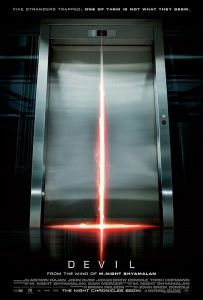 2010 has been a banner year for Trapped to Stuff Cinema. People have been trapped on a ski lift (Frozen), under a rock (127 Hours), in a coffin (Buried), and now with Devil… an elevator. The story comes from “the mind of M. Night Shyamalan,” not exactly a selling point at this juncture in time: five strangers are trapped in an elevator and one of them happens to be the titular devil. Now, that may sound like a waste of the Devil’s abilities; surely the Lord of Evil has better things to do than mess around with people in an elevator. Regardless, this low-rent thriller nearly overdoses on terrifically noisy jump scares as its primary source of spooks. As the candidates get picked off one by one when the lights go down, the guessing game becomes more tiresome. Even at a sparse 75 minutes the entire film feels exhausted. The characters are dumb. The Hispanic security guard tries to convince others that the devil’s responsible for the shenanigans. His method of argument: tossing a piece of toast in the air and saying because it landed jelly-side down, the devil is in play. Because when Old Scratch’s around, only bad things happen (protect your toast). The ending feels both contrived and tonally inappropriate, like putting a smiley face sticker on a school report on Ted Bundy. This is an entire movie that lands jelly-side down.
Nate’s Grade: C-
Share this:

Grown Ups (2010)
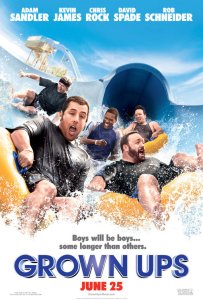 Adam Sandler keeps his friends from the unemployment line with this lowbrow, middle-aged themed, yet still entirely juvenile, comedy, Grown Ups. The movie is really a giant fetid waste of potential. It’s Sandler and his old Saturday Night Live buddies (David Spade, Rob Schneider, Chris Rock, and Kevin James obviously filling the Chris Farley spot) chumming it up and decrying the foibles of being 40. They don’t get the kids today, nostalgically reflect on their summer camp days, and try to recreate some of that old magic with a combined family get-together. Each man falls into a rigid type and will learn some half-hearted, disingenuous form of a life lesson by film’s end. The entire dimwitted plot is as stunted as the male characters. These guys just pal around and it’s termed a movie. The female characters are all one-note: figures of lust, saintly significant others who never get to be in on the joke, shrews, or Schneider’s older wife who is a constant butt of some mean-spirited jokes. The actors do have an amiable chemistry that allows the film to coast for some time before the whole affair just becomes wearisome. These guys have played these types for many many movies, and so everyone just operates on autopilot. The heavy slapstick momentarily distracts from the truth that Grown Ups is an unfunny, crass attempt by Sandler to get audiences to pay for his class reunion. The fact that this junk won the Best Comedy Award from the People’s Choice Awards illustrates the limitations of democracy.
Nate’s Grade: D+
Share this:

Waiting for Superman (2010)
 Award-winning documentary filmmaker Davis Guggenheim (An Inconvenient Truth) tackles an even more alarming subject – the state of the nation’s education. Guggenheim, who admits to enrolling his own kids in costly private schools, felt bad about all those “other kids” resigned to public schooling. His film addresses a myriad of issues related to the disparity in education. The deluge of data and statistics is broken up by the heart-wrenching story of five children ranging in age from five to fourteen. These children are hoping to land a chance to enroll in neighborhood charter schools. These charter schools perform higher than their public competition, so there are more applicants than seats open. Far more. By charter guidelines, the applicants are given a number and a lottery is taken to determine who earns a place in the school. To these five students and their families, the random drop of a numbered ping-pong ball can determine the fate of all.
You’d have to have a heart of stone not to feel such powerful pangs of emotion by the film’s devastating conclusion. Guggenheim frames the overall demise of public education by telling the small story of five hopeful students who must look to the simple luck of the draw to get a quality education in their neighborhood; the bigger issue now has a face to empathize with. And you will. Obviously the odds are stacked against all five kids Guggenheim selected to follow. I think the best charter school lottery odds had 20 seats available and only 65 applicants. It should therefore be no surprise that there are many dashed hopes and crushed dreams, and you too will feel tears rolling down your cheeks as you watch shell-shocked parents try to compose themselves as their child’s number is never called. It’s flat-out devastating to witness. It is a profound embarrassment that these families are forced into a lottery system just to earn a quality education. The anguish and bone-shaking disappointment will long linger, which is exactly what Guggenheim wants. The concluding portion of the movie drops all stats and cogent rhetoric and just opens up completely to unashamed, yet highly effective, emotional appeals. Guggenheim clearly knew that the odds were against these kids being selected, which upon reflection, gives the montage of sorrow a slightly unpleasant exploitative aftertaste.
 I wasn’t expecting a detailed manual on how to fix the nation’s educational woes, but at the same time I think Guggenheim is laying the blame a little too explicitly at the feet of intractable teacher unions. Now, full disclosure to my adoring readership: I work for a public school system and belong to a prominent teacher’s union, the National Education Association. I’m trying to be as impartial as possible in my analysis of a documentary that hits fairly close to home. It’s pretty impossible to not walk away affected from Waiting for Superman. You’ll be left shaken, red-eyed, and clamoring for reform, but what reform? Guggenheim tends to keep whacking at his target, the teachers unions, but a grave omission is that he never interviews a SINGLE teacher. He interviews retired teachers and numerous teachers that have become administrators, but a documentary about the concerns of a modern classroom might want to include the views of those teachers who are expected to get consistent results with inconsistent materials. There is enormous pressure on teachers, often the first to be blamed for circumstances beyond their control. Are teachers responsible for poverty and absent parenting? Are teachers responsible to fix all society’s ills? The modern educational environment has changed so much in recent years (I cannot even think of a life teaching before the distraction of texting and cell phones), and yet so much of our system is geared toward an outdated model. Tracking systems do more to segregate students into an educational caste system that tells a portion of students that nobody truly has high expectations for them. The summer recess was so that the kids could return to work on the farm in time for harvests. Hey, guess what, we stopped being an agrarian society for over 100 years.
Educational reforms like No Child Left Behind (NCLB) are mentioned, but the aftereffects are shockingly soft-pedaled by Guggenheim. The NCLB act was meant to make educators accountable, and in a way it does, but only to a single high-stakes test. The curriculum of many school environments is now entirely shaped to passing this test, which isn’t a surprise considering school funds are determined almost entirely by this single measuring device. There’s little room for enrichment when the test dictates all. I have spoken with several teachers and administrator, and I’ve heard horror stories where lower-performing students are tossed around in devious manners to keep the school’s percentage higher. The shame of NCLB is that its legacy may be that even more children are left behind. I’m flabbergasted that Guggenheim neglects to include any of the detrimental consequences of NCLB in his film. Now I’m by no means saying that teachers should not be held accountable and that unions can lead to abuses of power. Guggenheim references the infamous “rubber rooms” where disciplined teachers sit and collect full paychecks while reading the newspaper or playing cards. On the surface, naturally this excess is appalling and a waste of taxpayer dollars. But then if you stop and think, looking through the indignant broad strokes, you realize several of these rubber room inhabitants are simply getting the full measure of due process. Excess may be needed to ensure the rights of every citizen. Or do we start selectively choosing who is denied due process?
 At the risk of sounding too ideologically defensive, allow me to lastly take aim with Guggenheim’s thesis that he carefully shapes. Charter schools become Guggenheim’s shining beacon of hope for his handful of student subjects. The film itself evasively admits that only 1 in 5 charter schools succeeds and that most perform at levels below public schools. I’m not knocking the success of charter schools and the dedicated professionals who operate them. It’s just another choice, and I suppose that’s what Guggenheim really boils it down to – choice. He shows us that lower income Americans are denied educational choices, which leads to a limited array of choices of opportunities in a lifetime. Charter schools are free from the Byzantine bureaucracy of the public school system, which I think is why Guggenheim lionizes them despite the 20% success rate. Waiting for Superman shows that the status quo is anything but for too many.
With all of my rebuttals, it may sound like I strongly disliked this muckraking documentary. On the contrary. Waiting for Superman is supremely engrossing, stirring, moving, devastating, illuminating, occasionally frustrating, but easily one of the best films of 2010. Most of the ills of the United States can be traced back to the epicenter of educational failure. The state of America’s education is in crisis. Just like Guggenheim’s Oscar-winning Inconvenient Truth, this is meant to sound the alarm of an impending disaster. If the educational system keeps failing students en mass, you can expect there will be far-flung generational ramifications. How can the richest country in the world fall behind so far in education? Guggenheim is passionate about a problem with no clear-cut solution. Nobody knows what makes a good teacher. There is no secret formula. And just as each child is a unique and different, so are the educational situations nationwide. Every school is going to have a different solution than another. Guggenheim has a handful of ideas on how to patch up our schools (take away the excessive power of unions, make it easier to fire poor teachers, better access to alternative schools), but the ugly truth is that there is no magic solution. Simplistic at times and perhaps a little too evasive, Waiting for Superman is nonetheless a powerful document that challenges a nation to do better.
Nate’s Grade: A-
Share this:

Going the Distance (2010)
 At turns randy and sweet, this romantic comedy is surprisingly honest about the trials of long-distance relationships. Justin Long and Drew Barrymore fall for one another before their respective careers place them on opposite coasts. They explore all the real frustrations of having your beloved only reachable via phone for months on end. Going the Distance presents two likeable leads with an affable chemistry, and the real kicker is that they genuinely love each other. Nobody is a man-child or a shrew. The real villain is the distance. While the film doesn’t know if it wants to be a Judd Apatow-style raunchy comedy or a saccharine romantic comedy, there is a strong rooting interest in our couple. The supporting characters aren’t too wacky, the situations feel more authentic than contrived, and our couple makes seriously difficult decisions in the end that are downright adult. Going the Distance is a true surprise of a film. It’s got enough laugh-out-loud lines and situations to recommend as a comedy and enough emotional involvement to recommend as a relationship drama. It’s a little unnecessarily vulgar at times, like a fascinated kid who has just discovered the power of dirty words. While it may not go the full distance, this cheeky rom-com will nicely get you to a pleasant place.
Nate’s Grade: B-


 nathanzoebl
You must be logged in to post a comment.