The Hobbit: The Desolation of Smaug (2013)
 Back to another three-hour trip to Middle Earth. While the second Hobbit film is an improvement in just about every way, it’s still a clear example of a franchise stretching to the breaking point. Peter Jackson gets the second installment moving a lot quicker, and there are several standout action sequences that are glorious on the big screen. Unfortunately it still takes almost two full hours to get to the dragon of the title, but when it does, oh does the movie become that much grander. Benedict Cumberbatch gives frightful life to Smaug (pronounced, for whatever reason, as “Smaa-oog”), and the special effects are top-notch. The last forty minutes of the movie are solid gold, as Bilbo and the dwarves work together to battle Smaug in a virtuoso development of imaginative action; it’s wonderful how many moving parts are involved in this action set piece. However, Hobbit 2 still feels needlessly padded to meet out a trilogy. Does Gandalf (Ian McKellen) need to just disappear on his own mission that accomplishes what? Do I care at all about the people of Lake Town let alone their populist revolts? Do I need a parallel storyline about an injured dwarf? And for that matter, do I need a budding lady elf-dwarf romance? J.R.R. Tolkien fans will be in heaven (though maybe just purgatory with all the changes) to gawk at the realm of Middle Earth, but I always feel antsy (“Get on with it already”). Still, The Desolation of Smaug is an entertaining and at times majestic fantasy epic, I just wish Jackson and company didn’t take so many pit stops. Well at least we won’t have to wait so long for the dragon in Hobbit 3.
Nate’s Grade: B
Share this:

Saving Mr. Banks (2013)
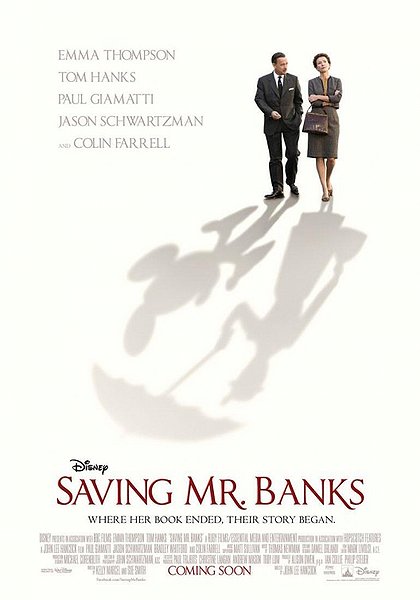 Seemingly sure-fire Oscar bait, Saving Mr. Banks left enough Academy voters cold and it’s easy to see why. First off, the behind-the-scenes sparring to adapt Mary Poppins is the movie we want to see, watching crotchety author P.L. Travers (Emma Thompson) butt heads with head honcho Walt Disney (Tom Hanks). The movie is at its best when these two share the screen, with Walt’s genial strong-arming finding little traction with Travers stern refusals (no Dick van Dyke, no animation, no mustaches). What I wasn’t expecting was a parallel storyline detailing Travers childhood in Australia dealing with an unstable home life thanks to a drunken father (Colin Farrell). It literally takes up half the movie, and while there are a few interesting juxtapositions, the screenplay just trades off scenes; one in 1961, then one in 1906, then back again, etc. The issue is that the flashbacks are never very revelatory and have no business dominating the running time. All of the information gleaned from these flashbacks could have been corralled into one late flashback, or even mentioned in a speech. Saving Mr. Banks gives you two movies running parallel, but most people will only be interested in the one. It’s a pleasant film, benefiting from strong performances by Thompson and Hanks (perfectly cast), but one can’t shake the feeling of Disney P.R. pervading the film’s retelling. It comes from the perspective that Disney is always right and that Travers was always wrong, having to work through her personal issues before relenting, even tearing up at the final product. In real life, Travers never forgave Disney and never allowed another of her Poppins books to be adapted into a film, though not for want of trying by the studios. It feels unfair to portray an author’s artistic integrity as an obstacle that needs to be defeated, but there it is, and Disney’s Mary Poppins, while beloved, resembles much of what Travers feared. Who defends the cranky authors of the world when they have a point? Saving Mr. Banks is an entertaining film, charming and likeable, until you begin to look beyond the fairy dust and realize the revisionism before your eyes.
Nate’s Grade: B-
Share this:

Fateful Findings (2013)
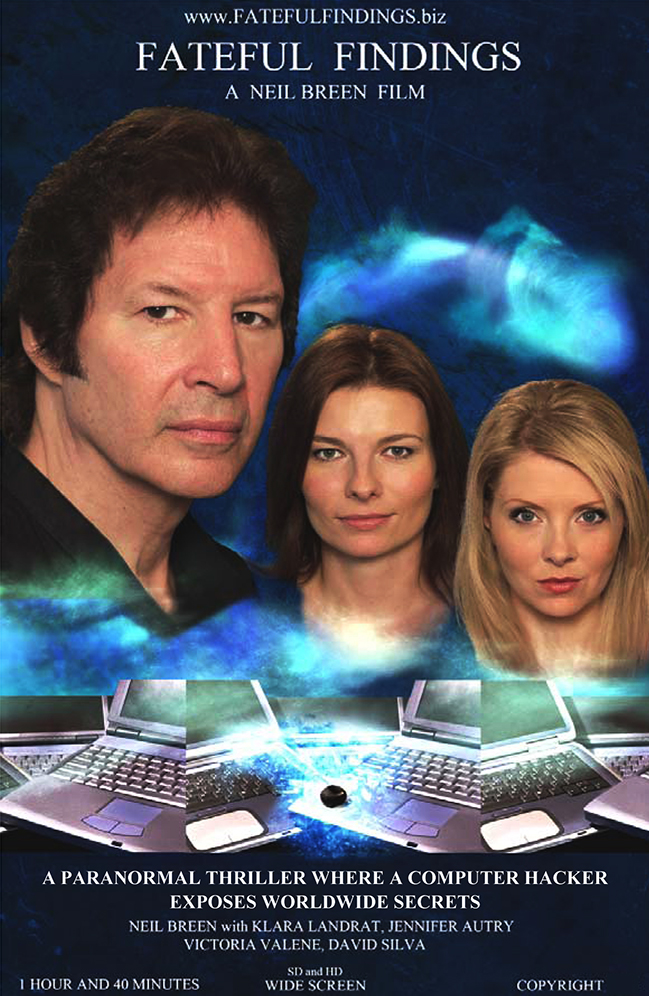 Ever since the ascent of Tommy Wiseau’s The Room atop the dung heap mountain of midnight movie fare, the world has been avidly searching for the next so-bad-it’s-amazing film. There have been several contenders over the years, most of which were amusing, such as Troll 2 or the original Birdemic, but some of which made you consider the value of life itself, such as 2009’s After Last Season. Oh, that one still makes me wince. Don’t even see that one. But as a lifelong lover of all things cinematically terrible, thanks in part to growing up on a healthy appetite of Mystery Science Theater 3000, I am compelled to seek out the worst of the worst. The Room is one of my favorite movies of all time; my love for it knows no heavenly bounds. I have to sniff out anything that comes remotely close to replicating that wonderful experience.
Enter Las Vegas realtor and architect Neil Breen. According to a Deadline Hollywood report from October 2013, Breen wrote/directed/produced/starred/edited/and just about everything else a little bundle of love called Fateful Findings. He sent it out blindly to distributors looking for any takers. It just so happens one bit, and now Fateful Findings is gearing up for a nationwide release specifically targeted at the midnight movie crowd that made The Room the sizeable cultural hit it is. Like Wiseau’s accidental masterpiece of cinematic miscalculation, Breen’s film is awash with bizarre directing choices, curious line readings, painful acting, subplots that come and go as they please, a lack of resolution, characters that behave more like aliens than human beings, odd camera framing and compositions, and, naturally, an ending that must be seen to be believed. For fans of woefully bad cinema, there’s a lot to dig in and I’ve got my knife and fork. First, I want to describe four of my favorite things about Fateful Findings and Breen.
 1) “It’s a magical day!”
The film opens with an eight-year-old boy and girl waking through the woods, coming across a magic mushroom (not that kind). The mushroom disappears, revealing a jewelry box, and inside is a black rock. “It must mean something,” young Dylan lets the audience know. Young Leah then says, twice, “It’s a magical day!” Oh, but if that wasn’t made abundantly clear, she also writes it in a notebook and shows it to the audience. But this opening scene isn’t done with its magic. We flash forward many years to an adult Dylan (Breen), who looks at least ten years older than the adult version of Leah (Jennifer Autry). Prepare for the sudden time jump shock. Anyway, Dylan and Leah never saw each other again after that magical summer that is… until she’s invited to a family barbeque. Why is this stranger, and her then fiancé, invited to a limited family engagement? Anyway, the way that these two people reconnect is that adult Leah bumps into adult Dylan and drops, what for it, the SAME notebook. It falls magically open to the SAME page, revealing the SAME message: “It’s a magical day!” Apparently she still carries that notebook around everywhere she goes and has never written in it since that fateful day. Who doesn’t bring a 30-year-old notebook with them to a barbeque?
2) “It was the Rolls Royce that hit ‘em. I saw it. I’m a witness.”
Also in the first ten minutes, we watch adult Dylan get creamed by a Rolls Royce. The speeded-up sequence itself is just hilarious to watch, especially since the car appears to be going rather slowly in the previous shot. Anyway, Dylan recovers in a hospital thanks to the black rock reviving him (make note when the EMTs arrive and their lagging sense of urgency). The collection of rubberneckers gathers at the accident scene, including one gentleman who, God bless him, foolishly attempts a British accent out of the blue, reciting the above line. I’m sure it would have been in question since the one car resting right next to the injured man is covered in his blood (how much did that cost to rent and splatter a car like that?). It’s at the hospital where Dylan unknowingly meets the adult Leah for the first time. She’s a doctor and pronounces Dylan “semi-comatose.” How is that a thing; can you be semi-pregnant? After his miraculous revival, Dylan leaves the hospital and re-enters his home, taking a shower. His wife, Emily (Klara Landrat, a former model), steps into the shower with him and happily embraces her man. Except beforehand we see a shot of his feet in the shower and blood is profusely streaming down his leg. Remember, all this is from a head wound, so how much does his head have to be bleeding to get down his leg? The shower is filled with blood, Dylan’s bandages are blotted red, and she steps inside. Gross. What kicks this entire sequence even higher in hilarity is that Dylan’s facial bandages actually cover his ENTIRE mouth and nose with no indentations for him to breathe out. When he detaches the oxygen mask, you’ll see there’s nowhere for him to actually breathe. Damn you, Obamacare!
 3) “No more books!”
Once home, we learn that Dylan has a Master’s degree in computer science but became a successful novelist, a fact he seems almost disdainful about. This dichotomy is illustrated by the fact that Dylan has four laptops out at all times, none of which are ever really turned on. Why four? Why not? He pounds away, literally, trying to complete his next book, but when his temper arises, he almost always takes it out on the poor laptops. This is a very abusive film when it comes to laptops. My favorite moment is when Dylan is holding a cup of coffee and it looks like he’s going to spill it on that laptop. It’s a ten-second sequence that leaves you on the edge of your seat, finally ending in an even greater comic punchline. At another point, Dylan throws two books into two laptops before holding back his incalculable rage onto a third laptop. The only way people communicate is by throwing things in this film. You could turn Dylan’s tortured mistreatment of laptops into a drinking game.
4) “I can’t believe you killed yourself. I cannot believe you killed yourself. I can’t help you out of this one.”
I won’t go into detail about the context of this quote, to spare some spoilers, but it illustrates the habit of actors repeating lines of dialogue ad nasuem. The dialogue itself is rather plain, so it’s weird that Breen and company feel the need to keep repeating themselves, as if we’re missing some deeper hidden meaning. We’re not.
Breen has described his film in interviews as a genre-bending psychological thriller, and while some of those elements may be present in the faintest, most diluted distillation, the man’s movie is really the long story of two marriages coming apart. Dylan’s marriage with Emily hits the skids when she gets addicted to his pain medication, but neither person seems to treat this as the serious development it is; what makes this worse is that Dylan enables her addiction. He keeps getting her the meds when he clearly no longer needs them. It seems once his childhood sweetheart re-enters his life, Dylan just forgets he has a wife. The other marriage consists of Dylan’s bickering neighbors, Amy (Victoria Valene) and Jim (David Silva), and they really have no impact on the greater plot whatsoever, and yet Breen’s film wastes so much time on their story. They’re unhappy. He wants sex. She doesn’t. Eventually in the heat of the moment Amy does something impulsive and very criminal, and the movie treats it like any nominal plot moment. A vital witness to this crime doesn’t bother speaking up until fifteen minutes later in the film, as if they just had some nagging chores to do before alerting others about a serious crime. Perhaps Jim and Amy are, in some twisted perspective, Breen’s idea of comic relief (Jim’s exaggerated “drunk” movement, throwing drinks on one another, etc.), but for a movie that is nonstop comic blunders, what difference does it make?
 And then there’s the supernatural story that permeates the edges of the film, popping in from time to time to remind you during the marital discord that, oh yeah, there’s a mysterious ghost or something or other. The supernatural stuff begins muddled and unexplained and never really clarifies. It’s thanks to the black rock, which Dylan refers to as a cube, that he’s able to survive being hit by the car. If that’s the case, then I don’t think I’d ever let that sucker out of my pocket. I’d glue it to my hand. Inexplicably, the rock also gives Dylan the ability to transport himself through walls, though he only does this once and never explains how he knew. The way we know something “magical” is happening is when a little puff of grey vapor appears onscreen. Is it a spirit, a malevolent force? Does it have anything to do with this stupid book that keeps haunting Dylan? I feel like Breen is patterning himself after the work of David Lynch, except that Lynch’s films, which can consist of weirdness for weird’s sake, have cohesion, a vision. Fateful Findings has the occasional supernatural entity, but it’s rarely examined, and then we’re off to the next subplot as if spinning a board game wheel. Then the supernatural angle, which is only barely toyed with, and with such peculiar indifference, is abandoned and the movie wholly chases after another storyline.
The movie’s final focus is on Dylan’s super secret hacking uncovering all sorts of vague secrets and corruption from governments and corporations (“As president of… The Bank…”). Throughout the film, Dylan keeps mentioning this but it never seems terribly significant, at least judging by the characters’ actions. It isn’t until the very end where Breen spends more than a passing interest in this subplot, because we have more important storylines to feature, like Ally (Danielle Andrade), his neighbor’s teen daughter, inexplicably trying to seduce him. It comes out of nowhere and is just as quickly pushed aside (I also wonder how old Ally is supposed to be). Allow me to thread an analytical narrative to make sense of these dispirit storylines. Assessing the film, it sure comes across like Breen’s attempt to bolster his sense of self. In every scenario, people treat him as a treasured human being, he’s at the center of a diabolical conspiracy, he’s gifted with magic powers that separate him from normal men, all women want to seduce him, and then in the end he’s the one who makes the world a better place by exposing corruption. It sounds like a hero complex to me. Even acts that deserve harsh scrutiny, like his enabling of his wife’s addiction or his blasé attitude about carrying on an affair, are ignored. In this universe, Dylan is always right, always desired, always respected, and always special.
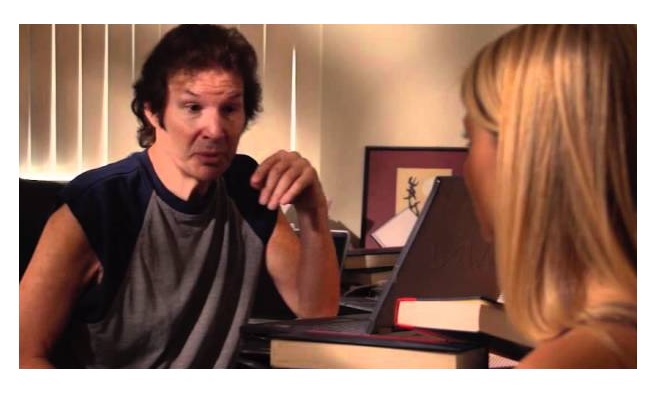
 The production has a hard time hiding its obvious shortcomings, sometimes hilariously so. It becomes clear very early that most of the film was likely shot in Breen’s home, which is fine except it also unsuccessfully doubles as other locations (the blinds are the big giveaway). The worst is the hospital room, which mostly consists of a bed and three oxygen canisters. What hospital room is going to have carpet? So much of the movie takes place in Dylan’s home office, with that plethora of laptops, that you’ll start to memorize the home layout. In the opening, with Dylan and Leah as kids, we’re shown modern-day vehicles and then flash forward at least 35 years. Could Breen not have shot the scene with some older vehicles? Then there are Dylan’s two therapist’s offices. The first one is the guy who keeps prescribing pain meds. Perhaps to communicate his overall incompetence as a doctor, Breen stages all of the therapy scenes in a conference room with both men sitting as far apart, at either end of the long conference table. What better way to foster patient intimacy? He also magically switches jackets in the middle of one session. The second therapist operates in what looks like a closet, and the only thing we see are two folding chairs. She may not really exist, or was in on the unexplained supernatural conspiracy, so perhaps the old lady therapist didn’t feel like putting that much effort into decoration.
The technical abilities of the Fateful Findings crew are, to be expected, less than stellar. The editing is another clumsy detraction, namely that Breen and his TWO other editors let their scenes meander several seconds longer than where they should have cut, giving the film a loping feeling. It’s like each person is counting mentally when to respond to the dialogue, and when one person finishes the film holds, counts as well, and then cuts. There are slow pans that add nothing to the film but space in between lines of dialogue. I don’t need rapid-fire cuts for what is essentially a domestic drama, but why the hesitant editing? Is it just a sneaky way of inflating the film’s running time? Even Breen’s staging of the camera can often be confounding. For whatever reason, the film often features camera shots of people’s feet or people very carefully cut off at the head, meaning their heads are not visible. It happens enough and for such nonessential scenes that I started to wonder if Breen found himself an Ed Wood-esque solution for not having his same actors for the scenes he needed them for. Beyond a Tarantino-size foot fetish, I don’t know why there are so many shots of feet. At least Breen is not as inept in his visual staging as the makers of After Last Season, a movie so bad it’s just bad beyond measure. Breen knows enough to adequately stage his scenes, which makes his choices all the more curious.
The acting is generally terrible across the board, occasionally breathtakingly bad. Let’s start with Breen himself, who is fairly listless and deadpan throughout. He raises his voice but rarely does he change how he’s responding. He’s aloof and strikingly self-serious at the same time. Breen’s command of his actors is limited to directing them to just ham it up. Most of the actors will exaggerate facial expressions and physical movements, providing more drama. Landrat is trapped by her storyline too early, and so she succumbs to the screaming wife with an Eastern European accent. Autry does no better, looking uncomfortable in every moment onscreen. The worst actor in the movie, easily, is Valene, who squawks in the same pained sing-songy manner with every line with nasally incredulity. The best performance in the film may belong to the mysterious old lady therapist who may not really exist. And yet, she’s the most grounded.
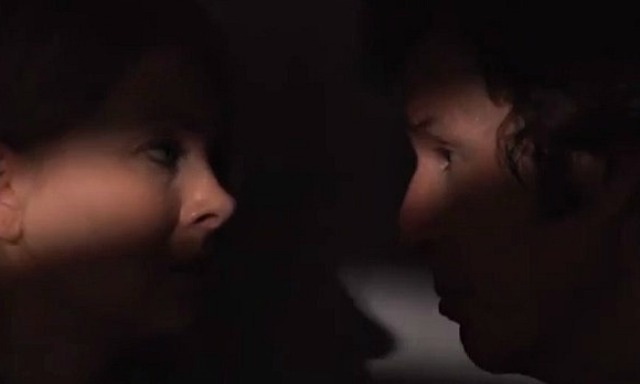
 Making the film seem even more alien is Breen’s chaste sense of human sensuality. One of the adjectives on the poster describing the film is “passionate,” but you have to wonder if Breen was just too uncomfortable, or perhaps his female actresses were, to make the onscreen passion a bit more palpable. The very way people kiss in this movie is so chaste. They lean in, pecking each other slightly on the lips, as if one was kissing their grandmother goodbye rather than engaging in uncontrollable passions. They were doing hotter fake kissing in 1940s Hayes code era Hollywood (check out Hitchcock’s Notorious and tell me that Cary Grant-Ingrid Bergman kiss still isn’t hot today). Breen’s passions are so modest and contained. Take for instance a scene of passion directly following a spat between Dylan and Emily, one where she threatens to leave him. Apparently that revved up their engines because they start tearing apart one another’s clothes and doing their chicken peck kissing. Breen, as is his usually fashion by this point, knocks over several laptops and throws papers into the air for what feels like a solid minute. Whenever disrobing one of the actresses, be it tearing of clothes or the more gentlemanly “unbuttoning” method, he always stops above his ladies bosoms, allowing a hint more cleavage but nothing beyond. It happens enough that it starts to become a noticeable artistic choice, as is his consistent framing of topless women sleeping face down on their beds. It gives just enough of a glimpse of partial nudity without revealing more (all four main actresses will go partially nude at some point in the film). This puzzled me because I was certain the only reason these actresses were selected is because they likely accepted a part where they would eventually display their physical assets. They’re not here because they can act, that’s for sure.
In fact, the only nudity in the entire movie belongs to Breen himself as he bares his behind while stumbling out of his carpeted hospital room. If you dare look closer, you’ll see the end of his gown catches the end of the hospital bed just so, allowing the flap to stretch and display Breen’s posterior. Either this was a one-time thing and Breen said, “why not?” or, and I think, given the nature of hero complex evidenced, this is more likely, that they kept shooting the scene until the flap caught and proudly displayed Breen’s rump. I suppose in the Garbage Bag Room (a reoccurring dream/nightmare in a space literally lined with garbage bags), there is a nude woman accompanying him, but she’s tastefully composed and likely a body double for Autry. For a man who looks visibly uncomfortable even kissing women, let alone disrobing them, it defies logic that Breen would acquiesce to his own nudity in his own film.
But the question that must be asked of all craptacular movies is whether it is the right kind of bad, the kind made with sincerity in equal measure with its incompetence. It’s one thing to make a bad movie and another to make it purposefully, chasing after the ever-hungry midnight movie crowd, looking to cash in with some canny filmmaking ineptitude (Birdemic 2, people). From everything I’ve gathered via Breen’s interviews, he’s legit. He even has previous movies to his name and I can only hope those will see a wider release. Breen’s film hits that so-bad-it’s-good sweet spot of derisive entertainment enjoyment. I was laughing just as many times as I was shaking my head. However, as a connoisseur of crap cinema, I must say that The Room maintains its throne. Breen’s film is a bit too lackadaisical in its nonsensical plotting and starts to feel redundant, and I’m not just talking about the oft-repeated dialogue. There is a finite level of bad to this film whereas The Room is a thousand brushstrokes of terrible. Breen’s film marvels but it may also test your patience at turns, unless you’ve been drinking heavily.
 Fateful Findings is awash in terrible decision-making, to the world’s benefit. Breen and his team have put together a movie that is baffling, ridiculous, and greatly entertaining. From the dropped subplots, repeated laptop abuse, inauthentic human behavior, hazy plotting, laughable special effects, chaste human interaction, strange feet-heavy framing, and that ending, oh the ending is just comedy gold; there’s a little something here for every discerning ironic viewer of bad movies, though the film does lag and repeat its offenses enough that it feels stretched and redundant. I’d say, amongst the spectrum of recent bad midnight movie fare, it’s probably just below Birdemic. I don’t know what the repeat value will be for Breen’s film, or whether it will catch on with audiences like Wiseau’s unexpected success. I can’t even say whether I really want to watch it again, but I will, and with a gathering of friends, and likely with the added benefit of some adult beverages. If Fateful Findings is playing at a theater near you, by means see it and bring your pals along for the fateful experience. It will make you think. Mostly about laptops.
Nate’s Grade: F
Entertainment value: A
Share this:

The Secret Life of Walter Mitty (2013)
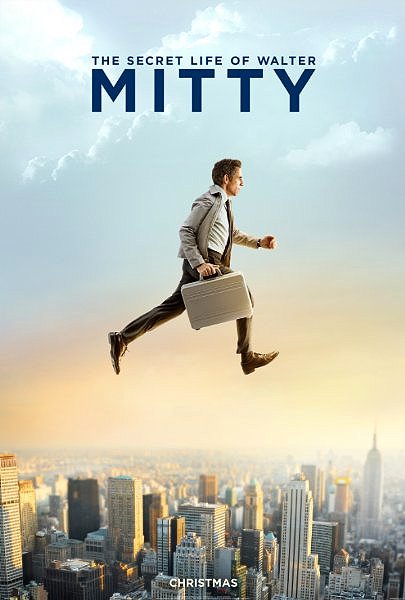 The Secret Life of Walter Mitty, based on James Thurber’s short story, is a property that has long beguiled Hollywood. The idea of escaping one’s ordinary life with fantasy, where we’re the hero. It was turned into a 1947 film starring Danny Kaye, which is rather entertaining, but has yet to be remade in all that time. It’s the kind of attractive project that has attached big name talent at different stages of development, including Steven Spielberg and Jim Carrey. It was never able to get off the ground, that is, until Ben Stiller stepped in, not just as director but also as the lead actor. Given Stiller’s directorial track record, there was suitable reason to anticipate what he could accomplish with Mitty, but the film too often feels like Stiller hamstrung, ably trying to marry a sincere indie sensibility to a mainstream sentimental holiday-released excursion for families. Stiller’s Walter Mitty never quite takes off.
Walter Mitty (Ben Stiller) is a man who has trouble filling out an online profile. He doesn’t have too many experiences or places traveled. It may be why he frequently “zones out,” as his family terms it, escaping into fantastical daydreams. In real life he works as a photography assistant for LIFE magazine, a publication that is transitioning to a digital-only existence. The enigmatic photographer Sean (Sean Penn) has sent a collection of film negatives to Walter, making special note of how Negative #25 is his life’s masterpiece. However, Walter cannot find it and is having trouble getting in contact with Sean, who is overseas on assignment. Without that much-hyped negative/picture, Walter will surely be fired, and then he’ll never have a chance to ask out his co-worker, Cheryl (Kristen Wiig). Walter sets out to Iceland and beyond to find the negative, stop daydreaming and finally live his life.
 The very tone of the movie feels like a miscalculation. It’s the story of a daydreamer, a man who retreats into his head and lives out preferable fantasies that are whimsical and far-fetched. We all knew this going into the film. It’s the same as Thurber’s story. The problem is that when Walter gets the courage to embrace life, his life is full of whimsical and far-fetched moments. He jumps out of a helicopter in shark-infested waters, where the sharks are ravenously active. He also hops into a car and has to outrun an oncoming ash cloud from an exploding volcano. And then in the third act, he travels across a mountain range all by himself and manages to miraculously find one guy. I don’t think this approach works if his real-life adventures are on par with his whimsical fantasies. I suppose one could argue that this serves a point to make real life seem just as appealing as his mental retreats, but I think it harms the very execution of the movie. First, if there’s a parallel, it means that his fantasy sequences aren’t going to be too fantastic, squashing the potential of Walter’s imagination. The only fantasy I enjoyed was a Man of Steel-esque brawl with a bearded Adam Scott (TV’s Parks and Recreation). Secondly, it means that the serious “go get ‘em” message of the movie is occurring within a medium that ordinary citizens have little connection with. Make no mistake, Walter Mitty is clearly meant as a mainstream feature meant to inspire the masses with its sentimental stripes, but is the story of a superhero doing super deeds any more relatable to the common man?
Another problem plaguing Mitty is the illusion of depth. Beyond the simplistic platitude of “get out and live your life,” there really isn’t much more of an idea explored here. It’s not like this idea hasn’t been explored in, oh, hundreds of other stories. Regardless, the film often just becomes a two-step process of Old Walter feeling timid, and then, what’s this, the hip soundtrack with the likes of Arcade Fire and Of Monsters and Men starts pulsating, and Mitty boldly shifts into New Walter, the go-getter, the guy who’s going to take charge of his own life. It’s a strong soundtrack in all senses. This process is repeated throughout the second act of the script where most of Mitty’s overseas journeys take place. Also, it may sound petty, but let’s focus for a moment on the applicability of the movie’s message compared to the practicality of what is onscreen. Live your life, but how many of us can afford to go globetrotting on a whim? I understand the larger canvas meant to evoke Mitty’s growing sense of discovery, so I’ll let it slide. The theme of Walter Mitty isn’t so much developed as it is repeated. There’s not enough substance here. In the end, the movie feels like 100 minutes of a soundtrack and a message in search of a better movie.
Allow me illustrate one of those “go out and live, Walt” moments in the film. Walter is in Greenland (though filmed in Iceland) and needs to get to a fishing vessel. The man next to him is a helicopter pilot. Great. But he’s also drunk, so Walter understandably refuses to fly with the man. This seems like a very rationale decision, but then he fantasizes Cheryl coming through, urging him on through song (through song!), and the soundtrack starts pumping, and Walter runs out and literally jumps inside the ascending helicopter. It’s meant to be portrayed as a triumphant moment of embracing the uncertainty of life’s adventure, but in reality the movie just pressured its title character into getting into a flying vehicle with a drunken pilot. What? That’s irresponsible.
And then there’s just the lackluster characters and plotting. Walter Mitty is a nice enough guy but too milquetoast to be that appealing, relying upon the comic graces of Stiller to provide the filling. The character of Walter is basically a hodgepodge of other Stiller characters in previous movies, but the character feels too restrained for an actor of Stiller’s talent. I understand that the arc has to travel from passive to active, but it feels like the funny Stiller we’re all accustomed to is being held in check thanks to the film’s broad appeal feel-good sentimentality. There’s one brief moment of the anarchic, silly Stiller that we loved so much in Tropic Thunder, and it involves a weird fantasy where Walter suffers the reverse-aging Benjamin Button disorder. It doesn’t fit at all with the tone of the film, and that’s why it stands out. Walter is a nice guy but rather boring. He pins his journey of self-discovery on getting the girl, and then when presented with one minor obstacle at the start of Act Three, rather than speak with her, he assumes the worst and just gives up. The narrative requires one of those eleventh-hour misunderstandings to keep the guy and girl apart, but it’s a frustrating decision that makes me like Walter less.
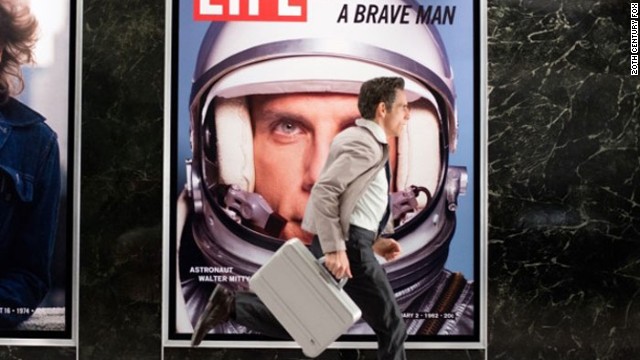 The Secret Life of Walter Mitty is also filled with blunt product placement and some strange plot elements that don’t blend together. I’m not generally offended by product placement in movies when they make it oblivious; hey, a character has to drink something so why not a (insert product here)? But the fact that the Walter Mitty team actually makes Water’s teenage stint at Papa John’s a reveal about his character, and that the very store is meant to stand in as a reminder of his own deceased father, is just wrong. Then there’s the fact that Walter works as a negative corrector (analog job) at a magazine (troubled industry), and that magazine happens to be LIFE (which shuttered in 2000). Why all the analog contexts? Is it meant to convey Walter’s reluctance to change or adapt? The whole notion of the magazine downsizing gives the film a real-life aspect that just doesn’t feel appropriate for the movie. The fact that Walter’s journey is propelled by a quest for a single missing negative feels a tad too facile for the man’s transformation, but it’s made worse when the answer to the location of the negative is so transparently obvious from the get-go. It was so obvious I almost talked myself out of it. Most of the supporting characters in the film serve little effect on any of the events. They’re there just to provide minor details about Walter and that’s it.
The movie is so earnest and you can tell Stiller is trying hard, but The Secret Life of Walter Mitty ends up being a disappointing feel-good message lacking substance and much entertainment. The filmmakers have conviction, I’ll give them that, but it’s misplaced, and the film’s tone has too many distracting elements. The fact that real life mirrors Walter’s fantasy visions seems like a miscalculation from the start. Thurber’s short story didn’t have that much to it to begin with but we need more than this, an office schlub learning to live his life through improbable adventures meant to inspire the rest of us common folk. As a slice of escapist entertainment, it’s not fanciful enough, not creative enough, and not funny enough. As a motivational, heart-tugging ode to living one’s life, it falls into too many traps to feel applicable, insightful, or engaging. It looks beautiful and the people behind the film obviously mean well, but good intentions and nice camerawork are not the same as an effective movie built from the ground up, namely the lackluster story and characters. The Secret Life of Walter Mitty feels like it has as much depth as a glossy, idealistic commercial, and perhaps for some this will suffice, but I found this Walter Mitty’s secret life not worth investigating.
Nate’s Grade: C+
Share this:

Fruitvale Station (2013)
 In the early hours of New Year’s Day in 2009, 22-year-old Oscar Grant was forcefully escorted off the Oakland transit system by armed officers. He was believed to be involved in some sort of gang-related scuffle on the train. Over the din of confusion, shouting, and anger, Oscar was shot and killed by a transit cop. His death sparked waves of outrage in his hometown and grabbed national headlines. Ryan Coogler was so passionate about Oscar’s death that he decided to write and direct a movie detailing the last hours of Grant’s life. He snagged Michael B. Jordan and Octavia Spencer (The Help) to star, attached Forrest Whitaker (Lee Daniels’ The Butler) as a producer, and the ensuing film, Fruitvale Station, debuted at the 2013 Sundance Film Festival and won the top honors. Thanks to Coogler, many more people will have a chance to get to know Oscar Grant as a person rather than an unfortunate statistic.
Coogler creates a remarkable debut film for himself, one where the details of life feel richly realized and observed. Sure there are obvious symbolic metaphors introduced like boiling lobsters and a lost dog that dies in Oscar’s arms (yes, foreshadowing), but as a whole Fruitvale Station feels like real life transposed onto celluloid. Coogler also works hard to humanize all the participants in his film, save for the transit cops at the end. There is a refreshing lack of judgment throughout the film as people are allowed to be the ambiguous creatures we are. No more so than Oscar. He has moments that make you wince, but mostly we watch a man struggling to get his life in order. He’s terrific with his daughter, loving and naturally attentive; he puts his family’s needs ahead of his own when it comes to money; he even helps a stranger learn how flash fry a fish, though there’s a hint of flirtation guiding his actions. But he also can’t hold onto a job, has trouble being more actionable in his life’s decisions, and temptation is always banging on his door to lead him back to prison. He’s a complicated man and Jordan (Chronicle) masterfully brings the man and his complexities to life. This is a star-making performance by Jordan (as was his turn on The Wire) and I was stunned at how easily Jordan dissolves completely into his role. There isn’t a physical nuance or line delivery that feels false. It’s a sympathetic humanization and Jordan’s performance is a gift. Combined with Coogler’s deft handling, Fruitvale Station is engrossing.
 For much of the film I felt like I was attending a funeral. It’s hard to watch at times, especially watching Oscar’s family wait at the hospital for the news we already know is coming. It reminded me of 2006’s United 93, where the overwhelming sense of dread held over every scene, every innocuous moment held the extra weight that it would be the last time this person was doing this or talking to this person; the dread of waiting for the end we all know is coming. Coogler opens his film with real phone video recordings of the death of Oscar Grant, so from the first moment on we’re awaiting the horrible inevitability. I suppose it gives every moment an extra dimension of pathos, and to some this may be cheap and easy, but it all comes down to perspective. Surely if you knew the final day of your life, you’d likely find extra meaning in the simplest things, bidding goodbye in a thousand different subtle ways. This message isn’t exactly new; it was already old when Thornton Wilder hammered it home in his 1937 play Our Town. Carpe Diem, seize the day, live every moment like it’s your last, stop and smell the roses; you get the idea. And so, the entire running time of Fruitvale Station is a mournful examination on the contradictions, complexities, and connections of a single human life.
Oscar Grant is not lionized as a saint nor is he vilified as some mindless thug without redemption. Carefully, Coogler constructs a complicated man struggling to right his life. Through flashbacks we see he’s spent time in prison, and he’s got a quick flash of a temper that can lead him into impulsive and violent confrontations. It’s significant that we see this prison flashback to summarize completely the life Oscar is trying not to return to. The temptation is always present to fall back on old patterns of comfort, namely cheating on his girlfriend (he has a lot of girls’ numbers in his phone) and going back to selling drugs to make ends meet. Oscar’s ongoing struggle with personal responsibility has cost him his supermarket job (he was late far too often), and he’s kept this news to himself, choosing not to worry those close to him. But his options are limited as an ex-con, let alone a guy fighting his own demons, but he keeps fighting because the Oscar we see, the glimpses of what he could become, are one who wants to be better. He dumps his supply of drugs rather than go through with a sale. The gesture is noble but also partially self-destructive from a pragmatically financial way of thinking. He’s in a deeper hole, money-wise, but he seems committed to making the change. A late encounter with a kind stranger also provides the possibility of a new job, a new chance, one that seems all the more tragic because we know it is a promise that will never be captured. Oscar Grant was likely never going to be a man who changed the world. He was an ordinary man. But we still mourn the death of ordinary men, even those who have made mistakes and are fallible.
 It’s impossible to view Fruitvale Station without its relevant connections to the Trayvon Martin case of 2012. Both of these men were black youths deemed to be “up to no good” with quick judgment skewed by prevailing racial bias. Both men were killed for being viewed as threats due to their race and gender. However, unlike Trayvon, we have a litany of witnesses and video evidence documenting the senseless execution of Oscar Grant. That transit officer argued he mistook his tazer for his gun because, surely, a suspect who is already handcuffed, face down on the ground, and having his head pressed down with the boot of an officer, surely that man needs to be tazed just for good measure. That officer, by the way, served 11 months of a two-year prison sentence for involuntary manslaughter (justice served?). It’s senseless tragedy built upon miscalculated racial alarm, and the reason we have a movie, the reason there were riots in Oakland, is because this specific case had witnesses. How many other innocent young men die every year because someone wrongly and hastily deemed them to be “up to no good”?
Coogler isn’t trying to stir the pot of racial animus or deify Oscar Grant into some martyr for the cause. Fruitvale Station only follows the last day of Oscar Grant’s life but in doing so it becomes an illumination of a human life. Oscar was an ordinary man before he met so unfortunate an end, but Coogler wants us to remember him not simply as a newspaper headline, but as a person. It’s a worthy endeavor that succeeds heartily but may prove to be dull to many, including several of my own friends and critical colleagues. I can’t argue that the life of Oscar Grant is notable to follow beyond the sad final twenty minutes. But that doesn’t bother me, because with the talents of Coogler and Jordan and their indomitable sense of purpose, the film becomes a fitting portrait of Oscar Grant as a human being and a life lived, not just a life prematurely extinguished. It’s powerful, upsetting, brimming with emotion and fury, and it’s also eerily relevant to today and will, I fear, only continue to be more relevant as the next Oscar Grant or Trayvon Martin captures the national spotlight. Coogler’s excellently realized film is a eulogy to an ordinary man, flaws and all, but also a call to do better.
Nate’s Grade: A-
Share this:

Lone Survivor (2013)
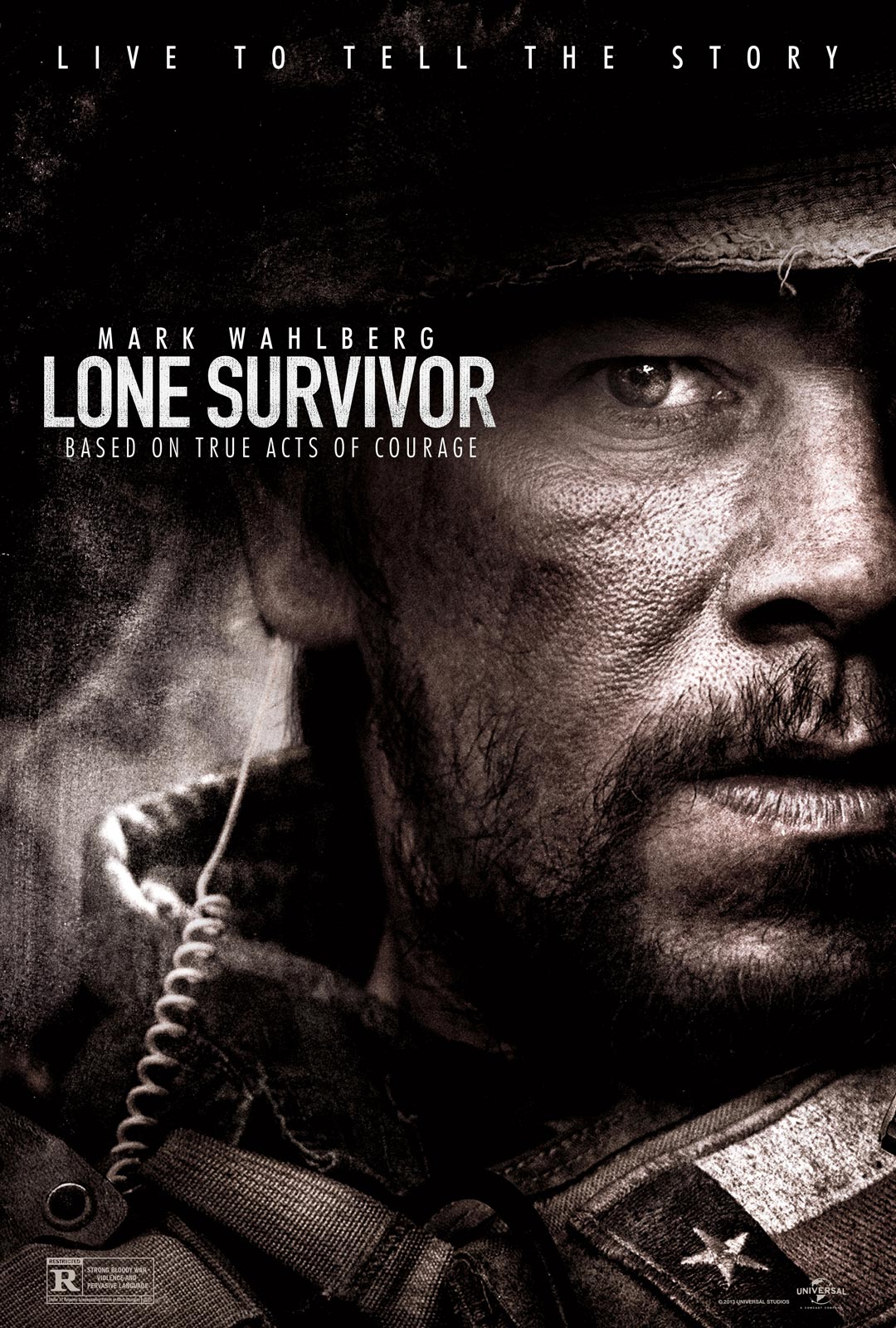 What do you do when the title of a movie is a spoiler? That’s the question with director Peter Berg’s reverential military action film, Lone Survivor. It’s the true story of a team of Navy Seals who had their mission compromised by a pair of unlucky Afghan goat herders. After deciding to set them free, rather than snuff them out, the Seals retreat to an extraction point, with a hundred Taliban fighters hot on their heels. When the action is firing, Berg is right at home, placing the audience in the middle of a visceral firefight that’s bloody and hardcore and pulse pounding. The rocky terrain of the country is just as deadly as the Taliban, as the Seals bounce around like ragdolls. The performances are all grizzled and finely attuned to keeping the terror of the moment at bay. Ben Foster (The Messenger) is the standout, which is a statement that’s been said with most Foster performances. At the end, I’m left wondering what is the film’s greater message. It’s retelling a military episode few people know about, illuminating the courage and bond between soldiers under fire. But in the end, all of these lives were lost because of one moral though arguably bad decision. Couldn’t they have just tied up the goatherds and gotten a better head’s start? Will the movie convince an audience that those innocent Afghan goatherds should have just been collateral damage? Does the movie critique the futility of America’s ongoing presence in Afghanistan? The futility of war itself? I doubt it, especially with Berg’s fervent appreciation of the armed forces putting their lives on the line (the opening credits themselves glorify the toughness of the Seals while also setting up an explanation why they could survive so many gunshots, injuries, etc.). Lone Survivor isn’t the heedless jingoistic propaganda piece that others critics have feared, but in the end it’s simply a sober and respectful tribute to the fallen, and that’s it. For many, this will be enough. For me, I was thrilled by the heroics but looking for more.
Nate’s Grade: B
Share this:

Mandela: Long Walk to Freedom (2013)
 One of the most important figures in the twentieth century, you’d expect Hollywood to give Nelson Mandela his well-deserved close-up, and in 2013 we got a biopic on his wife and the man himself, with Mandela: Long Walk to Freedom. It is a respectful, reverent, and relatively inspirational biopic boasted by a pair of great performances. Idris Elba (Pacific Rim/everything cool ever) nails the voice but also inhabits the courage of the man, the toll of his decisions, and the doubt that crept in at his darkest moments. Harris (Skyfall) gives a fiery performance as Winnie Mandela. You may be surprised, as I was, how active she was in South Africa’s rebellion against the government. The problem is that the film plays like a greatest hits collection without much more insight than we could glean from a cursory new report. Cramming the man’s life into 140 minutes is obviously going to be insufficient, but the speedy narrative does little justice to the man’s hardships and the complexities of South Africa’s civil rights movement. The cradle-to-grave approach in biopics is somewhat passé now. Rather movies like Lincoln and Invictus, also about Mandela, focus on pivotal moments that encapsulate the person. I think I have the perfect rewrite of this movie: adjust the focus squarely on the series of meetings in the late 1980s Mandela had with the South African government about political reform. Let’s dig deep into the political conflicts, the government’s fear to equal rights and possible recriminations, the smoothing of tensions, the building of trust, the fragility of a country in the balance. It may seem like more of a stage bound approach, but I think it has more immediacy, nuance, and works to summarize his lifetime of struggle and the change of his country. Oh well. Mandela is a respectful biopic but the man and his legacy deserved something better than a speedy run-through of his life’s checkpoints.
Nate’s Grade: C+
Share this:

The Wolf of Wall Street (2013)
 Martin Scorsese. The greatest living filmmaker on the planet. Enough said. When his latest, The Wolf of Wall Street, was pushed back due to an editing crunch, the rumor mill started as it normally does. Are there problems? Is it any good? Will it be forgotten this late into the awards season? While I can’t speak for the Academy, but for me The Wolf of Wall Street just about blows every competing movie out of the water this season. It’s brash, exhilarating, uproarious, mesmerizing, and just about every other adjective you can fetch from a dictionary. This is first-class filmmaking from a master, and consider Wolf of Wall Street the white-collar companion piece to Scorsese’s gangster masterpiece, Goodfellas. It’s that good, folks.
Based on his memoirs, Jordan Belfort (Leonardo DiCaprio) rises on Wall Street from a rookie stock trader to the king of his own empire. From the late 80s to the 90s, Jordan assembles a cutthroat team that knowingly sells lousy stocks to gullible investors and stuffing their pockets with hefty commissions. “Better there money was with me. I knew how to spend it better,” he admits. His closest friend and business partner, Donnie Azoff (Jonah Hill), literally quits his job to work for Jordan after spying one of his pay stubs. The guys start their own firm, specializing in high-pressure sales and on penny stock commissions. From there, they expand and expand until they’re making their own noise on Wall Street. The trading floor more closely resembles a frathouse party, complete with chimp, strippers, marching bands in their underwear, midget tossing, and other objectionable behavior. Jordan easily succumbs to the sex and drugs of the high-finance world of money, leaving his plain wife for Naomi (Margot Robbie), a gorgeous underwear model. He’s got a giant estate, a huge yacht, his own helicopter, and more money than he can spend. He’s also got the attention of the FBI and Agent Patrick Denham (Kyle Chandler). With the feds circling in, Jordan has to take extra steps to keep the good times rolling.
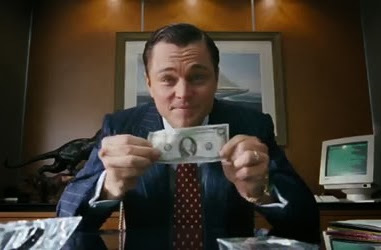 With a running time exactly one minute shy of three hours, it’s easy to call The Wolf of Wall Street self-indulgent and excessive, except that’s exactly the point. The movie is an orgy of unchecked male ego, a perverse bacchanal of Earthly pleasures that Caligula might blushingly admire. They are literally two orgies depicted in the movie and plenty of thrust-heavy sexual congress (I counted eight walkouts in my theater, most of them the little old lady variety). Here is a tilt-o-wheel of madness. These people were living like there was no tomorrow, had more money than they knew what to possibly do with, and would figuratively dance while Rome burns (in this instance, the stability of the U.S. economy). What’s important is to communicate that these individuals were having the time of their lives. It wasn’t just the hedonistic pleasures and the mountains of drugs; it was the power, the uninhibited embrace of a life available via poorly regulated capitalism. Many of those brokers in Jordan’s company were people from ordinary backgrounds. Their self-made success (that wasn’t so much earned as swindled) is a point of pride that fills them with purpose. They are seizing their full potential. There is no doubt in my mind that every broker in this movie would do it all again in a heartbeat. There is no remorse on display anywhere. The only remorse is having the ride unceremoniously end. “Was it obscene? Yeah it was obscene. In the normal world,” Jordan narrates. “And who wants to live there?”
I won’t say that there aren’t scenes and moments that could have been trimmed, but I was enjoying myself way too much to care about the bloat. This is the fastest three hours you’ll ever experience in your life. There’s some fat, yes, but man does this picture just move along like a freight train. The screenplay by Terence Winter (creator of HBO’s Boardwalk Empire) is impeccably drawn. The movie just courses with energy and watching it is often an exhilarating rush, communicating the highs the characters are undergoing. The supporting players are used to great effect to punctuate the comedy moment to moment. I loved Rob Reiner’s exasperated and profane performance as Jordan’s father. Naturally the bad behavior is entertaining in how absurd and over-the-top it can get, but one key sequence ranks up there with the finest sequences Scorsese has ever put to film. It’s the “Lemon” sequence, named after a legendarily potent batch of Quaaludes. It is a sequence of pure movie bliss, brilliantly edited and staged, as Jordan is placed in a precarious position when the drugs kick in, and his comic floundering is riotous. Winter and Scorsese have taken what, in other hands, could have been a modern American tragedy and decided to portray it as a darkly comic fantasia. I laughed long and hard throughout the movie. There are numerous scenes I can think back on and start laughing again. The ridiculous nature of moments, like discussing the logistics of tossing midgets at a dart board (“This is their gift”) is to be expected, but it’s the overall degenerate lifestyle these clowns chase after with impunity that kept me laughing.
I’ve read cantankerous critiques of the film, chastising Scorsese for celebrating the lavish lifestyle and excessive hedonism of his characters. I could not disagree with this appraisal more. The error is assuming that witnessing Jordan behaving badly is akin to celebrating it, as if adopting the perspective of our lead is the same as excusing his actions. Scorsese makes it clear early, and often, that Jordan Belfort is not a good person. Hopefully you don’t need him hitting his wife for this point to stick. This guy is fleecing people out of their life savings, living high off the fat of the land, and openly admitting to the camera how deeply illegal his activities are. But you’re under his spell, much like his brokers that worship him with unflinching zeal. Jordan, especially as portrayed by DiCaprio, is a volcano of energy and single-minded determination. He whips his troops up like a religious revival, manipulating you with every tactic in his employ. Early on, he’s defrauding ordinary middle-class and low-income clients, but because we’re all addicted to the adrenaline rush of the sale, of the con, we push this troubling reality from our minds. When he moves onto wealthier clients, we adopt a similar attitude of Teresa, Jordan’s first wife, mainly that these people can afford the losses and therefore get what they deserve from a silver-tongued shyster. It’s the audience that proves to have a selective memory because we’re drawn to Jordan’s charisma, expertise, and talent, so we ignore the pesky details of who gets stuck with the bill. Don’t pin that on Scorsese. He makes it abundantly clear that Jordan is a bad man, and the depths of his greed is but the tip of the iceberg when it comes to Wall Street. Jordan’s firm was a tiny player. Think of what horror stories Goldman Sachs or Lehman Brothers would offer if ever exposed.
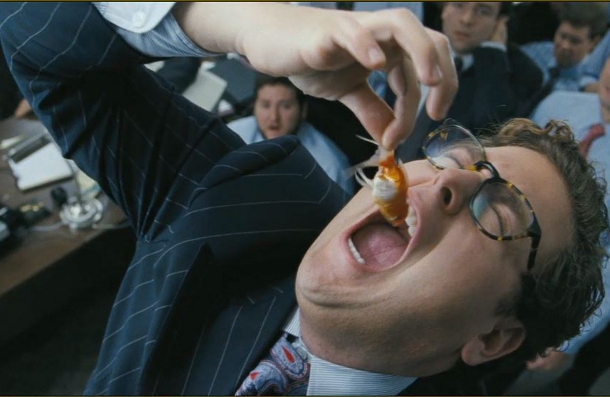 This is my favorite Scorsese film since Goodfellas, and they have plenty of similarities. It makes sense because these men of finance take their cues from movie gangsters, styling themselves as tough guys. At one point, brokers hold a guy over a building to intimidate him. There’s also certainly as much cocaine as there may have been in Scarface. But like that classic of the gangster cinema, Scorsese propels us into the hidden world of the financial institution run amok, allowing us a backstage pass to the people profiting from wrecking the economy. It’s a fascinating perspective that confirms some of our worst fears about stockbrokers. It’s a misogynistic boys club and the few women that do participate have to play by their hyper masculine, juvenile rules. These are people that find any number of ways to skirt the law, rip off their clients, and live in luxury until they can find another sucker. It’s a system built for the entertainment of the few on the backs of the many, and it’s just as relevant today as it was in the 90s. With Jordan’s inside knowledge, we’re educated on the many corrupt ways of Wall Street.
Marking the fifth collaboration with Scorsese, this may be the finest DiCaprio (The Great Gatsby) performance yet. The man sheds his vanity, easily fitting into the shark that is Jordan Belfort. He’s ruthless in one moment and completely inept in another, at the whim of his vices. DiCaprio taps into Jordan’s leadership qualities with the dynamite sales speeches, but he also shows what an insecure man he is at heart. He’s got a taste for the good life and is reinventing himself, including trading up in wives to attain that proverbial American Dream. He’s living empty pleasure to empty pleasure and he doesn’t care. DiCaprio acts as our ringmaster through his own circus, and you’ll be delighted and horrified by his actions (and also his peculiar, bird-like dance moves). There’s not a bad performance in the whole cast, and this is one huge cast. Hill (This is the End) is a becoming more and more credible as a dramatic actor, though he excels at the blustery outrageousness as Jordan’s number two. He’s a treat. Robbie (About Time) nails her New Yawk accent but more importantly nails the portrayal of a trophy wife who recognizes and eventually resents her lifestyle. And oh does she just exude sexual heat.
I want to focus on the very end of the film, so there will be some mild spoilers in this paragraph but nothing I feel that would ruin the viewing experience. You have been warned, spoiler phobes. As expected, Jordan eventually winds up in jail for his felonious misdeeds. Ordinarily this would be the end of our traditional law-and-order morality tales; the bad guys are locked away to pay for their crimes. Jordan tells us how nervous he was on his first day of prison, that is, until he remembered one very important fact: he’s rich. White-collar prison is not the same as other penitentiaries, and we see Jordan loftily playing tennis. His sentence is only three years as well, which seems like an insult given the thousands of lives he may have instrumentally ruined. But that’s the ultimate condemnation in the end: the system is rigged for people like Jordan, people with money. In the end, he wins. He goes to prison, his family life is torn asunder, and his personal relationships are strained, but the guy wins. He continues his speaking engagements motivating everyday saps how, with his cherished expertise, they too can rake in wealth. The final shot of the movie tells me everything I need to know. It’s a slight pan out to the crowd in attendance of Jordan’s speaking session. We see the collection of faces, each person hanging onto Jordan’s every word, each filled with idolatry. They want to be him. Despite everything, the bad behavior, the crimes, the waste, they all want to be him, and that’s why people like Jordan will always succeed, will always prevail, will always have the last laugh. There will always be a healthy supply of suckers that want to believe whatever nonsense he’s peddling. That’s the point. He won.
 Recently I watched the very good crime caper American Hustle and noted that its director looked to be fashioning a loving Martin Scorsese homage. Well, after watching The Wolf of Wall Street twice (not back to back, mind you; I’m not nuts) I can say that there is no Scorsese like the source. This is vintage Scorsese. This is brilliant filmmaking, a bold movie that practically sings, it flies by with exhilarating force and acumen, daring you to keep watching. The fact that 71-year-old Scorsese could make a movie this highly energetic, this debased, this brash, this borderline indecent, and this awesomely entertaining is encouraging. It’s even more hilarious to me that older Academy members at a recent screening of the film accosted Scorsese, essentially being termed a “debauched scoundrel.” That’s got to count as some badge of honor. Yes, at three hours the movie can get long but it’s never dull or taxing. The propulsive narrative, the hilarious humor, the shrewd characterization, the wanton excess, the filmmaking bravado that hums, it all coalesces into a disturbing and disturbingly enjoyable condemnation of greed and our inherent celebration of this lifestyle. There is not one aspect of this movie that falls flat. The Wolf of Wall Street is an invigorating piece of cinema. The choice of music, the swinging cinematography, the wide ensemble of actors, the feverish editing, it all comes beautifully together to form a whole that surpasses everything else in cinema this year. Dig in.
Nate’s Grade: A
Share this:

August: Osage County (2013)
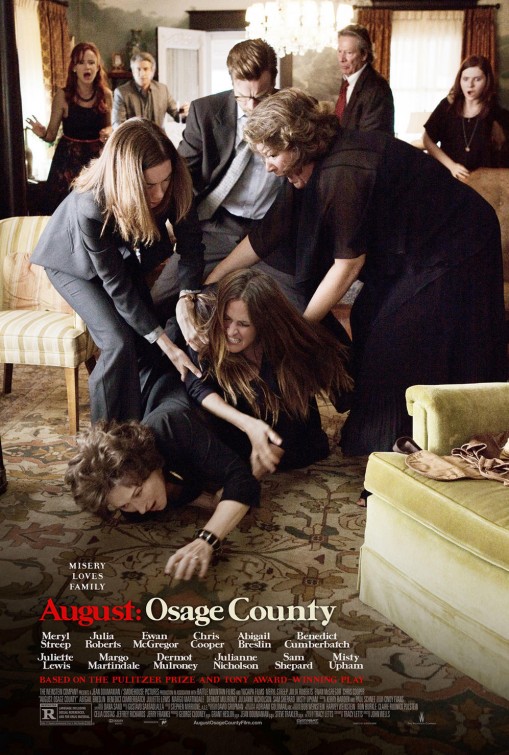 This holiday season, the movie with the most acting, by far, is likely to be August: Osage County, the adaptation of Tracy Letts’ Tony award-winning play. It’s a large dysfunctional family getting back together and opening old wounds, so, you know, the most relatable Christmas movie for some. It’s easy to see what attracted such A-list talent to this project because these characters are actor catnip; each is overflowing with drama, secrets, revelations, anger, and it’s all channeled through Letts’ barbed sense of humor and wickedly skillful dialogue. With Meryl Streep as the pill-popping matriarch, Julia Roberts as her resentful daughter, and a host of other inter-generational conflicts and secrets, you may feel exhausted by the end of its 130-minute running time (the stage play was 3.5 hours, respectively). The emotional confrontations feel like grueling pugilist matches, the melodrama kept at a fever pitch, but the film is never boring. Streep is her usual astonishing self and the deep ensemble gives each actor something to chew over. This is the best Roberts has been in years, and she’s not afraid to get nasty (“Eat your fish!”). Just when you think the story might soften, Letts unleashes another body blow, allowing no uncertainty that this is a family doomed. The story also provides insights into tracking the path of cruelty through the family tree, limb by limb. August: Osage County is stridently funny but also punishing in its no-holds-barred approach to family drama. If you’re looking for a movie that makes your family seem normal and even-tempered, this may be it.
Nate’s Grade: B
Share this:

American Hustle (2013)
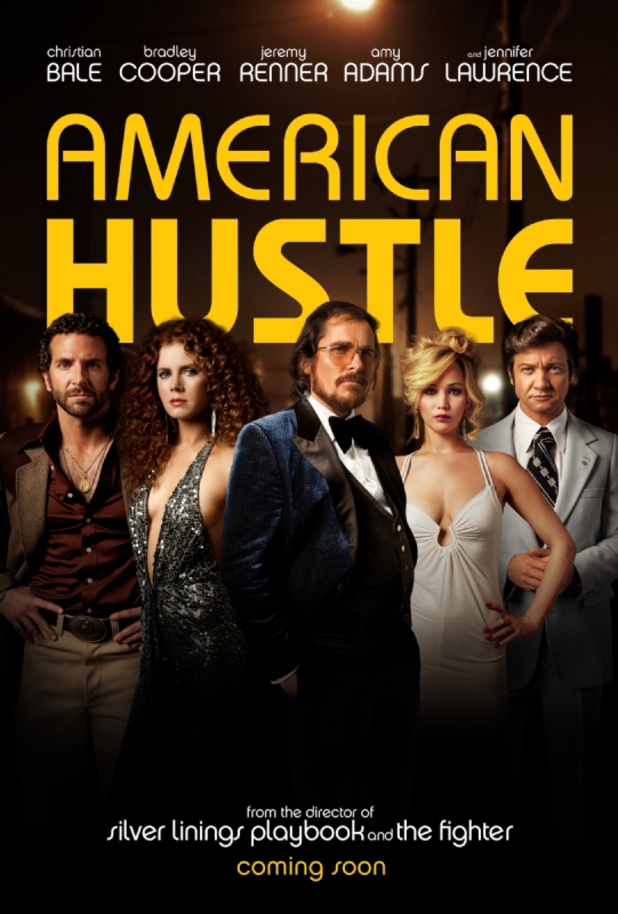 With two movies, writer/director David O. Russell has vaulted to the top of Hollywood. Previously known for his own difficult behavior, Russell’s last two films, The Fighter and Silver Linings Playbook, were both critical and commercial hits (Silver Linings made over $230 million worldwide). Both brought a bushel of Oscar nominations as well, making Russell one of the hottest directors for actors and producers. But a new side seems to have emerged over these last two movies, one less of Russell the domineering director and one of Russell the open collaborator. It feels like he’s just hitting his stride too. American Hustle is Russell’s latest and it’s sharply written, engrossing, lively, surprisingly comic, and readily entertaining.
In the late 1970s, the FBI set up an undercover sting to nail political corruption, ultimately nabbing several U.S. congressmen and one standing U.S. Senator. Richie DiMaso (Bradley Cooper) is an FBI agent who snags the perfect assistance. To catch a crook you have to think like a crook, and so Richie has strong-armed a pair of lucrative con artists into helping him. Irving Rosenfeld (Christian Bale) is a professional down to his elaborate hairpiece. He’s used to fleecing desperate people and selling phony artwork to the gullible, but he’s been too shy about making too much noise. If you stay small, you go unnoticed. Irving’s partner in crime is Sydney Prosser (Amy Adams), a kindred spirit who has reinvented her self. She and Irving are in love, and now they’re trapped by Richie to set up New Jersey mayor Carmine Polito (Jeremy Renner). The one unpredictable element is Irving’s young wife, Rosalyn (Jennifer Lawrence), who could blow up the whole operation with her careless and self-involved tantrums.
 Russell has once again given audiences one of the most entertaining films of the year, this time allowing them to participate vicariously in a con game, trying to anticipate the twists and turns and assessing everyone’s personal angle. This is a fictionalized rendition of the Abscam case (the opening text drolly says, “Some of this actually happened”) and it gives us a slew of meaty characters that have something going on. The central point elaborated in this pop crime caper is that we’re all cons, we’re all pretending, on some level, to be different people; Russell’s film just takes this notion to the extreme. Irving and Sydney are trying to escape lives of ordinary malaise, of being victims, of the more powerful dictating their options for them. With Sydney, she’s pretending to fall for Richie, but we don’t fully know which side she may choose to end up on. Richie is trying to also escape his dull life of desk jobs and lower middle-class dinners. His ambitions get hold of him, and with Irving’s aid, he catapults himself toward achieving those oversized dreams of his, never mind the ethical lapses in nabbing the bad guys. For Carmine, he’s so fiercely devoted to his community that you don’t doubt his loyalty for a second. He’s a man who sincerely wants to help others and is knowledgeable enough about how the world works, knowing he may have to grease some wheels to get the progress started. He is the most moral figure of the five main players and you may find yourself rooting for him to escape the snare closing in on him. Then there’s Rosalyn who has her hooks in Irving, looking for a sense of stability for her and her child. She’s a volatile cocktail of emotion but she knows what she needs to do to keep Irving anchored to her needs, though she’s also cognizant enough to latch onto a better provider if one materializes. Mixing and matching those characters, you have an eclectic mix of personalities clashing, many at odds with one another as far as goals, and the conflict stirred up is delicious.
Russell also attaches on his Martin Scorsese filter, delivering a freewheeling film about criminals from their wizened point of view, explaining the ins and outs of their hustle with flamboyance, style, and vigor. While the opening is a tad slow, including an opening minute watching Irving work his almost breathtaking comb over hairstyle, we plow right along into this world of hustlers and con men, learning tricks of their trade (hint: desperate people are desperate) and the tools to stay ahead of detection. We’re awash in multiple perspectives, each with voice over, a frenetic camera, and emboldened editing. It’s the Scorsese approach given studious application to the Abscam affair. It’s a great thing that Scorsese is the finest living filmmaker and devoting a two-hour-plus homage to the man’s most stylized crime pictures is a plus. Russell’s movie feels alive but also hungry, like many of his characters, restlessly searching for something. The scenes land but they don’t feel like they’re standing still; everything is propulsive in this movie. The small operation of Irving and Sydney is taken to the big leagues thanks to Richie’s ego, and the FBI’s desire for splashy headline busts, but wider exposure also exponentially multiplies the danger. Once the gambling scheme attracts the investment of the Mob, that’s when everyone has gone too far. I was clenching my fists in suspense toward the end, worried that our fictional cons may be too far in to survive.
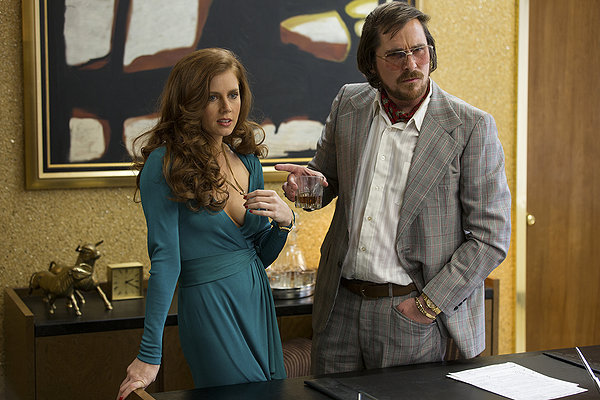 Russell hasn’t lost his magic touch with actors. His last two films have netted seven acting Oscar nominations and three wins, and the cast of American Hustle meets that same level of excellence. Perhaps even more so than The Fighter, the characters are given a very broadly comic brush, easily and routinely stepping into a carnival row of over-the-top behavior. It provides plenty of entertainment of the mishap and absurd variety, but there are also lone piercing moments of great empathy with these messy people. Mostly, the various actors all seem to be in a great syncopation, each one contributing where the other left off, building a great and compelling picture. When this ensemble is firing, it’s hard to beat. Special mention to comedian Louis C.K. (TV’s Louie) making the most of every scene he’s in as an FBI party pooper. His running gag involving a personal ice-fishing story is one of the film’s best jokes.
Bale (Out of the Furnace) is our guiding voice in this world, a flimflam man of the first order who fools maybe even himself. He’s got his own code of ethics and a heart behind that pot belly (another physical transformative performance by Bale the chameleon). He’s briskly entertaining but my only complaint is that, by being so suave and slick, he seems a tad too low-key at points given the risk involved. I know it’s part of the act, but from an audience standpoint, it makes him seem a tad too modulated. His equal is Renner (The Bourne Legacy) who is so earnest that it practically breaks your heart when he oversteps into morally murky territory.
However, Bale’s performance is compensated by the sheer craziness of the Silver Linings co-stars, Cooper and Lawrence. Cooper (The Place Beyond the Pines) is a lawman but also the film’s biggest antagonist. He gets drunk with power and the credit he’s receiving at the FBI. He’s also a deeply insecure man who is trying to style himself like Irving and Sydney as a posh reinvention. Cooper gives him a manic energy and taps back into his reservoir of eager-to-please egotism. Lawrence (Catching Fire) is the most unpredictable character. She acts on impulse, flirts with sabotage, and soaks up the spotlight she’s so rarely afforded. Lawrence is having the time of her life playing a loud, shrewish, vampy housewife who has a noticeable habit of starting house fires.
Beforehand, I would have thought that Lawrence and Adams should have swapped roles (still an interesting experiment), but having now seen the film, each suits them well. Adams (Man of Steel) is the saddest character of them all to me because she’s the bruised dreamer anxious to be anyone but who she really was. She relishes the con, more so than Irving, and ties much of her self-identity to her shyster skills.
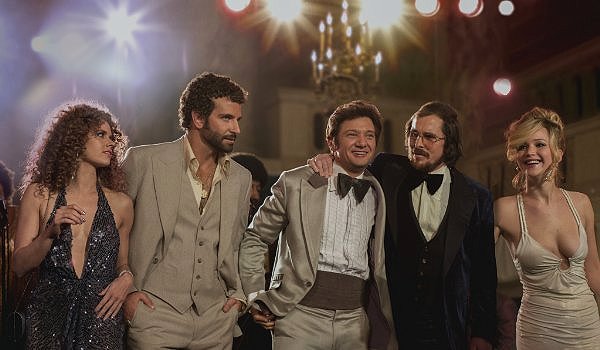 I’ve been dragging my feet writing my review and I’ve been trying to determine why, beyond, obviously, holiday-related sloth. American Hustle is readily a good movie that provides plenty of entertainment, meaty characters, and fun, but why do I keep feeling like it’s missing one undetermined ingredient? I can’t even articulate what at the moment but after having seen the film two times now, I feel like perhaps my emotional involvement was stunted. It’s a finely tuned script that delivers big performances for big-time actors, with a dandy ending that manages to dish out satisfying conclusions to its bevy of wheeler-dealers. But why didn’t I care more, why didn’t I feel more resonance by the time the end credits landed? The best theory I can surmise at this time is that we’re caught up in the con game, where everyone is pretending to be somebody else out of necessity or desire, that when it’s all over, we reflect on what a fun ride it’s been with fun characters but do we feel like we’ve gotten anywhere? I feel like I was more interested in the characters than attached to them. Again, American Hustle is still a sensationally entertaining movie and this paragraph is but a quibble, but it’s enough to thwart me from fully embracing and celebrating Russell’s film (confession: having already seen Scorsese’s brilliant Wolf of Wall Street, this could be coloring things for me with Russell’s Scorsese homage).
American Hustle is a fun ride with arresting performances, oodles of style, energy, and comedy. It’s a crime caper of the first order, easing you into this world and watching people play all sides. Even better, we’re given a volatile mix of personalities that clash, forming new and lasting conflicts, some of which could endanger the entire operation. These are interesting people to spend time with and so we can excuse the indulgences of a 140-minute movie that offers even more with this fantastic cast. Russell with a Scorsese filter is an even more improbably entertaining filmmaker. This is a crowd-pleasing sort of movie, much like Silver Linings, that doles out punchlines and payoffs with aplomb. It’s easy to go along for the ride, laugh uproariously, and then by the end sort of wonder whether it was all worth it. The emotional detachment to the characters may be a minor complaint for a film this largely satisfying, but since we’re spending so much time on our characters, I think I would have preferred something a tad more substantive by the end. It’s a great ride, with great characters and great humor, but there is a nagging concern that it may have been a better ride than a story. Regardless, American Hustle is an enjoyably alluring con that mines the absurdist fashions, personalities, and political overreach of the 1970s, painting a tale of criminals who may be the real heroes of the American dream.
Nate’s Grade: A-


 nathanzoebl
You must be logged in to post a comment.