50 Shades of Grey (2015)
 It’s hard to be ignorant of the publishing phenomenon that is 50 Shades of Grey by E.L. James. The erotic trilogy became notorious for its numerous and often outrageous sex scenes. I have many female friends, and relatives, who read the series, and while not a one will admit to finding the series ostensibly “good,” they each read every book. In a way it reminds me of another popular yet critically maligned romantic series – Twilight. It should be no coincidence then that Grey began its early life as Twilight fan fiction. The movie adaptation was a hotly followed topic. After all, people argued, how could it possibly be rated R? How could you adapt it to the screen? With a female director (Sam Taylor-Johnson, wife to actor Aaron Taylor-Johnson) and a female screenwriter (Kelly Marcel) to steer the adaptation process, I figured I would at least get a sense of exactly what was so uncontrollably appealing about the series. For a film designed to be titillating and provocative, I came away wishing it had more action (of any sort) because the movie was just so freaking boring.
Anna (Dakota Johnson) subs for her sick roommate and gets to interview playboy billionaire Christian Grey (Jamie Dornan). He takes an interest in her innocence. And so he runs into her at the hardware store where she works, he fetches her after a drunken text on her part, and whisks her away to his luxurious Seattle high-rise. Before things can get frisky he has to share a secret. He’s a dominant looking the world over for women who are willing to submit to him and be his submissive. The world of sadomasochism is a new one for Anna, a 22-year-old on the verge of graduating college. However, she’s drawn to Christian and accepts his terms, and that’s when the sex gets taken to another level.
 So much of the film is the drawn out flirtation between two characters that I found painfully uninteresting. Wasn’t this supposed to be the exciting and sexy story of risqué sex and overpowering urges? I’m by no means the target demographic but I felt unmoved by the onscreen sex because it was so sedate by Hollywood standards. I’ve seen more enthusiastic and engaging sex scenes skimming the channels of late-night cable TV. It certainly doesn’t even come close to rivaling some of the steamier sequences of films past, like 9 ½ Weeks, The Dreamers, Henry & June, Last Tango in Paris, The Piano, Risky Business, Sex and Lucia, Don’t Look Now, Y Tu Mama Tambien, Dangerous Liaisons, sex, lies, and videotape, Little Children, Mullholland Drive, and Secretary. For fans of romance with BDSM, please give 2002’s Secretary a chance since it is 500 shades superior to E.L. James.
I understand that most erotic TV series and films are readily designed for men, and 50 Shades was designed for women, and there are differences in approach and stimulation, but for a product that is famous for the degree of kink involved, I was sorely disappointed by the results. In short, the movie needs more kink. It plays out as an introductory guide to bondage and S&M. This aspect isn’t even explored until the very end. It’s too timid to really give in to the thrills of its premise and likewise the demand of its readership. There’s a lot of nudity, mostly from Johnson, but the sex scenes themselves are rather ordinary and sedate, all things considered. There are four of them in total for those curious readers wishing to keep track (I also tried keeping track of the times Anna bit her lower lip but lost count). The sex scenes are filled with plenty of moaning but not a one of them builds up to climax, a strange omission since we’re tracking Anna’s pleasures. I wasn’t expecting the graphic, and graphically drawn out, onscreen sex of Blue is the Warmest Color, but I was certainly expecting more after all the hubbub. In the end, a sexy movie is going to be known for its sexy scenes, which may or may not include sex (I feel like fans are going to be justifiably irked by the absence of full-frontal male nudity – come on, give the fans a bone here). 50 Shades of Grey is ironically far too tepid to register as much more than sub-soft core eroticism.
Then there are the characters, both of which are too one-dimensional, and also boring, to bring much interest. Cinema has always been interested in good-looking people getting it on, but unless there’s careful attention to plot and character, then you’re just recycling the same soft core setups. It is wholly transparent that James’ novel began as Twilight fan fiction because the couple occupies the same unhealthy relationship roles. The female lead is a stand-in for the audience/readers; she’s a mousey, shy, normal girl who gets swept away by a brooding and dangerous man who tells her he’s no good, insists she should not be with him, but cannot help himself falling for her because he sees her inner beauty. He’s more male chauvinist than complex character, and his obsession is less a sign of a tortured psyche and more, as displayed, a clear indication of a sexual predator. Anybody who requires his paramours to sign legal documents about what he can put inside them seems like somebody not worth knowing. He tracks her down across the country when she dares to see her mother because Anna didn’t ask his permission. Control freak or a budding sociopath? With a lack of tawdry sex scenes, the far majority of the film is Anna and Christian ramping up their almost endless sexual tension, which the movie will hit you over the head with. I didn’t feel a single thing between the two of them, partly because of how poorly written they are and also because of the lack of chemistry. We watch her bite her lip a thousand times. We watch her stammer. We watch him stare rather intently like a shark. The filmmakers are doing the work for us rather than allowing a romance to blossom organically. It’s cajoled and manipulated and feels inauthentic in every sense, even before the trip to the playroom begins.
There is one standout scene that is actually sexy, and apparently it’s quite different from the source material. As Anna and Christian go over his legal language for his submissive, they treat it as a business meeting with an arch sense of professionalism. It’s one of the few times Anna displays a spark of personality, as well as decision-making, as she goes line by line and says what she will and will not do. It’s played with a wry sense of humor but there’s also a sexy undercurrent throughout the scene, where these two adults are having fun with the preliminaries. If the rest of 50 Shades of Grey had this same sense of personality and fun, it might have worked as an engrossing erotic fantasy.
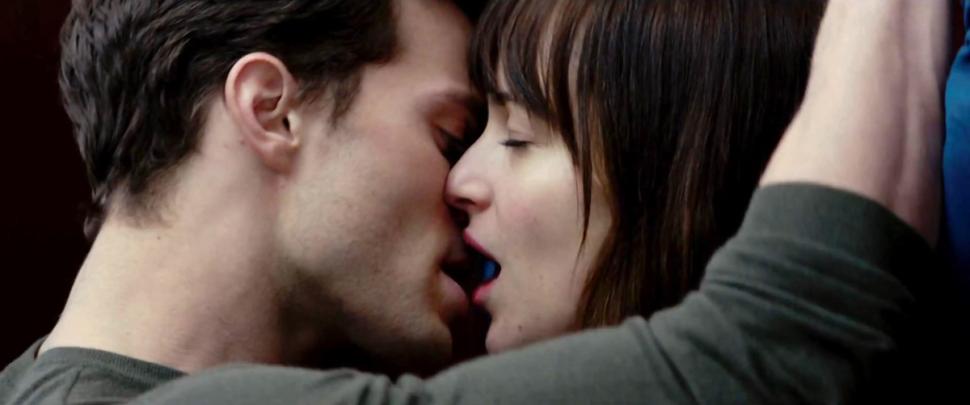 Johnson (Need For Speed) is an enjoyable screen presence even if there’s absolutely nothing interesting about her character. Anna is so absent a personality that it makes it easier for the story to present someone else doing all the work for her, pushing her, prodding her, giving her form. Johnson plays a lot of scenes for laughs, which work in a titter-generating way. I kept hearing Patricia Arquette’s voice whenever she spoke, but I may be alone in this unusual observation. Dornan (TV’s The Fall) on the other hand is terribly wooden. Again, he’s playing a rather terrible character with rather terrible dialogue, but it’s hard to feel any authentic sense of passion from the guy. It’s hard to say whether these actors are miscast or whether there could ever possibly be a suitable matching because of how lacking the simplistic characters are. They’re archetypes, and ones the movie has to keep persuading you are totally hot for one another.
So what is it that makes this property the would-be blockbuster that it is? The story arc has been done before for decades, going all the way back to Rudolph Valentino’s Son of the Sheik: the mysterious prince who comes and sweeps the princess off her feet to his exotic world of privilege. 50 Shades isn’t reinventing the wheel but it has struck a chord, and perhaps it’s the wish fulfillment angle, the introductory angle to a world of BDSM, or the plain Jane ordinary heroine that acts as a cipher for readership. The books are the books and the movie must be judged on its own account. I’m sure most of the series’ fans will be pleased one way or another, though I doubt many of them will find the movie an improvement over the book. Then again it does strip away James’ wretchedly torrid writing. If it wasn’t for the 100 million books sold worldwide, this movie wouldn’t be generating any of the hype it is, but is that the film’s fault? The hype machine unfairly builds expectations that will fail to be met, but then again it’s the over-saturated exposure that has ensured 50 Shades of being a Valentine’s weekend event for half the planet.
Surprisingly boring and rather tepid, 50 Shades of Grey feels too callow to be the provocative film experience it wants to be. It needs more of just about everything; more characterization, more organic coupling, more story, more romance, more kink. It is lacking in too many areas, though the production values are sleek, like it’s the most technically accomplished episode of Red Shoe Diaries. It’s a tedious story of the hazards and joys of giving up control, but I didn’t care about the characters. I need more than pretty people staring at each other for an hour while a breathy remix of a Beyonce song plays over the scene (to be fair that Beyonce remix is hot). The actors don’t connect together and the Christian character comes across as more of a monotone jerk than wounded bad boy. I’m sure 50 Shades has pushed millions into exploring aspects of their own sex lives they would not have felt comfortable exploring beforehand, and good for them. My friend Angie quipped that, if nothing else, the release of 50 Shades of Grey will cause a spike in battery sales for its opening weekend. It’s a shame then that the movie is too limp where it counts to be serviceable.
Nate’s Grade: C
Share this:

Jupiter Ascending (2015)
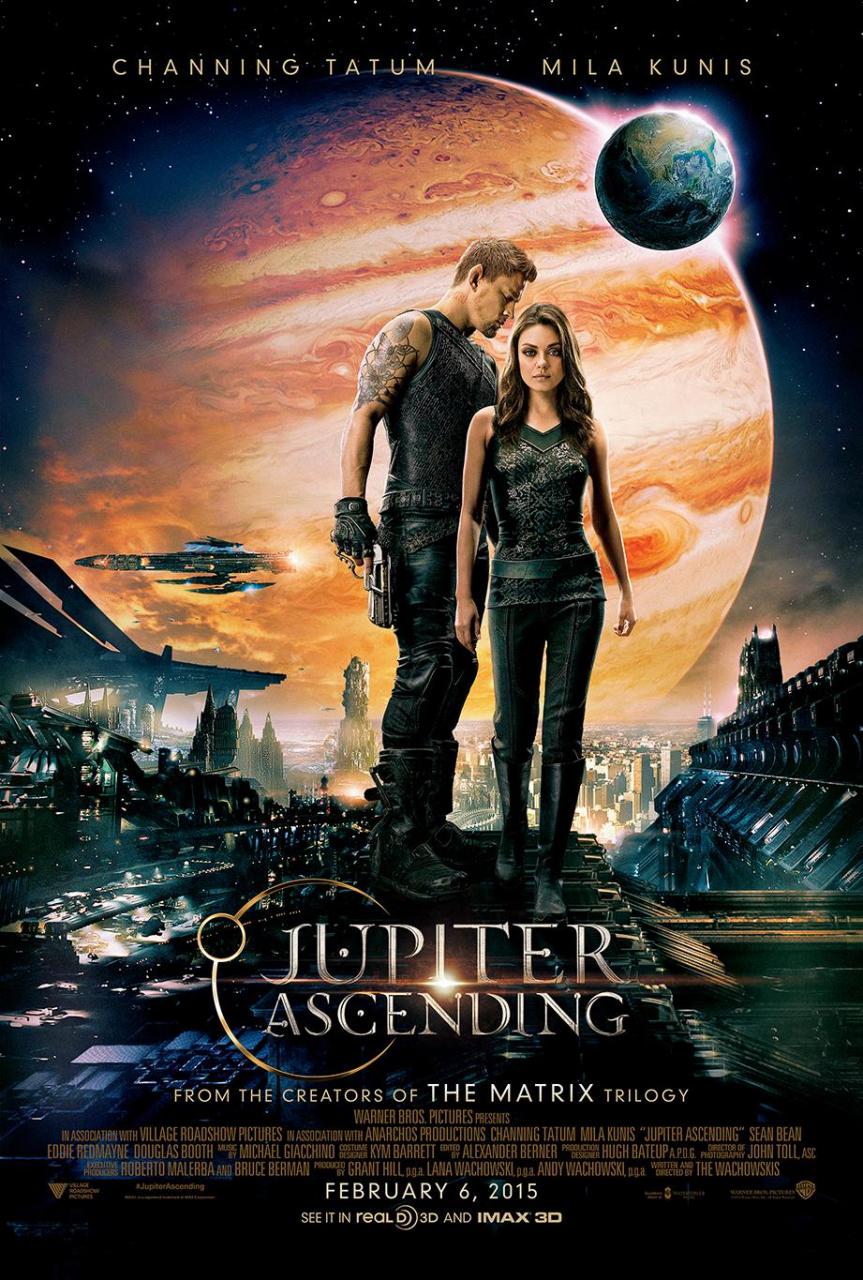 Few would dispute the imaginative powers of Andy and Lana Wachowski. They probably got a free pass from Warner Brothers after creating The Matrix, one of those culture-changing movies that come along so rarely. I was leery of Jupiter Ascending, their newest original science-fiction opus, when Warner Brothers delayed its summer release by nine months. The trailers and commercials were also doing a dandy job of hiding what exactly the movie was about besides cool visuals. I was holding out hope, thinking that maybe Jupiter would be silly but fun in a Fifth Element way, but instead ladies and gentlemen, we have an heir to 1980’s campy Flash Gordon.
Jupiter Jones (Mila Kunis) is an unhappy maid who cleans toilets for a living. Then one day she becomes the most important person in the universe. She discovers she is the reincarnation of the matriarch of House Abrasax, whose three children, Titus (Douglas Booth), Kalique (Tuppance Middleto), and Balem (Eddie Redmayne), are fighting over their inheritance. The biggest prize of them all is Earth, and now the appearance of Jupiter complicates ownership. Various alien species are sent to kill her, but Jupiter has a savior in disgraced galactic solider Caine Wise (Channing Tatum). He’s a “splice,” a result of gene splicing people with animals. He rescues Jupiter and they head off world to explore the much larger, much stranger universe.

Oh look, she’s falling again.
Right away, mere moments after leaving the theater, I knew the first step to make Jupiter Ascending a significantly better movie: completely remove the title character. First off, her name is awful and makes me think she’d be a character in the Jetsons universe. Mostly, she’s a terrible protagonist because she is merely a fairy tale wish fulfillment masquerading as a person. Her normal life is miserable but secretly she’s a space princess who is the reincarnation of a space queen. Allow me to momentarily pause and question this line of monarchy and inheritance law. Apparently Jupiter shares some genes with the deceased Lady Abrasax, but she has no direct bloodline. Does that automatically thrust her into another family’s inheritance squabbles? Why should they even consider her claim valid? Why does that place her at the top of the pecking order? When did we start recognizing reincarnation with inheritance law?
Back to the matter at hand, Jupiter is an annoyingly weak character that’s supposed to follow the arc of weak to strong, inactive to active. Except she doesn’t. Beyond accepting her incredible new position, there’s really not much that changes for her. She remains, from start to finish, weak-willed, gullible, always in need of saving, and so wretchedly annoying and without merit. Her cousin arranges her with a doctor for Jupiter to donate her eggs, but he expects a majority of the money. Why does she need this middleman in this arrangement? It’s another reminder how dim the character is and devoid of agency. And then all of a sudden a romance materializes between her and Caine because of course it does. I use “materializes” because there is no actual setup of any kind beyond the fact that Kunis and Tatum are attractive specimens. Their romantic dialogue will produce dangerously violent eye rolls.
The Wachoswkis are certainly imaginative filmmakers but their ambitious world-building impulses get the better of them and their story. The imagination is on full display when it comes to the visuals, the production design, costumes, and alien designs. There’s a grand mixture of creatures big and small, and even an elephant pilot because why not? However, the storytelling meant to house these cool things is notably deficient. Jupiter Ascending feels less like a story that naturally develops and whose complications arise in a semi-logistical fashion. It feels like somebody guiding you on a tour of Weird Stuff. It’s not so much a story as a collection of Weird Stuff, Weird Incidents, Weird Places, and Weird Creatures. You feel like you’re being skipped off from one exhibit to another, especially when Jupiter is kidnapped and threatened by each of the three Abrasax children in a row. Seriously, the entire scenario is on repeat, so when Jupiter continues making naïve choices, you can slap yourself extra hard having been through this purgatory just moments before. It’s only a matter of time before she gives in to whatever Abrasax demands again. There’s a general sense of repetition to the plot compounded by Jupiter’s incessant need to be saved (she seems to be falling a lot, out of spaceships, buildings, vehicles, etc., which also gets tiresome). The scheming Abrasax children seem to just slide in and out as the plot requires, with little in the way of resolution.
 It’s impossible to discuss the film without acknowledging how damn goofy the whole enterprise comes across. Caine is part wolf, part albino, part human, and apparently part angel since he got his wings removed as a punishment. Does that seem like a good combination of elements or like the aftermath of a drunken writing session? Let’s just run down some of these names: Jupiter Jones, Balem, Kalique, Stinger, Gemma Chatterjee, Phylo Percadium, Chicanery Night (!). To be fair, it’s not like Luke Skywalker or Darth Vader are less preposterous names. Caine has a pair of anti-gravity boots but they’re really just hovering rollerblades. There’s just something silly about watching a guy rollerblade, even if you attach a futuristic spin to it. There’s a hidden factory beneath the stormy Eye of Jupiter, and yet this same important factory seems ready made to fall apart if the slightest projectile pierces its exterior (it’s the Death Star all over again). There are weird small aliens, weird alien bounty hunters who can turn invisible but don’t, weird space police that are really bad at their jobs, weird robots with human faces, and there’s also weird stereotypical Russian immigrants for Jupiter’s obnoxious family. Perhaps all the goofy camp will enchant you but I never got onboard mostly because the story and central characters left me so thoroughly unengaged.
Another ongoing problem is that the Wachowskis are constantly telling you things rather than showing you and allowing the story to organically develop. There are no less than three times when Character A looks at Character B and literally verbalizes what they are thinking or feeling in this moment. It’s lazy screenwriting, beholden to constantly having to explain everything to an audience because either you think they are dumb or your plot is far too convoluted; either way, a problem. Such sample pieces of dialogue include these informational asides: “Bees are genetically programmed to recognize royalty,” and, mere seconds later, “Bees don’t lie.” There you have it; bees don’t lie. Now you know.
The most frustrating part of Jupiter Ascending is that there is a genuinely interesting movie buried under so much of this silly nonsense and ear-clanging noise. The starting premise that Earth is nothing more than a stock portfolio for an alien species, that’s good. The idea that a trio of siblings is squabbling over who gets their galactic inheritance, which includes the deed to Earth, that’s good. The idea that human life is seeded on planets merely to be harvested into an eternal youth elixir for the rich and powerful, that’s even better. It’s not exactly a nuanced critique of capitalism but it’ll do. I’m disappointed that we don’t find out more about a larger market for this rejuvenation technique. There has to be more customers for such a miracle product than one rich family. If this were an intergalactic King Lear or even a space version of Margin Call, it would be far more exciting and creative. Instead, the bigger ideas are grounded into pulp so that we can have more CGI-drenched action sequences. There’s one segment that tonally breaks away from the film, diving headlong into Douglas Adams-style satire on bureaucracy. Like most of the film, it has its moments of entertainment, but it comes from nowhere and has trouble fitting with everything else. I’ll give credit where it’s due and praise the special effects, as well as the overall production design. It’s too bad that the action too often feels like a bunch of pixels exploding, failing to provide a sense of immersion. It’s hard to get a feel for most of the action and its use of space, save for portions of the finale. There is one very fun and well-choreographed fight between Caine and a… dragon… sentry guy (I don’t really know what to call these winged henchmen). That fight is exciting. It’s a shame there aren’t more of them. Bring on more dragon sentry guys.
Kunis is certainly miscast on the part, though I doubt any actress could pull off such a lackluster heroine who is always needing to be rescued. Kunis is more adept in the realm of comedy (Ted) or seduction (Black Swan), neither of which is featured with Jupiter. Let me say one more reason this Jupiter Jones character is awful; part of her struggle concerns whether or not to marry a playboy space prince. I don’t know if the Wachowskis believed that Jupiter was supposed to be a “strong” figure, but reducing feminine value to her being married feels rather reductive for sci-fi (not that there isn’t a storied history of women being treated as objects of fantasy in the genre). Tatum’s (22 Jump Street) remarkable charms are dulled by his silly albino beard and general guard dog characterization. He’s less a character than a protector who inexplicably instantly falls in love with his charge. Both actors will no doubt rebound in short order.
 Reserve some pity for poor Eddie Redmayne, a man who will be experiencing the highs and lows of acting this month. He’s the frontrunner to win Best Actor for his stirring work as Stephen Hawking in The Theory of Everything, which is what makes his performance here even more astonishingly awful. He speaks in this effete whisper for the entire movie, one that is hardly audible at all, except for the occasional line where he screams and spasms, making the contrast all the more funny. He constantly holds his head back like he’s in danger of nosebleeds. This is a performance of such startling misdirection that I physically felt bad for Redmayne. He seemed to be reaching out to me, pleading through his glassy eyes, communicating, “Help me, help me.” Even if his character’s vocal range wasn’t so nonthreatening, Balem makes for a terrible main villain. As a rich lord with power at his disposal, he works, but late in the movie all of that is removed, and he has to be a physical threat. After 90 minutes of watching him on screen, you will never be able to see him as a credible physical threat, and even the movie doesn’t fully treat him this way, and yet the plot still places him in this role. He’s not a heavy. Balem is laughable but he’s another component of a generally laughable movie.
Jupiter Ascending is a rarity in Hollywood, a big-budget epic that overpowers you with a singular sense of style and imagination; it just so happens that so much of the creative fireworks are laughably terrible. The Wachowskis don’t do anything in half-measure, and the film is put in overdrive. There’s a mess of characters and peculiar details to make this world feel larger than life and tethered to the idea of fun. Then why oh why did we have to be saddled with such boring, one-dimensional characters and a secret princess storyline lifted from countless sources? In the past, the Wachoswkis have found ways to turn pop philosophy and pop-culture into an entertaining alchemy that separated them from the sci-fi pack of imitators, which were legion. I still have great fondness for the original Matrix (you can keep the sequels), V for Vendetta, and especially Cloud Atlas of late. The Wachowskis are ambitious filmmakers and they have the imagination and narrative sensibilities to achieve great things. It’s just that with Jupiter Ascending it feels like their real passion was in all the background artifacts, the minutia of the worlds, the alien costumes and makeup, the histories of worlds. It certainly wasn’t on a story or characters or a credible romance. And yet even after all of these words, I have to admit that Jupiter Ascending is entertaining, just not in the way its creators may have intended. It reminds me of 2014’s disastrous Winter’s Tale, a passion project that was so baffling and bafflingly terrible. If you’re curious and willing to part with some money, gather some friends and check out Jupiter Ascending. Just make sure you’ll have suitable time planned afterwards to discuss its particular brand of big screen lunacy.
Nate’s Grade: C
Share this:

Project Almanac (2015)
 I’m going to take a stand right now and declare that Hollywood should simply stop making found footage movies. I don’t hate the subgenre itself, and in fact a found footage approach can be rather interesting if given proper attention and care, but that is just not happening nearly enough. Too often Hollywood execs view found footage as a hook and slap it onto a story that does not need to be told in this limited style. There’s no reason that a perfectly fine buddy cop movie like End of Watch needed a found footage angle, except that’s probably how it was sold. If you’re going to do found footage you better have a god reason why your characters are recording every moment, and most do not. You better stick to the principle that the only viewpoint is from the camera, and most do not. And you better stick to the limitations of this viewpoint, meaning who is editing these things after the fact and adding popular music to make montages? Found footage is too often underdeveloped in approach, a lazy selling point because “the kids” today like documenting themselves doing everything. But really, can you name the last found footage hit? The Paranormal Activity franchise is on the downturn and the last critically lauded one was 2012’s Chronicle. Don’t just stop making found footage movies because they’re too often lackluster; stop making them because the public has grown indifferent. Now, with all that being said, the time travel flick Project Almanac proves once again to be a film that never needed to be found footage to work. As far as January releases go (usually a dumping ground for studio bombs) it’s better than most, but the poorly titled sci-fi drama wastes its premise on the myopic doldrums of youth.
 David Raskin (Johnny Weston) wants to get into M.I.T. but his hard-working mother doesn’t have the money to make this happen. He discovers an old video of his seventh birthday party and is shocked to see an image in the background that resembles him as a teenager. He and his friends, Quinn and Adam, investigate the video. They enter the basement lab that used to belong to David’s father, until he died in a car accident shortly after that birthday recording. There they find plans for a time machine and the boys busily go to work assembling it, perfecting it, and charging it. Jessie (Sophia Black-D’Elia), a popular girl at school, stumbles into their first experiment and becomes part of the group. They have to keep this a secret and they must only travel back as a group. The freedom and possibilities are exhilarating, but soon enough David discovers a spiral of consequences that are difficult to correct without scrapping everything.
From a structural standpoint, this movie gets pretty lopsided and completely misuses the possibilities it established even as it arbitrarily throws its own rules out the window. Project Almanac takes far too long to get the time machine working. The teens discover the manual but it takes almost the complete first act before they successfully travel in time. Why do we have to wait a full 30 minutes and watch trial after trial? It’s not exactly like the audience demands a sense of scientific accuracy. Once the teens do travel through time, they set their sights very low: pass a test, get revenge on a bully, win the local lottery, and go to Lolapalooza. There is the limitation of only going back three weeks into the past, which eventually disappears, but could these kids not aim higher in their goals? When they do go to Lolapalooza, the movie drags and drags, and it’s here where I started to theorize what became of this film (more on that below). Once we come back from the festival, David decides to jump back alone to stop himself from blowing his opening with his crush, Jessie. However, there are disastrous consequences stemming from this and he has to debate whether to undo his good fortune with Jessie. Want to know what those consequences include? Seventy-seven people dying in a plane crash. Our main character seriously agonizes about keeping his new girl or the lives of seventy-seven people. And what would he lose? It’s not like he can’t be suave around Jessie ANY OTHER TIME. All he has to do is say something and kiss her. The hesitation and struggle over this is comically absurd, but the struggle illuminates where Almanac could have gone. These teens could have used time travel to save lives, but I guess that’s not as fun as seeing Imagine Dragons backstage and dancing.
Another problem is that, from a time travel standpoint, this stuff doesn’t really follow its own rules. The gang goes back at several points to repeat the same goal, but at no point do they run into different iterations of themselves. If they keep going back to fix things, and fail, and then go back again, that’s a continuation of one ongoing timeline, not a do-over. Time doesn’t reset. With every time travel story there’s the nagging nature of paradoxes but Project Almanac just ignores them, hence the lack of doppelgangers. At one point, Quinn even seeks out his past self to pull a prank, which sounds really stupidly dangerous from a space-time continuum standpoint to me. The movie ignores paradoxes… until it doesn’t. The entire third act is about the consequences of paradoxes, and now all of a sudden it matters. That doesn’t work. The main third act conflict is David not wanting to lose his girlfriend. He keeps jumping back to fix this and fix that but it’s all to save his girlfriend, which is pretty dumb, as I‘ve pointed out already that Jessie could still decide on her own at any point in the future to be his gal. Then there’s the conclusion, as we all know that we have to get back to that birthday party at some point. I consider myself a smart man but the end doesn’t make any sense because (spoilers to follow) it invalidates the timeline that we witnessed. David makes it so the events will not happen and the machine will not be constructed. But why is there evidence? Why is there still a tape detailing this whole process? It should be wiped.
Requisite found footage griping: why do they record every damn thing in this movie? The gang even breaks into their high school to steal hydrogen canisters from a locked science lab. Why would you record your crime spree? Why would you record people just driving in cars or walking up to school? Why would you record any of this? How do you clearly pick up audio from two people at a distance, mind you, at a freaking outdoor concert with lots of noise to cancel out any discernible dialogue?
 There are moments that I really liked, flashes that show how much fun or even clever Almanac could have been under other circumstances. One of these moments involves Quinn going back to save his grade. Originally he failed his chemistry presentation, so he thinks he’ll easily pass thanks to the foreknowledge that time travel offers. He goes back, lists the first ten elements on the periodic table, and then his teacher asks him another question he wasn’t prepared for. He goes back, prepared for the two, and then the teacher asks another he wasn’t prepared for. Over the course of going back, he is actually forced to study to prepare for this presentation, and so even though he thought he would use time travel to be lazy, it forced him into doing what he should have done in the first place. When they go back to win the lottery, they accidentally write down one wrong number, so their first jackpot prize isn’t the full amount. They bicker about going back, whose fault it was, and then the film cuts immediately to them holding the full amount in a novelty check. All the characters are devoid of excitement, because that excited moment of revelry already happened, and now this is just an exercise to get over. The photographer chides them to be more excited. That is a fun moment. The characters are rather likeable. There’s another moment where Jessie realizes that David went back to fix a slip-up so they would end up together. And she reacts exactly how she should, wounded and mistrusting. How can she trust what he says now? How can she not doubt every moment being carefully pre-programmed for a desired result? She was manipulated. This confrontation was missing from About Time where Rachel McAdams would have learned that her charming husband traveled back in time dozens of times to perfect his courtship, thus manipulating her own sense of choice. Poor Rachel McAdams never finds out, which seems like a completely blown dramatic development, and lives in cherished ignorance instead. At least Jessie gets to know the truth and behaves naturally. There are other little moments that are fun but they are distractions from what could have been.
Allow me to do some serious speculation about Project Almanac’s own past. This film was originally supposed to come out a year prior hence why every date is referenced as 2014. MTV Films expressed some interest in the movie and it was shelved and likely retooled. Except with time travel films, retooling can be pretty monstrous with its carefully placed plot beats. Here’s what I think happened. Originally, the third act was all about David going back to save his father from dying in that car crash. He likely does but there are dire consequences, and so he keeps going back to try and mitigate the negative repercussions while still keeping his father. Doesn’t that sound like a much more emotionally involving storyline? He’s got far more personal stakes in this scenario than simply losing his girlfriend who he can regain. He can’t regain dear old dead dad. It seems preposterous to me from a screenwriting standpoint that they would introduce a deceased parent and not use time travel to save said parent. It’s the ultimate setup. Instead, with MTV attached, we got to keep things lighter and more appealing to the carefree fun of youth, and so the gang goes to Lolapalooza instead where they can watch rock bands. I think MTV came in and jettisoned the third act and the direction of the script, imposing the festival, and reminding people how music is essential to being young and free and alive. I can’t say whether it’s MTV’s influence or producer Michael Bay, but there’s a slew of product placement from start to finish as well. I have no proof of any of this but I think there’s something to my conspiracy theory.
If you needed any other example of how close Project Almanac would uphold to its own sci-fi rule system, a character asks a good question about how they can understand something, and David says, “I’ll tell you later.” Hey, you want to know something important, just wait, where it won’t be answered. The found footage aspect brings nothing to the film, is poorly integrated throughout, and just plain unnecessary. The plot is too underdeveloped and lacking ambition, using the miracle of time travel to party in such limited ways. The concluding half feels too low in stakes and obvious in conclusion. Time travel is all about the untold possibilities, and Project Almanac will ultimately fall in that territory, a somewhat amusing but mostly unfulfilled sci-fi film that should have gone back to the writing stage a few more times.
Nate’s Grade: C+
Share this:

The Interview (2014)
 Well, so maybe you’ve heard something about this little movie, The Interview? Seth Rogen and his writing partner Evan Goldberg (This is the End) weren’t intending to spark an international incident with their comedy about a pair of idiots trying to assassinate North Korea’s glorious leader, but after a few crazy turn of events, this little movie became a quixotic symbol of American patriotism. How dare North Korea get to dictate what Americans can and cannot see! Well, now The Interview is widely available in digital markets and we can agree that the fervor was for naught. The film is most shaky in the beginning, setting up Rogen as a TV producer and James Franco as the obnoxious talk show host. Once the boys get tangled up with the CIA, and especially once Kim Jong-Un comes into the picture (played by a much better looking actor, might I add, North Korean readers) the movie starts to even out and find its comic rhythms. While the ending is a little ho-hum, there are nice payoffs for several jokes and a poison strip has a wild and very funny comic development. I also enjoyed the emerging bromance between Franco and Kim Jong-Un that danced around with being subversive. However, there are two problems with the film. It doesn’t get risky enough (too many penis jokes) and James Franco. He’s been a capable comic actor but always in supporting or as a foil. Franco is not a comic lead, and his performance is much too amped and broad, needing to be dialed down to feel less desperate in overexcitement. It’ll be more a footnote in history than comedy, but The Interview is a fairly innocuous comedy that does get better as it chugs along, though clearly hits a ceiling. It’s certainly not anything worth going to war over.
Nate’s Grade: B-
Share this:

John Wick (2014)
 John Wick hits you like a breath of fresh air. The plot isn’t anything new. Once again a semi-retired hitman (Keanu Reeves) is pulled back into the fray. Once again Russian mobsters are the primary villains, a popular adversarial force in the fall of 2014. What makes Wick an enjoyable throwback is its dedication to action staging that is crisp, balletic, but most importantly, clear and engrossing action. Reeves may not be as agile as he once was when he first learned kung-fu, but the man still has some serious moves, and the action choreography and stuntwork of Wick allows him to display them in long takes with lots of decisive movement. It’s no Raid 2, but it’s well ahead of most American action films of late. There’s a nice variety of action along with lots of casual headshots, which seems only natural for a trained hitman. Then there are the small touches that add intrigue and help it stand from the pack, notably a hotel with an exclusive clientele of hitmen and women who must abide by a set of rules while on “safe ground.” It’s just enough to make a well-worn genre start to feel different again. The problem with John Wick, however, is that it runs out of steam too quickly, peaking right at the beginning of Act Three. There’s a whole other twenty minutes where the film has to establish a new antagonist to get us to the finish line. It just feels like John Wick accomplishes his goal too quickly and the movie doesn’t know exactly what to do after. The conclusion of several storylines feel clumsy, drawn out, and anticlimactic. But when it’s working, John Wick is a stylish and bloody action thriller that is fun and with the right sense of macabre humor to halt it from ever getting too laboriously serious.
Nate’s Grade: B
Share this:

Big Eyes (2014)
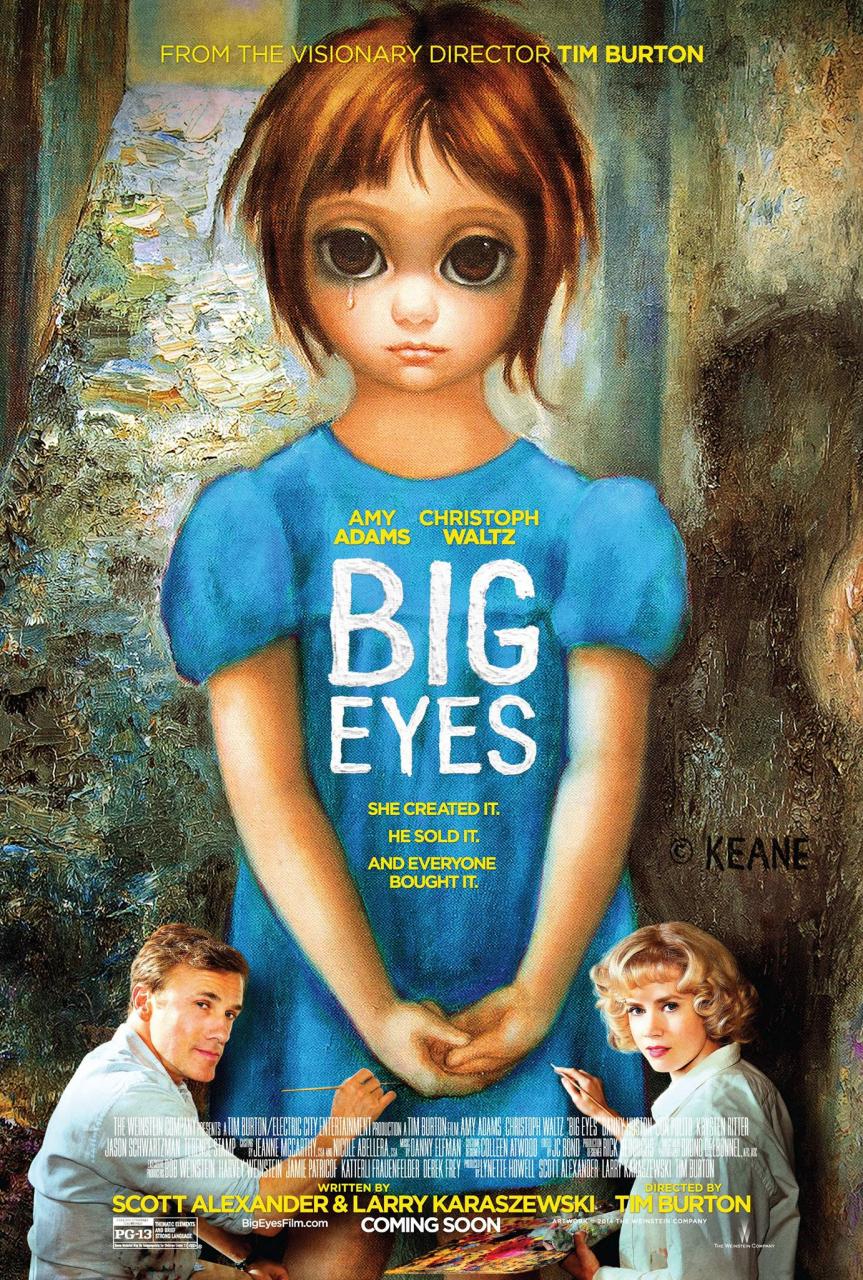 Like most people, Tim Burton is a filmmaker who likes working with a select set of familiar faces. Since 2001, Burton’s wife Helena Bonham Carter has appeared in every one of his films. Johnny Depp has appeared in every Burton film since 1999’s Sleepy Hollow, save for Planet of the Apes. It got to the point where you knew if Burton were attached as director, these two would be riding shotgun. No so fast, as Big Eyes is absent Depp, Carter, other longtime collaborators like editor Chris Lebenzon, and really any noticeable sign that Burton actually was the director. This bizarre biopic about a scandalous secret in the art world fails to justify more than a casual viewing.
In the 1960s, Margaret Keane’s (Amy Adams) portraits of waifish children with large, tragic eyes were the most popular art of the decade. They fascinated the public who couldn’t get enough, including clamoring for reprints so everyone could have their own Keane work of art. Except the world at large never knew that Margaret had painted them. Her husband, Walter (Christoph Waltz), was posing as the real creator. He appeared on television, ran with famous celebrities, and always looked for the next platform to elevate the Keane name, all while Margaret stayed home and painted. She agreed to go along with Walter’s version of events because the public was more accepting of a male painter, and Walter was such a natural salesman. The world could never know the truth.
 Being a true-life story, there are certain limitations inherent in sticking to the facts while still telling an engaging story, and Big Eyes suffers from this. There is an interesting story here, no doubt, and that is clear and on display when Margaret and Walter square off in court as a majority of the third act. Before then, the screenplay by Scott Alexander and Larry Karaszewski (Ed Wood, The People vs. Larry Flynt) plays in a very linear fashion, telling the story very conventionally except for the annoying narration of a news reporter (Danny Huston). The reason this character is clumsily inserted into being our narrator is because the real main character, Margaret, spends two acts being so passive and often hidden before she gathers the courage to challenge her husband and expose him. Naturally, there’s got to be a realistic character arc where our heroine goes from naïve and inactive to stronger and active, but it takes most of the movie. In the meantime, she paints and paints and literally hides herself from the world. It feels like the movie forgets about her while Walter is gallivanting around on her fame. Ironically, the movie actually becomes a series of men attempting to tell Margaret’s story; the first is her husband but the other is the invented and unnecessary narrator.
To make up for the time the film seems to paint a more flattering than deserved picture of Walter. I think perhaps they want the audience to fall under his spell just like Margaret and then slowly come to the same dawning realization. His initial argument is that female artists are not taken as seriously in their era, and I’m sure there’s truth to this. It was generally harder for a woman to be seen as legitimate in just about any capacity other than homemaker in the 1960s. We spend a full two acts with him charming others and hoodwinking the art world. He’s portrayed as more of a used car salesman con man than what could be described as a dangerous egotistical drunk who exploits his wife. The movie gives him a few nasty moments but it seems to portray Walter with light judgment, even after he endangers Margaret and their daughter’s lives. With Margaret figuratively and literally a kept woman cooped up for so long, Walter’s antics start to come across as vamping, filling time until Margaret hits that point on her character arc to leave him. It becomes tiresome then to just watch Walter sputter and spin his way to greater fortune and fame, though he deserves credit for popularizing the printing of painting reproductions that sell for cheap. Walter Keane, footnote in the art world for commercializing it for the masses. Waltz (Django Unchained) is an effortlessly entertaining actor and charming cads with a thinly veiled air of menace are his specialty. It’s a waste of his talents because Walter is kept as an ongoing mystery rather than an opportunity to explore a complicated character’s psyche. We find one falsehood after another, but in the end, he’s still just a mystery left unsolved.
There is amusement to be had at points as to be expected when it comes to keeping up a con, almost getting caught, the scrambles to continue hiding the big lie. This fun is at the expense of Margaret, which the movie wants you to think about and not think about at various points. There are streaks of comedy but I’d hardly call Big Eyes a comedy (sorry Golden Globes categorization). Terrence Stamp is enjoyable as a disapproving art critic who cannot believe what Walter is doing or why he is popular. The final act is easily its most entertaining as Margaret finally gets to call out her scoundrel of a husband for his bad behavior. It takes several unexpected turns that seem too fanciful to be true, and yet they are. The courtroom setting feels right for this script, and if there were a rewrite, I would have used it as the primary setting. The story could be introduced through a series of flashbacks. At least that way we don’t have to wait for Margaret to be the strong heroine we need, and we don’t have to be constrained by the wait of linear storytelling. This approach would strip away some of the redundancies of the plot and at least allow Margaret an opportunity to be the one telling her story.
 Another problem with Big Eyes is that at no point does it feel like a Tim Burton film. The man is better known for his dips into Gothic fantasy, but in 1994 he showed he could more than pull off a conventional film in Ed Wood. Just because the story doesn’t involve weird fantasy characters and violence doesn’t mean that Burton cannot still add value being the man to tell that tale. Unfortunately, there is no point while watching Big Eyes that feels like it was directed by Burton. The director could have been anybody. If you kept the identity of the director secret, I cannot imagine more than a slim number of participants accurately guessing who directed the picture. I wonder what attracted Burton to the script, which does have its share of true-life eccentrics and hucksterism, both appealing aspects for the man. It’s just lacking a sense of vision that Burton usually has in spades, even if that vision over three decades has become a tad commoditized. I won’t go as far to say the film is poorly directed because a majority of the problems remain with its script rather than the actors or shot selections. Still, Burton doesn’t bring much to elevate the material. Perhaps that’s a positive, he didn’t attempt to overpower the narrative with a superfluous detour in style, but then why hire Burton?
Adams (American Hustle) is a consistently good actress and she does her best with the part, but the limitations are even too much for her talents. By no means is she bad but she’s playing a passive character often given to worry. She’s stashed away for a majority of the movie. You feel like Adams is acting with one hand tied behind her back.
Big Eyes is a movie that intrigues you with its potential only to frustrate you with its eventual execution. The true story behind the film is juicy and outlandish, crying out for the venue of cinema. The struggle between husband and wife over the ownership of an empire is a conflict that hooks an audience. Thanks to a repetitive plot structure and character vamping, the film limits the heights it can achieve. Burton’s presence is not felt at all throughout the film. The comedy often sours when you realize the full context of what’s going on, a much more serious affair than the film often wants you to think about. The characters are kept at a distance and given arcs rather than deeper exploration. She will become active and find her voice, fighting for credit. He will be the con man who wants to keep everyone distracted, fueled by jealousy at his wife’s abilities. There’s more psychological complexity here, but Waltz and Adams are slotted in very narrow boxes. They have little to work with and their performances show it. Big Eyes isn’t a bad film but it’s one that deserved to be better in just about every regard. It’s a fleeting curiosity more than a fully developed film, and that’s a shame given the source material. Expect Burton to return back to the safe embrace of Johnny Depp’s arms at any moment.
Nate’s Grade: B-
Share this:

Transformers: Age of Extinction (2014)
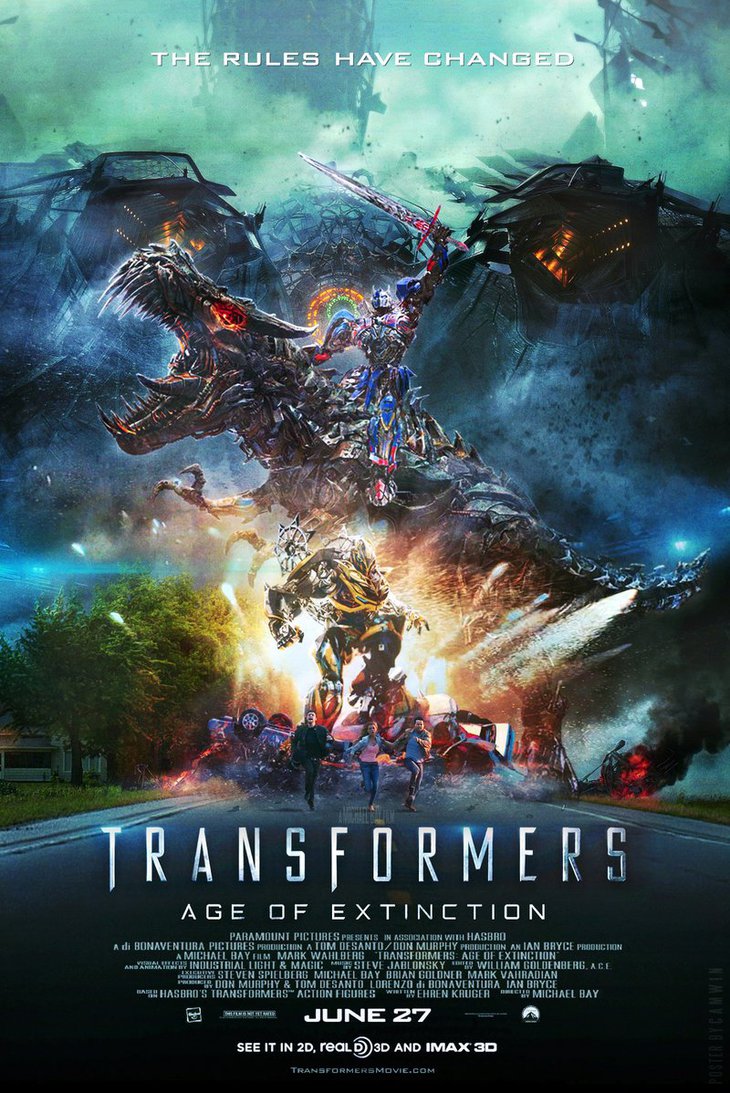 Four movies in, at this point you can either fall back on the old criticisms of Michael Bay as a filmmaker or simply let down your guard and look for any simple pleasures offered by the Transformers franchise, a series mostly known for chaotic plotting and action. Age of Extinction is probably the best Transformers film since the first one (take that for what you will) but it still has all the hallmarks of the obtuse and convoluted plotting, absurd and obnoxious characters, juvenile humor, intense product placement, and often incoherent action. Gone are the characters from the first three films and in their stead is Mark Wahlberg (upgrade) as a Texan inventor named, get this, Cade Yeager. He and his teen daughter come into contact with Optimus Prime and are on the run from multiple forces. Apparently a bounty hunter is looking to target Prime. The U.S. has a black ops team tracking down Transformers in hiding. And Stanley Tucci plays a business tycoon who wants to make his own Transformers via their magic substance “Transformium.” Reading all of that, you realize the pieces still don’t really make sense, and that’s before the robot dinosaurs come into play. And yet Bay and his team have fine-tuned the entertaining aspects of the franchise and better consolidated them in the fourth film. A badass alien bounty hunter/collector is a great addition, adding the government as an adversary, Titus Welliver (TV’s Lost) as a cocksure special agent, Tucci as a corporate blowhard, and robot dinosaurs, it all sort of works on its own terms. Again, if you try and logically connect the pieces, it won’t happen. By this point, if you’re not a fan of the series, there’s no real reason to continue watching, but if you’ve found any semblance of enjoyment then there should be enough to keep your attention with the fourth film, robot dinosaurs and all.
Nate’s Grade: C+
Share this:

The Boxtrolls (2014)
 Another delightful film from the creators of ParaNorman, the whimsical Boxtrolls is another stop-motion treasure that plays just as well for children as it does adults. The fanciful world follows the industrious title creatures that have wrongly been demonized as villains. Snatcher (a tremendous Ben Kingsley) has much to gain by stirring up boxtroll fears, and if he captures them all he’ll finally be allowed to join the town’s inner circle of muckity mucks. We follow “Eggs” a boy who has been raised by the boxtrolls since he was a baby and his re-emergence with the world above ground, notably with the help of a morbid little girl, Winnie (Elle Fanning). The world building is confident and well developed, the storyline finds nuanced ways to be touching and deliver serious messages about peer pressure, assimilation, and the ways which we judge ourselves and whether those are even of merit. But the main draw is the glorious animation, so fluid, so lively, and a landscape that makes full use of color and light and shadow. It’s an immersive experience that your eyes don’t want to blink for fear of missing something. The plot is droll and expertly sequenced with its variety of character and comic asides. The vocal cast does a terrific job, notably Kingsley and a hilarious Tracy Morgan. The film can get a little spooky for young children but should still be comfortable viewing. The Boxtrolls is further proof that the animation house Laika is operating at near-Pixar peak levels of brilliance and deserve the benefit of the doubt with any future films.
Nate’s Grade: A
Share this:

Foxcatcher (2014)
 Haunting and engaging with great performances, Foxcatcher is a dark drama based upon real events that lead to tragedy with the United Stated Olympic wrestling team. Steve Carell immerses himself in the role of eccentric wealthy scion John du Pont, a man eager to carve out validation for himself. He bankrolls the U.S. team to train at his onsite facilities, notably assisting Mark Schultz (Channing Tatum) who is eager to get out of the shadow of his older brother (Mark Rufallo). This is a bleak drama that goes to some dark avenues but it’s not as applicable as the Cannes raves would have you believe. I was never bored but I did find the movie to be somewhat limited in scope. It’s really the life and times of a rich weirdo with a manufactured world around him thanks to his privilege. Du Pont sees himself as a mentor and a teacher, but really he’s just the guy writing the checks, and when his constructed view of reality is challenged, that’s when things get dangerous. He’s not as psychologically complex as advertised. Director Bennet Miller (Moneyball, Capote) ensures the film is overrun in dread so you anticipate that something very bad will happen, and as a result it can be something of a murky slow burn that isn’t necessarily worth the 130 minutes of wait. Foxcatcher is another example in the 2014 trend of the performances being better than the film itself. It’s an intriguing film with great performances, just don’t expect exceptional commentary.
Nate’s Grade: B
Share this:

American Sniper (2014)
 When killing is a man’s gift, what effect does that have on the man? American Sniper follows the real-life heroics of the most prolific sniper in United States history. With director Clint Eastwood attached and awards buzz building, you’d expect that the film would get at the heart of a complex man who placed himself back into danger by choice. For a biopic on Chris Kyle, the man seems to get lost in the fog of war (movies).
Chris Kyle (Bradley Cooper) enlisted in the military right before 9/11 and served four tours of duty in Iraq. He served as cover for many missions, protecting thousands of soldiers. The troops just felt better knowing that Kyle had their back. Kyle got married and had several kids with his wife (Sienna Miller) but he kept leaping back into the fight, the place he felt he belonged.
 From the opening sequence on, American Sniper is often a gripping suspense piece. The opening moral dilemma sucks you right in. Should Chris shoot the mother and child? Are they a threat or is there just a misunderstanding? Will they change their minds and turn away? Is there time to debate all this with advancing U.S. troops? Eastwood does a great job of drawing out the tension with shot selections and the precise editing. The bulk of the movie hews closer to a conventional action movie, with Chris and his team clearing out Iraqi insurgents. We get to know a bit about the mechanics of sniper warfare. But Kyle gets restless being the guardian angel of death for the ground troops, and he goes down to their level and clears neighborhoods. This causes some conflict with his superiors because Kyle is far more valuable as a sniper. His reputation for killing is also getting him notoriety with his enemies. There is a price on Kyle’s head and skilled snipers are seeking him out for the prize. This is a natural way to build suspense as Kyle keeps returning back into Iraq with multiple tours, every tour increasing his personal danger. It allows for real consequences for the increasing prowess of our super sniper. There’s a sense of collateral damage to every kill, as every dead body creates more enemies and those enemies grow more incensed to take him out. Even if you know how exactly Kyle met his untimely end, there’s still plenty of suspense and well-orchestrated action sequences to please casual fans of the genre and true-life military thrillers.
It does feel like the complex story of Kyle, as well as the Iraq War, are being simplified into action movie fodder. There’s a steady supply of interchangeable supporting players, soldiers and spotters and the like, all of them without much to distinguish them as characters. They’re here to be sacrificed, to watch the splatter of red, and to increase the sense of loss because we know that Chris Kyle will not be taken down so we need other expendables. As expected, Miller gets rather short shrift as Kyle’s wife who gets to alternate between worry and unease. The screenplay by Jason Hall sets up some excellently harrowing suspense sequences but seems better engineered like its establishing video game stages of combat than complex people. As a result, when we lose characters it doesn’t feel like we’ve lost people we care about. It doesn’t have an impact beyond sudden shock, and even that is tempered in time with the sniper angle. You start expecting characters to get popped in mid-sentence.
 Where the film leaves you lacking is at its center with the man who is supposed to be the focal point of American Sniper. At the start we’re told that Kyle is the deadliest sniper in U.S. history and by the end that’s about all we know about the guy. He’s an ace killer. The movie has some top-notch suspense sequences with Kyle killing people. The early scenes with Kyle’s family do the bare minimum to establish a sense of pride in not backing down from a fight. There’s a scene where his girlfriend explains to him and the audience exactly why he’s difficult. It’s pretty transparent exposition but it’s also the last bout of clear characterization you’ll get until the end. There’s a slight nod to the mounting PTSD that is transforming Kyle into a man who feels whole only on the battlefield, but these are notes of characterization that are only cursory. It’s only at the very end does the movie remember to flesh out Kyle as a person rather than as an action hero, and by then there’s only enough time to hint at elements we’ve seen explored better in other war movies, particularly The Hurt Locker. As an action film, the movie works and works quite ably, but as a biopic on Chris Kyle it forgets what makes him human, instead focusing on his superhuman killing ability.
Cooper (American Hustle) bulked up a considerable amount of muscle to portray Kyle. He fits the part well and has the acting ability to communicate the troubled psychology of a man making sense of his old world after the trauma of war. It’s then a shame that he’s not given more opportunities to use those acting muscles. There is one phone call where Cooper wordlessly finally breaks down, allowing all the scar tissue to finally be seen on his haunted character, but it’s a moment rather than a culmination.
If you go into American Sniper hoping for an elevated thriller with some well-wrought suspense, then you’ll mostly be pleased with the film as a slice of entertainment. As a war commentary or a psychological study of the horrors of war, it comes up lacking, falling back on the action tropes of its genre and neglecting to properly build around its characters. The action is often biting, and a late sequence involving an oncoming sandstorm is an intense climax. However, it’s also emblematic of the shortfalls of the film. While it’s a sequence of action entertainment, it also reduces war into a video game and reminds you that the characters onscreen are not so much portrayed as people but holders of weapons. Kyle was a complex man who was more than his uncanny ability to kill, but you won’t get more in American Sniper. The nature of his death demands a more insightful exploration of the lasting effects of PTSD and what kind of treatment, or failure of treatment, many servicemen receive once they come home.
Nate’s Grade: C+


 nathanzoebl
You must be logged in to post a comment.