Category Archives: 2024 Movies
Tarot (2024)
 In the long line of horror movies about dumb teenagers stumbling onto curses, Tarot might be one of the most ineffective and ridiculous. First off, tarot readings are so detailed and specific, while also being vague to most of us unfamiliar with what you can find on the playing cards. This means the movie must constantly remind the viewer what the fateful readings were as well as the spooky imagery. Also, being a PG-13 movie, means that the terror is kept more on a psychological bullying level, where the teens have to “face their fears” but they’re not terribly personalized. One girl finds herself in a magician’s performance for ghouls and literally hides in a box only to be sawed in half. What was the personal fear there? Stage magicians? One guy is in a subway station and comes across a newspaper with his face on it and the headline, “You Die Today” (who says print media is dead…. wait a second). This is one of those movies that suffers because the rules of the curse are sketchy at best. We don’t know the escalation or how the teens might beat it. However, I wanted to almost applaud in amazement when the script practically plays an Uno Reverse card on its angry spirit (“If she’s killing everyone because they got their horoscope read, what if WE read HER horoscope to HER, huh?!”). The entire enterprise feels transparently like some studio exec optioned the concept of a tarot deck and said, “You know, make it haunted or whatever.” Unless you’re desperate for some derisive entertainment chuckles, skip Tarot.
Nate’s Grade: D+
Share this:

It’s What’s Inside (2024)
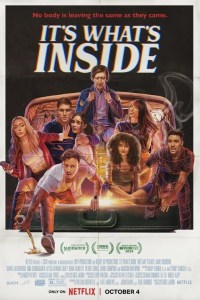 This sneaky little movie is exactly what I’ve been asking for from low-budget genre cinema, where creative ingenuity and imagination are the dominant forces to offset budget limitations. It’s What’s Inside is ostensibly a body swap movie between a group of friends stuck in a mansion overnight. A device allows eight people to swap into other hosts, and it plays as a silly party game early, before writer/director Greg Jardin increases the stakes. People pretend to be someone else and then explore that freedom, which usually means having affairs and getting a little too comfortable in other people’s bodies. Then there are… complications, and watching the characters frantically debate their new challenges and limitations with growing mistrust, exasperation, and betrayal makes for a delicious 90 minutes of surprises. Because there are multiple rounds of body-swapping, and eight starting characters, Jardin takes particular points to better clarify identities, from characters wearing Polaroids to a red-tinted sort of x-ray showing the real characters underneath the confusing physical surface. All of it helps, though I still had to ask who was really who quite often. I think watching it a second time would make it more coherent but also give me even more appreciation for Jardin’s slippery, shifting screenwriting. Here is a movie with rampant intrigue and imagination to spare, that maximizes its creativity to tap the body swap as an illuminating and destructive device to explore secret insecurities, desires, jealousies, and dissatisfaction in a friends group. It’s a wild trip, elevated by energetic and helpful editing, where the ideas are the main feature. It might not be much more than a bad overnight stay with bad people but It’s What’s Inside is top-notch genre filmmaking. It’s what’s inside the movie that matters most, its big imagination and fulfilling execution. Greg Jardin, you have my full attention with whatever movies you want to make from here on out.
Nate’s Grade: A-
Share this:

Beetlejuice Beetlejuice (2024)
 Usually sequels over thirty years later reek of desperation, trying to rekindle the past while usually only hoping to tickle people’s fading sense of nostalgia. Rare is the 30-year-plus sequel that excels by breaking free of its imitator and making us see the original in a new light. It helps to keep your expectations in check, especially for a project that is so miraculous as the original 1988 Beetlejuice. What a wild movie that was, an introduction to horror comedy for a generation, and a near-perfect balance of creepy, silly, and imaginative. From director Tim Burton’s career-launching sense of style, to Michael Keaton’s electric comedic performance, to Danny Elfman’s outstanding score, to the stop-motion visuals, fun and freaky makeup effects, and you had a madcap movie that felt like a unique discovery. Recreating that is near impossible, but if Beetlejuice Beetlejuice can recreate some of the elements and feelings that made the original what it was, then it can be considered a modestly successful late-stage sequel.
Lyrdia Deetz (Wynona Ryder) has become a long-running host of a paranormal TV talk show connecting people with messages from loved ones from beyond the grave. Her teenage daughter, Astrid (Jenna Ortega), is moody and embarrassed by her mother, feeling that she “sold out.” Mother and daughter return back to Connecticut to attend the funeral of Charles Deetz, Lyrdia’s father. Her pretentious and snippy stepmother, Delia (Catherine O’Hara), is trying to better commune with his spirit, and the entire town has become famous for its spooky seasonal history. Meanwhile, Beetlejuice (Keaton) is trying to avoid his former wife, Delores (Monica Bellucci), who naturally is seeking to obliterate him to ectoplasm. He’s still got his sights set on Lydia, who spurned his marriage hopes, and might be able to manipulate the Deetz family back into his control.
 Beetlejuice Beetlejuice gets the closest to rekindling that lightning-in-a-bottle alchemy from the 1988 original, serving as an appealing and enjoyable sequel. Nothing will ever be as original and wild and such a discovery as that first movie, which serves as a point of entry for many a Millennial fan who discovered that irresistible Tim Burton Neo-Gothic aesthetic. However, it recreates enough of the qualities that stood out about the original. The skewed sense of humor and surreal visuals, as well as goofy slapstick and vibrant imagination about life after death, it’s all such a fertile playground for Burton’s visual charms. The genius of the original was telling a ghost story from the ghost perspective as they learned about how to be better ghosts to try and scare their new living owners away. Given the world of the dead, there’s such tremendous storytelling and world-building possibilities here, explored richly in the animated 90s series for kids. Further stories in this universe have an automatically appealing power, and it’s just nice to watch Burton apply his specific aesthetic again, something fans haven’t really seen since 2007’s Sweeney Todd. I appreciated the weird morbid details and the practical production values; the Alice in Wonderland movies have shown that the “Burton look” isn’t best complimented by massive green screen sets. Having Burton, the “Burton look,” the original actors, with some exceptions (more on that later), and enough of that offbeat, chaotic, morbid tone return is a victory.
Beetlejuice Beetlejuice doesn’t so much alter our understanding of the world of the dead as established; it doesn’t radically rethink the landscape but it doesn’t repeat the same plot events either. I really liked the evolution of the adult Lydia as a jaded TV host. There’s a real dramatic punch to the reality that she sees the dead but has yet to see her deceased husband. She is incapable of reuniting with the man she misses the most, and she doesn’t know why. That yearning, paired with a lingering thematic mystery, can be a palpable storyline to explore. Pair that with some three generations of Deetz women trying to understand one another and work through personal resentments and we have fertile narrative ground. The three women were my favorite part of the movie, and their interactions and reflections on parenting and the challenges of trying to better understand one another are the foundation of the movie’s sense of heart. I really enjoyed the dynamic between the three, significantly upping Delia’s screen time and finding room to give her more dimension, an artist struggling in the wake of her grief. I’m a bit surprised that Ortega’s character isn’t more central to the drama. For all intents and purposes, she’s Lydia 2.0, so butting heads with Lydia 1.0 I guess feels redundant, so the story sends her off to find a cute boy in town and use that as an excuse for several unexpected needle-drop song use. There’s something inherently wrong watching a Tim Burton movie and hearing contemporary music. Imagine the Beetlejuice “Day-O” singalong but to, say, Sabrina Carpenter instead. No.
 Beetlejuice, as a character, is such an exciting agent of chaos, a horny ghost who operates on the same tonal wavelength as a Looney Tunes cartoon character. Even though the original movie is named after the guy, he’s only in the film for approximately twenty percent. Keaton was absolutely incredible in his comedic bravado, creating much of the character through his ad-libs and hair and makeup choices. Keaton is still fantastic in this go-for-broke sort of performance, a performance we’ve seen far less as he’s settled into a respectable dramatic acting career. It’s hard to remember, dear reader, but when Keaton was initially cast for Burton’s Batman, the fan base at the time was up in arms, considering Keaton more of an un-serious funnyman. It would have been easy to have Beetlejuice front and center for the movie, so it’s admirable that Burton and Keaton decided to keep his on-screen appearances short, leaving people wanting more. There’s a late turn of events that pairs Lydia and Beetlejuice together, and I wish this fractious pairing had been the bulk of the movie. The whole enemies-to-uneasy-allies would have put much more emphasis on their character dynamic and the comic combustibility. Still, seeing these characters come back and retain their appeal and personality without obnoxious pandering is welcomed.
The screenwriters find a clever solution for the Jeffrey Jones Dilemma. For those unaware, Jones, who portrayed Lydia’s father in the original, and best known for pugnacious supporting roles in movies like Ferris Bueller’s Day Off, Howard the Duck, and HBO’s Deadwood, was charged with soliciting a child for sexual exploitation. The movie continues with the character of Charles Deetz but without the involvement of Jones. The character gets his top eaten by a shark, so for the rest of the movie he’s a walking half of a corpse with a mumbly voice. It’s a clever way to include the character without the need for the actor.
With that decision to limit the Beetlejuice quotient of Beetlejuice Beetlejuice, it makes for a sloppier movie juggling a few underwritten subplots and side characters. The biggest non-factor is the return of Mrs. Beetlejuice. Here is a powerful antagonist who has the literal ability to suck out the souls of the recently dead and turn them into shriveled husks. She’s seeking vengeance against her ex and tracking him down through the netherworld. And yet, she could be completely eliminated from the movie without really affecting the other storylines. The whole Mrs. Beetlejuice/vengeful ex-wife character feels like a holdover from a different sequel script, clumsily grafted onto this other project, a vestigial artifact of another path not taken. There’s plenty of potential with the concept of the past victims of Beetlejuice coming back to seek retribution, and especially a trail of angry former lovers. It would explore the character’s history more meaningfully than an albeit amusing silent film interlude about how he married her during the era of the Bubonic Plague. We see how he died as a human, but there’s hundreds of years that can be illuminated from his failed schemes and odd jobs. Certainly there could be a whole club of ax-grinding malcontents sharing their mutual hatred of the Ghost with the Most. This character should better reflect Beetlejuice, and instead she’s just a monster on the prowl that eventually gets indifferently cast aside. It feels like Burton was looking for something for Bellucci to portray (Burton and Bellucci have officially been dating since 2023).
 She’s not alone as an antagonistic villain that pops up to provide momentary danger but is also hastily resolved to the point that it raises the question why they were even involved. There are three antagonists, not counting Beetlejuice, that appear throughout to threaten our Deetz family members in Act Three, each of them individually interesting and targeting a different member of the family for ill-gotten gain. Yet each one of these characters is conquered so easily that it nullifies their importance and overall threat. If Beetlejuice could, at any moment, just open a trapdoor to hellfire at a moment’s notice, what danger does any other character pose then? If a sand worm can just appear from nowhere and consume our pesky antagonist, then why can’t this be a convenient solution earlier? The defeats feel arbitrary, which make the antagonists feel arbitrary, which is disappointing considering that we have the full supernatural arsenal of undead possibilities to tap into. I enjoyed these characters for the most part, but it’s hard not to feel like they’re tacked-on and underwritten. The same can be said about Willem Dafoe’s police chief, a former actor who played a chief on TV and now tries to fill the role for real after death. I’m always glad to have more Dafoe in my movies (woefully underrepresented in rom-coms, you cowards!) but he’s just mugging in the corner, waiting for some greater significance or, at minimum, more memorably morbid oddity to perform.
Beetlejuice Beetlejuice is better than a desperate sequel cash-grab, though there are elements, ideas, characters, and jokes that could have been smoothed out, better incorporated, and developed to maximize the potential of the undead setting. It’s an enjoyable throwback for the fans of the original that does manage to tap into enough of those potent elements that made the original so memorable. It’s definitely less edgy and transgressive, maybe even a little too safe given the territory of spooky specters; the entire Soul Train bit felt like a bad Saturday Night Live sketch from the 1980. However, it’s still got enough of the charm and silliness to leave fans, old and new, smiling and wondering where it might go next in its wild world.
Nate’s Grade: B
Share this:

Wolfs (2024)
 George Clooney and Brad Pitt star as rival fixers, unscrupulous men the rich and powerful call upon to clean up the messes of the rich and powerful, as Clooney portrayed in 2007’s Michael Clayton. It’s clearly playing upon the movie world depiction of these kinds of characters, whose titular name comes from the famous Pulp Fiction fixer played by Harvey Keitel. I don’t know what writer/director Jon Watts (Cop Car, Spider-Man: No Way Home) wanted to say or even achieve once he brings these two bickering and aging alphas together on-screen. The first ten minutes is played completely straight, as the drama of a high-powered woman in peril (Amy Ryan) leads to dueling fixers with different bosses being put in charge of disposing of a body and returning stacks of ill-gotten goods. You might assume with this premise that the movie will be a cantankerous buddy movie, with the professionals trying to measure their competition over the course of one long hectic night. It plays with this professional rivalry for a while, but then Wolfs gets bogged down by mafia wars, double crosses, and convoluted conspiracies the fixers are trying to untangle while bringing on an unexpected third wheel to the night of shenanigans. The plot gets easily lost, and the comedy feels lacking and underwritten, relying upon the star power of its leads to serve some kind of ironic undercurrent of energy. I kept thinking to myself that this premise, with these actors, should be a lot more fun. By the end, it feels almost like a setup for a wacky TV series for further adventures, but if this is the level of entertainment we’re getting from this pairing, let the old men die off-screen, thank you.
Nate’s Grade: C+
Share this:

It Ends With Us (2024)
 If you’re expecting a charming romantic drama about a young woman moving back home and finding new love and rekindling romance with a past love, then you might be better off scanning the Hallmark Channel. For those blissfully unfamiliar with author Colleen Hoover, It Ends With Us is her best-seller about domestic abuse. The Dickensian-named Lily Bloom (Blake Lively), who wants to open a flower store, comes back home after her abusive father passes, and she reconnects with Atlas Corrigan (Brandon Sklenar), her childhood love who her father chased away. She also falls for child neurosurgeon Ryle Kincaid (director Justin Baldoni) who happens to be an abuser. It takes an hour into the movie before Ryle physically harms Lily, which means the movie up until that point is paced and structured like a typical romantic drama and we’re meant to find him smooth and desirable. Perhaps Hoover and the filmmakers are trying to better place us in the position of the abused spouse, providing context that some might use to excuse toxic behavior and red flags, but if they wanted to set up more of a love triangle, they’ve done a poor job. Atlas mostly appears in flashbacks as the idealistic, impoverished boyfriend she kind of takes in. He then re-establishes himself in the present with a successful fancy restaurant, and the movie more or less just puts him on a shelf and says, “When she’s ready to have someone nice, she’ll settle back with that bland guy from her past.” Feels like we’re spending too much time on stories that we shouldn’t, and less time on ones we should. It’s grandiose soap opera plotting for serious subject matter. Credit director/co-star Baldoni for not soft-pedaling the treacherous nature of his character’s control and insecurity. There’s a great deal of very uncomfortable and disturbing abuse sequences, including a rape, for a PG-13 movie. Domestic abuse, and growing up in the shadow of domestic abuse, makes for some very challenging viewing. If the movie was more insightful, or honest, or even nuanced, it might be worth enduring the discomfort of its two hours. It’s not. It’s just punishing.
Nate’s Grade: D
Share this:

Uglies (2024)

Even though Uglies is based upon a book series that hails back to 2005, it feels so much like it was developed in a vat subsisting on the runny discharge from other YA dystopian projects, finally settling into an unappealing mixture of familiar tropes. In this post-apocalyptic future world, society has rebuilt itself with a caste system that celebrates beauty. Teenagers undergo surgical operations and brainwashing to make themselves a member of the Pretties, the cool kids. If you’re even remotely familiar with YA storytelling, you can likely guess exactly where the movie goes from here. Our heroine is called Squint because society seems to think her eyes need work. There’s another character named Nose for the same reason, meaning that upon birth, I guess the doctor just holds up you baby and starts verbally roasting them. Squint is played by Netflix staple Joey King (The Kissing Booth, A Family Affair) and therein lies one of our central adaptation problems. The rules of Hollywood will not allow unattractive lead actors in movies like this, so the filmmakers give her brunette hair and less makeup, as if we’re supposed to find movie star Joey King to be naturally hideous. It’s the same with every actor in the movie. Now, if you were going to adapt this to a visual medium, maybe you lean into the visual contrasts in a more specific manner: all the “Uglies” are minorities and all the “Pretties” are lighter-skinned or white. That would bring an added colorism commentary but it would also be steering the movie into a more dangerous relevancy. The plot is all simplistic high school battle lines about individualism versus conformity, self-acceptance versus assimilation, though the optics of having a trans woman (Laverne Cox) being the evil head of education forcing surgery on teens and brainwashing them feels quite problematic considering grotesque conservative theories endangering the lives of actual trans people. There is one surprise in Uglies, one that I’ll spoil for you, dear reader. It doesn’t end. It sets up the next adventure with Squint supposedly bringing down the corrupt society from the inside, but I challenge anyone not familiar with the book series to be that compelled to put right the unresolved storylines and character arcs from this stalled launch.
Nate’s Grade: C-
Share this:

Reagan (2024)

My seventy-five-year-old father doesn’t get out to see as many movies as he used to, but one he was dead-set on seeing in theaters was Reagan. My sister took him and he came back singing the movie’s praises, celebrating Dennis Quaid’s portrayal of the 40th president of the U.S. of A. and extolling the virtues of this trip down Boomer memory lane. I’m glad my father enjoyed the movie. I’m glad the filmmakers could provide him two hours of uplift and entertainment, especially during times like these where my whole family can use the escape from present-day worries. I’m also retroactively relieved that I didn’t see the movie with him, though as a dutiful son and his movie buddy for decades, I would have. I’m glad because our opinions on the overall artistic merits would have been significantly different, and I wouldn’t want to rain on my father’s personal enjoyment (that’s what the written word is for).
For the benefit of analyzing Reagan as a movie first and foremost, I’ll reserve my reservations about his political legacy for the end of the review, but even as a standard presidential biography, Reagan the movie is a disappointing and reductive trip through one man’s Wikipedia summation of a career. I’ve become much more a fan of the biographies that choose a seminal moment from a public figure’s life to use as a framing device for the larger legacy (think 2012’s Lincoln focusing on the passage of the thirteenth amendment). I’d prefer that approach to the more familiar cradle-to-grave structure that often feels like a zoom through their greatest hits where none of the events are granted the consideration or nuance deserved. With Reagan the movie, we’re sprinting through history, although Reagan doesn’t even become president until an hour in. Instead, the focus is unilaterally on Reagan’s opposition to communism and the Soviets. Obviously distilling eight years of a presidency into a couple hours is a daunting and improbable task, the same difficulty for distilling any person’s complicated life into an accessible two hours of narrative. Still, you should have expected more.

For those coming into the movie looking for a critical eye, or an even-handed approach to this man’s faults and accomplishments, the movie condenses itself into a narrow examination on communism and the Cold War, a story we already know proves triumphant. The cumulative problem with Reagan the movie is that it doesn’t really add to a deeper understanding of the man. With its streamlined narrative and pacing, the movie sticks to its Greatest Hits of Reagan, especially his speeches. There are several famous Reagan speeches littered throughout the last act of the movie, and it doesn’t do much for a better understanding of the man delivering those remarks as just hitting upon people’s memories of the man in public venues. It would be more insightful to watch the team behind the scenes debating their choices. The movie portrays Reagan the man more like Saint Regan, arguing if there are any presentable faults they should be readily forgiven because it was all in pursuit of morally impregnable goals (he remarks that the vicious right-wing contras remind him of George Washington and the early colonial army…. yeah, sure). The filmmakers are too afraid to say anything too critical but also to reveal anything truly revelatory about their subject. So the movie becomes a glossy nostalgic-heavy drama without much in the way of drama because Reagan will always persevere through whatever hardships thanks to the power of his convictions, which will always be proven right no matter the context and repercussions. The movie seems to imply all his decisions led to the fall of the Berlin Wall, so it all must have worked out, right? Well, not for everybody, movie, but we’ll get to that in due time.
The filmmakers elect to frame the movie through a curious narrator – a retired KGB officer (Jon Voight) that has followed the life and times of Ronald Reagan going back to his early days. Apparently, this Soviet spy saw true greatness in Reagan way back and thought he might become a threat to the continuation of communism. It’s a strange perspective to be locked into, the enemy complimenting Reagan from afar and ultimately crediting the man’s faith in God as the reason that America triumphed over the Soviets. It means then that every scene has to be linked to our KGB narrator, and sometimes that can get questionable, like when he’s talking about Reagan’s time as a teenage lifeguard, or the time Reagan was being bullied by local kids, or Regan’s intimate conversations with his first wife, Jane Wyman (Mena Suvari). The scenes in Hollywood are so clunky, especially a dinner where the movie wants us to look down on Dalton Trumbo, blacklisted Hollywood Ten writer. This man stood for his principles and suffered a real backlash, and you want me to think of him as misguided and part of some liberal communist cabal (the movie also includes a picture of Oppenheimer as part of its Soviet influence targets)? By insisting upon a narrator that’s not Reagan, that means this KGB spy it also means that we’re seeing the world of Ronald Reagan through an interpreter’s prism, which makes the scenes even more curious for being such an unexpected cheerleader over Reagan’s amazing instincts and abilities. It would be like having Stalin narrate a biopic about FDR and showering the president with gushing praise.

Limiting the movie’s focus to Reagan’s lifelong battle against communist forces makes for a much cleaner and more triumphant narrative, and also leads to an ending we all know is coming, not that surprise or nuance is what the primary audience is looking for. The movie posits that Reagan pursued becoming the country’s chief executive for the selfless mission of standing up to the nefarious forces of communism. Then again, in the opening moments, the movie also tacitly implies that maybe it was the Russians who shot him back in 1981 when it was really an incel who thought he might impress Jodie Foster. Those opening moments also present a cliffhanger to come back to, as if there’s a gullible portion of the audience that is hanging on pins and needles in anticipation whether or not Reagan really was killed back in 1981 (“But… but if Ronnie dies, then who was left to beat the commies?”). It’s a very selective narrative framing that makes the movie easy to celebrate because Reagan is presented as America’s steadfast defender who stood up for our apple-pie American values and brought down the Soviets. Reagan certainly played his part in helping to facilitate the collapse of the Soviet Union, but he was one man coming in at the end of a chain of events spanning decades. I liken it to having a group project in school where you and your cohorts work steadily all week, and then the day it’s due, a kid who’s been absent all week except for that day comes onto the project, adds some contributions, and then takes credit for everything accomplished. Reagan gets his due but so do the other U.S, presidents, secretaries of state, and lots and lots of ambassadors that also helped reach this monumental conclusion. However, the biggest contributor to the collapse of the Soviet Union belongs to the Soviets themselves and their rejection of living in a reality in conflict with the dogma of their political leaders (sound familiar to anyone?).
The screenwriters also position the Great Communicator as being so powerfully persuasive that all it took was one speech and everyone was left helplessly in thrall of this man’s honeyed words. It takes on such a grandiose scale that makes Reagan look like a superhuman. The movie sets up its climax over whether or not Reagan will say “tear down this wall” in a speech at the Brandenburg Gate in 1987, which heightens the drama to a level of self-parody. Is there any spectator wondering if Reagan will eventually say the words that became famous? Beyond the false drama of whether or not Reagan will utter this phrase, the movie tries to fashion some unconvincing behind-the-scenes hand-wringing over what it will mean if Reagan says these words while in Germany. As if the man has ever been shy about denouncing communism and the Soviet state beforehand. The movie also exists in a world where every world leader and responsible adult is glued to a TV set watching Reagan speechify at any key moment. Hilariously, after Reagan does indeed say “tear down this wall,” the film cuts to Margaret Thatcher watching and solemnly saying, “Well done, cowboy.” The rousing music reaches a crescendo, the Reagan team celebrates like they just landed a man on the moon, and the implication is that now that Reagan has put these four words together in sequence, well that Gorbachev fella has no choice now. The movie is set up like this speech is the final blow that pushes the Soviet Union into the dustbin of history. And yet, the next scene of the Berlin Wall coming down has a helpful on-screen designation of time: “two years later.” So Ronnie gave his amazing speech and it immediately led to the end of East Germany… two years later. Does George H. W. Bush get all the credit for being president when the Soviet Union actually collapsed in 1991? I’m sure we can find a speech somewhere where he said something bad about them, and if Reagan the movie is an indication about political persuasion, all he had to do was say the words out loud. Then the wicked communist curse is broken, but few people knew that, only those who worked for Ronnie.

The movie goes to this magical solution time and again, as Reagan is able to solve any crisis with just the right combination of words. Whether it’s Vietnam protestors he cows into retreat by shushing them, or even a debate where all he has to do is throw out a joke and the opposition must crumble because nobody can recover in the face of a joke; the movie presents time and again a silly and reductive version of politics where all it takes is for people to hear the cherished words of Saint Reagan and be converted. Look, Reagan was an influential figure and inspired a generation of Republican leaders to follow in his wake, and yes his telegenic skills were an asset to his understanding of how to handle issue framing. But to reduce everything down to his overwhelming oratory powers of persuasion makes it seem like everyone in the world is falling prey to a linguistic cheat code they are unaware of. It’s the kind of deification that we might see in a North Korean movie extolling the powers of Kim Jong-Un (“He golfed a hole-in-one with every hole”). This is what a hagiography does rather than an honest biography, and that is why Reagan becomes a relatively useless dramatic enterprise except for those already predisposed to wanting to have their nostalgia tickled and their worldviews safely confirmed.
I wasn’t exactly expecting, say, an even-handed review over Reagan’s legacy, but there’s something rather incendiary about how it distills all of the opposition to Reagan and his policies. Our KGB narrator intones that not everybody was a fan of good ole Ronnie, and then in an abbreviated montage we get real news footage of protestors with placards condemning the Reagan administration for ignoring the AIDS epidemic, for tax cuts for the rich, for supporting the apartheid government of South Africa, for gutting social safety net programs, etc. The handling of the Iran-Contra scandal is hilariously sidestepped by the same Reagan who is shown on screen being so dogmatic about sticking to law that he fired all the striking air traffic control workers. It’s not enough that the movie reduces all relevant critical opposition to Reagan to a brief music montage, it’s that the movie then quickly transitions directly to a map of the 1984 electorate with Reagan winning in a landslide, as if to say, “Well, these cranky dead-enders sure were upset by these issues, but they must be wrong because the American people overwhelmingly re-elected him.”
I never found Quaid’s performance to be enlightening or endearing, more mimicry that settles into an unsettling cracked-mirror version. It always felt like an imitation for me, like something I’d see on Saturday Night Live in the 1980s with Phil Hartman. He holds the grin and nasally voice but delivers little pathos. It’s not exactly the actor’s fault when the screenplay gives him such little to do. There was a real opportunity to better humanize him toward the end as his mental decline was becoming more of a force. Instead, it’s relegated to the very end, as a gauzy way to usher the man off the stage with our sympathies. Voight (Ray Donovan) gets the most lines in the whole movie and really seems to savor his Ruskie accent. Curiously, his character is talking to a promising KGB pupil trying to learn where they went wrong and it’s not set up to be Vladamir Putin, himself a former KGB agent. The only other significant supporting role that lasts is Nancy Reagan played by Penelope Ann Miller (The Shadow, Carlito’s Way) and she’s relegated to the suffering spouse on the sidelines that always has the steel spine and the word of encouragement. Her best moment of acting was her embarrassment as a captive witness to Ronnie, before his step into politics, awkwardly dancing on stage with the PBR players as a shill for the beer company.

Let’s be honest about who Reagan is aimed at, an older, mostly conservative audience looking back at the time of Reagan’s reign and thinking, “Those were the good old days.” It’s not made for people like me, a progressive who legitimately believes that many of our modern-day problems can trace their source from the eight years of the Reagan administration. I’m talking about the trickle-down-economic fallacy that girds so much Republican magical thinking when it comes to taxes. I’m talking union busting, I’m talking his “welfare queen” projection, I’m talking the selling of arms for hostages (bonus fact: the Reagan campaign was secretly negotiating with Iran not to release the hostages until after the election to better doom Jimmy Carter’s chances of re-election), I’m talking about making college education far more expensive by massive cuts to state funding, I’m talking the rise of the disingenuous “textualist” judicial philosophy that only seems to mean something when its proponents want it to, I’m talking about training and arming Osama bin Laden to fight the Soviets in Afghanistan (wonder why the movie chose not to include this since it is Reagan fighting communism), and so on and so on. Naturally none of these are held to scrutiny by Reagan the movie because it’s from the writer of God’s Not Dead and the director of Bratz.
Suffice to say, Reagan has many notable shortcomings depicting a president who, with every passing year, only seems to add to his own shortcomings in legacy (the Party of Reagan has willfully given up all its purported principles to become the Party of Trump). If you’re looking for an overly gauzy, sentimental, and simplistic retelling of what people already know about Ronald Reagan, then this movie is for you. If you’re looking for anything more, then this is the New Coke of presidential biopics.
Nate’s Grade: C-
Share this:

Rebel Ridge (2024)
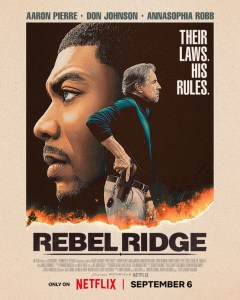 It only took minutes for me to be both engrossed and enraged by Rebel Ridge, the latest film from Jeremy Saulnier, a master of genre elevation. The scene begins with Terry Richmond (Aaron Pierce) riding his bike down a country road. A police cruiser appears behind him impatient to get around, and eventually the officer decides to use his vehicle to ram the bicyclist off the road. Afterwards, the officer tells Terry to stay on the ground and, upon a search of his belongings, discovers a stack of cash. Terry explains he cashed out his ownership in a restaurant and he’s on his way to do two things: buy a truck, and post bail for his cousin who was recently arrested for a minor drug possession. The police confiscate the money, accuse Terry of being involved with a drug conspiracy, and tell him that if he wants to fight for his money back, he’ll need to hire a lawyer and petition the court. Oh, and also the casual racism of the police officers is galling. With just his opening scene, Saulnier and his actors have made me feel vivid emotions and given me an underdog who I’m pulling for, a man who will come to serve as an honorable wrecking ball to this small-town police force who think they are above the law as it suits them. Saulnier’s movie tackles pertinent social topics with great care and detail, but it also delivers a masterful and satisfying action-thriller that knows how to entertain first and foremost rather than just incite.
 There are some serious criminal justice topics here dealt with unusually convincing clarity and accessibility, and that proves to be the ethos of Rebel Ridge, a message movie that knows it needs to be a movie first and a good one. Saulnier’s prior film work just oozes with dread and menace, though Blue Ruin and Green Room and even 2018’s Hold the Dark, by far the lesser work, dwell in bleak human outlooks. Very bad things will happen to people who stumbled into situations beyond their control, and usually by the end of the movie, there’s no recompense and we’re left to wonder about the empty cost of suffering. With Rebel Ridge, it feels like Saulnier has taken an assignment, like Netflix said to make one of your movies with your level of craft and thought, but also make it so the underdog is a badass and wins. I suppose one could argue that it’s turning a formula meant to defy convention back to convention, but by providing a crusader, we’re given a champion to root along that we can share confidence with. Terry isn’t invincible, some fearless behemoth who goes unopposed at every turn. He’s a formidable force but he’s also one man fighting against the forces of injustice and one black man fighting against racist white men in authority (superbly epitomized by Don Johnson’s good ole’ boy chief). Even with the power at his disposal, there are still limitations, which still makes the movie thrilling even if we ultimately suspect good might win out at the end. There’s nothing wrong with a triumphant ending as long as the work before establishes it as a fitting conclusion; tragedy and misery are not somehow more meaningful endings just because they are more serious or subversive. More people will learn valuable lessons about civil asset forfeiture and bail reform from this movie because it has a stirring and accessible story for a mass audience. The genuine thrills allow the messages to prosper.
And what thrills there are. There’s a staggeringly taut sequence where Terry is racing against time to get his cousin’s bail money deposited to prevent him from being transferred to prison. He’s checking the clock, looking down the small courthouse hallways, waiting for the officers he indisposed to come rushing back to arrest him. If only he can get this money deposited first. Saulnier does his own editing and creates a masterful sequence that left me nervously tapping my foot and awaiting the worst. The later confrontations with the police have a deeply satisfying turnabout, as these bullies come to realize far too late that they picked on the wrong man. Terry is an ex-Marine who taught martial arts and hand-to-hand combat to the Corps, but the most dangerous weapon he has is his mind. He’s constantly thinking about plans and implementation and adaptation. He’s intimidating already, but then when he starts to adapt, the sheer force of what this man is capable of makes him that much more incomparable. Even as a man on a mission, he’s still one black man fighting against a system of entrenched power that doesn’t like to bend when it comes to compromise or imposed oversight. He’s still got institutional power against him, and in one of Sauliner’s other movies, he probably would end with Terry winning a Pyrrhic victory but with the system ultimately standing, readjusting to maintain its dominance against further reforms. Here, that may still be true in a larger sense, but at least this one man can make a difference and bust a few racist bullies.
 This experience wouldn’t be nearly as awesome without the commanding presence of its leading man. Pierce has had some noteworthy roles in Krypton and The Underground Railroad (he was also the amazingly named rapper “Mid-Sized Sedan” in M. Night Shyalaman’s Old). Originally, John Boyega (Star Wars: The Rise of Skywalker) was the lead role of Terry but Boyega bowed out weeks into filming in 2021 reportedly for “creative differences.” I cannot fathom any other actor in this role now that I have seen how thoroughly magnetic Pierce comes across. He’s a future star in the making and this should serve as a showcase for Hollywood. I like Boyega as an actor and have since 2011’s Attack the Block, but Pierce is a far more intimidating presence and likely candidate for action retribution. I cannot overstate how much better this movie is because it found the perfect leading man for its hero. Saulnier’s excellent command of the genre and tension is made even more compelling because of Pierce being our vehicle for comeuppance. His smooth intensity beautifully amplifies Saulnier’s percolating dialogue, finding the exact right tone and presence to make the challenges to power feel oh so combustible.
I wish the second half of Rebel Ridge was as perfectly structured and executed as that first scene. The second half gets a little lost in the details of its overarching small-town conspiracy. The momentum of the movie starts to slag a bit, and the clear connection of cause-effect plotting gets bogged down. There’s still important revelations and you get nice moments from the likes of James Cromwell as a judge and Steve Zissis as a courthouse clerk trying not to make waves within a system he acknowledges is unjust. The real significant supporting character is Summer (AnnaSophia Robb) as a lawyer with a past of drug addiction that she’s still trying to put behind her to earn back parental rights to her kids. She’s a good foil for our crusading hero, and her storyline also smartly allows for more social-political tangents to be hit about the difficulty of addicts and ex-cons to try and start over in the workforce. I wish she was more involved in the climax, as she’s relegated to being mostly a damsel needing to be saved after she proved so capable and cunning throughout the rest of the movie assisting Terry. The second half just isn’t as strong as the first half because the movie overextends with its conspiracy and history without the same tremendous clarity and urgency that drove the first hour of Rebel Ridge. The ultimate conclusion, while still satisfying, lacks the fireworks that we crave. It’s more a race against time and hoping that certain elements finally stand up against the corrupt police forces. It’s a solid ending, enough for a catharsis that Saulnier so rarely allows, but it’s not quite the release we might want, and maybe that’s the ultimate point.
 Rebel Ridge is a great genre movie that flirts with true excellence. It’s Jeremy Saulnier’s most accessible and crowd-pleasing movie, an action-thriller that executes its sequences of tension and retribution with as much care as it incorporates its Big Ideas for viewers to think over. Genre movies have long tackled relevant social and political topics, sometimes in ways that are far more meaningful and impactful than message movies that get bogged down in didactic dogma. But if you can link a relevant social issue to a story that grabs us and makes us want to inch closer to the screen, something that links a larger problem to a personal story, then you’ve found an accessible illustration that people will actually want to see. Rebel Ridge stands out among the Netflix house of action movies and proves that even a mainstream Saulnier can deliver the goods. Just because he’s working with a more conventional formula doesn’t mean that he hasn’t put thought and care into his characters and action. Rebel Ridge may leave you wanting a little more with its ending, but what it supplies is so engaging and entertaining that I’m happy to report Saulnier hasn’t lost his edge. Keep ‘em coming like this, Jeremy.
Nate’s Grade: B+
Share this:

Deadpool & Wolverine (2024)
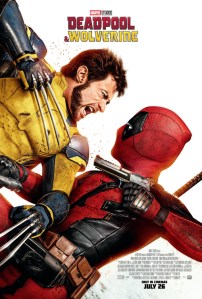 Thanks to some release shuffling, there was only one Marvel movie being released in 2024, the fewest since 2012 (excluding the COVID punting of 2020). There’s been a lot of ink spilled over “superhero fatigue,” especially the recent downturn of certain Marvel movies like Quantumania and The Marvels, though as I’ve written before, I don’t think audiences have become sick of superhero cinema, they have become more demanding from mediocre superhero cinema. Audiences just want something more than the same old same old. Enter Deadpool & Wolverine, resurrecting one of the greatest Marvel heroes and transplanting the first new Fox hero into their new corporate landscape. It’s the least serious Marvel movie yet by design and, judging by its runaway box-office success, that was what the people wanted in a summer blockbuster that made them remember the escapist joys of men in tights with anger issues.
Wade Wilson (Ryan Reynolds), a.k.a. the merc with the mouth Deadpool, is a man out of time. His universe is scheduled for elimination by the Time Variance Authority (TVA) because of the demise of Logan (Hugh Jackman) who served as an anchor being. Apparently, for reasons that don’t seem to make sense if you think of universes lasting longer than one human lifespan, once the anchor being goes, the universe dies out. Wade is thus in search of another Wolverine, but the one he finds is “the worst Wolverine,” a tragic hero drowning his sorrows and refusing to help. The two bickering mutants get cast to a dimensional dumping ground where they run into all sorts of castoffs and forgotten figures, chief among them Cassandra Nova (Emma Corrin), the twin who ate Professor Xavier in the womb rather than the other way around. She holds dominion in this strange realm, and Wade has to appeal to her, or eliminate her, to get out of this ashy purgatory and convince this wounded Wolverine to be a hero.
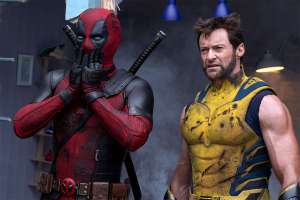 The Deadpool half of the title means that this movie is interested in serving as a meta-satire of superhero cinema, which means its breezy, surface-level charms can feel after a while like a fanboy sugar high. It’s hard to maintain the novelty of a fourth-wall breaking vulgar superhero with the third movie, but now we have Deadpool closing the book on the Fox era of twenty-first century superhero cinema as well as getting to play in a new sandbox of pop-culture references and superhero cliches. Welcome to the Marvel Cinematic Universe (MCU), Wade Wilson, though, as stated on-screen, you’re entering at a bit of a low point. For a while, at least, the movie can get by by having its resident prankster mug his way through the MCU catalog, fawning like the biggest fanboy (he did unsuccessfully audition for the Avengers). The opening sequence literally involves Deadpool digging up the adamantium corpse of Logan and using his unbreakable bones to inflict bloody carnage. It’s quite an attention-getter as well as something of a promise: we’re not going to undo the dramatic conclusion of 2017’s Logan, and even though this is the MCU, this movie isn’t going to go soft as it wades in its signature off-color comedy and bloody chaos.
Your mileage will vary depending upon what the hit-to-miss percentage is with the comedy. I found a lot of the homoerotic/homophobic banter to be dull and repetitive, but this kind of comedy ethos has been present from the first movie, the more-is-more approach. There’s an extended series of cameos that are fun castoffs from Fox comics universes, and the actors are definitely having a blast reliving their characters, or in one very special case, getting to live it once and for all. I wish there was more specific MCU commentary, but I cackled loudly when Reynolds turns to Jackman and taunts, “Disney’s going to make you keep doing this until you’re 90!” I really wish there was an extended critique of the state of post-credit scenes introducing new characters that we all know will never be seen again (remember Harry Stiles or Brett Goldstein?). Deadpool could have gotten stuck in an endless loop of end credit sequences. I enjoyed that a car’s product placement was subject to constant abuse and destruction, while still trying to maintain that sleek car commercial framing. The angry/shouty dynamic between Wolverine and Deadpool makes up for a lot, so even if the jokes are less than stellar, the cranky buddy dynamic still delivers.
 However, much like the 2022 Multiverse of Madness, the actual multiversal trips are quite few and quite disappointing. There’s a silly montage of Wade approaching the different Wolverines of different universes (no Dougray Scott, huh?) but almost all of the movie is spent between a dusty netherworld and a subway station. Again, with the promise of great possibility, these movies seem to say, “Will you settle for maybe TWO gray locations?” I was let down by the main setting reminding me of 2009’s Land of the Lost dumping ground for the nexus of discarded universes. When this whole multiverse phase comes to its inevitable conclusion, it’s going to feel like a promised epic family vacation that went about an hour down the road, visited two gas stations, a McDonalds, and then hastily turned around.
On the other side of the titular ampersand, Jackman is acting in a completely different movie, perhaps giving one of his most dramatically rich performances as the superhero. This is a different Wolverine than the one we saw in 2017’s Logan, so it allows Jackman the freedom to be able to hit some of the essential elements of the character while also getting a new opportunity to follow a different direction. This is a Wolverine haunted by his own sense of cowardice and blaming himself for the death of his X-Men. This is less the grumpy antihero we’ve grown to love over twenty years and more akin to the main character in 2023’s Godzilla Minus One, a war veteran who folded under pressure and attempts to live through their guilt and shame, ultimately finding solace in seeking the noble sacrifice but on the bigger stage now. This is a genuinely traumatized character working through the different dimensions of his trauma, and Jackman doesn’t for a second treat it like a joke. He’s set up to be the cranky straight man to Reynolds’ chatty goofball, and there is comedy to be had with that dynamic, but Jackman is so convincing with his portrayal, again twenty-four years into this character, that he made me tear up at a few points. That’s right, dear reader, Hugh Jackman is so great in his role, that he almost made me cry. Yes, in a third Deadpool wankathon movie. And that is why Jackman is such an incredible actor. The attempt at heart has never felt authentic for me with Deadpool, no matter how many side characters he collects and assures us that they “mean something.” However, by including Wolverine, the filmmakers allow the viewers to import our decades of accrued feelings onto him. It’s a cheat, but it works with an actor of Jackman’s caliber. Plus, who wouldn’t want to see more of this man in the role that he defined for a generation?
 Look, the movie operates more so than any other MCU enterprise on an expectation reflection system, likely supplying what you want out of a project like Deadpool & Wolverine. If you’re looking for a darker, sillier jaunt, there’s probably enough to serve as a diversionary change-of-pace. If you’re looking for a low-stakes reset, you’ll likely find it, though much depends on Where We Go From Here. If you’re looking for the same brash sense of humor and vulgarity from the two previous Deadpool movies, you’ll be satisfied. If you’re looking for something a little more thematically rich and rewarding, well this is the third Deadpool movie and I would ask why that’s a priority, but Jackman practically delivers just that. If you’re looking for a movie that rewards impish fan service, then here’s your winner, rewarding viewers who can even recall the vague minutia of the rise and fall of studio projects of old. I’ll always wish that more of the jokes hit their marks, or that the action could be a little more stylish, or that Reynolds and company had more trenchant satire for their corporate overlords rather than an occasional naughty tweaking that feels pre-approved, like writing a roast of a host. I would say it’s no more than the sum of its parts, but it almost made me cry and ended in such a jubilant fashion that I didn’t really care about the wishy-washy timey-wimey nonsense that the movie barely wants to pay attention to as well. Deadpool & Wolverine is an unexpected elegy for the Fox universe but also a reminder of the appeal of both of its titular stars.
Nate’s Grade: B
Share this:

Alien: Romulus (2024)

I will maintain that over the course of forty years that there have been no bad Alien movies. While 2017’s Alien Covenant gets the closest, I think each of the four Alien movies from 1979 to 1997 are worthy of praise for different reasons. The Alien franchise is unique among most sci-fi blockbusters in that each of its movies feels so radically different. The groundbreaking first movie is the hallowed haunted house movie in space; the 1986 sequel set the foundation for all space marine action movies, with Sigourney Weaver earning a Best Actress nomination, a real rarity for any sci-fi action movie; the much-derided third film from 1992 is much better than people give it credit for, and while flawed it has really intriguing ideas and characters with a unique setting and a gutsy ending; the fourth film from 1997 might just be the most fun, going all-in on schlocky action and colorful characters. Each of them is different with a style and tone of their own, and each is worthy of your two hours. Enter director/co-writer Fede Alvarez’s Alien: Romulus, meant to take place between the fifty-year time span between Alien and Aliens. It was intended to be a Hulu streaming movie but got called up to the big leagues of theatrical release, and while it has some underwritten aspects and clunky fan service, Romulus is another worthy sequel for a franchise that admirably keeps marching to its own beat.
It’s 2142 and life on an off-world colony isn’t exactly the adventure advertised. It’s a mining colony that’s slowly poisoning its huddled masses. Rain (Cailee Spaeny) has just finished her two-year contract only to be informed by her greedy company that, because of worker shortages, she’s locked in for another two years of indentured servitude. She’s also in charge of her adoptive brother, Andy (David Johnsson), a malfunctioning android that her late father reprogrammed. An ex-boyfriend comes back into Rain’s life with a plan: there’s an old derelict research station that they can scavenge and retrieve the cryo chambers, which can make long-term travel to a new life in a new system a possibility. There’s also a catch: they need Andy because only he can open the ship’s locked gates. The ragtag crew flies out to the derelict ship orbiting a ringed planet and, of course, discovers far more than they bargained for as the ship, of Weyland-Yutani origins, is crawling with face-hugging fiends just waiting for new faces.

Despite my grumbles, I found Alien: Romulus to be a very entertaining new entry that had the possibility of genre greatness. The setting and central character dynamic are terrific. The Alien franchise hasn’t exactly been subtle about its criticisms of multi-faceted corporations and their bottom-line priorities, but it’s even more effective to see the dinghy world of this mining colony. It’s a bleak existence of dystopian labor exploitation and you get an early sense of the desperation that motivates the characters to flee at any opportunity. Eventually, the evil corporation’s big plans for the “perfect organism,” a.k.a. the xenomorph, are to replace the depleting labor force. Humans, it turns out, aren’t built to work in space long-term, and the human cost is felt effectively in Act One. Another key part of what made the movie so immediately engaging for me is the sweet surrogate brother-sister relationship between Rain and Andy. He’s vulnerable, an older android model who needs some repairs, but he’s loyal and kind and loves pun-heavy jokes. This central relationship hooked me and gave me something to genuinely worry over as things get more dire, and it’s not just the scary aliens. Once onboard, Andy uploads the programming of a different android, and the competing objectives make him become a different person, all wonderfully played by Johnsson, who was supremely appealing in Rye Lane. While literally every other character is remarkably underwritten (this one doesn’t like robots, this one is pregnant, this one is… Buddhist?), the genuine bond between Andy and Rain grounded me.
Romulus also has some sneaky good set pieces that kept me squirming in my seat or inching closer in excitement. Alvarez (Don’t Breathe, Evil Dead) can concoct some dynamite suspense sequences and knows how to draw out the tension to pleasingly anxious perfection. This is the best Alien movie yet to really sell the danger of the springy face-huggers. There’s a taut sequence where the humans have to slow their movements to walk through a face-hugger minefield lest their spike in temperature alert the deadly creatures. There’s another later sequence that ingeniously utilizes space physics to escape the xenomorph acid blood. I loved how well it was set up and then the fun visuals of zero-gravity acid blood. The practical effects make for lots of great looking in-camera effects, and the production design is incredibly detailed while achieving a chilling overall mood of dread. Alvarez leans upon the visual frameworks of Ridley Scott and James Cameron, as who doesn’t, but finds ways to make his Alien movie his own. I really appreciated the dedication to the sprawling vistas of space, like extended shots outside the ship that really translate the sheer majesty and terrifying scale of space. The last-second threat of demolition is made all the more arresting by crashing into the rings of the planet. I think most people confuse a planet’s rings like it’s some kind of water vapor when instead it’s like a crowded highway of debris.

However, there are some misguided nods toward fan service that go overboard and become groan-inducing. There’s a fine line between homage and back-bending fan service, and Romulus skirts over occasionally into the dangerous territory, given over to references to the other movies that lack better context to make them anything more than contrived callbacks. Take for instance a triumphant killing of a xenomorph where a character utters, “Get away from her,” which itself would have sufficed, as any Alien franchise fan knows this reference point. Then the character continues, in an awkward pause, almost stumbling over the words and translating the awkwardness directly for us, as they add, “…You bitch.” Why? Why would this character need to say this exact same line (although, timeline-wise, this is now the first use of the phrase as Ripley is still in hypersleep)? The moment doesn’t call for this specific line; it could have been anything else, but they made it the line we all know from Aliens. There’s also the familiar ending where the characters think they’ve won and, wouldn’t you know it, there’s one more tussle to be had with a xenomorph who has snuck onto the escape ship. I’m less bothered by this continuation as it’s almost a formula expectation for the franchise at this point, though keeping Rain in her sleeping undies for the final fight seems like another unnecessary nod to the 1979 original. They even tie back the mysterious black goo from the Engineers via Prometheus, though as a vague power-up when, if I can recall, it was a biological weapon of mass destruction, but sure, now it’s a power-up elixir.
But the worst and most misguided act of fan service is where the movie literally brings a performer back from the dead (some spoilers ahead, beware). When Rain and the gang stroll through the derelict company ship, they discover the upper torso of a discarded android, like Ash (Ian Holm) in the original Alien. Not just like Ash because for all intents and purposes it is Ash, as the filmmakers resurrect Holm (who passed away in 2020) and use Deepfake A.I. technology to clumsily animate the man. This isn’t the first instance of a deceased actor brought back to screen by a digital double, from Fred Astaire dancing with a mop to Peter Cushing having a significant post-death supporting role in 2016’s Rogue One. Here’s the thing with just about all of these performances: they could have just been a different actor. Why did it have to be Grand Moth Tarkin (Cushing) and not just any other obsequious Empire middle manager? With Alien: Romulus, why does it have to be this specific version of an android when it could have been anyone else in the world besides the dearly departed Holm? I just can’t comprehend why the filmmakers decided to bring back Holm in order to play A DIFFERENT android who isn’t Ash but might as well be since he’s also been torn in half. Why not have the android be another version of Andy? That would have presented a more direct dichotomy for the character to have to process. The effects reanimating Holm are eerie and spotty at best, apparently built from an old scan from The Lord of the Rings. It’s just a distracting and unnecessary blunder, the inclusion of which can only be justified by trying to appeal to fans by saying, “Hey, remember this character? Even though he’s not that character. Well. Here.” We used to readily accept other actors playing the same character before the rise in technology. Nobody watching The Godfather Part II wondered why Robert DeNiro wasn’t a slimmed-down Marlon Brando.

As an Alien movie, Romulus starts off great and settles for good, but it still has several terrific set pieces, its own effectively eerie mood and style, and a grounded character dynamic that made me genuinely care, at least about two characters while the others met their requite unfortunate ends. It doesn’t have the Big Ideas of a Prometheus or the narrative arcs of Aliens, or even the go-for-broke schlock of Alien Resurrection, but Romulus delivers the goods while also feeling like its own movie, a fact I still continue to appreciate with the Alien franchise. It’s an enjoyable genre movie that fits in with the larger franchise. I wish some of the clumsy nods to fan service, especially the resurrection of a certain character, had been reeled back with more restraint to chart its own course, but it’s not enough to derail what proves to be a winning sequel.
Nate’s Grade: B


You must be logged in to post a comment.